
The Good Snake

Art by Carrie Knutsen

John 3:14-21 NRSV

It’s funny how I still have the same recurring nightmares that I had as a child.

Going to school and suddenly realizing that I forgot to dress myself that morning.

Being chased in the darkness by a gang of clowns that included Bozo, the Town Clown from Captain Kangaroo and Ronald McDonald.

But perhaps my most frightening recurring nightmare is the one where, I suddenly find myself standing in my front yard that is crawling with snakes. I can’t take on step without stepping on a slithering serpent.

Our deep fear of snakes makes even more strange the reference that Jesus makes to an obscure story in the book of Numbers.

 “And just as Moses lifted up the serpent in the wilderness, so must the Son of Man be lifted up that whosever believes in him might have eternal life.”

 This reminds me of the Sumerian God of Healing who walked around with two intertwined snakes upon his staff, which was later adopted as the symbol for the American Medical Association.

It’s a strange image of healing, isn’t it? Two snakes on a staff. Something frightening and threatening as a symbol for healing and wholeness.

But anyone who has ever experienced surgery and has listened to the doctor discuss the risks involved, knows that if we want to be healed, sometimes we must take a risk. If we want to be made whole, sometimes our lives must be threatened.

Yet, we are often startled or frightened by any sight of a snake. And if we dream of snakes most of us would call that dream a nightmare.

 The story in the book of Numbers begins as the starving Israelites desperately cry out to God for help. God hears their prayers and sends manna from heaven. At first, they were grateful, but after eating the manna day after day after day after day, they are fed up with it, literally and figuratively. So, in a spirit of selfish ungratefulness, they begin to complain God.

 It is then that these “fiery” serpents show up.

 One of my favorite preachers, Barbara Brown Taylor, points out that the Hebrew word for “fiery” is Seraph. She says that it is a word that is used to describe how your ankle feels when it is bitten by a poisonous snake: “fiery.” The serpents who bit the Hebrews for their ungratefulness were called Seraphs. Does that sound familiar? It is also the Hebrew name for angels.

In Isaiah 6, we are told that Seraphs or Seraphim surrounded the throne of God, protecting God. And here in Numbers, these, fiery, frightening Seraphs, these slithering serpents show up to frighten, hurt, but to ultimately save the people.

One could say that these fiery angelic serpents come to strike the people back into their senses. Being brought close to death, they remember how precious life is. They apologize to Moses, admitting how selfish and ungrateful they had become.

“Please, Moses, ask God to call back the snakes!” they pleaded.

However, God doesn’t remove the evil from their midst. Instead, God says to Moses: “take a brass serpent, put it on a pole, and make the people look at it.” So that in the future, when self-centeredness and ungratefulness overtake them, they will look at the snake, the symbol of their sinfulness upon the pole, and be saved.

Moses makes a replica of the outcome of the sin of the people and lifts it up onto a pole, makes them look at it, and there, they are able to see that the Seraph of death has become the Seraph of life.

In looking at the truth of who they were, no matter how painful and fiery that truth was—they receive salvation.

And now John says that Jesus uses this serpent on a pole to describe himself.

In a conversation with Nicodemus, Jesus uses the image of a snake on a pole as a parable of what he was doing to save the world.  Thus, one could say that the Gospel of John refers to Jesus, not only as “the Good Shepherd,” but also as “the Good Snake.”

 Jesus surprised us when he came to dwell among us, slithering into our darkness, our sinfulness. He opened his mouth and spoke prophetic words that cut us like a sword.

His teachings to love all people unconditionally, including our enemies, to sell our possessions and give them to the poor, to humble ourselves by taking the lowest seat at the table, to turn the other cheek, to forgive seventy times seven, to walk the extra mile, to regard women and children with equality, to welcome the foreigner, to do justice on the behalf of the marginalized, to defend the sinner, to see God in the least of those among us, to deny ourselves, lose ourselves and take up a cross, felt like a fiery poison coursing through our veins as it made us realize that we have a propensity to love the darkness more than the light.

 So, we had him arrested, and when Pilate asked us to choose between an insurrectionist and Jesus, we chose the criminal. We tortured him and lifted him high on a pole. And while he was lifted up, his prophetic venomous words calling us to deny ourselves and take up our own crosses, somehow, some way became words of life.

And standing at the foot of this pole, all who, even today, hear him cry out, “Father, forgive them, for they know not what they do,” are able to look up and say, “Truly, this was the Son of God.”

 When we dare to look intently at our Good Snake hanging on the cross, we begin to realize that on that cross hangs our refusal to follow his way of love, grace and justice, our choice to feed ourselves rather than feed hungry, look after ourselves rather than heal the sick, love ourselves, rather than love our enemies, and stand up for the rich, privileged and powerful rather than for those considered to be the least. We realize that on that cross hangs our pride, tribalism, hate, and bigotry. We realize that it was none other than our sin that put Jesus on the cross.

         And it is in looking intently at the snake on the pole, we find our salvation. It is in looking at our propensity for evil in this world that saves us and enables us to build God’s kingdom of love, grace, and justice in this world.

This why we need to take notice when others try to prevent us from looking at our sins, acknowledging our evil past, and studying our blighted history. We need to wake up and pay attention when someone repeats a lie to re-write history constantly spouting misinformation such as: “The United States was founded as a Christian nation,” “the Civil War wasn’t over slavery,” “some slaves had it pretty good,” “the holocaust never happened,” or the January 6 insurrectionists were “ordinary tourists.” And we also need to take note how the cross on which Jesus was crucified by an always unholy marriage of religion and state has been made into an adored ornament, and how the cause of Jesus’ death is most often attributed to God’s love instead of the rejection of God’s love by sinful humanity.

There are forces in our world today that want us to forget our sinful history, because they know in the words of George Orwell, that “the most effective way to destroy people is to deny and obliterate their own understanding of their history.” But it is in remembering and studying the truth of our history, no matter how bad that truth hurts, even if it stings like fiery venom in our veins, that we become better, more loving, more gracious, more just, more like the D\disciples we are called to be.

There’s a reason that the Civil Rights movement was emboldened after Mamie Till, the mother of Emmett Till, forced us to look at the snake by declining an offer from the mortician to “touch up” her son’s body and opting for an open casket funeral, saying: “I think everybody needed to know what had happened to Emmett Till.”

Perhaps she knew that when we look intently at the snake, an outbreak of the Kingdom God can happen.

And as people who understand that it was our sins that put Jesus on the cross, we should always do everything we can to help others look at the snakes in our midst today: the bodies of school children riddled with bullets from a mass shooter; the bloodied face of a gay child beat by bullies in a middle school restroom; the malnourished, starved corpses of Palestinian children victimized by a war that needs to end. Because when we look intently at the snake, we find the courage to say: “enough is enough is enough already!”

In planning the annual Yom Ha Shoah Holocaust Remembrance service this week with Rabbi Harley and other clergy, we read together the following words written by Rev. Terry Dickinson which underscore our necessity to remember, to never forget, to always look intently at the snake, because if we are honest, we would rather look the other way and pretend it never happened:

I’d rather pretend it never happened.
I’d rather believe that the sky was never blackened by the smoke of human death, that children and mothers and innocent men
were never victims of such a magnitude of hate.

I’d rather pretend it never happened, but if I have to remember,
if I must look into this gaping scar of human ignorance,
I want to believe that it could only happen once in the history of this universe. Yet, history has a terrible way of echoing in the stone-hard canyons of bigotry, repeating itself again and again.

I’d rather pretend it never happened, for in remembering,
the world seems a frightening place,
where we cannot celebrate, but would rather exterminate our differences and merge into one large mass of sameness.

I’d rather pretend it never happened and believe that it could never happen again. Yet, I know that as long as I look upon even one other person
with seeds of hate, and fail to see him as my brother,
or her as my sister, or them as my family,

then my own precious soul is fertile ground
for these seeds to sprout yet another Holocaust.[i]

Let us look intently at the snake. Look at him, lifted up, crucified. Listen to his words of mercy, love and grace. For if we can keep our eyes on the snake upon the pole, one day, love will finally win, the kingdom will finally come, and the only place on earth we will be frightened is in the deep recesses of our darkest nightmares.

[i] By Rev. Terry Dickinson (1997, Christway Unity Church, Hot Springs, AR)
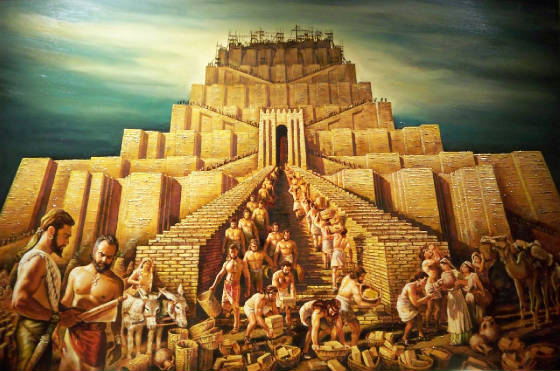
Grace in Genesis: Tower of Babel

Tower_of_Babel

Genesis 11:1-9 NRSV

The pastor stands up behind the pulpit, clears his throat, and announces: “This morning we are going to talk about race and racism.”

All over the sanctuary the congregation winces, and beg under their breaths: “Preacher, please don’t do it, for you’re about to open up a giant can of worms!”

But the old preacher, who has opened up more cans of worms than anyone could possibly count, ignores the grimaces and metaphorically gets out the can opener.

I hear many people in the church say that we should not talk about race or make race an issue. However, I believe we make it an issue when we pretend that it is a non-issue. I believe we do great harm to the cause of Christ when we ignore racism or deny that it exists. Furthermore, if we are to accept and do the will of God that I believe is revealed in the story of the Tower of Babel, the church must be willing to openly talk about race and the inherent racism that is prevalent in our families, our town, our region, our world, even in our own hearts.

In the eleventh chapter of Genesis we read:

Now the whole earth had one language and the same words. And as they migrated from the east, they came upon a plain in the land of Shinar and settled there. Then they said, ‘Come, let us build ourselves a city, and a tower with its top in the heavens, and let us make a name for ourselves; otherwise we shall be scattered abroad upon the face of the whole earth.

The whole earth was one. One language. One people. One tribe. One race. And they all came together to live in one place. They all came together to build something special, something big, something wonderful that would be a symbol of their unity, pride and patriotism.

Now, what is not to like about that?

Unity, oneness, togetherness, harmony, people of the same minds living in one accord.  Isn’t that the aspiration of all? Isn’t true that great minds think alike? Isn’t this the will of our God, God’s great purpose for humanity?

So what’s not to like in this seemingly perfect picture of unity in Genesis chapter 11? As it turns out, according to God, the creator of all that is, not very much.

Let’s look at God’s reaction to this oneness in verse 7 of our story: “Come, let us go down, and confuse their language there, so that they will not understand one another’s speech.”  So the Lord scattered them abroad from there over the face of all the earth…”

What? Are you serious? What is wrong with this great portrait of human unity, of one race of people, one nation, under God indivisible, all of one mind, coming together to make a name for themselves, to build great things, to be on top of the world, to celebrate their purity and pride as one master race?

The truth is that the builders of the great tower in Shinar had accomplished not what God wants for humanity, but what many throughout history, including the likes of Adolf Hitler and the Ku Klux Klan, have wanted for humanity: One master race of people coming together to form one supreme social order, one culture, sharing the same ideals, values and moral principles. Diversity is a threat. Diversity is something to fear. Diversity is something to segregate and discriminate. Diversity is something to send to the gas chambers or lynch in a tree.

I am not sure if anyone in my lifetime has articulated the thinking of the people of Shinar better than Atlanta Braves pitcher John Rocker back in 1999. Some of you may remember his response when he was asked by Sports Illustrated if he would ever play for the New York Mets or New York Yankees.

Rocker said:

I’d retire first. It’s the most hectic, nerve-racking city. Imagine having to take the number 7 Train to the ballpark looking like you’re riding through Beirut next to some kid with purple hair, next to some queer with AIDS, right next to some dude who just got out of jail for the fourth time, right next to some 20-year-old mom with four kids. It’s depressing… The biggest thing I don’t like about New York are the foreigners. You can walk an entire block in Times Square and not hear anybody speaking English. Asians and Koreans and Vietnamese and Indians and Russians and Spanish people and everything up there.[i]

The story of the Tower of Babel teaches us that what John Rocker said racked his nerves in the world is what God wills for the world. In verse 4 we read that the purpose of building the tower was to avoid what depressed John Rocker on the No. 7 train leaving Manhattan for Queens, and to avoid what John Rocker heard in Times Square. The purpose of settling in Shinar and building that tower was to live in a world with no foreigners, no confusing babbling in the streets, no queers or kids with purple hair to encounter on the way to work, no eating in the marketplace with people on strange diets, no rubbing elbows with people wearing weird clothes, head coverings or dots on their foreheads. So they came together and said, let’s build a tower of unity “to not be scattered over the face of the whole earth.” And God’s reaction to this racial purity and pride was to “scatter them over the face of the whole earth,” to create a world of diverse languages and cultures, to create a world of foreigners.

God was only accomplishing what God had always willed for the creation: diversity. In chapter one of Genesis, we read that the original plan for creation was for humankind to “multiply and fill the earth.” And after the flood in chapter ten we read where God sanctions and wills all nations to be “spread out over the earth.” (Gen 10:32). Simply put, from the very beginning of time, in spite of our will, in spite of our fear and our racial pride, God wills diversity.

Therefore, if we ever act or speak in any manner that denigrates or dehumanizes another because of their race, language, nationality or ethnicity, we are actually disparaging the God who willed such diversity. According to Genesis, diversity is not to be feared, avoided, prevented or lynched. If we want to do the will of God our creator and redeemer, diversity is to be embraced. In other words, if we love God, we will also love our neighbor. And this is what God wants us to be united by. It is why Jesus called it the greatest commandment—love God and our neighbors as ourselves. Love is what should unite us; not racial pride or patriotism.

The story of the Tower of Babel belongs to the same genre of the stories of Adam and Eve, Cain and Abel and Noah and the Flood. They are considered to be “pre-history stories.”[ii] That is, they are describing God’s relationship to the world before the call of Abraham and the history of the Jewish people. It amazes me how God in each of these stories is so often misinterpreted by Christians who believe that the God of the Old Testament is a God of wrath; not a God of grace. They say that they believe Jesus Christ is God; however, they fail to see Christ in these stories.

Consequently, God is often seen as one who curses Adam and Eve by kicking them out of the garden instead of as one who bends to the ground and clothes them with grace. God is seen as someone who curses Cain by sending him to the land of Nod, instead of as one who protects his life with a mark of grace. God is seen as one who curses all of humanity with a great flood with the exception of one family, instead of one who makes a decision to graciously suffer alongside all of humanity. And here in this story, God is seen as one who curses the builders of the tower by scattering them over the face of the earth, instead of being seen as one who reacts to racial pride and unity by fulfilling the purpose of creation from the very beginning, filling the earth, by graciously creating diverse languages, races and cultures.

The tragic irony is that throughout history many have used the story of the Tower of Babel to support slavery, apartheid, segregation and other forms of racism. Bob Jones University once used this story to ban interracial dating on campus. However, this story teaches something very different. The story of the Tower of Babel is God’s gracious stamp of approval, of blessing, on every race, every tribe, and every language in every land. It is the fulfillment of God’s original purpose for creation. The song we learned as little children cannot be more true: “Red, yellow, black and white, they are all precious in God’s sight.” God is not color-blind, as I hear some say, for God creates, wills, blesses and loves color. And it is this love that unites us all, as we have all been created to harmoniously see humanity as God sees it: as a beautiful, diverse, colorful rainbow created by, sanctioned by, and graced by God.

As a Bible-believing Christian, it confounds me when I hear that another, supposedly, Bible-believing Christian, has decided to put their house on the market and move because a person or a family of another race has moved into their neighborhood. I often think about this story in the first book of our Bible that describes a beautiful and diverse creation willed by God. But I also think about a passage in the last book of our Bible that describes an eternity willed by God. And I wonder what in the world these people, who claim to be Christian, are going to do if they do get to that place they think they are going after they die to live forever and ever.

Because guess what? According to Revelation, heaven looks more like Times Square and that No. 7 train on the way from Manhattan to Queens than some affluent suburb outside of Atlanta, Georgia.

In Revelation 7, we read these words:

After this I looked, and there was a great multitude that no one could count, from every nation, from all tribes and peoples and languages, standing before the throne and before the Lamb, robed in white, with palm branches in their hands. They cried out in a loud voice, saying, ‘Salvation belongs to our God who is seated on the throne, and to the Lamb!’  And all the angels stood around the throne and around the elders and the four living creatures [each representing the diversity of all creation], and they fell on their faces before the throne and worshipped God, singing, ‘Amen! Blessing and glory and wisdom and thanksgiving and honor and power and might be to our God for ever and ever! Amen.’

[i] Read more: John Rocker – At Full Blast – York, Braves, City, and League – JRank Articles http://sports.jrank.org/pages/4014/Rocker-John-At-Full-Blast.html#ixzz39oVUCEtA

[ii] See Walter Brueggemann Genesis


Other Sermons in this Series:

Grace in Genesis: Adam and Eve

Grace in Genesis: Cain and Abel

Grace in Genesis: Noah