A Pentecostal Outpouring

Acts 2 NRSV

I have heard more than one person say: “the Spirit of God is in this place.”

I have also heard people make the counter observation about other churches, saying something like: “I no longer felt the Spirit in that place.” And I am sure that there are some who have made, and who still make, that observation about our church.

So, a good question for us to ask on this Pentecost Sunday is: “How do we know whether or not the Holy Spirit is here?” How do we know if any church ever experiences something like Luke described as a violent wind and tongues of fire? How do we recognize a Pentecostal outpouring of the Holy Spirit?”

As a child, I remember our congregation often opening a worship service by singing:

There’s a sweet, sweet Spirit in this place. And, I know that it’s the Spirit of the Lord; There are sweet expressions on each face, And I know that it’s the presence of the Lord (Doris Akers, 1962).

“Sweet facial expressions?” Is that how we know? I suppose I see a few of those today. But are you happy because the Spirit is here or because you know there’s some good food waiting for you at the end of the service?

I have heard some people talk about an outpouring of the Spirit as they describe a worship service where people are standing singing praise songs to Jesus with their hands raised and tears rolling down their cheeks.

I once served on a town’s recreation committee with the responsibility of organizing the summer church softball league. After leading worship on Sunday, I drove over to a neighboring church to deliver the schedule for the upcoming season. As I pulled into the parking lot, I noticed that cars were pulling out, so I assumed their service had just ended. As I opened and walked through the front door of the sanctuary, I was alarmed to see several people lying motionless in the aisle! The pastor, who was gathering his notes at the pulpit, saw me come in, and without even a hint of concern in his voice, greeted me with a smile saying: “Brother Banks, welcome! Come back with me to my office, and don’t mind those folks lying there in the aisle.”

More than a little distressed, as I walked around the bodies lying in the aisle, I asked: “Are these people ok?”

The pastor said: “Oh, don’t you worry about them. They’ll get up soon enough. We just had a tremendous outpouring of the Holy Spirit today where several people were slain in the Spirit. It happens from time to time.”

I anxiously followed the pastor into his office, where he asked me to sit down across from his desk. As I handed him the softball schedules, I must have had a not-too-sweet expression on my face, because he asked, “Brother Banks, you don’t ever have people fall out during your services, do you?”

I answered: “Oh, it’s happened a time or two, and each time, somebody called 911.”

He smiled and said, “Well, that’s how we know that the Holy Spirit is in this place.”

So, should be concerned that no body passes out in the floor during our worship here? That no one stands and raises their hands as they sing overwhelmed with emotion?

So, what do we mean when we say we feel the spirit in this place?

Some Sundays, I am amazed how the anthem that Jeremy selects or the hymns that Judy plays fit perfectly with the sermon. I sit back here and say to myself: “That’s the Spirit working!”

However, as amazing as that is at times, I am not sure that exactly what is being described by Luke on the Jewish festival called Pentecost.

Luke writes: “When the day of Pentecost had come…all of them were filled with the Holy Spirit and began to speak in other languages, as the Spirit gave them ability.”

I suppose we could ask someone who knows a few languages, like Brian Cox, to come up here and speak to us this morning. But there’s a problem with that. The miracle of Pentecost was not so much in the speaking as it was in the hearing.

Amazed and astonished, they asked, ‘How is it that we hear, each of us, in our own native language?

If Brian comes up here and speaks to us in German, I am pretty sure we are not going to hear him in English.

Perhaps Luke, in describing the outpouring of the Holy Spirit, is trying to paint a portrait to help us see something larger, more wonderful, and more astonishing.

Perhaps Luke is describing what our country needs today, what our world needs today— a divine grace to listen, to hear, to understand, to empathize with others who may be so different from us that they speak a different language. Perhaps Luke is describing an outpouring of the Holy Spirit that produces a divine compassion for more people than the people we see as “our own,” a holy call for people to possess an empathy that transcends countries, ethnicities, sexual orientation, gender, and race. In this great Pentecostal outpouring-of-the-Spirit event, Luke just well may be describing the first Diversity, Equity, and Inclusion Conference!

Luke is describing a Pentecostal outpouring that transforms the hearts and minds of people to have the heart and mind of Jesus who listened to, heard, and learned from a Syrophoenician woman, saw the Samaritan as his neighbor, and accepted Eunuchs, who Matthew records Jesus saying were “born that way” (Matthew 19).

Luke is describing a people who would never say “God bless America” without a sincere desire for God to bless the entire world. He is describing a group of people who would never condemn the genocide of one nation without condemning the genocide of another. He is describing white people who do not hesitate when they see a black man mercilessly executed by police in the street to stand up and say “Black Lives Matter” or to speak out at the school board when the history lessons taught to children in our schools are being whitewashed.

Luke is describing people who do not merely worship Jesus, but they follow Jesus, and teach the way of love that Jesus taught, a generous love that is expressed as goodwill for all people.

Luke is describing hearts that are so generous “they would sell their possessions and goods and distribute the proceeds to all, as any had need.” These are people who never complain about food stamps, free healthcare, and increasing the minimum wage, because they truly believe in supporting the welfare of all people, so no one, regardless of their citizenship is in need.

Luke is describing people who feel a deep sense of connectedness to all people.

The COVID-19 pandemic taught us many things. Like all communicable diseases, that a virus can originate on the other side of the world and quickly spread to every nation on earth taught us how connected we all are to one another.

But it also taught us something about our refusal to acknowledge such connectedness. It taught us something sinister about our selfishness and self-centeredness as some refused to wear a mask in public or get a vaccine to protect their neighbor. Even some churches refused to abide by the stay-at-home orders at the beginning of the pandemic, revealing that we have many churches in America devoid of the Holy Spirit of the One who said the greatest commandment is to love our neighbors as ourselves.

It revealed that what this world needs today is some Pentecost, a serious outpouring of the Holy Spirit!

And by “serious,” I mean the world doesn’t need more people tearfully worshipping Jesus with their hands raised in the air. It needs more people following Jesus by extending their hands to help their neighbors in need.

The world doesn’t need more anthems or postludes that pair well with the sermon. It needs more people who are offering their spiritual gifts to pair with the needs of the world.

The world doesn’t need more people slain in the spirit on Sunday morning. It needs more people to be awakened by the spirit to a live a life of generosity for the goodwill of all people every day of the week.

And the world doesn’t need any more congregations with sweet expressions on each face. It needs more of the fire that was experienced on that day the Holy Spirit showed up enabling people of all nationalities, ethnicities, and races to see, to listen, to hear, and to care for one another.

The world needs more empathy and equity, more justice and generosity, more sharing and more goodwill, and not just for people who speak our language, are born in our country, share our pigmentation, or go to our church, but for all people.

The good news is that I believe this is indeed a spirit-filled church. Now, we are still calling 911 if you fall out in the aisle this morning, but there’s plenty of other evidence that the Spirit of the Lord is in this place.

The building and the blessing of the little food pantries, our donations to the Rivermont food pantry, our volunteers each month who serve at the Park View Mission, our folks who have signed up to deliver Meals on Wheels—these are all evidence of a Pentecostal outpouring of the Holy Spirit, or as my childhood preacher liked to say, “an unction of the Holy Ghost!”

And just this past week, our Outreach Team met with the Interfaith Virginia Center for Public Policy to discuss a partnership that will enable us to not only feed our neighbors in need, but to be advocates for justice, so our neighbors will not be hungry in the first place. This may be the strongest evidence of all that there’s Pentecostal outpouring in this place.

So, as we celebrate 150 years as a church, on this day which has been called “the birthday of the Church” (that’s Church with a big ‘C’), there is indeed a sweet, sweet spirit in this place. There are sweet expressions on some faces, but there are also some holy scowls, some furrowed brows, some eyes filled with divine determination, souls ignited by a fiery Call of Love to make this a more generous, equitable, and just world, not just for some of the people, but for all people. And I know that it’s the Spirit of the Lord. Amen.

Go Back to Where You Came From

go back to where you came from

Go back to where you came from.

Go back to that time before the Civil Rights Act of 1964. Go back to the time of Jim Crow when discrimination and segregation was the law. Go back to that place where people of color were terrorized with cross-burnings, church-burnings and lynchings.

Go back to where you came from.

Go back to that time before women had the right to healthcare, the right to vote and the right to work outside the home.

Go back to where you came from.

Go back to that time in history when human beings were sold and treated as property. Go back to that place where human beings were chained, shackled and whipped.

Go back to where you came from.

Go back to that time when indigenous Americans were considered to be soul-less creatures who could be hunted, killed and displaced like animals. Go back to that time women like Pocahontas were kidnapped and raped by colonizers without remorse.

Go back to where you came from.

Go back to that time when the state controlled religion in order to control people. Go back to that place where Christianity was used to support slavery, genocide, the castrations of gay people, and the hanging of women suspected to be witches.

Go back to where you came from.

Go back to that time when Christians terrorized anyone who did not fall in line with their understanding of God and the world. Go back to that place where they put free-thinking women like Jan Hus and Joan of Arc on a stake and set them on fire.

Go back to where you came from.

Go back to that time before Jesus said that the greatest commandment was to love our neighbors as ourselves. Go back to that time before the prophet Micah proclaimed that the one thing God requires is to do justice, love kindness and walk humbly with God.

Please, go back to where you came from. Because this is 2019. It is not 1919, 1819, 1619 or any other dark time in human history.

The Baptisms of Lydia and Traci

FullSizeRender-1

Acts 16:9-15 NRSV

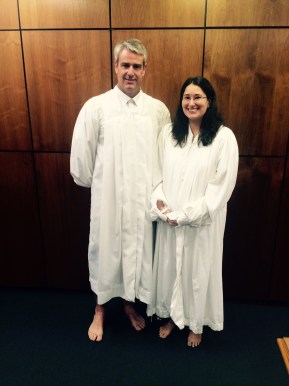
I believe the baptism of a certain woman named Lydia, and the baptism of a certain woman named Traci, have much to teach us this day.

Luke tells the story the baptism of Lydia. It begins with Paul and Silas sharing the good news of Jesus in Troas, an Asian town situated across the Aegean Sea from the European district of Macedonia. Paul has a vision of a man in Macedonia pleading: “Come on over and help us.” Convinced by the vision that God was calling them to go and proclaim the good news in Europe, without hesitation, they sailed to Macedonia, went through Samothrace and Neapolis, eventually settling in the leading city of Philippi.

While they were there, Paul and Silas heard about a group of women that had been gathering for worship down by the river outside the gate. So when the Sabbath came, they went and found the women, sat down with them, and engaged them in a conversation.

Then Luke says that it was obvious that this one woman in the group, this woman named Lydia, was really paying attention to what Paul had to say. And then he says some very remarkable things about this woman. First of all, he points out that she is an Asian business owner from Thyatira. Secondly, because he says that “she and her household” were baptized, it’s evident that she was the head of her household.

Now, remember, this is the first century. It’s not a period known for women working outside of the home. Females were treated as second-class citizens and even as “property.” Males were the leaders, the heads of business and the heads of households. And yet, here is a woman who is the head of both.

And since she is the only one who is pointed out to be really paying attention to what Paul was saying, she also appears to be the head of that community of faith which gathered there each week by the river.

And this says Luke, this baptism of a foreign woman who shatters all cultural expectations, this baptism of a woman who lived life two-thousand years ahead of her time, the baptism of this woman as the first European Christian, is the result of a vision from God that came to Paul.

So, what in the world was God trying to say to Paul and Silas through that vision of a man saying, “Come to Macedonia, because I need some help!”

Could it be that God was saying: “Paul and Silas, I know you are clear across the sea on another continent, but I need you to get in a boat right now and set sail to Macedonia. I need you to come over here to Europe, make your way through Samothrace and Neapolis, all the way to Philippi, and help me, once and for all, show the world that through my love revealed in Christ Jesus who continually lifted up the status of women, elevated the foreigner, accepted the Eunuchs, and did something almost daily to shatter all cultural expectations, destroying the stigma of status, race, ethnicity, class, and sexuality, that in my kingdom, there no longer Jew nor Gentile, slave nor free, male nor female. Help me clearly make the statement that in Christ all are one.”

It is as if God is saying, “I know people have heard the stories of Jesus calling women to be counted among his disciples. I know the word is out that Mary and Joanna were the first ones to proclaim the good news Easter. I know many have heard about my disciple Tabitha and her works of kindness and gifts of charity. And I know that folks are hearing about the good work of sister Phoebe leading the church at Cenchreae; however, I am still afraid I am going to need some more help here in Europe. Because I have this bad feeling that if I do not do something as radical as making the first baptized Christian on this continent a strong woman like Lydia, some of these Europeans, not to mention their descendants, are still going to argue, even two-thousand years from now, that a woman has no business being at the head of a communion table, or being the head of a household, or even being the head of her own body.”

“And I know people have heard the story of the Good Samaritan, that despised foreigner who proved to be a holy neighbor to the Jewish man who who was beaten and left dead on the side of the road, but I have this terrible inkling that if I don’t make a foreigner the first European convert, some Europeans, not to mention their descendants, even two-thousand years from now, may still harbor all kinds of prejudices against those who are not of European descent. So, get yourself over here to Macedonia as fast as you can and help me baptize this certain woman named Lydia!”

I believe Paul may have Lydia in mind when he penned the following words to the church at Ephesus: “But now in Christ Jesus you who once were far off have been brought near by the blood of Christ. For he is our peace; …and has broken down the dividing wall… So he came and proclaimed peace to you who were far off and peace to those who were near; for through him both of us have access in one Spirit to the Father. So then you are no longer strangers and aliens, but you are citizens with the saints and also members of the household of God” (Ephesians 2).

Then, there is the baptism of Traci. Like Lydia, Traci is also a certain woman; however, fortunate for her, she has joined a church that has learned a thing or two from Lydia. For, here at Central Christian Church, the gifts of women are valued just as much as the gifts of men. Traci will be encouraged here to use her gifts to freely follow Christ wherever the Spirit leads.

Traci is not a foreigner. However, since she was not raised in our church, she was a stranger, an outsider to most of us. Therefore, I believe the baptism of Traci reminds us that we have been called by God to reach out beyond our walls and embrace others like Traci who did not grow up in this church, or any church for that matter, so that they will no longer be strangers.

It is as if God is saying: “I know people have heard the Great Commission of the Risen Christ to “be witnesses in Jerusalem, in all Judea and Samaria, and to the ends of the earth” making “…disciples of all nations, baptizing them in the name of the Father, Son, and Holy Spirit…” But I have this bad feeling, that if I do not stir the hearts of people like Traci, and draw them into the renewing waters of the church, enlarging and changing the congregation, then the church might be tempted to become so comfortable with the status quo that they grow apathetic, just uninterested in reaching out to welcome the stranger.

The Rev. Jesse Jackson Jr. told a story at the recent men’s retreat that reminded me of something that happened to my wife Lori a few months before we came to Oklahoma. Rev. Jackson said that he went to a Popeye’s Chicken restaurant one night to get him some chicken. He went through the drive through and ordered a Chicken Combo plate. And lo and behold, the person working the drive thru window told him that they were out of chicken.

Lori had the same experience with a Bojangle’s Chicken and Biscuit restaurant in North Carolina. She went to Bojangles, which is similar to Popeye’s or a Golden Chick, to get her some chicken, only to be told that they were out of chicken.

Lori came home and said, “I am so mad. Bojangle’s Chicken and Biscuits told me that they were out of chicken. She said, “I can understand if they run out of the mashed potatoes. I can maybe even sympathize a little with them if they run out of biscuits. But Bojangle’s, like Jesse Jackson said of Popeye’s, has got no business running out of chicken!”

The baptism of Traci reminds us what the church is all about. If a church is not continually working to break down dividing walls and to build bridges and relationships with those outside the church, with the goal of having several baptismal services a year like this one a year, then the church is like a Rib Crib opening their doors for business when they’re fresh out of ribs! Might as well close down and put a chain on the doors.

After Lydia is baptized, notice the first thing that she does. She extends a gracious welcome to Paul and Silas inviting them stay at her home. Her words following her baptism remind me of our identity statement as Disciples of Christ, “We welcome all to the Lord’s table as God has welcomed us.”

I was on facebook Friday night, and I read these words from Traci’s timeline that are so so reminiscent of Lydia’s words: “Please come and visit Central Christian Church. The service starts at 10:15 am. It is a great church.”

Lydia and Traci remind us that each person in this room who has been baptized, who has been welcomed by God through the gracious hospitality of Christ, should feel compelled by the Holy Spirit of Jesus to go out from this place and welcome all people.

Through the baptisms of a certain woman named Lydia and a certain woman named Traci, I believe God is saying to each of us: “Go out, reach out, tear down a wall, build a bridge, connect, engage, get on facebook, get in a boat if you have to, travel through the streets of places like Samothrace and Neapolis and Philippi and Enid and North Enid and East, West and South Enid, because I need some help! I need some help sharing the good news that all are welcome at my table.”

Response to Viral Video Attacking Farmville Central High School

FCHSTo avoid fueling the fire, I have been asked not to respond to the insanity surrounding Farmville Central High School regarding the reactions of Christian extremists to a vocabulary lesson set in an Islamic context. I do not always do what I am asked; however, this time, I am acquiescing. The following is my non-response:

Sometimes the actions and words of others can be so ludicrously ignorant and unreasonable that they are unworthy of any thoughtful response. People who make obviously uninformed and phobic statements regarding the race, gender identity, sexual orientation, political affiliation or religion of another do not merit serious debate. It is like arguing with someone who does not believe in gravity.

Click here for WNCT story.

A Personal Thought on Martin Luther King, Jr. Day

martin-luther-king-on-pulpit-robert-casillaWhen I moved to southern Louisiana to preach the gospel, my church had a policy to close the church office on Fat Tuesday (the Tuesday before Ash Wednesday), but not on Martin Luther King, Jr. Day. I immediately changed the holiday policy stating: “I believe that churches should especially honor the MLK holiday. After all, he was a preacher who was martyred for preaching the gospel of Jesus!”

So, for me, today is a day to remember not only the sermons of Martin Luther King, Jr., but to also reexamine my own preaching, or lack thereof.

I have always believed that there is a lot of correlation between what happened in Memphis in 1968 and what happened in Jerusalem 2,000 years ago. I truly believe that if you love all people, and live your life trying to convince others to love all people, then there will always be some people, probably religious, who will want to kill you.

Today, I am reminded that if my preaching does not take grave risks by offending and outraging those who do not believe that God’s love expands past the lines of race, class, religion, nationality and sexual orientation, then I am not preaching the gospel of Jesus.