Being Great

Mark 9:30-37 NRSV

In Mark chapter 9, we read where the disciples are arguing with one another about which one of them was the greatest.

And who could blame them? For they had just tasted greatness on what we call the Mount of Transfiguration. In this same chapter, we read where Peter, James and John witness the appearance of Jesus, his face, even his clothes, shine!

So, of course the disciples are arguing about greatness. For they too wanted to shine!

And 2,000 years later, disciples are still arguing about what it means to be great, still arguing about how to make our country great, and to make our church great. And, here in the United States, the ones who seem to winning this argument, or at least are arguing the loudest, are all around us.

Do you want to be a great church?

Wed yourself to the empire. Unite with a political party. Do whatever it takes to attain power in order to legislate your own worldview and understanding of morality, and oppress all who do not fall in line.

Do you want to be a great church?

Then do whatever it takes to draw a large crowd. Because crowd size is what it is all about. To get people’s attention, make up some stories if you have to. They don’t have to be true stories. They just need to be sensational stories to get people riled up. Stoke fear if you have to, do whatever it takes to attract a big crowd. Tell them their whole world is going to end unless they join you. And if you’re loud enough, and say it often enough, you might be able to draw crowds like Elvis Presley used to draw, and you won’t even need a guitar. But speaking, of guitars…

Do you want to be a great church?

Then you have to make your services more entertaining. Do something to make the people smile, laugh, clap and tap their feet. And do you really need to have Communion every Sunday? That’s a lot of work. All that preparation and clean-up. And besides, no one wants to hear about sacrifice, self-expenditure, shed blood, and a broken body every Sunday! Just give the people what they want. Trade those tiny, dry crackers for some fresh, hot donuts, and trade that little sip of juice for a caramel macchiato or a vanilla latte.

Do you want to be a great church?

As the pastor, don’t ever be too real. Never admit your mistakes. Never apologize for anything. Don’t let people know that you need forgiveness. Never let it slip out that you have your doubts. Make them believe you never question your faith and you have all of the answers.

Do you want to be a great church?

Discourage all critical thinking. Encourage folks to check their brains at the door. Tell them exactly what you want them to believe. And them not to listen to anyone else and to even ignore what they may see with their very own eyes. Tell them that if they hear anything that is critical of you, it is fake news. Always keep it simple, black or white, good or evil, heaven or hell.

Do you want to be a great church?

Create an “us-verses-them” mentality, an “insider-verses-outsider” way-of-thinking. And remind the congregation every Sunday that we are “in,” and those who disagree with us are “out.” Make them feel righteous, holy, superior, knowing that while we are on their way to heaven, those who are unlike us are most certainly heading in the other direction.

Do you want to be a great church?

Look, it’s fine to say you welcome all people to church. But don’t say it every Sunday. Don’t over-emphasize it, and don’t advertise it. And avoid using words like “diversity,” equity, and inclusion” and never say “social justice.” And don’t talk so much about helping people who are poor, and standing up for the marginalized. Because, the truth is, people like to be with people who think like them, act like them, and look like them.

Do you want to be a great church?

Have more programs that are uplifting and edifying for the members. Give them what they want, especially those who have some money and some power in the community. Keep them filled, satisfied, happy and comfortable. Don’t ever pressure them to do things that are outside of their comfort zones. Always make the faith about winning; never losing anything, and certainly not losing themselves. Make it about being first; never about being last.

Do you want to be a great church?

Preach what is popular. Embrace the culture over the Word of God. Instead of preaching extravagant grace, preach “love the sinner and hate the sin.” Instead of preaching love your neighbor, preach “God only helps those who are willing to help themselves.”

Then Jesus comes, and he asks:

“What are you talking about?”

We are silent.

We are also embarrassed. Because deep down, we know that our arguments are antithetical to everything Jesus has been teaching us.

But Jesus heard us. Jesus always hears us.

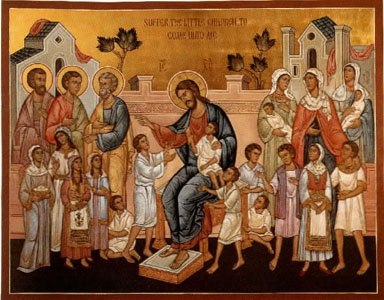
It is then that Jesus goes into the nursery and brings out a little baby; and taking the child in his arms, he says:

Whoever welcomes one such child in my name welcomes me, and whoever welcomes me welcomes not me but the one who sent me.

In other words, Jesus said to those who were arguing about greatness:

Stop worrying about being great, and start worrying about the least. And when you do that, when you take care of those who cannot care for themselves, when you feed those who cannot feed themselves, when you clothe those who cannot clothe themselves, when you welcome those who often feel unwelcomed, those who are treated like outsiders and called “aliens,” then you welcome God. And like me standing on that mountain, you will shine!”

Holding that baby in his arms, it is as if Jesus is asking: “Do you want to be great? Do you want to shine like me standing there with the prophet Elijah and the law-giver Moses? Then listen to the voices from the law and the prophets.”

Listen to the voice of Moses who commanded:

If there are any poor…in the land…do not be hard-hearted or tightfisted toward them. Instead, be generous and lend them whatever they need. …Give generously to the poor, not grudgingly, for the Lord your God will bless you in everything you do. There will always be some in the land who are poor. That is why I am commanding you to share freely with the poor and with other Israelites in need (Deut 15:7-11).

Never take advantage of poor and destitute laborers, whether they are fellow Israelites or foreigners living in your towns. …True justice must be given to foreigners living among you… (Deut 24:14-16).

Jesus is saying to listen to the Proverbs, words that us who is great in the eyes of God:

…blessed are those who help the poor… Those who oppress the poor insult their Maker, but helping the poor honors him (Proverbs 14:21, 31).

If you help the poor, you are lending to the Lord— and he will repay you!”(Proverbs 19:17).

And listen to who are not so great in God’s eyes:

Those who shut their ears to the cries of the poor will be ignored in their own time of need (Proverbs 21:13).

A person who gets ahead by oppressing the poor or by showering gifts on the rich will end in poverty (Proverbs 22:16).

Whoever gives to the poor will lack nothing, but those who close their eyes to poverty will be cursed (Proverbs 28:27)

So,

Speak out for those who cannot speak, for the rights of all the destitute. Speak out, judge righteously, defend the rights of the poor and needy (Proverbs 31:8-9).

Jesus is saying to listen the voice of the Psalmist…

Give justice to the poor and the orphan; uphold the rights of the oppressed and the destitute. Rescue the poor and helpless; (Psalms 82:2).

Do you want to be great? Then listen to the voice of the prophet Isaiah:

Learn to do good. Seek justice. Help the oppressed. Defend the cause of orphans. Fight for the rights of widows. “Come now, let’s settle this,” says the Lord. “Though your sins are like scarlet, I will make them as white as snow. Though they are red like crimson, I will make them as white as wool (Isaiah 1:17-18).

In other words,  says the Lord,  when you help the least, when the mission and ministries of your church side with the poor and the marginalized, I will transform you. I will transfigure you!

Do you want to know how to be a great church?  Do you really want to shine? asks Jesus. Then listen some more to Isaiah:

Free those who are wrongly imprisoned; lighten the burden of those who work for you. Let the oppressed go free, and remove the chains of injustice. Share your food with the hungry, and give shelter to the homeless. Give clothes to those who need them, and do not hide from relatives who need your help.

Then your salvation will come like the dawn, and your wounds will quickly heal. The Spirit of God will lead you forward, and the glory of the Lord will protect you from behind. Then when you call, the Lord will answer. ‘Yes, I am here,’ he will quickly reply, ‘Remove the heavy yoke of oppression…Feed the hungry, and help those in trouble. Then your light will shine out from the darkness, and the darkness around you will be as bright as noon’ (Isaiah 58:6-10).

The late Ruth Bader Ginsburg taught law students how to be great lawyers with advice that I believe applies to each of us.  She said something like: if you really want to shine, if you really want to be great, (an now I quote)

…you will do something outside yourself, something to repair tears in your community, something to make life a little better for people less fortunate than you. That’s what I think a meaningful life is. One lives not just for one’s self but for one’s community.

Amen.
Healing Religious Trauma

Acts 8:26-38 NRSV

This year’s Turner-Warren lecture still inspires me, and I hope you too, to think about the opportunities we have as a church to heal religious trauma caused by the oppressive beliefs of many who call themselves “Christian.” How do we support people who have been taught by preachers and by teachers and professors at their private conservative schools that who they are, that their very being, is outside of the boundaries of God’s love and grace?

How do we help people deconstruct the exclusion and fear of the other they have been taught in Sunday School and through sermons?  How do we help them to reach a point where they truly believe in the words of the Apostle Paul— the one who believed if anyone is outside the boundaries of God’s love, as a former persecutor of Christians, it was him— but became “convinced that neither death, nor life, nor angels, nor rulers, nor things present, nor things to come, nor powers, nor height, nor depth, nor anything else in all creation, will be able to separate us from the love of God in Christ Jesus our Lord” (Romans 8:28-29)?

How do we heal religious trauma here in city that is known for creating it?

Well, this may come as a surprise to people who have been injured by those who have weaponized the Bible, but I believe the Bible, particularly this morning’s epistle lesson, can help a church like ours serving in a city like ours. I often think of what a better world this would be if the people who claim to love the Bible or sell the Bible would actually read the Bible.

Verse 26 of chapter 8 of the book of Acts reads:

Then an angel of the Lord said to Philip, ‘Get up and go…:

The first thing we must learn is that we will never be able to fulfill our call to be healers of religious trauma unless we first fulfill our call to “get up and go” to meet people where they are. We must go to them, because, sadly, those who have been wounded by the church have some very good reasons for not coming to us.

People who have been hurt by the church understand that most churches not only expect people to come to them, but they expect them to come in a manner that meets their own religious and cultural expectations. That is, they know that many churches expect people to come to them who want to believe like them, look like them, love like them, and even hate like them.

And as our political environment teaches us, it’s not just the church that has trouble accepting those who are different. Excluding others seems to be something that seems to come very naturally for us. I think if we are honest, we would all admit that we would much rather be around people who are a lot like us.

Some have said that it may be part of our evolutionary DNA. It’s some inborn, natural instinct of survival. Fear the different. Beware of the other. Trust no foreigner. Avoid the outsider.

This, of course, is what fuels racism and homophobia. It supports white Christian nationalism and isolationism. It builds walls, discriminates, excludes, and demeans the other.

I believe this is what the Apostle Paul is talking about when he talks about the dangers of being led by the flesh and not by the Spirit. Because we human beings can easily be led by the flesh. A false prophet or Anti-Christ-like leader can easily stoke the fear of the outsider that is inside all of us. Unfortunately, it doesn’t take a stable genius to lead us to hate the other.

However, the Spirit leads us to take a higher road.

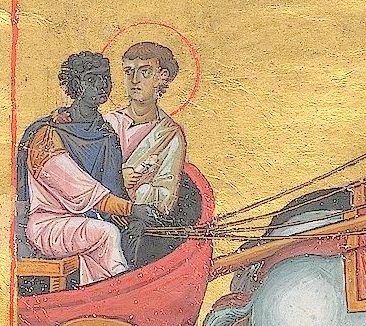
Notice that Luke tells us that the Spirit had to urge Philip, the Spirit had to push Philip, pull Philip, to get up and go to this chariot to meet this queer black man from Ethiopia.

Philip, I know this may be hard for you. I know this may be against your natural inclination. But go to this chariot and meet this stranger, this gender-variant foreigner, this victim of bad faith and sick religion who had been ostracized from their community of faith, this one demeaned and exploited for their sexuality, this one who has been clobbered by the Bible by those who arbitrarily pick and choose scripture passages like Deuteronomy 23:1 that says Eunuchs are forbidden to enter the temple, this one who has been taught their entire life that they are despised by God. Go to their chariot and meet them where they are. Don’t expect them to come to you. And when you encounter them, do not stand above them or over them. Do not judge them or condemn them. Join them. Get into the chariot and sit beside them. Ride alongside them. Engage them. Listen to them. Seek to understand them, empathize with them. Learn from this other, this stranger, this foreigner, this beloved child of God, this beautiful sibling of yours.

Philip meets the Eunuch who is reading from the book of Isaiah. This should not surprise us. For this is one of the most hopeful books in the Hebrew Bible for those who have been marginalized by sick religion, for those who have been taught that they are despised by God. Imagine the hope that burned in this Eunuch’s heart when he read the following words we find in Isaiah 56:

Thus says the Lord:

Maintain justice, and do what is right,

for soon my salvation will come,

and my deliverance be revealed.

Do not let the foreigner joined to the Lord say,

‘The Lord will surely separate me from his people’;

and do not let the eunuch say,

‘I am just a dry tree.’

For thus says the Lord:

To the eunuchs…

…I will give, in my house and within my walls,

a monument and a name

better than sons and daughters;

I will give them an everlasting name

that shall not be cut off.

And the foreigners who join themselves to the Lord,

…these I will bring to my holy mountain,

and make them joyful in my house of prayer;

their burnt-offerings and their sacrifices

will be accepted on my altar;

for my house shall be called a house of prayer

for all peoples.

Thus says the Lord God,

who gathers the outcasts of Israel,

I will gather others to them

beside those already gathered.

Philip hears him reading from Isaiah and asked: “Do you understand what you are reading?”

The Eunuch responds: “How can I understand it unless someone interprets it for me?

What a great question! What a better world this would be if more people understood that the Bible needs to be interpreted.

God never intended for people, on their own, to pick up the Bible, and arbitrarily lift scripture passages out of their contexts, and try to understand it or follow it. For this is one of the main causes of religious trauma today. Too many Christians are using the Bible out of context to support all kinds of hate, bigotry, and injustice.

And because of that, there are countless people in this world, countless people in this community, who are the victims of sick religion. They feel marginalized and disenfranchised by the church. They have been taught their entire lives that God despises them. They have no idea that God loves them and has a future for them— All because no one has interpreted the Bible pointing to the Jesus who came into the world, not to condemn the world by to save the world, to love the world.

The eunuch then begins to read from chapter 53:

Like a sheep he was led to the slaughter,

and like a lamb silent before its shearer,

so he does not open his mouth.

In his humiliation justice was denied him.

Who can describe his generation?

For his life is taken away from the earth.

Then the Eunuch asks Philip, ‘About whom, may I ask you, does the prophet say this, about himself or about someone else?’

The Eunuch is asking: Who is this one was also ostracized and marginalized by others, as I have been? Who is this who was led like a sheep to be slaughtered? Who is this one who has been humiliated and denied justice? Who is this who had his life taken from him? Who is this one who is just like me? Who is this one who relates to me so well, who understands my pain, who knows my heartache, who empathizes with my sufferings? Is it Isaiah? Or is it someone else?

Then, Philip tells the eunuch the good news about Jesus, perhaps saying something like: the one who understands your pain, knows your heartache, and empathizes with your sufferings is none other than Jesus, the enfleshed presence of God, and the powers-that-be crucified him for it. The one who relates to you, identifies with you, and because of that, loves you, welcomes you, accepts you, affirms you and forgives you like none other, is the very One who others said despised you.

When the Eunuch hears this good news about Jesus, the words of the prophet become not only hopeful news for the future, but good, glad, certain news for the present:

For thus says the Lord:

To the eunuchs…

…I will give, in my house and within my walls,

a monument and a name

better than sons and daughters;

I will give them an everlasting name

that shall not be cut off.

Suddenly, barriers fall. Walls crumble. Obstacles disappear. And the very doors of the Kingdom of Heaven swing wide open.

It is then the Eunuch, this one who had no name and no future, but now has an everlasting name exclaims:s “Look here is water! What is to prevent me then from being baptized?” In other words, “What is separating me from the love of God?”

Knowing that nothing in heaven nor on earth, nor angels, nor preachers, nor church boards, nor church bylaws, nor books of discipline, nor elders, nor deacons, nor Sunday School teachers, nor college presidents nor or professors, nor anything else in all creation, will be able to separate us from the love of God, Philip commanded the chariot to stop, and both of them, Philip and the eunuch, went down into the water, and Philip baptizes him, washing away the trauma.

Witnesses of Humanity

Luke 24:36b-48 NRSV

The Risen Christ stands among the disciples saying, “Peace be with you.”

And what’s the disciple’s response?

“And also with you.”

Nope, not even close.

They are startled, skeptical, and terrified. They think they are seeing a ghost.

Now, think about that for a minute.

Because of fear, the Risen Christ finds himself in a position that many find themselves in today: trying to convince others of their humanity.

“Look at my hands and my feet… Touch me and see that I have flesh and bones.” Look at me, and see I am a human.”

Jesus has joined all those who have yearned and who yearn today for their humanity to be recognized.

I will never forget visiting Berlin, Germany in the 1986 before the Berlin Wall was torn down. We toured a small museum dedicated to the holocaust at “Checkpoint Charlie,” before going into East Berlin. As a stark reminder that the Germans are not the only ones guilty of racism, one of the last exhibits displayed pictures taken during the 1968 strike of sanitation workers in Memphis, Tennessee. I will never forget standing in the city where Adolph Hitler once ruled looking at pictures of black men in my own country, in my neighboring state, in my lifetime, holding signs which read: “I am a man.” I am a human. I am somebody. I have flesh and bones.

And this was Jesus. “Look at my hands and my feet.”

But “in their joy they were disbelieving and still wondering.”

I suspect that is where many of us are today. Justice and mercy prevailing and love winning brings us some joy when we first think about it, but it seems too good to be true. As much as we want it, we have difficulty believing it, seeing it, recognizing the possibility of any true peace in our world. Because for love to win, the first thing we must do is to recognize the humanity in others. And that is something we human beings have always had a difficult time doing.

The good news is that Jesus is not finished with his disciples. For it is then Jesus asks a rather embarrassing question: “Do you have anything here to eat?” Now think about that for a moment.

Jesus is put into the awkward position to invite himself to dinner, to ask the disciples for the most basic form of hospitality. Because of the disciple’s fear, Jesus has to remind them that when someone pays a visit, the polite thing to do is to offer that someone something to eat or drink.

Amy and David, you will be glad to know that one of the first things we discussed after you agreed to be here this weekend is how and what we were going to feed you!

Perhaps we also need to be reminded that offering another food and drink is simple, yet profoundly powerful. For when we offer someone something to eat, we are recognizing and affirming their humanity. Thus, not only is it the polite thing to do; it is the humane thing to do. It is also a faithful thing to do.

Father Abraham taught us this truth that hot day by the oaks of Mamre.

In Genesis 18, we read where three strangers appear on the street and get Abraham’s attention. Which raises a good question: “Whose humanity gets our attention? Are there some lives that get our attention over other lives?

Next, Abraham simply does what people of faith do for others, he welcomes them with a generous, gracious hospitality.

Notice that when he sees them, he doesn’t ignore them and allow them to pass on by. He doesn’t politely nod or wave in their direction. Nor does he safely call out to them from a distance asking them to come to him, and he certainly does not tell them to go back to where they came from. Abraham goes out to them. And he doesn’t cautiously walk over to them. When he sees them, the scripture says that he “runs” to meet them where they are.

And when he encounters these strangers, notice that he does not stand arrogantly over them or above them, but he humbly bows himself to the ground before them and speaks to them like a servant:

“Please do not pass me by. Let me get some water and wash the dust off your feet. Let me make a place for you to rest in the shade. Oh, and my wife, Sarah, bakes the best bread. Come and allow us to serve you. Then, you can continue your journey refueled and refreshed.”

When the strangers agree to stay a while, Abraham can hardly contain himself. He runs back inside, “Hurry, Sarah, prepare three cups of choice flour, knead it, and bake a delicious cake. He then runs out back to the field and takes the best-looking calf of the flock and has his servant prepare a delicious dinner. He brought it to them under the shade tree and waited on them while they ate.

And as verse one of chapter 18 suggests, we later discover that these three strangers were actually angels, messengers from God. This story teaches us that when we graciously and generously welcome the stranger, we welcome God. When we invite others to the table, the Lord appears.

In chapter 10 of Mark’s Gospel, we read the following words of Jesus:

Whoever welcomes you welcomes me, and whoever welcomes me welcomes the one who sent me (Mark 10:40-42).

In the previous chapter we read where Jesus took a little child in his arms, and said:

Whoever welcomes one such child in my name welcomes me, and whoever welcomes me welcomes not me but the one who sent me (Mark 9:36-37).

And in Matthew 25 we read Jesus’ words:

I was hungry, and you gave me food; I was thirsty, and you gave me a drink; I was a stranger, and you welcomed me.

Do you see the pattern here? Jesus said that when we welcome others, we are welcoming him. And when we welcome him, we welcome God.

There was once a monastery that had fallen on hard times. The order was dying out. There were only five monks left, the abbot and four others.

The four monks feared that the monastery would have to be closed. In their desperation, they went out and sought counsel from a wise man they knew who lived in a hut in the woods that surrounded their monastery.

The wise man agreed to a meeting to talk with the abbot regarding the fate of their monastery. The meeting was very brief. For the only thing the abbot had to say was that he knew that “the Messiah was among them.”

The wise man returned to the monastery where the monks were eagerly waiting. “Please tell us! What do we have to do to save the monastery?” “Well,” the abbot replied, “the abbot was rather cryptic. He simply said that the Messiah is among us.”

“The Messiah is among us?” The four monks scratched their heads. How could the Messiah be among them? As they pondered the meaning of those words, the monks soon began to think of each member of the order as a possible Messiah. They started to treat one another with tremendous respect and kindness. And when people came to visit, they treated each of them as if they could be the Messiah, too.

When people from the surrounding area often came to picnic on the monastery’s beautiful grounds, to walk along the paths, and to pray in the chapel, the visitors were amazed by the generous welcome they received from the monks. There was an aura of respect and love that filled the place, making it strangely attractive, even compelling. Hardly knowing why, they began to come back to the monastery more frequently, to picnic, to play, and to pray. They began to bring their friends to show them this special place. And their friends brought their friends. Some of the younger men who came to visit talked more and more with the old monks, and they began to join the order. So before long, the monastery had once again become a thriving order, and a vibrant center of light and love for all people.

When we recognize the humanity of another, the dignity of another, when we graciously set a place at the table for another, when we do something as simple but as powerful as offering them something to eat or drink, we can begin to see the Imago Dei, the image of God in that person. And that is when something shifts and something we call “resurrection” happens, something that once seemed too good to be true becomes reality. Justice and mercy prevail. Love wins and peace comes.

As Jesus eats, enough of their fear subsides that their minds are opened, and they begin “to understand.” With each bite of fish that Jesus takes, the disciples are transformed from fearful skeptics to “witnesses of these things,” emboldened to be public witnesses for justice, mercy, and love in the world—which is exactly what our world needs today!

The world needs witnesses who do not merely talk about “these things” here, among ourselves, inside these four walls, but who do “these things” out in the public for all those who yearn for their humanity to be recognized:

For those whose basic human rights, even their bodily autonomy, are being stripped away;

For those who would love to have a seat at the table but are not invited or feel unwelcomed;

For those who have been traumatized by sick religion;

For those who are living in poverty, for workers denied a living wage;

For those whose lives are terrorized by war and violence.

We need to witness in public spaces speaking truth to power, asking questions of our presidential candidates, our governor, our representatives, and our mayor and city council, all who claim to be Christians:

“What are you doing to be a witness for the least of these?”

“What are you doing to be a witness of mercy for sick people and elderly people?”

“What are you doing to be a witness of justice for poor people and for incarcerated people?”

“What are you doing to be a witness of love for all those who are crying out for their humanity to be recognized?”

Jesus, the brown-skinned Jewish Palestinian, has risen from the dead and is standing before us today, pleading: “Friends, I’m hungry. Will somebody please give me something to eat? Will somebody please recognize my humanity by being a witness to the humanity of others?”

As disciples, may we push past our fear—fear of the stranger, fear of losing some friends, fear of upsetting some family, fear of some failure, fear of not having enough left over for ourselves—and understand that to be Easter people, to practice resurrection, is to first practice hospitality. And may we understand that we feed Jesus every time we feed the least, every time we offer a seat at the table for someone hungering and thirsting for justice.And the good news is that when the disciples fed Jesus, he fed them in return. When they chose generosity over suspicion, love over fear, their eyes were opened, their doubt vanished, and the resurrected Jesus came alive in them. Peace didn’t come first. Sharing a meal did. A recognition of another’s humanity did.

May we be witnesses of these things. And may the peace of Christ be with us all.

A Prophetic Cup of Water

Matthew Chapter 10 is perhaps one of the most demanding chapters in the entire Bible. 

Early in the chapter, we read that the discipleship business is a risky business. We are to go out into the world and encounter the sick and the dying. We are to engage those possessed by pure evil. We are to be willing to leave behind our families, our homes, even our clothes! Persecution is not only to be accepted. It is to be welcomed!  To save one’s self, we are to practice denying one’s self, pouring one’s self out, and losing one’s self.

And when read it, we think, “You know, I don’t think I am really cut out for this discipleship business. I don’t have the gifts, the time, the energy, the courage, and quite honestly, I don’t have the desire.” 

So thanks for the invitation, but I prefer to just keep my place safe and comfy in air-conditioned sanctuary. I am quite content singing some songs, even listening to a sermon. 

 Then, we reach the end of the chapter and we read these words: “Whoever gives even a cold cup of water to one of these little ones—truly I tell you, none of these will lose their reward.”  

And we say: “Hey now.  Wait just a minute! You know, this just might be something I can handle!—I can’t heal the sick. I hate hospitals, and I do all I can do to avoid nursing homes. 

I don’t have what it takes to minster to the poor. They make me nervous, make me feel dirty, and quite honestly, they stress me out.

I can’t be with the dying. That is what Hospice is for. And I dread going to funerals. I never know what to say or what to do. 

And I can’t leave my family behind. I can’t give up my possessions. And I don’t want to even think about losing my life. But hey, I am all about sharing a cold cup of water! 

Finally! Something I can do!. So, Jesus, I’ll tell you what I’m gonna do. As soon as I get home from church this afternoon, I am going to hook up my water hose to the spigot out in front of my house.  Then I am going to I make a sign and put it out by the road that reads: ‘Free cold drink of water for all who are thirsty!’ And to make this guest preacher happy, since he is preparing to move away, I will even add #JustLoveYour Neighbor.

Maybe I am cut out to be a disciple of Jesus after all!”For most of us, this seems like some good news! We who generally fail at casting out demons (even when they show up in church), we who would rather come to this lively place, than take the gospel out to the dying, we who take care of our own children while other children go hungry, and we who find praise far more satisfying than persecution, even we can open the doors of the kingdom through a simple act of hospitality, as small as giving a thirsty stranger a cold cup of water. 

“Praise be to Jesus!” we say. 

“So, I am going to just forget about all of that other stuff Jesus talked about, that big prophetic stuff, that demanding stuff, that risky and radical stuff. I’m just going to take Jesus at his word in Matthew 10:42 and run with it!  In fact, is going to be my new favorite scripture verse. This is my new calling. This is my mantra and my ministry. Cold cups of water for all God’s people!

But you have to wonder if we aren’t missing something. For deep inside, we all know we can do a lot better than that. We all know a cross or two we could bear. We all know a neighbor or three we could love. We all know someone we could help out. We all know ways we could be a little less selfish, less materialistic, more generous. 

True discipleship really cannot be as easy as passing out a few cups of water, can it? Are we really supposed to forget all about everything else that Jesus talked about? All of that hard stuff about “turning the other cheek,” “loving our enemies,” and selling everything we have to give to the poor?”  

Surely those are the marks of true discipleship. Those are the keys to the kingdom of heaven. There’s just no way a small act of inconsequential hospitality can compare to the risky and radical business of battling the demonic, coming into contact with the sick, ministering to the dying and enduring persecution.  

But Jesus seems to disagree. For in a fragmented and divisive world such as ours, a simple act of kindness, a small gesture of welcome to a stranger, a little genuine hospitality is never an easy, inconsequential act. In fact, it can be very risky business with very radical consequences.

 If you have trouble believing it, ask Don Hames who recently fell through someone’s front porch while delivering a small box of groceries! 

Or ask him how the act of delivering a hot meal can actually lead to the disappointment, rejection and persecution that Jesus talked about. As they encircled Jesus to arrest him in the Garden of Gethsemane, ask him about the day the St. Tammany’s Sherriff’s department came to his home, after a meal recipient who was suffering with mental illness and paranoia had trouble believing in our gracious hospitality. 

But also ask him how simple, practical acts of acts of love have literally changed people’s lives, and I am not talking only about the lives of those we serve, but I am also talking about those who serve. 

In this fragmented world, a world of walls and barriers, a world where there is so much division, so much hate and loneliness, a small gesture of hospitality, becomes a risky, radical and prophetic act that has the power to change your life, and perhaps the world.

And Jesus says to go and do this. Go out, move out, seek out, and reach out to strangers. Go and love your neighbors. 

And yes, this world is frightening beyond our walls. Our neighbors can be so different. And the truth is some of our neighbors can be downright scary. 

But our neighbors are also thirsty. 

So, welcome, engage, touch. Share a drink with someone. Make yourselves vulnerable to another. For there is no other way to fulfill the purpose for which you were created—to seek and make genuine peace in this world. 

This is discipleship. This is following the way of Jesus. It is done face-to-face, side-by-side, hand-to-hand, person-to-person. 

We cringe. Because we know that this kind of hospitality involves risk. It involves radical openness and intimacy with another.

Offering a cup of water to another involves the risk of rejection, even persecution, but also the risk of laughter; the risk of tears, but also the risk of love. 

I’ve heard it said that the problem with others is that they are just so “other.” Others can quite often be different. Others may not like us. Others might refuse our kindness. Others might wound us. Others might crucify us. And worst of all, others might change us.

The truth is that putting a welcome sign in the front yard beside the water hose is a downright dangerous activity.

Let me share the story with you that helped to inspire this movement, we call Just Love. A few years ago, while serving as pastor, I walkedx into the church kitchen to get a cup of coffee. A woman from the cleaning service the church had hired was in there preparing to mop the floor. Although I had seen her almost every week for three years, I am ashamed to say that I did not know her name. 

But that day, before I really thought about it, before considered the dangerous consequences of it, I asked this stranger, “Would you like a cup of coffee?” Somewhat shocked by my simple act of hospitality, she responded, “Yes, I would.” 

She then introduced herself to me over that cup, as she introduced all of her children, a sick grandchild, a sister battling cancer, a brother who lost his job, and an absent husband. I filled a bag with squash and cucumbers from our community garden, and I hugged this woman who I had hardly spoken to in three years—this stranger that I had all but ignored—this woman who was no longer a stranger. She was my sister. And acknowledging the change, the miraculous transformation that had occurred, I thought, or maybe I prayed, “Good Lord, it was just one cup of coffee!”

Paraphrasing United Methodist Pastor William Willimon: This is the way of the good Lord. For Jesus, oftentimes through the smallest and simplest of ways, is always trying to change us, challenge us, move us. He welcomes and accepts us only so we will welcome others, for not only their sakes, but for our sakes.

This is the gift of community. This is why we were created. It is the answer to our own sadness, to our own loneliness and to our deepest desires. Jesus knows we were not created to live in isolation, but created from the heart of a God who lives in a self-giving, loving communion with the Son and the Holy Spirit—A heart that is so full of love that it cannot help but offer grace and redemption to all and call all into this communion. 

And this communion grows. It grows when we offer kindness, gentleness, and mercy, when other lonely lives become wrapped up in our own, when the grace of God that was given to us is freely given to someone else. 

And before we know it, the small cup of water we offered to another becomes a cup of salvation as fear fades, barriers fall, walls come down, hands touch, hearts connect, eyes open, lives become entwined.  Creed, color, gender, sexual orientation, it really doesn’t matter.

Doing business with this kind of God, even when it seems small, safe and inconsequential, is always a risky business with radical consequences. And Jesus wants us to know that these consequences are eternal. Whether we are fighting demonic evil, healing the sick, caring for the dying, leaving behind our homes, our possessions, our friends and family, being persecuted for taking a stand for social justice, or simply offering meager acts of hospitality to a stranger, we always risk experiencing salvation.  

This is the great wonder of the gospel. When we reach out, accept, and welcome others, when we take the hand of another, when we embrace another, when we offer the unconditional love of God to another, even in the smallest of ways, even in sharing a glass of water or a small cup of coffee, or a box of groceries, God welcomes us. 

When we encounter another, we find communion with God and receive the overflowing hospitality of the Father, and of the Son, and of the Holy Spirit.[i]

Today, this is more important than ever. 

One of my favorite preachers, Diana Butler Bass, prophetically proclaims:

When the law fails to welcome and include, the practice of hospitality falls back to those who envision a truly accepting society — a community where all are welcomed and all are fed, a place of reciprocal generosity, humbled by the tender knowledge that (at any moment) we might be either host or guest.” 

The New Testament is clear. When Caesar’s law rules against hospitality to strangers, God’s people inveigh against such laws. We welcome everybody. We respect the dignity of every person. If you turn people away, you are turning Jesus Christ himself away.

The Cottage, Sunday Musings, Diana Butler Bass

“When the law fails to welcome and include, the practice of hospitality falls back to those who envision a truly accepting society — a community where all are welcomed and all are fed, a place of reciprocal generosity, humbled by the tender knowledge that (at any moment) we might be either host or guest.” 

The New Testament is clear. When Caesar’s law rules against hospitality to strangers, God’s people inveigh against such laws. We welcome everybody. We respect the dignity of every person. If you turn people away, you are turning Jesus Christ himself away.” 

Thank you, O God, for the hope that we can be a part of your plan for this world. Through Christ Jesus our Lord. Amen.

Commissioning and Benediction

Go out from this place with hope—hope that you can be a part of God’s plan for this world.  Move out now and reach out to strangers. Love your neighbors. Yes, even your neighbors who are different, even those who are downright scary. 

Because your neighbors are thirsty. 

Welcome, engage, touch. Embrace. Make yourselves vulnerable to another.

Go home and metaphorically make a sign to be placed out front where you live that reads: “Cold Cups of Water for All! #JustLoveYourNeighbor!”

And may the love of God, the grace of Christ, and the communion of the Holy Spirit be with us all. Amen.


[i] Inspired and Adapted from William Willimon. “Risky Business,” Clergy Journal, Jun 26, 2005, vol 33, no 2, pp 53-56.

A Radical Cup of Water

waterhose

Matthew 10:40-42 NRSV

Matthew Chapter 10 is perhaps one of the most demanding chapters in the entire Bible.

Early in the chapter, we read that the discipleship business is a risky business. We are to go out into the world and encounter the sick and the dying. We are to engage those possessed by pure evil. We are to be willing to leave behind our families, our homes, even our clothes! Persecution is not only to be accepted. It is to be welcomed!  To save one’s self, we are to practice denying one’s self, pouring one’s self out, losing one’s self.

And when read it, we think, “You know, I don’t think I am really cut out for this discipleship business. I don’t have the gifts, the time, the energy, the courage, and quite honestly, I don’t have the desire.”

So thanks for the invitation, but I prefer to just keep my place safe and comfy on this padded pew.

Then, we reach the end of the chapter and we read these words: “Whoever gives even a cold cup of water to one of these little ones—truly I tell you, none of these will lose their reward.”

And we say: “Hey now.  Wait just a minute. You know, I think I might be able to handle this! I can’t heal the sick—I hate hospitals, and I do all I can do to avoid nursing homes.

I don’t have what it takes to minster to the poor. They make me nervous, make me feel dirty, stress me out.

I can’t be with the dying. That is what Hospice is for. And I dread going to funerals. I never know what to say or what to do.

And I can’t leave my family behind. I can’t give up my possessions. And I don’t want to even think about losing my life. But hey, I am all about sharing a cold cup of water!

Finally! Something I can handle. So, Jesus, I’ll tell you what I’m gonna do. As soon as I get home from church this afternoon, I am going to hook up my water hose to the spigot out in front of my house.  Then I am going to I make a sign and put it out by the road that reads: ‘Free cold drink of water for all who are thirsty!’ And to make the preacher happy, since it is his last Sunday, I will even add: “And all means all.”

Maybe I am cut out to be a disciple of Jesus after all!”

For most of us, this seems like some good news! We who generally fail at casting out demons (even when they show up in church), we who would rather stay in our pews than take the gospel out to the dying, we who take care of our own children while others starve in the streets, and we who find praise far more satisfying than persecution, even we can open the doors of the kingdom through a simple act of hospitality, as small as giving a thirsty stranger a cold cup of water.

“Praise be to Jesus!” we say.

“So, I am going to just forget about all of that other stuff Jesus talked about, that big prophetic stuff, that demanding stuff, that risky and radical stuff. I’m just going to take Jesus at his word in Matthew 10:42 and run with it!  In fact, is going to be my new favorite scripture verse. This is my new calling. This is my mantra and my ministry. Cold cups of water for all God’s people!

But you have to wonder if we aren’t missing something. For deep inside, we all know we can do a lot better than that. We all know a cross or two we could bear. We all know a neighbor we could love. We all know someone we could help out. We all know ways we could be a little less selfish, less materialistic, more generous.

True discipleship really cannot be as easy as passing out a few cups of water, can it? Are we really supposed to forget all about everything else that Jesus talked about? All of that hard stuff about “turning the other cheek,” “loving our enemies,” and selling everything we have to give to the poor?”

Surely those are the marks of true discipleship. Those are the keys to the kingdom of heaven. There’s just no way a small act of inconsequential hospitality can compare to the risky and radical business of battling the demonic, coming into contact with the sick, ministering to the dying and enduring persecution.

But Jesus seems to disagree. For in a fragmented world such as ours, a simple act of kindness, a small gesture of welcome to a stranger, a little genuine hospitality is never an easy, inconsequential act. In fact, it can be very risky business with very radical consequences.

A short time ago, I replied to an email from a complete stranger who wrote to thank me for something that I had written on my blog. By the way, I ended that article, “And all means all.”

I replied to his email with a simple, hospitable, what-seemed-to-be-inconsequential, “Thank you.”

A few days later we are friends on Facebook.

A couple of weeks later, I get a telephone call asking me to pray for him about a job opportunity in the City.

A week later, I am asked to meet this stranger at a restaurant.

Before I left the house, I told Lori exactly where I was going. I called her when I arrived and told her that if she did not hear from me in a couple hours to call the police.

During dinner, he shared with me some his burdens, some of his pain, some of fears. He told me how he had often been condemned by the church for being different. I made myself vulnerable by sharing some of my own burdens. Before we departed, we embraced, no longer as strangers, but as brothers who had made a covenant suffer with and to pray for one another. I drove home wondering: “What on earth have I gotten myself into?”

In this fragmented world, a world of walls and barriers, a world where there is so much division, so much hate and loneliness, replying to a simple email, a small gesture of hospitality, becomes a risky, radical and prophetic act that has the power to change your life, and perhaps the world.

And Jesus says to go and do this. Go out, move out, seek out, and reach out to strangers. Love your neighbors.

And yes, this world is frightening beyond our walls. Our neighbors can be so different. And the truth is some of our neighbors can be downright scary.

But our neighbors are also thirsty.

So, welcome, engage, touch. Share a drink with someone. Make yourselves vulnerable to another. For there is no other way to fulfill the purpose for which you were created—to seek and make genuine peace in this world.

This is discipleship. This is following the way of Jesus. It is done face-to-face, side-by-side, hand-to-hand, person-to-person.

We cringe. Because we know that this kind of hospitality involves risk. It involves radical openness and intimacy with another.

Offering a cup of water to another involves the risk of rejection, but also the risk of laughter; the risk of tears, but also the risk of love.

I’ve heard it said that the problem with others is that they are just so “other.” Others can quite often be different. Others may not like us. Others might refuse our kindness. Others might wound us. Others might crucify us. And worst of all, others might change us.

The truth is that putting a welcome sign in the front yard beside the water hose is a downright dangerous activity.

Nearing the end of my ministry in North Carolina before moving to be with you here in Enid, I went into the church kitchen to get a cup of coffee. A woman from the cleaning service the church had hired was in there preparing to mop the floor. Although I had seen her almost every week nearly three years, I am ashamed to say that I did not know her name.

But that day, before I really thought about it, considered the dangerous consequences of it, I asked this stranger, “Would you like a cup of coffee?” Somewhat shocked by my simple act of hospitality, she responded, “Yes, I would.”

She then introduced herself to me over that cup, as she introduced all of her children, a sick grandchild, a sister battling cancer, a brother who lost his job, and an absent husband. I filled a bag with squash and cucumbers from our community garden, and I hugged this woman who I had hardly spoken to in three years—this stranger that I had all but ignored—this woman who was no longer a stranger. She was my sister. And acknowledging the change, the miraculous transformation that had occurred, I thought, or maybe I prayed, “Good Lord, it was just one cup of coffee!”

Paraphrasing United Methodist Pastor William Willimon: This is the way of the good Lord. For Jesus, oftentimes through the smallest and simplest of ways, is always trying to change us, challenge us, move us. He welcomes and accepts us only so we will welcome others, for not only their sakes, but for our sakes.

This is the gift of community. This is why we were created. It is the answer to our own sadness, to our own loneliness and to our deepest desires. Jesus knows we were not created to live in isolation, but created from the heart of a God who lives in a self-giving, loving communion with the Son and the Holy Spirit—A heart that is so full of love that it cannot help but offer grace and redemption to all and call all into this communion.

And this communion grows. It grows when we offer kindness, gentleness, and mercy, when other lonely lives become wrapped up in our own, when the grace of God that was given to us is freely given to someone else.

And before we know it, the small cup of water we offered to another becomes a cup of salvation as fear fades, barriers fall, walls come down, hands touch, hearts connect, eyes open, lives become entwined.  Creed, color, gender, sexual orientation, it doesn’t matter.

Doing business with this kind of God, even when it seems small, safe and inconsequential, is always a risky business with radical consequences. And Jesus wants us to know that these consequences are eternal. Whether we are fighting demonic evil, healing the sick, caring for the dying, leaving behind our homes, our possessions, our friends and family, being persecuted for taking a stand for social justice, or simply offering meager acts of hospitality to a stranger, we always risk receiving salvation.

This is the great wonder of the gospel. When we reach out, accept, and welcome others, when we take the hand of another, when we embrace another, when we offer the unconditional love of God to another, even in the smallest of ways, even in sharing a glass of water or a small cup of coffee, or in responding to an email, God welcomes us.

When we encounter another, we find communion with God and receive the overflowing hospitality of the Father, and of the Son, and of the Holy Spirit.[i]

[i] Inspired by William Willimon. “Risky Business,” Clergy Journal, Jun 26, 2005, vol 33, no 2, pp 53-56.

Welcome Others, Welcome God – Remembering Jim Butler

james-butler-1475668196

Genesis 18:1-8 NRSV

“The Lord appeared to Abraham by the oaks of Mamre, as he sat at the entrance of his tent in the heat of the day.”

When you worship and follow the Lord, the creator of all that is, the one who has graciously chosen to accept, forgive and love us, be in a relationship with us, then you never know when or where the Lord might appear. It could be the most ordinary of days while you are doing the most ordinary of things, like sitting outside your tent, or on your porch, or sitting on tractor, or sitting on a four-wheeler in the heat of the day. You may or may not be in the right frame of mind to recognize the presence, but the presence is nonetheless real and nevertheless powerful.

Abraham is minding his own business in the middle of the day when, out of nowhere, three strangers appear on the street.

Next, without hesitation, Abraham does what the Bible says the people of God do for others, he welcomes them with a generous hospitality.

And notice, that when he sees them, he does not safely call out to them from a distance. He does not cautiously walk over to them. And he certainly does not practically ignore them and allow them to walk on by. When he sees them, the scriptures say that he runs to meet them.

And when he encounters these strangers, he does not stand arrogantly over them, above them, but humbly bows himself to the ground before them and speaks to them like a servant.

“Please do not pass me by. Let me get some water and wash the dust off your feet. Let me make a place for you to rest in the shade. My wife, Marjorie, I mean Sarah, bakes the best bread. Come and allow us to serve you. Then, you can continue your journey, refueled and refreshed.”

When the strangers agree to stay a while, Abraham can hardly contain himself. He is absolutely thrilled. He runs back inside, “Hurry, Marg, Sarah, prepare three cups of choice flour, knead it, and bake a delicious cake. He then runs out back to the field and takes the best looking calf of the flock and has his servant prepare a delicious dinner. He brought it to them under the shade tree and waited on them while they ate.

In other words, when Abraham sees the three strangers he said with his words and his deeds, with his very heart and his soul, with all that he has: “Boy, am I glad to see you!”

I never once visited Jim, when he did not say those beautiful words of welcome to me. Never saw him when he did not act like he was absolutely thrilled to see me. But here’s the thing, Jim was never acting. It was always so evident that his words of greeting were never said casually or disingenuously, but said from his very heart and and soul.

And I am told that this is how Jim welcomed everyone: “Boy, am I glad to see you!”

One day he came in from the house and told his family: “The Oklahoma Highway Patrol just pulled me over on my four-wheeler.”

“What?” asked his family.

“Yeah, I was riding in on the state road the runs by the farm and he pulled me over!”

“Did you get a ticket?”

“No” I didn’t” said Jim.

His family looked at each other and said: “It’s probably because when the patrolman walked over to Jim’s four-wheeler, the first thing that he said was: “Boy, am I glad to see you!”

As verse one of Genesis 18 suggested, we later discover that these three strangers were actually angels, messengers from God. I believe the point that our God wants us to get is this: When we welcome others into our lives, the Bible tells us, we welcome God. When we welcome others, the Lord appears.

This truth was also taught by Jesus. In chapter 10 of Mark’s Gospel we read the following words of Jesus to the disciples, “Whoever welcomes you welcomes me, and whoever welcomes me welcomes the one who sent me” (Matthew 10:40-42). In Mark’s gospel we read where Jesus took a little child in his arms, and said, “Whoever welcomes one such child in my name welcomes me, and whoever welcomes me welcomes not me but the one who sent me” (Mark 9:36-37).

And in Matthew 25 we read Jesus’ words, “I was hungry and you gave me food; I was thirsty and you gave me a drink; I was a stranger and you welcomed me.”

Do you see the pattern here? Jesus said that when we welcome others, we are welcoming Jesus. And Jesus said when we welcome him, we welcome God.

When we open our hearts wide, when we sincerely invite others in, when we let them know how glad we are to see them, we are welcoming God into our lives.

No wonder we always felt so good every time we were in Jim’s presence. We were also in the presence of God.

I am so happy that I had the opportunity to speak with Jim during the last week of his life to tell him how, as a pastor, I wished everyone in the church had the same gracious, hospitable spirit that he possessed. Because I truly believe that when we swing wide the doors of the church to sincerely welcome others, letting others know that they are genuinely appreciated, that we are truly glad to see them, as Jim welcomed and appreciated others, no one will ever doubt that God is in our church, that the Lord himself is present, healing us, forgiving us, loving us, leading us to be the very embodiment of Christ in this world.

As you have already heard from his children and grandchildren, it was obvious to all who knew and loved Jim and were known and loved by him, that Jim had most certainly welcomed the the Lord into his life. Not only because we know that he hardly missed a Sunday worshipping here at Central Christian Church, faithfully attending the early 8 am service which gave him time to do some work on the farm on Sunday if needed. But we know that Jim had welcomed the Lord into his life, because we know that Jim truly emulated Christ in all that he did.

Hear again to the words from his children, how they remember him, this time paying attention to the many ways Jim imitated our Lord:

Vickie said that he was always there for her, that he always had time to listen. Through words, but more importantly through his actions, giving her guidance and wisdom, teaching her integrity, honesty and respect for others and teaching her to be grateful for all of the blessings of God.

If everyone had a dad like him, what a wonderful world it would be.  Because everyone would grow up knowing they were safe, protected, and loved.  Everyone would know what it means to have someone to believe in …someone who believes in you, too. Everyone would be given the opportunity, and the joy, that our family’s been given…by having a dad as supportive, as caring, as simply wonderful as he was to us.

And Ron described Jim’s Christ-like life in this way: He was a friend to me. He taught me to give my best in all that I do. He showed me how to love others unconditionally. He put the needs of others before his own need. He showed the importance of a good marriage, loving mom and making her happy for 67 years. He was generous to others, but never wanted recognition for his generosity. He always had a positive outlook on life, saying, “everything is going to be ok.” But what I will miss most is hearing my dad tell others ‘I sure am glad to see you,’ and meaning it.”

And today, because Jim lived a life imitating his Lord, a life that proclaimed the gospel of Christ, because we know that the very presence of the Lord was not only in his heart, but also in his actions, in his love for others, we can celebrate this day. For we the have confidence that because God was with Jim, and because God is with us, “Everything is going to be ok.”

When Rev. Speidel visited with Jim on Monday, this is exactly what she told him. And she told him this with full confidence. “Everything is going to be ok.” Although he was unable to speak, Shannon said that he nodded his head and she was certain that he heard her and understood that everything was truly going to be ok.

Because we have no doubt that Jim had welcomed God into his life, we now know that God has welcomed Jim, fully, finally and eternally into the life of God. On Tuesday afternoon, I am certain that before Jim could utter the words, he heard them the following words from the very throne of God, “Jim Butler, boy, am I glad to see you.”

And because of that, today, we are not saying good-bye to Jim. Jim never liked that. Instead, we are saying, “We will see you again!”

Let us pray together:

O God, help us to continue to be grateful for the life we remember this day. May we graciously welcome others, and thus welcome you. So you will one day welcome us to our eternal home. Amen.

Pillar of the Church: Remembering Jane Adams

Jane-Adams-1471363292

When I texted Rev. Speidel early Tuesday morning to inform her of Jane’s passing, she responded back with the words: “Pillar of the church.”

Jane Adams exemplified the foundation of Central Christian Church in Enid Oklahoma, as I believe Jane Adams, even in her last days on this earth, exemplified the very foundation of the gospel.

The day after they removed her ventilator, one week before she died, Jane asked me to give her an update on what was happening at the church. I knew exactly what she meant. She wanted to know if anything had happened that she would normally be involved with. In particular, she wanted to know if she missed helping to organize, prepare and serve a meal for a family before or following the funeral service of a loved one. For this is what she perhaps loved to do most in the church.

So, I mentioned the passing and an upcoming service for of one of our members, Bob Shaw. She immediately asked (now remember, they just pulled out the respirator less than 24 hours earlier): “Jarrett, have you contacted Dorothy Bracher about serving the church serving a meal for the family?”

I said, “Yes, I called Dorothy, but she is on her way to Texas for the week.”

I will never forget the concern that came over her face. I said, “Jane, don’t worry, I have contacted Irene Green, and she has agreed to plan the meal.”

Jane immediately: “Poor Irene! I don’t think has ever organized a funeral meal. I will help her!”

I said, “Jane, we will be fine, you just worry about getting well.”

She asked, “When is the funeral?”

I sort of chucked and said, “It’s Friday afternoon.”

And before I could say, “but,” she said, “Maybe I will be home Friday morning, and I will be able to help.”

“Jane!” I said with a smile, “Yesterday you were on life support! You don’t need to be worrying about this!”

She shook her finger at me, and we laughed together.

After a moment of laughter, Jane said, “Seriously, I will at least talk with Irene and give her some instructions.”

Jane was a pillar of Central Christian Church because Jane possessed the gift that I believe the scriptures suggest is the pillar of the Church, the gift that is the very foundation of the gospel.

Israel was commanded over and over to show hospitality, not only to fellow Jews, but also to the “sojourner, the stranger in their gates.”  Deuteronomy chapter 10 reads, “Remember you were a stranger and a sojourner, and God took you in. Therefore, you do the same.”

This virtue of hospitality is the foundation of the Christian Church (Disciples of Christ). Our statement of identity which is displayed at the doors of our sanctuary read: “We welcome all to the Lord’s table, as God has welcomed us.”

Jane Adams emulated this virtue, a virtue that is commanded throughout the Scriptures.

One day, Abraham and Sarah were awakened from their afternoon nap by three strangers by the Oaks of Mamre.  Sarah, like Jane did so many times in our church’s kitchen, prepared and served the strangers dinner.

Do you remember the rest of the story?  Those strangers turned out to be angels in disguise, angels who blessed Abraham and Sarah for their hospitality.

In practicing her gift of hospitality, her gift of welcome, her gift of being family to strangers, Jane continued the hospitality of the matriarch of our faith who entertained angels unaware.

Throughout his letters, the Apostle Paul picks up on this Hebrew theme by often encouraging the early church to “practice hospitality.” He recounts the words of Hosea to the Church at Rome:

As indeed he says in Hosea, ‘Those who were not my people I will call “my people”,  and her who was not beloved I will call “beloved”.

And at the end of Matthew’s gospel, do you remember what Jesus says is the great test of our faith, the one thing Jesus says that separates the sheep from the goats?  Jesus said that the major test of our faith is:

I was hungry and you gave me food. I was thirsty and you gave me something to drink. I was a stranger and you welcomed me.

And welcoming strangers into our church after or before a funeral service, becoming like family to them, is not the only way that Jane practiced this great virtue of hospitality.

I had only been in Enid a few hours when I was invited to the home of Tina Swanson for a welcome-to-the-church-new-pastor meal. Guess who else was a part of that meal? That’s right, one of the first persons who welcomed me to Enid as the minister of this church was Jane Adams.

Many people in the church do not even know this, but it was Jane Adams who made sure all children felt welcomed when they entered our education wing, as she decorated, and continually updated the decorations, of the front of our Children’s Library.

Now, I am aware that nearly every church has someone like this who volunteers their time and talents to make children feel welcome; however, more often than not, that someone usually has children or grandchildren of their own in the church. So they have some very personal reasons to make sure that children are welcome.

But this was not the case with Jane. With no children and no grandchildren of her own using our children’s library, Jane only had very divine reasons to welcome the children. Children that were not her own, became her children.

And as rare as this type of gracious hospitality is, none of her own children who are here today are surprised by this.

After teaching elementary school students in France and Germany, Jane returned to San Antonio where she taught at the Randolph Air Force Base for fifteen years. And then on June 6, 1978, Jane married Paul Adams. But here is the thing: Paul brought with him to this marriage, six children.

It was like the Brady Bunch; however, unlike Carol Brady, none of the six children were her own. And unlike Mike Brady, Paul Adams was not an architect, but was an Air Force Pilot.

And not long after they were married, with four kids still living at home, John 16, Lori 12, Philip 11 and James 5, Paul’s duties took him away from home for three months of Commander School.

So there was Jane, a newlywed. Since moving to the home of Vance Air Force Base, I have been told that being a newlywed to an Air Force Pilot has its own challenges. But here was Jane, a newlywed to an Air Force Pilot with a 16, 12, 11 and 5 year old, all of whom she barely knew, suddenly in her home without their father!

However, because of Jane’s innate gift of hospitality, James and John remember Jane being completely dedicated to their family from the get-go. It was like she just jumped right on in saying “well, here we go.”

Although those kids were almost strangers, Jane quickly became their mother, quickly and lovingly became family to them.

This reminds me so much of Paul’s words to the Ephesians. In chapter two, we read:

So then you are no longer strangers and aliens, but you are citizens with the saints and also members of the household of God, built upon the foundation of the apostles and prophets, with Christ Jesus himself as the cornerstone. In him, the whole structure is joined together and grows into a holy temple in the Lord; in whom you also are built together spiritually into a dwelling-place for God.

“Foundation.” “Cornerstone.” Another word for those things is “pillar.”

I believe this is why the Scriptures place so much emphasis on extending hospitality. This is why hospitality is the foundation of not only Central Christian Church in Enid, but of the Church. Hospitality, becoming sisters and brothers, or mothers to others, welcoming the stranger, helps us to welcome God.

When we become a pillar, our souls are forever attached to the pillar, a pillar though shaken will never fail, a pillar that not even death itself can move, because that pillar is none other than Jesus Christ himself.

The good news for all of us today is that there is no doubt in any of our minds that Jane had welcomed Jesus into her life.

She lived for Jesus. She proclaimed Jesus. She emulated Jesus. She was indeed a very part of the structure of the Body of Christ here at Central. In fact, she was one of our most important parts, for she was truly a pillar of this church.

And because of that, we have full confidence that she is forever attached to the pillar of Christ himself.

And here is more good news for her church that she loved and for all of us who are grieving this day: Because Jane welcomed others and thus welcomed Jesus, we have the certain hope that Jesus has now welcomed her. As Jane has welcomed so many people as family to her table, she is now and forever a child of God at the heavenly table.

Matthew writes that the “Kingdom of heaven can be compared to a king who gave a [great] wedding banquet (the kind that Jane prepared for so many, figuratively and literally)…[and he said] tell those who have been invited: Look, I have prepared my dinner, my oxen and my fat calves have been slaughtered, and everything is ready; come to the wedding banquet.”

And one of the most hopeful passages in the Bible is found in the book of Revelation: “And the angel said to me, ‘Write this: Blessed are those who are invited to the marriage supper of the Lamb.’ And he said to me, ‘These are true words of God’ (Revelation 19).

The good news for us today is that because Jane welcomed so many, became family to so many, thus welcoming Christ himself, the Lord has now welcomed her part of the eternal household of God. She is seated at the table being waited on by the Lord himself, this day and forevermore.

And what’s more, if we follow Jane’s example by welcoming others, God will one welcome us to join Jane at that table. Amen.

Welcome!

jesus_children_orthodoxGenesis 18:1-8 NRSV

Last week I said that the first four stories in our Bible are stories that are considered to be pre-history, that is before the call of Abraham and the history of God’s people. The story of Adam and Eve, Cain and Abel, Noah and the Flood and the Tower of Babel teach us some very important characteristics about who God is and how God relates to our world. They teach us that our God is a gracious, loving Creator who is committed to suffering with and for all people, people of every nation, race, color and creed.

The stories that follow in Genesis teach us what should be the very important characteristics of the people who claim to worship and serve this God.

Verse one of chapter eighteen is one of the most loaded verses in the entire Bible. “The Lord appeared to Abraham* by the oaks* of Mamre, as he sat at the entrance of his tent in the heat of the day.”

When you worship the Lord, the creator of all that is, the one who graciously loves and forgives, the one who is compassionately involved in the creation, stirred by it, moved by it, then you never know when the Lord may appear. It could be the most ordinary of days while you are doing the most ordinary of things, like sitting on your front porch in the heat of the day. You may or may not be in the right frame of mind to recognize the presence, but the presence is nonetheless real and nevertheless powerful.

Abraham is minding his own business in the middle of the day when, out of nowhere, three strangers appear on the street. Next, Abraham simply does what the Bible says the people of God do for others, he very welcomes them with a generous hospitality.

When he sees them, he does not safely call out to them from a distance. He does not cautiously walk over to them. And he certainly does not practically ignore them and allow them to walk on by. When he sees them, the scriptures say that he runs to meet them.

And when he encounters these strangers, he does not stand arrogantly over them, above them, but humbly bows himself to the ground before them and speaks to them like a servant.

“Please do not pass me by. Let me get some water and wash the dust off your feet. Let me make a place for you to rest in the shade. My wife, Sarah, bakes the best bread. Come and allow us to serve you. Then, you can continue your journey, refueled and refreshed.”

When the strangers agree to stay a while, Abraham can hardly contain himself. He runs back inside, “Hurry, Sarah, prepare three cups of choice flour, knead it, and bake a delicious cake. He then runs out back to the field and takes the best looking calf of the flock and has his servant prepare a delicious dinner. He brought it to them under the shade tree and waited on them while they ate.

And as verse one suggested, we later discover that these three strangers were actually angels, messengers from God. When we welcome the stranger, the Bible tells us, we may be welcoming God. When we welcome others, the Lord appears.

We also see this very clearly in the New Testament. In chapter 10 of Mark’s Gospel we read the following words of Jesus to the disciples, “Whoever welcomes you welcomes me, and whoever welcomes me welcomes the one who sent me” (Mark 10:40-42). In the previous chapter we read where Jesus took a little child in his arms, and said, “Whoever welcomes one such child in my name welcomes me, and whoever welcomes me welcomes not me but the one who sent me” (Mark 9:36-37).

And in Matthew we read Jesus’ words, “I was hungry and you gave me food; I was thirsty and you gave me a drink; I was a stranger and you welcomed me.”

Do you see the pattern here? Jesus said that when we welcome others, we are welcoming Jesus. And Jesus said when we welcome him, we welcome God.

When we open the doors of the church wide, when we invite others in, when we let them know that we are glad that they are here, we are welcoming the Lord himself.

There was once a monastery that had fallen on hard times. The order was dying out. There were only five monks left, the abbot and four others.

The monks feared that the monastery would have to be closed. In their desperation, they went out and sought counsel from a wise man they knew who lived in a hut in the woods that surrounded their monastery.

The wise man agreed to a meeting to talk with the abbot regarding the fate of their monastery. The meeting was very brief. The wise man said that he really did not have any great advice to give them, but he could say this: that the Messiah was among them.

The abbot returned to the monastery, where the monks were waiting eagerly to hear what the wise man had said. “Please tell us! What do we have to do to save the monastery?”  “Well,” the abbot replied, “the wise man was rather cryptic. He simply said that the Messiah is among us.”

“The Messiah is among us?” All of the monks scratched their heads. How could the Messiah be among them? As they pondered the meaning of these words, the monks soon began to think of each member of the order as a possible Messiah. They started to treat one another with tremendous respect and kindness. And when people came to visit, they treated each of them as if they could be the Messiah, too.

People from the surrounding area often came to picnic on the monastery’s beautiful grounds, to walk along the paths, and to pray in the chapel. The visitors were amazed by the welcome they received from the monks. There was an aura of respect and love that filled the place, making it strangely attractive, even compelling. Hardly knowing why, they began to come back to the monastery more frequently, to picnic, to play, to pray. They began to bring their friends to show them this special place. And their friends brought their friends. Some of the younger men who came to visit talked more and more with the old monks, and they began to join the order. So before long, the monastery had once again become a thriving order, and a vibrant center of light and love for people all over the realm.

When I first joined the conversations you were having a year ago to renovate our windows, to remove the stained plexiglass and replace it with a clear plastic so the windows could be seen from the street, I said that the need was not only aesthetic, as they looked horrendous, but it was also theological. To keep this beauty, the beauty of our Lord and Savior, inward, only unto ourselves, inside these walls was simply a theological travesty.

I have said recently that our education building needs to be renovated or at least refurbished. And like the windows, the need is not only aesthetic, it is also theological.

We have a great building and grounds committee; however, they cannot do it all by themselves. Our buildings are too old, have too many needs for just one committee to do it all by themselves. To be good stewards of our property, to make this a warm, welcoming place, we need to have many more work days like the one we had yesterday in the basement. I want to encourage you to walk through the education building, do it today if you have time, make sure you go upstairs, and ask yourself: what would you do to the building if you knew the Messiah was coming for a visit? Would you paint the walls? If so, what color? Would you paint the windows? Would you replace the ceiling tiles that are stained? Would your replace ceiling tiles that are missing?  What would the plaster in this room look like? Would it be chipped, stained, faded, discolored?

I want us to work hard in these nine months to finish the basement,  and make it a place of welcome for children; renovate our education building, and make it a warm and inviting place for all children; put up a playground right off of church street and make it a sign to the community that this church welcomes children; not so much because we want our church to look nice and pretty, not so much because we want to be proud when we invite over 100 children and their families here next June for the community Vacation Bible School, but because we take the words of Jesus very seriously when Jesus, holding a child in his arms, says, “Whoever welcomes one such child in my name welcomes me, and whoever welcomes me welcomes not me but the one who sent me” (Mark 9:36-37).

Fred Craddock, one of my favorite preachers, tells a story about going to church when he was a boy. He said that every Sunday morning, his mother took him to church with his sister. When the service was over, he said they followed their mother like little ducks out of the church. As the preacher stood at the door greeting folks, he would always say, “Mornin’ Mrs. Craddock.”  Then he would address the kids, “Good mornin’, Sonny. Good mornin’, Honey. The next Sunday, “Good mornin’ Mrs. Craddock, Good mornin’, Sonny. Good morning, Honey.” Every Sunday, “Good mornin’ Mrs. Craddock, Good mornin’, Sonny. Good morning, Honey.”

Then one day there was a new preacher. After he had been there a few weeks, as the Craddock family filed out of church, he said, “Good mornin’, Mrs. Craddock. Good mornin’, Fred.” And Fred Craddock said, “He was the best preacher we ever had, because there’s a big difference between Fred and Sonny.”

What a difference a genuine welcome makes. We all long for a place to call home. We all long for a place of welcome. Where we look around and it is obvious that someone cares about us, wants to know our names. Even the walls say they care.

As Disciples of Christ, we do not have a creed we follow. But we have a statement of identity. Part of it is on our church sign today. More than anything else, I want it to be the identity of this special place on the corner of Church and Main. I want it to be clear to all, not only through our actions and our words and our living, but also through our bricks and our mortar: “We welcome all to the Lord’s table as God has welcomed us.”

So let us commit ourselves to welcoming all, for when we welcome others with all that we are and with all that we have, we are welcoming God in the name of Christ Jesus our Lord. Amen.

Risky Business

Cup-Cold-Water

Matthew 10:40-44 NRSV

Matthew Chapter 10 is perhaps one of the most demanding chapters in the entire Bible. In this chapter Jesus seems to stress how important it is that every member of the Kingdom of God realizes that he or she is called to do ministry. And he calls us to do some very demanding things.

Early in the chapter, we read that following Jesus is some very risky business. We are to go out into the world and come in contact with the sick and the dying. Encounter those possessed by pure evil. We are to leave behind our families, our homes, even our clothes!  Persecution is to be not only accepted, but welcomed!  We are to practice denying one’s self, losing one’s self to receive salvation.

We read it, and we think, “You know, I don’t think I am really cut out for this salvation business. I don’t have the gifts, the time, the energy, and quite honestly, nor the desire to be a disciple of Jesus.

Then we reach the end of the chapter and we read these words: “Whoever gives even a cold cup of water to one of these little ones—truly I tell you, none of these will lose their reward.”

Then we think: “Hey. You know, I think I might be able to handle this! I sure can’t heal the sick—I hate hospitals and I avoid nursing homes. I don’t have what it takes to minster to the poor. They make me nervous, make me feel dirty.

I can’t be with the dying. That is what Hospice is for. And I hate going to funerals. I never know what to say or what to do. I can’t leave my family behind. I can’t give up my wardrobe. And I don’t even like to think about losing my life.  But hey, I am all about sharing a cold cup of water!

Finally, Jesus! Something I can handle. I’ll tell you what I will do, Jesus. As soon as I get home from church this afternoon, I am going to hook up my water hose. Then I am going to I make a sign and put it out there by the faucet that reads: ‘Free cold drink of water for all who are thirsty!’ Maybe I am cut out to be a disciple of Jesus after all!”

For most of us, this is some very good news indeed. We who generally fail at casting out demons, who would rather stay in our pews than take the gospel out to the dying, who pamper our own families while others starve in the streets and who find praise far more satisfying than persecution, even we can open the doors of the kingdom of heaven through a simple act of hospitality as small as giving a thirsty stranger a cold cup of water.

Praise be to Jesus!” we say.  “I am going to just forget about all of that other stuff, that big stuff, that demanding stuff, that risky stuff Jesus talked about.  I’m just going to take Jesus at his word in Matthew 10:42 and run with it.  This is going to be my new favorite scripture verse.  This is my calling. This is my ministry. Cold cups of water for everyone!

I wonder though, if we aren’t missing something. For deep inside, we all know that all of us can do a lot better than that. We all know a cross or two we could bear. We could probably be giving more to the church and to others. We could all be a little less selfish, less materialistic.

True discipleship really cannot be as easy as passing out a few cups of water, can it? Are we really supposed to forget all about everything else that Jesus talked about?  All of that hard stuff about “turning the other cheek,” “loving our enemies,” and selling everything we have to give to the poor?”

Surely these are the marks of true discipleship.  These are the keys to the kingdom of heaven. A small act of inconsequential hospitality cannot compare to the risky business of battling the demonic, coming into contact with the sick, ministering to the dying and enduring persecution.

Jesus seems to disagree.  In a fragmented world such as ours, a simple act of kindness, a small gesture of welcome to a stranger, a little genuine hospitality is never an easy inconsequential act. In fact, it can be some very risky business and its consequences can be eternal.

Several weeks ago, I replied to an email from a complete stranger who wrote to thank me for something that I had written on my blog. I replied with a simple, hospitable, what-seemed-to-be-inconsequential “Thank you.”  A few days later we are friends on facebook. A couple of weeks later, I get a telephone call asking me to pray for him about a job opportunity in Charlotte. A week later, I am asked to drive to meet this stranger in Raleigh.

Before I left the house this past Monday to meet this stranger, I told Lori exactly where I was going. I called her when I arrived and told her that if she did not hear from me in a couple hours to call the police.

When I met him for dinner, he shared with me some his burdens, some of his pain and fears. He told me how he had often been condemned by the church for being different. I made myself vulnerable by sharing some of my burdens. Before we departed, we embraced, no longer as strangers, but as brothers who made a covenant suffer with and to pray for one another. I drove home wondering, “What on earth have I gotten myself into?”

In this kind of world, a world of walls and barriers, a world of violence and loneliness, a world of great diversity, replying to a simple email, a small gesture of hospitality, becomes a risky, prophetic act that has the power to change your life.

And Jesus said to go and do this. Go out, move out, and reach out to strangers. Love your neighbors. Yes, this world is very frightening beyond our walls. And the truth is our neighbors are downright scary. But our neighbors are also thirsty. Welcome, engage, touch. Make yourselves vulnerable to another. For there is no other way to fulfill the purpose for which you were created—to seek and make genuine peace in this world. This is discipleship. This is following the way of Jesus. It is done face-to-face, hand-to-hand, person-to-person. We cringe. Because we know that this kind of hospitality is risky. It involves openness and intimacy with another.

Offering a cup of water to others involves the risk of rejection, the risk of laughter, the risk of tears, and the risk of love. I’ve heard it said that the problem with others is that they are just so “other.” Others quite often can be different. Others may not like us.  Others might refuse our kindness. Others might wound us. Others might crucify us. And worst of all, others might change us.

The truth is that putting a welcome sign in the front yard beside the water hose is a downright dangerous activity.

coffee friends

On Friday morning, I went in to the church kitchen to get a cup of coffee. A woman from the cleaning service was in there preparing to mop the floor. Although I have seen her almost every week for the last nine months, I did not know her name. Before I really thought about it, considered the dangerous consequences of it, I asked this stranger, “Would you like a cup of coffee?” Somewhat shocked by my simple act of hospitality, she responded, “Yes, I would.” She then introduced herself to me over that cup as she introduced all of her children, a sick grandchild, a sister battling cancer. I filled a bag with squash and cucumbers from our garden, and I hugged this woman who I had hardly spoken to in nine months, this stranger that I had all but ignored, this woman who was no longer a stranger but a sister. And acknowledging the change, the miraculous transformation that had occurred, I thought, or maybe I prayed, “Good Lord, it was just one cup of coffee!”

Paraphrasing United Methodist Pastor William Willimon: This is the way of good Lord. For Jesus, through the smallest and simplest of ways, is always trying to change us, challenge us. He welcomes and accepts us only so we will welcome others, for not only their sakes, but also for our sakes.

This is the gift of community. This is why we were created.  It is the answer to our own sadness, our own loneliness and our deepest desires. Jesus knows we were not created to live in isolation, but created from the heart of a God who lives in a self-giving, loving communion with the Son and the Holy Spirit.

A heart that is so full of love that it cannot help but offer grace and redemption to all and call us all into this communion. And this communion grows. It grows when we offer kindness, gentleness, and mercy, when other lonely lives become wrapped up in our own, when God’s love that was given to us is extended to someone else. And before you know it, the small cup of water we offered to another becomes a cup of salvation, as barriers fall, hands touch, lives become entwined.

Getting involved with this kind of God, even when it seems small, safe and inconsequential is always a risky business with great consequences. And Jesus wants us to know that its consequences are eternal. Whether we are fighting demonic evil, healing the sick, caring for the dying, leaving behind our homes, our wardrobes, friends and family, being persecuted for our faith, or simply offering meager acts of hospitality to a stranger, we always risk finding salvation.

This is the great wonder of the gospel. When we reach out and accept and welcome others, when we touch another’s hand, embrace another, offer the grace of God to another, even in the smallest of ways, even in sharing a glass of water, even in replying to one simple email or offering one small cup of coffee, God welcomes us. When we encounter another, we find communion with God and receive the overflowing hospitality of the Father, and of the Son, and of the Holy Spirit.[i]


[i] Inspired and Adapted from William Willimon. “Risky Business,” Clergy Journal, Jun 26, 2005, vol 33, no 2, pp 53-56.