

The Risen Christ stands among the disciples saying, “Peace be with you.”
And what’s the disciple’s response?
“And also with you.”
Nope, not even close.
They are startled, skeptical, and terrified. They think they are seeing a ghost.
Now, think about that for a minute.
Because of fear, the Risen Christ finds himself in a position that many find themselves in today: trying to convince others of their humanity.
“Look at my hands and my feet… Touch me and see that I have flesh and bones.” Look at me, and see I am a human.”
Jesus has joined all those who have yearned and who yearn today for their humanity to be recognized.
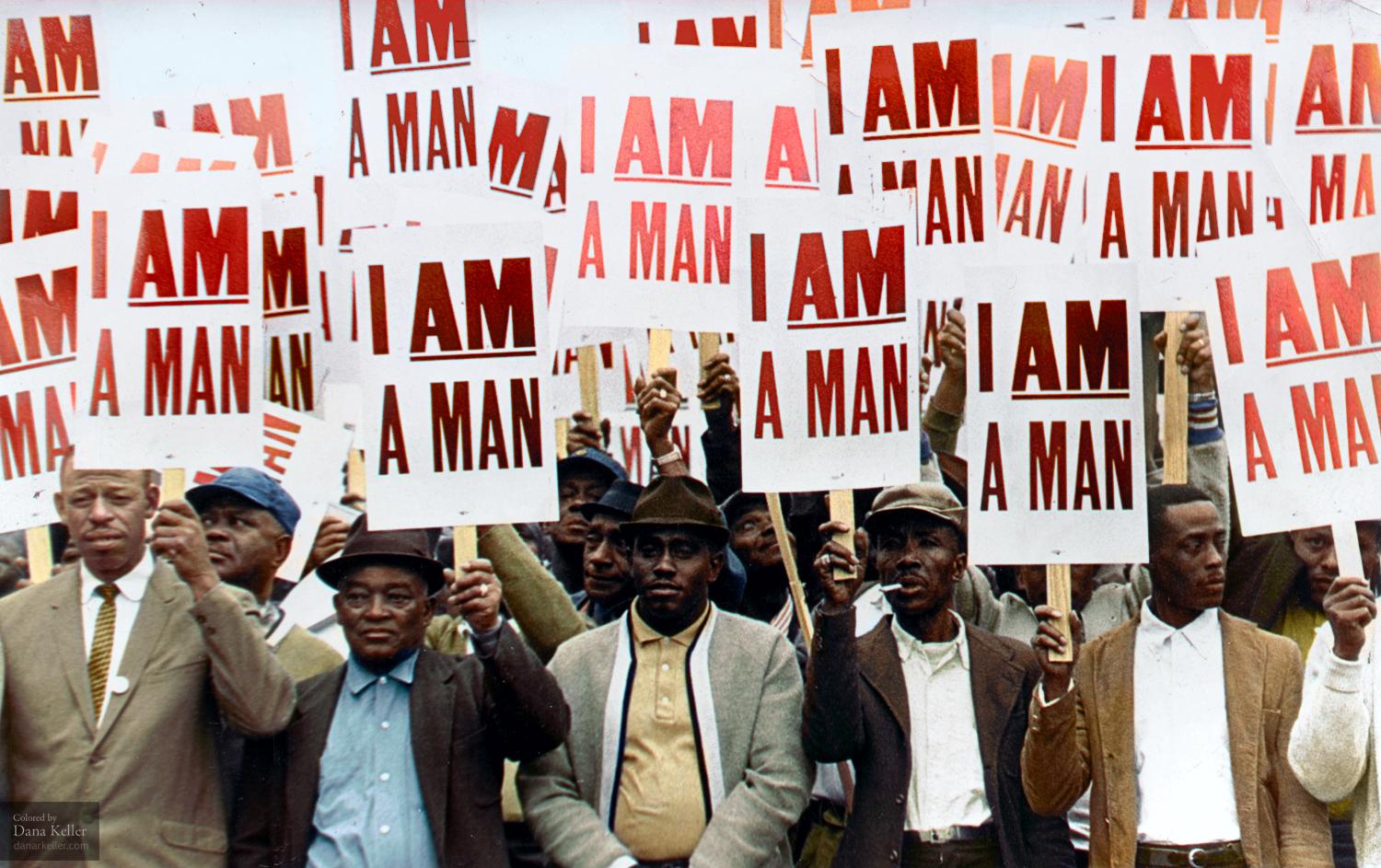
I will never forget visiting Berlin, Germany in the 1986 before the Berlin Wall was torn down. We toured a small museum dedicated to the holocaust at “Checkpoint Charlie,” before going into East Berlin. As a stark reminder that the Germans are not the only ones guilty of racism, one of the last exhibits displayed pictures taken during the 1968 strike of sanitation workers in Memphis, Tennessee. I will never forget standing in the city where Adolph Hitler once ruled looking at pictures of black men in my own country, in my neighboring state, in my lifetime, holding signs which read: “I am a man.” I am a human. I am somebody. I have flesh and bones.
And this was Jesus. “Look at my hands and my feet.”
But “in their joy they were disbelieving and still wondering.”
I suspect that is where many of us are today. Justice and mercy prevailing and love winning brings us some joy when we first think about it, but it seems too good to be true. As much as we want it, we have difficulty believing it, seeing it, recognizing the possibility of any true peace in our world. Because for love to win, the first thing we must do is to recognize the humanity in others. And that is something we human beings have always had a difficult time doing.
The good news is that Jesus is not finished with his disciples. For it is then Jesus asks a rather embarrassing question: “Do you have anything here to eat?” Now think about that for a moment.
Jesus is put into the awkward position to invite himself to dinner, to ask the disciples for the most basic form of hospitality. Because of the disciple’s fear, Jesus has to remind them that when someone pays a visit, the polite thing to do is to offer that someone something to eat or drink.
Amy and David, you will be glad to know that one of the first things we discussed after you agreed to be here this weekend is how and what we were going to feed you!
Perhaps we also need to be reminded that offering another food and drink is simple, yet profoundly powerful. For when we offer someone something to eat, we are recognizing and affirming their humanity. Thus, not only is it the polite thing to do; it is the humane thing to do. It is also a faithful thing to do.
Father Abraham taught us this truth that hot day by the oaks of Mamre.
In Genesis 18, we read where three strangers appear on the street and get Abraham’s attention. Which raises a good question: “Whose humanity gets our attention? Are there some lives that get our attention over other lives?
Next, Abraham simply does what people of faith do for others, he welcomes them with a generous, gracious hospitality.
Notice that when he sees them, he doesn’t ignore them and allow them to pass on by. He doesn’t politely nod or wave in their direction. Nor does he safely call out to them from a distance asking them to come to him, and he certainly does not tell them to go back to where they came from. Abraham goes out to them. And he doesn’t cautiously walk over to them. When he sees them, the scripture says that he “runs” to meet them where they are.
And when he encounters these strangers, notice that he does not stand arrogantly over them or above them, but he humbly bows himself to the ground before them and speaks to them like a servant:
“Please do not pass me by. Let me get some water and wash the dust off your feet. Let me make a place for you to rest in the shade. Oh, and my wife, Sarah, bakes the best bread. Come and allow us to serve you. Then, you can continue your journey refueled and refreshed.”
When the strangers agree to stay a while, Abraham can hardly contain himself. He runs back inside, “Hurry, Sarah, prepare three cups of choice flour, knead it, and bake a delicious cake. He then runs out back to the field and takes the best-looking calf of the flock and has his servant prepare a delicious dinner. He brought it to them under the shade tree and waited on them while they ate.
And as verse one of chapter 18 suggests, we later discover that these three strangers were actually angels, messengers from God. This story teaches us that when we graciously and generously welcome the stranger, we welcome God. When we invite others to the table, the Lord appears.
In chapter 10 of Mark’s Gospel, we read the following words of Jesus:
Whoever welcomes you welcomes me, and whoever welcomes me welcomes the one who sent me (Mark 10:40-42).
In the previous chapter we read where Jesus took a little child in his arms, and said:
Whoever welcomes one such child in my name welcomes me, and whoever welcomes me welcomes not me but the one who sent me (Mark 9:36-37).
And in Matthew 25 we read Jesus’ words:
I was hungry, and you gave me food; I was thirsty, and you gave me a drink; I was a stranger, and you welcomed me.
Do you see the pattern here? Jesus said that when we welcome others, we are welcoming him. And when we welcome him, we welcome God.
There was once a monastery that had fallen on hard times. The order was dying out. There were only five monks left, the abbot and four others.
The four monks feared that the monastery would have to be closed. In their desperation, they went out and sought counsel from a wise man they knew who lived in a hut in the woods that surrounded their monastery.
The wise man agreed to a meeting to talk with the abbot regarding the fate of their monastery. The meeting was very brief. For the only thing the abbot had to say was that he knew that “the Messiah was among them.”
The wise man returned to the monastery where the monks were eagerly waiting. “Please tell us! What do we have to do to save the monastery?” “Well,” the abbot replied, “the abbot was rather cryptic. He simply said that the Messiah is among us.”
“The Messiah is among us?” The four monks scratched their heads. How could the Messiah be among them? As they pondered the meaning of those words, the monks soon began to think of each member of the order as a possible Messiah. They started to treat one another with tremendous respect and kindness. And when people came to visit, they treated each of them as if they could be the Messiah, too.
When people from the surrounding area often came to picnic on the monastery’s beautiful grounds, to walk along the paths, and to pray in the chapel, the visitors were amazed by the generous welcome they received from the monks. There was an aura of respect and love that filled the place, making it strangely attractive, even compelling. Hardly knowing why, they began to come back to the monastery more frequently, to picnic, to play, and to pray. They began to bring their friends to show them this special place. And their friends brought their friends. Some of the younger men who came to visit talked more and more with the old monks, and they began to join the order. So before long, the monastery had once again become a thriving order, and a vibrant center of light and love for all people.
When we recognize the humanity of another, the dignity of another, when we graciously set a place at the table for another, when we do something as simple but as powerful as offering them something to eat or drink, we can begin to see the Imago Dei, the image of God in that person. And that is when something shifts and something we call “resurrection” happens, something that once seemed too good to be true becomes reality. Justice and mercy prevail. Love wins and peace comes.
As Jesus eats, enough of their fear subsides that their minds are opened, and they begin “to understand.” With each bite of fish that Jesus takes, the disciples are transformed from fearful skeptics to “witnesses of these things,” emboldened to be public witnesses for justice, mercy, and love in the world—which is exactly what our world needs today!
The world needs witnesses who do not merely talk about “these things” here, among ourselves, inside these four walls, but who do “these things” out in the public for all those who yearn for their humanity to be recognized:
For those whose basic human rights, even their bodily autonomy, are being stripped away;
For those who would love to have a seat at the table but are not invited or feel unwelcomed;
For those who have been traumatized by sick religion;
For those who are living in poverty, for workers denied a living wage;
For those whose lives are terrorized by war and violence.
We need to witness in public spaces speaking truth to power, asking questions of our presidential candidates, our governor, our representatives, and our mayor and city council, all who claim to be Christians:
“What are you doing to be a witness for the least of these?”
“What are you doing to be a witness of mercy for sick people and elderly people?”
“What are you doing to be a witness of justice for poor people and for incarcerated people?”
“What are you doing to be a witness of love for all those who are crying out for their humanity to be recognized?”
Jesus, the brown-skinned Jewish Palestinian, has risen from the dead and is standing before us today, pleading: “Friends, I’m hungry. Will somebody please give me something to eat? Will somebody please recognize my humanity by being a witness to the humanity of others?”
As disciples, may we push past our fear—fear of the stranger, fear of losing some friends, fear of upsetting some family, fear of some failure, fear of not having enough left over for ourselves—and understand that to be Easter people, to practice resurrection, is to first practice hospitality. And may we understand that we feed Jesus every time we feed the least, every time we offer a seat at the table for someone hungering and thirsting for justice.And the good news is that when the disciples fed Jesus, he fed them in return. When they chose generosity over suspicion, love over fear, their eyes were opened, their doubt vanished, and the resurrected Jesus came alive in them. Peace didn’t come first. Sharing a meal did. A recognition of another’s humanity did.
May we be witnesses of these things. And may the peace of Christ be with us all.
 Just Love