
This week, my friend, the Rev. Bob Ballance, made the following observation on social media:
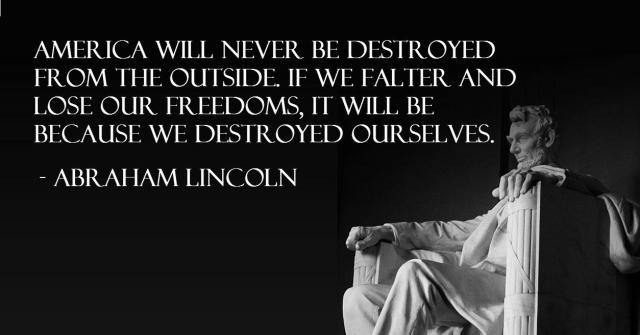
Our divisiveness across this country, so it seems to me, at least, is like a cancer spreading throughout the body. We just keep finding new ways to attack one another. National tragedies like hurricanes used to pull us together, but reports on the destruction of these storms is already old news, seemingly powerless to jolt us back to our collective senses. What was it President Lincoln said so eloquently? “America will never be destroyed from the outside. If we falter and lose our freedoms, it will be because we destroyed ourselves.” A century later, Khrushchev said the same: “We do not have to invade the United States. We will destroy you from within.” Where on earth are the prophets in times like these, those rare voices who have the gift and courage to rise up from the fringes with the right words at the right moment for the right reason? We used to could count on them to shout out the truth, hoping on a wing and a prayer to find a listening ear–any ear at all–to force at least a small nucleus to THINK and CHANGE, and then begin the work of pulling society back from the madness. This division has spread like wildfire into political parties, elections, the White House, the workplace, our stadiums, congregations, communities, families, even…into our playgrounds.
As a church that encourages inclusion and reconciliation, I believe we have a grand opportunity to be a shining example of harmony and unity to a divisive nation.
Do you know how to tell if your church is unified? It’s not by the number in attendance on a Sunday morning. And it’s not by what is put in the offering plates.
I believe that one way is by how long people linger in the building when worship is over. For when people find genuine love, acceptance and belonging in a place, they tend to want to stay in that place. I noticed last week how some of you hung around after the service like you didn’t want to leave. And that was good to me. A unified church is a church where people find love, acceptance and belonging.
A unified church can be a respite from the chaos and hurt that is in our world. It can truly be a sanctuary, a place to receive peace beyond understanding.
As I mentioned last Sunday, after Bruce Birkhead spent a difficult week in the hospital his wife Kaye, unaware of what would transpire this week, when Bruce needed some peace and rest, when Bruce needed to recharge is soul, I loved that he came here to this place.
So, I believe we have a wonderful opportunity to be a leader bringing peace to a divided nation. We have the opportunity be the rare prophetic voice that Rev. Ballance says our nation needs, those who posses the gifts and courage “to rise up from the fringes with the right words at the right moment for the right reason.” With our example of how to be a united blessed community we have the opportunity to “shout out the truth” to “pull society back from the madness.”
Let’s look again to the words of the one who seems to be speaking directly to us this morning:
Be of the same mind, having the same love, being in full accord and of one mind. Do nothing from selfish ambition or conceit, but in humility, regard others as better than yourselves. Let each of you look not to your own interests, but to the interests of others.
Let the same mind be in you that was in Christ Jesus,
who, though he was in the form of God,
did not regard equality with God
as something to be exploited,
but emptied himself,
taking the form of a slave,
being born in human likeness.
And being found in human form,
he humbled himself
and became obedient to the point of death—
even death on a cross.
We can be the prophetic voice that is needed to heal our nation with the humility of Christ.
And as First Christian Church in Fort Smith I believe we have a unique opportunity, as we are a people with diverse beliefs, different views, assorted experiences, various interpretations of the scriptures; yet we still come together each week with mutual respect for one another, in grace, in love and in humility around this table, united as one.
However, as good as our church is, I am afraid we still have some work to do, some obstacles to overcome. Because the truth is, that when many people today think about church, the word “humility” is not something that comes to their minds. In fact, it is the exact opposite that comes to their minds: words like “haughty,” “judgmental” and “uppity.”
Sadly, sometimes the church has been the cause of some of our nation’s division. So, when I say we have some work to do, I am saying that we need to go full-steam in the other direction.
Think of what a powerful witness we would be to our divided nation, if everyday, we literally and figuratively practiced humbly bending ourselves to the ground in the way of our God!
For when God wanted to reconcile the world unto God’s self, when God wanted to unite the world, God emptied God’s self, poured God’s self out, as a humble servant. God bowed down, down to meet us where we are, down to earth through a humble baby, laid down in a humble manger, worshipped by humble shepherds.
The gospel writers continually paint a portrait Jesus as one who is continually lowering himself in humility.
When his disciples chastised little children who needed to shape up and grow up before they be a part of God’s Kingdom, Jesus bent down down and welcomed them saying that the Kingdom of God actually belonged to such children.
While his disciples bickered about who was going to be promoted to be first in the Kingdom, Jesus taught them another way by doing things like stooping down to wash their feet, moving down to sit at the lowest seat at the table, crouching down to forgive a sinner, reaching down to serve the poor, lowering himself down to accept the outcast, touch the leper, heal the sick, eat and drink with the sinner, and raise the dead.
And nearing the culmination of this downward life, Jesus, the savior of the world, made his triumphant entrance into Jerusalem to liberate God’s people, not on some white war stallion that made its way up the equestrian ladder, but on a borrowed donkey. And he rode into Jerusalem not with an elite army that had advanced up the ranks in some up-and-coming militia, but came in with an army of rag-tag followers who had no idea what they were doing or where they were going.
While people exercise worldly power to move up, climb up, and advance, Jesus exercised a prophetic power that always propelled him in the opposite direction.
In the wilderness when he was tempted with worldly power, we watched Jesus embrace another power.
It is not a power that rules. It is a power that serves.
It is not a power that takes. It is a power that gives.
It is not a power that seizes. It is a power that suffers.
It is not a power that transforms stone into bread to feed his body. It is a power that transforms his body into living bread to feed the world.
It is not a power that commands angels to save himself. It is a power that gives himself away.
It is not a power that dominates from some high place in glory. It is a power that dies in a low place called Golgotha.
This is the narrow, humble, downward, descending way of Jesus toward the poor, the suffering, the marginal, the prisoners, the refugees, the lonely, the hungry, the dying, the tortured, the homeless–toward all who thirst and hunger justice and compassion.
And the good news is that as I look around this room, I see people who are committed to traveling this same downward path.
I see people who have chosen to be here this morning, not to get ahead, not to feel more righteous or superior than others, not to get something here in worship that will make you more successful, more affluent, climb a little higher. You are not even here looking to be uplifted, or to be more upbeat. I see people here who have chosen to move in the opposite direction.
I see a room full of people who are here not to get something, but to give something, not to be served by programs, but to serve on a mission.
Because you have heard, and you have believed Jesus when he said: “Anyone who wants to become great among you must be your servant, and anyone who wants to be first among you must be your slave, just as the Son of Man came, not to be served, but to serve, and to give his life as a ransom for many (Matthew 20:25-28).
May this always be who we are as a church.
May we come here each Sunday morning to embrace a mission of humility, sacrifice and selflessness. And then may we go out on a mission, bending ourselves down to the ground if we have to, to touch the places in people that most need touching. May we go out and stoop down to welcome all children. May we go out and reach down to serve the poor, lower ourselves down to accept the outcast. May we go out and get down on our knees to pray for and suffer with the sick and the despairing.
And by our humble example, may our divisive nation be inspired come together, be united as one, and together see our Lord “highly exalted…”
so that at the name of Jesus every knee should bend…
and every tongue should confess that Jesus Christ is Lord,
to the glory of God the Father.”
Invitation to the Table
As part of the world-wide community of Christians, we remember Jesus’ meal with his disciples.
The different languages you will hear today are symbols of the diversity of Christian experience, both close to us and around the world.
Jesus sets the table and his welcome extends to all of humanity.
People of all ages, of all genders, of all cultures, of all economic conditions are welcome here.
No one can earn a place at this meal. Come of your own choice. You need only desire to follow the downward way of Jesus.
Bring your hopes and your history. Bring your deliberations and your doubts.
Come with those who differ greatly from you and be reconciled as one.
Commissioning and Benediction
Although it sounds good to be an up and coming church, I commission us to be a church that is always down and going.
May we go out in humility, bending ourselves down to the ground if we have to, to touch the places in people that most need touching.
May we go out and stoop down to welcome and accept all children. Crouch down to a child in a wheelchair who has been told their entire life: “No You Can’t!” and tell them: “Yes You Can!”
May we go out and reach down to serve the poor, lower ourselves down to accept the marginalized, and may we get low, get down on our knees to pray with all who suffer.
And, there, as low as we can go, may this church be a shining example in a divisive nation of harmonious humility and revolutionary reconciliation.
And now may the communion of the Holy Spirit of God who came down to us in a stable and the grace of the Christ who knelt down to pick up his cross, be with us now and forevermore. Amen.

 Just Love