

John 1:29-34
“Behold!” It’s a powerful word, rich with meaning. But unless your last name is Shakespeare, you probably don’t use it that often. But maybe we should.
The imperative word is derived from the Greek Ἴδε (ide). It means: Wake up! Open your eyes! Take off the blinders! You need to stop whatever you are doing right now and start paying attention!
When John cries out, “Behold!” he’s doing what the prophets have always done: calling people to see what power doesn’t want us to see. Dr. Martin Luther King, Jr. heard the same summons. He asked America to wake up. He asked us to behold the gap between our creeds and our conduct, between what we claim to believe and what our systems actually do. Like John, King named injustice and exposed it. And, like John, he paid the price for it.
And what does John believe is imperative for us to see?
Behold! “The Lamb of God.”
Looking carefully at the language matters as scripture is so easily twisted to serve someone’s agenda. (By the way, taking the original language seriously is what it means to be “conservative,” conserving the original language and intent of the author.)
John is very precise here. He does not say that Jesus is “the lamb for God.” Because this is not about a sacrificial lamb offered up to appease God.
John says Jesus is “the lamb of God.” He is one who belongs to God, one who is aligned with the purposes of God.
Behind this image of the lamb is the Exodus story, where the lamb is a sign of deliverance from oppression, a symbol of liberation from slavery.
In Hebrew imagination, the lamb is also a symbol of vulnerability, a nonviolent creature caught up in violent systems. Thus, this is John’s way of saying that through Jesus, God identifies with the vulnerable. God stands with those crushed by violent power. That’s why Jesus said God is like a shepherd who will leave the flock to rescue the lamb who is most at risk, the lamb who is excluded or displaced.
Jesus calls himself the “the Good Shepherd” who knows his sheep. He identifies with them. This is why Jesus said when you feed the hungry, clothe the naked, welcome the stranger, heal the sick, visit the imprisoned, “you do it to me.”
And after the resurrection, he tells his disciples: “if you love me, feed my lambs” (John 21).
Then, John says something else which is often misunderstood:
“Behold! The lamb of God who takes away the sin of the world.” The Greek word here is αἴρων (airōn). It’s a word that means to lift up or remove but also to carry off, to dismantle, to tear down, to abolish.
John is saying: “Behold! The lamb of God who dismantles the sin of the world.” And notice John does not say, “sins”, plural. He says “the sin” of the world.
Because John is not talking about the private moral missteps of individual people. He’s talking about a power, a logic, a way of the world which is organized against life. He’s talking about a world-shaping force that generates many evils.
I believe the Apostle Paul helps us to understand this force in his first letter to Timothy where we read: “the love of money is the root of all kinds of evil” (1 Timothy 6:10). “Root” is another important word. A root is a generative source. Roots are hidden. Roots feed systems. Roots shape what grows above the surface.
Across scripture, greed distorts justice. It fuels violence, and it legitimizes domination. Pharaoh’s economy depends on forced labor. The Prophets condemn those who “sell the poor for silver.” Jesus said no one can serve two masters. We “cannot serve God and weath.” The early church shared their possessions because they knew hoarded wealth destroys community.
Greed appears as the sin of the world in systems: policies that treat people as expendable; wars fought for resources and control; slavery justified as “economic necessity”; violence framed as “security”; borders hardened to protect wealth; and bodies criminalized when they threaten profit.
Greed requires coercion to protect itself. It requires violence when it’s challenged. And it requires religious justification to appear moral.
Fascism is not a separate sin from greed. Fascism is greed fully armored. It is greed baptized in nationalism, enforced by violence, and justified by religion.
This is the sin of the world that John wants us to see today. Behold, the Lamb of God, who is aligned with the purposes of God, who stands with the poor, the displaced, and the oppressed, is here to dismantle a world ordered by greed, power, and violence.
That is why Jesus is crucified. Not for forgiving private vices. But because he threatened a world built on profit, domination, and control.
This is always how it goes. The world does not kill people for being kind and forgiving. It kills them for standing in the way of unjust systems.
Jesus is crucified when he confronts empire.
King is assassinated when he challenges economic exploitation, racialized violence, and militarism.
The prophets are silenced when they refuse to make peace with injustice.
The early church understood this. When John said, “Behold!” they got it. They understood sin, not as personal vices, but as the power tied to death, empire, and idolatry. The Apostle Paul and John spoke of sin as a force that enslaves, rules, and kills (Romans 5–7; John 8; 1 John).
John 1:29 was heard as a bold political statement: Jesus is one who confronts the powers that order the world against God’s justice. The cross was seen as the exposure of these powers and Jesus’ solidarity with the crucified. And salvation meant liberation into a new way of life, into what Dr. King called the beloved community.
But over time, that vision narrowed.
In the 4th century, when Christianity was wed to the Roman Empire, naming the sin of the world became costly, because now the church had something to lose. Thus, sin was relocated from systems to individual souls (By the way, this is what some would call “liberal”—changing the original meaning of scripture to support your own politics).
But doing so kept Jesus safe for those in power, because the understanding of sin then moved away from empire, away from economics and violence, and to individual hearts and personal vices. Jesus becomes a solution for personal guilt, rather than a threat to unjust order.
And then this theologian and philosopher named Augustine came on the scene. He did not intend to protect injustice, but his emphasis on inherited sin and inward transformation, unintentionally narrowed sin to the individual soul. And over time, the church began to speak more about what was going wrong inside of people, than what was going wrong in the world.
John 1:29 is still quoted, but now the Lamb of God soothes consciences rather than dismantles systems.
As the church’s power grew, sin became something the institution could diagnose, quantify, forgive, and monetize.
The Reformers responded by recovering grace, but they kept sin personal. John 1:29 is read as: “Jesus was crucified to pay the price for my sin” rather “than Jesus dismantles the sin that crucifies people.”
During the Enlightenment, Western culture learned to see everything through the lens of the individual—individual rights, individual reason, individual responsibility. The Bible was read the same way. Sin became private. Religion became personal comfort instead of public truth. And that kind of faith proved remarkably useful to empire—blessing colonization, baptizing conquest, and remaining silent in the face of genocide and slavery.
Today, American Christianity still preaches John 1:29, but it’s almost never connected to economic exploitation, racialized state violence, and imperial power. The misinterpretation of John 1:29 did not simply produce bad theology. It produced an impotent church: a church good at managing guilt, saving souls, and blessing the empire, and bad at confronting injustice, naming structural sin, and standing with those crushed by power; good at accepting the Jesus of empire and bad about following the Jesus of scripture.
That is why John’s message is more important today than ever. “Behold!” Wake up! Open your eyes! Look at the world today. And look at who Jesus is and who Jesus is calling you to be in this moment.
“Behold!” It’s not a word meant only to be powerfully spoken. It’s a word meant to be powerfully lived.
If Jesus is the Lamb of God who dismantles the sin of the world, then following Jesus cannot mean retreating into some private spirituality while the world keeps crucifying the vulnerable.
If Jesus is the Lamb of God who dismantles the sin of the world, it means we must become a people baptized not just with water, but with the Holy Spirit and with fire, a people caught up in God’s movement to interrupt greed, expose violence, and refuse religious cover for injustice.
If Jesus is the Lamb of God who dismantles the sin of the world, it means we stand where Jesus stands—with the poor, the criminalized, the displaced, and the ones the world calls expendable.
If Jesus is the Lamb of God who dismantles the sin of the world, it means we must resist the systems that profit from fear, domination, and death.
Dr. King warned us that remembering the dream without continuing the struggle is a form of betrayal. To honor King is not to quote him once a year, but to confront the same forces he confronted: economic exploitation; racialized violence, militarism, imperialism, and religious complicity.
Behold! Let’s wake up! Let’s open our eyes. Remove the blinders. And see that the Lamb of God is still at work, dismantling the sin of the world.
Dr. King stands in a long line of those who followed the Lamb—people like Francis of Assisi, Harriet Tubman, Óscar Romero, Dorothy Day, César Chávez, Renee Nicole Good, and countless others who refused to make peace with a world organized against life.
And now it’s our turn.
And if this sounds overwhelming, remember that systems are dismantled not by heroes alone, but by ordinary people who refuse to live as though injustice is normal.
So, what does it mean, in practice, to follow the Lamb who dismantles the sin of the world? It means at least three things.
1. We tell the truth.
We refuse silence. We name what harms God’s children—even when it costs us comfort or safety. We call greed what it is. We call violence what it is. We call empire what it is.
2. We offer our bodies.
We show up to stand with the vulnerable—in phone calls and letters to our representatives, in vigils, in protests, and in places of grief because the Lamb is never neutral and always takes a side.
3. We reorganize our lives.
We loosen our grip on wealth. We practice generosity that disrupts hoarding. We align our spending, giving, time, and votes with life instead of death, because you cannot dismantle the sin of the world while funding it.
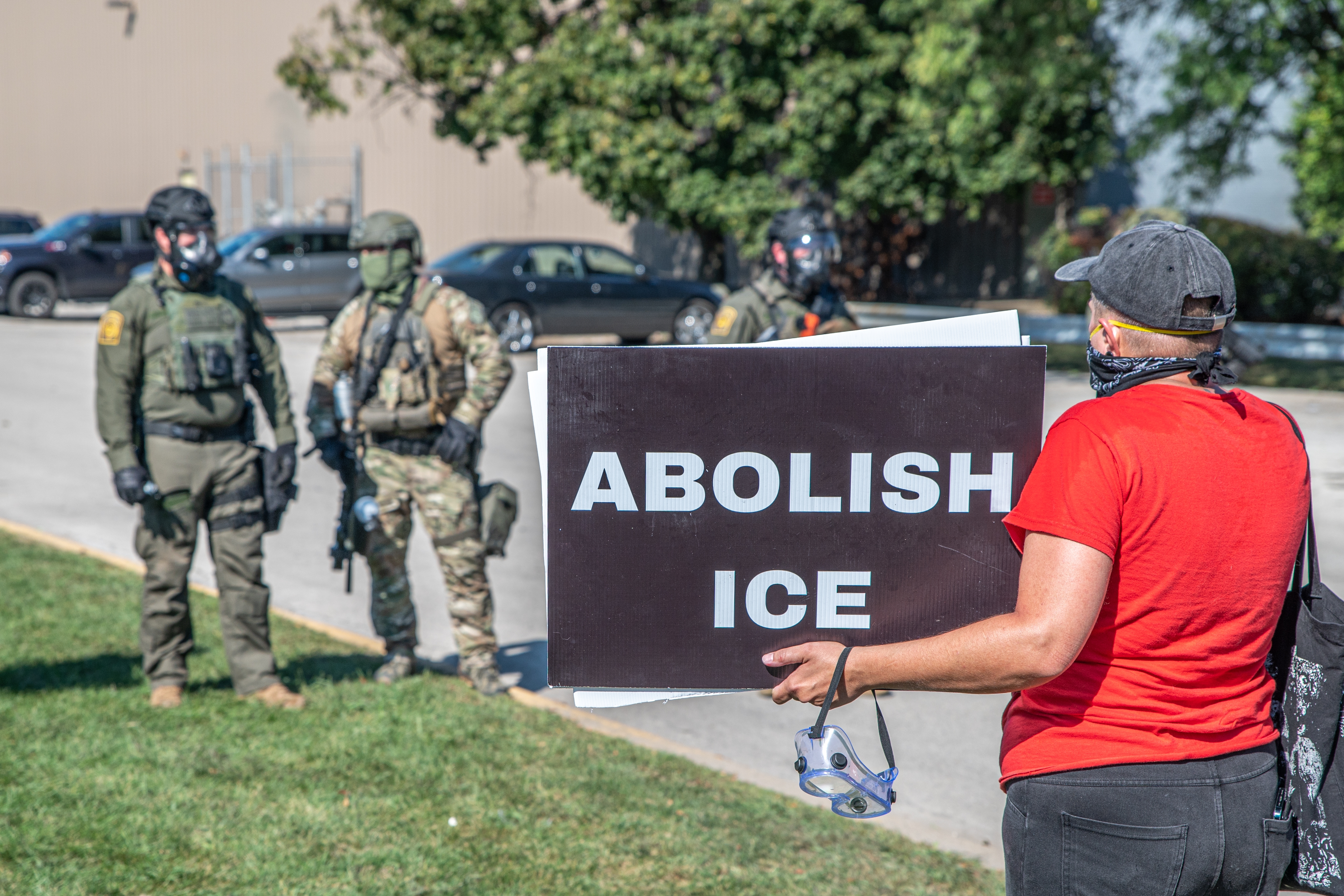
This is what it means to follow the Lamb. And when we live this way, we inevitably find ourselves standing in particular places, with particular people— in Minnesota, in Portland, in Chicago, in Palestine, in Iran, in Ukraine, in Venezuela, in Greenland, in Virginia, wherever empire kills, threatens and terrorizes God’s children, until the sin of the world is dismantled, until the system is abolished, until justice rolls down like waters, until all God’s children can breathe free.
Amen.
Pastoral Prayer
Holy and Living God,
God of justice and mercy,
God who hears the cry of the oppressed and does not turn away:
We come before you this morning because the world you love is hurting,
and because we refuse to pretend otherwise.
We come carrying the weight of what we have seen:
violence dressed up as policy,
greed disguised patriotism,
fear baptized as faith,
and power protected at the expense of human life.
Teach us again how to behold,
to see clearly what we those in power want us to ignore,
to name honestly what the world tries to normalize,
to look without flinching at suffering that is not accidental,
but produced by systems we are told to obey and not to question.
God of the Lamb,
we pray for all who are crushed beneath the sin of the world.
For immigrants and asylum-seekers living under constant threat,
families separated, children detained, lives treated as disposable,
be their shelter and their strength.
And disturb us, O God, when our comfort depends on their fear.
For Black and Brown communities targeted by violence,
over-policed and under-protected,
grieving lives stolen and justice delayed.
Hold the grieving close,
and unsettle every system that profits from racialized harm.
For workers exploited, wages stolen, bodies worn down,
while wealth is hoarded and inequality justified.
Strengthen those organizing for dignity,
and expose the lie that profit matters more than people.
For nations scarred by war, occupation, and imperial ambition,
for Gaza, for Ukraine, for Sudan, for Haiti,
for all places where civilians pay the price for the ambitions of the powerful.
Break the cycle of domination,
and give us the courage to resist the machinery of death.
God, we confess that too often the church has been silent
when it should have spoken,
neutral when it should have resisted,
and complicit when it should have stood with the crucified.
Forgive us when we have settled for private faith
while public injustice went unchallenged.
Forgive us when we sought peace without justice,
order without equity,
and unity without truth.
And yet, O God,
we thank you that despair does not have the final word.
We thank you for prophets who still cry out,
for organizers who refuse to give up,
for communities practicing mutual care,
for young people daring to imagine another way,
for elders who remember that change is possible.
Strengthen us to follow the Lamb:
not just in belief, but in practice;
not just in worship, but in witness.
Make us a people who tell the truth even when it costs us,
who stand with the vulnerable even when it is risky,
who resist systems of death even when it would be easier to look away.
Baptize us again with your Spirit and with fire
so that our faith is not passive,
our hope not shallow,
and our love not afraid.
Until the sin of the world is dismantled.
Until the systems of greed, fear and violence are abolished.
Keep us faithful, keep us awake, keep us moving.
We pray all this in the name of Jesus, the Lamb of God,
who stands with the crucified and leads us toward life.
Amen.



 Just Love