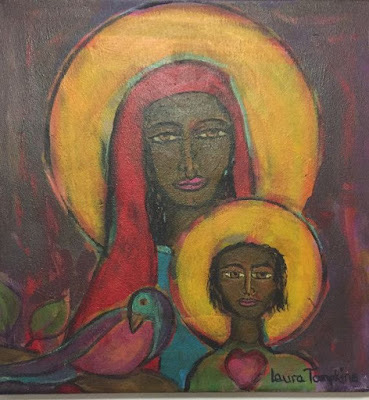
Christmas Contemplation

Luke 2:41-52 NRSV

It’s only been a few days since we celebrated his birth, but we fast forward twelve years when we read this morning’s lectionary gospel lesson where, in the same chapter of the story of his birth, Luke tells a story of 12-year-old Jesus that sounds something the contemporary holiday classic movie Home Alone.

After visiting Jerusalem for the Passover festival Mary and Joseph, with other members of their family had packed their bags and boarded the plane. From their seats in coach, they couldn’t see where Jesus was sitting, but assumed he as sitting somewhere among the large crowd of passengers. After a long day of travel, as they were retrieving their luggage from the baggage carousel, they picked up Jesus’ suitcase and handed it off to someone who began passing it down the line of relatives to Jesus, but at the end of the line, there’s no Jesus.

Because the boy never got on the plane and was now lost in New York, I mean Jerusalem.

It took three days of frantic searching before they found him in the temple, sitting among the rabbis, listening to their teachings, and asking questions. Don’t you wonder what questions twelve-year-old Jesus had for the Rabbis and what answers he gave in response to their questions that amazed all who heard him that day?

But it’s not Jesus’ questioning that gets my attention in this story. It’s Mary’s questioning. For I love the way Luke describes it: “Mary treasured all these things in her heart.”

The Greek word translated treasure means “to thoroughly keep.”

The thinking of Mary is thorough. Her questioning is meticulous and scrupulous. She thoroughly thinks it all through. Mary wonders, ponders, considers—she “treasures” the significance of what has happened.

And maybe, on this first Sunday after Christmas, this should be the mind of every disciple. A mind that is thoroughly evaluating and reevaluating, thoroughly questioning and wondering, thoroughly meditating and contemplating the meaning of Christmas.

What does it all mean to us? What does Christmas mean to the world? What does it mean to have faith in a God, who we believe is the creator, the source, and the essence of all that is, a God who we believe is Love love’s self becoming flesh, in the most humble, most selfless and most vulnerable of ways, to dwell among us, being with us, living in us, living through us, living for us, for all people, for the entire creation?

One of my favorite preachers, the Rev. Karoline Lewis writes: “Mary invites us into that contemplative space…not to obtain answers, but to ponder God’s place in and purpose for our lives. Mary summons us to sit and wonder…[reminding] us that an essential act of discipleship is reflection. Because none of what God is ever up to should be easy to get or at once understood.”

Lewis suggests that the best gift the church can give to people at Christmas is the gift of a safe and brave place for their own ponderings, a gift of space where reflection, questioning, and even doubting, are welcomed, and even encouraged, a gift of time that “demands only meditation and musing.”[i]

Especially in these days, when thinking doesn’t seem to be in vogue.

I’ve said it. You’ve said it. We’ve all noticed it. “Our country has a critical-thinking crisis.”

Well, we may not have put it in those exact words. But on this First Sunday after Christmas, it’s just not very nice using words like “stupid” or “idiots.”

We live in a world where there seems to be little time for any silence, much less for any meditation and contemplation. These days people are quick to allow others to tell them how to think and what to think without any questions. It’s what makes Fox News, some places on the internet, and churches where people are expected to check their brains at the door both popular and dangerous.

For a world where reasonable, reflective, critical thinking, and intelligent discourse have lost favor is a world that breeds authoritarianism and supports fascism. It is a world where an unstable, wannabe dictator can get a way saying something as ridiculous as: “What you are seeing is not happening.” And, without question, people will believe him.[ii]

I believe it’s fair to say that the lack of critical thought can be blamed for the most heinous and evil of all world events as it has led people to believe that something that is as obvious as our common humanity does not exist, to believe that one race, one nation or one religion is superior to another or favored by God over another, to believe that some people are cut-off or separated from God, while others are close to God.

So, perhaps the best sermon a preacher can preach on this Sunday after Christmas is one that invites us to join Mary after finding Jesus in the temple that day. It’s a sermon that gives us permission to think—a sermon that encourages us to follow the example of Mary to think deeply or to “treasure in our hearts” what this miraculous event we call Christmas truly means, to ask what our hearts are telling us in response to divinity becoming humanity, to the holy becoming flesh, to Love, love’s self, becoming a part of the creation and dwelling among us.

Franciscan Friar Richard Rohr, founder of the Center for Action and Contemplation, writes that contemplation is a way of “listening with the heart” in such a way that it awakens a new consciousness that is needed to create a more loving, just, merciful, and sustainable world.

Contemplation is the practice of being fully present—in heart, mind, and body—that allows us to creatively respond and work toward what could be. Contemplative prayer helps us to recognize and to sustain the Truth we encounter during moments we experience great love and great suffering, long after the intensity of these experiences wears off.”

So, on this Sunday after Christmas, let us ponder and wonder Christmas. Let us meditate and contemplate Christmas. Let us treasure Christmas. Let us make time for silence, and take time in silence to question our hearts and to listen. Not to hear the answer of popular culture, the answer of politicians, or even the answer of your church (and should I dare say) not even the answer of your pastor. Let us listen to hear a truth where Christmas becomes more than something we celebrate for a season, but a way of life that informs our being and instructs our living all year long.

Let us make time in these days of Christmas to listen to our hearts. What are our hearts telling us this morning about God being born as a vulnerable infant, in the body of a brown-skinned, Jewish Palestinian, to an unwed mother?

What are our hearts saying in response to a choir of Angels who invite not the rich and the famous to see the baby, but poor, lowly shepherds, those working the nightshift out in the fields tending to the sheep of another?

What do our hearts say when we read that the ones who feared the baby the most were those with the most privilege and power?

What are our hearts telling us when we hear the story of the baby and his parents fleeing their country as desperate refugees, crossing the border into Egypt as undocumented immigrants?

Father Rohr contemplates Christmas:

If we’re praying, [Christmas] goes deeper and deeper and deeper. If we are quiet once in a while…it goes deeper and deeper and deeper still.

There’s really only one message, and we just have to keep saying it until finally we’re undefended enough to hear it and to believe it: there is no separation between God and creation.

         This is the good news of Christmas, because, as Rohr observes:

Separation is the sadness of the human race. When we feel separate, when we feel disconnected…from our self, from our family, from reality, from the Earth, from God, we will be angry and depressed people. Because we know we were not created for that separateness; we were created for union.

So, God sent one into the world who would personify that union—[one] who would put human and divine together; [one] who would put spirit and matter together.”

[When we] wake up in the morning pondering and wondering: What does it all mean? What’s it all for? What was I put here for? Where is it all heading?

Rohr muses:

I believe it’s all a school. And it’s all a school of love. And everything is a lesson—everything. Every day, every moment, every visit to the grocery store, every moment of our so-ordinary life is meant to reveal, ‘My God, I’m a daughter of God! I’m a son of the Lord! I’m a sibling of Christ! It’s all okay. I’m already home free! There’s no place I have to go. I’m already here!’” Rohr then adds “But if we don’t enjoy that, if we don’t allow that, basically we fall into meaninglessness.[iii]

Rohr considers:

Friends, we need to surrender to some kind of ultimate meaning. We need to desire it, seek it, want it, and need it.

I know no one likes to hear this, but we even need to suffer for it. And what is suffering? Suffering is the emptying out of the soul so there’s room for love, so there’s room for the Christ, so there’s room for God.

On this first Sunday after Christmas, let us thank Mother Mary— For giving us permission to be still, to get quiet, to meditate and to contemplate, for encouraging us to ponder and to wonder, to find a safe and brave space to listen to our hearts to find meaning, purpose, and belonging, to empty our souls making room for love, to be enveloped with grace and held in love by the source and essence of all that is.

[i] https://www.workingpreacher.org/dear-working-preacher/keeping-company-with-mary

[ii] https://www.bbc.com/news/av/world-us-canada-44959340

[iii] https://cac.org/daily-meditations/only-one-message-2021-12-24/

A Nurse’s Prayer: Remembering Marianna Powell

Marianna Powell

I’m certain that many people have contacted the Powell family since Sunday to let them know that they were in their prayers.

Prayer: it is a wonderful gift of God’s grace. To know that others, some from great distances, from all over the country, are speaking to God on our behalf, asking God to bring us healing and comfort, can bring us a peace that is truly beyond our understanding.

For the good news is that we believe that God not only hears our prayers, listens to our prayers, but we believe God does all that God can do, gives all that God can give, to always answer our prayers.

This is why I loved Kerry’s response when I asked him and his brother Randy: “What was the most important thing that your mother taught you?”

Without hesitation, he said, “She taught us how to pray.”

Immediately, Randy nodded in affirmation.

I said, “What do you mean?”

“Oh. she would work and work with us to help us remember the and recite the words of the Lord’s Prayer,” he said. “Prayer was important to her. She believed in prayer. Before meals, before bed, she taught us to always pray.”

We talked a little more about prayer, but it wasn’t long, nor hard to understand, how prayer was the perfect segue to begin talking about her life, especially how she loved her vocation as a registered nurse.

As Randy and his wife Kandi, and Kerry and his wife Maria, who is also a nurse, talked about how important nursing was to Marianna, I began thinking about my grandmother who, like Marianna, was also born on April 19, but one year later in 1927; and, like Marianna, was also a registered nurse.

I will never forget my Nana talking about how she enjoyed nursing. She would often speak of what she believed to be “the healing power of personal touch,” the importance of “up close and personal” contact with patients.

And whenever I was sick or not feeling well, I always felt better when Mama would have Nana come over to check on me. I always felt better when Nana would come close to me, gently place the back of her hand on my forehead to check for a fever, placing her hands around my cheeks and neck to check for swelling.

Yes, as I said, there are many people praying for the Powell family today, some from great distances. They have sent cards, made phone calls, or reached out electronically with emails or social media, all pledging the Powell family their sincere prayers. Prayer is a wonderful gift of God’s grace. The Powell family appreciates prayer. Marianna taught them to believe in prayer.

But, then there are others (and I am speaking of you) who have gathered here in this place this morning. I am speaking of your who, as they they say, have put some feet on your prayers. You have come to be close this family in their grief. You have come to lay your hands on them, to touch them with an empathetic handshake or a loving embrace.

And they will forever be grateful for your presence here today. They will be grateful that you are not only here and near to them on this day, but grateful for the way that you will always remind them of their mother, grandmother and sister, for the way that you will always remind them of this this one with the heart of a nurse who loved them and loved others and prayed for so many, not from a distance, but up close and very personally.

I shared with the family the story of one of my first visits with Marianna. She was in the dining hall of the nursing home eating dinner. I pulled up a chair and sat beside her. At first, perhaps due to the strokes that she had suffered, she seemed to be a little distant, aloof.  I was on her left, unsure that she recognized my presence. She was sitting up, but slumping a little bit to the right, away from me.

However, when I leaned over and touched her arm, telling her that I was her pastor from Central Christian Church, she immediately turned to make eye contact with me and smiled. And I will never forget what happened next.

With strength that I did not know she possessed, she sat up and started leaning her head towards me.

The caregiver who was feeding her said: “She wants to kiss you!”

Surprised, but pleasantly so, I leaned in, turned my cheek towards her as she gave me what has to be one of the sweetest kisses I have ever received!

She loved her church and this one who represented her church so much, she prayed for her church in such a way that she could not remain distant, aloof. With the heart of a nurse still beating inside of her, she wanted to demonstrate her love, up close and personally. With every bit of strength that she could muster, with all that she had, a pure and powerful love compelled her to sit up and lean forward, until she could come close enough to me to offer me a prayer through her touch, through a beautiful kiss on the cheek.

Marianna taught her children how to pray with words. But, perhaps, more importantly, she also taught them how to pray with her life, with all that she had.

I believe the Apostle Paul aptly describes Marianna’s life when he wrote that we should “pray without ceasing.” That is, we should live a life of prayer. We should live our lives as if we are always with the Holy One.

It was this prayerful life that Randy and Kerry said taught them the Christian values of love, kindness and respect. However, they were both quick to point out: “Now we are not saying that we have always conveyed to others these values or lived out these values like our mother! We are just saying that because of our mother, and because of what she taught us with her life, we have at least been blessed with the wonderful opportunity live those values.”

We then talked about her love for God’s entire creation, especially for her beloved horses. They will never forget the time they took her to say goodbye to one of her horses. As you can imagine, Marianna did not say not say goodbye with a simple wave through the car window. She got as close as she could possibly get to her horse, so the horse could feel her touch and know her love.

This is why I thought it was rather interesting that one of the memories that Randy and Kerry said they will always cherish was their mother reading them the Christmas story from Luke’s gospel every Christmas. They then talked about how important it was to them to sit at their mother’s bedside this past Christmas and read it to her:

         In that region there were shepherds living in the fields, keeping watch over their flock by night. Then an angel of the Lord stood before them, and the glory of the Lord shone around them, and they were terrified. But the angel said to them, “Do not be afraid; for see—I am bringing you good news of great joy for all the people: to you is born this day in the city of David a Savior, who is the Messiah, the Lord. This will be a sign for you: you will find a child wrapped in bands of cloth and lying in a manger.” And suddenly there was with the angel a multitude of the heavenly host, praising God and saying, “Glory to God in the highest heaven, and on earth peace among those whom he favors!”  (Luke 2:8-14)

I find this interesting because the story of Christmas is essentially a story of a God who loved this world so much that God could not remain distant, aloof. God did not merely say to the heavenly host: “Let us pray for the creation. Let us pray for humanity.”

And of course, that in itself would have been enough. Because we believe in prayer. Marianna taught us to believe in prayer.

The writer to the Hebrews assures us that

[Christ] is able for all time to save those who approach God through him, since he always lives to make intercession for them.” The writer is saying that Jesus lives to make intercession for us. In other words, Jesus lives today to pray for us (Hebrews 7:25).

The Apostle Paul in his letter to the Romans writes:

Likewise the Spirit helps us in our weakness; for we do not know how to pray as we ought, but that the very Spirit intercedes with sighs too deep for words.  And God who searches the heart, knows what is the mind of the Spirit, because the Spirit intercedes for the saints according to the will of God (Romans 8:26-27).

If we ever worry that no one is praying for us, the Apostle Paul says that we can stop worrying. If no one earth is praying for us, Jesus certainly is. Jesus is our High Priest. He is our intercessor. He is our advocate. Christ lives today to pray for us. Even when we don’t know how to pray for others or for ourselves, even when we cannot find the words to pray, Paul says that the Spirit of God intercedes for us with “sighs too deep for words.”

Yes, if all God did for us was pray for us, even from a distance, that would be enough.

However, the love of God, the love of God that was revealed to us through Marianna Powell, and through Christ Jesus himself, is so great, so pure, and so powerful, that there was no way in heaven that God could remain distant, aloof.

God’s love for us compelled God to summon all the strength God could muster, to summon all that God had to give. Love compelled God to sit up in the heavens, and lean towards the earth, until God could come close enough to us to offer us a prayer through the “up close and personal” touch of the Divine, through a baby—Christ the Good Lord, the Good Shepherd, the Good Teacher, the Good Nurse—lying in a manger.

This is how we who are grieving today can truly be filled with a peace beyond understanding. People are not only praying for us from a distance. People are indeed here, in this room, with us. And God is not praying for us from some aloof heavenly place. God is indeed Emmanuel, which means, “God with us.”

God is here with us as God is with Marianna, loving her, touching her, embracing her, now and forevermore.

I want to close my remarks thanking God for Marianna’s love for us and for the special way that she revealed God’s love for us with these beautiful words by Allison Chambers Coxsey, entitled: A Nurse’s Prayer.

Give me strength and wisdom,

When others need my touch;

A soothing word to speak to them,

Their hearts yearn for so much.

Give me joy and laughter,

To lift a weary soul;

Pour in me compassion,

To make the broken whole.

Give me gentle, healing hands,

For those left in my care;

A blessing to those who need me,

This is a Nurse’s prayer.