On Sunday, during the Marine Corps Marathon in our nation’s capital, Seth Allen, who has Cerebral Palsy and Autism, will not recognize the White House, and he doesn’t have a strong opinion about who currently occupies it. When we roll by the US Capitol, Seth will not think of his Representative or his Senator from Oklahoma. The Supreme Court will be just another large building. When we pass by the monuments on the National Mall, Seth may not recognize them or understand who or what they memorialize. When we pass by the WWII and Vietnam Memorials, and when we start and finish near Arlington Cemetery, Seth will not grasp the significance.
For Seth, it will be just another race with Ainsley’s Angels, one that he participates in every month. I am sure he will notice that the course is much longer and has more runners; however, for Seth, the joy he experiences may be no greater than the joy he receives from participating in a small local 5k.
So, why spend all the money? Why travel all the way to Washington DC from Roland, Oklahoma? Why roll 26.2 miles?
Seth’s father George perhaps answered these questions best when he said: “Because this land is his land too.”
Seth’s inclusion with over 30 other Athlete Riders with Ainsley’s Angels in what is called “the People’s Marathon” powerfully proclaims the words inscribed in the granite of the Jefferson Memorial:
We hold these truths to be self-evident, that all men are created equal, that they are endowed by their Creator with certain inalienable rights, among these are life, liberty, and the pursuit of happiness.
The inclusion of Ainsley’s Angels in the Marine Corps Marathon declares to the occupant of the White House, to each lawmaker at the Capitol, to the judges seated on the Supreme Court, and to the entire nation: “Regardless of ability, difficulties, individual differences, unique characteristics, and different needs, ALL are created equal. ALL have a right to live. ALL have a right to love. ALL are worthy to be free. All are worthy of respect. ALL deserve to be happy. ALL deserve to be included.”
And if we continue to vote for this principle in two weeks, Seth’s smile at the finish line near the sacred grave markers of Arlington will reveal to the world that those who sacrificed their lives for this nation did not do so in vain.
And this will certainly not be “just another race.”
Inclusion. Acceptance. Mercy. Kindness. Compassion. Love. We know that God wants it. We know that this is God’s will for the world.
Exclusion. Discrimination. Prejudice. Meanness. Indifference. Hate. We know that God disdains it. We know this is not what God wills for this world.
And we know that if we do not live like we believe that mercy always triumphs judgment, then we do not live like we really believe in our glorious Lord Jesus Christ. We do not live like we believe in the one who lived and died extending mercy to the poor and the marginalized.
We know we are not perfect. We know we are going to make mistakes in this life. Therefore, to please our God, to live as believers in our glorious Lord and Savior, if we are going to err, we have decided to to err on the side of mercy. To please our Creator, we have decided to err on the side of grace. We have chosen to err on the the side of love.
But do we know whythis pleases our God so much? Do we know whyJesus lived and died showing us that mercy always triumphs judgment? Do we know why he directed his ministry toward those who were in the most need of mercy?
I believe one word in our scripture lesson reveals the answer. It is in verse 5.
”Listen, my belovedbrothers and sisters…”
Did you hear it? Beloved. We are God’s “beloved.” God loves us. God loves us; and therefore, God wants what is best for us. God loves us and wants us to live lives that are full, whole and blessed. As the prophet Jeremiah proclaimed: “For thus says the Lord, …surely I know the plans I have for you, says the Lord, plans for your welfare and not for harm, to give you a future with hope.”
And what is that plan? What is God’s plan to bless us?
The plan is what Jesus called the greatest commandment: that we love our neighbors as ourselves; and as the prophets, as Jesus and as the apostles like James teach us, that we love especially our poor neighbors.
Because as much as we might be tempted to believe it, as much sense as it might make to our flawed minds, James says, our hopeful future is not found by showing prejudicial treatment, extending a prejudicial welcome to our rich neighbors.
If we want to experience the promise of the Kingdom that God, if we want to experience life as God intended it, if we want to be blessed, then we need to love those that God has chosen to be heirs of that blessed Kingdom.
If we want to be blessed, we need to welcome and accept, include, those our culture disses. You know the dissed: the disenfranchised, the disrespected, the disqualified, the disheartened, the disdained, the disowned, and the disabled. For God uses those the world disses to bless us, to give us a future with hope.
This is the reason I no longer believe in using the word “disability” to describe persons who are living with blindness, deafness, quadriplegia, cerebral palsy, or other syndromes.
Consider the definition of “dis” in our English dictionary: to “have a primitive, negative or reversing force.” Discredit. Disengage. Disavow. Disappoint. Distrust.
Therefore, when we call a person disabled, it is like we are saying that they have an inherently negative ability to bless us, to make our lives better, to contribute to society, to have a positive impact on our word, to build up the body of Christ, to give us a future with hope.
This is why we have historically and literally pushed them to the margins. We have institutionalized them, separated them, ostracized them. Nazi Germany euthanized them.
And by excluding them from our lives, we’ve missed our loving God’s plan to bless us.
Henri Nouwen, one of my favorite Christian writers, was a priest, an esteemed writer and brilliant teacher in prestigious universities like Harvard and Yale.
However, he says that it was a desire to follow his Lord which prompted him to leave the Ivy League to spend the rest of his life serving as a chaplain to a wonderful community of people with different emotional, mental and physical abilities in Toronto.
In one of his many books, Nouwen tells a story about Trevor, a man in that community who was dealing with such severe mental and emotional challenges that he had to be sent to a psychiatric facility for another evaluation. As the chaplain, Henri wanted to visit him, so he had his secretary call the hospital and make an appointment.
When the higher-ups in that hospital discovered that it was the infamous Henri Nouwen, the renowned author and teacher from Yale and Harvard University who was coming, they asked if they could set up a special lunch with him in the “Golden Room”—this special meeting room at the hospital. They said that if Nouwen could come and say a few words, they would like to invite some of their most respected doctors and some esteemed clergy from the community to the special luncheon.
Nouwen thought to himself, “Oh Trevor has never missed a meal! He would love that!” So he agreed.
When he arrived, they took him to the Golden Room, but Trevor was nowhere to be seen. Troubled, he asked where Trevor was.
“Oh,” said an administrator, “Trevor cannot have lunch here. Patients and staff are not allowed to have lunch together. It’s too risky. Besides, no patient has ever had lunch in the “Golden Room.”
By nature, Henri was not a confrontational person. He was meek and very gentle. However, guided by the Spirit of the God who has chosen those the world has dissed to inherit and share the Kingdom of God, the thought came to his mind: “Include Trevor. Whatever you do, you mustinclude Trevor. Trevor needs to be here.”
So, Henri swallowed hard, he turned to the administrator and said, “But the whole purpose of my coming here today was to have lunch with Trevor. So, if Trevor is not allowed to attend the lunch, I will not attend either.”
Well, the thought of missing an opportunity for a lunch with the great Henri Nouwen was too much for them to bare, so they quickly found a way for Trevor to attend.
When they all finally gathered together, what the administrators had feared came to fruition. At one point during the lunch, while Henri was talking to the person at his right, he didn’t notice that Trevor, who was seated to his left, had stood up, lifting his glass of Coca-Cola in the air.
“A toast! I will now offer a toast,” Trevor said to the group.
The administrators were embarrassed, but had this look like “we knew this was a bad idea.” Everybody in the room got quiet and very nervous. What in the world was Trevor going to say?
Then Trevor, this deeply challenged man in a room full of PhDs and clergy, started to sing, “If you’re happy and you know it, raise your glass. If you’re happy and you know it, raise your glass…”
No one knew what to do. It was all so awkward. Here was a man with a level of challenge and brokenness, they could not begin to understand, yet he was beaming! He was absolutely thrilled to be there. He was so happy!”
So they started to sing. Softly at first, and then louder and louder until all of the doctors and all of the clergymen and Henri Nouwen were practically shouting, “If you’re happy and you know it, raise your glass.”
Henri went on to give a talk at the luncheon, I am certain his words were brilliant, as they always were, but the moment everyone remembered, the moment that blessed them the most, the moment God spoke most clearly, was through the person they all would have said was the least likely to speak for God.[i]
In his first sermon Jesus preached it. “Blessed are the merciful.” Blessed are those who believe and live as if they know mercy triumphs judgment.
This is the reason I no longer use the word “disabled” to describe persons with different abilities.
However, I still believe in using the word “disabled.”
But, it’s not the palsy, the syndrome, or the genetic anomaly that is disabling.
It is the exclusion that disables. It is the fear and the judgment and the prejudice that disables. It’s the constant stares, the negative remarks, the looking away, the shunning and the indifference that are disabling.
We are disabled when we disable others.
Our ability is “dissed” when we are unable to see the holy worth, the divine light, and the image of God in another. Our ability is “dissed” when we are unable to recognize the many gifts and different abilities that another has been given by our loving God to bless our lives and make this world amazing.
The good news is that our God loves us and wants to bless us, not diss us. God loves us and wants us to live full lives with meaning and joy. God loves us and wants us to have a future with a hope. And God has a plan to accomplish this divine will.
This is why the prophets, the apostles, and Jesus implore us over and over again to love our neighbors as we love ourselves, especially those who we characterized as poor, poor in cash, poor in health, poor in status, and poor in ability. This is why God commands us to live lives of inclusion, acceptance, kindness, and compassion, knowing that mercy always triumphs judgment. Let us pray together.
O God, help us to do your will. Help us to live lives of inclusion. acceptance. Fill us with your mercy, kindness, compassion and love. Help us to live lives blessed by your love. Amen.
After we sing our hymn of communion, all are invited to share a meal from this table, especially those our culture dissess. We will eat and drink and be blessed and transformed together.
Commissioning and Benediction
Go now and find those the culture disenfranchises, disrespects, disqualifies, disheartens, disdains, disowns, discredits, disengages, disavows, disappoints, distrusts and disables.
Go find them and love them.
See the the holy worth, the divine light, and the image of God in them. Recognize the many gifts and different abilities that they have been given by our loving God to bless our lives and make this world amazing.
[i]John Ortberg, in the sermon, “Guide.” Preachingtoday.com.
With the newspaper article that came out on Monday, and with our One-Year Anniversary Dinner and 5k coming up next weekend, many people have recently asked me, “How did you get started with Ainsley’s Angels?”
I have always enjoyed running. I know this may seem strange to many, but there’s perhaps nothing I like more than waking up at 4:30 am to lace up my running shoes and run 5 or 10 miles.
I love the way running makes me feel. I love the endorphins that it gives me. I love the way it keeps me relatively thin. I love the way running allows me to enjoy nature. I love the way it gives me opportunities to see some glorious sunrises. I love the way running gives me opportunities to make new friends. I love sense of accomplishment completing a race gives me.
Do you notice a common theme here?
“Me, me, me.” “I, I, I.”
I must confess. I run for many selfish reasons.
Running for all of these physical benefits might be what Jesus called: “working for bread that perishes.” This bread might help me endure temporarily, but not eternally.
However, thanks to a wonderful organization called “Ainsley’s Angels,” three years ago, I was given the opportunity to taste a slice of bread from another loaf. Another runner, and a member of our church, Bethann Wilkie, was contacted by Ainsley’s Angels inquiring if she knew anyone who was differently-abled who might enjoy riding in a race. She called me and asked me if I thought Bobby, a member of our church with Cerebral Palsy, might be interested.
I will never forget my response: “Bobby? He’s 48 years old! Why in the world would he want us to push him in stroller! Naw, I don’t think he would be interested.”
She said, “Would you at least go over to his house, show him some pictures and videos, and ask him.”
I said, “I will, but I cannot imagine him being interested.”
I went over to his house, showed him some pictures and a video. This was late November of 2015. I told him there was a race coming up on December 6 that we could be in.
Then Bobby, who has never taken one step in his life, looked at me with this indescribable expression of excitement and said, “Jarrett Banks (Bobby always calls me by my first and last name), Jarrett Banks, you mean to tell me that I can be in a race!?!”
Shocked by his response, I remember grinning from ear to ear, shaking my head saying: “Yes, you can!
“Okay!” he shouted, “I never thought I could be in a race!”
After talking it over with his parents, I told Bobby that we would get a chair and take him on a training run before we register him for a race that was coming up in about three weeks. Ainsley’s Angels delivered Bobby’s chair at church the following Sunday. It was a cold and rainy day, so we ended up pushing him up and down a hallway in the education building though. Bobby loved it. After checking the weather forecast, Bethann and I we made an appointment to meet Bobby in his home the following Thursday at 3pm to take a 3-mile test ride.
Bethann met me at the church, and we ran with the chair to Bobby’s house which was just a few blocks away. We rolled right up into the carport and found him sitting on the floor inside the door.
He hollered out, “Mama, Jarrett Banks and Bethann are here!”
His mother came to the door and said, “It is about time you got here!”
I said, “We’re not late, are we?”
She said, “No, but he has been sitting here on the floor waiting for an hour! You would think it is Christmas morning! This is all he has talked about!”
We loaded Bobby in the chair and started out. I don’t even think we got a block down the road when Bobby spoke up, “Jarrett Banks, my neighbor who lives right here doesn’t know about this. We need to tell her.”
I said, “Okay, when we get back from our run, we’ll tell her.”
He said, “Jarrett Banks, I think we need to tell her right now!”
For you see, whenever one is included, whenever one is accepted, whenever one is empowered, whenever one is loved, they cannot wait to tell someone about it!
So we pulled up on the sidewalk that led to her front porch and rang the door bell. As soon as she came to the door, Bobby started telling her all about it: “Hey, you will not believe this, but I am going to be in a race! This is my preacher Jarrett Banks and Bethann. I never thought I could be in a race before, but now I am!”
She graciously responded, “That is amazing Bobby! I am so happy for you!”
“Maybe you can come and watch me in the race!” Bobby said.
“Jarrett Banks, when is the race?”
Thrilled that I Bobby was so excited I smiled and said, “It is December 6.”
She smiled and said, “Well, I will have to see if I can be there!”
Bobby said, “Okay!”
I said, “Bobby, we have to go if we want to finish this run before it gets dark!”
He said, “Okay!” So off we went.
I think we made it two more blocks, when he said, “Jarrett Banks. My neighbor who lives right here does not know about this either.”
So, up on the side walk we went. I rang the door bell. She came onto the porch. Then Bobby started, “You will not believe this, but my preacher and I are going to be in a race!”
“That is wonderful Bobby! I love your new chair.”
“You need to come and watch us in this race? And so on and so on.
It was then I said, “Bobby, we really need to finish this training run before the sun goes down and it starts getting cold. Let’s wait until later to tell others about it.”
Bobby said, “Okay!”
For about two miles, Bobby laughed at every bump we went over. He waved at every passing car. And he pointed out all of the places the sidewalks needed ramps in the curbs at the end of a block. Every time we passed someone’s house he knew, he would tell me that we were going to have to come back and tell them, “’cause they don’t know about this.” I think he told us umpteen times “Jarrett Banks, Bethann run faster.”
After about two miles, Bobby got quiet. For about a quarter of a mile he didn’t make a sound. Bethann and I were quiet too. Running a little faster pace, we were just trying to breathe!
Then Bobby broke the silence, “Jarrett Banks, I know you are going to be mad at me.”
I said, “Bobby, I will never be mad at you.”
“Okay!” Then he said. “My Nanny does not know about this. We need to show her.”
Assuming he was talking about one of his caregivers, I asked, “Well, where does your Nanny live?”
He said, “Okay! I will show you!” We went about a block when he said, “Turn right here.” A few moments later he said, “Turn right here.” We did. Then he said, “Turn left.”
We pulled right up into a cemetery. We didn’t go very far, when he said, “Jarrett Banks, stop right here.” Bobby then pointed to the headstone of his grandmother who passed away in 1989.
As soon as we pulled up to the headstone, Bobby said, “Nanny, you will not believe this! But I am going to be in a race! Nanny, I never thought I could be in a race before! But this is my preacher, Jarrett Banks, and this is my friend Bethann, and they got me this chair, and Jarrett Banks, when is that race?”
Overwhelmed with emotion, I could barely speak, “It’s December 6th.”
It was then he said: “Nanny, please tell God to tell the Angels watch over me and my preacher Jarrett Banks and Bethann in this race and keep us safe, and take care of my dog that died.”
And I believe that was the moment I tasted it: holy manna, true bread from heaven that endures for eternal life.
And once you have tasted this bread, once you have allowed this Holy manna to feed your soul and fill your heart, there is just no going back to any ordinary bread that perishes.
This was the day Bethann and I both became Ainsley’s Angels. For how could we ever lace up our shoes and run for any selfish gain again? Bethann currently serves as the Ambassador for Ainsley’s Angels in Greenville, North Carolina.
And the good news is that you don’t have to run and push a full grown man in a stroller to receive this bread from heaven.
This bread is offered each time we love our neighbors as we love ourselves, every time we meet someone’s need, every time we forgive someone who has wronged us, every time offer grace, extend mercy and show kindness.
We can taste this bread when we feed the hungry.
We consume this bread when we give drink to the thirsty.
It fills us when we welcome the stranger. It feeds us when we defend the rights of the oppressed.
It satisfies us when we accept and empower the differently-abled.
It nourishes us when we love others the way Jesus loves us, selflessly, sacrificially, graciously.
And once you have tasted this bread from heaven, there is no going back. Our tastes change, our thirst is transformed, and we experience a different type of hunger all together. Our temporal hungers fade away.
Money and possessions no longer matter. Spiritual wholeness becomes more important to us than physical healing. The needs of others become more important than our own needs.
The way we measure success also changes, even in the church. The number of people that are serving the community every day becomes more important than the number of people attending the service on Sunday morning. The number of people who are out in the community doing what Jesus taught becomes more important that the number of people who are sitting in Sunday School studying his teachings. Following Jesus becomes more important than worshiping Jesus.
And we become convinced that this bread of God is that which comes down from heaven and gives life to the world, to a world that doesn’t even know that this bread exists. The world hungers, yet knows not what it hungers for.
And we are given this holy sense of urgency.
As Bobby would say, “They don’t know about this! And we need to tell them, and we need to tell them now.”
We need to tell them that Jesus is the bread of life. We need to show them that the way of Jesus is the way to life, abundant and eternal, and whoever comes to Jesus, will never be hungry, and whoever believes in Jesus will never be thirsty. Amen
I believe one of the most troubling things about the children who have been separated from their parents at the border is when we learned that the case workers and childcare workers were not aloud to touch the children. Sadly, with the prevalence of physical abuse in our world, perhaps we can understand why. However, we also understand that not touching them can also be a form of physical abuse. So much so, when some of the childcare workers confessed in an interview to breaking the rules and hugging the children who were in their care, we said, “Well, good for them!”
It should be no surprise to us when we learn that our God is a God who uses the physical as a means of grace. Today’s scripture lesson, with its repeated theme of physical touching, is a perfect example.
Through the act of touching, a woman is made whole, and God’s healing power is released.
In these stories, through the power of the physical touch, barriers of society and tradition are crossed. Rules and laws are broken. The woman in the story is ceremonially unclean. It is against the rules to touch her and it is against the rules to touch her. And notice, that she is also unnamed. Then, notice what happens after the woman breaks the law, reaches out and touches Jesus.
Jesus asks, “Who touched me?” desiring to know the woman who touched him, he reaches out and touches her. He commends her faith and calls her “daughter.” Through the grace of physical touch, the woman who was once unclean has been made whole. And the woman who was once unnamed has become a child of God.
In the second part of the story, the corpse of the girl is ritually unclean. Like the woman with the hemorrhage, this girl’s body is also untouchable. Yet, Jesus does the unthinkable and reaches out and touches the girl’s body nevertheless. In taking the girl’s hand, in touching the girl, Jesus reaches across the boundaries of society but also boundaries of death. And her life is restored.
About fifteen years ago, I attended a conference for pastors at Princeton University in New Jersey with the two ministers I met in Memphis a month or so ago. During our free time, we thought it would be exciting to board a train and visit the Big Apple. Before we left the conference, several frequent travelers New York City, who were also attending the conference, gave us some advice.
“When you are in the city, don’t look anyone in the eyes,” they said. “Don’t speak to anyone.” “Don’t point, at anyone or anything.” If you point at a building, someone may think you are pointing at them, and there may be trouble. And whatever you do, don’t touch anyone. Don’t get close to anyone!”
Being a first timer in the big city, and desiring not to be shot or cut or punched in the face, I decided that I better heed this advice.
As we were standing at one intersection in Times Square, waiting for the pedestrian light to turn green so we could cross, I noticed everyone in front of me, looking back over their shoulders. I turned around to see what they were looking at and saw a very elderly man with a long white beard, dressed as if he was homeless. With one hand on his grocery cart, he was bending down and picking up a slice of pizza he had dropped on the sidewalk with his other hand. After he picked it up we all watched as he went to take a bite as he walked down the road.
“Look, he’s going to eat it,” someone said. But before he could get it to his mouth, he dropped it again. The crowd laughed and jeered. We watched him yet a third time, pick up the pizza, put it to his mouth only to drop it again. The light turned green, the and off we went.
Later, we were walking up several flights of stairs as we exited the subway. My friend, Cary was in front of me and my friend, Steve was behind me.
Up ahead of us I noticed a frail-looking African-American man struggling to pull a large suitcase up the stairs. Cary walked passed the man. I walked passed the man, who I heard grunting with each step, watching out of the corner of my eye, dragging the suitcase behind him. “Should I help him,” I thought to myself. “No, he might get the wrong idea.” “He might think I’m trying to steal it or something.” I kept walking.
Steve, however, who was behind me, took a risk. Not knowing if the man even spoke English, he asked, “Do you need some help?” As Steve reached out and touched the end of the suitcase, the man immediately gave Steve a fearful, mean glance. But then, he smiled. I watched as he smiled most hopeful kind of smile, and said, “thank you.” Steve, picked up the suitcase and helped the man out of the subway. At the top of the stairs, the man reached out his arm, looking like he wanted to hug Steve. He stopped just short of a hug and patted Steve on the back, saying, “Thank you. God bless you.”
Once again, God used the physical as a means of grace. Steve reached out and touched and the power of God, the amazing grace of Jesus Christ was released. Fear was transformed into joy. We all felt it.
As long as I live, I’ll always wonder what might have happened if I had purchased that homeless man another slice of pizza. I’ll always dream of the possibilities, of what might have transpired, if I ate a slice of pizza with him. I’ll always think of the grace that might of come, the salvation that might have happened, through the simple act of reaching out my hand to that poor solitary soul who was struggling to survive.
Because our God is a God who uses the physical as a means of grace.
Look at your hands. They are sacred. They are holy. They are the means of God’s grace. The simple act of touching is powerful. It is sacred, and it is holy, maybe especially so if that touch reaches across barriers of society and tradition.
This past week I received a little push back when I posted a picture of myself with Hisham Yasin with our lunch plates and wrote a caption: “breaking bread with my Muslim brother.”
“How can you call a Muslim, who does not believe Jesus Christ is the Messiah, the Son of the Living God, your brother?” They asked.
I then shared with them the story of how I became Hisham’s brother. I said, “The first that I did was to break all sorts societal and traditional barriers by visiting with him in his office.”
During that visit I quickly learned that when it came to religion or politics or philosophy, even sports, Hisham and I agreed on very little. However, I learned that there was one thing that we did agree on. And that is that inclusive love has the power to change the world.
He offered me some dried figs and a delicious glass of herbal tea. He quoted passages from the Qur’an. I quoted Jesus. During our conversation he kept struggling with what to call me. Sometimes he would call me “preacher,” but sometimes he would call me “pastor.” I really got him confused when he just stopped halfway through our conversation, and asked me, “what do you like to be called?”
“Because I am more than a preacher and more than someone who give pastoral care, I guess I prefer ‘minister.’”
During the rest of the conversation, I think he called me all three titles.
After our visit, I reached out my hand to shake his. He immediately reached out both of his hands to hug me. As he gave me this great big hug, he said, “I don’t know to call you preacher, pastor or minister, so from now on, I just call you “brother.”
Now, at that moment, I reckon I could have pushed him away from me saying, “Now wait one minute, Mister, you are not my brother, for you do not believe Jesus is the Messiah, the Son of God, and Savior of the world!”
But thank God I chose instead to break traditional and societal rules, by hugging him back saying, “I love you brother,” to hear him say, “I love you my brother.” I chose to allow God to once more use the physical as a means of grace. And the power of God, the amazing grace of Jesus Christ was released. I felt it. And I believe Hashim felt it.
This, my friends, is what our world needs. We need to reach past all of the barriers that we erect between ourselves and our neighbors— political, religious, racial, ethnic, economic. We need to reach out and touch them. We need to allow them to touch us. We need to join hands, link arms, rub elbows and see that we have more things in common than the things that separate us. We need to see in the words of James Taylor, that ;there are ties between us, all men and women living on the Earth, ties of hope and love, sister and brotherhood.”
Every Sunday morning, when we gather around this table and affirm the grace of the physical. When we consume physical elements of grain and grape, resprenting the body and blood of Christ, we affirm that we have been touched by God through Christ. We affirm that through his touch, we have been made whole. Through his touch, we have all become children of God. But more than that, in consuming the body and blood of Christ, we acknowledge that we are his body and his blood. We are the body of Christ. Our hands are of Christ in this world. Our hands are sacred, and they are holy. They are means of God’s grace. They have the power to heal this broken world. They have to power to accept, to welcome, to love, and to make this world a better place.
After we sing our hymn of communion together, all are invited to consume the physical elements of grain and grape, receive grace, and renew the commitment to be the hands of Christ in this world.
Commissioning and Benediction
Go from this place and remember that, in the words of Teresa of Avila, “Christ has no body on this earth but yours…Yours are the eyes through which the compassion of Christ looks out on a hurting world; yours are the feet with which he goes about doing good; yours are the hands with which he is to bless now.”
Our scripture lesson this morning has always intrigued me, especially the picture of the resurrected Christ asking for and eating piece of broiled fish.
When I was growing up, my Baptist church had a week of revival every August. We had services Sunday Night through Friday night, and concluded the revival with a fish fry on Saturday.
Six long nights: 30 minutes of singing; one hour of preaching; and then thirty more minutes of altar call. It was hot. It was humid. It was more scary.
The guest preachers would always preach that heaven or hell is coming, and it’s coming sooner than later, so we better get ready! Although I’d never really feared going to hell; as a nine, ten, eleven-year old, going to heaven was not a place I wanted to go to anytime soon.
The only thing that got me through the week, and I suspect a few others, was that big, delicious fish fry that awaited us on Saturday.
Every year, without exception, preachers would frighten us with their heaven-or-hell-is-right-around-the-corner sermons. However, I remember that one preacher preached a particular sermon that made me feel a lot better about going to heaven.
It was Friday night, and bless his heart, I suppose he was trying to connect the revival service with the fish fry that everyone was looking forward to the next day.
He said that one of the most appropriate things we can do at the end of these services is to have a fish fry. He said: “After all, most of Jesus’ disciples were fishermen. And Jesus called the disciples ‘fishers of men.’”
He also pointed out that the early Christians used the Greek word translated “fish” as an acronym for the first letters Greek words translated “Jesus Christ, Son of God, Savior,” and how the sign of the fish was used to identify Christian communities, especially during the time when the church was persecuted.
But he did not get my full attention until he said: “But the reason that our fish fry tomorrow is especially appropriate is because when we all get to heaven with our new resurrected bodies, we are going to eat fish with Jesus, because after Jesus was resurrected, Jesus ate fish!”
For the very first time all week, I wanted to jump out of my pew and shout: “Amen! Brother, preach it!” Because that preacher answered one of those deep theological questions that no one could answer for me, a question that was more important than: “If God created the world, who created God?” or “Who was Cain’s wife? or “Did Adam and Eve have bellybuttons?”
He answered the all important: “Are we going to be able to eat in heaven?” The answer is a resounding yes! We are going to be able to eat fish! And for someone who loved to eat, and especially loved eating seafood, it took the fear of dying right away.
I really like this interpretation; however, I am pretty sure Luke, through the telling of this story, is trying to teach us something more.
Last Sunday, one of you asked me: “Isn’t Tilapia what they call ‘the Jesus fish?’” That really got me thinking about our scripture lesson this morning. What kind of fish did Jesus eat? And, what was the risen Christ trying to teach the disciples, and teach us, by asking for and eating a piece of broiled fish? Do you suppose Jesus, in his new resurrected body, was hungry? After all, from all we know, he hasn’t had anything to eat since that Thursday evening in the upper room.
To answer these questions, like all biblical questions, it is always important to put the story in its context.
The disciples had disappointed Jesus, and they knew it. The disciples had failed Jesus, and it was obvious. The disciples had forsaken Jesus, and they were cowering. For thirty pieces of silver, one of them betrayed Jesus with a kiss and then took his own life. One of them denied three times even knowing who Jesus was. To save their own necks, to avoid carrying a cross themselves, all of them in some way had abandoned Jesus in his hour of need.
And now they have received news that Jesus had come back from the grave. Which meant that he was probably coming straight for them. And considering their great failure at discipleship, they just knew that if he was coming, he was bringing hell with him!
“While they were talking about this…”
Can you imagine their conversation? “What are we going to do? Where are we going to go? How do we hide?”
John tells us the doors of the house where the disciples had gathered were locked for fear of the Jews. Perhaps the name of one of those Jews was Jesus.
It is then,
Jesus himself stood among them… They were startled and terrified, and thought that they were seeing a ghost.
Notice that they were not only “startled,” they were “startled and terrified.”
I bet they were! Like a ten-year old at a Baptist revival! For I am sure that in that moment they just knew that heaven or hell was right around the corner!
But then, notice what happens next. Jesus does not point out their failures. He doesn’t mention their denials, their betrayal, their abandonment. He does not shame them, guilt them or say anything to elicit any feelings remorse whatsoever for their bad behavior.
There are no words of judgment or condemnation. Jesus doesn’t give them a sermon on how they should have been better or even how they could do better.
Jesus surprises them and surprises us by saying, “Peace be with you.” To those who have very good reasons to be afraid, Jesus says, “Peace.”
He empathetically asks: ‘Why are you frightened, and why do doubts arise in your hearts?”
It is then where Jesus begins doing all that he can to relieve their doubts and fears. He shows them his hands and feet to prove that he was not some vengeful ghost come back to haunt them for their misdeeds.
And seeing a little joy in their eyes, but still sensing some lingering apprehension, Jesus takes it a step further and asks for something to eat. They hand him a piece of broiled fish that he eats in their presence.
He eats “in their presence.” It has been said that in sharing a meal with someone that we become most aware of who we are and with whom we are. In the previous scripture passage, on the road to Emmaus, when was Jesus made known to them? In the breaking of the bread.
Throughout the world, sharing a meal with someone has always been understood a great act of solidarity. Thus, in eating that fish, Jesus was not only making the statement that he was not some vindictive ghost, Jesus was making the statement that he was their merciful friend. He was their gracious brother. In spite of all of their denials and betrayals, in spite of being abandoned, tortured, humiliated and crucified, Jesus still loves them and is still willing to join them at the table.
If the disciples had any doubts that their sins were forgiven, those doubts quickly vanished when Jesus took the first bite of that broiled fish.
And it quickly became apparent to the disciples that the fish Jesus asked to eat was not for him. It was for them. It was not the risen Christ who was hungry. It was the disciples who were hungry.
So, what kind of fish did Jesus eat?
It was a fish of unconditional love. It was a fish of unlimited mercy. It was a fish of radical inclusion. It was a fish of amazing grace. It was a fish that revealed nothing on earth or in heaven can ever separate us from the love of God.
It was a fish that revealed God is always willing go a step further to proclaim the good news of Easter: “Peace I leave with you; my peace I give to you. I do not give to you as the world gives. Do not let your hearts be troubled, and do not let them be afraid.”
“My love for you has no end. My love for you never fails. My love does not keep an account of wrongdoing. My love is without reservations, without conditions. My love offers a grace that is greater than all sin and a peace that surpasses all understanding.”
Peace be with you, for you are my sons. You are my daughters. I have always loved you. I still love you. And I will love you forever. I will forgive you always. Peace, for I am making all things new. Fear not, for I am working all things together for the good. Do not doubt, for I am the resurrection and the life, and because I live you will also live. Peace be with you.”
The risen Christ ate fish—filling, satisfying, delicious fish—not because he was hungry, but because we are hungry.
It is very important for us to pay close attention to what happens next in our lesson: “Then he opened their minds to understand the scriptures that repentance and forgiveness of sins is to be proclaimed to all nations.”
What kind of fish did Jesus eat? He ate a fish that has the power to open minds!
Perhaps more than anything else, what the church needs are more minds that are open to understand the scriptures teach us that graceis what we are to proclaim to all nations.
Grace. Not judgment. Not condemnation. Not fear. Not shame. Not fire and brimstone. For those things never bring peace. Those things never bring healing.
It is unconditional love and peace that is to be proclaimed to all nations, beginning right here, from this very place where we became witnesses to these things:
Where we witnessed the words of the resurrected Christ: “Peace, be with you”: words spoken to remove all fear.
Where we witnessed the wounds in his hands and feet: wounds that have the power to heal the world.
Where we witnessed the Risen Lord eating a piece of broiled fish: where we experienced a grace that will satisfy the hunger of all humanity this day and forevermore. Peace be with you. Amen.
Invitation to Communion
This is the Lord’s table. He is the host. We are his guests.
He welcomes everyone to come and eat and be nourished, fed and forgiven.
Come and eat and live!
The only people excluded from our communion table are those that Jesus himself would exclude and that is nobody.
All are welcome.
Commissioning and Benediction
Go in courage and peace, proclaiming the Risen Lord to all!
Having witnessed unconditional love and unfettered grace,
Be a people who bring hope and justice to a hungry and hurting world!
The peace of the Lord is with you now and forever. AMEN.
I believe the baptism of a certain woman named Lydia and the baptism of a certain woman named Jamie have much to teach us this day.
The story of Lydia begins with Paul and Silas sharing the good news of Jesus in Troas, a town located in across the Aegean Sea from the European district of Macedonia. Paul has a vision of a man in Macedonia pleading: “Come on over and help us!” Convinced that God was calling them to go and proclaim the good news in Europe, they sailed to Macedonia, went through Samothrace and Neapolis, eventually settling in Philippi.
While in Philippi, Paul and Silas heard about a group of women that had been gathering for worship down by the river outside the gate. So when the Sabbath came, they went and found the women, sat down and engaged them in conversation.
Luke says it was obvious that one woman in the group, a woman named Lydia was closely paying attention to what Paul had to say.
It is then that Luke points out some very remarkable things about this woman. First of all, she is a foreign business owner from Thyatira, a town located in Asia minor in what is now Turkey. Secondly, because he says that “she and her household” were baptized, it’s evident that she was the head of her household.
Now, remember, this is the first century. It’s not a period known for women working outside of the home. Females were treated as second-class citizens, even as “property.” Males were the leaders, the heads of business and the heads of households. And yet, here is a woman who is the head of both.
And since she is the only one who is pointed out to be really paying attention to what Paul was saying, she also appears to be the head of that community of faith which gathered there each week by the river.
And this, says Luke, this baptism of a foreign woman who shatters all cultural expectations, this baptism of a woman who lived life two-thousand years ahead of her time, the baptism of this woman as the first European Christian, is the result of a vision from God that came to Paul.
So, what in the world was God trying to say to Paul and Silas through that vision of a man saying, “Come to Macedonia, because I need some help!”
Could it be that God was saying: “Paul and Silas, I know you are clear across the sea on another continent, but I need you to get in a boat right now and set sail to Macedonia. I need you to come over here to Europe, make your way through Samothrace and Neapolis, all the way to Philippi, and help me!
I need you to help me, to show the world once and for all that through my love revealed in Christ Jesus, through the one who continually lifted up the status of women, elevated the foreigner, accepted the Eunuchs, and did something almost daily to shatter all cultural expectations, destroying the stigma of status, race, ethnicity, class, and sexuality, that in my kingdom, there no longer Jew nor Gentile, slave nor free, male nor female. Help me clearly make the statement that in Christ all are one.”
It is as if God is saying: “I know people have heard the stories of Jesus calling women to be counted among his disciples. I know the word is out that Mary and Joanna were the first ones to proclaim the good news of Easter. I know many have heard about my disciple Tabitha and her works of kindness and gifts of charity. And I know that folks are hearing about the good work of sister Phoebe leading the church at Cenchreae; however, I am still afraid I am going to need some help over here in Europe.
Because I have this bad feeling that even if I do something as radical as making the first baptized Christian on this continent a strong woman like Lydia, some of these Europeans, and the descendants of these Europeans, are still going to argue, even two-thousand years from now, that a woman has no business being the head of a state, being at the head of a communion table, or being the head of a household, or even being the head of her own body. And I have this terrible notion that even in the year, let’s say, 2017, there will be still be reports of men with money, fame or political power molesting, even raping women and young girls.
And then people will have the audacity to defend such actions by blaming a 14-year-old girl for ‘not making good decisions’ or by trying to explain the illegal and immoral behavior with the relationship of Jesus’ earthly parents!
And I know people have heard the story of the Good Samaritan, that despised foreigner who proved to be a holy neighbor to the Jewish man who who was beaten and left dead on the side of the road, but I have this terrible inkling that even if I make a foreigner the first European convert, some Europeans, and the descendants of these Europeans, even two-thousand years from now, may still harbor all kinds of prejudices against those who are not of European descent.
So, get yourself over here to Macedonia as fast as you can and help me baptize this certain woman named Lydia! Because although not all churches will get it the message I am sending through this baptism, maybe, just maybe, there will be some churches who will get it.”
I believe Paul may have Lydia in mind when he penned the following words to the church at Ephesus: “But now in Christ Jesus you who once were far off have been brought near by the blood of Christ. For he is our peace; …and has broken down the dividing wall… So he came and proclaimed peace to you who were far off and peace to those who were near; for through him both of us have access in one Spirit to the Father. So then you are no longer strangers and aliens, but you are citizens with the saints and also members of the household of God” (Ephesians 2).
Then, there is the baptism of Jamie.
Like Lydia, Jamie is also a certain woman; however, fortunate for her, she has joined a church that has learned a thing or two from Lydia. For, here at First Christian Church in Fort Smith, the gifts of women are valued just as much as the gifts of men. Jamie will be encouraged here to use her gifts to freely follow Christ wherever the Spirit leads.
Jamie is not a foreigner. However, since she was not raised in our church, she was a stranger, an outsider to most of us. And sadly, Jamie has been and continues to be treated like an outsider by many in this town. Therefore, I believe the baptism of Jamie reminds us that we have been called by God to reach out beyond our walls and embrace others like Jamie who did not grow up in this church, or who have been marginalized by society, so that they will no longer be strangers, no longer outcast.
It is as if God is saying: “I know people have heard the Great Commission of the Risen Christ to “be witnesses in Jerusalem, in all Judea and Samaria, and to the ends of the earth” making “…disciples of all nations, baptizing them in the name of the Father, Son, and Holy Spirit…”
But I have this bad feeling, that if I do not stir the hearts of people like Jamie, and draw them into the renewing waters of the church, enlarging and changing the congregation, then the church might be tempted to become so comfortable with the status quo that they grow apathetic, uninterested in reaching out to welcome the stranger.
A few years ago, my wife Lori visited a Bojangle’s Chicken and Biscuit restaurant in North Carolina. The sign out front reads: “Famous Chicken and Biscuits.” She went through the drive-thru to get her some chicken. However, after she placed her order in the drive-thru, she was told that they were out of chicken.
Lori came home and said: “I am so mad! Bojangle’s Chicken and Biscuits told me that they were out of chicken. She said, “I can understand if they run out of the mashed potatoes. I can maybe even sympathize a little with them if they run out of biscuits. But a Chicken and Biscuit Restaurant, has got no business runnin’ out of chicken!”
The baptism of Jamie reminds us what the church is all about. If a church is not continually working to break down dividing walls, working to build bridges and relationships with those outside the church, with the goal of having several baptismal services a year, if the church is not a safe place of grace, love and mercy, then the church is like a Sweet Bay Coffee Shop that has run out of coffee! They might as well close down and put a chain on the doors!
After Lydia is baptized, notice the first thing that she does. She extends a gracious welcome to Paul and Silas inviting them stay at her home. Her words following her baptism remind me of our identity statement as Disciples of Christ, “We welcome all to the Lord’s table as God has welcomed us.”
I was on facebook Monday night, and I read these words from Jamie’s timeline that are so so reminiscent of Lydia’s words: “I want to invite all my friends to come to First Christian Church Sunday the 12th. We will be having a thanksgiving meal.”
Lydia and Jamie remind us that each person in this room who has been baptized, who has been welcomed by God through the gracious hospitality of Christ, should feel compelled by the Holy Spirit of Jesus to go out from this place and welcome all people.
Through the baptisms of a certain woman named Lydia and a certain woman named Jamie, I believe God is saying to each of us: “Go out, reach out, tear down a wall, build a bridge, connect, engage, get on facebook, get in a boat if you have to, travel through the streets of places like Samothrace and Neapolis and Philippi and Fort Smith and Van Buren and Greenwood, because I need some help! I need some help sharing the good news that at my table, all are welcome, and all means all!” Amen.
Invitation to Communion
As we sing our hymn of communion, please know that whoever you are, wherever you came from, whatever you bring with you, you are welcome to be served from this, God’s wide and inclusive table.
Jamie Pape gave the following testimony today after her baptism at First Christian Church in Fort Smith, AR. Her words were for her church and members of the LGBTQ+ community who have been victims of hate and bigotry.
Hello Everyone,
I want to thank everyone for being here today, not just for being here for my baptism, but really my rebirth as a human. I stand here in front of you, a simple humbled servant of God. I stand here only a short time removed from some very evil acts of violence, acts that send ripples of fear in their wake. I morn for those touched by this, but I also send out encouragement. This is not the end. I want them to know that they are loved by us and most importantly by God. God mourns the loss alongside you and will be there to comfort you. My plea is to never give up.
I know fully that pit of darkness that you can get close to. I have looked at it for most of my life. I know what fear can do. As a young child, I knew something was not right, and because of that I have endured countless acts of evil. I have been beaten and burned, but yet something kept giving me the strength to carry on.
I used to pray, every-night: “God please end my pain, God please, take me from this world.” Then, I would wake up, still living, but not alive, still here, but not. Confused as to why, afraid of what could happen should anyone discover my truth, confused as to why me, and alone, despite being with people who loved me. I felt like there was no one like me. Sure, there were characters on daytime talk shows, but I did not see people. I felt alone and afraid.
Now, I will not stand here and say that it was all gloom and doom. I had good days, and I had awesome days. The day I looked into someone’s eyes as she responded the words: “I do.” The day I held a tiny baby in my hands and realized this is why, this is why I was placed here. Then another came, and yes, another. I have three beautiful children who now are entering adulthood. I thank God for these, for they gave me a purpose, yet I still sat alone many nights, afraid, oftentimes depressed and silent. I still said the same prayers, had the same fears.
Fear ruled my life, until a little over two years ago. I decided to not let fear rule me any longer, to not live in pain any longer, to be fully truthful and honestly share that truth. SO I came out. It was not an easy road, and one I still travel to this day. But I do not walk it alone.
And yet, despite having taken this big step, that pit of darkness followed. Many times I feared it would consume me. I got to a point of wondering why God hated me, and I said one final prayer, I said God If you love me please, please speak to me, please show me that you love me… that Friday my boss at the job I had, for, no reason looked at me and said God loves you Jamie, just the way you are.
That night, I prayed. I said “God, thank you for speaking to me, but I need more. I need a church, because I used to go, but hate and fear drove me away from church. The next day, I met Dr. Jarrett Banks. He had said something I will never forget. He said: “I want to be your friend. Whether or not you come to church, I want to be your friend. He invited me to come here, no strings attached, just a promise that I would be safe. So I came. I faced my fears walking though the door. At first, I went in the wrong way and had to come around to the right door.
But I did. And with a deep breath I opened the door. I walked in. I stood right over there. I was going to sit alone. But someone noticed me, and she waved to me to come over. At first I thought maybe she was waving at someone else. Nope, she was indeed waving to me. So I went over. During that service I cried. I cried, because I felt a presence in my soul that I had not felt in ages. I cried at the words spoken about being inclusive.
Which brings us to today—a day where we celebrate a rebirth, as well as an early thanksgiving. I give thanks that God has placed all of you into my life. I thank God that people are starting to see the truth. I thank God for everyone who has been given the courage to stare down fear, and hate. And I thank God for giving strength to people to stand and defend those who cannot quite yet defend themselves. I give thanks to God… for life.
So in closing, I say this to those who hurt, those who mourn, those who fear: God loves you. We love you. I love you. Together, we will defend you, support you, and comfort you, until you can once again stand and do the same for others.
On Monday, if just for a moment, our busy lives were eclipsed by miracle.
At some point we stopped whatever we were doing, with friends, family or co-workers, to wonder at crescent shapes in the shadows on sidewalks, peer through homemade projectors crafted from an empty box of Cheerios, or gaze through a new pair of solar glasses that we will likely misplace or discard before we need them again. The hot August air cooled. The sky darkened. The moon eclipsed the sun, and we expressed a collective “wow!”
The news channels stopped talking about the threat of nuclear war, unstable world leaders, democrats and republicans, racists and terrorists, and showed us beautiful pictures of heavenly bodies that united us in awe.
It was just what our country needed.
We needed a pause to see the sheer mystery and miracle of it all. We needed a break to experience the utter grace of this mystery we call life. And we needed to do it together, in community, as one people.
It didn’t take long for us to see it, to experience it, and to get it. We only needed a few minutes for it to come into focus. Sun, moon, crescent lights on shadowy sidewalks, cool August breeze, projections in a homemade projector: It was all miracle, and it was all grace, completely unearned, undeserved.
Moreover, as the sky lightened, we began to see that this miracle has been here all the while, every day, every minute. The sun, moon, sky, shadows on sidewalks, trees, leaves, cool breezes, our co-workers, our family and our friends, even the concrete and the Cheerios we had for breakfast last week—it is all miracle, and it is all grace. It is all gift.
And this grace that we call life has the mysterious and miraculous power to unite us all, because it is for all: Caucasian, People of Color, Christian, Muslim, Jew, None, gay, straight, English-speaking, Hispanic speaking, rich, poor, abled and disabled.
The good news is that if we will pause, if just for a moment, we can experience this grace any time, any day. We can see it, and we can get it everyday; and with our human family, with our sisters and our brothers, we can express a collective “wow” at the love and the grace that bonds us together.
I believe the baptism of a certain woman named Lydia, and the baptism of a certain woman named Traci, have much to teach us this day.
Luke tells the story the baptism of Lydia. It begins with Paul and Silas sharing the good news of Jesus in Troas, an Asian town situated across the Aegean Sea from the European district of Macedonia. Paul has a vision of a man in Macedonia pleading: “Come on over and help us.” Convinced by the vision that God was calling them to go and proclaim the good news in Europe, without hesitation, they sailed to Macedonia, went through Samothrace and Neapolis, eventually settling in the leading city of Philippi.
While they were there, Paul and Silas heard about a group of women that had been gathering for worship down by the river outside the gate. So when the Sabbath came, they went and found the women, sat down with them, and engaged them in a conversation.
Then Luke says that it was obvious that this one woman in the group, this woman named Lydia, was really paying attention to what Paul had to say. And then he says some very remarkable things about this woman. First of all, he points out that she is an Asian business owner from Thyatira. Secondly, because he says that “she and her household” were baptized, it’s evident that she was the head of her household.
Now, remember, this is the first century. It’s not a period known for women working outside of the home. Females were treated as second-class citizens and even as “property.” Males were the leaders, the heads of business and the heads of households. And yet, here is a woman who is the head of both.
And since she is the only one who is pointed out to be really paying attention to what Paul was saying, she also appears to be the head of that community of faith which gathered there each week by the river.
And this says Luke, this baptism of a foreign woman who shatters all cultural expectations, this baptism of a woman who lived life two-thousand years ahead of her time, the baptism of this woman as the first European Christian, is the result of a vision from God that came to Paul.
So, what in the world was God trying to say to Paul and Silas through that vision of a man saying, “Come to Macedonia, because I need some help!”
Could it be that God was saying: “Paul and Silas, I know you are clear across the sea on another continent, but I need you to get in a boat right now and set sail to Macedonia. I need you to come over here to Europe, make your way through Samothrace and Neapolis, all the way to Philippi, and help me, once and for all, show the world that through my love revealed in Christ Jesus who continually lifted up the status of women, elevated the foreigner, accepted the Eunuchs, and did something almost daily to shatter all cultural expectations, destroying the stigma of status, race, ethnicity, class, and sexuality, that in my kingdom, there no longer Jew nor Gentile, slave nor free, male nor female. Help me clearly make the statement that in Christ all are one.”
It is as if God is saying, “I know people have heard the stories of Jesus calling women to be counted among his disciples. I know the word is out that Mary and Joanna were the first ones to proclaim the good news Easter. I know many have heard about my disciple Tabitha and her works of kindness and gifts of charity. And I know that folks are hearing about the good work of sister Phoebe leading the church at Cenchreae; however, I am still afraid I am going to need some more help here in Europe. Because I have this bad feeling that if I do not do something as radical as making the first baptized Christian on this continent a strong woman like Lydia, some of these Europeans, not to mention their descendants, are still going to argue, even two-thousand years from now, that a woman has no business being at the head of a communion table, or being the head of a household, or even being the head of her own body.”
“And I know people have heard the story of the Good Samaritan, that despised foreigner who proved to be a holy neighbor to the Jewish man who who was beaten and left dead on the side of the road, but I have this terrible inkling that if I don’t make a foreigner the first European convert, some Europeans, not to mention their descendants, even two-thousand years from now, may still harbor all kinds of prejudices against those who are not of European descent. So, get yourself over here to Macedonia as fast as you can and help me baptize this certain woman named Lydia!”
I believe Paul may have Lydia in mind when he penned the following words to the church at Ephesus: “But now in Christ Jesus you who once were far off have been brought near by the blood of Christ. For he is our peace; …and has broken down the dividing wall… So he came and proclaimed peace to you who were far off and peace to those who were near; for through him both of us have access in one Spirit to the Father. So then you are no longer strangers and aliens, but you are citizens with the saints and also members of the household of God” (Ephesians 2).
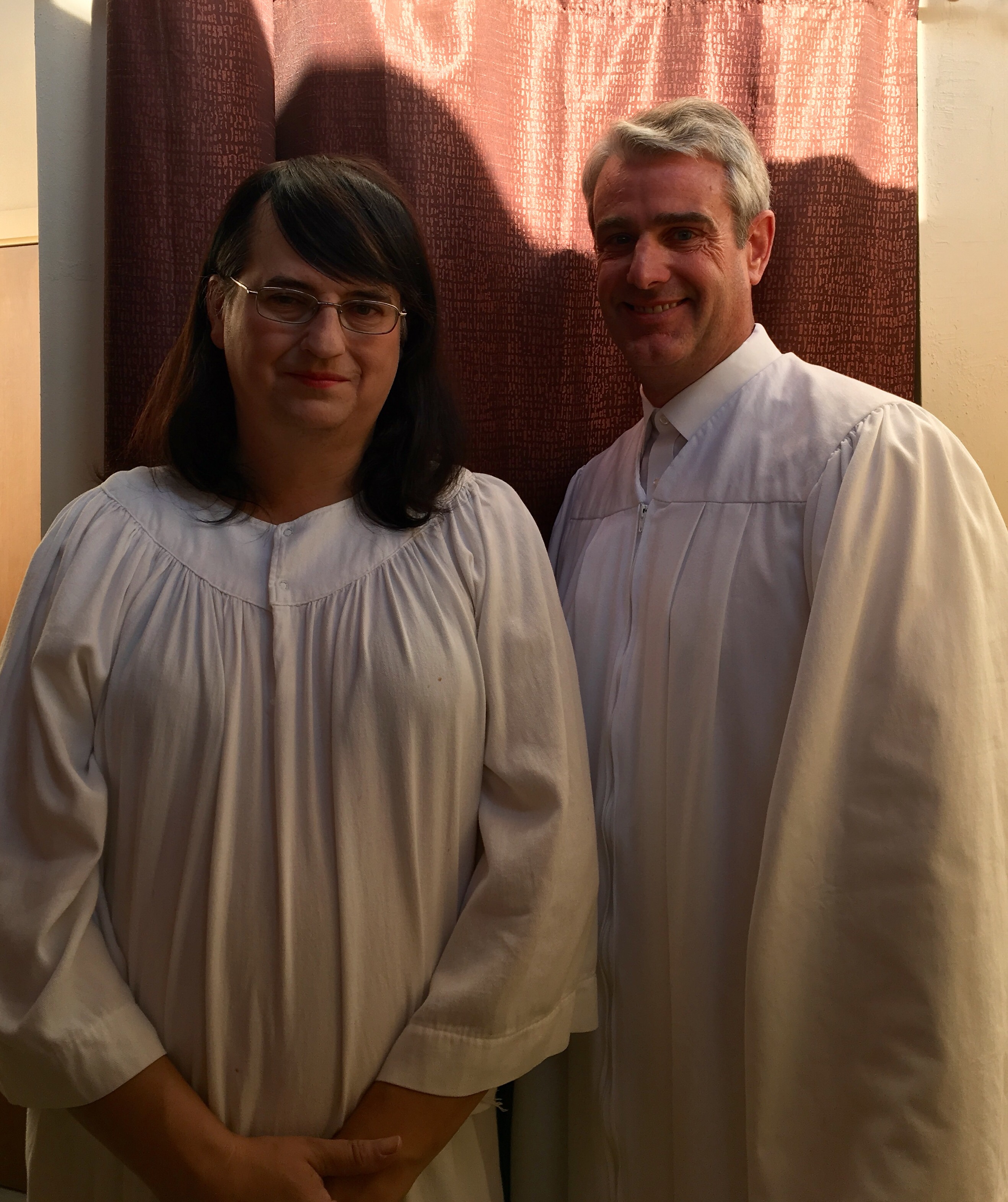
Then, there is the baptism of Traci. Like Lydia, Traci is also a certain woman; however, fortunate for her, she has joined a church that has learned a thing or two from Lydia. For, here at Central Christian Church, the gifts of women are valued just as much as the gifts of men. Traci will be encouraged here to use her gifts to freely follow Christ wherever the Spirit leads.
Traci is not a foreigner. However, since she was not raised in our church, she was a stranger, an outsider to most of us. Therefore, I believe the baptism of Traci reminds us that we have been called by God to reach out beyond our walls and embrace others like Traci who did not grow up in this church, or any church for that matter, so that they will no longer be strangers.
It is as if God is saying: “I know people have heard the Great Commission of the Risen Christ to “be witnesses in Jerusalem, in all Judea and Samaria, and to the ends of the earth” making “…disciples of all nations, baptizing them in the name of the Father, Son, and Holy Spirit…” But I have this bad feeling, that if I do not stir the hearts of people like Traci, and draw them into the renewing waters of the church, enlarging and changing the congregation, then the church might be tempted to become so comfortable with the status quo that they grow apathetic, just uninterested in reaching out to welcome the stranger.
The Rev. Jesse Jackson Jr. told a story at the recent men’s retreat that reminded me of something that happened to my wife Lori a few months before we came to Oklahoma. Rev. Jackson said that he went to a Popeye’s Chicken restaurant one night to get him some chicken. He went through the drive through and ordered a Chicken Combo plate. And lo and behold, the person working the drive thru window told him that they were out of chicken.
Lori had the same experience with a Bojangle’s Chicken and Biscuit restaurant in North Carolina. She went to Bojangles, which is similar to Popeye’s or a Golden Chick, to get her some chicken, only to be told that they were out of chicken.
Lori came home and said, “I am so mad. Bojangle’s Chicken and Biscuits told me that they were out of chicken. She said, “I can understand if they run out of the mashed potatoes. I can maybe even sympathize a little with them if they run out of biscuits. But Bojangle’s, like Jesse Jackson said of Popeye’s, has got no business running out of chicken!”
The baptism of Traci reminds us what the church is all about. If a church is not continually working to break down dividing walls and to build bridges and relationships with those outside the church, with the goal of having several baptismal services a year like this one a year, then the church is like a Rib Crib opening their doors for business when they’re fresh out of ribs! Might as well close down and put a chain on the doors.
After Lydia is baptized, notice the first thing that she does. She extends a gracious welcome to Paul and Silas inviting them stay at her home. Her words following her baptism remind me of our identity statement as Disciples of Christ, “We welcome all to the Lord’s table as God has welcomed us.”
I was on facebook Friday night, and I read these words from Traci’s timeline that are so so reminiscent of Lydia’s words: “Please come and visit Central Christian Church. The service starts at 10:15 am. It is a great church.”
Lydia and Traci remind us that each person in this room who has been baptized, who has been welcomed by God through the gracious hospitality of Christ, should feel compelled by the Holy Spirit of Jesus to go out from this place and welcome all people.
Through the baptisms of a certain woman named Lydia and a certain woman named Traci, I believe God is saying to each of us: “Go out, reach out, tear down a wall, build a bridge, connect, engage, get on facebook, get in a boat if you have to, travel through the streets of places like Samothrace and Neapolis and Philippi and Enid and North Enid and East, West and South Enid, because I need some help! I need some help sharing the good news that all are welcome at my table.”



 Just Love