Rise Up and Live!

Luke 7:11-17

Our scripture lesson this morning takes us back in time with Jesus to the gates of Nain, a small town in Galilee. As soon as Jesus enters the city gates, he encounters a funeral procession for the young son of a widow being carried to his grave.

But I believe Jesus sees more than a funeral. I believe Jesus sees it all. He walks into Nain and sees an unjust system carrying its latest victim to the grave. He sees the only son of a widow, which means, the only source of security for a woman living in a patriarchal world. When her son died, the widow’s future died with him. Jesus sees what happens when poverty and patriarchy crush a family. Thus, this is not just personal tragedy. It’s cruelty. And it’s a social indictment.

And I believe this is what Jesus wants us to see.

But we don’t need a time machine to see this funeral procession in Nain with Jesus, do we? For here in America, we can see it every day.

When billionaires profit from privatized healthcare, while the working poor die from preventable diseases, it’s like we are back in Nain.

When a bill they call “big and beautiful” takes health insurance away from millions of poor people and eliminates grants for medical research so the rich can enjoy tax cuts, it’s like we’re standing at the city gates of Nain.

When food programs for the poor are slashed in the name of “fiscal responsibility” while millions are spent on masked men in unmarked vans kidnapping brown-skinned people who are on the way to school or work, we are watching a very cruel spectacle march by.

When the supreme court denies the right to gender-affirming healthcare, greatly increasing the suicide rate among trans youth, when women are denied abortions, when programs like Job Corps are suspended, when missiles are being launched and bombs are being dropped, when we stand today on the threshold of war, indeed, we are not far from that funeral procession in Nain.

And the actions of Jesus in response to this procession reveal another tragic truth. The tragedy of the funeral procession in Nain is what happens when the powers of injustice, violence and death are normalized. A dead child going to their grave before their time is what it looks like when no one stands up to say: “Enough is enough!”

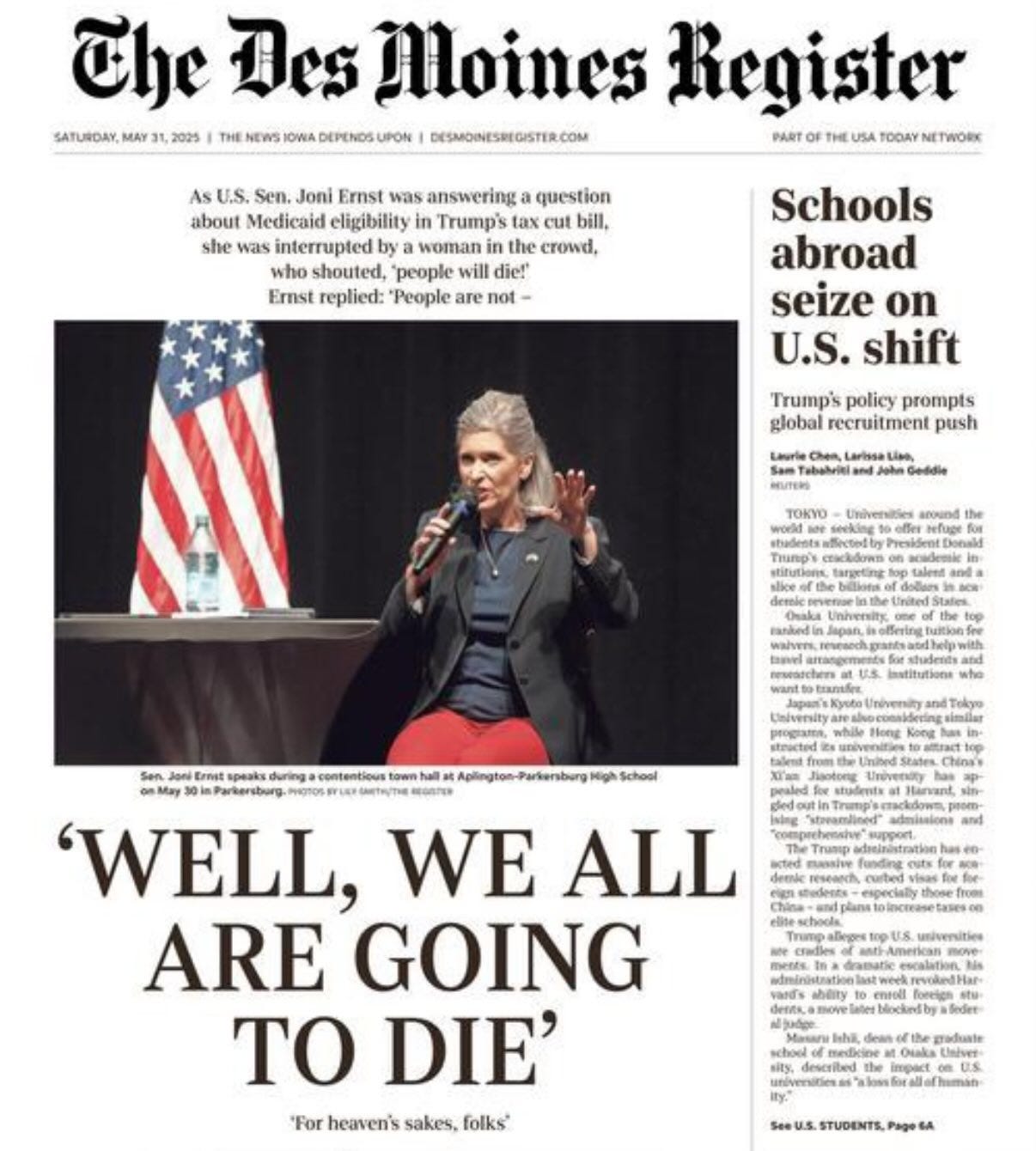
When a U.S. Senator from Iowa stands at the gates of power and shrugs her shoulders at the suffering of the elderly, veterans, children, and disabled folks if Medicare is cut, saying, “well, we are all going to die,” we know are living at the gates of Nain.

The good news is that when Jesus sees the funeral procession, he sees all of it. He sees the normalization of cruelty. He sees the pain of the widow. He sees her poverty. He sees her isolation. He sees the way she is seen or not seen by the political and religious culture. And Luke says, “He had compassion on her.”

As I have pointed out before, that word “compassion” in the Greek is visceral. Jesus felt it in his gut. The word literally means that he was filled with so much compassion, his stomach was in knots. And notice what happens next.

Jesus crashes the funeral. Jesus steps in and stops the procession. He reaches out and touches the bier.

By touching the bier, he touches what others refuse to touch. He breaks cultural, ritual, and religious protocol interrupting death with divine compassion. And then, with the authority of heaven, he speaks directly to the dead: “Young man, I say to you, rise!”

Notice that Jesus doesn’t offer thoughts and prayers. He doesn’t say “Rest in peace” or “God needed another angel in heaven” or, “bless his heart, he’s in a better place.” And he sure in heaven doesn’t say, “Well, we are all going to die.”

Jesus speaks in the face of injustice and death saying: “Rise!”

“Rise!”— That’s the gospel we are called to preach and to live.

“Rise!” is a gospel of protest; not passivity.

It’s a gospel of resurrection; not resignation.
It’s not a gospel that comforts the powerful, but a gospel that confronts the powerful and disrupts the unjust systems of death.

The question that this story begs of us today is: what kind of people will we be?

Will we be the indifferent crowd accepting injustice by following death to the grave, or will we be the disciples who walk with Jesus and interrupt it?

Will we shrug our shoulders accepting that “everybody dies,” or will we embrace a gospel that never shrugs, a gospel that always dares to stop the march of injustice?

These questions are most important today as many Christians have chosen death over life.

Oh, of course they would never confess that. They claim to follow the way of Jesus by being pro-life, but they act in ways that are the exact opposite.

They want to force children to be born into the world while they cut Head Start, undermine vaccines, refuse to fund public schools, stand against raising the minimum wage, deny healthcare, and cut food assistance. They hold press conferences about embryos but pass budgets that kill the most vulnerable among us. They preach “sanctity of life” but value their right to own an assault weapon more than they value the safety of school children. They cry “life is sacred,” but when asked about Medicare, they shrug and say: “Well, we are all going to die.”

That’s not pro-life. That’s pro-power, pro-patriarchy, and pro-political points. It’s s a theology of control, not compassion, and it has nothing to do with Jesus of Nazareth. I believe the church needs to be pro-life the way Jesus was pro-life.

That means pro-human dignity, pro-healthcare, pro-feeding the hungry, pro-housing, pro-living wages, pro-education, pro-immigrant, pro-refugee, pro-disabled persons, pro-LGBTQIA persons, pro-justice, pro-mercy, pro-nonviolence, and pro-peace.

Otherwise, it’s not life. It’s hypocrisy. Otherwise, what is the church good for?

I will never forget sharing with one of my former churches during a board meeting that unless some changes were made, unless we left the comfort and safety of the sanctuary to take the gospel from the pulpit into the public square, I believed the church was going to die.

Do you want to know what their response was?

“Well, we’re ok with that. The truth is, pastor, we would rather die than change anything.” I kid you not.

But I do not believe Christian pastors are called by God to be hospice chaplains for dying congregations. We are not called by God to manage the procession of death. And we are not called to be chaplains of empire or funeral directors for failed, unjust systems.

And we weren’t called to gather here in this place just to sing and sip coffee. We are called to go out and crash the funeral! We are called to disrupt the lie that poverty and cruelty is normal. We are called to touch the bier, to raise our voices, to say to a fragmented and unjust world: “This procession ends here! Rise up and live!”

Because Jesus didn’t come to help us die quietly and peacefully.
Jesus came so that we might have life and have it abundantly!

So, when they say, “well, we are all going to die,” we say:
Yes, that is true, but not all don’t need to die this way.
-Not for lack of access to healthcare.

-Not for a lack of opportunity to get an education.

-Not for a lack of food.

-Not for lack of insulin.

-Not for the lack of a living wage.

-Not because gender-affirming care upsets your privileged, ignorant, black and white, binary religious worldview.

– Not because compassion is considered too expensive and mercy too extravagant.

And not while the Church is still breathing and still following the way and voice of Jesus who says: “Open your eyes and see the suffering. See the injustice. And then step in— and touch the bier. Stand where the pain is. Interrupt the systems of death. Speak to the young people laid in caskets before their time and dare to declare: ‘You were meant for so much more than this!’”

Because healthcare is not luxury. It’s a human right. Compassion is not weakness, and empathy is not sin. It’s divine strength. The church is not called to manage the funeral. We’re called to proclaim resurrection.

So let us go from this place not in silence but in power.

Let us walk to the gates of our cities, our states, and this nation,
and speak like Jesus.

Let us say to our trans siblings: “We see you.”

Say to the poor, the and the disabled: “We are on your side.”

Say to the immigrant: “We stand with you.”
Say to the widow: “You are not alone.”
And say to the unjust systems of death: “Your time is up!”
And to all those who have been cast down: “Rise up and live!”

Because the final word is not cruelty. The final word is not indifference.
The final word is not: “well, everybody dies.” The final word is Jesus, and Jesus says: “Rise!”

So, let the Church rise! Let the people of God cry out at the gates of every system that shrugs at suffering:

To say to politicians obsessed with power and profit: We will not fooled by your pro-life bumper stickers.

To say to the politicians who offer thoughts and prayers but pass budgets of brutality: “We will not be silent!”

Because our Lord is the one who stops the funeral.

Our Lord is the one who touches the bier.
Our Lord is the one who weeps with the widow.
Our Lord is the one who speaks life into the grave and says: “Rise!”

And if we are going to follow that Lord, then we too must rise up, speak up, and lift up every child of God who’s been cast down. Because “everybody dies” may be a fact of biology, but rise up and live!” is the truth of theology!
So, let’s rise!

Dignity Is Not Conditional: Why Exempting Hotels and Farms from Immigration Raids Reveals a Deeper Moral Crisis

ICE will now raid homes but not hotels. They’ll round up families from neighborhoods but not from farms. Why? Because when it comes to immigration, it’s never been about “law and order.” It’s always been about profit and power. Let’s not be fooled: when farms and hotels are exempted from immigration raids, it’s not mercy. It’s exploitation. It’s greed wearing the mask of compassion. It says, you can stay, but only if you pick our fruit, clean our toilets, and stay silent.

However, a human being’s worth is not measured by how fast they can move in the field or how neatly they can make a bed. People are not machines. They are not tools. They are not “the help.” They are children of God, fearfully and wonderfully made, not for our convenience, but for beloved community.

Changing the immigration policy to raid homes but not hotels exposes the hypocrisy at the heart of immigration enforcement in America. It protects the industries that benefit from cheap, undocumented labor while punishing the workers themselves. That’s not justice. That’s not democracy. That’s Pharaoh.

The same Bible many evangelicals use to justify this cruelty also says: “Do not mistreat or oppress a foreigner, for you were foreigners in Egypt” (Exodus 22:21, Exodus 23:9, Leviticus 19:33-34). And let’s not forget Jesus himself was born into a family that fled persecution, crossed borders without papers, and found no room at the inn.

We don’t need immigration policies that ask: “How much can you produce?” We need policies that ask: “How much can we protect?” “How much can we love?” “How much justice can we make real together?

When we only protect immigrants when they’re useful to us, we are saying that dignity is conditional, that love is earned, and that God’s image in someone can be erased by a lack of paperwork. That is not moral. That is not just. And it is the anithesis of the gospel.

We must fight for policies rooted in human rights, not human labor. We must love people not because of what they can do, but because of who they are. And we must remember that no one is illegal. No one is disposable. No one is worth more because they work harder. In God’s economy, every person matters. Every life counts. Every stranger is a neighbor. Every neighbor is kin.

Indivisible, We Rise

John 17:20-26

I was speaking with a colleague recently who shared that she was struggling to balance delivering sermons that are challenging with sermons that are comforting, sermons that are prophetic with sermons that are therapeutic. She said, “because the truth is that we can’t make peace in the world if we don’t know peace for ourselves.” She then added, “but it is so hard these days to preach soothing, comforting sermons when there is so much injustice everywhere.”

I said: “Yeah, I don’t know when I’ll be able to preach what I have heard some ministers refer to as a “sugar-stick sermon” —One of those sermons that just makes everyone feel good.

She asked: “Do you think your congregation may start to complain?”

I said, “Well if they do, saying they just want to come to church to get some serenity, I think…I’ll just have to…I don’t know…encourage them to check out the new Yoga classes we’re hosting, and perhaps give that a go.”

But then I added: “But since I am one of those lectionary preachers, If I’m presented a scripture text that enables me to preach a sermon that will just put everyone at ease, I suppose I’ll consider it. Because I sure could use a sermon like that myself!”

         So, earlier this week when I checked the lectionary and read Jesus’ words in John 17:

My prayer is not for them alone (not just for the twelve). I pray also for [all] those who will believe in me through their message that all of them may be one,

I thought, “maybe this is it!”

I may actually give my poor congregation a break this Sunday by saying something that soothes their souls, warms their hearts, and gives them permission to take it easy, relax a little, because Jesus is praying for us!  What a lovely thought! And what is he praying for? To go out and change the world? No, “That we may all be one,” that we may be brought to “complete unity.”

How wonderful! First Christian has been due a sugar-stick sermon for a while now, and this Sunday they may finally get one!

I don’t know about you, but living in this divisive time is exhausting. And ya’ll, I’m tired. Tired of the tension. Tired of the chaos. Tired of the fighting. Can we just take break?

Could it really be that Jesus is giving us prayerful permission to stop trying to change the world, and to just come together and get along, accept things as they are, you know, agree to disagree?

Wouldn’t that be nice?

Everybody, no matter your religious or political beliefs— just lovin’ life together, saying: “You do you, and I’ll do me.” “Live and let live!” “Tomato, tomahto.”

We can certainly do it.  We know how to do it. That’s what many of us do every time we get together with family, right?

 So, let’s go up on the mountain this afternoon, sing Kum ba yah, agree to disagree, and have some communion!

Now, before we get too excited, I suppose we ought to take a closer look at Jesus’ prayer.

Jesus is praying to God:

I have made You known to them, and will continue to make You known in order that the love You have for me may be in them and that I myself may be in them.

Jesus is praying for us to be in union with him, not with everyone on earth. Jesus is praying specifically for God’s love to be in us as it is in him. Jesus is praying for a divine moral unity, a unity grounded in holy relationship, divine truth, justice, and love.

Jesus is not praying for us to come together with others in order to keep the peace so we can be comfortable, while the fires of injustice rage! No, I believe Jesus is praying for what William Barber calls “a moral fusion.” He is asking God to fuse us together as one holy movement of divine truth, justice, liberation, and love.

Why?

Look at verse 21. “So that the world may believe…” that Jesus, the one who fed the hungry, defended the vulnerable, liberated the oppressed and challenged systems of injustice, was indeed sent by God.

The church is to be a witness for Jesus. But, when the church is divided, that witness is diluted.

When evangelicals wrap Jesus in the American flag but support policies that ignore the cries of the poor, the witness is diluted.

When pastors stay silent on racism, homophobia, transphobia, and xenophobia, just to keep the tithes rolling in, the witness is diluted.

When pulpits are more worried about being politically correct than prophetically faithful, more concerned about keeping their congregants happy with sugar-stick sermons than sermons that inspire them to do something to change the world, the witness is diluted.

Jesus is saying the moral authority of the church is tied to the moral unity of the people.

Now, if we are going to talk about unity in these divisive times, we need to name a prophetic truth. Fascism is not just a political ideology. It’s a spiritual disease. And its first move is always the same: Divide the people.

Fascism doesn’t need a majority. It just needs a divided public. It’s what William Barber has been preaching for 20 years.

  • It tells white workers to blame Black ones for their poverty.
  • It tells rural communities that immigrants are the enemy.
  • It tells churches to obsess over private piety while ignoring public suffering.
  • It stokes fear, fuels scapegoating, and spreads lies that demonize the very people Jesus dignified.

Because the architects of fascism know that a people united in truth is stronger than any regime on earth built on lies.

So, they don’t want unity. What they want is obedience. They’re not interested in justice, just in control. And they don’t ever want the church to ever come together, rise up as one, and start talking and acting like Jesus!

They need the church to bless their injustice with a bowed head and a blind eye.

But Jesus didn’t die for that. He died and rose to inspire a people to refuse to be divided by the lies of empire! He died and rose to inspire people to be united in their advocacy for the poor, the marginalized and the vulnerable—to be united in their efforts to tear down unjust systems that oppress and in organizing the broken into a holy movement for wholeness, while resisting the temptation to turn against one another.

So, let the church rise today, not with shallow calls for peace, but with a deep and defiant unity, a unity that refuses to trade justice for comfort. May pastors everywhere raise their voices understanding that silence is not harmony. It is complicity.

And the good news is every time we choose solidarity over silence, we strike a blow against fascism! Every time we refuse to be divided, we become more dangerous to those depending on our division.

This time in our history is not a political moment. It’s a moral emergency. And through his prayer, Jesus is telling us how to respond. We are to be one.

William Barber preaches the need for a “moral fusion coalition.” A revival of Jesus-rooted unity that brings together all good people to stand up and exclaim: “We will not be divided by race!” “We will not be divided by religion.” “We will not be divided by party!” And we will not be divided by fear!”

A moral fusion is people who love each other and their neighbors enough to fight side by side.

It’s communities coming together to say poverty is violence and silence is also violence.

A moral fusion is pastors linking arms with priests, rabbis, and imams, speaking in a unified voice proclaiming that hate has never made any nation great, and it never will.

It’s houses of worship becoming sanctuaries for the afflicted, not silos for the comfortable.

It’s labor organizers praying with farm workers.

It’s black grandmothers and young white activists marching together for voting rights.

It’s queer teens and disabled elders showing up at the same city council meeting to demand dignity.

It’s not about sameness. It’s about shared struggle.

A moral fusion is not about unity for unity’s sake, It’s about a moral commitment to the least of these. It’s when we stop asking, “What’s safe for me?” and start asking, “What’s faithful to God?” Because a moral fusion doesn’t blend us into blandness. It binds us in boldness!

That’s the unity Jesus prayed for. It’s the unity we are called to live into, and it’s the unity the empire cannot handle!

Jesus prayed that we might be one. And now it’s our turn to become the answer to that prayer. Not just in what we say we believe, but in what we do, how we act, and how we vote. And oh, how the church today needs to reexamine its actions. Because:

  • If your unity doesn’t do something to care for the poor, you need to know Jesus didn’t pray for it.
  • If your unity doesn’t protect the vulnerable, Jesus didn’t pray for it.
  • If your unity silences truth to keep the peace, Jesus didn’t pray for it.
  • If your unity is built on avoiding conflict instead of confronting injustice, Jesus didn’t pray for it.
  • If your unity demands that the oppressed stay quiet so the privileged can stay comfortable, Jesus didn’t pray for it.
  • If your unity won’t march, won’t speak, won’t sacrifice—then it’s not the unity Jesus was talking about.
  • And on this first Sunday of Pride, it must be said, that if your unity is about limiting the rights of LGBTQIA+ people and the reproductive rights of women, you need to know Jesus never prayed for it, never talked about it, or even once ever thought about it!

The unity Jesus prayed for doesn’t come cheap. It costs comfort. It costs silence. And it costs staying out of trouble.

But when we are indivisible with this unity, liberty and justice can truly come for all.

And the good news is: we don’t have to wait for it. Jesus already prayed it. Jesus already declared it. Jesus already called it down from heaven. And the same Spirit that raised Jesus from the grave is the same Spirit calling us today to rise up together!

To rise up with the poor.
To rise up with the forgotten.
To rise up with the queer, the trans, the disabled, the undocumented, the imprisoned.
To rise up not in mere charity, but in solidarity.

Jesus prayed that we may rise up and be as one.
That we may rise up and boldly love as Jesus loved, as God loves.

And here’s some more good news. It may not be what you’d call “sugar-stick news,” but it is hopeful news:

Fascism will not have the final word.

Fear will not have the final word.
And we will not let division have the final word.

Because love still speaks today.
Justice still speaks today.
And unity—moral, bold, dangerous, Spirit-filled, costly unity—still speaks.

Jesus prayed for it.

Now let’s go and be the answer to the prayer.
Go be one. Go be the witness. Go change the world. Amen.

Far from the Shallow Now

Luke 5:1-11 NRSV

One morning, Jesus is preaching down at the lake. The crowd that had gathered is so large, Jesus felt like they were about to push him right into the water!

During the sermon, he sees two boats belonging to some fishermen who were on shore washing their nets. He gets into the boat belonging to Simon, and he asks Simon to anchor the boat a little way from the shore, where he continues his sermon.

Luke doesn’t record the words to Jesus’ sermon, but from his sermon in the very next chapter, we could probably take a good guess: “Blessed are you who are poor, for yours is the kingdom of God. Blessed are you who are hunger now, for you will be satisfied. Blessed are you who weep now, for you will laugh. Love everyone, even your enemies…” It’s a sermon of abundant mercy, extravagant grace, and boundless love!

After the sermon, Jesus tells Simon that he wants to do a little bit of fishing himself: “Let’s leave these shallow waters and let down the nets.”

Simon responds: “Master, with all due respect, I, along with my long-time business associates, James and John, have fished these waters all night long, and we haven’t caught a thing. Yet, if it will make you happy, I will go out a little deeper and put down the nets.”

Well, as soon as the nets hit the water, they catch so many fish that the nets begin to break. They quickly call out to James and John to get the other boat and offer them a hand.  And when they come, they fill the boats with so many fish that both boats begin to sink.

As Simon takes in the overwhelming scene— nets breaking, boats sinking, fish everywhere, a scene of failure and scarcity transformed into triumph and abundance, a scene of what can happen when you leave the shallow to dive into something deeper, what can be experienced when you obey the commands of Jesus—Simon is overwhelmed, and falling down at Jesus’ knees, he says: “Go away from me Lord, for I am a sinful man!”

It was as if Simon suddenly realized that it only seemed that Jesus was finished with his sermon that day. Jesus may be fishing, but he is still preaching. Through the abundant catch of fish, Jesus is still proclaiming God’s abundant mercy, extravagant grace, and boundless love. Believing he is underserving of such love, how unworthy he is of such abundance, Simon asks Jesus to go away.

But Jesus never goes away easily. “Simon, not only are you worthy to receive the abundant, extravagant, over-the-top love of God, you are worthy to share it with others and change this world! So, do not be afraid; for you are no longer going to be catching fish, you are going to be catching people!”

“I am asking you, Simon, along with your business partners James and John, to leave your shallow, contained, little world to venture out with me into a deeper, larger, revolutionary reality.

The truth is, Simon, I need you to go deeper. I need as many people as I can get to go deeper. The problems of the world are too great, and your lives are too short to waste any time wading in the shallow. And the grace of God is too extravagant. The mercy of God is too abundant. The love of God is too boundless for you to keep your it all to yourselves.

I need you to leave your shallow, safe world of spending all your time making a living to meet the needs of your immediate family, and I need you follow me into the deep, risky reality of sacrificing your time to meet the needs of the entire human family!

I need you to leave your shallow life that feeds you, and your children, and accept a deeper life that helps feed every child of God!

I need you to move beyond your shallow, narrow mission of caring for your own home, and accept the deeper, wider mission of caring for the entire planet!

I need you to lose the apathy towards issues that do not concern you and your limited of circle of family and friends to possess a deep empathy towards all who experience injustice!

I need you to move beyond your shallow understanding of success. Simon, no matter what you have been taught, success is not defined by the amount of fish you catch, or the size of your house or back account. It is so much deeper than that!

Your success is measured by how many people you loved extravagantly, abundantly, and graciously.

I need you to go deeper, Simon. You too, James and John, and be my disciples and fish for people. Do the hard, messy, oftentimes frustrating, and risky work to meet the needs of people, to care for and to liberate people. I need you to move far from the shallow now to do the deep work of love. And I am not talking about personal and intimate love, but a love that has public and political ramifications.

Now, here’s what I believe is the real miracle in this story. We read it in verse 11. After Jesus invited them to leave the shallow for something deeper, to leave the fish business to be in the people business we read: “When they had brought their boats to shore, they left everything and followed him.”

This is miraculous because when it came to accepting the extravagant grace and love of God revealed in the large catch of fish, Simon, seemed to have some difficulty: “Get out of here, Jesus! I am a sinful man!”

However, when it comes to following Jesus to a deeper life, to love others to selflessly and sacrificially, extravagantly and liberally, he, with James and John, leave everything and follow.

This is miraculous, because it is the exact opposite of how we humans usually work. We seem to have no problem accepting the grace of God for ourselves. We have no issues receiving the love of God for us personally. But we prefer to keep it shallow. We prefer to keep it personal. We prefer to keep it safe, keep it contained, keep it conservatively to ourselves. We are almost always reluctant to go deeper.

Because going deeper is dangerous. Going deeper is costly, and it is risky. Going deeper can be overwhelming. In the deep, fish break our nets and people break our hearts. Going deeper may mean leaving our friends and family behind.

I want to thank Katie Nunn for sharing her talent with us by creating this extravagant artwork that is adorning our baptistry today. When she first thought of this idea, which to me, speaks to the abundant and extravagant love we are called to share with others, she said she was tempted to think that the art might be “too far out” for church. But then, thinking about what this church means to her and to others, she thought, when it comes to love, for this church, there’s no such thing as being “too far out.”

In other words, Katie has joined a congregation of disciples, who, with Simon, James, and John, when it comes to love, have chosen to go deep, to go far out from the shallow.

We are disciples who have decided to go on a journey to share the abundant mercy, extravagant grace, and liberating love of God with all people, all the while knowing the journey will not be easy, comfortable, or popular.

Late author and professor John Augustus Shedd once said: “A ship in harbor is safe, but that is not what ships are built for.” And today, we are on a ship with Jesus. He is the captain who navigates our journey out of the harbor into deep, dark, and dangerous waters.

The darkness of these days, like deep water, requires more than a shallow response. The times are too serious, and our time is too short, to waste any amount of time playing around in the shallow.

When the president makes an executive order to “eradicate” any opposition to the sick religion of White Christian Nationalism or the cult of MAGA, while disparaging any religious thought that calls for mercy and compassion, empathy, and equality, we must go deeper.

When the tax status of non-profits and institutions that serve the common good are threatened, when aid to the poorest people in the world is cut off, our stewardship practices, our civic engagement and our commitments need to go deeper.

When houses of worship receive warnings by the government that sanctuary provided to the immigrant will not be honored, that we may be targeted, our commitment to the word of God “to treat the foreigner living among us as native born, to love them as ourselves” gets called into the deep (Leviticus 19:34).

When programs designed to celebrate diversity, create equity, and foster inclusion are eliminated in favor of protecting the privileged, our faith compels us to go into the depths of human solidarity and belonging.

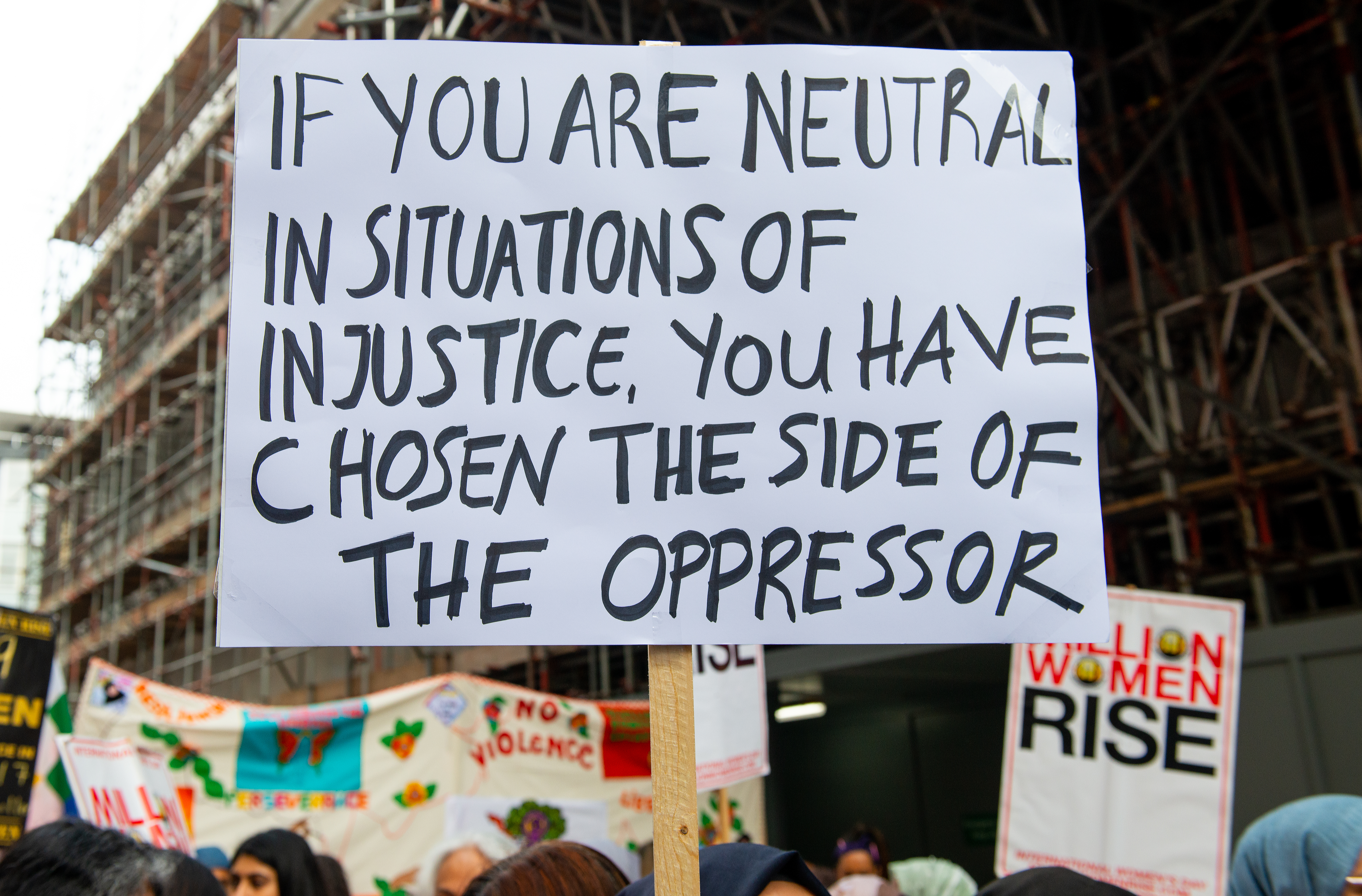
So, if you have come here this morning because you want to dip your toes in the safe shallow end of the pool, to wade, splash around, and enjoy yourselves, to nourish your private, personal relationship with the Lord, to remain neutral when it comes to public policy and politics that hurts the poor and the marginalized, then I am afraid, you have come to the wrong place! We don’t even have a kiddie pool for children in this place, as we are even training them to swim in the deep end.

Because we know that a shallow, safe, personal, and private faith, a faith that has the sole purpose to feed one personally, allows children to starve, and the entire creation to hunger.

A shallow faith allows the spread of a false gospel that is unconcerned with the living conditions of anyone else living on the earth as well as the state of the earth itself.

Shallow faith enables false prophets to reject Jesus, or worse, to act in ways that are the antithesis of Jesus, ways that are anti-Christ, and still claim they are following Jesus.

Shallow faith is afraid to enter into the depths of human suffering and oppression. It finds contentment inwardly, in one’s own family, job, possessions, and even church.

Shallow faith is afraid to rock the boat, afraid of losing a friend or upsetting a co-worker or family member.

Shallow faith is afraid of the sacrifices and the changes that need to be made.

And sadly, church is where people can be the most afraid, and thus the most shallow, the most small-minded and the most close-minded, the most self-interested and self-preserving

But the good news is that church can also be the place where people can be the most courageous, a place where we are challenged to be more open, more selfless, and more self-expending, where we are pulled by Jesus into the deep, dark, and dangerous places, far from the shallow.

To those difficult places where we have a deep conversation with that climate change-denier or anti-vaxer. Where we go out of our way to help an asylum seeker. Where we contact our legislatures to object to the wicked assault on trans people. Where we call out racism and white supremacy wherever we see it, on the school board, the city council, even in our own families.

The good news is that the First Christian ship of Lynchburg, Virginia has left the harbor. Jesus is our captain. And we are far from the shallow now! Amen.

Sorry, Not Sorry, Amen

I don’t know about you, but it seems like the older that I get, the more honest and forthright I become. The filter with which I was taught to cover my mouth doesn’t work as well as it once did.

For example: When any person says that gender is a binary, black and white issue, they are not just being unkind, they are being stupid!

Did I say that out loud?

And when a preacher says it, they are not just being stupid, they are being cruel. And when the President of the United States says it, they are not just being cruel, they are being wicked!

I’m just honestly telling it like it is. Sorry, not sorry.

I used to admire older people who unapologetically told it like it was, affirming their boldness by saying: “Well, at your age, you’ve earned the right to just come right out and say it!”

Now that I am older, I am thinking that it wasn’t so much that they had earned the right to lose their filter as much as they had become aware that their time on this earth was limited.

We just don’t have the time anymore to beat around the bush, to waste precious time mincing and sugar-coating our words. There’s no time to “diddle-daddle around,” as my grandmother used to say.

Or it could be that with age comes wisdom, and we realize that harsh honesty is always better than soft BS!  Speaking a truth flat-out is always better than tiptoeing around that truth, even if the truth makes those around us squirm.

This seems to be the wisdom of the writers of those Psalms we call the “Lament Psalms” which make up about one-third of all the Psalms.

I love these Psalms for their sheer honesty. They are unashamedly real. They openly speak to the reality of our pain, frankly speak to our frailty, and candidly speak of our failures. They also speak straight to the reality of the pain of our world: the plight of the poor; the despair of the displaced, the fears of the vulnerable, the evil of war, and the scourge of disease.

And they hold nothing back when they speak to the wickedness of those in power, and the injustices that ensue, economic and social.

And they speak of the reality of what sometimes seems like God’s apathy or even absence in the world.

In the tenth Psalm, we read the Psalmist honestly questioning:

Why, O Lord, do you stand far off? Why do you hide yourself in times of trouble?

These psalms sometimes speak the truth of what seems like the cruelty of God. In the sixth Psalm, we read:

O Lord, do not rebuke me in your anger, or discipline me in your wrath.”

Professor Walter Brueggemann writes that the Lament Psalms “break the force of denial” teaching us the importance of telling it like it is. They teach us the importance of declaring out loud that things are bad when things are bad. And they teach us to honestly say that when it comes to God, and God’s relationship with the world, even on our best days, we have our doubts.

However, that’s not our tendency, is it? Many of us were brought up to believe that any amount of crying, complaining, protesting, or lamenting means that our faith is weak, that we are being immature, “whiny little babies.” And to ever question God, well, that is simply out of the question!

However, the Lament Psalms move us in the opposite direction. They persuade us to not only tell it like it is, but to publically tell it like it is to God.

And these Psalms teach us that it this kind of truth-telling, that is the key to experiencing the hope we desperately need.

The thirty-second Psalm speaks to the danger of keeping silent:

While I kept silence, my body wasted away through my groaning all day long…my strength was dried up as by the heat of summer.

In other words: “For fear of offending someone, I didn’t speak up, I didn’t tell the truth, and it nearly killed me!”

Psalm 6 is one of my favorite Psalms. For here the Psalmist tells it like it is to God like none other.

2 Be gracious to me, O Lord, for I am languishing;
O Lord, heal me, for my bones are shaking with terror.
3 My soul also is struck with terror,
while you, O Lord—how long?
6 I am weary with my moaning;
every night I flood my bed with tears;
I drench my couch with my weeping.
7 My eyes waste away because of grief;
they grow weak because of all my foes.

 Here the Psalmist tells the truth, the whole truth, to God. There is no holding back, no pretending to be strong because others will think they are weak. There is no denial. This Psalmist keeps it very real. And notice what happens next! Look at what happens somewhere between the verses of seven and eight.

Somewhere between the verses, God shows up. Peace comes. Hope happens. Life is restored. Thus, in verse eight, the Psalmist is able to confidently proclaim:

8 Depart from me, all you workers of evil,
for the Lord has heard the sound of my weeping.
9 The Lord has heard my supplication;
the Lord accepts my prayer.

Now, we don’t know what exactly happened between verses seven and eight. We just know that something happened, and that something was Divine. Somewhere between the verses God breathed new life on the Psalmist. When the Psalmist told it like it was, God showed up.

Maybe God came through a still small voice, or through a wave of peace beyond their understanding. Or maybe God came through love expressed by a friend, or through a visit from a concerned neighbor. Perhaps someone cooked supper and brought it over, or simply offered a listening ear or an empathetic embrace. We just know that somewhere between the verses, God, in some inexplicable yet certain way, came.

We witness this while reading nearly every lament psalm. Whether the lament is honestly expressing personal pain, or the corporate pain of a nation. Listen once more to Psalm 10. The truth the Pslamist speaks is so real that it is still true today, 2500 years later. Listen again to the timeless lament:

2 In arrogance the wicked persecute the poor—

3 For the wicked boast of the desires of their heart,

   those greedy for gain curse and renounce the Lord.

4 In the pride of their countenance the wicked say, ‘God will not seek it out’;

   all their thoughts are, ‘There is no God.’

5 Their ways prosper at all times;

   your judgements are on high, out of their sight;

   as for their foes, they scoff at them.

6 They think in their heart, ‘We shall not be moved;

   throughout all generations we shall not meet adversity.’

7 Their mouths are filled with cursing and deceit and oppression;

   under their tongues are mischief and iniquity.

8 They sit in ambush in the villages;

   in hiding-places they murder the innocent.

Their eyes stealthily watch for the helpless;

9   they lurk in secret like a lion in its covert;

they lurk that they may seize the poor;

   they seize the poor and drag them off in their net.

10 They stoop, they crouch,

   and the helpless fall by their might.

11 They think in their heart, ‘God has forgotten,

   he has hidden his face, he will never see it.’

12 Rise up, O Lord; O God, lift up your hand;

   do not forget the oppressed.

13 Why do the wicked renounce God,

   and say in their hearts, ‘You will not call us to account’?

 And then, it is here, somewhere between verses 13 and 14, that something happens, and again, that something is Divine.

14 But you do see! Indeed, you note trouble and grief,

   that you may take it into your hands;

the helpless commit themselves to you;

   you have been the helper of the orphan.

15 Break the arm of the wicked and evildoers;

   seek out their wickedness until you find none.

16 The Lord is king for ever and ever;

   the nations shall perish from his land.

17 O Lord, you will hear the desire of the meek;

   you will strengthen their heart, you will incline your ear

18 to do justice for the orphan and the oppressed,

so that those from earth may strike terror no more.

Again, we don’t know how it happened, we just know that something happened. Somewhere between the verses, God showed up, as the Psalmist becomes convinced that God who once seemed to be blind to the injustices of the wicked does in fact see!

When the Psalmist honestly and publicly laments: This is not right. This is not fair. This is unjust. This is mean and cruel and evil and stupid. This is wicked. When the Psalmist courageously calls out injustice, calls a spade a spade, a crook a crook, despair is suddenly transformed into hope and sorrow into joy, as somehow, someway, somewhere God comes.

Perhaps someone, having listened to the cries of the powerless, courageously, unapologetically, and yet, graciously, stood up, looked the wicked ones in the eyes and honestly spoke truth to power, pleading for mercy on the behalf of the powerless, making the wicked the squirm in their pews.

Perhaps someone spoke up at a meeting of the city council, wrote a letter to the editor, or honestly corrected a misguided friend or family member who had been brainwashed by lies and misinformation.

Maybe it was something like a group of interfaith clergy who got organized, and in a sign of prophetic solidarity exchanged pulpits to honor a truth-telling prophet named Martin Luther King Jr.

Maybe this small act of solidarity grew into a mighty movement as the group of clergy, who honestly and publicly called out the injustices in the land, the evil of sick religion and the wickedness of greedy politics, began working together with their congregations to feed the hungry, to shelter the homeless, and to defend the marginalized—to stand up for the sacred value and dignity of all persons.

The courageous group of clergy never held back for fear of offending someone, for fear of losing a congregant or a big donation, as they unapologetically renounced the spiritual forces of wickedness in the land and unashamedly resisted evil, injustice, and oppression in whatever forms they took.

Then, their public faithfulness began to inspire others. People throughout the region became more aware, and more wise, knowing that they no longer had the time to diddle-daddle around with their faith. Their time was too short, and the times were too serious.

With hearts wide-open to the honest cries, to the pain, and to the needs of others, especially the most vulnerable in their midst, they understood that they must honestly and publicly take a stand and work somewhere between the verses of lament and the verses of hope, until all of God’s children are able to get those verses where they are able to confidently sing:

O God, you do see! You do hear!  And the arms of the evil doers will be broken. The Lord will seek out their wickedness until there is no more. The Lord will be king forever and ever! Justice will be done for the oppressed. And the wicked will strike terror no more!

Sorry, not sorry, Amen.

A Crowded Table

Sermon delivered during the Interfaith Service of Unity at Peakland Baptist Church in Lynchburg, VA, Thanksgiving Day 2024

Isaiah 25:1-9 NRSV

I begin the sermon with the two questions that are on everyone’s mind today: #1 “Will this divided nation ever come together?” And #2 “When will there finally be peace on earth?”

Nah. That’s not it. The questions on everyone’s mind today are: #1 “What’s for dinner?” and #2 “Who’s all invited?”

The prophet Isaiah answers the first question “What’s for dinner?” with a song about God’s promise of a generous and extravagant table where (as we read in the New Revised Standard Version):

The Lord of hosts will make a feast of rich food, a feast of well-matured wines, of rich food filled with marrow, of well-matured wines strained clear.

I imagine Isaiah adding: “Did I mention we’ll be havin’ well-mature wines and rich food?”

Isaiah understands that life is best celebrated with plenty of delicious food and the best wines, particularly when times have been dark, when the table’s been empty, when the cupboards ae bare—when tyrants have the upper hand, when the shadows of chaos and catastrophe cover a nation, like it is being punished for their poor choices causing the entire creation to suffer.

In the previous chapter of Isaiah, we hear the desperate lament of the prophet:

The earth is utterly broken, the earth is torn asunder, the earth is violently shaken…the moon… abashed, and the sun ashamed (24:19, 23).

A dark shroud of universal dismay and despair covers the land. And there, under the dismal cover of darkness, everything good seems to be wasting away.

Of course, the first thing Isaiah grieves is the wine cellar. Isaiah cries out:

The wine dries up, the vine languishes, all the merry-hearted sigh, the mirth of the timbrels is stilled, the noise of the jubilant has ceased (24:7-8).

It is in this dry, dark, and desolate setting that a shocking announcement is made by the prophet. It comes in the form of a gracious invitation to attend a most extravagant dinner table with rich food and plenty of delicous wine!

Which brings us to the second question on our minds this day. Now that we know what’s for dinner, we want to know who’s all invited?

And here comes the real shock. Who’s invited? All are invited to enjoy the feast.

And notice that it’s like Isaiah understands that such radical inclusion will be difficult for some folks to believe. So, the prophet uses the word “all” five times in three verses to make sure he gets his point across!

In verse 6 we read that the table is “for all peoples.” And just in case some interpret all peoples to mean just the legal, documented citizenry, the prophet adds, “all nations, and all faces.”

Talk about a crowded table! A table where everyone whose got a face is welcome!

“All are welcome.” That’s the words that we are accustomed to seeing outside some of our houses of worship or our meeting places, right? All are welcome. But it was my son who once pointed out the fallacy of that simple welcome. Referring to the sign outside a church building where I once served, he commented: “Dad, all can’t be welcome unless someone is doing the welcoming. A better sign would read, ‘We welcome all.’”

I had never thought about that. But he’s right. For all to be welcome, someone must do the welcoming. Someone must put in some effort. Someone must take some initiative. Someone must have some radical intentionality to create the revolutionary hospitality. Especially if all faces are invited. Especially if strange faces might show up. And most especially if the table is going to be crowded with strange faces.

I will never forget the first time that my wife Lori came home with me to meet my parents back in 1987, a few months before we were engaged to be married. I am very tempted right now to tell you that it was Thanksgiving, but it was actually Easter.

After attending worship that Sunday, my family gathered around a very crowded table for dinner, nine of us scrunched up together to sit at a table made for six. My aunt and uncle and cousin joined my brother, sister, Mom, Dad, Lori, and me. I was sitting at one end of the able. Dad was seated to my left. And Lori was seated to my right.

As my father asked the blessing using the vernacular of King James in 1611, to make Lori feel welcome at the strange, crowded table, I took my foot under the table and gave Lori a little love-tap on her ankle. (Most inappropriate during the high Old English Eastertide blessing my father was offering, but I suppose that’s what made it so much fun). Feeling my affection under the table in the middle of the prayer, Lori made eye contact with me gave me the sweetest little grin. I know, we were so bad.

A few minutes went by, when Lori got the notion to reciprocate, reaching out her toe to tap my foot. But when she looked over at me, she was rather disappointed to see that I didn’t react. So, she did it once more, this time, a little more playfully. But again, I was as cool as a cucumber, sitting there eating my dinner like it never happened.

That’s because it never happened. Lori, in a state of confusion sat back and peered under the table, only to discover that she had been flirting with my father!

But here’s the thing. My dad also never reacted. He too sat there like it never happened.

Now, I can only come up with two explanations for Daddy’s stoic lack of response. The first one, which I refuse to believe, is that is he enjoyed it and didn’t want her to stop. So, the conclusion I have chosen to draw is that he realized that Lori, bless her heart, didn’t really know what she was doing, and thus he made the decision to extend grace. Instead of embarrassing her, he chose to forgive her, accept her, and love her.

To set a crowded table where every face is welcomed, all those at the table must be intentional when it comes to grace, more so if strange faces are present. All the grace Daddy offered that day would have been for naught, if my cousin, or one of my siblings, was gawking under the table judging all the inappropriate footsie carryings-on.

To set a gracious table, one where every face fed feels safe, appreciated, respected, affirmed, liberated, and loved, takes some work, especially for those faces who have not been feeling those things. To set such a table might mean that we have to go so far as to turn over a table or two. It might mean we need to get into some trouble, in the words of John Lewis, “some necessary trouble, some good trouble.”

Because as history as proved, there are always privileged tyrants in the world who believe it’s their role to play the judge: deciding who deserves a seat at the table and who should be excluded or deported.

I believe it is notable that the Hebrew word for “tyrant” is repeated three times in three verses (verses 3, 4 and 5). In Isaiah 13 and 49, we read that Babylon was the tyrant. But here in chapter 25 the lack of a specific reference conveys the frequent cyclical threat of tyrants throughout history—tyrants in every age whose refusal to demonstrate love and grace, to treat every face with equality and justice, benefits them and their friends at the top, while everyone else suffers, while “the wine drys up, the vine languishes, and all the merry-hearted sigh.”

In every generation, there are those seek to enrich themselves at the expense of others. And fearing a revolt of the masses who will certainly suffer, they lie and make up stories, conning the masses to believe that it’s not them and their oligarch cronies who are preventing them from having a seat at the table, sharing in the rich bounty of the table, but it’s some poor marginalized group who’s preventing them.

It’s the poor and the immigrants, the Eunuchs and the sexually different, the widows and the unmarried, we should fear. They are the ones who are poisoning our blood, making us weak, destroying our culture. The tyranny of the greedy and the powerful who are now at head of the table have nothing to do with our low position or no position at the table, or why there is so little on the plate in front of us.

So, not seated at the prophet’s extravagant table set with rich food and fine wines for all faces, are the tyrants. Because the problem with just one tyrant at the table is that all faces will no longer feel welcomed at the table, especially those who hunger and thirst for a seat at the table, those who have been the victims or the scapegoats of tyranny. These were Isaiah’s people, the faces for whom the prophet was most concerned: the faces of all who have been pushed to the margins: the faces of widows and orphans, the faces of Eunuchs and foreigners, the faces of the poor and needy.

This is the sacred table I believe people of faiths are being called to set in our world today: a large, crowded table where there is no injustice, no bullying, no cruelty, no hate, and no oppression whatsoever.

Setting such a gracious table will most certainly require possessing the courage to flip a table or two, as we will have to work diligently to prevent anything, or anyone, opposed to love from taking over the table.

Public dissent is essential around the table, because the one thing that tyrants count on is the silence of others. As the old German saying goes: “If one Nazi sits down at a table with nine people, and there is no protest, then there are ten Nazis sitting at that table.”

However, when the nine stand up, speak up, and speak out, taking steps to ensure that just love remains at the table, either the fascist will leave the table, taking their prejudice, fear, hate and toxicity with them, or they will find grace for themselves, experience liberation and redemption, and be given a welcomed place at table.

And in the safe space of the table, as the people eat and drink together, as they share their grief and cry together, as they are filled with grace and love together, the dark shroud that had been covering their world will begin to dissipate, and suddenly they will once again be able to celebrate and to laugh together.

Gathered around the crowded and diverse table, Palestinian and Jew, Ukrainian and Russian, Indigenous people and colonists, queer and straight, documented and undocumented, able-bodied, and differently-abled, brown, black and white, all God’s children begin to understand that they share more in common than that which divides them, most importantly, one God, one Lord, and Creator of all faces. And there around the prophetic table, they are able to see their great diversity as the very image of God.

So, what’s for dinner?

As prejudice leaves and fears are relieved and tears are wiped away, mercy and compassion are for dinner.

As disgrace is forgiven and barriers begin to fall, grace and love are for dinner.

As despair dissipates and sorrow fades, hope and joy are for dinner.

As plates are passed and the wine is consumed, as people are seen, their voices are heard, and their beliefs are respected, as enemies become friends, and strangers become siblings, peace and salvation are for dinner.

And who’s all going to be there?

Here, now, this afternoon, tomorrow, next year, and well into the future, around our family tables, around the tables of our faith, around the table of our city, around the table of our nation, around the table of the earth, all who believe in love and need love, all who hunger and thirst for justice, are going to be there! Your faces are going to be there, and my face is going to be there. We are all going to be there, regardless of our religion or lack thereof, ensuring that no one and no thing opposed to love, no matter how powerful, will be there.

And the good news, proclaims Isaiah, is that our hungry and thirsting God will be also there, seated in our midst at the very crowded table, swallowing everything in heaven and on earth that divides us from one another, and consequently, from the love of God.

God will be there with a ravenously righteous appetite, swallowing even death, forever. And the most divided of nations will be united as all become one, and on earth there will be peace, as the entire creation is born again. Amen.

Deviled Ham

torches2

Luke 8:26-39 NRSV

Today’s gospel lesson is one of my favorite stories of Jesus. There is just so much from which to glean from all of the rich symbolism in this story.

Then they arrived at the country of the Gerasenes, which is opposite Galilee.

The opposite of Galilee. The opposite of home. The opposite of familiarity. The opposite of comfort. The opposite of sanctuary.

I believe it is important for the church today to note that the man in this story would have never had an encounter with Jesus, an encounter that brought him liberation, healing and restoration, if Jesus and his disciples stayed in Galilee.

This is one of the reasons I am so grateful for our Disciples Women Fellowship that has chosen to serve at Hope Campus twice a month. If we want to follow Jesus as his disciples, the church must be willing to leave the sanctuary to encounter people who need the liberation, healing and restoration that we know the love of God can bring.

As he stepped out on land,

Jesus and his disciples had just encountered a storm out on the lake, and now, as soon as Jesus steps out of the boat, they encounter a different kind of storm.

 a man of the city who had demons met him.

A man of the city—reminds me of another story of Luke, when “a woman of the city who was a sinner,” anoints Jesus’ feet. Right away, we get the suspicion that this man had a sinful reputation.

For a long time, he had worn no clothes, and he did not live in a house but in the tombs.

And here is where we begin to get the picture that this man of the city is not the only sinner in this story. He is unnamed, naked, and homeless, and he lives among the dead. He is treated as if he was no longer alive, as if he did not exist. He is fully debased, degraded and dehumanized with no rights, no privileges, no power, and no place whatsoever in society.

 Jesus then asked him, “What is your name?” He said, “Legion”; for many demons had entered him.

He has been driven to the margins of life by the Legion. Legion is a technical term for a division of the Roman Army. Thus, it is revealed that this man is a victim of the Roman Empire and its oppressive systems that do great harm to people like him.

We don’t know exactly what that means, “people like him,” but, sadly, we could make some good guesses:

Could it be that he spoke a foreign language? Was he an undocumented immigrant or refugee? Perhaps he had a different skin color? Maybe he practiced some kind of minority religion? Did he have cerebral palsy, autism, a Traumatic Brain Injury, down’s syndrome, or post-traumatic stress disorder? Did he suffer with seizures? Could it be that he suffered with some sort of mental illness? Might it be that he was gay or transgendered?

Not only is he a victim of unjust political systems, he is also a victim of his community. Unfortunately, that is the power of government: if the state leaders are against you, then it gives permission for society to be against you.

He’s labeled “demon possessed” which means he has been fully “other-ized.”

There is no evidence that he has ever harmed anyone, yet, he is “bound with chains and shackles” and “kept under guard.”

He is not to be counted in the census. There is no path to citizenship, no process to appeal. There is no grace.In an act of gross dehumanization, he is forced to live among the dead until he dies.

This is the evil of our world. It is not a spirit that might make us take off all of our clothes and take up residence in a cemetery. No, the evil of this world is the the chaining of this man, the oppression of this man, the dehumanizing treatment of this man, treating him as if he did not exist among the living, shackling him naked in a graveyard, is the true demonic evil in this story.

And for Jesus and his followers, this type of evil should always be brought out and driven out. Jesus is never happy when any person is demeaned, degraded, dehumanized and excluded from community. Whenever Jesus encounters chains, Jesus breaks the chains. The good news is that every time we draw a line that keeps people out, Jesus is with the people on the other side of that line.

This demonic evil, this anti-Christ spirit that possessed the state and the culture to oppress this man is further revealed in the fascinating account of the demons leaving the man and entering a herd of pigs that were minding their own business, innocently feeding on a hillside. As soon as the pigs get infected by the demons, they immediately rush down a steep bank, and they drown in the lake.

I once heard a preacher joke that it is right here in this story that we have the first recorded instance of “deviled ham.”

I know, it’s a terrible joke. Sounds like the kind of thing we might hear Jim Creekmore might say. The poor pigs. What did they do to deserve to become agents of evil? And how could Jesus do such an inhumane thing to any of God’s beloved creatures?

However, we soon discover that these poor pigs were infected with evil long before Jesus showed up.

Notice what happens when Jesus liberates this man (verse 37). When they find the man is liberated, do all the people thank Jesus? No, all the people, “all the people in the surrounding country beg Jesus to leave their presence.”

The demonic evil here is not only the oppression of this man by unjust political systems and a fearful culture, but that the people valued their pigs more than the man’s liberation. The people would rather keep their pigs, their income, their stock values, their privilege and power, rather than see this man set free. This is what made this herd of ham so deviled.

If it means losing some pigs, keep the man shackled.

If it means losing some pigs, crucify the liberator.

If it means losing some pigs, succeed from the union.

If it means losing some pigs, assassinate the preacher.

If it means losing some pigs, suppress the vote.

If it means losing some pigs, oppose the minimum wage.

If it means losing some pigs, then ban foreign nationals of another religion. Separate families. Close the border.

If it means losing some pigs, then resist equality, forget fairness and defend discrimination.

If it means losing some pigs, then keep quiet. Stay silent and stay put. Learn to live with injustice.

If it means losing some pigs, then stomach the murder of children. Be okay with torture. Endure endless war.

If it means losing some pigs, then water down the gospel. Ignore evil. Neglect the poor. Send the stranger away. Don’t feed the hungry. Don’t heal the sick, and whatever you do, don’t do anything to follow the sacrificial way of Jesus. Don’t love others as you love yourselves.

If it means losing some pigs, keep the man naked, chained and guarded.

The truth is, that whenever a person or a group is liberated from oppression, there is another person or group that has some deviled ham to lose, some things that they value more than another’s freedom.

So, a good question for us is, what is our deviled ham? What do we value more than another’s freedom?

Patriarchy? White supremacy? Heterosexism? Religious superiority? Homogenous cities and neighborhoods? Homogenous churches? Cheap fast food? Inexpensive coffee? Inexpensive clothing? Easy and quick access to guns?

Another question is: are we ready to leave Galilee? Leave the familiar and the comfortable in order to bring liberation, healing and restoration to another. Are we willing to leave home so others can have a home?

The man from whom the demons had gone begged that he might be with him; but Jesus sent him away, saying,

“Return to your home, and declare how much God has done for you.” [Restored to his community,] he proclaimed throughout the city how much Jesus had done for him.

Desiree Adaway, a consultant, trainer, and coach who helps to build equitable and inclusive working environments in companies and organizations including: IBM, United Airlines, The Girl Scouts, and Rotary International, writes:

We are all socialized into systems that oppress.

We learn to accept oppression as normal.

We are born into a social system which teaches us to accept things as they are.

We are rewarded for accepting things as they are.

We are congratulated for accepting things as they are.

We become “model members of society” when we accept things as they are.

We gain comfort, money, connections and power when we accept things as they are. People who go against the grain, pay the price.

I know [there’s] a tiny voice deep in your heart is saying “I do not oppress people.”

That might be true, you may not actively oppress others- but here is the reality- oppression is still happening, because this cycle and the systems they support continue to run uninterrupted.

Oppression is the norm, not the exception.

Justice is the exception, not the norm.

Institutions influence individuals and individuals influence institutions.

This process is pervasive, consistent, circular, self-perpetuating, and invisible.

The simplest thing to do is nothing.

But we have failed to realize that we have become participants in our own oppression by doing nothing.

Will you take responsibility for the oppression that continues? Will you stand up and confront the systems, rules, and norms?

How, where, and when you confront injustice is irrelevant, as long as you do it.

You and I are responsible for interrupting oppression. We are responsible for dismantling it. We are responsible for creating new systems and ways to share social power.

Society will not transform itself. We have to break the chains.

We all have to pay the price, so that can happen.

Let’s get to work y’all, because freedom ain’t free.[i]

[i]https://desireeadaway.com