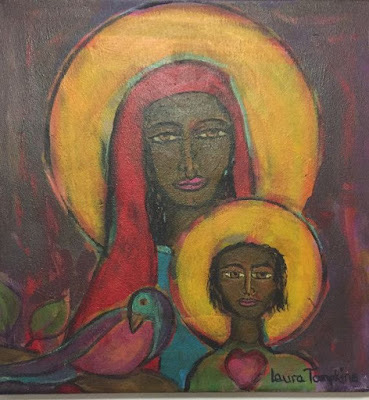
Christmas Contemplation

Luke 2:41-52 NRSV

It’s only been a few days since we celebrated his birth, but we fast forward twelve years when we read this morning’s lectionary gospel lesson where, in the same chapter of the story of his birth, Luke tells a story of 12-year-old Jesus that sounds something the contemporary holiday classic movie Home Alone.

After visiting Jerusalem for the Passover festival Mary and Joseph, with other members of their family had packed their bags and boarded the plane. From their seats in coach, they couldn’t see where Jesus was sitting, but assumed he as sitting somewhere among the large crowd of passengers. After a long day of travel, as they were retrieving their luggage from the baggage carousel, they picked up Jesus’ suitcase and handed it off to someone who began passing it down the line of relatives to Jesus, but at the end of the line, there’s no Jesus.

Because the boy never got on the plane and was now lost in New York, I mean Jerusalem.

It took three days of frantic searching before they found him in the temple, sitting among the rabbis, listening to their teachings, and asking questions. Don’t you wonder what questions twelve-year-old Jesus had for the Rabbis and what answers he gave in response to their questions that amazed all who heard him that day?

But it’s not Jesus’ questioning that gets my attention in this story. It’s Mary’s questioning. For I love the way Luke describes it: “Mary treasured all these things in her heart.”

The Greek word translated treasure means “to thoroughly keep.”

The thinking of Mary is thorough. Her questioning is meticulous and scrupulous. She thoroughly thinks it all through. Mary wonders, ponders, considers—she “treasures” the significance of what has happened.

And maybe, on this first Sunday after Christmas, this should be the mind of every disciple. A mind that is thoroughly evaluating and reevaluating, thoroughly questioning and wondering, thoroughly meditating and contemplating the meaning of Christmas.

What does it all mean to us? What does Christmas mean to the world? What does it mean to have faith in a God, who we believe is the creator, the source, and the essence of all that is, a God who we believe is Love love’s self becoming flesh, in the most humble, most selfless and most vulnerable of ways, to dwell among us, being with us, living in us, living through us, living for us, for all people, for the entire creation?

One of my favorite preachers, the Rev. Karoline Lewis writes: “Mary invites us into that contemplative space…not to obtain answers, but to ponder God’s place in and purpose for our lives. Mary summons us to sit and wonder…[reminding] us that an essential act of discipleship is reflection. Because none of what God is ever up to should be easy to get or at once understood.”

Lewis suggests that the best gift the church can give to people at Christmas is the gift of a safe and brave place for their own ponderings, a gift of space where reflection, questioning, and even doubting, are welcomed, and even encouraged, a gift of time that “demands only meditation and musing.”[i]

Especially in these days, when thinking doesn’t seem to be in vogue.

I’ve said it. You’ve said it. We’ve all noticed it. “Our country has a critical-thinking crisis.”

Well, we may not have put it in those exact words. But on this First Sunday after Christmas, it’s just not very nice using words like “stupid” or “idiots.”

We live in a world where there seems to be little time for any silence, much less for any meditation and contemplation. These days people are quick to allow others to tell them how to think and what to think without any questions. It’s what makes Fox News, some places on the internet, and churches where people are expected to check their brains at the door both popular and dangerous.

For a world where reasonable, reflective, critical thinking, and intelligent discourse have lost favor is a world that breeds authoritarianism and supports fascism. It is a world where an unstable, wannabe dictator can get a way saying something as ridiculous as: “What you are seeing is not happening.” And, without question, people will believe him.[ii]

I believe it’s fair to say that the lack of critical thought can be blamed for the most heinous and evil of all world events as it has led people to believe that something that is as obvious as our common humanity does not exist, to believe that one race, one nation or one religion is superior to another or favored by God over another, to believe that some people are cut-off or separated from God, while others are close to God.

So, perhaps the best sermon a preacher can preach on this Sunday after Christmas is one that invites us to join Mary after finding Jesus in the temple that day. It’s a sermon that gives us permission to think—a sermon that encourages us to follow the example of Mary to think deeply or to “treasure in our hearts” what this miraculous event we call Christmas truly means, to ask what our hearts are telling us in response to divinity becoming humanity, to the holy becoming flesh, to Love, love’s self, becoming a part of the creation and dwelling among us.

Franciscan Friar Richard Rohr, founder of the Center for Action and Contemplation, writes that contemplation is a way of “listening with the heart” in such a way that it awakens a new consciousness that is needed to create a more loving, just, merciful, and sustainable world.

Contemplation is the practice of being fully present—in heart, mind, and body—that allows us to creatively respond and work toward what could be. Contemplative prayer helps us to recognize and to sustain the Truth we encounter during moments we experience great love and great suffering, long after the intensity of these experiences wears off.”

So, on this Sunday after Christmas, let us ponder and wonder Christmas. Let us meditate and contemplate Christmas. Let us treasure Christmas. Let us make time for silence, and take time in silence to question our hearts and to listen. Not to hear the answer of popular culture, the answer of politicians, or even the answer of your church (and should I dare say) not even the answer of your pastor. Let us listen to hear a truth where Christmas becomes more than something we celebrate for a season, but a way of life that informs our being and instructs our living all year long.

Let us make time in these days of Christmas to listen to our hearts. What are our hearts telling us this morning about God being born as a vulnerable infant, in the body of a brown-skinned, Jewish Palestinian, to an unwed mother?

What are our hearts saying in response to a choir of Angels who invite not the rich and the famous to see the baby, but poor, lowly shepherds, those working the nightshift out in the fields tending to the sheep of another?

What do our hearts say when we read that the ones who feared the baby the most were those with the most privilege and power?

What are our hearts telling us when we hear the story of the baby and his parents fleeing their country as desperate refugees, crossing the border into Egypt as undocumented immigrants?

Father Rohr contemplates Christmas:

If we’re praying, [Christmas] goes deeper and deeper and deeper. If we are quiet once in a while…it goes deeper and deeper and deeper still.

There’s really only one message, and we just have to keep saying it until finally we’re undefended enough to hear it and to believe it: there is no separation between God and creation.

         This is the good news of Christmas, because, as Rohr observes:

Separation is the sadness of the human race. When we feel separate, when we feel disconnected…from our self, from our family, from reality, from the Earth, from God, we will be angry and depressed people. Because we know we were not created for that separateness; we were created for union.

So, God sent one into the world who would personify that union—[one] who would put human and divine together; [one] who would put spirit and matter together.”

[When we] wake up in the morning pondering and wondering: What does it all mean? What’s it all for? What was I put here for? Where is it all heading?

Rohr muses:

I believe it’s all a school. And it’s all a school of love. And everything is a lesson—everything. Every day, every moment, every visit to the grocery store, every moment of our so-ordinary life is meant to reveal, ‘My God, I’m a daughter of God! I’m a son of the Lord! I’m a sibling of Christ! It’s all okay. I’m already home free! There’s no place I have to go. I’m already here!’” Rohr then adds “But if we don’t enjoy that, if we don’t allow that, basically we fall into meaninglessness.[iii]

Rohr considers:

Friends, we need to surrender to some kind of ultimate meaning. We need to desire it, seek it, want it, and need it.

I know no one likes to hear this, but we even need to suffer for it. And what is suffering? Suffering is the emptying out of the soul so there’s room for love, so there’s room for the Christ, so there’s room for God.

On this first Sunday after Christmas, let us thank Mother Mary— For giving us permission to be still, to get quiet, to meditate and to contemplate, for encouraging us to ponder and to wonder, to find a safe and brave space to listen to our hearts to find meaning, purpose, and belonging, to empty our souls making room for love, to be enveloped with grace and held in love by the source and essence of all that is.

[i] https://www.workingpreacher.org/dear-working-preacher/keeping-company-with-mary

[ii] https://www.bbc.com/news/av/world-us-canada-44959340

[iii] https://cac.org/daily-meditations/only-one-message-2021-12-24/

Righteous Rage

Shirt can be ordered at https://pavlovitzdesign.com

John 2:13-22 NRSV

Psychologists have identified four stages of anger.[i] The first stage is when we are “annoyed.” Studies have shown that most people become annoyed a few times per day when someone or some situation becomes bothersome or irritating to us.

I am sure Jesus was annoyed as often as we are, if not more often. I believe we can read one example in Mark, chapter 2, when Jesus enters the synagogue on a sabbath and encounters a man with a withered hand. Although the Pharisees believed it was unlawful to heal on the sabbath, Jesus compassionately heals the man and then looks at the Pharisees “with anger” says Mark; for he was “grieved,” or I believe one could say, “he was very annoyed,” by their “hardness of heart.”

When we are annoyed and feel our stress levels begin to rise, we’ve moved into the second stage of anger: “frustration.” In this stage, we’re still able to think rationally, but because of our dissatisfaction with what’s happening, it might not be as easy to stay calm and clearheaded.

 A few weeks ago, we read an account of Jesus being frustrated when he encounters a leper, and according to Mark, is “moved with pity.” I pointed out that scholars agree that the Greek text is best translated, “moved with anger,” and I said it was not so much the disease of leprosy that angered or frustrated Jesus, but it was what the disease did to a person socially, excluding them from community.

The third stage of anger is “hostility.” We get to this stage when there’s been a large build-up of stress, pain, or anxiety. Things become so frustrating, we find it difficult to stay calm or to speak politely.  Have you ever heard the saying: “That’s enough to make a preacher cuss?” I could tell you some stories, but this is not the time nor the place. Maybe down in the fellowship hall Wednesday night, or better yet, downtown at the brewery Thursday evening. An example of Jesus becoming hostile may be last week’s gospel lesson when Jesus, calls Peter “Satan.”

Then we have the fourth stage: rage. This is the stage where we lose control. We lash out physically, like throwing an object, like silver coins, or turning over a piece of furniture, like a table in the temple, or we may threaten violence, like making a whip of cords and chasing everyone out of the room, even the sheep and the cattle.

 I don’t believe there’s better example of Jesus demonstrating rage than this temple scene in today’s gospel lesson. And a good question for those of us who are seeking to emulate Jesus is: What moved Jesus from simply being annoyed to a fit of rage?

To interpret this text, it is important to note why this is our lectionary text in the season of Lent. Our text begins: “The Passover of the Jews was near.” To commemorate the story of the Israelites’ protection from the Angel of Death and their Exodus from Egyptian slavery, Jewish people were coming from all over to purchase animals in the temple to make religious sacrifices to God so they could get right with God, experience some love and favor from God. To get right with God, people with means had enough money to purchase cattle or sheep, whereas people who were poor scaped up the little money they had and settled for the doves.

That the religious leaders were making a profit by leading people to believe they could not experience Divine favor unless certain conditions were met, enraged Jesus so that he made a whip and chased them out of the temple, pouring out their coins and turning over their tables, while specifically instructing those who were selling doves to the poor, “Take these things out of here!”

The Jews, who are now unable to purchase sacrifices to observe Passover, become fearful that they would be unable to get right with God. So, they confront Jesus: “You better be able to come up with a pretty good sign to prove to us that we don’t need to make sacrifices to experience God’s love!”

And it is then that Jesus responds, “Destroy this temple, and in three days, I will raise it up.” John tells us that Jesus was speaking not of the building in which they stood, but the temple of his own body.

I believe John is emphasizing that in the incarnation of Jesus, the good news of God’s unconditional love is enfleshed or embodied. In the words of Revelation 21, “God’s dwelling place is now among the people” with Jesus modeling the way.

This should not lead anyone to believe that the presence of God has departed from the Jewish faith or that Christianity supersedes any other religious tradition. Rather, from a Christian perspective, the good news that every person is loved by God just as they are, is enfleshed in anyone who follows the way of love that Jesus embodied.

Mahatma Gandhi was annoyed and frustrated when he famously said:

I like your Christ, but I do not like your Christians. Your Christians are so unlike your Christ.

This, of course, is the main problem of the church today. While there are many faith communities loving others selflessly and unconditionally, too many Christians have succumbed to their thirst for power and control.

Today, this is demonstrated whenever the church seems more concerned about the survival of the institution than the needs of people; whenever service in the community is performed in hope of gaining new members, rather than out of compassionate concern for neighbors in need; and whenever gatekeepers are appointed to determine who belongs in the family of God and the hoops through one must jump to be in community.

Instead of embodying the good news of God’s love for all people through acts of grace and mercy, the church today looks more like a set of rules designed by the powerful and the privileged to keep people in line and the marginalized in their place.

Christianity looks like a religion based more on nationalism than on following the way of love that Jesus modeled. It looks like a religion built on guilt, obligation, and fear, a religion whose purpose is to keep people out of an eternal hell while ignoring the hell humanity has created in God’s good creation.[ii]

A religion. This is what really enraged Jesus, that people took something as pure and wonderful and holy as the unconditional love of God and made it into a religion.

While I was pastoring a church right out of seminary back in 1993, a deacon in our church asked me where I saw myself in twenty-five years. I told him that I believed that I would still be pastoring a church somewhere.

He laughed out loud.

“What’s so funny?”   I asked.

“I see you more as the type who might be teaching in some college somewhere or directing a non-profit. I don’t think you are going to be a pastor.”

“Why do you say that?”

He said, “For one thing, pastors are generally religious people. And you, my friend, are not very religious!”

What this deacon failed to realize was that the church is not a religious organization. And the last thing a Christian pastor should be is religious.

Let me share with you what I think is a good definition of religion.  It comes from the late Episcopal Priest Robert Capon: “Religion is the attempt by human beings to establish a right relationship between themselves and something beyond themselves which they think to be of life-giving significance.”

This is what enraged Jesus so, that people have been made to feel that they must be religious, jump through some religious hoops, to get right with God. They believe if they make the right sacrifice, say the right prayers, believe in the right creed, behave the right way, avoid the right sins, then they can earn some Divine favor.

This is why we call the unconditional love of God Jesus taught and embodied “the gospel.” This is why we call it good news. If we called it religion, it would be bad news. Religion would mean that there was still some secret to be unlocked, some ritual to be gotten right, some law to obey, some theology to grasp, or some little sin to be purged.

Now, don’t get me wrong. We don’t need religion, but I believe we still need church. However, we do not need church to get right with God. We need church to discover ways we can get right with our neighbor. We need church to discover ways we can get right with the planet. Because what this world needs more than anything else today is not more religious people who believe they possess the keys to salvation, but more people to come together to love their neighbors, their communities, their cities, the entire creation, with the unconditional, unreserved, unbounded love of God that Jesus embodied.

Or maybe, in the words of Ziggy Marley, we need more people who simply make love their religion. Not for the sake of getting right with God, but for the sake of love and only love.

Because when love, just love, is our religion, we are free to volunteer at Park View Mission and truly love our neighbors purely, unconditionally, authentically, without any thought of persuading them to worship or believe like us.

When love is our religion, we are free to serve selflessly and sacrificially in our community without any temptation to ever say anything like: “Look at us. Look how good we are. Don’t you want to join our church?”

When love is our religion, we are free to purchase learning kits to help children living in poverty prepare for kindergarten with no strings attached, with no hidden agenda whatsoever, just love.

When love is our religion, we are free to pray earnestly for Palestinians in Gaza, give to organizations like Week of Compassion to support humanitarian aid for those who are suffering with no other intention but to love our neighbors as we love ourselves.

When love is our religion (just love, for the sake of love), when we love freely, unconditionally, unreservedly, fully, and purely, I believe we look like the enfleshed presence of God in the world.

And that, I believe, is what makes Jesus very happy.

And that, I believe, is what makes Jesus very happy.

[i] https://reallifecounseling.us/blog/stages-of-anger

[ii] https://www.ucc.org/sermon-seeds/sermon-seeds-transactionalism/