Reigning from the Cross

world_in_handsLuke 23:33-43 NRSV

Today is the last Sunday of the Christian Year.  It is called “Christ the King Sunday” or “The Reign of Christ Sunday.”  It signifies that at the end of it all, Jesus Christ has the last and final word.  And in this world of so much suffering and pain, oh how we need a day like today!  Oh how we need to be reminded that when it all boils down, when it all pans out, Jesus Christ is our ruler and our king. When it is all said and done, Jesus the Christ is ultimately in charge. Today is the day that we reassure ourselves that no matter how bad life gets, no matter how distressed, fragmented and chaotic life becomes, Christ is always in complete control.  “He’s got the whole world in his hands,” as we all like to sing.

Now, in this world of heart ache and heart break, the truth that Christ is the king and ruler of it all is always supposed to bring us great assurance and peace.  However; although none of us good God-fearing, church-going folks like to admit it, this truth of God’s complete reign over this world usually brings us the exact opposite.

Think about those times you were reminded by someone, albeit with good intentions, that “God is in control.”  When Lori and I lost our first child two months before the due date, people came up to us and said, “Don’t let this get you down.  Just remember that God doesn’t make any mistakes.”

After the doctor gave you the news that the tumor was malignant, people came up to you and said, “Don’t worry, God knows what God is doing.”

When people learned that you were going to lose your job, they reminded you, “It is going to be alright, for God is in control.”

At the graveside of a loved one, your friends and family lined up between you and the casket and whispered: “God has a reason for this.”

And very politely, we nodded. We even thanked them for their words with a hug or a handshake.  But then, a short time later, after we dried our tears, after we came to our senses, while we were sitting quietly at home or while we were out on a long drive, or maybe sitting in church, we began to reflect and to ponder those well-intended words. We began to think to ourselves: “If God is really sitting on some providential throne in complete control of this fragmented fiasco called life, this disastrous debacle called the world, then what type of ruler is this God? What type of king sits back and allows so much evil to occur in their kingdom?

Christ the King—what is supposed to bring us great strength, peace and comfort, instead brings us frustration, anger and doubt.  Christ the King—what is supposed to bring us assurance and hope brings us utter misery and despair.  And we are very much tempted to join all those who laughed and ridiculed Jesus: “Umphh!  King of the Jews! Some King!”

I have said it before, and I do not mind saying it again—If  God is the one who willed our first baby’s death, causes tumors to be malignant, gets us fired from our jobs, and takes our loved ones from us, then I really do not believe I want anything to do with a god like that!  I think I would rather join the millions of people who have chosen not to be in church on this Sunday before Thanksgiving.

The good news is that I am here. And I am here to thank God that God is not the type of King who decrees the death of babies, pronounces malignancies, commands layoffs and orders our loved ones to be suddenly taken from us. There is no doubt about it, Christ is King.  But thank God, Christ does not reign the way the kings of this world reign.

The reason I believe we allow ourselves to be tempted to give up on God in the face of evil is because we often forget that our God reigns not from some heavenly throne in some blissful castle in the sky. Our God reigns from an old rugged cross, on a hill outside of Jerusalem, between sinners like you and me. I believe we oftentimes become despairing and cynical about God, because we forget that our God does not rule like the rulers of this world.

The rulers of this world rule with violence and coercion and force.  Earthly rulers rule with an iron fist: militarily and legislatively and with executive orders. The kings of the world rule with raw power: controlling, dominating, taking, and imposing.

But Christ is a King who rules through suffering, self-giving, self-expending, sacrificial love.  Christ the King rules, not from a distance at the capital city, not from the halls of power and prestige, but in little, insignificant, out-of-the-way places like Bethlehem and Nazareth, and Fountain and Farmville.

Christ the King doesn’t rule with an iron fist, but rules instead with outstretched arms. Christ the King doesn’t cause human suffering from a far, but is right here beside us sharing in our suffering.

God possess what the late theologian Arthur McGill called a “peculiar” kind of power.

God’s power is not a power that takes, but is a power that gives.

God’s power is not a power that rules, but is a power that serves.

God’s power is not a power that imposes, but is a power that loves.

God’s power is not a power that dominates, but a power that dies.

And as Arthur McGill has written, this is the reason that it is “no accident that Jesus undertakes his mission to the poor and to the weak and not to the strong, to the dying and not to those full of life.  For with these vessels of need God most decisively vindicates his peculiar kind of power, [a] power of service whereby the poor are fed, the sinful are forgiven, the weak are strengthened, and the dying are made alive.”[i]

Christ the King did not take our first child.  The day our baby died, God cried with us in that hospital room.

God did not cause the tumor. The day the doctor said the word “cancer” was a day of anguish for God as it was for us.

God did not create the layoff.  The day you were told that your job was ending, God stayed up with you and worried with you all night long.

And God did not take your loved one.  When they died, something inside of God died too.

What we all need to learn are very different definitions of “king,” “rule,” “reign” and “power”—very different because they define the ways of the only true and living God rather than defining our false gods and their ways.

So when life gets us down (and if we live any length of time at all in this world, it most certainly will), we need to remember the great truth of this day—Christ is the King. And this King is reigning, suffering, sacrificing and giving all that God has to give from the cross.

crown of thornsGod does not make mistakes.  God knows what God is doing.  God is in control.  But God’s throne is not made of silver and gold. God’s throne is made of wood and nails. God wears not a crown of jewels but a crown of thorns.

This past week I visited a lovely lady in the hospital who is dying with cancer. Doctors have given her about three months to live. With great faith and assurance and peace, she told me that everything was going to be all right. No, she is not delusional. Her mind is not clouded with morphine. She is at peace because her King reigns from a cross. Her King is not far away from her sitting a throne removed from her agony. Her King is at her side suffering with her. Her King is not above her pain.  Her King is experiencing her every pain. Her King is not slowly taking her life away from her. Her King is giving the King’s very life to her, pouring out the King’s very self into her, and promises her every minute of every day to see her through.

Because of this, she told me that she has never known a time in her life when she more close to her Lord. All of her despair has been transformed into hope. And she is absolutely convinced that her death will be transformed into life everlasting.

After she described the intensified intimacy she now shares with her Lord, she then said something miraculous. With a hopeful joy in her smile and eternity in her eyes, she told me that she is really looking forward to celebrating Thanksgiving this year.  Think about that for a moment.

A woman, dying with cancer, told me that she has a lot for which to be thankful.

Don’t we all?


[i] Arthur McGill, Suffering: A Test of Theological Method, 61-63.

We Cannot Imagine

HeavenLuke 20:27-38 NRSV

One day in the sweet by and by, when we all get to heaven, in the resurrection of the dead, Jesus says we will “neither marry nor be given in marriage.” And today, some of us on this earth who are married, or have been married, sing or shout with a loud voice: “What a day of rejoicing that will be!”

Yes, for some of us with bad marriages, or have Exes that we don’t even want to talk about, this is some very good news! However, for those of us who love our spouses, and cannot imagine life without them, this news is rather disconcerting.

I am thinking specifically about those couples where you never see one without the other. I am thinking about those who have lived together so long that they not only begin to act alike and talk alike, but they actually begin to look alike. Couples who have been married 50, 60 or even 70 years. And when one passes away, the other usually follows very soon after—sometimes just months later; sometimes just days. And none of us are surprised! Not only could they not imagine life without one another, neither could we.

But there lies our real problem! We simply cannot imagine any life beyond this life. A few years ago, the group called Mercy Me, sang a very popular song about heaven entitled I Can Only Imagine. However, the truth is, that when it comes to the resurrection, when it comes to eternity, there is no way we can imagine. Even that popular song that says that we can has more questions in it than answers.

One of the reasons that we cannot imagine it is that eternal life is not something that happens because there is something intrinsic in our nature that makes it happen. It happens only because there something intrinsic in God’s nature that makes it happen. We cannot imagine it, because it is not of us. It is of God.

Some of the Sadducees did not believe in the resurrection, but many in the religious community did believe in the doctrine of the immortality of the soul. There was widespread belief that there is something within every human being that is eternal. When we die, our soul simply leaves our body and continues living in another realm. Heaven then is understood as a continuance of our present existence. So if we marry in this life, and our first spouse dies and we remarry, it makes sense to question who our spouse will be when we get to heaven. And if we remarry and our second spouse dies, and we remarry again, and that spouse also dies, and then we marry again, well, we’re going to have a real problem in the hereafter! You think you have problems now?

However, Jesus never talked about the immortality of the soul. Jesus talked about mortality and death and about the resurrection of the dead. As I said last week, when we face our deaths, because it is not God’s will for anyone to perish, it is in the very nature of God to resurrect and transform our deaths into a brand new life. It is just what God does.  It is who God is.

Therefore, in Revelation 21 we these hopeful words:

Then I saw a new heaven and a new earth; for the first heaven and the first earth had passed away. And I saw the holy city, the new Jerusalem, coming down out of heaven from God. And I heard a loud voice from the throne saying, ‘See, the home of God is among mortals. He will dwell with them; they will be his peoples, and God himself will be with them;he will wipe every tear from their eyes. Death will be no more; mourning and crying and pain will be no more, for the first things have passed away.’

And with our finite, mortal minds, we cannot imagine it.

The biblical revelation is clear:  Newness, a brand new beginning, a fresh start, a new life can come, but it comes only as a gift from the God of life, the God of the living, the creator of all that is. It cannot and does not come from those who cannot even begin to imagine it.

A very literal translation of the first line of Genesis is “In the beginning God began creating…”  William Willimon puts it this way: “Creation is not something that God did once and for all, but rather something that God continues to do in this world. God keeps making all things new. Day in and day out, God is actively involved with creation, intervening, interfering, renewing and doing battle the primordial chaos that threatens to undo creation. Creation continues as God keeps making something out of nothing.”[i]  This is just who our God is.

The key for us as people of faith in this ever-creating God is to come to understand that much of the pain and brokenness that we experience in this life is not the end, but only the beginning—the beginning of something wonderful that we cannot even imagine it.

We say we cannot imagine spending eternity without our spouses, without our children, without our friends. No we can’t. No more than a small child can imagine some of the pleasures of adulthood.[ii]

Try to explain to a child the immense joy that you receive sitting in front of your fireplace on cold mornings sipping a hot cup of coffee, listening only to sounds of sound of a soft blaze.  Try to explain to a youngster that has boundless energy the sheer gratification you experience rocking in a chair on your front porch at dusk, watching fireflies dance in your backyard.

“But mama, but grandma, but Nana, let’s go out there and try to catch some of them, put them in a jar.”

Think about the look you receive when you say, “No, honey, let’s just sit right here on this porch and quietly rock, breathe in the fresh air and just watch.”

No, just as a child cannot imagine what is pure heaven for adults, neither can we imagine the heaven God has prepared for us. The Apostle Paul put it this way,

But when the complete comes, the partial will come to an end. When I was a child, I spoke like a child, I thought like a child, I reasoned like a child; when I became an adult, I put an end to childish ways. For now we see in a mirror, dimly, but then we will see face to face. Now I know only in part; then I will know fully, even as I have been fully known (1 Cor 13).

But right now, we cannot imagine.  We can only trust that the God whose nature is to create and recreate and restore and resurrect will be faithful to God’s very nature.

And although I do not believe there is any way that we can fully imagine eternity, I do believe that we are privy here in our finiteness to glimpses of it. And I am not just talking about fireflies, coffee and fireplaces.

As a pastor, I have seen these glimpses, and though those glimpses might be like looking through a mirror, dimly, I have seen these glimpses often.  Someone loses a job.  They are overcome by depression and despair.  They think their world is coming to an end. They believe that life for them is over.  And I, as a pastor, try to minister to them the best way that I can.  I tell them that God will help them make something out of this mess.  God will make something good come from it.  They will be able to move on.  Things will get better.  And they, of course, cannot even imagine.

Then I check back with them in a few months, after they have landed a new job. And I hear them say things like: “Getting fired from that old job was the best thing that ever happened to me. I absolutely love my new job, and I have never been more happy!”

Someone else comes to me saying that their marriage was suddenly ending. They are completely devastated. They tell me that they feel like their life is over. Their marriage was the most important thing in the world to them, and now it was ending. They have no more reason to get up in the morning, no more reason to try to do a decent day’s work. They’re in utter despair.  Again, I try to reassure them. God will somehow, someway, work it out, help you get through this difficult time. God will work and wring whatever good can be wrung out of this horrible situation!”

“Preacher,” they say, “I cannot imagine.”

And then, a couple of years later, they fall in love again and remarry.  And I hear them say something like, “What I thought was the end of my life was only the beginning. And though I may never be able to go back to the good old days, I realize now that I have plenty of good new days ahead!”

Another comes to me and shares their doctor’s grim diagnosis. They use words like “terminal,” “inoperable,” and “untreatable.”  They say that life is over. Death is the only thing in their future. However, a short time later, as I visit them in the Hospice House, they let me know in a miraculous way that being fully alive and fully whole have absolutely nothing to do with physical well-being.

Who would have imagined?

A child dies. Then God steps in and miraculously begins working and creating and recreating and resurrecting. And untold dollars are raised in that child’s memory to fight a dreadful disease. And countless other children are saved.

Who could have imagined?

And the good news is that one day, when we face our final hours, with faith in the God of the living, the God of resurrection and restoration, that there is nothing final at all about them!


[i] Willimon, William. A quote found in some of my old sermon notes. Source uncertain.

[ii] Culpepper, Alan. Luke. The New Interpreters Bible, Volume 9 (Nashville: Abingdon Press, 1995), 390.

How God Always Responds to Death

Sermon Excerpt from Death at a Funeral

Luke 7:11-15

840-casket-before-burial

This is how I believe our God always responds to death: God does not will death. God does not ordain death. God is not sitting on a throne pushing buttons calling people home. Luke teaches us that when someone dies, God is moved very deeply.  It is a visceral reaction.  God is flooded with compassion for both the deceased and the living. God does not ignore death or accept death as a natural part of life, but on the contrary, God confronts death, recognizes the harsh reality of it, the sheer evil of it, and God is moved from the very depths of who God is.

Therefore, it is very inaccurate to ever say that in death: “God takes people home.” I have said many times that God is a giver not a taker. It is the very nature of who our loving God is. It is far more accurate to say that when any death occurs, no matter the age, no matter the circumstance, God confronts it. God is moved with compassion. And God doesn’t take, but gives God’s self completely, fully and finally to the one who dies and his or her grieving family.

God does not ignore death, or demean death, or simplify death saying, “This is all part of my purpose driven plan.”  Through Jesus, God does not let any death at a funeral simply pass by like it is somehow meant to be.  Through Christ, God is moved with compassion and sees death as a force contrary to God’s will and acts to overcome it. God always acts to transform death at a funeral into life at a funeral.

Why Worship Seems Like a Waste of Time

Luke 18:9-14 NRSV

Why does the worship of God always seem to end up on the bottom of our list of priorities?  If there is almost anything else going on, any other place to go, any other activity to do, it takes precedence over our worship.  Fishing trip?—Oh, I can miss church for that.  A round of golf this Sunday?—No problem, I can easily skip church this week.  Run a marathon—I’m there. Missing worship?  No problem. But you’re the preacher! Don’t worry, I can work it out!

You know it and I know it, we’ll skip church to do just about anything else.  The sad truth is that sometimes we’ll even skip church so we can stay home and do absolutely nothing.  Out too late on Saturday night?—Not a problem, I can just sleep in on Sunday morning.

And when it comes to missing worship, just about any excuse will do. It’s too hot. It’s too cold. It’s too windy. It’s too rainy. It’s too bad outside and my bed is calling my name! It’s too nice outside and the beach is calling my name! It’s too cloudy. It’s too sunny. I’m too tired. I’ve just got too much energy and want to do something that is fun!

And we all know the reason why.  We don’t like to admit it, but we all know why.  Too often than not, worship just seems like a waste of time.  We get up and drag ourselves out of the bed, iron our shirt or blouse, get dressed, go through you-know-what to get the kids ready, drive to this place, climb up the steps, sit down, sing, pray, take communion, and listen to a preacher drone on and on—and for what?  What do we get out of it?  What’s it all for?

Twelve o’clock rolls around and nothing about us has really changed.  We really don’t feel any better. We don’t have a new desire to do any better, and we really don’t want to even be any better. We get in our car and drive home thinking about all of the other things we could have been doing instead of wasting our time sitting in church.

Why is this?  Why does the worship of God often seem like such a colossal waste of our time?  Why do we very seldom get anything out of it?

Maybe it’s the choir’s fault.  Someone sang off key.  That song sure wasn’t very uplifting.  It sounded more like a funeral dirge than an anthem.  Why can’t that choir ever sing anything that makes me want to tap my toes, clap my hands?

Maybe it was the organist’s fault.  She just wasn’t on today.  She played that thing today like she stayed out too late last night.  And that offertory, well it just didn’t do a thing for me!

But more than likely it was the preacher’s fault.  You call that a sermon!  I’d rather hear John Moore preach anytime. You’d think that with all of his experience and education, he could do better than that!  I just didn’t get a thing out of that message!

Well, I wished it was as easy as all that.

Perhaps you have heard the story about the man who left the worship service complaining.  He shook the preacher’s hand at the front door and grumbled: “That last song didn’t do a thing in the world for me!”  To which the preacher responded: “Who cares?!?  Because that song was not for you! It was for God.”

We must learn to get it through the self-centered, self-absorbed, big heads that worship is not God’s gift to us. Worship is our gift to God.  Worship is about giving; not receiving.  We do not come here on Sunday morning to get something out of it, but to give something through it, namely ourselves.  We come to offer God our hearts, minds, soul and strength.

However, that is not to say that God does not reciprocate. Through our worship of God, I believe there is something from God that we should receive. None of us should leave this place on Sunday morning empty.  Having come to give ourselves to God, I do believe we should leave full, blessed, forgiven, and according to our scripture lesson this morning— we should leave this place feeling “justified.”

But sometimes, that is just not the case is it?  Sometimes we do leave this place empty. Why?  Whose fault is it? This morning’s lesson is about two men who went to church to worship. Jesus says that only one of the men went back home “justified,” that is, made right with God, forgiven.  For the other, worship was a waste of time.  Why?

Let’s look at this story closer.

publican_and_phariseeBecause we have been listening to Jesus’ parables for eight weeks now, from the very outset we know Jesus is setting us up for one of his surprises. The Pharisee was a good person. He prayed a fine prayer. The works that he mentions in his prayer are excellent deeds. They are deeds that go far beyond the basic demands of Jewish law. Furthermore, this Pharisee thanks God for his good life, recognizing that even his virtues have come to him as gifts of God.

The publican is a bad person. He’s not exaggerating when he says that he’s a “sinner.”  His life’s work was fleecing the poor on the behalf of the Roman occupation government.  And because of it, he is hated by his fellow Jews.

The two men go to church. One—a good, bible-believing, church-going person with good and honest moral values.  The other—a despised collaborator with the oppressive Romans—a sinner and he knew it.  Guess which one goes home justified and which one merely wasted his time?

Jesus said that it is this despised Publican who went home from church that day full, blessed, forgiven and justified. Why?

We need to remember that every parable that Jesus ever told has one important thing in common. The purpose of the parable is to teach us something about God and God’s kingdom—how God acts, and what God desires.  Like worship, parables are not about us. Parables don’t tell us what we ought to do. Parables tell us what God, in Jesus Christ does.

So, this particular parable teaches us that there is simply something inalienable about our God that loves to forgive sinners. Our God always surprises us by embracing those, who, because of their sin, seem to be outside the boundaries of God’s love. Our God always surprises us by accepting and loving those people that the world, especially the religious people in the world, despises.

Do you want to get something out of worship?  Then we must understand that every aspect of what we do in this service on Sunday morning is an acknowledgement that we are all, every one of us, fallen, broken, sinful human beings in desperate need of God’s grace. Not one of us here is any better than any other.

We sing hymns to God.  Why?  Because singing is all we can do.  The gift of God’s grace—the gift of life, the gift of salvation, the gift of eternity can not be earned and can never be deserved.  We sing because we have been given gifts that we cannot repay.

We pray.  Why?  Because this gift of God’s grace draws us close to the Giver. We crave intimacy and communion with God. For without God, we would not be.

We celebrate the Lord’s Supper. Why? Because we remember that God, through Jesus, did for did for us what we cannot do for ourselves. We, through our deeds could not come close to God, so God through Christ came close to us. We break the bread and share the cup in remembrance that for love of us, God gave us the very best gift that God had to give—the gift of God’s very self.

We give monetary gifts.  Why?  Because we know that this is the best way to acknowledge that all that we have and all that we are and all that we will ever have and will ever be is a gift of God’s grace.

We listen to God’s Word.  Why?  Because we know that our sinful souls need to hear it and embrace it. We have fallen short of being the people that God has created us to be. We make bad choices. And we even mess up our good choices. We are lost in need desperate need of direction, and we are sinners in desperate need of forgiveness.  We need to hear God say: “I am with you and will always be with you. I am for you and will always be for you. I love you and will always love you.”

Two men went to the same church: same choir, same organist, same old tired preacher. One did everything right in life. He always did right by his friends, his community, his family. He could do no wrong. He prayed the most eloquent of prayers, and it was quite obvious to all that he was better than most—But when twelve o’clock rolled around, he wondered where in the world the preacher found his sermon. He wondered why the organist was so tired and why choir was so off key. He went home feeling as if he had wasted his entire Sunday morning.

The other man had made a mess of his life—at work, at home and with his friends, and he knew that no matter how hard he tried he was going to continue to make mistakes. He was a sinner and he knew it. He was better than no one. But when twelve o’clock came, he said to himself, “Well, I believe that right there was the best sermon I ever heard. The offertory today rocked.  And the choir, well the choir, never sounded so good.”

How to Get Something Out of Worship

worshipExcerpt from Why Worship Seems Like a Waste of Time

There is simply something inalienable about our God that loves to forgive sinners. Our God always surprises us by embracing those, who, because of their sin, seem to be outside the boundaries of God’s love. Our God always surprises us by accepting and loving those people that the world, especially the religious people in the world, despises.

Do you want to get something out of worship?  Then we must understand that every aspect of what we do in the service on Sunday morning is an acknowledgement that we are all, every one of us, fallen, broken, sinful human beings in desperate need of God’s grace. Not one of us is any better than any other.

Welcome Home! (Too Bad You Can’t Stay)

Luke 17:11-19 NRSV

On this exciting Homecoming Sunday morning, it is an honor and it gives me great joy to say to you: “Welcome home!”

We have been expecting you. In fact, we have been eagerly anticipating your arrival for weeks as we have pulled out all the stops!  You will notice we’ve moved benches to the breezeway to make the grand, cordial statement: “Welcome! Sit down, make yourselves comfortable, and stay awhile!”

The brick pavers have been pressure washed, which is our way of rolling out the red carpet! Fresh pine straw has been spread, the bushes have been trimmed, mums have been planted, and the doors have been painted. The planter out front looks like autumn. The sign outside is so clean, you could eat off it!  And speaking of eating, a pig is ready to be picked, the beef is tender, the chickens are fried, the casseroles are plentiful and the tea is sweet! Countless deserts are ready to be sampled! All of this to say to you this day, “Welcome home! Here you will find a most hospitable grace and an extravagant, unconditional love.”

But now that you are here, now that you are seated comfortably with your friends and neighbors, I need to give you a word of warning, and with all of the extravagant hospitality that is going on here this morning, this cautionary word may sound a bit strange, if not inhospitable. Here it goes: “Welcome Home! Too bad you can’t stay.”

LoiteringSit down and make yourself comfortable, but don’t get too comfortable.  Appreciate the budding flowers and the fresh pine straw, but don’t fall in love with it. Enjoy the sumptuous feast. Eat and drink until you are satisfied, but afterwards don’t expect to find a place around here to sprawl out and take a nap! Welcome home! But don’t make yourself at home. Because the One we worship this day, the One we have chosen to follow is always on the move!

Jesus certainly never made himself at home. Earlier, in Luke’s gospel we read Jesus saying: ‘Foxes have holes, and birds of the air have nests; but the Son of Man has nowhere to lay his head’” (Luke 9:58).

Jesus was on a journey and the first words of our scripture lesson this morning remind us what type of journey that was: “On the way to Jerusalem…”  Jesus was following a way of self-denial, self-giving, and sacrifice. He was on the way to the cross. The world, of course, calls this way a foolish way. Jesus called it the only way.

On the way to Jerusalem, Luke tells us that “Jesus was going through the region between Samaria and Galilee.” Talk about foolish. First of all, every good Jew knew when you traveled from Galilee to Jerusalem it is always best to take the Samaria-Bypass to avoid the unfriendly Samaritans. And Jesus, who had already been turned away from the Samaritans because, “his face was set towards Jerusalem” (Luke 9:53) knew going down any other road was considered to be very unwise.

Secondly, because the two countries bordered one another, going through a region between Samaria and Galilee makes about as much sense as going into a region between North Carolina and Virginia. Not only does Jesus take the road less traveled, Jesus takes it to some in-between place. Perhaps it was like some place outside of Fountain. Hang a left off of 258 and who knows what county you’re in! Wilson? Pitt? Edgecombe? Or somewhere in between?

And it is in this in-between pace, where boundary lines are blurred, Jesus starts to enter a village. Is it in Samaria or Galilee? Who knows? And it is there, at the edge of this village, where he is approached by ten lepers. Some from Galilee; others Samaria.

Leprosy is described by Leviticus 13 as a white rash or swelling on the skin. Leprosy may or may not itch and is not contagious. What made the disease so horrible was not so much the physical pain as it was the spiritual pain. Lepers were considered to be unclean like none other, thus forced to live outside of villages away from the general population. The ten lepers are living somewhere out on the edge of town when they see Jesus entering the village and cry out, “Jesus, master, have mercy on us.”

Jesus orders them to go show themselves to a priest so they could be restored immediately and welcomed back home to life within their communities. As they went, Luke says that they all were made clean. Then one of them, just one out of ten, one who just happened to be a foreigner, a Samaritan, returned praising God and thanking Jesus.

So you see? As welcomed as we are here in this place, as warm and as comfortable we may feel here, as sweet as the tea and the pecan pie tastes, Jesus wants all of us to get out of here!

Jesus wants us to get out here, leave home, to share the good news of God’s hospitable grace and the unconditional love we experience here with all people. And the gospel is specifically calling us to venture out, to leave our comfort zones, this place we call home, to minister to folks who feel very far from home. And the irony is that we do not have to go far from home to find them.

Our church has been invited to minister to the residents at the Heritage Nursing Home in Farmville each Sunday morning in November. When we go, guess who we will find?

We will find men and women who have lost track of time and space. Sometimes they have trouble discerning whether it is day or night, the weekend or a weekday, even discerning their current whereabouts. And there are folks like these are everywhere. They are in nursing homes and hospitals and some are at home, but are they far from home: countless people living somewhere in-between. Lines blurred; time and space, fuzzy.

No, you do not have to travel far to find people everywhere who have lost track of time and space due to depression, overwhelming grief, all types of sickness and pain, anguish, anxiety, addictions, financial stress, dementia, or the side effects of medication. They are lost and alone, grieving, suffering, despairing—living on the edge. Some may be incarcerated, imprisoned by the state, while others reside at in a perpetual imprisoned state. Some feel abandoned by family. Some feel abandoned by the church, and some even feel abandoned by God. Some are not sure if God is for them or against them. For a myriad of reasons, within their souls they are drifting, roaming far from home barely getting by in a foreign state of mind and spirit.

But Jesus, we like it…here!  We’re home and we’re comfortable. And not only does it make us uncomfortable to be around the lost, it discourages us. Jesus, we have gone out before. We have visited the hospitals. We have been to the nursing home. We have stood in line at the funeral home. We have sat for hours with our lost neighbors, and we have served countless meals to those living on the edge at the Soup Kitchen. We have even visited the prisons. Each time we went, we extended your grace and shared your love. But, here’s the thing Jesus, very few ever seem to be receptive.

Jesus says, “Odds are: only about one out of ten. And yes, it’s discouraging, but here’s the good news, when you find that one who is receptive, they may have something wonderful to teach you about faith in God and salvation.”

After Jesus asked about the other nine, and pointed out that it was a “foreigner” who returned to give thanks, Jesus tells the foreigner that his faith had made him well, or more literally, his faith had saved him, thereby making this foreign, estranged outsider living in a fuzzy, blurred-lined, in-between kind of place a lesson of salvation for us all.

Last month I had the privilege to visit with a beautiful woman during her last days on this earth at the Hospice Home in Greenville. She was only 64 years old. One day, I arrived around 4 in the afternoon. She looked at the clock and asked me why I had come to see her so early in the morning. Her mind, clouded by morphine, did not know if it was day or night.

That same week, during a visit with her daughter, the dying woman, with tears in her eyes, asked a very familiar question. She asked: “Lord, Why me?” The daughter thought to herself, “Yes, mama, why you? Why do you have to have the stupid disease? Lord, Why you?

Her mother then surprised her daughter by finishing her question. She asked: “Why me, Lord? Why am I so lucky? Why have so many people come to visit me while I have been sick? Why do I have such a loving family, such good friends? Why do I have such a wonderful life?

Instead of being bitter about the years she would not have, she was grateful to God for the years that she did have. Instead of being angry that she was leaving her beloved family and dear friends, she was grateful that she had devoted friends and family. Even in a state where lines were blurred, time and space—fuzzy, she recognized that all of life is but a gift of God’s inexplicable grace. And there in a foreign place, living on the edge in-between life and death she turned, thanked Jesus and praised God.

And her daughter knew, beyond a shadow of a doubt, that her mother was saved.

I believe Jesus pointed out that it was a foreigner whose faith had saved him as way of saying to us: “Dare to leave your comfort zone to minster to those who are struggling somewhere in a foreign state, but when you go, it is important to realize that you do not go as if you are one with all of the answers, possessing all of the faith, going out as if on a crusade to save all those with less faith. Because oftentimes, says Jesus, it is the one living on the edge, the foreigner, who can teach us a thing or two about faith in God and salvation.

The table has been set, the grounds have been prepared and the feast is ready! We cannot welcome you more. But just remember, you cannot stay here. Enjoy your dinner, your sweet tea and pecan pie, but if you want to be the church and the people that God is calling you to be, you’ve got to get out of here. You have to leave this comfort zone to share the hope, grace, love, good news and hospitality you experience here at home with all those who are very far from home.

We’re Small, but We Can Do Some Big Things!

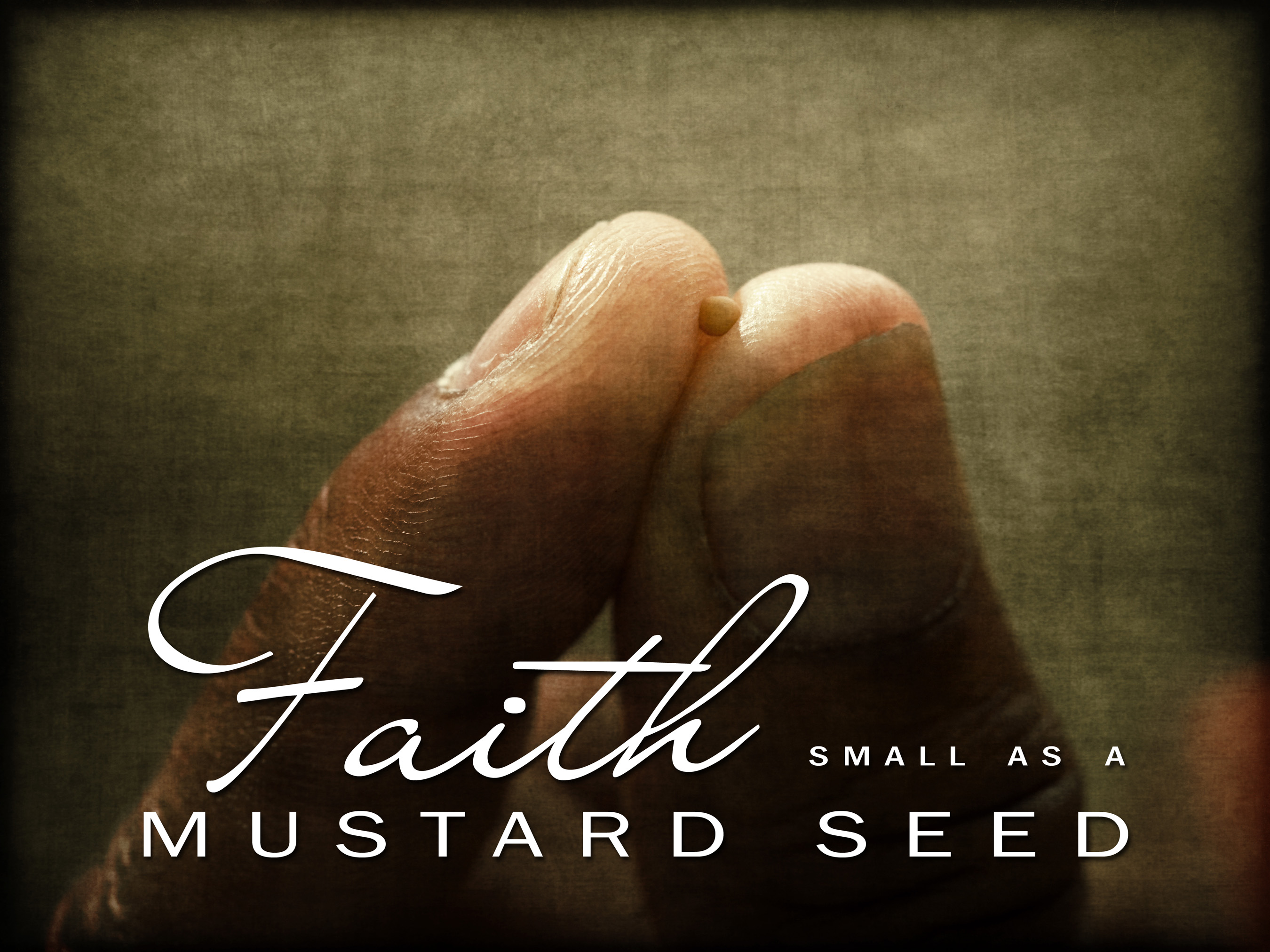
Mustard-Seed-Faith-by-CRILuke 17:3-6 NRSV

As Luke begins his gospel by addressing Theophilus, I want to begin the sermon this morning addressing Luke.

Dear Luke:

Thank you for your careful investigation and for the very orderly account you gave us so that we may know the truth concerning the life, death and resurrection of our Lord and Savior, Jesus Christ. However, on this World Communion Sunday, on the behalf of millions of Christians spread across this globe, and especially on the behalf of a handful of Christians here in Farmville, North Carolina, I would like to voice a concern that many of us have. (Sounds pretty tactful so far, don’t you think? Because here comes the boom!)

Luke, my dear brother in Christ, you are killing us. I mean, brother come on! For five weeks now you have been asking us to do some very big things! You have told us that if we want to be disciples of Jesus it is going to mean losing ourselves, denying ourselves, being a community that is always more concerned about others, about the outsider, than we are about ourselves.  It means having a strong passion for the poor, those we regard as “the least of these.” You have even told us that following Jesus involves a cross and we are going to have to carry it! Brother, come on!

Luke, during these five weeks, we have listened as you have shared some pretty outlandish parables of Jesus. And yes, although some revealed that there is nothing in this world that can separate us from the grace of God, which was rather comforting, they also re-emphasized that Jesus wants us to extend this same grace and to all people, which, quite frankly makes us rather uncomfortable. And last Sunday, you even had the audacity to bring Hell into it. You warned us that if we continued to believe that we were more blessed and favored than others, one day, we might find ourselves in flames begging one of those “others” for a sip of water!

So, come on Luke, enough already. We simply cannot take it anymore. We just can’t handle it. You are asking far too much from us! Being a community of love and forgiveness for all people is just too messy, too hard, too risky, and takes too much of our time. There’s just so much pride we can swallow at one time. And besides, we have enough of our own problems to worry about.

We have our own kids to take care of. Luke, I am not sure if you know about these things, but we have these things called soccer, football, volleyball, cross country, cheerleading and dance. And some of our kids have special needs, and then on top of that, there are our parents who are getting on up there in age with their own special needs. And did we mention that we have full-time jobs?

Oh, yes, there are some of us who are retired, but we too have our own needs. The truth is some of us are just too tired and too old to keep doing all these things that Jesus demands. You ask us to deny ourselves and carry a cross, when just trying to survive each day is like carrying a cross.

And Luke, have you seen our church lately? Have you seen how small we have become these days? We just don’t have the resources that we once had. So many good people have passed away. We have lost too many hard workers, too many teachers, too many people with some deep pockets, if you know what I mean. And have you seen our building? It is over 100 years old! So many repairs, renovations are needed. It is about all we can just do to keep it up.

So Luke, with all due respect, if you really need us to do more than we are doing now, if you want us to be more that we already are, if you really want us to reach out to others, sacrifice, be a community of love and forgiveness for all, and on top of all of that carry a cross, then something is gonna have to give. You are going to have to find a way to give us some more faith, because there is just too little left here. Sincerely, your friend and brother in Christ, Jarrett Banks

After Jesus finished speaking about the need to forgive people who have wronged them not once, but seven times, the disciples, like a crowd of exasperated members of a small, struggling old church in a small town in Eastern North Carolina, said: “Come on Jesus. You are killing us. Enough already. We simply cannot take it anymore. We just can’t handle it. You are asking far too much from us! If you really want us to do more, you need to “increase our faith” (Luke 17:5).

It is then that Jesus responded with some very good news: “If you had the faith the size of a mustard seed, you could say to this mulberry tree, ‘Be uprooted and planted in the sea,’ and it would obey you.”

And to really understand just how good this news is we need to understand something about the Greek language and the use of the word “if”. In the Greek, it is used two different ways. One is to express a condition contrary to a fact, “If I were you.” The second way is to express a condition according to the fact, “If God is for us, who can be against us.” Here, Jesus is using the latter. In the original Greek, Jesus was saying: “If you have faith as small as a mustard seed,” (And you do have it) then you can do some very big and miraculous things!

When the exasperated disciples got to a point when something just had to give, when they just did not believe they had enough of what it takes to be the people Jesus was calling them to be, they said: “Then, Jesus, increase our faith!”

Jesus responded: “Here’s the good news! I don’t have to increase it, because it only takes a little to do some very big things. And since, by the grace of God, you have a little, (you would not be following me if you didn’t) although your numbers are small, although you have very little left in the tank, in fact, I know that some of you are currently running on fumes, I have already given you what you need to do some very big things. If fact, as small as you are, as frail as some of you are, as uneducated and misinformed some are, although you constantly misunderstand what I have been teaching you, although some of you will even betray me, others will deny me, and when the going gets tough all may desert me, I have given you all that you need to change the world!

Night is falling. Jesus has been teaching out on a hillside. And the crowd that showed up that day, well, they were getting hungry.

The disciples with a little panic in their voices insist: “Jesus, there’s a thousand hungry people out there. We need to send them back to town so they can buy something to eat.”

Jesus asks, “But tell me what do you have?”

“Jesus, something’s got to give because we have very little. Just a few loaves and two miserable little fish.”

Jesus takes what they have, blesses it, breaks it, and gives it.  And, the good news is: it is enough.

However, that is not the end of the story.  Although that would be enough, there is more.  We read where “all ate and all were filled.”  They were all fulfilled, all satisfied.  They just didn’t receive something to “tie them over” until they got back into town.  They ate until they were full and satisfied.

But the story doesn’t even in end there.  They took up what was left over and 12 baskets were filled. The truth is: there was not enough.  There was more than enough. There was not only fulfillment and satisfaction, but there was a surplus. The good news is: This is simply the way it is with Jesus.

All of ye of little faith, those of us who complain that we are just too small, too old, too tired, to transform this church, to transform this community, and to change our world, this good news that Jesus always gives us more than enough is not new news to us.

Let’s take just a few minutes now and think about it.  Let’s go back in time several years. Remember that time before the divorce or separation, before the diagnosis, before you lost your job, before the flood, before the tornado, before the miscarriage, before the accident, before your child was lost, before your spouse died.  During that time before the pain, before the grief, imagine that God came to you in a dream and revealed every hardship you would have to endure in your life.  How would you have responded?

I know how I would have responded. God, you are killing me. There is just no way. Come on God, enough already. Something will have to give. There’s just no way I can do it. I simply do not have what it takes. If you really want me to make it, Lord, you are going to have to increase my faith!

And Jesus would say, “I don’t have to. I have already given you what you need.” And guess what, the good news is, and we knew it all the while, Jesus is absolutely right.

On this World Communion Sunday, we have gathered with Christians all over the world around a very small but very holy table. From this table, we take into our hands what may be one of the smallest, tiniest pieces of bread that we have ever held, and we put what resembles a mere crumb into our mouths, and we eat it.. And then we take the smallest of cups, and sip the smallest amount of juice.  It is just a small taste really, but the good news is: it is enough. No, the good news is: it is more than enough. Amen.

We’re Able, but Are We Willing?

bridges not wallsLuke 16:19-31 NRSV

This morning, Jesus is telling another story to teach us something about the nature of God—who God is, how God acts, and what God desires. And as I said last week, we usually find that something in that part of the story that takes us by surprise, shocks us.

It is not difficult to find that moment in this morning’s lesson. But to fully grasp it we need to know a little background about original audience.[i] The Pharisees were notorious for believing and teaching some very bad theology. It is what we call “TV evangelist theology,” “the prosperity gospel” or the “health and wealth gospel.”  It means that we can find favor with God, and if we do, whether it is by living a pure and holy life or by giving generously to God “through a seed offering to the name and address displayed on your television,” then God will bless you with health and wealth. In fact, if you give regularly to their ministry, not only can you expect to receive an autographed copy of their new book, but you can expect to get unexpected checks in the mail! You will not only feel good that you are supporting a great ministry, but you may also be healed your disease or disability.

So here’s the thinking:

Have a lot of money, a great stock-portfolio, growing investments? Blessed. Living from one social security check to the next? Not blessed.

Have plenty of food, nice clothes and a nice car? Blessed. On food stamps, wear worn, old-fashioned clothes, drive a broken down heap? Not so much.

Have great healthcare, low co-pay and deductible? Access to great doctors? Blessed. No insurance, can’t remember your last check-up? Not so blessed.

Nice home? Blessed. Live in the projects? Not blessed.

Healthy and fit, training to run a 5k? Blessed. Sick, in a wheel-chair, homebound? Unblessed.

The sick and the poor, well, they’re just not living right. They make poor decisions in life. I hate to say it, but a lot of them deserve their plight.

The healthy and wealthy, well, evidently they have been living right. They make good and wise decisions, and because of that, they have caught the eye of God and found some divine favor. The poor? The sick? Well, they’ve caught the eye of God too!

And because of that belief, the Pharisees kept the poor and sick at a distance, outside of their circle of friends. They did everything they could do to keep a large gap between them. They were never invited into their homes and they cringed each time one would stumble into the synagogue.

So Jesus tells a story. There was a rich man from a big family who was well-dressed, well-fed and well-off, and of course lived in an exclusive gated community. And right outside of that gate, was this poor, hungry and sick man named Lazarus.

Lazarus would look through the gate and dream of being able to eat just the left-over scraps from the rich man. The only attention and care he received were from the neighborhood dogs that came and licked his wounds. How unblessed is that?

Well, one day, both men died. After all that’s what all men do, don’t they?  All of the money, good fortune in the world can not prevent it. So, no surprise there.

But hold on, because here it comes. The poor man, the man who was seemingly blessed not so much in life, is carried away by the angels to be with Father Abraham.

And, by this time, you know it is really coming. You can almost feel it! If the church pews had seatbelts, I’d be hearing a lot of clicks about now.

The rich man who had a stellar reputation in the community, the one who was seemingly very blessed in life, the one who always bragged to his friends down at the synagogue how good God had been to him, found himself being tormented in Hades.

C’mon Jesus, really?!? Really?

Really! He looks up and sees Abraham with Lazarus at his side and cries out, “Father Abraham, it’s hot as Hades down here! Please send Lazarus to visit me with just a drop of water!”

Abraham responds, “It’s too late. You are no longer able to be comforted. Besides, there is now this chasm, this gate, this wall separating you from us and us from you. And it has been fixed.

Now, isn’t that ironic? In life, the rich man who separated himself, who kept his distance, segregated and protected himself from the likes of people like Lazarus, is now eternally separated from him. And he is unable to do anything about it.

“Ok,” he says, “If I am unable, my five brothers who are still living are very able! Please send Lazarus to warn them so that they will not join me in this God forsaken place!”

Abraham responds: “They’ve already been warned in the scriptures.”

“But, Abraham, look, uh, I know my brothers, and I am afraid that they are not really into Bible Study, but if someone rises from the grave, then they might listen.”

“No,” says Abraham, “If they are not willing to listen to Moses and the prophets, neither will they be convinced, even if someone rises from the dead.”

Oh – my – word! Jesus is not just speaking to the Pharisees here, is he? Jesus is speaking to crowds of people gathered almost two-thousand years later on Sunday mornings at 11am who proclaim to know someone who has indeed rose from the dead.

It is too late for the rich man. He is no longer able to change—change his theology, change his heart, change his view of his neighbors living on the other side of the tracks. He is no longer able to tear down the wall and begin building bridges. And although his five brothers are able to change, we learn the sad and the scary truth that they are simply not willing to change.

And here we are, as able as those brothers. The truth is, we are more than able. For not only do we have Moses and the Prophets, we also have Matthew, Mark, Luke, John and Paul and the risen Christ himself. So, the scary question is: are we willing? Are we willing to change our theology, our hearts and our actions? Are we willing to tear down the walls and build some bridges?

Yes, we hear bad theology all of the time from the TV preachers, but we also hear it right here in the local church. And sometimes it comes out of our very own mouths.

When someone compliments us by telling us what a nice home we live in, or what a nice car we drive, or what a beautiful family we have, or how good we look for our age, we respond how we think all good Christians who go to church every Sunday should respond, “Well, the Lord has really been good to me.” “The Lord has really blessed me.”  And we even believe responding in such a manner might coax God into blessing us some more!

Through the story of the Rich Man and Lazarus, Jesus says that our wealth and our health and our nice teeth are not signs that we are God’s favorites. In fact, those things may be some of the bricks in the wall that separates us from those who are poor, sick and have never seen a dentist. And according to Jesus, if we do not do something about it, that wall, that chasm, will eternally separate us from God.

When someone who is doing the best they can to make ends meet, who is struggling to put food on the table and keep the lights on, hears someone who has it all proclaim, “Yes, the Lord sure has been good to me! The Lord has really blessed me!” what are they to think?  What else can they think except: “Obviously, for some reason or another, I am not one of God’s favorites.”

So, should those of us with good jobs, nice homes and a clean bill of health thank God for what we have? Absolutely! But should we interpret our nice things as a sign that God has looked down on us favorably, given us a nod and a wink—a pat on the back? Jesus says, absolutely not!

One week before Hurricane Katrina paralyzed the Gulf Coast, a young mother went into labor about 10 days before her due date. Although she needed a C-section, she delivered a healthy boy in a New Orleans hospital. She later interpreted having the baby 10 days early as a sign of God’s divine favor. She said, “God knew that if the baby was born on the due date, we would not be able to get to a hospital. So, God made the baby come early.”

There’s no doubt she should thank God the baby came early; however, Jesus says she needs to be very careful how she interprets and shares her story because, without knowing it, she may be building a wall or a chasm between her and someone else. For example, what is the New Orleans father to think whose baby did not come early, whose wife was unable to go to the hospital because of the flood, and because of that, lost not only his baby, but his wife too?  Did God favor one family over the other?

Jesus said, absolutely not! And if you think that because of your good fortune in life you are blessed, one day you might find yourself asking someone who was less fortunate than you in life for a sip of water!

Jesus also put it this way: the sun shines on the good and the evil and the rain falls on the just and unjust alike (Matthew 5:45).

One day Luke says that Jesus cried out, “How often have I desired to gather everyone together as a hen gathers her brood under her wings, but you were not willing!” (Luke 13:34).

The question for us this morning is this, “Are we willing to be gathered under the wings of grace[ii] and see all people, rich and poor as our brothers and our sisters. Are we willing to start building bridges or keep putting more bricks in the wall?”

The good news for us is, unlike the rich man in our story, it’s not too late. We are able, more than able. The question is, “Are we willing?”


[i]Cousar, Charles B.; Gaventa, Beverly R.; McCann, J. Clinton; and Newsome, James D., Texts for Preaching: A Lectionary Commentary Based on the NRSV–Year C (Louisville:  Westminster John Knox Press, 1994)

Craddock, Fred B., Luke, Interpretation. (Louisville:  John Knox Press, 1990)

Craddock, Fred B.; Hayes, John H.; Holliday, Carl R.; and Tucker, Gene M., Preaching Through the Christian Year, C (Valley Forge:  Trinity Press, 1994)

Culpepper, R. Alan, Luke, The New Interpreter’s Bible, Volume IX.  (Nashville:  Abingdon, 1995)

Being the Embodiment of Christ – “Forgiveness”

I want to begin a several-part series entitled: “Being the Embodiment of Christ.” I want to explore ways that our church can overcome past mistakes, the mistakes of our church as well as the mistakes of the Church (and that is Church with a big “C”). There is no doubt that many of these mistakes have not only wounded the church’s witness, but they have actually wounded the faith of many. I believe we simply must accept responsibility for some of the reasons that people are all but giving up on organized religion these days.

Therefore, I would like to begin this series with a confession and with an appeal for forgiveness. As part of the Body of Christ, we confess that we have not always modeled the life and teachings of Jesus. We have been selfish, self-righteous and judgmental. Like the Pharisees in Jesus’ day, we have often been purveyors of bad theology. We have neglected the poor “at our gate” (Luke 16:20). When God has called us to speak out for justice in our world, we have been silent. When God has called us to stand for peace, we have taken a stance for war. Although we say we believe we will go to heaven to one day to worship with every race and tribe (Revelation 7:9), we prefer a worship that is segregated.

This is by no means a complete list of our sins. However, we believe it is a good start. And we choose to start this process of reconciliation within community. Instead of giving up on the church, we commit ourselves more fully to the church. As Rev. Lillian Daniel has said, “Community is where the religious rubber meets the road. People challenge us, ask the hard questions, disagree, need things from us, require our forgiveness. It’s where we get to practice all the things we preach” (Going Solo). As we ask to be forgiven for our many trespasses, we recommit ourselves to being a community of grace and forgiveness forgiving the trespasses of each other.

One of my favorite preachers and authors, Frederick Buechner, has written some of the best words on the subject of forgiveness that I know:

forgivenessTo forgive somebody is to say one way or another, “You have done something unspeakable, and by all rights I should call it quits between us. Both my pride and my principles demand no less. However, although I make no guarantees that I will be able to forget what you’ve done, and though we may both carry the scars for life, I refuse to let it stand between us. I still want you for my friend.”

To accept forgiveness means to admit that you’ve done something unspeakable that needs to be forgiven, and thus both parties must swallow the same thing: their pride.

This seems to explain what Jesus means when he says to God, “Forgive us our trespasses as we forgive those who trespass against us.” Jesus is not saying that God’s forgiveness is conditional upon our forgiving others. In the first place, forgiveness that’s conditional isn’t really forgiveness at all, just fair warning; and in the second place, our unforgiveness is among those things about us that we need to have God forgive us most. What Jesus apparently is saying is that the pride that keeps us from forgiving is the same pride that keeps us from accepting forgiveness, and will God please help us do something about it.

When somebody you’ve wronged forgives you, you’re spared the dull and self-diminishing throb of a guilty conscience.

When you forgive somebody who has wronged you, you’re spared the dismal corrosion of bitterness and wounded pride.

For both parties, forgiveness means the freedom again to be at peace inside their own skins and to be glad in each other’s presence. ~originally published in Wishful Thinking and later in Beyond Words

Being a community of grace and forgiveness–I believe it is a great start to begin overcoming the mistakes of our church and of the Church. The truth is, we have to start being such a community if we ever want to welcome back those who have left the church or welcome for the first time those who have never considered being a part of the church. And we absolutely have to be such a community if we want to ever come close to becoming the church that God is calling us to be.

C’mon Jesus, Really!?!

really2Luke 16:1-9 NRSV

It is chapter 16 in Luke’s gospel, and Jesus is fired up! He has been telling parable after parable after parable. And we have to go back an entire chapter to remind ourselves what got Jesus worked up into this parabolic frenzy. That’s right, it was that familiar grumbling:  “And the Pharisees and the scribes were grumbling and saying, “This fellow welcomes sinners and eats with them.”

Evidently, if you want to get Jesus started, if you really want to get him riled up, if you want to push his buttons, all you have to do is start grumbling about Jesus welcoming sinners to his table. All you have to do is question the height, depth, and breadth of God’s grace. All you have to do is suggest that someone—somewhere, somehow, someway—can be separated from the love God.

Jesus responds by telling four parables: one about a sheep that strayed, one about coin that was lost, one about a son who misused his inheritance, and one about a manager who misused his boss’ money.

Jesus used parables throughout his ministry to reveal a little something about the nature God. And in all parables, there is usually some action that takes us by surprise, and sometimes even confuses us. It makes us say something like: “Really?!?” “Faith the size of a mustard seed can move a mountain?” “C’mon Jesus, Really?!?” Really?”

And it is usually in that moment where we find that little something Jesus wants us to learn about the nature of God.

To go after and find that one lost sheep that did not have the good sense to stay with the flock, the shepherd is really going to risk the ninety-nine sheep that are faithful? He’s really going to leave them wilderness for who knows how many days and nights? Really?!? Alone in the wilderness? Really?!? The entire flock? C’mon, Jesus, Really?!?

To find one lost coin, a woman is going to sweep the entire house, search day and night, and when she finds it, she’s really going to invite all of her friends, the entire neighborhood to rejoice with her? Really?!? The entire neighborhood? For one coin? Really?!? Jesus, c’mon?!

After a son has the audacity to ask his perfectly healthy and fit father for his inheritance; after he spends all of it on who knows what, and having no other place to go, returns home; the father has even greater audacity to welcome him back home with open arms. “Really?!? C’mon Jesus, Really?!? And not only does he welcome him home, but does so with one, big, extravagant party. Really?!? With a robe? A kiss? And a ring? And a fatted calf? Really?!? C’mon Jesus, Really?!?” “Jesus?”

But Jesus does not answer. After all, his button has been pushed and he’s on a roll! He has one more story to tell and this one, well this one is a doozy!

A certain rich man gets word that the manager of his properties has been cheating him out of some money. So he calls him into his office, asks for the books, and tells him that he has to let him go.

Now, most employees who are caught in some sort of embezzling or swindling scam would be grateful that a pink slip was all they got; and thus, go home with a little bit of gratitude, but not this employee. This one is clever, crafty and conniving. After all, he did not get the job as manager by being a hard worker or by being handy with a shovel. This one has a plan. And it is a sneaky plan. It is a selfish plan. It’s fraudulent, even criminal. And it is more than a little risky. If his previous behavior did not land him in prison, this certainly should.

He goes out and one by one meets with his boss’s customers. “How much do you owe the boss man?”

“A hundred jugs of olive oil.”

“Here’s your bill. Take it and make it fifty. And do it before we change our minds!”

“And you sir, what do you owe the boss?”

“A hundred containers of wheat.”

“Here, take your bill and make it eighty.”

And this went on and on until he reduced the debts of all of the boss’s customers.

And when the boss man discovered what his dishonest manager had done, cheating him out of even more money, the boss man commends and applauds the little weasel for being so weasel-y. And all God’s children said, “REALLY?!?” Commends the dishonest manager? For being dishonest? C’mon Jesus, really?!? He does not take the weasel by the throat and strangle him to death? Or even call the law? He praises him? Really?!? I mean, c’mon now, really!?!

And it is here, in this action, that we find that little something that Jesus wants us to learn about the nature of God. And in this case, it happens to be a very big something.

When the height, depth and breadth of God’s grace is questioned, “This fellow eats and drinks with sinners,” Jesus responds:

Yes, I do. And for just one sinner who has lost her way, I am willing to risk ninety-nine religious people who think they have life all figured out. And I will not stop seeking and reaching out my hands for that one until she is found. I will sweep every room, move every piece of furniture, rip up the carpet and tear a house a part if I have to.

And I don’t care who that sinner is or what that sinner has done, there is absolutely nothing that they can do to be separated from my love and grace. He can squander my property, spend it all on who knows what, then come crawling back to me, only because he has no other place to go, only for reasons that are purely selfish, and I will not only welcome him back with open arms, I will throw one big, extravagant party!

So, yes, I really do eat and I drink with sinners, because God’s grace is really, really, really bigger than you think. It is more extravagant and more generous than you know.

And if you still do not believe it? If you still question the heights and depths and lengths I would go through to accept, love and forgive the sinner, let me tell you yet another story. And this one is one, well this one is a real doozy!

A rich man had a manager who was quite the scoundrel. When the master learns that he was cooking the books, although he could have had him thrown in prison or even crucified, the master very graciously lets him go.

It is then the manager makes what seems to be an extraordinary gamble. He meets with the boss man’s customers and says, “Christmas has come early!” And one by one he reduces their debts and puts the master in some kind of pickle!

What on earth is the boss man going to do now? Is he going to round up all of his happy customers and tell them that it was a one big mistake? Not only would they think that his manager pulled one over on him, but he would look like a miserly scrooge.

Or will he let the little swindle slide and receive praise for being a very generous boss man?  What does the boss man love more:  his money or his new reputation for having a gracious and generous nature? The manager was betting on the latter and the gamble pays off. He commends the manager for being a shrewd businessman. [i]

And we are shocked, asking, “really Jesus?!” “Really?!?”

But after hearing the parables of the lost sheep, the lost coin and the gracious father who welcomes back his prodigal son, should we be surprised?

The shepherd searches until he finds the lost sheep not because of who the sheep is, but because of who the shepherd is. The woman searches until she finds the coin because of who she is. It is her nature to keep searching. The prodigal son is welcomed graciously back by the father, not because of anything that the son did, after all he only came crawling back because he had nowhere else to go. He is welcomed graciously back because that is the nature of his father.

And now, here is an unfaithful manager whose actions can only be described as selfish and self-serving. And the master, seeing all of this, is still generous because it is in the very nature of the master to be generous. The dishonest manager knew this, bet on this and won.

Therefore Jesus says, “If the children of God, who question whether I should be eating and drinking with sinners, would only believe in God’s grace the way the dishonest believe in grace, and try to exploit it, then the children of God would never question that there is absolutely nothing in all of creation that can ever separate them from the love of God.”

However, Jesus knew that it would take more than parables to convince us. There would need to be one more action, at a place called The Skull.

Luke writes: “They crucified Jesus there with the criminals, one on his right side and one on his left. Then Jesus said, ‘Father, forgive them; for they do know what they are doing.’”

C’mon, Jesus, Really?!?

The good news is: really!

Now listen to one more parable. There was this certain pastor who had served churches his entire adult life. He was far from perfect, but worked hard to love people and to serve the community.

One day, for many reasons, he just threw up his hands and walked away from the church. The fire that he once had for ministry was all but gone. He was even tempted at times to give up on organized religion all together. For three years he worked outside of the church and lived mostly for himself and his immediate family. He was no longer involved in his community. And he hardly ever even visited with his neighbors.

But then there was this church—this church that knew him when his hair was much darker, knew a lot of his faults, but recognized his gifts for ministry and believed that he still had much to give to the Lord and to their community—and this church welcomed this pastor and his family with open arms. They offered him grace and encouragement and rekindled that fire inside of him, which, at least today, burns brighter than ever!  And although he still has a lot of faults and flaws, they call him, “pastor.”

Really!?! C’mon First Christian Church, Really?!?  Really?

Really!

O God, forgive us for doubting, for questioning the stories of your amazing grace. Thank you for loving us freely and unconditionally. And give us the courage and the vision to share this good news in this community and throughout the world. Amen.


Richard B. Vinson, Luke, Smyth and Helwys Bible Commentary (Macon: Smyth and Helwys Publishing, 2008) 520-524.

Fred Craddock, Luke, Interpretation (Louisville: Westminster Press, 1990) 192.

R. Alan Culpepper, Luke, New Interpreter’s Bible (Nashville: Abingdon Press, 1995) 306-311.