
John 9:1-41
Our gospel lesson today speaks about a kind of blindness that has nothing to do with our eyes but has everything to do with how we see God.
Jesus and his disciples encounter a man who has been blind from birth. He sits beside the road like so many people society has learned not to see. He is not asked his name. He is not asked his story. Instead, he becomes a theological puzzle. The disciples look at him and ask a question that has echoed through centuries of religion: “Rabbi, who sinned, this man or his parents, that he was born blind?”
Do you hear the assumption beneath that question?
If something is wrong, someone must be to blame.
If someone is suffering, God must be punishing them.
If tragedy occurs, it must somehow be deserved.
The disciples are not asking how to help the man, how to love the man. They are asking how to explain him. And that, my friends, is one of the oldest forms of spiritual blindness.
Because when we cannot see God clearly, we begin to see one others through the lens of judgment. We categorize people. We label. We decide who is worthy and who is not. We divide the world into the righteous and the sinners, the blessed and the cursed, those who matter, and those we can write off.
But Jesus refuses the premise of their question. He says, “Neither this man nor his parents sinned.”
In other words: You’re asking the wrong question!
The blindness in this story is not just in the eyes of the man sitting beside the road. The deeper blindness is in the religious imagination that believes God would punish a child before he was even born.
The truth is: that’s exactly how many of us were taught to see God.
The truth is: that’s exactly how some of us were taught to see God, a God who created a heaven for some and hell for others—a divine sorting system separating the saved from the damned. We were also told God knows all, past, present, and future. That means God created some people, all the while knowing, they would be tortured in hell for all of eternity.
And somewhere along the way, the fear of God instead of the love of God, became the engine of our faith.
Today, we are grateful to have Brian Recker with us, whose work explores how that fear has shaped Christian belief and practice for generations. And how when fear shapes our theology, it inevitably shapes our ethics.
Because if God condemns, we learn to condemn. If God divides humanity into insiders and outsiders, we feel justified doing the same. If God punishes people, then punishment itself begins to look holy. And if God punishes people eternally, then taking the life of another can start to look holy too.
Over time, that vision of God begins to justify things we might otherwise resist.
It rationalized stealing this land we enjoy.
It justified slavery.
It defended segregation.
It condemns LGBTQ people as beyond God’s love.
And it whispers that violence, war, and domination are acceptable tools in the hands of those who believe they are on God’s side.
Fear does not just distort our picture of God. It distorts how we see one other. And it doesn’t save us from hell. It unleashes hell on earth.
The good news is that Jesus reveals a very different vision of God. He doesn’t argue theology with the disciples. He doesn’t stand above them looking down on them, violently lashing out at them.
He bends down to the ground. He kneels in the dirt. He spits in the dust and makes mud that he places on the man’s eyes, telling him to go wash in the Pool of Siloam.
It’s a strange miracle of mud, spit, and dust. But it’s the same dust from which the book of Genesis says humanity was first formed. It’s almost as if Jesus is re-creating this man’s sight from the very soil of creation itself.
And when the man washes, suddenly he can see. But here’s the irony: the man who had been blind can now see clearly; but the religious authorities, those who believe they understand God the best, cannot.
They interrogate the man. They question his parents. They debate whether the miracle could possibly have happened. And finally, when the healed man refuses to abandon the truth of what he has experienced, they throw him out. Because when love disrupts a theology built on fear, the system is threatened.
Sometimes it’s easier to deny a miracle than to change our picture of God.
During my time in New Orleans planting a new expression of church, a movement that we called, “Just Love Your Neighbor,” I also served as an “as needed” or “PRN” hospice chaplain, like I do now.
I had a Jewish patient who had been married to a Christian for over 50 years.
After his death, his wife asked me to preach his funeral service. When I asked why she didn’t want to ask her pastor, she responded: “I am afraid that he might insinuate my husband is in Hell because he is not a Christian, and I know you will not do that.”
After the funeral, she started participating in our new movement, giving her time and her dollars, while remaining a member of her church.
Over time, she opened up about the frustration that was leading her to reject the things that she was being taught in her church.
One day, she said something like: “I was always taught that God loved me. But I was also taught that if I didn’t believe the right things, particularly about Jesus, God would send me to hell forever. But I think I am beginning to realize: that’s not love; that’s a threat.”
She paused for a moment and then said quietly, “I don’t think I’ve ever actually met the God Jesus talked about.”
That widow was not rejecting her church. She was rejecting her church’s distorted image of God. She was rejecting a God who looked suspiciously like our fears.
And she’s not alone.
There are countless people, here in this city, who are walking away from church, not because they’ve rejected the love of God, but because they cannot reconcile that love with the threat of eternal punishment.
Sometimes, the people some say have lost their faith, or doubt their faith, are actually the ones who see God the most clearly.
And the ones who are the most certain, those who say they see clearly, the ones we hear saying “The Bible is clear…,” are actually the ones who are the most blind.
And this blindness doesn’t only affect individual lives. But it shapes the entire world.
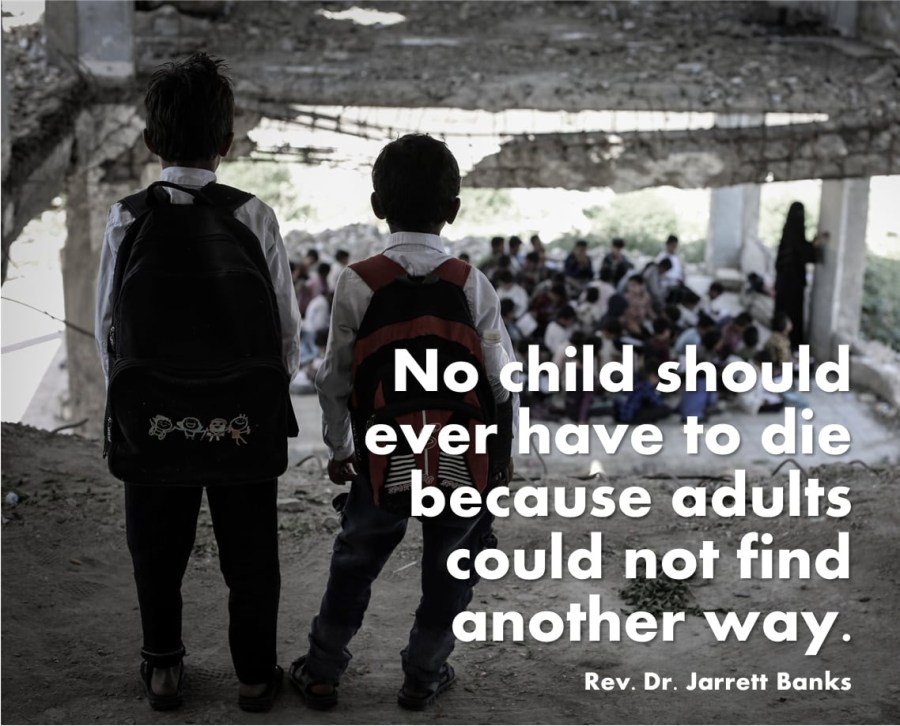
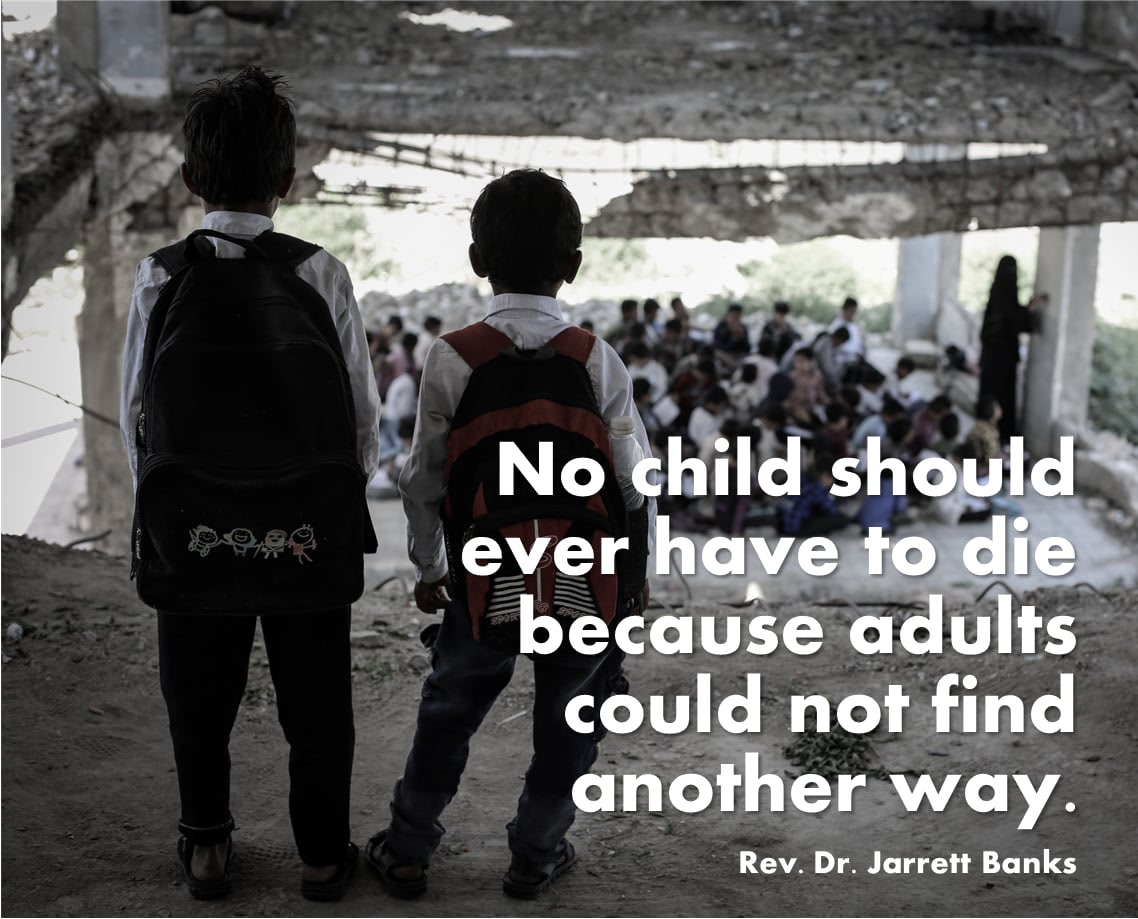
Right now, we are witnessing what happens when this blindness goes unchallenged. Missiles continue to cross the skies of the Middle East, and this week we learned that one of them, fired by our own country, struck a school in Iran, killing children as they sat in their classroom. Children at their desks. Children with books open in front of them. Children who woke up that morning expecting an ordinary day at school and instead became casualties of war.
No child should ever have to die because adults could not find another way.
If we can hear that story and not feel something break inside us, then perhaps the blindness Jesus speaks about has reached deeper into our hearts than we realize.
Because no matter which flag flies over the missile launcher, the God Jesus revealed is not the author of bombs that fall on children.
And yet, the language of righteousness still fills the air.
Every nation says God is on their side.
Every government says the violence is necessary.
Every military claims the destruction is justified.
But when we look through the eyes of Jesus, we begin to see something different.
We see children in classrooms who never chose this war.
We see parents praying the same desperate prayer on every side of every border: “O God, let my child live!”
And if we can see that, if we truly allow ourselves to see it, then we must ask an uncomfortable question: How did a faith centered on the Prince of Peace become so comfortable blessing violence?
Part of the answer is in the way we imagine God. For when we believe in a God who punishes, violence begins to look like divine justice.
But when we see the God revealed in Jesus, the God who heals instead of harms, who forgives instead of retaliates, who tells us to love even our enemies, then war begins to look less like righteousness and more like the tragic consequence of humanity still struggling to see clearly.
At the end of the story, Jesus finds the man who has been cast out by the religious authorities. And the man does something remarkable. He believes. Not in a doctrine. Not in a system. But in the love of the one who healed him. He trusts the love he encountered. And that is the heart of this story.
The miracle is not simply that a blind man gains sight. The deeper miracle is that Jesus reveals what God actually looks like.
A God who does not stand far away diagnosing sin. But a God who kneels in the dust beside human suffering. A God who touches our wounded places without hesitation. A God who sees us completely, and loves us anyway, unconditionally, unreservedly, and does all that God can do to recreate, restore, and resurrect.
When we begin to see God that way, something inside us changes. Shame begins to loosen its grip. Hatred begins to lose its power. The walls between “us” and “them” begin to crumble. And the people we once feared begin to look like neighbors again.
Near the end of the story, Jesus says something haunting: “I came into this world so that those who do not see may see, and those who think they see may become blind.”—Reminding us that the greatest spiritual danger is not doubt. It is certainty. Especially certainty about a God who violently condemns anyone before they were born.
But the good news of the gospel is that Jesus is still opening eyes, still kneeling in the dirt of our world, still touching wounded lives, and still inviting us to wash away the old stories that told us God was against us.
And when our eyes finally open, we may discover something astonishing. The God we feared was never really there. And the God who is there has been loving us all along.
Later today, Brian will help us explore what it means to move beyond a faith driven by fear of hell toward a spirituality rooted in love. And that journey, from fear to love, is exactly the journey this gospel story invites us to take.
The man healed by Jesus ends this story with a simple testimony: “One thing I do know: I was blind, but now I see.”
That may be the most honest confession any of us can make. Because faith is not about having every answer. It’s about learning to see. Seeing the love that is God more clearly. Seeing our neighbors more compassionately. Seeing our enemies more humanly. And seeing the world as Jesus sees it: a world filled with beloved people; a world worth healing; a world where love, not fear, has the final word.
And when we finally see that clearly enough, we may find ourselves saying with the man in the story: “One thing I do know, I was blind, but now I see!”
Amen.
 Just Love