Renewing Our Hearts to Partnership: Embracing Diversity

diversity-shutterstock-998x615

Ephesians 4:1-16 NRSV

There is but one body and one Spirit—just as you were called into one hope when you were called.

Unity. It is the theme of World Communion Sunday. But when we talk about “unity” in the church, what are we really talking about? Are we talking about everyone believing the same thing, thinking the same way, being on the same page when it comes to matters of faith and practice? Are we talking about sharing the same set of values and moral principles? Are we talking about one particular style of worship? What does “unity” in the church really mean?

I believe the ancient story of the Tower of Babel can help us with this.

In the eleventh chapter of Genesis we read:

“Now the whole earth had one language and the same words. And as they migrated from the east, they came upon a plain in the land of Shinar and settled there. Then they said, ‘Come, let us build ourselves a city, and a tower with its top in the heavens, and let us make a name for ourselves; otherwise we shall be scattered abroad upon the face of the whole earth.”

The whole earth was one. One language. One people. One tribe. One race. And they all came together to live in one place. They all came together to build something special, something great, something wonderful that would be a symbol of their unity.

Unity, oneness, togetherness, harmony, people of the same minds living in one accord. Isn’t this the will of our God, God’s great purpose for humanity?

So what’s not to like in this seemingly perfect picture of unity in Genesis chapter 11? As it turns out, according to God, the creator of all that is, not very much.

Let’s look at God’s reaction to this oneness in verse 7 of our story: “Come, let us go down, and confuse their language there, so that they will not understand one another’s speech.”  So the Lord scattered them abroad from there over the face of all the earth…”

What? Are you serious? What is wrong with this great portrait of human unity, of one race of people, one nation, one language, all of one mind, coming together, to build something great, to celebrate the pride of one master race?

The truth is that the builders of the great tower in Shinar had accomplished not what God wants for humanity, but what many throughout history, including the likes of Adolf Hitler and the Ku Klux Klan, have wanted for humanity: One master race of people coming together to form one supreme social order, one culture, sharing the same ideals, values and moral principles.

For so many, diversity is a threat. Diversity is something to fear. Diversity is something to segregate and discriminate. Diversity is something to scapegoat. Diversity is something to send to the gas chambers, lynch in the trees or shoot in the streets.

I am not sure if anyone in my lifetime has articulated the thinking of the people of Shinar better than Atlanta Braves pitcher John Rocker back in 1999. Some of you may remember his response when he was asked by Sports Illustrated if he would ever play for the New York Mets or New York Yankees.

Rocker said:

“I’d retire first. It’s the most hectic, nerve-racking city. Imagine having to take the number 7 Train to the ballpark looking like you’re riding through Beirut next to some kid with purple hair, next to some queer with AIDS, right next to some dude who just got out of jail for the fourth time, right next to some 20-year-old mom with four kids. It’s depressing… The biggest thing I don’t like about New York are the foreigners. You can walk an entire block in Times Square and not hear anybody speaking English. Asians and Koreans and Vietnamese and Indians and Russians and Spanish people and everything up there.”[i]

The story of the Tower of Babel teaches us that what John Rocker said “racked his nerves” in the world is exactly what God wills for the world. In verse 4 we read that the purpose of building the tower was to avoid what depressed John Rocker on the No. 7 train leaving Manhattan for Queens, and to avoid what John Rocker heard in Times Square.

The purpose of settling in Shinar and building that tower was to live in a world with no foreigners, no confusing babbling in the streets, no queers or kids with purple hair to encounter on the way to work, no eating in the marketplace with people on strange diets, no rubbing elbows with people wearing weird clothes, head coverings or dots on their foreheads.

No sitting in the same pews at church with people dress differently than we do on Sunday morning and definitely no people who think differently, believe differently, or worship differently.

The people in Shinar said: “We will be truly unified! We will look alike, think alike and believe alike. We will sing worship alike, sing alike and pray alike.”

So they came together and said, let’s build a tower of unity “to not be scattered over the face of the whole earth.”

And God’s reaction to this kind of unity? Let’s “scatter them over the face of the whole earth,” to create a world of diverse languages and cultures, to create a world of foreigners.”

God was only accomplishing what God had always willed for the creation: diversity. In chapter one of Genesis, we read that the original plan for creation was for humankind to “multiply and fill the earth.” And after the flood in chapter ten we read where God sanctions and wills all nations to be “spread out over the earth.” (Gen 10:32). Simply put, from the very beginning of time, in spite of our will, in spite of our fear and our racial or cultural pride, God wills diversity.

Therefore, if we ever act or speak in any manner that denigrates or dehumanizes another because of their race, gender, language, beliefs, dress, nationality or ethnicity, we are actually disparaging the God who willed such diversity. According to Genesis, diversity is not to be feared, avoided, prevented, lynched or shot. If we want to do the will of God our creator and redeemer, diversity is to be welcomed and embraced. In other words, if we love God, we will also love our neighbor.

And this is what should unite us as Christians!

It is the love of God for all of us, a love that God wants us to share with others that unites us.

I believe it’s why Jesus called it the greatest commandment. Loving God and neighbor is what should unite us; not race, not correct doctrine, not a set of beliefs, not one style of worship, but love.  It was Disciples of Christ forefather Thomas Campbell who said: “Love each other as brothers [and sisters] and be united as children of one family.”

And the Apostle Paul wrote: “I therefore beg you to lead a life worthy of the calling to which you have been called, with all humility and gentleness, with patience, bearing with one another in love.”

The story of God’s displeasure with the Tower of Babel is God’s gracious stamp of approval, of blessing, on every race, every tribe, and every language in every land. It is the fulfillment of God’s original purpose for creation. The song we learned as little children cannot be more true: “Red, yellow, black and white, they are all precious in God’s sight.”

God is not color-blind, as I hear some say, for God creates, wills, blesses, and loves color. And it is this love that unites us all, as we have all been created to harmoniously see humanity as God sees it: as a beautiful, diverse, colorful rainbow created by, sanctioned by, and graced by God.

As Bible-believing Christians, our nerves should never be racked on Sunday mornings, [as my mama used to say, we should never get in a tizzy!) if we look around the congregation and see some diversity—see some folks who not only dress differently and look differently, but see folks we know believe differently, live differently, worship differently, interpret the Bible differently, and yet they still choose to partner with us through this church, united by a commitment to share the love and grace of Christ we have all received with the world.

And it should rack our nerves all to pieces on Sunday mornings, if we look around the congregation and only see a bunch of folks who look just like us.

And if we are not immensely bothered by a lack of diversity in this sanctuary, if we are not partners in ministry with those who differ from us, if we would rather remain homogenous by remaining divided, I believe we need to remember not only this story in the first book of our Bible that describes a beautiful and diverse creation willed by God, but I also believe we need to think about a about a passage in the last book of our Bible that describes a diverse eternity willed by God.

And we must as ourselves the question: If diversity bothers us now, what are we going to do when we get to that place we think we’re are going after we die to live forever and ever.

Because guess what? According to Revelation, heaven looks more like Times Square and that No. 7 train on the way from Manhattan to Queens than some affluent suburb outside of Atlanta, Georgia.

In Revelation 7, we read these words:

After this I looked, and there was a great multitude that no one could count, from every nation, from all tribes and peoples and languages, standing before the throne and before the Lamb, robed in white, with palm branches in their hands. They cried out in a loud voice, saying,
‘Salvation belongs to our God who is seated on the throne, and to the Lamb!’
And all the angels stood around the throne and around the elders and the four living creatures [each representing the diversity of all creation], and they fell on their faces before the throne and worshipped God, singing, ‘Amen! Blessing and glory and wisdom and thanksgiving and honor and power and might be to our God for ever and ever! Amen.

Let us pray:  Thank you O God for the diversity that is in this place we call Central Christian Church. Help us to accept it, embrace it, love it, as we partner together to be the church you are calling us to be in this city and in our world.

[i] Read more: John Rocker – At Full Blast – York, Braves, City, and League – JRank Articles http://sports.jrank.org/pages/4014/Rocker-John-At-Full-Blast.html#ixzz39oVUCEtA

Life Like a Country Song: Remembering Robert Dean Shaw

Bob shaw

Bob Shaw loved music, more specifically country music, more specifically pre-1960 country music, and more specifically, pre-1960 country music that you could dance to, or at least tap your toe to. The kind of songs that were earthy, rural, set in a small town or in a farming community. Songs stirring patriotism and championing hard work. Songs speaking about lasting love and songs speaking about love lost and heart break. Songs speaking about rural life: the land, raising children and bird dogs, hunting and catfishing. Songs of sacrifice and worrying about the kids and the dogs.

Bob loved another Bob with the last name of Wills, known as the King of Texas Swing.

Bob had such a love for Texas Swing that he taught himself to play the guitar, and steered his daughter Ronda away from the flute, an instrument that may never have been played in the Texas Playboy band. Bob even took some guitar lessons in his late in his forties.

I don’t believe Bob’s love for country music should not surprise anyone who reads reads his obituary, as his epitaph reads like lyrics to a country song, you might say, some good ol’ Texas Swing.

Born in Lacey, Oklahoma, a small rural farming community, Bob attended Mound Ridge, a one room school house.

Bob Wills once sang of the rural, slow paced, southern way of life that Bob Shaw was born into:

Yes, this is Southland, where everything’s fine

It’s where they really live and give you a feeling

That you’re welcome any time

You’ll find our men are stronger, women sweeter

And you’ll live much longer, no rush every day.

Bob graduated from high school and was drafted into the United States Army, serving from 1953 to 1955 during the Korean Conflict. He was stationed in what he called “cold and dark Greenland,” building a runway to defend the North Atlantic from a possible Russian advance. Those years of service were difficult for Bob. He lost a dear friend and comrade in an explosion, and Bob himself was injured in an accident with a Jeep. This service and sacrifice, this love for country led him to later become the Commander and District Commander of the American Legion. Bob’s love for country is perhaps what attracted him the patriotic music of Bob Wills’. One song goes:

When the Yanks raised

The Stars and Stripes on Iwo Jima Isle

Ev’ry heart could sing once again

And the sight of Old Glory over Iwo Jima Isle

Swelled the hearts of our fighting men

After serving his country, Bob moved to Kingfisher where he worked for Cimarron Electric, and later he would move to Enid to work with OG&E where he continued to sacrifice for others. Working with electricity is a dangerous venture, but being a lineman, is another kind of danger.

One day, in Pawhuska, Oklahoma, Bob was on the ground while a fellow lineman was high in a bucket truck working on an electric line. Not knowing that the line was live, his co-worker grabbed the line. The electricity immediately grabbed and held on to him, until Bob says he could see smoke appear to come from the top of his head. Without hesitation, and putting himself at risk, Bob climbed the pole and pulled his co-worker off of the line, saving the man’s life.

Bob would find love, have two sons, but then, like a country song, lose love, as his first marriage would not last.

Bob Wills sings of the heartbreak of love lost:

No more to be sweetheart, no more to be friend

My yesterdays haunt me, my weary heart cries

I just can’t go on, dear, with tears in my eyes.

However, Bob Wills also sings of the hope of finding new love:

I’ll have somebody else as soon as you are gone

You’ll never break my heart no more

I used to weep and sigh each time we said goodbye

You broke my heart so often, there’s no more tears to cry.

And in 1969, Bob married Linda Kisling.

Celebrating the joy of lasting love Wills sings:

Stay all night, stay a little longer

Dance all night, dance a little longer

Pull off your coat throw it in the corner

Don’t see why you don’t stay a little longer.

And that is just what Linda did, standing faithfully by his side for 47 years. The two of them had one child together, his only daughter, Ronda.

Bob enjoyed hunting quail on the farm. He and his bird dogs also hunted ducks, turkeys and pheasants. He also enjoyed fishing, especially catfishing. Bob liked to get a way, and enjoy the outdoors. Bob believed in working hard, but he also believed in taking it easy.

Bob Wills sings:

I might have gone fishing. I got to thinking it over.

And the road to the river is a mighty long way,

Now it could be the season, no rhyme or no reason,

Justa taking it easy, it’s my lazy day

Bob Shaw’s obituary closes: Bob is survived by his wife, Linda, a daughter ,Ronda and her husband Terry, two sons, Jerry Walker, Larry Walker and his wife, Candy, three grandchildren, seven great-grandchildren and one sister, June Lindsey. He was preceded in death by a brother.

When I asked Bob’s family how Bob expressed his love and devotion to them, they all agreed: “He worried about us.” Ronda said that he especially worried about her driving, arriving at her destination safely, wherever that may have been. Bob would probably agree that worry is the price that parents pay for the gift of children.

Again, Bob Wills sings:

Woe is me, so is you

What a price to pay

Tell me what I’m gonna do

I can’t go on this way

Every night I walk the floor

Worried over you

All I do is watch the door

Hopin’ you’ll come through

Pacin’ up, pacin’ down

‘Til the break of day

I’m the saddest soul in town

I can’t go on this way

Where are you at tonight?

Now, I do not believe that Bob Shaw’s worry meant that he lacked faith in God. For after his heart surgery, Bob made a grateful promise to God that he’d be more faithful in his church attendance. Keeping his promise, Bob and Linda would arrive around 9 am for the 10:15 service almost every Sunday! They sat together on the same bench for over an hour in the gathering area waiting for the service to begin. It was kind of their spot.

Thus, I don’t believe that Bob’s worry meant his faith was weak. I believe it only meant that he loved you so. Worry was simply the price that he paid for love.

I believe it is good to be reminded that, like worry, grief is also the price we pay for love. Grieving only means that we have loved have loved another the way our creator has intended for us to love another.

Garth Brooks, a post-1960 country music star that Bob probably never listened to, sings a song entitled, “The Dance.”

One line of that song goes: “I could have missed the pain, but I’d a’had to miss the dance.”

The only way to miss pain in life is to miss love in life. But to never love someone the way you loved your husband, your father, your brother, your grandfather and great grandfather is to never really live. As the country song goes, the only way to miss the pain of loss is to miss the whole dance of life.

You loved Bob, and now you are paying the price for that love. Grief is the consequence of love. But you know something? Everyone of us here this day, is going to go on courageously loving one another because the ones we love are worth that price. You have loved.  And now you grieve.

So I say to you this afternoon, grieve. Grieve long and deeply. Do not dare run away from it. Do not treat it as if were a stranger you could send away, or deny that grief, because who does not know any better thinks it means your faith is weak. Grieve what is lost. Grieve honestly, lovingly and patiently. Grieve until your cup is emptied. For this is the only way back to wholeness.

Grieve and even thank God or your grief. Because like Bob’s worry, your grief only means you loved. However, also remember the words of the Apostle Paul in his letter to the Thessalonians that those of us who call ourselves Christians should not grieve as others do who have no hope.  As Christians, our grief is different, because as Christians we possess hope.  We have the hope that as God raised up Jesus from the dead, God has raised Bob.

Perhaps today, Bob Shaw has found another Bob, and maybe even the rest of the Texas Playboy band, and they, even now, are playing the guitar and singing together:

Will you miss me when I’m gone?

Will you ever think of me?

Will the past be just today…

If you cry yourself to sleep

As I did for you for so long

Then perhaps you’ll dream of me

Will you miss me when I’m gone…

…I love you just the same

More than you will ever know

When your hair has turned to white

And you feel so all alone

Maybe then you’ll think of me

Will you miss me when I’m gone?

Response to the Orlando Massacre

more love less hate

How do we begin to respond to this act of hate and terrorism against those attending the Pulse Night Club in Orlando Florida?

First, perhaps we might respond in the same way our God responds. I believe we respond by being prayerfully present, not only suffering with those who are injured and weeping with those who have lost loved ones, but also grieving with the larger LGBTQ and Muslim communities who are hurting today in ways few of us can imagine. We respond by standing in mournful solidarity with all people who are hated for their faith, race, gender, economic status, or sexual orientation.

Secondly, I believe we respond by speaking out against the demonic evil that is intensifying in our world today in the form of racism, sexism, xenophobia, homophobia and all kinds of hateful bigotry.

May we remember the words of Rev. Dr. Martin Luther King Jr. who once said: “In the end, we will remember not the words of our enemies, but the silence of our friends.” These words were spoken during another time in our history when the same demonic evil was rising, and a time, according to Dr. King, when many Christians, including pastors, chose to be “cautious” instead of “courageous” by remaining silently “behind the anesthetizing security of stained glass windows.”

It is way past time for Christians who believe in love, believe that God is love, believe that Christ exemplified and commanded love, especially towards victims of hate and prejudice— it is past time for Christians who believe that we were created for such love to stand up and speak out for this love.

Name injustice and evil when you see it. Speak truth to power when it’s needed. Show great love even when it’s risky.

It is time to boldly and sacrificially bear witness to a grace that is so radical and a love that is so socially unacceptable that, according to Jesus, it will cause people, especially religious people, perhaps people in our own churches and families, perhaps our customers and clients, our friends and neighbors, to revile us, and persecute us and utter all kinds of evil against us falsely on his account.

It is time for Christians to no longer be ashamed of the gospel of the Christ who loves all and died for all and conquered evil for all.

Lastly, I believe we can respond to this tragedy, by doing what we can, where we can, when we can, in this present climate of hate to oppose any legislation or any political candidate that will not promise to defend and fight for the protection, the liberty and the justice for all people.

And all means all.

And may we fight this good fight fervently, yet kindly; fiercely, yet peaceably- with the certain hope knowing that our Bible, our faith, and even history itself, teaches us that evil will not prevail, hate will not have the final word, and the darkness will not overcome; because in the end, it is love that wins.

Love always wins.

First Love

first-love-logofinal2

John 21:1-19 NRSV

I want us to take a close look this morning at Jesus. Look at him as he appears with wounds in his glorified, resurrected body to a few friends after Easter.  Look at him.  He had come into the world with a message through words and deeds of God’s unending, unlimited, unwavering and unconditional love for the world. But the world did not want anything to do with that message. Therefore, he was tortured, crucified and sealed in a tomb. He came to give us the best that God had to give, the gift of God’s self, and the world reciprocated that gift with the very worst the world had to give, the cross. Jesus came offering love, unbounded, unending, and we nailed it to a tree. Jesus came offering grace, free, extravagant, and it was too much for us. So, we killed him.

But there he was, standing before friends with scars on his hands and feet and in his side. Standing there rejected; standing there wounded simply asking, “Do you love me?”  And he keeps asking, “Do you love me?”  “Do you love me?  Three times he asks.  “Do you love me?”

I believe there is another way of phrasing this simple question. The rejected, wounded Jesus is standing there asking: “Do you really know how much I love you?”

Because if you and I really knew how much Jesus loves us, we would certainly love him. If we really knew the heart of God which was revealed through the love of Christ Jesus, loving this Jesus would be our only response.

John the evangelist calls this love revealed through Christ “God’s first love.”  “Let us love,” he says, “because God first loved us.” God is love and only love. So, let us love because this God has loved us freely and unconditionally from the very beginning.  The Psalmist sings that it was “in love that God created our inmost self and knit us together in our mother’s womb” (Psalm 139:13).

Henri Nouwen once said that this first love is often difficult for us human creatures to comprehend. For the love with which we are most familiar is “second love.” This is the love we experience in our human relationships.  It is the affirmation, affection, sympathy, encouragement and support that we receive from our parents, spouses, church members and friends. Nouwen says that this second love is only a broken reflection of the first love. The second love is a love which often leaves us doubting that love, frustrated by that love, angry and resentful.

All of us who experience human love know just how limited, broken and very fragile it is. Nouwen says that “behind the many expressions of this second love, there is always the chance of rejection, withdrawal, punishment, blackmail, violence and even hatred. Contemporary movies and plays portray the ambiguities and ambivalences of human relationships,” and there are no friendships; there are no marriages, and there are no communities, even communities of faith, in which the “strains and stresses of the second love are not keenly felt.” With human relationships there is always the chance of “abandonment, betrayal, rejection, rupture, and loss.”  “These are all the shadow side of the second love.”

The good news of the gospel is that the second love is “only a broken reflection of the first love, and that the first love is offered to us by a God in whom there are no shadows.”

Jesus is standing there, rejected and wounded and resurrected and glorified as the incarnation of the shadow-free first love of God.  Look at him. Jesus is standing there offering from his very heart streams of living water. Listen to him. Jesus is standing there crying out with a loud voice, “Let anyone who is thirsty come to me!  Let anyone who believes in me come and drink” (John 8:37). “Come to me, all you who labor and are overburdened, and I will give you rest.  Shoulder my yoke and learn from me for I am gentle and humble in heart and you will find rest for your souls” (Matthew 11:28-29).

Jesus is standing there rejected and wounded, yet resurrected and glorified asking, “Do you love me?” “Do you have any idea how much I love you? I love you with a perfect love, a shadow free first love.  I love you without limits, without conditions. I love you without end.”

Do you love me? Then feed my sheep.

I believe when we really know how much God truly loves us, our natural response is feeding the sheep of God: nourishing them physically and spiritually; tending the lambs of God: meeting their needs, educating them, fighting for the lost, the last and the least, protecting them from all those who wish to do them harm, those wolves who often clothe themselves with righteousness, who hide under garments of “family values” or “religious freedom.”

Look at Jesus, standing there in all his glory, yet wounded and broken and rejected, standing there with the loving heart of God. Our response to this Jesus can be none other but to bring healing, reconciliation, new life, justice and hope wherever we go. Our only response should be to say to the world with our whole being: “You are loved, unreservedly, unconditionally, eternally. There is no reason to be afraid, for God loved you first. God loved you before you loved God or even knew God. In love, God created your inmost self and knit you together in your mother’s womb. And God loves you even when your rejected and crucified that love.”

However, because we are more familiar with the second love, with fragmented human love, our natural response is often to love expecting something in return, therefore we have this awful and evil tendency to judge and to discriminate.

I believe this is why we are seeing so much hate in our world today: We have forgotten the first love. I believe the church and our country is in the state that it is in today because we have taken our eyes off of the crucified, risen Lord is standing before us all, asking, “Do you love me?”

After asking three times if we know how much God love us, and after telling us how to respond three times, Jesus said: “In all truth I tell you:  When you were young you put on your own belt and walked where you liked; but when you grow old you will stretch out your hands and somebody else will put a belt around you and take you where you would rather not go.”

This is a radical response, a radical understanding of maturity, for it is the exact opposite of the world’s understanding of maturity, the exact antithesis of American values. But God’s first love is a radically different from the world’s second love and any human value.

The world says: “When you were young, you were dependent and could not go where you wanted, but when you grow old you will be able to make your own decisions, go your own way and control your own destiny.”

Jesus’ vision of maturity is the exact opposite. It is the ability and the willingness to be led to those places where you would rather not go.

Here, as he has said before, Jesus is saying that we must become child-like. We must allow someone else to fasten our belts. We must place all of our being into the hands of God and allow God to lead us even into unknown, undesirable and painful places.

Look at Jesus, standing there rejected and wounded, yet resurrected and glorified. Look at him as he appears with wounds in his glorified, resurrected body to a few friends after Easter Sunday.  Look at him. He is standing there.  Listen to him. He is asking, “Do you love me?  Do you love me?  Do you love me?

When God Calls

called

Jeremiah 1:4-10 NRSV

Almost every Sunday, I stand from a pulpit and say something about the calling of God. I say things like, “God is calling us to use our gifts.” “God is calling us to this mission or that mission.” “God is calling us to catch fire and light up this city.” God is calling.

Oftentimes, I talk about this “calling” when I pray. “God, you have called us to this place.” “God, you call us to be your servants.” “God, you call us to live a self-denying life of discipleship.”

And on many Sundays we even sing about this calling. “Jesus is tenderly calling.” “I can hear my Savior calling.”

It is the kind of language that I use when my North Carolina beach loving friends ask me: “Why did you move from a place that is a little over an hour’s drive from the ocean to land-locked Oklahoma? Do you have family there? Do you have good friends there? Do you owe someone a favor there? Did you lose some kind of bet?”

“No, I am here because I believe God has called me here.” “God called me to go to seminary.” “God called me to be a pastor.” “God called me to serve with the Central Christian Church in Enid.” God called.

But what are we really saying when we speak of God this way? What is this call of God? Why does God call? How do we recognize God’s call? And more importantly, how do we answer God’s call?

I do not believe there is any better place to examine the nature of God’s “calling” than these first few verses of the book of Jeremiah:

Now the word of the Lord came to me saying, ‘Before I formed you in the womb, I knew you, and before you were born I consecrated you.’

It should be noted that the very first word of this prophetic book that we call Jeremiah belongs to God. The prophet’s words begin, not with the prophet having some word inside of him that needs to be expressed, but rather with God’s word coming to him. This is what Martin Luther referred to as “the external word,” a word that is not self-derived, but a word that comes as an intrusion, oftentimes a surprise, a gift from the outside, a word from a God who says: “I want to transform the world, and guess who I am calling to help me do it!”

Therefore, it is a misnomer when we speak of this book of the Bible as “The Book of Jeremiah,” as if this book were mostly about the words of one man. It is perhaps better entitled, “The Book of God,” for it is God who begins the conversation.

In the beginning, Jeremiah sets the record straight that the words, the mission, and the direction of Jeremiah’s life was God’s idea before it was Jeremiah’s idea. “I knew you before you knew you,” says the Lord.

I believe this is one of the most important theological concepts that the church needs to recover today. Our worship, our mission, our purpose as a church is not about us. This, what we are doing right here and now is not something that we created for ourselves. Central Christian Church was God’s idea before it was our idea.

William Willimon once put it this way: “[Church] is primarily about learning to suppress some of our self-concern and cultivate more God-concern.” Thus, Sunday worship is a blessed opportunity to look beyond ourselves, to get outside ourselves, to hear and to embrace and to follow the external Word.

But notice how Jeremiah responds to this external word. When he hears it, he has a hard time accepting it and even a more difficult time following it. For his very first words in response to the word of God are words of resistance:

Ah, Lord God!  Truly I do not know how to speak, for I am only a boy.

Hmmm. If the external Word of God is anything like the way most preachers these days describe it, why in the world would Jeremiah resist it? For who in their right mind turns down some chicken soup for the soul? Who refuses to take a little pick-me-up-feel-good vitamin to help get you through the week? Who says “no” to words that meet needs and fulfill desires? Who rejects a God who is all about making us happy, healthy, comfortable and prosperous?

And Jeremiah is not alone. He’s not the only one in the Biblical witness who has trouble accepting this divine Word. Remember when God called Sarah? She spat out her coffee and laughed out loud: “Ah Lord God, I am much too old for such a calling!” Remember when God called Moses? “Ah, Lord, God, not me! I am not very good at public speaking.” Remember when God Mary: “Ah, Lord, God, not me! How can this be? I am much too young for such a calling!”

Why the resistance? Why do they all try to argue their way out of it?

Could it be that they all knew just enough about God to know that this word, this external Word, this divine Word was not about them, or even for them, thus it was bound to make their lives more difficult.

But notice that God not phased by Jeremiah’s resistance and continues calling, commanding Jeremiah to “go.” But promises that in spite of the persecution that he will no doubt receive for going out, for standing up and for speaking out, God would be there each time to rescue him.

Now, there is no way that I can go into all of the horrible things that happened to Jeremiah along the way and still keep this sermon under twenty minutes. He was scorned by community leaders. He was beaten and bullied by organized religion. He was physically assaulted by his own family. He was put in prison by the government. And he had his life threatened more than once.

And each time, God did come to his rescue. Well, sort of. For each time Jeremiah got knocked down, God came and picked him up, but only to immediately call out to him once more: “Go!  Get up and go young Jeremiah, for:

Today I appoint you over nations and over kingdoms, to pluck up and to pull down, to destroy and to overthrow, to build and to plant.

No wonder Jeremiah is continually persecuted! Change is never painless. In order for something to be planted, something must be plucked up. The word that brings new life is also the word that destroys and overthrows. As we’ve learned earlier this month, oftentimes the Word of God comes as fire. Henri Nouwen once wrote that our God is one who is continually calling us to go into “unknown, undesirable and painful places.”

After all, this Word, this external Word, this divine call is not about us. This call is not about meeting our needs; for if it has anything at all to do with our needs, this Word is about rearranging our needs. This call is not about fulfilling our desires; for if it has anything at all to do with our desires, it is about transforming those desires. This call is about what God desires and what God needs from ordinary people like you and me to build God’s kingdom on this earth.

Thus, I believe the church must be very careful when we talk about our ministry and mission.

During our wonderful leadership retreat that Rev. Speidel facilitated a week ago, I heard many say that they desired to come up with some ministries that would bring in new people to Central and fill up this sanctuary.

I believe that is a very good desire. It is my desire. However, I wonder if we are ever going to fill this sanctuary again, one of the first things we might need to stop saying is that we desire to fill this sanctuary. After all, this thing called “church” is not about what we desire. It is first and foremost about being called by an external, divine Word.

Let’s have the very best, the most active and the most theologically sound ministry with children and youth in this city. But not because we want to attract and bring in new young families to our church who will come in and help make our church more exciting. Let’s all use our gifts, selflessly and sacrificially, to build a great ministry with our youth and children because we have been called to do so. Because we have heard an external word, saying that “unless one welcomes little children, they do not welcome me.”

Let us love and respect our neighbors who do not belong to a church, meet them where they are, build relationships with them, earn their trust, care for them, be their friends, rejoice with them, even suffer with them, not because they might start coming to church with us, take our place on some committee or begin putting dollars in the offering plate, but because we have been called to love them. We have heard an external Word to “love our neighbors as ourselves.”

Let us give the poor and the hungry a chicken sandwich, treat a stranger like family, give someone who is cold a new coat, offer assistance to those who have been imprisoned, not because they might pray with us, one day believe like us, worship like us, dress like us and act like us, not because they may one day help us or even help themselves, but because we have been called to do this. We have heard an external word to do it unto the least of these our sisters and brothers.

Let us go an visit residents in the nursing homes. Embrace them. Send cards to them. Visit them. Prepare meal for them. Not because cooking or going to the nursing home makes us happy. Not because being nice to someone in the nursing home might one day get us or the church a special gift, but because we have been called to be family to them. We have heard an external word to take care of widows and all who are lonely and destitute.

You want to bring more people into the church? Then maybe we need to stop saying or even thinking that we want to bring more people into the church.

And just go. Go and selflessly and sacrificially use the gifts God has given us to share the love and grace of Christ with others for no other reason except that is what we have been called to do.

Just go and love one another with a love that is so radical and with a grace that is so socially unacceptable that it will cause people to ridicule us asking:

“Why on earth are you treating them that way? Are they friends of yours? Are they family?  Are you returning a favor? Did you lose a bet? Or do you expect them to reciprocate by doing something for you?”

And we respond: “No, we love them like that, because that is simply what we have been called to do. For each Sunday morning our church gives us this blessed opportunity to look beyond ourselves, to get outside ourselves, so we can hear and embrace and follow the divine, external Word.”

Well, I’ve preached long enough this morning. I realize that at this point this sermon seems to be unfinished. It seems to be lacking something. That’s because it is. This is a sermon that doesn’t have a conclusion—yet. That’s because we are going to write the conclusion.  It’s a sermon that each of us who are being called today are going to have to finish ourselves.

I’ve walked you through the story of Jeremiah’s calling, a story that began with God. Our story also begins with God. God is here and God is calling. How will we respond?

The Empty Nest

empty nestOur baby has left the nest for college and for the world, and honestly, her parents are not doing very well.

Because we have lived much longer than she, we are much more aware of the many threats that exist in the world. However, because we love her much more than she is aware, we have chosen to set her free into the threatening world and to pay the price with our suffering.

Although we have taught her well, we know that she will make mistakes and choices that will cause her pain. We also know that she will encounter people who will disappoint her, and some, who will even hurt her.

However, we also know that by setting her free, she has the potential to do so much good in this world. She has many gifts, exceptional abilities and a tremendous love to make this world a better place. But at the same time, we know that there will always be those who will oppose her love by disparaging her gifts and obstructing her good works.

As her parents, we know that as long as we are living, we will always be there for her, doing all that we can do, to forgive her mistakes, to comfort her when she hurts, to encourage her to fulfill her potential, to pick her up when she falls, and to always love her more than we love our own lives, more than she may ever understand. This will inevitably bring us more pain, but without any doubt, we know our baby is worth it.

The prophet Isaiah often referred to God as a mother who suffers for her children. Jesus often called God “father.” Suffering in the empty nest, we know, more fully than ever, why.

Consequently, although we may not be doing very well these days, we know, honestly and more fully, we will be just fine.

Ten Observations from My Wheelchair

IMG_1821
These things I have learned following my knee surgery:

1. Elevators are usually a great distance from the escalator or stairs.

2. Getting on an elevator when someone else in a wheelchair is exiting the same elevator requires speed, agility and sometimes patience.

3. Not all automatic handicap door buttons function properly.

4. Most doors are dangerously heavy and swing closed very quickly.

5. Going downhill is just as difficult as going uphill, and it is more scary.

6. Some thresholds are insurmountable without extra help from strangers.

7. Extra help is often readily available from strangers.

8. Strangers will make eye contact, smile and offer a warm greeting.

9. Strangers will hold doors open and compassionately ask if there is anything else they can do for you.

10. Strangers will approach you empathetically express concern for your well-being.

What a better world it would be if we treated everyone as if they are disabled or somehow challenged. Because, living in this broken, difficult, obstructed, sometimes scary and dangerous world, aren’t we all?

Choosing Our Pain

Mark 8:34-38 NRSV

This past week, I invited someone to visit our church. They responded that they had been wounded so badly by people in the church in the past, that they were much better off staying at home on Sunday mornings. Their words and the snow that had just fallen reminded me of an old song by Simon and Garfunkle:

A winter’s day in deep and dark December

I am alone, gazing from my window to the street below

On a freshly fallen, silent shroud of snow,

I am a rock, I am an island.

I’ve built walls, a fortress deep and mighty that none may penetrate.

I have no need of friendship.

Friendship causes pain.

It’s laughing, it’s loving I disdain.

I am a rock, I am an island

Don’t talk to me about love;

Well, I’ve heard that word before.

It is sleeping in my memory.

I won’t disturb this slumber of feelings that have died.

If I had never loved, I never would have cried.

I am a rock, I am an island.

I have my books and poetry to protect me.

I am shielded in my armor, hiding in my room, safe within my womb.

I touch no one, and no one touches me.

I am a rock, I am an island,

And a rock feels no pain, and an island never cries.

How many of us have been tempted by the brokenness of human relationships, hurt so badly by love, that were tempted to withdraw unto ourselves becoming rocks or islands?

We give our love to another—a spouse, a relative, maybe a friend, perhaps even the church. We empty ourselves. We pour out ourselves.  We make ourselves vulnerable as we give ourselves completely to that person, to that family or to that community.  And what do we get in return? We get disappointed. We get betrayed. We get stabbed in the back. We get manipulated. We get used and abused.

Sometimes the pain is so profound and so intense that we are tempted to withdraw. We say: “If loving others is only going to bring heartache and heartbreak, I will never love again! I will never open myself up, empty myself, pour myself out to another!

“If being her friend is going to hurt this much, I’ll go it alone. “If loving him is going to bring this pain, I’ll be a rock.” “If joining a church and getting involved in the life of the church is going to bring this much misery, then on Sunday mornings, I’ll be an island! And I will never feel pain and grief again!  For ‘a rock feels no pain, and an island never cries.’”

Perhaps we’ve all said it, or at least felt it. For who can deny the reality that when we do open ourselves up and love another as God has created us to love, we indeed open ourselves up to the enormous likelihood of grief and pain.

However, the question I would like to pose this morning is this: “Is the likelihood of grief and pain any less enormous when we choose to stay home, go it alone? Is it really true that “rocks do not hurt and islands do not cry?” The truth is that if we love, we cannot avoid grief. But can we truly avoid grief by avoiding love? As human beings, is it possible for us to avoid pain by going it alone, by living life outside of community?”

A Buddhist Monk would argue that the one element in life that is unavoidable in this world is pain. One of the four noble truths of Buddhism is that suffering is a basis for reality. Pain is in inescapable. I believe there is an element of truth here. If we love we will suffer. But if we go it alone we will also suffer. Whatever path we choose, pain is always inevitable.

Jesus himself said, “In the world, we will have tribulation.”

But here’s the good news: We have been given the grace to choose our pain.

We can choose to love as Christ taught us to love, choose to be in community and experience the pain of grief. Or, we can choose to become rocks or islands and experience the pain of loneliness. But what every human being needs to do at some point or another is to choose their pain. We can choose the pain that comes from emptying and pouring out ourselves, denying ourselves, loving and forgiving others, living in community or we can choose the greater pain that comes from being alone.

Let’s consider for a moment the pain of loneliness, the pain of living a total self-centered life.

In the beginning, God called everything in creation good. But when God looked around and saw that Adam was alone, God said, “It is not good that the man should be alone. I will make him a helper as his partner.”  John Milton once wrote: “Loneliness was the first thing the eyes of God called ‘not good.’”[1]

The truth is that we were created for relationships. We were created to be with one another and to love one another. Without other human beings, we cannot be truly human.

Commenting on this passage from Genesis, John Claypool once said, “A man by himself is not a man; that is, he could never have become one, nor having become one, remain one, without…other humans.”[2] And although the path of love will lead to the enormous likelihood of pain, any other path we choose will lead to even greater pain.

The pain of loneliness and isolation is so much greater that C.S. Lewis likened it to Hell itself. He once said that the thought of “being alone forever was more fearful than a thousand burning hells.” And such existence is the logical end of not loving, of leading a totally self-centered life. [3]

T. S. Elliot once wrote these words about self-centeredness and loneliness:

There was a door And I could not open it. I could not touch the handle. Why could I not walk out of my prison? What is Hell? Hell is oneself, Hell is alone, the other figures in it merely projections. There is nothing to escape from And nothing to escape to. One is always alone.[4]

I believe this is partly what Jesus meant when he said: “For those who want to save their life will lose it, and those who lose their life, for my sake, for the sake of the gospel, will save it.”

Loving others as we are created to love others is painful. Being a part of a church can be painful; however, not loving, becoming a rock or an island is “as painful as a thousand burning Hells.”

When I was a pastor in Winston-Salem, our church advertised in our community that we were going to have “a mission blitz.” We were going to take an entire Saturday, split up in teams and to go out into the community to work in people’s yards and homes. We had several people respond to our advertising by contacting the church days before the blitz to request yard work and light housework.

There was an elderly man we will call Mr. Jones who contacted us stating that his gutters needed to be cleaned and his yard needed to be raked. That Saturday afternoon I arrived at his house with three other adults and four teenagers to do the requested work.

Before we could get started, Mr. Jones met us in the front yard. He immediately welcomed us with left over Halloween candy explaining that since the light on his front porch was burned out, not a single trick-or-treater had visited his house this year.

As we sat on his front porch eating fun-size candy bars, Mr. Jones began to share his sad and rather long story with us. He said that since his wife died twenty years ago he had been living all alone in his house. He then shared with us that although he and his wife had desired a family, they were never able to have any children. Having been injured in World War Two, he never had a job, but he somehow managed to make ends meet with his disability checks. When we finally were able to get away from his stories and hospitality, we got the ladders and the rakes out of the truck and went to work on his gutters and yard.

I had not been on my ladder for more than fifteen minutes when Mr. Jones came out of the back door carrying a tray of cups of hot chocolate for all of us. He said, “Y’all better come and get this before it gets cold.”

We stopped our work and visited again with Mr. Jones for another half hour or so. This time he asked us a lot of questions, especially the teenagers. He wanted to know what grade they were in, what their favorite subjects were, what they wanted to do when they grew up, and whether or not they had a girlfriend or boyfriend.

When we finally got away from him again, we began to see something that we had not seen earlier. There was really not that much work to do. He only had one tree in his yard. The gutters had very few leaves in them. They were not impeding the flow of water. And the leaves that were on the ground were being blown by the wind from his yard into a field behind his house.

It then occurred to me, that Mr. Jones did not need any work. Mr. Jones needed us. Mr. Jones needed someone in the world to acknowledge that he was alive. Mr. Jones needed what he was created to need. Mr. Jones needed others to love him. And Mr. Jones needed to love others.

Yes, loving others will inevitably bring us enormous pain. But the pain will not be any less enormous if we become rocks or islands. In fact, the pain of isolation and loneliness may be as enormous as “a thousand burning hells.”

We can choose to love or not to love.  But we cannot choose pain or no pain. Therefore, in this world we must choose our pain. My prayer is that each of us will recommit to choosing the pain that comes with giving, with emptying ourselves, and pouring out ourselves to others.

And may we go out into our community and find the Mr. Jones’ of the world, male and female, young and old, and love them, and allow them to love us.

[1]This quote of John Milton was borrowed from a sermon entitled “When You Are Lonely” by Dr. William Powell Tuck to Hampton Baptist Church in Hampton, Virginia on July 20, 2003

[2]John Claypool, “Choose Your Pain”

 [3]Ibid

 [4]William P. Tuck, “When You Are Lonely”

Only Love Drives Out Hate

mlk_light_love1

I met a woman recently who said: “Jarrett, I cannot wait for you to meet my husband. He is a retired minister.”

“I would love to meet him,” I said. “I bet we have a lot to talk about.”

“You sure do!” she responded. “He hates a lot of things about church just like you!”

Initially, I responded to the woman by laughing and saying something like: “That’s right! I am certain that we will have a lot to talk about!” However, as I got in my car and drove back to my office, I thought about the tragedy of being primarily known in this world for what I hate.

If you have read my articles or listened to my sermons, you have heard me express some of my negative emotions regarding the church. I have criticized the church for being self-righteous, judgmental, exclusive, sexist, racist, homophobic, and ignorant. I have said that the church oftentimes looks more like a country club for the pompous than the Body of Christ doing the things Jesus did and loving the people Jesus loved. The reality is that there are many things about the church that I hate.

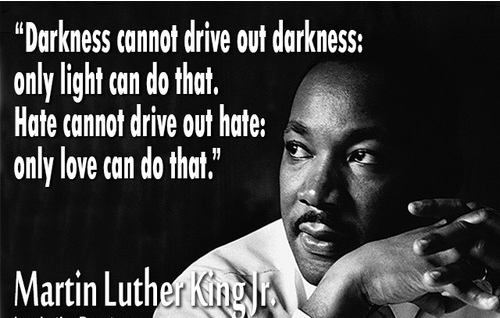
As I drove and reflected on the woman’s words, I was reminded of the words of Martin Luther King, Jr: “Darkness cannot drive out darkness; only light can do that. Hate cannot drive out hate; only love can do that.” And I ask myself: “Jarrett, what are you doing, what are you preaching and writing, how are you living, that shines the light of love?”

“Jarrett, What are you doing to be humble, accepting, and inclusive? What are you doing to do justice on the behalf of every person, to value the sacred worth of all people: male and female, black and white, Hispanic and Asian, gay and straight, open and close-minded, Christian and non-Christian? Jarrett, what are you doing to look like, act like, and be like Jesus in this world?”

If I can begin to work on these questions, maybe a time will come in my life when another person will approach me one day and say: “Jarrett, I cannot wait for you to meet my spouse. She is a retired minister. Her light shines in this dark world just like yours. She loves people and the church just like you!”

Grace in Genesis: Tower of Babel

Tower_of_Babel

Genesis 11:1-9 NRSV

The pastor stands up behind the pulpit, clears his throat, and announces: “This morning we are going to talk about race and racism.”

All over the sanctuary the congregation winces, and beg under their breaths: “Preacher, please don’t do it, for you’re about to open up a giant can of worms!”

But the old preacher, who has opened up more cans of worms than anyone could possibly count, ignores the grimaces and metaphorically gets out the can opener.

I hear many people in the church say that we should not talk about race or make race an issue. However, I believe we make it an issue when we pretend that it is a non-issue. I believe we do great harm to the cause of Christ when we ignore racism or deny that it exists. Furthermore, if we are to accept and do the will of God that I believe is revealed in the story of the Tower of Babel, the church must be willing to openly talk about race and the inherent racism that is prevalent in our families, our town, our region, our world, even in our own hearts.

In the eleventh chapter of Genesis we read:

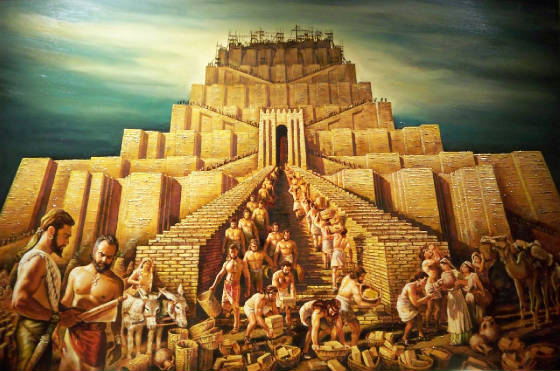
Now the whole earth had one language and the same words. And as they migrated from the east, they came upon a plain in the land of Shinar and settled there. Then they said, ‘Come, let us build ourselves a city, and a tower with its top in the heavens, and let us make a name for ourselves; otherwise we shall be scattered abroad upon the face of the whole earth.

The whole earth was one. One language. One people. One tribe. One race. And they all came together to live in one place. They all came together to build something special, something big, something wonderful that would be a symbol of their unity, pride and patriotism.

Now, what is not to like about that?

Unity, oneness, togetherness, harmony, people of the same minds living in one accord.  Isn’t that the aspiration of all? Isn’t true that great minds think alike? Isn’t this the will of our God, God’s great purpose for humanity?

So what’s not to like in this seemingly perfect picture of unity in Genesis chapter 11? As it turns out, according to God, the creator of all that is, not very much.

Let’s look at God’s reaction to this oneness in verse 7 of our story: “Come, let us go down, and confuse their language there, so that they will not understand one another’s speech.”  So the Lord scattered them abroad from there over the face of all the earth…”

What? Are you serious? What is wrong with this great portrait of human unity, of one race of people, one nation, under God indivisible, all of one mind, coming together to make a name for themselves, to build great things, to be on top of the world, to celebrate their purity and pride as one master race?

The truth is that the builders of the great tower in Shinar had accomplished not what God wants for humanity, but what many throughout history, including the likes of Adolf Hitler and the Ku Klux Klan, have wanted for humanity: One master race of people coming together to form one supreme social order, one culture, sharing the same ideals, values and moral principles. Diversity is a threat. Diversity is something to fear. Diversity is something to segregate and discriminate. Diversity is something to send to the gas chambers or lynch in a tree.

I am not sure if anyone in my lifetime has articulated the thinking of the people of Shinar better than Atlanta Braves pitcher John Rocker back in 1999. Some of you may remember his response when he was asked by Sports Illustrated if he would ever play for the New York Mets or New York Yankees.

Rocker said:

I’d retire first. It’s the most hectic, nerve-racking city. Imagine having to take the number 7 Train to the ballpark looking like you’re riding through Beirut next to some kid with purple hair, next to some queer with AIDS, right next to some dude who just got out of jail for the fourth time, right next to some 20-year-old mom with four kids. It’s depressing… The biggest thing I don’t like about New York are the foreigners. You can walk an entire block in Times Square and not hear anybody speaking English. Asians and Koreans and Vietnamese and Indians and Russians and Spanish people and everything up there.[i]

The story of the Tower of Babel teaches us that what John Rocker said racked his nerves in the world is what God wills for the world. In verse 4 we read that the purpose of building the tower was to avoid what depressed John Rocker on the No. 7 train leaving Manhattan for Queens, and to avoid what John Rocker heard in Times Square. The purpose of settling in Shinar and building that tower was to live in a world with no foreigners, no confusing babbling in the streets, no queers or kids with purple hair to encounter on the way to work, no eating in the marketplace with people on strange diets, no rubbing elbows with people wearing weird clothes, head coverings or dots on their foreheads. So they came together and said, let’s build a tower of unity “to not be scattered over the face of the whole earth.” And God’s reaction to this racial purity and pride was to “scatter them over the face of the whole earth,” to create a world of diverse languages and cultures, to create a world of foreigners.

God was only accomplishing what God had always willed for the creation: diversity. In chapter one of Genesis, we read that the original plan for creation was for humankind to “multiply and fill the earth.” And after the flood in chapter ten we read where God sanctions and wills all nations to be “spread out over the earth.” (Gen 10:32). Simply put, from the very beginning of time, in spite of our will, in spite of our fear and our racial pride, God wills diversity.

Therefore, if we ever act or speak in any manner that denigrates or dehumanizes another because of their race, language, nationality or ethnicity, we are actually disparaging the God who willed such diversity. According to Genesis, diversity is not to be feared, avoided, prevented or lynched. If we want to do the will of God our creator and redeemer, diversity is to be embraced. In other words, if we love God, we will also love our neighbor. And this is what God wants us to be united by. It is why Jesus called it the greatest commandment—love God and our neighbors as ourselves. Love is what should unite us; not racial pride or patriotism.

The story of the Tower of Babel belongs to the same genre of the stories of Adam and Eve, Cain and Abel and Noah and the Flood. They are considered to be “pre-history stories.”[ii] That is, they are describing God’s relationship to the world before the call of Abraham and the history of the Jewish people. It amazes me how God in each of these stories is so often misinterpreted by Christians who believe that the God of the Old Testament is a God of wrath; not a God of grace. They say that they believe Jesus Christ is God; however, they fail to see Christ in these stories.

Consequently, God is often seen as one who curses Adam and Eve by kicking them out of the garden instead of as one who bends to the ground and clothes them with grace. God is seen as someone who curses Cain by sending him to the land of Nod, instead of as one who protects his life with a mark of grace. God is seen as one who curses all of humanity with a great flood with the exception of one family, instead of one who makes a decision to graciously suffer alongside all of humanity. And here in this story, God is seen as one who curses the builders of the tower by scattering them over the face of the earth, instead of being seen as one who reacts to racial pride and unity by fulfilling the purpose of creation from the very beginning, filling the earth, by graciously creating diverse languages, races and cultures.

The tragic irony is that throughout history many have used the story of the Tower of Babel to support slavery, apartheid, segregation and other forms of racism. Bob Jones University once used this story to ban interracial dating on campus. However, this story teaches something very different. The story of the Tower of Babel is God’s gracious stamp of approval, of blessing, on every race, every tribe, and every language in every land. It is the fulfillment of God’s original purpose for creation. The song we learned as little children cannot be more true: “Red, yellow, black and white, they are all precious in God’s sight.” God is not color-blind, as I hear some say, for God creates, wills, blesses and loves color. And it is this love that unites us all, as we have all been created to harmoniously see humanity as God sees it: as a beautiful, diverse, colorful rainbow created by, sanctioned by, and graced by God.

As a Bible-believing Christian, it confounds me when I hear that another, supposedly, Bible-believing Christian, has decided to put their house on the market and move because a person or a family of another race has moved into their neighborhood. I often think about this story in the first book of our Bible that describes a beautiful and diverse creation willed by God. But I also think about a passage in the last book of our Bible that describes an eternity willed by God. And I wonder what in the world these people, who claim to be Christian, are going to do if they do get to that place they think they are going after they die to live forever and ever.

Because guess what? According to Revelation, heaven looks more like Times Square and that No. 7 train on the way from Manhattan to Queens than some affluent suburb outside of Atlanta, Georgia.

In Revelation 7, we read these words:

After this I looked, and there was a great multitude that no one could count, from every nation, from all tribes and peoples and languages, standing before the throne and before the Lamb, robed in white, with palm branches in their hands. They cried out in a loud voice, saying, ‘Salvation belongs to our God who is seated on the throne, and to the Lamb!’  And all the angels stood around the throne and around the elders and the four living creatures [each representing the diversity of all creation], and they fell on their faces before the throne and worshipped God, singing, ‘Amen! Blessing and glory and wisdom and thanksgiving and honor and power and might be to our God for ever and ever! Amen.’

[i] Read more: John Rocker – At Full Blast – York, Braves, City, and League – JRank Articles http://sports.jrank.org/pages/4014/Rocker-John-At-Full-Blast.html#ixzz39oVUCEtA

[ii] See Walter Brueggemann Genesis


Other Sermons in this Series:

Grace in Genesis: Adam and Eve

Grace in Genesis: Cain and Abel

Grace in Genesis: Noah