

Some appeal to guilt: “If you don’t give, how will we keep the lights on and the camera rolling?”
Some appeal to fear: “If you don’t tithe, God will not bless you.”
Some appeal to self-interest: “Give, and you’ll get an unexpected check in the mail.”
And some appeal to nostalgia: “This is the church your grandparents built. You owe it to them to give.”
So, this stewardship season, I want to make something clear: you will never ever hear anyone in this church suggest that pledging your tithes and offerings, your service and your presence, is a way to bribe God, to buy blessings, to feed our souls, or keep our consciences clear.
Furthermore, we are not being asked to make a pledge to the 2026 budget because we recently had to replace the hot water heater, the roof may leak in a heavy rain, and we’ve hired an expensive professional to relocate a large family of bats which have taking up residence in the attic.
That’s because, we believe your pledges, your service, must come from a deeper place.
It was the prophet Jeremiah who proclaimed: “The days are coming,” declares the Lord, “when I will make a new covenant…I will put my law in their minds and write it on their hearts.”
We give because God’s law has been put in our minds and written on our hearts.
Now, when we hear the word “law,” we might think about rules, regulations, and restrictions, what we can and can’t do. But Jeremiah isn’t talking about that kind of law. He’s talking about something much deeper than any rule or ritual.
Jeremiah is talking about the moral rhythm of God. He’s talking about justice, kindness, mercy, and humility. He’s talking about empathy and compassion, engraved not on tablets of stone, but on the living tablets of human hearts.
This is the reason we pledge our gifts. We give, not from guilt, not from obligation, not from a belief that we will get something in return, not even from a command. We give because the rhythm of God’s morality has been written on our hearts.
And when this is written on our hearts, we don’t have to be told to pledge, to give, or to care, to love, to be kind, to show mercy, and to do justice. We just do. We don’t even need a stewardship campaign to tell us we need to embody radical welcome and revolutionary love. It is just who we are.
So, as we think about stewardship this month, as we consider pledging our tithes and our offerings, our service, and our presence, to make this world more just, loving, and peaceful, an important question we should ask ourselves is this:
What is it that is written on our hearts? Because the reality is, everyone has something written inside of them.
Sadly, for many, it is fear—put there by wicked men who seek power by dividing us.
For some, it’s scarcity. It’s the fear that there’s not enough.
For some, it’s fear of the other, immigrants taking what we believe is ours.
For some, it is cynicism. It’s the fear that nothing in this world ever changes, anything I give simply will not matter.
The good news is that not only does God have a powerful eraser, in the words of the prophet, “forgiving wickedness and remembering sin no more,” the good news is that God is still writing. And when God writes, God never uses the ink of fear, but always writes in the ink of justice.
Onto our each of our hearts, God is writing justice, not selfishness; compassion, not comfort; and selfless love, not self-preservation.
Here’s some more good news. Your choosing to be here this morning is a good sign that that the ink of God is flowing through your veins. That’s why I believe you are sitting in a pew this morning. That’s why you give. That’s why you serve. That’s why you show up when your neighbors need you, and that’s why you rally when your country needs you.
Jesus illustrated this truth with a story of a woman, a widow with no power, no protection, and no position. She doesn’t have wealth. She doesn’t have influence. All she has is the ink of God on her heart.
She shows up before a judge who, the text says, neither feared God nor had respect for people. We know the kind. He doesn’t care about justice. He doesn’t care about her. He doesn’t care about God. He cares only for himself.
But because of that something written on her heart, nevertheless she persists. She keeps showing up. She keeps knocking. She keeps demanding justice.
Now, we don’t know what her case was.
Maybe her landlord was exploiting her.
Maybe her neighbor had taken her land.
Maybe she had been cheated out of her inheritance.
Maybe she was being denied healthcare, due process, or civil rights.
Most certainly, she was a victim, or should I say “a survivor” of misogyny.
Whatever it was, she kept showing up.
And although the judge doesn’t have a moral, empathetic bone in his body (again, we know the type, don’t we?), even he gives in. Not because he suddenly finds compassion, but because she refuses to go away.
Now, this is not a story about nagging God until God gives us what we want. This is a story of faithful persistence in the face of injustice. It’s a story about a woman who knew something about the power of showing up. The odds were against her, but she kept showing up. The judge was morally depraved, but she kept showing up. Her friends told her she needed to accept things the way they are because nothing in this world ever changes, but she kept showing up because God’s justice, the rhythm of God’s morality was written on her heart.
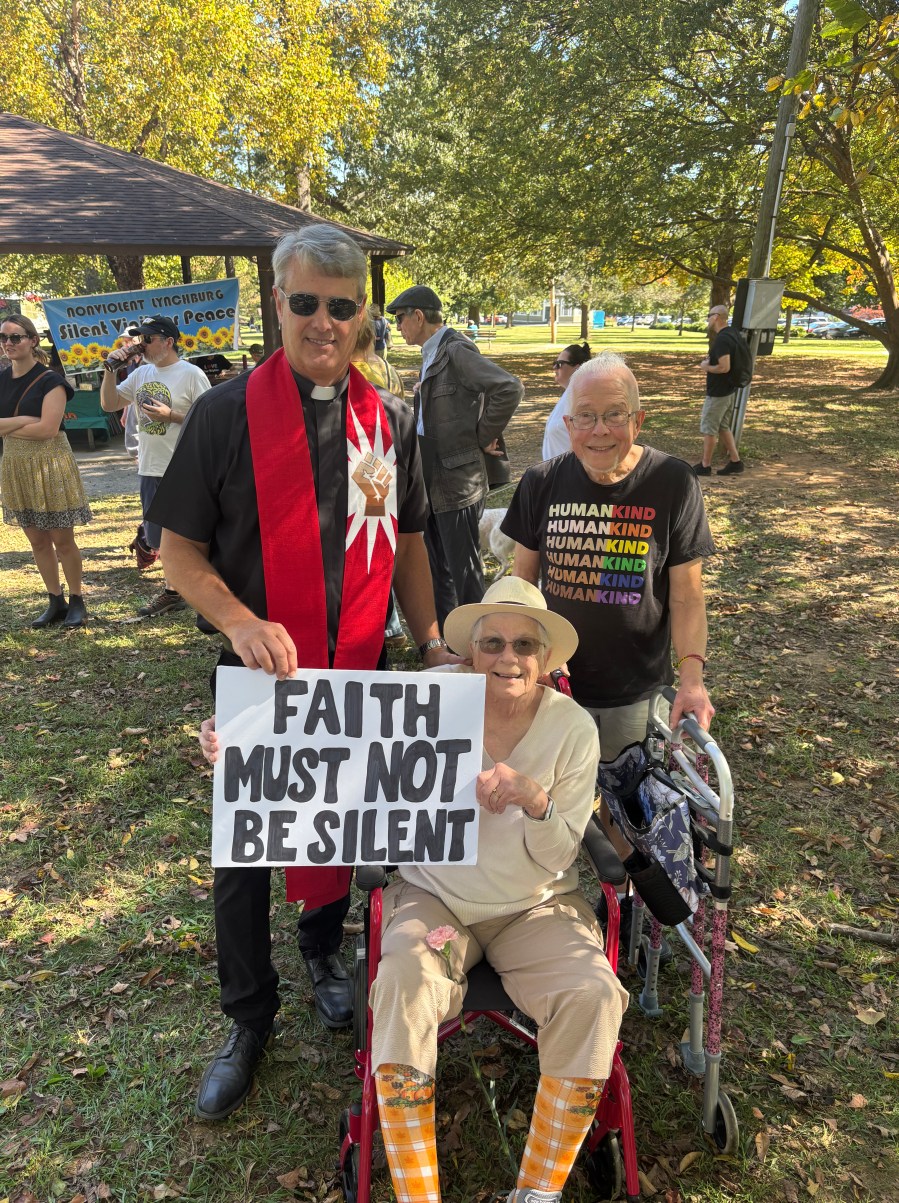
It was the same rhythm that propelled Marion Stump to show up in Miller Park yesterday at the No Kings Rally— demonstrating that when justice is written on your heart, when the ink of God is coursing through your veins, not even pancreatic cancer can keep you from showing up!
This is why this is a perfect text for our stewardship season in this time and place. Because giving is a form of showing up. Serving is a form of showing up. Speaking out, organizing, marching, standing with the vulnerable, fighting for democracy — all of it is showing up before the immoral powers and principalities and saying: “There will be justice here.”
As the widow kept knocking at the courthouse door, we must keep knocking at the world’s door. And every gift of generosity, every dollar given, every act of kindness, every time we show up, is one more knock, one more insistence that justice matters, and love will win.
Now, here’s a statistic that gives me hope today: Researchers say that if just 3.5% of a nation’s population mobilizes in sustained, nonviolent action, they can turn the tide against authoritarianism. Think about that. Not half the country. Not even a tenth. Just 3.5%. That’s about one in every thirty people. If one in thirty people with justice written on their heart keeps showing up, keeps marching, keeps knocking, keeps giving, keeps serving, keeps praying, you can change the direction of a nation. This nation can be turned toward justice again.
So, we must never believe our offering doesn’t matter, our presence doesn’t count, our gifts are too small, or that our persistence is not power. Because every time we show up, every time we give out of what’s written on our hearts, we’re part of that 3.5%. We’re part of the turning. We’re part of God’s kingdom breaking in.
Good stewardship is and has always been heart-based. It’s justice-based. It’s love-based. It’s what Jeremiah saw when he said:
No longer shall they teach one another, saying, ‘Know the Lord,’ for they shall all know me, from the least of them to the greatest.
When the covenant is written on our hearts, we don’t need coercion. We don’t need compulsion. We don’t need manipulation. Because the Spirit itself bears witness in our hearts, and when God’s handwriting burns in your chest, you wake up every morning asking: “How can I give myself today for justice, for peace, for love?”
And the good news is that the world doesn’t need an extraordinary event to change. It changes through ordinary persistence. Through the widow who won’t give up. Through the disciple who keeps showing up. Through the church that keeps preaching hope, even when hope seems hard to find, because every time we show up, we bear witness to the covenant of God written inside of us. We demonstrate to the world: “Greed will not have the last word. Hate will not have the last word. Fear will not have the last word. And love will one day ultimately and finally win.
Disciples, we are the people who keep showing up. We show up for one another. We show up for our neighbors. We show up for the nation. We show up wherever anyone thirsts for justice and hungers for love.
Because when the covenant of God is written on your heart, you can’t sit still in the face of suffering. You can’t stay silent in the face of injustice. You can’t keep your hands closed when the Spirit is calling you to open them.
The widow kept showing up before the unjust judge, and we keep showing up before an unjust world—not out of guilt, not out of duty, not to get something in return, but because there’s something divine inside of us that will not let us rest.
It’s what Jeremiah called a new covenant. It’s what Jesus called the kingdom of God. It’s what we call faith in action.
So, this stewardship season, we’re not asking you to give out of fear or guilt or obligation. We’re asking you to give because you’ve got something written on your heart.
Give because you believe that love is stronger than hate, and there’s a love inside of you that will not let you go. Give because you trust that justice will prevail. Give because you know that hope still has work to do in this world!
Give, because you’re part of that 3.5% who refuse to bow before kings, who refuse to be silent in the faces of those in power with no regard for people or God, who refuse to quit knocking, who refuse to stop showing up.
Because that’s what the church is.
It’s not a building that needs maintaining, but a movement that needs to keep marching.
And we will keep showing up—not until we get what we want, but until the world becomes what God dreams it to be.
Until every heart bears the handwriting of God, and every gift, every prayer, every act of courage echoes that same eternal truth:
We give, we serve, we love, we persist, because it’s written on our hearts!
Amen.
Pastoral Prayer
God of persistence and promise,
You are the One who writes truth on human hearts,
who carves compassion into our very being,
and who teaches us to keep showing up
in hope, in prayer, and in love.
You have written Your covenant not on stone tablets
but in the living flesh of our hearts.
So even when the world forgets justice,
even when the powerful ignore the cries of the poor,
Your truth keeps pulsing within us,
calling us to rise again, to knock again,
to believe again that love will have the final word.
We thank You for the saints and prophets
who never stopped knocking on the doors of indifference.
For the mothers who marched,
for the workers who organized,
for the dreamers who still believe in a more just tomorrow.
May their persistence live in us.
And forgive us, O God, when we grow weary in doing justice.
Forgive us when our compassion has an expiration date,
when our generosity depends on convenience,
when our prayers fade because the answers take too long.
Remind us again that the work of justice
is not measured in days or dollars or ease,
but in faithfulness, in showing up again and again.
In this season of stewardship, teach us to give not from fear or guilt,
but from gratitude and conviction.
Let our generosity be an act of defiance
against greed, apathy, and despair.
Write Your covenant deep within us,
until our giving, our praying, and our living
all bear witness to Your love at work in the world.
We pray for those whose hope feels faint today:
for the tired caregiver; the underpaid worker;
the neighbor who feels unseen; the soul that feels unheard.
May they find strength in the knowledge
that You are the God who listens, the God who remembers,
the God who still answers cries for justice.
And so, we will keep showing up.
We will keep praying, keep working, keep giving,
until the widow’s cry is answered,
until Your justice rolls down like waters,
and Your mercy like an ever-flowing stream.
We ask this in the name of Jesus,
the One who kept showing up,
the One who never gave up,
the One who lives and reigns through love.
Amen.


 Just Love