If We Loved Like Jesus

John 13:31-35

In the words of Stevie Wonder, I have “some serious news to pass on to everybody (which is really news to no one): “Love is in need of love today.”

Although some of Jesus’ last words, which are usually understood as one’s most important words, came in a commandment to love one another as he loved, many Christians have rejected those words, and today, love seems to have fallen out of favor.

One excuse I hear is: “Well, love might have worked back in Jesus’ time, but the world’s a much different place today. Love, especially loving like Jesus loved, well, that just doesn’t cut it anymore.”

Preaching love these days gets one called “a left-wing lunatic,” while stirring up hate gets one elected President. Being empathetic toward another gets one called “a sinner,” while being a bully gets one called “faithful,” or “councilman.” Deporting and separating families gets cheers, while asking for some common decency and humanity, gets one called “soft.”

If we truly love like Jesus loved—if we feed the hungry, if we care for the sick, if we give to the poor, if we stand up for the marginalized, if we speak out on behalf of the oppressed, if we welcome the stranger, and accept those who are cast away, we’re considered: “enemies of the state.”

These days, the peace and love crowd who lead with mercy, are out of date. And the mean and tough crowd, those who can make the hard decisions are trending. They can take away SNAP benefits without any apprehension, have people arrested without any due process and disappeared without any second thought. They say the country can afford to show our strength with a military parade, but not to show our compassion with healthcare for the elderly.

But love? Love is weak, they say. And these days, in these times, they say love is for losers. It may have worked back in the first century, when Jesus commanded it, but not here in the twenty-first, not anymore.

But the truth is, first century Palestine was not much different from today. Beneath the rule of the Roman Empire, ordinary people bore the weight of crushing taxes, land seizures, violent crackdowns, and the threat of crucifixion designed to silence dissent and maintain control. The elites—

local, imperial and religious— colluded to rob people of their wealth and dignity, leaving entire communities displaced and impoverished. It was a time when the underprivileged dare not imagine a world where justice was right for the oppressed and not a privilege of the powerful.

And it was into the thickness of that unrelenting, darkness, Jesus commanded his followers: “Love one another.”

Because Jesus knew that love is the light the darkness cannot overcome, and love is only power in the world strong enough to tear down empires and build God’s kin-dom.

So, when Jesus said, “Love one another as I have loved you,” he wasn’t being soft, and he sure as heaven wasn’t being weak.

He was talking about using the most powerful force in the world to change the world! He was talking about a love that was so threatening to the powers-that-be it would get you arrested and could easily get you nailed to a cross.

Jesus was talking about a love that confronts the empire, a love that calls out injustice, a love that always, insistently, and unapologetically, favors the oppressed and welcomes the people society tries to cast out. It’s a love that moves mountains, flips tables, and shakes up the status quo. It’s a love that demands justice for the poor, healthcare for the sick, and freedom for the oppressed.

Jesus said, “Love one another, as I have loved you,” because Jesus knew that love, the love he taught, the love he modeled and embodied, is the only power in the universe that can turn this world around.

Earlier this spring, Father John Dear reminded us that although the term “nonviolence” may sound passive and weak, there’s really nothing passive or weak about it. Nonviolence is “active love. It’s active resistance to evil.”

It’s important to remember that Jesus was anything but passive. He didn’t just sit back in his thoughts and prayers and wait for the world to change. He marched right into the temple and flipped over the tables of those who were hurting the poor saying: “This is not the kingdom of God! This is not how God’s people do things!”

He challenged the hypocrisy of the religious culture, those who claimed to love God but failed miserably in the things God requires, kindness, justice, and mercy, especially to those who were the most thirsty and hungry for it.

That’s how Jesus loved. And that’s how the world today needs us to love.

Dorothy Day, who devoted her entire life to loving like Jesus, once said: “Love, and ever more love, is the only solution to every problem that comes up in the world.” Love keeps coming. It keeps showing up. It keeps resisting and pushing back the darkness.

Dr. King described love’s power this way: “Power at its best is love implementing the demands of justice, and justice at its best is power correcting everything that stands against love.” Love stands up to racism, to sexism, to greed, to exploitation, to marginalization, and says: “Not on my watch!”

Gandhi once said: “Nonviolence is not a weapon of the weak. It is the weapon of the strong.” The strength of love is not how hard we hit or how loud we shout. It’s in how firmly we stand for love when hatred thunders and violence strikes. That’s true strength. And the good news is that the church that commits to loving like Jesus has that strength in abundance!

The problem is that an alternative Jesus devoid of love is now being used to fuel injustice. When I heard in seminary that when fascism comes to America, it’ll be wrapped in the flag and carrying a cross, I really didn’t think I’d ever see it.

Ten commandments hang on the walls, but there’s no compassion in the halls. They call it freedom, but it only works for some. Prayers and crosses are everywhere, but mercy? It’s nowhere to be found. They may say it is about God, but it’s all about control.

As Rev. Dr. William Barber likes to say, you can’t say God Bless America and think you’re being holy when you’re terrorizing immigrants, taking away food from the poor, and denying healthcare. That’s not holiness, says Barber, — “that’s pure hypocrisy dressed up in Sunday clothes!” It is sin. And if we stay silent while God’s name gets stamped on policies that crush the poor, deport the stranger, and hoard wealth for the few, then we are complicit in that sin. Jesus didn’t die for a faith that props up empires — he died for a love that tears them down.

And Barber reminds us that none of what we are seeing today is new. In the 1930s, fascists in Europe had a way of wrapping cruelty in religious national pride. They spread lies about minorities and built concentration camps and called it security. They locked up dissenters and called it patriotism. They cut off aid to the vulnerable and called it government efficiency. They blamed the Jews for the crucifixion of Jesus and called it eradiating anti-Christian bias.

And today’s mass deportations, voter suppression, and attacks on the press, free speech and universities — they are all echoes of those same dark chapters.

The good news is that love didn’t fail back then — because love does as love always does— Love showed up.

Love resists. It never quits. Love stays. It never retreats. Love fights. And love always wins.

Harriet Tubman went back, again and again. Because love doesn’t leave people behind. Chains broke. A system cracked. The lie of slavery collapsed. And love won.

In Selma, they beat ‘em with batons on that bridge. But they marched anyway. Love crossed into history. The Voting Rights Act was signed. And love won.

At Stonewall, they said love was illegal. They raided bars and broke lives. But the people rose. Years later, the Supreme Court saw the truth that love is love is love, and love got a seat at the altar. Love won.

In 2020 when everything shut down, love opened up. Mutual aid was demonstrated. Grocery runs happened. Meals on porches were shared. Text chains were created. Check-ins occurred. Love filled the gaps.

Not soft love. Not timid love. Resilient, rooted, revolutionary love—this is the love Jesus commanded when he said: “as I have loved you, love one another.”

It’s a love that doesn’t flinch. A love that never folds. A love that bears all things, believes all things, hopes all things, endures all things. A love that doesn’t give up. Not then. And not now.

If only the church had followed the simple commandment to love Jesus as he loved, it would’ve never been seduced by any politician shouting, “Make America Great Again!” Because the only greatness Jesus is interested in is the greatness of love—Love that welcomes the stranger, feeds the hungry, and protects the vulnerable—A love that would never chant “Send them back.”  But always says: “Come to me, all you who are weary and burdened, and I will give you rest.”

So, no — love is not weak, and it is not soft— love is power. Love is resisting. Love is marching. Love is standing up and speaking out.

Love is nonviolence in action, and as Father Dear says, love is a “force more powerful than all the weapons of war.”

The good news is—we can see love is rising today!

We can see love standing unshakably during a silent peace vigil on Monument Square in the pouring rain. It can be seen getting pastors arrested for praying in public in the Rotunda to protect Medicaid. And when the Boss sits down at concert and speaks like the prophet Isaiah.

And we can see love persisting as a new Pope chooses to be named Leo, after the Pope who laid the foundations in 1891 for Catholic social teaching advocating for: the rights of workers, especially the poor; the divine dignity of all persons, the government’s role in social justice; and role of the church in protecting the most vulnerable.

A small act of kindness extended to a stranger, a church sheltering an asylum-seeker, federal judges pushing back to defend the Constitution—This is not weakness. This is the power that can change the world!

If we loved like Jesus, our immigration policies would be built on hospitality, not hostility.

If we loved like Jesus, we would welcome the stranger, not criminalize them.

If we loved like Jesus, unchristian Nationalism would bow to the kingdom of God, and white supremacy wrapped up in Christian language would never be tolerated.

And the church wouldn’t be known for judgment, but for joy. We’d be too busy setting extra places at the table to worry about who belongs and who doesn’t.

If we loved like Jesus, our love would be bigger than our borders. Our love would be stronger than our fears. And our love would be louder than all voices put together conning us to divide, exclude, and hoard.

So, let’s love like Jesus! Let’s make the kingdom of God visible, one act of radical love at a time!

As Rev. Barber says — “it’s not about left or right, it’s about right and wrong.” And love is always right!

So, let’s be known for love. Let love do the talking. Let love do the walking. Let love be the proof. Let love be the revolution! Amen.

A Hundred Fifty-Three

John 21:1-11

Happy Star Wars Day! May the fourth be with you!

You may laugh, but there are churches that are observing this day, May the 4th, as Star Wars Sunday, focusing on the spiritual struggle between darkness and light, drawing parallels between “the Force” and the Christian concept of God.

Numbers, like the 4th when it occurs in May, have always been significant in the life of the church, as numbers always seem to be significant in the Holy Scriptures.

The number 40 is symbolic of testing, trials, and periods of preparation, as we remember the story of Noah and the rain that fell for 40 days and 40 nights, and of Moses and the Israelites’ 40-year journey out of slavery into the Promised Land, and of Jesus’ 40-day fast in the wilderness.

The 144,000 protected from judgment we read about in the book of Revelation is based on the number 12, a symbol for wholeness based on the 12 tribes of Israel and the 12 disciples. The number 7 in Revelation symbolizes divinity, whereas the number 6, particularly 666, symbolizes evil.

So, when we read the story of the miraculous catch of fish in this post-Easter story, the number 153 leaps off the page!

Verse 11 reads: “So, Simon Peter went aboard and hauled the net ashore, full of large fish, a hundred fifty-three of them, and though there were so many, the net was not torn.”

Such an odd number. Such an exact number. Why not just say 150 fish? Or tell a good fishing story by exaggerating it, rounding it on up to 200?

But John says the net contained exactly a hundred fifty-three fish. There are so many possibilities with and no shortage of interpretations.

Some have interpreted 153 fish to mean: “It’s just a lot of fish.”[i] And that moments of such abundance say something about living in a world where the good news of Easter is a reality, as grief is transformed into action, scarcity is transformed into abundance, and despair becomes hope we discover that what seems like the end is only the beginning!

It means living in a world, that when it comes to the love that Jesus taught, modeled, and embodied, we can never give in, give out, or give up, because we know that such love always wins. Such love never ends. Not even death can stop it. It means never retreating in despair believing that things in the world cannot get better.

But something tells me that the number 153 means even more. If it’s just about “a lot of fish,” why didn’t John simply write, “they caught so many fish the nets started to break, and the boats began to sink,” as we’ve heard in another story (Luke 5)? Why does John specifically record the number 153?

Some scholars believe the number symbolizes the truth  that Jesus did not come to abolish Jewish law or the Torah. They point out that the Torah, the first five books of the Bible, was divided into portions to be read in worship. Like the Lectionary that I use each week to preach, the portions were part of a three year-cycle, and the three-year Torah cycle used in Palestine around the First Century had, you guessed it, 153 portions.

Now, if you think that is interesting, listen to this.

St. Augustine pointed out that the number 153 is the triangular of 17. That means that if you add all the numbers decreasing from 17, you get 153. That is to say: 17 + 16 + 15 + 14 +13 + 12 + 11… all the way down to +1 = 153.

So 153, according to Augustine, is all about the number 17, which Augustine believed was a sign of the union of Judaism and Christianity as we have 10 commandments in the Old Testament and 7 Gifts of the Spirit in the New Testament.

How about that? But wait, there’s more.

In the book of Acts, we read that 17 nations were present for Pentecost. So, Peter’s catch of 153 fish at the end of John’s gospel might mean something like the end of Matthew’s gospel when Jesus calls us to make disciples of all nations.

It was St. Jerome who pointed out that during the time John tells this story that there were only 153 species of fish in all the world. Hence, 153 signifies the universal hope that every person of every class and time would be saved through the Gospel.

St. Gregory the Great believed 10 and 7 are perfect numbers, added together make 17. This, times 3, factoring in the Trinity, makes 51. This, times 3 again, makes 153.

St. Augustine also notes that there were 7 disciples in the boat (Peter, Thomas, Nathanael, James and John, and two other disciples), who had all been filled with the 7 gifts of the Holy Spirit. 7 times 7 equals 49. 49 plus 1 (that’s Jesus) makes the perfection of 50. And 50 x 3 for the Trinity gives you 150 plus another 3 for the Trinity gives you 153.

St. Cyril breaks 153 into 100 (the great number of gentiles to be saved), plus 50 (the smaller number of Jews to be saved), plus 3 (the Trinity who saves all).

Others have pointed out that 100 (representing the number of married faithful in the Church), plus 50 (the faithful who commit themselves later in life to celibacy either living as widows or living with their spouse in a brother-sister relationship), plus 3 (the precious few who commit their whole lives to celibacy as virgins) equals 153.[ii]

I hope you are writing all this down.

Now, do you want to know what I believe is the significance of 153?

Allow me to first preface my opinion by reminding you that I have a Doctorate in Ministry and have been a student of scripture for half a century, if you count my Sunday School classes as a child. Plus, I grew up on the Outer Banks of North Carolina; thus, I know a thing or two about fishing.

Here it is. You will really want to write this down. For it is going to blow your mind and probably change your life.

Here it is. Drum roll please. People who go fishing like to count their fish.

That’s it. People who fish count their fish. Now, it may mean a little more than that, but not much more.

I also believe this Easter story has something to do about people, as the story is very similar to other fishing stories when Jesus tells the disciple anglers that they were going to go from catching fish to catching people (Mark 1 and Matthew 4).

Thus, a hundred fifty-three means that people, like fish, are to be counted. Now, compared to the hyper-symbolic, mathematical theories of the saints, that may sound like a hollow interpretation; however, when we consider the number of people who are discounted and marginalized in our world today, this simple interpretation is nothing less than prophetic.

So, what this Easter story says to me is that this movement we call discipleship where we can be confident love will win and justice will prevail, is a movement that prophetically proclaims that every person counts.

A hundred fifty-three is particularly prophetic for Americans as the United States has always had a problem counting certain people, as some in this nation, including those in power today, have always had a problem with equality. There have always been those who want to put a tear in the net, so all will not be counted.

Ever since the Constitution’s original framework, when enslaved people of color were counted as three-fifths of a person, there have been people in this country who have sought to undermine equality, suppress the vote, and discount entire groups of people.

And today, those people are in power, intentionally tearing the net by rolling back all the progress made for equality and civil rights in the 20th century, calling desegregation “a historic wrong,”[iii] and going after any organization, business or university that seeks to count everyone with programs focused on diversity, equity, and inclusion. And now, democracy hangs in the balance.

Perhaps we should have seen the end to democracy coming —when every ten years there’s an argument in our country about who should be counted and who should not be counted in the census, as counting every person is fundamental to democracy, based on the principle that each person counts and deserves representation.

So, I believe 153 is a profoundly prophetic number for America today. A hundred fifty-three affirms democracy and the principle that all people are created equally. A hundred fifty-three means there is no person who does not count.

A hundred fifty-three affirms our annual Holocaust Remembrance Service, as a hundred fifty-three means that six million Jewish people count. And they still count, despite those today who are seeking to re-write history or “move on from past guilt.”[iv]

And a hundred fifty-three also means that 2.3 million people in Gaza count, 2.3 million Palestinians who are starving to death today because of the Israeli and US-backed ban of food and humanitarian aid.[v]

One of the best things about living in New Orleans was when I had the opportunity to officiate a funeral where we marched in the cemetery behind a jazz band singing: “Oh when the saints go marching in, when the saints go marching in, oh Lord, I want to be in thatnumber when the saints go marching in!”

Oh Lord, how people just want to be counted.

People of color who cry for their lives to matter just want to be counted.

Trans men and women asking not to be called by their dead name just want to be counted.

Pregnant women who desire to have a choice in their healthcare, just want to be counted.

Disabled people requesting fairness and equal opportunity, just want to be counted.

Immigrants, refugees, and Asylum-seekers in the pursuit of happiness, just want to be counted.

People who are being snatched off our streets and disappeared, need to be counted.

Books banned; history erased; votes suppressed; due process denied; free speech stifled; basic rights deprived; Medicaid, SNAP, Head Start, low-income energy assistance, and other programs cut—it’s all about people who must be counted!

Think about who you know today—at work or at school, in your neighborhood or in your family—who may feel like they are of no count. And think about what actions you could take, or this week, or next, to let know that they do count—to you, to this church, and to God—and maybe, one day, to the nation.

“Simon Peter…hauled the net ashore, full of large fish, a hundred fifty-three of them, and though there were so many, the net was not torn.”

The net was not torn. All were counted. Amen.


[i] https://www.workingpreacher.org/dear-working-preacher/resurrection-is-abundance

[ii] https://parish.rcdow.org.uk/harefield/wp-content/uploads/sites/148/2022/10/The-mystery-of-the-153-fish-in-the-Gospel-of-John.pdf

[iii] https://wpde.com/news/nation-world/doj-department-of-justice-officially-ends-desegregation-order-at-louisiana-school-plaquemines-parish-after-nearly-50-years-court-system-integrated-racial-segregation-south#

[iv] https://www.npr.org/2025/01/27/nx-s1-5276084/elon-musk-german-far-right-afd-holocaust

[v] https://www.pbs.org/newshour/world/palestinians-struggle-to-feed-their-families-as-israel-blocks-gaza-aid-for-nearly-60-days

Far from the Shallow Now

Luke 5:1-11 NRSV

One morning, Jesus is preaching down at the lake. The crowd that had gathered is so large, Jesus felt like they were about to push him right into the water!

During the sermon, he sees two boats belonging to some fishermen who were on shore washing their nets. He gets into the boat belonging to Simon, and he asks Simon to anchor the boat a little way from the shore, where he continues his sermon.

Luke doesn’t record the words to Jesus’ sermon, but from his sermon in the very next chapter, we could probably take a good guess: “Blessed are you who are poor, for yours is the kingdom of God. Blessed are you who are hunger now, for you will be satisfied. Blessed are you who weep now, for you will laugh. Love everyone, even your enemies…” It’s a sermon of abundant mercy, extravagant grace, and boundless love!

After the sermon, Jesus tells Simon that he wants to do a little bit of fishing himself: “Let’s leave these shallow waters and let down the nets.”

Simon responds: “Master, with all due respect, I, along with my long-time business associates, James and John, have fished these waters all night long, and we haven’t caught a thing. Yet, if it will make you happy, I will go out a little deeper and put down the nets.”

Well, as soon as the nets hit the water, they catch so many fish that the nets begin to break. They quickly call out to James and John to get the other boat and offer them a hand.  And when they come, they fill the boats with so many fish that both boats begin to sink.

As Simon takes in the overwhelming scene— nets breaking, boats sinking, fish everywhere, a scene of failure and scarcity transformed into triumph and abundance, a scene of what can happen when you leave the shallow to dive into something deeper, what can be experienced when you obey the commands of Jesus—Simon is overwhelmed, and falling down at Jesus’ knees, he says: “Go away from me Lord, for I am a sinful man!”

It was as if Simon suddenly realized that it only seemed that Jesus was finished with his sermon that day. Jesus may be fishing, but he is still preaching. Through the abundant catch of fish, Jesus is still proclaiming God’s abundant mercy, extravagant grace, and boundless love. Believing he is underserving of such love, how unworthy he is of such abundance, Simon asks Jesus to go away.

But Jesus never goes away easily. “Simon, not only are you worthy to receive the abundant, extravagant, over-the-top love of God, you are worthy to share it with others and change this world! So, do not be afraid; for you are no longer going to be catching fish, you are going to be catching people!”

“I am asking you, Simon, along with your business partners James and John, to leave your shallow, contained, little world to venture out with me into a deeper, larger, revolutionary reality.

The truth is, Simon, I need you to go deeper. I need as many people as I can get to go deeper. The problems of the world are too great, and your lives are too short to waste any time wading in the shallow. And the grace of God is too extravagant. The mercy of God is too abundant. The love of God is too boundless for you to keep your it all to yourselves.

I need you to leave your shallow, safe world of spending all your time making a living to meet the needs of your immediate family, and I need you follow me into the deep, risky reality of sacrificing your time to meet the needs of the entire human family!

I need you to leave your shallow life that feeds you, and your children, and accept a deeper life that helps feed every child of God!

I need you to move beyond your shallow, narrow mission of caring for your own home, and accept the deeper, wider mission of caring for the entire planet!

I need you to lose the apathy towards issues that do not concern you and your limited of circle of family and friends to possess a deep empathy towards all who experience injustice!

I need you to move beyond your shallow understanding of success. Simon, no matter what you have been taught, success is not defined by the amount of fish you catch, or the size of your house or back account. It is so much deeper than that!

Your success is measured by how many people you loved extravagantly, abundantly, and graciously.

I need you to go deeper, Simon. You too, James and John, and be my disciples and fish for people. Do the hard, messy, oftentimes frustrating, and risky work to meet the needs of people, to care for and to liberate people. I need you to move far from the shallow now to do the deep work of love. And I am not talking about personal and intimate love, but a love that has public and political ramifications.

Now, here’s what I believe is the real miracle in this story. We read it in verse 11. After Jesus invited them to leave the shallow for something deeper, to leave the fish business to be in the people business we read: “When they had brought their boats to shore, they left everything and followed him.”

This is miraculous because when it came to accepting the extravagant grace and love of God revealed in the large catch of fish, Simon, seemed to have some difficulty: “Get out of here, Jesus! I am a sinful man!”

However, when it comes to following Jesus to a deeper life, to love others to selflessly and sacrificially, extravagantly and liberally, he, with James and John, leave everything and follow.

This is miraculous, because it is the exact opposite of how we humans usually work. We seem to have no problem accepting the grace of God for ourselves. We have no issues receiving the love of God for us personally. But we prefer to keep it shallow. We prefer to keep it personal. We prefer to keep it safe, keep it contained, keep it conservatively to ourselves. We are almost always reluctant to go deeper.

Because going deeper is dangerous. Going deeper is costly, and it is risky. Going deeper can be overwhelming. In the deep, fish break our nets and people break our hearts. Going deeper may mean leaving our friends and family behind.

I want to thank Katie Nunn for sharing her talent with us by creating this extravagant artwork that is adorning our baptistry today. When she first thought of this idea, which to me, speaks to the abundant and extravagant love we are called to share with others, she said she was tempted to think that the art might be “too far out” for church. But then, thinking about what this church means to her and to others, she thought, when it comes to love, for this church, there’s no such thing as being “too far out.”

In other words, Katie has joined a congregation of disciples, who, with Simon, James, and John, when it comes to love, have chosen to go deep, to go far out from the shallow.

We are disciples who have decided to go on a journey to share the abundant mercy, extravagant grace, and liberating love of God with all people, all the while knowing the journey will not be easy, comfortable, or popular.

Late author and professor John Augustus Shedd once said: “A ship in harbor is safe, but that is not what ships are built for.” And today, we are on a ship with Jesus. He is the captain who navigates our journey out of the harbor into deep, dark, and dangerous waters.

The darkness of these days, like deep water, requires more than a shallow response. The times are too serious, and our time is too short, to waste any amount of time playing around in the shallow.

When the president makes an executive order to “eradicate” any opposition to the sick religion of White Christian Nationalism or the cult of MAGA, while disparaging any religious thought that calls for mercy and compassion, empathy, and equality, we must go deeper.

When the tax status of non-profits and institutions that serve the common good are threatened, when aid to the poorest people in the world is cut off, our stewardship practices, our civic engagement and our commitments need to go deeper.

When houses of worship receive warnings by the government that sanctuary provided to the immigrant will not be honored, that we may be targeted, our commitment to the word of God “to treat the foreigner living among us as native born, to love them as ourselves” gets called into the deep (Leviticus 19:34).

When programs designed to celebrate diversity, create equity, and foster inclusion are eliminated in favor of protecting the privileged, our faith compels us to go into the depths of human solidarity and belonging.

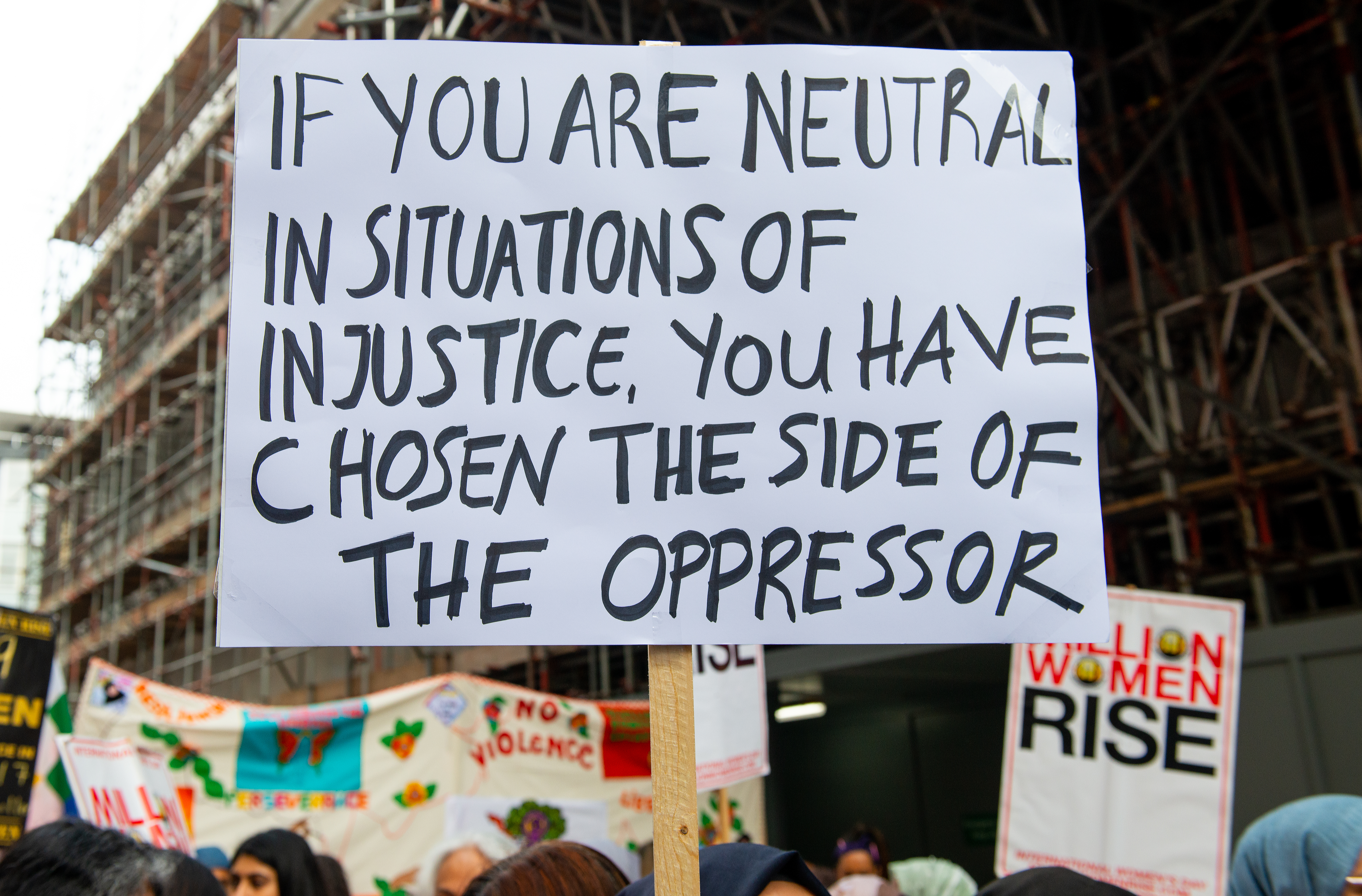
So, if you have come here this morning because you want to dip your toes in the safe shallow end of the pool, to wade, splash around, and enjoy yourselves, to nourish your private, personal relationship with the Lord, to remain neutral when it comes to public policy and politics that hurts the poor and the marginalized, then I am afraid, you have come to the wrong place! We don’t even have a kiddie pool for children in this place, as we are even training them to swim in the deep end.

Because we know that a shallow, safe, personal, and private faith, a faith that has the sole purpose to feed one personally, allows children to starve, and the entire creation to hunger.

A shallow faith allows the spread of a false gospel that is unconcerned with the living conditions of anyone else living on the earth as well as the state of the earth itself.

Shallow faith enables false prophets to reject Jesus, or worse, to act in ways that are the antithesis of Jesus, ways that are anti-Christ, and still claim they are following Jesus.

Shallow faith is afraid to enter into the depths of human suffering and oppression. It finds contentment inwardly, in one’s own family, job, possessions, and even church.

Shallow faith is afraid to rock the boat, afraid of losing a friend or upsetting a co-worker or family member.

Shallow faith is afraid of the sacrifices and the changes that need to be made.

And sadly, church is where people can be the most afraid, and thus the most shallow, the most small-minded and the most close-minded, the most self-interested and self-preserving

But the good news is that church can also be the place where people can be the most courageous, a place where we are challenged to be more open, more selfless, and more self-expending, where we are pulled by Jesus into the deep, dark, and dangerous places, far from the shallow.

To those difficult places where we have a deep conversation with that climate change-denier or anti-vaxer. Where we go out of our way to help an asylum seeker. Where we contact our legislatures to object to the wicked assault on trans people. Where we call out racism and white supremacy wherever we see it, on the school board, the city council, even in our own families.

The good news is that the First Christian ship of Lynchburg, Virginia has left the harbor. Jesus is our captain. And we are far from the shallow now! Amen.

When Jesus Falls Out of Favor (and nearly off a cliff!)

Luke 4:14-30 NRSV

Once upon a time, in a land far away, but not so different from our own, excitement was in the air as folks began gathering in the narthex, sipping their coffee. Everyone was looking forward to the sermon. Because today, they had a special guest preacher!

Many were just glad to have a break from listening to their pastor who they’ve had to now put up with for a year and a half. But some were really looking forward to hearing one of their own, someone who had moved away, made a name for himself, and made them proud. He had come back home for a visit and had been asked by the Elders to fill the pulpit.

No one paid attention as the announcements were being made. In the pews, heads moved and necks stretched, as everyone was trying to catch a glimpse of their hometown pride and joy.

After the Children’s Moment and the Pastoral Prayer, the young man stood up in the pulpit.

“Look! There he is!”

“My, hasn’t he grown!”

“He looks just like one of us, with his dark eyes and complexion.”

The worship leader handed him a scroll. He unrolled it and began reading words from the prophet Isaiah:

‘The Spirit of the Lord is upon me,

   because he has anointed me

     to bring good news to the poor.

He has sent me to proclaim release to the captives

   and recovery of sight to the blind,

     to let the oppressed go free,

to proclaim the year of the Lord’s favor.’

He rolled up the scroll, gave it back to the worship leader, and sat down. All were smiling as he had just read one of their favorite scripture passages.

It is then, that he stood back up and dropped the mic by declaring: ‘Today, this scripture has been fulfilled in your hearing!’

Countless amens could be heard throughout the sanctuary. One congregant shouted: “Hallelujah!” Another exclaimed, “Praise Jesus!” Another said, “I wished he was our full-time pastor!”

Everyone was pleased as they could be! Because the scripture he read was being fulfilled for them. Good news for the poor meant good news for them, because they didn’t consider themselves to be among the rich oligarchs that were in power.

And because they were living in an occupied territory, release to the captives, meant liberation for them!

Because they had lost hope and had a difficult time seeing anyway forward, recovery of sight to the blind meant recovery of hope for them!

And because they felt oppressed by the Romans, freedom for the oppressed meant freedom for them!

So, amen, brother! Preach it!

They could not have been more enthusiastic with their hometown hero! All throughout the sanctuary, you could hear proud comments like: “Why isn’t that Joseph’s oldest boy?”

After the choir sang the anthem, the young preacher stands back up, takes a sip of water, and begins the sermon: “There’s no doubt many of you will say: ‘Doctor, cure yourself.’ ‘Do here also here in your hometown the things that we heard you do Capernaum.’”

“That’s right!” someone shouted!

Another yells: “Charity begins at home!”

Someone else screams, “America First!” (I mean, “Israel First!”)

On the edge of their seats, their ears are itching to hear what their hometown boy had to say next!

It is then he says something like: “You know that no prophet is accepted in his hometown

Someone cupped their hands to their mouth and shouted: “We’ll always accept you Jesus!”

Another yelled: “That’s right! You are one of us!”

Still another shouted: “We’re with you all the way!”

He takes another sip of water and then begins to proclaim that Isaiah’s prophetic vision of good news, liberation, recovery of sight, and freedom is not for them only, or even for them first. It is for everyone, maybe even especially for those who need it the most, folks that may not be from around here

In the congregation, shoulders tense, and heads turn. More comments could be heard, but the enthusiastic tone becomes disconcerting: “Wait a minute! I know he’s not talking about diversity, equity, and inclusion, is he?”

Jesus, though, is undaunted by the sudden aggravation in the air, because he wasn’t there to win a popularity contest or to scratch itching ears. He’s  there to tell the truth, even if that truth is unsettling, because Jesus knows that the truth of God’s inclusive and equitable love, as offensive as it may be, is the only way to create a more peaceful and just world.

Jesus then reminded the congregation why the prophets are never popular in their hometown by referring to two stories, one about the prophet Elijah and one about the prophet Elisha.

“You remember Elijah, don’t you? And the story of those three and half years it hardly rained a drop, causing a severe famine throughout the region? Now there were countless widows living in Israel during that time who were starving to death. But God didn’t send the prophet Elijah to help any widows in Israel. No, instead, God sent the prophet to save a widow in Lebanon.”

Apart from a few gasps, the congregation fell so silent you could hear a pin drop.

“And you remember the prophet, Elisha? There were many lepers suffering in Israel, but instead sending the prophet to heal those in Israel of their disease, God sent Elisha to heal a leper in Syria.”

The sanctuary exploded! People rose to their feet. Some began shaking their fists in the air.

How dare he say that the blessings of God extend beyond our borders, to other cultures and ethnicities!

The audacity he has to say that God’s mercy, justice, and freedom are not just those of us who have the proper papers or the right genes!

And how dare he infer that God may even favor someone from Lebanon or from Syria, over us!

The unmitigated gall he has to say that this scripture is fulfilled in our hearing, but not fulfilled for us!

Overcome with rage, the congregation turns on Jesus.

Some demand an apology.

Others call his words “ungracious,” his tone “nasty.” And his service “boring.”

One accused him of being a left-wing lunatic who was bringing woke politics into the synagogue!

Someone else cried: “Deport him!” Another shouted: “Send him to Guantanamo Bay!”

They become so angry that before Jesus is able to finish the sermon, they chase him out of the sanctuary and run him clear out of town right to the edge of a cliff. But he doesn’t fall off the cliff. He somehow sneaks through the crown and escapes.

How quickly had Jesus fallen out of favor and nearly off a cliff!

But that’s the world in which we live—a world where empathy is considered a sin. Because empathy involves loving our neighbor—not the just ones who live next door, but the ones who live in Lebanon and Syria, in Mexico, Gaza, Columbia, Cuba, and Venezuela—as much as we love ourselves.

The word “freedom” has always been a threatening word when it is applied to a group people that another group of people deem “other” or “less.”

 “Diversity,” “equity,” and “inclusion” have always been offensive words to those who want good things for themselves only, or at least, for themselves first. Equality can feel like oppression to those accustomed to privilege. And in our nation, that means that the angry mobs have historically been white people.

It was only a little over 60 years ago, a time that those currenlty in power are trying to take us back to, empathetic people from all over the United States traveled to the South to take a stand for the civil rights of all people. Some were called Freedom Riders, as they rode buses throughout the South to nonviolently resist unjust Jim Crow laws.

Like the time Jesus preached freedom for the other in the synagogue, an angry mob formed. And on Mother’s Day in 1961, in Anniston, Alabama, 50 white men, many of them religious, attacked a Greyhound bus carrying black and white Freedom Riders with pipes, chains, and bats. They smashed windows, slashed tires, and beat the sides of the bus to terrorize the Freedom Riders who were inside.

Once the attack subsided, with the Freedom Riders still on board, the police pretended to escort the damaged bus to safety, but instead they abandoned it just outside the Anniston city limits.

Another armed mob surrounded the bus and began breaking more windows. The Freedom Riders refused to exit the bus and received no aid from two highway patrolmen who were watching nearby. When a member of the mob tossed a firebomb through a broken bus window, others in the mob attempted to trap the passengers inside by barricading the doors of the bus.

The mob fled when they feared the fuel tank was about to explode. Somehow, the Riders were able to escape the ensuing flames, only to be attacked and beaten as they exited the burning bus.[i]

Kindness, grace, and compassion have always made people wickedly angry when it is applied to outsiders. Some people have always called empathy a “sin,” because empathy involves caring for someone other than yourself, or other than “your” people. Thus, the powers of wickedness have always tried to trump the power of love. Darkness has always sought to overcome light.

The good news is that darkness is no match for even a little bit of light, and love always wins. The good news is that Jesus did not fall off that cliff, and through the resurrected body of Christ, he is still alive and preaching in our world today.

I know that it may feel like we are standing at the edge of a great cliff. Our feet may be slipping as the rocks move under our feet. Some of us have slipped, and our feet are dangling over the edge. We’re barely hanging on. But we are not falling.

Somehow, someway, as Jesus escaped those angry worshippers who chased him to an edge of a cliff outside the city limits of Nazareth, and as the Freedom Riders escaped that bus set on fire outside the city limits of Anniston, Alabama, we too have escaped.

 We are still here. Jesus and his followers may have fallen out of favor with the powers-that-be, but we have not fallen off the cliff!

And despite the opposition in our nation today, the intimidation in our state today, and the hostility in our city today, we are still proclaiming good news today, not just for ourselves, but for all people.

We are still committed as ever to fulfilling the promises of God for black and brown people—

Proclaiming God’s liberation for non-binary and transgendered people—

Proclaiming God’s freedom for undocumented people, asylum seekers, refugees, migrants, and victims of war.

And proclaiming a hopeful vision of God’s peace and justice—

God’s empathetic vision of mercy and compassion—God’s prophetic vision of diversity, equity, and inclusion—shining our lights so all can see it!

The dark winds of wickedness are howling, but our candles are still burning!

On the edge of a cliff, we may feel we are barely hanging on today. We may have fallen out of favor. But we are not falling off! Say it with me: We are not falling off! Amen.

[i] https://calendar.eji.org/racial-injustice/may/14