

What a surreal Fourth of July this has been following the Supreme Court’s decision that Presidents who break our laws are immune to prosecution, that a president with a flawed character can do whatever they want to do and get away with it, if it is deemed an official act.
As outrageous as it is, I am afraid that this is how many in our country have always defined the concept of freedom. It is a type of freedom that serves the privileged and the powerful, as it figuratively, and sometimes literally, places shackles on all others. It is a type of freedom that is for some of the people and never for all the of the people.
Freedom (life, liberty and the pursuit of happiness) is part of our identity as a nation, a sacred concept for which blood has been shed. Yet, as history proves, it is a concept that is far from perfect.
History reveals a national economy built on the genocide of native people, slavery, Jim Crow laws, a denial of voting rights for women, and LGBTQ oppression.
For some with privilege and power today, freedom means the right to deny workers a living wage and the right to refuse service to people they find objectionable. They use the iconic Revolutionary War motto “Don’t Tread on Me” to express their disdain for their taxes being used to feed impoverished children at school or to provide SNAP benefits to the parents of those children.
For some, religious liberty means the right to hurt their neighbors instead of the freedom to love them. It is all about self-interest with no regard for others, especially minorities. Although they claim to be Christian, their beliefs and actions are most accurately described as “anti-Christ.”
The good news is (and oh how we need some good news today) I know many people who have committed themselves to follow the way of love that Christ taught and embodied—a powerful, liberating way of love that lets freedom ring for all.
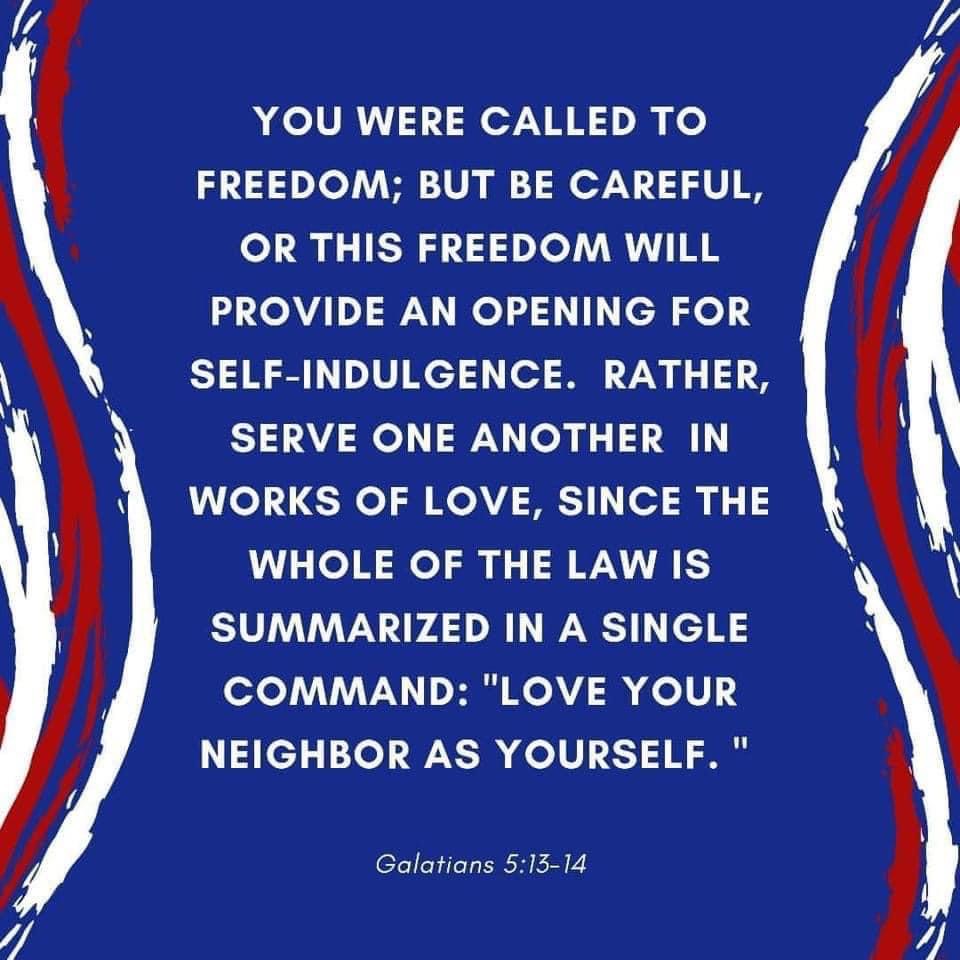
I am looking at a whole room of people who believe with the Apostle Paul that we are called to freedom, not to indulge in our selfish impulses, but to serve one another in love, people who believe they are free, not only to love themselves, but to love their neighbors as themselves.
I am looking at a room full of people who are concerned with freedom for others as much as they are concerned with freedom for themselves, who believe freedom brings both the opportunity and the responsibility to serve and to stand for others, not simply to amass personal rights and privileges at the expense of others.[i]
I see people who have chosen to use their freedom to follow Jesus as disciples, people who are fulfilling what it truly means to be the church in an oppressive world, unlike some in the church today who are doing the exact opposite, actually supporting systems of oppression.
When I think about the purpose of the church, how the church should serve in today’s world, I am constantly drawn to Mark 6 and this account of Jesus sending the disciples into the world for the very first time to be disciples. So much so, it was the source of inspiration for our new expression of church in New Orleans that Lori and I were a part of.
In verse 6 we read:
6aAnd he was amazed at their unbelief.
I wonder if Jesus would be amazed at the unbelief of some in the church today. Having been a part of the church my entire life, I know I am often amazed when I consider how many in the church do not seem to believe that we are called to live, love and serve in the selfless, sacrificial way of Jesus. Instead, they have accepted an individualistic religion where they “accept Jesus,” “receive Jesus,” “study Jesus,” and “worship Jesus”; not actually “follow Jesus.”
I wonder if Jesus is amazed by the number of people who believe the Kingdom of God is just some place we go to after we die, instead of something we are supposed to work at, to give of ourselves to, to pour ourselves out for, to sacrifice to create right here on earth. I wonder if Jesus is amazed every time people pray: “Thy kingdom come on earth as it is in heaven,” and then don’t do a thing to make it happen!
6bThen he went about among the villages teaching.
Jesus was among the people, all the people, because Jesus was for all the people. Jesus went village to village teaching everyone that the most important thing we can do in this world is to love our neighbors as ourselves, and here in this text, we read that he expects his disciples to do the very same thing.
7He called the twelve and began to send them out two by two, and gave them authority over the unclean spirits.
To me, one of the most disturbing political signs that I see in some yards today are the ones that say: “Jesus 2024 – Our Only Hope.” Not only do these signs support a dangerous Christian Nationalism making our Jewish, Muslim, and Hindu neighbors feel like second-class citizens, but they support an individualism that is opposed to the mission of Jesus as Jesus never intended to be on a mission to transform and save the world by himself. In what could be described as a call to democracy, Jesus called and gave authority and power to people to join him on that mission. He sent them out doing the very things that he did, some very big things like: challenging the unclean spirits: the spirits of war, selfishness, greed, poverty, all kinds of bigotry, and any type of oppression.
8He ordered them to take nothing for their journey except a staff; no bread, no bag, no money in their belts; 9but to wear sandals and not to put on two tunics.
Freedom for many means the freedom to acquire and accumulate as much wealth as possible without any sense of responsibility to share any of that wealth. Jesus, however, calls people to live simply so they are able to give generously.
10He said to them, ‘Wherever you enter a house, stay there until you leave the place. 11If any place will not welcome you and they refuse to hear you, as you leave, shake off the dust that is on your feet as a testimony against them.’
Jesus warns that if we teach others the importance of using our freedom to love our neighbors as we love ourselves, we will not be received by everyone. There will always be those who will choose to live solely for themselves instead of for others. But we should never let that discourage or stop us. We should peacefully but persistently keep moving forward, keep working, and keep doing what we have been called to do.
12So they went out and proclaimed that all should repent.
Disciples go out and proclaim that all should repent of their selfish, self-centered, self-preserving ways and embrace a way of freedom that is far from individualistic, but a way of freedom that is profoundly connected with the well-being of everyone.
13They cast out many demons, and anointed with oil many who were sick and cured them.
We are called to stand up and speak out against the evil forces in our world. We are called to restore and to heal. We are called to be a courageous, peace-making, justice-creating, evil-exorcising, hope-giving movement for wholeness in our fragmented world!
And today, perhaps more than ever, I am grateful that you with so many others are offering this world hope by answering this call, as we journey towards a more perfect union, realizing the truth that all people are created equal and freedom is for all.
In his Fourth of July email, prophetic preacher John Pavlovitz wrote the following:
It is highly probable that it will get much worse before it gets better. And yet, no matter how dire things become, we still have our hands and our voices and our gifts and resources and platforms and privilege and lives to leverage to make it less dire for someone.
I’m not writing to tell you how bad things are…I’m [writing] to remind you how good you are.
This is not about anyone else’s inhumanity. It’s about your humanity.
It’s not about one group of people’s cruelty. It’s about your empathy…
In some ways it doesn’t matter who is in the seats of power.
It doesn’t matter how horrible the legislation that gets passed.
It doesn’t matter how much the evangelical church rejects Jesus and his teachings.
It doesn’t matter how compromised the courts are.
It doesn’t matter how predatory the preachers or the politicians become.
That is almost irrelevant.
Their violence is not the point.
Your capacity for love is the point.
And that love is the only plan.
Pavlovitz continues:
So yes, we will grieve and lament the unthinkable news this week. We will feel the sickness on this holiday [celebrating] a freedom that feels as though it’s evaporating—and then, we will get on to the work of fighting like hell to make sure that it doesn’t. Be greatly encouraged.
Amen.
[i] Adapted from article by Rev. Dr. Brett Opalinski, Emory University Candler School of Theology

 Just Love