Let’s Dance

old-guy-dancing

2 Corinthians 13:11-13

2 Samuel 6

Modern Trinitarian thought uses a word spoken by Gregory of Nazi-anzus and Maximus the Confessor to describe how three can be one. These ancient thinkers referred to the inner life and the outer working of the Trinity as peri-co-reses. It means literally in the Greek, “to dance,” suggesting a dynamic, intimate relationship shared by the Father, the Son and the Holy Spirit.

C. S. Lewis once wrote:

All sorts of people are fond of repeating the Christian statement that ‘God is love.’ But they seem not to notice that the words ‘God is love’ has no real meaning unless God contains at least two Persons. Love is something that one person has for another person. If God was a single person, then before the world was made, [God] was not love…


And that, writes Lewis,

is perhaps the most important difference between Christianity and all other religions: that in Christianity, God is not a static thing—not even a person—but a dynamic, pulsating activity, a life, almost a kind of drama. Almost, a kind of dance…

Lewis continues:

And now, what does it all matter?  It matters more than anything else in the world.  The whole dance, or drama, or pattern of this Three-Personal life is to be played out in each one of us: (or putting it the other way around) each one of us has got to enter that pattern, take his [or her] place in that dance. There is no other way to the happiness for which we were made.

I want to assert that the the problem with most churches today is that there is just not enough dancing. For some reason, maybe it is from our Puritan roots, church people are too reserved and rigid. Most of us prefer to keep our faith personal, private, than let it all hang out for others to see.

There’s a great dancer in our Bible that I believe the church could learn a thing or two from. We read about him in 2 Samuel 6.

After David led a great army to get possession of the Ark of the Covenant to return it to Jerusalem, David and his army were so overcome with what was going on that they engaged in festive rejoicing and dancing. They were seized by what James Newsome, New Testament professor of Columbia Seminary calls “a spirit of prophetic ecstasy.”

The scriptures say that David sang and danced before God “with all his might.” He sang and danced before God with all that he had and with all that he was.

You might say that David was God-intoxicated. And when you become God-intoxicated, so filled with the Holy Spirit of God, there’s just know way you can keep it private.

When David and his wife Michal arrived home from the party and began preparing to turn in for the night, David, if he was anything like me, was probably hoping to hear some words of affirmation from his wife. Something like, “Honey, you were so wonderful today. As I listened to you sing and watched you dance in the streets, you just don’t know how proud I was of you! You danced your heart out! And why shouldn’t you have, you brought the Ark of the Covenant back to Jerusalem where it belongs!”

However, the words David hears are something like: “David, you looked like a drunken fool.”

Perhaps David did act like an intoxicated fool. Uninhibited and unrestrained, he lost all self-control. Seized by “a spirit of prophetic ecstasy,” David held absolutely nothing back. David surrendered to the Spirit which had filled him.

David danced, charged by the rule of God. David danced, electrified by the justice of God. David danced a dance of total self-surrender. David danced, holding nothing back. David danced giving all that he had and all that he was to God. And there was absolutely nothing personal or private about this dance. This dance caused a scene. This dance created a fuss. This dance got people’s attention. This dance challenged the status quo. This dance disturbed the peace.

And Michal despised David for it.

This is what happens when one drinks what Paul calls in Ephesians “huge draughts of the Spirit of God.” This is what happens when one becomes God-intoxicated. There is no way to control it, temper it. There is no way to conceal it. There is no way to regulate it to two hours on a Sunday morning. When one becomes drunk with the rule of God, the love of God, one’s feet will inevitably move to the dance of the gospel, and one will be despised for it.

The truth is: the dance of the gospel is a dangerous dance. The dance of the gospel is a disturbing dance. Because the active affirmation the rule of God does not set well with the Michals of the world.

The dance of personal, private piety are easier steps to follow, aren’t they? The message of false prophets watering down the gospel of Christ as nothing more than a little dose of “chicken soup for the soul” is much easier to swallow. If we just get ourselves right with the Lord, if we pray right and live right, if we are good moral people, if we don’t drink, dance, smoke or chew or go with girls who do, then God will bless us and one day send us to heaven.

The dance of the gospel is radically different. The dance of the gospel are steps to the beat of a different drum. If we get right with the Lord; if we pray right and live right; if we lose all inhibitions and all restraint; if we completely surrender ourselves to the rule of God; if we love others as Christ loves us, unconditionally, unreservedly; if we question the status quo, if we disturb the peace; if we dance to the beat of this drum, then we will invariably upset some folks.

That’s a good question for all of us who are attempting to follow Jesus, is it not? In your walk with Jesus, are you getting any push back?”

The answer should always be “yes,” for the dance of the gospel is a dance of self-surrender to a radical beat. It is a beat of sacrifice. It is a beat of selflessness. It is a beat of self-expenditure. It is a beat of a scandalous love and an offensive grace. And to world, as the Apostle Paul warned the Corinthians, if we let go and dance to this beat, we are certain to look like fools.

And as Luke warned us in Acts chapter 2 last week, when we are filled with the Holy Spirit of God, we may even be accused of public drunkenness, even if it before 9am in the morning.

We will be called drunken fools when we offer our friendship and our food to a group of people on a late Sunday afternoon who can offer us nothing in return.

We will be called drunken fools we spend valuable time volunteering at the hospital, visiting a nursing home, serving lunch in a soup kitchen, or spending a week of your hard earned vacation as a counselor at church camp.

We will be called drunken fools when we offer love and forgiveness to our enemies, when we give the shirt off our backs to complete strangers in need.

We will be called drunken fools anytime we love anyone with the self-expending love of Christ—whenever we love someone without inhibitions, without restraints, and without any strings attached.

We will be called drunken fools when we continue to challenge the status quo, question immoral systems of injustice, and disturb the peace.

For the Michals of the world despise this dance. And they will do everything in their power to stop this dance.

We have all heard their voices: loud echoes which discourage such dancing. “Don’t get too close to him. Do not give your heart to her. You will be sorry. They will only let you down.”

“Don’t love that man. He has done absolutely nothing to deserve it and will never reciprocate.”

“Don’t love that woman. She is too needy. She never does anything to help herself. She will demand too much.”

The voices of Michal say: “The system is not that broken. The poor get what they deserve. Most minorities have it pretty good in our country, and they are the real racists. Public education is not worth fighting for. Healthcare is not a right.”

The voices of Michal say: “Keep your faith private, personal. Keep it between you and God. Don’t stir up trouble. Just sit on a pew and look forward to going to heaven. Sing behind stained glass. Forget about being missional. Don’t worry about your neighbor. Don’t waste your time giving yourself away to strangers. Loving like that is crazy. It is too risky. It leads to too much pain.”

However, there is another voice, a Divine voice that was heard by David: “These are serious times, so let’s drink large draughts of the Holy Spirit, until we are all God-intoxicated! Let’s sing and dance in the streets with all we have.” It is a voice which says: “Let’s Dance!  Hold nothing back. Give yourself away. Surrender yourself to the beat of the heart of the gospel. Love. Love honestly and deeply. Love courageously and graciously. Lose yourself. Empty yourself. Pour yourself out. Question the systems of injustice. Defend the powerless. Stand up for the marginalized. Challenge the status quo. Disturb the peace.”

Will this love cause pain?  It will cause enormous pain. But the joy of God which will consume you will be so immense the suffering will be well worth it.

You’ve heard me quote the great Oklahoman theologian, Garth Brooks’: “I could have missed the pain, but I would have had to have missed the dance.”

Dancing the dance of the gospel will inevitably bring pain. However, never truly following in the steps of Jesus to avoid that pain is never really living. There is no joy being a wallflower on the wall of life or being a Sunday morning pew-napper.

So, let’s get our backs up off the wall! Let’s drink huge draughts of the spirit of God, and let us dance!  Let’s go out and dance in the streets of Enid and have seizures of prophetic ecstasy!

Now, be warned! We will look like drunken fools, and we will suffer for it. But the immense joy of God, the joy of abundant life, now and forevermore, is well worth it.
We Need a Little Pentecost

john's ordinaiton

Acts 2:1-21 NRSV

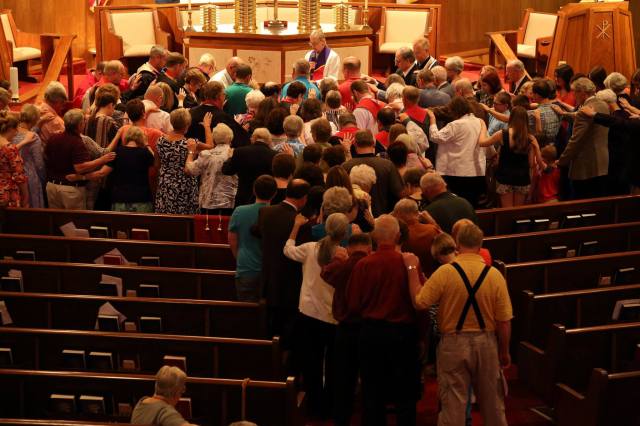
Did anyone get what we were trying to do last Sunday afternoon in this place? Clergy, adorned in red stoles symbolizing the fire of the Holy Spirit, came from all over the Oklahoma and beyond to surround the Reverend John Wheeler in this place. Do you know we were doing in this area down front, laying our hands on John or on somebody that was laying their hands on John?

We were trying to bring John a little Pentecost!

Because Rev. John, bless his heart, certainly needs a little Pentecost—

-Graduating from seminary;

-Pledging a commitment to vocational Christian ministry;

-Dedicating his life to preach, not just any message, but the message of one who was forced to carry a cross for that message;

-Vowing to walk in the steps of the one who loved his neighbors with such a radical grace and inclusion that he was called a glutton and a drunkard who ate and drank with the wrong kind of people.

-Accepting the call to do the works of one who was run out of many a village for those works, who never made any money because of those works, and was arrested, beaten and crucified for  those works;

—Yes, Rev. John Wheeler, bless your heart, you certainly need a little Pentecost!

Pentecost is often called the day God gave birth to the ministry of all ministers—the day when the outpouring of God’s energy through the Holy Spirit swept down like wind and fire and touched all who had gathered for the Jewish festival.

New Testament professor Beverly Gaventa describes the energy that poured out that day as: “Sudden, unmerited, irresistible new life!”

And when you are called to be a minister, when you are called to be the church, to be the very hands and feet of one gave himself unto death, even death on a cross, oh how we need this life-giving power! Oh how we need a little Pentecost!

And this power came in dramatic, indescribable fashion. Gaventa writes: “It is as if not even the most lavish use of human language is capable of capturing the experiences of the day.” She writes: “All of the stops on the literary organ are employed: a heavenly sound like rushing wind, descending fire, and patterns of transformed speech.” That’s because there are just no words to describe this sudden, unmerited, irresistible gift of new life!

And this is exactly what Rev. Wheeler needs as he commits his life to ministry. And this is exactly what our church needs today if it is to continue to be the church God is calling us to be.

Before last Sunday’s ordination, perhaps the only thing that has come close to Pentecost for John and Sally was the time they held their son Luke, and a few years later, Chloe, in their arms for the very first time: feeling their soft skin pressed up against theirs, smelling their sweet heads, listening to their precious sounds. Sudden, unmerited, irresistible, new life. There are just no words in any language to describe the immense power of it, the sheer miracle of it.

This is what Acts 2 was trying describe that day that new life came.

Don’t you wished you could have been there at that festival that day to get you some of that! Don’t you wished you could have felt the wind, saw the fire, heard the miracle?

If only we, living today in the 21st century, could have been there on that day. Think of what Central Christian Church could be, rather would be, if only we could have been present on the Day of Pentecost. Think of impact we would have in our city and in our world if you and I could have received this indescribable gift of the outpouring of God’s energy. Think of all we could accomplish together in the name the Christ who loved all and poured out himself for all.

But we were not there, were we? Unfortunately for us, we were born nearly 2000 years too late. The Day of Pentecost was just a one-day, one-time event in human history, and we missed it all! God simply does not work that way in our world anymore.

Well, I don’t believe that, and I have this sense that you don’t either. That is why we had that ordination service last week for John: to make it happen all over again!

Theology Professor, Robert Wall, points out that the Pentecost experience of God’s Spirit occurred not only once, but is repeated several times in Acts. The images and language of Pentecost, Walls says, “are routinely recalled to interpret subsequent outpourings of God’s Spirit as the constant testimony to God’s continuing faithfulness.”

In the eighth chapter of the book of Acts, we read that after Peter and John laid their hands on the people of Samaria, they received the Holy Spirit.” They received sudden, unmerited, irresistible new life.

In the tenth chapter of Acts we read that while Peter was still preaching, “the Holy Spirit came on all who had heard the message. The circumcised believers who had come with Peter were all astonished that the gift of the Holy Spirit had been poured out even on the Gentiles.”

Again, in the eleventh chapter Peter says, “As I began to speak the Holy Spirit fell upon them just as it had upon us in the beginning.”

In the nineteenth chapter of Acts, after Paul baptizes twelve people in Ephesus, we read: “After Paul had laid his hands on them, the Holy Spirit came upon them….”

Throughout Acts we learn that Pentecost, the power of sudden, unmerited, irresistible new life is not a one-day, one-time event in human history. The gift of Pentecostal power is an experience which is repeated and repeated often in our world. And it is still being repeated today.

The truth is that I believe we have experienced the possibilities of Pentecost on numerous occasions. We just didn’t know what to call it.

The exhilarating discovery that a new baby is on the way. The miraculous birth of that baby. The excitement of a new job. The anticipation of a new school. The hope of a new marriage. The promise of new friendships. Yes, we have all experienced the grand possibilities which come with new beginnings, fresh starts or second chances.

And it is not only in the special events of life that we experience these possibilities. I believe when we consider that all of life is a gift of God’s grace, there is no event which is so ordinary that the Spirit of God is not present in it.

Frederick Buechner writes that God’s Spirit can be found in the most common of places, “always hiddenly, always leaving room to recognize him or not to recognize him, but all the more fascinatingly because of that, all the more compellingly and hauntingly.” Because all of life is a gift of God’s grace, inexplicable new life can be experienced everywhere!

Buechner writes that it can be found “Taking your children to school, and kissing your wife goodbye. Eating lunch with a friend.  Trying to do a decent day’s work.  Hearing the rain patter against the window.”

Yes, the possibilities of Pentecost can be experienced everywhere, but perhaps, most especially, as we reach out to others in unconditional love.

I do not believe it is a coincidence that in Acts we read that the gift of the Holy Spirit often came after Peter, John or Paul laid their hands on others. I believe one of the best ways to usher in the possibilities of Pentecost is by reaching out and personally touching others.

God’s energy is released and new life comes when we lay our hands on someone ordaining them to Christian ministry, but also when we graciously serve a meal to someone hungry, when we tenderly caress the forehead of someone in a nursing home, when we gently hold someone’s hand in a hospital, and when we empathetically embrace someone in a funeral home.

Pentecost comes when we, the body of Christ, lay our hands, which, by the way, are the hands of Christ, on all who are in need. Pentecost comes when we seek out someone who has wronged us to offer a handshake of forgiveness a hug of mercy, the grace of friendship. Pentecost comes when we welcome, accept and hold the hand of an outsider.

And the good news is that this sudden, unmerited, irresistible new life can come even in our darkest moments. Pentecost can happen, not just when something or someone is being born or reborn. Pentecost can come, not just with the sunrise of new day. The truth is that Pentecost can happen at what might seem to be the sunset. Sudden, unmerited, irresistible new life can happen even amidst the storm.

Peter, in his sermon, recalls the words of the prophet Joel. He recalls the signs Joel says are a prelude to disaster—blood, fire, darkness and smoky mist. However, the death and destruction prophesied by Joel is transformed on Peter’s tongue into a declaration of new life. For Joel, these signs of the outpouring of God’s Spirit are a prelude to disaster. But for Peter, with faith in the power of the risen Christ, these signs of God’s energy released are a prelude to the redemption of humankind.

Thus, whether it be days in our lives, or days in our church, that cause us to despair, God, with a power called Pentecost, can redeem the darkness of even death into the light of life.

Pentecost—this is our hope.  And this is our purpose. May Central Christian Church, who may not have been present on that day nearly 2000 years ago, but has, in so many ways, experienced this power of Pentecost nonetheless, work together to share this gift of new life with our city and our world. May we share it with our words, but also through the laying on of our hands of service, so that sudden, unmerited, irresistible new life may rain down from heaven like wind and fire and touch everyone!

Get Your Heads out of the Clouds

Acts 1:6-14 NRSV

I have had more than my fill of end-of-the-world Sunday School lessons and doomsday sermons. In the sixth grade, I had a Sunday School teacher who talked about the end of days and the imminent return of Christ every Sunday for a year. She clouded my head with charts and graphs, all indicating that Jesus was certainly going to come back before my high school graduation.

In seventh grade, our youth minister took us to see the movie The Late Great Planet Earth. Like the recent Left Behind movie with Nicolas Cage, it was about all these people disappearing in the rapture. Planes, trains and automobiles were all of sudden without drivers. I watched in horror as planes crashed into crowded cities, trains derailed, and automobiles collided on every street.

And if that was not enough to permanently scar me for life, it seems like every revival preacher I ever heard would preach that the Lord was going to return in their lifetime. This always bothered me, especially since most of these revival preachers were retired, and to me, looked like they only had two, maybe three good years left.

Today, you can find preachers on TV who are still preaching the imminent return of Christ. They point to world events—ISIS, Iran, North Korea and Russia—as signs that the end is near. If you took some of these preachers to heart, you’d never plan anything a week in advance. You sure wouldn’t be freezing strawberries, and you’d never buy green bananas!

This is where today’s scripture lesson offers us a little bit of sanity.

For months, the risen Christ had been warning his followers that he would one day leave them, but he had reassured them, “I will not leave you orphans.” He told them that when he left they were to return to Jerusalem and wait for the coming of the Holy Spirit.

In today’s lesson, the time that they had been dreading for weeks had come. But before he departed, they asked him what my Sunday School teacher and those revival preachers seemed to already know: “When will you come again and restore the kingdom to Israel?”

He replied: “It is not for you to know the time or the period…But you will receive power when the Holy Spirit has come upon you; and you will be my witnesses in Jerusalem, in all Judea, and Samaria, and to the ends of the earth.”

After those words, he ascended into heaven, vanished from their sight, and left them standing there, gazing into the sky. They just stood there, looking up into the clouds.

And while they were gazing up toward heaven, while they had their heads in the clouds, suddenly, two men in white robes stood by them. They said, “Men of Galilee, why do you stand looking up toward heaven? This Jesus, who has been taken up from you into heaven, will come in the same way as you saw him go into heaven.”

Jesus’ followers were instructed to get their heads out of the clouds. They didn’t need to be alarmed about the departure of Jesus, for Jesus would one day return to them. They don’t know when, but they don’t need to know. In the words of Jesus, “It’s not for them to know the time or the period.”

“All you need to know,” said the angels, “is that he is coming.” It’s a certainty; he’s coming, so you can stop looking into the clouds, and start living for him by doing what he has commanded, and being his “witnesses to the ends of the earth.”

I believe this wonderful Ascension story teaches those of us who are obsessed with the second coming of Christ, that we need to stop obsessing. We need to get our heads of the clouds and start living the way Jesus commanded us to live.

There are too many Christians who regard faith as some ticket to heaven. Their salvation is something to be possessed, held on to, not actually lived, or shared with others.

I believe this scripture reminds us to get our heads out of the clouds, get our minds off of heaven, and come back down to earth. Come down and go to Jerusalem. Come down and go into all of Judea and even into places that we do not want to go, like Samaria. Go and be a witness to the good news of the gospel of Jesus Christ everywhere. Don’t go to church for the assurance that you possess something spiritual that others lack. Go and be the church by giving yourself to others who are the very image of God.

The story also teaches us that if we truly want to see God, if we really want receive the power of the Holy Spirit, instead of looking up in the clouds, all we have to do is to look around us.

In the play, Inherit the Wind, one of the characters says: “He got lost.  He was looking for God too high up and too far away.”

The truth is that we find God when we redirect our gaze from the heavens toward people, and toward the world around us. We find God when we understand that grace, salvation, and the love of God are not mere tickets to heaven, but something that is to be shared with all people every day here on earth.

And we find God through mirroring God’s love, a sacrificial, self-denying, self-expending love—a love from a God giving all that God has to give, for God so loved this world more than God’s self. Thus, our faith is about honoring a God who died for all.

Here in Enid, Oklahoma, our heavens are blessed with the roar of aircraft piloted by men and women who possess this same sacrificial, self-denying, self-expending love—a love that is willing to give all, for these men and women we see in the skies above us love their country more than self.

Tomorrow, we remember those who did give all, as they paid the ultimate sacrifice defending our freedom, but we also honor all who are willing to lay down their lives at a moment’s notice. And in Enid, living in the shadow of Vance Air Force Base, named for Leon Vance Jr. who heroically gave his all during World War II, all we have to do is walk outside and look toward the heavens to be reminded of these men and women.

But as our eyes are focused upward, we need to pay attention to the voice of angels: “Men and women, boys and girls of Enid, why do you stand looking up toward heaven? Get your heads out of the clouds and share this love—the love that you see in the jets flying overhead—share this love throughout Garfield County, across Oklahoma, and even into those places that you may not want to go.

This is the reason it has been such a wonderful blessing to welcome members of the 3rd and 33rd Flying Training Squadrons into our church the past two weeks to prepare and serve a hot meal to some of the the most impoverished men, women and children living in our community (last they week they served 60). The sacrificial love we hear and see in our skies literally came down to earth.

For when I walked into our church’s kitchen the last two Sunday afternoons, I saw none other than the very presence of the risen Christ. He had not disappeared into the clouds, but was right here in our church through the love of these service men and women who sacrificed a Sunday afternoon to feed the hungry. And there was no doubt that the risen Christ was also there sitting around those tables. You could see him clearly in the smiles, in the sincere gratitude of the ones who were being fed, accepted and embraced by selfless and unconditional love.

This is why the angels told the disciples to redirect their gaze, to get their heads out of the clouds. Stop looking for Jesus in the heavens. The angels said to them and says to us: “Look around you. In Jerusalem and Judea. But also look beyond you, even into Samaria, even in places that you may be afraid to go, places that may make you uncomfortable, places that may be painful, risky, dangerous.  Look, go, and live for Jesus, and you will find him.

Moshe is a prophet in Elie Wiesel’s book entitled The Oath.

Moshe was speaking with Azriel, the narrator of the story one evening after a meeting at the synagogue.

“You go to school?”  asked Moshe. “To what purpose?”

“To learn,” said Azriel.

“To learn what?”

“Torah,” the boy said uneasily (That’s the first five books of the Old Testament).

“Torah is life,” said Moshe, “and life must be lived; it cannot be learned from books, between four walls.”

“I thought,” said Azriel, “that Torah is more than life, since God himself submits to its commandments.”

“God too must be lived, my boy,” said Moshe. “You must live God, not study God in books, between four walls.”

Let us pray together.

God, help us to get our heads out of the clouds,

out of books,

out from these four walls,

and go out into the world to live Christ,

around us and even beyond us.

Help us to go and be the body of Christ,

be a community of grace,

of self-expending love,

and wholeness in our fragmented world. Amen.

Embracing the Grace, Authenticity and Mission of Jesus: Thank You Rev. Speidel

Shannon

There is widespread agreement that if a church is to survive this century, then it must do what most churches resist doing. It must change. To avoid joining the thousands of churches that will die by the end of this century, I believe there are three major changes that many churches need to make. 

  1. Churches must wholeheartedly embrace the grace of Jesus.

Jesus prevented religious folks from throwing rocks as sinners, and so should we. Of all of the human organizations on this fragmented planet, the church should be a place where all people are welcomed to join a community of grace, love and forgiveness. Without fear of being judged, bullied, or ridiculed, all people should feel welcomed to come as they are and honestly and openly confess their sinfulness and brokenness, and then receive grace. Then, they should be encouraged to share that same grace with others. I believe all churches should be open and affirming, because a church that follows Jesus has no business being closed and condemning.

  1. Churches must wholeheartedly embrace the authenticity of Jesus.

Some church people have the reputation of being like the people Jesus criticized the most: hypocrites. Therefore, we must stop claiming to follow Jesus on Sunday morning while ignoring everything Jesus taught the rest of the week. This means that blessing the poor, standing up for the powerless, and fighting for those who hunger and thirst for justice should always be our priority. It means loving our neighbors as ourselves, selflessly and sacrificially, no matter the cost.

  1. Churches must wholeheartedly embrace the mission of Jesus.

Jesus never confined his ministry to the Temple or a synagogue. Church people must be willing to move out of the sanctuary into a hurting world. Instead of inviting people to come to church on Sunday, we should be asking people to be the Church everyday by doing the things Jesus did such as: eating and drinking with outsiders, feeding the hungry, welcoming the foreigner, becoming a friend to the oppressed, and being a healing presence for all who need wholeness.

The exceptional leadership that Rev. Shannon Speidel has given to our church as our Associate Minister for the past two years is exactly what we need if we are to continue to be a viable church, as she wholeheartedly embraces the grace, authenticity, and mission of Jesus. I am grateful for the way that her inclusive love for all people, her unwavering passion for social justice, and her bold desire to be the hands and feet of Christ out in the world has challenged us to be the church God is calling us to be.

I am also thankful that she will continue to be in a position to bless Oklahoma as she begins her ministry with the Oklahoma Conference of Churches. Churches across Oklahoma are fortunate to have a leader like Rev. Speidel who possesses the gifts, vision, passion and faithfulness that will help them not only survive, but thrive throughout the 21st century.

Sunset or Sunrise

Sunset

This picture appeared recently in the Enid News and Eagle. The caption simply read: “Sunset.” However, at first glance, it is difficult to tell if it is a sunset or a sunrise.

As attendance, giving, and baptisms continue to decrease in North American churches, many are asking: “Is the sun setting or rising on the church?”

After posting the picture on facebook and posing the question, “Is it a sunset or a sunrise?” Rev. Dean Phelps, a facebook friend and long-time minister, wisely commented: “It all depends on when we wake up.”

Rev. Phelps was prophetically suggesting that if the church wakes up early, it could be a sunrise. However, if the church wakes up too late, it could be a sunset.

I believe it is a sunset if the church continues to slumber under the covers of the culture. I have called this embracing an “alternative gospel” or a “fake news Jesus.” It is a protective, safe, defensive religion that fears the other, and thus judges, excludes, and condemns the other. It is miserly with mercy, stingy with love, and tight-fisted with grace.

However, I believe it is a sunrise if the church awakes to pull back the covers of the culture to embrace the authentic gospel and good news of Jesus. We must awaken to discover our purpose to be a community of radical inclusion and extravagant grace. We must awaken to answer our call to love others as Christ loves us, unconditionally, unreservedly and fearlessly.

I believe it is a sunset if the church continues to dream of the glory days. Sadly, the dreams of many churches are either stuck some in distant past recalling fuller pews and bigger programs, or they are stuck in some heavenly future, fixed on pearly gates and streets of gold.

However, I believe it is a sunrise if the church awakens with eyes wide-open to see its mission in the here and now. We must awaken with our eyes focused on the present suffering of the entire creation, and then we must selflessly and sacrificially use our gifts, time and energy to be a movement for wholeness, healing and peace.

I believe it is a sunset if the church continues to hit the snooze button to rest in their comfort zones. Many churches have no desire to get up and go out, leaving their cozy environments behind. There is no interest to get outside of the security blanket of the sanctuary to do the hard work of feeding the hungry, clothing the naked, defending the marginalized, and breaking the bonds of injustice.

However, I believe it is a sunrise if the church will rise up from its comfort zone to go out into what can be a cold and dark world. We must awaken to be the embodiment of Christ in this world even if it means there is a cross involved, even if it means suffering for the sake of God’s creation.

Is it a sunset or a sunrise?

It all depends on when we wake up.

A Movement for Wholeness in a Fragmented World

DOC Identity

John 9:1-41 NRSV

Let’s think for a minute what it did for this poor blind man when the disciples began a theological debate over his blindness.

“So, they tell us that you were born blind?  Well, let’s get out our Bibles and Sabbath Day School Quarterlies, and see if we can find some theological reasons for your blindness. Of course, everyone knows it is because of sin. But since you were born blind, perhaps it is not so much your sin as much as it is the sin of your parents.”

Yes, I’m sure all of that theologizing and rationalizing and Bible Study did absolute wonders for that poor man. I am sure he really appreciated it!

But how often have we’ve been guilty of doing the same. For some reason, because we are Christian, we believe it is our holy responsibility to try to explain human suffering in light of our faith in God.

When the earthquake and Tsunami struck Japan several years ago, I heard some preachers say that God was judging that area of the world because Christianity was not the prominent religion.

         When the terrorists destroyed the World Trade Center Towers on 9-11, some preachers said that corporate greed was to blame.

When Hurricane Katrina devastated New Orleans and Gulfport, Mississippi, many blamed it on all the new casinos that had been built in along the Gulf Coast.

And whenever there is an outbreak of strong storms, especially strong storms with tornadoes, I have heard many Christians say, as I am certain we will hear them say in the next couple of months: “God must be trying to get our attention!”

For whatever reason, when suffering occurs, we believe that God must have had some pretty good reasons to allow it.

In the face of human suffering, two predominate responses are echoed by the church.

The first response is the one I usually hear from the TV evangelists. It is the response of those in our text this morning. God is sitting at the command center in complete control of every earthly thing that happens. God has got a plan for the world, and it’s a good plan, and we human beings need to trust that plan. Even if people suffer, we shouldn’t question the plan or God’s judgments. Because God’s judgments are always just. You just have to have faith and believe God has God’s reasons. God has a driving purpose for everything that happens in this world.

The other response comes from some liberal scholars. And that is one of silence. They say that God is completely unknowable. Life, and the suffering that comes with it, is utterly mysterious. It is ok to question God, to ask “why?” But we simply have no answers to any of our “why” questions. Silence.

Frankly, I find both of these responses to human suffering to be troubling.

First of all, those who believe God has some kind of divine, driving purpose behind every evil thing that happens in this world, in my estimation, paint a very evil, mean portrait of God.

And those who respond only with only silence, those who refuse to say anything or do anything in response to human suffering paint a very detached, indifferent portrait of God. God is watching us, but as Bette Midler sings, “God is watching us from a distance.” God is reduced to this mysterious abstraction devoid of any real meaning.

The gospels, however, paint a very different image of God through the words and works of Jesus, who we believe to be the incarnation of God—which means that if we want to know how God responds to human suffering, all we have to do is look to Jesus.

I believe the life, suffering and death of Christ teach us that when a landslide shook the earth in Washington State a few year ago, so quivered the very heart of God. Last year, as the flood waters swelled in Southern Louisiana and North Carolina, tears welled up in the eyes of God

As the livelihood of many were suddenly poured out, so emptied the very self of God. God was not causing the evil, neither was God unmoved by it.

This is where I believe our gospel lesson this morning is especially helpful. When Jesus is questioned about this man’s lifetime of suffering by his disciples, Jesus really doesn’t answer the question, but he certainly isn’t silent or detached.

Jesus responds by saying that this is a good opportunity, not for theological debate, not for some long discussion theodicy (the problem of evil), not to assign blame or responsibility; but rather, it is an opportunity bend to the ground, spit in the dirt, and get his hands dirty, so that the glory of God might be revealed.

Jesus responds to a fragmented world by becoming involved, even if it means some work, even if it means rolling up his sleeves, lowering himself to the ground, and getting his hands dirty to touch the places on others that most need touching. Jesus responds to a fragmented world by becoming a movement for wholeness—bending, stooping, humbling himself to the ground—working, touching, healing, restoring.

And with that, a huge argument ensues.

But notice that Jesus refuses to engage in the argument. Jesus doesn’t have time for that. Jesus is not interested in doctrinal debate or theological speculation. Jesus is interested in simply being there with the man, for the man; thus, revealing the peculiar glory and power of our God.

I think it is interesting that the great Southeast-Asian Tsunami of the last decade struck the day after Christmas. One of the world’s worst natural catastrophes took place the very first day after the church’s celebration of the Incarnation, the celebration of the good news that our God did not remain silent, aloof and detached from us. Our God came to the earth, became flesh, became a part of the earth, to be with us. Our God is a God who descends to us. Our God is a God who bends, who stoops to the earth to be for us. Our God is a God who has selflessly and sacifcially chosen to suffer with the creation.

The story of this healed blind man comes in the same Gospel of John that begins, “In the beginning was the Word…and the Word was made flesh…and we beheld his glory.”

The great, grand glory of this God who became flesh with us is not that God is in complete control of everything earthly thing that happens, and it is not that God has an explanation or a reason or a driving purpose for everything that happens to us, but rather that God is Emmanuel, God here with us.

In the face of our suffering, our God reaches in and reaches out to us, bends to the ground, gets God’s hands dirty, and touches us.

And then God calls us to do the very same.

Every year as Holy Week approaches, I think about the worshippers of the Goshen United Methodist Church in Piedmont, Alabama.

It was Palm Sunday in 1994.

About midway through the worship service at 11:35 am, as the choir began to sing, a tornado ripped through the church building destroying it completely.

Eighty-three out of the 140 worshippers who attended the service that day were seriously injured. Twenty-one worshippers were killed. Eight of the dead were little children—children who had just walked down the aisle waving their palm branches.

There was absolutely no driving purpose, no theological explanation for that tragedy, except for the fact that we live in fallen, broken, unfair and sometimes senseless world where tornados, tsunamis, hurricanes, landsides, heart disease, dementia, and cancer can develop and arbitrarily destroy.

Thankfully, Christians from all over the world didn’t just talk about that tragedy in their Sunday School classes, trying to figure out if there was some reason God allowed it. They responded to that great tragedy by emulating the God revealed to us in Christ, by bending themselves to the ground, getting their hands dirty, to raise that church out of the rubble. Christians everywhere imitated their Savior by suffering with and being with the grieving. Doing whatever they could do to bring hope, wholeness, and restoration.

On the church’s website today, you will find these words:

 After the tornado, we received many gifts from all over the world. They lifted us up and helped us to know that we are not alone. Among those gifts were a banner and a painting of Jesus walking on turbulent waters. These and other gifts are reminders that God is with us through our storms, and with His help we will rise above them and be stronger because of them. We can now affirm the truth of the message that is contained on a plaque and in the words of a song: ‘Sometimes God calms the storm. Sometimes, …the storms rage, and God calms the child.’

And in the end, isn’t that much better than any theological explanation?

Let us pray together…

When Jesus was asked about the reason for human suffering, he did not answer the question. He did not get into a theological debate. He did not assign blame or responsibility. Instead, he chose to be a movement for wholeness in this fragmented world by bending to the ground and getting his hands dirty to bring about healing and  restoration. In the wake of the storms of our lives, may we do the same. Amen.

Enid Welcome Table

Enid Welcome

In our combined forty years of ministry, my colleague Rev. Shannon Speidel and I have had many church experiences that we would deem “holy.”

However, they all pale in comparison to what we have experienced during the last twelve months in the visioning and planning of the Enid Welcome Table.

During our preliminary conversations regarding moving one of our worship services to a different time, it was brought to our attention that the food insecure population of Enid was served a meal (with no strings attached) every day of the week with the exception of Sunday. We were also told that many who rely on the gracious ministry of a weekday community soup kitchen called Our Daily Bread are famished on Monday mornings. They report not having had anything to eat since Saturday, when they were served a meal by the wonderful feeding ministry of First Presbyterian Church of Enid.

A task force was created by the worship committee to discuss moving one of our services. Task force members have said that they “felt the spirit of God moving in the room” as they discussed the possibility of a worship service occurring around tables after a meal was shared with some of the most impoverished people in our community.

The Enid Welcome Table planning committee was soon developed. It includes members of our church, members of other Enid churches, and people who are not members of any church. They are people who are committed to providing a “restaurant quality” meal each Sunday to anyone in need.  They believe the best way to accomplish this is to recruit 52 organizations and businesses in Enid, asking them to prepare and serve one high quality meal a year.

The idea of inviting the entire community to be a part of the Enid Welcome Table is one the most exciting aspects of this ministry. My congregation has heard me talk at great lengths regarding the difficulty of doing “evangelism in the 21st century.” I say: “If you don’t believe it’s difficult, try inviting someone to who doesn’t attend church to come to church with you to listen to a sermon!”

Then I add, “On the other hand, I think you will get a quite different response if you try inviting someone who doesn’t attend church to join you in doing something that Jesus would obviously do, like feeding the hungry.”

As I often say, the reason people are not in church today is NOT because they have given up on Jesus. The reason people are not in church today IS because they do not see Jesus in the church.

We are excited about the Enid Welcome Table; because instead of inviting people “to come to church,” we will be inviting people “to be the church.” Instead of inviting people to listen to stories about Jesus that took place 2000 years ago, we will be inviting people to be the selfless hands and feet of Jesus in this world today. Instead of inviting people to come to a service of worship, we will be inviting people to go and worship with their service.

And all will be invited to serve. Your religion (or lack of religion), your sexuality, your race, your mental or physical ability, your political stance – it doesn’t matter! All means all.

I, along with many other church scholars, are convinced that this is the way to revive, revitalize, and restore the church in the 21st century. I have witnessed first-hand the miraculous transformation that can happen by embracing a missional model in my previous congregation.

We also believe it is very important to feed the hungry with “no strings attached.” We believe there are too many Christian organizations that offer to help people if.

“Love your neighbor, if they look like you.” “Welcome the stranger, if they want to be Christian.” “Feed the hungry, if they pray with you.”

No, Jesus never said “if.”

Jesus said: “Love your neighbors,” period. “Welcome the stranger,” period. And “feed the hungry,” period.

We do not believe Jesus ever put stipulations on grace. That is why it is called grace.

Therefore, the mission of the Enid Welcome Table is to graciously feed people with absolutely no strings attached. The worship service that will be offered after the meal will always be optional. People of other faiths and people with no faith are welcome. No one will ever be judged, disrespected or preached to. All will be loved, accepted, and fed.

We believe the Enid Welcome Table has the potential to dramatically transform our community to be an example to the world of miracles that can happen when people truly become the gracious hands and feet of Christ in our world.

_____________________________

If you, your business, or your organization would like to serve a meal to the food insecure of Enid, Oklahoma, please contact me at jarrettb@centralenid.org or Rev. Shannon Speidel at shannons@centralenid.org. Donations are also appreciated.


Renewing Our Hearts for a Mission of Discipleship

new-york-77639_640

Matthew 16:24-26 NRSV

Good things are happening at Central Christian Church as our church is on a mission.  As we say every Sunday around this table, we are on a mission to be a church of extravagant welcome. We want to live up to the identity statement of our denomination and truly welcome all people to the Lord’s Table as God has graciously welcomed us. Because we believe when we graciously and generously welcome others, we welcome God. When we compassionately and lovingly include others, we include God. And when we welcome and include God in our lives, in our church, good things happen.

Here at Central we believe God is here with us. The spirit of the Risen Christ is here moving, working, stirring, calling, prodding, pulling, transforming. Central Christian Church is on a mission, and we are on this mission with none other than the Risen Christ himself.

Thus, I believe it is the Christ who is calling us today to be faithful disciples, and I believe he is calling us in the same way he called the first disciples, with the simple, yet powerful words: “If any want to become my followers, let them deny themselves and take up their cross and follow me.”

Jesus says that the first thing we need to do is decide if we want to follow him. He said: “If any want to be my followers…”

I have said in recent weeks that I believe the reason many churches are losing members today is because, for many, the does not look like a group of people who have decided to follow Jesus. Church members do not look like people on a mission for others, but look more like some type of religious club created for the members, to make them feel holier and superior than others.

This is perhaps why the first thing Jesus says we must do once we decide we want to follow him is to “deny ourselves.”  This thing called “discipleship,” this thing called “church,” is not about us. It is not about achieving a good, happy and successful life or even an eternal life. It is not about receiving a blessing. It is about being a blessing others. It is not about feeding our souls. It is about feeding the hungry. It is not about finding a home. It is about welcoming the outcast and the homeless. It is not about acquiring spiritual riches. It is about giving everything away to the poor. It is not about getting ahead. It is about sharing with people who can barely get by. It is not about winning. It is about sacrifice. It is not about gaining eternal life for ourselves. It is about dying to self.

There is a reason that we do not make a habit of clapping in church after the choral anthem or after a solo. Because the music being offered is not for us. It is for God. It is not about sharing music to bless or uplift us. It is about sharing the best of what we have to praise God.

I believe the reason that churches struggle today is because, in our attempt to entice new members, excite new members, gain new members, we have made the church about us. We have said, “Come, and join our church where we have services and programs that are certain to benefit your life. Instead of saying: “Come, join our church, where you will be given opportunities to give your life away.” “Come, join our church, where you will be encouraged to sacrifice and serve and to deny yourselves.”

Jesus said, “Let them deny themselves, and take up their crosses.”

I don’t know how it happened, or precisely when it happened, but I can understand why it happened. At some point we have interpreted taking up and carrying our crosses to mean something completely different than what Jesus intended. Somehow, the crosses we bear have become synonymous with the pain and sufferings that we involuntarily put up with in life.

We say: “Diabetes: It’s my cross that I have to bear.” “Arthritis: It’s the cross I carry.” “Migraine headaches: It’s the cross that I have take up.” Anything from High Blood Pressure, heart disease and C.O.P.D. to a bad back, cold sores and varicose veins: “It’s the cross that I bear in this life.”

However, when Jesus is talking about cross bearing, he is talking about something completely different. He is not talking about some kind of involuntary pain and suffering that we are forced to put up with. He is talking about pain and suffering, the giving way of our lives, that we voluntarily choose for the sake of others.

On this fifteenth anniversary of 9-11, we remember a day of great tragedy for our nation, but also a day of great heroism. With much pride, admiration and gratitude we remember the first responders who gave their lives trying to rescue those trapped inside of those towers.

We also remember the men and women who, loving country more than self, gave their lives in Iraq and Afghanistan fighting the war on terror. Every September 11, I think of my friend Christopher Cash, who did not hesitate to report for duty when his National Guard Unit was summoned to go to Iraq. And in Iraq, Chris carried a cross, meaning that he gave all that he had, as he lost his life in an ambush.

And of course, we do not have to be a first responder or join the military to carry a cross.

Adopting a resident in the nursing home to visit when the nursing home is the last place on earth you want to go may be a cross Jesus is calling you to bear.

Deciding to forgive someone who has wronged you and has caused indescribable pain in your life may be a cross you Jesus is calling to carry.

Electing to serve on the youth or children’s ministry team when you already have little or no time for yourself, may be a cross Jesus is calling you to pick up.

Agreeing to volunteer to feed the food insecure when your own cabinets are almost bare, may be a cross Christ is calling you to take up.

Picking a less lucrative career because you feel called to serve others might be a cross Jesus wants you to pick up.

Choosing to love someone when you know that loving that someone will inevitably bring enormous grief may be a cross Jesus wants you to bear.

Resolving to make a generous pledge to the church’s annual budget when your own budget is tight is a cross Jesus is calling you to carry.

Standing up for the rights of minorities when the majority is against you is cross that I believe Jesus asks us all to take up.

I believe churches are struggling today, because they only encourage their members to do what makes them happy, what is comfortable for them. “Do you love kids? Do children make you happy? Then serve on our children’s ministry team!” “Do you love going to the hospital to visit sick people? Have you always wanted to be a nurse? Then serve on our hospital ministry team!”

As a leader of this church, I want to ask you to sign up for, not only what may be uncomfortable for you, but those things that actually might cause you great pain and grief. Because, more than anything, I want to lead a church of committed disciples who have intentionally decided to deny themselves and take up their crosses to sacrificially serve others.

Finally, Jesus says, “After you decide to follow, after you deny yourselves, and after you pick up your crosses, then I want you to follow me.”

Jesus wants us to “follow;” which denotes moving; not sitting in a pew.

Our faith, our discipleship, our church is to never be complacent, stationary or constricted. It is not an inert, static thing. It is not something that we can hold or withhold. It is a dynamic, moving, changing, progressing, dancing, advancing, all-embracing energy of sacrificial, selfless love.

As we say every Sunday, we need to make this place a place of welcome for all people. Because, when we welcome others, we welcome God. However, our church, our discipleship should never be limited to any place. Yes, I do believe that the doors, walls and ceilings of our buildings should be warm welcoming; however, they should never constrain our true mission.

We are a church that meets in a place, but we are also a church on the move, following Christ, sacrificially denying self, courageously taking risks, wherever Christ leads in our community, throughout the region, into all the world.

Central Christian Church is indeed on a mission. And we believe we are on a mission with none other than the Spirit of the Risen Christ himself. We believe he is here today, right now, moving, working, stirring, calling, prodding, pulling, transforming.

For the Least of These or for the Exalted of Us?


Debbie Berg finish

Luke 14:1, 7-14 NRSV

During the three three years that I took a break from local church ministry, I had a taste of what some of you refer to as “the real world.” You might say that was pursuing the American dream, chasing the almighty dollar.

I worked in the development office for a small university which meant that my job was to raise money. I was continually seeking to locate and to build relationships with some of the wealthiest people in the area with the sole purpose of getting them to freely and enthusiastically open up their checkbooks.

And then some friends and started a small business, manufacturing and selling products to the electrical construction industry with the same exact purpose, trying to get some of the largest electrical distributors in the United States to write us some very large checks.

So, for three years, I traveled the country, by car, pickup truck and plane, on a continuous quest, searching high and low, scouring the landscape, and at all times, during an economic recession, looking for the next prospect, that next big donor, that next big customer, that new big account, all with the purpose of growing, advancing, and expanding an institution or a company.

And during those three years, driving many a mile, flying in many a plane, and speaking with many a person, I had the opportunity to talk with others about, and to reflect on, the current state of the local church, which, like our nation’s economy at the time, was in sort of a recession of its own.

It is news to no one that local church membership in North America has been in a state of perpetual decline for most, if not the entirety of my lifetime. These days, people just don’t seem to want to go to church anymore. Consequently, many churches have simply given up trying to grow, advance or expand. They are just trying to survive. Hold on. Maintain. Keep the piano tuned and lights on.

And during my travels, I also had some time to reflect on the current role of the pastor of a local church, at least the way that I had always approached the role; which, quite frankly, was very similar the way that I approached business in the so called “real world.”

As a pastor, I had often been on a constant search, scouring the landscape, at all times, during a church membership recession, looking for that next wealthy prospect, that next big giver, that next new member who will come into the church, open up their checkbooks to help pay for our programs, fund some needed renovations, finance a new roof, and perhaps most imporantly, support my salary.

“What did I hear you say?  A doctor has moved into your neighborhood? Well, give me her name and address and I’ll be sure to pay her a visit! We’ll give her and her family free meal tickets to Wednesday night suppers for a month!”

“You say, ‘An attorney has opened up a new practice in town?’ Well, I need drop by his office this right away! Invite him to the next Men’s Breakfast!  I wonder if he has any children. More children with well-to-do parents will help us attract even more children with their well-to-do parents.  After all, we need to keep growing, advancing and expanding! Well, to be honest, we need them just to maintain, keep our programs going, keep the utilities paid, keep the AC on and our doors open. And we have to keep searching, keep seeking, keep inviting, keep persuading, keep trying to find people, and not just any people, people with some means, people with some resources, folks with some wherewithal!”

But then we read Jesus, and we quickly learn that he does not care too much for our real-world way of growth, expansion, and advancement, especially when it comes to building the Kingdom of God.

Jesus says when you are sending out invitations, don’t send them to the well-to-do folks that can offer you something in return. Don’t invite your friends and your neighbors, you know, the folks who look like you, dress like you, think like you, and have the same if not more income as you. Instead, invite the poor, the crippled, the lame and the blind. Invite even those who can in no way pay to support the church’s budget and donate to the organ fund.

The holy wind of the Spirit is calling, says Jesus: “Invite, welcome, include and love those society considers to be the least among us: the unfortunate and underprivileged, the ostracized and outcast, the deprived, downtrodden and derelict, the poor and the pitiful. Greet, accept and receive the stranger. Quench the thirsty. Heal the broken. Feed the hungry. Protect the bullied. Care for the dying. Befriend the friendless. Forgive the wrongdoer. Love the sinner. Be the embodiment of my Holy Spirit in this broken world.”

I have told you before, and I still believe it today. People are not leaving the church because they are leaving Jesus. I believe the vast majority of people love Jesus and I believe sincerely would like to follow Jesus. The problem is that when they come to church, they simply do not find Jesus.

Where then can Jesus be found? When does Jesus appear in our churches?  One day a crowd of people asked Jesus, “When did we see you.” Jesus responded, “when you loved and cared for the least of these” (Matthew 25).

Jesus says that if you want people to see him, we must welcome, include, accept and minister to the least, to those who cannot offer us anything in return. I understand that this is very difficult to hear, especially in the midst of a membership recession.

“Forget about yourselves,” says Jesus, “Forget about self-preservation, forget about reaching folks that might be able to help us with our programs, balance our budget, pay our utilities and support salaries.”  And notice that he even says that we might have to wait to be rewarded, not in this life, but at the resurrection.” There may be nothing more difficult than hearing this. Except for maybe doing this!

But here’s the good news. I believe that there are people everywhere, some may be your friends, relatives or rich neighbors, who are still searching for a group of believers that not only hears these words of Jesus, but actually has the courage to act on them. They have all but given up on organized religion; however, they are still hoping that there is a church that exists somewhere in this broken world that looks and acts like Jesus.

If you are my friend on facebook…and if you are not, you should be. And and if you are not on facebook period, opening up a facebook right now is worth it, just to be my friend to see some the things that I have been posting lately regarding Ainsley’s Angels of America.

Ainsley’s Angels are groups of runners that includes children and adults with exceptional needs in 5k races, 10k races, or even in marathons all over the country. Welcoming and including and sharing joy with children and adults with exceptional needs is such a holy work; it is such a pure mission, such a selfless act; it’s such a Christ-like grace… that guess what? People everywhere are asking how they can be apart of this!

Listen to this, because I can’t make this stuff up. Through just a through a few posts on Facebook during the last two weeks, we have raised over two thousand dollars and recruited a team of dedicated Angel Runners. Everyday our numbers keep growing. Runners are calling. Walkers are calling. Even couch potatoes, who now, because of what they have seen on Facebook, want to be runners are calling. And of course, parents of children with special needs are calling.

We had a funeral here a few weeks ago. When the funeral director saw the chairs designed to include children with exceptional needs we had displayed in our gathering area, he walked into my office and handed me a check for $500.

I didn’t call the Enid Civitan Club. They called me. They didn’t ask me to come and be the program for them. I am not sure if they even saw the chairs in our gathering area. But they called to say they wanted to donate $1,000.

And people are calling me asking me to be their programs. During the next month I have been asked to speak at 2 Ambuc clubs, the Kiwanis Club, and even the Corvette Club. And I didn’t ask to speak at any of those clubs.

With support like this, do you know what I think? I think I could start a church!

Simply because I am involved in something that looks like Jesus: Reaching out to, welcoming, including, sharing joy with, those society considers to be the least among us.

And everywhere church people are asking, “Why does it seem that people just don’t want to go to church anymore?”

However, have you ever thought that maybe people not going to church is actually a good thing!

Because maybe church is not some place to which we are supposed to go. Maybe church is something we are supposed to be.

So, instead of inviting others to go to church, perhaps we should be inviting them to be the church, saying: “Join us to be the embodiment of Jesus Christ in this broken world with a burning passion for the disabled and the powerless, for the left out and the left behind, for the poor and the bullied. Come and join us to be the body of Christ as we humbly seek to care more about ‘the least of these,’ and care less about ‘the exalted of us’. Go and be something and do something that is truly holy, pure and selfless.”

Jesus in Vegas and Enid

Luke 13:10-17 NRSV

Many of you have not heard the story of how I made the transition from Baptist to Disciples of Christ, and why I moved to Enid, America. So, this morning, I thought I’d tell ya.

After being serving as a Baptist minister for over 25 years, I reached that point that pastors are warned in seminary about: “burn-out.” And left the ministry for a short time.

Now, because of time, I can’t give you all the reasons if felt like I needed a break from pastoral ministry. So, I will just sum it up with a statement that I made repeatedly before I left the church. I said, “For at least six months before I die, I want to do all I can to be a follower of Jesus, and I no longer feel like I can do that as a pastor of a church.

You might say that I had grown into a church cynic, someone who had all but given up on organized religion.

As the pastor and spiritual leader of the church maybe some of it was my fault, but for me, the church no longer looked like Jesus. It didn’t look like a a group of people committed to be on a mission for others, but looked more like some type of religious club created for the members, to make them feel holier and superior than others.

And of course there were other reasons for my burn-out. I was constantly getting in trouble for breaking all of the religious and cultural rules, the club rules, like refusing to re-baptize Methodists and Presbyterians as a requirement for church membership because when they were baptized in their church people in my church said they were not old enough or did not get wet enough.

Mike Huckabee, former pastor and Arkansas governor, wrote about why he resigned from the church to enter politics. He states: “I had been growing restless and frustrated in the ministry,” As a young minister, he said he envisioned himself as “the captain of a warship leading God’s troops into battle.” But he said, what the people really wanted was for him “to captain the Love Boat, making sure everyone was comfortable and having a good time.”

So, like Mike Huckabee, I left the ministry. But instead of going into politics, I worked a little in Higher Education. Then a good friend of mine who was an electrical contractor asked me if I wanted to help him start a small business. He had designed a tool that can be carried in the back of a pick up truck, a tool that you could assemble in 10 minutes and take down or pick up and set up to a 40-foot light pole.

We applied for a patent and took it to National Electrical Contractor’s Association’s Convention in San Diego where we won an award for one of the best new tools in 2011 for the electrical construction industry.

We filed to trademark the name of this tool (and here is why you have never heard this story before). Because the tool enables you to lift the pole and walk with it until it is ready to be set, we called it the Pole Dancer.

So I went from being a preacher to Pole Dancer. Lori says I went from saving souls to raising poles. For three years I traveled all over the country demonstrating and selling Pole Dancers.

Now, as I was traveling, I got to meet a lot of people, and I quickly discovered that the majority of people in this country do not belong to a church. Some have never belonged to a church. But I met many who were raised in the church, but had reached a point where they had given up on the church. They said some of the same things that I said about the church, that they simply did not see Jesus in the church.

They would quote the Bible to me saying, “although Jesus said do not judge and let those without sin cast the first stone, churches are filled with some very judgmental people!” They’d say: “Churches are all about themselves. All about making money, building large buildings.”

Well one day, I got a call to do a Pole Dancer demonstration in Las Vegas. Sin city. Perfect place for a Pole Dancer, I thought. The city that people say represents everything that is depraved about us.

That’s right, your pastor traveled to Las Vegas with a Pole Dancer.

Early one morning, I went for a run on the Las Vegas strip. The streets were already crowded with people. Some were shopping. Some were on their way to another casino. While others were on their way to do who knows what to fulfill their most selfish desires.

As I ran along, I noticed that all of the electronic billboards suddenly changed at once displaying a picture of a young man with words that read, “David Vanbuskirk. 1977-2013. Las Vegas Police Search and Rescue Officer.” I later read that Vanbuskirk died while rescuing a hiker stranded in an off-limits area of a mountain northwest of Las Vegas when he fell from a helicopter hoist line.

I ran a few more blocks until I noticed that the people walking up and down the busy sidewalks began to stop and peer down the street that was suddenly empty of traffic. The entire Las Vegas strip, which just a few seconds earlier was booming with the sounds of automobiles and of people enjoying their selves, became profoundly silent. Men began to remove their hats. A woman covered her heart with her hand. A little boy, sitting on his father’s shoulders, saluted. I stopped running. And with everyone else, my eyes turned toward the street where we watched and listened as a very long police motorcycle motorcade produced the only sound on the hushed strip. The motorcade was followed by a white police pick-up truck carrying a flag-draped casket.

After the processional, people remained silent and still for several more minutes. Some bowed their heads. Others wiped tears from their eyes. Others embraced their loved ones.

This is when I believe I heard the voice of God clearly calling me to go back into the ministry. At this time the First Christian Church of Farmville had already asked me to do some pulpit supply for them and there were whispers about me becoming their interim.

And there on the Las Vegas Strip, as the casket of Vanbuskirk passed by, God was speaking loudly and clearly to me, revealing that there is something within all of us, deep within our most selfish, indulgent and decadent selves, even in the heart of “sin city,” that yearns to associate with those who love others more than self, with those who humbly, courageously and sacrificially serve, expecting absolutely nothing in return.

There is something within even the most devout church cynic, even within the ones who have all but given up on organized religion, that desires to be more like Jesus. And they are hoping that somewhere, somehow, some way, a church exists in this broken world that looks more like the self-denying mission of Jesus than some sort of religious club.

I thought about the circumstance of this police officer rescuing that stranded hiker. I am sure he did not know anything about that hiker. He didn’t know whether the hiker was male or female, rich or poor, gay or straight, documented or undocumented, Muslim or Christian, black, brown or white, English-speaking or Spanish-speaking.

He didn’t know whether or not this person would ever really contribute to society or even one day give to the Fraternal Order of the Police.

He just knew that the hiker was stranded and needed help. The hiker was probably afraid. The hiker was probably hungry, thirsty, perhaps wounded. And Vanbuskirk was called to offer peace, give food, provide food and bring healing.

Vanbuskirk wasn’t worried about breaking any religious or cultural rules. He was only worried about rescuing the perishing, saving the lost.

It was in that moment, that I made a promise to God. “God, if you give me an opportunity to serve as a pastor again, I am going to do all that I can do to lead your people to love others more than self, to serve humbly, courageously and sacrificially, graciously, expecting absolutely nothing in return.

God, I will lead your church with great worship services, but more importantly, I will lead your people to worship you with great service to their community. And I will lead them to do it with no strings attached whatsoever.

I will comfort the fearful, feed the hungry, give drink to the thirsty, heal the wounded, not because they might believe like I believe, contribute to the budget, or even attend one of my sermons, but simply because they need help.

And I will lead without prejudice, without judgment. I will lead the church to love all people, and all means all.”

So that’s why I am here.

Like the the Disciples of Christ Church in Farmville, North Carolina, I believe I have found here, in Enid, America, a congregation that wants to be the type of church that even the most devout church cynic can appreciate and even yearn to be a part of.