Why Bother with Church (Renewing Our Partnership Mission)

church-why-botherEphesians 4

Over the last several years, I have talked to many people about church, specifically, about why they no longer are, or have never been, a part of a church. The four most common responses are as follows:

#1: “Faith in God is something that is very personal. Thus, my relationship with God is a very private matter between God and me and no one else. I don’t have to go to church to be a Christian.”

Then there are all the criticisms.

#2: I used to go to church. But I kept hearing church people say that everything that happens in this world is God’s will; that God is in control of everything. Then, some very bad things started happening in my life.” They will then share something like: “Our child was killed in an automobile accident” or “my spouse was diagnosed with a chronic illness” and then they will say something like: “So, frankly, if the church thinks all of this bad stuff in my life is the will of God, then I don’t need the church in my life.”

#3: “The church is full of condescending, judgmental, mean people who think they are better than everyone else. I believe in God, and I love Jesus and his teachings, but I can worship and serve God better by myself while having a cup of coffee on my back porch, or on the beach, a mountain or a lake, than I can sitting in church all dressed up with a bunch of hypocrites.”

And lastly, #4: “Organized religion has always been bad. Much of the hate and violence that has been a part of our world, and is in our world today, is because of religion. Not only do I think the world is better off without church, I am better off without it too.”

Now, during the first half of my ministry, back in my good ol’ Baptist days, I used to defend and make all sorts of excuses for the church. I used to argue with people who said negative things about the church, telling them that they really did not know what they were talking about. But today, in what I hope is only the beginning of the second half of my ministry, I am no longer defending the church. As a Christian pastor who feels more free than ever to simply tell it like it is, I am no longer making excuses.

Because the truth is that almost everyone I have spoken with who has given up on the church has made some very valid points.

Of course, faith is very personal. For God is personal, and I believe God desires to have a very personal, intimate relationship with each one of us.

And yes, I cannot agree more that the church is guilty of preaching some very bad theology. Preaching that everything that happens in this fragmented world is God’s will has led many to believe that God is an uncaring, immovable, distant God who is sitting on some throne arbitrarily pushing buttons making some very bad things happen to some very good people.

And people are absolutely right when they say some church people are condescending, judgmental and mean-spirited people who really do think they are better than everyone else. Some are arrogant, rude, pretentious, and are just not any fun to be around.

And, to the charge that organized religion has done, and is doing, some very bad things in this world, I will be the first to say: “Amen!” After all, it was organized religion that killed Jesus.

I believe it is time for the church to stop making excuses and honestly acknowledge that the church is certainly at fault for the number of people who have decided once again to stay home this morning or go any place this morning except to a church. However, although I believe the criticisms about the church could not be more accurate, I believe the conclusions that these criticisms have led to cannot be more inaccurate.

When Jesus went into the Temple and saw some very bad things happening, he did not make excuses; however, nor did give up on the Temple and stay home on the Sabbath with a cup of coffee to worship and serve God on the back porch. Jesus confronted the badness by flipping a table or two, telling the religious folks that they had made “a house of prayer” into “a den of robbers.”

More than anything else, not only do I believe the church today needs to confess that we too have been “a den of robbers,” I believe the church needs to rediscover what it means to be “a house of prayer.” And I believe we need to be the house of prayer that Jesus taught us to be.

Of course, faith in God is personal. We worship and serve not a static thing, not some vague idea or some spiritual force, but a very personal God who desires more than anything else to get personal with us. However, one’s faith in God was never meant to be, and can never be, a private matter.

There’s a very good reason that when Jesus taught us to pray, he said pray: “Our Father who art in heaven,” and never: “My father who art in heaven.” There’s a reason Jesus said, pray “Give us this day our daily bread,” and never “give me this day my daily bread.” God wants us to pray, not alone on our back porches with a cup of coffee, not in the park or on the beach, but together, as a community, as partners in faith and ministry.

Of course, the church has taught and currently teaches bad theology, and no one needs bad theology in their life. However, I believe everyone who wants to have a relationship with God needs the church in their life. Church is where you can hear some bad theology, but it is also the only place in the world you can hear some very good theology, theology that helps us grow into the persons God is calling us to be.

In spite of what you may hear a few people say, church is where are reminded that everything that happens in this fragmented world is not the will of God, as Jesus taught us to pray, “Thy kingdom come, thy will be done, on earth as it is in heaven.” If everything that happens on earth is God’s will, then there would be no need to pray for it to be done. Church is where we pray for it together, where we seek to be the people God is calling us to be together, where we partner together to use our individual gifts and our talents to do the will of God together in our communities and in our world.

Of course, churches are full of people who can be mean; however, it is simply impossible for one to serve God better alone than it is being a part of a congregation with those mean people. Over and over in the gospels Jesus admonishes us to love our enemies and forgive others as we have been forgiven.

Jesus never said stay home away from people who get on your nerves, who push your buttons and pray: “Forgive me of my trespasses, period.” “Come into my life and save me, period.”

As we have seen for several weeks now, Jesus never calls us to a selfish, self-absorbed life. Jesus calls us to deny ourselves, give of ourselves, partner up with one another, and together, pray, “Forgive us our trespasses, (comma; not period) as we forgive those who trespass against us.” Being a part of a community, especially with people who have trespassed against us, is the only way we have the opportunity to practice forgiveness, to love our enemies, to live as Christ calls us to live, to move beyond a selfish, self-absorbed temporary religion into a selfless, sacrificial, eternal life.

And of course, organized religion is bad, and many churches are bad; however, I do not believe anyone one is better off without a church.

Like all human organizations, churches can give into the great temptations of the world: power, exclusivity, greed, hate. However, instead of sitting at home and complaining about how bad the church is, Jesus calls us to join the church, to partner with and pray with the church, “Lead us into temptation, but deliver us from evil.” Being the church that God is calling us to be requires all of us praying this prayer together. And sometimes it may require someone summoning the courage to flip a table or two.

Nowhere in the New Testament are we taught that one can be a Christian alone, at home, on a beach, mountain or lake. We were not given life, grace, and salvation so we could have some sort of private, self-absorbed relationship with God, but we were given life, grace, and salvation, and we were given certain gifts and talents to selflessly partner with others to do ministry. We are called to build up the Body of Christ, to share with all the life, grace and salvation that has been given to us.

So, next time you encounter someone who criticizes you for being a part of a church, or the next time someone gives you an excuse for why they no longer attend church, or the next time someone upsets you at church and you are tempted to start staying home on Sunday mornings, remember the words of Jesus that we have been talking about during these last four weeks.

Jesus said, if you want to be my disciples, you must deny yourself, pick up a cross and follow me. Jesus is continually calling us to give ourselves away, lose ourselves, die to ourselves. Jesus expects us to suffer with others. Last week we read a story about Jesus praising a woman for giving away everything that she had to something larger than herself, all that she had to live on. Now ask yourself: “Where else on this planet, other than the church, is this type of lifestyle being encouraged?” “What other group is asking you to give your life away?” “Where in this world does another group meet together in a room where a cross, a table, a loaf representing a broken body and a cup representing a life outpoured?”

The church is not perfect and will never be perfect. The church often teaches some bad theology and has some bad people. Organized religion has been and continues to be bad; at times it is even evil. However, despite all of its badness, I believe the church is the best way in this world we can truly be the people God is calling us to be.
Sermon Excerpts about Church

As we renew our mission to be the church, here are some thoughts about the church from a year’s worth of sermons.

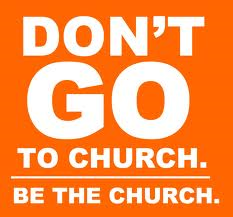
Be the church

Going solo with faith

I have a confession to make. During my break from pastoral ministry, I often felt the temptation to go solo with my faith. I would go for a Sunday morning run along the Tar River in Greenville. There, I would pray and enjoy being alive in God’s creation, and think to myself, “This is the way to do church! There is no one to disagree with me. There is no one sharing their problems with me, making me uncomfortable, and taking up my time. And I must confess, it was rather nice!

However, I must also confess it was very selfish. It was arrogant, and it was self-righteous. The truth is: it was the very antithesis of who Jesus calls us to be as his disciples.

From People Grumble But Angels Sing

The church is the light of the world

We are to shine our lights by lifting up, accepting and caring for all people, especially those the world leaves behind. We are to light it up by loving, accepting, and caring for the least among us: the poor, the weak, those who need mercy, the marginalized who hunger and thirst for justice, the obviously flawed but pure in heart, and the troubled who yearn for peace.

Will we look like fools? You bet. Will people say that the way we accept and love and affirm others is socially and even theologically unacceptable? It’s likely. Will we be demeaned and even persecuted by others in the community, even other churches? Perhaps.

From Light It Up

Got Jesus? Oh God, I hope not!

If Jesus is something or even someone that we get, then church becomes just another product whose members are mere consumers. Thus, like going to a store, the spa, or the local cineplex, church becomes some place we go to get something. Some go to get fed. Others go to get nurtured and pampered. Some go to get entertained.

However, if it is Jesus who gets us, if Jesus is about us giving ourselves to the God revealed in Christ, then church means a radical, self-denying, sacrificial way of living.

If Jesus is about giving one’s life away, then the church becomes something much more than a self-help center offering self-improvement workshops.

Wednesday night becomes less of a time to get fed, physically and spiritually, and more of a time to pray for others, celebrate the joys of life with others, and even suffer with others. It becomes a time to build a community of selfless love and forgiveness with others. Bible study becomes less of a time to acquire more biblical knowledge than others and more of a time to consider how the scriptures inform our service to others.

Sunday morning becomes less about what God has to offer us and more about what we have to offer God.  When we eat the bread, we do not consume it. When we drink from the cup, we do not merely swallow it. We allow it to consume and swallow us, every part of us. And we commit ourselves to presenting our own bodies as living sacrifices for others, pouring our very selves out for others in the name of the God who emptied God’s self out for us.

And every day of the week, we become more than Christians who possess exclusive tickets to heaven in hand. We become the Light of the World.

Got Jesus? O God, for the sake of this community and for sake of this world, I pray not. Amen.

From Got Jesus?

 It only takes a spark

The truth is, when our church becomes nothing but a safe, static sanctuary, a place of secure stability where nothing really ever changes, where we can cool off, cool down and just for sixty-minutes a week, chill out, we are not fulfilling our purpose as the children of a dynamic, dancing God.  We are not the incendiary force that Jesus ignites us to be.  And we are one boring sight—to God as well as to the world.

Yet, when we be become ignited, fired up, disrupted, when we allow ourselves to be engaged by the Christ, when we truly decide to follow him, each of us using the gifts we have been given by the fiery Holy Spirit to serve him, to truly love all people, to meet the needs of our community; when we lose ourselves and become caught up in God’s dance, discover God’s purpose, we become a purifying and warming blaze, and it is, I promise you, a glorious site to behold, to God, as well as to the world.

When others see that that we look like the fiery Holy Spirit of Jesus—when they see us mowing a neighbor’s lawn, growing fresh vegetables for the needy, serving the soup kitchen, giving to help the poor in our community with rent and utilities, delivering meals on wheels to the elderly, adopting a nursing home resident, planning to help repair a stranger’s home in West Virginia, going back to Nicaragua, when they read on our sign, “All Are Welcomed to Worship and to Serve”, when they see that we are always willing to change and adapt, even reorganize—others will want to join us and serve alongside us.

From I Smell Smoke

The church is in the clothing business

I believe with all of my heart that this is one of our primary purposes as a community of faith. We are to always be a community of grace. If people cannot come through the doors of the church and take off their masks, stop the charade, and honestly lay bare all of their sin and all of their grief, knowing that they will never be judged, looked down upon or condemned, then I do not believe we are a church. I am not sure what type of business we’re running, but we are not a church, we are not a community of grace. As a church we are to always be in the business of yearning to meet people where they are, so we can be with them, so we can walk alongside of them, so we can listen to them, learn from them, forgive them and love them.

From Grace in Genesis: Adam and Eve

The first word people should hear from the church

The first word they hear from the church should never be judgment, condemnation or some loud, angry, hate-filled rant or protest. It should never be that God took her or snatched him, or is punishing them, or trying to get their attention because of some sin. No, the first word they need to hear from us is “peace.”  They need to hear God say, “Peace. My peace I give to you. You are my sons. You are my daughters, I have always loved you.  I still love you. I will love you forever. I am here with you and for you, always working all things together for the good.”

I believe people in our world who have locked their doors to the church are thirsting for this peace. They are thirsting for a group of people in our world that have the audacity to truly live as the embodiment of Christ in this world offering the first word of Easter, the peace of Christ to a fearful world through selfless, sacrificial love and service to others. They are thirsting for a church that seeks to be, not an institution, but the living embodiment of Christ in this world, serving the poor, and those whom society has marginalized, offering grace, acceptance, love and peace.

From The First Easter Word

We learn from others

Dare to leave your comfort zone to minster to those who are struggling somewhere in a foreign state, but when you go, it is important to realize that you do not go as if you are one with all of the answers, possessing all of the faith, going out as if on a crusade to save all those with less faith. Because oftentimes, says Jesus, it is the one living on the edge, the foreigner, who can teach us a thing or two about faith in God and salvation.

From Welcome Home! Too Bad You Can’t Stay

Embracing Diversity

Therefore, if we ever act or speak in any manner that denigrates or dehumanizes another because of their race, language, nationality or ethnicity, we are actually disparaging the God who willed such diversity. According to Genesis, diversity is not to be feared, avoided, prevented or lynched. If we want to do the will of God our creator and redeemer, diversity is to be embraced. In other words, if we love God, we will also love our neighbor. And this is what God wants us to be united by. It is why Jesus called it the greatest commandment—love God and our neighbors as ourselves. Love is what should unite us; not racial pride or patriotism.

From Grace in Genesis: Tower of Babel

Allowing the words and works of Jesus to interpret the Bible for us

From Baptism Obstacles

The world would be a much better place today if more people understood that the Bible needs to be interpreted. I do not believe God ever intended for people, on his or her own, to pick up the Bible, and arbitrarily lift scripture passages out of their contexts, and try to understand it or follow it. I believe this is one of the reasons that baptism statistics are in such a decline today. Too many Christians are using the Bible out of context to support all kinds of hate and injustice. And because of that there are countless people in this world, countless people in this community, who are the victims of bad religion. They feel marginalized and disenfranchised by the church. They have been taught their entire lives that God despises them. They have no idea that God loves them and has a future for them— All because no one has interpreted the Bible pointing to the Jesus who came into the world, not to condemn the world by to save the world, to love the world.

Luke tells us that the Spirit had to urge Philip to get up and go to the chariot to see this Eunuch from Ethiopia. Go to the chariot and meet this strange foreigner; this victim of bad religion who had been ostracized from the community of faith; this one demeaned and exploited for his sexuality; this one who has been clobbered by the Bible by those who arbitrarily pick and choose scripture passages like Deuteronomy 23:1 that says they are forbidden to enter the temple; this one who has been taught his entire life that he is despised by God. Go, Philip, and meet him where he is. Do not stand above him or over him. Do not judge him or condemn him. Join him. Get into the chariot and sit beside him. Ride alongside him. Engage him. Listen to him. Learn from this other, this stranger, this foreigner.

From Baptism Obstacles

We are born holding hands

This past Mother’s Day, a rare set twins were born in Ohio. They were called mono, mono twins, meaning that they shared the same amniotic sac and thus were in constant contact with one another. However, it was not the mono, mono rarity that got them so much attention this week. Jillian and Jenna Thistlewaite were miraculously born holding hands.

One of the most popular songs when I was born back in 1966 was entitled, Born Free.  “Born free, as free as the wind blows, as free as the grass grows, born free to follow your heart.”

It’s a nice song. However, when you take a good look at Jillian and Jenna Thistlewaite, we learn something completely different. We were not born to be independent and free, but we were born to be utterly dependent on one another. We were born to need one another. Jillian and Jenna remind us that Christ has commanded us to love one another, to link up with one another in mutual care and concern, and to feel responsibility for one another. We were born to live in community.

We were not born free, as the song goes. We were born holding hands.

From Born Holding Hands

We must be willing to share in the suffering of others

Another reason I believe people are leaving the church is that they see within the church a group of people who fail to see the importance of true fellowship, of suffering with others.

Today, this can most obviously be seen on social media, especially facebook. Someone will post a tragic circumstance: the loss of a job, the loss of their health, or even the loss of a child. Then come the God-awful comments: “God doesn’t make mistakes.” “God has a purpose.” “God has a plan.” “God knows best.” “God needed another angel.”

For some reason or another, some Christians think it is their mission to help others avoid suffering, as they think suffering somehow means their faith is weak. They believe they must say something to fix the problems of another, to say something theological to make everything better. However, their trite comments are seen as uncaring, unsympathetic, distant, and cold. And people everywhere read those callous comments and think, “If that is the church, then I want no part of it.”

Henri Nouwen has written: “When we honestly ask ourselves which persons in our lives mean the most to us, we often find that it is those, who instead of giving advice, solutions, or cures, have chosen rather to share our pain and touch our wounds with a warm and tender hand. The friend who can be silent with us in a moment of despair or confusion, who can stay with us in an hour of grief and bereavement, who can tolerate not knowing, not curing, not healing and face with us the reality of our powerlessness, that is a friend who cares.”

From Renewing our Fellowship Mission

Locked Doors

lockJohn 20:19-31 NRSV

On the evening of the first Easter, we find the disciples of Jesus cowering together in a house. Windows shut, shades pulled, curtains drawn, shudders closed and the doors have been locked up tight. It is nighttime, a dangerous time in any city, but this is Jerusalem, and here, on this night, the disciples had some pretty good reasons to lock the doors.

The most obvious reason their doors were locked was the fear that the institutional, religious authorities who organized and began plotting from the very beginning to put an end to Jesus and his message were quite possibly even now plotting to put an end to them.

So the disciples locked the doors.

And then, there may be another reason, earlier in our text we read where Mary Magdalene has told them, “I have seen the Lord.”  And what do they do?  They locked the doors.

After denying that he even knew who Jesus was, I’m sure Peter felt like locking the doors. After fleeing and deserting Jesus, leaving him to die alone between two thieves, I’m sure many of the disciples felt like locking the doors.

This image of locked doors has had me thinking all week. As I have pondered this image, I cannot get the words of my home pastor out of my mind. Every Sunday, during the Invitation, he always said the same words: “The doors of our church are now open for membership. If anyone here would like to be received into full membership into our church, you are invited to come down during the singing of this hymn.

Remembering these words this week has caused me to ask a question, a question that I believe is imperative for the church in the 21st century to ask: “Why do you suppose so many people today, especially people in their 20’s, 30’s, and 40’s, when it comes to church membership, also feel like locking the doors, locking the doors to even the thought of becoming a part of the church?”

From asking this question to countless people all over this country who have given up on the church since I was ordained in 1992, this is what I have discovered:

The reason that most young people give for locking the doors to even the very thought of being associated with the church is that they simply have no trust in organized, institutional religion. In fact, they regard the church the same way the disciples cowering behind closed doors regarded the religious system of their day—as a threat to Jesus and everything for which Jesus stood.

They hear some of their friends, the ones who do proudly profess to be a part of a church, on a tirade protesting against such things as equal rights, social justice, equitable healthcare, and any criticism about the gap between poor and the rich. They hear their church friends make scornful remarks about minorities of every persuasion, and they know just enough about Jesus and his affinity for the poor and the marginalized to know that something is terribly wrong with this picture.

Many young people today in no way want to be associated with the words of many in the church who make heinous claims on the behalf of God, such as: tornadoes are God’s way of getting our attention, the Haiti earthquake as well as Hurricane Katrina were directly linked to Voodoo or Catholicism; the Japan earthquake and tsunami and the South Asia tsunami were directly linked to Buddhism or Islam; or the events of 9-11 and the subsequent deaths in the War on Terror are God’s judgment on abortionist and homosexuals.

Young people today do not want to be associated with a religion that has preachers and congregations who picket the funerals for our soldiers who paid the ultimate sacrifice, yelling hate-filled rants declaring that their deaths are the will of God.

They hear preachers declare from their pulpits that either the American President or the Pope is the anti-Christ. And they look at institutional, organized religion these days and think that we may be the ones who are anti-Christ. So, like the disciples distancing themselves from self-righteous and judgmental organized religion, young people are locking their doors to the church.

And secondly, as the disciples also hid behind locked doors avoiding Jesus, there are some who are not simply avoiding organized religion; they are avoiding God. When they lost their grandparents, their parents, or some, their children, the response from their Christian friends was that God took them. God needed another angel, another flower in the heavenly garden.

The response of some in the church was that all of their loved one’s pain and suffering and their subsequent death, that their child’s untimely and tragic death was all part of some purpose-driven divine plan. So they lock the doors, wanting absolutely nothing to do with a God like that.

Whatever the reason for the disciples’ fear, the irony of our gospel lesson is that the judgmental, organized religious authorities were not trying to get to the disciples to arrest them and Jesus was not trying to get to them to punish, condemn them or take their lives. As I said at the Sunrise Service last week, Jesus was trying to get to the disciples in order to give them the word that they needed more than any other word—the very first word of the Easter story.

On Easter evening, the Risen Christ returns to his disciples, the same fearful followers who denied, forsook and abandoned him and pronounced “Peace!”  It was the same word that was proclaimed at his birth by the angels in the beginning of the gospel.  “Glory to the God in the highest and on earth, peace!”  And it was one of the last words from the cross when he said, “Father, forgive them, for they know not what they do.”  And here, the first word of Easter to the fearful disciples cowering behind locked doors is “Peace.”

THIS is what I believe all people need to hear from the church, and it needs to be the very first word they hear from us.

The first word they hear from the church should never be judgment, condemnation or some loud, angry, hate-filled rant or protest. It should never be that God took her or snatched him, or is punishing them, or trying to get their attention because of some sin. No, the first word they need to hear from us is “peace.”  They need to hear God say, “Peace. My peace I give to you. You are my sons. You are my daughters, I have always loved you.  I still love you. I will love you forever. I am here with you and for you, always working all things together for the good.”

I believe people in our world who have locked their doors to the church are thirsting for this peace. They are thirsting for a group of people in our world that have the audacity to truly live as the embodiment of Christ in this world offering the first word of Easter, the peace of Christ to a fearful world through selfless, sacrificial love and service to others. They are thirsting for a church that seeks to be, not an institution, but the living embodiment of Christ in this world, serving the poor, and those whom society has marginalized, offering grace, acceptance, love and peace.

Several Easters ago, we went to visit my parents in Elizabeth City.  We had a nice dinner, watched the Masters, and then ate some leftovers before heading home. It was late when we arrived back home, about 11:00.  And guess what?  We were locked out. In a hurry to leave after church, I had accidentally grabbed the wrong set of keys.

As Lori and Sara sat in the car, twelve year-old Carson and I checked every window on the first floor.  All locked.  “I guess I’ll break a window.”

“Wait a minute,” Carson, who has always had a lot more patience than me, said. “I think the window in the middle dormer upstairs is unlocked.” I grabbed my extension ladder that was much too short for the job.  I stood it almost straight up and asked Carson to hold it at the bottom as I climbed up.  Got myself on the roof in front of the dormer, but before I could reach it, because of the pitch of the roof, and the dew that had gathered, I began to slide off.  Came down, feet hit the ladder, almost knocking it over. I put a death grip on my shingles with my hands. Grabbed the top of the ladder with one foot and straightened it out with the other as Carson helped at the bottom.  I don’t know if he was more scared that I was going to fall and kill myself on the brick steps below or fall right on his head.

After one more idiotic try to climb on the roof, it occurred to me, “Maybe I can peel the vinyl ceiling back on my back porch just enough to climb up into the attic. Got my pry bar, and went to work.  Less than five minutes later, I was inside.

Now, was my wife happy?  Was I the hero of the night?  Was she proud of my resourcefulness and my persistence?  No, she was absolutely horrified by how quickly I broke into our securely locked house. “If a preacher can break in, anyone can!” she said.

This is the good news of this Easter Season. Our securely locked doors are not a problem for Jesus.  Here is the promise of Easter for each of us today. Just as the risen Christ was not stumped by the locked doors behind which the disciples cowered, so I promise you that the risen Christ will not be deterred by the locks that any of us or anyone else has put on our own doors.  Our God is wonderfully resourceful, imaginative, persistent, and determined to get to all of us.  Even in our lostness, even in our betrayals and denials, even with all of our past failures, Christ is ever determined to share his peace with us in this world.

I believe Christ is as alive today as he has ever been. I believe he is on the loose, even here in Farmville. He is moving and working and he is as determined as ever to get the word out…the very first word of the gospel proclaimed by angels, and the last word proclaimed on the cross and the first word of Easter: peace.  The question is: will he be able to use us? Will we allow him to breathe the Holy Spirit on us and send us into the world to help him share that word—a word of unlimited grace, unreserved forgiveness and unconditional love for all God’s people, especially to those who have locked the doors to the possibility of being a part of the church.

Will he find a group of people here that have the audacity to truly live as the embodiment of Christ in this world offering the first word of Easter, the peace of Christ to a fearful world through selfless, sacrificial service to others?

From what I have learned about you over the last seven months, and from what I what I see in you every week, I believe the answer is ABSOLUTELY!

Got Jesus? O God, I Hope Not

got jesus

If Jesus is something or even someone that we get, then church becomes just another product whose members are mere consumers. Thus, like going to a store, the spa, or the local cineplex, church becomes some place we go to get something. Some go to get fed. Others go to get nurtured and pampered. Some go to get entertained.

However, if it is Jesus who gets us, if Jesus is about us giving ourselves to the God revealed in Christ, then church means a radical, self-denying, sacrificial way of living.

If Jesus is about giving one’s life away, then the church becomes something much more than a self-help center offering self-improvement workshops.

Wednesday night becomes less of a time to get fed, physically and spiritually, and more of a time to pray for others, celebrate the joys of life with others, and even suffer with others. It becomes a time to build a community of selfless love and forgiveness with others. Bible study becomes less of a time to acquire more biblical knowledge than others and more of a time to consider how the scriptures inform our service to others.

Sunday morning becomes less about what God has to offer us and more about what we have to offer God.  When we eat the bread, we do not consume it. When we drink from the cup, we do not merely swallow it. We allow it to consume and swallow us, every part of us. And we commit ourselves to presenting our own bodies as living sacrifices for others, pouring our very selves out for others in the name of the God who emptied God’s self out for us.

And every day of the week, we become more than Christians who possess exclusive tickets to heaven in hand. We become the Light of the World.

Got Jesus? O God, for the sake of this community and for sake of this world, I pray not. Amen.

We Are All Preachers

Barbara Brown Taylor

Our Nehemiah Bible Study this past week reminded me of something Barbara Brown Taylor wrote in wonderful meditation called The Preaching Life.  In it she stresses the need for all Christians to rediscover their preaching vocation.

Somewhere along the way we have misplaced the ancient vision of the church as a priestly people—set apart for ministry in baptism, confirmed and strengthened in worship, made manifest in service to the world.  That vision is a foreign one to many church members, who have learned from colloquial usage that “minister” means the ‘ordained person,’ in a congregation, while “lay person” means ‘someone who does not engage in full-time ministry.’  Professionally speaking that is fair enough—but speaking ecclesiastically, it is a disaster. Language like that turns clergy into purveyors of religion, and lay persons into consumers, who shop around for the church that offers them the best product.

Taylor writes of the need to revive Martin Luther’s vision of the priesthood of all believers, who are ordained by God at baptism to share Christ’s ministry in this world.

All we have to do is sit down and study he scriptures to understand that this is just how our God works in this world.  Nowhere in the scriptures do we find God saying, “Go into the world and make Christian lay people out of people.  Bring them into the church so they can sing some hymns, pray and listen to a sermon about being good, moral people.  Form a type of club.  Hire a full-time club president who is going to be there for the club members.  Her job will be to hold their hand and pray for them in the hospital, marry them, and one day bury them.

No, what we do find in scriptures is Jesus instructing us to go into the world and make disciples .  And what do disciples do?  Sit on a pew every Sunday?  Sing, pray, try to be good, religious?  No, they do what Jesus did.  They preach, teach, heal and exorcise demons.

But you say, “I can’t do those things.  I can’t preach.  That’s why we call you “preacher!”  “That’s why we pay you!”

Barbara Brown Taylor continues writing:

While preaching and celebrating the sacraments are two particular functions to which I was ordained, they are also metaphors for the whole church’s understanding of life and faith…Preaching is not something that an ordained minister does for 15 minutes on Sundays, but what the whole congregation does all week long; it is a way of approaching the world, and of gleaning God’s presence there.

Many of you are preaching every week, and you don’t even realize it.

Actin’ a Fool

Thomas Campbell, Alexander Campbell and Barton Stone

1 Corinthians 1:18-31 NRSV

As some of you know, I am taking an online class on the history of our denomination. It has been exciting to read how the forbearers of the Christian Church (Disciples of Christ) stirred up thousands of people in the late 18th and early 19th centuries with their writings and sermons.  Some people estimate that when Barton Stone held his revival at Cane Ridge, Kentucky in 1801, nearly 30,000 people showed up—10% of the entire population of Kentucky at the time. [i]

What were these folks preaching that started a movement that would later become one of the largest denominations in North America?

They simply had the audacity to preach messages that called for a return to taking the message of the Bible seriously. They denounced all man-made creeds and confessions and committed themselves to following Jesus at all costs. And in so doing they were continually bucking the system, going against the doctrinal grains of the Church.

They preached against slavery, preached for the inclusion of all Christians at the communion table, stood against the power of the clergy over the laity, the power of Bishops over the clergy and anything that did not jive with Jesus. And for doing so, many were excommunicated, labeled heretics, radicals and fools. In fact, The Fool of God is the title of a novel based on the life of our forebear Alexander Campbell.[ii]  

But here’s the thing, people responded to these fools. And by 1960, the movement they started had grown into a denomination with 1.6 million members.

Now here’s some troubling news. In 2012 we only had 625,000 members. Since 1960 our denomination has had a 60% decline in membership.[iii]

There are many complex reasons for this decline. However, this morning, I want to suggest what I believe is at least one of the reasons, and here it is: We stopped actin’ a fool.

In fact, the Christian Church (Disciples of Christ) has been labeled by many as “a moderate, mainline, mainstream protestant denomination in North America.”[iv] Did you hear that: moderate, mainline, mainstream! 

Barton Stone, Thomas and Alexander Campbell would roll over in their graves!

token

While Alexander Campbell was studying at the University of Glasgow in Scotland, the time had come for communion at his Presbyterian church. Communion was only observed a couple of times a year, so it was a pretty big deal. His church had a custom, like many Presbyterian churches of that day, to pass out these “communion tokens.” You would line up, present yourself to the minister. If the minister believed that you were worthy that day to participate in communion, he would hand you a token, a little coin. This was your ticket to the table. When you arrived at the table, you would present your coin, and then and only then, could you receive communion. If the minister did not think you were worthy, he would not give you a token, and thus, no communion for you. It also implied there may be no heaven for you either!

With his communion token in hand, Alexander Campbell approached the communion table. When he was handed the plate where he was to place his token, it is said that Campbell, “threw” the coin onto the plate, publically refused the bread and the wine, and then walked out of the sanctuary as a “free man” in Christ.[v]

Now, does that sound mainstream, mainline and moderate to you?  

Alexander Campbell was anything but a mainstream Christian. He would say that he was an upstream Christian, swimming like a salmon against the mainstream currents of his day. And many said he acted a fool.

This is what I believe we must regain as a church. We need more people like Alexander Campbell who are willing to humbly walk with Jesus, kindly love all people and do the justice of Jesus even if it makes them look foolish.

The Apostle Paul very clearly and outrageously writes:  “The way of the cross is foolishness” to the world.  We proclaim “Christ crucified, a stumbling block to Jews and foolishness to the Gentiles.” “God chose what is foolish in the world to shame the wise; God chose what is weak in the world to shame the strong.”

But this is a hard message for us to get. Because there is a part of all of us that does not want to look foolish. When I was trying to help a family at Christmas, someone asked me, “Are you sure they are a deserving family?” She didn’t want me to do anything foolish.  And it did make me pause, because I didn’t want to do anything foolish either.

A recent survey by Bill McKibben reveals that three-quarters of Americans believe the Bible teaches that “God helps those who help themselves.”[vi]  However, that statement is from deist Ben Franklin; not the Bible.[vii] “God helps those who help themselves” is in fact one of the most unbiblical ideas. It is Jesus who made the dramatic counter assertion: “Love your neighbor as yourself.”  But, deep down we prefer Ben Franklin don’t we?  Doesn’t sound so foolish.

There is a large part within all of us that yearns to be moderate, mainline and mainstream. However, when we stop actin’ the fool in the eyes of the world, I believe we stop being Christian, we cease being disciples.

Søren Kierkegaard, the great Danish theologian, writes: “Christianity has taken a giant stride into the absurd. Remove from Christianity its ability to shock and it is altogether destroyed. It then becomes a tiny superficial thing, capable neither of inflicting deep wounds nor of healing them. It’s when the absurd starts to sound reasonable that we should begin to worry.” He goes on to name a few of Jesus’ shocking and absurd assertions: “Blessed are the meek; love your enemies; go and sell all you have and give it to the poor.”[viii]

And you know the others: “forgive seventy times seven, turn the other cheek; someone takes your coat, offer them your shirt, pray for those who persecute you; blessed are the poor; visit the imprisoned; to save your life, you must lose your life, take up your cross and follow me.”

And then there is the entire foolish story: The foundation of his arrival was laid by a murderer with a speech impediment and a bad temper named Moses; his advent was promised by prophets who did not deserve to be prophets; he was born to ordinary peasants in a cattle stall and laid in a feeding troth; worshipped by loathsome shepherds; his family on the run in Egypt like illegal immigrants; a triumphant ride into Jerusalem to liberate the world on the back of a donkey—and then there is the most foolish part of it all—the arrest, the trial, the desertion of the his friends, the cross and those shocking words: “Father, forgive them, for they know not what they do.”

Then to add audacity on top of audacity, foolishness on top of foolishness, Jesus is resurrected by God and given right back to the very ones who nailed him to a tree.

There is nothing moderate, mainline or mainstream about this thing we call ‘Christianity,’ this thing we call ‘church.’ It is all so radical, so reckless, so shocking, so undeserving, so unconditional and so inclusive. It is a love that is so socially unacceptable, that it can only be described as foolish.

Henri Nouwen was a priest and brilliant teacher at places like Harvard and Yale. However, wanting to truly follow Jesus before he died, many say that he did something absolutely foolish. He left the Ivy League to spend the last decade of his life serving as a chaplain within a community of people with severe emotional, mental and physical disabilities.

L'Arche Community
L’Arche Community in Edmonton

In one of his many books, Nouwen tells a story about Trevor, a man in that community who was dealing with such severe mental and emotional challenges that he had to be sent to a psychiatric facility for an evaluation. One day Henri wanted to visit him, so he called the hospital and arranged for a visit.

When those who were in authority found out that it was Henri Nouwen, the renowned author and teacher from Yale and Harvard who was coming, they asked if they could have lunch with him in the Golden Room—a special meeting room at the facility. They would also invite doctors and other clergy to the special luncheon. Nouwen agreed.

When he arrived, they took him to the Golden Room, but Trevor was nowhere to be seen. Troubled, he asked about Trevor’s whereabouts.

“Oh,” said an administrator, “Trevor cannot come to lunch. Patients and staff are not allowed to have lunch together. Besides, no patient has ever had lunch in the Golden Room.”

Henri Nouwen with another resident
Henri Nouwen with Linda Slinger

By nature, Henri was not a confrontational person. He was very meek and gentle—much unlike Alexander Campbell—but so like him in many ways. Being guided by the Spirit, here was the thought that came to his mind: “Include Trevor.” Knowing that community is about inclusion, Henri thought: “Trevor ought to be here.”  So, Henri swallowed hard, turned to the administrator and said, “But the whole purpose of my coming was to have lunch with Trevor. If Trevor is not allowed to attend the lunch, I will not attend either.”

The thought of missing an opportunity for lunch with the great Henri Nouwen was too much, so they quickly found a way for Trevor to attend. When they all gathered together, something interesting happened. At one point during the lunch, Henri was talking to the person to his right and didn’t notice that Trevor had stood up and lifted his glass of Coca-Cola.

“A toast. I will now offer a toast,” Trevor said to the group.

Everybody in the room got nervous. What in the world was he going to say?

Then Trevor, this deeply challenged man in a room full of PhDs and esteemed clergy, started to sing, “If you’re happy and you know it, raise your glass. If you’re happy and you know it, raise your glass…”

No one knew what to do. It was awkward. Here was a man with a level of challenge and brokenness they could not begin to understand, yet he was beaming. He was thrilled to be there. So they started to sing. Softly at first and then louder and louder until all of the doctors and clergymen and Henri Nouwen were practically shouting, “If you’re happy and you know it, raise your glass.”

Henri went on to give a talk at the luncheon, but the moment everyone remembered, the moment God spoke most clearly, was through the person they all would have said was the least likely to speak for God.[ix]

This is what the entire Bible is all about. This is what the cross, the gospel and our faith is all about. God uses the foolish things of the world to shame the wise.

This morning, after the hymn of commitment, we are going to install our officers that you have elected for 2014. We are going to ask them to commit themselves to following Jesus. And as Frederick Buechner writes: “In terms of human wisdom, Jesus was a perfect fool. And if you think you can follow him without making something like the same kind of fool of yourself, you are laboring not under the cross, but a delusion.”[x] So we are going to ask them, in the name of First Christian Church, in the name of God, to act a fool, to shock this community with the grace of God revealed in the life, the death and resurrection of Jesus Christ our Lord.  And then we are going to promise them our support which makes us just as foolish.

Are you ready? I hope you are. If this church is to continue to grow and thrive in this community, continue to make a difference, continue to be the church God is calling us to be, I pray you are.


[i] Duane Cummins, The Disciples: A Struggle for Reformation (St. Louis: Chalice Press), 2009.

[ii] Louis Cochran, Published October 18th 2002 by Wipf & Stock Pub 

[vi] Bill McKibben, “The Christian Paradox,” Harpers Magazine, July 7, 2005.

[vii] Deism is a religious and philosophical belief that a supreme natural God exists and created the physical universe, and that religious truths can be arrived at by the application of reason and observation of the natural world.  Deists generally reject the notion of supernatural revelation as a basis of truth or religious teaching.

[ix] John Ortberg, in the sermon, “Guide.” Preachingtoday.com.

[x]Frederick Buechner, as quoted by Joe Roos, Sojourners Magazine, “The Foolishness of the Cross,” Aug. 2007.

Why Should I Join a Church?

why-join-a-church

To entice people to join the church, I once heard a minister tell a group of prospects that members of the church enjoy special member “benefits.” For example, he said: “You have the benefit of a pastor to visit you or pray for you when you are sick or hospitalized.  You have the benefit of programs that are designed to meet the needs of you and your family. And you have the privilege to use the church’s facilities for weddings or funerals without a fee.”

However, I do not believe this is what Jesus ever intended the church to be. Church membership is not like an American Express Card membership, a Sam’s Club, a country club or gym membership where membership has its privileges. The gospel truth is that it is quite the opposite.

Church is not some place to come and receive, but is a dynamic opportunity to go and to give. Church is a chance to fulfill the greatest commandment of Jesus to love God and our neighbors as ourselves.  Church is an occasion to deny and lose one’s self in sacrificial service to others. The purpose of church is not to meet your needs, but to transform your needs.

And the gospel truth is that church membership will not eliminate fees. On the contrary, church membership, if it is about following Jesus, will cost you dearly.

Heaven Can Wait

END IS NEARLuke 21:5-19 NRSV

One of the great things about living in southern Louisiana were the countless stories about two infamous Cajuns named Boudreaux and Thibodeaux.

Reverend Boudreaux was the part-time pastor of a small, rural Baptist church and Pastor Thibodeaux was the minister of a Pentecostal church directly across the road. One day, they were both standing out by the road in front of their churches, each pounding a sign into the ground as fast as they could. The sign read:

Da End is Near
Turn Yo Sef ‘Roun Now
Afore It Be Too Late!

As soon as the signs got into the ground, a car passed by.  Without slowing down, the driver leaned out his window and yelled as loud as he could: “You bunch of religious nuts!”

Then, from the curve in the road you could hear tires screeching and a big splash.

The Reverend Boudreaux yells at Pastor Thibodeaux across the road and asks:

“Do ya tink maybe da sign should jus say ‘Bridge Out’?”

The last couple of Sundays the Christian calendar and the lectionary has led us to ponder the tough subjects of death, the resurrection of the dead and eternal life. And today’s gospel lectionary is on a similar topic: the end of the world.

Now, I have to be honest here, after the last two Sundays, I am really ready to focus on something else!  Besides, all this apocalyptic gloom and doom talk is really not for us mainstream, progressive, educated church types here on Main Street.

But this is just how the Church calendar works I guess. We are approaching the end of the calendar as next Sunday concludes the church year with Christ the King Sunday, emphasizing that when it is all said and done, in the end, Jesus Christ is King of Kings and Lord of Lords. So, I guess it makes sense that here, on this next to last Sunday of the church year, even we downtown Main Street church folks are asked to listen to sermon about the final judgment.

And, although we don’t like it, maybe we need to hear it. After all, in the last couple of years, chatter about the end of days seems to have spiked a bit with all of the Mayan doomsday predictions, super storms like last year’s Sandy and last week’s killer typhoon in the Philippians, numerous earthquakes and tsunamis, the global recession, nuclear tensions with North Korea and Iran, the constant threat of terrorism, and with the attention given by cable TV to doomsday preppers.

In September of this year, a poll by the Barna group found 4 in 10 Americans – and 77 percent of evangelical Christians – believe the “world is now living in the biblical end times.”[i]

So, in spite of what you may think about this subject, perhaps we need to hear what Jesus has to say.

About the destruction of it all, in verse 7, we read where they ask Jesus: “When will this be, and what will be the sign that this is about to take place?”

In verse 8 we read Jesus’ answer: “Beware that you are not led astray.”

Then Jesus specifically warns us to stay away from those who claim to be Christian and say, “The time is near.” Jesus says, “Do not go after them.” Do not follow them. Do not listen to them. Don’t pay them any attention!

Well, glory halleluiah!  Because after two Sundays preaching on death and the resurrection of the dead, I really don’t want to talk about the end of days! So, Amen Jesus! Preach it! Let’s move on to some more pleasant things! Enough of all this gloom and doom!

Ok, now let’s listen to what Jesus has to say next! Hopefully it is something more uplifting than death!

“But before all this occurs, they will arrest you and persecute you.”  “You will be betrayed even by parents and brothers, by relatives and friends; you will be hated by all because of my name; and they will put some of you to death.” “But “this will give you an opportunity to testify.”

Man! And we thought we were off the hook this week!

But if we have been reading and listening to Luke, we should not be that surprised. It is as if Jesus is saying, “Do not worry so much about the tribulations to come with the end of the world, because if you are truly following me, if you are faithfully living as my disciple, if you have fully committed yourself to carrying a cross, if you are really speaking truth to power, if you are serving those I call you to serve, if you are standing up for my justice and my wholeness in this fragmented world, then you have will enough trouble for today!

If you are truly living for me and loving this broken and suffering world as much as I love this world, you will sacrifice much. You may even lose your friends and family! Matthew remembers Jesus saying on another occasion: ‘So do not worry about tomorrow, for tomorrow will bring worries of its own. Today’s trouble is enough for today (Matthew 6:34).

Jesus seems to be saying here: “Don’t focus so much on the end days, don’t’ dwell on the impending doom and demise of it all but instead, focus on the opportunities that you have today in this hurting world ‘to testify,’ to selflessly and sacrificially serve me by serving and suffering for others.”

Jesus is saying: “It is perfectly is to think and dream about going to Heaven one day. It is fine to have the hope that someday, somehow, some way there’s not going to be anything more to fear or dread. It is wonderful to know a time is coming when there is going to be no more crying, no more pain, and no more death. It is great to sing those old hymns of faith, such as “When We All Get to Heaven,”  “Shall We Gather at the River,” and “I Can Only Imagine,” but if Heaven is the only place your hearts are, if going to Heaven and avoiding Hell is the only reason you are Christians, then you have missed the whole point of who I am and who you are called to be as my disciples.”

I believe Jesus is saying to us: “So don’t come to church looking to avoid a suffering world! Come to church and bear the sufferings of this world! Don’t come to church looking for some fire insurance. Come to church and let me lead you into the fire!”

This is exactly why I believe so many Christians are tempted “go after” those who love to preach about the end of days, especially those who say that it is coming in our lifetimes. For it is far easier to believe that God has already given up on this world. It is much easier to look at the destruction in the Philippines and believe that it is all a part of God’s plan, a preview of things to come! It is far easier to believe that earthquakes and hurricanes and tornadoes and poverty and wars are all part of God’s apocalyptic will than it is to believe that God calls us to selflessly and sacrificially suffer alongside those who are suffering.

It would be far easier to believe that Christianity is only about getting a ticket to heaven to escape this world than it is to believe that it is about selfless, sacrificial service.

British scholar Lesslie Newbigin comments: “In an age of impending ecological crises,” with the “threat of nuclear war and a biological holocaust” many Christians have retreated into a “privatized eschatology.”  That means, that the only hope that they possess, in the words of Newbigin, is “their vision of personal blessedness for the soul after death.”[i]

Christians everywhere, in the words of Newbigin, have “sounded the trumpet of retreat.” They have thrown their hands in the air and have given up on the world. Their faith in Jesus has become solely and merely a private matter. Faith is only something they possess, something they hold on to, that they can someday use as their ticket out here. In the meantime, they withdraw into safe sanctuaries and look forward to that day “the roll is called up yonder.”  And they listen to angry sermons by angry preachers condemning the world to Hell in a hand basket.

And giving up on the world is really nothing new.  At the turn of the first century, Jews called Gnostics had a similar view of the world.  Everything worldly, even the human body itself, was regarded as evil.  And maybe, they too, had some pretty good reasons to believe that way, because regardless of what some may believe, the world did not start going bad in our lifetimes. The truth is: it has been bad ever since that serpent showed up in the garden.

At the turn of the first century, Jews were a conquered, depressed people, occupied the Romans.  And they were terrorized daily by a ruthless, pro-Roman King named Herod—a king who would murder innocent children to have his way.  The Gnostics looked at the world and their situation and came to the conclusion that they were divine souls trapped in evil bodies living in a very dark, God-forsaken, God-despised world.

As I have mentioned, Next Sunday marks the end of the Christian calendar. The next Sunday begins the season of Advent, the very beginning of the church.

It is the season that we remember that it was into a very dark, and seemingly God-forsaken, God-despised world that something mysterious happened that we call Christmas. A light shone in that darkness proving in the most incredible and inexplicable way that this world is anything but God-forsaken or God-despised!

God loves this world so much that God emptied God’s self and poured God’s self into the world. God came and affirmed, even our fleshly existence as God, God’s self, became flesh. And God came into the world not to condemn the world, but to save the world. For so God loved the world that God came into the world and died for the world.

Thus, the message that we all need to hear today and hear often is not that the end is near as God believes the world is worth destroying, but it is that God believes this world is worth saving. God believes the world is still worth fighting for. God still believes that this world is worth dying for.

As the body of Christ in this world, we as the church are not called to retreat or withdraw from the world and its troubles, but are called to love this world, to do battle for this world, to even die for this world.  We are called to be a selfless community of faith in this broken world. And, no matter the cost, we are called to share this good news of Christmas all year long!


[i] Read more at http://www.wnd.com/2013/10/billy-graham-sounds-alarm-for-2nd-coming/#Y8RpIeMpqqHd8uRF.99

[ii] Leslie Newbigin, The Gospel in a Pluralistic Society, 113.