

I might as well address the elephant in the room right here and now from the get-go. The rumors are true. Rev. Mooty was right last week when he said: “I don’t know Jarrett, except that he is an eastern North Carolina boy.” Which he said was “a good thing.” And “that he was originally a Baptist.” Then, with tongue in cheek, he said he had “always heard Baptists made good Christians!”
So, allow me to use my first sermon to tell you how I got to this place where I am standing today, behind this Open and Affirming pulpit wearing a stole with chalice and a St. Andrew’s cross.
Although there many types of Baptists, I sometimes unfairly place them into two categories.
First, there’s the hard-shell variety. These are the ones who don’t drink, dance, cuss or chew or go with girls or boys who do…at least not before Noon on Sunday.
Then there’s the category of which I was a part: those of the more moderate persuasion.
“Pastor, that doesn’t look like sweet tea in your glass.”
“Everything in moderation,” I used to respond.
“Let’s be Christian, but let’s not get too crazy with it.”
“Follow Jesus but don’t get fanatical about it.”
“Embrace the gospel, but don’t go overboard with it.”
“Be a disciple, but don’t overdo it.”
“Moderation is the key to everything in life,” I was taught, especially when it comes to pastoring a church.
“Don’t upset the status quo. Don’t disturb the peace. Don’t stir things up.”
“Moderation” is the key to playing it safe. Moderation helps one avoid conflict, in the community and in the church. Moderation keeps your congregation comfortable, satisfied, unchanged. Thus, moderation helps pastors pay their mortgages, get their kids through college, and fund their pension. Moderation makes for more pleasant church business meetings and uneventful board meetings. I learned very quickly that when you preach moderate sermons, you don’t have to spend your entire Monday smoothing all the feathers you ruffled in the congregation on Sunday morning!
Moderation is the key to survival in this divisive time. So, it’s best to avoid saying anything that someone may interpret as being “political,” especially from the pulpit.
But then I started reading the likes of Barton Stone and Thomas and Alexander Campbell.
These Scottish-Americans had the audacity to preach revolutionary messages that called for a return to taking the message of Jesus seriously. They courageously denounced all creeds and confessions and radically committed themselves to following Jesus at all costs. And in so doing they were continually bucking the system, going against the doctrinal grains of the Church and defying the societal norms of the culture.
They preached and supported politics against slavery. They preached for the inclusion of all Christians at the communion table. And they openly criticized mainline Christianity and anything that didn’t jive with Jesus.
And of course, the mainstream powers-that-be pushed back. They said: “Barton and Alexander, you’re taking this too far.” “You’re out of bounds.” “You need to tone it down, slow your roll, pump the brakes, moderate.”
But they would not bow down, back down or slow down. They refused to compromise. And for so doing, they were excommunicated by the Church and labeled heretics, radicals, rabble-rousers and fools. They were called every name in the book, but one.
They were never called “moderate.”
During this same time period, other prophetic voices like William Lloyd Garrison echoed Stone and Campbell’s revolutionary opposition to the injustice of slavery.
Garrison wrote:
I am aware, that many object to the severity of my language; but is there not cause for severity?
I will be as harsh as truth, and as uncompromising as justice.
On this subject, I do not wish to think, or speak, or write, with moderation.
No! no! Tell a man whose house is on fire, to give a moderate alarm; tell him to moderately rescue his wife from the hand of the ravisher; tell the mother to gradually extricate her babe from the fire into which it has fallen; –
– so don’t you urge me to use moderation in a cause like the present. I am in earnest — I will not equivocate — I will not excuse — I will not retreat a single inch — AND I WILL BE HEARD.
After studying the forbearers of the Disciples movement, one day a verse I read in the first chapter of Ephesians nearly jumped off the page.
He destined us for adoption as his children through Jesus Christ, according to the good pleasure of his will, to the praise of his glorious grace that he freely bestowed on us in the Beloved. In him we have redemption through his blood, the forgiveness of our trespasses, according to the riches of his grace that he lavished on us (Ephesians 1:8).
“Lavished.” Don’t you like that? When I think of all my shortcomings and failures, I think: “Thank God that God doesn’t give grace in moderation. Praise the Lord that God just doesn’t give me a sensible amount of mercy, a reasonable amount of forgiveness, a rational amount of love. Praise God that when it comes to grace, God lavishes.
When we took our two children to the beach or to the pool when they were younger, Lori was always in charge of the sunscreen. And when it came to protecting her babies, she would always lavish them with the sunscreen lotion. The poor things would be covered in white lotion in from head to toe.
And if I ever said, “Baby, don’t you think you overdid it a little with the sunscreen? Moderation, baby. Moderation is the key.”
She’d look at me with this look of disappointment and say: “You must not love them like I do!”
When it comes to covering God’s children with grace, Paul says that God lavishes. When it comes to love, God loves all God’s children, thus God overdoes it.
Disciples like to say that where the Bible speaks, we speak, and the entire Biblical witness testifies to this lavish grace. It is a grace that is extravagant, excessive, over-the-top, overdone.
Cain kills his brother Able, thus Cain himself deserved to die. But what did God do? God lavishes Cain. Cain is exiled from the community because of his actions, but God faithfully promises to go with him, mark him with grace and protect his life (Genesis 4).
Moses kills an Egyptian, breaking one of the Ten Commandments. But God chooses that murderer to reveal those commandments to the world and to lead the Israelites out of bondage into the Promised Land (Exodus 2).
David not only commits adultery, but kills the husband of his mistress (2 Samuel 11). Yet, Matthew proudly announces David in Jesus’ genealogy (Matthew 1).
The Psalmist proclaims that the Good Shepherd doesn’t just fill our cups, the Lord overdoes it as our cups runneth over.
The good news is, when it comes to grace, when it comes to love, God lavishes. God always seems to overdo it.
The story of Jesus’ first miracle says it all. When the wine gave out at a wedding party, what does Jesus do? He turns water into more wine. But not just some water into a little bit of wine. He makes, according to John’s estimate, 180 gallons of the best-tasting wine they ever had.
And considering that most traditional wedding parties at the time were attended by 50 or so guests, it is shockingly obvious that Jesus really overdid it! There’s nothing moderate about 180 gallons of wine!
Then, there are all those stories that he told.
The father of the prodigal son doesn’t just welcome home his returning son. The father lavishes the son. The father overdoes it: “Quickly bring out a robe, the best one, and put it on my son; put a ring on his finger and sandals on his feet. And get the fatted calf and kill it. And let us eat and drink and have one extravagant party!”
It wasn’t that the Good Samaritan stopped and helped the wounded man in the ditch. It was the way he lavished the man. It was the way he overdoes it by pouring expensive oil on his wounds, putting the wounded man in his car, taking the man to the hospital and telling the doctors, “Forget about filing insurance! Here’s all my credit cards, my debit card, everything. I’ll be back in a week, and if that’s not enough money to treat the man’s wounds, I’ll give you even more!”
And this morning we read where Jesus was teaching on a hillside and looks out at the large crowd that showed up looking for some hope. Thousands of them came from all over. They were hungry. Darkness was setting in.
The moderate disciples said: “Let’s be prudent, Jesus, and send them back to town so they find themselves something to eat.”
But Jesus radically takes all they have, blesses it, breaks it, and in an act that can only be described as revolutionary, feeds 5,000 people!
But the story doesn’t end there. They took up what was left over, and 12 baskets were filled. Once again, Jesus overdid it. Jesus took it too far. Jesus lavished.
The good news is that when disciples are willing to listen to Jesus, people in need— people who are hungry, poor, oppressed, marginalized, vulnerable, and hurting— don’t only get what they need. They always get more. They are lavished.
So, as followers of Jesus, how do we live? Are we moderate with grace? Are we passive with justice? Are we subtle with kindness? Are we modest with mercy? Are we restrained with the good news?
Afraid of upsetting our moderate friends and family, are we discreet with the extravagance of our love that sets an elaborate, excessive, overdone, and yes, very liberal table of grace every Sunday morning for all people without exceptions?
Or do we truly believe that the greatest commandment is to love the God of love with ALL of our heart, soul, mind and strength and our neighbors as ourselves?
Because the truth is that the church has been embarrassingly and tragically guilty of doing tremendous damage to the world, as well as to the mission of Christ, by loving others in moderation.
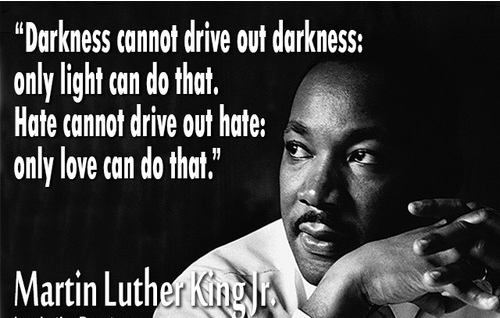
Rev. Dr. Martin Luther King Jr. had something to say about that from the isolation of a Birmingham jail when he said:
The great stumbling block…in the stride toward freedom is not the… Ku Klux Klanner, but the white moderate who is more devoted to order than to justice…
The late John Lewis shared King’s frustration when he said:
Followers of the One, who when it came to love, never did anything in moderation, can no longer passively wait for a more just and equitable world, but we must be willing to stir up some holy trouble.
This past week I received these powerful words of encouragement from The Reverend Cyd Cowgill:
That when it comes to the revolutionary Word of God,
when it comes to the boundless love of God,
when it comes to the extravagant grace of God,
when it comes to the prophetic justice of God,
when it comes to the radical inclusion of God,
when it comes to the excessive and socially unacceptable hospitality of God,
when it comes to fighting for a world where every life has equal value, when it comes to standing and preaching and fighting against Christian White Nationalism, racism, sexism, sick and harmful religion, meanness, misinformation, and all types of bigotry,
We will not compromise. We will not bow down, stand down or even slow down. We will not moderate. We will not equivocate. We will not excuse. We will not retreat a single inch. WE WILL BE HEARD!

 Just Love