When Jesus Starts a Fire

Luke 12:49-53

When we first hear Jesus ask in Luke 12, “Do you think I have come to bring peace on the earth?” I think most of us instinctively want to answer, “Yes, of course! That’s exactly why you came and why we are here! We have come into this sanctuary to escape a stressful world so Jesus can bring us some of that peace that the world cannot give.”

For that is the Jesus our supposedly Bible-believing culture has taught us to expect: the good shepherd Jesus who lays us down on green grass beside still waters; the gentle, mild, inoffensive Jesus who smooths over conflicts and calms everybody down.

We were taught about the Jesus who tells you to keep your voice down, to stay in line, to be respectable, to obey the rules, and to keep the peace. The Jesus who pledges allegiance to the flag, prays before the football game, never risks an argument at the dinner table, and keeps his sermons short so we can get home for lunch.

It’s the Jesus of softly lit stained-glass windows, your children’s Sunday School coloring books, and on the expressway billboard. It’s the Jesus our culture has been marketing for generations: the Jesus who prays for political leaders instead of confronting them’ the Jesus who offers his disciples comfort without challenge, personal salvation without public solidarity, and tragically, peace without justice. It’s a Jesus who never gets upset and overturns a table. He never angers the authorities and never divides a household. It’s a Jesus that God sent to earth and had crucified as an atoning sacrifice, not executed by an unholy alliance between an authoritarian government and sick religion. It’s a Jesus who died for human sin, not because of human sin and the evil systems those sins created.

However, for those of us who might not call ourselves “Bible-believing,” but who actually open and read the Bible, it’s obvious this is not the Jesus standing in front of us in Luke 12. Luke teaches us that the Jesus we have been sold is a complete fabrication of a church that has for far too long traded the gospel for a seat at Caesar’s table.

The real Jesus, the one we meet here in the Gospel of Luke, is not here to hand us a sedative, he’s here to hand us a cross. He’s not here to calm the waters, he’s here to stir the waters until the entire ship turns toward love and justice. The Jesus we meet here is aflame with holy anguish. He’s fierce and fired-up, on a furious mission to change the world. He’s not an accessory to the empire as we have been duped to believe; he’s a threat to it. He’s not patting Rome on the head, telling it “to keep up the good work and know we are praying for your success.” He’s announcing a new reign that will outlast every empire’s rise and fall.

In agony, Jesus proclaims, “I came to bring fire to the earth, and oh how I wish it were already kindled!”

Jesus is talking about a revolution!

Eugene Debs, a political activist and trade unionist of the 19th century, called Jesus “the world’s supreme revolutionary leader, the champion of the downtrodden masses.” Lincoln Steffens, a journalist of that same time, called the teachings of Jesus “the most revolutionary propaganda” he ever encountered. I love the way contemporary writer John Eldredge describes the Jesus of culture vs. the Jesus of scripture saying: “We’ve made elevator music of Jesus! We’ve made Him the most boring, bland, blah person [in the world]; when he was the most revolutionary man [in the world].”

And here’s the thing: if we’re going to follow this Jesus, if we are to call ourselves disciples of this Jesus, then we must see ourselves as revolutionists. And we should feel the same agonizing fire burning in our bones when the world blesses war, justifies genocide, hoards wealth, and “liberates” the capital city not for poor people, but from poor people, and calls it “peace.” Because a holy fire has been ignited in us, a fire that refuses to settle for the inevitable woes of a country run by greed and violence with an immoral agenda propped up by a fictitious Jesus, even if it costs us relationships.

This is the fire that Jesus was talking about in Luke 12. It’s not the cozy fireplace kind of fire. It’s the fire of purification. It’s the fire that burns up injustice, lights up the lies we’ve been living under, and exposes the truth.

And here’s the thing about fire. Fire never leaves things the way it found them. Fire changes everything it touches. Jesus didn’t come to add a little moral flavoring to an already comfortable society. He came to set the whole thing ablaze to destroy all that is corrupt so all that is good can shine even brighter.

So, when Jesus asks, “Do you think I have come to bring peace on the earth?” He’s warning us that if we’re serious about following him, we then we will stand up and speak against the status quo, and doing so never happens without disruption and division.

But preacher, c’mon, Jesus talked a lot about peace. Didn’t he say: “Peace I leave with you. My peace I give to you.” Isn’t that why we pass the peace every Sunday after we sing the doxology? That’s the best of this service!

Yes, but Jesus also said, “But I don’t give you peace as the world gives you peace.” Jesus doesn’t give peace as empire defines it. His peace is not the polite quiet that comes from ignoring injustice. It’s not the family harmony that’s created by never bringing up the truth. No, Jesus brings a peace that the world cannot give. It’s a peace that can only come through the fierce, unrelenting work of justice.

This is not the peace of passivity, as John Dear reminded us in March. It’s the peace of nonviolent resistance. It’s the peace that says, “I will stand in the way of violence, even if it costs me everything.” The peace Jesus gives is the peace of the cross.

It’s not the kind of peace that sends you home from church for a Sunday afternoon nap. It’s the kind of peace that makes attending next Sunday’s ministry fair a priority, a peace that is continually asking, “what is my part in this struggle?” And it’s the peace that never normalizes the violence and injustice of this world

Two weeks ago, after a man, who fell victim to those in power who question science and vaccines, fired 500 shots at the Center for Disease Control across the street from Emory University where my son is employed, I was disheartened to hear a CNN reporter repeat the following assertion: “This is just the world in which we live.”

We live in a culture that says violence is inevitable, that wars will always come, that poverty will always be with us, not as a challenge to be confronted, but as a fact to be accepted. It tells us mass shootings are just “the new normal,” and climate collapse is just “the cost of progress.”

But Jesus comes today with another message. With anguish in his heart and fire in his eyes, Jesus says: “Don’t you fall for it! Don’t consign yourself to the inevitability of the violence of this culture of greed and sick religion! Don’t hand your conscience over to the empire!”

Jesus says: “Come and take up a cross and join another way. Come walk the road where you truly love all people as you love yourself. Come walk the road where you speak truth to power even when power hits back. Come walk the road where you risk the wrath of your own family if they’ve chosen the safety of silence over the risk of love.”

Jesus warns: “Your family will say you’ve gone too far. They’ll say you’re out of line, and some will cut you off for it. But this is what it means to follow me. To be woke when others have chosen to sleep. To be fired up when others have grown cold. To live by the ethic of God’s reign when others have bowed to the culture of violence. To let a fire burn in you so all that remains is love. And let that love, fierce, bold, and unafraid, be the sign that the reign of God has come near.

This is a call to vigilance. To live every day as though the kingdom is breaking in right now—because it is. To act every day as though nonviolence is not just an idea but the only way—because it is.

This is not the hour for lukewarm discipleship. This is the hour to join hands, to take up the cross, and walk straight into the struggle, knowing that on the other side is life: life abundant, life eternal, life together in the reign of God.

So, if you’re tired of watching world leaders stand under a banner which says “pursuing peace” but remain committed to authoritarian violence, let the fire burn.

If you’re tired of politicians who can find trillions of dollars for war but not a dime for poor people, let the fire burn.

If you are tired of people saying they are pro-life while they vote to take away healthcare and food from the poor, let the fire burn.

If you’re tired of wages that will not sustain life while billionaires get richer, if you’re tired of the earth gasping for breath while the oil companies count their profits, if you’re tired of schools closing while prisons keep expanding, if you’re tired of living in a world that is against diversity, equity, inclusion, equality, democracy, and liberty and justice for all, let the fire burn.

If you’re tired of the lie that nothing can change, let the fire burn.

Let it burn until it dissolves the chains off the prisoner and melts guns into garden tools. Let it burn until it scorches every policy that denies food to the hungry, shelter to the homeless, health care to the sick, and dignity to all sexualities, genders, and races.

Let it burn away every lie we’ve ever heard about a fictitious Jesus offering peace without justice and grace without a cross.

Let it burn away all the comfort we have wrapped ourselves in while our neighbors suffer.

Let it burn until we rise up from the ashes of this empire’s false promises and walk together toward the Beloved Community.

So let it burn. Fan it. Feed it. Fuel it. Follow it. Until the world is so ablaze with God’s love that no darkness can remain, no lie can survive, and no one can mistake the peace of empire for the peace of Jesus ever again.

Amen.

Rise Up and Live!

Luke 7:11-17

Our scripture lesson this morning takes us back in time with Jesus to the gates of Nain, a small town in Galilee. As soon as Jesus enters the city gates, he encounters a funeral procession for the young son of a widow being carried to his grave.

But I believe Jesus sees more than a funeral. I believe Jesus sees it all. He walks into Nain and sees an unjust system carrying its latest victim to the grave. He sees the only son of a widow, which means, the only source of security for a woman living in a patriarchal world. When her son died, the widow’s future died with him. Jesus sees what happens when poverty and patriarchy crush a family. Thus, this is not just personal tragedy. It’s cruelty. And it’s a social indictment.

And I believe this is what Jesus wants us to see.

But we don’t need a time machine to see this funeral procession in Nain with Jesus, do we? For here in America, we can see it every day.

When billionaires profit from privatized healthcare, while the working poor die from preventable diseases, it’s like we are back in Nain.

When a bill they call “big and beautiful” takes health insurance away from millions of poor people and eliminates grants for medical research so the rich can enjoy tax cuts, it’s like we’re standing at the city gates of Nain.

When food programs for the poor are slashed in the name of “fiscal responsibility” while millions are spent on masked men in unmarked vans kidnapping brown-skinned people who are on the way to school or work, we are watching a very cruel spectacle march by.

When the supreme court denies the right to gender-affirming healthcare, greatly increasing the suicide rate among trans youth, when women are denied abortions, when programs like Job Corps are suspended, when missiles are being launched and bombs are being dropped, when we stand today on the threshold of war, indeed, we are not far from that funeral procession in Nain.

And the actions of Jesus in response to this procession reveal another tragic truth. The tragedy of the funeral procession in Nain is what happens when the powers of injustice, violence and death are normalized. A dead child going to their grave before their time is what it looks like when no one stands up to say: “Enough is enough!”

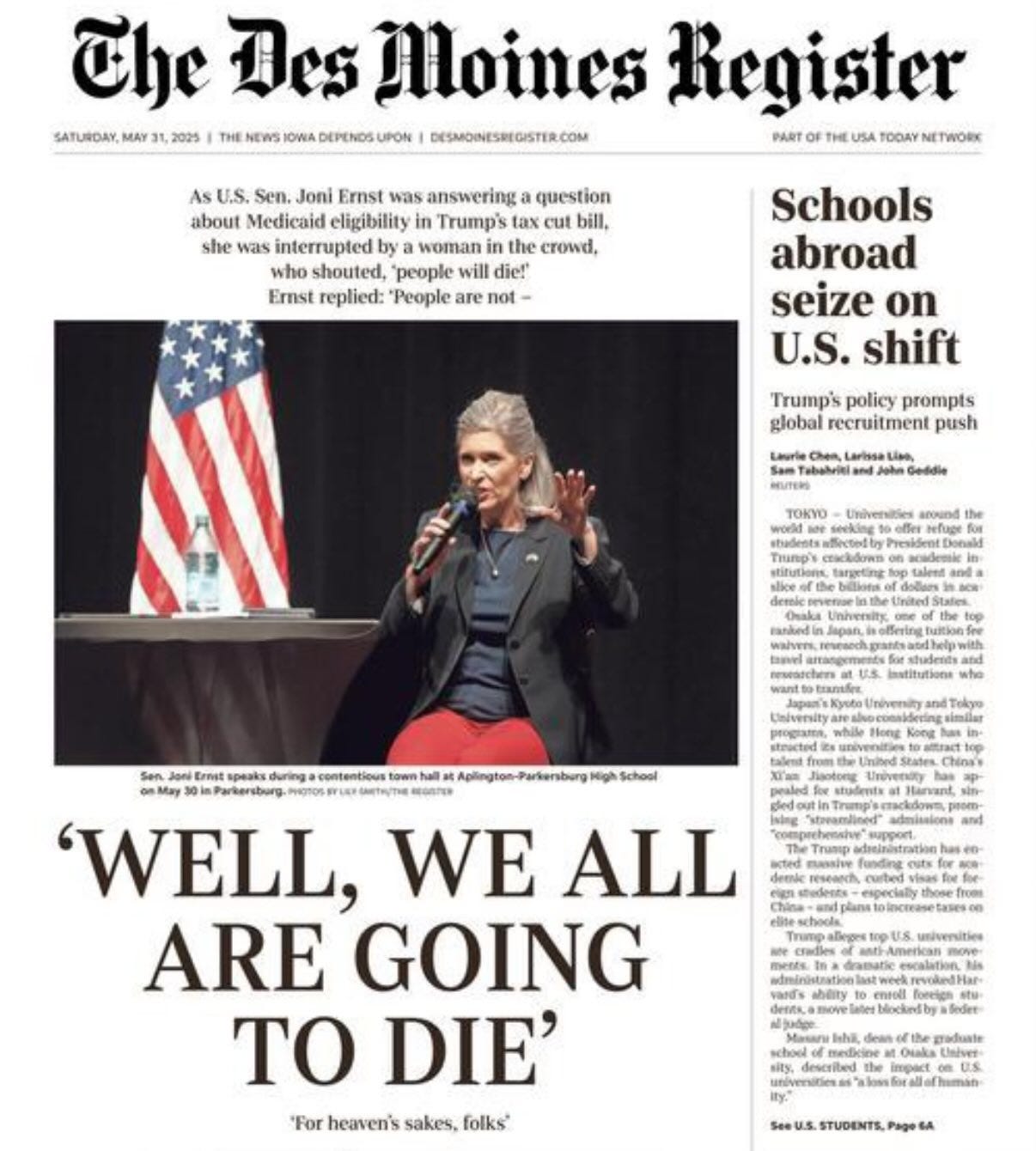
When a U.S. Senator from Iowa stands at the gates of power and shrugs her shoulders at the suffering of the elderly, veterans, children, and disabled folks if Medicare is cut, saying, “well, we are all going to die,” we know are living at the gates of Nain.

The good news is that when Jesus sees the funeral procession, he sees all of it. He sees the normalization of cruelty. He sees the pain of the widow. He sees her poverty. He sees her isolation. He sees the way she is seen or not seen by the political and religious culture. And Luke says, “He had compassion on her.”

As I have pointed out before, that word “compassion” in the Greek is visceral. Jesus felt it in his gut. The word literally means that he was filled with so much compassion, his stomach was in knots. And notice what happens next.

Jesus crashes the funeral. Jesus steps in and stops the procession. He reaches out and touches the bier.

By touching the bier, he touches what others refuse to touch. He breaks cultural, ritual, and religious protocol interrupting death with divine compassion. And then, with the authority of heaven, he speaks directly to the dead: “Young man, I say to you, rise!”

Notice that Jesus doesn’t offer thoughts and prayers. He doesn’t say “Rest in peace” or “God needed another angel in heaven” or, “bless his heart, he’s in a better place.” And he sure in heaven doesn’t say, “Well, we are all going to die.”

Jesus speaks in the face of injustice and death saying: “Rise!”

“Rise!”— That’s the gospel we are called to preach and to live.

“Rise!” is a gospel of protest; not passivity.

It’s a gospel of resurrection; not resignation.
It’s not a gospel that comforts the powerful, but a gospel that confronts the powerful and disrupts the unjust systems of death.

The question that this story begs of us today is: what kind of people will we be?

Will we be the indifferent crowd accepting injustice by following death to the grave, or will we be the disciples who walk with Jesus and interrupt it?

Will we shrug our shoulders accepting that “everybody dies,” or will we embrace a gospel that never shrugs, a gospel that always dares to stop the march of injustice?

These questions are most important today as many Christians have chosen death over life.

Oh, of course they would never confess that. They claim to follow the way of Jesus by being pro-life, but they act in ways that are the exact opposite.

They want to force children to be born into the world while they cut Head Start, undermine vaccines, refuse to fund public schools, stand against raising the minimum wage, deny healthcare, and cut food assistance. They hold press conferences about embryos but pass budgets that kill the most vulnerable among us. They preach “sanctity of life” but value their right to own an assault weapon more than they value the safety of school children. They cry “life is sacred,” but when asked about Medicare, they shrug and say: “Well, we are all going to die.”

That’s not pro-life. That’s pro-power, pro-patriarchy, and pro-political points. It’s s a theology of control, not compassion, and it has nothing to do with Jesus of Nazareth. I believe the church needs to be pro-life the way Jesus was pro-life.

That means pro-human dignity, pro-healthcare, pro-feeding the hungry, pro-housing, pro-living wages, pro-education, pro-immigrant, pro-refugee, pro-disabled persons, pro-LGBTQIA persons, pro-justice, pro-mercy, pro-nonviolence, and pro-peace.

Otherwise, it’s not life. It’s hypocrisy. Otherwise, what is the church good for?

I will never forget sharing with one of my former churches during a board meeting that unless some changes were made, unless we left the comfort and safety of the sanctuary to take the gospel from the pulpit into the public square, I believed the church was going to die.

Do you want to know what their response was?

“Well, we’re ok with that. The truth is, pastor, we would rather die than change anything.” I kid you not.

But I do not believe Christian pastors are called by God to be hospice chaplains for dying congregations. We are not called by God to manage the procession of death. And we are not called to be chaplains of empire or funeral directors for failed, unjust systems.

And we weren’t called to gather here in this place just to sing and sip coffee. We are called to go out and crash the funeral! We are called to disrupt the lie that poverty and cruelty is normal. We are called to touch the bier, to raise our voices, to say to a fragmented and unjust world: “This procession ends here! Rise up and live!”

Because Jesus didn’t come to help us die quietly and peacefully.
Jesus came so that we might have life and have it abundantly!

So, when they say, “well, we are all going to die,” we say:
Yes, that is true, but not all don’t need to die this way.
-Not for lack of access to healthcare.

-Not for a lack of opportunity to get an education.

-Not for a lack of food.

-Not for lack of insulin.

-Not for the lack of a living wage.

-Not because gender-affirming care upsets your privileged, ignorant, black and white, binary religious worldview.

– Not because compassion is considered too expensive and mercy too extravagant.

And not while the Church is still breathing and still following the way and voice of Jesus who says: “Open your eyes and see the suffering. See the injustice. And then step in— and touch the bier. Stand where the pain is. Interrupt the systems of death. Speak to the young people laid in caskets before their time and dare to declare: ‘You were meant for so much more than this!’”

Because healthcare is not luxury. It’s a human right. Compassion is not weakness, and empathy is not sin. It’s divine strength. The church is not called to manage the funeral. We’re called to proclaim resurrection.

So let us go from this place not in silence but in power.

Let us walk to the gates of our cities, our states, and this nation,
and speak like Jesus.

Let us say to our trans siblings: “We see you.”

Say to the poor, the and the disabled: “We are on your side.”

Say to the immigrant: “We stand with you.”
Say to the widow: “You are not alone.”
And say to the unjust systems of death: “Your time is up!”
And to all those who have been cast down: “Rise up and live!”

Because the final word is not cruelty. The final word is not indifference.
The final word is not: “well, everybody dies.” The final word is Jesus, and Jesus says: “Rise!”

So, let the Church rise! Let the people of God cry out at the gates of every system that shrugs at suffering:

To say to politicians obsessed with power and profit: We will not fooled by your pro-life bumper stickers.

To say to the politicians who offer thoughts and prayers but pass budgets of brutality: “We will not be silent!”

Because our Lord is the one who stops the funeral.

Our Lord is the one who touches the bier.
Our Lord is the one who weeps with the widow.
Our Lord is the one who speaks life into the grave and says: “Rise!”

And if we are going to follow that Lord, then we too must rise up, speak up, and lift up every child of God who’s been cast down. Because “everybody dies” may be a fact of biology, but rise up and live!” is the truth of theology!
So, let’s rise!

Anointing a Movement

John 12:1-8 NRSV

Palm Sunday is just a week away, and you know what that means. Well, at least according to the Revised Common Lectionary, it’s time to gather around the table with Jesus for an unforgettable dinner party where so much more is happening around, and under the table, than we can imagine.

In fact, there must be more happening around this table, or this whacky supper scene would be like some bizarre, meaningless dream, like the kind we have when we’re sick with a fever.

It’s a scene that begs us to take a deep dive, asking some serious questions.

Because, seated at the head of the table is none other than Lazarus, who just a few weeks ago was dead and buried. And this is no Weekend at Bernie’s situation! Lazarus is alive and kicking, because a few days ago, Jesus stood at his grave, called him by name, and raised him from the dead.

What on earth can this mean? That Jesus is at the table with Lazarus, who was dead and buried but is now asking someone to please pass the gravy!

We are told that Lazarus’ sister Martha is serving. Sounds like Martha. Always busy in the kitchen. His sister Mary’s also there. But she’s in the dining room with Jesus. Something else that makes sense, as we might remember Jesus’ visit with Mary and Martha as told by Luke.

But it’s what Mary does next that completely floors us! As Mary literally gets in the floor! The scene under the table is almost as insane as the living and breathing presence of Lazarus at the table! She’s down there anointing Jesus’ feet with a pound of very expensive perfume. Think about that! A pound of perfume! Of course, the fragrance fills the entire house.

Then, we have another surprise. Judas, the disciple whom John says is about to betray Jesus, is also at the table. Jesus is at the table with both friend and foe, ally and adversary. And just as we start to ponder the meaning such an inclusive, open table, Judas shocks us by asking a question that we can easily imagine Jesus asking, “Why wasn’t this perfume sold and the money given to the poor?”

But just when we think that we have seen and heard everything, we are floored again by Jesus’ response: “The poor you will always have with you. You will not always have me.”

Oh, Jesus. I sure wished you hadn’t said that.

 Because Jesus, although it sounds absurd, because it is absurd, Christians will use that one sentence to justify ignoring over 2,000 verses in the Bible calling for economic justice and a civic responsibility to care for the poor, marginalized, and oppressed. Jesus, I know this sounds ridiculous, because it is ridiculous, Christians will make their faith solely about worshipping at your feet, praising you, instead of following you. In fact, they will worship you while embracing a way of life, that is the exact opposite of following you.

They will stand behind and support the Herods of this world who defund programs that serve the poor. They will bless authoritarians who cut humanitarian aid, leaving food intended to feed the hungry to rot in ports and warehouses. They will support tyrants who suspend refugee resettlement programs, who target and remove from the country certain ethnic groups without any due process or legal counsel. They will support executive orders criminalizing migrants, dismantling public education, that take away healthcare, eliminate food assistance and public health services, remove environmental protections, and deny science. And in the place of fair, progressive taxes, they will bless rulers who institute tariffs, causing the cost of goods and services to skyrocket, hitting the poorest amongst us the hardest—all to enrich the already ultra-rich.

And preachers, who claim Christian, will gather on Sunday morning, stand in pulpits, and not say one word about it. They will shrug their shoulders, and using your name, say something like: “Poverty? Well, there’s really nothing we can do about that. Like Jesus said, we’ll always have the poor among us.

So, Jesus, I really wished you hadn’t said that.

But you are Jesus. So, you must have a had a pretty good reason for saying it.

Hmm. Let’s think about this… You said it the context of this whacky dinner party where there is so much more going than we know.

Lazarus was dead and buried, but he’s now sitting upright and taking nourishment! Mary is under the table anointing your feet with this expensive perfume that she purchased for your burial, to anoint your dead body. Hmmm.

In the home of one who had been brought back to life from the dead, instead of anointing your dead body, she is anointing your living body.”

Jesus, I think we are beginning to see a theme here.

At a table, belonging to Lazarus, who had been called out of death into life, Mary anoints not the death of Jesus, but the life of Jesus. Mary anoints the living Jesus, the living way of Jesus, the living movement of Jesus.

So, maybe in defending the anointing of Mary to Judas, Jesus wasn’t saying that we can’t do anything about poverty. Jesus was saying that doing something about poverty in this world is going to take more than selling some perfume and writing a check. Eradicating poverty is going to take more than charity. It’s going to take a living movement. It’s going to take embracing a way of life, a holy movement, that challenges the corrupt systems of injustice, that resists the Empire, and speaks truth to power.

This whacky dinner party is beginning to make sense to us now, as it seems to me that one of the problems with the church today is that too many Christians prefer the dead feet of Jesus over the living feet of Jesus.. Just ask them: “Who is Jesus to you?” They’ll respond: “The one who died for my sins.”

They prefer the dead feet of Jesus over the living feet of Jesus that takes steps to bring good news to the poor and to the marginalized, the feet that takes a stand to liberate the oppressed, the feet that stands at the bedside of the sick brining life to the dying, and feet that even stands outside a tomb bringing life to the dead.

Jesus didn’t die for anyone’s sin. Jesus died because of sin. Jesus died because the Empire preferred a dead Jesus about personal and private salvation over a living Jesus about political and societal transformation.

In anointing the living feet of Jesus, Mary was anointing a movement—a dynamic, public, political movement of feet standing for justice, a movement of feet marching for peace, a movement of feet making strides for acceptance, belonging, diversity, equity, and inclusion.

Mary was anointing a way of living, a movement that put legs and feet on thoughts and prayers, that walks the extra mile to bless the poor, filling the hungry with good things and sending the rich away empty.

At the dinner table of Lazarus who had been called out of death into life, Jesus is calling us out of death into life: “Do you want to do something that changes the world? Do you really want to do something about poverty? Then don’t embrace my dead body lying in a tomb. Embrace the life I am living, the way I am walking, the movement I am embodying. Walk the walk, take the steps, and make the stands I am making.”

Like he did while standing in front of the tomb of Lazarus, I believe Jesus is calling us out of death today. He is calling us by name, begging us to come out to become his living feet in this world.

I love the way the Apostle Paul states this truth in the fifth chapter of his letter to the Ephesians:

Wake up from your sleep!  Climb out of your coffins! Christ will show you the light!

So, watch your step. (C’mon Paul! He’s saying, “Watch how you march, where you stand.”)

Use your head. Make the most of every chance you get. (And listen to this next sentence) These are desperate times!

So, don’t live carelessly, unthinkingly  (I hear: “Please don’t willfully misinterpret Jesus to avoid your responsibility to the poor. ‘Cause more than two thousand verses of scripture can’t be wrong.”)

Then, Paul says: “Make sure you understand what the Master wants” (Ephesians 5:14-17 MSG).

And what does the Master want?

The Master wants a movement. The Master needs us to do more than support a charity. The Master wants a movement. The Master wants fearless feet that march against all the forces of death in the world— the forces of greed, selfishness, disease, and violence—marching in a movement to raise the entire creation back to life!

The Master wants compassionate feet that take a stand for mercy, empathetic feet that walk in the shoes of another.

The Master wants gracious feet that run to welcome a stranger

The Master wants quick feet that jump to defend someone being oppressed, strong, determined feet that never retreat, give in, or give out.

The Master wants tireless feet that can stand for over 25 hours on a senate floor to proclaim words of love and truth, liberty and justice, fairness and equality, kindness, and decency to a nation in crisis.

The Master wants courageous feet that can stand in the street for two hours in the bright springtime sun on a Saturday afternoon in front of city hall to call out greed, bigotry, and corruption.

The Master wants caring feet that can stand for an hour in a silent vigil to be a public, prophetic witness for justice, or for just three minutes to speak truth to power at a meeting of the city council.

Six days after this dinner at Lazarus’ house, Jesus is, once again, at a table with his disciples. It would be his final dinner before nails are driven into his feet, as well as his hands. After the dinner, Jesus gets up from the table, takes off his robe, and ties a towel around himself. He then pours water into a basin and begins washing the feet of the disciples, wiping them with the towel around him.

Now, many will say that he was just teaching his disciples how to be a servant. But those of us who just have read the previous chapter… we have this idea that he is teaching us something more. Jesus was anointing a movement. Because Jesus knows that eradicating poverty and the problems of this world is going to take more than volunteering to serve in a soup kitchen. It’s going to take a movement—an anointed, living, dynamic, breathing, alive and kicking, nonviolent, courageous, public, street-taking, truth-telling, peace-making, mercy-seeking, justice-doing, forward-marching, love-infused, prophet-inspired, Spirit-empowered, Jesus-led movement.

Are we ready to be the feet in such a movement? The times are indeed desperate, so I pray we are.  Amen.

Time to Be Prodigally Prophetic


Luke 15:1-3, 11b-32 NRSV

One day, Jesus is confronted by some grumbling Scribes and Pharisees: “Jesus, why do we keep hearing these stories about you hanging out in some sketchy parts of town? We hear these rumors about you eating and drinking with those people, the kind of people everyone knows are sinners!”

 “And you claim to be a man of God!”

“Rabbi, if you are a Rabbi, let me tell you something. Our God is an awesome God who will punish not only the sinner, but the sinner’s children and grandchildren. God will strike you down with a lighten bolt, and if not that, send a cancer, a heart attack or maybe a stroke. And, Jesus, you better watch out, because if you get too many sinners in one place, too many sinners at one bar or pub, or in one city or in one nation, God might send a tornado or an earthquake, and take out everyone!”

When Jesus is confronted by these religious people with a bad and violent theology, he responds as he usually does—by telling a story. Here, he tells three stories—one about a lost sheep, another about a lost coin and another about a lost boy. The parable of the lost boy has been commonly referred to as the “Parable of the Prodigal Son” for some pretty good reasons.

Growing up in church, my home pastor would often use the dictionary when he came to a point like this in his sermon. I think he defined a word for us every Sunday!  He would say, “Now, Webster defines ‘prodigal’ as…”  In that spirit, but with a 21st century twist, allow me to do the same: Now, Google defines “prodigal” as…

  1. wastefully or recklessly extravagant
  2. giving or yielding profusely; lavish
  3. lavishly abundant; profuse
  4. a person who spends, or has spent, his or her money or substance with wasteful extravagance.

The youngest son had the gall to demand his inheritance so he could leave home.  Demanding his inheritance meant that he had come to this point in his life where he did not mind regarding his father as being dead and buried. Isn’t that nice?

Then the surprising part. The father just hands it over. Then, we are told that the boy ventures out into a wild and “distant country,” I guess like West Virginia, where he wasted every red cent whooping it up—thus, the designation “prodigal”— reckless, lavish, wasteful, extravagant.

When the boy ran out of money, there was a great famine in the land. That was when the prodigal son found a job feeding pigs, and things got so bad, the boy thought about eating and drinking with the pigs!

“Oh, of course there is a famine,” say the religious leaders with their bad and violent theology! “That is what we are trying to tell you!  A famine! That is brilliant!  Oooh. God is soooooo good. I bet that boy starves to death! Or at least gets a bad case of salmonella from eating with the pigs. And serves him right! A just punishment for a prodigal—one who had everything only to recklessly waste everything. Death from lack! Death from scarcity! What wonderful irony. How cool is God?”

 Jesus continues… “the boy decides to go back to the father and beg forgiveness…”

“Yeah, good luck with that!” the religious leaders howl, laughing at such a ridiculous scenario!

However, we know the rest of the story…

“And when he was “a long way off,” the father saw him and ran and embraced him. Think about this. How do you suppose this father saw him “a long way off?” Because the father had been waiting, looking down the road every day for the boy to return.

Some of my fondest childhood memories are sitting on the front porch with my brother and my sister, waiting and watching for Daddy to come home from work. We would position ourselves on the porch at just the right angle so if we squinted and strained hard enough, we could see through our dogwood trees and our neighbors’ crepe myrtles to get a glimpse of Daddy’s Green Ford LTD from a half a mile away. Then we would be ready to run out into the yard to pounce on Daddy as soon as he opened the car door to welcome him home.  As soon as he got out of the car I would jump on his back, while my sister and brother would grab both his legs. On a good day, if we could muster just enough leverage, Daddy would fall into the grass where we would lavish him with hugs and kisses like three little puppy dogs while he nearly tickled us to death. Mama, used to get on us. She’d remind us how tired Daddy was from working all day, and how one day when he drove up and saw us running and screaming towards the driveway, he was going to just keep going down the road!

I think mama was just jealous.

Every day, this father sat on his front porch, gazing down the road, watching and waiting, hoping and praying, grieving for his boy to return home. And while the boy was still a long way off, when through the fig and the olive trees the father could just make out his silhouette coming doing the road, the father got up and started running to meet his child, and throwing his arms around him, he began kissing him profusely.

I wonder how long the father waited for his son’s homecoming.  I wonder why the father waited. Can’t you just hear his concerned friends and neighbors, or maybe even his pastor telling him: “Old man, it’s time for you to move on. You’ve gotta get past this.  You’ve gotta face the facts. He’s not coming back. It’ time to get over it. It’s time to move on. Concentrate on your older boy who’s still here with you.”  But every day, the father still waited and watched and hoped and prayed and grieved.

 And he really didn’t have any evidence that his son was still alive. A young kid with a pocket full of cash, first time away from home, traveling alone—he was an easy target to any would-be thieves and murderers. Remember the story of the Good Samaritan? Still, the father patiently, and you might say…recklessly… waited. Every day, he kept looking down the road in front of his house. Straining to see, hoping and praying to see, his son coming home.

Then the great reunion and the biggest, most extravagant homecoming party anyone has ever heard of! The sandals, the ring, the robe, the best one! The calf, the fattest one! Nothing held back for this son who everyone thought was dead but now is alive, was lost and now is found.

And the religious leaders are seething, but now, with the older son. Listen how the older son talks about his brother: “How can you do this for ‘this son of yours?’ “How can you do this, not for ‘my brother,’ but for this one who’s, as far as I am concerned, a stranger, a foreigner, from some distant country?”

Then, it occurs to us.

We thought this was a story of a prodigal son, but it’s really a story of a prodigal father. It is a story of a parent’s love that is “reckless,” “profuse.” “extravagant,” and “excessive.”

When the boy wanted to leave home, the father recklessly gave him his inheritance. While the boy was gone out into the far country, his friends and neighbors would say that the father recklessly waited. And when the boy at last returned, the father recklessly threw an extravagant party. The father loved his son prodigally when he left home, he loved him prodigally while he was away from home, and he loved him prodigally when he returned home.

The good news is that is how our God loves each one of us.  It’s the exact opposite of violence. Our God is a God who, when it comes to love, holds nothing back. God’s love for us is extravagant, excessive, relentless, even reckless. The point of the story is that God’s love for us is profusely prodigal.

This is why we should never apologize for loving others in a way that the conservative religious culture would characterize as “liberal” or “radical.”

God is profusely prodigal in God’s desire to draw all of us unto God’s self. God is relentlessly radical to have us in God’s arms so God can shower us with divine kisses. And as the ranting of the religious leaders and the anger of the older brother reveal, such prodigal love, such extravagant grace and profuse mercy, such over-the-top compassion and empathy, will always be rejected by the conservative religious culture, and even frowned upon by some of our family members.

In fact, if we are praised by the predominant religious culture and by most in our families, then that is a tell-tell sign, that when it comes to love, when it comes to being a disciple of Jesus, we are doing something terribly wrong.

So, like a parent waiting on the porch for their wayward child to return home, may our love for others and for this planet, may our love for justice and equality, our love for diversity, equity, and inclusion, may our love for peace and freedom, always be profusely prodigal.

Then, it will be prophetically prodigal. Because love—when it is extravagant, when it is lavishly abundant and reckless, when it is completely nonviolent and unconditional, when it is radically counter-cultural and seemingly foolish—that’s the type of love that has the power to change the world! In fact, it is the only power that can change this world!

Ya gotta love that we are having our first nonviolent peace vigil this week on April Fool’s Day, as I am sure that we will have some passersby look at the signs we will be holding and say: “Look at dem crazy fools!” Because when we dare to be prophetically and publicly prodigal in a conservative, religious town, we are going to look foolish. And perhaps we are. How foolish are we?

  • We’re prodigally prophetic and foolish enough to believe that the only life worth living is a life that is given away.
  • We’re foolish enough to believe the Kingdom of God belongs to the poor.
  • We’re foolish enough to believe those who hunger and thirst for justice will be filled.
  • We’re foolish enough to believe the last shall be first.
  • Thus, we’re prodigally prophetic and foolish enough to use our power and privilege, not to enrich ourselves, but stand up for the marginalized, defend the most vulnerable, and free the oppressed.
  • We’re prophetically prodigal and foolish enough see every human being, every race, color, gender, and every sexual orientation, is the image of God, that every person is a beloved child of God.
  • We’re foolish enough to forgive seventy times seven.
  • We’re foolish enough to turn the other cheek, go the extra mile, give the very shirt off our back.
  • We’re prodigally foolish enough to feed the hungry, love an enemy, welcome a stranger, and visit a prison.
  • We’re foolish enough to believe that this world, this earth can be a better place, that all of creation can live in peace.
  • We’re prodigally foolish enough to get back up when life knocks us down.
  • We’re prodigally foolish enough to never give up, never give in, and never give out.
  • We’re foolish enough to believe that nothing can separate anyone from the love of God.
  • We’re recklessly, profusely, prodigally, prophetically foolish enough to believe that nothing can stop us, not even death, because nothing can stop love. Nothing can cause it to fade or to fail. Love always wins, and love never ends.

Light It Up: Changing the way we see the world to change the world


Inspired by Practicing Peace, Living Nonviolence: A Weekend with Rev. John Dear, March 22-25, 2025, Lynchburg, VA

Today’s lectionary gospel lesson is from Luke 13 where we read beginning with verse one:

At that very time there were some present who told him about the Galileans whose blood Pilate had mingled with their sacrifices.

He asked them, ‘Do you think that because these Galileans suffered in this way they were worse sinners than all other Galileans? No, I tell you; but unless you repent, you will all perish as they did.

Or those eighteen who were killed when the tower of Siloam fell on them—do you think that they were worse offenders than all the others living in Jerusalem?

No, I tell you; but unless you repent, you will all perish just as they did.’

Here, Jesus is challenging some very bad theology. It’s a bad theology that supposes that people who suffer from the violent actions or inactions of authoritarians like Pontius Pilate somehow deserve what they get. The lives lost, harmed, displaced, or deported, are never the fault of the builders of towers or of the ones who make the executive orders.

It’s a bad theology that was created to always blame the victim, and it’s been called “one of the most sinister features of the fascist character.”[i]

The poor suffer, why? Because they are too lazy to pull themselves up by their own bootstraps, of course. They didn’t study hard enough in school. They’re not grinding hard enough at work. They’re not applying for enough jobs.

It’s a bad theology that views poverty as punishment for people who just don’t try hard enough, while exonerating the lawmakers, policy makers, and the oligarchs who’ve purchased those politicians to enrich themselves. It’s a bad theology that views people living in poverty as “parasites,” cursed by God for some good reason, and views the rich and the powerful, the builders of towers and the wielders of weapons, as people who are blessed by God.

Jesus emphatically speaks against this greedy and violent way of seeing the world: “No, I tell you!” And then, with a sense of urgency, Jesus challenges us to do something about it, before this dark and violent worldview is the death of us.

“No, I tell you, but unless you repent you will all perish as they did!”

But there’s a problem when some of us hear this word “repent”, as the word itself has been the victim of bad theology—perhaps with the intention to prevent us from ever fulfilling Jesus’ urgent plea to do something about the culture of greed and violence.

Maybe some of you, like me, were taught like that the word “repent” means to turn away personal sins. Raised as a Baptist, that meant to stop drinking, dancing, smoking, cussing, and having sexy thoughts.

However, when Jesus used the word “repent” to speak of our urgent need to change, he was talking about changing the way we see the world, so we can act to change the world. I believe the apostle Paul understood this when he wrote that in Christ, there is a new creation (2 Cor 5:17). When we follow Jesus, the way we see the entire creation changes. Sadly, that verse is also the victim of bad theology as it is often translated “In Christ, there is a new creature” to keep the focus on personal, individual sin and away from societal, cultural, social, and political sin.

Jesus talked more about our failure to see than he ever talked about private sins. Listen to John recount how Jesus spoke of his purpose in this world: “I came into this world…so that those who do not see may see…” (John 9:39). And throughout the gospels, Jesus continually asks: “Do you have eyes and fail to see?” (Mark 8:18) “Why do you see the speck in your neighbor’s eye?” (Matthew 7:3) “Blessed are the eyes that see what you see!” (Luke 10:23) “Prophets and kings desired to see what you see but did not see it!” (Luke 10:24)

Over and over Jesus talked about importance of seeing a world that many people have difficulty seeing.

This is why I believe Jesus called himself the light of the world. For to truly see anything, what do we need? We need light. Thus, he said: “I am the light of the world. Whoever follows me will never walk in darkness but will have the light of life” (John 8:12).

I believe Jesus called himself the light of the world, because it was his life’s mission to lead us to change the way we see the world so we can change the world, to see the truth of who God has created us to be, of how God has created us to live.

And what is the truth that God wants us to see?

I believe the answer can be found in Jesus’ first recorded sermon which Rev. Dear read a few moments ago.[ii]

“Blessed are the poor in spirit, for theirs is the kingdom of heaven.”

Jesus wants us to see the truth that God blesses the “poor in spirit.” Not the religious, the devout, the pious, or even the spiritual. Not the pastors, the elders, the deacons, not even the church member who serves every week in a soup kitchen. No, God favors the ones who have come to be served in the soup kitchen. They are not the ones with something to give. They are the ones with nothing to give. Jesus says the ones who are blessed, the ones who are favored by God are those who, spiritually speaking, are completely destitute. Their very spirits have been broken. And notice that Jesus uses the present tense. Not will be blessed. Not might be favored. They are, right now, right here, blessed. And their future is the kingdom of heaven. Can you see it?

“Blessed are those who mourn, for they will be comforted.”

Jesus wants us to see that God favors the mourners. Not only those who may be mourning the death of someone or are grieving over the injustices of the world, but maybe especially those who are mourning over their own lives, those who are wondering if their lives have any value. They remember how their fathers and mothers, their ancestors, were valued by this world. They consider how they are valued by this world. And they look into the eyes of their children and grandchildren, and they grieve. They cry out in the streets for their lives to matter, yet Jesus calls them blessed and promises comfort. Can you see it?

“Blessed are the meek, for they will inherit the earth.”

The meek are favored, says Jesus. Not the powerful and violent. Not the ones with the charisma or the confidence, or the physical ability, or the privilege, or an inheritance of wealth, to do whatever is necessary to overcome all sorts of adversity and make it to the top. Jesus says, blessed are the ones who never seem to get ahead. It is the last, says Jesus, not the first, who survive and inherit the earth. Can you see it?

“Blessed are those who hunger and thirst for righteousness for they will be filled.”

Not the ones who are righteous, but the ones on whose behalf the prophet Amos preached: “Let justice roll down like waters, and righteousness like an ever-flowing stream” (Amos 5:24). These are the ones who are unjustly judged, mistreated, shunned, scapegoated, and bullied by society, even by communities of faith. They suffer grave injustices simply because of who they are.

They have been beaten up so badly by the world that they hunger and they thirst for justice like a wanderer lost in a hot desert thirsts for water. Jesus says that they are blessed, and they are the ones who will not only be satisfied, but will be filled, their cups overflowing. Can you see it?

“Blessed are the merciful, for they will receive mercy.”

Not the perfect and the proud, the boastful and the arrogant. Not the ones who never admit any mistake. But God favors the ones who are fully aware of their imperfections, the ones who have made mistakes, terrible mistakes, and they know it. Thus, when they encounter others who are also suffering from unthinkable errors in judgment, they have mercy, compassion, empathy, and in their hearts, there is always room for forgiveness. They give mercy, because they need mercy for themselves. And because they are favored by God, they will receive it. Can you see it?

Blessed are the pure in heart, for they will see God.

Not the pure, but the “pure in heart.” Not the ones whose outer appearance and abilities suggest to some that they have the best genes. No, God favors the ones who are viewed by some as flawed. We are reminded of the words of 1 Samuel “for the Lord does not see as mortals see; they look on the outward appearance, but the Lord looks on the heart” (1 Samuel 16:7). God will see the pure beauty of who they truly are, and they will see God. Can you see it?

Blessed are the peacemakers, for they will be called children of God.

Not the ones who have necessarily found peace for themselves. But  blessed are the tormented, the disturbed and the restless, who, because they are so continuously in chaos, seek to make peace whenever and wherever they can. Blessed are those who are without stability, the immigrant and  refugee without a home, but seek it, because they will find a home, a place of security, rest and a peace that is beyond all understanding, within the family of God.[i] Can you see it?

One way to sum up Jesus’ Beatitudes may be: “Blessed are the victims of bad theology.” God is on the side of the  ones violent authoritarians like Pilate victimize and God wants us to see that and then turn the entire culture of greed and violence upside down!

And this, Jesus pronounces, is not a prescription of how things should be or how things could be. Jesus asserts that this is how things are! Can you see it?

If not, then maybe we need some more light! Because if we can’t soon see it, says Jesus, we are all doomed to perish!

I believe this is why Jesus announces: “I have come as light, as the Light of the World, to help you see it, to give all who are blind to it, the sight to see this world as God sees it.” The way of God’s universal, inclusive unconditional love for the entire creation is the only way to never walk in darkness, to never perish, but have the light of life!

And after preaching what we call the Beatitudes, revealing who is truly blessed and favored in by God in this world, Jesus announces to those who want to follow him: You are the lights of the world!  And you must not ever hide your light, shine it privately in a sanctuary or personally at home, but shine your light courageously and publicly on the way things are, so all may begin to see the world the way God sees it.

We are to shine our lights by loving all people, but especially those who are the the victims of bad theology. We are to light it up by loving and doing justice and working to create a world that blesses the least among us: the poor, those who are crying out for their lives to matter, the weak and the underprivileged, those who need mercy, the marginalized who hunger and thirst for justice, the physically maligned but pure in heart, and the spiritually or mentally troubled who yearn for peace.

Will we be despised for it? You bet. Will people say that the way we accept and love and affirm others, the way we speak truth to power, is socially and even theologically unacceptable? Of course. Will we be demeaned and even persecuted by others, even by those in organized religion? Most certainly. Might we get arrested? If we are truly following the way of Jesus, that’s always a possibility!

But here’s the good news:

Jesus also said, “Blessed are those who are persecuted for righteousness’ sake, for theirs is the kingdom of heaven. Blessed are you [notice the change in person] when people revile you and persecute you and utter all kinds of evil against you falsely on my account. Rejoice and be glad, for your reward is great in heaven, for in the same way they persecuted the prophets who were before you.”

So, while many people, even those who claim to be Christian today, have chosen to live in a dark, violent world, a world where they blindly believe that it is the rich, the prosperous, the privileged and the powerful that are blessed and favored by God, a world that will inevitably bring suffering to all of us, including them, let us commit ourselves to living in the world created by our gracious, loving God, in the world that Jesus, the Light of the World, came to help us see.

And let us, as lights of this world, for the sake of this world, keep lighting this world up, courageously, and publicly until the day comes when the eyes of all are finally fully opened, and there is finally peace on earth.

[i]https://en.wikipedia.org/wiki/Victim_blaming#:~:text=Adorno%20defined%20what%20would%20be,features%20of%20the%20Fascist%20character%22.

[ii] Interpretation of the Beatitudes inspired by Frederick Buechner. Whistling in the Dark: An ABC Theologized (New York: Harper Collins, 1988), 18.

Home by Another Way


Participating in a nonviolent Moral Monday March in Raleigh NC in 2015

Matthew 2:1-12 NRSV

As many of you know, my wife Lori works downtown at the Free Clinic of Central Virginia which has recently suffered major damage from a fire which was started outside in the parking lot. The building has been condemned and it will take weeks, maybe eve months, before it can be used again. It is a tragic situation as many with low income depend on the clinic not only for healthcare, but for emergency dental services. So, as a church in Lynchburg, it is important that we pray for the staff, and for the Free non-profit’s board of directors, that they will be able to wisely respond to this disaster so they can continue serving this community.

Our church’s support of the Free Clinic seems to be more important when we consider that it was one of our very own, Anne Bishop, who worked with another one of our church members, Jack Scudder, to found the free clinic thirty years ago.

Lori and I had the opportunity to visit with Anne on the Sunday after leading my first worship service here, and I had the honor of officiating Anne’s memorial service just a couple of weeks later. To describe Anne’s trail-blazing, pioneering spirit which led her to start the Free Clinic, during her service, I talked about the unique way that Anne drove a car.

Whenever Anne traveled, she always made sure she returned home by another way. To make the trip more interesting, and to learn more about her surroundings, she was always fond of taking a different route home, even, when she traveled in other country. When she traveled overseas, she would order maps and highlight the roads to make sure she always arrived back to her starting point by another way. Her daughter Kathy said: “After returning a rental car in England, the clerk, who evidently had some type of GPS history on the car, asked: ‘Ma’am, did you drive down every road in Great Britain?’”

It was then that I pointed out that “Home by Another Way” are the exact words that Matthew uses to describe the journey of the wise men after they worshipped Jesus, laying down their gifts of gold, frankincense, and myrrh. Having been warned in a dream not to return to King Herod as the king had requested, Matthew says they went “home by another way.”

I then pointed out that death is often described as a homecoming or a homegoing, and as people of faith, we believe this journey home called life matters. How we go home makes a difference. Do we go home following the instructions of King Herod? Do we collaborate with the empire, bow down to those in power, accept the status quo, go with the culture? Or do we choose to go home by another way?

Do we go home following the way of power and greed, of fear and violence? Or do we go home following the way of love and generosity, of compassion and of peace?

After King Herod’s encounter with the Wise Ones looking for the child who was said to be “king of the Jews,” Matthew says that King Herod was “afraid.” And then adds: “And all of Jerusalem with him.”

For the nation instinctively knew that if its self-absorbed, narcissistic, authoritarian leader was afraid, everyone should be afraid. Because, as almost always the case with the King Herod’s of the world, fear leads to violence.

Obviously, the Wise Ones sensed Herod’s fear, and knowing his violent reputation and his propensity to stoke and orchestrate violence against the innocents, when they went to bed that night, one, or maybe all of them, had a dream which warned them to go home by another way.

For when it comes to fear and to violence, when it comes to bowing down to authoritarians who stoke fear and promote violence, wise people of faith are always led to go home by another way.

 It was surreal to awakened on the first day of the year to the news of violence in New Orleans. And it certainly didn’t take long for the King Herods of the world to use that violence to stoke even more fear in the nation, scapegoating immigrants, which will certainly lead to more violence.

The good news is, as you may have read in the newsletter this week, our church’s outreach team has proposed that our church use 2025 to go home by another way, by committing ourselves to a movement of nonviolence.

During this first quarter, our church is honored to have the opportunity host Father John Dear, a world-renowned author and advocate for nonviolence who was nominated by Desmond Tutu for the Nobel Peace Prize. As this year’s Turner-Warren/Shumate Lecturer, Father Dear will host a workshop on non-violence on March 22, speak here in this sanctuary the 23rd and at the University of Lynchburg on the 25th.

We may have awakened this year to the news of violence and fear, but we are going to go through this new year by another way, a way of love and grace, a way of truth and compassion, a way of doing justice and making peace. We are going to go through 2025 by a way of nonviolence, a way of living that is encouraged by all the great world religions, as it is rooted in the belief that the creative force of the universe is love; God, God’s self, is love.

Thus, peacemakers like Mahatma Gandhi and Martin Luther King Jr. gave their lives teaching that the most important thing that human beings can do is to exercise this creative force by learning to love the way we were created to love. For Gandhi and King, following a way of nonviolence was understood as the science of how we create life in the image of God, how we create a world that practices justice, truth, and compassion.

Dr. King noted that Gandhi was probably the first person in history to lift the love ethic of Jesus above mere interaction between individuals to a powerful and effective “social force on a large scale.” “Love, for Gandhi,” said King, “was a potent instrument for social and collective transformation,” and [the nonviolent resistance philosophy of Gandhi] was the only morally and practically sound method open to oppressed people in their struggle for freedom.”

Dr. King understood that although the way of nonviolence sounds passive and ineffective, it is the most active and effective resistance of evil in the world.

 Through the way nonviolence, courage displaces fear. Love transforms hate. Acceptance dissipates prejudice. Hope ends despair. Peace dominates war. Faith reconciles doubt. Mutual regard cancels enmity. Justice for all overthrows all injustice. And the redemptive community supersedes the systems of gross social immorality.

Nonviolence is not for cowards and passive people but requires much bravery and courage.

Nonviolence is not just a temporary attitude. It’s a full-time way of life. Nonviolence is assertive spiritually, mentally, and emotionally. Nonviolence is always informing and persuading the opponents of justice.

Dorothy Day wrote in 1967 that she regretted that she had not done more to promote nonviolence “as a way of life.” Father John Dear comments: “I think we can all do more to nourish, study, cultivate and promote nonviolence as a way of life, as a spiritual path, as the basis for people in power, as a political methodology for change, and as a hermeneutic for Christian discipleship. Active nonviolence is the best hope for humanity.”

In response to the fear that King Herod possessed and stoked among the people, and to the violence that would surely follow, after paying homage to the baby Jesus, the Wise Men decided to go home by another way, the way of nonviolence. But they were not retreating. They were not running away. And they were not being passive in any way.

Choosing to go home another way was very active resistance. It was a way of telling the world that they would not bow down to King Herod. They would not be attracted to his power, seduced by his fame, duped by his wealth, or conned by his charisma.

And neither are we.

By choosing to go home by another way, the way of nonviolence, we are joining a movement of most active resistance—

One which actively wages peace, not war; passionately fights poverty, not people who are poor; ferociously attacks homelessness, not the homeless; aggressively opposes bigotry, not people who are queer.

We are choosing to go home by a way that dynamically endangers easy gun access, not school children; assiduously admonishes men who attempt to control the bodies of women, not the women who are those bodies.

This way wholeheartedly works to banish unkind immigration policies, not immigrants. It vehemently demands fair living wages, adequate housing, and free access to education and healthcare, not the exact opposite.

We are choosing a way that fervently heals spiritual trauma and never causes it; vigorously protects the environment and doesn’t threaten it; and tirelessly works for justice that is restorative, not punitive.

We are choosing a way that defeats evil, not the evil doers. It destroys fascism, not the fascist. It kills Christian Nationalism and religious extremism, not religious people. It vanquishes the fool heartedness of our neighbors, not our neighbors.

So, you see, this way is not for the coward nor the passive. It is for the courageous and the brave.

And it is also for the wise.

Because choosing the peace-making, compassion-loving, justice-doing way of nonviolence is always our best response to the fear-mongering King Herods of this world, especially when those kings can cause an entire nation to be afraid with them.

The question our gospel lesson asks us today is simply: Will we be wise ones too and choose this way? Will we be brave and courageous and choose to actively resist the King Herods of the world?

I pray we will. Amen.