Palm Sunday Prayer

God of Love and Justice,

As we begin this Holy Week, some of us can remember a more innocent time when we possessed a more naïve understanding of the world.

Our thoughts were as innocent as the children who waved palm branches on this day.

We once listened to scripture retell the events of this week and wondered how on earth can the actions and attitudes of people change so dramatically in a just few days.

How can people enthusiastically choose to follow a nonviolent savior riding a donkey on Sunday, and in the same week, choose a violent insurrectionist to be their savior instead. How can people shout “Hosanna! Blessed is he who comes in the name of the Lord!” on Sunday, and days later, shout “Crucify him.”

But living in this current culture, we no longer wonder.

For we live in a nation where people claim to follow the way of Jesus on Sunday, but during the week, willfully choose to live a way that is the exact opposite.

Instead of blessing the poor, they curse the poor.

Instead of providing comfort to those who are mourning for their lives to matter, they tell them that their lives matter too.

The meek are oppressed; not blessed.

Those who hunger and thirst for justice are scapegoated; not filled.

The merciful are ridiculed.

The pure in heart are bullied.

The peacemakers are labeled “weak” and “stupid.”

And those who seek to follow the inclusive, unconditional, universal way of love that Jesus taught are persecuted for doing so by those who claim Jesus to be their Savior.

The singers of “Hosanna” deny food to the hungry. The wavers of palm branches deny healthcare to the sick. The triumphant deny children an equitable education. Workers are denied a living wage. The imprisoned are denied due process. Immigrants are tormented. Women are subjugated. Strangers are feared and sent away.

Truth and honesty are rejected in favor of misinformation and lies.

Nationalism is preferred over discipleship.

Greed is favored over generosity.

Retribution is supported over forgiveness.

Profit is chosen over the planet.

Guns are valued over children.

Kindness is mocked.

Equality is despised.

Diversity, equity, and inclusion are banned.

Empathy is called a sin.

So, Lord, on this Palm Sunday we pray for the strength to resist, for the courage to dissent, and for the resilience to defy the anti-Christ spirit that seems to have a hold on our world.

Be with us, O God, through the betrayal, the trial, the denials, the mockery, the flogging, the suffering, and the execution; that we like the women disciples, will remain faithful, purposeful, and peaceful all the way to the tomb.

In the shadow of death and grief, renew our spirits to courageously stand against the evil rulers, the authorities, and the powers of this dark world.

May we be resilient until the stone is rolled away, the bonds of death are broken, and the power of evil is defeated. May we remain faithful until love is finally won, peace is fully realized, and liberty and justice are enjoyed by all.

Worst Parade Ever

 John 12:12-15 NRSV

It has been said that “Everybody loves a parade!” I have often thought that this is the reason, in their desire to fill the pews on Sunday morning, churches are tempted act like some type of parade.

You know, like the parades they have down in New Orleans where they throw candy, toys, beads, and all sorts of fun things from the floats that pass by. I have often thought that people go to parades like some people go to church: to get something, to catch something that is thrown their way, something sweet, pleasant, something that is going to make their lives better, make their families stronger, happier.

Then there are other parades. Although no candy is thrown, these parades just have a way of making us feel good. They put us in a good mood. Nothing gets some of us in the Holiday Spirit like the Macy’s Thanksgiving Parade.

There are people who go to church to get in a particular mood. They go to hear something that moves them, stirs them. They go to see something that wows them. They go to ooh and ahh. They go to get a good feeling that will hopefully last them the rest of the week.

Then there are military parades. President Trump once said that is what our country needs. They show off a well-trained, well-conditioned army marching in step with tanks and missiles with nuclear warheads to show the world who’s the strongest and the greatest, whose citizens are the safest, most protected, most secure.

Just like some people go to church to get something that makes them feel a little more superior than others, reaffirms their power and privilege. They also go to be protected from all sorts of evil. And they go for some eternal security.

If we pay attention, we discover that each of these parades has the same drumbeat. It is a beat that is easy for us to march to. It is a beat of pleasure, a beat of comfort, a beat of self-preservation, but also self-indulgence and self-aggrandizement. It is a beat of pride, a beat of greed, a beat that entices us.

And, although we know this beat has an innate tendency to be depraved, although we know this beat often stirs the darker, most selfish places within us, we love this beat. Many live by this beat, work by this beat, relate to others by this beat, vote by this beat. We even worship by this beat.

But on this Palm Sunday, we are reminded that there is yet another kind of parade. And it’s a parade that marches to the beat of very different drum.

Nearing the end of his life, Jesus, the savior of the world, paraded into Jerusalem to liberate God’s people, not on some white war stallion, but on a borrowed donkey; not with a well-trained, well-conditioned army, but with a gang of rag-tag students who had no idea what they were doing or where they were going.

The late Henri Nouwen, one of my favorite authors and pastors once said, that to much of the world, this parade looked “downright stupid.”

For Jesus marched to a difficult beat that pushes against the status quo, that pulls us out of our comfort zones, that challenges our instincts.

While others marched to the beat of a self-serving, self-seeking, self-preserving drum, Jesus rode a donkey and marched to the beat of a self-giving, self-denying drum.

As the crowds waved palm branches and shouted “Hosanna! God save us!” Jesus answered their cries by marching to a beat of sacrificial, unconditional love for all people, especially for those considered to be among least. Although he knew he would be killed for it, Jesus kept marching forward with a scandalous, socially acceptable love and an offensive grace.

Yes, bouncing in on the back of a donkey, Jesus marched to the beat of a very different drum.

During Virginia 10-miler in September, I have been told that several of you have made signs to hold up to cheer on the runners who make their way up and down Rivermont and Langhorn. As a runner, I know the type. These signs are often very creative. I have seen signs that say: “You Are Running Better than the Government.” One of my favorite signs that I see people holding in nearly every race reads: “Worst Parade Ever.”

If we are honest, this is our initial reaction to this Palm Sunday parade. The people cry “Hosanna! God save us!” And here comes God, riding in on a donkey!

This is not a parade of pride. It is a parade of humility.

It is not a parade that entertains. It is a parade that suffers.

It is not a parade of pleasure. It is parade of agony.

It is not a parade of self-preservation. It is a parade of self-expenditure.

And although the route of this parade brought Jesus to the capital city, this parade was not good news for the rich and the powerful, the self-important and the self-sufficient.

This parade was good news for the poor, the suffering, the marginal, the prisoners—for all who thirst and hunger justice and compassion.

This march was good news those who had been left out and left behind: For sinners condemned by bad religion; For women, children and minorities silenced by the privileged; For the broken cast aside by society; For all those who are unable to march: the blind, the disabled, the mentally ill, the wounded and the sick. For all who needed salvation.

Maybe the President was partly right. What America needs right now is a good parade.

However, we do not need a parade led by tanks and missiles with nuclear warheads asserting that military might is the answer to our problems.

We need a parade led by one riding a donkey asserting that selfless love is the answer.

We need a parade that emphasizes that what this nation needs is more humility and less arrogance, more respect and less name-calling, more empathy and less callousness, more acts of kindness and less meaness.

We need a parade led by one riding a donkey showcasing not those who sit in the highest seats of power, but school children who just want to be safe, workers who just want a living wage, persons with different abilities who just want to be included, the sick who just want to see a doctor, the poor who just want to eat, the oppressed who just want to be free, refugees who just want to live, immigrants who just want to be seen as human beings rather than animals, and women who just want the government to stay out of their most personal decisions.

We need a parade led by our savior who rides a donkey!

And if we are honest, we would confess that this parade is not always easy for us accept. Notice verse 16: “His disciples did not understand these things…” The truth is: neither can we.

United Methodist Bishop William Willimon writes:

We wanted Jesus to come to town on a warhorse, and Jesus rode in on a donkey. We wanted Jesus to march up to the statehouse and fix the political problem, and Jesus went to the temple to pray. We wanted Jesus to get organized, mobilize his forces, get the revolution going, set things right, and Jesus gathered with his friends in an upper room, broke bread, and drank wine. We wanted Jesus to go head-to-head with the powers-that-be, and Jesus just hung there, on Friday from noon until three, with hardly a word.

Jesus didn’t come fixing all our problems. He didn’t come offering us health and wealth, an easy life or even a better life. He didn’t come showering us with treats to make us feel good. And he didn’t come showing us his power and might. Jesus came riding a donkey.

For God so loved the world that God emptied God’s self. God poured God’s self out and showed us the way to love. God bore our rejection and suffered, even to death on cross. God came to us—not in the way that we wanted—but, the good news is, God came in the way that we need for life—abundant and eternal.

Those great theologians of our time, the Rolling Stones had it right:

You can’t always get what you want, but if you try sometime, you might just find, you get what you need.

We found the worst parade ever became the best parade ever!

I may want these pews to be full every Sunday morning. However, for us to be the church that God is calling us to be, worship service attendance on Sunday morning will never be as important as how we are worshiping God with our selfless service the rest of the week. How we march through these doors on Sunday morning is not nearly as important as how we are marching outside of these doors on Monday.

To determine if we are being the church God is calling us to be, what we need is a new gauge. We need a new benchmark to determine if we are marching to the beat of a different drum, a new indicator to tell if we are marching in the steps of the One who rides a donkey. For it’s not how many of us are coming to church that is important to this One. It’s what we are doing in the world to be the church.

Purchasing summer learning kits for to prepare underprivileged children for kindergarten is a sign that we are marching in the steps of the one who rides a donkey.

Building a community pantry and serving a meal at a local mission to feed people who are food-insecure is evidence that we are marching in the steps of the one who rides a donkey.

Worshipping with a Jewish synagogue to take a stand together against racism and hate demonstrates that we are marching in the steps of the one who rides a donkey.

Selflessly giving our time, our resources, and ourselves marching in a Christmas parade to advocate for inclusion, marching to the capital to cry out against injustice, violence and corruption, to speak up for the care of God’s creation; marching down the road to extend mercy to someone who is broken; marching across a room to perform a small act of kindness to a stranger, marching out in the darkness to be a friend to someone who is afraid, marching everywhere we go to love all of our neighbors as we love ourselves—

These are the markers that we are the church God is calling us to be.

May God give us the grace and the strength to keep marching forward to the beat of a different drum, to keep following in the steps of the One who rides a donkey; to keep marching a march of suffering, but also a march of joy; a march of sacrifice, but also a march of hope; a march to lose our lives, but also a march to save our lives.

Religion Is Making the Pandemic Worse

This pandemic is terrifying, and religion is making it worse.

Science is being denied in the name of religion as pastors, politicians and parishioners are ignorantly insisting that people should still gather for worship putting all of us at risk. But what I believe is even worse than that is the insidious theology that is being expressed by people of faith everywhere.

“God is in control” they post. “God doesn’t make mistakes” they say. “God is trying to teach us something” they sermonize.

Really? God, the creator and source of love, Love Itself, wants the most vulnerable among us to die alone, sick, afraid and unable to breathe?

I believe religion is making this pandemic even more terrifying, because there are too many people in this world who are following the wrong god.

Too many Christians have created their own version of God, their own Lord, their own King, who sits up on some heavenly throne pushing buttons, pulling levers, controlling, dominating, dictating.

A tornado strikes. They say, “God is trying to get our attention.”

Cancer happens. They say, “God has God’s reasons.”

A loved one dies. They say, “God needed another angel.”

A pandemic rages. They say “God must be angry.”

“God is in control. God does not make mistakes. God knows what God is doing.” They think they are making things better by saying these things, but they are only making things worse.

This is why I believe this week that we call “Holy Week” which begins this weekend is so important. The events we remember this week remind us what kind of God, what kind of King, we serve. Holy Week reminds us, contrary to what some of our Christian friends say, God does not rule like the rulers of this world. God does not reign from some heavenly throne in some blissful castle in the sky, but God rules from an old rugged cross, right here on earth, between broken people like you and me.

The rulers of this world rule from places of self-interest and self-preservation. They rule from places of greed and pride.

However, this Holy week teaches us that Christ is a King who rules from a polar-opposite place—a place of self-expending, self-dying, sacrificial, suffering love.

Christ the King does not rule with an iron fist; Christ the King serves with outstretched arms. Christ the King does not cause human suffering from some far away heavenly realm; Christ the King is right here in our realm sharing in our suffering.

Theologian Arthur McGill put it this way:

God’s power is not a power that takes, but is a power that gives.

God’s power is not a power that rules, but is a power that serves.

God’s power is not a power that imposes, but is a power that loves.

God’s power is not a power that dominates, but a power that dies.

This is why it is no accident that Jesus undertakes his mission to the poor and to the weak and not to the rich and the strong; to the dying and not to those full of life. This is why Jesus was so concerned about those marginalized and demonized by organized religion and the power-that-be. McGill continues:

For with these vessels of need God most decisively vindicates the divine power: a power of service whereby the poor are fed, the sinful are forgiven, the weak are strengthened, and the dying are made alive.

God did not cause this pandemic. The day the first person was infected was a day of anguish for God.

God did not create the layoff. The day you were told that your job was ending, God stayed up with you and worried with you all night long.

And God did not take our loved one. When they died, something inside of God died too. For self-givers are never takers.

A more accurate and theologically sound way of describing what happened to our loved ones when they breathed their last breath is that God came, and God, wholly, completely and eternally, gave all of God’ self to them.

So when this pandemic gets us down, we need to remember the great truth of Holy Week—Christ is King. And this King is reigning, suffering, sacrificing and giving all that God has to give from the cross. God’s throne is not made of silver and gold. God’s throne is made of wood and nails. God wears not a crown of jewels, but God wears a crown of thorns.

And when more people begin to understand this, that God did not bleed for only a few hours during one Holy Week, but continues, even today, to bleed for us, to pour God’s self out for us, perhaps religion will cease making this pandemic worse.

It will be what gets us through it. And then, together with our Easter God, we will make something very good come out of it all.

Choose This Day

rile up the gov't

Growing up in church, I was taught that the Christian faith, and life itself, was primarily about a choice.

It is about a choice to accept Jesus as personal Lord and Savior or to reject Jesus. It’s about a choice to spend all of eternity in heaven with God and his angels or to forever burn in hell with the devil and his angels.

In church, I was also taught that I could not afford to wait to make this choice. I needed to make a decision before we finished singing the last hymn, because if I didn’t, the Lord could return or I might get killed in a car accident on the way home, and it would be too late. So, there was a sense of urgency instilled in me to make this choice.

I was also taught that if I didn’t make a choice, I was actually making choice. Not to choose was to choose.

For me, it wasn’t a very difficult choice to make. “Preacher, you are saying that if I choose to accept Jesus as my personal Lord and Savior, I get to live in paradise forever? But if I don’t, I am damned to hell for the same amount of time?” Well, preacher, how fast can you schedule my baptism?!

The problem is that the gospel writers never record Jesus presenting such a choice. Although, I’ve heard countless preachers point to our scripture lesson here in Luke 23, and try to say Jesus is presenting this choice, Jesus never does.

The irony is, that here in Luke 23, the chapter that has the story of the infamous thief on the cross that Jesus says will be with him in paradise, we are presented with a choice. And it is a choice that each person born into this world must make. We must choose our kingdom.

Jesus talked about “kingdom” more than almost anything else. Over 100 times in the Gospels Jesus announces that he is building the “Kingdom of God,” and implies almost every time that he needs people like you and me to help him. He taught us to pray: “Thy kingdom come. Thy will be done on earth as it is in heaven” (Matthew 6:10, KJV).

Jesus’ message compels us to make a choice to live, work, pray and love in ways that bring God’s Kingdom to this world. And, just like I was taught growing up in church, making this choice is an urgent matter. In fact, I believe it perhaps is more urgent today than ever.

And it is in Luke 23 we learn that it was this urgent message that put Jesus on the cross.

The assembly [of the Elders of the people, including the chief priests and the scribes] rose as a body and brought Jesus before Pilate. They began to accuse him, saying, “We found this man perverting our nation, forbidding us to pay taxes to the emperor, and saying that he himself is the Messiah, a king.”

Then Pilate asked him, “Are you the king of the Jews?”

He answered, “You say so.”

Then Pilate said to the chief priests and the crowds, “I find no basis for an accusation against this man.”

But [religious supporters of Caesar] were insistent and said, “He stirs up the people by teaching throughout all Judea, from Galilee where he began even to this place [even here in Jerusalem, here in the capital city!].

And when he learned that he was under Herod’s jurisdiction, he sent him off to Herod, who was himself in Jerusalem at that time. The chief priests and the scribes stood by, vehemently accusing him. Even Herod with his soldiers treated him with contempt and mocked him; then he put an elegant robe on him, and sent him back to Pilate (Luke 23:1-11).

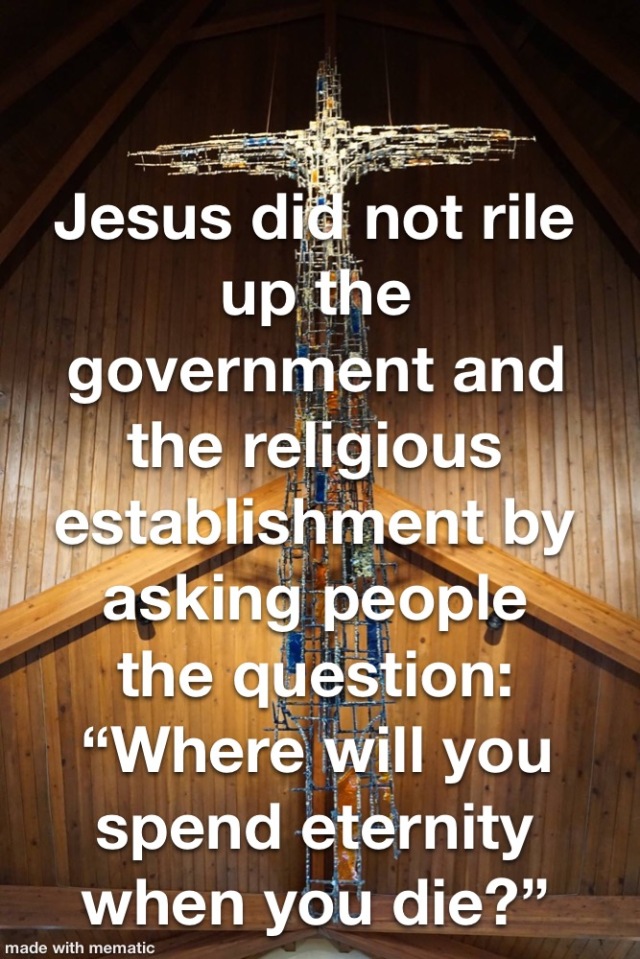
It is obvious that Jesus did not rile up the government and the religious establishment by asking people the question: “When you die, do you know where you are going to spend eternity?”

To understand exactly what Jesus is talking about when he talked about “Kingdom,” it is important understand something about the Kingdom into which he was born.

Rev. Joe Kay, UCC Minister from Ohio, describes the Kingdom of Caesar this way:

“It was a Kingdom ruled by the empire’s values of violence, dominance, supremacy, wealth, privilege, and self-interest. Life was cheap, and economic injustice was rampant.”

The empire’s leaders acted in narcissistic ways. As John Dominic Crossan notes in his book God and Empire, Caesar Augustus assumed the titles of “liberator,” “savior,” “redeemer,” and “lord.” He saw himself as the divinely chosen leader of the greatest empire in the world.

Caesar’s supporters praised him constantly and advanced his agenda. His base of support included religious leaders who were co-opted into doing the empire’s bidding in exchange for maintaining their own wealth, power, and privilege.

Religion and Rome were intertwined, working together to advance the empire. Then Jesus came along and challenged it all.”

In fact, this is exactly how his birth was announced by the Angels with the sentence:

“Glory to God in the highest and peace on earth to those with whom God is well pleased.”

As I mentioned during the season of Advent, this phrase is almost a direct quote from the decrees of Caesar Augustus.

Each time Augustus made an imperial decree to support the Roman occupation of the Near East, the following words opened the decree: “Glory to the most august Caesar (who was otherwise known as God in the Highest), and peace on earth to those with whom the god Augustus is well pleased.”

Thus, the Christmas angels sang the Emperor Augustus’ imperialistic words. When Jesus was born in Bethlehem, there was a royal decree: “Glory to God in the highest! There’s a brand new kingdom in this world!

Every time Jesus taught and preached about the Kingdom of God, Rev. Kay notes “he was essentially saying: you’ve already been born into Caesar’s kingdom, but now is the time to enter into a completely different realm. You need to be born again into God’s kingdom, into a realm that operates by values that are in stark contrast to the values of Caesar.”

Love rules in the place of selfishness.

Kindness in the place of cruelty.

Generosity in the place of greed.

Humility in the place of pride.

Social justice in the place of inequality.

Mercy in the place of fear.

And grace rules in the place of judgment.

It is important for us to understand that Jesus never talked about the Kingdom as if it were just some future event in the sweet bye and bye. He proclaimed that the Kingdom was already here—a place of unlimited love and unending compassion. A place where everyone is welcomed, especially the marginalized. A place where nobody is ever treated like an outsider. It is a place where even condemned thieves are forgiven and promised paradise.

It’s a place where healing is offered to all. It is a place where peacemaking is valued over warmongering, and where the lowly and the least are treated as the greatest.

The operating values of Caesar’s kingdom — power, greed, wealth, privilege, self-interest — are rejected, resisted and rebuked in God’s Kingdom.

And today, right now, we have a choice. Which kingdom will we choose? Whose values will we live and enact and advocate in our communities and our world?

It can’t be both. And as much as we want to, we can’t try to live with one foot in both worlds — that does not and will not work. As Matthew remembers Jesus teaching, “no one can serve two masters.”

It’s either one or the other.

And like I learned growing up in church, we can not avoid choosing, because not to choose is to choose. To simply go along with the status quo is a choice to support those who rule over it and protect it. If we do not challenge Caesar, we are in league with Caesar — we have chosen his kingdom over God’s Kingdom.

Also, as I learned growing up in church, we cannot delay making a choice. We can not afford to wait. And it is not because we may get into a car accident on the way home from church this morning. It is because the times in which we live are too serious, the problems of this world are too great and the hate in our world is too strong.

Furthermore, Jesus said the kingdom of God is not a future event. It is here, and it is now. And we are invited to become part of it at this very moment.

We have a choice to make… today.

As Crossan puts it: “God’s kingdom is here, but only insofar as you accept it, enter into it, live it, and thereby establish it.”

And everyone is invited to join. There are no barriers, no borders, no walls. All are welcomed and all means all, but citizenship does come at a cost. Choosing to establish God’s Kingdom in this world is a much more difficult than choosing which kingdom you want to live in the next world. For God’s kingdom unavoidably confronts and challenges the many Caesars that are always in our world, along with their ardent supporters and their devoted religious minions.

And they’ll use every one of Caesar’s tools to protect their privilege and power — bullying, harassment, intimidation, self-promotion, lying, verbal and physical violence.”

The gospels tell us that the kingdom of Rome and its religious supporters conspired to get rid of Jesus and his message to establish the Kingdom of God. And the same thing happens today.

The supporters of Caesar have completely changed the message of Jesus. They have twisted the gospel and perverted the faith. They teach that the Kingdom of God is a future place we experience when we die, not a place we are to live today. They say that the gospel is about personal salvation, not world transformation. They preach that Jesus wants to enter our hearts, not enter Jerusalem, Little Rock or Washington DC.

And at times, it feels like Caesar’s kingdom is invincible, that it is Caesar who will have the final say. The good news is that Good Friday is always followed by Easter Sunday.

“And in every moment we have trouble recognizing God’s kingdom in our world and in our lives, Jesus says: Look a little closer, love a little stronger, believe a little deeper. And you will see, it’s right here.”

And Jesus invites us all to enter this place of life, love, and healing right now.

Let us pray together.

O God, may thy Kingdom come, thy will be done, on earth as it is in heaven. Amen.


https://sojo.net/articles/religion-and-power-were-intertwined-then-jesus-challenged-it-all?fbclid=IwAR0_D94N5pdJ2CFbIT4SVTzjPjAJc4-Xv70fQy2Di045VPOesGdkm4mmpek

Crown of Thorns

Matthew 21:1-11 NRSV    nerve gas

Palm Sunday—it’s the spectacular day we celebrate the King of Kings’ triumphant entry into Jerusalem!  And in this world of so much suffering and pain, oh how we need a day like today!  Oh how we need to hear that Jesus Christ, our ruler and our king is coming through the gates to finally set things right, to take complete control of things. Oh how we need a day to reassure ourselves that no matter how bad life gets, no matter how distressed, fragmented and chaotic life becomes, and how hopeless it seems, Christ is large and in charge! “He’s got the whole world in his hands,” as we all like to sing.

Ok. Now, as we Disciples of Christ like to do, let’s get real for a moment. Let’s honestly think through this. Is the truth that “He’s got the whole world in his hands really that comforting?”

Although none of us good God-fearing, Bible-believing, church-going folks like to admit it, is this truth of God’s supreme providential power more than a little disturbing?

Think about those times you were reminded by someone, albeit with good intentions, that “God is in control.” When Lori and I lost our first child two months before the due date, people came up to us and said, “Don’t let this get you down. Just remember that God doesn’t make any mistakes.”

After the doctor gave you the news that the tumor was malignant, people came up to you and said, “Don’t worry, God knows what God is doing.”

When people learned that you were going to lose your job, they reminded you, “It is going to be alright, for God in control.”

At the graveside of a loved one, your friends and family lined up between you and the casket and whispered: “God has a reason for this.”

And very politely, we nodded. We even thanked them for their words with a hug or a handshake. But then, a short time later, after we dried our tears and came a little bit more to our senses, while we were sitting quietly at home or while we were out on a long drive, or maybe sitting in church, we began to reflect and to ponder those well-intended words. We began to think to ourselves: “If God is really sitting on some providential throne in complete control of this fragmented fiasco called life, this disastrous debacle called the world, then, really, just what type of ruler is this God? Just what type of king sits back and allows so much evil to occur in their kingdom, especially to people we are told the king loves.

The king of kings makes his triumphant entry—what is supposed to bring us great strength, peace and comfort, instead brings us frustration, anger and doubt.

Hosanna, the King is coming to save us—what is supposed to bring us assurance and hope brings us misery and despair. And we become tempted to join all those who will laugh and ridicule Jesus by the end of this week: “Umphh!  King of the Jews! Some King!”

I have said it before, and I do not mind saying it again—If God is the one who willed our first baby’s death, causes tumors to be malignant, gets us fired from our jobs, takes our loved ones from us, and sits back allowing such atrocities as the snuffing out of lives of little Syrian children being with nerve gas, then I really do not believe I want anything to do with a god like that!  I think I would rather join the millions of people who have chosen not to be in church on this Sunday before Easter.

But the good news is that I am here.

And I am here to proclaim with a confident voice God that God is not the type of King who decrees the death of babies, pronounces malignancies, commands layoffs and orders our loved ones to be suddenly taken from us. There is no doubt about it, Christ is King.  But thank God, Christ does not reign the way the kings of this world reign.

The reason I believe we allow ourselves to be tempted to give up on God in the face of evil is because we often forget that our God reigns not from some heavenly throne in some blissful castle in the sky. But our God reigns from an old rugged cross, on a hill outside of Jerusalem, between sinners like you and me.

I believe we oftentimes become despairing and cynical about God, because we forget that our God does not rule like the rulers of this world.

The kings of this world rule with violence and coercion and force. Earthly rulers rule with an iron fist: militarily and legislatively, and with executive orders. Worldly kings rule with raw power: controlling, dominating, taking, and imposing.

But, as the events that took place this week in Jerusalem 2,000 years ago remind us, Christ is a king who rules through self-giving, self-expending, sacrificial love. Christ is a king who rules, not from a distance at the capital city, not from the halls of power and prestige, but in little, insignificant, out-of-the-way places like Bethlehem and Nazareth, and Waukomis and Enid.

Our King doesn’t rule with an iron fist. Our King rules with outstretched arms.

Our King doesn’t cause human suffering from a far. Our King is right here beside us sharing in our suffering.

Our King possess what the late theologian Arthur McGill called a “peculiar” kind of power.

God’s power is not a power that takes. It is a power that gives.

God’s power is not a power that rules. It is a power that serves.

God’s power is not a power that imposes. It is a power that loves.

God’s power is not a power that dominates. It is a power that dies.

And as Arthur McGill has written, this is the reason that it is “no accident that Jesus undertakes his mission to the poor and to the weak and not to the strong, to the dying and not to those full of life.  For with these vessels of need God most decisively vindicates his peculiar kind of power, [a] power of service whereby the poor are fed, the sinful are forgiven, the weak are strengthened, and the dying are made alive.”[i]

Christ the King did not take our first child. The day our baby died, our King came and cried with us in that hospital room.

God did not cause the tumor. The day the doctor said the word “cancer” was a day of anguish for God as it was for us.

God did not create the layoff. The day you were told that your job was ending, God stayed up with you and worried with you all night long.

And God did not take your loved one.  When they died, something inside of God died too.

What we all need to learn are very different definitions of “king,” “rule,” “reign” and “power”—very different because they define the holy ways of the only true and living God, rather than defining our false gods and their worldly ways.

When life gets us down (and if we live any length of time at all in this world, it most certainly will), we need to remember the great truth of this day—The king has arrived. The king has entered the gates. And this king is has come to take his place on his throne, on an old rugged cross.  Do you see him reigning today? Do you see him bleeding, suffering, sacrificing, and giving all that God has to give from from the cross?

God does not make mistakes. God knows what God is doing. God is in control. God is king. But God’s throne is not made of silver and gold. God’s throne is made of wood and nails. God wears not a crown of jewels. God wears a crown of thorns.

This past week, I visited with Marion Batterman whose doctor just told him that he was dying. He said, “Pastor, my doctor gives me no hope. They said that my lungs are just about gone.”

I said, “Marion, I am so sorry.”

“Oh don’t be sorry he said. “Because my hope is not in my doctor! My hope is in my Lord!”

“So Marion,” I said, “Even when your lungs stop working completely…”

Marion finished the sentence, “I still have hope!”

No, he was not delusional. His mind was not clouded with medication. Marion was at peace, because his King reigns from a cross.

Marion was filled with hope, because his King is not far away from him seated a celestial throne removed from his agony. His King is seated at his very side suffering with him.

His King is not above his pain. His King is experiencing every bit of his pain.  His King is not willing or decreeing his death, his king is experiencing his death.

His King is not slowly taking his life away from him. His King is giving the King’s eternal life to him, pouring out the King’s holy self into him, and promises him every minute of every day to see him through his dying.

After he described an intensified intimacy that he now shares with his Lord, he then said something miraculous. With this hopeful joy in his smile and eternity in his eyes, he told me that he was a blessed man.

Think about that for a moment.

A man, barely able to breathe, nearing the end of his life, told me that he is blessed.

Aren’t we all?

[i] Arthur McGill, Suffering: A Test of Theological Method, 61-63.

The King We Need

rolling stones

Luke 19:28-40 NRSV

Our Palm Sunday gospel lesson is a rather strange text. As Jesus instructed them to do so, the disciples borrowed a donkey, brought it to Jesus, threw their cloaks on it and set Jesus on top. “As he rode along, people kept spreading their cloaks on the road. As he was approaching the path down from the Mount of Olives, the whole multitude of the disciples began to praise God joyfully with a loud voice, for all the deeds of power that they had seen, saying, “Blessed is the king who comes in the name of the Lord! Peace in Heaven, and glory in the highest heaven!”

Did you hear something strange there? For when have you ever heard the disciples of Jesus referred to as “the whole multitude of the disciples.” There were only twelve. But Luke describes them as “the whole multitude of the disciples.”

Let’s see, has there been any other time in Luke’s gospel when we have heard such language? Reminds us of another multitude, doesn’t it? The whole “multitude of the heavenly host” at the birth of Jesus, praising God and saying, “Glory to God in the highest heaven, and on earth peace among those whom he favors!” That sounds much like the chant of the disciples this morning, doesn’t it? I believe Luke wants to make the point that this processional of Jesus into Jerussalem is as important as the first processional of Jesus into the world. For Luke, Palm Sunday is as significant as Christmas.


And this is certainly not the only strange thing in this text. But by this point in Luke’s story, should we really be that surprised?  For throughout Luke something is always out of place, out of kilter, out of whack. If we remember the stories Luke has told us thus far, we would remember that the perfect neighbor is a despised Samaritan; the selfish prodigal is welcomed home with an extravagant party; the greedy publican goes home from the Temple justified; a woman who lets down her hair at the dinner table is praised; the first is last and the last is first; to save one’s life, one must lose one’s life; and now the king, and not just any king, the king of kings, the one whose birth was heralded by “a  multitude of heavenly hosts,” a theme now picked up by a multitude of disciples, enters the city riding on a donkey, and not just any donkey, a borrowed donkey.

If Jesus is a King, he is certainly unlike any king the world had ever seen: A king of poor shepherds; A king of simple fishermen; A king of dishonest tax collectors; A king of despised Samaritans; A king of harlots; A king of lepers, demoniacs, cripples, and outcasts. New Testament professor Alan Culpepper writes: “Those who followed this king were a rag tag bunch, pathetically unfit for the grand hopes that danced in their imaginations.”


And the cloaks thrown on the road that day were not expensive garments but tattered shawls and dusty, sweat-stained rags. Jesus was certainly no ordinary king, but a rather strange one.

The King we may want is not the king we get. But the good news is, this is the King we truly need. It is the King this broken world needs. It is the only king that can save this world. It is the only King that can give us life, true life, abundant and eternal.

Reminds me of the words of those great theologians of our time who once sang: “We can’t always get what we want, but we we try sometimes, we might just find, we get what we need.”

Jesus is the King. But as he will tell Pilate later this week, Jesus is a different kind of King, for his kingdom “is not from this world.” He adds: “If my kingdom was from this world, my followers would be fighting to keep me from being handed over to the Jews. But as it is, my kingdom is not from here.”

And, if we are honest, this makes those of us living in this world very uncomfortable. But that is Jesus. He comforts the afflicted of this world and afflicts the comfortable of this world. And whether we like to admit it or not, the truth is, we have grown rather fond of the kings and kingdoms of this world. And we sometimes have difficulty accepting anything different.

We prefer the kingdoms in this world that “would be fighting” to keep Jesus “from being handed over to the Jews.”

We prefer “an eye for an eye and a tooth for a tooth.”

We prefer “It’s not our job to judge the terrorists. It’s our mission to arrange the meeting.”

We prefer “the statue of Liberty…shaking her fist.”

The truth is that we prefer answering violence with more violence. We believe combating hate with more hate. We believe fighting for what we believe, even for Jesus.

We believe in coercing our convictions, imposing our opinions, forcing our beliefs, and we don’t care who it offends or even destroys in the process.

We prefer a kingdom where we say it loudly and proudly that “we eat meat; we carry guns; we say Merry Christmas and Happy Easter; we speak English and if you don’t like it, get the heck out!”

We prefer a kingdom where we do unto others as they do unto us.

We prefer a kingdom where we love only those we believe deserve our love.

We prefer a kingdom where we help only those who are willing to help themselves.

We prefer a kingdom where people put the needs of their own before the needs of a foreigner.

We prefer a kingdom where we care ourselves, while our neighbors fend for themselves.

Jesus implies to Pilate that there are two types of kings. There are the kings of this world, and then there is the king from another world. And then Jesus asks Pilate and Jesus asks you and me: Who is your king? Who do you say that I am? Am I your King? Is your king from another world or is your king from this world?

One king offers protection;

One king promises persecution, saying if you follow him, people will rise up and utter all kinds of evil against you.

One king endorses greed and validates prosperity;

One king fosters sacrifice and promotes giving it all away.

One king caters to the powerful, the wealthy and the elite;

One king blesses the weak, the poor and the marginalized.

One king accepts only people of like-mind, like-dress, like-language, and like-faith;

One king accepts all people.

One king is restrictive with forgiveness;

One king is generous with it.

One king controls by fear;

One king reigns with love.

One king leads by threat of punishment;

One king rules with the promise of grace.

One king governs by imposing;

One king leads with service.

One king throws rocks at sinners;

One king defends those caught in the very act of sinning.

One king devours the home of the widow;

One king offers her a new home.

One king turns away the refugee;

One king welcomes the refugee, for he, himself, was a refugee.

One king destroys his enemies with an iron fist;

One king dies for his enemies with outstretched arms.

For one king’s throne is made with silver and gold;

One king’s throne is made with wood and nails.

One king wears a crown of rubies and diamonds;

One king wears a crown of thorns.


So, of course, the powers that be, the kings of this world, will arrest this king “whose kingdom is not from this world.” Of course, they will torture this king, spit on this king, mock this king, and crucify this king—this king from a foreign realm. Of course, they will try to bury this king and seal this king’s tomb up with a stone.

But hate will not defeat this king. Bigotry will not stop this king. Religion and patriotism will not overthrow this king. This king will rise again. But not in the way the kings of this world rise. Despite the desires of his followers or the lyrics of their songs, there will be no thunder in his footsteps or lightening in his fists. There will be no plagues, fire, brimstone, or flood. There will no shock and awe or violence or riots in the streets of any kind.

For this king understands what, sadly, few since have understood, and that is:

“The ultimate weakness of violence is that it is a descending spiral, begetting the very thing it seeks to destroy. Instead of diminishing evil, it multiplies it. Through violence you may murder the liar, but you cannot murder the lie, nor establish the truth. Through violence you may murder the hater, but you do not murder the hate. In fact, violence merely increases hate. So it goes. Returning violence for violence multiplies violence, adding deeper darkness to a night already devoid of stars. Darkness cannot drive out darkness: only light can do that. Hate cannot drive out hate: only love can do that,” said the Reverend Doctor Martin Luther King Jr.

Consequently, this king will arise from the darkness of the grave, powerfully, yet unobtrusively; mightily, yet unassumingly; leaving room to recognize him or not to recognize him, leaving room to believe or to doubt, to reject him or to follow him. This king will drive out the darkness, not with more darkness, but with light. This king will drive out the hate, not with more hate, but with love.

So, how do we live in these hate-filled days of hostility, violence and riots in the streets?

Well, that all depends on who your king is.

The arrest this week of a terrorist responsible for the attacks in Paris reminded me of Antoine Leiris, who lost his wife in those attacks, who proclaimed to the world which king he chooses to serve. He shared it in beautiful tribute to his wife on Facebook, in the days after the attack, promising to not let his 17-month-old son grow up in fear of ISIS.

“You took away the life of an exceptional human being, the love of my life, the mother of my son, but you will not have my hatred…

I do not know who you are, and I do not wish to…

If this God for whom you kill so blindly has made us in His image, every bullet in the body of my wife will have been a wound in His heart…

So I will not give you the privilege of hating you. You certainly sought it, but replying to hatred with anger would be giving in to the same ignorance which made you into what you are. You want me to be frightened, that I should look into the eyes of my fellow citizens with distrust, that I sacrifice my freedom for security. You lost. I will carry on as before.”

No, it may not be what we want, but if we open our hearts and try, it is truly what we need. It is what our world needs. So let heaven and nature sing! May the whole multitude of God’s people prepare him room shouting with our words and deeds: ‘Blessed is the king who comes in the name of the Lord! Glory in the highest heaven and on earth peace!”

Our God Rides a Donkey

donkeyjesusJohn 12:12-15 NRSV

A few moments ago we prayed for a variety of people who all have one thing in common.  They are suffering.  Some are suffering with cancer.  Others heart disease.  Some are trying their best to recover from strokes. Others are recovering from injuries from an accident or a fall.  Others are experiencing the grief over losing a loved one to death.

And of course the question that people of faith ask is why?

Why do bad things happen to good people?

As a Christian pastor, I have often said that the question that one should ask is not “why me?”   But “why not me.”  We are human beings, and the reality is, that human beings suffer.  Human beings get cancer, have heart disease and strokes and get into accidents.

“Why me?”  No, the better question is, since I am a human being, “Why not me?’

Hear me clearly say this: When bad things happen, God is not punishing us, God is not trying to get anyone’s attention, wake anyone up, and God is not trying to teach us something.  In this fragmented world, bad things simply happen.

I hate it when people misquote the Bible by saying that “the Good Lord doesn’t put any more on us that we can bear.”  As if the Lord looks at people like Joyce Letchworth and says: She has buried two sons, had heart bypass and a valve replacement surgery, still, I think she could bear breaking a hip.

God does not put anything on us.  We suffer because we are fragile, immortal human beings and that’s it. And God does not “take,” “pluck,” or “call home” anyone from this life.  We die because we are human.

However, I believe the question that most of us really want answered is not so much, “Why me?”, but “Why isn’t God doing something about it?”  Why doesn’t God do something to prevent or relieve the suffering? We understand that God doesn’t cause suffering, but, why on earth, doesn’t God do something about it?  That’s what I don’t understand.

Well, one easy answer is that suffering is for our own good. A long time ago, Irenaeus of Lyons, a second century bishop, wrote on the educational value of suffering.

Why doesn’t God end our suffering?  Well, through our encounters with pain, we grow and develop. The infant who touches a hot stove learns a valuable lesson.  What if human beings never experienced want, deprivation, terrible heat or unbearable cold? Would human culture have developed among other creatures? No, said Irenaeus. Suffering is thus a great teacher, a wonderful prod for advancement in human development.

Even the book of Hebrews says that Jesus learned obedience through his suffering.

Now, I realize that this is somewhat true. The keyword here is “somewhat.” My aching bones tell me that a person in my shape should not try to run a marathon. But what about those whose bones lie in the mass graves in Iraq or Syria? What about the bones of the five year old boy found in a septic tank in Virginia? What lesson is there for that grieving community?

Some pain is helpful, but not all pain. The truth is that there is far too much useless, pointless pain in this broken and fallen world to speak to positively of the educational potential of suffering. What on earth is a child who falls victim to an internet child molester to learn?

Which brings us back to our main question: Why doesn’t God do something about the pain of this world?  Why doesn’t God intervene and do something?

One philosopher once said, “Either God is good, but ineffective and unconcerned, in which case he is not good for us, or, considering the unrelieved, unjustified pain in this world, God is evil.”  There is just too much unrelieved, unaddressed pain in this world to have God any other way.

Another response is that God is very good, but God is simply inactive. This seems to be the conventional modern resolution of the matter. Rabbi Harold Kushner has said that God only had six days to complete the world, and unfortunately, some things were left unfinished. God is not a personal errand boy. Stuff happens. And God? Well, God is simply uninvolved.

This is the modern, deist God of our founding fathers. Deism is the belief that God set up the world then went on a permanent vacation. Deism rescues us from the dilemma of having to make excuses for God’s lack of engagement with us and our suffering. God doesn’t heal, save, rescue or reach in, not because God is unconcerned and unloving, but rather because God is simply uninvolved.

Deism tended to be the faith of most of the modern world because, in order to get the modern world going, the first thing we needed to do was to remove God from the world so that we could be free to run things as we want. Belief in this God who is empathetic but not meddlesome, having gotten God safely filed away as some vague spiritual feeling, we were free to give ourselves more fully to a more effective god—the nation, the economy, or whatever. The bloody 20th century, the perhaps even bloodier beginning of the 21st century, is the result.

But then, despite ourselves—God, all of a sudden, surprises us. God comes. And God acts. A life gets uplifted. Someone comes away healed, whole. A life is changed, a future rearranged.  On her death bed, after suffering more than I have seen anyone suffer, Alawoise Flanagan miraculously smiles, her eyes ablaze with hope. And members of the Flanagan family miraculously experience a peace and strength that surpasses all understanding. Just when we thought God had taken some cosmic vacation, God shows up and we experience life, abundant and eternal.

This is Palm Sunday. It is the Sunday that God showed up on the streets of Jerusalem riding a donkey. It isn’t that God is unconcerned, uninvolved, and uninterested in us, it is that the way God comes to us is not the way we want or expect God to come.

William Willimon writes: We wanted Jesus to come in to town on a warhorse, and Jesus rode in on a donkey. We wanted Jesus to go up to the statehouse and fix the political problem, and Jesus went to the temple to pray. We wanted Jesus to get organized, mobilize his forces, get the revolution going, and set things right, and Jesus gathered with his friends in an upper room, broke bread, and drank wine.  We wanted Jesus to go head-to-head with the powers-that-be, and Jesus just hung there, on Friday, from noon until three, with hardly a word.

It wasn’t that Jesus didn’t do anything; it was that Jesus didn’t do the thing that we wanted. It wasn’t that Jesus did not come and intervene; it was that Jesus came riding a donkey.

God emptied God’s self, poured God’s self out, became one of us, bore our sins and our sufferings, even to death, death on cross. God came to us—not in a way that we wanted—but in a way that is all we truly need for life—abundant and eternal.

When my friend, Tony Cartledge’s, eleven year-old little girl died in his arms after their car was struck by a drunk driver, Tony said that he knew beyond a shadow of a doubt that God was there. No, God didn’t go after the drunk driver with a vengeance and reverse the evil that had happened, but there God was nonetheless: Holding that little girl with him; feeling Tony’s pain; shedding divine tears; promising hope and peace. God was undeniably present. And “miraculously,” said Tony, “that presence was enough.”  “That presence was all that I needed.”

There are people on our prayer list, and others for whom we prayed today who I pray will somehow, some way, be able to say: “It may not have been what I wanted—but God’s humble, loving, suffering, self-giving, life-changing, healing, hopeful presence, is all that I will ever need—for now and forevermore.  Amen.”

Good News in the Disappointment of Holy Week

holy week crown

It is two-thousand years later, and we are still surprised, confused, and even somewhat disappointed. Shattering our expectations of a Savior, King Jesus enters the city this week to liberate his people riding a borrowed donkey with an army of rag-tag students who have no idea what they are doing.

God’s throne is not made of silver and gold. God’s throne is made of wood and nails. God wears not a crown of jewels, but a crown of thorns.

When God chose to save the world from sin and evil, Jesus exercised a peculiar kind of power. It is not the type of power that we are accustomed to or desire. It is not a power that rules but is a power that serves. It is not a power that takes but is a power that gives. It is not a power that seizes but is a power that suffers. It is not a power that dominates but is a power that dies.

And we are still surprised, confused and somewhat disappointed.

“O God, though I attend and support my church every Sunday, why do my prayers seem to go unanswered? Why do I still struggle with life?”

“Dear Lord, We have been serving you our entire lives, faithfully giving you all that we have! I do not understand why you have not brought physical healing to my wife who suffers daily with a chronic disease.”

“Heavenly Father, we try our best to respect and love all people. That is why I am somewhat dismayed that you allow others to call us names, ridicule us and cause us pain.”

“And yet, Lord, in my astonishment, bewilderment and disappointment, you come to me nonetheless. Although I have no idea I am doing, you envelop me with your grace. You come to me in all of your glory and with all of your power. You come serving, giving, suffering and dying. You come offering me the very best gift that you can possibly offer—the gift of your peculiar holy self.”

And the good news is: that is more than enough!

Holy Week

holyweekSometimes it seems odd to call this week “Holy.”

The week that begins on Sunday with our Savior’s triumphant entry into Jerusalem ends with his death on a cross at a place called “The Skull. Shouts of “Hosanna!” on Sunday quickly turn into shouts of “Crucify Him!” by Friday.

Every imaginable evil is hurled his way. The powers that be, both religious and political, are ready to entrap and ensnarl him. He is betrayed by one of his very own followers with a kiss for thirty pieces of silver. After his arrest and a hasty trial, his disciples all abandon him. One of his closest friends on earth denies that he even knows him.

Then, deserted by his friends, Jesus is ridiculed, spat upon, utterly humiliated and beaten beyond recognition. A crown of thorns is put on his head, and he is forced to carry his own cross. His hands and feet are nailed to the cross before it is lifted into the air where he hung for six hours between two criminals before dying. The week ends with his burial.

What on earth is “holy” about any of these events?

The answer is a simple one. If Jesus is an ordinary man, then the answer is, “nothing.” If Jesus was but a man, then this week is utter tragedy. However, if Jesus is the Incarnate God, the creator of all that is who became one of us, then the answer is “everything!”

For it means that God understands every aspect of what it means to be human. Our God is a God knows something about every imaginable evil that can be hurled our way. Our God knows betrayal, abandonment, humiliation, loneliness, and immense suffering. Our God has experienced death.

This week means that our God understands.

And three days later, an empty tomb reveals that God redeemed it all! God took the evil hurled God’s way and transformed it, recreated it into something wonderful.

Thus, the good news of this week is that not only has God experienced all of the evil of this world and understands (which would be good news enough), but that God takes that evil and transforms it into something wonderful, something profoundly “Holy.”