Do This and Live

dallas shootings

Luke 10:25-37 NRSV

Sometimes preachers can begin preparing their sermon too early. I began working on this sermon more than a week ago. I chose the theme, the point and the title of the sermon early Tuesday morning.

As you can probably tell by the title of my sermon, “Do This and Live,” the point of my message this morning was going to be that it is high time for Christians to put our faith into action.

In the beginning of Luke 10, we read Jesus saying to seventy of his followers: “the harvest is plentiful but the laborers are few.” Then he commissions them to do some pretty big things: bring peace to the people, cure the sick, work to bring the kingdom of God near.

This was going to be my sermon.

I was going to tell the story of the Good Samaritan, tell how he overcame his fear of the other, how he reached out and reached down to help him in his time of distress, and then I was going to quote Jesus, by saying: “Go and do likewise.” “Do this and live.”

I was going to say that it is time for us act, to go and do likewise.

I was going to say that the Samaritan did not merely wish the man lying in the ditch well. He did not just send his thoughts and his prayers. He didn’t mull over the situation, consider  the risk involved, ask whether or not his insurance would cover it. He just acted.

I was going to encourage you to be the church that Shannon often describes as one that is “on the move.”

I was going to admonish you to move beyond thoughts and prayers, study and contemplation, to be more committed than ever to truly be a movement for wholeness in this fragmented world.

A movement. Not a team of thinkers.

A movement. Not philosophy class.

A movement. Not a club of theorists.

A movement. Not a group of day dreamers.

A movement. Not a church of well-wishers.

A movement, a body of doers, doing all that we can, when we can, with all that we have been given,

working for wholeness in a creation that is broken,

working for justice in systems of inequality,

working for mercy and grace in a society of bigotry and prejudice,

working for peace in a culture of war and violence,

working for truth in a nation of politics,

working for love in a world of hate,

working for hope in a world of despair.

However, after the horrific events continued to unfold this week, I went back to our scripture lesson to read it once more in the light of what has been a horrendous week for our country.

Surely, God has something else to say to us this week.

The first time I read the story, I read it the way many read it. By understanding that God wants us to see ourselves in that Good Samaritan, that God wants us to overcome our fear of the other and act to truly love others as we love ourselves. God wants us to courageously go out, reach out and reach down to help those who have been left behind, put down, beaten up.

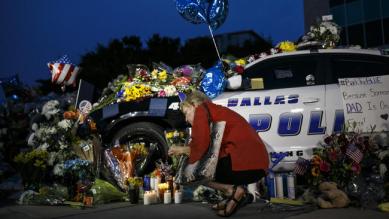
But after a week in which we witnessed 250 murders in Baghdad, the murder of two African Americans in Baton Rouge and St. Paul, and the murders of five police officers in Dallas, I began to read the text differently.

Instead of seeing ourselves in that Good Samaritan, perhaps God needs us to acknowledge today that we are more like one who has been robbed, beaten, and left bleeding, half-dead in a ditch on the side of a wilderness road.

That is where I believe we truly are as Americans today. We have been robbed: robbed of pride and dignity, robbed of trust and hope, and robbed of peace and security. We have been beaten: beaten by racism and hate, beaten by terrorism and violence, and beaten by confusion and despair. And we are bleeding. We are bleeding tears, bleeding fear, and bleeding anger.

And honestly, we are currently unable to act sensibly, unable to move courageously, and certainly unable to be any semblance of a movement for wholeness, because we ourselves are not whole. We are broken, barely making it, not knowing whether we might live or die.

And one by one, people are passing us by. Friends are disappointing us, and even people of faith are letting us down. We are being treated as if our lives do not matter.

But here is the good news:

The good news is that someone is coming towards us. Someone is coming very near to us. Although we cannot comprehend it, we sense his presence.

He is but a stranger to us. His ways are not our ways. He comes from a foreign land. He is one who has been despised and rejected by the world, a man of sorrows held in low esteem.

But when this strange one sees us, as he becomes acquainted with our suffering, he is immediately moved with compassion. He is moved thoroughly and deeply.

We have been beaten so badly, he does not recognize if we are black or white, Jew or Muslim, male or female.

Yet, he suffers with us, and he suffers for us. His empathy towards us brings him down to his knees. We can feel his warmth. We perceive his empathy. And then, kneeling beside us, with his own hands, he tends to the places where we have been hurt. He stops the bleeding. He cleanses our lacerations. A costly wine poured out. Carefully, attentively and lovingly, he bandages all of our wounds.

He then puts his arms around us. Although we still cannot make out his face, cannot comprehend his actions, we instinctively know that we can trust him. We can trust him. So we put hands around his neck as he picks us up.

He picks us up and carries us until we reach a safe place, a place where no one judges us, a place where we are welcomed and accepted just as we are.

He stays beside us and continues to care for us. He gives us warm bread and something refreshing to drink. He stays with us through the darkness of the night, holding us, loving us, assuring us that we will not only have life, but we will have life abundantly, assuring us that a new day will dawn and we will be a part of it.

And when that day comes, he sacrificially pays the price for our care, for our healing, for our salvation. And then he places us in the hands of others who will care for us, shepherd us, love us as he loved us.

He then tells us that he must go, but before he departs, he makes a promise. I will come again. I will surely come again, and whatever your debt may be, I will take care of it. I will pay it in full. I will forgive it fully, completely. Grace will be yours not only today, but forever.

And our cups runneth over. We are healed, made whole. We have been saved. For we have never experienced such a love, a love without conditions, a grace without limits, a mercy without reservations.

This afternoon, our church is partnering with Youth and Family Services to host a back to school bash for foster children living here in Garfield County. We will have games, provide haircuts, and give out book bags with school supplies. Most of all, we will give them our love.

We will let them know that today they come to a safe place. A place where no one will judge them, a place where they will be accepted and welcomed.

We will let them know that there is a community here that will hold them, love them unconditionally, share mercy with them unreservedly, and offer grace to them with no strings attached whatsoever.

We are not going to merely offer these foster kids our thoughts and prayers. We are not going to just wish them well. We are going to act.

And we are going to continue these acts of grace with others in our community who find themselves in need. We are truly committed to be a church on the move.

However, before we can do this, before we can be a body of doers, before we can go and hold others in the light of Christ, a light that will certainly drive away the darkness, I believe we first need to be held in that light ourselves.

Before we can envelop others with a love that will drive out the hate, we first need to know that we have been embraced by such a love. Before we can become a movement for wholeness, we first need to be made whole.

And if we do this, accept this love, receive this grace, allow this mercy to take a hold of us, pick us up, heal us, redeem us, and transform us, if we do this, we will live.

And then, we can share this life with others. We can truly be a movement for wholeness in a fragmented world.

Come, Lord Jesus. Come quickly.

Christmas Begins in the Wilderness

TheGriswoldFamilyChristmasTreeMark 1:6-8 NRSV

When does Christmas begin for you? Was it on Black Friday at the mall, or while watching A Charlie Brown Christmas or National Lampoon’s Christmas Vacation? Was it last Sunday morning as the first candle of Advent was lit in this place? When does it start? When do you begin to realize the good news that is Christmas? Where are you when it happens? On the Town Common during the annual Christmas tree lighting? Walking down Main Street during the Taste of Farmville? Going caroling with the children from church? Maybe it is not until Christmas Eve, as you light your candle and sing, Silent Night. Perhaps it is when you are alone at home, listening to Christmas music and decorating your own tree.

For Mark, the good news of Christmas begins in what most of us would call a strange and unexpected place. Unlike us, the good news of Christmas does not start with some warm sentimental scene. And unlike Matthew and Luke, for Mark, the good news of Christmas does not begin with heavenly visitations, choirs of angels, the worship of shepherds, a star rising in the East, or Magi bearing gifts. For Mark, Christmas does not even begin with a little baby wrapped in swaddling clothes lying in a manger.

For Mark, the good news of Jesus Christ, the Son of God, the good news of Emmanuel, God with us, the good news of Christmas, begins somewhere out in the wilderness. And he is not talking about some snow-covered winter wonderland where the Griswold’s find their family Christmas tree.

For Jewish people aware of their history, Christmas begins in that place that was experienced somewhere between slavery in Egypt and the Promised Land. Somewhere out in that place of testing, trial and temptation, somewhere out in that place of doubt, dread and despair, that place where you do not know if you want to live or die, that place with the Red Sea swelling before you and Pharaoh’s army advancing behind you. That place where Elijah fled to save his life from Jezebel’s army and then prayed for God to take his life away. That place where even Christmas himself would be haunted by wild beasts and tempted by Satan. For Mark, Christmas begins in the most strange and unexpected place, a raw, dangerous place called the wilderness.

The beginning of the good news that is Christmas occurs in that place where God seems to be against you, or appears to be so far away that you doubt God’s very existence—suffering in an intensive care unit at the hospital, laying in utter misery in a nursing home, holding the hand of a parent with Alzheimer’s, picking out a casket for a spouse in a funeral home, at home anxiously trying to pay your monthly bills, in the middle of a fight with a loved one, in Pearl Harbor 73 years ago this hour, in any place where people are overtaken by tension and terror, overwhelmed by despair and disappointment, or overcome by sin and shame.

Last weekend, I was at home trying to get my own Christmas started as I do every weekend after Thanksgiving. However, this year it began a little differently, you might say it began strangely and unexpectedly.

Instead of decorating my tree this year with Christmas music playing in the background, I decorated it while watching the local news. As I hung ornaments, I listened to the tragic story of a high school student killed in an automobile accident outside of Pinetops. As I turned on the lights of the tree, I glanced up to see pictures of mothers with their children escaping from war-torn Syria into refugee camps in Lebanon. I saw images of many children: some starving, others injured, some dying, others sick, all very afraid. I saw gruesome images of parents holding the lifeless body of their child. And I thought to myself, “I need to turn this depressing mess off and put on something a little more Christmasy.”

Then it occurred to me. This may be as close to Christmasy as it gets, for this is Christmas in the wilderness. The Good News according to Mark concurs that this is Christmas, raw Christmas. This is where Christmas truly begins. This is Christmas untamed and undecorated. For Christmas began when God came into a depressing mess.

And no matter how hard we try, no matter how much energy we expend or how much money we spend; we cannot escape the raw truth of it. Christmas begins, says Mark, with a “voice crying out in the wilderness.” And there is no music, no matter how Christmasy, that we can play loud enough to drown out this voice. There are no decorations glitzy enough and no lights bright enough to temper this voice.

This voice can be heard throughout every refugee camp in Lebanon and by every parent mourning the loss of their child. It can be heard in every intensive care unit, in every nursing home and funeral home. This voice can be heard in every wilderness, in every depressing mess on earth.

Through the good news of Christmas, God is crying out: I am for you; not against you. I am with you; not away from you. And I am more real, more alive, and more at work in this world than you can sometimes believe. As the prophet Isaiah said: “I am about to do a new thing; now it springs forth, do you not perceive it? I will make a way in the wilderness and rivers in the desert” (Isa 43:19).

The good news is: Christmas does not begin with us. It does not begin when we get the house all decorated or get all of our shopping done. We do not have to host a Christmas party or even go to one. We don’t even have to go to church, light a candle or sing a carol. Christmas begins with God and with a voice crying out in the wilderness, in those places where we may least expect it, but need it the most.

Some of us know that Luke tells his beloved Christmas story in chapter 2 of his gospel. However, I believe he perhaps tells it more poignantly in chapter 10.

A man was traveling down a wilderness road that was so dangerous that it was sometimes called “the way of blood” or “the bloody pass.” And there out in the wilderness, the man fell into the hands of robbers, who stripped him, beat him, leaving him half dead on the side of the road. As the man lay on the roadside, somewhere between Jerusalem and Jericho, somewhere between life and death, wanting to live, but also maybe wanting to die, he is ignored by two religious leaders who are also traveling down the same road.

God only knows why these men who you would expect to stop and help ignored the man. Perhaps they thought the robbers were still nearby, or maybe they thought the man lying on ground was only pretending, playing some sort of trick, so that when they came near him, he would beat and rob them. For whatever reason, they believed it was much too risky for them to stop.

Then came this one, Luke calls him a Samaritan, which means this was someone who was despised and rejected by the religious establishment, someone who was often misunderstood and rarely respected, someone who knew something about pain and brokenness, betrayal and abandonment, God-forsakenness; someone who had spent many days and nights in the wilderness himself, tempted and tried.

This one who was the least expected to stop and help, saw the man. He saw the man’s wounds, saw the man’s fear, saw the man’s despair and was moved with mercy and compassion. And there in the wilderness he risked his own life, as he sacrificially came to him, selflessly bent himself down to the ground, and joined the man.

The man did not have to do anything to make this one come to him. Out of pure love, unconditional and unreserved, this one just came. He then touched the man where the man most needed touching, pouring oil and wine on the man’s wounds and bandaging them. He then picked the man up and safely carried him out of the wilderness. He stayed with him, at his side through the darkness of the night. When morning came, he paid for the man’s debts, and made the promise: “I will come back. I will return.”

Of course, we call this “The Story of the Good Samaritan.” However, I believe it should be called, “The Story of Christmas.” A story that begins with a voice of mercy and compassion crying out in the wilderness, in those strange, dangerous places where we least expect it, but most need it.

Hospice caregivers will often speak of a dying person “rallying” for a brief time right before death. A person who has been non-responsive will begin to talk. One who has been confused or disoriented will become suddenly coherent. And those who have not had any food for sometimes days may request something to eat or drink. As a pastor, I have seen this “rally” more times than I can possibly count. I am not sure exactly why it happens; I just know that it happens, and it happens often.

My faith tells me that it is Christmas. It is God seeing one lying in the wilderness in their weakest, most broken state, seeing one in their most desperate, most vulnerable need, and it is God being moved with mercy and compassion for that one. It is a voice crying out from the heavens into the wilderness: “I am for you, not against you, I am with you, not away from you. I am Emmanuel. I will risk my own life for you. I will give my all to take care of your wounds and to pick you up, to forgive all of your debts. And when you are ready, I will come back, and I will take you unto myself, so that where I am, you will also be.”

The good news for us this day is that Christmas comes to us all when we confess that we are all half dead, lying on some wilderness road east of Eden, beaten up so badly by this sinful world that no one can tell whether we are Jew or Gentile, male or female, black or white, slave or free.[i] Whenever we confess our brokenness, our sinfulness, and our need for a Savior, a voice from heaven cries out in our wilderness and Christmas comes. Christmas always comes.

When does Christmas begin for you? When does it start? Where are you when you begin to realize the good news that is Christmas? The good news, according to Mark, is that Christmas begins when and where you may least expect it, but need it the most.

[i] This sentence is adapted from words spoken by Frank Tupper in one of my theology classes at Southern Seminary, Louisville, Kentucky, 1989-1992.