Far from the Shallow Now

Luke 5:1-11 NRSV

One morning, Jesus is preaching down at the lake. The crowd that had gathered is so large, Jesus felt like they were about to push him right into the water!

During the sermon, he sees two boats belonging to some fishermen who were on shore washing their nets. He gets into the boat belonging to Simon, and he asks Simon to anchor the boat a little way from the shore, where he continues his sermon.

Luke doesn’t record the words to Jesus’ sermon, but from his sermon in the very next chapter, we could probably take a good guess: “Blessed are you who are poor, for yours is the kingdom of God. Blessed are you who are hunger now, for you will be satisfied. Blessed are you who weep now, for you will laugh. Love everyone, even your enemies…” It’s a sermon of abundant mercy, extravagant grace, and boundless love!

After the sermon, Jesus tells Simon that he wants to do a little bit of fishing himself: “Let’s leave these shallow waters and let down the nets.”

Simon responds: “Master, with all due respect, I, along with my long-time business associates, James and John, have fished these waters all night long, and we haven’t caught a thing. Yet, if it will make you happy, I will go out a little deeper and put down the nets.”

Well, as soon as the nets hit the water, they catch so many fish that the nets begin to break. They quickly call out to James and John to get the other boat and offer them a hand.  And when they come, they fill the boats with so many fish that both boats begin to sink.

As Simon takes in the overwhelming scene— nets breaking, boats sinking, fish everywhere, a scene of failure and scarcity transformed into triumph and abundance, a scene of what can happen when you leave the shallow to dive into something deeper, what can be experienced when you obey the commands of Jesus—Simon is overwhelmed, and falling down at Jesus’ knees, he says: “Go away from me Lord, for I am a sinful man!”

It was as if Simon suddenly realized that it only seemed that Jesus was finished with his sermon that day. Jesus may be fishing, but he is still preaching. Through the abundant catch of fish, Jesus is still proclaiming God’s abundant mercy, extravagant grace, and boundless love. Believing he is underserving of such love, how unworthy he is of such abundance, Simon asks Jesus to go away.

But Jesus never goes away easily. “Simon, not only are you worthy to receive the abundant, extravagant, over-the-top love of God, you are worthy to share it with others and change this world! So, do not be afraid; for you are no longer going to be catching fish, you are going to be catching people!”

“I am asking you, Simon, along with your business partners James and John, to leave your shallow, contained, little world to venture out with me into a deeper, larger, revolutionary reality.

The truth is, Simon, I need you to go deeper. I need as many people as I can get to go deeper. The problems of the world are too great, and your lives are too short to waste any time wading in the shallow. And the grace of God is too extravagant. The mercy of God is too abundant. The love of God is too boundless for you to keep your it all to yourselves.

I need you to leave your shallow, safe world of spending all your time making a living to meet the needs of your immediate family, and I need you follow me into the deep, risky reality of sacrificing your time to meet the needs of the entire human family!

I need you to leave your shallow life that feeds you, and your children, and accept a deeper life that helps feed every child of God!

I need you to move beyond your shallow, narrow mission of caring for your own home, and accept the deeper, wider mission of caring for the entire planet!

I need you to lose the apathy towards issues that do not concern you and your limited of circle of family and friends to possess a deep empathy towards all who experience injustice!

I need you to move beyond your shallow understanding of success. Simon, no matter what you have been taught, success is not defined by the amount of fish you catch, or the size of your house or back account. It is so much deeper than that!

Your success is measured by how many people you loved extravagantly, abundantly, and graciously.

I need you to go deeper, Simon. You too, James and John, and be my disciples and fish for people. Do the hard, messy, oftentimes frustrating, and risky work to meet the needs of people, to care for and to liberate people. I need you to move far from the shallow now to do the deep work of love. And I am not talking about personal and intimate love, but a love that has public and political ramifications.

Now, here’s what I believe is the real miracle in this story. We read it in verse 11. After Jesus invited them to leave the shallow for something deeper, to leave the fish business to be in the people business we read: “When they had brought their boats to shore, they left everything and followed him.”

This is miraculous because when it came to accepting the extravagant grace and love of God revealed in the large catch of fish, Simon, seemed to have some difficulty: “Get out of here, Jesus! I am a sinful man!”

However, when it comes to following Jesus to a deeper life, to love others to selflessly and sacrificially, extravagantly and liberally, he, with James and John, leave everything and follow.

This is miraculous, because it is the exact opposite of how we humans usually work. We seem to have no problem accepting the grace of God for ourselves. We have no issues receiving the love of God for us personally. But we prefer to keep it shallow. We prefer to keep it personal. We prefer to keep it safe, keep it contained, keep it conservatively to ourselves. We are almost always reluctant to go deeper.

Because going deeper is dangerous. Going deeper is costly, and it is risky. Going deeper can be overwhelming. In the deep, fish break our nets and people break our hearts. Going deeper may mean leaving our friends and family behind.

I want to thank Katie Nunn for sharing her talent with us by creating this extravagant artwork that is adorning our baptistry today. When she first thought of this idea, which to me, speaks to the abundant and extravagant love we are called to share with others, she said she was tempted to think that the art might be “too far out” for church. But then, thinking about what this church means to her and to others, she thought, when it comes to love, for this church, there’s no such thing as being “too far out.”

In other words, Katie has joined a congregation of disciples, who, with Simon, James, and John, when it comes to love, have chosen to go deep, to go far out from the shallow.

We are disciples who have decided to go on a journey to share the abundant mercy, extravagant grace, and liberating love of God with all people, all the while knowing the journey will not be easy, comfortable, or popular.

Late author and professor John Augustus Shedd once said: “A ship in harbor is safe, but that is not what ships are built for.” And today, we are on a ship with Jesus. He is the captain who navigates our journey out of the harbor into deep, dark, and dangerous waters.

The darkness of these days, like deep water, requires more than a shallow response. The times are too serious, and our time is too short, to waste any amount of time playing around in the shallow.

When the president makes an executive order to “eradicate” any opposition to the sick religion of White Christian Nationalism or the cult of MAGA, while disparaging any religious thought that calls for mercy and compassion, empathy, and equality, we must go deeper.

When the tax status of non-profits and institutions that serve the common good are threatened, when aid to the poorest people in the world is cut off, our stewardship practices, our civic engagement and our commitments need to go deeper.

When houses of worship receive warnings by the government that sanctuary provided to the immigrant will not be honored, that we may be targeted, our commitment to the word of God “to treat the foreigner living among us as native born, to love them as ourselves” gets called into the deep (Leviticus 19:34).

When programs designed to celebrate diversity, create equity, and foster inclusion are eliminated in favor of protecting the privileged, our faith compels us to go into the depths of human solidarity and belonging.

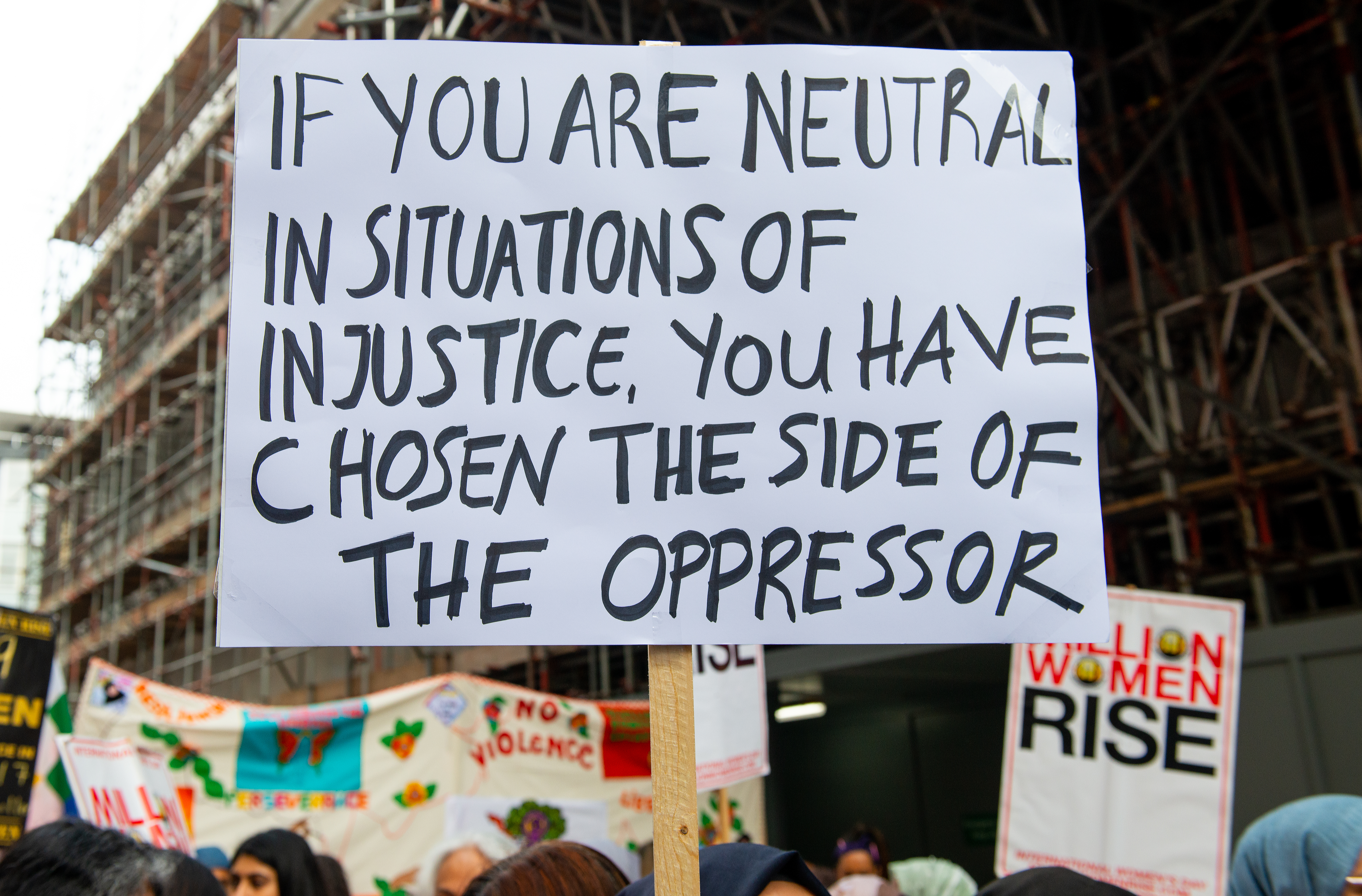
So, if you have come here this morning because you want to dip your toes in the safe shallow end of the pool, to wade, splash around, and enjoy yourselves, to nourish your private, personal relationship with the Lord, to remain neutral when it comes to public policy and politics that hurts the poor and the marginalized, then I am afraid, you have come to the wrong place! We don’t even have a kiddie pool for children in this place, as we are even training them to swim in the deep end.

Because we know that a shallow, safe, personal, and private faith, a faith that has the sole purpose to feed one personally, allows children to starve, and the entire creation to hunger.

A shallow faith allows the spread of a false gospel that is unconcerned with the living conditions of anyone else living on the earth as well as the state of the earth itself.

Shallow faith enables false prophets to reject Jesus, or worse, to act in ways that are the antithesis of Jesus, ways that are anti-Christ, and still claim they are following Jesus.

Shallow faith is afraid to enter into the depths of human suffering and oppression. It finds contentment inwardly, in one’s own family, job, possessions, and even church.

Shallow faith is afraid to rock the boat, afraid of losing a friend or upsetting a co-worker or family member.

Shallow faith is afraid of the sacrifices and the changes that need to be made.

And sadly, church is where people can be the most afraid, and thus the most shallow, the most small-minded and the most close-minded, the most self-interested and self-preserving

But the good news is that church can also be the place where people can be the most courageous, a place where we are challenged to be more open, more selfless, and more self-expending, where we are pulled by Jesus into the deep, dark, and dangerous places, far from the shallow.

To those difficult places where we have a deep conversation with that climate change-denier or anti-vaxer. Where we go out of our way to help an asylum seeker. Where we contact our legislatures to object to the wicked assault on trans people. Where we call out racism and white supremacy wherever we see it, on the school board, the city council, even in our own families.

The good news is that the First Christian ship of Lynchburg, Virginia has left the harbor. Jesus is our captain. And we are far from the shallow now! Amen.

Standing on Opposite Sides of a Cultural War


Self-professing Christians find themselves standing today on the opposite sides of our nation’s cultural war, and those on both sides claim to be standing on the side of Jesus. But standing on opposite sides, both cannot be right, can they? Yet, here we are, in a country that has not been more divided since the Civil War.

So, a good question that I believe all Christians must ask of themselves is this: “When we take a stand that divides us from others, that may alienate us from some of our friends, even from members of our family, how do we know if we are truly on the side of Jesus?”

This is an important question for us to ask, because throughout history, there have been Christians who, although they claimed to be on the side of Jesus, were actually standing on the opposite side of Jesus.

In the name of Jesus, Christians fought in the Crusades against Muslims. In the name of Jesus, Christians supported the genocide of Native Americans and the slavery of Africans, which literally led to a Civil War. In the name of Jesus, Christians supported the Jewish Holocaust, the subjugation of women and Jim Crow laws. With the wisdom of hindsight, Christians since have apologized for standing on the wrong side.

However, the good news is that there have always been Christians who have stood firm on the right side of history, even if it meant separating them from friends and family. I have always been proud to know that one of the founders of our denomination, Barton Stone, was willing to leave behind friends and family, moving from Kentucky to Illinois to free the slaves that he inherited.

So, if being on the wrong side, the opposite side of Jesus, is a real possibility, how do we know if we are on the right side? How do we know that we are standing with Jesus?

Could it be that it really is not that complicated? Is it possible that this failure to be on the wrong side is so much a part of human history, that Jesus addressed it in a very simple, direct, and uncomplicated way.

I give you a new commandment, that you love one another. Just as I have loved you, you also should love one another. By this everyone will know that you are my disciples, [in other words this is how you will know that you are standing on the right side with me] if you have love for one another” (John 13:34-35 NRSV).

Thus, when we are taking a stand for Jesus, and we become aware that we are upsetting, or alienating our family or friends, I believe it is imperative to ask: “Am I standing on the side love?” “Am I on the outs with my family and friends, because I am loving others like Jesus loved others, selflessly and sacrificially?  Am I in this fight, because I love my neighbors as myself—all of my neighbors?”

Or am I standing firm and alienating my friends and family because of something else? Is it pride? Is it power and privilege? If it is not about grace, is it about being superior to another, more holy, more righteous? If it is not about love, is it about fear? Is it about greed? A good question to always ask is: “Does my stand actually hurt my neighbors?”

In Acts, chapter 11, we read that when Barnabas arrived in Antioch to visit one of the first churches, the first thing that he witnessed was “grace.” In verse 22 we read:

…and they sent Barnabas to Antioch. When he came and saw the grace of God, he rejoiced, and he exhorted them all to remain faithful to the Lord with steadfast devotion… and it was in Antioch that the disciples were first called ‘Christians’.

When Barnabus saw Christians, he saw the grace of God.

What do people see when they see us?

Let us pray they always see grace. May they always see love. Even for those standing on the opposite side.

A Politically-Correct Gospel

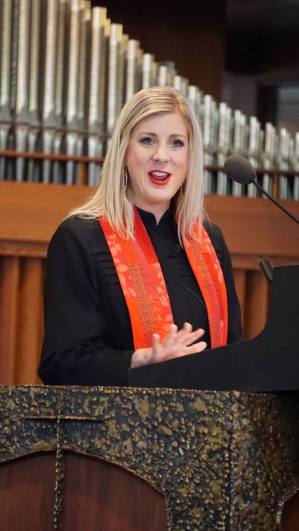
Shannon

The following sermon was preached by Rev. Shannon Fleck at the Installation Service of Jarrett Banks as the 25th Senior Minister of First Christian Church in Fort Smith. 

Matthew 22:15-22 NRSV

  • Good morning everyone! I want to preface this morning by saying that I am not the usual occupant of this pulpit. So if you are visiting this morning and you hate it, come back next and hear Jarrett before making that decision. If you love what you hear today, come back next week also because he and I are kind of cut from the same theological cloth.


  • It is my intention to get a little real with you today. Because the world we live in could use a little more real. A little less side stepping. A little less “fake news”. A little less politically correct. I hope you don’t mind.


  • For sixteen blissful, easy breezy, smooth sailing months Jarrett and I served in ministry as a team in Enid, OK. And by easy breezy, I mean the hardest experience in ministry either one of us has ever faced. Those 16 months united the two of us as a team more so than any ministers I had ever seen.


  • And I tell you this only to qualify myself to you all as ready and willing to stand here on his behalf, alongside him as he makes promises to you all, his new congregation… and you make promises to him.


  • Ministry is hard. Ministry is especially hard in a world where religion has been used to repeatedly cause traumatic injury to God’s children for centuries. As a minister, one walks a consistent line of being “pastor” to those who have been hurt and those who have committed the hurting.


  • Living always in a dichotomy of another’s religious priorities versus your own, and inevitably, always letting someone down for not “doing faith” exactly as they see fit.


  • So friends, heeding to the promises exchanged here today will at times be easy and at times a challenge. But a minister’s heart and mind is constantly living in multiple places in order to be present with all of you;


  • You’re ALWAYS a minister. It is not an occupation that you do, it is a call you live every day, in every interaction.


  • I mean, one of the first questions one has upon meeting someone is asking what they do for a living, right? Ministers dread this question, because the minute we tell someone, we are immediately sentenced to carry whatever religious opinion, or guilt, or shame, or praise (maybe) they have.


  • Ministry is so very hard.


  • I know this person, as all of you will, if you don’t already. And he knows as well as I that there are things that pastors will always want to say that they probably never should, but a guest pastor can.


  • Like say, talk about politics from the pulpit.


  • This has been a spoken and unspoken no-no for ministers and preachers of the gospel for what seems like an eternity, erring on the side of caution, rather than offending the occupants of our pews. Ministers have been cautioned using the most emphatic of deterrents, fear.


  • So, imagine my quandary when today’s text appeared before me as the lectionary gospel for this week. A text that unashamadely places issues of religion and politics fully front and center. Crammed together. Not uncomfortably, like an awkward interaction with a relative at Thanksgiving, but as a matter of fact….


  • Any person who claims that religion and politics don’t mix, clearly missed today’s Gospel lesson.


  • It is important to note that Jesus, does not provide religious absolution from political and government involvement, we are going to have to pay those taxes.


  • But he makes the important distinction that loyalty to such things should only go so far as our complete and moral love of God will let us. So as we seek to give to Caesar what is caesars and to God what is God’s, we must remember that each and every being is God’s, and our loyalty is to what belongs to God first.


  • Now as I begin to wonder if some want to shift in their seats a bit I have to say that it’s understandable really, our desire to keep these topics out of the forefront of our most comfortable settings. Our relationships, our families, our sanctuaries. We do not want to be uncomfortable. There is nothing safe about that.


  • But in this effort to bifurcate the gospel from the reality of the political systems that influence our lives, we have done a disservice to that all important notion of Christian call.


  • And most importantly, we have left faith vulnerable and isolated. Up on the auction block to the highest bidder.


  • The bible has been contorted so many times to fit the comfort level of the powerful. Pushed, twisted, and breached more times than we can count.


  • What is politically correct about that?


  • Well church, if you wanted a pastor who would succumb to the fear of offending you… you hired the wrong guy.


  • Because this man that you just exchanged promises with, knows the politically correct work of the Gospel of Jesus Christ. And most importantly, he knows all about its unpopularity amongst the masses.


  • He is not concerned about comfort, least of all his own, he is concerned about living in the messy, abundant, unapologetic love of Christ with all people.


  • He is not one who will, as a friend of mine says, give you baby food from the pulpit, but sustenance for the journey.


  • He will ask from you all that makes you comfortable so that it can be stretched and extended into a grace filled life you may not had known was possible. But it will take trust on all your parts to change this world, and a willingness to stand up tall for what is hard.


  • That is a politically correct Gospel.


  • And in case you might need some real-world examples of a politically correct gospel, let me see if I can come up with a few.


  • When a terrorist, no matter the color of their skin, rings shots out through the streets or schools of America, the church should be prepared to offer a call to action against such disasters. Remaining silent is not an option.


  • When thousands upon thousands of women cry out “me too” on social media, the church of Jesus better stand in support of the endless victims of assault, harassment, and violence. Remaining silent is not an option.


  • When yet another person of color is gunned down by those sworn to protect and serve with nothing to show for it but another acquittal. Remaining silent is not an option.


  • When individuals are hated, ostracized, belittled, stripped of rights and protections, or disowned because of who they love. Remaining silent is not an option.


  • When the hurting, disabled, and abused are brushed aside, not even to be seen or heard. Remaining silent is not an option.


  • When white supremacists once again feel the safety to come out of their holes of hiding and not be held accountable by modern day “caesars”. Remaining silent is not an option.


  • When events like taking a knee become more important than providing aid to devastated storm victims, remaining silent is not an option.


  • When public education is devalued, politicized, and underfunded; when immigrants and refugees are locked out and shoved out of a better life; when Christians use their religious privilege to demean and degrade other religions… we absolutely cannot remain silent.


  • The idea that the Gospel isn’t political is offensive, because it refutes everything Jesus stood for and died for.


  • This gospel is a moving, emphatic, provocative, unshakeable political statement against a world that wants nothing to do with the unrestricted love God


  • I cannot help but congratulate you all on your choice of pastor.


  • Jarrett has had a journey out of a denomination that did not fit his need to practice a politically correct Gospel and into one that fits him like a glove.


  • His immense and humble gratitude for the opportunity to genuinely serve in context that is ready and willing to move and shake a world with unrestricted, unapologetic and immovable love radiates in his passion for the work of Christ.


  • Congratulations to you all. Now it’s time to get to work.


About Shannon

The Rev. Shannon Fleck currently serves as the Director of Community Engagement with the Oklahoma Conference of Churches, where she focuses on Community Organizing, Social Justice and Interfaith ministries.

Rev. Fleck is a native of the State of Oklahoma, spending her childhood with her family in Guthrie. Rev. Fleck attended the University of Central Oklahoma in Edmond, OK, where she received a Bachelor of Arts in Sociology. After working for the State of Oklahoma for two years in Juvenile Justice, she began seminary at Phillips Theological Seminary in Tulsa, OK where she was the Matthew Thompson Fellow, Student Senate Moderator, and the recipient of the Sojourner Award, the Interpreter’s Award and multiple book awards. Rev. Fleck was Ordained by the Christian Church (Disciples of Christ) in 2011.

Prior to her current position with OCC, Rev. Fleck served as the Associate Minister at Central Christian Church in Enid, OK where she was instrumental in beginning the weekly Welcome Table Ministry for the food insecure of Enid, a bi-monthly Suicide Survivor Support Group, a religious presence at Enid’s Pride Celebration, and multiple services and programs throughout the church year to accommodate marginalized communities. She has also served in ministry at the Little Rock Air Force Base Chapel in Jacksonville, Arkansas, First Christian Church in Yukon, OK, Western Oaks Christian Church in Oklahoma City, OK and First Christian Church in Guthrie, OK.

Rev. Fleck serves on the Board of the Oklahoma Coalition for Reproductive Justice and is the 2nd Vice Moderator for the Christian Church (Disciples of Christ) in Oklahoma. On October 20, 2017, Rev. Fleck was presented the 2017 Church Women United in Oklahoma Human Rights Award in recognition of her justice work in the State of Oklahoma. Rev. Fleck is a passionate minister for the work of Social Justice; standing up for the marginalized and ensuring dialogue and understanding among all people is at the heart of what ministry means for Rev. Fleck.