Let’s Get Physical

Poor People’s Campaign June 29, 2024 in Washington DC to Support Poor and Low-Income People

Mark 5:21-43 NRSV

Yesterday, I had the privilege of escorting Betty Anne and Nancy to Washington DC for a rally of the Poor People’s Campaign. As we were crossing a street on the way back to the Metro Station, I heard Nancy say: “Betty Anne, watch your step on this curb.”

I responded, “Yes, Betty Anne! I forgot to go over the rules with the both of you for this trip. Rule number one is no falling. Nobody is allowed to fall on this trip!” And I admit I said it because both of them are not as young as they used to be.

Then, you know what happened next. I tripped over a loose brick in the sidewalk all 6’4” of my old self ended up laying, bruised and scraped up in some bushes.

As I was trying to reorient myself, I felt the hands of Betty Anne and Nancy on my shoulder and I felt this other hand touch my arm, and heard a strange voice with a foreign accent asking me to take her arm. As I did, this stranger pulled me back to my feet and, in a kind voice, asked me if I was ok.

It is hard to explain it, but something very hopeful, even spiritual happened in that physical encounter.

Thus, it is no surprise to me to learn that our God is a God who uses the physical as a means of grace. Today’s scripture lesson, with its repeated theme of physical touching, is a perfect example.

Through the act of touching, a woman is made whole, and God’s healing power is released.

Through the power of the physical touch, barriers of society and tradition are crossed. Rules and laws are broken. The woman in the story is unnamed and ceremonially unclean. It is against the rules to touch her, and it is against the rules for her to touch another. Then, notice what happens after the woman breaks the law by reaching out and touching Jesus.

Jesus asks, “Who touched me?” And desiring to connect with the woman who touched him, he reaches out and touches her. He commends her faith and calls her “daughter.” Through the grace of physical touch, the woman who was once unclean has been made whole. And the woman who was once unnamed has become a child of God.

In the second part of the story, like the woman with the hemorrhage, this the corpse of the girl is ritually unclean. Touching a corpse is against the rules. Yet, Jesus reaches out and touches the girl’s body nevertheless. In taking the girl’s hand, in touching the girl, Jesus reaches across the boundaries of society, but also boundaries of death. And her life is restored.

About twenty years ago, I attended a conference for pastors at Princeton University in New Jersey with two good friends of mine who were both serving as pastors at the time in North and South Carolina. During our free time one day, we Carolina boys thought it would be exciting to board a train and visit the Big Apple. Before we left, several frequent travelers New York City who were also attending the conference, gave us some advice.

“When you are in the city, don’t look anyone in the eyes,” they said.  “Don’t speak to anyone. Don’t point, at anyone or anything. If you point at a building, someone may think you are pointing at them, and there may be trouble. And whatever you do, don’t touch anyone. Don’t get close to anyone!”

As we were standing at one intersection in Times Square, waiting for the pedestrian light to turn green so we could cross, I noticed everyone in front of me, looking back over their shoulders. I turned around to see what they were looking at and saw a very elderly man with a long white beard who appeared to be homeless. With one hand on his grocery cart, he was bending down and picking up a slice of pizza off sidewalk. As he walked down the road pushing the grocery cart, he lifted the pizza to his mouth.

“Look, he’s going to eat it,” someone jeered.  But before he could get it to his mouth, he accidently dropped it. The crowd laughed at the poor man as we watched him a second time, pick up the pizza, put it to his mouth only to drop it again. The light turned green, the and off we went.

Later, we were walking up several flights of stairs as we exited the subway.  My friend, Cary was in front of me and my friend, Steve was behind me.

Up ahead, I noticed a frail-looking man struggling to pull a large suitcase up the stairs. As Cary and I walked past the man who grunted with each step dragging the suitcase behind him I thought: “Should I help him?”  “No, he might get the wrong idea, think I’m trying to steal it or something.”  So, I kept walking.

Steve, however, who was a few steps behind us, took a risk. Not knowing if the man even spoke English, he asked, “Do you need some help?” As Steve reached out and touched the end of the suitcase, the man immediately gave Steve a fearful, mean glance. But then, seeing that Steve intended no harm, he smiled. I watched as he smiled most hopeful kind of smile, and said, “thank you.” Steve, picked up the suitcase and helped the man out of the subway. At the top of the stairs, the man reached out his arm, looking like he wanted to hug Steve. He stopped just short of a hug and patted Steve on the back, saying, “Thank you. God bless you.”

Once again, God used the physical as a means of grace.  Steve reached out and touched and the power of God, the amazing grace of Jesus Christ was released.

As long as I live, I’ll always wonder what might have happened if I had purchased that homeless man a fresh slice of pizza.  I’ll always dream of the possibilities of what might have transpired if I ate a slice of pizza with him. I’ll always think of the grace that might of come, the salvation that might have happened, through the simple act of reaching out my hand to that poor man who was struggling to survive.

The critique I heard most about the new expression of church we planted in New Orleans that we called “Just Love” is that we lacked a spiritual emphasis. People would say: “I love your feeding ministry and all of your service projects, but it sounds like you are only interested in meeting people’s physical needs. What about the spiritual?”

During the summer of 2020, I was out on my route delivering hot meals one evening to people who are food-insecure in Abita Springs, Louisiana. I pulled into the driveway of a gentleman to whom I have been delivering meals since the start of the pandemic in March.

As usual, he was sitting on a chair in front of his house waiting for me. I look forward to seeing him each week, and he always looks forward to seeing me. Every time I pull up in front of his house, I hear: “Rev, am I glad to see you!”

As I was handing him a bag containing two meals, a woman approached us on a bicycle. She asked me: “Sir, do you have any extra? I am so hungry.” I replied, “No, but if you give me your name and address, I can add you to my list for the next time I am out here delivering meals.” She responded: “Sir, I don’t have an address.” Then, she started to ride off.

Having just learned she was homeless, I stood there, speechless. That is when the gentlemen who had been sitting out in the heat waiting for me to deliver his food shouted, “Hey! you can have mine!”

I said: “There are two plates in the bag. You both can have one!”

He looked at the bag, and then he held it up to the woman who had stopped her bicycle, and said: “No, I have a can of beans that I can warm up. I will be alright. You take both of these.”

The woman took the bag, thanked the man, and rode away.

The man looked at me and said, “Like you say Rev, just love.” He turned and went inside.

It was one of the most spiritual experiences of my life. It was a Holy God moment if there ever was one.

And this, my friends, is what our world needs. We need to reach past all of the barriers that we erect between ourselves and our neighbors— political, religious, racial, ethnic, economic. We need to go out, reach out, and touch them. We need to allow them to touch us. We need to join hands, link arms, rub elbows, and see that we have more things in common than the things that separate us.

And when we do that, something that can only be described as “spiritual” happens. When we touch and connect with others, we touch and connect with God, for we are soon able to see the very image of God in others.

Every Sunday morning, we gather around this table and affirm the grace of the physical. When we consume physical elements of grain and grape, representing the body and blood of Christ, we affirm that we have been touched by God through Christ. We affirm that through his touch, we have been made whole. Through his touch, we have all become children of God.

But more than that, in consuming the body and blood of Christ, affirm that we are the physical body of Christ in this world. Our hands are the hands of Christ. Our hands are holy. Our hands are a means of God’s grace. They have the power to heal this broken world. They have the power to accept, to welcome, to love, and to make this world a better place.

Thus, the simple act of touching—reaching out, connecting, sharing—is profoundly and powerfully spiritual.  It is sacred, and it is holy, perhaps more so if that touch reaches across the barriers of society and tradition.

A little bit of physical exertion to help a neighbor can bring hope. A simple handshake or embrace can bring a peace that is beyond all understanding. Reaching out a hand to an old man lying scaped and bruised in the bushes become a spiritual exercise. Sharing a meal with someone can start a powerful chain reaction of selfless love that changes the world!

When we reach out, touch, connect and share with our neighbors, we can’t and we won’t stay silent when the Supreme Court makes it illegal for a homeless person to sleep on a park bench, when it takes away the healthcare rights of women, or makes it more difficult for anyone to vote.

We can’t and we won’t vote for politicians that hurt LBGTQ people and support policies that marginalize people of other faiths.

And we can’t and we won’t accept poverty as the fourth leading cause of death in this, the richest country in the world.

We must recognize togther that there are dark forces working in our world that do not want us to come together. They use fear to divide us and lies to separate us. Because when we come together, when we touch our neighbors, when we allow our neighbors to touch us, they know that something powerful happens, because love happens. And when love happens, change happens. Grace happens. Empathy happens. Compassion happens.

And votes happen. The general welfare of all the people happens. Solidarity with low wage workers happens. Hospitality to the foreigner happens. A call for a ceasefire and all wars to cease happens. A demand for wealthy corporations to pay their fair share to secure a safety net for the poor and disabled happens. Free fully funded public education happens. Access to quality healthcare happens.

Healing happens. Life happens. Liberty and justice for all finally happens.

When It’s Okay to Vacay

Mark 4:26-32 NRSV

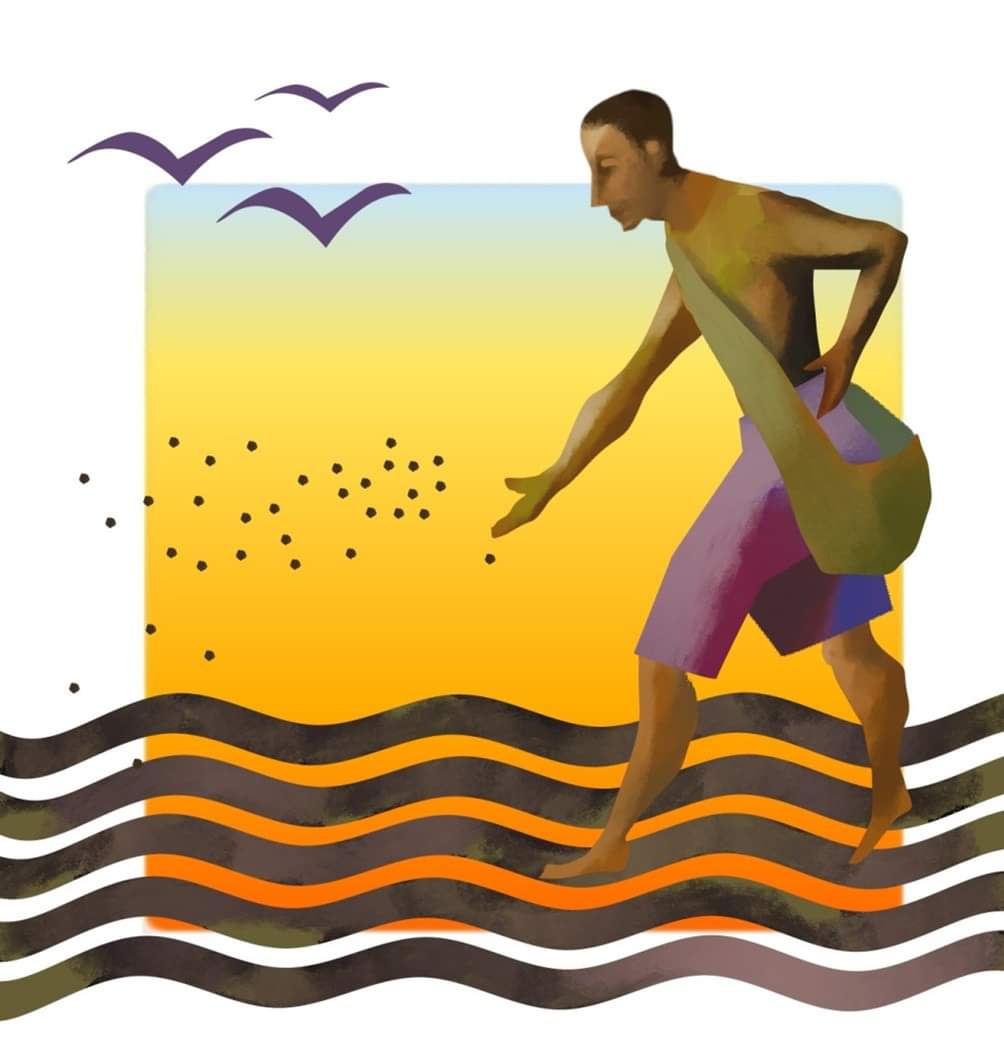
Jesus said: The way the Kingdom of God happens, the way love wins and justice prevails in our world, is like someone scattering seeds on the ground, and then, lies down and goes to sleep. Then, while they are not paying any attention to it, and are unable to explain it, the seed sprouts and grows. The earth produces “of itself.” The seed produces “of itself.”

I think it is hopeful to consider the Greek word translated “of itself.” The word is automatos. Sound familiar? It is where we get our English word “automatically.”

And for emphasis, the Greek places the word in the beginning of the sentence. When we scatter good seeds: “Automatically, the seed grows. Automatically, the earth produces. Automatically, the Kingdom of God happens.”

In miraculous ways that we cannot begin to understand, when we plant the right seeds, the Kingdom of God automatically happens.

I love Martin Luther’s interpretation of this parable. He said:

After I preach my sermon on Sunday, when I return home, I drink my little glass of Wittenberg beer, and I just let the gospel run its course.

In other words, after working with God scattering some good seeds, proclaiming the gospel that Jesus taught, enacted, and embodied, Luther knew he could take some time off, enjoy a Sabbath, or possibly, take a little vacation.

Because Luther knew that the power of his sermons to create a more just and peaceful world was not based on the power of his theological acuity, the eloquence of his words, or in his gifts as a community organizer. No amount of charisma or art of his persuasion could plant the gospel in such a way that it would grow, expand, and transform into something that looked like the Kingdom of God. That was only something that only God could do, organically, mysteriously, and miraculously. All he could do was scatter some good seeds.

This explains how I could go to the beach with my family last week and do absolutely nothing for seven days and still call myself a faithful disciple. And it explains how you can take a vacation too without the guilt of thinking you need to be doing more to make a difference in this world!

Now, I know telling you to “take a vacation” flies in the face of what you usually hear me say from this pulpit on Sunday mornings. And for that, perhaps I should apologize.

Since I have been your pastor, you could argue that you’ve only heard me preach one sermon. And that is: “We’ve got some work to do!”

If you were here a couple of weeks ago, you heard me say that God does not work alone in this world. Since the very beginning, God has called human beings to accomplish God’s divine purposes for the world. And I said that when God calls, God calls us to do some pretty big things! My sermon even inspired Johnny Louthridge to challenge Ken Burger end all wars and to bring peace on earth.

On Trinity Sunday, I called being a disciple of the Triune God a “dance”—a beautiful dance of selfless, self-expending love. God calls us to enter that dance, to get busy answering the call to love this world! On Easter Sunday, I said: “For Easter to happen, for love to win, for justice to prevail, we need to pick up and carry a cross!”

Attempting to make a difference in this world as a preacher, I am afraid I may have given the impression that it is up to us to do good in this world, or good will not be done. Through my sermons, you may have heard the blasphemous belief that we are the saviors of the world, that it is up to us, and only us, to set the world right, or the world will be lost.

This “only-I-can-fix-it” mentality can be very dangerous, not only to ourselves, but ultimately, to the world.

It is what causes preachers to burn out and followers of Jesus to check out. We look at the overwhelming gravity of the world’s problems, at all the violence and greed, the injustice and inequity, and we say: “There’s just no way we can make any real difference.” So, we throw our hands in the air and give up. Some take even a permanent vacation from church.

So, please forgive me if you heard me say that God created the world and then left it all entirely up to us. Pardon me if I have ever sounded like our country’s Deist founders who believed that God created the universe and then went on some cosmic vacation.

There’s a famous account of the great prophet, Sojourner Truth, while she was listening to a speech one day in 1852 by a despairing and nearly burned-out Frederick Douglass, who was questioning if slavery could end without slaves resorting to violence. From the audience, Sojourner Truth interrupted Douglass by shouting out a rhetorical question: “Is God dead?” Douglass said her interruption was like someone throwing a brick through a window!

Truth had faith that God had a central role in the quest towards the abolition of slavery. Truth believed that God not only created the world, but God is still creating. God not only sent and resurrected Jesus, but our God is still resurrecting, and is still sending God’s self through God’s Holy Spirit. Our God is not dead, inactive, or ineffective, but very much alive, active, and ever victorious!

And because of that, the good news is that we can go on vacation. Because God is continually acting, we can relish times of inactivity, reflection, and the good grace of doing absolutely nothing.

We can spend a lazy day, or seven, at the beach, because God’s reign in the world is growing and will continue to grow, day in and day out, year after year.

But there’s an important caveat for the faithful disciple who wants to take a break. There are a few terms and conditions we must consider. There’s an acknowledgement box that needs to be checked. And I know how most of us like to skip over all those words, scroll quickly down to the bottom so we can check the box and move on. But it’s important for us to take some time and actually read the terms and conditions that apply.

The problem with too many Christians today is that they’ll put their hand on the Bible to be sworn into public office and never open the Bible and read it!

It’s only okay to take a vacay, if we’ve been working with God scattering good seeds. We don’t get to take a vacation if all we’ve been doing is working against God sowing bad or mean seeds: seeds of division, seeds of fear, and seeds of hate.

And the good news is that if we are working with God sowing good seeds, they can be the smallest of seeds, like the mustard seed, which, when sown upon the ground, is the smallest of all the seeds on earth; yet it grows and becomes the greatest of all shrubs which puts forth large branches, so that the birds of the air can make nests in its shade.

Did you hear that?

Disciples are those who do something, even a little something, to cultivate structures and systems that provide shade, shelter, protection, and healthy living environments.

This is what working with God looks like in this world. And notice that this is not the first time we read about birds in this fourth chapter of Mark’s gospel. We read in verses three and four that the seeds that fall on the path are eaten up by birds that were hungry. Is it possible then, that those same hungry birds are the ones who will be able to make their nests in the shade and protection of the large shrub produced by the mustard seed?

The Psalmists certainly understood that the provision of protection, especially for the hungry and the poor, is paramount to the purposes of God. Listen to this prayer for those in power recorded in the seventy-second Psalm:

May [they] judge your people with righteousness and your poor with justice. May the mountains yield prosperity for the people, and the hills, in righteousness. May [they] defend the cause of the poor of the people, give deliverance to the needy, and crush the oppressor… May [they] be like rain that falls on the mown grass, like showers that water the earth… For [they] deliver the needy when they call, the poor and those who have no helper. [They have] pity on the weak and the needy and save the lives of the needy. From oppression and violence, [they] redeem their lives; and precious is their blood in their sight”(Psalm 72:1-6, 12-13).

The psalmist’s prayer underscores that “working with God” means working for a justice that emphasizes the well-being of the entire community, with special attention on behalf of the poor, the vulnerable, and the marginalized. “Working with God” means working to protect the least of these from being overpowered, exploited, or rendered landless, homeless, and destitute.

The psalmist prays that those with political, social, and economic power will be especially attentive to bring justice to the poor, to defend the cause of the poor, to protect the poor, and to crush those who would oppress them.

This is why we are working to charter a bus to Washington on June 29 to stand with the Poor People’s Campaign. Bishop William Barber compares this event to the march on Washington on January 6, 2021, saying:

We’re marching on Washington with a spirit of resurrection, not of insurrection—a non-violent resurrection of unity, not a violent insurrection of division.

In other words, we’re marching to combat hate, division, and an extremist political agenda by scattering seeds of new life, seeds that will sprout opportunity for people, especially poor people, to live lives that are protected and enabled to thrive.

We are scattering seeds to sprout: living wages for low-income workers; healthcare for all people; environmental justice; a ceasefire and humanitarian relief in Gaza and an end to genocide worldwide; just immigration laws; the restoration of the rights of women; adequate and affordable housing; a fully-funded public education; and full and expanded voting rights.

And when we do this work, when we get in lockstep with God, when we join that dance between the Father, Son and Holy Spirit, when we pick up and carry a cross, when we pray with the Psalmist, doing what we can individually, democratically and ecclesiastically to scatter seeds of justice, seeds of equity, seeds of mercy, and seeds of peace—because they are good seeds, because they are holy seeds—the fruits that God will produce from those seeds, the fruits of “love winning” and “God’s kingdom coming,” will be automatic!

The hungry will be filled with good things.

The lowly will be lifted up.

The mighty will be cast down from their thrones.

And then, we can rest from our labors.

We can take a vacation.

We can enjoy a sabbath.

And if we want, even this very afternoon, we can sit back with Martin Luther and sip a cold beer.  Amen.

Pentecostal Hope

Sermon preached at the Arkansas State Capitol, May 21, 2018, the day after Pentecost Sunday, following a march of the Poor People’s Campaign: A National Moral Call for Revival

For God so loved the world, that God came into the world to show us how to love our neighbors as ourselves—All of our neighbors, but especially our neighbors who have been pushed to the margins: the sick in need of healthcare; the immigrant in need of a home; the poor in need of a living wage; school children who just want to be safe; people of other faiths who hunger for respect; and people of color who thirst for their lives to matter.

Offended by the unsettling force of this inclusive love that proclaimed good news to the poor and liberation to the oppressed, that affirmed the rights of women and welcomed the children; afraid of this radical love that had the audacity to stand for liberty and justice for all, the privileged powers-that-be plotted against it, arrested it, and crucified it.

Three days later there were stories of a resurrection, a resurgence of this love. Because that’s the thing about this love. This love will not be defeated. No amount of obstruction or collusion can conquer this love. No amount of hush money can silence this love. There’s not enough nails in Jerusalem or bullets in Memphis or lies in Washington that can assassinate this love.

But the light of this love is such a threat to the systems that feed the darkness, the darkness will still try to find a way to overcome it.

Discrimination will be legalized under the guise of religious freedom. Voter suppression will be carried out under the guise of preventing voter fraud. Racist voter ID laws, gerrymandering, and sick religion will be used to disengage and disenfranchise minorities. People with different faiths and different ethnicities will be demonized and dehumanized by Caesar himself. More prisons will be built. New walls will be erected. Families will be separated.

However, yesterday, I went to church. I went to church, and I heard some good news from the second chapter of the book of Acts.

“When the day of Pentecost had come, they all came together in one place.”

“They all came together”—black, white and brown; Gay, Transgendered, and Straight; Democrat, Republican and Independent; Muslim, Jew and Christian.

“And there came a sound, like the rush of a violent wind, and it filled the entire house” where they had gathered. I believe the sound sounded something like: “FORWARD TOGETHER—NOT ONE STEP BACK!”

“Divided tongues, as of fire, appeared among them… All of them were filled with the Holy Spirit” of a love that was so inclusive, so radical, so audacious, that despite their different languages, when they spoke out together, they were heard with a miraculous clarity by all.

“But others sneered and said, ‘They are filled with new wine.’”

They’re a bunch of sore losers, entitled whiners.

“But Peter, standing with the eleven, raised his voice and addressed them: ‘Men of Judea and all who live [and work] in Jerusalem [and Little Rock and Washington], let this be known to you, and listen to what I say. Indeed, these are not drunk, as you suppose,

“No, this is what was spoken through the prophet Joel:
‘In the last days it will be, God declares,
that I will pour out my Spirit upon all flesh,
and your sons and your daughters shall proclaim prophetic justice,
and your young men shall see visions,
and your old men shall dream dreams.
Even upon [the poorest of the poor] both men and women,
in those days I will pour out my Spirit;
and they shall [proclaim good news to the poor and liberation to the oppressed]
And I will show portents in the heaven above
and signs on the earth…

[In other words, God is saying: “Through these people, through a new unsettling force of inclusive love, I am going to change the world!’]

“Awe came upon everyone, because many wonders and signs that were being done…”

The moral narrative changed. Walls came down. Chains were loosed. A blessed community was formed. Racism, sexism, Islamophobia, homophobia, and xenophobia were relinquished. Voting rights were restored. Fair living wages were paid. Unfair incarcerations ceased. Affordable housing, healthcare and education were available. All of creation was respected and protected. Clean water was consumed. Clean air was breathed.

And liberty and justice came. And it came for all. Not just to one race, one faith, and one nation. It came for every nation under heaven.

Truth came for all. Peace came for all. Mercy came for all. Love came for all.

Into the world’s darkness, light came for all, and darkness could not, cannot, and will not, ever overcome it!

I Pledge Allegiance

Poor People's CampaignDelivered at the Introduction Meeting of the Poor People’s Campaign at First Christian Church in Fort Smith AR, May 6, 2018

I

In America, I as an individual,have certain inalienable rights. As an individual citizen of this country, I have freedom. And with that freedom, I have a great responsibility. I have a voice. I have a vote, and I have the responsibility to make this country the very best that it can be. And that includes keeping our water safe, our air clean and our land pure.

Pledge allegiance

Our allegiance does not mean blindly accepting our faults, never questioning our past, and never second-guessing how current policies will affect our future. Allegiance means faithfully doing our part to “mend thine every flaw.”

It means being loyal, law-abiding citizens committed to our civic duty of voting in elections. However, it also means voicing opposition to laws that need to be changed and to elected officials who need be corrected. Civil allegiance sometimes means civil disobedience.

Like a faithful marriage, pledging allegiance means being loyal to our country in good times and in bad, in sickness and in health, for richer, for poorer, never giving up, never becoming complacent, never running away. It means perpetually praying for it, continually correcting it, forever fighting for it.

To the flag of the United States of America and to the Republic for which it stands

The flag is not a mere sign for our country. It is the profound symbol of our country. Signs are limited as signs only give information. Signs do not have the power to stand for something. Only symbols can do that. Whereas signs invoke intellectual responses from the brain, symbols elicit visceral emotions from the heart and gut. This is the reason seeing the Confederate Battle Flag flying on the back of motorcycles this weekend turned my stomach. The flag is not a mere historical marker, label, design or brand but a powerful symbol that stands for something. Flags have the power to move us, stir us, and guide us.

One nation

Our flag stands for one nation. Although heritage and culture are important aspects of life in different parts of our country, they are never more important than the unity of our country. Abraham Lincoln and Jesus spoke truth when they said: “a house divided against its self cannot stand.”

We need to come together not as liberal or conservative, republican or democrat but simply as Americans who believe we can do better and be better.

Under God

Not under God because we are down here and God is up there. Not under God because we want some sort of theocracy like the belief of ISIS and other Islamic extremists. And not under God because we believe we were established to be a Christian nation like the beliefs of Christian extremists.

Rather, we pledge our allegiance to country under, after, second to, our allegiance to the law of God.

As people of faith, this is why our allegiance is not blind. The Commander-in-Chief is not our chief commander. The Supreme Court is not our supreme being. Our allegiance is first pledged to something that is bigger than our nation, even larger than our world.

It is an allegiance that informs our vote, rallies our civic duties, admonishes our obedience to civil law, and yet, sometimes calls us to civil disobedience. For the Christian, it is the God revealed through the words and works of Jesus who becomes our civil conscience. We believe the law of God revealed through Christ supersedes every human law.

Immediately following words from the Apostle Paul regarding good citizenship and obeying the law, we read that every one of God’s laws is summed up in just one law: “You shall love your neighbor as yourself.” Jesus said it this way: “On this hang all of the laws of the prophets “…that you love your neighbor as yourself.”

And just in case some are still confused to what “love” is, Paul defines love by saying: “Love does no harm to a neighbor.”

Jesus said, “There is no law greater.” It is as if Christ is saying, “If you don’t get anything else from Holy Scripture, you need to get this: ‘love your neighbor as yourself.’” Yet, as evidenced by the amount of hatred, racism and violence that is in our nation today, much of it propagated in the name of God, this supreme law is widely ignored, disobeyed or rejected all together.

I believe it is when we first pledge our allegiance to this supreme law, that we have the opportunity to be a great nation. For when we love our neighbors as ourselves, when in everything we do to others as we would have them do to us, it quickly becomes “self-evident that all people are created equal with certain inalienable rights, that among these are life, liberty, and the pursuit of happiness.”

Indivisible

When we pledge allegiance to the supreme law of God, when we pledge to love our neighbors as ourselves, we promise to work together under God to build bridges to overcome the gaps and barriers that we have created that divide us: racial, sexual, ethnic, political, economic, educational and religious. We pledge to come together, side by side, hand in hand, for the equality of all people and the inalienable rights of all people.

This does not mean that we are to never disagree with the beliefs or lifestyles of others. We can certainly love our neighbor while disagreeing with our neighbor. It is not hating our neighbor when we disagree with the flag that our neighbor flies; however, when we infringe on their life, their liberty, and their pursuit of happiness by supporting public policies or actions that treat them as second-class citizens, that do harm to our neighbor, that keep the poor poor while keeping the rich richer, it is certainly not loving our neighbor as we love ourselves. As our 44thPresident said in the eulogy of Rev. Clementa Pinckney: “…justice grows out of recognition of ourselves in each other. [Our] liberty depends on [our neighbors] being free, too.”

With liberty and justice for all.

We pledge to work for freedom and fairness not just for our educated, rich neighbor who can afford the best attorneys, and not just for our advantaged, abled-bodied and able-minded straight, white, Christian, English-speaking neighbors. We pledge ourselves to stand for liberty and justice for all. And according to the Abrahamic faiths, “all” especially includes foreigners, minorities, the poor, the differently-abled, all those who have been pushed to the margins.

All even includes people of every nation. For our love and our mission to stand for liberty and justice have no borders.

In response to a call to include the rights of the LGBTQ community as civil rights, one of my friends raised the following question on Facebook, and to avoid being obscene, I am going to paraphrase: “They only represent 2% of the population. Why do they matter?”

This was not just one lone, ugly, hateful voice, but one that was representative of the sentiment of many.

“They only make up 2% of the population. Why do they matter?”

For the Christian who pledges his or her allegiance to the flag of the United States of America, and to the Republic for which it stands, one nation, under God, indivisible, with liberty and justice for all: LGBTQ+ lives matter; Black lives matter; Poor People’s lives matter, because according to everything for which this flag stands under the supreme law of the God of love, all lives will never matter, until all finally means all.