Hanging Between Heaven and Earth is

2 Samuel 18:5-9, 15, 31-33 NRSV

John 6:35, 41-51 NRSV

How many times have you been the object of misdirected grief and frustration? Maybe it came from a loved one, a close friend or perhaps a spouse. Out of nowhere they snap at you with this unprovoked ferocity to which you quizzically respond: “Why are you yelling at me?” “What on earth did I do?”  To which they respond: “I am not mad at you. You just happen to be the only one in the room.”

Perhaps we have all been the victim of such misdirected grief. And perhaps all of us have expressed such misdirected grief and frustration. We’ve given it to our spouses. We’ve given it to our children. We’ve given it to our friends. We may have even given it to total strangers.

And then there are those times when we are so filled with pain and grief that our screams of pain are completely undirected. There are some experiences in this broken world which are so painful and so dreadful they cause us to scream out whenever, wherever, to whomever or whatever. Sometimes our screams are loud reverberations. And sometimes our screams are silent aches. They are the unavoidable, gut-wrenching responses to the frequent tragedies of life.

Sometimes it happens after a bitter argument with a loved one. It may occur after receiving a grim diagnosis. It could happen after a serious injury or during a prolonged illness. It might happen after visiting a loved one in the nursing home, or in the doctor’s office, or an ICU waiting room.

It could happen while listening to the outrageous lies from a presidential candidate during a press conference. Or listening to bigotry, racism and misogyny that sounds more like is coming from 1924 than 2024. Or when a white supremacist compares himself to Martin Luther King Jr.

And sometimes it just happens out of nowhere. We scream out in grief, sometimes aloud, sometimes silently—a scream of shock and disbelief, a scream of anger and frustration, a scream of anxiety and fear, a scream of bitterness and hopelessness. We scream out whenever, wherever, to whomever and whatever.

So, perhaps we can empathetically relate to the undirected and undeveloped cries of King David. When David learned that his son Absalom had been found slain, his body in a tree (and I love the way this is worded on our text) “hanging between heaven and earth,” David painfully and relentlessly laments aloud to no one in particular. Later we read in verse 33: “The king was deeply moved, and went up to the chamber over the gate, and wept; and as he went, he said, ‘O my son Absalom, my son, my son Absalom! Would that I had died instead of you, O Absalom, my son, my son!’”

The cries of David are like our cries when we have been overwhelmed with profound grief. They are fearful cries oftentimes addressed to the wind. They are angry cries. And they are hopeless cries.  They are cries of utter despair. Walter Brueggemann calls the words of David “unformed, pathos-filled grief…addressed to no one in particular, surely not to the God of hope.”[1]

Like his son Absalom, David himself was hanging somewhere between heaven and earth.

David was not addressing God, as, at the time, he was probably questioning the very existence of God. He cried out like I suspect most parents would, whenever, wherever and to whomever.  His cries were undirected and undeveloped.

And yet, I do not believe his cries were unheard. One of the greatest lies I hear from some evangelicals that is that God only hears the prayers of Christians.

Let me call your attention to a wonderful passage of scripture found in the second chapter of Exodus. We read that the Israelites in Egypt groaned under their slavery. The scripture tells us that they groaned and cried out.  Much like King David, their cries of grief and frustration and despair were undirected and unformed. Yet, we read that “out of their slavery, their cry for help rose up to God. God heard their groaning. God looked upon them and God took notice of them” (Exodus 2:24).

The cries of the Israelites, the cries of David and the cries of you and the cries of me may be undirected but they are never unheard. Our cries may be undeveloped groanings, but they are always understood.

The good news is that although David’s “primal scream” addressed into the wind is initially one of desperate despair, it can be interpreted as the first step to hope. God hears our undirected and undeveloped cries.  God hears our loud reverberating cries and our silent aching cries. God sees us when we are hanging somewhere between heaven and earth. Although we may not address heaven, although we may doubt the very existence of heaven, heaven sees us and heaven hears us and heaven takes notice of us.

The wonderful truth is that God hears our pain. As Paul Duke has said, we can “pray our pain.”[2]  Isn’t that wonderful?  We can pray our pain.  In fact, I believe our pain might be our best prayers in that they are probably our most honest prayers. Our most disjointed and incoherent groans into the wind may be our most articulate and eloquent prayers to the God of hope. The good news is that some of our best communication to God, some of our best talks with our creator may be what Fred Craddock calls “praying through clenched teeth.”[3]

Dr. Ernie White, one of my seminary professors who was stricken with cancer while I was a student, shaped my theology when one day he told the class, that although he could not explain it, somehow, someway, the sicker he got, the more pain he experienced, the more hopeful he became. He said that it was in his weakest moments when he felt the closest to God.

The Psalmist proclaims: “When we cry out from the depths, the Lord hears our voices. Let us wait for the Lord, and hope in God’s word” (Psalm 130).

Hanging between heaven and earth, crying out from the depths whenever, wherever, and to whomever, God hears us. And if we will wait for the Lord, I believe we will hear wonderful words of life and hope. As the psalmist proclaims, we will know a steadfast love which has great power to redeem.

Hanging between heaven and earth, Jesus to say to us:

I am the bread of life. Whoever comes to me will never be hungry…  I am the bread that came down from heaven.”  “Very truly I tell you, whoever believes has eternal life. I am the bread of life. Your ancestors ate manna in the wilderness, and they died. This is the bread that comes down from heaven, so that one may eat of it and not die. I am the living bread that came down from heaven. Whoever eats of this bread will live forever; and the bread that I will give for the life of the world is my flesh.

God, the holy Creator of all that is, is even now lovingly emptying God’s self and pouring God’s self out for us. Revealing to us that God is here with us, not away from us; God is here for us and not against us.  God is here meeting us in the depths of our pain, offering us the very best gift God has to offer, the gift of God’s holy self.

God is working in this fragmented world recreating and resurrecting, working all things together for the good, doing all that God can do to “wring whatever good can be wrung out” of the tragedies of life.[4]  Although we can never go back before the injury, before the illness, before the diagnosis, before the argument, before our job was lost, before our relationship ended, although we cannot go back to the good old days, we can go forward with God into good new days.

Although our screams may be undirected, they are never unheard. Although our cries may be undeveloped, they are divinely and empathetically understood.  We can pray our pain.  And if we wait and hold on somewhere between heaven and earth, God, the bread of life, comes down to meet us in our pain and to envelope us with God’s steadfast love which has the power to redeem our deepest despair into our highest hope.

We will then be compelled to share this hope. For we each know someone who is even now hanging somewhere between heaven and earth—hanging and crying out aimlessly and hopelessly.

They may be a member of this congregation: awaiting test results that are a matter of life and death; dropping of their child off at a university far away from home, sitting alone grieving the loss of their loved one. They may be a family member, a neighbor or a co-worker, facing the most difficult days of their lives.

The cries come from parents of school children in Gaza crying out in the grief after losing their children to indiscriminate bombs. They come from parents in Israel who still have no word from their kidnapped loved ones. They come from our southern border, from asylum seekers, many who are LGBTQ, seeking a life free of violence and oppression. They come from hospitals in states where women are denied healthcare. They come from people right in here in Lynchburg who are denied a living wage by their employers. They come from parents of children going back to a school where their child bullied by students and the administration. They come from cities and communities who have experienced devastating flooding, gun violence, and polluted drinking water.

We need to demonstrate with our steadfast love, with our words and our deeds, with our voices and our votes that God hears them, and God loves them. Although at the time it may be difficult for them to believe that God even exists, God hears them and God understands. We are being called to wrap our arms around them and feed them bread—bread not to merely get them by until their next meal, but bread from heaven which has about it what New Testament Scholar Charles Cousar calls “the tang of eternity.”[5]  With all that we are and all that we have, we are called to empty ourselves, pour ourselves out to feed them the bread of hope which satisfies now and forevermore.

[1]Walter Brueggeman, Charles B. Cousar, Beverly Gaventa, James D. Newsome. Texts for Preaching: A Lectionary Commentary Based on the NRSV—Year B. (Louisville, Kentucky: Westminster/John Knox Press, 1993) 460.

[2]Paul Duke, “First Prayer from the Ashes” Review and Expositor 4 (1992): 618.

[3]“Praying Through Clenched Teeth” is the title of a sermon by Fred B. Craddock included in The Twentieth Century Pulpit, Vol. 2, ed. James W. Cox (Nashville: Abingdon Press, 1981) 47-52.

[4]This quotation is from sermons by John Claypool that I have been privileged to hear at various conferences.

[5]Brueggeman, Cousar, Gaventa, and Newsome. Texts for Preaching, 463.

When God Refuses to Listen

heather in ainsleys chair

Isaiah 1:1, 10-20 NRSV

I like to be honest from this pulpit. I like to be real. So let’s be really honest this morning. Have you ever prayed and had the feeling that God’s not listening?

You come to this place of worship and you go through all of the motions. You sing all of the hymns. You actually pray during the moment of silence, instead of spending those moments planning the rest of your day. You listen reverently to the choir’s anthem, and like few people, you even listen intently to every word of the sermon. But as the organist begins playing the prelude, you wonder if it was all just a big waste of time.

I believe this is a reason some people stay home on Sunday mornings. They are not getting through to God and God isn’t getting through to them. Sometimes, they blame it one the music. They say that the music just doesn’t inspire them. But most of the time, it is the preacher’s fault. They usually say something like, “I am just not being fed anymore at that church.” Have you heard that before?

Well, Isaiah suggests that their belief that worship is a waste of their time, that God is not listening, is not the choir director’s fault, and it may not be the preacher’s fault either.

Isaiah says that the reason that you may feel like worship is not bringing you close to God, the reason you don’t feel like God is listening, the reason that you feel like God has not heard a word you’ve said is because God has not been listening to a word you’ve said.

Isaiah says that if we truly want to know that God is listening to us, if we truly want to feel close to God, if we want our worship on Sunday to mean something, there are some things that we must do.

And if we don’t do those things, according to Isaiah, God might respond to our worship this way: “What are your services to me? I have had it up to here, I am sick to my stomach of all your worship! I have no desire for any of it. Stop tramping into my courts. And I have had enough of your preacher with his fancy robe who thinks he is all that with all of his seminary degrees. Your prayers, your hymns, they have become a burden to me. I have stopped listening!”

So, according to Isaiah, what must we do to be heard by God?

Put away the evil of your deeds. Pursue justice and champion the oppressed, give the orphan his rights, plead the widow’s cause.

If we want to be heard by God, if we want worship to be meaningful, Isaiah says that we better doing what we can help the most vulnerable members of our community.

My friend Rev. Dr. William Barber has he wonders why we spend so much time doing the things about which “God says so little” while spending so little time on the things about which “God says so much.”

I wonder if Isaiah is suggesting that the church might re-evaluate our ministry-team meetings. Like any congregational-led church, we have a lot of meetings here. We are having several tonight.

If Isaiah was here, he might ask us: “What has been the subject of your longest, most arduous church meeting? What was the agenda of that meeting that caused your spouse at home to worry about you, or even question your whereabouts, because they thought you should have been home hours earlier?”

Was it about how our church could could advocate for those in our community who feel oppressed? Was it about meeting the needs of children who do not have the support of family? Was it about defending the rights of widows or the rights of the most vulnerable members of our community? Was the agenda something about which God says so much? Or was the agenda something about which God says so little?

Rev. Michael MacDonald writes that many Christian Americans not only never have any lengthy church meetings about how they can better serve the poor, they just simply have a bad attitude about serving the poor. So bad, that many folks probably wished they had the license to rewrite the many scriptures which speak for the poor.

I would argue that many people actually believe they have such a license. Because as a pastor, it has been my experience that whenever I have spoken on behalf of the poor and the vulnerable, someone almost always accuses me of being a “liberal.” Then, they will something like, “The Bible says that God helps those who help themselves.”

When in fact, the overall message of the Bible says nothing close to that. Aesop’s Fables say that. Benjamin Franklin said that. Thus, I want to respond: “Who’s the liberal here? The one who is conserving the Judeo-Christian teachings of the Scriptures to help the poor and champion the oppressed, or the one who is re-writing the scriptures with the words of a fable or Deist Ben Franklin?”

For example: This is how McDonald said some Americans would rewrite the story of the Good Samaritan:

The lawyer asked, “And who is my neighbor?”

Jesus replied, “Now by chance a priest was going down the road from Jerusalem to Jericho and saw a man who was hungry and ill clad.  He thought about stopping to help him, but decided that the man had probably been planted there by advocates for the homeless, so he walked by on the other side lest he give encouragement to those who wanted to divide society along class lines in order to gain political power for themselves.

So, likewise a Levite, when he came to the place and saw him, thought about helping him. But the Levite was afraid that he would rob the man of his independence, and he could plainly see that the man had sandal straps by which to pull himself up. So, he too, passes by on the other side.

But a Samaritan came near him and was moved by self-righteous pity. The Samaritan bandaged his wounds pouring oil and wine on them, no doubt as a publicity stunt to make his own self feel good and look good before his peers.

Then the Samaritan put the man on his own animal and brought him to an inn. The next day, he took out two denarii, gave them to the innkeeper and said, “Take care of him; and when I come back, and will repay you whatever more you spend,” thus encouraging the injured man to live like a parasite off other people’s hard-earned wealth.

Which of these three do you think was a neighbor to the man?  The lawyer said, “[Well of course] the two who showed him mercy by walking by on the other side.”

And God says, “You can pray without ceasing, but I won’t be listening. I won’t listen to those of you who pervert justice, those of who champion the cause of the rich and powerful, those of you who take advantage of the powerless. God ahead, have yourselves a worship service, have two of them, but I won’t be there.” God says, “I simply don’t listen to the prayers of those who are all about feeding themselves while orphans and widows, the disadvantaged and the vulnerable, go hungry.”

I believe Baptist evangelist Tony Campolo is right when he says that the one thing every Christian should do is not only write a check to help the poor, but help the poor in such a way that we actually build a relationship with them, get to know them on a personal level.

When I have been in conversations with churches about feeding the food-insecure, I always say that I believe we should merely hand them a meal.

I believe we should to sit down at the table with them, and get to know them, listen to them, love them, befriend them, be family to them. Let them know that we are willing to fight for them, defend their rights and plead their case. Be there to help them become the person that God is calling them to be.

Campolo says, in a way that only a good ol’ Baptist could say it, that one important reason that Christians should want to actually sit down at the table with people who are poor is because on the last day, when you are standing before the Great Judge, as God is separating the sheep from the goats and points to us and asks the question, “When have you clothed the naked, fed the hungry, given drink the thirsty, when have you shown generosity to the least of these my brothers and my sisters?”—That is when you are going to want to have the new friend you met around that table standing beside you, and you are going to want to be able to turn to them pat them on the back, and say with a confident smile, “Go ahead, you tell it.”

Do you want to come to this place on Sunday morning and really have an encounter with God? When Mary Beth begins playing the Postlude, do you want to know that you have actually communed with the creator of all that is? Isaiah, and I believe Jesus says, that will depend on how you commune with the most vulnerable members of our community.

When God Refuses to Listen

NotListening1

Isaiah 1, 10-20 NRSV

I like to be honest from this pulpit. I like to be real. So let’s be really honest this morning. Have you ever prayed and had the feeling that God’s not listening?

You come to this place of worship and you go through all of the motions. You sing all of the hymns. You actually pray during the moment of silence, instead of spending those moments planning the rest of your day. You listen reverently to the choir’s anthem, and like few people, you even listen intently to every word of the sermon. But as the organist begins playing the prelude, you wonder if it was all just a big waste of time.

I believe this is a reason some people stay home on Sunday mornings. They are not getting through to God and God isn’t getting through to them. And Randy, as the Choir Director, guess what? Sometimes, they say it is your fault. They say that the music just doesn’t inspire them. But most of the time, it is the preacher’s fault. They usually say something like, “I am just not being fed anymore at that church.” Have you heard that before?

Well, Randy, I have some good news for us! Isaiah suggests that their belief that worship is a waste of their time, that God is not listening, is not the choir director’s fault, and it may not be the preacher’s fault either.

Isaiah says that the reason that you may feel like worship is not bringing you close to God, the reason you don’t feel like God is listening, the reason that you feel like God has not heard a word you’ve said is because God has not been listening to a word you’ve said.

Now, I believe that the entire Bible and Jesus himself came and taught us that God operates by something we call grace. Salvation, and prayer for that matter, conversation with God, a personal relationship with God can not be earned, and it is in no way deserved. “We are saved by grace and not works lest anyone should boast.” I know that.  And I believe that with all of my heart.

However, Isaiah says that if we truly want to know that God is listening to us, if we truly want to feel close to God, if we want our worship on Sunday to mean something, there are some things that we must do.

And if we don’t do those things, according to Isaiah, God might respond to our worship this way: “What are your services to me? I have had it up to here, I am sick to my stomach of all your worship! I have no desire for any of it. Stop tramping into my courts. And I have had enough of your preacher with his fancy robe who thinks he is all that with all of his seminary degrees. Your prayers, your hymns, they have become a burden to me. I have stopped listening!”

So, according to Isaiah, what must we do to be heard by God?

Put away the evil of your deeds. Pursue justice and champion the oppressed, give the orphan his rights, plead the widow’s cause.

If we want to be heard by God, if we want worship to be meaningful, Isaiah says that we better doing what we can help the most vulnerable members of our community.

My friend Rev. Dr. William Barber has he wonders why we spend so much time doing the things about which “God says so little” while doing so little of the things about which “God says so much.”

I wonder if Isaiah is suggesting that the church might re-evaluate our committee meetings. Like any congregational-led church, we have a lot of committee meetings here. Isaiah may want us to ask: “What has been the subject of your longest, most arduous church meeting? What was the agenda of that meeting that caused your spouse at home to worry about you, or even question your whereabouts, because they thought you should have been home hours earlier?”

Was it about how our church could could advocate for those in our community who feel oppressed? Was it about meeting the needs of children who do not have the support of family? Was it about defending the rights of widows or the rights of the most vulnerable members of our community? Was the agenda something about which God says so much? Or was the agenda something about which God says so little?

Rev. Michael MacDonald writes that many Christian Americans not only never have any lengthy church meetings about how they can better serve the poor, they just simply have a bad attitude about serving the poor. So bad, that many folks probably wished they had the license to rewrite the many scriptures which speak for the poor.

I would argue that many people actually believe they have such a license. Because as a pastor, it has been my experience that whenever I have spoken on behalf of the poor and the vulnerable, someone almost always accuses me of being a “liberal.” Then, they will something like, “The Bible says that God helps those who help themselves.”

When in fact, the overall message of the Bible says nothing close to that. Aesop’s Fables say that. Benjamin Franklin said that. Thus, I want to respond: “Who’s the liberal here? The one who is conserving the Judeo-Christian teachings of the Scriptures to help the poor, or the one who is re-writing the scriptures with the words of a fable or Deist Ben Franklin?”

For example: This is how McDonald said some Americans would rewrite the story of the Good Samaritan:

The lawyer asked, “And who is my neighbor?”

Jesus replied, “Now by chance a priest was going down the road from Jerusalem to Jericho and saw a man who was hungry and ill clad.  He thought about stopping to help him, but decided that the man had probably been planted there by advocates for the homeless, so he walked by on the other side lest he give encouragement to those who wanted to divide society along class lines in order to gain political power for themselves.

So, likewise a Levite, when he came to the place and saw him, thought about helping him. But the Levite was afraid that he would rob the man of his independence, and he could plainly see that the man had sandal straps by which to pull himself up. So, he too, passes by on the other side.

But a Samaritan came near him and was moved by self-righteous pity. The Samaritan bandaged his wounds pouring oil and wine on the, no doubt as a publicity stunt to make his own self feel good and look good before his peers.

Then the Samaritan put the man on his own animal and brought him to an inn. The next day, he took out two denarii, gave them to the innkeeper and said, “Take care of him; and when I come back, and will repay you whatever more you spend,” thus encouraging the injured man to live like a parasite off other people’s hard-earned wealth.

Which of these three do you think was a neighbor to the man?  The lawyer said, “[Well of course] the two who showed him mercy by walking by on the other side.”

And God says, “You can pray without ceasing but I won’t be listening. I won’t listen to those of you who pervert justice, those of who champion the cause of the rich and powerful, those of you who take advantage of the powerless. God ahead, have yourselves a worship service, have three of them, but I won’t be there.” God says, “I simply don’t listen to the prayers of those who are all about feeding themselves while orphans and widows, the disadvantaged and the vulnerable, go hungry.”

I believe Baptist evangelist Tony Campolo is right when he says that the one thing every Christian should do is not only write a check to help the poor, but help the poor in such a way that we actually build a relationship with them, get to know them on a personal level.

This is what I want to do when we begin feeding the food insecure later this year as the prelude to a new worship service. I don’t want to merely hand them a brown paper bag lunch out the back door, with perhaps a scripture verse stapled to it, or a religious tract thrown inside of it, and then encourage them to go someplace else to eat it, out of sight, out of mind.

I want us to sit down at the table with them, get to know them, listen to them, love them, befriend them, be family to them. Let them know that you are willing to fight for them, defend their rights and plead their case. Be there to help them become the person that God is calling them to be.

Campolo says, in a way that only a good ol’ Baptist could say it, that one important reason that Christians should want to do this is because on the last day, when we are standing before the Great Judge, as God is separating the sheep from the goats and points to us and asks the question, “When have you clothed the naked, fed the hungry, given drink the thirsty, when have you shown generosity to the least of these my brothers and my sisters?”—That is when you are going to want to have the new friend we met around that table standing beside us, and we are going to want to be able to turn to them with confidence, pat them on the back, and say with a smile, “Go ahead, you tell it.”

Do you want to come to this place on Sunday morning and really have an encounter with God? When Terri begins playing the Postlude, do you want to know that you have actually communed with the creator of all that is? Isaiah, and I believe Jesus says, that will depend on how you commune with the most vulnerable members of our community.

Prayer Works. So Let’s Go to South Carolina!

Missions TrailerEastern North Carolinians, including myself, know the devastation of flood waters all too well. That is why we have been praying for our neighbors throughout South Carolina. We pray, because we believe prayer works.

Pope Frances once said this about prayer: “You pray for the hungry. Then you feed the hungry. That’s how prayer works.”

Prayer works, and prayer creates work.

Prayer generates empathy and sacrificial efforts. Prayer fosters unreserved love and extravagant acts of grace. Prayer encourages boundless compassion and generous acts of mercy. Prayer creates risk. Prayer creates responsibility.

So you know what this means, don’t you? If we have been praying for South Carolina, and we believe prayer works, then we must go to South Carolina and work!

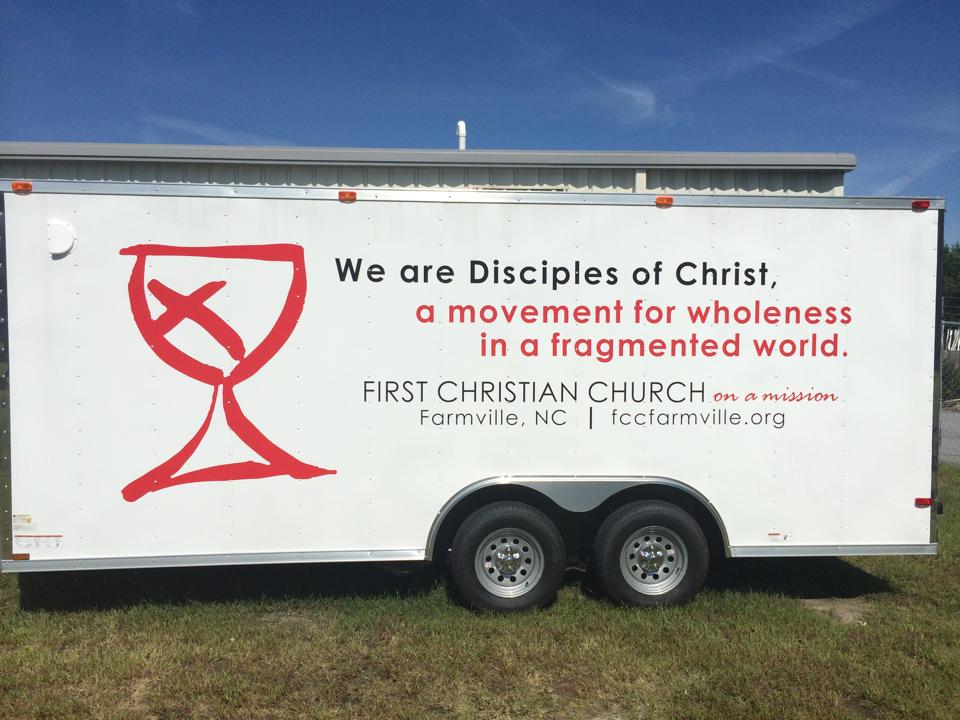
First Christian Church recently purchased a missions trailer that we are currently stocking with tools, materials and supplies to help our neighbors in times such as this. We are planning to lead a mission trip to South Carolina November 15 – 21. We welcome all who have been praying for South Carolina to join us.

If you are interested in donating or participating in any way, please contact our church office at (252) 753-3179. You may also contribute by supporting our Fall Festival for Missions on November 7.

And please, keep praying!

Prayer Works

Quilting Bees 1

James 5:13-20 NRSV

For perhaps too many weeks now, maybe too many months, our scripture lessons have been pointing out the things that are not right within the church. They have been pointing out the sins of the church. They spoke about disciples being ashamed of the gospel: ashamed of the extravagant grace and unrestricted love of the gospel. They pointed out the hatred, bigotry and racism that is present in society, but also in the church. They talked about the temptation to do what is popular instead of what is holy. They spoke about the dangers of following the laws of culture instead of the supreme law of God to love our neighbors as ourselves. And last week, the scriptures said to be a consecrated church, to be a blessed church, we need to stop worrying about how to be the greatest and start worrying about the least, the poor, and the marginalized.

Well, today, it appears that we may finally be off the hook, as our scripture lesson this morning focuses on some things that I believe are very right within the church.

“Are any among you suffering?” James asks. “Then you should pray.”

Hallelujah, we got that, James!

For this is one thing that we are actually pretty good at doing! We will certainly pray for one another, especially if we hear that another among us is suffering.

One of the comments that I hear frequently from church people who have experienced some form of suffering is: “I just don’t know how people who do not have a church family make it in this world.”

You say that, because you truly mean that. You say that, because when you needed your church the most, people in the church prayed for you. People in the church cared for you. When you suffered, people in the church came to your side and suffered alongside you, offering you mercy and compassion, love and grace.

As Paul wrote to the Corinthians: “When one part of the body suffers, we all suffer” (1 Cor 12:26).

James continues: “Are there any among you cheerful? Then sing songs of praise.”

Amen, brother James! We got that too!

This past Wednesday night, when we heard Ann Byrd and Myrtle Sugg had turned another year older, we cheerfully put our voices together and sang “Happy Birthday!”

For as Paul also said, “When one part of the body rejoices, we all rejoice!”

James goes on: “Are any among you sick? They should call for the elders of the church and have them pray over them, anointing them with oil in the name of the Lord.”

Oh, we are quite good at that too, brother James!

One of the first things we do when we hear someone has been hospitalized, has become ill, has lost a loved one, or has been bitten by a dog, is to email the Elders.

Then, although we may not use olive oil like it was used in the first century, we do participate in other acts of “personal touch,” other forms of “laying on of hands,” to bring healing, to foster wholeness and peace. And we do it the name of the Lord.

As most of you know, we have a wonderful prayer quilt ministry here. We have a group that meets monthly to make the quilts that we pass around to the entire congregation, so each member of the church can prayerfully lay their hands on each quilt, before we present it to the person who is suffering. It is a truly wonderful ministry.

Then, James reminds us that prayer works. Prayer changes things. Prayer changes people. Prayer brings healing; sometimes physical; always, always spiritual. Prayer, says James, helps us to forgive one another. Prayer “saves.” And the Greek word translated “save” here, is sozo, the same word that we use when we talk about “salvation.”

And then James tells a story to back it up, a wonderful story about Elijah and the power of prayer.

James, we are with you 100 percent! Preach it brother! For we also have our stories.

Just last Sunday afternoon, I visited an elderly widower in his home. He shared his joys with me. I shared mine. Then, the shared some of his sorrows. He shared his sufferings. He talked about his failing health and his frail body. He talked about a new medication that the doctors were trying. Dr. Barrow, we laughed together, when he said, “You know doctors, though. They only practice medicine.” I said, “Just like preachers: “we only practice faith.” Then he got serious, as he said, “So, only God knows if I am going to get any better.”

After we talked a little more, we joined hands, we bowed our heads, and we prayed together. After we prayed, he took out a handkerchief, removed his glasses, and wiped tears from his face.

Then, with a grin that emitted pure joy, he said, “I know I am going to be fine. I am going to be fine. I am going to be fine one way or another. Whether I get better, or whether I go to be where my wife is. God knows, either way, I am going to be fine.”

Prayer works. Prayer changes things. Prayer changes people. Prayer raises people up. Prayer saves people. Sometimes physically; always, and most importantly, spiritually.

And, all of us inside the church have countless stories to back it up.

So, Amen again brother James! Preach it! As Bobby Jr. says, “You got that right!”

But brother James…oh, he’s not finished with us yet.

Listen to how biblical scholar, Eugene Peterson, puts it:

My dear friends, if you know people who have wandered off from God’s truth, don’t write them off. Go after them. Get them back and you will have rescued precious lives from destruction and prevented an epidemic of wandering away from God. (James 5:19-20 MSG).

Hmmm, not only does prayer work, prayer is work!

So, maybe, we are not so much off the hook this week after all. For we would all confess that this is an area that is not always right within the church.

Most churches are pretty good about being a community of care of concern. We are good about praying for one another and rejoicing with one another. The bad news is: we are also good about sometimes writing people off. Where we sometimes struggle is working to bring others into our community.

For churches generally have programs and ministries that are geared to meet the needs of primarily whom?

They have shepherding programs, prayer shawl or prayer quilt ministries, prayer meetings, Bible studies, hospital visitation teams, homebound ministries, bereavement care, youth and children’s programs for whom?

For folks outside of the church?

Or for folks inside of the church?

Do you remember one of the first things that I led us to do as the pastor of this church? I said that we really needed to fix our stained glass windows as soon as possible. The Plexiglass that protected our beautiful stained glass windows depicting the good news of Christ were tarnished so badly on the outside, that our windows could only be seen by those of us on the inside the church.

I said, “aesthetically speaking,” it was “horrendous;” but “theologically speaking,” it was a “disaster.” I said that we needed to make sure that we were always working to share the good news of Christ with those who are on the outside of the church.

Do you remember what one of the first things we heard from folks who questioned us having a community garden?

Someone asked: “What if someone who doesn’t belong to the church comes by and steals your tomatoes?”

And we responded, “Isn’t that the whole point?”

One thing that I love about our church, and one of the reasons that I believe we continue to grow, is that we are moving well past a ministry model that focuses on the needs of the membership and moving toward a ministry model that focuses on the needs of the community.

The good news is: when I ask for a prayer quilt, no one asks me: “Well, pastor, is this for a member of the church?”

The good news is: when we get a request to build a handicap ramp, no one asks, “Is this for someone we know?”

The good news is: when I ask the outreach ministry team for some money to pay someone’s utilities, no one questions: “Does this person really deserve our help?”

The good news is: when I ask you to pray for someone, no one asks: “What church do they belong to?”

The good news is: no one here batted an eye when the town wanted to have a meeting in the fellowship hall to discuss Pitt Community College coming to Farmville. And, as far as I know, no one even raised an eyebrow when they asked us to serve them a meal.

The good news is: I know of no one who got upset when the Methodist church in town borrowed our van to go on a mission trip. And no one even flinched when money was allotted to send a mission team from our church back to West Virginia.

And, the good news is: I know of no one who criticizes me for spending time ministering to those outside of our church, like the elderly widower with whom I spent part of last Sunday afternoon.

Because you get it.

Prayer works. Prayer changes things. Prayer changes people. Prayer heals. Prayer raises people up, and prayer saves.

And we have stories to prove it.

And, as James reminds us, prayer is not just for us.

Prayer is for all.

And all means all.

Prayer works, and prayer creates work. Prayer generates selfless and sacrificial efforts. Prayer fosters acts of extravagant grace and unrestricted love. Prayer encourages generous mercy and boundless compassion. Prayer creates risk. Prayer creates responsibility. Prayer creates a church with wide open doors and a wide open table.

Yes, you are right. I don’t know how people who do not have a church family make it in this world.

So, let’s keep praying and let’s keep working. Let’s keep sacrificing. Let’s keep giving, and let’s keep risking to invite and to welcome them into our church family, showing them by our extravagant grace and unrestrictive love, through our generous mercy and boundless compassion, that prayer works.

Prayer works, indeed.

Prayer for Emanuel AME Church and the Global Church

names charleston

The following prayer is a response to a joint pastoral letter from the Disciples of Christ in SC and NC written for a prayer vigil held at the Mt Moriah Community Church in Farmville, 9 am, June 20, 2015.

Good and gracious God, Father and Mother of us all,

Hearts shattered, souls lamenting, bodies languishing, and minds enraged,

We gather together with our members of our family of faith here in Farmville to grieve alongside our sisters and brothers in Charleston, praying that they will know a peace that is beyond understanding. May those who have lost loved ones be comforted knowing that you are suffering with them, and so are we.

We gather to support the leaders and the members of the Emanuel AME Church, praying that they will be led by your wisdom, endowed by your love and empowered by your courage to continue to live selflessly boldly proclaiming good news to the poor, freedom to the imprisoned and recovery of sight to the blind, setting free all who are oppressed.

We gather to stand with the leaders of the African Methodist Episcopal Denomination, praying that they will persist and prevail courageously ministering to the social, spiritual and physical development of all people.

We gather in prayer for all African American churches who worship, serve and love their neighbors under the constant threat of persecution by the demonic forces of our time. May they be emboldened by remembering the words of their Lord and Savior and rejoice and be glad, for great is their reward in heaven, for in the same way the prophets were persecuted before them.

We gather to pray for the city of Charleston, the political leaders of our cities, states and country, and for the Body of Christ spread throughout our land. We pray for boldness in naming the sin of racism in our lives, our church and our country. We pray for fortitude in confronting racism, in all of its manifestations. And we pray for courage in confronting hatred and violence in all of its manifestations.

And we also gather this day O God to pray for the Body of Christ here in our own community. Forgive our division. Forgive our segregation. Forgive the barriers we have erected: racial, ethnic, and socio-economic. Forgive the chasm of fear that we have created. Forgive our failure to build bridges between the churches here in our own town. Forgive our failure to come together in the name of Christ, one body following one Lord, to stand for justice and equity for all of our citizens. Forgive us of our failure to truly love our neighbors as we love ourselves.

Forgive us, O God, and envelop us with your grace. Grant us your guidance, will and determination to follow the Christ together in the steps that he is leading us next. It is in the name of Christ Jesus our Lord who unites us all we pray, Amen.

A Runner’s Prayer

MARTATHON-1

Someone recently asked me how she should pray for me this weekend during the marathon.

She even had the audacity to ask: “Do you want me to pray that you win the race?” 

First of all, let’s get something straight. The winner of the marathon will have time to take a shower, eat some brunch, update their facebook status, and take a nap before I cross the finish line!

Then she asked, “Or do you want me to pray that you don’t get injured and are just able to finish the race?”

Now, that is a better prayer.

However, I do not believe it is the best prayer.

The truth is that I ought to be grateful that I have the health and the ability to risk injury.

The real miracle on Saturday will not be that I finish the race, but that I have the opportunity to start the race.

So if you want to pray for me this weekend, don’t pray for my legs.

Instead, pray for my eyes.

Pray that my eyes may see the sheer grace of this mystery we call life, this miracle we call the world.

Pray that my eyes may see that all that I have and all that I am is an unearned and undeserved gift of God’s amazing grace.

And then, maybe, having seen the sheer grace and absolute glory of it all—the gift of my great friends, the gift of my wonderful family, the gift of my inexplicable life—I will not only run the full marathon this Saturday, but I will dance the 26.2!

Even if it takes all day.