Rise Up and Live!

Luke 7:11-17

Our scripture lesson this morning takes us back in time with Jesus to the gates of Nain, a small town in Galilee. As soon as Jesus enters the city gates, he encounters a funeral procession for the young son of a widow being carried to his grave.

But I believe Jesus sees more than a funeral. I believe Jesus sees it all. He walks into Nain and sees an unjust system carrying its latest victim to the grave. He sees the only son of a widow, which means, the only source of security for a woman living in a patriarchal world. When her son died, the widow’s future died with him. Jesus sees what happens when poverty and patriarchy crush a family. Thus, this is not just personal tragedy. It’s cruelty. And it’s a social indictment.

And I believe this is what Jesus wants us to see.

But we don’t need a time machine to see this funeral procession in Nain with Jesus, do we? For here in America, we can see it every day.

When billionaires profit from privatized healthcare, while the working poor die from preventable diseases, it’s like we are back in Nain.

When a bill they call “big and beautiful” takes health insurance away from millions of poor people and eliminates grants for medical research so the rich can enjoy tax cuts, it’s like we’re standing at the city gates of Nain.

When food programs for the poor are slashed in the name of “fiscal responsibility” while millions are spent on masked men in unmarked vans kidnapping brown-skinned people who are on the way to school or work, we are watching a very cruel spectacle march by.

When the supreme court denies the right to gender-affirming healthcare, greatly increasing the suicide rate among trans youth, when women are denied abortions, when programs like Job Corps are suspended, when missiles are being launched and bombs are being dropped, when we stand today on the threshold of war, indeed, we are not far from that funeral procession in Nain.

And the actions of Jesus in response to this procession reveal another tragic truth. The tragedy of the funeral procession in Nain is what happens when the powers of injustice, violence and death are normalized. A dead child going to their grave before their time is what it looks like when no one stands up to say: “Enough is enough!”

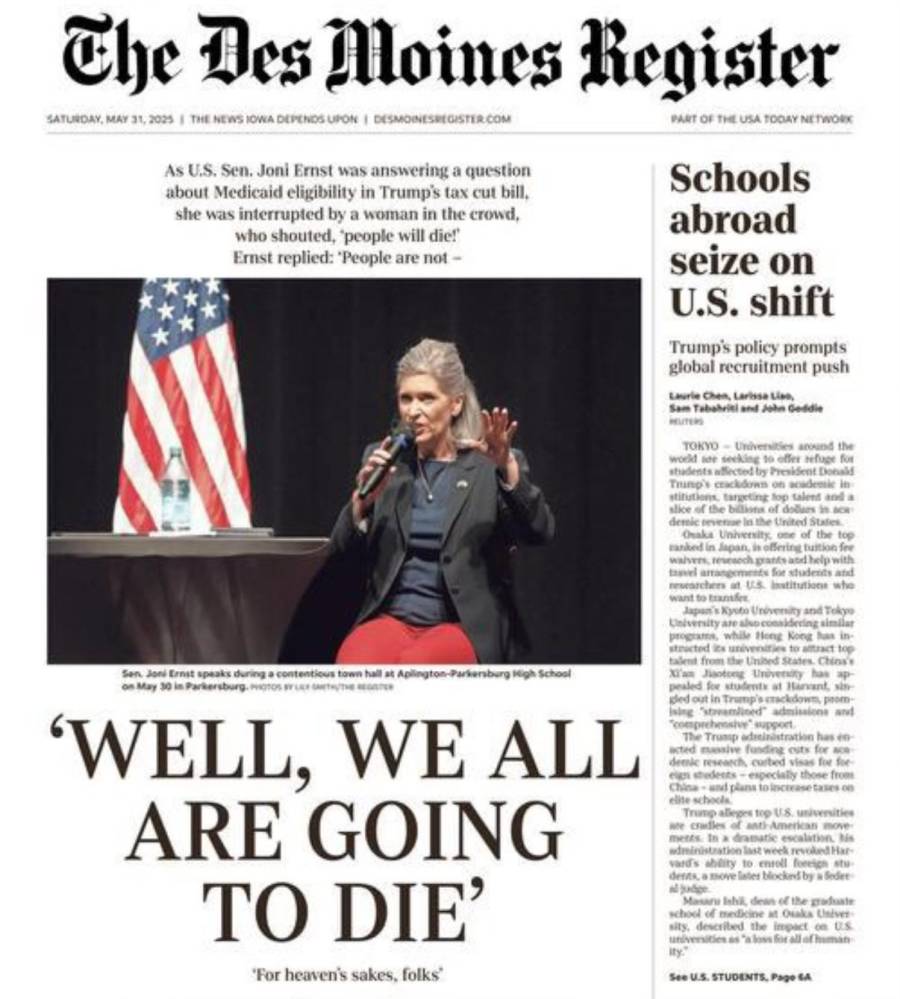
When a U.S. Senator from Iowa stands at the gates of power and shrugs her shoulders at the suffering of the elderly, veterans, children, and disabled folks if Medicare is cut, saying, “well, we are all going to die,” we know are living at the gates of Nain.

The good news is that when Jesus sees the funeral procession, he sees all of it. He sees the normalization of cruelty. He sees the pain of the widow. He sees her poverty. He sees her isolation. He sees the way she is seen or not seen by the political and religious culture. And Luke says, “He had compassion on her.”

As I have pointed out before, that word “compassion” in the Greek is visceral. Jesus felt it in his gut. The word literally means that he was filled with so much compassion, his stomach was in knots. And notice what happens next.

Jesus crashes the funeral. Jesus steps in and stops the procession. He reaches out and touches the bier.

By touching the bier, he touches what others refuse to touch. He breaks cultural, ritual, and religious protocol interrupting death with divine compassion. And then, with the authority of heaven, he speaks directly to the dead: “Young man, I say to you, rise!”

Notice that Jesus doesn’t offer thoughts and prayers. He doesn’t say “Rest in peace” or “God needed another angel in heaven” or, “bless his heart, he’s in a better place.” And he sure in heaven doesn’t say, “Well, we are all going to die.”

Jesus speaks in the face of injustice and death saying: “Rise!”

“Rise!”— That’s the gospel we are called to preach and to live.

“Rise!” is a gospel of protest; not passivity.

It’s a gospel of resurrection; not resignation.
It’s not a gospel that comforts the powerful, but a gospel that confronts the powerful and disrupts the unjust systems of death.

The question that this story begs of us today is: what kind of people will we be?

Will we be the indifferent crowd accepting injustice by following death to the grave, or will we be the disciples who walk with Jesus and interrupt it?

Will we shrug our shoulders accepting that “everybody dies,” or will we embrace a gospel that never shrugs, a gospel that always dares to stop the march of injustice?

These questions are most important today as many Christians have chosen death over life.

Oh, of course they would never confess that. They claim to follow the way of Jesus by being pro-life, but they act in ways that are the exact opposite.

They want to force children to be born into the world while they cut Head Start, undermine vaccines, refuse to fund public schools, stand against raising the minimum wage, deny healthcare, and cut food assistance. They hold press conferences about embryos but pass budgets that kill the most vulnerable among us. They preach “sanctity of life” but value their right to own an assault weapon more than they value the safety of school children. They cry “life is sacred,” but when asked about Medicare, they shrug and say: “Well, we are all going to die.”

That’s not pro-life. That’s pro-power, pro-patriarchy, and pro-political points. It’s s a theology of control, not compassion, and it has nothing to do with Jesus of Nazareth. I believe the church needs to be pro-life the way Jesus was pro-life.

That means pro-human dignity, pro-healthcare, pro-feeding the hungry, pro-housing, pro-living wages, pro-education, pro-immigrant, pro-refugee, pro-disabled persons, pro-LGBTQIA persons, pro-justice, pro-mercy, pro-nonviolence, and pro-peace.

Otherwise, it’s not life. It’s hypocrisy. Otherwise, what is the church good for?

I will never forget sharing with one of my former churches during a board meeting that unless some changes were made, unless we left the comfort and safety of the sanctuary to take the gospel from the pulpit into the public square, I believed the church was going to die.

Do you want to know what their response was?

“Well, we’re ok with that. The truth is, pastor, we would rather die than change anything.” I kid you not.

But I do not believe Christian pastors are called by God to be hospice chaplains for dying congregations. We are not called by God to manage the procession of death. And we are not called to be chaplains of empire or funeral directors for failed, unjust systems.

And we weren’t called to gather here in this place just to sing and sip coffee. We are called to go out and crash the funeral! We are called to disrupt the lie that poverty and cruelty is normal. We are called to touch the bier, to raise our voices, to say to a fragmented and unjust world: “This procession ends here! Rise up and live!”

Because Jesus didn’t come to help us die quietly and peacefully.
Jesus came so that we might have life and have it abundantly!

So, when they say, “well, we are all going to die,” we say:
Yes, that is true, but not all don’t need to die this way.
-Not for lack of access to healthcare.

-Not for a lack of opportunity to get an education.

-Not for a lack of food.

-Not for lack of insulin.

-Not for the lack of a living wage.

-Not because gender-affirming care upsets your privileged, ignorant, black and white, binary religious worldview.

– Not because compassion is considered too expensive and mercy too extravagant.

And not while the Church is still breathing and still following the way and voice of Jesus who says: “Open your eyes and see the suffering. See the injustice. And then step in— and touch the bier. Stand where the pain is. Interrupt the systems of death. Speak to the young people laid in caskets before their time and dare to declare: ‘You were meant for so much more than this!’”

Because healthcare is not luxury. It’s a human right. Compassion is not weakness, and empathy is not sin. It’s divine strength. The church is not called to manage the funeral. We’re called to proclaim resurrection.

So let us go from this place not in silence but in power.

Let us walk to the gates of our cities, our states, and this nation,
and speak like Jesus.

Let us say to our trans siblings: “We see you.”

Say to the poor, the and the disabled: “We are on your side.”

Say to the immigrant: “We stand with you.”
Say to the widow: “You are not alone.”
And say to the unjust systems of death: “Your time is up!”
And to all those who have been cast down: “Rise up and live!”

Because the final word is not cruelty. The final word is not indifference.
The final word is not: “well, everybody dies.” The final word is Jesus, and Jesus says: “Rise!”

So, let the Church rise! Let the people of God cry out at the gates of every system that shrugs at suffering:

To say to politicians obsessed with power and profit: We will not fooled by your pro-life bumper stickers.

To say to the politicians who offer thoughts and prayers but pass budgets of brutality: “We will not be silent!”

Because our Lord is the one who stops the funeral.

Our Lord is the one who touches the bier.
Our Lord is the one who weeps with the widow.
Our Lord is the one who speaks life into the grave and says: “Rise!”

And if we are going to follow that Lord, then we too must rise up, speak up, and lift up every child of God who’s been cast down. Because “everybody dies” may be a fact of biology, but rise up and live!” is the truth of theology!
So, let’s rise!

The Way

ultrasound

John 14:1-14 NRSV

It was the summer 1993. Lori and I had been married five years and were expecting our first child. I had graduated from seminary the previous year and was serving with my first church as a pastor in rural Northeast Georgia. At our first OB/GYN appointment in Athens, we were told that our baby was due to be born on November 25. On Mother’s Day 1994, we were going to have some special reasons to celebrate.

During the last week of July, we were scheduled to have an ultrasound that would hopefully determine the gender of our child. I remember being more excited than anxious about this appointment. The baby was already moving and kicking quite a bit. Lori would call to me from another room in the house asking me to rush over to her. She would grab my hand and place it on the exact spot the baby was kicking so I could share her excitement. Lori was clearly showing at this time as strangers were beginning to approach us in public to offer their congratulations and to inquire when our baby was due.

As the doctor moved the ultrasound wand around on Lori’s abdomen and the black, white, and gray images of our baby appeared on a computer screen, I remember feeling like a wide-eyed child at Christmas getting a glimpse of the best present I could ever receive. We immediately heard a very strong and fast heartbeat. We then saw the outline of a head and a face. We saw arms, hands, legs, feet, even toes. After a minute or so, I remember growing impatient and asking the doctor if he could tell if it was a boy or a girl.

Following my question, my anticipation heightened as there was a brief period of silence in the room with the exception of the loud echo of a rapid heartbeat. Finally, the silence was broken as the doctor said, “It is really difficult to tell sometimes with our outdated equipment.” He moved the wand around for another minute and said, “The equipment that they have in Atlanta is far more advanced than mine. We probably need to make an appointment for you.” But before I could express any disappointment, he added: “There’s also something else going on that needs a better look.” He then handed the wand to the nurse and asked for us to come to his office where he would make an appointment for us to go to Atlanta. It was at that moment that my excitement was completely replaced by anxiety.

Suddenly, I no longer cared if it was a boy or a girl.

During the appointment in Atlanta, the doctor, who had been attentive yet quiet during the entire exam, spoke for the first time by pointing out a curvature in the spine. He called it a “neural tube defect.” This was the first time I had ever heard the term “neural tube.” However, upon hearing it one does not need to be familiar with it when the word “defect” is attached to it, as that word is more than enough to cause any parent-to-be’s heart to sink, especially when it is spoken to describe the spine of your unborn child’s spine.

Immediately following the ultrasound, we met with a team of doctors, nurses and genetic counselors in a large consultation room. In a compassionate, yet straightforward way, we were told that our baby’s spine “twisted,” probably during the early weeks of the pregnancy, and prevented the formation of an abdominal cavity. We were told that although our baby seemed to have healthy organs, there was nothing to contain those organs. Surgery was not an option. Our baby had absolutely no chance at life. A counselor put her hand on Lori’s shoulders and handed her a tissue to wipe the tears from her face.

After counseling and prayerfully considering all of our options, two days later, the pregnancy was terminated in the hospital without complications.

When we came home from the hospital, Lori went to bed where enormous grief she experienced kept her for days. She did not feel like talking to anyone, not even talk to her mother, who called several times a day, every day.

When Lori finally decided that she was ready to talk to people, the support from Christians came. However, some of the support came in ways that were more hurtful than helpful. It came in religious, pious, and judgmental ways. Almost everyday it came in ways that left us cold, empty, even resentful.

Now, I am sure it only came in these ways because these perhaps well-intended religious people understood it was their Christian duty to bring life, resurrection, restoration where there is death, despair and brokenness. And, maybe this was just the only way they thought they could bring it. Maybe this was the way they were taught on some church pew or in some Sunday School class. This was simply the only way they knew how to share the good news, proclaim the gospel, to be “a movement for wholeness in this fragmented world,” as we Disciples like to say.

But it came in ways that, for us, made the world even more fragmented. It came in preachy, accusatory ways, demeaning us for terminating the pregnancy. It came in the way of a theology lesson suggesting that we perhaps should have possessed more faith, that with prayer, God could have created a new body for our baby before he or she was born.

It came by the way of an ethics lecture insinuating that we were somehow “playing god.”

Then, came the support in ways that are all too familiar but never too helpful, all too religious-like but never too Christ-like. It came in the way of words that would have been best left unsaid.

“God knows best. God has God’s reasons. God does not make mistakes.” “God must have known you were just not ready to be parents.” “God must have needed another flower in heaven.” “You are young and can always try again.” One even said, “Perhaps God knew that your child was going to be a bad person or have a difficult life, so God, with the ability to see a future that we cannot, intervened and took your child.”

For some reason, Christians just feel compelled to say something, anything, even if it is hurtful.

We tried not to be angry with them, not to resent their ways of being religious. We defended them by saying, “Well, that is just her way, bless her heart.” We said, “Well, everyone knows the way he is.” It was just their way of doing what they thought would bring us some hope, their way of bringing us some wholeness, their way of bringing peace to our troubled hearts; and people, well, people have their ways.

Jesus, however, said that he was the way. “I am the way, and the truth, and the life; no one comes to the Father, but by me” (John 14:6).

As Frederick Buechner has reminded us:

He didn’t say that any particular ethic, doctrine, or religion was the way, the truth, and the life. He said that he was. He didn’t say that it was by believing or doing anything [or saying anything] in particular that you could “come to the Father.”

Jesus didn’t say the Bible-Belt-culture evangelicalism manufactured for the self-interest of the privileged was the way. He didn’t say some alternative gospel created to ignore God’s will for social justice was the truth. And he didn’t say that the fake good news made up to cheapen the grace of the irrefutable good news was the life. He said that he was.

Buechner continues:

He said that it was only by him – by living, participating in, being caught up by, the way of life that he embodied. That was his way.

And thank God, that others came to us in his way. People from our church came to us with silent but empathetic embraces. They came bringing nothing with them but their tears and their own broken hearts. Some came bringing a home-cooked meal or a homemade dessert. One came with a vase of freshly-cut flowers from their garden. They came graciously. They came faithfully. They came intentionally with the love and in the way of the Christ. They came with the face of God.

Andrew King poetically reflects on this love, this way and this face:

We thought you wore the skin

of thunder, spoke in verbs of stormwind,

majestic and mighty as lightning

upon summits,

unreachable

as the cold and silent fire

of distant stars; hidden behind

a curtain in the temple,

an untouchable invisibility approachable

by the highest priest only,

hands freshly bloodied

from an altar.

And then somehow the veil was parted:

we gained glimpses of the glory

of the nearness of your love

as the hurting were healed,

the outcast befriended,

the lost restored,

and everywhere the powers of death

had their dominion challenged,

by the son of a Jewish carpenter

from Galilee.

If you have seen me,

said Jesus, you have seen the Father.

And we do see you there,

in the Gospels,

healing in synagogues

and in houses,

feeding the hungry on hillsides,

embracing the lepers and the sinners,

turning over the tables

in the temple,

nailed to a cross of injustice

but risen,

greeting women at

the graveside,

sharing bread with your friends,

the dominion of death

overturned.

Approachable, reachable,

the accessible God,

visible in the skin of Jesus.

But you are not done,

not content to wear

such skin only in the pages

of the Gospels.

The many-colored, multi-shaped

body of Christ – the Church

wide as the nations of the world –

bears your image where it acts

in your love:

still feeding,

still healing,

still teaching mercy,

making you visible

not in great

structures nor

in high saints alone,

but in the ordinary

persons in the pews,

as here, on a day like any other,

a woman making dinner,

and packing it,

knocking on the door of a neighbor

newly home from surgery for cancer:

the face of the one receiving it

lit with thankfulness,

the face of the one freely giving

like the face

of God.

When our hearts were troubled, because of the many faces of God that came to us in his way, in the visible skin of the body of Christ, although we were without child, on Mother’s Day in 1994, we still had special reasons to celebrate.

And on Mother’s Day in 2017, I can stand here today confidently proclaiming that Jesus—not religion, not ethics, not any doctrine—Jesus is the way, the truth and the life.

Let us pray,

God, embolden us to live, participate in, be caught up by, the way of life embodied by the Christ. Amen.

Invitation to the Table

The way to this table of communion this morning is not religion. The way to the bread of life is not ethics. The way to the cup of salvation is not any doctrine. The way to the life and to the truth that is represented here is only Jesus. And since Jesus lived and died to make a way for all, all are invited.

Why This Christian Pastor Is Pro-Choice: It’s Personal

abortion-debate

Introduction

As a married, father-of-two, Christian pastor who was raised in the rural South as an evangelical Southern Baptist, many are quick to make many assumptions about me.

The most prevalent assumption is that I am on the Pro-Life side of the abortion debate, as many assume that one simply cannot be both a Christian and Pro-Choice. Many believe it is a black and white issue, a simple decision between good and evil, life and murder.

As a married, father-of-two, Christian pastor, I strongly support the 1973 decision of the United States Supreme Court in the case of Roe v. Wade. And, of course, I do not believe I am supporting evil. My convictions about abortion are strong, because my convictions are personal.

Our Personal Story

It was the summer 1993. My wife Lori and I had been married five years and were expecting our first child. I had graduated from seminary the previous year and was serving with my first church as a Southern Baptist pastor in rural, Northeast Georgia. At our first OB/GYN appointment in Athens, we were told that our baby was due to be born on November 25.

During the last week of July, we drove to Athens for a highly anticipated appointment with our OB/GYN. We were scheduled to have an ultrasound that would hopefully determine the sex of our child. I remember being more excited than anxious about this appointment. The baby was already moving and kicking quite a bit. Lori would often call to me from another room in the house asking me to rush over to her. She would grab my hand and place it on the exact spot the baby was kicking so I could share her excitement. Lori was clearly showing at this time as strangers were beginning to approach us in public to offer their congratulations and to inquire when our baby was due.

As the doctor moved the ultrasound wand around on Lori’s abdomen and the black, white, and gray images of our baby appeared on a computer screen, I remember feeling like a wide-eyed child at Christmas getting a glimpse of the best present I could ever receive. We immediately heard a very strong and fast heartbeat. We then saw the outline of a head and a face. We saw arms, hands, legs, feet, even toes. After a minute or so, I impatiently asked: “Can you tell if it is a boy or a girl?”

Following my question, my anticipation heightened as there was a brief period of silence in the room, with the exception of the loud echo of a rapid heartbeat. Finally, the silence was broken as the doctor said, “It is really difficult to tell sometimes with our outdated equipment.” He moved the wand around for another minute and said, “The equipment that they have in Atlanta is far more advanced than mine. We probably need to make an appointment for you.” But before I could express any disappointment, he added: “There’s also something else going on that needs a better look.” He then handed the wand to the nurse and asked for us to come to his office where he would make an appointment for us to go to Atlanta. It was at that moment that my excitement was completely replaced by anxiety. Suddenly I no longer cared if it was a boy or a girl.

In his office, our doctor tried to break the news to us as compassionately as he could break it. It was obvious that he was struggling to communicate. At first, he seemed to blame the bulk of his concern on what he called his “antiquated ultrasound equipment.” I remember being irritated as I had no sympathy for the envy he possessed towards the doctors in Atlanta. As he seemed to be avoiding telling us anything specific, frustrated, I remember asking him directly, “But you suspect that there could be something wrong with our baby. Don’t you?”

He responded, “Yes.” A wave of anxiety came over me intensifying my stress. But then he added, “Again, you need another ultrasound before we can really determine how bad it is.”

It was a long and difficult two weeks before we could see the doctor in Atlanta.  Every time our baby moved or kicked, it produced a wide-range of emotions in both of us. We did not know whether to cry, giving into grief; or smile, opening ourselves to the prospects of hope. Of course, hope is what we wanted. It is much easier to hope than it is to accept anything that brings grief. We asked one another: “How can there be something wrong with a baby whose heart is strong?” We conjectured: “Perhaps the more advanced ultrasound equipment in Atlanta will tell us that everything is ok.” The second week in August, we nervously drove to Atlanta holding on to hope, even if was just a sliver.

I will never forget the way we were greeted by the medical team we met in Atlanta. They could not have been more hospitable and caring. After they greeted us like family, we proceeded to an examination room for the ultrasound. Again, as soon as the gel on the wand touched Lori’s abdomen, we heard the heartbeat, a beat that was so strong that it could not help but to grow that little sliver of hope. As he moved the wand, we could see the same beautiful images, perhaps a little clearer, that we saw in Athens. We easily recognized a beautiful head, but this time, we saw more pronounced facial features, a nose, lips, even eyes. Again, limbs, hands, feet, fingers and toes came into focus. Nevertheless, I still did not possess enough hope to allow one thought to cross my mind about trying to determine the sex of our unborn child.

The doctor, who had been attentive yet quiet during the entire exam, spoke for the first time by pointing out a curvature in the spine. He called it a “neural tube defect.” This was the first time I had ever heard of a “neural tube.” However, upon hearing the term, one does not need to be familiar with the importance of the neural tube to be alarmed, as the word “defect” that was attached to it is more than enough to cause one’s heart to sink, especially when it is said to describe your unborn child’s spine.

Immediately following the ultrasound, we met with the team of doctors, nurses and a genetic counselor in a large consultation room. In a compassionate, yet straightforward way, we were told that our baby’s spine “twisted,” probably during the early weeks of the pregnancy, and prevented the formation of an abdominal cavity. We were told that although our baby seemed to have healthy organs, there was nothing to contain those organs. Surgery was not an option. Our baby will certainly die during the birthing process. A counselor put her hand on Lori’s shoulders and handed her a tissue to wipe tears from her face.

The team graciously addressed all of our questions. They told us that many severe neural tube defects end in miscarriage in the first trimester, but in some unfortunate cases such as ours, they do not. They assured us that we could soon try again to have a child, as they believed the defect was more of an anomaly than it was genetic. They then presented us with our options.

One option was to do nothing but wait until the pregnancy reaches full term and the baby is able to be born naturally or by C-section. However, because of the severity of the defect, we would be unable to hold our dead child, and may not want to see him or her. Our baby’s remains would be immediately prepared for a funeral service.

abortoin-is-murderThe second option was to terminate the pregnancy immediately. However, if we chose this option, it would be considered an abortion, and due to the political climate of the day, there was only one hospital in the state of Georgia which would perform an abortion this late in the pregnancy. He said that we could go to several clinics, but we may have to endure picket signs and possibly hecklers from religious groups opposed to abortion. The thought of my wife, who was still wiping tears from her eyes, being called a “murderer” or a “baby killer” by people claiming to follow Jesus, people who had no idea who we were, or what we were going through, made me furious. We were also told that although our child had a strong heartbeat, because of politics, for the record they would state that our child had “no viable heartbeat.”

Although the second option sounded dishonest, even illegal, it was obvious to us that it was the best, most compassionate option. I could not imagine Lori waiting three more months, feeling the baby move and kick, feeling another life inside of her, all the while knowing that this life will never have a chance. We scheduled an appointment for a procedure to end the pregnancy two days later.

That night, we checked into an Atlanta hotel to await our next appointment. The grief we experienced was immense. All of our dreams for the future were suddenly taken away from us. Furthermore, although the doctors and genetic counselors assured us we could one day have a child, we knew that in life there were never any guarantees.

That evening, we decided to go see a movie to try to get our mind off our grief. Although I never second guessed our decision to terminate the pregnancy, our decision was affirmed by a stranger as we stood in line to purchase our movie tickets. A woman who was also obviously expecting to have a baby approached us. She smiled and said, “Aww. When is your baby due?”

My chest tightened as I looked at Lori and saw tears begin to well up in her eyes once more. I was amazed when Lori smiled at the stranger and said, “November 25.” She then somehow found the courage to graciously reciprocate the question. Politely, she asked the woman who was glowing with anticipation, “When is your baby due?” So much for us trying to escape our grief.

During the movie, Lori put her hands on her abdomen and told me that the baby was moving. I thought to myself that these next two days were going to be a living hell. I could not imagine asking Lori to wait three more months, not only feeling the baby’s movement, but to endure more oohing and awing and questions from well-meaning strangers, for me, was as unconscionable as it was inhumane. As I watched the movie that I really never watched, I remember thanking God for the gift of medical science and compassionate physicians that could help bring healing and wholeness to our broken lives.

As planned, two days later, the pregnancy was terminated in the hospital without complications. However, as the next several weeks and even months proved, terminating the pregnancy did nothing to immediately heal our enormous grief. When we came home from the hospital, Lori went to bed and stayed there for nearly a week. She did not feel like talking to anyone. During that mournful week Lori would not even talk to her mother, who called several times a day, every day.

Now, over twenty years later, our grief has long subsided as Lori and I are the proud parents of a 19-year-old son and 17-year-old daughter. However, because of our experience, I continue to possess a very personal interest in the abortion debate which continues in our country.

Conclusion

The abortion debate centers around the Roe v. Wade Supreme Court decision of 1973. If many evangelical Christians had their way, and the Roe v. Wade decision was overturned in 1993, Lori would have been forced by the government to endure three more months of her pregnancy. Although her physical health was not in danger, as mentioned above, I cannot imagine the psychological trauma that continuing the doomed pregnancy would incur upon Lori. Today, we continue to be grateful to God for the healing gift of medical science, a compassionate team of doctors and nurses, and for the opportunity and freedom to make a safe and humane choice, a choice that we and our doctors believed would bring us the most wholeness and healing.

The issue of abortion is a complicated one. Like every person I have ever talked to about the subject, I do not believe abortion should be used as birth control. As a follower of Jesus who gave his life standing up for the rights of the poor and the marginalized (including the rights of women who were treated unjustly by a patriarchal system), I believe very strongly in the sanctity of life. This is the reason I do not support capital punishment. However, the decision to terminate a pregnancy is a personal and oftentimes complicated matter. Thus, I believe the only ones who should be a part of that decision are the parents of the unborn child, especially the mother, the doctors and God. The government should not be involved.

I fully understand the strong, moral desire of Christians to limit abortions in America. However, I do not think a government can legislate morality. This is why I believe the church should always be strong proponents of sex education and of the use of contraceptives. Unfortunately, the church has been either silent when it comes to sex education and contraceptives or has flat-out discouraged both. It is strange to me that many Christians who are against the Roe v. Wade decision are supportive of the Hobby Lobby Supreme Court decision to deny women healthcare coverage for contraceptives. It is also interesting to me that many Christians who claim to support a limited government are also the same ones who believe the government should be involved in matters as personal as pregnancies.

Life is not easy. Sometimes difficult decisions have to be made. Sometimes the solutions are not black and white. Sometimes those decisions are not between a clear good and a clear evil. Sometimes we are forced to choose the lesser of two evils. I want to live in a country where I am free to prayerfully make such difficult choices, especially choices that are so personal in nature, without any interference from the government.

2007 Disicples of Christ Resolution Regarding Abortion