
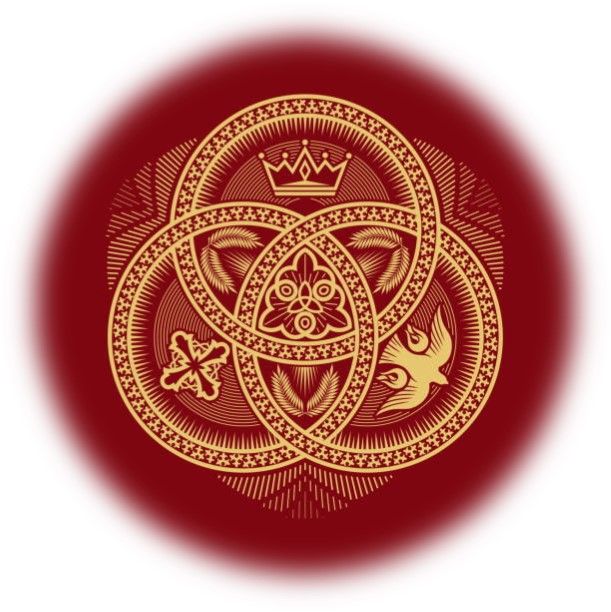
How ironic that we are recognizing graduates and celebrating the gift of learning on Trinity Sunday, the day the church celebrates its most difficult teaching of all to learn, some would say its most impossible teaching to learn, the doctrine of the Holy Trinity.
It’s fascinating to read the letters regarding the Trinity between those radical Presbyterians, Barton Stone and Alexander Campbell, who started this movement for wholeness that we call the Christian Church (Disciples of Christ). It is obvious that Stone had a more difficult time accepting the Trinity than Campbell. Stone writes to Campbell:
On this doctrine many things are said, which are dark, unintelligible, unscriptural, and too mysterious for comprehension. Many of these expressions we have rejected…
I wonder if Stone’s problem was that he was trying to comprehend the Trinity in the first place. For maybe the Holy Trinity is something to be lived, more than learned, something to be experienced more than explained, something or someone with whom to relate more than to understand.
Modern Trinitarian thought uses a word spoken by Gregory of Nazianzus and Maximus the Confessor to describe how three can be one. These ancient thinkers of the fourth and fifth centuries referred to the inner life and the outer working of the Trinity as peri-co-reses, which means literally in the Greek, “to dance.” They were suggesting a dynamic, intimate, self-giving relationship shared by the Father, the Son, and the Holy Spirit.
So perhaps, the Holy Trinity is not a doctrine to learn at all, but more of a connection to be enjoyed. It is to be encountered more in relationship than in religion. It is something that is unseen, yet true; inexplicable, yet real. It is more surreal than literal; more actual than factual.
The late author and lecturer Phyllis Tickle tells the following story that I believe speaks to the mystery of the Trinity. She was addressing a Cathedral gathering on the historicity of the Virgin Birth. She recounts:
The Cathedral young people had served the evening’s dinner and were busily scraping plates and doing general clean-up when I began the opening sections of the lecture I had come to give.
The longer I talked, the more I noticed one youngster—no more than seventeen at the most—scraping more and more slowly until, at last, he gave up and took a back seat as part of the audience.
When all the talking was done, he hung back until the last of the adults had left. He looked at me tentatively and, gaining courage, finally came up front and said, ‘May I ask you something?’
‘Certainly,’ I said. ‘What about?’
‘It’s about that Virgin Birth thing,’ he said. ‘I don’t understand.’
‘What don’t you understand,’ I asked, being myself rather curious by now because of his intensity and earnestness.
‘I don’t understand,’ he said, ‘what their problem is,’ and he gestured toward the empty chairs the adults had just vacated.
‘What do you mean?’ I asked him.
‘Well,’ he said, ‘it’s just so beautiful that it has to be true whether it happened or not.’
So, I believe it is with the Trinity. This dynamic, intimate relationship, this holy, self-giving dance, shared by the Father, Son and Holy Spirit is so beautiful, that it has be to true, whether it is the most accurate description of the image of God or not.
C. S. Lewis once wrote:
All sorts of people are fond of repeating the Christian statement that ‘God is love.’ But they seem not to notice that the words ‘God is love’ has no real meaning unless God contains at least two Persons. Love is something that one person has for another person. If God was a single person, then before the world was made, [God] was not love…
And that, wrote Lewis:
is perhaps the most important difference between Christianity and all other religions: that in Christianity, God is not a static thing—not even a person—but a dynamic, pulsating activity, a life, almost a kind of drama. Almost, a kind of dance…
There it is again: a dance. The Trinity is an activity. It’s something moving, something to be experienced, something to be lived, something to be shared. Lewis continues:
And now, what does it all matter? It matters more than anything else in the world. The whole dance, or drama, or pattern of this Three-Personal life is to be played out in each one of us: (or putting it the other way around) each one of us has got to enter that pattern, take [their] place in that dance. There is no other way to the happiness for which we were made.
Trappist Monk Thomas Merton once said:
To say that I am made in the image of God is to say that love is the reason for my existence, for God is love. Love is my true identity. Selflessness is my true self. Love is my true character. Love is my name.
I believe it is in the sacred dance of selfless, self-giving love shared by the Father, Son, and Holy Spirit that we find our holy purpose. It is where we can get in touch with our true identity that Paul describes in his letter to the Romans as “children of God,” “joint heirs with Christ” who “live by” and are “led by the Spirit.”
And when we embrace our true, authentic selves, when we accept our identity that we are created in love to share love, when we accept that we are love, and we begin to fulfill our holy purpose by sharing ourselves with others and the world, something wonderful happens. Not only are we happier and more fulfilled, but the world around us becomes just, more equitable, more gracious, more merciful, and more peaceful.
Think of how much evil exists in our world because people do the exact opposite. We define God on our own terms, instead of allowing the image of the Triune God define us. Instead of understanding God and our true identity as selfless, self-givers, we understand God and our identity as selfish takers. Such an understanding emboldens oppression. It fuels White Christian Nationalism, justifies war, and is behind much, if not all, of the violence in our world today.
How often have you attended a funeral and heard the phrase: “God came and took them home?” We might hear it as a harmless misinterpretation of God by a preacher who didn’t go to seminary, but it is very bad theology that has very evil consequences.
The Trinity teaches us that God does never “takes” anyone. For givers are the opposite of not takers. I believe a more accurate way of describing what happens to us when breathe our last breath on this earth is that God comes and completely, eternally, and finally gives all of God’ self to us.
I believe with all my heart that by living our identity as self-givers, by joining the holy, self-giving dance of the Trinity, we can reclaim a gospel that has been hijacked by people who would rather live in this world on their terms instead of on God’s terms. We can reclaim a gospel that has been co-opted by takers, by people who have exploited the name of God for their own selfish gain.
For if we embraced our identity as self-givers, as persons living, moving and having our being with God, in God, think of how everything that is upside down in our world today is transformed. Think of how our relationships with ourselves and others would change.
Think of how our faith would change. Our faith would not be about what we can take from God—healthier marriages, stronger families, deeper friendships, peace, security, comfort, a mechanism to overcome trials or to achieve a more prosperous life, or even gain an eternal life.
Our faith would be what we can give back to the Holy Giver—namely all that we have and all that we are, even if it is costly, even if it involves risk, danger and suffering, even if it involves the loss of relationships, some stress on our marriages, sleepless nights, a tighter budget, even if it involves laying down our very lives.
Think of how church would change. Church would not be about what we can take from it. It would not be about feeding our souls, experiencing some personal peace, receiving a blessing or some inspiration to help us through the week.
Church would be about opportunities to participate in self-giving acts of love. Church would be about feeding those who hunger for justice, working for world peace, being a blessing to our communities, and inspiring our nation and the world.
Church would not be a way to for us to get some Jesus. Church would be way we allow Jesus to get us, to love our neighbors as we were created to love, dynamically, graciously, generously.
And we would never see our neighbors for what we can take from them, or how we can use them, profit by them, but always see what we may be able to offer them, especially those things that others are constantly robbing them of to support their dominance and superiority over them—their dignity, their equality, their sacred value as human beings created in the holy image of God.
The earth would not be something for us to take from, plunder and exploit for our own selfish wants, but something for which we sacrificially care for, respect, nurture, and protect.
I believe when we embrace our sacred identity as givers, instead of takers, and enter into the holy, self-giving dance of the Trinity, God’s kingdom comes on earth as it is in heaven.
Embracing the holy self-giving dance of the Trinity rebuilds a broken world, corrects an upside-down moral narrative, and heals sick religion.
Embracing the holy, self-giving dance of the Trinity brings down walls and breaks the chains of injustice.
When we embrace our identity and enter into the holy, self-giving dance of the Trinity, hate, bigotry, and violence passes away, liberty and justice and peace come, and it comes for all, as all of creation is born again.
And this, my fellow Americans, is how we can best honor those who have died in war on this Memorial Day weekend. For when we all embrace our sacred identity, and enter into the holy, self-giving dance of the Trinity, the words of the prophet Isaiah are fulfilled:
They shall beat their swords into ploughshares,
and their spears into pruning-hooks.
Nation shall not lift up sword against nation,
neither shall they learn war anymore (Isaiah 2:3-4).
Yes, Barton Stone, this Holy Trinitarian dance is a mystery. But it is a Mystery that has happened and is happening to us, and in us. It is our sacred identity. We can’t comprehend it. But we can accept it. We can join it. We can live it. We can move and have our being in it. And we can share it, today and forevermore.

 Just Love