
The God of the Living

Luke 20:27-38

This morning, we gather in a sacred circle of love with parents and grandparents, their family and friends, and the wider church family to dedicate ourselves to God and to one another. We will make promises this morning to support a family as they raise their daughter in love, envelop her with mercy, teach her the stories of our faith, and to resist the powers and authorities that would deny her life.

We declare today what Jesus declared in the Gospel of Luke: that our God is not the God of the dead, but the God of the living.

That means we have a living, active, public faith. It’s not a private, personal faith without works that the book of James pronounced dead. It’s a living, working, breathing, forward-marching, justice-seeking, hope-singing faith. It’s a faith that lifts up little babies and baptizes big dreams. And it’s a faith that always refuses to let despair have the final word.

The story in Luke 20 begins with a question, but it’s not an honest question. The Sadducees, a group of religious elites who didn’t believe in the resurrection, have come to Jesus with a trick question with the purpose of trapping him in theological quicksand.

They spin this wild scenario about a woman who marries seven brothers, one after another, each dying without having children. Then they ask, “In the resurrection, whose wife will she be?”

Their question sounds absurd because it is absurd. For they’re not trying to understand the ways of God. They’re only trying to protect their ways, to defend their black and white, tidy little world where their control goes unchallenged, where the poor stay in their place, and where God doesn’t mess with the systems they’ve built to protect their power and privilege.

But Jesus, as he so often does, flips the table. He says, “You’re asking the wrong question. Resurrection isn’t about hierarchy or control. It’s about life, free, full, meaningful, unending, abundant life.”

It is then Jesus shakes their world with these powerful words: “God is not the God of the dead, but of the living; for to God all of them are alive.”

The God of the living is the one who refuses to be confined to any religious box or to be controlled by any political party.

The God of the living is the one who is forever calling life out of tombs and hope out of heartbreak.

The God of the living is the one who breathes over the chaos, creating a new world, and calling it good.

The God of the living is the one who takes what the empire crucifies and declares, “Love will win!”

This is the God who is still speaking, still creating, still re-creating, still resurrecting us from all the small deaths we endure today, like the death of empathy, the death of mercy, the death of social justice, the death of diversity, equity, and inclusion.

When we dedicate Maggie this morning, we are declaring our allegiance to this God, the God of the living, who says to all matter of death: “Rise up and live!”

When we dedicate Maggie, we are saying that we will raise her not in fear but in faith, not in greed but in generosity, not in apathy but in active love.

In a world that often chooses death (death by selfishness, death by bigotry, death by poverty, death by racism, death by environmental destruction, death by indifference), we are promising that we will stand with the God of resurrection who always chooses life.

Hannah and Austin, in dedicating Maggie today, hear this blessing from the church: As a parent, you are participating in resurrection. Every sleepless night, every patient conversation with your child, every prayer whispered over her fevered forehead— it’s all resurrection work.

Raising a child is resurrection work because it is an act of resistance. It is believing in the future when the world tells you to give up. It is saying, “As bad as things seem today, I still believe in tomorrow.”

You are forming in Maggie a living faith, one that will not just memorize Bible verses, but will embody them. One that will not just believe in Jesus, accept Jesus, but will follow Jesus, bearing witness to a faith that will learn to feed the hungry, to welcome the stranger, to defend the marginalized, and to speak truth in love.

When you hold Maggie and whisper prayers, when you read her stories of courage, when you teach her to say “please” and “thank you” and “I’m sorry,” and “I love you,” you are introducing them to the God of the living, the One who delights in her laughter, in her curiosity, and in her wide-eyed wonder.

You are shaping a world in which Maggie can live fully, freely, and faithfully.

And First Christian, this dedication isn’t just a family’s promise. It’s our promise too.

We are the village that surrounds all the children in our congregation with love. We are the people who will teach them how to sing, how to serve, and how to stand up for what’s right.

When we dedicate Maggie this morning, we are committing to build a world where all children can breathe clean air and drink clean water, where food is available and healthy, where their schools are safe and fully-funded, and where their neighbors are kind.

We’re committing to the slow, holy work of resurrection, to dismantling systems of death so that every child can live abundantly.

We are committing to be the church that loves all God’s children, no matter their color, gender, ability, sexuality, or identity, because to God, all of them deserve life, abundant and free.

The Sadducees were trapped in a world too small for the God Jesus proclaimed.

They couldn’t imagine life beyond the limits of their power, so they made up and absurd scenario to debate and stop Jesus because they feared that the God he was revealing was much more than they could control and much bigger than any binary box they’ve tried to put God into.

But Jesus taught them that the resurrection isn’t some theory to be debated. Resurrection is a truth to be lived.

Jesus taught that every act of love is resurrection.

Every cry for justice is resurrection.

Every march on behalf democracy and every silent vigil on behalf of peace is resurrection.

Every child lifted up in dedication is resurrection.

When we bless Maggie today, we’re making resurrection visible to the world.

We’re saying to the powers of death, “You will not win here.”

We’re saying to the forces of despair, “You will not have the last word.”

We’re saying to the powers of fear, “You can stop speaking now.”

And we’re saying to the God of the living, to the God of resurrection, that we will live like resurrection people.

To raise children who believe that love is stronger than hate.
To build communities that value life more than profit.
To be the kind of people who feed the hungry, comfort the grieving, stand with the oppressed, care for the planet, and keep singing hope, even in the dark.

Because to believe in the God of the living means more than believing in life after death. It means believing in life before death. It means believing that the kingdom of God can be glimpsed in the way we treat one another. It means that every child we nurture, every parent we support, every injustice we confront, every prayer we pray, every neighbor we love—it’s all resurrection work.

So, when Jesus says, “God is not the God of the dead, but of the living,” he’s just talking about heaven. He’s talking about this very moment— about the breath in your lungs, the heartbeat in your chest, the promise in Maggie’s eyes.

He’s talking about the way God’s Holy Spirit moves in this congregation and in this community. He’s talking about the way God keeps showing up, calling us to live, to love, to care, to feed, to lift one another higher, to believe in a better tomorrow.

As we dedicate Maggie today, we are bearing witness to the world that our God is the God of the living. And we, by grace and commitment, are a people of the living. And we will go from this place to build a world worthy of her life and the lives of all God’s children.

We will be bold enough to proclaim resurrection in a culture obsessed with violence, in a society dying with greed and hate, in a nation that withholds food from the hungry. We will love so fiercely that future generations will say of us: “Those were the people who truly chose life!” “Those were the ones who stood in the shadows of death and made resurrection visible!”

Because the God of the living is still breathing life into this world.
And that means our work and our hope is not finished yet.

Amen.


Pastoral Prayer

God of the living,
You are the breath in our lungs and the light in our eyes,
the pulse that moves through creation and the promise that will not let us go.
You are the beginning and the end,
and still You meet us right here, in the middle,
in this church, in this moment, in the ordinary holiness of our lives.

We give You thanks today for the gift of life:
for children who remind us how wonder works;
for parents who pour out love without counting the cost;
for seniors whose wisdom steadies our steps.
We thank You for laughter that catches us by surprise,
for tears that speak what words cannot,
and for the holy mystery that keeps drawing us back to You.

God, we confess that we do not always live as people of the living.
We get trapped in fear,
in cynicism,
in systems that trade life for profit and power.
Forgive us, O God.
Breathe new life into this congregation.
Teach us again to see Your image in every child,
Your presence in every neighbor,
Your Spirit in every act of justice and mercy.

We pray for those among us who are struggling:
for the sick and the sorrowing;
for those weighed down by anxiety or grief;
for those who have lost work, or hope, or direction.
Be near to them, God of the living.
Surround them with grace that will not let them go.

We pray for our world:
for peace in places of war;
for food in places of hunger;
for safety where children fear;
for compassion where cruelty has taken root.
Remind us that Your kingdom is not an idea for tomorrow,
but a movement for today
that resurrection is not just a promise after death,
but a power that transforms life right now.

And as we prepare to hear Your Word and dedicate these children,
open our hearts to Your living presence among us.
Make us brave enough to live as resurrection people
to raise our children in love,
to build communities of justice,
and to trust that Your Spirit is still breathing life into this world.

We pray all this in the name of Jesus,
the Christ of the living,
the friend of the broken,
the hope of every generation. Amen.


Child Dedication Liturgy

Today we celebrate the gift of life and the goodness of God who entrusts children to our care.

As a community of faith, we stand with these parents who bring their child, Margaret Evaline Grooms, before God, seeking grace, wisdom, and strength for the journey ahead.

We dedicate not only this child, but also ourselves, to be a people who nurture, teach, protect, and love.

For we follow the One who said, “Let the little children come to me, for it is to such as these that the kingdom of God belongs.

Charge to the Parents
Hannah and Austin, you have been given a sacred trust: to care for this child; to love them with patience and joy; to teach them the stories of faith; to model the way of Jesus in your home and in your life.

Do you promise to raise your child in the love of God, to encourage curiosity and compassion, to seek justice, to practice kindness, and to walk humbly with your child in faith?

Parents: We do, with God’s help.

Do you promise to teach your child that they are wonderfully made, beloved of God, and that nothing in life or in death can ever separate them from that love?

Parents: We do, with God’s help.

Charge to the Congregation

Church, this child does not belong to these parents alone— she belongs to all of us.

We are called to surround this family with a community of care: to teach, to listen, to celebrate, and to stand with them in every season.

Do you, as the gathered body of Christ, promise to support these parents in their sacred calling, and to help this child grow in love, faith, and justice?

Congregation: We do, with God’s help.

Do you promise to create a world where every child is safe, fed, valued, affirmed, and free to become all God intends? If so, please stand.

Join me in welcoming this child as we read together.

We welcome this child into our church family.
We promise to love them, to pray for them,
to teach them by our words and example,
and to walk with them as they grow in faith, hope, and love.
May our life together reflect the grace and joy of Christ.

Prayer of Dedication

God of the living,
we give You thanks for the gift of Maggie,
for the laughter, wonder, and light she brings into the world.
Breathe Your Spirit upon her, that she may grow strong in body and kind in heart.
Grant these parents wisdom, courage, and joy in their calling.
Surround them with love that will not let them go,
and a community that will not let them fall.

May this child come to know the depth of Your grace,
to trust Your goodness,
and to live in the fullness of Your love.

We dedicate Maggie and ourselves to Your care and keeping,
in the name of the God of the living:
Creator, Christ, and Holy Spirit. Amen.


Invitation to Communion
At this table, we meet the God of the living,
the One who welcomes children and sinners, saints and seekers.

Here, life conquers death.
Here, grace outshines guilt.
Here, love gets the last word.

So, come with your doubts and your dreams,
your gratitude and your grief.
Come, for this table is set for all of God’s children.
There is room enough for all here.

Invitation to Generosity
God is the giver of every good gift:

life and breath; laughter and love;
children to nurture and a community to sustain us.

As we dedicate our Maggie this morning, we also dedicate ourselves.
We give that others may live,
that every child may know the security of love,
that hope might have hands and faith might have feet.

Let us bring our gifts with joy,
trusting the God of the living to use them
for the healing of the world.

Commissioning and Benediction
Go now as people of the living God,
as people who believe that love is stronger than fear,
that hope is greater than despair,
and that new life is already breaking forth among us.

May the Spirit of the living Christ go with you,
to guide your steps,
to guard your hearts,
and to bless all the children in your care.

Go in peace,
to love and to live as resurrection people.

Amen.

Rise Up and Live!

Luke 7:11-17

Our scripture lesson this morning takes us back in time with Jesus to the gates of Nain, a small town in Galilee. As soon as Jesus enters the city gates, he encounters a funeral procession for the young son of a widow being carried to his grave.

But I believe Jesus sees more than a funeral. I believe Jesus sees it all. He walks into Nain and sees an unjust system carrying its latest victim to the grave. He sees the only son of a widow, which means, the only source of security for a woman living in a patriarchal world. When her son died, the widow’s future died with him. Jesus sees what happens when poverty and patriarchy crush a family. Thus, this is not just personal tragedy. It’s cruelty. And it’s a social indictment.

And I believe this is what Jesus wants us to see.

But we don’t need a time machine to see this funeral procession in Nain with Jesus, do we? For here in America, we can see it every day.

When billionaires profit from privatized healthcare, while the working poor die from preventable diseases, it’s like we are back in Nain.

When a bill they call “big and beautiful” takes health insurance away from millions of poor people and eliminates grants for medical research so the rich can enjoy tax cuts, it’s like we’re standing at the city gates of Nain.

When food programs for the poor are slashed in the name of “fiscal responsibility” while millions are spent on masked men in unmarked vans kidnapping brown-skinned people who are on the way to school or work, we are watching a very cruel spectacle march by.

When the supreme court denies the right to gender-affirming healthcare, greatly increasing the suicide rate among trans youth, when women are denied abortions, when programs like Job Corps are suspended, when missiles are being launched and bombs are being dropped, when we stand today on the threshold of war, indeed, we are not far from that funeral procession in Nain.

And the actions of Jesus in response to this procession reveal another tragic truth. The tragedy of the funeral procession in Nain is what happens when the powers of injustice, violence and death are normalized. A dead child going to their grave before their time is what it looks like when no one stands up to say: “Enough is enough!”

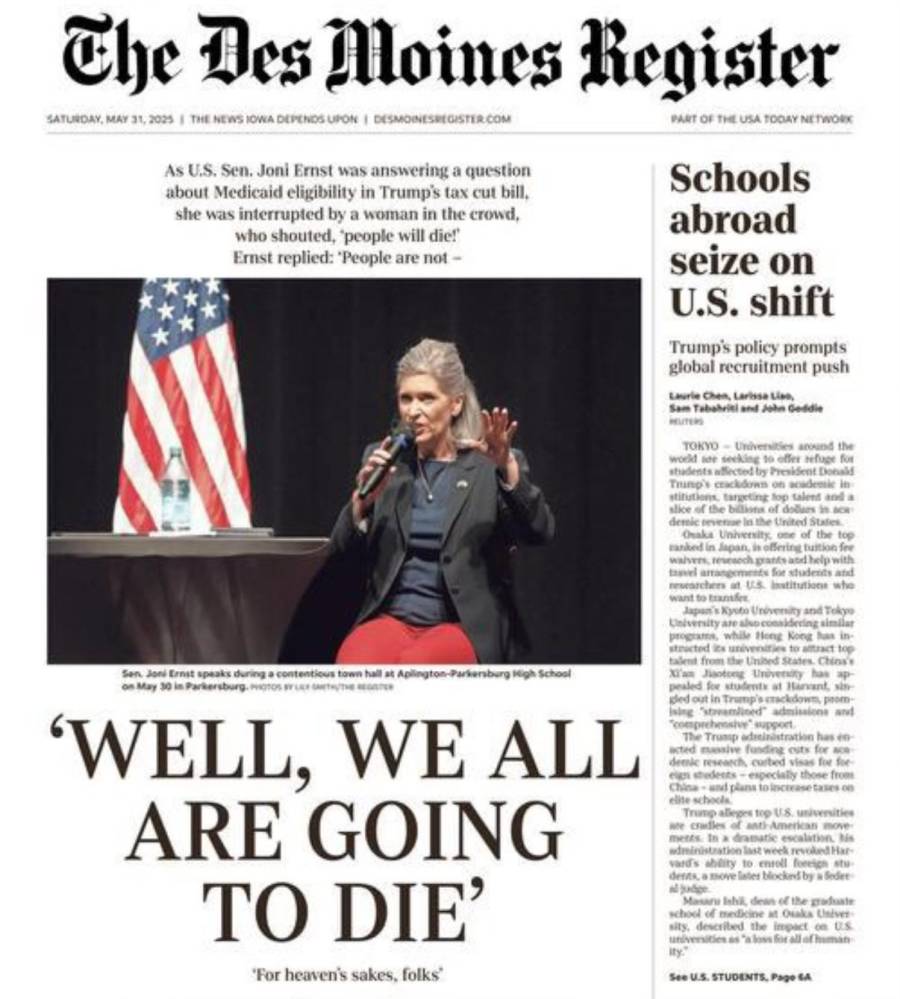
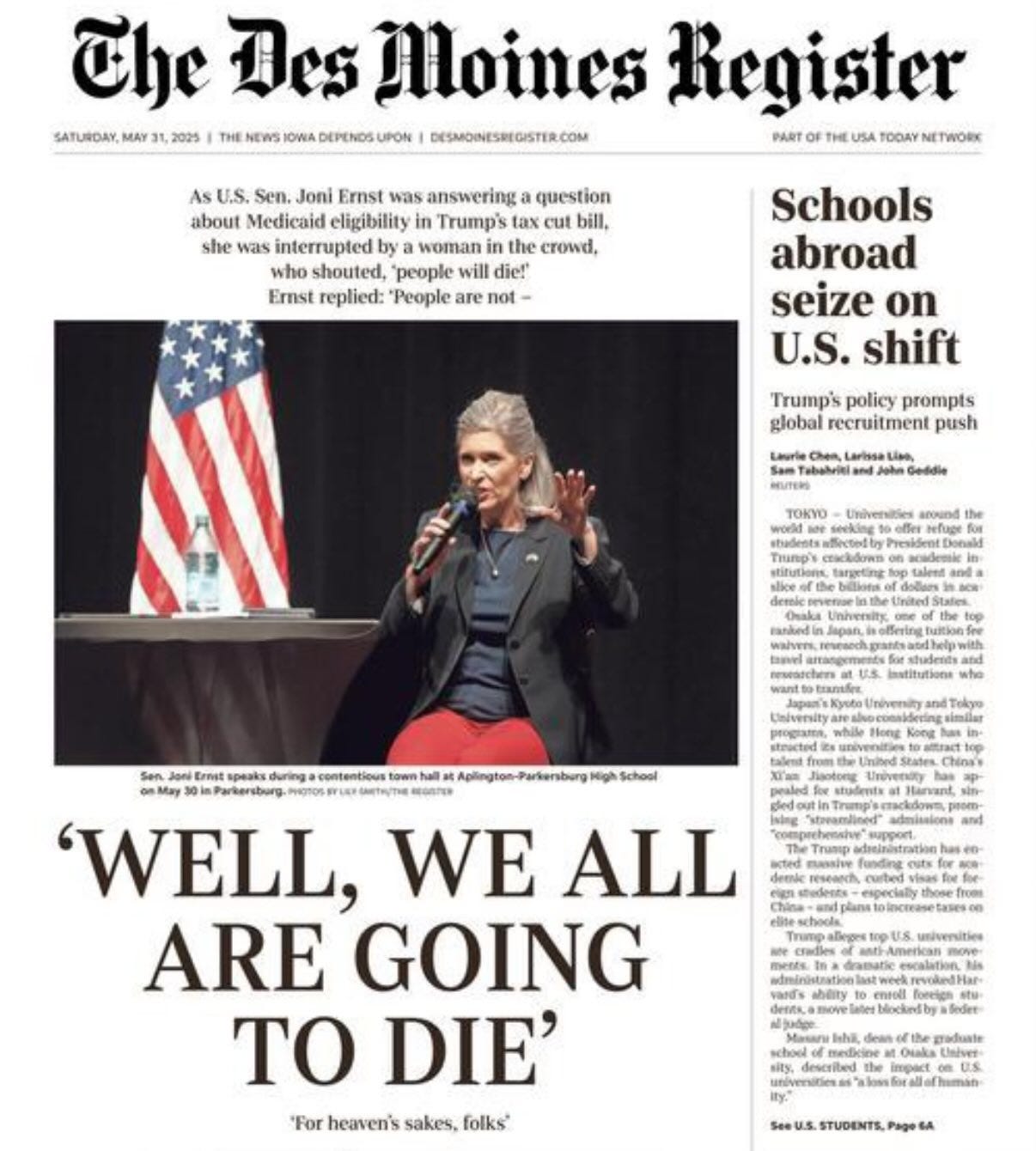
When a U.S. Senator from Iowa stands at the gates of power and shrugs her shoulders at the suffering of the elderly, veterans, children, and disabled folks if Medicare is cut, saying, “well, we are all going to die,” we know are living at the gates of Nain.

The good news is that when Jesus sees the funeral procession, he sees all of it. He sees the normalization of cruelty. He sees the pain of the widow. He sees her poverty. He sees her isolation. He sees the way she is seen or not seen by the political and religious culture. And Luke says, “He had compassion on her.”

As I have pointed out before, that word “compassion” in the Greek is visceral. Jesus felt it in his gut. The word literally means that he was filled with so much compassion, his stomach was in knots. And notice what happens next.

Jesus crashes the funeral. Jesus steps in and stops the procession. He reaches out and touches the bier.

By touching the bier, he touches what others refuse to touch. He breaks cultural, ritual, and religious protocol interrupting death with divine compassion. And then, with the authority of heaven, he speaks directly to the dead: “Young man, I say to you, rise!”

Notice that Jesus doesn’t offer thoughts and prayers. He doesn’t say “Rest in peace” or “God needed another angel in heaven” or, “bless his heart, he’s in a better place.” And he sure in heaven doesn’t say, “Well, we are all going to die.”

Jesus speaks in the face of injustice and death saying: “Rise!”

“Rise!”— That’s the gospel we are called to preach and to live.

“Rise!” is a gospel of protest; not passivity.

It’s a gospel of resurrection; not resignation.
It’s not a gospel that comforts the powerful, but a gospel that confronts the powerful and disrupts the unjust systems of death.

The question that this story begs of us today is: what kind of people will we be?

Will we be the indifferent crowd accepting injustice by following death to the grave, or will we be the disciples who walk with Jesus and interrupt it?

Will we shrug our shoulders accepting that “everybody dies,” or will we embrace a gospel that never shrugs, a gospel that always dares to stop the march of injustice?

These questions are most important today as many Christians have chosen death over life.

Oh, of course they would never confess that. They claim to follow the way of Jesus by being pro-life, but they act in ways that are the exact opposite.

They want to force children to be born into the world while they cut Head Start, undermine vaccines, refuse to fund public schools, stand against raising the minimum wage, deny healthcare, and cut food assistance. They hold press conferences about embryos but pass budgets that kill the most vulnerable among us. They preach “sanctity of life” but value their right to own an assault weapon more than they value the safety of school children. They cry “life is sacred,” but when asked about Medicare, they shrug and say: “Well, we are all going to die.”

That’s not pro-life. That’s pro-power, pro-patriarchy, and pro-political points. It’s s a theology of control, not compassion, and it has nothing to do with Jesus of Nazareth. I believe the church needs to be pro-life the way Jesus was pro-life.

That means pro-human dignity, pro-healthcare, pro-feeding the hungry, pro-housing, pro-living wages, pro-education, pro-immigrant, pro-refugee, pro-disabled persons, pro-LGBTQIA persons, pro-justice, pro-mercy, pro-nonviolence, and pro-peace.

Otherwise, it’s not life. It’s hypocrisy. Otherwise, what is the church good for?

I will never forget sharing with one of my former churches during a board meeting that unless some changes were made, unless we left the comfort and safety of the sanctuary to take the gospel from the pulpit into the public square, I believed the church was going to die.

Do you want to know what their response was?

“Well, we’re ok with that. The truth is, pastor, we would rather die than change anything.” I kid you not.

But I do not believe Christian pastors are called by God to be hospice chaplains for dying congregations. We are not called by God to manage the procession of death. And we are not called to be chaplains of empire or funeral directors for failed, unjust systems.

And we weren’t called to gather here in this place just to sing and sip coffee. We are called to go out and crash the funeral! We are called to disrupt the lie that poverty and cruelty is normal. We are called to touch the bier, to raise our voices, to say to a fragmented and unjust world: “This procession ends here! Rise up and live!”

Because Jesus didn’t come to help us die quietly and peacefully.
Jesus came so that we might have life and have it abundantly!

So, when they say, “well, we are all going to die,” we say:
Yes, that is true, but not all don’t need to die this way.
-Not for lack of access to healthcare.

-Not for a lack of opportunity to get an education.

-Not for a lack of food.

-Not for lack of insulin.

-Not for the lack of a living wage.

-Not because gender-affirming care upsets your privileged, ignorant, black and white, binary religious worldview.

– Not because compassion is considered too expensive and mercy too extravagant.

And not while the Church is still breathing and still following the way and voice of Jesus who says: “Open your eyes and see the suffering. See the injustice. And then step in— and touch the bier. Stand where the pain is. Interrupt the systems of death. Speak to the young people laid in caskets before their time and dare to declare: ‘You were meant for so much more than this!’”

Because healthcare is not luxury. It’s a human right. Compassion is not weakness, and empathy is not sin. It’s divine strength. The church is not called to manage the funeral. We’re called to proclaim resurrection.

So let us go from this place not in silence but in power.

Let us walk to the gates of our cities, our states, and this nation,
and speak like Jesus.

Let us say to our trans siblings: “We see you.”

Say to the poor, the and the disabled: “We are on your side.”

Say to the immigrant: “We stand with you.”
Say to the widow: “You are not alone.”
And say to the unjust systems of death: “Your time is up!”
And to all those who have been cast down: “Rise up and live!”

Because the final word is not cruelty. The final word is not indifference.
The final word is not: “well, everybody dies.” The final word is Jesus, and Jesus says: “Rise!”

So, let the Church rise! Let the people of God cry out at the gates of every system that shrugs at suffering:

To say to politicians obsessed with power and profit: We will not fooled by your pro-life bumper stickers.

To say to the politicians who offer thoughts and prayers but pass budgets of brutality: “We will not be silent!”

Because our Lord is the one who stops the funeral.

Our Lord is the one who touches the bier.
Our Lord is the one who weeps with the widow.
Our Lord is the one who speaks life into the grave and says: “Rise!”

And if we are going to follow that Lord, then we too must rise up, speak up, and lift up every child of God who’s been cast down. Because “everybody dies” may be a fact of biology, but rise up and live!” is the truth of theology!
So, let’s rise!

Reviving the Heart of a Lady

Acts 9:36-43

This morning’s epistle lesson is one of a handful of biblical stories where someone, other than Jesus, dies and is raised back to life.

In 1 Kings 17, we read the story of the prophet Elijah raising to life the dead son of a widow. Luke tells a similar story of Jesus also raising to life the dead son of a widow. Mark tells a story about Jesus raising the dead daughter of a synagogue official (Mark 5). And it is John who tells the infamous story of Lazarus (John 11).

In Acts 20, we read Luke’s fascinating story of Eutychus, the only person in the Bible who can blame his passing on a Sunday sermon that went too long!

Bless his heart, as Eutychus sat in a windowsill listening to Paul preach on and on and on and on, the poor fella nodded off to sleep and toppled out the window, falling three stories to his death!

To Paul’s credit, he stopped preaching and immediately ran downstairs. I suppose feeling somewhat responsible for his congregant’s tragic and untimely demise, Paul knelt down, propped the dead body up in his arms and said to the shocked eyewitnesses who were standing nearby: “He’s ok. He’s fine. Nothing to see here! Go on about your business.” Luke tells us Paul then went back upstairs and had communion, while Eutychus, having had his fill of preaching for the day, and maybe for the rest of his life, skipped the rest of the service and went away alive and well (Acts 20).

Now, who here today can believe that you could literally be bored to death by a sermon?

I know. All of you can.

But who here believes that if I so happened to bore one of you to death with one of my sermons, that I possess the power run down the aisle, prop up your lifeless body in my arms and bring you back to life?

No one believes that.

But we do have the new defibrillator now hanging up right outside the narthex ready to go. So, I guess you never know!

However, believing that one has the power to literally raise the dead back to life is no laughing matter. For example, no one would be laughing if someone’s heart did stop during the service, and I called off the one rushing the defibrillator down the aisle, exclaiming: “There’s no need here for science! Stand back! I got this!”

A few years ago, the nation watched in horror as members of a Pentecostal Church in Redding, California, inspired by the raising-the-dead stories in the Bible, prayed over the body of a 2-year-old little girl for five days, attempting to bring her back to life.

So, how should these stories be interpreted? Are they to be taken literally, or should we look for some deeper meaning, some symbolic meaning that is more true, more real, and more prophetic, than any possible literal understanding.

What are we to make of the story of Tabitha, the only woman referred to as a disciple in the in the New Testament, who died but was raised back to life by Peter?

We are told that she lived a life devoted to good works and acts of charity, but then, one day, she became ill and died. Those who had been caring for her washed her body and laid her in a room upstairs. She must have been an important figure in the life of the early church as the apostle Peter was immediately summoned to come to the home to pay his respects. As soon as Peter arrived, he was taken upstairs to the room where the body of Tabitha was lying in wake.

Among those at the visitation were (and I quote) “all the widows” of Joppa. They stood beside Peter weeping, showing off the items of clothing that Tabitha had made for them.

Think about that. “All the widows.” What an impact Tabitha had made to those who were among the most marginalized and disadvantaged in society, those who had been discounted— victims of injustice by being excluded from inheritance laws. They all stood around the body grieving, as their ally, their advocate, and their champion, was no more.

It’s then that Peter clears the room. He prays, and turns to the body and says, “Tabitha, get up.” Tabitha opens her eyes, and seeing Peter, she sits straight up.

What in the world can this mean?

The most obvious meaning to me is that this world needs more Tabathas. The world needs more Tabithas who are committed to good works, to acts of charity, and to defending and caring for the marginalized and the most vulnerable among us.

Heaven doesn’t need another angel, as people like to say at funeral visitations. We need more angels here on earth, specifically angels like Tabitha.

Earlier this week, I overheard a conversation between a local pastor and another man that went like this:

“I hope to retire at the end of the year,” said the pastor, “but I am worried that it may take a long time to find my successor, as there’s not many men studying for the ministry these days.”

The other man responded: “Well, in the interim, do you have some leaders in your congregation who might step up to help lead the church?”

The pastor replied: “We do have couple of young, godly men in the church who I am currently mentoring.” Then he said, “And I have this woman. She’s incredible, a hard worker, very devout and dependable.”

He then added: “If she were a man, I’d want to have her cloned.”

I should have spoken up.  But instead, I just quietly wondered if this preacher had ever heard the story of the church leader named Tabitha.

And then this wave of sadness came over me, as I was reminded of the role the church currently plays in supporting the subjugation of women in our society and is one of the main reasons I may not live to see a female elected President.

Tell me, when you first heard that “nine-year old baby girls need to be happy with two dolls this Christmas,” did you notice that there was no mention of anything boys would need to sacrifice?

Because sacrificing is for the women—those who should forgo a college education and a career so they can stay home where they belong and raise a family.

Today, we hear those in power mocking and discounting women who do not have biological children. The suggestion has even been made that the votes of women who do not have children should count less than women who have children.

Every day, it seems as if we encounter some form of hyper-masculinity that has historically associated with fascism.

In 1930’s Germany, as incentive to keep women in their place, and to keep immigrants in the minority, Adolf Hitler introduced the “Cross of Honor of the German Mother,” a decorative medal that honored “children-rich” mothers of German heritage, excluding Jewish Germans.

The medals came in three classes: the Bronze Cross for mothers of four or five children; the Silver Cross for mothers with six or seven children; and the Gold Cross for mothers with eight or more children.

Six years after Hitler’s medal program was introduced, Soviet dictator Joseph Stalin followed suit with the “Order of Maternal Glory,” also offering three tiers: “Third Class” for mothers of seven children; “Second Class” for mothers of eight children; and “First Class” for mothers of nine children.

Soviet women raising 10 or more children were given the title “Mother Heroine” up until the fall of the USSR in 1991.

In 2022, the Mother Heroine award was revived, adding a payment of 1 million rubles, which is equivalent to more than $12,000.

And now, the White House is considering implementing similar incentives, including payments of $5,000 in cash and a “National Medal of Motherhood” to moms in the U.S. who have six or more children.[i]

I believe it’s important to point out today that Tabitha is never described as a mother. We are only told that she was a faithful disciple, devoted to good works and acts of charity, especially among those who were marginalized and discounted by society.

Perhaps what this country needs is a “National Medal of Justice Doers!” Because what this country needs are more people like Tabitha. It needs more allies, advocates, and champions for the poor, the discounted, and the marginalized.

But what if Tabitha’s story means even more?

What if Tabitha is a larger symbol for our deepest and best moral value of caring for the least of these? And what if Peter in this story, the one who revives this value, the one considered by Catholics to be the first Pope, is a symbol for the church?

What if Tabitha is a symbol of kindness, compassion, mercy, and empathy? A symbol of diversity, equity, and inclusion? A symbol of welcome and belonging? A symbol liberty and justice for all, especially for those discounted and marginalized.

What if Tabitha is a large feminine symbol holding up a light for all those who are left out and left behind: the tired; the poor; the huddled masses yearning to breathe free; the wretched refuse, those considered despicable, regarded as garbage; the homeless; the tempest tossed?

Then, like the Tabitha in Luke’s story, we know today that she has fallen ill, gravely ill. You might say she has a heart problem, is heart sick, or suffering a heart attack.

Her heart has been broken by those who believe character no longer counts.

Her heart has been hardened by sexism, racism, fear, and greed.

Her heart has been jolted out of rhythm by chaos and confusion.

Her arteries have been clogged by the evil forces, the principalities, the powers, and the world rulers of this present darkness.

Hate has put her heart in cardiac arrest.

So, what do we do when the heart of liberty-and-justice-for-all stops beating?

Well, that’s when we summon Peter, we summon the church, we summon all disciples who are committed to the way of love Jesus taught. That’s when we summon all people who have good hearts, to be, in the words of Rev Dr. William Barber, “the moral defibrillators of our time” to shock what is the very heart of our nation! To shock what is the heart of this nation, liberty and justice for all, with the power of love and mercy, especially for the poor, the marginalized and the most vulnerable.[ii]

So, the question that Tabitha’s story beg of us today is this: Do you have a heart? Is there a heart in this congregation?

Do you have a heart for poor people? Do you have a heart for transgendered people? Do you have a heart for immigrants?

Do you have a heart for women? Do you have a heart for mothers who have been deported by ICE and separated from their families? Do you have a heart for the value, the worth, and the dignity of all women, regardless of whether they choose to have children?

Then you have been summoned today. You have been called to be “the moral defibrillators of our time” to shock our city with love, to revive the pulse of our state with mercy, and to raise back to life the very heart of our nation.

[i] https://people.com/trump-team-ponders-incentives-motherhood-birthrate-11719580

[ii] Address to the DNC by Rev. Dr. William Barber, 2016

I Have Seen the Lord!

John 20:1-18 NRSV

It’s Easter, and all over the world preachers are feeling the pressure to preach the better-than-the-average sermon. All week they’ve been burdened to come up with something insightful, something profound, to say about this story of stories, preferably something their congregations have never heard before. Oh, the pressure!

Each week for a sermon, I write, on average, 1,800 words. This is the number of words that I, with my seasoned homiletical and ecclesial acuity, have deemed theologically and linguistically necessary to bequeath the congregation an appropriate word from the Lord. And on the Sundays I need to be better than average, like Easter, I am always tempted to go a little longer, like upward to 2,000 words or more.

Now, my wife Lori believes that I should be able to write a sermon, and she’d prefer I write a sermon, even for Easter, with much fewer words. But Lori hasn’t been to seminary, I tell myself.

That’s why, by the way, every now and again, I throw in seminary words like “ecclesial” and smart-sounding words like “bequeath”—to convince the congregation, and myself, that I know what I’m doing up here. And we preachers especially like to use big words on Easter!

However, as I prepared for today’s sermon, I came to realize that Lori may be right.  In fact, esteemed professor of homiletics Karoline Lewis, points out that the best Easter sermon ever delivered, and the sermon we desperately need to hear again today, was nowhere close to 1,800 words. It contained 5. Lewis says that the best Easter sermon ever delivered was proclaimed by Mary Magdalene on that first Easter morning: “I have seen the Lord!”[i]

That’s it. There’s your Easter sermon. “I have seen the Lord!” Now, let’s sing a hymn, have communion, and pass the peace!

Now, because I don’t want to be accused of being lazy on Easter, I will attempt to say a little more. But I tend agree with Rev. Lewis that, too often, our preaching, especially on Easter, is just “too much –too much explanation, too much justification, too much rationalization.” She says our preaching is too much expository and not enough experiential. It’s too much illustrational and not enough incarnational. She argues preaching needs to be less performance and more personal, more down-to-earth, more authentic.

That struck a chord with me this week, as I recently heard local colleague make the shocking assertion, that on some days, he has this sinking feeling that God is not in Lynchburg.

Now, that’s a dark statement coming from anyone, but coming from a pastor in this town, it’s especially chilling. Almost as chilling as it is ironic with the vast number of churches in our city.

Last year, one of my guilty pleasures in life was binging the dark TV drama series called “Preacher.” Lori didn’t care for it. I loved it. It’s a story based on a comic book hero, a Texas Preacher, who’s on a mission in Louisiana searching for God who’s gone missing. God just got tired of being God one day, vacated the throne, got on motorcycle, and headed to New Orleans to listen to some good jazz and have a good time. It’s a very dark and rather bloody story about the chaos that ensues when God forsakes and abandons the world. All hell literally breaks loose as vampires, fallen angels, demons, and the devil himself wreak havoc upon the earth.

And my colleague says this is what it can sometimes feel like serving as a pastor in Lynchburg, Virginia. He says he sometimes wants to cry out like Jesus from the cross, “My God, My God, why have you forsaken us?”

Maybe we have had days when we have wanted to do the same.

The lack of affordable housing, the number of people living with food insecurity, the plans to cut spending on public schools and social services, the ugliness on the city council—it can all seem like God has left the city limits.

Just last week, an owner of a new restaurant told me that he recently served dinner to a member of the city council who had the hateful audacity to advise him to refuse service to members of the LGBTQ community.

And then we have the number of people who claim to be Christians or even “Champions for Christ” who support ways that the exact opposite of the way of the inclusive, universal, unconditional love that Jesus taught, modeled, and embodied.

Looking at some parts of our city, we can easily identify with Jesus when he lamented what seemed like the absence of God in Jerusalem, crying: “Jerusalem, Jerusalem, the city that kills the prophets and stones those who are sent to it!”

And you don’t even need to be religious to believe that God may have even fled the country—a nation where people can be snatched from their homes and disappeared to a gulag in El Salvador without any recourse. Bishop William Barber notes: “Like the lynching trees of the South and the crosses of Rome, these public acts of brutality are designed to inspire fear that compels the masses to comply. But we cannot comply.”[ii]

This is why on this Easter Sunday, we need to hear the personal, authentic, first-person, five-word sermon of Mary Magdalene: “I have seen the Lord!” We need a first-hand witness of the resurrection, not a third-person account, confession, or creed.

In these dark, seemingly God-forsaken days, we don’t need to hear the stale and old: “He was crucified, dead, and buried; the third day he rose from the dead…” or “Christ the Lord is risen; he is risen indeed.” That’s nice, that’s good, but these days, we need more.

We need a first-person, eye-witness testimony. We need to hear of a new and fresh encounter. We need somebody to stand up before us today and exclaim: “I have seen the Lord!”

As we demonstrated during our Maundy Thursday service, the good news is that we can easily point out all the places in Lynchburg where we have seen the Lord, where there is resurrection in the midst of ruin; the light of new life in the shadows of death; love, when all that seems visible is hate. There’s much goodness, generosity and compassion in the midst of all the meanness, selfishness and cruelty: Parkview Mission, Interfaith Outreach, Meals on Wheels, The Free Clinic…It would take much more 1,800 words to name all of the non-profits and organizations that are being the hands and feet of the Lord in this town.

 But proclaiming, “I have seen the Lord,” means even more than that.

“I have seen the Lord” means personally bearing witness to the resurrection. It means being a first-person, eyewitness, living testimony of Easter.

In the hateful darkness of a violent world that has rejected the way of Jesus and would crucify him all over again if it got the chance, “I have seen the Lord” means demonstrating that there is another way of being in the world— a loving, justice-seeking, non-violent way that embodies all that is life-giving. It means living and giving and loving and serving in such a way, that when others see you, watch you, listen to you, they say: “Wait one second. Did I just see the Lord?”

“I have seen the Lord” insists that the ways of love will always win over the ways of hate.

“I have seen the Lord” affirms that the way of peace will always overcome the way of violence.

“I have seen the Lord” confirms that the truth of kindness, mercy and decency will always be louder than the con of fear, confusion, and chaos.

“I have seen the Lord” asserts that the voices of compassion will always be heard over the clamor of cruelty and retaliation.”

“I have seen the Lord” is what Gandhi proclaimed when he shared a vision of a world where all of creation and every living creature is revered and respected, thriving in peace and harmony, when all most can see is ecological devastation, violence, war, oppression, injustice, colonialism, and imperialism.

“I have seen the Lord” were the exact words of Martin Luther King Jr. when he preached on the day before his assassination: “I have seen the promised land. I may not get there with you. But I want you to know tonight, that we, as a people, will get to the promised land. And I’m happy tonight. I’m not worried about anything. I’m not fearing any man. Mine eyes have seen the glory of the coming of the Lord.”

“I have seen the Lord” is a proclamation that neither death by starvation in India, nor death by a bullet in Memphis, nor death on a cross in Jerusalem, can prevent love from winning and justice from coming.

Mary’s proclamation “I have seen the Lord” proclaims not only that a single stone was rolled away 2,000 years ago, but countless stones are still being rolled away today, all the stones that are used to prevent new life from rising: racist stones blocking paths to citizenship; bigoted stones blocking the doors of closets; corrupt stones blocking the power of free speech and due process; greedy stones blocking care for the environment; deceptive stones blocking the truth of science and history; and violent stones blocking any possibility of new life, justice, and peace.

“I have seen the Lord” is the justice those are demanding on the behalf of Abrego Garcia and every person deported unjustly. It’s the defiance of Harvard University, and the cry of all protesting the rise of fascism.

“I have seen the Lord,” when we speak it into our own lives, become words that have the power to roll back all the stones that confine and constrain the possibility that liberty and justice, dignity and respect can be for all people.

But “I have seen the Lord” is so counter-cultural, so counter-intuitive, often defying what we see with our own eyes, that it can be difficult to speak it. Especially to speak it personally, authentically in the first-person, to speak it with faith and conviction. It’s much easier to walk out of this service this morning and recite a third-person creed, “Christ the Lord is risen. He is risen indeed” than it is to honestly say in the first-person, “I have seen the Lord!”

Perhaps, like anything difficult, we need to practice it, and practice it daily.

So, in what places do you need practice it today? In front of what tomb do you need proclaim resurrection today?

What stone in your life needs to be removed today so you can be free?

What’s preventing you today from experiencing the joy of new life? What is blocking you today from enjoying peace, possessing hope, and knowing love?

On this Easter morning, when we walk out of this church building, where’s the first place we need to go to proclaim: “I have seen the Lord!”

Who do we know that may be unable to say it today, but needs to hear it, because they have been hiding in the tombs too long?

Today, we thank God for Mary Magdalene, the preacher of the best Easter sermon ever proclaimed, the good news we all need to hear today: “I have seen the Lord!”

[i] Sermon inspired by the thoughts of Rev. Dr. Karoline Lewis shared in an article entitled: True Resurrection, March 20, 2016

[ii] From The Power of a Moral Opposition: A Holy Saturday Reflection, April 19, 2025.

For Easter to Happen, Somebody Needed to Pick Up and Carry a Cross

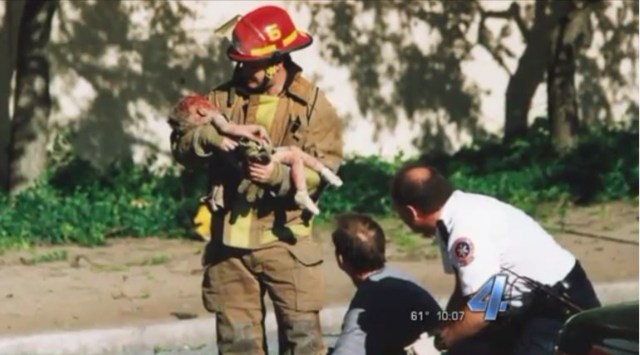
oklahoma city bombing firefighter baby

Luke 24:1-12 NRSV

It is Easter Sunday! Resurrection morning has dawned. New life is being born! Something wonderful has been lost, but something magnificent is being gained.

However, on this Sunday of Sundays, I believe it is important for us to realize that before we can experience new life, before we can celebrate resurrection, before we can sing alleluias, before love can win, somebody needed to pick up and carry a cross.

And the sad thing is that there are very few of Jesus’ disciples who understand this. They do not understand it today, and they did not understand it 2,000 years ago.

Although Jesus continually taught that to gain our lives, we must be willing to lose our lives, that Easter could not happen without some self-denial, that resurrection could not come without some self-expenditure, that new life could not be born without some sacrifice, that love could not be won without some suffering, that the the light of Sunday morning could not  dawn without the darkness of Good Friday, when the time came for the disciples to follow Jesus all the way to the foot of the cross, most all of them very selfishly fled to save their lives.

One would betray Jesus. Another would deny that he even knew Jesus. Nearly all would desert him. In spite of Jesus’ continual call to pick up a cross and follow him, most of the disciples never got it.

However, there were a few disciples who did get it. There were a few who were willing to carry a cross. There were a few who chose to live selflessly and to love sacrificially. There were a few who faithfully followed Jesus all the way to Golgotha.

Although the intrinsic sexism of this world’s history has caused many in the church to overlook these faithful disciples, the good news is that all four Gospel writers did not.

In Luke 8 we read these words: Afterward [Jesus] journeyed from one town and village to another, preaching and proclaiming the good news of the kingdom of God. Accompanying him were the Twelve and some women…Mary, called Magdalene… Joanna…Susanna, and many others…” These women helped support Jesus and the twelve “out of their own means.”

And on Good Friday, when none of the male disciples could be found, Mark 15 reads: “There were also some women looking on…among whom were Mary Magdalene, and Mary the mother of James, Joses, and Salome.

In Matthew 27 we read: “Among them [gathered at the foot of the cross] was Mary Magdalene, and Mary the mother of James and Joseph, and the mother of the sons of Zebedee.

In John 19:25 we read where all the male disciples fled: “But standing by the cross of Jesus were His mother, and His mother’s sister, Mary the wife of Clopas, and Mary Magdalene.

There are many problems with Christianity today. However, I believe one of the biggest problems with our faith today, especially here in North America, is that we have too few Mary Magdalenes.

There are too few people who understand that authentic faith, true discipleship, always involves a cross. It always involves answering a call, taking a risk, denying oneself, going against the status quo, pushing the boundaries, stepping way outside one’s comfort zone.

A problem with the church today is there are too many Christians who believe they can sing “alleluias” on Easter Sunday without going through some suffering on Good Friday, who believe they can experience some new life without death to self, who believe they can somehow rise up from the waters of baptism without getting their hair wet, who believe they can serve Jesus without getting their hands dirty.

What this world desperately needs needs right now, and what the church needs more than anything today, are more disciples like Mary Magdalene. For Mary Magdalene understood that when Jesus called people to be his disciples, Jesus was always clear that there would be a cross involved.

I think this is the reason that Mary Magdalene is remembered today by Matthew, Mark, Luke and John. This is the reason she is mentioned by name by the gospel writers more than any other apostle. And this is the reason that today, on this Easter Sunday morning, Christians all over the world will hear her name mentioned as they gather to worship.

Some will hear her name as Mark 15 is read: “Mary Magdalene and Mary the mother of Joses were looking on to see where Jesus was laid.”

Some will hear her name as Matthew 28 is read: “Now after the Sabbath, as it began to dawn toward the first day of the week, Mary Magdalene and the other Mary came to look at the grave.”

Some will hear it as Mark 16 is read: “When the Sabbath was over, Mary Magdalene, and Mary the mother of James, and Salome, bought spices, so that they might come and anoint Him.”

And others will hear it as John 20 is read: “Now on the first day of the week Mary Magdalene came early to the tomb, while it was still dark, and saw the stone already taken away from the tomb.”

Just as Mary Magdalene had given what she had to support Jesus’ life, Mary was still doing all she could for Jesus in death.

And because she always selflessly pouring herself out, because she kept giving, kept sacrificing, kept risking, serving, bending, expending, anointing, because she was the most faithful of all of the disciples, because she not only sacrificially followed Jesus all the way to the cross, but courageously followed him all the way to the grave, because she followed him to the very end, she was the first person on earth to see the risen Lord.

Mark 16:9 reads: “Now after He had risen early on the first day of the week, He first appeared to Mary Magdalene…”

And in John 20:18 we read where it was Mary Magdalene who first proclaimed the good news of Easter, speaking five simple words that changed the world forever: “Mary Magdalene came, announcing to the disciples, ‘I have seen the Lord.’”  Not only was she the first person to see the Lord, she was the first person to proclaim the world-changing, earth-shaking, life-saving good news of Easter to the world!

Mary Magdalene was the very first to preach the glorious good news of resurrection on Easter Sunday, because she stayed with Jesus until the very last in his suffering and death of Good Friday. Easter happened for Mary because she had answered a call to follow Jesus, and she followed Jesus all the way.

Observing Good Friday this year was a surreal experience for many Americans, as it fell on April 19, the day of the terrorist bombing in Oklahoma City.

The story of one survivor, Terri Talley, exemplifies the suffering experienced by our nation, as well as how new life was raised out of the ashes through those who were willing to pick up and carry a cross.

Employed by the Federal Employee’s Credit Union on the third floor of the Murrah Federal Building, that morning was extremely busy for Terri. She had just returned to work after spending several days away, and a stack of paperwork waited for her.

Catching up on work, Terri took a moment that morning to chat with her good friend and coworker Sonja Sanders. “For her, it was a big day. She had just been promoted into management,” states Terri, who is certain she was the last person to have spoken with her friend.

What seemed like just moments afterward, everything changed. At 9:02 am, thousands of pounds of explosives, assembled in the back of a Ryder moving truck parked in front of her office building, exploded.

Terri recounts: “I fell from the third floor to somewhere around the basement level. It was really really fast. It was so fast that I didn’t really know what had happened. The suction pulled me down so quickly.”

Surrounded by noise Terri says, “When I came to the first time, I thought: ‘This is a really bad dream. I will just go to sleep and when I wake up everything will be okay.’ But when I came to [again], everything wasn’t okay. I thought that I must have been in a really bad wreck, and I must be [pinned in the wreckage], because I couldn’t see anything. I couldn’t move. I couldn’t even scream for help. I would try, but I was really squished. And I thought to myself: ‘I hope someone finds me.’”

Terri was found by a firefighter who almost overlooked her. [Like being sealed in a tomb] she was completely encased in concrete and granite. Terri says: “There was just a little hole and a little piece of me was showing. He touched me and … started screaming: ‘Hey! I have a live one here, and I need some help!'”

After much hard work, Terri was freed and rushed to a nearby hospital, where her injuries were identified: temporary blindness, a concussion, temporary amnesia, a cracked first vertebra in her neck, a broken right ankle, skin damage on her foot, and multiple abrasions. During her seven days in the hospital, and for weeks following, a sense of shock permeated her life.

However, today, she has this powerful message for the world:

I always tell [even] the littlest of kids: ‘Don’t think that there is nothing you can do, because kids would color pictures and send me notes. Those made me feel like people were really thinking about me. You can always do something, no matter what age you are.’[i]

This illustrates that to experience Easter Sunday, we have to have a Good Friday.

Before new life could be experienced, before resurrection could be celebrated, before “alleluias” could be sung, before love could be won, somebody needed to pick up and carry a cross.

-First Responders needed to run toward an explosion.
-Firefighters needed to go into a burning building.
-Doctors and nurses needed to give all that they had to give.
-Friends and family and church members needed to pray.
-And little children needed to pick up some crayons and color a picture.

To make Easter happen for someone–today, right here, right now–we can all do something, be something, risk something, sacrifice something, give something, create something.

We can all pick up and carry a cross.

We can feed someone who is hungry.

Visit someone who is lonely.

Love someone who is hurting.

Include someone who has been left out.

We can mentor someone who lives in a foster home.

Care for someone who is sick.

Forgive someone who has made mistakes.

Believe someone who has been abused.

We can share grace with someone who faces discrimination.

Stand up for someone victimized by injustice.

Speak out for someone devalued by oppression.

We can stay close by and anoint someone who is dying.

Be a friend to someone who is grieving.

With the spirit of Mary Magdalene, let’s keep the faith, and let’s keep the faith going, keep it moving forward, all the way to the foot of the cross, through the betrayals, through the fear, through the denials, through the suffering, through the shame, all the way to the grave, even to a tomb that has been sealed by granite or concrete.

Let us keep doing whatever we can, with whatever we have, wherever we are, to love one another until the entire world is able to sing:

“Alleluia! Alleluia! I have seen the Lord!”


[i]https://www.nps.gov/okci/learn/historyculture/stories.htm

A Day for Fools

fool

John 20:1-18 NRSV

For the very first time in my lifetime, Easter is on April Fools Day, which presents the preacher with the perfect opportunity to point out the foolishness of it all.

The Apostle Paul outrageously asserts:

“The way of the cross is foolishness” to the world (1 Corinthians 1:18-31).

We proclaim Christ crucified, a stumbling block to Jews and foolishness to the Gentiles. God chose what is foolish in the world to shame the wise; God chose what is weak in the world to shame the strong.

We witnessed some of the foolishness last week. Jesus, the King of Kings and Lord of Lords, the Savior of the World, arrives in the capital city, not on a powerful war horse, not on a white stallion, not in a royal entourage, but bouncing in on the back of a borrowed donkey.

I believe ne of the most troubling things about our faith is the attempt by the church to try to deny or even conceal the foolishness of the gospel. Ashamed of to be labeled a fool, there is this tendency to take the all of the foolishness that is inherent in the gospel and re-package it as just another brand of worldly wisdom, common sense, something on which all Americans easily accept and agree.

A recent survey by Bill McKibben reveals that three-quarters of Americans believe the Bible teaches that “God helps those who help themselves.”[i]  However, that statement is from deist Ben Franklin; not the Bible.[ii] In fact, “God helps those who help themselves” is one of the most unbiblical ideas. It is Jesus who made the dramatic counter assertion: “Love your neighbor as yourself.”  But, deep down we prefer Ben Franklin don’t we?  Doesn’t sound so foolish.

Søren Kierkegaard, the great Danish theologian, writes: “Christianity has taken a giant stride into the absurd. Remove from Christianity its ability to shock, and it is altogether destroyed. It then becomes a tiny superficial thing, capable neither of inflicting deep wounds nor of healing them. It’s when the absurd starts to sound reasonable that we should begin to worry.” He goes on to name a few of Jesus’ shocking and foolish assertions: “Blessed are the meek; love your enemies; go and sell all you have and give it to the poor.”[iii]

Listen to some of the most popular preachers today. Christianity is not about absurdity; it’s about positive thinking. It’s about how to be successful and happy and satisfied and effective at home, at work and at play, in marriage, in friendships, and in business. There is no cross bearing. No Jesus bounding into Jerusalem on the back of a donkey. No foolishness. It’s no wonder the church today looks more like a country club than it does the living body of Christ.

Perhaps this tendency to rationalize the gospel has been with us since day one. Just listen to Mary and the way she rationalizes that first Easter morning when she saw that the stone had been removed.

So she ran and went to Simon Peter and the other disciple…and said to them, “They have taken the Lord out of the tomb…

Of course this is what must have happened. Anyone with a lick of common sense can deduce this. It would be foolish to believe anything else!

Mary stood weeping outside the tomb.

A very reasonable thing to do in this situation.

As she wept, she bent over to look into the tomb; and she saw two angels in white…

They said to her, “Woman, why are you weeping?”

She said to them, “They have taken away my Lord, and I do not know where they have laid him.”

“And I do not know…”

She almost confesses to her problem right there, that she “does not know,” but it becomes obvious she is still grounded in earthly wisdom, still constrained by common sense.

“I don’t know where they have laid him.”

“When she had said this, she turned around and saw Jesus standing there, but she did not know that it was Jesus

Of course it’s not Jesus. That would be absurd.

1Jesus said to her, “Woman, why are you weeping? Whom are you looking for?” Supposing him to be the gardener…

Of course he’s probably the gardener. That’s just good common sense.

 She says to him, “Sir, if you have carried him away, tell me where you have laid him, and I will take him away.”

A rational request, a reasonable appeal.

But the good news is that the risen Christ is continually liberating us from the restrictions of rational thought, reasonable assertions, and all of the limitations of human reason!

The Risen Christ is continually breaking the restraints of common sense, pushing the boundaries of human logic. He is continually calling us out of the world that we have all figured out to live in a new realm that many would regard as foolish.

And notice how is does it. He breaks the barriers of worldly wisdom, the presuppositions that Mary has of what is going on in this world and not going on in this world, by calling her by name.

Jesus said to her, “Mary!”

And for Mary, this is the moment she takes a great stride into the absurd, the moment her whole world is suddenly transformed. This is the moment Mary began walking by faith and not by sight.

In his second letter to the Corinthians, Paul writes these words:

[Jesus] died for all, so that those who live might live no longer for themselves, but for him who died and was raised for them.

From now on, therefore, we regard no one from a human point of view; even though we once knew Christ from a human point of view, we know him no longer in that way. So if anyone is in Christ, there is a new creation: everything old has passed away; see, everything has become new!

The Apostle Paul is writing about a miraculous change that has been wrought in his life because of the change that has been wrought in the world through God in Jesus Christ.

Paul is saying that at one time he understood Christ with the wisdom of mortals—as a great teacher, a fine moral example.

But now he is able to see in the death and resurrection of Christ, a radical shift in the entire world. In Christ, a new age has been inaugurated. The whole world has changed. Just as God brought light out of darkness in creation, God has now recreated the world in the life, death, and resurrection of Christ.

This is what the great theologian Moltmann was trying to point out when he said,

“We have attempted to view the resurrection of Christ from the viewpoint of history. Perhaps the time has come for us to view history from the viewpoint of the resurrection!”

Paul was saying that when Jesus was raised from the dead, the whole world had shifted on its axis. All was made new.

This is exactly what happened to Mary when the risen Lord called her by name.

 Mary recognizes the risen Christ, turns and says to him in Hebrew, “Rabbouni!” (which means Teacher).

And Mary experienced a transformation that was so real, that she was compelled to announce it to the world: “I have seen the Lord!”

You know, it’s one thing to experience something that you know the whole world thinks is foolish. But it takes foolish to a whole other level when you go out and share that something with the world.

But that is just what people who have experienced the good news of Easter do.

That is why on this April 1, when some look at us gathered here, praying and singing, preaching and baptizing, and say that everything that we are doing here today only confirms their preconceptions that this day is a day for fools, we smile, and we respond: “You have no idea just how foolish we are!”

How foolish? You ask.

Oh, we’re foolish enough!

  • We’re foolish enough to believe that the only life worth living is a life that is given away.
  • We’re foolish enough to believe the Kingdom of God belongs to the poor.
  • We’re foolish enough to believe those who hunger and thirst for justice will be filled.
  • We’re foolish enough to believe the last shall be first.
  • We’re foolish enough to believe that all things work together for the good.
  • We’re foolish enough to believe that nothing can separate us from the love of God.
  • We’re foolish enough to believe that this world can be a better place.
  • We’re foolish enough to believe that character still counts, morality still matters, and honesty is still a virtue and all three are still possible.

And we are foolish enough to take foolish to whole other level!

  • We’re foolish enough to love our neighbors as ourselves.
  • We’re foolish enough to forgive seventy times seven.
  • We’re foolish enough to turn the other cheek, go the extra mile, give the very shirt off our back.
  • We’re foolish enough to feed the hungry, love an enemy, welcome a stranger, visit a prison, befriend the lonely.
  • We’re foolish enough to stand up for the marginalized, defend the most vulnerable, and free the oppressed.
  • We’re foolish enough to call a Muslim our brother.
  • We’re foolish enough to believe that someone with Cerebral Palsy can run a marathon.
  • We’re foolish enough to believe students can build an affordable house for a family who struggles to make ends meet.
  • We’re foolish enough to get back up when life knocks us down.
  • We’re foolish enough to never give up, never give in, and never give out.
  • We’re foolish enough to believe that nothing can stop us, not even death.


Because, although it may seem absurd, Somebody loves us.

Somebody came and taught us to see the world in a brand new way.

Somebody picked up and carried a cross.

Somebody suffered.

Somebody gave all they had, even to the point of death.

Somebody arose from the grave.

And that same Somebody found us and called us by name.


[i]Bill McKibben, “The Christian Paradox,” Harpers Magazine, July 7, 2005.

[ii]Deism is a religious and philosophical belief that a supreme natural God exists and created the physical universe, and that religious truths can be arrived at by the application of reason and observation of the natural world.  Deists generally reject the notion of supernatural revelation as a basis of truth or religious teaching.

[iii]http://sojo.net/magazine/2007/08/foolishness-cross

Autumn People

Autumn-Leaves-in-sunshine

Christians are fond of saying that they are Easter people. We say we have a spring-time faith. We are about new life springing forth.

What we tend to forget is that before spring can happen, autumn must come. Before new life can spring forth, something must die. Before Easter could arrive, someone had to pick up and carry a cross.

We have many difficult issues facing our country today. According to a recent poll by the Associated Press, only 24% of Americans believe we are heading in the right direction. The status quo seems to be dividing us further, emboldening the hate among us, and leading us into a nuclear winter.

Christians have responded in typical fashion.

Some Christians have embraced the status-quo, for change is too uncomfortable. They have chosen to live in denial with blind eyes, deaf ears and hard hearts.

More Christians understand that our nation is heading in the wrong direction, but they have made the decision to tune it all out and do nothing to try to change anything. They have chosen to retreat into safe sanctuaries to sing about Easter and going to heaven.

However, if Jesus chose comfort and safety, if Jesus embraced or ignored the status quo, Easter could not happen.

I believe the time has come for Christians to rediscover our call to be autumn people.

The time has come to let the old ways of being Christian die. Like the leaves of a tree, we must let our old ways of self-preservation, our old ways denial and retreat, fall to the ground and be swept away.

The time has come for us to pick up and carry a cross. The time has come for us to risk something, sacrifice something, and do something. We must depart the safety and the comfort of our sanctuaries to stand against evil, liberate the oppressed, rescue the perishing, and speak truth to power.

We must be willing to sacrifice something for justice, lose something for kindness, give away something for peace, die to something for love.

For it is in losing we find. It is in dying we live. It is in being autumn people we become Easter people.

Another Point of View

Callie Anne

Philippians 3:4b-14 NRSV

There are many things that happen to us that make us look at the world in a brand new way. Things happen, and our whole world changes.  We see things differently, have a new perspective, see things from another point of view.

Oftentimes, this new perspective comes to us by way of tragedy or pain. Sometimes, when someone suffers a heart attack or another life-threatening illness, they can experience such a radically new perspective that their entire personality changes.

Our world changes every time we lose someone we love. “Without them, the world is just not the same,” we say.

Our world changed when we woke up on Monday morning and learned of the horrific shooting in Las Vegas. We were reminded how vulnerable and fragile life is, how evil human beings can be. We were given a new sense of humility. We appreciated life more. We cherished our loved ones more. We were given a brand new perspective for living.

Likewise, something very good can also bring a new perspective. Love can do that. When we are with someone we love, the sky seems bluer, the sun shines brighter. Love makes us more grateful, more giving, more kind. When we fall in love, the whole world changes.

And of course, having a baby changes everything. It brings a whole new perspective. A brand new point of view. There’s more responsibility, more worries, and more fun, and there’s less sleep, less time, and less fun. Parenthood: it’s a brand new world.

In this morning’s scripture lesson, the Apostle Paul is writing about the miraculous change that has been wrought in his life because of the change that has been wrought in the world through God in Jesus Christ.

The things that used to matter to him no longer matter: being religious, having religious parents, observing all of the religious rituals, obeying and defending all of the religious laws. It’s all “rubbish,” says Paul. He is saying: “In the power of the resurrection of Christ, I have a brand new faith, a brand new way of relating to God and to the world!”

In his second letter to the church at Corinth, he puts it this way:

From now on, therefore, we regard no one from a human point of view; even though we once knew Christ from a human point of view, we know him no longer in that way. So if anyone is in Christ, there is a new creation: everything old has passed away; see, everything has become new! (2 Corinthians 5:16-17).

In the life, death and resurrection of Christ, a new age has dawned, the whole world is different.

This is what the great theologian Moltmann was trying to point out when he wrote:

We have attempted to view the resurrection of Christ from the viewpoint of history. Perhaps the time has come for us to view history from the viewpoint of the resurrection.

Paul believed that when God raised Jesus from the dead, the whole world shifted on its axis. All was new.

A couple of weeks ago, I suggested that when we read the gospels, we discover that Jesus doesn’t tell us how to have abundant life through our religion, but tells us how to have abundant life through our sight. Perhaps Jesus figures, in his stories and actions, if he could just get us to see the world through some new angle of vision that is larger than our limited “human point of view,” then we will know how to live that vision.

Maybe that is the purpose of every Sunday morning in this place. Sunday mornings is less of a time to get some religion, be religious, learn some religious laws, and more of a time to help us to no longer see the world “from a human point of view.”

And let’s be honest, from a human point of view, church can be depressing. The forces of evil are so strong, hate is so commonplace, our political system is so corrupt, religion is so crazy; everyday, I know clergy who feel like throwing their hands up in the air and just giving up.

But we keep at it. We keep going. We keep working. We keep preaching, hoping and praying that somehow, someway, someday, someone’s going to catch a new vision. Someone’s going to gain a new perspective. Someone’s going to start seeing the world in a brand new way. Someone’s is going to start giving more generously, speaking more courageously, serving more compassionately, loving more unconditionally. Someone is going to open their eyes and answer the divine call to do something, anything, to make this world more kind, more just and more peaceful.

This is not wishful thinking. This is not a failure to come to terms with reality. This is a staunch faith that when people truly experience the life, death and resurrection of Christ, there is a whole new creation, a brand new world.

When he was told that he was going to be laid off from work, he thought his life was over. He believed he had no other possibilities, no other options. He could see losing his house, his insurance, his pension, and so many things that he had worked so hard for.

However, that was just his narrow-minded, limited, human point of view. What he couldn’t see was losing that job was going to be the best thing that ever happened to him. He couldn’t see that a new job awaited him that would utilize his gifts more fully, thus giving him greater fulfillment.

After the doctor’s diagnosis and the decision was made to place her under the care of Hospice, some said that it was just not God’s will for her to be healed. Some grieved for they knew her last days would be a time of sadness and pain.

But that’s just a narrow-minded, short-sighted, restricted, human point of view. They failed to remember that in Christ there’s a whole new creation. A new creation where spiritual healing is greater than physical healing.

Can you see it?

Of course, she would be feeble, and she would be tired, but she would be more alive, more whole, more blessed, and more engaged; she would possess more hope and share more love than the most physically fit person anyone knows.

Before she was born in 2012, she was diagnosed a rare genetic disorder called Apert Syndrome. The bones in her skull, hands and feet fused together prematurely. Two surgeries to split the bones of her skull would be required, along with surgeries to split the bones in her hands and feet. To survive, she would need to be fed through a feeding tube for two long years.

“Oh, how tragic,” the people said. “How horrific,” they cried. “How is she going to ever be happy?” they asked. “How will her parents afford her costly surgeries, attend to her special needs? How will they ever survive the stress? It’s difficult enough to raise a healthy child in this world? How are they going to raise one with so many challenges?”

But that’s only seeing the world from a limited, incomplete, dimly-lit, narrow-minded, human point of view. What they failed to factor in is that in Christ there is a brand new world, a new brand new creation.

Can you see it?  I think you can.

Despite her many challenges, she will be one of the happiest, spirited little girls that you’ll ever know. Fundraisers and generous donations by God’s people would help pay for the enormous medical expenses. Like raising any child in this world, there will stress, but the strength and courage and peace that flows out of a relationship with Christ will be more than enough to see this family through each day. And they will never be alone.

They will be surrounded by families of faith that care for them, prays with them and vows to help Callie Anne and her family see their world with brand new eyes—to see life with a new vision, with a fresh new perspective.

A terrorist thug shoots and kills 58 people, injuring over 500 more.

“The world is going to hell!” they say. “God has given up on us!” they bemoan. “This is the new normal. There’s just nothing we can do to prevent this from happening again!” they quibble.

But that’s only a narrow-minded, limited, shallow, shadowy, defeated, and very ignorant human point of view.

There was only one cowardly terrorist, but did you see the countless brave men and women who were willing to lay down their lives for strangers, forming human shields, carrying the wounded to safety? Did you see the police officers risking it all by running towards the gunfire, courageous men and women bearing witness to the truth that God still loves this world, God has not given up on this world, God still believes this world is worth fighting for, sacrificing for, dying for!

The good news is that we will not allow the personal evil of a single killer affect our sight, cloud our vision, and shape our worldview.

No, with faith in Christ, we will continue to see our world from the viewpoint of the resurrection. We will see a world where when there seems to be no way, God is always making a way. We will see a world where no matter how bad things sometimes get, God is always working those things out for the good. We will see a world where no matter how distant God seems, God is always present resurrecting, recreating, reforming and transforming sorrow into joy, despair into hope, and death into life!

Let us pray,

Lord Jesus, in whose light is our life, we pray that you will give us eyes to see your work in the world, eyes to see your presence moving among us, and eyes to gain a new vision of who we ought to be. Release our grip on the old, familiar world of death and defeat. And help us thereby live out your resurrection everyday of our lives. Give us grace to see.  Amen.


Easter People Behind Locked Doors

Andrew Finiish
As a Special Olympian, Andrew has run in many 1 mile “fun runs,” but he has always dreamed of finishing a 5k race. However, Down’s Syndrome and surgically-reconstructed knees have made it impossible. The good news is Easter transforms impossibility into reality.

1 Peter 1:3-9 NRSV

It’s the Season of Easter. The Lord is Risen. Christ is alive! Jesus is on the loose. The Messiah is on the move. And he’s coming for his disciples! He’s coming to offer them an incredible gift!

As our Epistle Lesson testifies:

“Blessed be the God and Father of our Lord Jesus Christ! By his great mercy he has given us a new birth into a living hope through the resurrection of Jesus Christ from the dead…” (1 Peter 1:3).

And where are the disciples?

The first verse of our gospel lesson this morning reads: “When it was evening on that day, the first day of the week, and the doors of the house where the disciples had met were locked…”

Jesus is alive. He is moving out in the world, and the disciples are inside a building, cowering behind locked doors.

Now, it is nighttime, a dangerous time in any city, and here in the city of Jerusalem on this night, maybe they had a good reason or two to lock their doors.

The most obvious reason being their fear that the religious leaders who organized to crucify Jesus would soon be coming after them. The ones who began plotting from the very beginning to put an end to Jesus and his message were quite possibly even now plotting to put an end to them.

So, who could blame them for locking the doors.

But then, there may be have been another reason those doors were locked.

Remember, Mary Magdalene has told them, “I have seen the Lord.”

And what do the disciples do? They lock their doors.

Could it possibly be that they did not know what kind of gift the Risen Christ was bringing to them: a new birth into a living hope through his resurrection?

Or could it be that they knew exactly the kind of gift Jesus was bringing?

After all, they were all witnesses to what had to taken place before Easter could happen: Before a new birth into a living hope could come, somebody had to pick up a cross.

So Jesus might be coming with the promise of new birth into a living hope, but before this new life can fully realized, there might be some more cross bearing to do.

And this was certainly no new concept for them. For they had heard Jesus say on numerous occasions: “to gain one’s life, one must first be willing to lose one’s life.”

They had heard Jesus say, the road to rebirth, the way to new life, the route to resurrection, the path to Easter, was very narrow and very few find it. For it’s a road of self-denial. It’s a way of self-expenditure. It’s a route of sacrifice. It’s a path of suffering.

So, when they heard that Christ was on the loose and he was coming with the promise of new birth into a living hope through his resurrection, of course they locked the doors.

Just like we lock our doors.

And my, my: The locks that we use! The barriers we create! The walls we build!

His way is just so radical, so revolutionary, so scandalous, we do all we can do to shut him out.

“I know Jesus said that he is ‘the way, the truth and the life,’ but we still prefer to do things our way, make up our own truth, live our own life.”

“I know Jesus said, ‘Blessed are the poor,’ but isn’t that the Salvation Army’s job?”

“I know Jesus never excluded anyone, but perhaps we ought not advertise that.”

“I know Jesus said ‘the first shall be last,’ but I still think we should put America first.”

“I know Jesus called women to be his disciples, and I am aware that whenever he had an opportunity, he elevated the status of women, but they really shouldn’t serve behind the table or preach behind a pulpit.”

“I know Jesus stopped the self-righteous from throwing rocks at a sinner, but if we are not careful we are going to make our church ‘a haven’ for all kinds sinners.”

“I know Jesus said that when we welcome the stranger we welcome God, but ‘pardon me, I believe you are sitting in my pew.’”

“I know Jesus said ‘forgive seventy times seven,’ but the Bible says those people are abominations!”

“I know Jesus said we could learn from Syrophoenicians and Samaritans, and he said, ‘Love your neighbor as yourself’ but surely he did not mean for us to love our Muslim neighbors!”

“I know Jesus said ‘there are other sheep who do not belong to this fold and we must bring them in also,’ but ‘You’re not a member of this church. So, what are you doing here?’”

“I know Jesus said feed the hungry, but we have to be fed too.”

“I know Jesus talked about being salt for the world, but are we going to let those people use our salt…and our pepper…and our sugar… and our sweet ‘n’ low?”

I want to suggest that it wasn’t just great fear that caused the disciples to lock those doors. It was also great courage.

For it takes some incredible nerve, some brave audacity, some serious brass, to lock the Risen Christ out of the building.

And sadly, ever since that first Easter evening, people who claim to follow the way of Jesus have been brazen in their attempts to thwart the way of Jesus.

Think about it. We have to be pretty bold to dare to reduce the meaning of the death-defying power of the resurrection. We have to be pretty brave to call ourselves “Easter People” and then water down the meaning of it.

I am grateful that church pews all over Enid were full last Sunday. However, I am afraid that the only reason many people came to church was merely to thank God that they, like Christ, will one day be resurrected to live forever. I am afraid the reason some church pews were so full on Easter Sunday was simply because “Easter People” wanted to remember Jesus’ resurrection and look forward to their own.

But if that is all Easter truly means, do you really believe those disciples would have locked those doors on that first Easter Sunday?

No, those doors were locked, because those disciples knew exactly what Easter means. They knew that Easter means the resurrection offers a living hope for this world, and not just for the next world. Easter is something to be lived today and freely shared with all who need re-birth and new life now.

But to do that, to offer that Easter hope to others, to truly live as Easter people, means that someone is going to have to pick up a cross.

It means that someone is going to have to deny themselves. It means someone is going to have to lose themselves. It means someone is going to have to open a door, leave a building, remove a barrier, tear down a wall, go outside, bend down to the ground, pick up a cross and walk in the steps of Jesus.

It means someone is going to have to share. It means someone is going to have to sacrifice. It means someone is going to have to suffer. It means someone is going to have to do something more than study a lesson, sit on a pew, sing a hymn and listen to a sermon.

So, the disciples, like you and like me, locked the doors.

Now listen to the good news:

When it was evening on that day, the first day of the week, and the doors of the house where the disciples had met were locked… Jesus came and stood among them.”

The good news is that the doors we lock, the barriers we create, the walls we build, will not thwart the way of Jesus! Despite our bold and brazen attempts to stop Jesus from coming, to shut him out, he’s still coming. And nothing is going to stop him or even slow him down.

And he is coming to lead his Easter people get out of the building, to pick up a cross and bring rebirth and new life to all whose lives have been diminished, to all those who have been de-humanized by poverty, disability, bigotry and hate.

And here is some really good news: To bring new life, by the grace of God, we may not have to hang on that cross. We might not have to shed any blood. We may not even have to get arrested. We just need to be willing to pick up a cross and carry it a little way. The Risen Christ will carry it the rest of the way.

Running 3.1 miles is nothing for Gary Hula. Gary has been running 26 miles before church on Sunday for the last several weeks in training for the Oklahoma Memorial Marathon. Gary can run 3.1 miles while reading the News and Eagle and drinking a cup of coffee!

But that is how far Gary usually runs while pushing someone with special needs for Ainsley’s Angels.  Just 3.1 miles. Takes Gary 20 minutes.

But after a 3.1 mile race last week, the mother of the 26-year-old man with surgically reconstructed knees and Down’s Syndrome, who rode in a running chair that this church purchased for just a few hundred dollars, said and I quote: “My son’s dreams have come to life.”

Can you hear the resurrection in that statement? Do you hear Easter in that mother’s voice?

The next day the risen Christ came and helped us to welcome some of the most impoverished people in this community for a meal in our Fellowship Hall. Now, we didn’t do that much. The Oakwood Country Club prepared all the food. All we had to do was warm it up and put it on some plates. We just had to show up, unlock a couple of doors, and invite people in. We just had to be kind to people, treat people as we would want to be treated.

But after serving that meal, one of the guests said to a volunteer: “Today, you have made me feel human again.”

Do you hear the rebirth in that statement? Do you hear the new life? Can you hear Easter in that woman’s voice?

The good news is that because the Lord is risen, because Christ is alive, because Jesus is on the loose in this world, because the Messiah is on the move, all we may have to do to be the Easter people the Risen Christ is calling us to be is to be willing to unlock a door.

Easter People

Welcome Table

The Easter Sunday timing of the Enid Welcome Table’s debut could not have been more appropriate.

The front doors of the church building swung open wide, as guests, some homeless, some extremely impoverished, all hungry, were greeted with smiles and words of welcome. As they walked into the fellowship hall, a host guided them to a table that was beautifully decorated with an Easter-themed table cloth and a spring flower bouquet centerpiece. Soft jazz  played from the sound system adding to the welcoming ambiance.

After the host fulfilled the guests’ drink orders, a waiter approached the table to read the menu that was displayed on the TV monitors in the front of the room. Guests had a choice between pork tenderloin, peel-and-eat Cajun jumbo shrimp, and baked chicken. Sides included sweet potatoes, roasted potatoes, a medley of roasted vegetables, macaroni and cheese, and deviled eggs. Desserts included lemon cake, cherry pie, apple pie and chocolate cupcakes.

The attentive wait staff promptly served the guests with generous portions and while keeping their drink glasses full.

Volunteers who had come to serve, some members of our church, some members of other churches, some members of no church, joined the guests at the tables to share dinner and conversation.

Upon experiencing the extravagant welcome, a genuine welcome devoid of any agenda, strings, or ulterior motives, one of the guests said to a volunteer: “You have made me feel human again.”

“You have made me feel human again.”

Let that sink in.

It was Easter Sunday, and someone said that she felt alive again. It was Easter Sunday, and someone said that she experienced new life. It was Easter Sunday, and someone said that they felt resurrected.

Christians often like to call themselves “Easter People.” However, I am afraid that what that means to many is that they, like Christ, will one day be resurrected to live eternally in heaven. I am afraid the reason some church pews are so full on Easter Sunday is simply because “Easter People” want to remember Jesus’ resurrection and look forward to their own.

However, what if being “Easter People” means something more?

What if the resurrection is not just a gift to remember or a gift to look forward to, but a gift to be experienced now? What if resurrection is a gift to be shared with others today? What if being “Easter People” means that we are people who offer the gift of resurrection to those whose lives have been diminished by the sin and evil in our world? What if being “Easter People means we are called to resurrect those who have been de-humanized by poverty, racism, classism, sexism, homophobia, or xenophobia?

What if being “Easter People” means that we are called to do much more than sit on a pew on Easter to thank God for the promise of God’s kingdom that is coming after the resurrection? What if being “Easter People” means that we are called to get off of those pews to bring the promise of God’s Kingdom that is coming now to those who need resurrection today? This Easter Sunday at Central Christian Church, that is exactly what being “Easter People” meant.