Witnesses of Humanity

Luke 24:36b-48 NRSV

The Risen Christ stands among the disciples saying, “Peace be with you.”

And what’s the disciple’s response?

“And also with you.”

Nope, not even close.

They are startled, skeptical, and terrified. They think they are seeing a ghost.

Now, think about that for a minute.

Because of fear, the Risen Christ finds himself in a position that many find themselves in today: trying to convince others of their humanity.

“Look at my hands and my feet… Touch me and see that I have flesh and bones.” Look at me, and see I am a human.”

Jesus has joined all those who have yearned and who yearn today for their humanity to be recognized.

I will never forget visiting Berlin, Germany in the 1986 before the Berlin Wall was torn down. We toured a small museum dedicated to the holocaust at “Checkpoint Charlie,” before going into East Berlin. As a stark reminder that the Germans are not the only ones guilty of racism, one of the last exhibits displayed pictures taken during the 1968 strike of sanitation workers in Memphis, Tennessee. I will never forget standing in the city where Adolph Hitler once ruled looking at pictures of black men in my own country, in my neighboring state, in my lifetime, holding signs which read: “I am a man.” I am a human. I am somebody. I have flesh and bones.

And this was Jesus. “Look at my hands and my feet.”

But “in their joy they were disbelieving and still wondering.”

I suspect that is where many of us are today. Justice and mercy prevailing and love winning brings us some joy when we first think about it, but it seems too good to be true. As much as we want it, we have difficulty believing it, seeing it, recognizing the possibility of any true peace in our world. Because for love to win, the first thing we must do is to recognize the humanity in others. And that is something we human beings have always had a difficult time doing.

The good news is that Jesus is not finished with his disciples. For it is then Jesus asks a rather embarrassing question: “Do you have anything here to eat?” Now think about that for a moment.

Jesus is put into the awkward position to invite himself to dinner, to ask the disciples for the most basic form of hospitality. Because of the disciple’s fear, Jesus has to remind them that when someone pays a visit, the polite thing to do is to offer that someone something to eat or drink.

Amy and David, you will be glad to know that one of the first things we discussed after you agreed to be here this weekend is how and what we were going to feed you!

Perhaps we also need to be reminded that offering another food and drink is simple, yet profoundly powerful. For when we offer someone something to eat, we are recognizing and affirming their humanity. Thus, not only is it the polite thing to do; it is the humane thing to do. It is also a faithful thing to do.

Father Abraham taught us this truth that hot day by the oaks of Mamre.

In Genesis 18, we read where three strangers appear on the street and get Abraham’s attention. Which raises a good question: “Whose humanity gets our attention? Are there some lives that get our attention over other lives?

Next, Abraham simply does what people of faith do for others, he welcomes them with a generous, gracious hospitality.

Notice that when he sees them, he doesn’t ignore them and allow them to pass on by. He doesn’t politely nod or wave in their direction. Nor does he safely call out to them from a distance asking them to come to him, and he certainly does not tell them to go back to where they came from. Abraham goes out to them. And he doesn’t cautiously walk over to them. When he sees them, the scripture says that he “runs” to meet them where they are.

And when he encounters these strangers, notice that he does not stand arrogantly over them or above them, but he humbly bows himself to the ground before them and speaks to them like a servant:

“Please do not pass me by. Let me get some water and wash the dust off your feet. Let me make a place for you to rest in the shade. Oh, and my wife, Sarah, bakes the best bread. Come and allow us to serve you. Then, you can continue your journey refueled and refreshed.”

When the strangers agree to stay a while, Abraham can hardly contain himself. He runs back inside, “Hurry, Sarah, prepare three cups of choice flour, knead it, and bake a delicious cake. He then runs out back to the field and takes the best-looking calf of the flock and has his servant prepare a delicious dinner. He brought it to them under the shade tree and waited on them while they ate.

And as verse one of chapter 18 suggests, we later discover that these three strangers were actually angels, messengers from God. This story teaches us that when we graciously and generously welcome the stranger, we welcome God. When we invite others to the table, the Lord appears.

In chapter 10 of Mark’s Gospel, we read the following words of Jesus:

Whoever welcomes you welcomes me, and whoever welcomes me welcomes the one who sent me (Mark 10:40-42).

In the previous chapter we read where Jesus took a little child in his arms, and said:

Whoever welcomes one such child in my name welcomes me, and whoever welcomes me welcomes not me but the one who sent me (Mark 9:36-37).

And in Matthew 25 we read Jesus’ words:

I was hungry, and you gave me food; I was thirsty, and you gave me a drink; I was a stranger, and you welcomed me.

Do you see the pattern here? Jesus said that when we welcome others, we are welcoming him. And when we welcome him, we welcome God.

There was once a monastery that had fallen on hard times. The order was dying out. There were only five monks left, the abbot and four others.

The four monks feared that the monastery would have to be closed. In their desperation, they went out and sought counsel from a wise man they knew who lived in a hut in the woods that surrounded their monastery.

The wise man agreed to a meeting to talk with the abbot regarding the fate of their monastery. The meeting was very brief. For the only thing the abbot had to say was that he knew that “the Messiah was among them.”

The wise man returned to the monastery where the monks were eagerly waiting. “Please tell us! What do we have to do to save the monastery?” “Well,” the abbot replied, “the abbot was rather cryptic. He simply said that the Messiah is among us.”

“The Messiah is among us?” The four monks scratched their heads. How could the Messiah be among them? As they pondered the meaning of those words, the monks soon began to think of each member of the order as a possible Messiah. They started to treat one another with tremendous respect and kindness. And when people came to visit, they treated each of them as if they could be the Messiah, too.

When people from the surrounding area often came to picnic on the monastery’s beautiful grounds, to walk along the paths, and to pray in the chapel, the visitors were amazed by the generous welcome they received from the monks. There was an aura of respect and love that filled the place, making it strangely attractive, even compelling. Hardly knowing why, they began to come back to the monastery more frequently, to picnic, to play, and to pray. They began to bring their friends to show them this special place. And their friends brought their friends. Some of the younger men who came to visit talked more and more with the old monks, and they began to join the order. So before long, the monastery had once again become a thriving order, and a vibrant center of light and love for all people.

When we recognize the humanity of another, the dignity of another, when we graciously set a place at the table for another, when we do something as simple but as powerful as offering them something to eat or drink, we can begin to see the Imago Dei, the image of God in that person. And that is when something shifts and something we call “resurrection” happens, something that once seemed too good to be true becomes reality. Justice and mercy prevail. Love wins and peace comes.

As Jesus eats, enough of their fear subsides that their minds are opened, and they begin “to understand.” With each bite of fish that Jesus takes, the disciples are transformed from fearful skeptics to “witnesses of these things,” emboldened to be public witnesses for justice, mercy, and love in the world—which is exactly what our world needs today!

The world needs witnesses who do not merely talk about “these things” here, among ourselves, inside these four walls, but who do “these things” out in the public for all those who yearn for their humanity to be recognized:

For those whose basic human rights, even their bodily autonomy, are being stripped away;

For those who would love to have a seat at the table but are not invited or feel unwelcomed;

For those who have been traumatized by sick religion;

For those who are living in poverty, for workers denied a living wage;

For those whose lives are terrorized by war and violence.

We need to witness in public spaces speaking truth to power, asking questions of our presidential candidates, our governor, our representatives, and our mayor and city council, all who claim to be Christians:

“What are you doing to be a witness for the least of these?”

“What are you doing to be a witness of mercy for sick people and elderly people?”

“What are you doing to be a witness of justice for poor people and for incarcerated people?”

“What are you doing to be a witness of love for all those who are crying out for their humanity to be recognized?”

Jesus, the brown-skinned Jewish Palestinian, has risen from the dead and is standing before us today, pleading: “Friends, I’m hungry. Will somebody please give me something to eat? Will somebody please recognize my humanity by being a witness to the humanity of others?”

As disciples, may we push past our fear—fear of the stranger, fear of losing some friends, fear of upsetting some family, fear of some failure, fear of not having enough left over for ourselves—and understand that to be Easter people, to practice resurrection, is to first practice hospitality. And may we understand that we feed Jesus every time we feed the least, every time we offer a seat at the table for someone hungering and thirsting for justice.And the good news is that when the disciples fed Jesus, he fed them in return. When they chose generosity over suspicion, love over fear, their eyes were opened, their doubt vanished, and the resurrected Jesus came alive in them. Peace didn’t come first. Sharing a meal did. A recognition of another’s humanity did.

May we be witnesses of these things. And may the peace of Christ be with us all.

Locked Doors

lockJohn 20:19-31 NRSV

On the evening of the first Easter, we find the disciples of Jesus cowering together in a house. Windows shut, shades pulled, curtains drawn, shudders closed and the doors have been locked up tight. It is nighttime, a dangerous time in any city, but this is Jerusalem, and here, on this night, the disciples had some pretty good reasons to lock the doors.

The most obvious reason their doors were locked was the fear that the institutional, religious authorities who organized and began plotting from the very beginning to put an end to Jesus and his message were quite possibly even now plotting to put an end to them.

So the disciples locked the doors.

And then, there may be another reason, earlier in our text we read where Mary Magdalene has told them, “I have seen the Lord.”  And what do they do?  They locked the doors.

After denying that he even knew who Jesus was, I’m sure Peter felt like locking the doors. After fleeing and deserting Jesus, leaving him to die alone between two thieves, I’m sure many of the disciples felt like locking the doors.

This image of locked doors has had me thinking all week. As I have pondered this image, I cannot get the words of my home pastor out of my mind. Every Sunday, during the Invitation, he always said the same words: “The doors of our church are now open for membership. If anyone here would like to be received into full membership into our church, you are invited to come down during the singing of this hymn.

Remembering these words this week has caused me to ask a question, a question that I believe is imperative for the church in the 21st century to ask: “Why do you suppose so many people today, especially people in their 20’s, 30’s, and 40’s, when it comes to church membership, also feel like locking the doors, locking the doors to even the thought of becoming a part of the church?”

From asking this question to countless people all over this country who have given up on the church since I was ordained in 1992, this is what I have discovered:

The reason that most young people give for locking the doors to even the very thought of being associated with the church is that they simply have no trust in organized, institutional religion. In fact, they regard the church the same way the disciples cowering behind closed doors regarded the religious system of their day—as a threat to Jesus and everything for which Jesus stood.

They hear some of their friends, the ones who do proudly profess to be a part of a church, on a tirade protesting against such things as equal rights, social justice, equitable healthcare, and any criticism about the gap between poor and the rich. They hear their church friends make scornful remarks about minorities of every persuasion, and they know just enough about Jesus and his affinity for the poor and the marginalized to know that something is terribly wrong with this picture.

Many young people today in no way want to be associated with the words of many in the church who make heinous claims on the behalf of God, such as: tornadoes are God’s way of getting our attention, the Haiti earthquake as well as Hurricane Katrina were directly linked to Voodoo or Catholicism; the Japan earthquake and tsunami and the South Asia tsunami were directly linked to Buddhism or Islam; or the events of 9-11 and the subsequent deaths in the War on Terror are God’s judgment on abortionist and homosexuals.

Young people today do not want to be associated with a religion that has preachers and congregations who picket the funerals for our soldiers who paid the ultimate sacrifice, yelling hate-filled rants declaring that their deaths are the will of God.

They hear preachers declare from their pulpits that either the American President or the Pope is the anti-Christ. And they look at institutional, organized religion these days and think that we may be the ones who are anti-Christ. So, like the disciples distancing themselves from self-righteous and judgmental organized religion, young people are locking their doors to the church.

And secondly, as the disciples also hid behind locked doors avoiding Jesus, there are some who are not simply avoiding organized religion; they are avoiding God. When they lost their grandparents, their parents, or some, their children, the response from their Christian friends was that God took them. God needed another angel, another flower in the heavenly garden.

The response of some in the church was that all of their loved one’s pain and suffering and their subsequent death, that their child’s untimely and tragic death was all part of some purpose-driven divine plan. So they lock the doors, wanting absolutely nothing to do with a God like that.

Whatever the reason for the disciples’ fear, the irony of our gospel lesson is that the judgmental, organized religious authorities were not trying to get to the disciples to arrest them and Jesus was not trying to get to them to punish, condemn them or take their lives. As I said at the Sunrise Service last week, Jesus was trying to get to the disciples in order to give them the word that they needed more than any other word—the very first word of the Easter story.

On Easter evening, the Risen Christ returns to his disciples, the same fearful followers who denied, forsook and abandoned him and pronounced “Peace!”  It was the same word that was proclaimed at his birth by the angels in the beginning of the gospel.  “Glory to the God in the highest and on earth, peace!”  And it was one of the last words from the cross when he said, “Father, forgive them, for they know not what they do.”  And here, the first word of Easter to the fearful disciples cowering behind locked doors is “Peace.”

THIS is what I believe all people need to hear from the church, and it needs to be the very first word they hear from us.

The first word they hear from the church should never be judgment, condemnation or some loud, angry, hate-filled rant or protest. It should never be that God took her or snatched him, or is punishing them, or trying to get their attention because of some sin. No, the first word they need to hear from us is “peace.”  They need to hear God say, “Peace. My peace I give to you. You are my sons. You are my daughters, I have always loved you.  I still love you. I will love you forever. I am here with you and for you, always working all things together for the good.”

I believe people in our world who have locked their doors to the church are thirsting for this peace. They are thirsting for a group of people in our world that have the audacity to truly live as the embodiment of Christ in this world offering the first word of Easter, the peace of Christ to a fearful world through selfless, sacrificial love and service to others. They are thirsting for a church that seeks to be, not an institution, but the living embodiment of Christ in this world, serving the poor, and those whom society has marginalized, offering grace, acceptance, love and peace.

Several Easters ago, we went to visit my parents in Elizabeth City.  We had a nice dinner, watched the Masters, and then ate some leftovers before heading home. It was late when we arrived back home, about 11:00.  And guess what?  We were locked out. In a hurry to leave after church, I had accidentally grabbed the wrong set of keys.

As Lori and Sara sat in the car, twelve year-old Carson and I checked every window on the first floor.  All locked.  “I guess I’ll break a window.”

“Wait a minute,” Carson, who has always had a lot more patience than me, said. “I think the window in the middle dormer upstairs is unlocked.” I grabbed my extension ladder that was much too short for the job.  I stood it almost straight up and asked Carson to hold it at the bottom as I climbed up.  Got myself on the roof in front of the dormer, but before I could reach it, because of the pitch of the roof, and the dew that had gathered, I began to slide off.  Came down, feet hit the ladder, almost knocking it over. I put a death grip on my shingles with my hands. Grabbed the top of the ladder with one foot and straightened it out with the other as Carson helped at the bottom.  I don’t know if he was more scared that I was going to fall and kill myself on the brick steps below or fall right on his head.

After one more idiotic try to climb on the roof, it occurred to me, “Maybe I can peel the vinyl ceiling back on my back porch just enough to climb up into the attic. Got my pry bar, and went to work.  Less than five minutes later, I was inside.

Now, was my wife happy?  Was I the hero of the night?  Was she proud of my resourcefulness and my persistence?  No, she was absolutely horrified by how quickly I broke into our securely locked house. “If a preacher can break in, anyone can!” she said.

This is the good news of this Easter Season. Our securely locked doors are not a problem for Jesus.  Here is the promise of Easter for each of us today. Just as the risen Christ was not stumped by the locked doors behind which the disciples cowered, so I promise you that the risen Christ will not be deterred by the locks that any of us or anyone else has put on our own doors.  Our God is wonderfully resourceful, imaginative, persistent, and determined to get to all of us.  Even in our lostness, even in our betrayals and denials, even with all of our past failures, Christ is ever determined to share his peace with us in this world.

I believe Christ is as alive today as he has ever been. I believe he is on the loose, even here in Farmville. He is moving and working and he is as determined as ever to get the word out…the very first word of the gospel proclaimed by angels, and the last word proclaimed on the cross and the first word of Easter: peace.  The question is: will he be able to use us? Will we allow him to breathe the Holy Spirit on us and send us into the world to help him share that word—a word of unlimited grace, unreserved forgiveness and unconditional love for all God’s people, especially to those who have locked the doors to the possibility of being a part of the church.

Will he find a group of people here that have the audacity to truly live as the embodiment of Christ in this world offering the first word of Easter, the peace of Christ to a fearful world through selfless, sacrificial service to others?

From what I have learned about you over the last seven months, and from what I what I see in you every week, I believe the answer is ABSOLUTELY!

Grace in Galilee

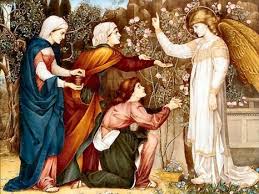
easter angel

Mark 16:1-8 NRSV

The messenger tells the women at the tomb, “Go, tell his disciples—and Peter—that he is going ahead of you to Galilee’ there you will see him, just as he told you.”

What a peculiar thing to say. What does he mean “the disciples and Peter?”  Is Peter no longer a disciple? That’s like someone saying, “Go tell the choir—and Harold.”  When was Harold ever not a part of the choir?

Go tell the disciples—and Peter.  It would be, of course, fair to assume, that on this first Easter Sunday morning, Peter just might be outside Jesus’ circle of trust.

When Jesus is arrested in the garden of Gethsemene, John tells us that it was Peter who protested by drawing his sword and cutting the ear off the slave of the High Priest. Jesus chastises Peter and heals the man’s ear.  In this action, Peter proves that he has missed the whole point of Jesus’ ministry and purpose.  All throughout his ministry, Jesus spoke of turning the other cheek, laying down one’s life, losing one’s self, dying to self, and loving one’s enemies, and here is Peter, at the end of Jesus’ ministry, demonstrating that he doesn’t have a clue who Jesus is or what his Kingdom is all about.

Then after Jesus is arrested and taken to the high priest, Marks says that Peter followed behind at safe distance, right into the courtyard of the high priest where Jesus would be tried. He sat outside with the guards, warming himself at a fire when this servant girl of the high priest stares at him.  She then approaches Peter: “I know you. You were with Jesus, the man from Nazareth.”  Peter denies it saying, “Girl, I don’t know and I don’t even understand what you’re talking about.”

Then Peter, trying to save his own skin, tries to make an exit.  This one who has been taught that those who try to save their life will lose it, slips out into the forecourt. A cock crows.

The same servant girl followed him and started talking about him to all the bystanders saying, “This man is definitely, one of them.”  But again, Peter denied it.  Then, it is one of the bystanders who goes up to Peter and says, “I know you’re with that Jesus, because you’re not from the city, you are from the country, you’re a Galilean.”

Then Peter, this disciple of Jesus, this one who has been taught by Jesus to do unto others as he would have them do unto him, this one who has been taught that the greatest commandment is to love one another, curses at the innocent bystander.  And then, this one who was taught by Jesus to never swear with an oath, let your yes be yes an your no be no, always be honest and truthful, lies again, this time emphatically, by swearing an oath, “I told you that I don’t know this man that you are talking about.”

And that moment, Mark says, the cock crowed for the second time.  Then Peter remembered Jesus’ words to him, “Before the cock crows twice, you will deny me three times.”  And he broke down and wept.

So of course it is very fair to assume that Peter is now way outside the circle. Simon Peter simply never got it. He never got the point of understanding who Jesus was or what his Kingdom was all about.  Peter was as dumb at Easter as he was at Christmas.  One could say that he was a complete failure at being a disciple.

And what maybe worse, he was a failure and he knew that he was a failure.  That’s why we find him at the end of Mark’s story crying like a baby.

“Go tell the disciples and Peter—this has-been, washed-up and flunked-out disciple who is far, far outside my circle.”

Now, it would be easy to believe this interpretation if it wasn’t for one important fact.  All of the disciples were flunkies.  In the Gospel of Mark, none of them get it.  After Jesus was arrested, while Peter was following the soldiers and Jesus into the courtyard of the High Priest, where are all of the others?  Read verse 50 of chapter 14.  “All of them deserted him and fled.”

They’re all losers. They all cared more about their own lives then they did Jesus.  And not only that, even the women in Mark’s gospel, the women who always appear in the gospels to be just a little more astute than the men, even the women do not seem to get it.  “Go tell the disciples and Peter that he is going ahead of you to Galilee; there you will see him just as he told you.”  And what did they do? “Go, tell,” said the angel.  Read verse 8:  “and they said nothing to anyone.”

No, in saying, go tell the disciples and Peter, the messenger of God was not inferring that Peter was outside the circle. God was saying that Peter, despite everything that he had done, despite everything that he hadn’t done, despite his stupidity, his failings, his denials, Peter was still very much in the circle.

The angel was saying: “Go tell all the disciples that Jesus has be raised for them, and please, especially tell Peter. Tell him to dry up his tears in spite of all of his sin, his failure to follow Jesus, and his denials.”

Jesus is alive for all, maybe more so for Peter.

“Please let this one who feels like an outcast, who feels so much outside the circle of God’s love, that if Death could not separate him from Jesus love, his sin and his denials were certainly not going to do it. Jesus is alive for all of the disciples, and even, especially Peter, especially this one who realizes his failure. Jesus is alive for even Peter, and the good news is, even for you and for even me.

Go tell the disciples and Peter. It is not a peculiar thing to say. It is good news. It is not odd. It is amazing. It is good, amazing grace.  It is the good, amazing news of Easter. God offered us the very best that God had to offer, the gift of God’s self through Jesus Christ. We reciprocated that gift with the worse that we had to offer—the cross.  And yet, God still raises Jesus from the dead and sends him back to the very ones who nailed him to a tree.

Now, let me tell you what’ really odd about this text. “Go tell the disciples and Peter that he is going ahead of you to Galilee.”  To Galilee?  Now that’s peculiar. On the first day of his eternal life, Jesus decides not to go to the capital city, not to the places of power and prestige, not to where he could really get some attention, be some breaking news before millions, but he chooses to go to Galilee.[i]

Compared to Jerusalem, Galilee is backwoods, insignificant. Galilee is way out in the country, way out of the way.

One might have thought, that upon being raised from the dead, Jesus would stride triumphantly back into Jerusalem. Imagine what a stirring sight that would have been. Jesus could have strolled right into the palace and said, “Pontius Pilate, I am afraid you’ve made a big mistake.”  Or he might have stood on the steps of the temple, chiding the crowds for their fickleness and betrayal, showing himself to the multitudes that were present when he was crucified.

Jesus, however did none of that.  Rather, he went on ahead of his own disciples to meet them back in Galilee.

That is, Jesus will meet his disciples in a rather ordinary place, a place where their discipleship began. Jesus had come out to where they lived, out to Galilee. They had attempted to be his disciples mostly in Galilee. It was in Galilee where they left good paying jobs, their families all forms of security to follow Jesus.

In Jerusalem, they had betrayed and deserted him.  Back home, in Galilee they accepted and followed him.

And Jesus goes back home—to Galilee. The failure of the disciples, the denial of Peter, the disobedience of the women, none of this is the end of the story. A fresh start can be made, and where will this new beginning be? Where is the risen Christ? Back where it all began, back home in Galilee.

The good news of Easter is that in spite of our sins, our failures to follow him, our denials and betrayals, Jesus is alive—Jesus is on the loose—Jesus is moving.  Where?  Out in Galilee.  He’s out where the disciples live. He’s out where you live and I live. At home, out in Galilee.

The risen Christ always appears to the disciples in the most ordinary of places: at breakfast, on the beach, while they are at work.  Something about the risen Christ loves to meet people in the most ordinary places.  That’s good if you want to meet Jesus, because most of us live and most of us work in ordinary places, like Galilee.

Go tell the disciples and especially Peter that Jesus is going ahead of them to Galilee. And, there in Galilee, there in a most ordinary place, you will find grace.

Go tell these sinful, selfish, human beings, these very ordinary fishermen, even this one named Peter who thinks I have forsaken him, that I am going ahead of them, back to the place where it all started.  Forgiveness of sins, a fresh new beginning, a brand new start is available where?  In the most ordinary of places—at home, where you live, where you work.

The good news is that no matter what we have done, no matter who we are, even if we are just as dumb at Easter as we were at Christmas, Jesus lives for us. And we don’t have to go anywhere special or do anything special to meet him. He’s gone on, ahead of you, ahead of me.  He’s gone to where we live.

The good news of this day of days is that we, even sinners like us, can go home today. We can go back to our homes here in Farmville, in Fountain, in Wilson, Tarboro, Greenville, Winterville, New Bern, we can even go down back into Greene County, and there, wherever we go, in our most ordinary place, we will find that Jesus is already there, enveloping us with grace, filling our hearts with love with love, giving us a fresh new beginning, a brand new start.

So, go!  Go home. And begin living the first day of your eternal life.


[i] Inspired from William Willimon, He Came Back to Us .(http://www.northalabamaumc.org/blogs/detail/177), 2008