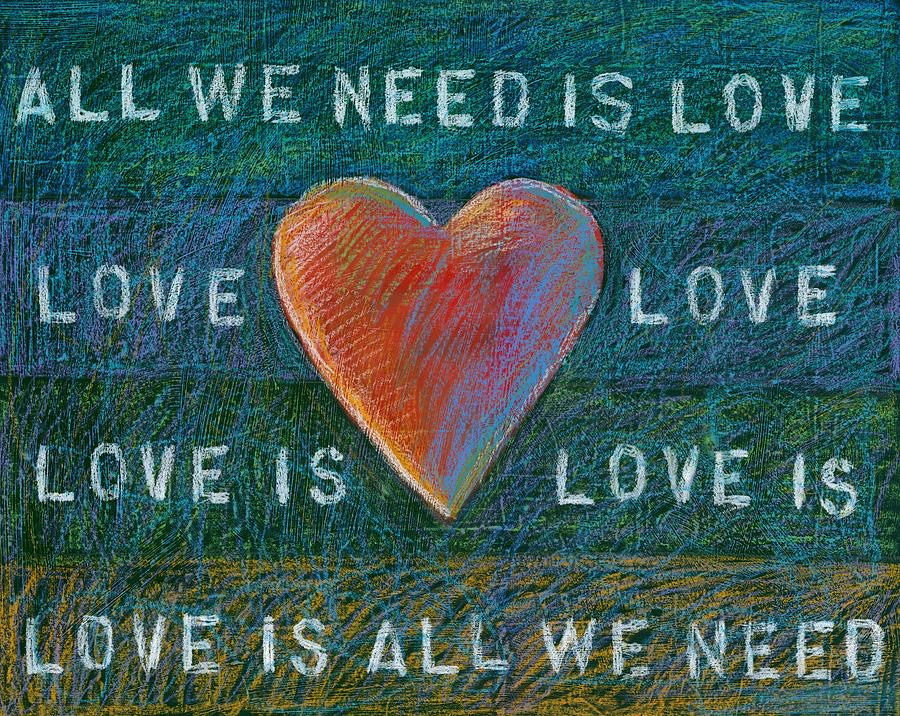
Wake Up and Love

Romans 13:8-14 NRSV

The song “Fruitcakes,” from Jimmy Buffett’s album of the same name, has a verse to which many of us can relate:


Religion is in the hands of some crazy-ass people

Television preachers with bad hair and dimples

The god’s honest truth is: it’s not that simple!

Right?

That’s why I find it interesting that a local pastor is preparing a Bible Study series entitled: “Answers to Your Toughest Faith Questions.”  The Facebook post then listed a small sampling of the theological questions that he would be giving answers to:

Who is God?

Why do bad things happen to good people?

What is salvation?

Now, I was raised going to church every Sunday. I hardly ever missed Sunday School class. I attended every Vacation Bible School and went to church camp every summer. I studied religion and philosophy in college, and I went on to get a Master of Divinity Degree, and then, a Doctorate in ministry. I did some math and deduced that I have written and preached over 1,500 sermons. So, you would think, that when it comes to theology, I would know a thing or two; however, the truth is that I really don’t know that much.

The only thing that I really know about theology is that the more I know, the less I seem to know.

Some of you are probably thinking about right now: “Well, if there’s a local pastor who giving answers to some tough theological questions, maybe our new pastor, bless his heart, should show up for a class, or at least Zoom in, and learn something!”

But here’s the thing:

I know just enough about theology to know that there many ways one can answer those types of questions. In our seminary theology classes, we studied several answers to those tough questions from several different theologians, and then we worked to form our own opinion.

This may surprise you, but when it comes to God and God’s relationship to this mystery we call life, with both the holy and the horrible parts of it, that’s about all I’ve got: opinions.

This is part of the reason I could not be happier today to be counted as part of Disciples of Christ. With the late, wonderfully honest and thoughtful Rachel Held Evans, I have always “longed for a church to be a safe place of doubt, to ask questions, and to [always] tell the truth, even when it is uncomfortable.”

I believe First Christian Church has a long history of being that type of church. We call ourselves “disciples” because we have decided to follow the way of love Jesus taught and emulated, not because we have figured out God. With the Harry Emerson Fosdick, most of us “would rather live in a world where our lives are surrounded by mystery than live in a world so small that our minds could comprehend it.”

If you keep coming to worship here while I am the pastor, you may begin noticing a few words that I use more than other words when I am preaching. Besides “God” and “Jesus” and “good news” and “all means all”, the two words that I use more than any other are: “I believe.”  “I believe this to be true…I believe that God works this way…I believe that God desires this…I believe that God wants us to do that…“I believe God is calling us to go, be or act…”

One day, a parishioner in one of my previous churches made an appointment with me to complain about my preaching. Which, by the way, was very common. He sat down in my office and began telling me how frustrated I made him by saying “I believe” so much, and if I didn’t stop saying it, he might have to find another church!

I asked him, “What would you rather me say?”

“I need my pastor to be more authoritative,” he said.

He wanted me to say: “I know,” “I’m certain,” “I’m confident,” “I’m convinced,” “I conclude…”; not “I believe.”

But when it comes to theology, that’s all I’ve got. I believe. I theorize. When it comes to this being or Spirit, or force, or power in, behind and over the universe we call “God,” I think. I consider, I ponder, and I wonder.  I “lean more towards.” I surmise, guess, deduce, speculate, estimate and contemplate. I hope, which, by the way, infers that I also doubt.

And if that bothers some of you who come to this place Sunday after Sunday in search of concrete, black and white authoritative answers about God, all I can say is, I am sorry. You won’t find that here. At least, not from me.

When I was in my twenties, still fresh out of seminary, and still naïve enough to think I knew some stuff about God, I had the amazing opportunity to gather each Wednesday for lunch with a group of highly esteemed and seasoned clergy in Winston-Salem. Among those who attended the group was the Rev. Dr. Warren Carr, a retired pastor and renowned Civil Rights hero while serving Watts Street Baptist Church in Durham. What an honor and privilege was it for me to sit at a table each week this man who was a sought-after lecturer on college campuses for his wealth of knowledge, experience and expertise.

For a few years, a group of clergy, religion and philosophy professors in North Carolina gathered for a retreat at the Caraway Conference Center in Asheboro. I was absolutely giddy one year when I checked into the retreat center and was told that I would be sharing a room with Dr. Carr.

After an extensive and very academic group discussion that evening, much of which was over my head, we all retired to our rooms. As we settled in our twin beds like we were in youth camp and turned off the lights, Dr. Carr asked me: “Did you enjoy tonight’s conversation?”

“Yes,” I responded. “But to be honest, being in a room of full of wisdom with people like you reminds me that I still have much to learn.”

 Dr. Carr laughed and then spoke words that I will never forget:

I have been a pastor and a serious scholar of scripture for sixty-five years, but all that I really know about God is that God is love. And God loves me. Therefore, I ought to love. And to be honest, everything else is fuzzy.

I was taken back by his honesty and didn’t know quite how to respond.

Then, after a moment of silence, he said, “But love is all I need to know.”

I wonder if that was what Paul was trying to infer in his letter to the Romans:

Owe no one anything, except to love one another; for the one who loves another has fulfilled the law. [The entire law code] …is summed up in this word, ‘Love your neighbor as yourself.’ Love does no wrong to a neighbor; therefore, love is the fulfilling of the law.

To the Galatians, again Paul writes:

For the whole law is summed up in a single commandment, ‘You shall love your neighbor as yourself’ (Gal 5:14).

And we’ve heard this before. Matthew records Jesus saying that the greatest commandment is to love God, [which means to literally love Love] and to love our neighbors as ourselves, and on this commandment hangs all of scripture (Matthew 22:34-40).

Mark remembers Jesus saying we are not far from the kingdom of God if we understand loving our neighbor as ourselves is more important than any act of worship (Mark 12:28-34).

Luke recounts Jesus telling a lawyer that loving our neighbors as ourselves is the key to inheriting eternal life. “Do this, and you will live,” says Jesus (Luke 10:25-28).

Not only is love all we need to know, all we need to understand about the scriptures, worship, and eternal life, Paul describes it as a debt we owe. Owe no one anything, except to love one another. John put it this way: “Beloved, since God loved us so much, we also ought to love one another” (1 John 4:11).

And in our Epistle lesson this morning, Paul expresses an urgency to love. “Besides this, you know what time it is, how it is now the moment for you to wake from sleep.” It’s time to wake up and love.

Lori and I experienced this urgency when we lost our first child in the 23rd week of pregnancy in 1993. A week or so after we left the hospital, a colleague and pastor immediately offered a pastoral visit. But instead of offering his love like it was a debt he owed me, with a confident, rather authoritative voice, he said:“Jarrett, I believe God knew that you were not ready to be a father.”

But, you know, I didn’t need his theology. I didn’t need his belief, his contemplation or his speculation.

As you know, Erin, our Christian education intern is in Illinois today after receiving a call this week that her grandfather, who she adored, and who adored her, had passed away. Although Erin is a seminary student studying theology, right now she doesn’t need our theological theories. She doesn’t need our ponderings or our wonderings. What Erin needs and needs urgently is our love.

Tripp, the seven-year-old grandson of Jim and Verna who has been on our prayer list for several years, will soon undergo treatments again to fight leukemia. Tripp and his family do not need our theology, our deductions or our estimations. What they urgently need is our love.

Having learned this week that their premature baby has suffered brain damage, Miles and Emily do not need our guesses or our opinions about God. What they need, and need urgently, is our love. In fact, the following words are from a text I received from Emily on Friday:

Send lots of love and prayers his way so we can have some clarity in the days, weeks, and months to come. We are in for a long journey with Henry, and we are just pouring all our love and energy into him by spending lots of time together reading, talking and loving.

Emily’s urgent plea was: “Send lots of love.”

A line from of one of Jimmy Buffett’s newest songs, released after his death, goes:

…when the journey gets long, just know that you are loved. There is light up above, and the joy is always enough.

The good news for people like you and me who do not have all the answers, who accept and even embrace the mystery of it all, who do more pondering than knowing and more wondering than concluding, is that we have experienced love— holy, sacred, divine, mysterious, incredulous but certain love. And although we cannot fully comprehend the power of love or the Source of love, we know with confidence that it is love that has brought us to this place we call church. And, with all our misgivings and misunderstandings, with all our doubts and unanswered questions, we somehow, some miraculous way, know that it is love that keeps us here.

And here is some more good news.  I KNOW– even this one who doesn’t KNOW much about theology— who some say might not know much about anything, from a science book or from three years of the French I took— But I KNOW, without a doubt, with absolute certainty and with utmost confidence, and on good authority, that Love is present here in this church, and Love is calling us with an urgency to be love and to share love. And if we wake up and answer this call, what a wonderful world this would be.

Father’s Day Wake-Up Call


Children at the border

Let every person be subject to the governing authorities; for there is no authority except from God, and those authorities that exist have been instituted by God. Therefore, whoever resists authority resists what God has appointed, and those who resist will incur judgment (Romans 13:1-2).

Yes, Romans 13 says that. But that is not all it says. After writing a few sentences on obeying the laws of the state, the Apostle Paul begins echoing the words of Jesus:

You shall not commit adultery; You shall not murder; You shall not steal; You shall not covet”; and any other commandment, are summed up in this word, ‘Love your neighbor as yourself.’ Love does no wrong to a neighbor; therefore, love is the fulfilling of the law (Romans 13:8-10).

Then, in the very next verse, Paul writes that “now is the moment” we need to “wake up.”

Besides this, you know what time it is, how it is now the moment for you to wake from sleep. For salvation is nearer to us now than when we became believers; the night is far gone, the day is near. Let us then lay aside the works of darkness and put on the armor of light (Romans 13:11-12).

When it comes to being subject to the supreme law to love our neighbors, too many Christians today have hit the snooze button. They have pulled the covers over their heads and have closed their eyes. For whatever reason: self-preservation; greed; racism; or to protect their privileged positions, they seek darkness over light, judgment over grace, division over unity, exclusion over acceptance, and hate over love.

The Apostle John warns us of “false prophets” who possess “the spirit of the anti-Christ” and “a spirit of error” who can easily lead the people of God astray (1 John 4:1-6). Stressing how important it is for Christians possess “a spirit of love,” he then pleads:

Love one another, because love is from God; everyone who loves is born of God and knows God. Whoever does not love does not know God, for God is love…  No one has ever seen God; if we love one another, God lives in us, and God’s love is perfected in us (1 John 4:7-12).

Yes, the Bible says to be subject to the governing authorities. But it says much more than that. One would have to be asleep not to know it.

It is Father’s Day. Our neighbors are being harmed. I can not think of a better day for Christians to wake up. Now is the moment.

Wake-Up Call!

Romans 13:8-14 NRSV

It was the summer of 2013. It had been three years since I served my last church. At the time, I didn’t think I would ever serve as a pastor again.

I was on a business trip in Las Vegas, the city that’s said to represent everything depraved that is within us.

Early one morning, I went for a run on the Strip. The streets were already crowded with people. Some were shopping. Some were on their way to another casino. While others were on their way to do who knows what to fulfill their most selfish desires.

As I ran along, I noticed that all of the electronic billboards suddenly changed displaying a picture of a young man with words that read: “David Vanbuskirk.1977-2013. Las Vegas Police Search and Rescue Officer.” I would soon learn that Vanbuskirk was killed while rescuing a hiker stranded in an off-limits area of a mountain northwest of Las Vegas, when he fell from a helicopter hoist line.

I ran a few more blocks, until I noticed that the people walking up and down the busy sidewalks began to stop and peer down the street that was suddenly empty of traffic. The entire Strip, which was booming with the sounds of automobiles and of people enjoying themselves a few seconds earlier, became profoundly silent.

A man removed his hat. A woman covered her heart with her hand. A little boy, sitting on his father’s shoulders, saluted. I stopped running. And with everyone else, my eyes turned toward the street where we watched and listened as a very long police motorcycle motorcade produced the only sound on the hushed strip. The motorcade was followed by a white police pick-up truck carrying a flag-draped casket.

People remained silent and still for several more minutes. Some bowed their heads. Others wiped tears from their eyes. Others embraced their loved ones.

Here are some questions I believe the church needs to ask today:

What was it that stopped the traffic on one of the busiest streets in the country?

What was it that got everyone’s attention?

What was it that made people cry?

What was it that got even the most indulgent and decadent one, in the heart of sin city, to believe in something greater than thenself?

What was it that turned eyes away from reveling and drunkenness, debauchery and licentiousness, quarreling and jealousy and toward selflessness and sacrifice?

What is it that has the power to change the world?

It’s the very power that is the heart of our Christian faith, or should be the heart of our faith.

It’s the power that caused firefighters, police officers and first responders to run into the Twin Towers on 9-11 when everyone else was running out of them.

It’s the power that has sent John Mundy and hundreds of volunteers back to Texas this weekend. It’s the power behind our prayers for Florida and the Caribbean.

It’s the power that gives generously to disaster relief funds like Week of Compassion.

It’s the power that can unite our government to save the lives of the Dreamers.

It’s the force that created the universe, this good earth, and every living thing in it (Genesis 1-2).

It’s the source of all life (John 1:4).

It’s the burning compulsion to liberate God’s people from the evils of oppression and slavery (Exodus 3).

It’s the fire in the prophet’s voice to welcome the foreigner, defend the orphan, stand up for the poor and take care of the widow (Isaiah 1:17).

It’s the drive that sent Emmanuel into the world, not to condemn the world, but to save the world (John 3:17).

It’s the energy that continues to pour out the very Spirit of God on all flesh to overwhelm evil and overcome death (Romans 12:21).

It’s the power of love—pure, unconditional, unreserved, unrelenting —passionate love that propels action, deep love that compels sacrifice.

Jesus said there is no greater power in the world than the power of love compelling one to lay down one’s life for another (John 15:13). And there is no greater commandment than to love your neighbor as yourself (Matthew 22:40).

To the Corinthians, Paul writes about faith, hope and love, but says that the greatest of these is love. And if love is not in our words, even in our confessions of faith, then we are only making noise. If love is not the heart of all that we do, we are nothing (1 Corinthians 13).

To the Romans, Paul echoes the words of Jesus:

You shall not commit adultery; You shall not murder; You shall not steal; You shall not covet”; and any other commandment, are summed up in this word, ‘Love your neighbor as yourself.’ Love does no wrong to a neighbor; therefore, love is the fulfilling of the law (Romans 13:9-10).

Paul writes that “now is the moment” we need to “wake up” and understand that what the world needs now is love (Romans 13:11). And as Dionne Warwick sings, “not just for some, but for everyone.”

When it comes to loving all people, we have too many Christians who keep hitting the snooze button. They pull the covers over their heads, close their eyes, and selfishly sleep. For whatever reason: self-preservation, control, greed, to protect their privileged positions, they seek darkness over light, judgment over grace, exclusion over acceptance, and hate over love.

John calls them “false prophets” who possess “the spirit of the anti-Christ” and “a spirit of error” (1 John 4:1-6).

Stressing how essential it is for Christians possess a spirit of love, he then pleads:

Love one another, because love is from God; everyone who loves is born of God and knows God. Whoever does not love does not know God, for God is love…  No one has ever seen God; if we love one another, God lives in us, and God’s love is perfected in us (1 John 4:7-12).

I began to think about the rescue of that stranded hiker. Vanbuskirk probably didn’t know anything about that hiker. He didn’t know whether the hiker was male or female; rich or poor; Democrat or Republican; gay or straight; documented or undocumented; Muslim or Christian; black, brown or white.

He didn’t know if this person would ever contribute to society, or ever give a dime to the Fraternal Order of the Police.

He just knew that the hiker was stranded and needed help. He just knew the hiker was afraid. The hiker was hungry, thirsty, wounded. And Vanbuskirk was called to protect and serve.

Vanbuskirk wasn’t concerned about breaking any religious, cultural or political rules. His only concern was rescuing the perishing, saving the lost.

It was in that moment that something inside of me woke up. It was like an alarm went off inside my soul. Love—pure, unconditional, unreserved, unrelenting. Passionate love pierced my heart. Deep love roused me from a self-absorbed slumber. And there, in the middle of the Miracle Mile, I began to pray:

“God, if you give me an opportunity to serve as a pastor again, I am going to do all that I can to lead your people to love others more than self, to serve and protect courageously, graciously, expecting absolutely nothing in return.

God, I will lead your church with great worship services, but more importantly, I will lead your people to worship you with great service. And I will lead them to do it with no strings attached, selflessly, sacrificially, always lovingly.

Lord, together, we will comfort the fearful, feed the hungry, give drink to the thirsty, heal the wounded, not because they might believe like we believe, contribute to our budget, or even attend one of our services, but simply because they need help.

Lord, we will serve without prejudice, without judgment. We will love all people, and all means all.”

Before I came home from that trip to Vegas, I received a phone call from the search committee of the First Christian Church (Disciples of Christ) in Farmville, North Carolina, asking me if I would consider being their pastor.

And four years later, I stand before you today believing that what the world needs now more than anything else is for the church to wake up to rediscover what is the very heart of our faith: love, not just for some, but for everyone.

I love the quote from German Lutheran theologian of the early seventeenth century, Rupertus Meldenius that is usually printed in our order of service: “In essentials, unity. In non-essentials, diversity. In all things, love.”

When thinking about what is essential to our faith, we might say that it is our confession of faith, “Jesus is Lord.” But we can say “Jesus is Lord” all day long, but if we don’t have love, we are only making noise, says Paul. We can say we love God, but if we don’t love our neighbors, we are liars, says John. This is why Jesus says: “Many will call me Lord, yet I will have to say to them, depart from me, for I never knew you.”

Love is our essential. And it is in this essential that we must be unified. Then, we say, “In non-essentials diversity.” And just in case you didn’t get it the first time, we are going to say it again, “in all things, love.”

I have heard the term wake-up call many times in the short-time I have been your pastor. The white nationalists’ march on Charlottesville has been called a wake-up call. The “Nashville Statement” put out by Christians to further marginalize the LGBT+ community has been termed a wake-up call. I heard the solar eclipse and Hurricanes Harvey and Irma referred to as wake-up calls.

I don’t believe the Apostle Paul cares what we use for an alarm, because we already “know what time it is. How now is the moment to wake up. For salvation is coming near. The time has come to lay-aside the works of darkness and put on the armor of light.”

So, let’s wake up and love our world.

Let us love our city so purely that it stops traffic on Rogers Avenue.

Let us love our neighbors so unconditionally that it gets everyone’s attention.

Let us love people so unreservedly that it brings tears to the eyes of strangers.

Let us love so relentlessly that it gets even the most selfish, indulgent and decadent one in this city to believe in something greater than self.

Let us love so passionately that it turns people’s hearts away from indifference and toward justice, away from reveling and drunkenness and toward self-denial and selflessness, away from debauchery and licentiousness, quarreling and jealousy and toward empathy and compassion, sacrifice and generosity.

Let us love the creation so deeply that it changes the world!

Amen.


Invitation to Communion

This table has been set with the power that created the universe, the source of all life that liberates the oppressed, overwhelms evil and overcomes death. This table has been set with love—pure, unconditional, unreserved, unrelenting—passionate love propelling action, deep love compelling sacrifice.

And it is love incarnate, the living Christ, who invites all to receive this power and share it with the world.


Commissioning and Benediction

You know what time it is!

The time is now! This is the moment!

Having awakened from a self-absorbed slumber,

go and love the creation so deeply that it changes the world.

Go and stop some traffic.

Go and get somebody’s attention.

Go and make somebody cry.

Go and help somebody believe.

And may the God who is love, the Christ who exemplified and commanded love, and the Spirit who empowers love, be with us all.