Last Sunday, Pima County Sheriff’s Sergeant Derek Tyra was supervising seven other deputies handling traffic control and basic event safety, protecting the runners during a race in Tucson named for Gabe Zimmerman, the Aide who was killed in the shooting involving Congresswoman Gabrielle Giffords on January 8, 2011.
During the race, Tyra received a call that a car driven by a suspect in a shooting was possibly heading toward the runners. As a car matching the description of the vehicle passed by, Tyra gave chase and decided to perform a “high risk stop” which meant he would have to place himself between the suspect and the runners.
Tyra managed to pull the vehicle over and safely apprehend the suspect.
“The man is a hero,” the race director said. “He says that it’s just what they’re supposed to do, but it’s pretty amazing that he was able to intervene with a live shooting suspect just steps from all these runners. He may have saved any number of lives with his actions today.”
“I just happened to be at the right place at the right time,” Tyra said. “I didn’t think twice about it.”
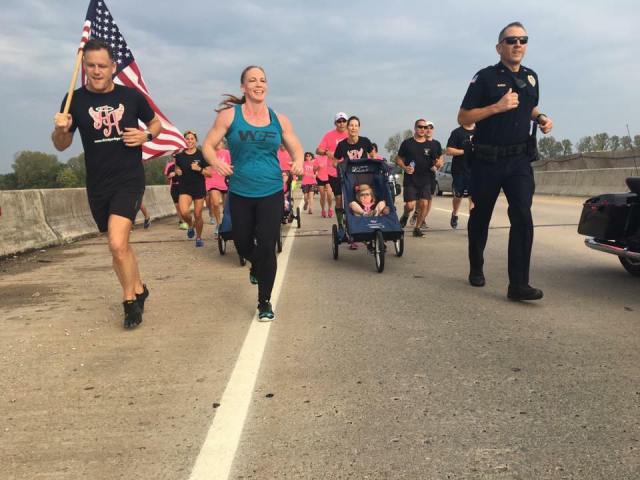
As I read this amazing story, I immediately thought of Fort Smith Police Captain Danny Baker, who ran in uniform alongside of Marine Captain Maggie Seymour and local runners who were pushing three children with special needs in the Ainsley’s Angels in Arkansas’ inaugural event on Monday morning.
It was remarkable that Captain Baker was able to run the 3.5 miles on a hot, humid morning in uniform. However, it was more remarkable how he ran. Captain Baker ran placing himself between the runners and the vehicles that were passing by in the left lane on busy Highway 64. He ran with one eye on the runners and the children and one eye on the traffic, motioning the runners several times to keep to the right.
Captain Baker kept everyone safe, and he didn’t think twice about it.
Thank you Captain Baker and law enforcement officers everywhere who serve and protect our communities selflessly and sacrificially. You are not only heroically fulfilling your duties, but you are serving as role models for us all.
For this is part of our mission as the body of Christ in this world. The Apostle Paul put it this way: “Love your neighbors as yourself [and remember] that love does no harm to your neighbor” (Romans 13:10). God calls us to selflessly and sacrificially place ourselves between our neighbors and anything that may harm them, and not think twice about it.
It was the summer of 2013. It had been three years since I served my last church. At the time, I didn’t think I would ever serve as a pastor again.
I was on a business trip in Las Vegas, the city that’s said to represent everything depraved that is within us.
Early one morning, I went for a run on the Strip. The streets were already crowded with people. Some were shopping. Some were on their way to another casino. While others were on their way to do who knows what to fulfill their most selfish desires.
As I ran along, I noticed that all of the electronic billboards suddenly changed displaying a picture of a young man with words that read: “David Vanbuskirk.1977-2013. Las Vegas Police Search and Rescue Officer.” I would soon learn that Vanbuskirk was killed while rescuing a hiker stranded in an off-limits area of a mountain northwest of Las Vegas, when he fell from a helicopter hoist line.
I ran a few more blocks, until I noticed that the people walking up and down the busy sidewalks began to stop and peer down the street that was suddenly empty of traffic. The entire Strip, which was booming with the sounds of automobiles and of people enjoying themselves a few seconds earlier, became profoundly silent.
A man removed his hat. A woman covered her heart with her hand. A little boy, sitting on his father’s shoulders, saluted. I stopped running. And with everyone else, my eyes turned toward the street where we watched and listened as a very long police motorcycle motorcade produced the only sound on the hushed strip. The motorcade was followed by a white police pick-up truck carrying a flag-draped casket.
People remained silent and still for several more minutes. Some bowed their heads. Others wiped tears from their eyes. Others embraced their loved ones.
Here are some questions I believe the church needs to ask today:
What was it that stopped the traffic on one of the busiest streets in the country?
What was it that got everyone’s attention?
What was it that made people cry?
What was it that got even the most indulgent and decadent one, in the heart of sin city, to believe in something greater than thenself?
What was it that turned eyes away from reveling and drunkenness, debauchery and licentiousness, quarreling and jealousy and toward selflessness and sacrifice?
What is it that has the power to change the world?
It’s the very power that is the heart of our Christian faith, or should be the heart of our faith.
It’s the power that caused firefighters, police officers and first responders to run into the Twin Towers on 9-11 when everyone else was running out of them.
It’s the power that has sent John Mundy and hundreds of volunteers back to Texas this weekend. It’s the power behind our prayers for Florida and the Caribbean.
It’s the power that gives generously to disaster relief funds like Week of Compassion.
It’s the power that can unite our government to save the lives of the Dreamers.
It’s the force that created the universe, this good earth, and every living thing in it (Genesis 1-2).
It’s the source of all life (John 1:4).
It’s the burning compulsion to liberate God’s people from the evils of oppression and slavery (Exodus 3).
It’s the fire in the prophet’s voice to welcome the foreigner, defend the orphan, stand up for the poor and take care of the widow (Isaiah 1:17).
It’s the drive that sent Emmanuel into the world, not to condemn the world, but to save the world (John 3:17).
It’s the energy that continues to pour out the very Spirit of God on all flesh to overwhelm evil and overcome death (Romans 12:21).
It’s the power of love—pure, unconditional, unreserved, unrelenting —passionate love that propels action, deep love that compels sacrifice.
Jesus said there is no greater power in the world than the power of love compelling one to lay down one’s life for another (John 15:13). And there is no greater commandment than to love your neighbor as yourself (Matthew 22:40).
To the Corinthians, Paul writes about faith, hope and love, but says that the greatest of these is love. And if love is not in our words, even in our confessions of faith, then we are only making noise. If love is not the heart of all that we do, we are nothing (1 Corinthians 13).
To the Romans, Paul echoes the words of Jesus:
You shall not commit adultery; You shall not murder; You shall not steal; You shall not covet”; and any other commandment, are summed up in this word, ‘Love your neighbor as yourself.’ Love does no wrong to a neighbor; therefore, love is the fulfilling of the law (Romans 13:9-10).
Paul writes that “now is the moment” we need to “wake up” and understand that what the world needs now is love (Romans 13:11). And as Dionne Warwick sings, “not just for some, but for everyone.”
When it comes to loving all people, we have too many Christians who keep hitting the snooze button. They pull the covers over their heads, close their eyes, and selfishly sleep. For whatever reason: self-preservation, control, greed, to protect their privileged positions, they seek darkness over light, judgment over grace, exclusion over acceptance, and hate over love.
John calls them “false prophets” who possess “the spirit of the anti-Christ” and “a spirit of error” (1 John 4:1-6).
Stressing how essential it is for Christians possess a spirit of love, he then pleads:
Love one another, because love is from God; everyone who loves is born of God and knows God. Whoever does not love does not know God, for God is love… No one has ever seen God; if we love one another, God lives in us, and God’s love is perfected in us (1 John 4:7-12).
I began to think about the rescue of that stranded hiker. Vanbuskirk probably didn’t know anything about that hiker. He didn’t know whether the hiker was male or female; rich or poor; Democrat or Republican; gay or straight; documented or undocumented; Muslim or Christian; black, brown or white.
He didn’t know if this person would ever contribute to society, or ever give a dime to the Fraternal Order of the Police.
He just knew that the hiker was stranded and needed help. He just knew the hiker was afraid. The hiker was hungry, thirsty, wounded. And Vanbuskirk was called to protect and serve.
Vanbuskirk wasn’t concerned about breaking any religious, cultural or political rules. His only concern was rescuing the perishing, saving the lost.
It was in that moment that something inside of me woke up. It was like an alarm went off inside my soul. Love—pure, unconditional, unreserved, unrelenting. Passionate love pierced my heart. Deep love roused me from a self-absorbed slumber. And there, in the middle of the Miracle Mile, I began to pray:
“God, if you give me an opportunity to serve as a pastor again, I am going to do all that I can to lead your people to love others more than self, to serve and protect courageously, graciously, expecting absolutely nothing in return.
God, I will lead your church with great worship services, but more importantly, I will lead your people to worship you with great service. And I will lead them to do it with no strings attached, selflessly, sacrificially, always lovingly.
Lord, together, we will comfort the fearful, feed the hungry, give drink to the thirsty, heal the wounded, not because they might believe like we believe, contribute to our budget, or even attend one of our services, but simply because they need help.
Lord, we will serve without prejudice, without judgment. We will love all people, and all means all.”
Before I came home from that trip to Vegas, I received a phone call from the search committee of the First Christian Church (Disciples of Christ) in Farmville, North Carolina, asking me if I would consider being their pastor.
And four years later, I stand before you today believing that what the world needs now more than anything else is for the church to wake up to rediscover what is the very heart of our faith: love, not just for some, but for everyone.
I love the quote from German Lutheran theologian of the early seventeenth century, Rupertus Meldenius that is usually printed in our order of service: “In essentials, unity. In non-essentials, diversity. In all things, love.”
When thinking about what is essential to our faith, we might say that it is our confession of faith, “Jesus is Lord.” But we can say “Jesus is Lord” all day long, but if we don’t have love, we are only making noise, says Paul. We can say we love God, but if we don’t love our neighbors, we are liars, says John. This is why Jesus says: “Many will call me Lord, yet I will have to say to them, depart from me, for I never knew you.”
Love is our essential. And it is in this essential that we must be unified. Then, we say, “In non-essentials diversity.” And just in case you didn’t get it the first time, we are going to say it again, “in all things, love.”
I have heard the term wake-up call many times in the short-time I have been your pastor. The white nationalists’ march on Charlottesville has been called a wake-up call. The “Nashville Statement” put out by Christians to further marginalize the LGBT+ community has been termed a wake-up call. I heard the solar eclipse and Hurricanes Harvey and Irma referred to as wake-up calls.
I don’t believe the Apostle Paul cares what we use for an alarm, because we already “know what time it is. How now is the moment to wake up. For salvation is coming near. The time has come to lay-aside the works of darkness and put on the armor of light.”
So, let’s wake up and love our world.
Let us love our city so purely that it stops traffic on Rogers Avenue.
Let us love our neighbors so unconditionally that it gets everyone’s attention.
Let us love people so unreservedly that it brings tears to the eyes of strangers.
Let us love so relentlessly that it gets even the most selfish, indulgent and decadent one in this city to believe in something greater than self.
Let us love so passionately that it turns people’s hearts away from indifference and toward justice, away from reveling and drunkenness and toward self-denial and selflessness, away from debauchery and licentiousness, quarreling and jealousy and toward empathy and compassion, sacrifice and generosity.
Let us love the creation so deeply that it changes the world!
Amen.
Invitation to Communion
This table has been set with the power that created the universe, the source of all life that liberates the oppressed, overwhelms evil and overcomes death. This table has been set with love—pure, unconditional, unreserved, unrelenting—passionate love propelling action, deep love compelling sacrifice.
And it is love incarnate, the living Christ, who invites all to receive this power and share it with the world.
Commissioning and Benediction
You know what time it is!
The time is now! This is the moment!
Having awakened from a self-absorbed slumber,
go and love the creation so deeply that it changes the world.
Go and stop some traffic.
Go and get somebody’s attention.
Go and make somebody cry.
Go and help somebody believe.
And may the God who is love, the Christ who exemplified and commanded love, and the Spirit who empowers love, be with us all.
Have you noticed that every other television commercial that comes on the air is an ad touting the benefits of a new prescription drug? There is a new drug available for whatever it is that might ail you!
Do you have frequent heartburn? Are you tired of being tired? Is depression making you depressed? Do you have trouble going to sleep? Do you have difficulty waking up? Do you want to avoid diet and exercise? Is it painful for you to walk your dog? Is your hair falling out? Do you have a going or a growing problem? Are you overweight but love to eat? Do you need to put some excitement back into your relationships? No matter what you’ve got, there is a new pill created just for you.
And then, in nearly every commercial, after the person begins taking what they asked their doctor to prescribe, there is all of this exuberant celebration: dancing in the streets; jumping up and down; digging for clams; running around in the yard with your dog and your water hose; even sitting outdoors and watching the sunset while holding hands with your significant other in separate bathtubs!
As a pastor, I oftentimes wonder if this is not how we oftentimes promote the church. \If you channel surf through the religious channels, you will find that there is no shortage of preachers who sound like they are spokespeople for some new drug. “Are you down and out? Are you drowning in a sea of debt? Are you empty inside? Does your marriage need a boost? Then pick up the phone and make your pledge, send in your check, and sit back and wait for God to pour out God’s blessings! Wait for God to give you a reason to celebrate!”
I am not exactly sure, but I suspect that is what many people were thinking when they were following Jesus throughout Galilee. Listen to how the Sermon on the Mount begins: “And great crowds followed him from Galilee, the Decapolis, Jerusalem, Judea, and from beyond the Jordan.” Folks had come out from all over to follow Jesus.
And listen to what Jesus says:
Are you 50 years old and wonder where your life is going? Are you down and out and feeling blue? Do you need help raising your children? Does your marriage need a boost?
No, instead Jesus says things like, “For the gate is narrow and the road is hard that leads to life, and there are few who find it.”
The crowd gets really quiet! Someone whispers, “I know he didn’t say ‘hard,’ did he? I thought Jesus was all about making things easy!”
Jesus continues:
“Love everyone, including your enemies. Be a blessing to the poor and to those who hunger and thirst for justice. Pray for those who persecute you. Forgive those who have wronged you. Don’t judge. Accept others as I have accepted you. Deny yourself. Pick up your cross and follow me. Die to yourself. Don’t just hear these words, but do these words.”
I am afraid that churches are so desperate to attract people that they have been willing to trivialize and water down the gospel. I am afraid that the salvation that many churches are preaching is no different than the salvation that is being preached in commercials about a new prescription drug.
May God forgive the church for sometimes implying that Jesus will make life easier, will fix everything that is wrong with us, will put a little lilt in our voices, a little sunshine in our souls, because the chances are very good that the message Jesus preaches will only make your life more difficult.
I believe one of the reasons many churches are losing members today is because, for many, the church does not look like Jesus. I believe people still love Jesus and want to follow Jesus today; however, the church does not look like a group of people who have decided to follow Jesus. Church members do not look like a group of people who are on a mission for others but look more like some type of religious club created for the members in order to make them feel holier and superior than others.
Mike Huckabee, former pastor, Arkansas governor, and presidential candidate, wrote about why he resigned from serving as pastor of a church to enter politics. He states: “I had been growing restless and frustrated in the ministry,” As a young minister, he said he envisioned himself as “the captain of a warship leading God’s troops into battle.” But he said, what the people really wanted was for him “to captain the Love Boat, making sure everyone was having a good time.”
This is perhaps why the first thing Jesus says we must do once we decide we want to follow him is to “deny ourselves.” We must learn that this thing called “discipleship,” this thing called “church,” is not about us. It is not about achieving a good, happy and successful life or even an eternal life.
Discipleship is not about receiving a blessing. It is about being a blessing to others. It is not about feeding our souls. It is about feeding the hungry. It is not about finding a home. It is about welcoming the outsider. It is not about acquiring spiritual riches. It is about giving everything away to the poor. It is not about getting ahead. It is about sharing with people who can barely get by. It is not about triumph. It is about sacrifice. It is not about gaining eternal life for ourselves. It is about dying to ourselves.
I believe the reason that many churches struggle today is because, in our attempt to entice, excite and gain new members, we have made the church all about us. We have said, “Come, and join our church where we have programs that are certain to benefit your life!” Instead of saying: “Come and join our church where you will be given opportunities to give your life away. Come and join our church where you will be encouraged to sacrifice and to serve expecting nothing in return.”
Looking around this room tonight fills me with so much hope for our world. For I look around and see a generation that is up and coming. I look around and see a room full of energetic youth with high ambitions. I look around and ask, “My God, how high can they go? How high can these young men and women, these future leaders of the world, go?
You were probably taught at a very early age that up high is where it is at, and no doubt you spent the first eighteen years of your lives trying to grow up, graduate high school and then possibly pursue an even higher education. All so you move up a little higher in this world. And after all of your graduations, you will work hard to make sure you are always upward bound: up for a promotion so you can move up the ladder. For up, up highis how our society measures success.
Up high, we are told, is where we will find our life, a life that is full, complete, satisfied, and abundant. Up high is where we are able rub elbows with others who also shaped up, grown up and moved up. Up high is where we find what we call the “in” crowd. They are the “up” and the “in” as opposed to the “down” and the “out.”
So we set goals that are high. We seek to make high marks, achieve high grades, meet high expectations.
The message of nearly every motivational speaker or life coach in America today is all about how to shape up and move up, aim high and soar high.
After all, who in their right mind would want to move in the opposite direction? Who wants to change directions from up high to down low? As the late Henri Nouwen one of my favorite preachers, has said: “Downward mobility [in our society] is not only discouraged, but even considered unwise, unhealthy or downright stupid.”
Can I get an “Amen?” Come on now, really? Who in their right mind would want to lower themselves? What mind must you have to want to humble yourself, move to and sit at the lowest seat at the table, lower yourself to the ground to wash another’s feet, descend down the economic ladder to relate to the poor, be with and love the down and out?
What kind of mind? As Adam Greene read a few moments ago, the mind of Christ.
When God chose to reveal to the world a life that is full, abundant and eternal, God’s will for all people, God chose a life of downward mobility. God emptied God’s self, poured God’s self out, humbled God’s self, lowered God’s self and came down. Down to meet us where we are, down to earth as a lowly baby, born in a lowly stable, laid down in a feeding troth to worshipped by down and out shepherds.
The scriptures do say that Jesus grew upward in stature; however, the gospel writers continually paint a portrait Jesus’ life as one of downward mobility. He is continually bending himself to the ground, getting his hands dirty, to touch the places in people that most need touching.
While his disciples seemed to always focus on privilege and honor and upward mobility, chastising little children who needed to shape up and grow up before they could come to Jesus, Jesus argued that the Kingdom of God actually belonged to such children.
While his disciples argued about who was going to be promoted, who was going to graduate to be the first in the Kingdom, Jesus frustrated them (and if we are honest, frustrated us) by doing things like moving down to sit at the lowest seat at the table, bending down to wash their feet, stooping down to welcome small children, crouching down to forgive a sinner, reaching down to serve the poor, lowering himself down to accept the outcast, touch the leper, heal the sick, and raise the dead.
While others exercised worldly power to graduate and move up, climb up, and advance, Jesus exercised a strange and peculiar power that always propelled him in the opposite direction. It is not a power that rules but is a power that serves. It is not a power that takes but is a power that gives. It is not a power that seizes but is a power that suffers. It is not a power that dominates but is a power that dies.
And nearing the culmination of his downward life, to save the world, Jesus went to highest seats of power in the capital city of Jerusalem, not on a white stallion with an elite army of high ranking soldiers, but riding a borrowed donkey with a handful of ragtag students who never even got a GED. The whole scene of Jesus riding that donkey, in the words of Henri Nouwen, looks “downright stupid.”
This is the narrow and seemingly foolish way of downward mobility, the descending way of Jesus toward the poor, toward the suffering, the marginalized, the prisoners, the refugees, the undocumented, the lonely, the hungry, the dying, the tortured, the homeless–toward all who thirst and hunger justice and compassion.
And what do they have to offer? Those who are down and out in our world cannot offer success, popularity, riches, or worldly power, but they do offer the way to life, full, complete, abundant and eternal.[i]
So tonight, filled with hope for the world as I look around this room asking, “My God, how high can these young men and women, these future leaders of the world go?” I am also asking with even greater hope for the world and the Kingdom of God, “My God, how low can they go? How low can these young men and women, these future leaders of the world, these future leaders of the church go? How low can they go to fulfill the divine purposes that you have for each of their lives?
My hope is that you are here tonight, not to ask God to help you move up to be with the “in” crowd. Not to find something here in worship that will make you more successful, more affluent, climb a little higher. I hope you are not even here looking to be uplifted or to be more upbeat or for some kind of upstart to get this new chapter in our life headed on an upswing. My hope is that you are here in worship tonight because you have chosen to move in the opposite direction.
My hope is that you will always want to continually go down, get low, lose yourselves, die to yourselves, to live for Christ. For you have heard, and you have believed Jesus when he said: “Anyone who wants to become great among you must be your servant, and anyone who wants to be first among you must be your slave, just as the Son of Man came, not to be served, but to serve, and to give his life as a ransom for many (Matthew 20:25-28).
Although it sounds good to be a part of the up and coming generation, my hope is that you will be a generation that is always downand going. May you always go down, get low, sacrificially and selflessly. And then go out bending yourselves down to the ground if you have to, to touch the places in people that most need touching. May you go out and stoop down to welcome and accept all children, to love on those in hospitals and nursing homes. May you go out and reach down to serve the poor, lower yourselves down to accept the outcast and the marginalized, and may you get low, get down on your knees to pray for the grieving and the lost.
And, there, as low as you can go, may you truly find your life, your purpose in this world, one that is full, complete, satisfied, abundant and eternal.
[i] The sermon is inspired by this paraphrase from Henri Nouwen, Here and Now, 138-139.
Many people will not worship in a church during Holy Week because someone in the church, without thinking, offered them an easy answer in the face of evil. “God does not make mistakes,” they said. “God is in control. God knows what God is doing,” they said. “God is the ruler of the universe,” they said.
The reason I believe people are tempted to give up on faith in God is because they are unaware that God does not reign from some heavenly throne in some blissful castle, but from an old rugged cross, on a hill outside of Jerusalem, between sinners like you and me. I believe people become despairing and cynical about God, because they fail to understand that our God does not rule like the rulers of this world.
The rulers of this world rule with violence and coercion and force. Earthly rulers rule with an iron fist: militarily and legislatively and with executive orders. The kings of the world rule with raw power: controlling, dominating, taking, and imposing.
But Christ is a King who rules through suffering, self-giving, self-expending, sacrificial love. Christ the King rules, not from a distance at the capital city, not from the halls of power and prestige, but from ordinary places like Bethlehem and Nazareth, and Van Buren and Fort Smith.
Christ the King doesn’t rule with an iron fist. This King rules with outstretched arms.
Christ the King doesn’t cause human suffering from a far, but is right here beside us sharing in our suffering.
God’s power is not a power that takes. It is a power that gives.
God’s power is not a power that rules. It is a power that serves.
God’s power is not a power that imposes. It is a power that loves.
God’s power is not a power that dominates. It is a power that dies.
This, says the late theologian Arthur McGill, is the reason that it is “no accident that Jesus undertakes his mission to the poor and to the weak and not to the strong, to the dying and not to those full of life. For with these vessels of need God most decisively vindicates his peculiar kind of power, [a] power of service whereby the poor are fed, the sinful are forgiven, the weak are strengthened, and the dying are made alive.”
God did not cause the tumor. The day the doctor said the word “cancer” was a day of anguish for God as it was for us.
God did not create the layoff.
The day you were told that your job was ending, God stayed up with you and worried with you all night long.
And God did not take your loved one. When they died, something inside of God died too.
What we all need to learn are very different definitions of “king,” “rule,” “reign” and “power”—very different because they define the ways of the only true and living God rather than defining our false gods and their ways.
So when life gets us down, we need to remember the great truth of Holy Week—Christ is the King. And this King is reigning, suffering, sacrificing and giving all that God has to give from the cross.
God does not make mistakes. God knows what God is doing. God is in control. But God’s throne is not made of silver and gold. God’s throne is made of wood and nails. God wears not a crown of jewels but a crown of thorns.



 Just Love