When God Refuses to Listen

heather in ainsleys chair

Isaiah 1:1, 10-20 NRSV

I like to be honest from this pulpit. I like to be real. So let’s be really honest this morning. Have you ever prayed and had the feeling that God’s not listening?

You come to this place of worship and you go through all of the motions. You sing all of the hymns. You actually pray during the moment of silence, instead of spending those moments planning the rest of your day. You listen reverently to the choir’s anthem, and like few people, you even listen intently to every word of the sermon. But as the organist begins playing the prelude, you wonder if it was all just a big waste of time.

I believe this is a reason some people stay home on Sunday mornings. They are not getting through to God and God isn’t getting through to them. Sometimes, they blame it one the music. They say that the music just doesn’t inspire them. But most of the time, it is the preacher’s fault. They usually say something like, “I am just not being fed anymore at that church.” Have you heard that before?

Well, Isaiah suggests that their belief that worship is a waste of their time, that God is not listening, is not the choir director’s fault, and it may not be the preacher’s fault either.

Isaiah says that the reason that you may feel like worship is not bringing you close to God, the reason you don’t feel like God is listening, the reason that you feel like God has not heard a word you’ve said is because God has not been listening to a word you’ve said.

Isaiah says that if we truly want to know that God is listening to us, if we truly want to feel close to God, if we want our worship on Sunday to mean something, there are some things that we must do.

And if we don’t do those things, according to Isaiah, God might respond to our worship this way: “What are your services to me? I have had it up to here, I am sick to my stomach of all your worship! I have no desire for any of it. Stop tramping into my courts. And I have had enough of your preacher with his fancy robe who thinks he is all that with all of his seminary degrees. Your prayers, your hymns, they have become a burden to me. I have stopped listening!”

So, according to Isaiah, what must we do to be heard by God?

Put away the evil of your deeds. Pursue justice and champion the oppressed, give the orphan his rights, plead the widow’s cause.

If we want to be heard by God, if we want worship to be meaningful, Isaiah says that we better doing what we can help the most vulnerable members of our community.

My friend Rev. Dr. William Barber has he wonders why we spend so much time doing the things about which “God says so little” while spending so little time on the things about which “God says so much.”

I wonder if Isaiah is suggesting that the church might re-evaluate our ministry-team meetings. Like any congregational-led church, we have a lot of meetings here. We are having several tonight.

If Isaiah was here, he might ask us: “What has been the subject of your longest, most arduous church meeting? What was the agenda of that meeting that caused your spouse at home to worry about you, or even question your whereabouts, because they thought you should have been home hours earlier?”

Was it about how our church could could advocate for those in our community who feel oppressed? Was it about meeting the needs of children who do not have the support of family? Was it about defending the rights of widows or the rights of the most vulnerable members of our community? Was the agenda something about which God says so much? Or was the agenda something about which God says so little?

Rev. Michael MacDonald writes that many Christian Americans not only never have any lengthy church meetings about how they can better serve the poor, they just simply have a bad attitude about serving the poor. So bad, that many folks probably wished they had the license to rewrite the many scriptures which speak for the poor.

I would argue that many people actually believe they have such a license. Because as a pastor, it has been my experience that whenever I have spoken on behalf of the poor and the vulnerable, someone almost always accuses me of being a “liberal.” Then, they will something like, “The Bible says that God helps those who help themselves.”

When in fact, the overall message of the Bible says nothing close to that. Aesop’s Fables say that. Benjamin Franklin said that. Thus, I want to respond: “Who’s the liberal here? The one who is conserving the Judeo-Christian teachings of the Scriptures to help the poor and champion the oppressed, or the one who is re-writing the scriptures with the words of a fable or Deist Ben Franklin?”

For example: This is how McDonald said some Americans would rewrite the story of the Good Samaritan:

The lawyer asked, “And who is my neighbor?”

Jesus replied, “Now by chance a priest was going down the road from Jerusalem to Jericho and saw a man who was hungry and ill clad.  He thought about stopping to help him, but decided that the man had probably been planted there by advocates for the homeless, so he walked by on the other side lest he give encouragement to those who wanted to divide society along class lines in order to gain political power for themselves.

So, likewise a Levite, when he came to the place and saw him, thought about helping him. But the Levite was afraid that he would rob the man of his independence, and he could plainly see that the man had sandal straps by which to pull himself up. So, he too, passes by on the other side.

But a Samaritan came near him and was moved by self-righteous pity. The Samaritan bandaged his wounds pouring oil and wine on them, no doubt as a publicity stunt to make his own self feel good and look good before his peers.

Then the Samaritan put the man on his own animal and brought him to an inn. The next day, he took out two denarii, gave them to the innkeeper and said, “Take care of him; and when I come back, and will repay you whatever more you spend,” thus encouraging the injured man to live like a parasite off other people’s hard-earned wealth.

Which of these three do you think was a neighbor to the man?  The lawyer said, “[Well of course] the two who showed him mercy by walking by on the other side.”

And God says, “You can pray without ceasing, but I won’t be listening. I won’t listen to those of you who pervert justice, those of who champion the cause of the rich and powerful, those of you who take advantage of the powerless. God ahead, have yourselves a worship service, have two of them, but I won’t be there.” God says, “I simply don’t listen to the prayers of those who are all about feeding themselves while orphans and widows, the disadvantaged and the vulnerable, go hungry.”

I believe Baptist evangelist Tony Campolo is right when he says that the one thing every Christian should do is not only write a check to help the poor, but help the poor in such a way that we actually build a relationship with them, get to know them on a personal level.

When I have been in conversations with churches about feeding the food-insecure, I always say that I believe we should merely hand them a meal.

I believe we should to sit down at the table with them, and get to know them, listen to them, love them, befriend them, be family to them. Let them know that we are willing to fight for them, defend their rights and plead their case. Be there to help them become the person that God is calling them to be.

Campolo says, in a way that only a good ol’ Baptist could say it, that one important reason that Christians should want to actually sit down at the table with people who are poor is because on the last day, when you are standing before the Great Judge, as God is separating the sheep from the goats and points to us and asks the question, “When have you clothed the naked, fed the hungry, given drink the thirsty, when have you shown generosity to the least of these my brothers and my sisters?”—That is when you are going to want to have the new friend you met around that table standing beside you, and you are going to want to be able to turn to them pat them on the back, and say with a confident smile, “Go ahead, you tell it.”

Do you want to come to this place on Sunday morning and really have an encounter with God? When Mary Beth begins playing the Postlude, do you want to know that you have actually communed with the creator of all that is? Isaiah, and I believe Jesus says, that will depend on how you commune with the most vulnerable members of our community.

Forward Together

If our can't fly run

Isaiah 43:16-21 NRSV

They say that hindsight is 20/20. Sometimes, it is easier to see more clearly what is really going on in the world when we are looking back. They say history is the best judge. I believe this is particularly true when it comes to faith.

The presence of God seems to be more recognizable when we look back.

Looking back, we say: “If it were not for God’s abiding presence, there’s no way I would not have gotten through that!” “During the storms of life, at the time it was difficult to see God, but looking back it was obvious that God was undeniably present.”

Looking back, we clearly see God’s hand during the divorce, through the sickness, in the miscarriage, at the death.

Looking back, we plainly see God helping us to learn from mistakes, grow from painful experiences.

Looking back, we see God working all things together for the good, wringing whatever good can be wrung out of life’s most difficult moments.

Looking back, we can see God, reconciling, creating, recreating, resurrecting.

Looking back, we say, “Yes, I am a better person today because what happened yesterday. Although, I could not see it at the time, that period of struggle was the best thing that happened to me.”

Which raises the question about today? Where is God in the present? What is God doing in our lives at this very moment? What is God up to in the world today? And the more important question, are we able to see it? Or do we have to wait 5-10-20 years to see it?

This may have been what was going on with the Israelites when Isaiah preached the sermon in our scripture lesson this morning.

Some scholars believe the Israelites were on their way back from exile in Babylon. They were on a long and treacherous journey through a desolate and dangerous wilderness. Food, water and shelter were scarce. Protection, minimal. So it was not uncommon for people die in the wilderness.

Then Isaiah proclaimed: “The same God of the great Exodus who liberated your ancestors from Egyptian slavery by making “a way in the sea, a path in the mighty waters” (Isa 43:16) promises to do something brand new: God will make a “way in the wilderness” (Isa 43:19).

“So, stop looking back on those good old days, where God’s presence was so clear, so evident and so real, because God is working even now to create good new days! Bring your faith in the God of the past into the present!” preached Isaiah.

Other scholars believe the prophet was addressing Israelites who had already made it back to Jerusalem, and instead of finding the home they remembered and loved, they found an abandoned city in ruins. Having made their dangerous journey through the wilderness, they found themselves in even more danger. Rather than the safety and comfort of home, they found themselves constantly threatened by enemies who had taken control of the land in their absence. The stories of Ezra and Nehemiah tell us how dangerous it was for the people who worked to rebuild the ruined city. At one point, Nehemiah encouraged everyone working on the rebuilding of the city to carry swords for protection (Neh. 4:17-18)!

So, the prophet was preaching: “You can’t go back, but the same God you clearly see in the past is about to do something brand new to help you move forward with God into a new day!”

But moving forward is almost always one of the most difficult things to do. Moving forward is scary. Perhaps that’s because, without the advantage of hindsight, it is more difficult to see God at work today and tomorrow than it does to see God at work in the past.

But moving forward is what our faith is all about, and it is what it has been about since the very beginning. Once Adam and Eve obtained the knowledge of good and evil, there was no going back, no undoing it. It’s like they say, once you see something there is no unseeing it.

But, in the shame of who they were and what they had become, hiding naked and exposed in the trees, God finds them, then with God’s own hands, makes garments of skin and graciously clothes them. Adam and Eve cannot go back to the good old days of blissful paradise, but now clothed with grace, by the very hands of God, they can go forward with God into good new days.

Cain kills his brother Abel and is excommunicated to the land of Nod. Cain can not undo what he has done. He cannot go back. But God promises to go with him into a new reality and marks him with grace.

The truth is: most of us right now desperately need to hear these words of God, “Behold I am doing a new thing.”

Isaiah understands this need. He is saying: “I know, life may not good for you right now. Some of you are doubting today that will see tomorrow. Although you have experienced the hand of God in your life before, it’s very difficult for you to see that holy hand now. It is hard for you to keep the faith and move forward.”

I believe it is this dilemma that is the death of many churches today. Churches can see God in the past, but they have difficulty seeing God in the present. Ask yourself: “What are the new things that God is working on with us here at First Christian Christian in Fort Smith? What new things is God leading us to do? What new places is God leading us to go.”

“What’s that did the preacher just say? Did he say “new things” and “church” in the same sentence?  New? Doesn’t he know if we’ve never done it that way before, it just can’t be done.

“Behold I am doing a new thing! Can you not see it?”

I believe this may be the most important question we can ask ourselves. “Can we not see it?” Are we capable of seeing the new thing that God is doing in our world? Are we able to open our eyes and see the new world unfolding before us? Are we ready for the new thing that God wants to do in us and through us?

This past week, I read an article that reminded me why this was so important.

On the week of the 51stanniversary of the assassination of Rev. Dr. Martin Luther King, Jr, the article pointed out that the majority of the nation today looks back with reverence and great fondness on Dr. King. We look back, and we can clearly see God at work in him and through him.

However, at the time of his death, Dr. King was one of the most reviled men in the United States. His message of liberation for people of color, Native people and poor people was widely rejected. According to a 1968 poll,75 percent of Americans disapproved of him.

Now, the majority of Americans who were not alive or adults in the 1960’s look back and would like to believe that we would have be in that 25 percent. But would we? Or, back in the mid-60’s would Isaiah’s words convict our hearts, “God is doing a new thing through this young black preacher from Georgia, can you not see it?”

After all, many of the conditions that he marched, boycotted and spoke out against still exist today. Some say that although we’ve made some progress, we have taking a giant step backwards in the last few years when it comes to racism, sexism, materialism and militarism.

And yet, even as we look back today on Martin Luther King Jr with great admiration, much of America condemns the activists today, in the same way he was condemned 51 years ago.

Many detest those today who are speaking out, sitting in, kneeling and marching against the same conditions. If you took a poll today, I believe you would find that the majority of the country disapprove of movements that are demanding justice for Black men, women, and children killed by police, proclaiming that Black Lives Matter. Most people are leery of people crying for justice for women in the #metoo movement. Most are indifferent to justice movements for immigrants and justice movements for Indigenous peoples like Standing Rock, as well as justice movements for trans, binary, and gender-nonconforming people.

Dr. William Barber, who is currently continuing the work of Dr. King’s Poor People’s Campaign, has his life threatened constantly.

Which makes us wonder. What would we have done if we were living in South Africa during Apartheid or Germany in the 1930’s? What would we have thought of Harriet Tubman, Frederick Douglass and Sojourner Truth, or even abolitionists like Barton Stone and Alexander Campbell?

And what would we have thought of that radical Rabbi named Jesus? What would would our conversations be around the dinner table after we heard the reports—of him breaking the laws of the Sabbath? Touching lepers? Including women as his disciples? Demanding that people sell all of their possessions and give them to the poor? What would be our response to his sermon that encouraged people to turn the other cheek, give the shirt off their back, forgive their enemies, love everyone and take up a cross? What would we have said in response to the news from the women who said that he was not dead, but had risen just as he said?

Would we have been able to see God at work in and through Jesus?

Sometimes we are ready to see something and sometimes we are not. Last week, we were reminded that the so-called “Prodigal” son had to hit rock bottom before he could hear God speaking to him. In today’s Hebrew scripture, Isaiah points out that, as wonderful as God’s new thing was, people may have a difficult time seeing it. Which begs the question: What makes us able to see God at work in the world?

Perhaps you heard the story about the guy who bought a pack mule? The seller of the Mule said: “This mule will understand every order you give him. All you need to do is tell him where he should go and what he should do, and he will do it every time.”

However, when the buyer got home and tried to get the mule to go forward, the mule refused. He couldn’t get the mule to take one tiny step forward. So he took the animal back to the original owner and said, “You lied to me. When I give him the simple command to go forward, this mule won’t move an inch.”

The seller looked at the mule, looked at the buyer, then picked up a two-by-four and whopped the mule on the backside and then said “go forward.” The mule went forward.

The buyer said, “what on earth did you do?”

The seller smiled. Then he said, “Well, sometimes you just have to do some dramatic to get the mule’s attention.”

I wonder if that’s applies to us too?

Whatever it takes, I pray that something gets the church’s attention today, right now, so that we are able to see God at work in our world, so we can join God in that work.

For behold God is doing a new thing. Can you not see it? And God wants us to move forward.

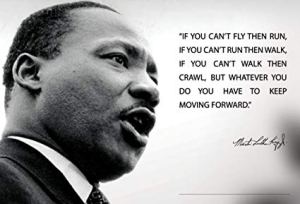
And in the words of Dr. King, if we can’t fly, let’s run. If we can’t run, let’s walk. If we can’t walk, let’s crawl. But whatever we do, let’s keep moving forward. Forward together, not one step back.


I Pledge Allegiance

Poor People's CampaignDelivered at the Introduction Meeting of the Poor People’s Campaign at First Christian Church in Fort Smith AR, May 6, 2018


I

In America, I as an individual,have certain inalienable rights. As an individual citizen of this country, I have freedom. And with that freedom, I have a great responsibility. I have a voice. I have a vote, and I have the responsibility to make this country the very best that it can be. And that includes keeping our water safe, our air clean and our land pure.

Pledge allegiance

Our allegiance does not mean blindly accepting our faults, never questioning our past, and never second-guessing how current policies will affect our future. Allegiance means faithfully doing our part to “mend thine every flaw.”

It means being loyal, law-abiding citizens committed to our civic duty of voting in elections. However, it also means voicing opposition to laws that need to be changed and to elected officials who need be corrected. Civil allegiance sometimes means civil disobedience.

Like a faithful marriage, pledging allegiance means being loyal to our country in good times and in bad, in sickness and in health, for richer, for poorer, never giving up, never becoming complacent, never running away. It means perpetually praying for it, continually correcting it, forever fighting for it.

To the flag of the United States of America and to the Republic for which it stands

The flag is not a mere sign for our country. It is the profound symbol of our country. Signs are limited as signs only give information. Signs do not have the power to stand for something. Only symbols can do that. Whereas signs invoke intellectual responses from the brain, symbols elicit visceral emotions from the heart and gut. This is the reason seeing the Confederate Battle Flag flying on the back of motorcycles this weekend turned my stomach. The flag is not a mere historical marker, label, design or brand but a powerful symbol that stands for something. Flags have the power to move us, stir us, and guide us.

One nation

Our flag stands for one nation. Although heritage and culture are important aspects of life in different parts of our country, they are never more important than the unity of our country. Abraham Lincoln and Jesus spoke truth when they said: “a house divided against its self cannot stand.”

We need to come together not as liberal or conservative, republican or democrat but simply as Americans who believe we can do better and be better.

Under God

Not under God because we are down here and God is up there. Not under God because we want some sort of theocracy like the belief of ISIS and other Islamic extremists. And not under God because we believe we were established to be a Christian nation like the beliefs of Christian extremists.

Rather, we pledge our allegiance to country under, after, second to, our allegiance to the law of God.

As people of faith, this is why our allegiance is not blind. The Commander-in-Chief is not our chief commander. The Supreme Court is not our supreme being. Our allegiance is first pledged to something that is bigger than our nation, even larger than our world.

It is an allegiance that informs our vote, rallies our civic duties, admonishes our obedience to civil law, and yet, sometimes calls us to civil disobedience. For the Christian, it is the God revealed through the words and works of Jesus who becomes our civil conscience. We believe the law of God revealed through Christ supersedes every human law.

Immediately following words from the Apostle Paul regarding good citizenship and obeying the law, we read that every one of God’s laws is summed up in just one law: “You shall love your neighbor as yourself.” Jesus said it this way: “On this hang all of the laws of the prophets “…that you love your neighbor as yourself.”

And just in case some are still confused to what “love” is, Paul defines love by saying: “Love does no harm to a neighbor.”

Jesus said, “There is no law greater.” It is as if Christ is saying, “If you don’t get anything else from Holy Scripture, you need to get this: ‘love your neighbor as yourself.’” Yet, as evidenced by the amount of hatred, racism and violence that is in our nation today, much of it propagated in the name of God, this supreme law is widely ignored, disobeyed or rejected all together.

I believe it is when we first pledge our allegiance to this supreme law, that we have the opportunity to be a great nation. For when we love our neighbors as ourselves, when in everything we do to others as we would have them do to us, it quickly becomes “self-evident that all people are created equal with certain inalienable rights, that among these are life, liberty, and the pursuit of happiness.”

Indivisible

When we pledge allegiance to the supreme law of God, when we pledge to love our neighbors as ourselves, we promise to work together under God to build bridges to overcome the gaps and barriers that we have created that divide us: racial, sexual, ethnic, political, economic, educational and religious. We pledge to come together, side by side, hand in hand, for the equality of all people and the inalienable rights of all people.

This does not mean that we are to never disagree with the beliefs or lifestyles of others. We can certainly love our neighbor while disagreeing with our neighbor. It is not hating our neighbor when we disagree with the flag that our neighbor flies; however, when we infringe on their life, their liberty, and their pursuit of happiness by supporting public policies or actions that treat them as second-class citizens, that do harm to our neighbor, that keep the poor poor while keeping the rich richer, it is certainly not loving our neighbor as we love ourselves. As our 44thPresident said in the eulogy of Rev. Clementa Pinckney: “…justice grows out of recognition of ourselves in each other. [Our] liberty depends on [our neighbors] being free, too.”

With liberty and justice for all.

We pledge to work for freedom and fairness not just for our educated, rich neighbor who can afford the best attorneys, and not just for our advantaged, abled-bodied and able-minded straight, white, Christian, English-speaking neighbors. We pledge ourselves to stand for liberty and justice for all. And according to the Abrahamic faiths, “all” especially includes foreigners, minorities, the poor, the differently-abled, all those who have been pushed to the margins.

All even includes people of every nation. For our love and our mission to stand for liberty and justice have no borders.

In response to a call to include the rights of the LGBTQ community as civil rights, one of my friends raised the following question on Facebook, and to avoid being obscene, I am going to paraphrase: “They only represent 2% of the population. Why do they matter?”

This was not just one lone, ugly, hateful voice, but one that was representative of the sentiment of many.

“They only make up 2% of the population. Why do they matter?”

For the Christian who pledges his or her allegiance to the flag of the United States of America, and to the Republic for which it stands, one nation, under God, indivisible, with liberty and justice for all: LGBTQ+ lives matter; Black lives matter; Poor People’s lives matter, because according to everything for which this flag stands under the supreme law of the God of love, all lives will never matter, until all finally means all.

God-Blessed Eyes

Harrison

Matthew 13:10-17 NRSV

The pastor stands up in the pulpit, clears his throat, and announces: “This morning we are going to talk about racism and reconciliation.”

And all over the sanctuary the congregation winces. Under their breaths, they beg: “Preacher, please don’t do it! You are getting ready to open up a can of worms!”

But the middle-aged preacher, who has opened up more cans of worms than anyone could possibly count, ignores the grimaces and metaphorically gets out the can opener.

Ever since I have been a pastor, church folks have urged me to avoid talking about race.

They say: “If you talk about it, you are just going to stir things up, make things worse. If we would all just leave it alone, it will go away.

And if you think about, those who call attention to the color of their skin are the real racists. They need to stop saying their lives matter and understand that all lives matter. Reconciliation Sunday? Really? Come on, preacher, we just need to let it go!”

And, for the most part, when it comes to talking about race, we white preachers have been very silent.

But guess what? It ain’t working.

The recent Alt-Right White Nationalists’ march in Charlottesville was a stark reminder that racism in this country is not going away that easily.

Yet, many would still rather shut their eyes and close their ears, pretending that racism no longer exists.

A couple of years ago, someone blocked me on Facebook. When I asked a mutual friend why I was blocked. She responded that he didn’t like seeing my Ainsley’s Angels posts of children with special needs. He said that the pictures of the children made him uncomfortable.

“Out of sight out of mind,” as we like to say.

Maybe this is why Jesus talked more about sight than he talked about sin.

Throughout the gospels, Jesus asks: “Do you have eyes and fail to see?” (Mark 8:18)

In our gospel lesson this morning, Jesus quotes the prophet Isaiah:

You will indeed listen, but never understand, and you will indeed look, but never perceive. For this people’s heart has grown dull, and their ears are hard of hearing, and they have shut their eyes; so that they might not look with their eyes and listen with their ears.

In Isaiah chapter 6, we read that closed minds, closed eyes, and closed ears (ignoring injustice, looking the other way, tuning it out), will lead to “cities lying in waste without inhabitant, and houses without people, and the land utterly desolate.”

Refusing to listen to and understand the cries of injustice— possessing hearts that are dull and indifferent— leads to complete desolation. It leads to tiki torches in Charlottesville, a shooter in Charleston, voter suppression in North Carolina, an assassination in Memphis, Jim Crow in the South, a holocaust in Germany, and a mass lynching of 237 African Americans in Arkansas.

Isaiah continues:

Even if a tenth part remains in it, it will be burned again,
like…an oak whose stump remains standing when it is felled.’

But listen to the good news. This passage in Isaiah concludes:

The holy seed is its stump.

There’s a holy seed ready to sprout forth. In a land of deep darkness, a light shines forth. In the demise and the decay, there is the promise of new life. Like a candle flickering in the dark, hope is burning. Like a stream trickling in the desert, reconciliation is possible.

And Jesus suggests that the key to reconciliation, healing and redemption is open minds and open hearts.

The mission of Ainsley’s Angels is the very thing that Jesus is talking about here. The primary mission is “raising awareness.”  Awareness, says Jesus, is having God-blessed eyes and God-blessed ears. Because whether you are talking about ableism or racism or any other ism, awareness is what is needed before reconciliation can happen.

And with this blessed awareness, what is it specifically that Jesus wants us to see? What do we see for Jesus to respond: “Blessed are your eyes for they see!” “Prophets and righteous people longed to see what you see but did not see it!”

I believe the answer is in Jesus’ first recorded sermon. In Matthew 5 we read where Jesus went up on a mountain and taught them saying:

Blessed are the poor in spirit, for theirs is the kingdom of heaven. Blessed are the meek for they shall inherit the earth.

God-blessed eyes see that the “poor in spirit” and the “meek” are blessed by God; Not the one who has never had a reason to doubt that God was indeed for them, not against them; with them, not away from them. But God-blessed eyes see that God is on the side of the ones who have been degraded and dehumanized by the systems and structures of the priveledged. Their spirits have been crushed by inequitable education, poor healthcare, discrimination in the workplace and racial profiling in the streets. But their future, says Jesus, is the kingdom of heaven.

Blessed are those who mourn, for they will be comforted.

God-blessed eyes see that God empathizes with the mourners. Not those the Apostle Paul is talking about when he says we should “give thanks in all circumstances” (I Thessalonians 5:18), or “rejoice even in the midst of suffering” (Romans 5:3-10), but the ones who have a difficult time finding anything for which to be thankful. For them, there is no rejoicing. They are not just complaining about the pain in their life. They actually in mourning over that pain. They look at how their parents and grandparents were valued by the world. They see how their lives are valued. And they look into the eyes of their children and grandchildren, and they grieve for them. But because Jesus knows that love will win, and evil will be overcome, Jesus calls them blessed and promises comfort.

Blessed are those who hunger and thirst for righteousness for they will be filled.

Not the ones who are righteous, but the ones on whose behalf the prophet Amos preached: “Let justice roll down like waters, and righteousness like an ever-flowing stream” (Amos 5:24). This is everyone who have been marginalized by society, even by communities of faith. They have suffered grave injustices just for being different.

They have been bullied so badly by the world that they hunger and thirst for justice and righteousness like a wanderer lost in a hot desert thirsts for water. Jesus says that they are blessed, and they are the ones who will not only be satisfied, but will be filled, their cups overflowing.

Blessed are the pure in heart, for they will see God.

Not the pure, but the “pure in heart.” Not those who look like you do on the outside. Not those who share your skin tone. No, God blesses those who dream with Rev. Dr. King for a world where they will be judged not by the color of their skin but by the content of their character. God-blessed eyes have the grace to see others as the Lord sees them, “for the Lord does not see as mortals see; they look on the outward appearance, but the Lord looks on the heart” (1 Samuel 16:7). God sees them for who they truly are, beloved children of God, created in the image of God, and they will see God.

Blessed are the peacemakers, for they will be called children of God.

Not the ones who have necessarily found peace for themselves. But God blesses the tormented: the discriminated and the victimized, who, because their lives are so continuously in chaos, seek to make peace whenever and wherever they can. Blessed are those who live with no peace, but seek it, because they will find a home and a peace that is beyond all understanding, within the family of God.[i]

Blessed are the merciful, for they will receive mercy.

Not the proud, the boastful and the arrogant. Not the ones who never admit any mistake, those who say they are “the least racist person” or that they “don’t have a racist bone in their body.” But God blesses the ones who are fully aware of their prejudices, the ones who have made mistakes, terrible mistakes, and they know it. Thus, when they encounter others who are also suffering from this fragmented world, they have mercy and compassion. In their hearts there is always room for others. They give mercy, because they need mercy for themselves. And Jesus says, they will receive it.

Do you see what Jesus wants us to see? Are your eyes God-blessed?

What’s the one thing we mortals need in order to see?

We need light.

The good news is that the Lord announces: “I have come as light, as the Light of the World!”

And not only that, Jesus says: “You who seek to be my disciples, you who have answered the call to be my hands and feet in this world, are not only holy seeds in a burned-out stump. You are also the Lights of the World. And you are called not to hide your light, but to shine your light so all may see this world as God sees it.

We are to shine our lights by Stanley with, lifting up, and caring for all people, especially those who are left behind. We are to light it up by defending and caring for those whose spirits have been broken, those who mourn and need mercy, the marginalized who hunger and thirst for justice, the discriminated who seek equity, and the troubled who yearn for peace.

So, as lights of this world, for the sake of this world, may First Christian Church of Fort Smith light this our city up:

So crushed spirts can have new life.

Light it up,

So the despairing can have hope.

Light it up,

So that those who ache for fairness will be satisfied.

Light it up,

So that victims of all kinds of discrimination will see God.

Light it up,

So that those who yearn for peace will receive justice and know peace.

Light it up,

Until the day comes when the eyes and ears of all are finally and fully blessed and the entire human race be reconciled as one.

[i] Inspired by Frederick Buechner. Whistling in the Dark: An ABC Theologized (New York: Harper Collins, 1988), 18.     


Thank You Enid, Oklahoma

img_5529-1
Boomers or Sooners, it doesn’t matter. The people of Enid, Oklahoma possess the same boundless spirit today that settled the Cherokee Strip in the 1893 Land Rush. It is a spirit of possibility, opportunity and welcome.

Soon after I staked my claim here, I inquired about the possibility of bringing an Ainsley’s Angels’ Ambassadorship to Enid. Ainsley’s Angels is a non-profit running group that shares joy and acceptance by including children and adults with special needs (Athlete Riders) in endurance events. However, I was told that the small population of Enid would not be able to support it, and I would need to incorporate a larger city, like Tulsa. They said that I would not be able to raise enough money or recruit enough runners.

Well, they just didn’t know the people of Enid, Oklahoma!

I introduced Ainsley’s Angels to Enid with a 5k in August. Three Angel Runners pushed two Athlete Riders. In September, twenty-one Angel Runners pushed nine Athlete Riders in the Great Land Run 10k.

When our church learned that Sunday was the only day of the week that the food-insecure were not served a free meal in Enid, we suggested recruiting 52 businesses or organizations to prepare and serve one meal a year on Sunday in a nice sit-down restaurant atmosphere from our church’s kitchen. However, some responded by saying that doing this weekly would be unachievable, and we should perhaps aim for once-a-month.

Well, they just didn’t know the people of Enid, Oklahoma!

Today, groups from our high schools, businesses, civic organizations, Vance Air Force Base, and even a group from an assisted-living facility, have volunteered to prepare and serve a Sunday meal to hungry men, women, and children with grace, dignity and love.

When some of my colleagues heard that I was going to publicly stand up and speak out on behalf of the LGBTQ community after the Orlando Pulse nightclub shooting, I was told that the people of Enid, who live in the conservative Bible Belt, were going to run me out of town.

Well, they just didn’t know the people of Enid, Oklahoma!

After I helped lead a prayer vigil on Enid’s town’s square, the leaders of our church had a meeting and reaffirmed our church’s commitment to be a people of grace and welcome to all God’s children though differing in race, gender, age, sexual orientation, gender identity, nationality, ethnicity, marital status, physical or mental ability, political stance or theological perspective. They said they wanted their pastor to love all of our neighbors, and all means all.

When I told people that I wanted to serve and worship with the African American churches in Enid, someone told me that this would be very difficult, because Enid was still somewhat segregated.

Well, they just didn’t know the people of Enid, Oklahoma!

I have been honored to preach at St. Stephens AME Church on two occasions and to be the Master of Ceremonies at Enid’s Annual Martin Luther King Jr. Celebration. On World Communion Sunday in October, our church was led in worship by the African-American voices of the Southern Heights Community Choir and of the First Missionary Baptist Church. On that day, we renewed our commitment to partner with the larger Church to overcome barriers of race and ethnicity, and we renewed our commitment to social justice by being an anti-racism, pro-reconciling church in our community.

Thank you Enid, Oklahoma for still being a place of boundless possibilities, opportunities and welcome!

I thank God that I got a chance to know you!

When God Refuses to Listen

NotListening1

Isaiah 1, 10-20 NRSV

I like to be honest from this pulpit. I like to be real. So let’s be really honest this morning. Have you ever prayed and had the feeling that God’s not listening?

You come to this place of worship and you go through all of the motions. You sing all of the hymns. You actually pray during the moment of silence, instead of spending those moments planning the rest of your day. You listen reverently to the choir’s anthem, and like few people, you even listen intently to every word of the sermon. But as the organist begins playing the prelude, you wonder if it was all just a big waste of time.

I believe this is a reason some people stay home on Sunday mornings. They are not getting through to God and God isn’t getting through to them. And Randy, as the Choir Director, guess what? Sometimes, they say it is your fault. They say that the music just doesn’t inspire them. But most of the time, it is the preacher’s fault. They usually say something like, “I am just not being fed anymore at that church.” Have you heard that before?

Well, Randy, I have some good news for us! Isaiah suggests that their belief that worship is a waste of their time, that God is not listening, is not the choir director’s fault, and it may not be the preacher’s fault either.

Isaiah says that the reason that you may feel like worship is not bringing you close to God, the reason you don’t feel like God is listening, the reason that you feel like God has not heard a word you’ve said is because God has not been listening to a word you’ve said.

Now, I believe that the entire Bible and Jesus himself came and taught us that God operates by something we call grace. Salvation, and prayer for that matter, conversation with God, a personal relationship with God can not be earned, and it is in no way deserved. “We are saved by grace and not works lest anyone should boast.” I know that.  And I believe that with all of my heart.

However, Isaiah says that if we truly want to know that God is listening to us, if we truly want to feel close to God, if we want our worship on Sunday to mean something, there are some things that we must do.

And if we don’t do those things, according to Isaiah, God might respond to our worship this way: “What are your services to me? I have had it up to here, I am sick to my stomach of all your worship! I have no desire for any of it. Stop tramping into my courts. And I have had enough of your preacher with his fancy robe who thinks he is all that with all of his seminary degrees. Your prayers, your hymns, they have become a burden to me. I have stopped listening!”

So, according to Isaiah, what must we do to be heard by God?

Put away the evil of your deeds. Pursue justice and champion the oppressed, give the orphan his rights, plead the widow’s cause.

If we want to be heard by God, if we want worship to be meaningful, Isaiah says that we better doing what we can help the most vulnerable members of our community.

My friend Rev. Dr. William Barber has he wonders why we spend so much time doing the things about which “God says so little” while doing so little of the things about which “God says so much.”

I wonder if Isaiah is suggesting that the church might re-evaluate our committee meetings. Like any congregational-led church, we have a lot of committee meetings here. Isaiah may want us to ask: “What has been the subject of your longest, most arduous church meeting? What was the agenda of that meeting that caused your spouse at home to worry about you, or even question your whereabouts, because they thought you should have been home hours earlier?”

Was it about how our church could could advocate for those in our community who feel oppressed? Was it about meeting the needs of children who do not have the support of family? Was it about defending the rights of widows or the rights of the most vulnerable members of our community? Was the agenda something about which God says so much? Or was the agenda something about which God says so little?

Rev. Michael MacDonald writes that many Christian Americans not only never have any lengthy church meetings about how they can better serve the poor, they just simply have a bad attitude about serving the poor. So bad, that many folks probably wished they had the license to rewrite the many scriptures which speak for the poor.

I would argue that many people actually believe they have such a license. Because as a pastor, it has been my experience that whenever I have spoken on behalf of the poor and the vulnerable, someone almost always accuses me of being a “liberal.” Then, they will something like, “The Bible says that God helps those who help themselves.”

When in fact, the overall message of the Bible says nothing close to that. Aesop’s Fables say that. Benjamin Franklin said that. Thus, I want to respond: “Who’s the liberal here? The one who is conserving the Judeo-Christian teachings of the Scriptures to help the poor, or the one who is re-writing the scriptures with the words of a fable or Deist Ben Franklin?”

For example: This is how McDonald said some Americans would rewrite the story of the Good Samaritan:

The lawyer asked, “And who is my neighbor?”

Jesus replied, “Now by chance a priest was going down the road from Jerusalem to Jericho and saw a man who was hungry and ill clad.  He thought about stopping to help him, but decided that the man had probably been planted there by advocates for the homeless, so he walked by on the other side lest he give encouragement to those who wanted to divide society along class lines in order to gain political power for themselves.

So, likewise a Levite, when he came to the place and saw him, thought about helping him. But the Levite was afraid that he would rob the man of his independence, and he could plainly see that the man had sandal straps by which to pull himself up. So, he too, passes by on the other side.

But a Samaritan came near him and was moved by self-righteous pity. The Samaritan bandaged his wounds pouring oil and wine on the, no doubt as a publicity stunt to make his own self feel good and look good before his peers.

Then the Samaritan put the man on his own animal and brought him to an inn. The next day, he took out two denarii, gave them to the innkeeper and said, “Take care of him; and when I come back, and will repay you whatever more you spend,” thus encouraging the injured man to live like a parasite off other people’s hard-earned wealth.

Which of these three do you think was a neighbor to the man?  The lawyer said, “[Well of course] the two who showed him mercy by walking by on the other side.”

And God says, “You can pray without ceasing but I won’t be listening. I won’t listen to those of you who pervert justice, those of who champion the cause of the rich and powerful, those of you who take advantage of the powerless. God ahead, have yourselves a worship service, have three of them, but I won’t be there.” God says, “I simply don’t listen to the prayers of those who are all about feeding themselves while orphans and widows, the disadvantaged and the vulnerable, go hungry.”

I believe Baptist evangelist Tony Campolo is right when he says that the one thing every Christian should do is not only write a check to help the poor, but help the poor in such a way that we actually build a relationship with them, get to know them on a personal level.

This is what I want to do when we begin feeding the food insecure later this year as the prelude to a new worship service. I don’t want to merely hand them a brown paper bag lunch out the back door, with perhaps a scripture verse stapled to it, or a religious tract thrown inside of it, and then encourage them to go someplace else to eat it, out of sight, out of mind.

I want us to sit down at the table with them, get to know them, listen to them, love them, befriend them, be family to them. Let them know that you are willing to fight for them, defend their rights and plead their case. Be there to help them become the person that God is calling them to be.

Campolo says, in a way that only a good ol’ Baptist could say it, that one important reason that Christians should want to do this is because on the last day, when we are standing before the Great Judge, as God is separating the sheep from the goats and points to us and asks the question, “When have you clothed the naked, fed the hungry, given drink the thirsty, when have you shown generosity to the least of these my brothers and my sisters?”—That is when you are going to want to have the new friend we met around that table standing beside us, and we are going to want to be able to turn to them with confidence, pat them on the back, and say with a smile, “Go ahead, you tell it.”

Do you want to come to this place on Sunday morning and really have an encounter with God? When Terri begins playing the Postlude, do you want to know that you have actually communed with the creator of all that is? Isaiah, and I believe Jesus says, that will depend on how you commune with the most vulnerable members of our community.

Drunk, Dancing Disturbers of the Peace

disturber_of_the_peace_baby_hat

2 Samuel 6:-1-5, 12-19 NRSV

Ephesians 5:6-20 The Message

This passage from Ephesians is the story of my faith, or at least, I hope to make it the story of my faith. For there was a time that I was taken in by all sorts of religious smooth talk, and I hung around people who knew the religious sales lingo all too well.

They spoke words that were religious, yet unbiblical, but words that my itching ears wanted to hear: “Only people who think and believe like us are God’s children”; “God only wants us to only help those who are willing to help themselves”; “God wants us to love the sinner but hate the sin”, which was also interpreted, “We should love others, but we don’t have to like others.”

Now, this did keep me out of trouble. It kept me from hanging around or friending anyone who did not think like me and worship like me. And it also kept me from doing anything to help the poor in my community or anyone outside of my church.

The faith instilled in me was personal and private. It was something I possessed, clung to, an exclusive ticket to an eternal home. It was about personal peace and eternal security. It was something that kept me from immorality. And immorality was always limited to personal sin, especially the big five (I know you thought they were 10, but we good Baptists had 5): “Do not to drink, dance, smoke or chew or go with girls who do.”

My faith was always controlled, moderated, tempered, I later learned, watered down. It never challenged the status quo, never disturbed the peace, never questioned why women did not preach in church, or even take up the offering. It never asked why the living quarters for migrant workers in my farming community looked so bad or why all migrant workers were black.

My faith was kept trucked away, wasting away in the dark. Faith was something that we only did on Sunday morning between the hours of 10 and 12. Although going to church often seemed like a waste of time, as I spent many of those hours nodding, sometimes actually napping in my pew, I was taught that this was what made God happy.

But here in Ephesians, Paul is telling me that my faith was actually making God furious. My faith was not merely sleeping in a pew. My faith was dead in the pew.

Wake up from your sleep, Climb out of your coffins; Christ will show you the light!

So watch your step. Use your head. Make the most of every chance you get. These are desperate times!

17 Don’t live carelessly, unthinkingly. Make sure you understand what the Master wants.

18-20 Don’t drink too much wine. That cheapens your life. Drink the Spirit of God, huge draughts of him. Sing hymns instead of drinking songs! Sing songs from your heart to Christ. Sing praises over everything, any excuse for a song to God the Father in the name of our Master, Jesus Christ

Now, like every good Southern Baptist, I knew not to drink too much wine. But I never learned that I was supposed to replace the wine. I never knew I was supposed to drink from the Spirit of God and become God-intoxicated. I did learn that these are desperate times, and my faith involved singing hymns, but only singing hymns to be heard only from behind the stained glass; Not singing and dancing in the streets in the light of the day like some public drunkard!

This passage reminds me of a story from second book of Samuel.

After David led a great army to get possession of the Ark of the Covenant to return it to Jerusalem, David and his army were so overcome with what was going on that they engaged in festive rejoicing and dancing. They were seized by what James Newsome, New Testament professor of Columbia Seminary calls “a spirit of prophetic ecstasy.”

The scriptures say that David sang and danced before God “with all his might.” He sang and danced before God with all that he had and with all that we was. David was God-intoxicated.

And when you become God-intoxicated, so filled with the Spirit of God, you will most certainly disturb the peace and face opposition it.

When David and his wife Michal arrived home from the party and began preparing to turn in for the night, David, if he was anything like me, was probably hoping to hear some words of affirmation from his wife. Something like, “Honey, you were so wonderful today. As I listened to you sing and watched you dance in the streets, you just don’t know how proud I was of you! You danced your heart out! And why shouldn’t you have, you brought the Ark of the Covenant back to Jerusalem where it belongs!”

However, the words David hears are something like: “David, you looked like a drunken fool.”

Perhaps David did act like an intoxicated fool. Uninhibited and unrestrained, he lost all self-control. Seized by “a spirit of prophetic ecstasy,” David held absolutely nothing back. David surrendered to the Spirit which had filled him.

David danced, charged by the rule of God. David danced, electrified by the justice of God. David danced a dance of total self-surrender. David danced, holding nothing back. David danced giving all that he had and all that he was to God. And there was absolutely nothing personal or private about this dance. This dance caused a scene. This dance created a fuss. It got people’s attention. It challenged the status quo. It disturbed the peace. And Michal despised David for it.

This is what happens when one drinks huge draughts of the Spirit of God. This is what happens when one becomes God-intoxicated. There is no way to control it, moderate,  temper it. There is no way to conceal it. There is no way to regulate it to two hours on a Sunday morning. When one becomes drunk with the rule of God, the love of God, one’s feet will inevitably move to the dance of the gospel, and one will be despised for it.

The dance of the gospel is a dangerous dance. The dance of the gospel is a disturbing dance. The active affirmation the rule of God does not set well with the Michals of the world.

The dance of personal, private piety are easier steps to follow, aren’t they? The message of false prophets watering down the gospel of Christ as nothing more than a little dose of “chicken soup for the soul” is much easier to swallow. If we just get ourselves right with the Lord, if we pray right and live right, if we are good moral people, if we don’t drink, smoke or chew or go with girls who do, then God will bless us and one day send us to heaven.

The dance of the gospel is radically different. The dance of the gospel are steps to the beat of a different drum. If we get right with the Lord; if we pray right and live right; if we lose all inhibitions and all restraint; if we completely surrender ourselves to the rule of God; if we love others as Christ loves us, unconditionally, unreservedly; if we question the status quo, if we disturb the peace; if we dance to the beat of this drum, then we will invariably get some push-back.

That’s a good question for all of us who are attempting to follow Jesus, is it not? “In your walk with Jesus, are you getting any push back?”

The answer should always be yes, for the dance of the gospel is a dance of self-surrender to a radical beat. It is a beat of sacrifice. It is a beat of selflessness. It is a beat of self-expenditure. It is a beat of a scandalous love and of an offensive grace. And to world, as the Apostle Paul warned the Corinthians, if we let go and dance to this beat, we are certain to look like fools. And as Luke warned us in Acts chapter 2, when we are filled with the Holy Spirit of God, we may be accused of public drunkenness.

We will be called drunken fools when offer our friendship to a poor woman in a nursing home who can offer us nothing in return.

We will be called drunken fools we spend valuable time volunteering at the hospital, serving lunch in a soup kitchen, building a handicap ramp for a stranger who may never use it, spending a week repairing homes in West Virginia, spending thousands of dollars in Nicaragua, or visiting someone in prison.

We will be called drunken fools when we offer love and forgiveness to our enemies, when we give the shirt off our backs to complete strangers in need.

We will be called drunken fools anytime we love anyone with the self-expending love of Christ—whenever we love someone without inhibitions, without restraints, and without reservations.

We will be called drunken fools when we continue to challenge the status quo, question immoral systems of injustice, and disturb the peace.

For the Michals of the world despise this dance. And they will do everything in their power to stop this dance.

We have all heard their voices: loud echoes which discourage such dancing. “Don’t get too close to him. Do not give your heart to her. You will be sorry. They will only let you down.”

“Don’t love that man. He has done absolutely nothing to deserve it and will never reciprocate.”

“Don’t love that woman. She is too needy. She never does anything to help herself. She will demand too much.”

The voice of Michal say: “The system is not that broken. The poor get what they deserve. Most minorities have it pretty good in our country, and they are the real racists. Public education is not worth fighting for. Healthcare is not a right.”

The voices of Michal say: “Keep your faith private, moderate. Keep it between you and God. Don’t stir up trouble. Just sit on a pew and look forward to going to heaven. Sing behind stained glass. Don’t worry about missions. Don’t worry about your neighbor. Don’t waste your time giving yourself away to strangers. Loving like that is crazy. It is too risky. It leads to too much pain.”

However, there is another voice, a voice heard by David: “These are serious times, so let’s drink large draughts of the Spirit, until we are all God-intoxicated! Let’s sing and dance in the streets with all we have.” It is a voice which says: “Dance! Hold nothing back. Give yourself away. Surrender yourself to the beat of the heart of the gospel. Love. Love honestly and deeply. Love courageously and graciously. Lose yourself. Empty yourself. Pour yourself out. Question the systems of injustice. Challenge the status quo. Disturb the peace.”

Will this love cause pain? It will cause enormous pain. But the joy of God which will consume you will be so immense the suffering will be well worth it.

Garth Brooks once sang a song entitled “the dance.” There’s a line in that song that goes, “I could have missed the pain, but I would have had to have missed the dance.”

Dancing the dance of the gospel will inevitably bring pain. However, never truly following in the steps of Jesus to avoid that pain is never really living. There is no joy being a wallflower on the wall of life or being a Sunday morning pew napper.

So, let us wake up from our sleep and rise from our coffins. Let us drink huge draughts of the spirit of God, and let us dance! May the First Christian Church go out and dance in the streets of Farmville, Greenville, Winterville, Tarboro, Pinetops, Wilson, Fountain and Pikeville and have seizures of prophetic ecstasy! Be warned, we will look like drunken fools, and we will suffer for it. But the immense joy of God, the joy of abundant life, now and forevermore, is well worth it.

Light It Up!

beatitudes-1

Matthew 5:1-20

I believe one of the reasons that some Southerners yearn to see some snow, at least once a year, is because of the sheer magic of it. In an article for the Farmville Enterprise I quoted J.B. Priestly: “You go to bed in one kind of world and wake up in another quite different, and if this is not enchantment then where is it to be found?”

Then I wrote:

One day Stantonsburg Road was littered with empty Natural Light cans, leftover trash from Bojangles and McDonalds, and the carcass of a possum or two. The next day it was a majestic, untarnished pathway through a winter wonderland.

One day my lawn was brown, covered with ugly winter weeds and strewn with fallen tree limbs and dog droppings that I have been too lazy to pick up. The next day it was glistening white, void of a single blemish.

One day the flaws and faults of this fragmented world were all too apparent. The next day everything seemed to be forgiven, blanketed by grace. And although the world was still a very dangerous place to drive and to even walk, the hopeful wonder and potential beauty of the world was obvious (from: Snowflakes from Heaven).

Snow in the South is like a fairytale. But a few days later, the sun comes out, the rains fall, and it quickly melts away bringing us back to the real world, where we see the harsh, uncovered reality of it all. And the winter wonderland that once was seems to be a distant magical dream.

Have you ever considered that we might have it all backwards?

What if the fairytale is the littered highways and the brown lawns with ugly winter weeds?

What if the magical dream is the uncovered, unforgiven, graceless, and fragmented existence?

What if reality is the winter wonderland? What if reality is the world that has been blanketed by grace? What if reality is the world where hopeful wonder and potential beauty always exist?

I know what you are thinking…“Oh my goodness! Somebody call 911 ‘cause the preacher has lost his mind!”

But what if I have not lost my mind, and in fact, right now, my mind is as sane and as sharp as it has ever been?

I have said before that Jesus spoke less about sin and more about our inability to see. Jesus said, “I came into this world for judgment so that those who do not see may see…” (John 9:39).  He continues throughout the gospels:

Do you have eyes and fail to see (Mark 8:18)? Why do you see the speck in your neighbor’s eye (Matthew 7:3)?  Blessed are the eyes that see what you see (Luke 10:23)! Prophets and kings desired to see what you see but did not see it (Luke 10:24)!

Over and over, Jesus talked about importance of seeing something that most have difficulty seeing. I believe this is what Jesus meant when he said that he came not to abolish the law, but to fulfill it (Matthew 5:17). Not to get rid of it, but to bring it back into focus, to help us to truly see the purpose within it.

This is why I believe he said: “I am the light of the world. Whoever follows me will never walk in darkness but will have the light of life” (John 8:12).

To see anything, light is needed; thus, one of the main purposes of Jesus is enabling people to see, to see the real world, to see reality.

And what is reality? What is it that we have so much trouble seeing? What is it that God wants us to see?

I believe the answer is in Jesus’ first recorded sermon. Jesus went up on a mountain, and after he sat down, his disciples came to him, and taught them, saying:

Blessed are the poor in spirit, for theirs is the kingdom of heaven (Matthew 5:3).

God favors the “poor in spirit.” Not the religious, the devout, the pious or even the spiritual. Not the pastors, the elders and the deacons, not even the church member who serves in the soup kitchen. No, God favors the ones who have come to be served at the soup kitchen. They are not the ones with something to give. They are the ones with nothing to give. Jesus says the ones who are blessed, the ones who are blessed by God are those who, spiritually speaking, are completely destitute and needy. Their very spirits have been broken. And notice that Jesus uses the present tense. Not will be blessed. Not might be favored. They are, right now, right here, blessed. This is reality. And their future is the kingdom of heaven.

Blessed are those who mourn, for they will be comforted (Matthew 5:4).

God favors the mourners. Not the faithful who can understand what the Apostle Paul was talking about when he said we should “give thanks in all circumstances” (I Thessalonians 5:18), or “rejoice even in the midst of suffering” (Romans 5:3-10), but the ones who are not just complaining about the pain in their life, but they actually in mourning over that pain. They look at who they are, and who they have become, and they grieve. They look in the mirror in utter despair, and Jesus calls them blessed and promises comfort.

Blessed are the meek, for they will inherit the earth (Matthew 5:5).

The meek, the gentle, the shy and the timid are favored. Not the strong. Not the ones with the personalities or the confidence to overcome all sorts of adversity and somehow still make it to the top. Blessed are the ones who have never conquered anything, not even their own fears. It is the weak, says Jesus, not the strong, who survive and inherit the earth.  

Blessed are those who hunger and thirst for righteousness for they will be filled (Matthew 5:6).

Not the ones who are righteous, but the ones on whose behalf the prophet Amos preached: “Let justice roll down like waters, and righteousness like an ever-flowing stream” (Amos 5:24). These are the ones who have been unjustly judged, mistreated, shunned and bullied by society, even by communities of faith. They have suffered grave injustices because of their race, gender, ethnicity, sexual orientation, mental and physical ability, socioeconomic level and political or theological background. They have been beaten up so badly by the world that they hunger and thirst for justice and righteousness, like a wanderer lost in a hot desert thirsts for water. Jesus says that they are blessed and they are favored and they are the ones who will not only be satisfied, but will be filled, their cups overflowing.

Blessed are the merciful, for they will receive mercy (Matthew 5:7).

Not the perfect and the proud, the boastful and the arrogant. But God favors the ones who are fully aware of their imperfections, the ones who have made mistakes, terrible mistakes. Thus, when they encounter others who are also suffering from unthinkable errors in judgment, they have mercy and compassion, and in their hearts, there is always room for forgiveness. They give mercy, because they need mercy for themselves. And because they are favored by God, they will receive it.

Blessed are the pure in heart, for they will see God (Matthew 5:8).

Not the pure, but the “pure in heart.” Not the ones who, on the outside, appear to be straight and narrow, the ones who seem to have it all together, whose characters appear to be flawless. No, God favors the ones viewed by the world as abominations. We are reminded of the words of 1 Samuel “for the Lord does not see as mortals see; they look on the outward appearance, but the Lord looks on the heart” (1 Samuel 16:7). God will see the hopeful wonder and the potential beauty of who they are and they will see God.

Blessed are the peacemakers, for they will be called children of God (Matthew 5:9).

Not the ones who have necessarily found peace for themselves. But the tormented, disturbed and restless, who, because they are so continuously in chaos, seek to make peace whenever and wherever they can. Blessed are those who are without stability, but seek it, because they will find a home, a place of security, rest and a peace that is beyond all understanding, within the family of God.[i]

This, Jesus pronounces, is not a prescription of how things should be or how things could be. Jesus asserts that this is how things are! This is not some enchanted dream or magical fairytale. This is reality. This is truth. And Jesus announces: “I have come as light, as the Light of the World, to help you see it, to give all who are blind to it, sight to really see it as it really is.”

And not only that, Jesus says, you, who seek to follow me, you, who seek do the things that I do, go to the places that I go, you, who want to be my disciples, are also the Lights of the World. And you are called not to hide your light, but to shine your light on what is reality, what is true, so all may see it the way God sees it.

And we are to light it up in the same manner Jesus lit it up.

In Matthew 4 we read after James and John, Peter and Andrew left their fishing nets to follow Jesus, they proclaimed “…the good newsof the kingdom by curing every disease and every sickness among the people…those who were afflicted with various diseases and pains, demoniacs, epileptics, and paralytics, and he cured them” (Matthew 4:23-24).

We are to shine our lights by lifting up, accepting and caring for all people, especially those the world leaves behind. We are to light it up by loving, accepting, and caring for the least among us: the poor, the weak, those who need mercy, the marginalized who hunger and thirst for justice, the obviously flawed but pure in heart, and the troubled who yearn for peace.

Will we look like fools? You bet. Will people say that the way we accept and love and affirm others is socially and even theologically unacceptable? It’s likely. Will we be demeaned and even persecuted by others in the community, even other churches? Perhaps.

But here is the good news: Jesus also said,

Blessed are those who are persecuted for righteousness’ sake, for theirs is the kingdom of heaven. Blessed are you [notice the change in person] when people revile you and persecute you and utter all kinds of evil against you falsely on my account. Rejoice and be glad, for your reward is great in heaven, for in the same way they persecuted the prophets who were before you (Matthew 5:10-11).

So let the rest of the world live in their enchanted, dreamlike, fairytale existence where the rich, the prosperous, the powerful and the strong are blessed and favored by God.

And let us commit ourselves to living in reality, in the world created by our gracious God, in the world that Jesus, the Light of the World, came to help us see, in the world where the Holy Spirit reveals the hopeful wonder and potential beauty in all things and in all people, in the world that has indeed been blanketed by grace, like a 4-inch snowfall in the South.

And let us, as lights of this world, for the sake of this world, keep lighting it up, until the day comes when the eyes of all are finally fully opened. Amen.


[i] Words on the Beatitudes were inspired by Frederick Buechner. Whistling in the Dark: An ABC Theologized (New York: Harper Collins, 1988), 18.           


COMMISSIONING AND BENEDICTION

Go now into the world and light it up!

So the poor will know that they are blessed.

Light it up!

So that the weak will know that they are favored.

Light it up!

So that those who ache for justice will be satisfied.

Light it up!

So that the obviously flawed but pure in heart will see God.

Light it up!

So that those you yearn for peace will know security as God’s beloved children.

Light it up!

Knowing that if you are persecuted, yours is the Kingdom of Heaven.

Light it up!

Until the day comes when the eyes of all are finally fully open, and all may know love of God, the grace of Jesus Christ and the communion of the Holy Spirit. Amen.


A Personal Thought on Martin Luther King, Jr. Day

martin-luther-king-on-pulpit-robert-casillaWhen I moved to southern Louisiana to preach the gospel, my church had a policy to close the church office on Fat Tuesday (the Tuesday before Ash Wednesday), but not on Martin Luther King, Jr. Day. I immediately changed the holiday policy stating: “I believe that churches should especially honor the MLK holiday. After all, he was a preacher who was martyred for preaching the gospel of Jesus!”

So, for me, today is a day to remember not only the sermons of Martin Luther King, Jr., but to also reexamine my own preaching, or lack thereof.

I have always believed that there is a lot of correlation between what happened in Memphis in 1968 and what happened in Jerusalem 2,000 years ago. I truly believe that if you love all people, and live your life trying to convince others to love all people, then there will always be some people, probably religious, who will want to kill you.

Today, I am reminded that if my preaching does not take grave risks by offending and outraging those who do not believe that God’s love expands past the lines of race, class, religion, nationality and sexual orientation, then I am not preaching the gospel of Jesus.