What’s Written on Your Heart

Some appeal to guilt: “If you don’t give, how will we keep the lights on and the camera rolling?”

Some appeal to fear: “If you don’t tithe, God will not bless you.”

Some appeal to self-interest: “Give, and you’ll get an unexpected check in the mail.”

And some appeal to nostalgia: “This is the church your grandparents built. You owe it to them to give.”

So, this stewardship season, I want to make something clear: you will never ever hear anyone in this church suggest that pledging your tithes and offerings, your service and your presence, is a way to bribe God, to buy blessings, to feed our souls, or keep our consciences clear.

Furthermore, we are not being asked to make a pledge to the 2026 budget because we recently had to replace the hot water heater, the roof may leak in a heavy rain, and we’ve hired an expensive professional to relocate a large family of bats which have taking up residence in the attic.

That’s because, we believe your pledges, your service, must come from a deeper place.

It was the prophet Jeremiah who proclaimed: “The days are coming,” declares the Lord, “when I will make a new covenant…I will put my law in their minds and write it on their hearts.”

We give because God’s law has been put in our minds and written on our hearts.

Now, when we hear the word “law,” we might think about rules, regulations, and restrictions, what we can and can’t do. But Jeremiah isn’t talking about that kind of law. He’s talking about something much deeper than any rule or ritual.

Jeremiah is talking about the moral rhythm of God. He’s talking about justice, kindness, mercy, and humility. He’s talking about empathy and compassion, engraved not on tablets of stone, but on the living tablets of human hearts.

This is the reason we pledge our gifts. We give, not from guilt, not from obligation, not from a belief that we will get something in return, not even from a command. We give because the rhythm of God’s morality has been written on our hearts.

And when this is written on our hearts, we don’t have to be told to pledge, to give, or to care, to love, to be kind, to show mercy, and to do justice. We just do. We don’t even need a stewardship campaign to tell us we need to embody radical welcome and revolutionary love. It is just who we are.

So, as we think about stewardship this month, as we consider pledging our tithes and our offerings, our service, and our presence, to make this world more just, loving, and peaceful, an important question we should ask ourselves is this:

What is it that is written on our hearts? Because the reality is, everyone has something written inside of them.

Sadly, for many, it is fear—put there by wicked men who seek power by dividing us.

For some, it’s scarcity. It’s the fear that there’s not enough.

For some, it’s fear of the other, immigrants taking what we believe is ours.

For some, it is cynicism. It’s the fear that nothing in this world ever changes, anything I give simply will not matter.

The good news is that not only does God have a powerful eraser, in the words of the prophet, “forgiving wickedness and remembering sin no more,” the good news is that God is still writing. And when God writes, God never uses the ink of fear, but always writes in the ink of justice.

Onto our each of our hearts, God is writing justice, not selfishness; compassion, not comfort; and selfless love, not self-preservation.

Here’s some more good news. Your choosing to be here this morning is a good sign that that the ink of God is flowing through your veins. That’s why I believe you are sitting in a pew this morning. That’s why you give. That’s why you serve. That’s why you show up when your neighbors need you, and that’s why you rally when your country needs you.

Jesus illustrated this truth with a story of a woman, a widow with no power, no protection, and no position. She doesn’t have wealth. She doesn’t have influence. All she has is the ink of God on her heart.

She shows up before a judge who, the text says, neither feared God nor had respect for people. We know the kind. He doesn’t care about justice. He doesn’t care about her. He doesn’t care about God. He cares only for himself.

But because of that something written on her heart, nevertheless she persists. She keeps showing up. She keeps knocking. She keeps demanding justice.

Now, we don’t know what her case was.

Maybe her landlord was exploiting her.

Maybe her neighbor had taken her land.

Maybe she had been cheated out of her inheritance.

Maybe she was being denied healthcare, due process, or civil rights.

Most certainly, she was a victim, or should I say “a survivor” of misogyny.

Whatever it was, she kept showing up.

And although the judge doesn’t have a moral, empathetic bone in his body (again, we know the type, don’t we?), even he gives in. Not because he suddenly finds compassion, but because she refuses to go away.

Now, this is not a story about nagging God until God gives us what we want. This is a story of faithful persistence in the face of injustice. It’s a story about a woman who knew something about the power of showing up. The odds were against her, but she kept showing up. The judge was morally depraved, but she kept showing up. Her friends told her she needed to accept things the way they are because nothing in this world ever changes, but she kept showing up because God’s justice, the rhythm of God’s morality was written on her heart.

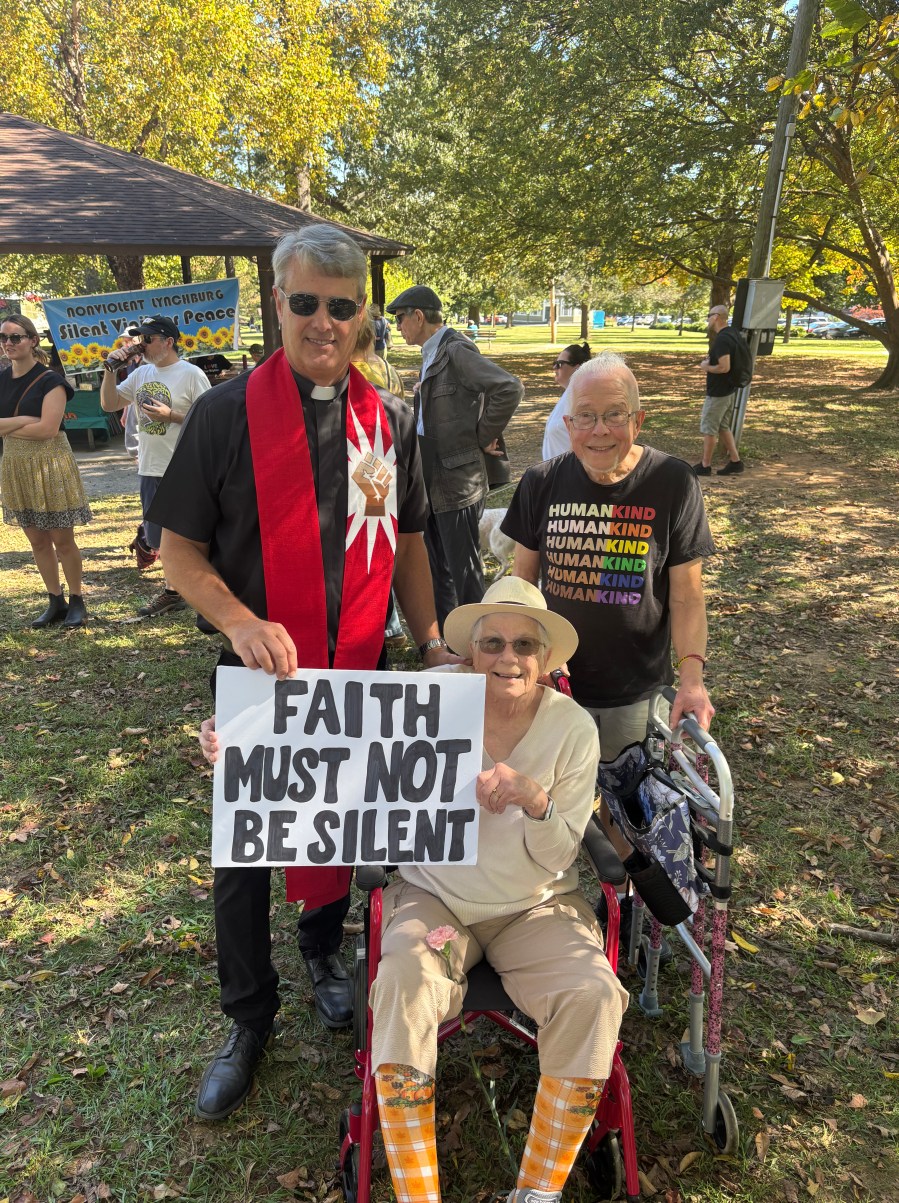
It was the same rhythm that propelled Marion Stump to show up in Miller Park yesterday at the No Kings Rally— demonstrating that when justice is written on your heart, when the ink of God is coursing through your veins, not even pancreatic cancer can keep you from showing up!

This is why this is a perfect text for our stewardship season in this time and place. Because giving is a form of showing up. Serving is a form of showing up. Speaking out, organizing, marching, standing with the vulnerable, fighting for democracy — all of it is showing up before the immoral powers and principalities and saying: “There will be justice here.”

As the widow kept knocking at the courthouse door, we must keep knocking at the world’s door. And every gift of generosity, every dollar given, every act of kindness, every time we show up, is one more knock, one more insistence that justice matters, and love will win.

Now, here’s a statistic that gives me hope today: Researchers say that if just 3.5% of a nation’s population mobilizes in sustained, nonviolent action, they can turn the tide against authoritarianism. Think about that. Not half the country. Not even a tenth. Just 3.5%. That’s about one in every thirty people. If one in thirty people with justice written on their heart keeps showing up, keeps marching, keeps knocking, keeps giving, keeps serving, keeps praying, you can change the direction of a nation. This nation can be turned toward justice again.

So, we must never believe our offering doesn’t matter, our presence doesn’t count, our gifts are too small, or that our persistence is not power. Because every time we show up, every time we give out of what’s written on our hearts, we’re part of that 3.5%. We’re part of the turning. We’re part of God’s kingdom breaking in.

Good stewardship is and has always been heart-based. It’s justice-based. It’s love-based. It’s what Jeremiah saw when he said:

No longer shall they teach one another, saying, ‘Know the Lord,’ for they shall all know me, from the least of them to the greatest.

When the covenant is written on our hearts, we don’t need coercion. We don’t need compulsion. We don’t need manipulation. Because the Spirit itself bears witness in our hearts, and when God’s handwriting burns in your chest, you wake up every morning asking: “How can I give myself today for justice, for peace, for love?”

And the good news is that the world doesn’t need an extraordinary event to change. It changes through ordinary persistence. Through the widow who won’t give up. Through the disciple who keeps showing up. Through the church that keeps preaching hope, even when hope seems hard to find, because every time we show up, we bear witness to the covenant of God written inside of us. We demonstrate to the world: “Greed will not have the last word. Hate will not have the last word. Fear will not have the last word. And love will one day ultimately and finally win.

Disciples, we are the people who keep showing up. We show up for one another. We show up for our neighbors. We show up for the nation. We show up wherever anyone thirsts for justice and hungers for love.

Because when the covenant of God is written on your heart, you can’t sit still in the face of suffering. You can’t stay silent in the face of injustice. You can’t keep your hands closed when the Spirit is calling you to open them.

The widow kept showing up before the unjust judge, and we keep showing up before an unjust world—not out of guilt, not out of duty, not to get something in return, but because there’s something divine inside of us that will not let us rest.

It’s what Jeremiah called a new covenant. It’s what Jesus called the kingdom of God. It’s what we call faith in action.

So, this stewardship season, we’re not asking you to give out of fear or guilt or obligation. We’re asking you to give because you’ve got something written on your heart.

Give because you believe that love is stronger than hate, and there’s a love inside of you that will not let you go. Give because you trust that justice will prevail. Give because you know that hope still has work to do in this world!

Give, because you’re part of that 3.5% who refuse to bow before kings, who refuse to be silent in the faces of those in power with no regard for people or God, who refuse to quit knocking, who refuse to stop showing up.

Because that’s what the church is.

It’s not a building that needs maintaining, but a movement that needs to keep marching.

And we will keep showing up—not until we get what we want, but until the world becomes what God dreams it to be.

Until every heart bears the handwriting of God, and every gift, every prayer, every act of courage echoes that same eternal truth:

We give, we serve, we love, we persist, because it’s written on our hearts!

Amen.


Pastoral Prayer

God of persistence and promise,
You are the One who writes truth on human hearts,
who carves compassion into our very being,
and who teaches us to keep showing up
in hope, in prayer, and in love.

You have written Your covenant not on stone tablets
but in the living flesh of our hearts.
So even when the world forgets justice,
even when the powerful ignore the cries of the poor,
Your truth keeps pulsing within us,
calling us to rise again, to knock again,
to believe again that love will have the final word.

We thank You for the saints and prophets
who never stopped knocking on the doors of indifference.
For the mothers who marched,
for the workers who organized,
for the dreamers who still believe in a more just tomorrow.
May their persistence live in us.

And forgive us, O God, when we grow weary in doing justice.
Forgive us when our compassion has an expiration date,
when our generosity depends on convenience,
when our prayers fade because the answers take too long.
Remind us again that the work of justice
is not measured in days or dollars or ease,
but in faithfulness, in showing up again and again.

In this season of stewardship, teach us to give not from fear or guilt,
but from gratitude and conviction.
Let our generosity be an act of defiance
against greed, apathy, and despair.
Write Your covenant deep within us,
until our giving, our praying, and our living
all bear witness to Your love at work in the world.

We pray for those whose hope feels faint today:
for the tired caregiver; the underpaid worker;
the neighbor who feels unseen; the soul that feels unheard.
May they find strength in the knowledge
that You are the God who listens, the God who remembers,
the God who still answers cries for justice.

And so, we will keep showing up.
We will keep praying, keep working, keep giving,
until the widow’s cry is answered,
until Your justice rolls down like waters,
and Your mercy like an ever-flowing stream.

We ask this in the name of Jesus,
the One who kept showing up,
the One who never gave up,
the One who lives and reigns through love.
Amen.


Radical Welcome. Revolutionary Love.

Luke 17:11-19

I want to begin this sermon talking a little bit about preaching.

There are basically two kinds of sermons you’ll hear in churches today. One starts with a thought the preacher has. They then hunt through the Bible to find a verse or two to back up that thought.

The second kind starts, not with the preacher’s idea, but with the scripture itself. Preachers who follow this path use a tool called the lectionary, a three-year cycle of readings first shaped by the early church in the fourth century and rooted in the reading traditions of Jewish synagogues. The lectionary keeps preachers from preaching their own pet ideas, and since it always includes a gospel lesson, the preacher is encouraged to interpret each reading through the life and love of Jesus.

That’s the kind of preaching I believe in.

And it’s probably why, in my previous congregations, I’ve been criticized for preaching too many sermons about the poor and marginalized. Because here’s the reality: Besides the truth that Jesus said his very purpose was to proclaim good news to the poor and liberation to the oppressed, there are over two thousand scriptures instructing people of faith how to treat the poor. As Bishop William Barber says, “If you cut all those verses out of the Bible, the whole book would fall apart. There’d be nothing left.”

So yes, I plead guilty—for preaching the Bible in the light of Jesus. And every week, the scriptures amaze me. For they never seem to read like old stories but read more as a mirror to the present. This is why I was taught in seminary to prepare for a sermon with the Bible in one hand and a newspaper in the other, as I would always be able to find a relevant word of challenge and hope.

Today, Luke’s gospel brings us face to face with Jesus on the border, where he once again encounters the marginalized poor who are crying out for mercy.

It’s a beautiful story about healing and gratitude, but when we look closer, we see that it is about so much more than that. It’s about who gets welcomed and affirmed and what kind of love has the power to change the world.

And that’s why it’s the perfect reading to launch our stewardship season with the theme: “Radical Welcome. Revolutionary Love.”

Luke tells us that Jesus is walking along the border between Galilee and Samaria. In 2025, there’s no way we can rush pass that detail. Jesus is on the border—that place where boundaries get policed, where soldiers get sent, where dreams are crushed, and walls get built. It’s the place where the desperate gather, immigrants are scapegoated, and the poor are told to go back to where they came from.

It is there that Jesus meets ten people with leprosy—ten people who know exactly what it means to be told they don’t belong. They’ve each heard the words of Leviticus cherry-picked and used like weapons against them, if you can imagine such a thing:

The person who has the leprous disease shall wear torn clothes and let the hair of his head be disheveled; and he shall cover his upper lip and cry out, ‘Unclean, unclean.’ … He shall live alone; his dwelling shall be outside the camp. (Leviticus 13:45–46)

That’s what marginalization looks like in scripture form, an ancient version of “You’re poisoning the blood of our country.”

So, the outsiders keep their distance while they cry out: “Jesus, Master, have mercy on us!”

And isn’t that the same cry echoing all around us today?

It’s the cry of immigrants and of all who are excluded from the opportunities enjoyed by the privileged.

It’s the cry of anyone denied due process under the law or denied representation in gerrymandered voting districts.

It’s the cry of LGBTQ people shut out and abused by the church.

It’s the cry of women who are denied access to reproductive care.

It’s the cry of every Black and Brown neighbor who drives past a Confederate flag waving in the wind—a painful reminder of the systemic racism they are forced to endure.

They all cry out: “Lord, have mercy!”

And what does Jesus do? He doesn’t ignore their cries. And he doesn’t ask for credentials or proof of worthiness. Without asking whether they’re citizens of Galilee or Samaria, he opens a free clinic right there at the border.

But notice something else: Jesus doesn’t just give them free healthcare and send them on their way. He wants to make sure they’re restored back into community. That’s why he says, “Go and show yourselves to the priests.” Because according to the Mosaic Law, only a priest could officially declare them “clean” allowing them to re-enter society.

Because Jesus is never satisfied with individual healing. Jesus wants liberation. Jesus wants justice. He wants inclusion. He wants acceptance, belonging, and abundant life for all.

But the story doesn’t end there.

Out of the ten who are healed, only one turns back to say thank you—and Luke wants to make sure we know that the hero of the story was a Samaritan, the foreigner in the group. The outsider of outsiders. The religious heretic. The one the establishment called impure, illegal, and alien. And when this outsidiest of all the outsiders turns back to Jesus, “Jesus doesn’t say, “Sorry, you’re not one of us.” “Sorry, you don’t sing in our language.” “Sorry, your faith and traditions are different from ours.” He says, “Your faith has made you well.”

This is what radical welcome looks like in a world obsessed with borders—literal and figurative. Who’s in, who’s out. Who’s legal, who’s illegal. Who’s acceptable, who’s disqualified. This is the world Jesus dares to say: “All belong. All are worthy. All can be healed, and liberty and justice can be for all.”

This is the radical welcome we’re called to embody as a church. To be people who don’t just tolerate diversity but celebrate it. To be a community where God’s wide, universal, unconditional embrace is visible, tangible, and undeniable, where every person hears the gospel loud and clear: “You belong here!”

And this welcome is not only radical. It’s revolutionary.

Because this kind of love doesn’t just heal individuals; it transforms systems. It disrupts the status quo. It flips tables. It tears down walls. It not only welcomes—it honors. It not only includes—it affirms.

And because of this, revolutionary love is always costly. It cost Jesus his reputation. It cost him his safety. It eventually cost him his life. But he showed us that the only love worth living for is the kind of love worth dying for.

This is the kind of love we are called to practice. A love that refuses to let anyone stand outside the circle, and keeps widening that circle again and again, no matter the cost. A love that refuses to stay silent in the face of injustice and is always willing to risk comfort for the sake of compassion, willing to be called an “insurrectionist,” to even get shot in the face with a chemical weapon like the Presbyterian Minister in Chicago this week.

So, you may ask, “What does this have to do with stewardship?” The answer is “everything.”

Because stewardship is not about maintaining a building or keeping the lights on. Stewardship is about resourcing the ministry of radical welcome and revolutionary love.

When we give, we’re not paying dues to an institution; we’re investing in liberation.

We’re not buying comfort; we’re building community.

We’re not keeping the lights on; we’re keeping hope alive.

We’re not feeding our souls.

But every dollar we give is bread for the hungry, balm for the wounded, space for the excluded, and hope for the desperate. Every pledge we make is a declaration: “We refuse to be a church of scarcity, fear, or maintenance, but choose to be a church of abundance, courage, and mission!”

Giving to our church is much different than giving to a charity. It’s resistance to the forces of greed and self-interest. It’s protest against a world that says money is for hoarding, power is for the few, people should be divided, and love is conditional.

Giving to our church proclaims: God’s economy is different. In God’s economy, generosity multiplies. In God’s economy, love grows stronger the more it is shared, and our lives become fuller the more we give them away.

It’s the Samaritan who shows us that gratitude itself can be revolutionary. When he turns back to give thanks, he refuses to be silent. He refuses to treat his healing as a private, personal blessing and interrupts our gospel lesson with praise, teaching us that gratitude interrupts despair and fuels generosity.

That’s what this year’s stewardship season is about. It’s an invitation to practice gratitude like that Samaritan. To turn back to Jesus. To say, “thank you.” To recognize that every good gift comes from God, and that the only faithful response is to give back.

So, here’s our call this stewardship season:

To give back by walking the borderlands with Jesus, refusing to let anyone be cast aside.

To practice welcome so radical that people say, “I never knew church could look like this.”

To embody love so revolutionary that systems tremble, powers take notice, and hope is rekindled.

To give with such joy and generosity that the world knows: this is a congregation that truly takes Bible seriously while living in this world as disciples of Christ.

And no, it’s not easy. It takes faith. It takes sacrifice. It takes courage. People will laugh at us, dismiss us, and even attack us. But here’s the good news: the same Jesus who healed the ten and honored the Samaritan is still walking with us. The same Spirit that moved then is moving now.

The lepers cried out for mercy, and Jesus answered. The Samaritan turned back to give thanks, and Jesus affirmed his faith. Today, we stand in that same story. We are the ones who have been welcomed. We are the ones who have been loved. We are the ones who have been healed.

And now it’s our turn. It’s our turn to welcome, to heal, to affirm, to love, to give.

So, let’s stand up with gratitude.

Let’s step out in faith.

Let’s lean forward in love.

Because the world is waiting for a church like this—a church that practices radical welcome and revolutionary love!”

It’s not just a theme or a slogan.

It’s not just the idea of a preacher with some cherry-picked verses to back it up.

It’s the gospel.

It’s the good news.

And it’s our calling.

It’s our witness to the world!

Amen.

Consecrating Our Lives

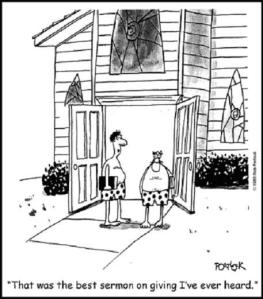
cartoon on giving

Matthew 20:1-16 NRSV

Today is Consecration Sunday. Consecration—It means to bless, to sanctify, or to make holy. This is the Sunday that we consecrate the pledges that we have made to the mission and the ministries of this church for the coming year.

Now, how do you suggest, pray tell, we do that? Exactly, how are we going to make these pledges that are in this box holy? I know how some churches do it. They get themselves a holy man with some holy hands to make the pledges holy. The holy man simply comes, reaches out and everything the holy man touches is consecrated, sanctified, blessed and made holy. The holy man might even have some holy water to help really make some things holy.

Problem is: where are we are going to get a holy man? Does anybody know one? Look around. Does anybody see a holy man in this room? Oh, no. Don’t look at me! Wearing a robe with the pretty stole does not make one a holy man!

And you know better than that as many of you have known me a long time. I have been called a lot of things, but I don’t think anyone has ever called me a holy man. And the only holy water I ever had (if coming from the Jordan River makes it holy), was poured out earlier this month in our baptismal pool.

So, how in the world are we going to consecrate this box, sanctify this box, make this box of pledges holy, without a holy man or a holy woman?

Well, let’s turn to that place that all Christians should turn when they have questions about faith and the church. Let’s turn to the Bible, and more specifically, let’s turn to Jesus.

In this morning’s lectionary lesson, we find Jesus doing something he absolutely loved: telling a story. And not just any story, but a story about who God is, how God acts, and what God desires. And if we want to truly live in the image of God, the story is also about us.

Jesus said, the way God is, acts, and thinks is like a landowner who went out around 6 am to hire some workers for his vineyard. He said, “I will pay you the going rate for 12 hours’ worth of work: 120 bucks.” They agreed and went to work.

At 9 am, he goes out and hires some more workers, and tells them that he will pay them whatever is right. He hired a few more people at noon and told them the same. Then went out and hired some at 3 pm and then even a few more at 5 pm and telling them, “Come and work and I will pay you what is right.”

At 6 pm, when the work day was over and the time had come to settle up with all of the workers, he called up the ones he hired last, who had only worked for only one hour, and shocked everyone by paying them each $120.00.

Well, the ones who had been working for 12 hours started to get a little excited. “Boss man paid them $120 an hour! Let’s see, $120 times 12 hours, uh, that means we are going to get paid $1,440 for our work!”

It is then the boss does something that is even more shocking. He gives those who had worked all day the exact amount he gave those who had worked for just one hour. And you better believe that when they got their check, they got pretty upset: “We have worked out here all day in the scorching heat. And you paid us the same as the ones who worked only an hour in the cool of the day!”

The boss replied: “Did you not agree to work all day for $120? Or are you just envious because I am so generous?”

Of course they were upset because he was generous, too generous. He overdid it with generosity when he paid those last workers, and there was nothing fair about it.  It was shockingly offensive.

This, Jesus says, is who God is, how God works, how God thinks, and what God desires. In other words, this, says Jesus, is holy.

So what is it that makes something holy? According to Jesus, it is an amazing grace, an overdone generosity that is so unfair that it is shockingly offensive.

Now, back to the box. Once again, are we going to make the contents of this box holy? Well, according to Jesus, we do not need a holy man or a holy woman with holy hands or any holy water, which, by the way, is good news, because we certainly don’t have any here.

I believe Jesus would say that these pledges in this box are made holy by the way we give our offerings to fulfill our pledges, and by the way we use these offerings after they are received.

First of all, the ones who made the smallest pledges in this box have as much worth as those who have made the largest pledges in this box. And those who joined this church just a few weeks ago and their pledges, are as important to this church as the ones who joined this church 50 years ago and their pledges. No, it is not fair. It is shockingly offensive. But it is holy.

Secondly, all of these pledges will be made holy if the offerings that are given to fulfill the pledges are given generously and graciously. Jesus says that when the landowner paid an entire day’s wage to those he hired at 5:00, he was essentially paying for nothing. He paid for labor that he did not receive. Therefore, he gave freely, selflessly and sacrificially. He gave generously, expecting nothing in return.

It is interesting to hear some people say that they give to the church expecting to somehow be blessed by God. I cannot tell you how many testimonies I have heard from people on Consecration Sundays about giving a large offering to the church on Sunday, and then on Monday morning, opening their mailbox to find an envelope with an unexpected check inside of it. Or how after they gave to the church their business grew, their sales increased, or a rich uncle died and left them a bunch of money.

The landowner paid some of the workers for 12 hours of labor and only got 1 hour. Therefore for 11 hours, he paid for nothing. He got nothing in return. It is not fair. It is shockingly offensive. But it is holy.

Thirdly, all of these pledges will be made holy, if the offerings which will be given to fulfill the pledges are used to give to others, graciously, selflessly, sacrificially and generously.

We are to give to those who cannot give us anything in return. We are to love those who will never put a dime in our offering plate. We are to use our offerings to reach out to those and care for those who will never do anything whatsoever to benefit our church or our lives. They might live as far away as Nicaragua, West Virginia, and many live right here in Farmville.

I believe this gracious type of generosity that Jesus expects us to have is evident in the way we minister to children and youth: those little ones who have no job, no income, nothing to offer us in return.

Now, I know some churches will say: “if you minister to children and youth by having good and strong programs, then you will get their parents to come and give, maybe even their rich grandparents.” But during the next year, I believe God wants us to minister to our children, finish our basement, purchase children’s choir robes, overdo it with Vacation Bible School, buy some playground equipment, send some kids on a mission trip and send them back to camp, expecting absolutely nothing in return. It is not fair. It is shockingly offensive. But it is holy.

Fourthly, we are also to give generously to those who simply do not deserve our generosity. The landowner gave to workers who did absolutely nothing to earn their pay.

In the weeks leading up to Thanksgiving and Christmas, there is a lot of talk in the media about giving. During this time of the year, many organizations try to raise money to help the less fortunate. In nearly every plea I hear, someone will say something like “Donate this year to a deserving a child.” “Give to the well-deserved needy in our community.” Through this parable, Jesus implies that when we give, we should give maybe especially to those who do not deserve, have done absolutely nothing to earn our generosity. It is not fair. It is shockingly offensive. But it is holy.

This is how we make this box of pledges holy. And we can do it without a holy man or a holy woman with holy hands!

Which brings up an interesting question: If we can make this box holy, if we can consecrate and sanctify our pledges and our offerings, can we then consecrate our lives? Can we make our lives holy? Can we perhaps be holy men and holy women with holy hands?

Through the parable of the workers in the vineyard, I believe Jesus is suggesting that we can.

To make this happen, I believe Jesus wants us to simply get over the envy that we possess by the overdone generosity of God’s grace. And I believe the only way to truly get over it is to understand that we are the recipients of it. We need to understand that there is nothing any of us have done to deserve or earn the gifts of God’s grace. No human being ever did anything to earn the gift of life: the gift of birth; the gift of breath and a beating heart; the gift of feeling the warmth of the sun or a cool autumn breeze or a purple and gold sunset. And no person has or will ever be able to earn, do anything to deserve rebirth, unconditional love, forgiveness, salvation, and life eternal. They are given as free gifts of an amazing grace and an overdone generosity by a loving God. I believe when we understand this truth that all is gift, all is grace, and when we embrace this truth, we will begin to live this truth. We will live it by giving our lives freely, selflessly, sacrificially and generously and thus live in the very image of God. And guess what? Our lives are consecrated and sanctified. They are blessed and made very holy.

Well, how about that! Look around this room. I see a room full of holy men and holy women and holy boys and holy girls with holy hands to go with, what we are going to make together in this next year, a very holy box.

Renewing Our Stewardship Mission

faith and giving

Mark 12:41-44 NRSV

As we give some thought to renewing our mission to be good stewards of what we have, as we consider what we give back to God as a response to all that God has given us, I believe as Christians we need to consider the responses of Jesus to those he encountered who gave and those who did not give.

One day Jesus sits down and watches the crowd put their offerings into the treasury of the temple. Many rich people come and drop in large bags of money. Then a poor widow comes and puts in only two small copper coins which were only worth a penny. Jesus immediately calls his disciples together and says, “The truth be told, this poor widow has put in more than any one else today. While others have been giving out of their abundance, she gave out of her poverty, putting in everything she had, all she had to live on.”

I imagine the disciples being absolutely shocked by this, asking:  “But Jesus, isn’t that just a bit too generous? Everything she had? Don’t you think she was overdoing it just a bit?”

And I imagine Jesus responding: “Why are you surprised? Too Generous? Overdoing it? Have you not learned anything about who God is and how God relates to this world?  Do you know nothing about the grace of God? Were you not paying attention in Sabbath School or Vacation Torah School? The whole story of God is about God surprising us by generously overdoing it!”

Adam and Eve selfishly decide that they want to live in the garden on their terms instead of on God’s terms. In the process, they gain the painful knowledge of good and evil. With all of their sin exposed, in fear they hide from God whom they hear walking through garden in the cool of the day. But God lovingly and generously makes garments of skin and clothes them with a grace they did not deserve.

Cain does the unthinkable and kills his brother Able. He is exiled from the community because of his actions, but God promises to go with him, graciously protecting him.

Moses kills an Egyptian, breaking one of the Ten Commandments. But God surprisingly chooses that murderer to reveal those commandments to the world and to lead the Israelites into the Promised Land.

David not only commits adultery, but kills the husband of his mistress. Yet, the Bible surprisingly calls David “a man after God’s own heart.”

When it comes to grace, when it comes to love, God always surprises, shocks, and generously overdoes it.

I then imagine Jesus reminding the disciples all that has taken place since they had chosen to follow him.

“Don’t you remember the first sign of God’s grace that I showed you?  Do you remember what happened when we ran out of wine at that wedding reception? I turned water into more wine. And not just some water into a little bit of cheap wine. But I surprised everyone by making 180 gallons of the best-tasting wine anyone ever tasted. And yes, I admit it. I overdid it. But that was the point. It was the first sign that the Kingdom of God was coming near.

It is why I overdid it feeding five thousand people that day. Don’t you remember all of those leftovers?

And think about all of the stories I tell everyday about the nature of our God.

A farmer sows way too much seed. Most of it is “wasted,” falling on the wrong type of soil. But when sowing good seed in bad soil, you have to overdo it. And the seed that did take root produced an abundant, overflowing, overdone harvest.

A father not only welcomes home his wayward son, he way overdoes it with the hospitality. He says to his servants, “Quickly bring out a robe, the best one, and put it on my son. Put a ring on his finger and sandals on his feet. And get the best calf we have and barbeque it. Then let us eat and celebrate!”  The older brother is shocked by the whole generous, overdone scene.

The Good Samaritan not only stops and helps a wounded man in the ditch, he overdoes it, by pouring expensive oil on his wounds, by putting the wounded man in his SUV, by taking the man to the hospital and telling the doctors, “Forget about filing insurance! Here’s all my credit cards, my checkbook, everything. I’ll be back in a week, and if that’s not enough money to treat the man’s wounds, I’ll give you even more!”

And then, in the greatest story that will ever been told, the one that I have been talking about for months that you still don’t quite understand. For God so loved the world that has sent the very best gift that God had to send into the world, all that God had, all that God was and is, all that God had to live on, the gift of God’s life. But the world is going to reject this gift. The shocking, overdone grace of it is too much for this sinful world to handle. They are going to torture, humiliate, and kill this gift in the most painful and degrading of ways.  But three days later, God will transform death into life, forgiving the sins of the entire world, proving once and for all, that when it comes to grace, there is something built right into the very nature of God always generously overdoes it.

The question for each of us as we think about stewardship is: how have we responded to this grace? As people who have been called to inherit the generous, self-giving nature of God, as the Body of Christ in this world, how do we live? How do we give? Are we stingy with our love?  Are we miserly with forgiveness? Do we scrimp on grace? Are we tight-fisted with the good news? When it comes to giving to God, when is the last time any of us have generously overdone it?

When we talk about stewardship in the church, Christians love to talk about tithing: giving ten percent of one’s income to the church. We keep 90% and give God 10%. There are a few verses in the Old Testament that allude to it. It seems reasonable, comfortable enough. So we pick out those verses, and we preach it. The problem is: Jesus and the entirety of the Holy Scriptures never once even hint that, when it comes to giving, when it comes to responding to grace, God wants us to be reasonable and comfortable. And when God gave to us, thank God that God was not reasonable. Thank God that God did not remain in the comfort of some heavenly cloud. God came. God emptied and poured out God’s very self. When God gave, God overdid it. God gave it all.

Thus, Jesus never talked about giving ten-percent. He talked about giving it all. The entire Bible says when we give, God expects us to overdo it.

We all know what it means to overdo it. And the sacrifice that overdoing it requires. We have all said it. “I better tighten the old purse strings, because I really overdid on vacation last week.” “We better not go on that ski trip in January, because we really overdid it this year on Christmas.”

We overdo it at the mall. We overdo it at the spa. We overdo it in restaurants. We overdo it on trips. We overdo it at the beach. But when have we ever overdone it at church?

“We better skip going out for lunch today and go home and eat some leftovers, because when that offering plate came my way today, I really overdid it.”

“I don’t think I am going to take that trip this year, because I am really going to overdo it with my pledge to the church.”

Giving ten percent for some may be overdoing it. For others, it might be a sacrifice to give 5%. However, for others, giving 10% may be simply reasonable and comfortable. For some, giving 25% is still reasonably comfortable.

And I believe we all know that God does not want us to be the reasonable, comfortable church on the corner of Church and Main. When it comes to giving to others, when it comes to love, when it comes to grace, when it comes to selfless ministry in our community and in our world, God wants us to be a church that overdoes it in just about everything we do.

One day as Jesus is setting out on a journey a man runs up to him, kneels down at his feet and asks: “Good Teacher, what must I do to inherit eternal life?” Jesus said, “Go, sell what you own, and give the money to the poor, and you will have treasure in heaven; then come, follow me.” When he heard this he was shocked and probably silently  responded: “Isn’t that overdoing it a bit?” And he went away grieving, for he had many possessions (Mark 10:17-31).

A very wealthy member of the church was asked by the minister to share a brief testimony during worship about why he believed in stewardship. He agreed. It was the Sunday before the pledge cards were due. He stood up in front of the congregation and said: “You all know me to be a man of great wealth. And it is true. I am a millionaire. But I want to say that I attribute it all to something I did in church as a young boy. I had just earned my first dollar for feeding my neighbors’ dog while they were on vacation. I went to church and there was a missionary speaking. He challenged us to give sacrificially to the work of missions, and since I only had one dollar, I knew that I either had to give all of it to God or none of it. So at that moment, I made a decision. I decided to give my whole dollar, the first money I’d ever earned, all that I had, to God. I believe God blessed that decision and that is why I’m a millionaire today.”

The gentleman made his way back to his seat and there was a sort of awed silence in the room at the power of his testimony. But just as he was sitting down, a little old lady sitting in the pew behind him, leaned over to the man, and in a loud whisper that could be heard throughout the entire sanctuary said, “I dare you to do it again!”

Humane Society’s Holy Work

Humane

I wholeheartedly believe that the employees, volunteers and supporters of the Humane Society of Eastern North Carolina are doing the sacred work of God in our community.

From Genesis to Revelation, the Holy Scriptures admonish us to take care of all living creatures.

In Genesis, Adam and Eve, who represent all humankind, were instructed to be stewards over “every living thing that moves on the earth” (Genesis 1:26-30).

Jesus said that God is like a shepherd who would risk much to save just one sheep that is lost (Luke 15).

The Apostle Paul wrote that God was redeeming the entire creation through Christ Jesus (Romans 8:22).

And in Revelation 4 we are given a beautiful picture of a lion, representing all wild animals; an ox, representing all domesticated animals; and an eagle, representing all birds gathered around the throne of God together worshiping God with humankind in eternity.

Last year, the Humane Society of Eastern North Carolina rescued and found homes for 382 animals. Still, over 2,000 animals were euthanized at the Pitt County Animal Shelter. The Humane Society, the area’s only no-kill facility, helped to increase the live outcome by 7%, as 70% of the animals that were adopted came from the county shelter.

The Humane Society of Eastern North Carolina receives no funding from local, state or federal government and receives no funding from the national office of the Humane Society. They operate solely on local donations.

Money is desperately needed to provide more resources to pull more animals from the shelter for adoption. The Humane Society of Eastern North Carolina has been operating at a 60% reduced capacity since 2012 because of limited funds.

As the Body of Christ in this world, I believe it is our responsibility to the Creator of every living creature to do all that we can, whenever we can, to be good stewards of God’s precious creatures. Supporting the Humane Society provides us with a great opportunity to fulfill our sacred obligation.

Click on the links below to help:

Humane Society of Eastern NC

Canine Crawl 5k