On the Side of Children

Florence Track

Mark 9:30-37 NRSV

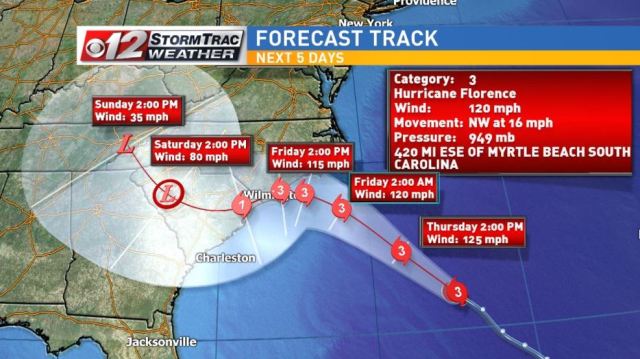
Hurricane Florence was first predicted to come ashore in southeast North Carolina and then take a take a northwestern path. This was a dire prediction for my friends and family who live in northeastern North Carolina as they were prepared to experience the most dangerous quadrant of the storm. It looked like Florence was going to take the same path of Hurricane Floyd, the storm that flooded our home in 1999.

However, just a couple days before the storm made landfall, the prediction changed. It was still going to come into southeastern North Carolina, but then it would take a turn towards the south before moving westward before heading North. It was this change that spared my friends and family living in the northeastern part of the state.

Last Sunday, I read the following post on facebook:

It is not that the weatherman missed the prediction. It is that God spared us from the worst.

The statement immediately received nearly 50 likes and drew comments like:

Amen.

God answers prayers.

God answers prayers. And not just prayers, but prayers in numbers.

God protected us.

We are blessed.

I understand in part why they posted it. Things could have been so much worse, and they were grateful, and they were grateful to God..

However, I could not help but to think: “I hope no one in Wilmington, Fayetteville, New Bern, Lumberton or Kinston reads this.”

Then came obvious, disturbing questions:

Were the prayers from the people living in those devastated cities not answered? Or were there was just not enough people in those cities praying? Did they have a higher number of people praying in northeastern NC?

If God could spare northeastern NC by turning the storm, why didn’t God just turn the hurricane out to sea before it made landfall and spare everyone? Did God favor one side of North Carolina over another?

I suppose many would tell me that I am not supposed to question God. “God has God’s reasons,” they say. “It is just God’s will and we have to accept it,” they say.

But I am not the first one to ask such questions. In Luke 13, we read people asking Jesus if the Galileans who were massacred by Pilate were killed because of some sort of sin in their life. Or if the Jews were killed when the tower of Siloam fell, perhaps during a storm, because of something they did or did not do.  Jesus emphatically answered them: “No, I tell you.”

Throughout time, it has been very popular to believe that it is always God’s will if someone comes to power, no matter how horrible that person is. It is God who causes earthquakes, sends tornadoes, and steers Hurricanes, sparing some while destroying others.

This very popular but what I would call very “twisted” theology becomes even more disturbing when one considers the children.

On Monday of this week, in Union County, North Carolina, where Lori and I both attended college, the body of 1-year old Kaiden Lee-Welch was found. According the sheriff’s department, she was swept away in rushing waters from a creek that had overflowed.

Last Sunday, in Dallas, North Carolina, just a few miles from where Lori was born and raised, 3-month-old Kade Gill died after a tree fell into a family’s mobile home and struck the boy and his mother as they sat on a couch.

The very first death I remember being reported occurred soon after the Hurricane made landfall on that Friday in Wilmington.  A 7-month-old baby was killed, also by a tree that fell into a home.

What kind of God steers a hurricane on a path that kills little children? It is certainly not the God that is revealed in words and works of Jesus, the one who welcomed the children, the one who said that it was better for one to tie a millstone around one’s neck and be cast into the sea than to cause any child to stumble.

So, why do so many still insist that God is the reason that some are spared from Hurricanes and others, even little children, are not?

I believe this morning’s scripture lesson possibly holds the answer.

Mark 9:30: “They went on from there and passed through Galilee. He did not want anyone to know it;”

He didn’t want anyone to know the truth. Perhaps he was afraid that like so many Christians today, they could not handle the truth. The truth that “the Son of Man is to be betrayed into human hands, and they will kill him….”

Verse 32: But they did not understand what he was saying and were afraid to ask him.

One reason some of us insist God is sending and steering Hurricanes is that we still have a difficult time accepting the truth that God suffers. We do not understand the suffering of God, and we are afraid to ask him. We are afraid, because if God is a God who suffers, then those of us who are created in the image of God, are also created to suffer.

I believe that God’s hand can be seen in the desolation of Hurricane Florence; not causing or controlling the storm, but in those who suffer while responding to the storm—the firefighters, police, paramedics, soldiers, doctors, nurses, pastors, counselors and utility workers; those who have left the comfort and safety of their homes to give of themselves to serve their neighbors in need. The hand of God can be seen the suffering servants of God who are doing all that they can do to bring healing, peace and restoration.

Verse 33 & 34: Then they came to Capernaum; and when he was in the house he asked them, ‘What were you arguing about on the way?’

But they were silent, for on the way they had argued with one another who was the greatest.”

And there it is.

Perhaps this is the true reason that people are quick to say God controls the path of Hurricanes. People still like to make the argument that they are the greatest—

“I am great, for God hears my prayers. I am great, for God spared my house. I am great, for my home did not flood. I am great, for no one in my family was killed. I am great, for am not suffering.”

Verse 35: He sat down, called the twelve, and said to them, ‘Whoever wants to be first must be last of all and servant of all.’

Jesus says, “No, I tell you, avoiding suffering is not an indication that you are great. No I tell you, being in a state of comfort and safety does not mean you have God’s stamp of approval on your life. No, I tell you, being spared from a storm is not a sign that you are blessed.”

No, I tell you, if you want to be great, if you want God’s stamp of approval, if you want to be blessed by God, you must be willing to sacrifice, put yourself last, place the needs of others ahead of your own needs, be a servant, suffer with those who are grieving, agonize with those who feel forsaken, betrayed and powerless.

Verse 36 & 37: Then he took a little child and put it among them; and taking it in his arms, he said to them, ‘Whoever welcomes one such child in my name welcomes me, and whoever welcomes me welcomes not me but the one who sent me.’

In other words, Jesus said: Do you want to be great? Do you want to be on the side of God? Then, don’t take the side of the powerful, the privileged and the protected. Instead, always take the side of the most vulnerable among you. Take the side of children who are so precious and fragile, whose lives are threatened or lost. Take the side of women who have been unheard, whose lives are disregarded and degraded. Take the side of victims who have been blamed, whose lives have been disrespeceted and diminished.

As the Proverbs declare:

Speak out for those who cannot speak, for the rights of all the destitute. Speak out, judge righteously, defend the rights of the poor and needy (Proverbs 31:8-9).

So, where was God in Hurricane Florence? Contrary to popular theology, God was on the side of those who experienced the worst of the storm. God was on the side of the children who were swept away. God was on the side of the babies who were crushed. God was on the side of the elderly who drowned. God was on the side of forty-two of God’s beloved who died in the storm.

Where was God in the storm? God was on the side of Windy Newton and Nicolete Green who drowned in the back of a sheriff’s van as they were being transported to a mental health facility. God was on their side feeling their fear, knowing their terror, experiencing their confusion, tasting their deaths.

What was God doing during Hurricane Florence? God was suffering. God’s self was being broken. God’s self was pouring out. God was grieving with those who lost their loved ones, hurting with those who lost property, agonizing with those whose homes were destroyed, distressing with those whose livelihoods were lost.

And the good news is: because God was present, so was life—life—hopeful, abundant and eternal.

God was there to begin the holy work of transforming the anguish into peace, the despair into hope and the deaths into life.

And God is with all of us who choose to follow the Lord in this holy work. God is with us when we become suffering servants, putting the needs of others ahead of our own, giving sacrificially to Hurricane relief through our church, planning or supporting mission trips to the devastated areas.

And God is with us at this very moment. Because as we gather around this table in communion with Christ, we are joined with the trials and sufferings of all people.

This morning we pray that through Christ we too would be with those who endured the wind, rain, and flooding.

As we come to this Table, may Christ’s presence be known to all those who are suffering from the storm, just as He makes His presence known in the breaking of the bread and the sharing of the cup – at this Table and around the world, in every nation, among every people.

These are the gifts of God for God’s people! After we sing our hymn of communion, let us receive them with joy, gratitude and hope.
Getting Our Hands Dirty

Harvey

John 9:1-7 NRSV

Let’s think for a minute what it did for that poor blind man when the disciples began theological debate over his blindness.

“So, they say you were born blind?  Well, let get out our Bibles and see if we can find some theological reason for your blindness. It has to be because of sin.  But since you were born blind, perhaps it’s not your sin that is to blame but the sins of your parents.”  Yes, I’m sure all of that blaming did a whole lot for that poor man!

But how often have we’ve been guilty of doing the same. For some reason, because we are Christian, we believe it is our holy responsibility to try to explain human suffering and misery in light of our faith in God.

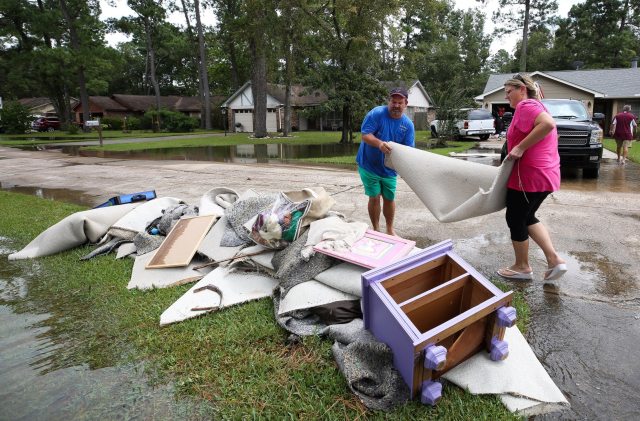
Since Hurricane Harvey flooded Texas, I have heard people blame the Mayor Sylvester Turner, climate change, the lack of zoning regulations, Donald Trump, the recent solar eclipse and even same-sex marriage. I am sure there will more blame associated with Hurricane Irma in the coming days.

In the face of human pain and suffering, there are two predominate responses by the church.

The first one is that God has a reason for it. God is sitting at the command center in complete control of every earthly thing that happens.

The other point of view is one of silence, just silence.

I find both of these responses troubling. Those who believe God has some kind of divine purpose for every evil thing that happens in this world paint a very mean portrait of God. And those who respond with silence make God out to seem detached and uncaring.

However, I believe the life, suffering and death of Christ teach us that when the rains poured down, so flowed the very tears of God. When the waters overflowed the banks of the bayous, so broke the very heart of God. When lives were suddenly drowned out, so emptied the very self of God. God was not causing the evil. Neither was God silent.

This is where I believe the story of the man born blind can be helpful. When Jesus is questioned about the man’s suffering by his disciples, Jesus doesn’t answer their questions, but neither is he silent. Jesus responds that this is the time, not to assign blame or responsibility, but rather, to bend to the ground and get his hands dirty, so that the glory of God might be revealed.

In the wake of the many storms in our world, may we do the same.

Crown of Thorns

Matthew 21:1-11 NRSV    nerve gas

Palm Sunday—it’s the spectacular day we celebrate the King of Kings’ triumphant entry into Jerusalem!  And in this world of so much suffering and pain, oh how we need a day like today!  Oh how we need to hear that Jesus Christ, our ruler and our king is coming through the gates to finally set things right, to take complete control of things. Oh how we need a day to reassure ourselves that no matter how bad life gets, no matter how distressed, fragmented and chaotic life becomes, and how hopeless it seems, Christ is large and in charge! “He’s got the whole world in his hands,” as we all like to sing.

Ok. Now, as we Disciples of Christ like to do, let’s get real for a moment. Let’s honestly think through this. Is the truth that “He’s got the whole world in his hands really that comforting?”

Although none of us good God-fearing, Bible-believing, church-going folks like to admit it, is this truth of God’s supreme providential power more than a little disturbing?

Think about those times you were reminded by someone, albeit with good intentions, that “God is in control.” When Lori and I lost our first child two months before the due date, people came up to us and said, “Don’t let this get you down. Just remember that God doesn’t make any mistakes.”

After the doctor gave you the news that the tumor was malignant, people came up to you and said, “Don’t worry, God knows what God is doing.”

When people learned that you were going to lose your job, they reminded you, “It is going to be alright, for God in control.”

At the graveside of a loved one, your friends and family lined up between you and the casket and whispered: “God has a reason for this.”

And very politely, we nodded. We even thanked them for their words with a hug or a handshake. But then, a short time later, after we dried our tears and came a little bit more to our senses, while we were sitting quietly at home or while we were out on a long drive, or maybe sitting in church, we began to reflect and to ponder those well-intended words. We began to think to ourselves: “If God is really sitting on some providential throne in complete control of this fragmented fiasco called life, this disastrous debacle called the world, then, really, just what type of ruler is this God? Just what type of king sits back and allows so much evil to occur in their kingdom, especially to people we are told the king loves.

The king of kings makes his triumphant entry—what is supposed to bring us great strength, peace and comfort, instead brings us frustration, anger and doubt.

Hosanna, the King is coming to save us—what is supposed to bring us assurance and hope brings us misery and despair. And we become tempted to join all those who will laugh and ridicule Jesus by the end of this week: “Umphh!  King of the Jews! Some King!”

I have said it before, and I do not mind saying it again—If God is the one who willed our first baby’s death, causes tumors to be malignant, gets us fired from our jobs, takes our loved ones from us, and sits back allowing such atrocities as the snuffing out of lives of little Syrian children being with nerve gas, then I really do not believe I want anything to do with a god like that!  I think I would rather join the millions of people who have chosen not to be in church on this Sunday before Easter.

But the good news is that I am here.

And I am here to proclaim with a confident voice God that God is not the type of King who decrees the death of babies, pronounces malignancies, commands layoffs and orders our loved ones to be suddenly taken from us. There is no doubt about it, Christ is King.  But thank God, Christ does not reign the way the kings of this world reign.

The reason I believe we allow ourselves to be tempted to give up on God in the face of evil is because we often forget that our God reigns not from some heavenly throne in some blissful castle in the sky. But our God reigns from an old rugged cross, on a hill outside of Jerusalem, between sinners like you and me.

I believe we oftentimes become despairing and cynical about God, because we forget that our God does not rule like the rulers of this world.

The kings of this world rule with violence and coercion and force. Earthly rulers rule with an iron fist: militarily and legislatively, and with executive orders. Worldly kings rule with raw power: controlling, dominating, taking, and imposing.

But, as the events that took place this week in Jerusalem 2,000 years ago remind us, Christ is a king who rules through self-giving, self-expending, sacrificial love. Christ is a king who rules, not from a distance at the capital city, not from the halls of power and prestige, but in little, insignificant, out-of-the-way places like Bethlehem and Nazareth, and Waukomis and Enid.

Our King doesn’t rule with an iron fist. Our King rules with outstretched arms.

Our King doesn’t cause human suffering from a far. Our King is right here beside us sharing in our suffering.

Our King possess what the late theologian Arthur McGill called a “peculiar” kind of power.

God’s power is not a power that takes. It is a power that gives.

God’s power is not a power that rules. It is a power that serves.

God’s power is not a power that imposes. It is a power that loves.

God’s power is not a power that dominates. It is a power that dies.

And as Arthur McGill has written, this is the reason that it is “no accident that Jesus undertakes his mission to the poor and to the weak and not to the strong, to the dying and not to those full of life.  For with these vessels of need God most decisively vindicates his peculiar kind of power, [a] power of service whereby the poor are fed, the sinful are forgiven, the weak are strengthened, and the dying are made alive.”[i]

Christ the King did not take our first child. The day our baby died, our King came and cried with us in that hospital room.

God did not cause the tumor. The day the doctor said the word “cancer” was a day of anguish for God as it was for us.

God did not create the layoff. The day you were told that your job was ending, God stayed up with you and worried with you all night long.

And God did not take your loved one.  When they died, something inside of God died too.

What we all need to learn are very different definitions of “king,” “rule,” “reign” and “power”—very different because they define the holy ways of the only true and living God, rather than defining our false gods and their worldly ways.

When life gets us down (and if we live any length of time at all in this world, it most certainly will), we need to remember the great truth of this day—The king has arrived. The king has entered the gates. And this king is has come to take his place on his throne, on an old rugged cross.  Do you see him reigning today? Do you see him bleeding, suffering, sacrificing, and giving all that God has to give from from the cross?

God does not make mistakes. God knows what God is doing. God is in control. God is king. But God’s throne is not made of silver and gold. God’s throne is made of wood and nails. God wears not a crown of jewels. God wears a crown of thorns.

This past week, I visited with Marion Batterman whose doctor just told him that he was dying. He said, “Pastor, my doctor gives me no hope. They said that my lungs are just about gone.”

I said, “Marion, I am so sorry.”

“Oh don’t be sorry he said. “Because my hope is not in my doctor! My hope is in my Lord!”

“So Marion,” I said, “Even when your lungs stop working completely…”

Marion finished the sentence, “I still have hope!”

No, he was not delusional. His mind was not clouded with medication. Marion was at peace, because his King reigns from a cross.

Marion was filled with hope, because his King is not far away from him seated a celestial throne removed from his agony. His King is seated at his very side suffering with him.

His King is not above his pain. His King is experiencing every bit of his pain.  His King is not willing or decreeing his death, his king is experiencing his death.

His King is not slowly taking his life away from him. His King is giving the King’s eternal life to him, pouring out the King’s holy self into him, and promises him every minute of every day to see him through his dying.

After he described an intensified intimacy that he now shares with his Lord, he then said something miraculous. With this hopeful joy in his smile and eternity in his eyes, he told me that he was a blessed man.

Think about that for a moment.

A man, barely able to breathe, nearing the end of his life, told me that he is blessed.

Aren’t we all?

[i] Arthur McGill, Suffering: A Test of Theological Method, 61-63.

A Movement for Wholeness in a Fragmented World

DOC Identity

John 9:1-41 NRSV

Let’s think for a minute what it did for this poor blind man when the disciples began a theological debate over his blindness.

“So, they tell us that you were born blind?  Well, let’s get out our Bibles and Sabbath Day School Quarterlies, and see if we can find some theological reasons for your blindness. Of course, everyone knows it is because of sin. But since you were born blind, perhaps it is not so much your sin as much as it is the sin of your parents.”

Yes, I’m sure all of that theologizing and rationalizing and Bible Study did absolute wonders for that poor man. I am sure he really appreciated it!

But how often have we’ve been guilty of doing the same. For some reason, because we are Christian, we believe it is our holy responsibility to try to explain human suffering in light of our faith in God.

When the earthquake and Tsunami struck Japan several years ago, I heard some preachers say that God was judging that area of the world because Christianity was not the prominent religion.

         When the terrorists destroyed the World Trade Center Towers on 9-11, some preachers said that corporate greed was to blame.

When Hurricane Katrina devastated New Orleans and Gulfport, Mississippi, many blamed it on all the new casinos that had been built in along the Gulf Coast.

And whenever there is an outbreak of strong storms, especially strong storms with tornadoes, I have heard many Christians say, as I am certain we will hear them say in the next couple of months: “God must be trying to get our attention!”

For whatever reason, when suffering occurs, we believe that God must have had some pretty good reasons to allow it.

In the face of human suffering, two predominate responses are echoed by the church.

The first response is the one I usually hear from the TV evangelists. It is the response of those in our text this morning. God is sitting at the command center in complete control of every earthly thing that happens. God has got a plan for the world, and it’s a good plan, and we human beings need to trust that plan. Even if people suffer, we shouldn’t question the plan or God’s judgments. Because God’s judgments are always just. You just have to have faith and believe God has God’s reasons. God has a driving purpose for everything that happens in this world.

The other response comes from some liberal scholars. And that is one of silence. They say that God is completely unknowable. Life, and the suffering that comes with it, is utterly mysterious. It is ok to question God, to ask “why?” But we simply have no answers to any of our “why” questions. Silence.

Frankly, I find both of these responses to human suffering to be troubling.

First of all, those who believe God has some kind of divine, driving purpose behind every evil thing that happens in this world, in my estimation, paint a very evil, mean portrait of God.

And those who respond only with only silence, those who refuse to say anything or do anything in response to human suffering paint a very detached, indifferent portrait of God. God is watching us, but as Bette Midler sings, “God is watching us from a distance.” God is reduced to this mysterious abstraction devoid of any real meaning.

The gospels, however, paint a very different image of God through the words and works of Jesus, who we believe to be the incarnation of God—which means that if we want to know how God responds to human suffering, all we have to do is look to Jesus.

I believe the life, suffering and death of Christ teach us that when a landslide shook the earth in Washington State a few year ago, so quivered the very heart of God. Last year, as the flood waters swelled in Southern Louisiana and North Carolina, tears welled up in the eyes of God

As the livelihood of many were suddenly poured out, so emptied the very self of God. God was not causing the evil, neither was God unmoved by it.

This is where I believe our gospel lesson this morning is especially helpful. When Jesus is questioned about this man’s lifetime of suffering by his disciples, Jesus really doesn’t answer the question, but he certainly isn’t silent or detached.

Jesus responds by saying that this is a good opportunity, not for theological debate, not for some long discussion theodicy (the problem of evil), not to assign blame or responsibility; but rather, it is an opportunity bend to the ground, spit in the dirt, and get his hands dirty, so that the glory of God might be revealed.

Jesus responds to a fragmented world by becoming involved, even if it means some work, even if it means rolling up his sleeves, lowering himself to the ground, and getting his hands dirty to touch the places on others that most need touching. Jesus responds to a fragmented world by becoming a movement for wholeness—bending, stooping, humbling himself to the ground—working, touching, healing, restoring.

And with that, a huge argument ensues.

But notice that Jesus refuses to engage in the argument. Jesus doesn’t have time for that. Jesus is not interested in doctrinal debate or theological speculation. Jesus is interested in simply being there with the man, for the man; thus, revealing the peculiar glory and power of our God.

I think it is interesting that the great Southeast-Asian Tsunami of the last decade struck the day after Christmas. One of the world’s worst natural catastrophes took place the very first day after the church’s celebration of the Incarnation, the celebration of the good news that our God did not remain silent, aloof and detached from us. Our God came to the earth, became flesh, became a part of the earth, to be with us. Our God is a God who descends to us. Our God is a God who bends, who stoops to the earth to be for us. Our God is a God who has selflessly and sacifcially chosen to suffer with the creation.

The story of this healed blind man comes in the same Gospel of John that begins, “In the beginning was the Word…and the Word was made flesh…and we beheld his glory.”

The great, grand glory of this God who became flesh with us is not that God is in complete control of everything earthly thing that happens, and it is not that God has an explanation or a reason or a driving purpose for everything that happens to us, but rather that God is Emmanuel, God here with us.

In the face of our suffering, our God reaches in and reaches out to us, bends to the ground, gets God’s hands dirty, and touches us.

And then God calls us to do the very same.

Every year as Holy Week approaches, I think about the worshippers of the Goshen United Methodist Church in Piedmont, Alabama.

It was Palm Sunday in 1994.

About midway through the worship service at 11:35 am, as the choir began to sing, a tornado ripped through the church building destroying it completely.

Eighty-three out of the 140 worshippers who attended the service that day were seriously injured. Twenty-one worshippers were killed. Eight of the dead were little children—children who had just walked down the aisle waving their palm branches.

There was absolutely no driving purpose, no theological explanation for that tragedy, except for the fact that we live in fallen, broken, unfair and sometimes senseless world where tornados, tsunamis, hurricanes, landsides, heart disease, dementia, and cancer can develop and arbitrarily destroy.

Thankfully, Christians from all over the world didn’t just talk about that tragedy in their Sunday School classes, trying to figure out if there was some reason God allowed it. They responded to that great tragedy by emulating the God revealed to us in Christ, by bending themselves to the ground, getting their hands dirty, to raise that church out of the rubble. Christians everywhere imitated their Savior by suffering with and being with the grieving. Doing whatever they could do to bring hope, wholeness, and restoration.

On the church’s website today, you will find these words:

 After the tornado, we received many gifts from all over the world. They lifted us up and helped us to know that we are not alone. Among those gifts were a banner and a painting of Jesus walking on turbulent waters. These and other gifts are reminders that God is with us through our storms, and with His help we will rise above them and be stronger because of them. We can now affirm the truth of the message that is contained on a plaque and in the words of a song: ‘Sometimes God calms the storm. Sometimes, …the storms rage, and God calms the child.’

And in the end, isn’t that much better than any theological explanation?

Let us pray together…

When Jesus was asked about the reason for human suffering, he did not answer the question. He did not get into a theological debate. He did not assign blame or responsibility. Instead, he chose to be a movement for wholeness in this fragmented world by bending to the ground and getting his hands dirty to bring about healing and  restoration. In the wake of the storms of our lives, may we do the same. Amen.

Left-Handed Power

okalhoma sunset

I recently had a conversation with someone who firmly believed God uses God’s power to cause tragedies in life in order to accomplish some divine purpose. The God who rules with “thunder in his footsteps” and “lightening in his fist” as the song goes, will rain down cancer, heart disease, automobile accidents, hurricanes and earthquake to accomplish the divine purpose.

For me, this represents a gross misunderstanding of the power of God. Although the Bible insists over and over that our ways are not God’s ways, we insist on equating God’s power with our concept of worldly power.

One day, a father was driving down a road with his little boy admiring a beautiful sunset. The father said to son, “And to think, God created all of this just for us to enjoy.”  The little boy responded, “And to think, God did it all with God’s left hand.”

“What do you mean, son? Where did you hear that?”

“Well, God had to use God’s left hand, because my Sunday School teacher told me that in heaven Jesus was sitting on God’s right hand.”

As they say, “out of the mouth of babes.”

The truth is, we have allowed the world to define power for us instead of allowing the Jesus we remember in this season of Lent to define such power.

To the world, power means controlling. Power means dominating.  Power means taking. Power means ruling.  Power means imposing.

However, the power of God as revealed through Jesus Christ is the exact opposite. God has what the late theologian Arthur McGill called a “peculiar” kind of power.  You could call it a “left-handed power.” It is a power of self-expending, self-giving love.

God’s power is not power that takes, but a power that gives.

God’s power is not a power that rules, but a power that serves.

Not a power that imposes, but a power that loves.

Not a power that dominates, but a power that dies.

And as McGill has written, this is the reason that it is “no accident that Jesus undertakes his mission to the poor and to the weak and not to the strong, to the dying and not to those full of life. For with these vessels of need God most decisively vindicates his peculiar kind of power, his power of service whereby the poor are fed, the sinful are forgiven, the weak are strengthened, and the dying are made alive.”

Our God Rides a Donkey

donkeyjesusJohn 12:12-15 NRSV

A few moments ago we prayed for a variety of people who all have one thing in common.  They are suffering.  Some are suffering with cancer.  Others heart disease.  Some are trying their best to recover from strokes. Others are recovering from injuries from an accident or a fall.  Others are experiencing the grief over losing a loved one to death.

And of course the question that people of faith ask is why?

Why do bad things happen to good people?

As a Christian pastor, I have often said that the question that one should ask is not “why me?”   But “why not me.”  We are human beings, and the reality is, that human beings suffer.  Human beings get cancer, have heart disease and strokes and get into accidents.

“Why me?”  No, the better question is, since I am a human being, “Why not me?’

Hear me clearly say this: When bad things happen, God is not punishing us, God is not trying to get anyone’s attention, wake anyone up, and God is not trying to teach us something.  In this fragmented world, bad things simply happen.

I hate it when people misquote the Bible by saying that “the Good Lord doesn’t put any more on us that we can bear.”  As if the Lord looks at people like Joyce Letchworth and says: She has buried two sons, had heart bypass and a valve replacement surgery, still, I think she could bear breaking a hip.

God does not put anything on us.  We suffer because we are fragile, immortal human beings and that’s it. And God does not “take,” “pluck,” or “call home” anyone from this life.  We die because we are human.

However, I believe the question that most of us really want answered is not so much, “Why me?”, but “Why isn’t God doing something about it?”  Why doesn’t God do something to prevent or relieve the suffering? We understand that God doesn’t cause suffering, but, why on earth, doesn’t God do something about it?  That’s what I don’t understand.

Well, one easy answer is that suffering is for our own good. A long time ago, Irenaeus of Lyons, a second century bishop, wrote on the educational value of suffering.

Why doesn’t God end our suffering?  Well, through our encounters with pain, we grow and develop. The infant who touches a hot stove learns a valuable lesson.  What if human beings never experienced want, deprivation, terrible heat or unbearable cold? Would human culture have developed among other creatures? No, said Irenaeus. Suffering is thus a great teacher, a wonderful prod for advancement in human development.

Even the book of Hebrews says that Jesus learned obedience through his suffering.

Now, I realize that this is somewhat true. The keyword here is “somewhat.” My aching bones tell me that a person in my shape should not try to run a marathon. But what about those whose bones lie in the mass graves in Iraq or Syria? What about the bones of the five year old boy found in a septic tank in Virginia? What lesson is there for that grieving community?

Some pain is helpful, but not all pain. The truth is that there is far too much useless, pointless pain in this broken and fallen world to speak to positively of the educational potential of suffering. What on earth is a child who falls victim to an internet child molester to learn?

Which brings us back to our main question: Why doesn’t God do something about the pain of this world?  Why doesn’t God intervene and do something?

One philosopher once said, “Either God is good, but ineffective and unconcerned, in which case he is not good for us, or, considering the unrelieved, unjustified pain in this world, God is evil.”  There is just too much unrelieved, unaddressed pain in this world to have God any other way.

Another response is that God is very good, but God is simply inactive. This seems to be the conventional modern resolution of the matter. Rabbi Harold Kushner has said that God only had six days to complete the world, and unfortunately, some things were left unfinished. God is not a personal errand boy. Stuff happens. And God? Well, God is simply uninvolved.

This is the modern, deist God of our founding fathers. Deism is the belief that God set up the world then went on a permanent vacation. Deism rescues us from the dilemma of having to make excuses for God’s lack of engagement with us and our suffering. God doesn’t heal, save, rescue or reach in, not because God is unconcerned and unloving, but rather because God is simply uninvolved.

Deism tended to be the faith of most of the modern world because, in order to get the modern world going, the first thing we needed to do was to remove God from the world so that we could be free to run things as we want. Belief in this God who is empathetic but not meddlesome, having gotten God safely filed away as some vague spiritual feeling, we were free to give ourselves more fully to a more effective god—the nation, the economy, or whatever. The bloody 20th century, the perhaps even bloodier beginning of the 21st century, is the result.

But then, despite ourselves—God, all of a sudden, surprises us. God comes. And God acts. A life gets uplifted. Someone comes away healed, whole. A life is changed, a future rearranged.  On her death bed, after suffering more than I have seen anyone suffer, Alawoise Flanagan miraculously smiles, her eyes ablaze with hope. And members of the Flanagan family miraculously experience a peace and strength that surpasses all understanding. Just when we thought God had taken some cosmic vacation, God shows up and we experience life, abundant and eternal.

This is Palm Sunday. It is the Sunday that God showed up on the streets of Jerusalem riding a donkey. It isn’t that God is unconcerned, uninvolved, and uninterested in us, it is that the way God comes to us is not the way we want or expect God to come.

William Willimon writes: We wanted Jesus to come in to town on a warhorse, and Jesus rode in on a donkey. We wanted Jesus to go up to the statehouse and fix the political problem, and Jesus went to the temple to pray. We wanted Jesus to get organized, mobilize his forces, get the revolution going, and set things right, and Jesus gathered with his friends in an upper room, broke bread, and drank wine.  We wanted Jesus to go head-to-head with the powers-that-be, and Jesus just hung there, on Friday, from noon until three, with hardly a word.

It wasn’t that Jesus didn’t do anything; it was that Jesus didn’t do the thing that we wanted. It wasn’t that Jesus did not come and intervene; it was that Jesus came riding a donkey.

God emptied God’s self, poured God’s self out, became one of us, bore our sins and our sufferings, even to death, death on cross. God came to us—not in a way that we wanted—but in a way that is all we truly need for life—abundant and eternal.

When my friend, Tony Cartledge’s, eleven year-old little girl died in his arms after their car was struck by a drunk driver, Tony said that he knew beyond a shadow of a doubt that God was there. No, God didn’t go after the drunk driver with a vengeance and reverse the evil that had happened, but there God was nonetheless: Holding that little girl with him; feeling Tony’s pain; shedding divine tears; promising hope and peace. God was undeniably present. And “miraculously,” said Tony, “that presence was enough.”  “That presence was all that I needed.”

There are people on our prayer list, and others for whom we prayed today who I pray will somehow, some way, be able to say: “It may not have been what I wanted—but God’s humble, loving, suffering, self-giving, life-changing, healing, hopeful presence, is all that I will ever need—for now and forevermore.  Amen.”

Getting Our Hands Dirty

John 9:1-41 NRSVdirty-hands-medium-new

Let’s think for a minute what it did for this poor blind man when the disciples began a theological debate over his blindness.

“So, they say you were born blind? Well, let get out our Bibles and see if we can find some theological reason for your blindness. It has to be because of sin. But since you were born blind, perhaps it’s not your sin that is to blame but the sins of your parents.”

Yes, I’m sure all of that theologizing and rationalizing did a whole lot for that poor man.

But how often have we’ve been guilty of doing the same. For some reason, because we are religious, or at least, spiritual people, we believe it is our ordained duty to try to explain human suffering and misery in light of our faith in God.

When the earthquake and Tsunami struck Japan a few years ago, like the Tsunami that struck Southeast Asia years before, I heard some preachers say that it is because Japan was not a Christian nation.

When terrorists destroyed the World Trade Center Towers on 9-11, they said that corporate greed was to blame.

When Hurricane Katrina devastated New Orleans and Gulfport, I heard some blame it on all the new casinos that had been built in the region.

And whenever there is an outbreak of strong storms, tornadoes, wildfires or landslides, I have heard plenty of Christians say, “God must be trying to get our attention!”

For whatever reason, when suffering occurs, we believe God must have had some pretty good reasons to allow it.

In the face of human pain and suffering, there are two predominate explanations that are usually given by the church.

The first one is the one I usually hear from the TV evangelists and conservative pulpits. God is sitting at the command center in complete control of every earthly thing that happens. God has got a plan for the world, and it’s a good plan, but we as limited human beings may not always be able to figure that plan out. Who knows? Maybe people who suffer deserve to suffer. But we do know this: God’s judgments are always just. You just have to have faith and believe. You have to trust that God has his reasons, has his driving purposes for everything that happens.

The other response comes from more liberal scholars. And that is one of silence, just silence. God is large and God is indescribable. Life, and the suffering that comes with it, is utterly mysterious. We simply have no answers to our “why” questions—silence.

Frankly, I believe both of these responses are terrible, to say the least. First of all, those who believe God has some kind of divine, driving purpose for every evil thing that happens in this world, in my estimation, paint a very evil and anti-christ portrait of God.

And those who respond with silence, those who refuse to say anything at all in response to human suffering, make God out to seem detached and aloof. God is watching us, but from a distance. Thus, God is reduced to this a mysterious abstraction devoid of any real meaning.

However, the gospels paint a very different image of God through the words and works of Christ. I believe the life, suffering and death of Christ teach us that when the landslide shook the earth in Washington, so quivered the very heart of God. As the earth rolled down and toppled homes and lives, so rolled down the very tears of God. As the lives of many were suddenly were poured out, so emptied the very self of God. God was not causing the evil. Neither was God silent.

This is where I believe our Gospel lesson this morning is especially helpful. When Jesus is questioned about this man’s lifetime of pain and suffering by his disciples, Jesus really doesn’t answer the question, but neither is he silent. Jesus responds by pointing out that this was a good opportunity, not for theological debate, not to assign blame or responsibility, but rather, to bend to the ground, spit in the dirt, and get his hands dirty, so that the glory of God might be revealed. Jesus responds to human suffering and misery by bending to the ground, getting his hands dirty to bring about healing and wholeness.

And with that, a huge argument ensues. But notice that Jesus refuses to engage in the argument. Jesus is not interested theological debate or speculation. Jesus is interested in simply being there with the man, touching the man, thus revealing the peculiar glory of our God and power of out God.

When I was in college, one of my favorite professors was Dr. Bobby Bell. During my junior year, Dr. Bell was diagnosed with a terminal cancer. I had the wonderful opportunity to take what would be his last class. He was a sociology professor; however, he would often share his faith in class.

ll never forget the time when one of my classmates asked Dr. Bell if he ever felt that God had some reason for allowing his cancer. “

God did not give me this cancer. I am a human being. And human beings sometimes get cancer. I have cancer because I am human, and not for any other reason. I don’t believe for a minute that God wants me or anyone to have cancer. That’s why I believe during this time of suffering and pain, I have sensed, in a way that I have never sensed before, the very intimate, near presence and love of Christ in my life. And I may not be healed physically, but I have certainly felt the hand of Christ on me and know that I have been healed spiritually. I believe the living Lord is here suffering with me, and that means everything in the world to me.

Dr. Bell died two days before final exams. But there’s no doubt in my mind that he died a healed and a very whole man.

I think it is interesting that the great Southeast Asia Tsunami hit the day after Christmas. One of the world’s worst natural catastrophes took place the very first day after the church’s celebration of the Incarnation, the celebration of the good news that our God did not remain silent, aloof and detached from us. The celebration that our God became flesh and came among us; our God is a God who descends; our God is a God who bends, who stoops to the earth.

The story of this healed blind man comes in the same Gospel of John that begins, “In the beginning was the Word…and the Word was made flesh and moved in with us…and we beheld his glory.” The great, grand glory of this God who became flesh with us, is not that God is in complete control of everything earthly thing that happens, and it is not that God has an explanation or a reason or a driving purpose for everything that happens to us, but rather that God is here with us.

In the face of suffering, our God reaches in and reaches out to us, bends himself to the ground, gets God’s hands dirty and touches us.

Every year when Holy Week approaches, I think about the worshippers of the Goshen United Baptist Church in Piedmont, Alabama. It was Palm Sunday in 1994. About midway through the worship service at 11:35 am, as the choir began to sing, a tornado ripped through the church building destroying it completely. Eighty-three out of the 140 worshippers who attended the service that day were injured. Twenty-one worshippers were killed. Eight of the dead were little children—children who had just walked down the aisle carrying their palm branches.

There was absolutely no driving purpose, no theological explanation for that tragedy, except for the fact that we live in fallen, broken, unfair and sometimes senseless world where tornados, landslides, tsunamis, hurricanes, and cancer can develop and arbitrarily destroy.

Thankfully Christians from all over the world responded to that great tragedy by emulating our God revealed to us in Christ, by bending themselves to the ground, getting their hands dirty, raising that church out of the rubble. Christians everywhere imitated their Savior by suffering with and being with the grieving.

On the church’s website today, you will find these words:

 After the tornado, we received many gifts from all over the world. They lifted us up and helped us to know that we are not alone. Among those gifts were a banner and a painting of Jesus walking on turbulent waters. These and other gifts are reminders that God is with us through our storms, and with His help we will rise above them and be stronger because of them. We can now affirm the truth of the message that is contained on a plaque and in the words of a song: ‘Sometimes God calms the storm. Sometimes, he lets the storms rage, and calms the child.’

The good news is, as the Psalmist so beautifully describes it in the 23rd Psalm, God is always there to calm God’s children.

And in the end, isn’t that much better than any theological explanation?

Left-Handed Power

sunset-road-iii-hdr-joelht-deviantart_405797

I recently had a conversation with someone who firmly believes God uses God’s power to either cause or avoid preventing tragedies in life in order to accomplish some divine purpose. The God who rules with “thunder in his footsteps” and “lightening in his fist,” as the song goes, will rain down cancer, heart disease, automobile accidents, hurricanes and earthquakes to accomplish the divine purpose.

Thus, when a school teacher and mother of two runs her car off the road and is tragically killed, people say: “God has God’s reasons.”

For me, this represents a gross misunderstanding of the power of God revealed through Jesus.

One day, a little boy and a father who were driving down the road admiring a beautiful sunset. The father said to son, “And to think, God created all of this just for us to enjoy.”

The little boy responded, “And to think, God did it all with God’s left hand.”

Puzzled, the father asked: “What do you mean, son? Where did you hear that?”

“Well, the little boy responded, “God had to use God’s left hand, because my Sunday School teacher told me that in heaven Jesus was sitting on God’s right hand.”

As they say, out of the mouth of babes.

The truth is, we have allowed the world to define “power” for us, instead of allowing Jesus to define “power” for us.

To the world, “power” means controlling.  Power means dominating.  Power means taking. Power means ruling.  Power means imposing.

However, the power of God as revealed through Jesus Christ is the exact opposite.  God has what the late theologian Arthur McGill called a “peculiar” kind of power.  You could call it a “left-handed power.”  It is a power of self-expending, self-giving love.

God’s power is not power that takes, but a power that gives.

God’s power is not a power that rules, but a power that serves.

Not a power that imposes, but a power that loves.

Not a power that dominates, but a power that dies.

And as Arthur McGill has written:

This is the reason that it is no accident that Jesus undertakes his mission to the poor and to the weak and not to the strong, to the dying and not to those full of life.  For with these vessels of need God most decisively vindicates his peculiar kind of power, his power of service whereby the poor are fed, the sinful are forgiven, the weak are strengthened, and the dying are made alive (See Reigning from the Cross).

Thus, the moment the school teacher in the accident took her last breath, God did not take her. The best way to explain it is that during that moment, God came and God gave. God came, and in a most powerful way, gave her the very best gift that God has to give, the gift of God’s holy self. God came and gave God’s self completely and eternally to her.

Thanks be to God.