Indivisible, We Rise

John 17:20-26

I was speaking with a colleague recently who shared that she was struggling to balance delivering sermons that are challenging with sermons that are comforting, sermons that are prophetic with sermons that are therapeutic. She said, “because the truth is that we can’t make peace in the world if we don’t know peace for ourselves.” She then added, “but it is so hard these days to preach soothing, comforting sermons when there is so much injustice everywhere.”

I said: “Yeah, I don’t know when I’ll be able to preach what I have heard some ministers refer to as a “sugar-stick sermon” —One of those sermons that just makes everyone feel good.

She asked: “Do you think your congregation may start to complain?”

I said, “Well if they do, saying they just want to come to church to get some serenity, I think…I’ll just have to…I don’t know…encourage them to check out the new Yoga classes we’re hosting, and perhaps give that a go.”

But then I added: “But since I am one of those lectionary preachers, If I’m presented a scripture text that enables me to preach a sermon that will just put everyone at ease, I suppose I’ll consider it. Because I sure could use a sermon like that myself!”

         So, earlier this week when I checked the lectionary and read Jesus’ words in John 17:

My prayer is not for them alone (not just for the twelve). I pray also for [all] those who will believe in me through their message that all of them may be one,

I thought, “maybe this is it!”

I may actually give my poor congregation a break this Sunday by saying something that soothes their souls, warms their hearts, and gives them permission to take it easy, relax a little, because Jesus is praying for us!  What a lovely thought! And what is he praying for? To go out and change the world? No, “That we may all be one,” that we may be brought to “complete unity.”

How wonderful! First Christian has been due a sugar-stick sermon for a while now, and this Sunday they may finally get one!

I don’t know about you, but living in this divisive time is exhausting. And ya’ll, I’m tired. Tired of the tension. Tired of the chaos. Tired of the fighting. Can we just take break?

Could it really be that Jesus is giving us prayerful permission to stop trying to change the world, and to just come together and get along, accept things as they are, you know, agree to disagree?

Wouldn’t that be nice?

Everybody, no matter your religious or political beliefs— just lovin’ life together, saying: “You do you, and I’ll do me.” “Live and let live!” “Tomato, tomahto.”

We can certainly do it.  We know how to do it. That’s what many of us do every time we get together with family, right?

 So, let’s go up on the mountain this afternoon, sing Kum ba yah, agree to disagree, and have some communion!

Now, before we get too excited, I suppose we ought to take a closer look at Jesus’ prayer.

Jesus is praying to God:

I have made You known to them, and will continue to make You known in order that the love You have for me may be in them and that I myself may be in them.

Jesus is praying for us to be in union with him, not with everyone on earth. Jesus is praying specifically for God’s love to be in us as it is in him. Jesus is praying for a divine moral unity, a unity grounded in holy relationship, divine truth, justice, and love.

Jesus is not praying for us to come together with others in order to keep the peace so we can be comfortable, while the fires of injustice rage! No, I believe Jesus is praying for what William Barber calls “a moral fusion.” He is asking God to fuse us together as one holy movement of divine truth, justice, liberation, and love.

Why?

Look at verse 21. “So that the world may believe…” that Jesus, the one who fed the hungry, defended the vulnerable, liberated the oppressed and challenged systems of injustice, was indeed sent by God.

The church is to be a witness for Jesus. But, when the church is divided, that witness is diluted.

When evangelicals wrap Jesus in the American flag but support policies that ignore the cries of the poor, the witness is diluted.

When pastors stay silent on racism, homophobia, transphobia, and xenophobia, just to keep the tithes rolling in, the witness is diluted.

When pulpits are more worried about being politically correct than prophetically faithful, more concerned about keeping their congregants happy with sugar-stick sermons than sermons that inspire them to do something to change the world, the witness is diluted.

Jesus is saying the moral authority of the church is tied to the moral unity of the people.

Now, if we are going to talk about unity in these divisive times, we need to name a prophetic truth. Fascism is not just a political ideology. It’s a spiritual disease. And its first move is always the same: Divide the people.

Fascism doesn’t need a majority. It just needs a divided public. It’s what William Barber has been preaching for 20 years.

  • It tells white workers to blame Black ones for their poverty.
  • It tells rural communities that immigrants are the enemy.
  • It tells churches to obsess over private piety while ignoring public suffering.
  • It stokes fear, fuels scapegoating, and spreads lies that demonize the very people Jesus dignified.

Because the architects of fascism know that a people united in truth is stronger than any regime on earth built on lies.

So, they don’t want unity. What they want is obedience. They’re not interested in justice, just in control. And they don’t ever want the church to ever come together, rise up as one, and start talking and acting like Jesus!

They need the church to bless their injustice with a bowed head and a blind eye.

But Jesus didn’t die for that. He died and rose to inspire a people to refuse to be divided by the lies of empire! He died and rose to inspire people to be united in their advocacy for the poor, the marginalized and the vulnerable—to be united in their efforts to tear down unjust systems that oppress and in organizing the broken into a holy movement for wholeness, while resisting the temptation to turn against one another.

So, let the church rise today, not with shallow calls for peace, but with a deep and defiant unity, a unity that refuses to trade justice for comfort. May pastors everywhere raise their voices understanding that silence is not harmony. It is complicity.

And the good news is every time we choose solidarity over silence, we strike a blow against fascism! Every time we refuse to be divided, we become more dangerous to those depending on our division.

This time in our history is not a political moment. It’s a moral emergency. And through his prayer, Jesus is telling us how to respond. We are to be one.

William Barber preaches the need for a “moral fusion coalition.” A revival of Jesus-rooted unity that brings together all good people to stand up and exclaim: “We will not be divided by race!” “We will not be divided by religion.” “We will not be divided by party!” And we will not be divided by fear!”

A moral fusion is people who love each other and their neighbors enough to fight side by side.

It’s communities coming together to say poverty is violence and silence is also violence.

A moral fusion is pastors linking arms with priests, rabbis, and imams, speaking in a unified voice proclaiming that hate has never made any nation great, and it never will.

It’s houses of worship becoming sanctuaries for the afflicted, not silos for the comfortable.

It’s labor organizers praying with farm workers.

It’s black grandmothers and young white activists marching together for voting rights.

It’s queer teens and disabled elders showing up at the same city council meeting to demand dignity.

It’s not about sameness. It’s about shared struggle.

A moral fusion is not about unity for unity’s sake, It’s about a moral commitment to the least of these. It’s when we stop asking, “What’s safe for me?” and start asking, “What’s faithful to God?” Because a moral fusion doesn’t blend us into blandness. It binds us in boldness!

That’s the unity Jesus prayed for. It’s the unity we are called to live into, and it’s the unity the empire cannot handle!

Jesus prayed that we might be one. And now it’s our turn to become the answer to that prayer. Not just in what we say we believe, but in what we do, how we act, and how we vote. And oh, how the church today needs to reexamine its actions. Because:

  • If your unity doesn’t do something to care for the poor, you need to know Jesus didn’t pray for it.
  • If your unity doesn’t protect the vulnerable, Jesus didn’t pray for it.
  • If your unity silences truth to keep the peace, Jesus didn’t pray for it.
  • If your unity is built on avoiding conflict instead of confronting injustice, Jesus didn’t pray for it.
  • If your unity demands that the oppressed stay quiet so the privileged can stay comfortable, Jesus didn’t pray for it.
  • If your unity won’t march, won’t speak, won’t sacrifice—then it’s not the unity Jesus was talking about.
  • And on this first Sunday of Pride, it must be said, that if your unity is about limiting the rights of LGBTQIA+ people and the reproductive rights of women, you need to know Jesus never prayed for it, never talked about it, or even once ever thought about it!

The unity Jesus prayed for doesn’t come cheap. It costs comfort. It costs silence. And it costs staying out of trouble.

But when we are indivisible with this unity, liberty and justice can truly come for all.

And the good news is: we don’t have to wait for it. Jesus already prayed it. Jesus already declared it. Jesus already called it down from heaven. And the same Spirit that raised Jesus from the grave is the same Spirit calling us today to rise up together!

To rise up with the poor.
To rise up with the forgotten.
To rise up with the queer, the trans, the disabled, the undocumented, the imprisoned.
To rise up not in mere charity, but in solidarity.

Jesus prayed that we may rise up and be as one.
That we may rise up and boldly love as Jesus loved, as God loves.

And here’s some more good news. It may not be what you’d call “sugar-stick news,” but it is hopeful news:

Fascism will not have the final word.

Fear will not have the final word.
And we will not let division have the final word.

Because love still speaks today.
Justice still speaks today.
And unity—moral, bold, dangerous, Spirit-filled, costly unity—still speaks.

Jesus prayed for it.

Now let’s go and be the answer to the prayer.
Go be one. Go be the witness. Go change the world. Amen.

Don’t Be An Absent Thomas

John 20:19-31

It can be difficult to relate to the ancient characters of scriptures. They walked this earth so long ago, that we sometimes wonder if we share anything in common.

However, most of us can easily relate to the disciples who were cowering behind locked doors on that first Easter evening. It’s been 2,000 years, but today, we can feel their anxiety, we know their grief.

Jesus had been rejected by the religious and political culture. People had chosen the way of a violent insurrectionist, and condemned the way of nonviolent, universal, unconditional love for all people.

Disappointment, disillusionment, and despair overwhelmed the disciples, as it seemed that love was defeated and hope was lost.

We can imagine their regret and guilt, as we wonder what we might have done differently. And we can sense their fear, as we wonder today if there is any path forward, if the world can be any better.

The disciples did the only thing that they knew to do. They gathered together.

You might say, they went to church, as the Greek word for church, ecclesia, literally means a gathering or an assembly.

That’s all it means— not an institution; not an establishment; not even an organization. Just a gathering, an assembly. It means community.

When all seemed to be falling apart around them, they gathered together in community.

And it was while they were together, in community, that something miraculous happened, that something that we call Easter. Somehow, someway, the Risen Christ showed up and a peace beyond all understanding came over them.

Together, in community, they received the good news that love cannot be defeated, that love never ends. When all seems to be lost, love remains. Love bears all things, believes all things, hopes all things, endures all things. Love always wins.

And the anxiety and fear of the disciples were suddenly transformed into rejoicing, as a path forward began to emerge. They suddenly felt empowered and sent into the world to share hope with all who are despairing, speaking the truth to the powers of darkness, standing up for mercy, defending the defenseless, and to breaking down every wall that divides and every barrier that excludes.

The story of the way the disciples first encounter Easter this speaks volumes about the power of community— Community is where we experience love and grace. Community is how we experience hope and peace. Community is where fear is transformed into rejoicing. Community is when the Risen Christ shows up and Easter happens. Community is how love wins, death is defeated, and light overcomes the darkness.

This is the power of church. This is why church is needed today. This is why it is good to join a church, to be a church together.

However, in the middle the rejoicing, we get our first inkling that something is wrong. It is here we read that sometimes dreaded conjunction: “but.”

But Thomas, who was one of the twelve, was not with them when Jesus came.”  All of the disciples were gathered together in community, and all experienced the hope of Easter—all of them, except Thomas.

We can only guess where he was— Somewhere out on his own; someplace withdrawn; somewhere isolated; in some private sanctuary. We just know he was not where he should have been. He was not in church. Thomas was absent from community.

Later, when the disciples find Thomas and tell him that they had experienced the Risen Lord, Thomas responds with those infamous words that has given him the nickname, “Doubting Thomas.” “Unless I see the mark of the nails in his hands, and put my finger in his side, I will not believe.”

We like to call him “Doubting Thomas,” because, all of us, if we are honest, have our doubts. And we like to be able to relate to these disciples, even if it is 2,000 years later. However, when you think about it, that is really an unfair designation, because Thomas is really no different from the other disciples. Thomas is not asking for anything more than the other disciples received on that first Easter.

The only thing that makes Thomas different from the others is that Thomas had skipped church. Thomas was not present in community. He’s not so much a “doubting Thomas” as he is an “absent Thomas.” All the other disciples had gathered together in community. The Risen Christ showed up. And absent Thomas missed it all!

No, we really don’t know why Thomas was absent on that Sunday. But those of us who have been a part of the church could certainly guess, couldn’t we?

For how many times have we been tempted to stay home on Sunday mornings. How often have we thought to ourselves: “You know, I don’t need those people down at the church! After all, there are people there who have hurt my feelings. There are some people there who get on my nerves. I am better off sitting my back porch, taking a walk in a park, or watching the sun rise all by myself..”

Maybe Thomas was just tired of people. As United Methodist Bishop William Willimon once said, “Being a pastor would be a great profession, if it weren’t for the people.”

Maybe he was tired of all the self-absorbed arguments about who was going to be seated where in the Kingdom of Heaven. Maybe he was simply sick of being around people who were constantly disappointing Jesus—people who could never follow through with their commitments, keep their promises, fulfill their obligations. Maybe he was tired of all of the passive aggressiveness, resentment, and jealousy.

Maybe he had just given up on the hope that the world could be a better place. Maybe he had acquiesced to the belief that love can never and will never win, that the moral arc of the universe actually does not bend towards justice.

So, when Sunday came around, Thomas stayed home. Thomas decided that he’d be better off on his back porch with a cup of coffee. And who could blame him?

But here’s the problem.

In staying home on Sunday, in avoiding community, in missing church, Thomas missed the miraculous transforming presence of the risen Christ.

And here’s the thing. We read in verse 26 that Thomas had to wait “a week later” to experience Easter.

Think about that. A whole week later. Thomas, the only disciple who missed seeing Jesus, the only one who missed the transforming power of Easter, the only one not to experience love winning, did not receive a personal, private visit from Jesus on Monday morning. He didn’t get a phone call on Tuesday, or a card in the mail from Jesus on Wednesday letting him know he was missed. There was no text message on Thursday, no email on Friday and no Facebook message or Instagram on Saturday.

Thomas had to wait an entire week—until when? When the disciples were again gathered together in community.

Listen again to verse 26. “A week later his disciples were again in the house, and Thomas was with them.” I bet he was!

And just like the week before with the other disciples, Jesus gives Thomas what he needs to experience the fullness of his transforming presence. Jesus says to Thomas, “Put your finger here and see my hands. Reach out your hand and put it in my side. Do not doubt, but believe.” And this time, not so much because Thomas had stopped questioning, stopped doubting, but because Thomas was present, because he was in community, the risen Lord gave Thomas what he needed to exclaim: “My Lord and my God.”

I believe one of the biggest problems with the church today is not doubt, but a belief that love can win, justice can come, Easter can happen, faith can be lived, without community, without ecclesia, without gathering.

Faith today has been reduced to a private, personal transaction between the individual and God. The love-wining, community-organizing, campaign-building, forward-marching, culture-challenging, justice-doing movement of Jesus that has the power transform the world and all its troubles…has been reduced to an individual’s personal ticket to leave this world and its troubles behind.

Our faith has become more about meditating to be in a personal relationship with Jesus and less about collaborating to be on a public mission led by Jesus. It has become more about worshiping Jesus in the heart and less about following the way of Jesus in the world.

It was Jesus who defined our faith by saying:

“The Spirit of the Lord is upon me,
because he has anointed me
to bring good news to the poor.
He has sent me to proclaim release to the captives
and recovery of sight to the blind,
to let the oppressed go free…” (Luke 4:18).

As disciples, this is our mission. And there’s is just no we can accomplish this mission alone, by ourselves, watching the sunrise or walking our dog in the park. It is talks community, collaboration and cooperation.

Because the gospel of Jesus is not good news to the individual. It is good news to the poor.

The gospel of Jesus is not about the release of an individual’s soul. It is about speaking out to release all who are held captive—physically, systemically, and spiritually.

The gospel of Jesus is not about an individual closing their eyes in thoughts and prayers to the troubles of this world. It is about possessing eyes that are wide-open to the world’s problems and having the power to come together to do something about it.

The gospel of Jesus is not about individual freedom. It is about coming together, side by side, shoulder to shoulder, hand in hand, leaning on one another and on God, while working for the liberty and justice of all.

Our faith in the risen Christ is personal, but it is never private. It is only by coming together as a community that we become who we were created to be as human beings and called to be as disciples of Christ. It is through our coming together, that we experience the fullness of the presence of the risen Lord and are given the power transform the world.

The church is far from perfect. There can be accusations, denials, and desertion. There’s apathy, jealousy, resentment, and failure. There’s cowardice, compromise, manipulation, and selfishness. This is the way it has always been, even with the first group of disciples.

However, when we come together in the name of Christ, something miraculous happens that we call Easter. Despite all our imperfections, the risen Christ shows up. And we are given what we need to believe, to hope, to move forward, to be justice-doers, and peacemakers. In community, we are transformed in love, so we can transform the world with love. Amen.

Christmas Contemplation

Luke 2:41-52 NRSV

It’s only been a few days since we celebrated his birth, but we fast forward twelve years when we read this morning’s lectionary gospel lesson where, in the same chapter of the story of his birth, Luke tells a story of 12-year-old Jesus that sounds something the contemporary holiday classic movie Home Alone.

After visiting Jerusalem for the Passover festival Mary and Joseph, with other members of their family had packed their bags and boarded the plane. From their seats in coach, they couldn’t see where Jesus was sitting, but assumed he as sitting somewhere among the large crowd of passengers. After a long day of travel, as they were retrieving their luggage from the baggage carousel, they picked up Jesus’ suitcase and handed it off to someone who began passing it down the line of relatives to Jesus, but at the end of the line, there’s no Jesus.

Because the boy never got on the plane and was now lost in New York, I mean Jerusalem.

It took three days of frantic searching before they found him in the temple, sitting among the rabbis, listening to their teachings, and asking questions. Don’t you wonder what questions twelve-year-old Jesus had for the Rabbis and what answers he gave in response to their questions that amazed all who heard him that day?

But it’s not Jesus’ questioning that gets my attention in this story. It’s Mary’s questioning. For I love the way Luke describes it: “Mary treasured all these things in her heart.”

The Greek word translated treasure means “to thoroughly keep.”

The thinking of Mary is thorough. Her questioning is meticulous and scrupulous. She thoroughly thinks it all through. Mary wonders, ponders, considers—she “treasures” the significance of what has happened.

And maybe, on this first Sunday after Christmas, this should be the mind of every disciple. A mind that is thoroughly evaluating and reevaluating, thoroughly questioning and wondering, thoroughly meditating and contemplating the meaning of Christmas.

What does it all mean to us? What does Christmas mean to the world? What does it mean to have faith in a God, who we believe is the creator, the source, and the essence of all that is, a God who we believe is Love love’s self becoming flesh, in the most humble, most selfless and most vulnerable of ways, to dwell among us, being with us, living in us, living through us, living for us, for all people, for the entire creation?

One of my favorite preachers, the Rev. Karoline Lewis writes: “Mary invites us into that contemplative space…not to obtain answers, but to ponder God’s place in and purpose for our lives. Mary summons us to sit and wonder…[reminding] us that an essential act of discipleship is reflection. Because none of what God is ever up to should be easy to get or at once understood.”

Lewis suggests that the best gift the church can give to people at Christmas is the gift of a safe and brave place for their own ponderings, a gift of space where reflection, questioning, and even doubting, are welcomed, and even encouraged, a gift of time that “demands only meditation and musing.”[i]

Especially in these days, when thinking doesn’t seem to be in vogue.

I’ve said it. You’ve said it. We’ve all noticed it. “Our country has a critical-thinking crisis.”

Well, we may not have put it in those exact words. But on this First Sunday after Christmas, it’s just not very nice using words like “stupid” or “idiots.”

We live in a world where there seems to be little time for any silence, much less for any meditation and contemplation. These days people are quick to allow others to tell them how to think and what to think without any questions. It’s what makes Fox News, some places on the internet, and churches where people are expected to check their brains at the door both popular and dangerous.

For a world where reasonable, reflective, critical thinking, and intelligent discourse have lost favor is a world that breeds authoritarianism and supports fascism. It is a world where an unstable, wannabe dictator can get a way saying something as ridiculous as: “What you are seeing is not happening.” And, without question, people will believe him.[ii]

I believe it’s fair to say that the lack of critical thought can be blamed for the most heinous and evil of all world events as it has led people to believe that something that is as obvious as our common humanity does not exist, to believe that one race, one nation or one religion is superior to another or favored by God over another, to believe that some people are cut-off or separated from God, while others are close to God.

So, perhaps the best sermon a preacher can preach on this Sunday after Christmas is one that invites us to join Mary after finding Jesus in the temple that day. It’s a sermon that gives us permission to think—a sermon that encourages us to follow the example of Mary to think deeply or to “treasure in our hearts” what this miraculous event we call Christmas truly means, to ask what our hearts are telling us in response to divinity becoming humanity, to the holy becoming flesh, to Love, love’s self, becoming a part of the creation and dwelling among us.

Franciscan Friar Richard Rohr, founder of the Center for Action and Contemplation, writes that contemplation is a way of “listening with the heart” in such a way that it awakens a new consciousness that is needed to create a more loving, just, merciful, and sustainable world.

Contemplation is the practice of being fully present—in heart, mind, and body—that allows us to creatively respond and work toward what could be. Contemplative prayer helps us to recognize and to sustain the Truth we encounter during moments we experience great love and great suffering, long after the intensity of these experiences wears off.”

So, on this Sunday after Christmas, let us ponder and wonder Christmas. Let us meditate and contemplate Christmas. Let us treasure Christmas. Let us make time for silence, and take time in silence to question our hearts and to listen. Not to hear the answer of popular culture, the answer of politicians, or even the answer of your church (and should I dare say) not even the answer of your pastor. Let us listen to hear a truth where Christmas becomes more than something we celebrate for a season, but a way of life that informs our being and instructs our living all year long.

Let us make time in these days of Christmas to listen to our hearts. What are our hearts telling us this morning about God being born as a vulnerable infant, in the body of a brown-skinned, Jewish Palestinian, to an unwed mother?

What are our hearts saying in response to a choir of Angels who invite not the rich and the famous to see the baby, but poor, lowly shepherds, those working the nightshift out in the fields tending to the sheep of another?

What do our hearts say when we read that the ones who feared the baby the most were those with the most privilege and power?

What are our hearts telling us when we hear the story of the baby and his parents fleeing their country as desperate refugees, crossing the border into Egypt as undocumented immigrants?

Father Rohr contemplates Christmas:

If we’re praying, [Christmas] goes deeper and deeper and deeper. If we are quiet once in a while…it goes deeper and deeper and deeper still.

There’s really only one message, and we just have to keep saying it until finally we’re undefended enough to hear it and to believe it: there is no separation between God and creation.

         This is the good news of Christmas, because, as Rohr observes:

Separation is the sadness of the human race. When we feel separate, when we feel disconnected…from our self, from our family, from reality, from the Earth, from God, we will be angry and depressed people. Because we know we were not created for that separateness; we were created for union.

So, God sent one into the world who would personify that union—[one] who would put human and divine together; [one] who would put spirit and matter together.”

[When we] wake up in the morning pondering and wondering: What does it all mean? What’s it all for? What was I put here for? Where is it all heading?

Rohr muses:

I believe it’s all a school. And it’s all a school of love. And everything is a lesson—everything. Every day, every moment, every visit to the grocery store, every moment of our so-ordinary life is meant to reveal, ‘My God, I’m a daughter of God! I’m a son of the Lord! I’m a sibling of Christ! It’s all okay. I’m already home free! There’s no place I have to go. I’m already here!’” Rohr then adds “But if we don’t enjoy that, if we don’t allow that, basically we fall into meaninglessness.[iii]

Rohr considers:

Friends, we need to surrender to some kind of ultimate meaning. We need to desire it, seek it, want it, and need it.

I know no one likes to hear this, but we even need to suffer for it. And what is suffering? Suffering is the emptying out of the soul so there’s room for love, so there’s room for the Christ, so there’s room for God.

On this first Sunday after Christmas, let us thank Mother Mary— For giving us permission to be still, to get quiet, to meditate and to contemplate, for encouraging us to ponder and to wonder, to find a safe and brave space to listen to our hearts to find meaning, purpose, and belonging, to empty our souls making room for love, to be enveloped with grace and held in love by the source and essence of all that is.

[i] https://www.workingpreacher.org/dear-working-preacher/keeping-company-with-mary

[ii] https://www.bbc.com/news/av/world-us-canada-44959340

[iii] https://cac.org/daily-meditations/only-one-message-2021-12-24/

A Crowded Table

Sermon delivered during the Interfaith Service of Unity at Peakland Baptist Church in Lynchburg, VA, Thanksgiving Day 2024

Isaiah 25:1-9 NRSV

I begin the sermon with the two questions that are on everyone’s mind today: #1 “Will this divided nation ever come together?” And #2 “When will there finally be peace on earth?”

Nah. That’s not it. The questions on everyone’s mind today are: #1 “What’s for dinner?” and #2 “Who’s all invited?”

The prophet Isaiah answers the first question “What’s for dinner?” with a song about God’s promise of a generous and extravagant table where (as we read in the New Revised Standard Version):

The Lord of hosts will make a feast of rich food, a feast of well-matured wines, of rich food filled with marrow, of well-matured wines strained clear.

I imagine Isaiah adding: “Did I mention we’ll be havin’ well-mature wines and rich food?”

Isaiah understands that life is best celebrated with plenty of delicious food and the best wines, particularly when times have been dark, when the table’s been empty, when the cupboards ae bare—when tyrants have the upper hand, when the shadows of chaos and catastrophe cover a nation, like it is being punished for their poor choices causing the entire creation to suffer.

In the previous chapter of Isaiah, we hear the desperate lament of the prophet:

The earth is utterly broken, the earth is torn asunder, the earth is violently shaken…the moon… abashed, and the sun ashamed (24:19, 23).

A dark shroud of universal dismay and despair covers the land. And there, under the dismal cover of darkness, everything good seems to be wasting away.

Of course, the first thing Isaiah grieves is the wine cellar. Isaiah cries out:

The wine dries up, the vine languishes, all the merry-hearted sigh, the mirth of the timbrels is stilled, the noise of the jubilant has ceased (24:7-8).

It is in this dry, dark, and desolate setting that a shocking announcement is made by the prophet. It comes in the form of a gracious invitation to attend a most extravagant dinner table with rich food and plenty of delicous wine!

Which brings us to the second question on our minds this day. Now that we know what’s for dinner, we want to know who’s all invited?

And here comes the real shock. Who’s invited? All are invited to enjoy the feast.

And notice that it’s like Isaiah understands that such radical inclusion will be difficult for some folks to believe. So, the prophet uses the word “all” five times in three verses to make sure he gets his point across!

In verse 6 we read that the table is “for all peoples.” And just in case some interpret all peoples to mean just the legal, documented citizenry, the prophet adds, “all nations, and all faces.”

Talk about a crowded table! A table where everyone whose got a face is welcome!

“All are welcome.” That’s the words that we are accustomed to seeing outside some of our houses of worship or our meeting places, right? All are welcome. But it was my son who once pointed out the fallacy of that simple welcome. Referring to the sign outside a church building where I once served, he commented: “Dad, all can’t be welcome unless someone is doing the welcoming. A better sign would read, ‘We welcome all.’”

I had never thought about that. But he’s right. For all to be welcome, someone must do the welcoming. Someone must put in some effort. Someone must take some initiative. Someone must have some radical intentionality to create the revolutionary hospitality. Especially if all faces are invited. Especially if strange faces might show up. And most especially if the table is going to be crowded with strange faces.

I will never forget the first time that my wife Lori came home with me to meet my parents back in 1987, a few months before we were engaged to be married. I am very tempted right now to tell you that it was Thanksgiving, but it was actually Easter.

After attending worship that Sunday, my family gathered around a very crowded table for dinner, nine of us scrunched up together to sit at a table made for six. My aunt and uncle and cousin joined my brother, sister, Mom, Dad, Lori, and me. I was sitting at one end of the able. Dad was seated to my left. And Lori was seated to my right.

As my father asked the blessing using the vernacular of King James in 1611, to make Lori feel welcome at the strange, crowded table, I took my foot under the table and gave Lori a little love-tap on her ankle. (Most inappropriate during the high Old English Eastertide blessing my father was offering, but I suppose that’s what made it so much fun). Feeling my affection under the table in the middle of the prayer, Lori made eye contact with me gave me the sweetest little grin. I know, we were so bad.

A few minutes went by, when Lori got the notion to reciprocate, reaching out her toe to tap my foot. But when she looked over at me, she was rather disappointed to see that I didn’t react. So, she did it once more, this time, a little more playfully. But again, I was as cool as a cucumber, sitting there eating my dinner like it never happened.

That’s because it never happened. Lori, in a state of confusion sat back and peered under the table, only to discover that she had been flirting with my father!

But here’s the thing. My dad also never reacted. He too sat there like it never happened.

Now, I can only come up with two explanations for Daddy’s stoic lack of response. The first one, which I refuse to believe, is that is he enjoyed it and didn’t want her to stop. So, the conclusion I have chosen to draw is that he realized that Lori, bless her heart, didn’t really know what she was doing, and thus he made the decision to extend grace. Instead of embarrassing her, he chose to forgive her, accept her, and love her.

To set a crowded table where every face is welcomed, all those at the table must be intentional when it comes to grace, more so if strange faces are present. All the grace Daddy offered that day would have been for naught, if my cousin, or one of my siblings, was gawking under the table judging all the inappropriate footsie carryings-on.

To set a gracious table, one where every face fed feels safe, appreciated, respected, affirmed, liberated, and loved, takes some work, especially for those faces who have not been feeling those things. To set such a table might mean that we have to go so far as to turn over a table or two. It might mean we need to get into some trouble, in the words of John Lewis, “some necessary trouble, some good trouble.”

Because as history as proved, there are always privileged tyrants in the world who believe it’s their role to play the judge: deciding who deserves a seat at the table and who should be excluded or deported.

I believe it is notable that the Hebrew word for “tyrant” is repeated three times in three verses (verses 3, 4 and 5). In Isaiah 13 and 49, we read that Babylon was the tyrant. But here in chapter 25 the lack of a specific reference conveys the frequent cyclical threat of tyrants throughout history—tyrants in every age whose refusal to demonstrate love and grace, to treat every face with equality and justice, benefits them and their friends at the top, while everyone else suffers, while “the wine drys up, the vine languishes, and all the merry-hearted sigh.”

In every generation, there are those seek to enrich themselves at the expense of others. And fearing a revolt of the masses who will certainly suffer, they lie and make up stories, conning the masses to believe that it’s not them and their oligarch cronies who are preventing them from having a seat at the table, sharing in the rich bounty of the table, but it’s some poor marginalized group who’s preventing them.

It’s the poor and the immigrants, the Eunuchs and the sexually different, the widows and the unmarried, we should fear. They are the ones who are poisoning our blood, making us weak, destroying our culture. The tyranny of the greedy and the powerful who are now at head of the table have nothing to do with our low position or no position at the table, or why there is so little on the plate in front of us.

So, not seated at the prophet’s extravagant table set with rich food and fine wines for all faces, are the tyrants. Because the problem with just one tyrant at the table is that all faces will no longer feel welcomed at the table, especially those who hunger and thirst for a seat at the table, those who have been the victims or the scapegoats of tyranny. These were Isaiah’s people, the faces for whom the prophet was most concerned: the faces of all who have been pushed to the margins: the faces of widows and orphans, the faces of Eunuchs and foreigners, the faces of the poor and needy.

This is the sacred table I believe people of faiths are being called to set in our world today: a large, crowded table where there is no injustice, no bullying, no cruelty, no hate, and no oppression whatsoever.

Setting such a gracious table will most certainly require possessing the courage to flip a table or two, as we will have to work diligently to prevent anything, or anyone, opposed to love from taking over the table.

Public dissent is essential around the table, because the one thing that tyrants count on is the silence of others. As the old German saying goes: “If one Nazi sits down at a table with nine people, and there is no protest, then there are ten Nazis sitting at that table.”

However, when the nine stand up, speak up, and speak out, taking steps to ensure that just love remains at the table, either the fascist will leave the table, taking their prejudice, fear, hate and toxicity with them, or they will find grace for themselves, experience liberation and redemption, and be given a welcomed place at table.

And in the safe space of the table, as the people eat and drink together, as they share their grief and cry together, as they are filled with grace and love together, the dark shroud that had been covering their world will begin to dissipate, and suddenly they will once again be able to celebrate and to laugh together.

Gathered around the crowded and diverse table, Palestinian and Jew, Ukrainian and Russian, Indigenous people and colonists, queer and straight, documented and undocumented, able-bodied, and differently-abled, brown, black and white, all God’s children begin to understand that they share more in common than that which divides them, most importantly, one God, one Lord, and Creator of all faces. And there around the prophetic table, they are able to see their great diversity as the very image of God.

So, what’s for dinner?

As prejudice leaves and fears are relieved and tears are wiped away, mercy and compassion are for dinner.

As disgrace is forgiven and barriers begin to fall, grace and love are for dinner.

As despair dissipates and sorrow fades, hope and joy are for dinner.

As plates are passed and the wine is consumed, as people are seen, their voices are heard, and their beliefs are respected, as enemies become friends, and strangers become siblings, peace and salvation are for dinner.

And who’s all going to be there?

Here, now, this afternoon, tomorrow, next year, and well into the future, around our family tables, around the tables of our faith, around the table of our city, around the table of our nation, around the table of the earth, all who believe in love and need love, all who hunger and thirst for justice, are going to be there! Your faces are going to be there, and my face is going to be there. We are all going to be there, regardless of our religion or lack thereof, ensuring that no one and no thing opposed to love, no matter how powerful, will be there.

And the good news, proclaims Isaiah, is that our hungry and thirsting God will be also there, seated in our midst at the very crowded table, swallowing everything in heaven and on earth that divides us from one another, and consequently, from the love of God.

God will be there with a ravenously righteous appetite, swallowing even death, forever. And the most divided of nations will be united as all become one, and on earth there will be peace, as the entire creation is born again. Amen.

Time for Some Serious Soul-Searching

Mark 9:38-50 NRSV

In Mrs. Welch’s sixth grade class back in 1977, I sat beside one of the coolest boys in school. He was the new kid, a foreigner from some distant land, like New Jersey. His name was Robbie something-or-another. All I remember about his last name was that it was hard to spell and funny-sounding to me. Robbie wore a leather jacket like the Fonz, and he had this long, jet black, wavy, Donnie Osmond hair. He could not have been more popular. And with my cowlicks, braces, low self-esteem from five years of speech therapy, and all-around awkwardness, he got on my last nerve.

One day in class, Robbie whispered: “Hey Jarrett, you wanna to see my switchblade?” Being a naïve little boy, I said: “You don’t have a switchblade. Switchblades are not allowed in school.”  He then pulled a shiny, steel-plated case out of his pocket and showed it to me. I may have been awkward, but I was newly baptized Christian who knew right from wrong, so without hesitation, I got up from my desk, walked up to the teacher’s desk and told Mrs. Welch that Robbie had brought a switchblade to school.

As I stood smugly at her desk, Mrs. Welch called Robbie up and asked him if he had brought a knife to school. Robbie reached into his pocket and pulled what appeared to be the knife. He then pushed the button and ejected a long black comb and started combing his wavy Donnie Osmond hair.

Putting the comb back into his pocket, Robbie looked at me and sneered: “You little tattle-tail!” And, I will never forget the disappointed look Mrs. Welch gave me before I turned and took the walk of shame back to my seat. That was the day I learned how uncool it can be to be a tattle-tail.

And this morning, we read where the disciple John learns a similar lesson.

John, thinking he was being a good Christian, goes up to Jesus and says: “Teacher, we saw someone casting out demons… and we tried to stop him, because he was not following us.”  Like a jealous sixth-grader running to the teacher to tell on someone who is breaking the rules, John believes Jesus is going to be pleased with the information. But Jesus says, “Do not stop him…Whoever is not against us, is for us.”

Although the obvious reason I was so eager to tell on Robbie was jealousy, I cannot help but to think that if Robbie had been one of my friends with whom I had grown up, maybe someone from my youth group at church, I probably would not have been so eager to run to the teacher that day. But Robbie was an outsider. He had a funny last name. He was from some far-off land called New Jersey. And not only was he a foreigner, he was a Donnie Osmond look-alike foreigner who was succeeding in being something that I was utterly failing to be: cool.

And to understand John’s real problem with this outsider who was casting out demons, we need to go back and read verses 14-19 in this same chapter.

Jesus sees a crowd where people are arguing and asks them what they are arguing about.

Someone from the crowd answered him, “My son has a spirit that makes him unable to speak; and whenever it seizes him, it dashes him down; and he foams and grinds his teeth and becomes rigid; and I asked your disciples to cast it out, but they could not do so.”

Saying Jesus is unhappy is an understatement:

You faithless generation, how much longer must I be among you? How much longer must I put up with you? [then we can almost see him rolling his eyes as he says] Bring him to me.

The problem for John was that this one who made him run to the teacher was not only an outsider, he was successful doing something that the disciples were utterly failing to do: “casting out demons.” And Jesus says: “Don’t stop him, for whoever is doing such work of exorcising the demons in our world is clearly on our side!”

Now, when we read this text here in the 21st century describing someone who “seizes,” is “suddenly unable to speak,” who “falls to the ground foaming and grinding his teeth,” and “becoming rigid,” it is obvious to us that what is being described is someone experiencing an epileptic seizure. If this happens to anyone here this morning, you can bet we’re calling 911. We will not be having a demon exorcism!

But as you have heard be say before, I love the ancient language of “casting out demons,” for it infers much more than healing the sick. It infers bringing evil into light, challenging the powers of injustice, and liberating the oppressed. It infers calling out and casting out the evil forces in our world that are hurting people.

So, here we have John and the disciples who had just been chastised by Jesus for lacking the faith to liberate people who are oppressed, for failing to do the work of Jesus in the world. And here’s John seeing an outsider successfully doing the work.

Can you believe that? That there are actually some people outside the church, who do not claim to be Christian, who act more like Jesus than some people who attend church every Sunday? Of course, we can.

As author and outspoken advocate for global peace and non-violence, Matthew Distfano, prophetically points out: “Kind atheists are closer to Jesus than mean Christians.”

As a Christian pastor, I would much rather lead a small group of atheists and agnostics who believe that loving our neighbors as ourselves is the most important thing we can do on this earth, than lead a mega-church of believers who never doubt the existence of God, but who are hateful or indifferent to the needs to others.

The sad reality is that Christians who confidently sing Blessed Assurance on Sunday mornings can be the greatest stumbling block to those who need to experience the grace and love of God today.

I believe this is why Jesus uses such disturbing language to illustrate how important it is that his disciples do some serious soul-searching. As former Southern Baptist leader Russell Moore was quoted this week in the Atlantic: “If we’re willing to see children terrorized because of a false rumor about Haitian immigrants, we should ask who abducted our conscience, not someone’s pet.”

Jesus said that his disciples need to do some serious introspection to determine if they are doing some things or not doing some things that serve as a stumbling block for others, that may prevent someone from knowing God’s extravagant grace and from experiencing God’s liberating love?  Jesus underscores the seriousness of such soul-searching by saying that if you are going to put up any obstacle between people and God’s love, it’s better to tie huge millstone around your neck and jump in the ocean!

Then, to further underscore how important self-criticism is, Jesus uses some gruesome metaphors to get our attention: self-mutilation, an ever-active worm which eats the flesh, and an unquenchable fire. If your hand, the things you do; if your feet, the places you go; do nothing to help someone who needs healing, wholeness and liberation, or worse, adds to their pain, or participates in their oppression, then cut them off, for it is better to have one hand or one foot than your whole body go into an unquenchable fire!

And if your eye prevents you from loving a neighbor, because of the way you see at that neighbor, or the way you unable to see that neighbor, Mark doesn’t say “pluck it out” as Matthew says, Mark writes that Jesus emphatically said, “tear it out!”

I believe Jesus is saying that he can not over emphasize the importance of doing the serious and holy work of introspection and soul-searching, making absolute certain that we are following the way of love, kindness, and mercy, the way of peace and justice, making certain that none our actions or our inactions are hurting our neighbors.

Such soul-searching is badly needed today as people of faith find themselves standing today on the opposite sides of a culture war where people on both sides claim to be standing on the side of Jesus.

So, a good question for all Christians today is: “How do we know we are for Jesus and not against Jesus?”

Could it be that it really is not that complicated? Could it be that John learned his lesson that Jesus teaches him in our lesson this morning as evidenced by his quote of Jesus we read in John 13:

I give you a new commandment, that you love one another. Just as I have loved you, you also should love one another. By this everyone will know that you are my disciples, [in other words, this is how you will know that you are for me and not against me] if you have love for one another (John 13:34-35 NRSV).

In this most divisive time, if there has ever been a time for Christian Americans to do some serious soul-searching, it is now.

Are we standing on the side of the liberating love that Jesus taught, modeled and embodied? Do our actions liberate people who are being oppressed today? Or do our actions, or our inactions, support the oppression of people?

Are we calling out the powers of injustice that are hurting people today, making them less free, less safe, making them feel less human? And are we casting out these powers by casting our votes in the next 36 days?

Or are we standing today for something else? If we are not standing for liberating love, what are we standing for? Is it pride? Is it power and privilege? Is about being superior to another, more holy, more righteous, more entitled? Is it about fear? Is it about greed? Is it about jealousy?

Are we standing with Jesus and with people of all faiths and even no faith who standing today on the side of love? Or are we standing against them?

Yes, now is certainly the time in this nation for some serious soul-searching. Amen.

Let’s Get Physical

Poor People’s Campaign June 29, 2024 in Washington DC to Support Poor and Low-Income People

Mark 5:21-43 NRSV

Yesterday, I had the privilege of escorting Betty Anne and Nancy to Washington DC for a rally of the Poor People’s Campaign. As we were crossing a street on the way back to the Metro Station, I heard Nancy say: “Betty Anne, watch your step on this curb.”

I responded, “Yes, Betty Anne! I forgot to go over the rules with the both of you for this trip. Rule number one is no falling. Nobody is allowed to fall on this trip!” And I admit I said it because both of them are not as young as they used to be.

Then, you know what happened next. I tripped over a loose brick in the sidewalk all 6’4” of my old self ended up laying, bruised and scraped up in some bushes.

As I was trying to reorient myself, I felt the hands of Betty Anne and Nancy on my shoulder and I felt this other hand touch my arm, and heard a strange voice with a foreign accent asking me to take her arm. As I did, this stranger pulled me back to my feet and, in a kind voice, asked me if I was ok.

It is hard to explain it, but something very hopeful, even spiritual happened in that physical encounter.

Thus, it is no surprise to me to learn that our God is a God who uses the physical as a means of grace. Today’s scripture lesson, with its repeated theme of physical touching, is a perfect example.

Through the act of touching, a woman is made whole, and God’s healing power is released.

Through the power of the physical touch, barriers of society and tradition are crossed. Rules and laws are broken. The woman in the story is unnamed and ceremonially unclean. It is against the rules to touch her, and it is against the rules for her to touch another. Then, notice what happens after the woman breaks the law by reaching out and touching Jesus.

Jesus asks, “Who touched me?” And desiring to connect with the woman who touched him, he reaches out and touches her. He commends her faith and calls her “daughter.” Through the grace of physical touch, the woman who was once unclean has been made whole. And the woman who was once unnamed has become a child of God.

In the second part of the story, like the woman with the hemorrhage, this the corpse of the girl is ritually unclean. Touching a corpse is against the rules. Yet, Jesus reaches out and touches the girl’s body nevertheless. In taking the girl’s hand, in touching the girl, Jesus reaches across the boundaries of society, but also boundaries of death. And her life is restored.

About twenty years ago, I attended a conference for pastors at Princeton University in New Jersey with two good friends of mine who were both serving as pastors at the time in North and South Carolina. During our free time one day, we Carolina boys thought it would be exciting to board a train and visit the Big Apple. Before we left, several frequent travelers New York City who were also attending the conference, gave us some advice.

“When you are in the city, don’t look anyone in the eyes,” they said.  “Don’t speak to anyone. Don’t point, at anyone or anything. If you point at a building, someone may think you are pointing at them, and there may be trouble. And whatever you do, don’t touch anyone. Don’t get close to anyone!”

As we were standing at one intersection in Times Square, waiting for the pedestrian light to turn green so we could cross, I noticed everyone in front of me, looking back over their shoulders. I turned around to see what they were looking at and saw a very elderly man with a long white beard who appeared to be homeless. With one hand on his grocery cart, he was bending down and picking up a slice of pizza off sidewalk. As he walked down the road pushing the grocery cart, he lifted the pizza to his mouth.

“Look, he’s going to eat it,” someone jeered.  But before he could get it to his mouth, he accidently dropped it. The crowd laughed at the poor man as we watched him a second time, pick up the pizza, put it to his mouth only to drop it again. The light turned green, the and off we went.

Later, we were walking up several flights of stairs as we exited the subway.  My friend, Cary was in front of me and my friend, Steve was behind me.

Up ahead, I noticed a frail-looking man struggling to pull a large suitcase up the stairs. As Cary and I walked past the man who grunted with each step dragging the suitcase behind him I thought: “Should I help him?”  “No, he might get the wrong idea, think I’m trying to steal it or something.”  So, I kept walking.

Steve, however, who was a few steps behind us, took a risk. Not knowing if the man even spoke English, he asked, “Do you need some help?” As Steve reached out and touched the end of the suitcase, the man immediately gave Steve a fearful, mean glance. But then, seeing that Steve intended no harm, he smiled. I watched as he smiled most hopeful kind of smile, and said, “thank you.” Steve, picked up the suitcase and helped the man out of the subway. At the top of the stairs, the man reached out his arm, looking like he wanted to hug Steve. He stopped just short of a hug and patted Steve on the back, saying, “Thank you. God bless you.”

Once again, God used the physical as a means of grace.  Steve reached out and touched and the power of God, the amazing grace of Jesus Christ was released.

As long as I live, I’ll always wonder what might have happened if I had purchased that homeless man a fresh slice of pizza.  I’ll always dream of the possibilities of what might have transpired if I ate a slice of pizza with him. I’ll always think of the grace that might of come, the salvation that might have happened, through the simple act of reaching out my hand to that poor man who was struggling to survive.

The critique I heard most about the new expression of church we planted in New Orleans that we called “Just Love” is that we lacked a spiritual emphasis. People would say: “I love your feeding ministry and all of your service projects, but it sounds like you are only interested in meeting people’s physical needs. What about the spiritual?”

During the summer of 2020, I was out on my route delivering hot meals one evening to people who are food-insecure in Abita Springs, Louisiana. I pulled into the driveway of a gentleman to whom I have been delivering meals since the start of the pandemic in March.

As usual, he was sitting on a chair in front of his house waiting for me. I look forward to seeing him each week, and he always looks forward to seeing me. Every time I pull up in front of his house, I hear: “Rev, am I glad to see you!”

As I was handing him a bag containing two meals, a woman approached us on a bicycle. She asked me: “Sir, do you have any extra? I am so hungry.” I replied, “No, but if you give me your name and address, I can add you to my list for the next time I am out here delivering meals.” She responded: “Sir, I don’t have an address.” Then, she started to ride off.

Having just learned she was homeless, I stood there, speechless. That is when the gentlemen who had been sitting out in the heat waiting for me to deliver his food shouted, “Hey! you can have mine!”

I said: “There are two plates in the bag. You both can have one!”

He looked at the bag, and then he held it up to the woman who had stopped her bicycle, and said: “No, I have a can of beans that I can warm up. I will be alright. You take both of these.”

The woman took the bag, thanked the man, and rode away.

The man looked at me and said, “Like you say Rev, just love.” He turned and went inside.

It was one of the most spiritual experiences of my life. It was a Holy God moment if there ever was one.

And this, my friends, is what our world needs. We need to reach past all of the barriers that we erect between ourselves and our neighbors— political, religious, racial, ethnic, economic. We need to go out, reach out, and touch them. We need to allow them to touch us. We need to join hands, link arms, rub elbows, and see that we have more things in common than the things that separate us.

And when we do that, something that can only be described as “spiritual” happens. When we touch and connect with others, we touch and connect with God, for we are soon able to see the very image of God in others.

Every Sunday morning, we gather around this table and affirm the grace of the physical. When we consume physical elements of grain and grape, representing the body and blood of Christ, we affirm that we have been touched by God through Christ. We affirm that through his touch, we have been made whole. Through his touch, we have all become children of God.

But more than that, in consuming the body and blood of Christ, affirm that we are the physical body of Christ in this world. Our hands are the hands of Christ. Our hands are holy. Our hands are a means of God’s grace. They have the power to heal this broken world. They have the power to accept, to welcome, to love, and to make this world a better place.

Thus, the simple act of touching—reaching out, connecting, sharing—is profoundly and powerfully spiritual.  It is sacred, and it is holy, perhaps more so if that touch reaches across the barriers of society and tradition.

A little bit of physical exertion to help a neighbor can bring hope. A simple handshake or embrace can bring a peace that is beyond all understanding. Reaching out a hand to an old man lying scaped and bruised in the bushes become a spiritual exercise. Sharing a meal with someone can start a powerful chain reaction of selfless love that changes the world!

When we reach out, touch, connect and share with our neighbors, we can’t and we won’t stay silent when the Supreme Court makes it illegal for a homeless person to sleep on a park bench, when it takes away the healthcare rights of women, or makes it more difficult for anyone to vote.

We can’t and we won’t vote for politicians that hurt LBGTQ people and support policies that marginalize people of other faiths.

And we can’t and we won’t accept poverty as the fourth leading cause of death in this, the richest country in the world.

We must recognize togther that there are dark forces working in our world that do not want us to come together. They use fear to divide us and lies to separate us. Because when we come together, when we touch our neighbors, when we allow our neighbors to touch us, they know that something powerful happens, because love happens. And when love happens, change happens. Grace happens. Empathy happens. Compassion happens.

And votes happen. The general welfare of all the people happens. Solidarity with low wage workers happens. Hospitality to the foreigner happens. A call for a ceasefire and all wars to cease happens. A demand for wealthy corporations to pay their fair share to secure a safety net for the poor and disabled happens. Free fully funded public education happens. Access to quality healthcare happens.

Healing happens. Life happens. Liberty and justice for all finally happens.

How Are We United?

Philippians 2:1-13 NRSV

It is World Communion Sunday, annually observed on the first Sunday in October to celebrate the unity of the world-wide Church. As a symbol of unity, Christians from all over the world come together this day to confess “Jesus is Lord” and to participate in the Lord’s Supper.

In the 19th century, our Disciples of Christ forebears Barton Stone, Thomas and Alexander Campbell were great proponents of such unity. They believed that, despite of our different nationalities, languages, cultures, races and creeds, this table, the bread and the cup, and the great confession of faith “Jesus is Lord,” unites us all.

So as a Christian minister, especially as a Disciples of Christ minister, I am supposed to stand behind this pulpit on this day and confidently announce that because we will participate in the Lord’s Supper this morning, and because we confess with our mouths that Jesus Christ is Lord, we are united. We are in one accord with Christians from all over the world who are sharing in the same supper and making the same confession.

I suppose it is great, sentimental thought. It is a gushy, romantic concept. And it sounds like the responsibly religious thing to say on this World Communion Sunday. But, if I am to be honest this morning, I am not so certain I am buying it. Or I am at least struggling to believe it.

For example: are we really in one accord with the person or persons who, with obvious malice, continues to strip the flag from our church sign?

Or are we really in solidarity with the racist Christians who belong to the German National Democratic Party that is seeking to revive Nazism?

Are we on the same page with Christians in Russia, Uganda and Nigeria who are supporting laws that are brutally repressive to LGBTQ people?

Do we really want to brag about being on common ground with Christians in Jordan, Iran and Syria who have murderous hatred for the nation of Israel?

And are we unified with Christians, here in our own country, who harbor the same hate for Palestinians? Or believe that it is not only okay to discriminate on the basis of race, gender or sexuality, but out of fear and hate, believe it is their duty to God to do so? Do we stand untied with the Christians who marched in Charlottesville carrying tiki torches shouting, “Jews will not replace us,” or with the Christians who stormed the Capitol on January 6 carrying crosses or banners that read “Jesus Is Lord” while shouting, “hang Mike Pence!”

Are we really at one with the Christian TV evangelists who live in mansions they bought with money donated by the people they swindled, many of them poor?

Sometimes, I look at the actions of Christians around the world and think that I may have more in common those who do not profess any faith at all.

Like us, these Christians confess “Jesus is Lord.” Like us, they partake in the Lord’s Supper. And like us, they may even be partaking today on this World Communion Sunday, this very hour. But they are nothing at all like us. When they eat the bread today, it appears to be from a much different loaf. When they drink the juice or wine today, it seems to be from a totally different cup.

The truth is that there are many people in this world who erroneously only confess or claim to be Christian. In chapter seven of Matthew’s gospel we read Jesus’ words: “Not everyone who says to me, ‘Lord, Lord,’ will enter the kingdom of heaven, but the one who does the will of my Father who is in heaven. On that day many will say to me, ‘Lord, Lord, did we not prophesy in your name, and cast out demons in your name, and do many mighty works in your name?’ [I think we could add here: “Did we not take the Lord’s Supper together in your name?]  And then will I declare to them, ‘I never knew you; depart from me, you workers of lawlessness.’” (Matthew 7:21-23).

So, I must honestly confess that I really don’t want to united with some who confess Jesus to be Lord, and who share in the Lord’s Supper.

So, maybe our unity needs to come from another place.

In the newsletter, this week I made the suggestion that love of our neighbors can unite us.

For Jesus said:

I give you a new commandment, that you love one another. Just as I have loved you, you also should love one another. By this everyone will know that you are my disciples, if you have love for one another (John 13).

In John’s epistle we read:

Beloved, let us love one another, because love is from God; everyone who loves is born of God and knows God. Whoever does not love does not know God, for God is love. Those who say, ‘I love God’, and hate their brothers or sisters, are liars; for those who do not love a brother or sister whom they have seen, cannot love God whom they have not seen. The commandment we have from him is this: those who love God must love their brothers and sisters also. God is love, and those who abide in love abide in God, and God abides in them.

I believe God wants Christians around the world to unite today, not merely around a table or with a confession of faith, but by the Christ-like love we have for others every day. We are to love as God loves us, selflessly, sacrificially, unreservedly and unconditionally.  As the song goes, “What this world needs today more than anything else is love, sweet love.”

But here’s the problem with this “all-we-need-is-love” theology. It makes great gushy music, and it might inspire an inspirational sermon; however, the truth is: the love we have for others will never be enough to truly unite all Christians. Because, as much as we try to love one another, we will always fall short.

Our ego, our pride, and our is always getting in the way.

For example, “It is nearly impossible for me to stand up here this morning and preach “love one another” and not have some disdain in my heart for those Christians who do not love one another. Wasn’t the judgmental pride in my voice obvious a moment ago when I arrogantly suggested we were not united with, were better than, “other” Christians?

I sounded like the self-righteous Pharisee in one of Jesus’ parables who arrogantly boasted, thanking and praising God that he was not like the Tax Collector (Luke 18).

The truth is, when it comes to genuinely loving one another as God loves us, as hard as we might try, we all fall short.

         So, what is it that truly unites us as Christians? In 1 John we read:

God’s love was revealed among us in this way: God sent his only Son into the world so that we might live through him. In this is love, not that we loved God, BUT THAT GOD LOVED US…Beloved, since God loved us so much, we also ought to love one another.

It is not our love that unites us. It is God’s love that unites us. Christians all over the world are united by the truth that:

 Christ Jesus, who, though he was in the form of God, did not regard equality with God, as something to be exploited, but emptied himself, taking the form of a slave, being born in human likeness. And being found in human form, he humbled himself and became obedient to the point of death—even death on a cross.

All Christians are united by the great truth that “God proves his love for us in that while we still were sinners Christ died for us” (Romans 5:8).

The good news is that THIS is what unites us as Christians. God loves us despite our egotistical love and our judgmental love. God loves despite our arrogance and self-righteousness, and God loves us despite our hate.

Thus, the truth is that we do indeed have something in common with the malicious folks who keep stripping our flag of extravagant welcome. We have something in common with the racist, Neo-Nazi, German Christians, with homophobic Russian, Ugandan, and Nigerian Christians, with anti-Semitic Christians around the world, with hateful and fearful American Christians, and with those TV evangelists living their mansions who oppress the poor. And with our Christian neighbors who believe it is their God-given duty to discriminate against those who live and love differently than they do.

And 200 years ago, Barton Stone, Thomas and Alexander Campbell were exactly right. This table and our confession of faith “Jesus is Lord” unite us all.

We are united by this meal, representing the body and the blood of Christ, representing the very life of God lovingly broken and graciously poured out for all. Christians all over the world, with all our sin and shortcomings, share the same bread and the same cup and receive the same grace.

We are made one by the great confession that our Lord is Jesus, who was sent to save us, not because of our love for God, or for others, but because of God’s love for us.

The good news is that this not some great, sentimental thought or some gushy, romantic concept, and this is not just the responsibly religious thing to say on this World Communion Sunday. This is the gospel.

Unity in Christ

lincoln

Philippians 2:1-13 NRSV

This week, my friend, the Rev. Bob Ballance, made the following observation on social media:

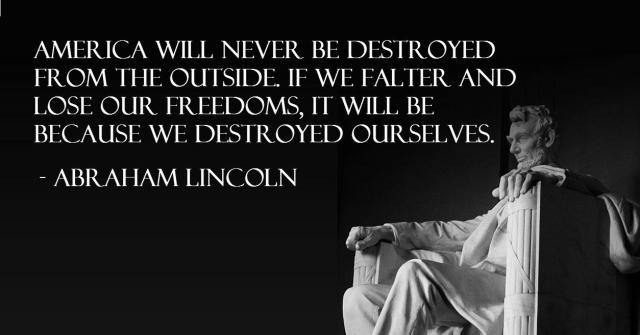
Our divisiveness across this country, so it seems to me, at least, is like a cancer spreading throughout the body. We just keep finding new ways to attack one another. National tragedies like hurricanes used to pull us together, but reports on the destruction of these storms is already old news, seemingly powerless to jolt us back to our collective senses. What was it President Lincoln said so eloquently? “America will never be destroyed from the outside. If we falter and lose our freedoms, it will be because we destroyed ourselves.” A century later, Khrushchev said the same: “We do not have to invade the United States. We will destroy you from within.” Where on earth are the prophets in times like these, those rare voices who have the gift and courage to rise up from the fringes with the right words at the right moment for the right reason? We used to could count on them to shout out the truth, hoping on a wing and a prayer to find a listening ear–any ear at all–to force at least a small nucleus to THINK and CHANGE, and then begin the work of pulling society back from the madness. This division has spread like wildfire into political parties, elections, the White House, the workplace, our stadiums, congregations, communities, families, even…into our playgrounds.

As a church that encourages inclusion and reconciliation, I believe we have a grand opportunity to be a shining example of harmony and unity to a divisive nation.

Do you know how to tell if your church is unified? It’s not by the number in attendance on a Sunday morning. And it’s not by what is put in the offering plates.

I believe that one way is by how long people linger in the building when worship is over. For when people find genuine love, acceptance and belonging in a place, they tend to want to stay in that place. I noticed last week how some of you hung around after the service like you didn’t want to leave. And that was good to me. A unified church is a church where people find love, acceptance and belonging.

A unified church can be a respite from the chaos and hurt that is in our world. It can truly be a sanctuary, a place to receive peace beyond understanding.

As I mentioned last Sunday, after Bruce Birkhead spent a difficult week in the hospital his wife Kaye, unaware of what would transpire this week, when Bruce needed some peace and rest, when Bruce needed to recharge is soul, I loved that he came here to this place.

So, I believe we have a wonderful opportunity to be a leader bringing peace to a divided nation. We have the opportunity be the rare prophetic voice that Rev. Ballance says our nation needs, those who posses the gifts and courage “to rise up from the fringes with the right words at the right moment for the right reason.” With our example of how to be a united blessed community we have the opportunity to “shout out the truth” to “pull society back from the madness.”

Let’s look again to the words of the one who seems to be speaking directly to us this morning:

Be of the same mind, having the same love, being in full accord and of one mind. Do nothing from selfish ambition or conceit, but in humility, regard others as better than yourselves. Let each of you look not to your own interests, but to the interests of others.

Let the same mind be in you that was in Christ Jesus,
who, though he was in the form of God,
did not regard equality with God
as something to be exploited,
but emptied himself,
taking the form of a slave,
being born in human likeness.
And being found in human form,
he humbled himself
and became obedient to the point of death—
even death on a cross.

We can be the prophetic voice that is needed to heal our nation with the humility of Christ.

And as First Christian Church in Fort Smith I believe we have a unique opportunity, as we are a people with diverse beliefs, different views, assorted experiences, various interpretations of the scriptures; yet we still come together each week with mutual respect for one another, in grace, in love and in humility around this table, united as one.

However, as good as our church is, I am afraid we still have some work to do, some obstacles to overcome. Because the truth is, that when many people today think about church, the word “humility” is not something that comes to their minds. In fact, it is the exact opposite that comes to their minds: words like “haughty,” “judgmental” and “uppity.”

Sadly, sometimes the church has been the cause of some of our nation’s division. So, when I say we have some work to do, I am saying that we need to go full-steam in the other direction.

Think of what a powerful witness we would be to our divided nation, if everyday, we literally and figuratively practiced humbly bending ourselves to the ground in the way of our God!

For when God wanted to reconcile the world unto God’s self, when God wanted to unite the world, God emptied God’s self, poured God’s self out, as a humble servant. God bowed down, down to meet us where we are, down to earth through a humble baby, laid down in a humble manger, worshipped by humble shepherds.

The gospel writers continually paint a portrait Jesus as one who is continually lowering himself in humility.

When his disciples chastised little children who needed to shape up and grow up before they be a part of God’s Kingdom, Jesus bent down down and welcomed them saying that the Kingdom of God actually belonged to such children.

While his disciples bickered about who was going to be promoted to be first in the Kingdom, Jesus taught them another way by doing things like stooping down to wash their feet, moving down to sit at the lowest seat at the table, crouching down to forgive a sinner, reaching down to serve the poor, lowering himself down to accept the outcast, touch the leper, heal the sick, eat and drink with the sinner, and raise the dead.

And nearing the culmination of this downward life, Jesus, the savior of the world, made his triumphant entrance into Jerusalem to liberate God’s people, not on some white war stallion that made its way up the equestrian ladder, but on a borrowed donkey. And he rode into Jerusalem not with an elite army that had advanced up the ranks in some up-and-coming militia, but came in with an army of rag-tag followers who had no idea what they were doing or where they were going.

While people exercise worldly power to move up, climb up, and advance, Jesus exercised a prophetic power that always propelled him in the opposite direction.

In the wilderness when he was tempted with worldly power, we watched Jesus embrace another power.

It is not a power that rules. It is a power that serves.

It is not a power that takes. It is a power that gives.

It is not a power that seizes. It is a power that suffers.

It is not a power that transforms stone into bread to feed his body. It is a power that transforms his body into living bread to feed the world.

It is not a power that commands angels to save himself. It is a power that gives himself away.

It is not a power that dominates from some high place in glory. It is a power that dies in a low place called Golgotha.

This is the narrow, humble, downward, descending way of Jesus toward the poor, the suffering, the marginal, the prisoners, the refugees, the lonely, the hungry, the dying, the tortured, the homeless–toward all who thirst and hunger justice and compassion.

And the good news is that as I look around this room, I see people who are committed to traveling this same downward path.

I see people who have chosen to be here this morning, not to get ahead, not to feel more righteous or superior than others, not to get something here in worship that will make you more successful, more affluent, climb a little higher. You are not even here looking to be uplifted, or to be more upbeat. I see people here who have chosen to move in the opposite direction.

I see a room full of people who are here not to get something, but to give something, not to be served by programs, but to serve on a mission.

Because you have heard, and you have believed Jesus when he said: “Anyone who wants to become great among you must be your servant, and anyone who wants to be first among you must be your slave, just as the Son of Man came, not to be served, but to serve, and to give his life as a ransom for many (Matthew 20:25-28).

May this always be who we are as a church.

May we come here each Sunday morning to embrace a mission of humility, sacrifice and selflessness. And then may we go out on a mission, bending ourselves down to the ground if we have to, to touch the places in people that most need touching. May we go out and stoop down to welcome all children. May we go out and reach down to serve the poor, lower ourselves down to accept the outcast. May we go out and get down on our knees to pray for and suffer with the sick and the despairing.

And by our humble example, may our divisive nation be inspired come together, be united as one, and together see our Lord “highly exalted…”

so that at the name of Jesus every knee should bend…
and every tongue should confess that Jesus Christ is Lord,
to the glory of God the Father.”


Invitation to the Table

As part of the world-wide community of Christians, we remember Jesus’ meal with his disciples.

The different languages you will hear today are symbols of the diversity of Christian experience, both close to us and around the world.

Jesus sets the table and his welcome extends to all of humanity.

People of all ages, of all genders, of all cultures, of all economic conditions are welcome here.

No one can earn a place at this meal. Come of your own choice. You need only desire to follow the downward way of Jesus.

Bring your hopes and your history. Bring your deliberations and your doubts.

Come with those who differ greatly from you and be reconciled as one.


Commissioning and Benediction

Although it sounds good to be an up and coming church, I commission us to be a church that is always down and going.

May we go out in humility, bending ourselves down to the ground if we have to, to touch the places in people that most need touching.

May we go out and stoop down to welcome and accept all children. Crouch down to a child in a wheelchair who has been told their entire life: “No You Can’t!” and tell them: “Yes You Can!”

May we go out and reach down to serve the poor, lower ourselves down to accept the marginalized, and may we get low, get down on our knees to pray with all who suffer.

And, there, as low as we can go, may this church be a shining example in a divisive nation of harmonious humility and revolutionary reconciliation.

And now may the communion of the Holy Spirit of God who came down to us in a stable and the grace of the Christ who knelt down to pick up his cross, be with us now and forevermore. Amen.


Eclipsed by Grace


On Monday, if just for a moment, our busy lives were eclipsed by miracle.

At some point we stopped whatever we were doing, with friends, family or co-workers, to wonder at crescent shapes in the shadows on sidewalks, peer through homemade projectors crafted from an empty box of Cheerios, or gaze through a new pair of solar glasses that we will likely misplace or discard before we need them again. The hot August air cooled. The sky darkened. The moon eclipsed the sun, and we expressed a collective “wow!”

The news channels stopped talking about the threat of  nuclear war, unstable world leaders, democrats and republicans, racists and terrorists, and showed us beautiful pictures of heavenly bodies that united us in awe.

It was just what our country needed.

We needed a pause to see the sheer mystery and miracle of it all. We needed a break to experience the utter grace of this mystery we call life. And we needed to do it together, in community, as one people.

It didn’t take long for us to see it, to experience it, and to get it. We only needed a few minutes for it to come into focus. Sun, moon, crescent lights on shadowy sidewalks, cool August breeze, projections in a homemade projector: It was all miracle, and it was all grace, completely unearned, undeserved.

Moreover, as the sky lightened, we began to see that this miracle has been here all the while, every day, every minute. The sun, moon, sky, shadows on sidewalks, trees, leaves, cool breezes, our co-workers, our family and our friends, even the concrete and the Cheerios we had for breakfast last week—it is all miracle, and it is all grace. It is all gift.

And this grace that we call life has the mysterious and miraculous power to unite us all, because it is for all: Caucasian, People of Color, Christian, Muslim, Jew, None, gay, straight, English-speaking, Hispanic speaking, rich, poor, abled and disabled.

The good news is that if we will pause, if just for a moment, we can experience this grace any time, any day. We can see it, and we can get it everyday; and with our human family, with our sisters and our brothers, we can express a collective “wow” at the love and the grace that bonds us together.

Renewing Our Hearts to Partnership: Embracing Diversity

diversity-shutterstock-998x615

Ephesians 4:1-16 NRSV

There is but one body and one Spirit—just as you were called into one hope when you were called.

Unity. It is the theme of World Communion Sunday. But when we talk about “unity” in the church, what are we really talking about? Are we talking about everyone believing the same thing, thinking the same way, being on the same page when it comes to matters of faith and practice? Are we talking about sharing the same set of values and moral principles? Are we talking about one particular style of worship? What does “unity” in the church really mean?

I believe the ancient story of the Tower of Babel can help us with this.

In the eleventh chapter of Genesis we read:

“Now the whole earth had one language and the same words. And as they migrated from the east, they came upon a plain in the land of Shinar and settled there. Then they said, ‘Come, let us build ourselves a city, and a tower with its top in the heavens, and let us make a name for ourselves; otherwise we shall be scattered abroad upon the face of the whole earth.”

The whole earth was one. One language. One people. One tribe. One race. And they all came together to live in one place. They all came together to build something special, something great, something wonderful that would be a symbol of their unity.

Unity, oneness, togetherness, harmony, people of the same minds living in one accord. Isn’t this the will of our God, God’s great purpose for humanity?

So what’s not to like in this seemingly perfect picture of unity in Genesis chapter 11? As it turns out, according to God, the creator of all that is, not very much.

Let’s look at God’s reaction to this oneness in verse 7 of our story: “Come, let us go down, and confuse their language there, so that they will not understand one another’s speech.”  So the Lord scattered them abroad from there over the face of all the earth…”

What? Are you serious? What is wrong with this great portrait of human unity, of one race of people, one nation, one language, all of one mind, coming together, to build something great, to celebrate the pride of one master race?

The truth is that the builders of the great tower in Shinar had accomplished not what God wants for humanity, but what many throughout history, including the likes of Adolf Hitler and the Ku Klux Klan, have wanted for humanity: One master race of people coming together to form one supreme social order, one culture, sharing the same ideals, values and moral principles.

For so many, diversity is a threat. Diversity is something to fear. Diversity is something to segregate and discriminate. Diversity is something to scapegoat. Diversity is something to send to the gas chambers, lynch in the trees or shoot in the streets.

I am not sure if anyone in my lifetime has articulated the thinking of the people of Shinar better than Atlanta Braves pitcher John Rocker back in 1999. Some of you may remember his response when he was asked by Sports Illustrated if he would ever play for the New York Mets or New York Yankees.

Rocker said:

“I’d retire first. It’s the most hectic, nerve-racking city. Imagine having to take the number 7 Train to the ballpark looking like you’re riding through Beirut next to some kid with purple hair, next to some queer with AIDS, right next to some dude who just got out of jail for the fourth time, right next to some 20-year-old mom with four kids. It’s depressing… The biggest thing I don’t like about New York are the foreigners. You can walk an entire block in Times Square and not hear anybody speaking English. Asians and Koreans and Vietnamese and Indians and Russians and Spanish people and everything up there.”[i]

The story of the Tower of Babel teaches us that what John Rocker said “racked his nerves” in the world is exactly what God wills for the world. In verse 4 we read that the purpose of building the tower was to avoid what depressed John Rocker on the No. 7 train leaving Manhattan for Queens, and to avoid what John Rocker heard in Times Square.

The purpose of settling in Shinar and building that tower was to live in a world with no foreigners, no confusing babbling in the streets, no queers or kids with purple hair to encounter on the way to work, no eating in the marketplace with people on strange diets, no rubbing elbows with people wearing weird clothes, head coverings or dots on their foreheads.

No sitting in the same pews at church with people dress differently than we do on Sunday morning and definitely no people who think differently, believe differently, or worship differently.

The people in Shinar said: “We will be truly unified! We will look alike, think alike and believe alike. We will sing worship alike, sing alike and pray alike.”

So they came together and said, let’s build a tower of unity “to not be scattered over the face of the whole earth.”

And God’s reaction to this kind of unity? Let’s “scatter them over the face of the whole earth,” to create a world of diverse languages and cultures, to create a world of foreigners.”

God was only accomplishing what God had always willed for the creation: diversity. In chapter one of Genesis, we read that the original plan for creation was for humankind to “multiply and fill the earth.” And after the flood in chapter ten we read where God sanctions and wills all nations to be “spread out over the earth.” (Gen 10:32). Simply put, from the very beginning of time, in spite of our will, in spite of our fear and our racial or cultural pride, God wills diversity.

Therefore, if we ever act or speak in any manner that denigrates or dehumanizes another because of their race, gender, language, beliefs, dress, nationality or ethnicity, we are actually disparaging the God who willed such diversity. According to Genesis, diversity is not to be feared, avoided, prevented, lynched or shot. If we want to do the will of God our creator and redeemer, diversity is to be welcomed and embraced. In other words, if we love God, we will also love our neighbor.

And this is what should unite us as Christians!

It is the love of God for all of us, a love that God wants us to share with others that unites us.

I believe it’s why Jesus called it the greatest commandment. Loving God and neighbor is what should unite us; not race, not correct doctrine, not a set of beliefs, not one style of worship, but love.  It was Disciples of Christ forefather Thomas Campbell who said: “Love each other as brothers [and sisters] and be united as children of one family.”

And the Apostle Paul wrote: “I therefore beg you to lead a life worthy of the calling to which you have been called, with all humility and gentleness, with patience, bearing with one another in love.”

The story of God’s displeasure with the Tower of Babel is God’s gracious stamp of approval, of blessing, on every race, every tribe, and every language in every land. It is the fulfillment of God’s original purpose for creation. The song we learned as little children cannot be more true: “Red, yellow, black and white, they are all precious in God’s sight.”

God is not color-blind, as I hear some say, for God creates, wills, blesses, and loves color. And it is this love that unites us all, as we have all been created to harmoniously see humanity as God sees it: as a beautiful, diverse, colorful rainbow created by, sanctioned by, and graced by God.

As Bible-believing Christians, our nerves should never be racked on Sunday mornings, [as my mama used to say, we should never get in a tizzy!) if we look around the congregation and see some diversity—see some folks who not only dress differently and look differently, but see folks we know believe differently, live differently, worship differently, interpret the Bible differently, and yet they still choose to partner with us through this church, united by a commitment to share the love and grace of Christ we have all received with the world.

And it should rack our nerves all to pieces on Sunday mornings, if we look around the congregation and only see a bunch of folks who look just like us.

And if we are not immensely bothered by a lack of diversity in this sanctuary, if we are not partners in ministry with those who differ from us, if we would rather remain homogenous by remaining divided, I believe we need to remember not only this story in the first book of our Bible that describes a beautiful and diverse creation willed by God, but I also believe we need to think about a about a passage in the last book of our Bible that describes a diverse eternity willed by God.

And we must as ourselves the question: If diversity bothers us now, what are we going to do when we get to that place we think we’re are going after we die to live forever and ever.

Because guess what? According to Revelation, heaven looks more like Times Square and that No. 7 train on the way from Manhattan to Queens than some affluent suburb outside of Atlanta, Georgia.

In Revelation 7, we read these words:

After this I looked, and there was a great multitude that no one could count, from every nation, from all tribes and peoples and languages, standing before the throne and before the Lamb, robed in white, with palm branches in their hands. They cried out in a loud voice, saying,
‘Salvation belongs to our God who is seated on the throne, and to the Lamb!’
And all the angels stood around the throne and around the elders and the four living creatures [each representing the diversity of all creation], and they fell on their faces before the throne and worshipped God, singing, ‘Amen! Blessing and glory and wisdom and thanksgiving and honor and power and might be to our God for ever and ever! Amen.

Let us pray:  Thank you O God for the diversity that is in this place we call Central Christian Church. Help us to accept it, embrace it, love it, as we partner together to be the church you are calling us to be in this city and in our world.

[i] Read more: John Rocker – At Full Blast – York, Braves, City, and League – JRank Articles http://sports.jrank.org/pages/4014/Rocker-John-At-Full-Blast.html#ixzz39oVUCEtA