Radical Welcome. Revolutionary Love.

Luke 17:11-19

I want to begin this sermon talking a little bit about preaching.

There are basically two kinds of sermons you’ll hear in churches today. One starts with a thought the preacher has. They then hunt through the Bible to find a verse or two to back up that thought.

The second kind starts, not with the preacher’s idea, but with the scripture itself. Preachers who follow this path use a tool called the lectionary, a three-year cycle of readings first shaped by the early church in the fourth century and rooted in the reading traditions of Jewish synagogues. The lectionary keeps preachers from preaching their own pet ideas, and since it always includes a gospel lesson, the preacher is encouraged to interpret each reading through the life and love of Jesus.

That’s the kind of preaching I believe in.

And it’s probably why, in my previous congregations, I’ve been criticized for preaching too many sermons about the poor and marginalized. Because here’s the reality: Besides the truth that Jesus said his very purpose was to proclaim good news to the poor and liberation to the oppressed, there are over two thousand scriptures instructing people of faith how to treat the poor. As Bishop William Barber says, “If you cut all those verses out of the Bible, the whole book would fall apart. There’d be nothing left.”

So yes, I plead guilty—for preaching the Bible in the light of Jesus. And every week, the scriptures amaze me. For they never seem to read like old stories but read more as a mirror to the present. This is why I was taught in seminary to prepare for a sermon with the Bible in one hand and a newspaper in the other, as I would always be able to find a relevant word of challenge and hope.

Today, Luke’s gospel brings us face to face with Jesus on the border, where he once again encounters the marginalized poor who are crying out for mercy.

It’s a beautiful story about healing and gratitude, but when we look closer, we see that it is about so much more than that. It’s about who gets welcomed and affirmed and what kind of love has the power to change the world.

And that’s why it’s the perfect reading to launch our stewardship season with the theme: “Radical Welcome. Revolutionary Love.”

Luke tells us that Jesus is walking along the border between Galilee and Samaria. In 2025, there’s no way we can rush pass that detail. Jesus is on the border—that place where boundaries get policed, where soldiers get sent, where dreams are crushed, and walls get built. It’s the place where the desperate gather, immigrants are scapegoated, and the poor are told to go back to where they came from.

It is there that Jesus meets ten people with leprosy—ten people who know exactly what it means to be told they don’t belong. They’ve each heard the words of Leviticus cherry-picked and used like weapons against them, if you can imagine such a thing:

The person who has the leprous disease shall wear torn clothes and let the hair of his head be disheveled; and he shall cover his upper lip and cry out, ‘Unclean, unclean.’ … He shall live alone; his dwelling shall be outside the camp. (Leviticus 13:45–46)

That’s what marginalization looks like in scripture form, an ancient version of “You’re poisoning the blood of our country.”

So, the outsiders keep their distance while they cry out: “Jesus, Master, have mercy on us!”

And isn’t that the same cry echoing all around us today?

It’s the cry of immigrants and of all who are excluded from the opportunities enjoyed by the privileged.

It’s the cry of anyone denied due process under the law or denied representation in gerrymandered voting districts.

It’s the cry of LGBTQ people shut out and abused by the church.

It’s the cry of women who are denied access to reproductive care.

It’s the cry of every Black and Brown neighbor who drives past a Confederate flag waving in the wind—a painful reminder of the systemic racism they are forced to endure.

They all cry out: “Lord, have mercy!”

And what does Jesus do? He doesn’t ignore their cries. And he doesn’t ask for credentials or proof of worthiness. Without asking whether they’re citizens of Galilee or Samaria, he opens a free clinic right there at the border.

But notice something else: Jesus doesn’t just give them free healthcare and send them on their way. He wants to make sure they’re restored back into community. That’s why he says, “Go and show yourselves to the priests.” Because according to the Mosaic Law, only a priest could officially declare them “clean” allowing them to re-enter society.

Because Jesus is never satisfied with individual healing. Jesus wants liberation. Jesus wants justice. He wants inclusion. He wants acceptance, belonging, and abundant life for all.

But the story doesn’t end there.

Out of the ten who are healed, only one turns back to say thank you—and Luke wants to make sure we know that the hero of the story was a Samaritan, the foreigner in the group. The outsider of outsiders. The religious heretic. The one the establishment called impure, illegal, and alien. And when this outsidiest of all the outsiders turns back to Jesus, “Jesus doesn’t say, “Sorry, you’re not one of us.” “Sorry, you don’t sing in our language.” “Sorry, your faith and traditions are different from ours.” He says, “Your faith has made you well.”

This is what radical welcome looks like in a world obsessed with borders—literal and figurative. Who’s in, who’s out. Who’s legal, who’s illegal. Who’s acceptable, who’s disqualified. This is the world Jesus dares to say: “All belong. All are worthy. All can be healed, and liberty and justice can be for all.”

This is the radical welcome we’re called to embody as a church. To be people who don’t just tolerate diversity but celebrate it. To be a community where God’s wide, universal, unconditional embrace is visible, tangible, and undeniable, where every person hears the gospel loud and clear: “You belong here!”

And this welcome is not only radical. It’s revolutionary.

Because this kind of love doesn’t just heal individuals; it transforms systems. It disrupts the status quo. It flips tables. It tears down walls. It not only welcomes—it honors. It not only includes—it affirms.

And because of this, revolutionary love is always costly. It cost Jesus his reputation. It cost him his safety. It eventually cost him his life. But he showed us that the only love worth living for is the kind of love worth dying for.

This is the kind of love we are called to practice. A love that refuses to let anyone stand outside the circle, and keeps widening that circle again and again, no matter the cost. A love that refuses to stay silent in the face of injustice and is always willing to risk comfort for the sake of compassion, willing to be called an “insurrectionist,” to even get shot in the face with a chemical weapon like the Presbyterian Minister in Chicago this week.

So, you may ask, “What does this have to do with stewardship?” The answer is “everything.”

Because stewardship is not about maintaining a building or keeping the lights on. Stewardship is about resourcing the ministry of radical welcome and revolutionary love.

When we give, we’re not paying dues to an institution; we’re investing in liberation.

We’re not buying comfort; we’re building community.

We’re not keeping the lights on; we’re keeping hope alive.

We’re not feeding our souls.

But every dollar we give is bread for the hungry, balm for the wounded, space for the excluded, and hope for the desperate. Every pledge we make is a declaration: “We refuse to be a church of scarcity, fear, or maintenance, but choose to be a church of abundance, courage, and mission!”

Giving to our church is much different than giving to a charity. It’s resistance to the forces of greed and self-interest. It’s protest against a world that says money is for hoarding, power is for the few, people should be divided, and love is conditional.

Giving to our church proclaims: God’s economy is different. In God’s economy, generosity multiplies. In God’s economy, love grows stronger the more it is shared, and our lives become fuller the more we give them away.

It’s the Samaritan who shows us that gratitude itself can be revolutionary. When he turns back to give thanks, he refuses to be silent. He refuses to treat his healing as a private, personal blessing and interrupts our gospel lesson with praise, teaching us that gratitude interrupts despair and fuels generosity.

That’s what this year’s stewardship season is about. It’s an invitation to practice gratitude like that Samaritan. To turn back to Jesus. To say, “thank you.” To recognize that every good gift comes from God, and that the only faithful response is to give back.

So, here’s our call this stewardship season:

To give back by walking the borderlands with Jesus, refusing to let anyone be cast aside.

To practice welcome so radical that people say, “I never knew church could look like this.”

To embody love so revolutionary that systems tremble, powers take notice, and hope is rekindled.

To give with such joy and generosity that the world knows: this is a congregation that truly takes Bible seriously while living in this world as disciples of Christ.

And no, it’s not easy. It takes faith. It takes sacrifice. It takes courage. People will laugh at us, dismiss us, and even attack us. But here’s the good news: the same Jesus who healed the ten and honored the Samaritan is still walking with us. The same Spirit that moved then is moving now.

The lepers cried out for mercy, and Jesus answered. The Samaritan turned back to give thanks, and Jesus affirmed his faith. Today, we stand in that same story. We are the ones who have been welcomed. We are the ones who have been loved. We are the ones who have been healed.

And now it’s our turn. It’s our turn to welcome, to heal, to affirm, to love, to give.

So, let’s stand up with gratitude.

Let’s step out in faith.

Let’s lean forward in love.

Because the world is waiting for a church like this—a church that practices radical welcome and revolutionary love!”

It’s not just a theme or a slogan.

It’s not just the idea of a preacher with some cherry-picked verses to back it up.

It’s the gospel.

It’s the good news.

And it’s our calling.

It’s our witness to the world!

Amen.

Being Great

Mark 9:30-37 NRSV

In Mark chapter 9, we read where the disciples are arguing with one another about which one of them was the greatest.

And who could blame them? For they had just tasted greatness on what we call the Mount of Transfiguration. In this same chapter, we read where Peter, James and John witness the appearance of Jesus, his face, even his clothes, shine!

So, of course the disciples are arguing about greatness. For they too wanted to shine!

And 2,000 years later, disciples are still arguing about what it means to be great, still arguing about how to make our country great, and to make our church great. And, here in the United States, the ones who seem to winning this argument, or at least are arguing the loudest, are all around us.

Do you want to be a great church?

Wed yourself to the empire. Unite with a political party. Do whatever it takes to attain power in order to legislate your own worldview and understanding of morality, and oppress all who do not fall in line.

Do you want to be a great church?

Then do whatever it takes to draw a large crowd. Because crowd size is what it is all about. To get people’s attention, make up some stories if you have to. They don’t have to be true stories. They just need to be sensational stories to get people riled up. Stoke fear if you have to, do whatever it takes to attract a big crowd. Tell them their whole world is going to end unless they join you. And if you’re loud enough, and say it often enough, you might be able to draw crowds like Elvis Presley used to draw, and you won’t even need a guitar. But speaking, of guitars…

Do you want to be a great church?

Then you have to make your services more entertaining. Do something to make the people smile, laugh, clap and tap their feet. And do you really need to have Communion every Sunday? That’s a lot of work. All that preparation and clean-up. And besides, no one wants to hear about sacrifice, self-expenditure, shed blood, and a broken body every Sunday! Just give the people what they want. Trade those tiny, dry crackers for some fresh, hot donuts, and trade that little sip of juice for a caramel macchiato or a vanilla latte.

Do you want to be a great church?

As the pastor, don’t ever be too real. Never admit your mistakes. Never apologize for anything. Don’t let people know that you need forgiveness. Never let it slip out that you have your doubts. Make them believe you never question your faith and you have all of the answers.

Do you want to be a great church?

Discourage all critical thinking. Encourage folks to check their brains at the door. Tell them exactly what you want them to believe. And them not to listen to anyone else and to even ignore what they may see with their very own eyes. Tell them that if they hear anything that is critical of you, it is fake news. Always keep it simple, black or white, good or evil, heaven or hell.

Do you want to be a great church?

Create an “us-verses-them” mentality, an “insider-verses-outsider” way-of-thinking. And remind the congregation every Sunday that we are “in,” and those who disagree with us are “out.” Make them feel righteous, holy, superior, knowing that while we are on their way to heaven, those who are unlike us are most certainly heading in the other direction.

Do you want to be a great church?

Look, it’s fine to say you welcome all people to church. But don’t say it every Sunday. Don’t over-emphasize it, and don’t advertise it. And avoid using words like “diversity,” equity, and inclusion” and never say “social justice.” And don’t talk so much about helping people who are poor, and standing up for the marginalized. Because, the truth is, people like to be with people who think like them, act like them, and look like them.

Do you want to be a great church?

Have more programs that are uplifting and edifying for the members. Give them what they want, especially those who have some money and some power in the community. Keep them filled, satisfied, happy and comfortable. Don’t ever pressure them to do things that are outside of their comfort zones. Always make the faith about winning; never losing anything, and certainly not losing themselves. Make it about being first; never about being last.

Do you want to be a great church?

Preach what is popular. Embrace the culture over the Word of God. Instead of preaching extravagant grace, preach “love the sinner and hate the sin.” Instead of preaching love your neighbor, preach “God only helps those who are willing to help themselves.”

Then Jesus comes, and he asks:

“What are you talking about?”

We are silent.

We are also embarrassed. Because deep down, we know that our arguments are antithetical to everything Jesus has been teaching us.

But Jesus heard us. Jesus always hears us.

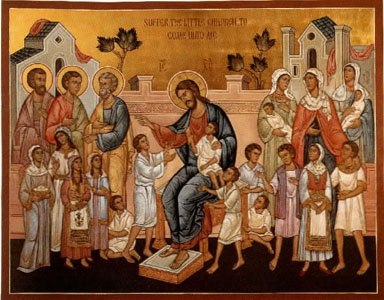
It is then that Jesus goes into the nursery and brings out a little baby; and taking the child in his arms, he says:

Whoever welcomes one such child in my name welcomes me, and whoever welcomes me welcomes not me but the one who sent me.

In other words, Jesus said to those who were arguing about greatness:

Stop worrying about being great, and start worrying about the least. And when you do that, when you take care of those who cannot care for themselves, when you feed those who cannot feed themselves, when you clothe those who cannot clothe themselves, when you welcome those who often feel unwelcomed, those who are treated like outsiders and called “aliens,” then you welcome God. And like me standing on that mountain, you will shine!”

Holding that baby in his arms, it is as if Jesus is asking: “Do you want to be great? Do you want to shine like me standing there with the prophet Elijah and the law-giver Moses? Then listen to the voices from the law and the prophets.”

Listen to the voice of Moses who commanded:

If there are any poor…in the land…do not be hard-hearted or tightfisted toward them. Instead, be generous and lend them whatever they need. …Give generously to the poor, not grudgingly, for the Lord your God will bless you in everything you do. There will always be some in the land who are poor. That is why I am commanding you to share freely with the poor and with other Israelites in need (Deut 15:7-11).

Never take advantage of poor and destitute laborers, whether they are fellow Israelites or foreigners living in your towns. …True justice must be given to foreigners living among you… (Deut 24:14-16).

Jesus is saying to listen to the Proverbs, words that us who is great in the eyes of God:

…blessed are those who help the poor… Those who oppress the poor insult their Maker, but helping the poor honors him (Proverbs 14:21, 31).

If you help the poor, you are lending to the Lord— and he will repay you!”(Proverbs 19:17).

And listen to who are not so great in God’s eyes:

Those who shut their ears to the cries of the poor will be ignored in their own time of need (Proverbs 21:13).

A person who gets ahead by oppressing the poor or by showering gifts on the rich will end in poverty (Proverbs 22:16).

Whoever gives to the poor will lack nothing, but those who close their eyes to poverty will be cursed (Proverbs 28:27)

So,

Speak out for those who cannot speak, for the rights of all the destitute. Speak out, judge righteously, defend the rights of the poor and needy (Proverbs 31:8-9).

Jesus is saying to listen the voice of the Psalmist…

Give justice to the poor and the orphan; uphold the rights of the oppressed and the destitute. Rescue the poor and helpless; (Psalms 82:2).

Do you want to be great? Then listen to the voice of the prophet Isaiah:

Learn to do good. Seek justice. Help the oppressed. Defend the cause of orphans. Fight for the rights of widows. “Come now, let’s settle this,” says the Lord. “Though your sins are like scarlet, I will make them as white as snow. Though they are red like crimson, I will make them as white as wool (Isaiah 1:17-18).

In other words,  says the Lord,  when you help the least, when the mission and ministries of your church side with the poor and the marginalized, I will transform you. I will transfigure you!

Do you want to know how to be a great church?  Do you really want to shine? asks Jesus. Then listen some more to Isaiah:

Free those who are wrongly imprisoned; lighten the burden of those who work for you. Let the oppressed go free, and remove the chains of injustice. Share your food with the hungry, and give shelter to the homeless. Give clothes to those who need them, and do not hide from relatives who need your help.

Then your salvation will come like the dawn, and your wounds will quickly heal. The Spirit of God will lead you forward, and the glory of the Lord will protect you from behind. Then when you call, the Lord will answer. ‘Yes, I am here,’ he will quickly reply, ‘Remove the heavy yoke of oppression…Feed the hungry, and help those in trouble. Then your light will shine out from the darkness, and the darkness around you will be as bright as noon’ (Isaiah 58:6-10).

The late Ruth Bader Ginsburg taught law students how to be great lawyers with advice that I believe applies to each of us.  She said something like: if you really want to shine, if you really want to be great, (an now I quote)

…you will do something outside yourself, something to repair tears in your community, something to make life a little better for people less fortunate than you. That’s what I think a meaningful life is. One lives not just for one’s self but for one’s community.

Amen.

Healing Religious Trauma

Acts 8:26-38 NRSV

This year’s Turner-Warren lecture still inspires me, and I hope you too, to think about the opportunities we have as a church to heal religious trauma caused by the oppressive beliefs of many who call themselves “Christian.” How do we support people who have been taught by preachers and by teachers and professors at their private conservative schools that who they are, that their very being, is outside of the boundaries of God’s love and grace?

How do we help people deconstruct the exclusion and fear of the other they have been taught in Sunday School and through sermons?  How do we help them to reach a point where they truly believe in the words of the Apostle Paul— the one who believed if anyone is outside the boundaries of God’s love, as a former persecutor of Christians, it was him— but became “convinced that neither death, nor life, nor angels, nor rulers, nor things present, nor things to come, nor powers, nor height, nor depth, nor anything else in all creation, will be able to separate us from the love of God in Christ Jesus our Lord” (Romans 8:28-29)?

How do we heal religious trauma here in city that is known for creating it?

Well, this may come as a surprise to people who have been injured by those who have weaponized the Bible, but I believe the Bible, particularly this morning’s epistle lesson, can help a church like ours serving in a city like ours. I often think of what a better world this would be if the people who claim to love the Bible or sell the Bible would actually read the Bible.

Verse 26 of chapter 8 of the book of Acts reads:

Then an angel of the Lord said to Philip, ‘Get up and go…:

The first thing we must learn is that we will never be able to fulfill our call to be healers of religious trauma unless we first fulfill our call to “get up and go” to meet people where they are. We must go to them, because, sadly, those who have been wounded by the church have some very good reasons for not coming to us.

People who have been hurt by the church understand that most churches not only expect people to come to them, but they expect them to come in a manner that meets their own religious and cultural expectations. That is, they know that many churches expect people to come to them who want to believe like them, look like them, love like them, and even hate like them.

And as our political environment teaches us, it’s not just the church that has trouble accepting those who are different. Excluding others seems to be something that seems to come very naturally for us. I think if we are honest, we would all admit that we would much rather be around people who are a lot like us.

Some have said that it may be part of our evolutionary DNA. It’s some inborn, natural instinct of survival. Fear the different. Beware of the other. Trust no foreigner. Avoid the outsider.

This, of course, is what fuels racism and homophobia. It supports white Christian nationalism and isolationism. It builds walls, discriminates, excludes, and demeans the other.

I believe this is what the Apostle Paul is talking about when he talks about the dangers of being led by the flesh and not by the Spirit. Because we human beings can easily be led by the flesh. A false prophet or Anti-Christ-like leader can easily stoke the fear of the outsider that is inside all of us. Unfortunately, it doesn’t take a stable genius to lead us to hate the other.

However, the Spirit leads us to take a higher road.

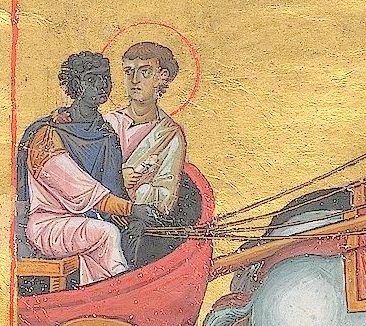
Notice that Luke tells us that the Spirit had to urge Philip, the Spirit had to push Philip, pull Philip, to get up and go to this chariot to meet this queer black man from Ethiopia.

Philip, I know this may be hard for you. I know this may be against your natural inclination. But go to this chariot and meet this stranger, this gender-variant foreigner, this victim of bad faith and sick religion who had been ostracized from their community of faith, this one demeaned and exploited for their sexuality, this one who has been clobbered by the Bible by those who arbitrarily pick and choose scripture passages like Deuteronomy 23:1 that says Eunuchs are forbidden to enter the temple, this one who has been taught their entire life that they are despised by God. Go to their chariot and meet them where they are. Don’t expect them to come to you. And when you encounter them, do not stand above them or over them. Do not judge them or condemn them. Join them. Get into the chariot and sit beside them. Ride alongside them. Engage them. Listen to them. Seek to understand them, empathize with them. Learn from this other, this stranger, this foreigner, this beloved child of God, this beautiful sibling of yours.

Philip meets the Eunuch who is reading from the book of Isaiah. This should not surprise us. For this is one of the most hopeful books in the Hebrew Bible for those who have been marginalized by sick religion, for those who have been taught that they are despised by God. Imagine the hope that burned in this Eunuch’s heart when he read the following words we find in Isaiah 56:

Thus says the Lord:

Maintain justice, and do what is right,

for soon my salvation will come,

and my deliverance be revealed.

Do not let the foreigner joined to the Lord say,

‘The Lord will surely separate me from his people’;

and do not let the eunuch say,

‘I am just a dry tree.’

For thus says the Lord:

To the eunuchs…

…I will give, in my house and within my walls,

a monument and a name

better than sons and daughters;

I will give them an everlasting name

that shall not be cut off.

And the foreigners who join themselves to the Lord,

…these I will bring to my holy mountain,

and make them joyful in my house of prayer;

their burnt-offerings and their sacrifices

will be accepted on my altar;

for my house shall be called a house of prayer

for all peoples.

Thus says the Lord God,

who gathers the outcasts of Israel,

I will gather others to them

beside those already gathered.

Philip hears him reading from Isaiah and asked: “Do you understand what you are reading?”

The Eunuch responds: “How can I understand it unless someone interprets it for me?

What a great question! What a better world this would be if more people understood that the Bible needs to be interpreted.

God never intended for people, on their own, to pick up the Bible, and arbitrarily lift scripture passages out of their contexts, and try to understand it or follow it. For this is one of the main causes of religious trauma today. Too many Christians are using the Bible out of context to support all kinds of hate, bigotry, and injustice.

And because of that, there are countless people in this world, countless people in this community, who are the victims of sick religion. They feel marginalized and disenfranchised by the church. They have been taught their entire lives that God despises them. They have no idea that God loves them and has a future for them— All because no one has interpreted the Bible pointing to the Jesus who came into the world, not to condemn the world by to save the world, to love the world.

The eunuch then begins to read from chapter 53:

Like a sheep he was led to the slaughter,

and like a lamb silent before its shearer,

so he does not open his mouth.

In his humiliation justice was denied him.

Who can describe his generation?

For his life is taken away from the earth.

Then the Eunuch asks Philip, ‘About whom, may I ask you, does the prophet say this, about himself or about someone else?’

The Eunuch is asking: Who is this one was also ostracized and marginalized by others, as I have been? Who is this who was led like a sheep to be slaughtered? Who is this one who has been humiliated and denied justice? Who is this who had his life taken from him? Who is this one who is just like me? Who is this one who relates to me so well, who understands my pain, who knows my heartache, who empathizes with my sufferings? Is it Isaiah? Or is it someone else?

Then, Philip tells the eunuch the good news about Jesus, perhaps saying something like: the one who understands your pain, knows your heartache, and empathizes with your sufferings is none other than Jesus, the enfleshed presence of God, and the powers-that-be crucified him for it. The one who relates to you, identifies with you, and because of that, loves you, welcomes you, accepts you, affirms you and forgives you like none other, is the very One who others said despised you.

When the Eunuch hears this good news about Jesus, the words of the prophet become not only hopeful news for the future, but good, glad, certain news for the present:

For thus says the Lord:

To the eunuchs…

…I will give, in my house and within my walls,

a monument and a name

better than sons and daughters;

I will give them an everlasting name

that shall not be cut off.

Suddenly, barriers fall. Walls crumble. Obstacles disappear. And the very doors of the Kingdom of Heaven swing wide open.

It is then the Eunuch, this one who had no name and no future, but now has an everlasting name exclaims:s “Look here is water! What is to prevent me then from being baptized?” In other words, “What is separating me from the love of God?”

Knowing that nothing in heaven nor on earth, nor angels, nor preachers, nor church boards, nor church bylaws, nor books of discipline, nor elders, nor deacons, nor Sunday School teachers, nor college presidents nor or professors, nor anything else in all creation, will be able to separate us from the love of God, Philip commanded the chariot to stop, and both of them, Philip and the eunuch, went down into the water, and Philip baptizes him, washing away the trauma.

Going Fishing

Fishing net parament adorning the communion table of the First Christian Church in Lynchburg, Virginia

As we celebrate 150 years of being church, I think it is good to highlight something that is central to who we are as the First Christian Church in Lynchburg, VA. And that is fishing. You knew that right? Why else would we adorn our communion table with a giant, very colorful, diverse mosaic of a giant fishing net. There’s a great description of our fishing net parament hanging on the wall in the back of the sanctuary that I encourage you to read when you have a chance.

Our fishing net is appropriate as the gospels are full of great fishing stories. Like the story of Jesus is having church on the beach. Luke tells us that the congregation gathered that day is so large, they keep “pressing in on him to hear the word of God,” almost pushing Jesus into the water!

It is then that Jesus sees two boats belonging to some fishermen who are out washing their nets. He climbs into one of the boats belonging to a fella named Simon and asks him to put it out a little way from the shore so he could teach the crowds on the beach from the boat, setting up a little pulpit on the water.

After the Benediction is pronounced and church is over, Jesus says to Simon, “Let’s move the boat to some deeper waters and go fishing.” And this is the moment, for Simon and all of us, that church really begins.

Simon says, “Jesus, we’ve been fishing all night long and haven’t caught a thing. But, if you say so, I’ll cast my net one more time.”

It is then that Luke tells us that they catch so many fish that they had to call in re-enforcements and a second boat. Filled with so many fish, the nets almost break.

Do you remember Simon’s reaction to this glorious catch? “Praise God from whom all blessings flow for this miraculous catch of fish!”

Nope, not even close.

Scared to death, Simon says the almost unthinkable: “Go away from me Lord!”

Then, as it usually is with the stories of Jesus, we learn there is much more going on here than a few folks going fishing. As our scripture lesson in Mark reminds us, this story in Luke is not a story about catching fish at all. It is a story about catching people. It is a story about inclusion. It is a story about bringing new people aboard.

And like Simon, this can scare us sto death.

Growing up in Northeastern North Carolina surrounded by water, I quickly learned that there are basically two types of fishermen.[i] First, there’s the fisherman who really doesn’t care if they catch anything at all. They are perfectly content sitting in their boat with a line in the water. It doesn’t bother them in the least if they do not get a nibble all day long. Enjoying the sunshine and the fresh air, the brim of their hat pulled down over their eyes, they are so comfortable, so at peace, so at home, they might even doze off and take a little nap. They are just happy to be in the boat. They’ve got a bag lunch, some snacks and a few cold beverages, and a bumper sticker on their truck that reads: “A bad day fishing is better than a good day at work.”

And besides, if they did catch anything, which by the way would be by sheer accident or dumb luck since they’re not paying any attention whatsoever to their pole, that would just mean for some work for them to do when they get back to the shore. And the one thing that fishing is not supposed to be is work!

I am afraid I have just painted a portrait of many in the church today. We’re perfectly content just to have one line in the water, not really caring if we ever bring anyone else aboard. Because bringing aboard others always involves work. It involves sacrifice. Because you know about others? They are just so “other.”

So, the purpose of church is reduced to making sure that everyone who is already in the boat is happy, peaceful, and comfortable. If we catch something, that’s well and good. But if we don’t catch anything, well, that is probably for the best.

Then, we have the second kind of fisherman. These are the ones who are really intentional about catching fish. This was my Nana and Granddaddy.

On the water with Nana and Granddaddy, I didn’t know whether to call what we were doing out there in the boat “fishing” or “moving.” Because oftentimes, as soon as I could get some bait on my hooks and drop it in the water, I’d hear Granddaddy say, “Alright, let’s reel ‘em in. We’re going to find another place where the fish are more hungry.” I remember spending as much time watching the bait and tackle on the end of my line fly in the wind as we moved from place to place as I did watching it in the water. But guess what? With Nana and Granddaddy, we moved a lot, but we always caught a lot of fish!

To be the church that God is calling us to be, we must be a people on the move, willing to change, go to other places, and we must be intentional.

We must constantly reel in our lines to go outside of these walls to meet people exactly where they are, not where we might want them to be, but where they are, especially in those deep, dark places where people are hungry for love and starving for grace; where they are famished for liberty, and thirsty justice and equality.

And we must be willing to express our intentionality, publicly, out loud.

Many churches today are happy to say: “All are welcome.” But what does that truly mean? Welcome by whom?  For all can’t be welcome unless someone is doing the welcoming. Right? That’s why we need to be explicit saying, “The First Christian Church of Lynchburg, Virginia welcomes all.”

And who is “all”? Sadly, today saying “all” not saying enough. “All” who want to look like us, believe like us and behave like us?

That’s why we have to say it, and say it explicitly, intentionally, out loud. Especially today, we need to keep saying that this church welcomes people who identify as LGBTQIA+. We need to say out loud that we do not believe being queer is any more sinful than being cisgendered and heterosexual can be. We need to keep saying publicly that we affirm all people are created in the image of God. We are not afraid to say out loud that this church believes black lives matter and black and brown people are always welcome here. To sit in our pews, be on our boards, lead our worship and preach from our pulpits.

We need to keep saying that our church welcomes women and believes women can teach a Bible study class that is of full men. We believe women, as well as people who identify as LGBTQIA+, can be teachers, preachers, pastors and even President of the Denomination. We believe women have power in the church’s boardroom, and that they always have power over their own bodies.

And when you are welcomed here, we need to keep reminding you that you become a part of our body; thus, when you suffer, we all suffer. So, you can count on us to be there for you, to care for you, to pray with you, and to fight for you when the world treats you unjustly.

The problem is that too many churches today are sitting back, half asleep, with one pole in the water. They are not moving, not changing, and not going out. And they are not intentionally saying anything, at least anything out loud. They could care less if anyone new comes to them, but if by sheer accident or dumb luck someone new does happen to come aboard, churches expect them to come aboard in a manner that measures up to their own expectations.

I will never forget that Nana used to go fishing with this special red pocketbook. It was leather or maybe vinyl and must have been lined with plastic. Nana always went fishing with this pocketbook, because when Nana was about the business of catching flounder, Nana did not discriminate.

When it came to flounders, you could say, Nana was Open and Affirming. Nana very graciously welcomed all flounders aboard the boat, even if they did not measure up to the expectations of the North Carolina Wildlife Commission.

I remember measuring a flounder: “Oh no! This flounder is an inch too short, I guess I need to throw him back.”

“Oh, you will do no such thing!” Nana would say, “He’s ‘pocket-book size!’”


Here’s what you don’t know, Nana’s son, my uncle, at the time, was a North Carolina Game Warden. Nana risked getting into trouble not only with the state, but with her own family.

I have heard it said, “If following Jesus does not get you into some trouble, then you’re probably not doing right.”

Pastors are constantly getting into trouble, for it is impossible to please everyone. But what’s crazy to me is that I have gotten into the most trouble when I have preached sermons on loving our neighbors, when I preach against hate and discrimination and for unconditionally loving and fully including people who may not measure up to our cultural, societal, or religious expectations.

I have had family members actually tell me that they are ashamed of me and that I embarrass them by preaching such inclusivity.

Some believe the sole purpose of the church is about making sure that everyone who is already in the boat is contented, comfortable and happy. They are unaware that Jesus calls us all to fish for people, to cast a large net bringing others aboard without discrimination, leading them to make the life-giving, world-changing decision to join a movement following the way of love that Jesus taught his disciples.

And God help us when the church is embarrassed to stand up to our friends and family and shout with the Apostle Paul: “For I am not ashamed of the gospel; it is the power of God for salvation!”  What’s the rest of that verse? “For everyone…Jew and Gentile. (Romans 1:16). Everyone.

I am afraid that many churches today are like fearful ol’ Simon, who upon looking at all those different fish in the boat, responded to Jesus with those unthinkable words, “Lord, go away from me.” They say it today through their exclusive membership policies, through their by-laws, creeds and confessions and in their sermons. And it is the main reason why so many churches today look nothing like Jesus.

Late Disciples of Christ pastor Fred Craddock loved to tell the story of one local church. Although their sign out front read, “A church that serves all people,” when all people would show up to be served, the exclusive spirit of the congregation continually drove the newcomers away.

About ten years went by. When, one day, Craddock was driving down the road where that church was located when he saw that the building that once housed that church had been converted into a restaurant.

Curious, he stopped and went inside. In the place where they used to be pews, there were now tables and chairs. The choir loft and baptistery was now the kitchen. And the area which once contained the pulpit and communion table now had an all-you-can-eat salad bar. And the restaurant was full of patrons—every age, color and creed.

Upon seeing the sad, but very intriguing transformation, Craddock thought to himself, “At last, God finally got that church to serve all people.”

[i] I heard Rev. Jesse Jackson allude to these “2 types of fishermen” at the Oklahoma Regional Men’s Retreat at Camp Christian, Guthrie, Oklahoma in 2016.

A Radical Cup of Water

waterhose

Matthew 10:40-42 NRSV

Matthew Chapter 10 is perhaps one of the most demanding chapters in the entire Bible.

Early in the chapter, we read that the discipleship business is a risky business. We are to go out into the world and encounter the sick and the dying. We are to engage those possessed by pure evil. We are to be willing to leave behind our families, our homes, even our clothes! Persecution is not only to be accepted. It is to be welcomed!  To save one’s self, we are to practice denying one’s self, pouring one’s self out, losing one’s self.

And when read it, we think, “You know, I don’t think I am really cut out for this discipleship business. I don’t have the gifts, the time, the energy, the courage, and quite honestly, I don’t have the desire.”

So thanks for the invitation, but I prefer to just keep my place safe and comfy on this padded pew.

Then, we reach the end of the chapter and we read these words: “Whoever gives even a cold cup of water to one of these little ones—truly I tell you, none of these will lose their reward.”

And we say: “Hey now.  Wait just a minute. You know, I think I might be able to handle this! I can’t heal the sick—I hate hospitals, and I do all I can do to avoid nursing homes.

I don’t have what it takes to minster to the poor. They make me nervous, make me feel dirty, stress me out.

I can’t be with the dying. That is what Hospice is for. And I dread going to funerals. I never know what to say or what to do.

And I can’t leave my family behind. I can’t give up my possessions. And I don’t want to even think about losing my life. But hey, I am all about sharing a cold cup of water!

Finally! Something I can handle. So, Jesus, I’ll tell you what I’m gonna do. As soon as I get home from church this afternoon, I am going to hook up my water hose to the spigot out in front of my house.  Then I am going to I make a sign and put it out by the road that reads: ‘Free cold drink of water for all who are thirsty!’ And to make the preacher happy, since it is his last Sunday, I will even add: “And all means all.”

Maybe I am cut out to be a disciple of Jesus after all!”

For most of us, this seems like some good news! We who generally fail at casting out demons (even when they show up in church), we who would rather stay in our pews than take the gospel out to the dying, we who take care of our own children while others starve in the streets, and we who find praise far more satisfying than persecution, even we can open the doors of the kingdom through a simple act of hospitality, as small as giving a thirsty stranger a cold cup of water.

“Praise be to Jesus!” we say.

“So, I am going to just forget about all of that other stuff Jesus talked about, that big prophetic stuff, that demanding stuff, that risky and radical stuff. I’m just going to take Jesus at his word in Matthew 10:42 and run with it!  In fact, is going to be my new favorite scripture verse. This is my new calling. This is my mantra and my ministry. Cold cups of water for all God’s people!

But you have to wonder if we aren’t missing something. For deep inside, we all know we can do a lot better than that. We all know a cross or two we could bear. We all know a neighbor we could love. We all know someone we could help out. We all know ways we could be a little less selfish, less materialistic, more generous.

True discipleship really cannot be as easy as passing out a few cups of water, can it? Are we really supposed to forget all about everything else that Jesus talked about? All of that hard stuff about “turning the other cheek,” “loving our enemies,” and selling everything we have to give to the poor?”

Surely those are the marks of true discipleship. Those are the keys to the kingdom of heaven. There’s just no way a small act of inconsequential hospitality can compare to the risky and radical business of battling the demonic, coming into contact with the sick, ministering to the dying and enduring persecution.

But Jesus seems to disagree. For in a fragmented world such as ours, a simple act of kindness, a small gesture of welcome to a stranger, a little genuine hospitality is never an easy, inconsequential act. In fact, it can be very risky business with very radical consequences.

A short time ago, I replied to an email from a complete stranger who wrote to thank me for something that I had written on my blog. By the way, I ended that article, “And all means all.”

I replied to his email with a simple, hospitable, what-seemed-to-be-inconsequential, “Thank you.”

A few days later we are friends on Facebook.

A couple of weeks later, I get a telephone call asking me to pray for him about a job opportunity in the City.

A week later, I am asked to meet this stranger at a restaurant.

Before I left the house, I told Lori exactly where I was going. I called her when I arrived and told her that if she did not hear from me in a couple hours to call the police.

During dinner, he shared with me some his burdens, some of his pain, some of fears. He told me how he had often been condemned by the church for being different. I made myself vulnerable by sharing some of my own burdens. Before we departed, we embraced, no longer as strangers, but as brothers who had made a covenant suffer with and to pray for one another. I drove home wondering: “What on earth have I gotten myself into?”

In this fragmented world, a world of walls and barriers, a world where there is so much division, so much hate and loneliness, replying to a simple email, a small gesture of hospitality, becomes a risky, radical and prophetic act that has the power to change your life, and perhaps the world.

And Jesus says to go and do this. Go out, move out, seek out, and reach out to strangers. Love your neighbors.

And yes, this world is frightening beyond our walls. Our neighbors can be so different. And the truth is some of our neighbors can be downright scary.

But our neighbors are also thirsty.

So, welcome, engage, touch. Share a drink with someone. Make yourselves vulnerable to another. For there is no other way to fulfill the purpose for which you were created—to seek and make genuine peace in this world.

This is discipleship. This is following the way of Jesus. It is done face-to-face, side-by-side, hand-to-hand, person-to-person.

We cringe. Because we know that this kind of hospitality involves risk. It involves radical openness and intimacy with another.

Offering a cup of water to another involves the risk of rejection, but also the risk of laughter; the risk of tears, but also the risk of love.

I’ve heard it said that the problem with others is that they are just so “other.” Others can quite often be different. Others may not like us. Others might refuse our kindness. Others might wound us. Others might crucify us. And worst of all, others might change us.

The truth is that putting a welcome sign in the front yard beside the water hose is a downright dangerous activity.

Nearing the end of my ministry in North Carolina before moving to be with you here in Enid, I went into the church kitchen to get a cup of coffee. A woman from the cleaning service the church had hired was in there preparing to mop the floor. Although I had seen her almost every week nearly three years, I am ashamed to say that I did not know her name.

But that day, before I really thought about it, considered the dangerous consequences of it, I asked this stranger, “Would you like a cup of coffee?” Somewhat shocked by my simple act of hospitality, she responded, “Yes, I would.”

She then introduced herself to me over that cup, as she introduced all of her children, a sick grandchild, a sister battling cancer, a brother who lost his job, and an absent husband. I filled a bag with squash and cucumbers from our community garden, and I hugged this woman who I had hardly spoken to in three years—this stranger that I had all but ignored—this woman who was no longer a stranger. She was my sister. And acknowledging the change, the miraculous transformation that had occurred, I thought, or maybe I prayed, “Good Lord, it was just one cup of coffee!”

Paraphrasing United Methodist Pastor William Willimon: This is the way of the good Lord. For Jesus, oftentimes through the smallest and simplest of ways, is always trying to change us, challenge us, move us. He welcomes and accepts us only so we will welcome others, for not only their sakes, but for our sakes.

This is the gift of community. This is why we were created. It is the answer to our own sadness, to our own loneliness and to our deepest desires. Jesus knows we were not created to live in isolation, but created from the heart of a God who lives in a self-giving, loving communion with the Son and the Holy Spirit—A heart that is so full of love that it cannot help but offer grace and redemption to all and call all into this communion.

And this communion grows. It grows when we offer kindness, gentleness, and mercy, when other lonely lives become wrapped up in our own, when the grace of God that was given to us is freely given to someone else.

And before we know it, the small cup of water we offered to another becomes a cup of salvation as fear fades, barriers fall, walls come down, hands touch, hearts connect, eyes open, lives become entwined.  Creed, color, gender, sexual orientation, it doesn’t matter.

Doing business with this kind of God, even when it seems small, safe and inconsequential, is always a risky business with radical consequences. And Jesus wants us to know that these consequences are eternal. Whether we are fighting demonic evil, healing the sick, caring for the dying, leaving behind our homes, our possessions, our friends and family, being persecuted for taking a stand for social justice, or simply offering meager acts of hospitality to a stranger, we always risk receiving salvation.

This is the great wonder of the gospel. When we reach out, accept, and welcome others, when we take the hand of another, when we embrace another, when we offer the unconditional love of God to another, even in the smallest of ways, even in sharing a glass of water or a small cup of coffee, or in responding to an email, God welcomes us.

When we encounter another, we find communion with God and receive the overflowing hospitality of the Father, and of the Son, and of the Holy Spirit.[i]

[i] Inspired by William Willimon. “Risky Business,” Clergy Journal, Jun 26, 2005, vol 33, no 2, pp 53-56.

Welcome!

jesus_children_orthodoxGenesis 18:1-8 NRSV

Last week I said that the first four stories in our Bible are stories that are considered to be pre-history, that is before the call of Abraham and the history of God’s people. The story of Adam and Eve, Cain and Abel, Noah and the Flood and the Tower of Babel teach us some very important characteristics about who God is and how God relates to our world. They teach us that our God is a gracious, loving Creator who is committed to suffering with and for all people, people of every nation, race, color and creed.

The stories that follow in Genesis teach us what should be the very important characteristics of the people who claim to worship and serve this God.

Verse one of chapter eighteen is one of the most loaded verses in the entire Bible. “The Lord appeared to Abraham* by the oaks* of Mamre, as he sat at the entrance of his tent in the heat of the day.”

When you worship the Lord, the creator of all that is, the one who graciously loves and forgives, the one who is compassionately involved in the creation, stirred by it, moved by it, then you never know when the Lord may appear. It could be the most ordinary of days while you are doing the most ordinary of things, like sitting on your front porch in the heat of the day. You may or may not be in the right frame of mind to recognize the presence, but the presence is nonetheless real and nevertheless powerful.

Abraham is minding his own business in the middle of the day when, out of nowhere, three strangers appear on the street. Next, Abraham simply does what the Bible says the people of God do for others, he very welcomes them with a generous hospitality.

When he sees them, he does not safely call out to them from a distance. He does not cautiously walk over to them. And he certainly does not practically ignore them and allow them to walk on by. When he sees them, the scriptures say that he runs to meet them.

And when he encounters these strangers, he does not stand arrogantly over them, above them, but humbly bows himself to the ground before them and speaks to them like a servant.

“Please do not pass me by. Let me get some water and wash the dust off your feet. Let me make a place for you to rest in the shade. My wife, Sarah, bakes the best bread. Come and allow us to serve you. Then, you can continue your journey, refueled and refreshed.”

When the strangers agree to stay a while, Abraham can hardly contain himself. He runs back inside, “Hurry, Sarah, prepare three cups of choice flour, knead it, and bake a delicious cake. He then runs out back to the field and takes the best looking calf of the flock and has his servant prepare a delicious dinner. He brought it to them under the shade tree and waited on them while they ate.

And as verse one suggested, we later discover that these three strangers were actually angels, messengers from God. When we welcome the stranger, the Bible tells us, we may be welcoming God. When we welcome others, the Lord appears.

We also see this very clearly in the New Testament. In chapter 10 of Mark’s Gospel we read the following words of Jesus to the disciples, “Whoever welcomes you welcomes me, and whoever welcomes me welcomes the one who sent me” (Mark 10:40-42). In the previous chapter we read where Jesus took a little child in his arms, and said, “Whoever welcomes one such child in my name welcomes me, and whoever welcomes me welcomes not me but the one who sent me” (Mark 9:36-37).

And in Matthew we read Jesus’ words, “I was hungry and you gave me food; I was thirsty and you gave me a drink; I was a stranger and you welcomed me.”

Do you see the pattern here? Jesus said that when we welcome others, we are welcoming Jesus. And Jesus said when we welcome him, we welcome God.

When we open the doors of the church wide, when we invite others in, when we let them know that we are glad that they are here, we are welcoming the Lord himself.

There was once a monastery that had fallen on hard times. The order was dying out. There were only five monks left, the abbot and four others.

The monks feared that the monastery would have to be closed. In their desperation, they went out and sought counsel from a wise man they knew who lived in a hut in the woods that surrounded their monastery.

The wise man agreed to a meeting to talk with the abbot regarding the fate of their monastery. The meeting was very brief. The wise man said that he really did not have any great advice to give them, but he could say this: that the Messiah was among them.

The abbot returned to the monastery, where the monks were waiting eagerly to hear what the wise man had said. “Please tell us! What do we have to do to save the monastery?”  “Well,” the abbot replied, “the wise man was rather cryptic. He simply said that the Messiah is among us.”

“The Messiah is among us?” All of the monks scratched their heads. How could the Messiah be among them? As they pondered the meaning of these words, the monks soon began to think of each member of the order as a possible Messiah. They started to treat one another with tremendous respect and kindness. And when people came to visit, they treated each of them as if they could be the Messiah, too.

People from the surrounding area often came to picnic on the monastery’s beautiful grounds, to walk along the paths, and to pray in the chapel. The visitors were amazed by the welcome they received from the monks. There was an aura of respect and love that filled the place, making it strangely attractive, even compelling. Hardly knowing why, they began to come back to the monastery more frequently, to picnic, to play, to pray. They began to bring their friends to show them this special place. And their friends brought their friends. Some of the younger men who came to visit talked more and more with the old monks, and they began to join the order. So before long, the monastery had once again become a thriving order, and a vibrant center of light and love for people all over the realm.

When I first joined the conversations you were having a year ago to renovate our windows, to remove the stained plexiglass and replace it with a clear plastic so the windows could be seen from the street, I said that the need was not only aesthetic, as they looked horrendous, but it was also theological. To keep this beauty, the beauty of our Lord and Savior, inward, only unto ourselves, inside these walls was simply a theological travesty.

I have said recently that our education building needs to be renovated or at least refurbished. And like the windows, the need is not only aesthetic, it is also theological.

We have a great building and grounds committee; however, they cannot do it all by themselves. Our buildings are too old, have too many needs for just one committee to do it all by themselves. To be good stewards of our property, to make this a warm, welcoming place, we need to have many more work days like the one we had yesterday in the basement. I want to encourage you to walk through the education building, do it today if you have time, make sure you go upstairs, and ask yourself: what would you do to the building if you knew the Messiah was coming for a visit? Would you paint the walls? If so, what color? Would you paint the windows? Would you replace the ceiling tiles that are stained? Would your replace ceiling tiles that are missing?  What would the plaster in this room look like? Would it be chipped, stained, faded, discolored?

I want us to work hard in these nine months to finish the basement,  and make it a place of welcome for children; renovate our education building, and make it a warm and inviting place for all children; put up a playground right off of church street and make it a sign to the community that this church welcomes children; not so much because we want our church to look nice and pretty, not so much because we want to be proud when we invite over 100 children and their families here next June for the community Vacation Bible School, but because we take the words of Jesus very seriously when Jesus, holding a child in his arms, says, “Whoever welcomes one such child in my name welcomes me, and whoever welcomes me welcomes not me but the one who sent me” (Mark 9:36-37).

Fred Craddock, one of my favorite preachers, tells a story about going to church when he was a boy. He said that every Sunday morning, his mother took him to church with his sister. When the service was over, he said they followed their mother like little ducks out of the church. As the preacher stood at the door greeting folks, he would always say, “Mornin’ Mrs. Craddock.”  Then he would address the kids, “Good mornin’, Sonny. Good mornin’, Honey. The next Sunday, “Good mornin’ Mrs. Craddock, Good mornin’, Sonny. Good morning, Honey.” Every Sunday, “Good mornin’ Mrs. Craddock, Good mornin’, Sonny. Good morning, Honey.”

Then one day there was a new preacher. After he had been there a few weeks, as the Craddock family filed out of church, he said, “Good mornin’, Mrs. Craddock. Good mornin’, Fred.” And Fred Craddock said, “He was the best preacher we ever had, because there’s a big difference between Fred and Sonny.”

What a difference a genuine welcome makes. We all long for a place to call home. We all long for a place of welcome. Where we look around and it is obvious that someone cares about us, wants to know our names. Even the walls say they care.

As Disciples of Christ, we do not have a creed we follow. But we have a statement of identity. Part of it is on our church sign today. More than anything else, I want it to be the identity of this special place on the corner of Church and Main. I want it to be clear to all, not only through our actions and our words and our living, but also through our bricks and our mortar: “We welcome all to the Lord’s table as God has welcomed us.”

So let us commit ourselves to welcoming all, for when we welcome others with all that we are and with all that we have, we are welcoming God in the name of Christ Jesus our Lord. Amen.