
Pentecost and the Sin of Christian Nationalism

Acts 2:1-21

There are Sundays when the church calendar feels almost divinely timed. And today is one those days.

Here we gather one week after thousands gathered on the National Mall in Washington for a massive Christian nationalist rally, wrapped in flags, political slogans, and declarations about reclaiming America for God, all the while courts across the South continue chipping away at voting rights protections, enabling racial gerrymandering, and turning back hard-won civil rights gains that generations marched, bled, and died to secure. It also so happens to be Memorial Day weekend— a holiday that too often becomes more about glorifying war than grieving its terrible human cost.

And for many of us, especially here in Lynchburg, Virginia, none of this feels abstract, for we know the history all too well.

We know what happens when Christianity becomes entangled with nationalism, militarism, white supremacy, and political power.

We have seen crosses used to bless segregation. We have heard scripture quoted to defend exclusion, to subjugate women, and to oppress queer people— by those who had the audacity to call themselves “a moral majority.”

We have watched churches drape sanctuaries in patriotic symbols while remaining silent about poverty, systemic racism, and state violence. We have seen war baptized as holy, while the Prince of Peace is pushed to the margins.

And now, the courts continue to turn back the clock on civil rights protections while the language of a “Christian America” grows louder.

The good news is: Here comes Pentecost! Arriving right on time, to disrupt it all!

While many Christians proclaim a faith wrapped in control, borders, and cultural supremacy, the Spirit arrives in Acts 2 like uncontrollable wind and untamed fire.

While loud voices today insist God speaks only one language, blesses only one nation, and favors only one color and one kind of believer, Pentecost erupts as a miracle of radical diversity where everybody hears the inclusive good news in their own language.

Outsiders suddenly become insiders. Women prophesy. Young people dream, and ordinary people become preachers.

The Holy Spirit of God does not arrive carrying a flag, but carrying fire, a fire that falls on everybody. And once the wind starts blowing, there’s no power on earth that can contain it or control where it goes.

This whole Pentecost scene is the exact opposite of how you will hear those with power today talk about God. Instead of building walls between people, the Spirit comes and tears them all down. Instead of creating a smaller table, the Spirit sweeps down and makes the table bigger, creating belonging that is bigger than borders, flags, parties, and nations.

And so today, as we gather on this Pentecost Sunday in Lynchburg, Virginia, we are confronted with a question that is as urgent now as it was in the first century: Will Christianity be a movement of uncontrollable, unconstrained, Spirit-filled, inclusive, universal love, or will Christianity be a weapon for cultural and political control?

Will we have the courage to demonstrate that the Spirit of God is indeed still in this world? Not in a political rally, not with flags waving beside crosses—but with wind, wild disruptive wind, the kind of wind you cannot own, predict, domesticate or weaponize.

And then as fire! Not fire descending on one chosen nation. Not fire resting on one kind of faith, affirming one color of skin or one gender or sexual orientation. But fire dancing over every nation, every accent, every gender, every age, every body—

Dark-skinned bodies and light-skinned bodies. Bodies considered clean and bodies considered unclean. Bodies welcomed by religion and bodies pushed outside the gates. Bodies the empire celebrated and bodies the empire overlooked. The Spirit touches the ones with power and the ones those in power try to erase: widows and laborers; immigrants and refugees; people with trembling faith; people with no faith; people carrying shame. The Spirit of God rests every story, every wound, every trauma, everybody.

The Spirit lands in all the places religion has learned to avoid. The Spirit speaks through people empire has learned to silence. The Spirit widens the circle the privileged and the powerful try to close.

And suddenly, through the people, the Spirit begins speaking in languages the empire never taught them. And the miracle is that each heard “in their own native language.”

Rather than forcing the crowd to learn a single, dominant language or forcing them to assimilate erasing their unique backgrounds, Pentecost is the miracle of God honoring the diversity of every culture. Hearing the gospel in their “own native language” is a divine demonstration that every culture, every background, and distinct voice is valued, validated, and worthy to carry God’s message of radical inclusion and revolutionary love.

The Spirit does not come and erase diversity. The Spirit comes and blesses diversity and speaks through it. And that matters deeply today.

It was surreal last Sunday, plugging back into the world from vacation to read about thousands gathering on the National Mall in Washington for a massive Christian nationalist prayer rally. It was described as a recommitment of America as “One Nation Under God.” The event blended patriotic symbolism, political power, and conservative Christianity in ways that set off alarm bells among many faith leaders and advocates for religious and pluralism. There were crosses beside nationalist imagery, political speeches wrapped in revival language, and declarations that America is somehow uniquely chosen by God.

Consequently, on Monday, as if right on cue, two White Christian Nationalists opened fire at an Islamic Center killing two people who sacrificed their lives to save the lives of countless school children.

But the good news is, also right on cue, Pentecost arrives today to dismantle it all.

Christian nationalism wants uniformity. And Pentecost creates plurality.

Christian nationalism says: “One language, one culture, and one kind of Christian.” And Pentecost says: “Every tribe. Every tongue. Every nation.”

Christian nationalism wraps the gospel in the flag. And Pentecost tears down every border.

Christian nationalism confuses political power with divine blessing. Pentecost arrives among the powerless.

And perhaps most importantly: Christian nationalism thrives on certainty and control. But the Holy Spirit is mysterious and uncontrollable.

Richard Rohr often reminds us that God is not a problem to be solved but a mystery to be encountered. The Spirit cannot be confined to any doctrine or creed. The Spirit is breath, movement, surprise, and transformation. Jesus himself says in John’s gospel: “The wind blows where it chooses.”

You cannot legislate wind. You cannot control fire. You cannot trap the Spirit inside a statement of faith or a party platform.

But Christian nationalism tries. Oh, how it tries. Because Christian nationalism is terrified of ambiguity, terrified of questions, terrified of difference, and terrified of change. It has black-and-white answers for every mystery.

Pentecost is gloriously wild and free. So much so, people think the disciples are drunk. Nobody fully understands what’s going on. Maybe that is because real encounters with God often dismantle our certainty before they rebuild our compassion.

Rachel Held Evans once wrote that faith is not about having all the answers but about learning to live inside the questions with God while loving everybody. That is Pentecost.

Pentecost is not certainty descending from heaven. It is courage descending from heaven: courage to love people who are different, even when it is unpopular; courage to cross boundaries, even when it is dangerous; courage to reject white supremacy, even when it benefits you; and the courage to stop pretending God belongs to our tribe.

This is what makes Pentecost such a threat to Christian Nationalism. Because once the Spirit starts moving, the insiders lose control of the gates. Suddenly, Gentiles are welcomed. Women prophesy. Young people speak truth. Old men dream dreams. The poor are lifted. The margins become the center.

As the prophet Joel declares in the passage Peter quotes: “I will pour out my Spirit upon all flesh.”

All flesh. Not just American flesh. Not just Christian flesh. Not just white, straight, cisgendered, conservative flesh. All flesh.

That little word “all” may be the most challenging word in the entire Pentecost story. Because exclusion is always easier than inclusion.

It’s easier to build a movement around fear. It’s easier to define ourselves against our enemies. It’s easier to believe God loves our nation more than others. It’s easier to imagine we alone possess truth.

Church, we must hear this truth today: the opposite of Pentecost is not atheism. The opposite of Pentecost is fearful religion that cannot imagine God speaking through people who are different from us. The opposite of Pentecost is the belief that God endorses our tribe over all others. The opposite of Pentecost is any Christianity more obsessed with control than compassion.

And so, on this Pentecost Sunday, the question for us is: Are we willing to be disrupted and filled by the Holy Spirit?

Because the Spirit is in this world today. And the Spirit is blowing: into sanctuaries and into protests; into immigrants’ prayers and queer children’s tears; into Black churches crying for justice; into young people exhausted by hypocrisy; into weary souls who were told they did not belong.

And the Spirit still burns today. Not to destroy people, but to burn away fear, to burn away supremacy, to burn away the illusion that God can be monopolized by nation, race, ideology, or religion.

And if that fire truly lives in us, then we cannot remain silent while people are pushed to the margins. We cannot worship on Sunday while ignoring voter suppression on Monday.

We cannot sing about justice while children go hungry, while the poor are abandoned, while immigrants are demonized, while truth is traded for power.

Because Pentecost is not just an emotional experience. Pentecost is a public movement. The same Spirit that filled the disciples sent them back into the streets. Back into the world. Back into the struggle for human dignity.

So church, if the Spirit has touched us, then we must become people who resist every form of hatred dressed up as holiness. We must tell the truth when history is being erased. We must protect democracy when voices are being silenced. We must stand with the poor, the excluded, the vulnerable, and the forgotten. We must build communities where every person can breathe, belong, and flourish.

We cannon not be silent, because the fire of Pentecost makes neutrality impossible. The Spirit calls us beyond comfortable religion into courageous love: into a faith that feeds the hungry, welcomes the stranger, confronts racism, rejects nationalism, laments war, seeks peace, tells the truth, and keeps widening the circle of belonging.

Because the world does not need another church obsessed with power. Lord, we know here in Lynchburg, we have too many of those. The world needs a church alive with the Holy Spirit, a church brave enough to love across every border, a church humble enough to listen across every difference, a church courageous enough to believe that another world is still possible.

And maybe that’s the real miracle of Pentecost: That ordinary people like me and you, filled with the breath of God, can still change the world.

Amen.


Pastoral Prayer

Spirit of Wind and Fire,

On this Pentecost Sunday, we gather longing for your presence.

Blow through this sanctuary and through our weary hearts.
Burn away our fear, our prejudice, our need for control.
Teach us again how to become people of compassion, courage, and peace.

Today, we remember the story of your Spirit falling upon all flesh —
upon people of every language and nation —
and we confess how often humanity still chooses division over understanding, violence over reconciliation, domination over love.

As this nation approaches Memorial Day, we pause to remember all those who have died in war.

We remember sons and daughters who never came home.
We remember bodies broken by battle and minds forever scarred by violence.
We remember civilians caught in the crossfire of empire, families displaced by conflict, and children who learned the sound of bombs before they learned the sound of birds singing.

God of mercy, receive the grief of this world.

And while we honor sacrifice, do not let us glorify war.

Do not let flags or patriotic rituals numb us to the human cost of violence.
Do not let nationalism become more sacred to us than the commandment to love our neighbors and our enemies alike.

Instead, make us peacemakers.

Give wisdom to leaders intoxicated by power.
Give courage to prophets who dare speak against violence.
Give comfort to veterans carrying wounds both visible and invisible.
Give strength to all who labor for diplomacy, justice, reconciliation, and nonviolence.

Holy Spirit, disturb every version of religion that blesses hatred, exclusion, supremacy, or cruelty.

When fear tells us to build walls, teach us to build tables.
When certainty tempts us to stop listening, teach us humility.
When bitterness hardens our hearts, breathe through us again.

Pour out your Spirit upon all flesh:
upon the grieving,
the exhausted,
the oppressed,
the marginalized,
the forgotten,
and the hopeful.

Let your fire become light instead of destruction.
Let your wind carry healing instead of meanness.
Let your church become a people known not for power, but for love.

And where this world knows only violence,
teach us the difficult, holy work of peace.

We pray all this in the way of Jesus,
who came not to destroy lives, but to save them. Amen.


Invitation to Communion

You don’t see a flag in this sanctuary because this table does not belong to a nation. It does not belong to any political party, any denomination, or an any ideology. This table belongs to Christ. And at this table, the walls we build around one another begin to fall.

On the day of Pentecost, the Spirit spoke in many languages so that everyone could hear the good news of God’s love. In the same way, this table stretches wider than our divisions, wider than our fears, wider than our certainty.

Here, there is no insider or outsider. No first-class or second-class children of God. Only hungry people longing for grace.

So come: you who are weary, you who are questioning, you who are hopeful, you who are grieving, you who are longing for peace.

Come not because you have all the answers, but because God’s love has already made room for you.

For this is the table where strangers become neighbors, where enemies become beloved, and where the Spirit keeps teaching us how to become one body through love.

Invitation to the Offering

Pentecost reminds us that the Spirit does not move only inside sanctuaries.

The Spirit moves through communities of compassion, justice, hospitality, and courage. The Spirit moves whenever people feed the hungry, welcome the stranger, speak truth to power, and create spaces where every person knows they belong. Our offerings become part of that holy work.

When we give, we participate in building a world shaped less by fear and scarcity and more by generosity and hope. We help keep tables open, ministries alive, and communities connected.

So let us give today not out of obligation, but out of gratitude for the wild and generous Spirit still moving among us.

Commissioning and Benediction

Go now into the world,
not carrying fear, but fire.

Go carrying the breath of the Holy Spirit,
a Spirit too wild to be controlled,
too loving to exclude,
and too powerful to be confined by borders, flags, or walls.

May the wind of God disturb your complacency.
May the fire of God burn away your prejudice.
May the love of God widen your heart.

And may you leave this place speaking peace in every language you know:
through acts of justice,
through courage and compassion,
through mercy and welcome.

For the Spirit has been poured out on all flesh.

So go and live like that is true.

In the name of the Creator,
the Christ,
and the Holy Spirit.

Amen.
Rebuilding from the Ruins

1 Peter 2:2-10

Some of you may have heard about the scripture passage that was read recently from the Oval Office:


“If my people who are called by my name humble themselves, pray, seek my face, and turn from their wicked ways, then I will hear from heaven and will forgive their sin and heal their land” (2 Chronicles 7:14).

Spoken in the highest office in the land! Well, glory, hallelujah!

That means we’re going to be okay… right? Our country is finally heading in the right direction! Because that’s how God builds. Always from the top down… right?

Well, that’s what Christian Nationalists would have us believe. But it is actually the opposite of what scripture declares.

The promise for healing in this verse is clear. But so is the condition. “If my people…” first do what?

“Humble themselves.”

And what does scripture mean when it calls people to humble themselves?

Now, many Christians have been taught that humility simply means bowing your head and professing Jesus Christ as your personal Lord and Savior.

But when the actions of so many who profess faith are the very things causing the most harm in the world, when that profession coexists with injustice, exclusion, and even cruelty, we know that scripture is calling us to something deeper.

Biblical humility is not just about a faithful profession. It is about a faithful position. It is about where we place ourselves in relation to power suffering and injustice.

To humble ourselves is not simply to bow our heads. It is to bend our lives: to step down from systems that elevate some while diminishing others; to move intentionally toward those who have been pushed aside; to identify with the poor; to stand with the marginalized; to draw near to the stones the builders have rejected.

And that kind of humility is much more than reciting a scripture or saying a prayer, especially from a high, gold-plated place of power and privilege. It calls us to look down— to the margins, to the overlooked, to the places where people have been left out and left behind.

This is where I believe this morning’s epistle lesson offers us some good guidance.

1 Peter is calling us to identify with, to stand beside, to join and to gather the stones that have been “rejected by mortals, yet chosen and precious in God’s sight.” And then to become, “like living stones… letting ourselves be built into a spiritual house.”

Get together, organize with those who have been excluded and become “living stones.” No longer dead stones. No longer hopeless stones. No longer discounted, discarded, dismissed, disposable, or forgotten stones. No longer the stones left on the margins of the construction site.

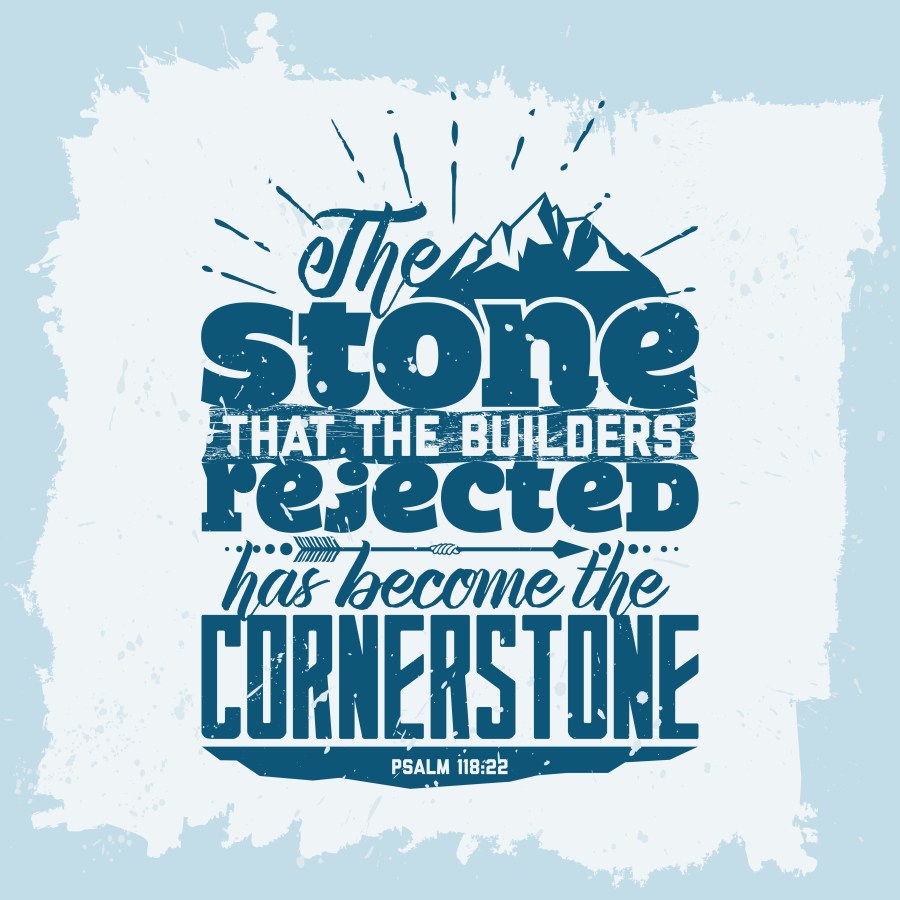
But chosen, gathered, living stones building something together. And not only that, “the stone the builders have rejected have become the cornerstone”— which is a quote from the 118th Psalm declaring that those who are despised and rejected in this world are actually the most vital and foundational part of what God intends to build in this world.

Literally, a cornerstone is the first stone set in the construction of a masonry foundation, crucial for aligning and balancing the entire structure.

Figuratively, a cornerstone represents a fundamental, indispensable part of something, such as core beliefs, principles, or policies. It is the foundational reference point for an entire structure’s orientation, with all other stones measured against it.

Which means the very ones this world has rejected are the most essential to what God is building.

For those of us who have paid just a little attention in church, it’s not surprising that this Psalm is quoted not only here in 1 Peter, but also by Luke in Acts 4, and by Jesus in all four gospels, as this cornerstone principle conveys a divine pattern that runs all the way through scripture. When God builds in this world, God always builds from the bottom up.

When God wanted to call a people, God didn’t go to the center of power. God went to Abraham and Sarah—wandering, aging, convinced they had nothing more to offer.

When famine threatened survival, God worked not through the Pharoah, but through Joseph—the brother who was betrayed, imprisoned, and cast aside.

And when God heard suffering, it wasn’t the cries of Pharoah, but the cries of an enslaved people. “I have seen their misery… I have heard their cry” (Exodus 3:7). God chose the side of the oppressed, not just to comfort them, but to liberate them.

And when those liberated people obtained power and began shaping a society, God gave them a command: Don’t forget where you came from. Don’t forget the poor. Care for the widow. Defend the orphan. Don’t oppress the stranger. Don’t mistreat foreigners residing in your land, but rather treat them as native-born citizens and love them as you love yourself. Build a world that does not recreate the harm you escaped.

But as soon as they got a little bit of power, they forgot. And to remind them, God sent prophets who truth to power: “Woe to those who trample on the needy.” “Woe to those who build their houses on injustice.”

Because God is never neutral when people are suffering. God is always on the side of the oppressed and the rejected. Not only consoling them but calling them to organize to build something better.

Over and over, scripture reveals a God who calls the unlikeliest of people:

Moses—a fugitive, slow of speech—but called to confront the empire.

Deborah—a woman chosen by God in a world that discounted her.

Gideon—fearful, from the weakest clan.

Ruth—a foreign widow, gleaning scraps, woven into the story of kings.

Hannah—barren and dismissed, who sang of a God who lifts the lowly from the dust.

David—a shepherd boy, overlooked and left in the fields.

Again, and again, God chose the stones rejected by the powers-that-be. Whenever the world was most broken, most in need of a reconstruction, when people were exiled, displaced, stripped of identity, God spoke into their displacement, promising not just a return, but a rebuilding from the ruins, not from the top down, but from the bottom up.

The story of Jesus is but a continuation of this divine pattern. When God became flesh, God didn’t come through a palace. But through a young, poor, unmarried woman living under empire, named Mary.

And she sang: “God has brought down the powerful from their thrones and lifted up the lowly.”

In Jesus’ first sermon, this divine pattern is unmistakable: “The Spirit of the Lord is upon me,” he says, “because he has anointed me to bring good news to the poor.

And look at who Jesus gathers around him: The poor, the sick, the excluded. And to them, Jesus says: “Blessed are you.” And he doesn’t stop there. He gathers them and builds a movement. He takes the rejected stones and begins constructing a new kind of community: a community where the last are first, dignity is restored, and love becomes the structure.

So, when Peter says: “You are a chosen race, a royal priesthood, a holy nation, God’s own people,” we know who he’s talking about. He is talking about a scattered, struggling, rejected people. And Peter says: “You are the ones God is building with.”

Now, let’s bring that word into our moment. Because people are still being rejected.

The poor are dismissed. Workers underpaid. Immigrants dehumanized. The trans community demonized. The unhoused pushed out of sight.

The message to them is: “You don’t belong.” “You don’t count.” “You will not be accepted.” “You will not have any part constructing our society, building this nation.”

Yet, scripture says: “You are chosen.” And not only are you chosen, you are the cornerstone of the building, the most fundamental, most indispensable part of it.

This is where the language of Reconstruction in America begins to sound less like history and more like prophecy.

The First Reconstruction took place when poor Black and white people came together after the Civil War to expand democracy, to build an interracial government, to build new schools, to reimagine what this country could be.

And then the backlash came. Jim Crow was born. The stones were rejected again.

The Second Reconstruction, the Civil Rights Movement, took place when ordinary people, many poor and dismissed, stood up and declared their dignity in the face of violence and oppression. And again, progress came. But resistance followed. Resistance that we are still witnessing today as many of the gains made during the Civil Rights movement have been reversed. Jim Crow didn’t die, it just rebranded itself as “Make America Great Again.”

And now we find ourselves asking: Is there a Third Reconstruction on the horizon? And if so, who will build it?

If scripture is any guide, it will not begin in places of wealth and power. It will begin with people who have been pushed out: the poor; the marginalized; the rejected. Because they are the ones who know something about both suffering and hope.

And here’s the word that comes back to us 2 Chronicles: “Humble yourselves.”

Not just in a profession of faith. But in a proximity of faith. Not just in words. But in solidarity, in action. Because Peter doesn’t just say, “You are living stones, period.” He says, “let yourselves be built.”

The fundamental question for people of faith is this: Are we are willing to be aligned alongside those the world has rejected? Will follow the leadership of those who are suffering today? Will we join what God is building?

Because that’s humility. And that’s how a new house gets built. That’s how healing happens.

And yes, that kind of building will cost something. Because when you make the rejected the cornerstone, the most important part of the building, you challenge systems that depend on their rejection. That’s why this kind of gospel makes people stumble (verse 8).

But here’s the hope. It’s not easy hope. But it’s real hope: “You once were not a people, but now you are God’s people.” Which means: What has been scattered can be gathered, and what has been rejected can become the foundation.

So, hear this:

Maybe the Third Reconstruction is not something far off. Maybe it is already beginning: in movements for living wages; in communities organizing for healthcare; in silent vigils for peace; in pop-up protests on the side of the highways against the mistreatment of immigrants; in people with whistles protecting their immigrant neighbors; in people refusing to give up on one another; in the quiet but courageous work of solidarity.

Church, this is where we are called to step it. To humble ourselves, to build with those the world has rejected.

And if we dare to do that, if we dare to live that, the nation can heal and a new house will rise.

Built not on exclusion, but on belonging.

Built not on supremacy, but on equality.

Built not on scarcity, but on justice.

Built on compassion instead of cruelty, and on love instead of fear.

A house will rise where the stones that have been rejected are valued, important, the foundational reference point for the entire house’s orientation.

A house that will stand.

Because it is built the way God has always built in this world: with people who humble themselves and build, not from the top down, but from the bottom up.

Amen.


Pastoral Prayer

Holy and Living God,

You are the One who hears what the world ignores.

You are the One who sees what others pass by.

You are the One who gathers what has been scattered

and builds what has been broken.

We come before you today bringing all that we are.

We bring our gratitude:

for signs of hope we have witnessed this week;

for neighbors caring for neighbors;

for courage rising in unexpected places;

for love that refuses to give up.

We bring our grief:

for a world that still wounds so many;

for those living without enough food, enough care, enough rest;

for communities burdened by injustice;

for those who feel invisible, expendable, forgotten.

We bring our own hearts:

tired in some place; guarded in others, and still longing to be part of something more.

God of mercy,

You call us to humility, not just in word, but in life. So we ask:

Bend our lives toward your justice.

Draw us closer to those we have kept at a distance.

Open our eyes to where you are building

and give us courage to join you there.

We pray for those who are suffering today:

for the sick, the grieving; the anxious; the overwhelmed.

For all who are on our hearts and on our prayer list.

Be near to them, O God.

We pray for those organizing, resisting, and rebuilding

often without recognition, often at great cost.

Strengthen them. Sustain them. Surround them with hope.

And we pray for ourselves

that we would not settle for a faith that is comfortable,

but would seek a faith that is faithful.

A faith that follows you

into the places where healing is still needed.

Into the communities where dignity is still denied.

Into the work of building a more just and loving world.

Gather us, O God, as living stones. Shape us. Place us. Use us.

We pray all of this in the spirit of Jesus, Amen.


Invitation to Communion

This table is not built by human hands alone.

It is set by a God who gathers the rejected and calls them beloved.

This is not a table for the perfect. This is not a table for the powerful.

This is a table for those who hunger—for bread, for justice, for belonging.

Here, the last are welcomed first. Here, the overlooked are seen. Here, the broken are made whole.

So come—not because you have it all together, but because God is still putting us together.

Come as living stones, ready to be shaped into something new.

Come, for all is ready.


Invitation to the Offering

What we offer today is more than money. It is a declaration.

A declaration that we believe in a different kind of world. A declaration that we trust God is still building—and that we want to be part of that work.

So, we give—not out of obligation, but out of hope.

We give to support ministries of compassion and justice, to stand alongside those too often pushed aside, to help build a community where all can flourish. So, as you give, consider this:

Where is God building in our world? And how might what I offer today help strengthen that work?

Let us give generously, as people who are being built into something beautiful together.


Commissioning and Benediction

Go now, not just with heads bowed, but with lives bent toward justice.

Go as living stones, shaped by grace, placed with purpose, and joined together in love.

Go to where God is building: among the poor; alongside the marginalized;

in the very places the world has overlooked.

And as you go, remember: The stone the builders rejected has become the cornerstone.

Which means:

what has been cast aside can rise, what has been broken can be rebuilt,

and what has been dismissed can become the foundation of something new.

So, go with courage to stand where God stands,

with humility to walk alongside others,

and with hope that will not let you go.

And may the God who builds from the bottom up

hold you, guide you, and use you, now and always.

Amen.

We Had Hoped

Luke 24:13-35

There is a particular kind of sentence that only comes from heartbreak. We find it in verse 21 of our gospel lesson, and it starts like this: “We had hoped…”

It’s the kind of sentence you hear when dreams collapse under the weight of reality. It’s whispered in hospital rooms, at funeral homes, often in conversations that trail off into silence. It’s the language of people who believed something good was possible, but then watched it all fall apart.

“We had hoped…” Things would be different. The diagnosis and the prognosis, the outcome and outlook for the future was better.

Two disciples are walking away from Jerusalem, walking away from the place where everything unraveled, walking away from the cross, from the chaos, from the confusion.

And as they walk away from it all, they talk: about what happened; about what went wrong; about how it all fell apart; about how mercy was beaten down, and love was crucified.

“We had hoped he was the one to redeem Israel.” We had hoped to be liberated from King Herod and from the systems that bless the elites while the poor suffer.

“We had hoped…” Past tense. Because hope had been buried.

And if we’re honest, that sentence doesn’t belong only to them. It belongs to us too.

For we know what it is to say, “We had hoped…”

We had hoped things would not be this bad.

We had hoped we would not go to war.

We had hoped that truth would matter.

We had hoped that the teachings of Jesus to love one another, to bless the poor, to defend the marginalized, to welcome the stranger, would have been followed by more people.

We had hoped that our friends were not betrayers.

We had hoped justice would come a little quicker and peace a little closer.

We had hoped that what we believed about love—that it is stronger than hate, deeper than fear, and more powerful than violence—would be easier to see in our world. And we had hoped that selfishness, greed, hatred, and just pure meanness, would not be so prevalent…and so powerful.

But here we are, walking our own roads to Emmaus, grieving that every time we look at the news, we read something crazy: something mean; something evil. We are also carrying grief we can’t always name, questions for which we don’t have answers, and anxiety that keeps us awake at night.

And like those disciples, we don’t always realize who is walking beside us, who has been walking with us all along.

The good news of our gospel lesson is that somewhere between Jerusalem and Emmaus, Jesus is present. Not in spectacle. Not in certainty. Not in the kind of power the world recognizes. But in quiet companionship.

He draws near to them. So near, they can reach out and touch him. And the strange thing is—they don’t recognize him. Which might be the most honest part of the whole story.

Some people tell me that they have trouble believing in this mystery we call resurrection. They read about it in the gospels, but they have trouble trusting it in the real world.

I believe that is because resurrection rarely looks like what we expect. It doesn’t always arrive in a blinding light or with a clap of thunder. Sometimes, it comes disguised as a conversation; It shows up as empathy, as a presence that won’t let us go, as a voice meeting us where we are, asking questions:

“What are you discussing as you walk along?”

Jesus is not interrupting their grief, as much as he’s joining it. He lets them tell the story. He listens to their disappointment. He holds space for their “we had hoped…” And then, and only then, he begins to reframe it.

Not by denying their pain or rushing them past it. But by reminding them that the story isn’t over yet.

He opens the scriptures. He re-tells the story they thought they knew.

He shows them that what looked like an ending…was never meant to be the end.

And still, they don’t recognize him. Not yet.

Because sometimes our hearts need to change before our eyes can see it. They ask: “Were not our hearts burning within us while he was talking to us on the road?”

That’s resurrection, too. Resurrection is not just empty tombs. It’s burning hearts. It’s not just life after death. It’s hope rekindled in the middle of a dark journey. It’s the realization sung by Raye in the Click Clack Symphony with Hans Zimmer that although we’ve “slipped back into a darkness we had hoped by now to overcome…the cold never lasts. It just teaches the heart how to burn.”

Finally, the disciples reach Emmaus, the place they thought they were going to stay, the place they had finally arrived to get away from it all.

But something has now shifted. “Stay with us,” they say. Because when resurrection gets close, even if you don’t fully understand it, you don’t want it to leave.

So, he stays. They sit at the table. He takes bread. He blesses it, breaks it, gives it. And suddenly, their eyes are opened, and they finally recognize him.

Not on the road. Not in the explanation. Not even in the opening of the scriptures. But in the breaking of bread. In a most ordinary act, made holy. In a moment so simple it could have been overlooked. Resurrection was experienced in fellowship, in community, around a table in an empathetic moment of grace and love.

And look at verse 31 again. Just as quickly as they recognize him, he vanishes. It all happens in one verse.

Which might seem cruel, until we realize: The Risen Christ doesn’t vanish as soon as he is recognized because he is no longer in the world. He vanishes because he is no longer limited to one place, to one moment, to one form. Now, the disciples will see him everywhere! In every broken piece of bread given. In every act of grace. In every moment where love refuses to stay buried and is shared freely.

And here’s the real miracle: They turn around. These same disciples who were walking away from it all, who were done, who were finished, who were at closing time—they get up that very hour and go right back to all. Back to Jerusalem. Back to the place of disappointment. Back to the place of pain. Back to the place where hope seemed to die.

But they go back differently. Not because everything has suddenly been fixed. Not because Herod is no longer on the throne. Not because the world has stopped being that crazy. They go back differently because resurrection has found them on a dark road. And once resurrection finds you, you can’t keep walking in the same direction.

That’s the hope of Easter.

Not that the world has suddenly become easier. Not that suffering has disappeared, or injustice has ceased. Not that every “we had hoped” is instantly resolved.

But that Christ is still walking with us, even when we don’t recognize him. That the story is still being told, even when it feels like it has ended. That hearts can still burn, even when hope feels cold. And that around a table, in the breaking of bread, in the sharing of life together, in the stubborn persistence of love, eyes can still be opened.

So, if you find yourself today on the road to Emmaus, if you are carrying disappointment, or confusion, or quiet grief…if your faith feels more like past tense than present reality…listen closely. Look around this room. Feel the love around you, the empathy that surrounds you.

There is a presence walking beside you this morning. Asking questions. Telling stories. Refusing to let the darkness have the last word. And maybe, just maybe, before this day is over, at some table, in some ordinary moment, your eyes will be opened too. And you will discover what the disciples did:

That resurrection meets us on the road. It sits with us in the tension. It breaks bread in the middle of our unfinished stories. And then it sends us back—

Not as people who have all the answers, but as people whose hearts are burning, carrying a hope that refuses to stay in the past tense. Because in Christ, “We had hoped” becomes “We have seen.” And that is enough to turn us around.

Not because we are strong enough, but because resurrection is. Easter is God’s declaration that even when empire does its worst, even when violence seems to have the final say, even when hope is sealed in a tomb, that is not the end of the story.

And if that is true, then we are not called to survive this moment quietly. We are called to face it. To resist it. To fight it.

But not with the weapons of the world. Not with hatred. Not with fear. Not with the same kind of power that crucified Jesus. We fight it the way the risen Christ teaches us: with truth that refuses to bend; with love that refuses to give up; with courage that refuses to be silent; with a community that refuses to let anyone walk the road alone.

We fight it every time we tell the truth when people prefer to hear the lie, every time we choose generosity in a culture of greed, every time we protect the vulnerable in a world that exploits them, every time we refuse to let religion be used as a tool of exclusion instead of liberation.

That’s what it means to be Easter people. Not people who escape the world, but people who are sent back into it.

Back to Jerusalem. Back to the places where things are broken. Back to the systems that need disrupting. Back to the communities that need healing. Back into a country that needs redeeming.

Because resurrection doesn’t remove us from the struggle. It prepares us for it. It steadies our hearts. It sharpens our vision. It reminds us who we are: we are people who have seen something.

Maybe not perfectly. Maybe not with absolute certainty.

But enough to know this: Love is still alive! Truth is still worth telling! Justice is still worth pursuing. And no empire, no ideology, no distortion of faith gets the final word.

War rages, but this is not the end of peace. This is where peacemakers rise.

Religious nationalism is in power. But this is not the end of democracy. This is where courage finds its voice.

Hate is loud. But it is not the end of love. This is where love becomes unrelenting.

The road to justice is long, and it is not easy, but Easter means we do not walk this road alone. It means our hearts can still burn. It means our eyes can still be opened. It means we can still turn around.

And it means that even now, in a world that feels like it is unraveling, God is still at work, Christ is still present, and resurrection is still breaking in.

So go back. Back to the places that need hope the most.

Go back. Not as people who are afraid of this moment, but as people who were made for it. Because we are Easter people. And the story is not over yet! Amen.


Pastoral Prayer

God of the road and the table,

we come to you as we are.

Some of us weary from the journey,

some of us carrying grief we cannot name,

some of us holding hope with trembling hands.

You know the roads we have walked this week—

the conversations that have stayed with us,

the headlines that have unsettled us,

the quiet fears we have not yet spoken aloud.

And still, you draw near.

You do not wait for us to have clarity or certainty.

You meet us in our questions,

you walk with us in the chaos,

you listen as we share our heartache and heartbreak.

So today, O God, rekindle in us a living hope.

Where there is despair, breathe your life.

Where there is fear, steady our hearts.

Where there is cynicism, awaken in us a deeper trust.

We pray for a world that feels fractured—

for places where war rages and peace feels distant,

for communities burdened by injustice,

for leaders and systems that have failed the lives of so many.

Give us courage to be people of truth and justice.

Give us strength to resist what diminishes your image in others.

Give us grace to love all people, as we love ourselves.

We lift before you those in need of healing—

in body, in spirit, in relationships that feel beyond repair.

Be present, O Christ,

in hospital rooms and living rooms,

in moments of waiting and in moments of fear.

And remind us, again and again, that we do not walk alone.

That even now, you are with us.

We pray all of this in the name of the risen Christ,

who meets us on the road and is known in the breaking of bread. Amen.


Invitation to Communion

This is not a table for the certain, for those who have everything figured out.

This is the table where Christ meets us—

on the road, in our questions, in our unfinished faith.

It was in the breaking of bread that their eyes were opened.

Not because they understood everything, but because Christ was present.

So, all are invited to partake.

Partake if your hope feels strong or if your hope feels fragile.

Partake if you are still searching, still wondering, still walking.

Because this is the table where Christ is made known.


Invitation to Give

The disciples did not recognize Christ at first, but their hearts were already changing.

That’s how it is with grace. It meets us, it stirs us, and it begins to turn us outward.

So, we give, not out of obligation, but as a response to the One who has walked with us, who has opened our eyes, who sends us back into the world with purpose.

In a world shaped by scarcity and fear, our giving becomes an act of trust.

In a culture of taking, our generosity becomes a witness.

So let us offer our gifts, as signs of hope, as acts of resistance, as participation in God’s ongoing work of love.

Commissioning and Benediction

Go now—

not as those who have all the answers,

but as those whose hearts have been set ablaze.

Go back to the places you came from,

back to your homes, your work, your communities,

knowing that Christ goes with you.

When the road feels long, when hope feels distant, when you struggle to see, remember:

Christ is still drawing near.

Christ is still being made known.

Christ is still turning us around.

So go in courage. Go in compassion. Go in the unrelenting hope of Easter.

And may the love of God, the presence of Christ, and the power of the Spirit go with you, now and always.

Amen.

Love Gets the Last Word

John 20:1-20

Before the sun had the decency to rise, before hope had any real evidence to stand on, Mary Magdalene ran. Not casually walked. Not carelessly wandered. Not cautiously approached. Mary ran.

Because when love has been crucified, when dreams have been buried, when the world as you knew it has collapsed in on itself—grief does not move slowly or carefully. It rushes. It assumes. It fills in the blanks with the worst possible story: “They have taken the Lord out of the tomb, and we do not know where they have laid him.”

That’s what grief says.

Not, “He is risen.”

Not, “God is doing a new thing.”

Not even, “Let’s wait and see.”

No. Often in a downward spiral, grief concludes: “They have taken him.”

Things are bad, and it’s only going to get worse. When it rains, it pours. And we better get out the buckets cause the roof is going to leak.

It is the most human response in this broken world: to assume that what we love the most has been stolen, taken away, destroyed, and erased. And it is not coming back.

And if we’re honest on Easter Sunday 2026, we know that feeling.

Because we are living in a moment where it is easy, almost natural, to assume the worst. It is what we assume every time we check the headlines.

No one expects to turn on the news these days and hear: Good news! Things are not as bad as they seem! Good news! Better days are coming.

No, these days, we expect only news of despair. The secretary of defense calls himself the secretary of war and calls the hell that is war, “holy,” and uses religious language to bless overwhelming violence. Here at home, gas prices are still rising. Grocery bills continue to climb. Families sit at kitchen tables doing math that does not add up. All the while White Christian Nationalism is suffocating democracy. History is being whitewashed. And we wonder about the next election, if there will even be a next election. And we ask: Has the country we love been taken from us. And in the quiet spaces of our hearts, a question forms:

Has hope been taken from us too? Has something sacred been stolen from our lives?

And like Mary, we rush to conclusions. “They have taken…” They have taken our peace. They have taken our security. They have taken our freedom. They have taken our future.

The good news today is that Easter interrupts our assumptions. Because what Mary thinks has happened is not what God is actually doing. She comes to the tomb expecting death to have the final word. Instead, she finds confusion. She finds what seems like absence.

But what she really finds is mystery. And if we’re not careful, we will mistake the mystery of God for the absence of God too.

Early in my ministry, I remember sitting at a hospital bedside, the kind of room where the machines speak more than the people. A family gathered, holding hands, passing a tissue box to wipe tears, praying prayers that felt like they were bouncing off the ceiling. One of them finally said what everyone else was thinking but didn’t want to say it out loud: “Where is God in this?”

Not in anger. Not even in disbelief. Just…exhaustion, just grief. Because sometimes the silence of God feels like abandonment. Sometimes the unanswered prayer feels like absence. Sometimes the delay feels like denial.

And in that moment, there was no lightning bolt. There was no sudden turnaround. No miracle that tied everything up neatly. Just breath. Just presence. Just people refusing to let one another be alone.

And I remember realizing—almost against my will—that maybe God had not stepped out of the room.

Maybe God had simply refused to show up on our terms. Maybe the mystery of God is not that God is absent, but that God is present in ways we do not yet recognize. Present in the quiet grip of a hand. Present in the tears that fall without shame. Present in the stubborn love that keeps showing up even when hope feels thin.

We want a God who explains everything. But more often, we encounter a God who accompanies us through anything.

And that kind of presence—it doesn’t always feel like power. Sometimes it feels like weakness. Sometimes it feels like waiting. Sometimes it feels like an empty tomb before you understand what empty really means.

The good news of Easter is: just because we cannot see God clearly does not mean God is not working deeply. The mystery is not God’s absence. The mystery is that God is already at work—in the dark, in the silence, in the in-between—bringing life out of places we had already declared dead.

Let’s get back to our gospel lesson, for the story is getting ready to take to turn.

Peter and the beloved disciple run to the tomb. They see the linen cloths. They don’t fully understand—but something in them shifts. The story is not over.

And then Mary, still weeping, encounters a gardener…or so she thinks. “Woman, why are you weeping? Whom are you looking for?” She is still operating out of her assumption: “They have taken him.”

Until he speaks her name: “Mary.” And everything changes.

This is the Easter truth we are invited into today: We are often wrong about how the story ends.

We assume God is not present when God is standing in front of us.

We assume loss when God is working resurrection.

We assume absence when God is preparing revelation.

We assume death has won when love is already rising.

As Rev. Dr. William Barber reminds us in his prophetic witness, “We must learn to see not just the pain of the present, but the possibility of redemption breaking through it.”

Easter is not naïve optimism. It does not ignore the cross. It does not pretend that violence, injustice, and suffering are not real.

No. Easter stares the powers of death in the face and declares: You do not get the last word!

Not war. Not “overwhelming violence.” Not religious nationalism.

Not greed. Not lies. Not systems that crush the poor, while protecting the powerful. Not even the grave itself. The good news of Easter is that love gets the last word.

But here’s the thing—we don’t always recognize resurrection right away. Mary doesn’t. She mistakes Jesus for the gardener. Which, if you think about it, is not entirely wrong.

Because resurrection is a kind of gardening. It is God tending to what has been buried. It is life pushing up through the soil of despair. It is beauty growing in places we had already written off as dead.

And maybe that’s what we need to hear this Easter: That even now—especially now—God is at work beneath the surface.

In communities organizing for justice.

In neighbors caring for one another when systems fail.

In courage rising up in unexpected places.

In love refusing to give up.

In people who have gathered on a rainy Sunday morning with the audacity to believe that something happened on that day Mary ran to the tomb, something mysterious happened that we call resurrection.

We may not understand it. We may never wrap our minds around it. But I don’t believe that is important. What is important is that we live it. It’s even more important than believing it.

Jesus says to Mary, “Do not hold on to me… but go.”

Go tell the others. Go bear witness. Go live as if love actually has the final word in this world.

And that’s the invitation of Easter for all of us.

In a world quick to assume the worst, we become people who dare to hope anyway. In a culture shaped by fear, we become practitioners of love. In a nation that chooses violence to get its way, we choose a life of nonviolence while praying, not my will, but God’s will be done. In the face of systems that profit from despair, we become witnesses to resurrection.

Not because things are not as bad as they seem.

Not because better days are right around the corner.

Not because life in this world is suddenly going to become easy.

But because Christ is somehow, some mysterious way, risen.

And that changes everything.

So, the next time you feel that familiar rush of fear, the next time your heart wants to say, “They have taken…”—

Pause. Breathe. And listen.

Because resurrection often begins with a voice calling your name.

Reminding us:

What you thought was gone is not gone.

What you thought was over is not over.

What you thought was lost is only being redeemed.

Hate does not get the final word. Violence does not get the final word. Despair does not get the final word.

Love does. It always has. It always will.

Alleluia. Alleluia.

Amen.


Pastoral Prayer

Risen Christ,

we come to you this morning carrying everything—

the joy we can name

and the weight we cannot quite put into words.

We come like Mary,

early in the morning,

still holding our assumptions,

still wondering if something sacred has been taken from us.

And yet, you meet us here.

So we pray—

not as people who have it all figured out,

but as people who are learning to trust you in the mystery.

God of life,

we lift before you a world that feels fragile.

We pray for places torn by war,

for lives caught in the crossfire of decisions made far from their homes.

We pray for wisdom where there is power,

for restraint where there is anger,

for courage where there is fear.

Let your peace rise where violence threatens to have the final word.

We pray for those feeling the pressure of rising costs—

for families stretching every dollar,

for workers carrying quiet anxiety,

for those who must choose between what they need and what they can afford.

Be bread in empty places.

Be provision where there is not enough.

Be hope where worry has taken root.

We pray for those gathered here and those we carry in our hearts—

for the sick and the recovering,

for the grieving and the lonely,

for those facing decisions, diagnoses, and uncertain futures.

Risen Christ,

meet them as only you can—

not always with easy answers,

but with your unmistakable presence.

Call their names in the darkness.

Remind them they are not alone.

Hold them in a love that does not let go.

God, teach us to be people of resurrection—

not just in what we believe,

but in how we live.

Where there is despair, make us bearers of hope.

Where there is division, make us builders of community.

Where there is injustice, make us seekers of your righteousness.

And when we are tempted to assume the worst—

to believe that love has been taken,

that hope has been buried,

that the story is over—

call our names again.

Turn us around.

Open our eyes.

Send us out.

We pray all of this in the name of the risen Christ,

who taught us to pray, saying:

Our Father…

Amen.


Invitation to Communion

This table is not for those who have it all figured out.

This is not a table for those who never doubted, never feared, never assumed the worst.

This is a table for Marys who come weeping. For disciples who run but do not yet understand. For people who have whispered, “They have taken…”

and are still learning how to say, “He is risen.”

Because at this table, we do not receive certainty—we receive presence. Bread that tells us God is still with us. Cup that reminds us love has already been poured out—and it has not run dry.

In a world where so much feels taken—peace, stability, freedom—this table declares: what God gives cannot be stolen.

Here, Christ meets us—not always where we expect, but always where we need.

So, come.

Come with your questions. Come with your grief. Come with your fragile hope.

Because the risen Christ is still calling our names, still breaking bread,

still reminding us:

Love does not lose. Love does not end. Love gets the last word.


Invitation to the Offering

In a world shaped by scarcity, we are taught to hold tight—

to protect what we have, to fear there won’t be enough.

But Easter tells a different story.

A story where life comes out of what was given away.

A story where love multiplies when it is shared.

A story where even what seemed lost is gathered up and redeemed.

So, we give—not because the world is secure,

but because God is faithful.

We give as an act of resistance

against fear, against greed, against the lie that death has the final word.

We give as a testimony:

that we believe in a God who is still bringing life out of empty places.

So let us offer our gifts, our lives, and our trust—

knowing that in God’s hands, nothing given in love is ever wasted.


Commissioning and Benediction

Go now into a world that will tempt you to assume the worst.

Go into places where fear speaks loudly,

where uncertainty lingers,

where it feels like something sacred has been taken.

But do not go as people of despair.

Go as those who have heard their name spoken by the risen Christ.

Go as those who know the tomb is empty—

not because nothing happened,

but because God happened.

And when you cannot see clearly,

when the mystery feels like absence,

remember:

God is still at work. Love is still rising. Hope is still alive.

So go—

to love boldly, to serve courageously, to live as witnesses to resurrection.

And may the God who brings life out of death,

the Christ who calls you by name,

and the Spirit who sustains you in every mystery

go with you, now and always.

Amen.

Holy Surprises at Sunrise

Invocation

Risen Christ,

you who meet us in the in-between,

on roads marked by uncertainty,

in moments we did not plan,

in places we did not expect,

draw near to us now.

As the light breaks over this new day,

break into our hearts again

with a hope we cannot control

and a joy we cannot contain.

Where we have given in to despair,

speak your living word.

Where fear has taken hold,

breathe your peace.

Where grief has settled deep within us,

call us again by name.

Meet us here—

not when we have it all together,

not when we have finally arrived,

but here, on the way—

and remind us

that we are not alone.

Open our eyes to your presence,

our ears to your voice,

and our hearts to your love,

that we might rise with you

to walk in newness of life.

For the dawn has come,

and still you come to us—

alive, unexpected,

and full of grace.

Amen.


Sermon

Matthew 28:1-10

Before the sun has fully risen…before certainty has returned…before the world has made sense again…two women are walking a road between grief and hope.

Mary Magdalene and the other Mary have come to a tomb carrying all the weight that comes with loving something the world has taken from you. They are not expecting resurrection. They are expecting silence. Finality. An ending.

And yet—the earth shakes, the stone rolls, and an angel speaks:

“Do not be afraid… He is not here… He has been raised… Go and tell… He is going ahead of you to Galilee; there you will see him… This is my message for you.”

It is a word meant to steady them. A word meant to give direction. A word meant to move them forward. Go to Galilee. That’s where resurrection will be.

And so, they go—afraid, yes, but also filled with great joy. Because even a trembling hope is still hope. But here is where the story surprises us. Because they don’t make it to Galilee. Somewhere on the road—before they arrive, before they figure it all out, before they get where they thought they needed to go—the Risen Christ meets them.

Not in Galilee. Not at the destination. But in the in-between. “Greetings,” he says. And suddenly the promise is no longer distant.

The hope is no longer deferred. The risen Christ is standing right in front of them. Which raises a holy, unsettling question for us this morning: What do we do with the fact that the angel said one thing…and yet, Jesus showed up somewhere else?

“You will see him in Galilee. This is my message for you,” the angel declared.

And yet, the risen Christ had his own way of arriving.

Maybe the angel wasn’t wrong. Maybe Galilee still matters. But if what this moment reveals is something deeper?

That even the messengers of God cannot map out all the places resurrection will break in. Even angels don’t get to control where new life appears. And if angels don’t know…then we certainly don’t.

Which means…hear this clearly this Easter morning: We cannot predict where Christ will show up. We cannot confine resurrection to a location. We cannot limit hope to what seems likely or reasonable.

And because of that, we can never give in to despair. Not now.

Not ever. Because despair depends on certainty.

Despair says:

“This situation is too far gone.”

“This violence will never end.”

“This division is permanent.”

“This grief will define the rest of my life.”

“This world is too broken to be redeemed.”

Despair pretends it knows the final chapter. But Easter interrupts that illusion. Because if the risen Christ can show up anywhere—on any road, in any moment, in any life—then despair loses its authority.

If the risen Christ does not even follow the directions given by angels…then there is no place left where hope cannot break in.

Not in a world at war.

Not in economies that strain and stretch families thin.

Not in communities fractured by fear and suspicion.

Not in the quiet, private griefs we carry that no one else sees.

Not even there. Especially there.

The women set out for Galilee thinking that hope was waiting for them down the road.

But they discovered that resurrection was already on the road with them. And maybe that is the word we need this morning.

We are always being told where hope is supposed to be.

“Things will get better when…”

“Peace will come if…”

“Joy will return once…”

We keep placing resurrection somewhere out ahead of us—

in Galilee.

But Easter says: Lift your eyes. Because Christ is not only waiting at the destination. Christ is meeting you in the middle.

On the road of uncertainty. On the road of grief. On the road between what has been and what will be.

“Greetings,” he says. And notice what the women do. They don’t analyze. They don’t debate. They don’t question whether this fits their expectations.

They fall at his feet. They take hold of him. They worship.

Because when resurrection meets you on the road, the only appropriate response is to cling to it. To trust it. To let it reorder what you thought you knew about what is possible.

And then Jesus says something that echoes the angel, but deepens it: “Do not be afraid… Go and tell my brothers…” Do not be afraid. Because fear and despair are close cousins.

Fear says: “We don’t know what’s coming.”

Despair says: “And whatever it is, it won’t be good.”

But resurrection says: You don’t know what’s coming—and that is precisely why you can hope. Because God is not limited to the outcomes you can imagine.

If Christ can appear where he was not expected, then new life can emerge where we have already given up looking.

If Christ can meet them on the road, then Christ can meet us here.

Here, in this fragile morning light, in this aching and beautiful world, in this moment that feels both heavy and holy.

And so, we go on. Like those women—with a strange mixture of fear and great joy.

We go on without having all the answers.

We go on without knowing exactly where resurrection will appear next.

We go on without the certainty we often crave.

But we also go on with this unshakable truth: Christ is risen. And because he is risen, hope is no longer confined.

It is loose in the world. Unpredictable. Uncontainable. Showing up where it shouldn’t, breaking in where it wasn’t planned, meeting us on roads we never expected to be holy.

So, we can never give in to despair. Not because everything is already fixed—but because resurrection refuses to stay where we put it.

Not because the world is easy—but because Christ is alive within it.

Not because we know what comes next—but because we don’t.

And somewhere—on some road you are walking even now—

the risen Christ is already drawing near. “Greetings,” he says.

Do not be afraid. Christ is risen. And he is already on the way.


Invitation to Communion

This is not a table for those who have it all figured out.

This is not a meal for those who know exactly where Christ will appear.

This is a table for travelers:

for those on the road between fear and hope,

for those who are still making their way to Galilee,

for those who have known grief, and yet dare to move forward.

Because the good news of Easter is this:

Christ does not wait only at the destination.

Christ meets us along the way.

So, partake.

Not because you are certain,

but because you are hungry.

Not because you have arrived,

but because Christ is already here.

Communion Prayer

Risen Christ,

we give you thanks this morning

for meeting us where we are—

not where we thought we needed to be.

You met the women on the road,

in their fear and their joy,

in their uncertainty and their hope.

And you meet us here.

In bread and cup,

in simple elements,

you come close again—

not distant, not delayed,

but present.

Pour out your Spirit upon us

and upon these gifts of bread and cup,

that they may be for us your life,

your love,

your resurrection.

And make us your body in the world—

a people who do not give in to despair,

a people who look for you

not only in the expected places,

but in every road we walk.

When we leave this table,

send us out with courage—

to trust that you are already ahead of us,

and already beside us,

and somehow, always still surprising us.

We pray in the name of the risen Christ,

who meets us and calls us forward.

Amen.


Easter Proclamation

One: When fear tells us the story is over—

Many: Resurrection is already on the move.

One: When grief convinces us all is lost—

Many: Christ meets us on the road.

One: When we do not know where hope will come from—

Many: We trust the God who surprises us.

One: When despair claims the final word—

Many: We proclaim life stronger than death.

One: Christ is not confined to where we expect—

Many: Christ is alive and already among us!

One: Christ is risen!

Many: Christ is risen indeed! Alleluia!

Benediction

Go now into this Easter morning—

not with all the answers,

but with a living hope.

Go knowing that Christ is not confined

to where you expect to find him.

Go trusting that on every road you walk,

in every place you fear hope cannot reach,

the risen Christ is already drawing near.

So do not be afraid.

And do not give in to despair.

For Christ is risen—

not only at the destination,

but all along the way.

And wherever you go,

he will meet you there.

Amen.