Remember Your Baptisms!

Baptism

Romans 6:1-5 NRSV

I love a baptismal service on Easter Sunday morning! I love it, because I believe one of the greatest things we can do on Easter Sunday morning is to listen again to the words of the Apostle Paul that are etched onto our baptistery, and remember our baptisms!

As a pastor who has been blessed with the opportunity to remember many baptisms, I will never forget one particular Sunday I walked into the waters of a baptistery like ours.

It was the Sunday after Hurricane Floyd flooded the first house Lori and ever purchased in eastern North Carolina.

I had been wading in waist deep water that Thursday and all day Friday. And then that Sunday morning, one of the first things that I did was to climb down those steps into waist deep water.

I’ll never forget the first words I spoke.  I looked out into the congregation from that baptistery, and I said, “You know, standing here this morning in waist deep water is the last place I wanted to be this morning.”

But I then said, “But it may also be first place I need to be this morning!”

Before that Sunday, baptismal water had always represented purity and refreshment to me. It was a water which cleansed one’s spirit and refreshed one’s soul. It was a renewing, invigorating water, life-giving water. Baptismal water was to me like the water from a spring welling up into eternal life from which we could drink and never thirst again.

However, on that particular Sunday, that water came to represent to me something more, something dreadful, something heinous, something sinister. That water came to symbolize destruction, despair; it came to symbolize death.

To the church in Rome, the Apostle Paul said: “Remember that you have been buried with Christ by baptism into death.”

You know what this means don’t you?  It means Paul’s house must have flooded too!

Well, probably not. But it does means that Paul understood the destructive forces of sin and evil in our world. It means the apostle Paul understood water to be symbolic of of those chaotic forces, evil forces in our world that seek the drain the very life out of us.

For many of that day, water was a very fitting for symbol for death, as many lost loved ones at sea, folks who who traveled out on the water, encountered a storm and never returned. Therefore, water was something to fear. Water was something to dread.

This is why the picture of Jesus walking on water is so inspiring.  Jesus was doing much more than walking on water. Jesus was walking all over the forces of evil like they did not even exist.

This is why when John gives a list of things which we are not going to find in heaven in the 21st chapter of Revelation, “no more sea,” is the first thing on his list. Before no more crying, no more pain, and no more mourning, John says there will be no more sea. One day there will be no more of anything more to fear or dread.

My hope on this Easter Sunday is that Braylen, Brenden, Ethan, Caden, Ashton, Rhianna, Brooke and Angie will always remember their baptisms—Remember that they who have been buried with Christ into death, have also been raised with Christ to walk in the newness of life.

And may each of us remember our baptisms. May we remember that we went under the water, but may we especially remember that we also came up out of that water.

We came out of the water symbolizing that in this world of evil and sin, with Christ we can be more than conquerors.

We came up out of the water symbolizing that in spite of those who attempt to drain the very life of us, in spite of those who never cease in persecuting us, we can do all things through Christ who strengthens us.

We came up out of the water symbolizing that despite the many storms of life that come our way, death, divorce disease, there is nothing in all of creation: no rulers, no powers, no things present, no things to come, no height, no depth and not even death, that will ever be able to separate us from the love of God through Christ Jesus our Lord.

We came up out of the water symbolizing that in all things, God works for the good for those who love God and are called according to God’s purpose.

We came up out of the water symbolizing that when we face uncertain days, even death, we will possess the grace to always remember our baptisms and the glorious message of Easter that our baptisms proclaim!

Sudden Sunday Surprise

He is not here

Sermon preached at the Easter Sunrise Service, Central Christian Church, Enid, Oklahoma.

Matthew 28:1-10 NRSV

There is no doubt that the surprising events which took place on Friday had left the disciples in a state of shock and disbelief.  The King of the Jews, the Son of God, the one who would finally bring them liberation from the Romans was crucified like a common criminal.  They were all taken off guard as all of their hopes, all of their dreams suddenly vanished.

They found themselves in the same state of mind you and I find ourselves when our lives are often surprised by evil.  When the telephone rings in the middle of the night.  And it is not the wrong number.  When we hear words from our employers like “cutting back, laying off, letting go,” or words from our doctors like “cancer, inoperable, terminal.”

 “No, it can’t be!”  “I don’t believe it!”  “This is not happening!”

Then as Sunday morning was dawning, maybe not part of the original twelve because of the sexism that has been so apparent in the history of humankind, but two of Jesus’ disciples nonetheless, Mary Magdalene and another Mary went to see the tomb, trying to comprehend what had happened, still trying desperately to believe it and somehow accept it.

And then it all seemed to happen again.  For that is how evil works in our world. When evil surprises us it does it in clusters. Some people say that it always comes in three’s. Other say, “when it rains pours.”

And suddenly, suddenly a word which always denotes surprise, shock and awe: there was a great earthquake.

“Not again!”  ‘Please no more.  There is just so much we can stand.”

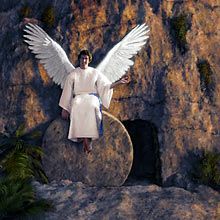
But then in the midst of their confusion, shock, and bewilderment, an angel of the Lord descended from heaven and came and rolled back the stone and sat on it.  It so surprised the guards at the tomb, that they fell down on the ground like dead men.

But the angel said to the women, “Do not be afraid; I know that you are looking for Jesus who was crucified. He is not here. For he has been raised, as he said. Come, see the place where he lay. Then, go quickly and tell his disciples. “He has been raised from the dead, and indeed he is going ahead of you to Galilee; there you will see him.  This is my message for you.”

“So they left the tomb quickly with fear and great joy.”  There’s a paradox, isn’t?  Fear and joy. It lets us know that the women are still somewhat shocked. For they have been saturated with surprise!

Then, “Suddenly,” (there’s our surprising word again).  “Suddenly, Jesus met them and said, “Greetings!”  Surprise of all surprises!  “And they came to him,” and did the only thing they could do, “They took hold of his feet, and worshiped him.”  Then Jesus said, “Do not be afraid; go and tell my brothers to go to Galilee; there they will see me.”

Hold on!  I thought the women were in Galilee. For that is what the angel had said, “He is going ahead of you to Galilee, there you will see him.” The angel even bolsters these instructions by saying, “This is my message to you.” But where do they see Jesus?

They see Jesus somewhere along to road to Galilee.  The angel was wrong.  For the women did not have to wait to see Jesus.

I believe this is even more good news for us on this early Easter morning.

If angels do not know exactly when or where Jesus will appear with a presence and with words that compel us to take a hold of his feet and worship him, how can any of us presume to know?

Therefore, we should never be despairing, that is, we should never believe that things have gotten so bad Jesus will not come.

The wonderful truth is that when our lives are suddenly surprised by evil, Christ will always come, perhaps when we least expect it, maybe when we are least aware of it, and surprise us with words of love, words or peace, words of grace, words of assurance and words of salvation.

If we keep our eyes peeled to it and our hearts open to it, Christ will suddenly catch us off guard with his wonderful, hopeful, life-giving presence.

And we must never forget that since we are his followers, since we are called to be the Body of Christ in this world, we are commissioned to surprise all those who need surprising with the astounding love and amazing grace of God.

Maternal God

mama bear

I need a brand new start, a fresh new beginning. I need to begin again, begin anew, begin afresh. I need to experience some new life, some new creation, some new opportunities, some new birth. I need some more Easter in my life. I need to be born again, born anew. This world and all of its injustices and hate is draining the very life out of me.

The good news is that it is Mother’s Day. We are in church. The Bible is open, and our maternal God is making all things new.

Deuteronomy 32:18  “You were unmindful of the Rock that bore you; you forgot the God who gave you birth.”

The Bible suggests that one of the reasons that we yearn for newness of life is that we have simply forgotten the God who gave us new life in the first place. Throughout the Hebrew Scriptures, God is portrayed as the mother of Israel. It is God who gave birth to the nation and loves Israel as a mother loves her child.

In the New Testament, it is obvious that Jesus understands this maternal love as he uses birth imagery to explain the gift of salvation, the gift of new life, abundant and eternal. Jesus told Nicodemus that if he wanted to truly experience life, he must be born anew, born from above.

And throughout the history of the Church, baptismal waters have always been symbolic of the waters of the birthing process. For the God that is portrayed throughout scriptures, the God we worship this morning is a God who is continually in labor. Always creating, recreating, working all things together for the good. Always making a way when there is no way.

So if you are yearning for a fresh start, a new beginning, a new birth, some more Easter in your life this morning, the good news is that it is Mother’s Day. We are in church, and the Bible is open to help us remember the source of all new life.

Psalm 22:9  “Yet it was you who took me from the womb; you kept me safe on my mother’s breast.

This is a beautiful portrait of God as a midwife who helps in the birth process. As the church, one of our chief goals is to make sure that we do everything in our power to help others experience new life. I believe we are called to share the maternal love of God and its power to create, re-create, renew and refresh with all people.

One special way we do this is by being a community of love and forgiveness, one that always gives all persons a welcoming and accepting environment to be born again and to start afresh.

Whenever people walk through the doors of the church they need to instinctively know that that they are loved without conditions, without reservations, and without limits. People need to know that, unlike most places in this world, we are not as concerned about your past, as we are about your future. In this place, we don’t care as much about what you have done or where you have been, as we care about where you are and where you are going.

So, if you are looking for a new birth today, if you are looking for a little more Easter in your life, the good news is that it is Mother’s Day. We are in church, and the Bible is open proclaiming the love and grace of our birth giving, new life-giving, maternal God.

Isaiah 49:15  “Can a woman forget her nursing child, or show no compassion for the child of her womb?  Even these may forget, but I will not forget you.”

 I think that it is important to acknowledge on this Mother’s Day that the Bible does not blindly and sentimentally honor our earthly mothers as some churches will do this morning. The Bible is honest enough to admit that for some of us, this day we call Mother’s Day brings more pain than it does joy. Today, some of us remember mothers who abused us or abandoned us. And for some of us mothers, this day is a fresh reminder of children who have continually disobeyed and disappointed us. Today, there are mothers everywhere who have been forgotten by their children. For some there was no card in the mail and there will be no visit or phone call. However, as Isaiah reminds us, God, our Heavenly Mother, who gave birth to us, the true source of our lives, the one who nursed us when we were children, will always show compassion for us and will never forget us; will never leave nor forsake us.

As a church that is committed to share this maternal love with all people, may we never forget the pledge we have made to Gentry Jo today and so many other children we have pledged our support to in this place.

May we not forget this pledge when one day we are asked to volunteer in the nursery, to teach a Sunday School class, to serve as a camp counselor, to work at Vacation Bible School, or to spend the night at the church for a children’s lock-in.

And may we not forget this pledge, and sit quietly and idly by, as Gentry Jo’s schools continue to be underfunded, Gentry Jo’s teachers continue to be underpaid, and public education in general continues to be undermined.

And may we not forget the pledge we have made to our children and remain silent when we hear of children who are being exploited or abused, who are being bullied and harmed for being different, for being poor, or for being vulnerable.

May children everywhere know: It is Mother’s Day. We are in church. The Bible is open, and we are worshipping and serving and following a Heavenly Mother who never forgets any of her children. We are worshiping and serving and following a Heavenly Mother who has filled us with compassion and a determination to bring new life, re-creation and restoration to all of God’s children, especially to those who are easily and conveniently forgotten by the majority.

Hosea and Isaiah proclaim this tenacious determination:

Hosea 13:8a  I will fall upon them like a bear robbed of her cubs…” 

Isaiah 42:14  “For a long time I have held my peace, I have kept still and restrained myself; now I will cry out like a woman in labor, I will gasp and pant.”

 This passage reminds me of the great words of Martin Niemöller, the prominent German Lutheran pastor who was arrested and placed in a concentration camp for being an outspoken critic of Adolf Hitler. He is perhaps best remembered for the quotation:

First they came for the Socialists, and I did not speak out—
Because I was not a Socialist.

Then they came for the Trade Unionists, and I did not speak out—
Because I was not a Trade Unionist.

Then they came for the Jews, and I did not speak out—
Because I was not a Jew.

Then they came for me—and there was no one left to speak for me.

According the US Department of Health and Human services, 27% of Oklahoma’s children under five years-old live in poverty. 12,000 children in Oklahoma are the victims of neglect or abuse a year. The number of child victims has increased 62.2% since 2009. Of this number, 61.7% were either Black, Hispanic, Native American, Pacific Islander or of another ethnicity other than Caucasian.

These numbers are not often talked about in the majority of churches in Oklahoma, because these children are not in the majority. Just as the majority of churches are deathly silent today in the face those who are currently legislating, dictating, and propagating hate and discrimination towards minorities.

However, it is Mother’s Day. And we are in a church that truly believes where the Bible speaks, we speak; and thus, like a woman in labor, like a mama bear robbed of her cubs, we are no longer restraining ourselves, but are crying out with our maternal God against the evils and injustices that are so much a part of our world.

And we do not cry out in despair, but like a woman giving birth, we cry out with great hope knowing that something inexplicable, yet certain is coming. Something is about to be born. Something new is coming. Something miraculous is coming. Something refreshing and comforting is coming.

Isaiah 66:12-13  “For thus says the Lord; I will extend prosperity to her like a river, and the wealth of the nations like an overflowing stream; and you shall nurse and be carried on her arm, an dandled on her knees.  As a mother comforts her child, so I will comfort you; you shall be comforted in Jerusalem.”

We never cry in despair, because we know that whenever we cry out to God honestly, whenever we cry out telling God the whole truth, our God always shows up, filling our cup, giving us hope, making a way when there seems to be no way, sending a river in the desert, and enveloping us with a peace and a comfort that is experienced by a child nursing in her mother’s arms.

So, today, we cry out like a woman in labor, we gasp and we pant knowing that God is coming to work all things together for the good. For it is in God’s very divine maternal nature to extend God’s peace and comfort and God’s grace and mercy to all people regardless of who we are or what we have done. Thus Jesus says:

Luke 13:34 “Jerusalem, Jerusalem, the city that kills the prophets and stones those who are sent to it!  How often have I desired to gather your children together as a hen gathers her brood under her wings, and you were not willing!”

The good news is, albeit good news that is difficult for us to hear, that there is not only hope and comfort coming for the children who are exploited and abused, there is also hope for the perpetrators. We worship a God who maternally loves and cares for all people, good and bad. And because of that unconditional love, our God is suffering greatly this day. Our God is suffering like any mother who has felt the sting of her children’s rejection. So, as difficult as it may be, it is for the sake of God on this Mother’s Day, that those of us here in the church with our Bibles open, also pray for our enemies, as we will continue to pray for the entire creation.

With the determination and tenacity of a mama bear, we will pray for and work for the comfort of all of God’s children, that all may experience new life, experience the hope of Easter, experience the grace and the forgiveness, the comfort and the peace in the shadow of the maternal wings of our God—until that day comes when God makes all things new!

Hear now these very maternal and hopeful words from Revelation:

Revelation 21  “Then I saw a new heaven and a new earth; for the first heaven and the first earth had passed away…And I saw the holy city, the new Jerusalem, coming down out of heaven from God…And I heard a loud voice from the throne saying,
‘See, the home of God is among mortals.
God will dwell with them;
and they will be God’s children,
and God will be with them
to wipe every tear from their eyes.
Death will be no more;
mourning and crying and pain will be no more,
for the first things have passed away.’ And the one who was seated on the throne said, ‘See, I am making all things new.’”

Yes, thanks be to God, it is Mother’s Day. We are in church. Our Bibles are open, and our maternal God is wiping every tear from our eyes and making all things new. Amen.

The Baptisms of Lydia and Traci

FullSizeRender-1

Acts 16:9-15 NRSV

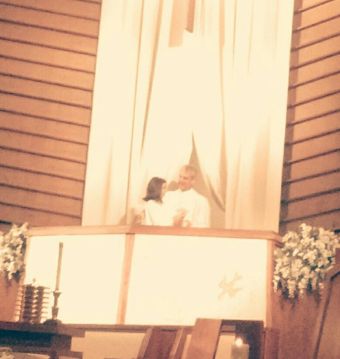
I believe the baptism of a certain woman named Lydia, and the baptism of a certain woman named Traci, have much to teach us this day.

Luke tells the story the baptism of Lydia. It begins with Paul and Silas sharing the good news of Jesus in Troas, an Asian town situated across the Aegean Sea from the European district of Macedonia. Paul has a vision of a man in Macedonia pleading: “Come on over and help us.” Convinced by the vision that God was calling them to go and proclaim the good news in Europe, without hesitation, they sailed to Macedonia, went through Samothrace and Neapolis, eventually settling in the leading city of Philippi.

While they were there, Paul and Silas heard about a group of women that had been gathering for worship down by the river outside the gate. So when the Sabbath came, they went and found the women, sat down with them, and engaged them in a conversation.

Then Luke says that it was obvious that this one woman in the group, this woman named Lydia, was really paying attention to what Paul had to say. And then he says some very remarkable things about this woman. First of all, he points out that she is an Asian business owner from Thyatira. Secondly, because he says that “she and her household” were baptized, it’s evident that she was the head of her household.

Now, remember, this is the first century. It’s not a period known for women working outside of the home. Females were treated as second-class citizens and even as “property.” Males were the leaders, the heads of business and the heads of households. And yet, here is a woman who is the head of both.

And since she is the only one who is pointed out to be really paying attention to what Paul was saying, she also appears to be the head of that community of faith which gathered there each week by the river.

And this says Luke, this baptism of a foreign woman who shatters all cultural expectations, this baptism of a woman who lived life two-thousand years ahead of her time, the baptism of this woman as the first European Christian, is the result of a vision from God that came to Paul.

So, what in the world was God trying to say to Paul and Silas through that vision of a man saying, “Come to Macedonia, because I need some help!”

Could it be that God was saying: “Paul and Silas, I know you are clear across the sea on another continent, but I need you to get in a boat right now and set sail to Macedonia. I need you to come over here to Europe, make your way through Samothrace and Neapolis, all the way to Philippi, and help me, once and for all, show the world that through my love revealed in Christ Jesus who continually lifted up the status of women, elevated the foreigner, accepted the Eunuchs, and did something almost daily to shatter all cultural expectations, destroying the stigma of status, race, ethnicity, class, and sexuality, that in my kingdom, there no longer Jew nor Gentile, slave nor free, male nor female. Help me clearly make the statement that in Christ all are one.”

It is as if God is saying, “I know people have heard the stories of Jesus calling women to be counted among his disciples. I know the word is out that Mary and Joanna were the first ones to proclaim the good news Easter. I know many have heard about my disciple Tabitha and her works of kindness and gifts of charity. And I know that folks are hearing about the good work of sister Phoebe leading the church at Cenchreae; however, I am still afraid I am going to need some more help here in Europe. Because I have this bad feeling that if I do not do something as radical as making the first baptized Christian on this continent a strong woman like Lydia, some of these Europeans, not to mention their descendants, are still going to argue, even two-thousand years from now, that a woman has no business being at the head of a communion table, or being the head of a household, or even being the head of her own body.”

“And I know people have heard the story of the Good Samaritan, that despised foreigner who proved to be a holy neighbor to the Jewish man who who was beaten and left dead on the side of the road, but I have this terrible inkling that if I don’t make a foreigner the first European convert, some Europeans, not to mention their descendants, even two-thousand years from now, may still harbor all kinds of prejudices against those who are not of European descent. So, get yourself over here to Macedonia as fast as you can and help me baptize this certain woman named Lydia!”

I believe Paul may have Lydia in mind when he penned the following words to the church at Ephesus: “But now in Christ Jesus you who once were far off have been brought near by the blood of Christ. For he is our peace; …and has broken down the dividing wall… So he came and proclaimed peace to you who were far off and peace to those who were near; for through him both of us have access in one Spirit to the Father. So then you are no longer strangers and aliens, but you are citizens with the saints and also members of the household of God” (Ephesians 2).

Then, there is the baptism of Traci. Like Lydia, Traci is also a certain woman; however, fortunate for her, she has joined a church that has learned a thing or two from Lydia. For, here at Central Christian Church, the gifts of women are valued just as much as the gifts of men. Traci will be encouraged here to use her gifts to freely follow Christ wherever the Spirit leads.

Traci is not a foreigner. However, since she was not raised in our church, she was a stranger, an outsider to most of us. Therefore, I believe the baptism of Traci reminds us that we have been called by God to reach out beyond our walls and embrace others like Traci who did not grow up in this church, or any church for that matter, so that they will no longer be strangers.

It is as if God is saying: “I know people have heard the Great Commission of the Risen Christ to “be witnesses in Jerusalem, in all Judea and Samaria, and to the ends of the earth” making “…disciples of all nations, baptizing them in the name of the Father, Son, and Holy Spirit…” But I have this bad feeling, that if I do not stir the hearts of people like Traci, and draw them into the renewing waters of the church, enlarging and changing the congregation, then the church might be tempted to become so comfortable with the status quo that they grow apathetic, just uninterested in reaching out to welcome the stranger.

The Rev. Jesse Jackson Jr. told a story at the recent men’s retreat that reminded me of something that happened to my wife Lori a few months before we came to Oklahoma. Rev. Jackson said that he went to a Popeye’s Chicken restaurant one night to get him some chicken. He went through the drive through and ordered a Chicken Combo plate. And lo and behold, the person working the drive thru window told him that they were out of chicken.

Lori had the same experience with a Bojangle’s Chicken and Biscuit restaurant in North Carolina. She went to Bojangles, which is similar to Popeye’s or a Golden Chick, to get her some chicken, only to be told that they were out of chicken.

Lori came home and said, “I am so mad. Bojangle’s Chicken and Biscuits told me that they were out of chicken. She said, “I can understand if they run out of the mashed potatoes. I can maybe even sympathize a little with them if they run out of biscuits. But Bojangle’s, like Jesse Jackson said of Popeye’s, has got no business running out of chicken!”

The baptism of Traci reminds us what the church is all about. If a church is not continually working to break down dividing walls and to build bridges and relationships with those outside the church, with the goal of having several baptismal services a year like this one a year, then the church is like a Rib Crib opening their doors for business when they’re fresh out of ribs! Might as well close down and put a chain on the doors.

After Lydia is baptized, notice the first thing that she does. She extends a gracious welcome to Paul and Silas inviting them stay at her home. Her words following her baptism remind me of our identity statement as Disciples of Christ, “We welcome all to the Lord’s table as God has welcomed us.”

I was on facebook Friday night, and I read these words from Traci’s timeline that are so so reminiscent of Lydia’s words: “Please come and visit Central Christian Church. The service starts at 10:15 am. It is a great church.”

Lydia and Traci remind us that each person in this room who has been baptized, who has been welcomed by God through the gracious hospitality of Christ, should feel compelled by the Holy Spirit of Jesus to go out from this place and welcome all people.

Through the baptisms of a certain woman named Lydia and a certain woman named Traci, I believe God is saying to each of us: “Go out, reach out, tear down a wall, build a bridge, connect, engage, get on facebook, get in a boat if you have to, travel through the streets of places like Samothrace and Neapolis and Philippi and Enid and North Enid and East, West and South Enid, because I need some help! I need some help sharing the good news that all are welcome at my table.”

Cliques and Churches


clique

John 10:11-18 NRSV

When I first moved to Enid, I was immediately told that Enid could be “a cliquish town.” They told me that within this town, there exist these “cliques,” these small groups, circles or factions of close knit, tight, cohesive people. I have also heard this said about every church that I have ever served with, and this church is no different.

However, this may not be as bad as it might sound. I believe there may be something good, even redemptive in the cliques of Enid and in the cliques of the Central Christian Church.

Jesus differentiated himself as a shepherd as opposed to a hired hand. He said that when the hired hand sees the wolf coming, he leaves the sheep and runs away, and the wolf snatches the sheep and scatters them. Jesus says that the hired hand runs way because a hired hand does not care for the sheep. The good shepherd, however, knows the sheep and loves the sheep and is willing to lay down his life for the sheep.

Along life’s journey, all of us have encountered shepherds and hired hands haven’t we? Perhaps it was when we, or our loved ones, were admitted to the hospital. The nurse on duty during the day was loving and caring and compassionate. He called us by name. It was apparent that he loved his job. He acted as if he had been called by God to be a nurse. Being a nurse and caring for others was his Christian vocation. He checked on us frequently and did things for us that he really did not have to do. He was a shepherd who cared for his sheep.

Then the 7:00 shift change came. The night nurse took over. And he was night and day different from the day nurse. We asked him politely for some medicine to help us rest. He rolled his eyes and walked out of the room. We only saw him one other time during the night. We never got the medicine we requested. It was obvious that he was only there to earn a pay check. There was no sense of call, no sense of vocation.  He was truly a hired hand if there ever was one. Not a caring bone in his body. He never once called us by our name.

Jesus said that he is the good Shepherd and he knows his own, and his own know him. Jesus is describing a type of inexplicable, intimate relationship. The Greek word translated “know” in this verse is the same word used to describe the intimate relationship between a married couple.

The relationship Jesus is describing is rooted in the most intimate relationship between the Father and the Son. It is a relationship which is so intimate that Jesus later says, “the Father and I are one.”

Thus, when Jesus speaks of the flock, Jesus is describing a close knit, tight, cohesive, caring, supportive flock of people. There are no strangers in this flock. Each person in the flock knows and is known, intimately, personally, profoundly. You might say that Jesus is describing a type of clique.

This knowing is much more than mere recognition. This knowing in this clique includes a deep involvement in the life of the other. It is an involvement characterized by self-giving, sacrificial love. Where folks, Jesus says, are willing to lay down their lives for one another. Jesus was describing what should characterize the life of this church, and every church.

This is what I believe makes this installation service, three and a half months after I began serving with you as your pastor, so meaningful. If we had this service in January, or even in February, many in this flock would be like strangers to me, and I might feel more like a hired hand. I told the group Wednesday night that I was glad we are having this service in April, because now, three months in, because I have come to know you, I have really come to like you folks, in fact, I have grown to love you. I think we have a pretty good clique going on here.

However, Jesus reminds us that such mutual knowing and intimacy, which is characteristic of cliques, should never become so warm, safe and cozy that it becomes exclusive. Such intimacy and caring should never be turned inward. Listen again to verse 16. I think it may be the most important part of our lesson this morning: “I have other sheep who do not belong to this fold. I must bring them also.”

Jesus reminds us that although a clique may represent a loving and caring, intimate community, a clique should never be closed. A clique should always be open-ended. The flock is not yet finally fixed. There are always others who recognize the shepherd’s voice and need to enter the fold.

I believe failing to remember this is the downfall of churches. We must always remember that communities of mutual caring and intimate knowledge should never be closed.

Someone asked me if we were an open and affirming church. I thought to myself, “What a sad day it is when someone feels like they need to ask that question!” Because as a church, we have absolutely no business being closed and condemning.

However, it is important to recognize that all of us possess a tendency to exclude those who are different from us: those who did not grow up in the church; folks who have no idea what it means to be Christian; folks who have questions and doubts; those who are burdened by all types of struggles; folks who are broken, physically, spiritually and socially; those who look, live, believe and speak differently. Comfortable with our clique, we may tend to avoid inviting and embracing the other.

But if a church gives into this tendency to shun and exclude others, then it ceases being a church. Because if a church is not, first and foremost, a place of grace for all people, then it ceases being Christian.

In Acts, chapter 11, we read that when Barnabas arrived in Antioch to visit one of the first churches, the first thing that he witnessed was “grace.” In verse 22 we read:

“…and they sent Barnabas to Antioch. When he came and saw the grace of God, he rejoiced, and he exhorted them all to remain faithful to the Lord with steadfast devotion… and it was in Antioch that the disciples were first called ‘Christians’. I believe it is important to remember that the first clique to be called to be called Christian was called a community of grace.

As Mother’s Day approaches, our thoughts will almost certainly turn inward toward family. There is no doubt about it, a family is a clique; it is a close knit, tight, cohesive community of mutual knowing and caring. But, do you remember what Jesus reminded us about families? In the 12th chapter of Matthew’s Gospel, Matthew writes that as Jesus was speaking to the crowds, someone told him, “Look your mother and your brothers are standing outside, wanting to speak to you.”  And Jesus replied: “Who is my mother, and who are my brothers?” And pointing to his disciples, he said, “Here are my mothers and my brothers!  For whoever does the will of my Father in heaven is my brother and sister and mother.”

Jesus had a very broad understanding of family, didn’t he? The clique is never closed. The flock is never finally fixed. Jesus yearned for deep, personal, intimate relationships with all who try to do the will of the Father. Jesus desired to be in a community of mutual knowing and caring with a broad range of people, with, in fact, all people.

They tell me that Enid is a cliquish town and Central Christian is a cliquish church. And I for one am grateful that they are absolutely correct.  Within our city there exists communities of mutual knowing and caring. The same is true with this church. There are Bible study classes and small groups who genuinely know one another and care for each another. They are not hired hands but are shepherds to one another.

However, during this installation Sunday as our thoughts turn inward as we commit ourselves to remain faithful to one another with steadfast devotion, may Jesus remind us that those thoughts should also be turned outward to the world. May Central Christian Church reach out and invite and embrace others, embrace even those who are different from us, realizing that the clique is never closed and the flock is never finally fixed.

May we go out and remembering the words of Jesus, “I have others who do not belong to this fold. And I must bring them also.”  And may we remember that we are not hired hands; we have a vocation and a high calling… We are the body of Christ.

Teresa of Avila described it this way: “Christ has no body on this earth but yours…Yours are the eyes through which the compassion of Christ looks out on a hurting world; yours are the feet with which he goes about doing good; yours are the hands with which he is to bless now.”  Right now. Right here.  Let us pray together.

Lord Jesus, even though we crucified you, you rose from the dead and returned to us. Even though we forsook you and denied you, you returned and sought us out, as a shepherd seeks lost sheep. You called us by our very own names, and you summoned us to follow you as sheep follow their good shepherd. So here we are. We are together because you have called us to be together.  However, there are many others who you have also called and summoned who are not here, not yet a part of this flock.  May we have the grace and the courage to bring them in also.  Amen.

First Love

first-love-logofinal2

John 21:1-19 NRSV

I want us to take a close look this morning at Jesus. Look at him as he appears with wounds in his glorified, resurrected body to a few friends after Easter.  Look at him.  He had come into the world with a message through words and deeds of God’s unending, unlimited, unwavering and unconditional love for the world. But the world did not want anything to do with that message. Therefore, he was tortured, crucified and sealed in a tomb. He came to give us the best that God had to give, the gift of God’s self, and the world reciprocated that gift with the very worst the world had to give, the cross. Jesus came offering love, unbounded, unending, and we nailed it to a tree. Jesus came offering grace, free, extravagant, and it was too much for us. So, we killed him.

But there he was, standing before friends with scars on his hands and feet and in his side. Standing there rejected; standing there wounded simply asking, “Do you love me?”  And he keeps asking, “Do you love me?”  “Do you love me?  Three times he asks.  “Do you love me?”

I believe there is another way of phrasing this simple question. The rejected, wounded Jesus is standing there asking: “Do you really know how much I love you?”

Because if you and I really knew how much Jesus loves us, we would certainly love him. If we really knew the heart of God which was revealed through the love of Christ Jesus, loving this Jesus would be our only response.

John the evangelist calls this love revealed through Christ “God’s first love.”  “Let us love,” he says, “because God first loved us.” God is love and only love. So, let us love because this God has loved us freely and unconditionally from the very beginning.  The Psalmist sings that it was “in love that God created our inmost self and knit us together in our mother’s womb” (Psalm 139:13).

Henri Nouwen once said that this first love is often difficult for us human creatures to comprehend. For the love with which we are most familiar is “second love.” This is the love we experience in our human relationships.  It is the affirmation, affection, sympathy, encouragement and support that we receive from our parents, spouses, church members and friends. Nouwen says that this second love is only a broken reflection of the first love. The second love is a love which often leaves us doubting that love, frustrated by that love, angry and resentful.

All of us who experience human love know just how limited, broken and very fragile it is. Nouwen says that “behind the many expressions of this second love, there is always the chance of rejection, withdrawal, punishment, blackmail, violence and even hatred. Contemporary movies and plays portray the ambiguities and ambivalences of human relationships,” and there are no friendships; there are no marriages, and there are no communities, even communities of faith, in which the “strains and stresses of the second love are not keenly felt.” With human relationships there is always the chance of “abandonment, betrayal, rejection, rupture, and loss.”  “These are all the shadow side of the second love.”

The good news of the gospel is that the second love is “only a broken reflection of the first love, and that the first love is offered to us by a God in whom there are no shadows.”

Jesus is standing there, rejected and wounded and resurrected and glorified as the incarnation of the shadow-free first love of God.  Look at him. Jesus is standing there offering from his very heart streams of living water. Listen to him. Jesus is standing there crying out with a loud voice, “Let anyone who is thirsty come to me!  Let anyone who believes in me come and drink” (John 8:37). “Come to me, all you who labor and are overburdened, and I will give you rest.  Shoulder my yoke and learn from me for I am gentle and humble in heart and you will find rest for your souls” (Matthew 11:28-29).

Jesus is standing there rejected and wounded, yet resurrected and glorified asking, “Do you love me?” “Do you have any idea how much I love you? I love you with a perfect love, a shadow free first love.  I love you without limits, without conditions. I love you without end.”

Do you love me? Then feed my sheep.

I believe when we really know how much God truly loves us, our natural response is feeding the sheep of God: nourishing them physically and spiritually; tending the lambs of God: meeting their needs, educating them, fighting for the lost, the last and the least, protecting them from all those who wish to do them harm, those wolves who often clothe themselves with righteousness, who hide under garments of “family values” or “religious freedom.”

Look at Jesus, standing there in all his glory, yet wounded and broken and rejected, standing there with the loving heart of God. Our response to this Jesus can be none other but to bring healing, reconciliation, new life, justice and hope wherever we go. Our only response should be to say to the world with our whole being: “You are loved, unreservedly, unconditionally, eternally. There is no reason to be afraid, for God loved you first. God loved you before you loved God or even knew God. In love, God created your inmost self and knit you together in your mother’s womb. And God loves you even when your rejected and crucified that love.”

However, because we are more familiar with the second love, with fragmented human love, our natural response is often to love expecting something in return, therefore we have this awful and evil tendency to judge and to discriminate.

I believe this is why we are seeing so much hate in our world today: We have forgotten the first love. I believe the church and our country is in the state that it is in today because we have taken our eyes off of the crucified, risen Lord is standing before us all, asking, “Do you love me?”

After asking three times if we know how much God love us, and after telling us how to respond three times, Jesus said: “In all truth I tell you:  When you were young you put on your own belt and walked where you liked; but when you grow old you will stretch out your hands and somebody else will put a belt around you and take you where you would rather not go.”

This is a radical response, a radical understanding of maturity, for it is the exact opposite of the world’s understanding of maturity, the exact antithesis of American values. But God’s first love is a radically different from the world’s second love and any human value.

The world says: “When you were young, you were dependent and could not go where you wanted, but when you grow old you will be able to make your own decisions, go your own way and control your own destiny.”

Jesus’ vision of maturity is the exact opposite. It is the ability and the willingness to be led to those places where you would rather not go.

Here, as he has said before, Jesus is saying that we must become child-like. We must allow someone else to fasten our belts. We must place all of our being into the hands of God and allow God to lead us even into unknown, undesirable and painful places.

Look at Jesus, standing there rejected and wounded, yet resurrected and glorified. Look at him as he appears with wounds in his glorified, resurrected body to a few friends after Easter Sunday.  Look at him. He is standing there.  Listen to him. He is asking, “Do you love me?  Do you love me?  Do you love me?

The Seal Broken

stone rolled away

Matthew 27:62-28:10

During our very meaningful Tenebrae service on Friday night, we listened to the voices of Good Friday. “Father, if it is possible, let this cup pass from me; yet not what I want, but what you want.”

“Are you still sleeping and taking your rest? See, the hour is at hand, and the Son of Man is betrayed into the hands of sinners. Get up, let us be going.  See my betrayer is at hand.”

“The one I will kiss is the man; arrest him.”

“Have you come out with swords and clubs to arrest me as though I were a bandit?”

“Then all of the disciples deserted him and fled.”

“He has blasphemed!  Why do we still need witnesses? He deserves death. Then they slapped him and spat in his face.”

“You were also with Jesus, the Galilean.” “I do not know what you are talking about.”

“This man was with Jesus of Nazareth.” “I do not know the man.”

“Certainly you are also one of them, for your accent betrays you.”

“’I do not know the man!’ And the cock crowed.”

“I have sinned by betraying innocent blood.” “Judas then went out and hanged himself.”

“Are you the King of the Jews?”

“Release to us Barabbas.” “Crucify Jesus.” “Let him be crucified.”

“I am innocent of this man’s blood, see to it yourselves.”

“Hail, King of the Jews!”

“You, who would destroy the Temple and build it in three days, save yourself!”  “If you are the Son of God, come down from the cross.” “He saved others, yet cannot save himself.”

“Eli, Eli, lema sa-bach-tha-ni? My God, my God, why have your forsaken me?”

“Command the tomb to be made secure. You have a guard of soldiers; go, make it as secure as you can.” “So they went with the guard and made the tomb secure by sealing the stone.”

These are the voices of Good Friday: voices of betrayal; voices of denial; voices of disappointment; voices of hate; voices of cruelty; voices of finality; voices of no turning back; voices of no moving forward; voices of death. “Make the tomb as secure as you can. Seal the stone.”

And the reality is that you did not have to attend either the service on Thursday or Friday to hear these voices. For we live in a Good Friday World, don’t we?

We’ve heard these voices just this week.

Yesterday from Utah: “A woman heading to her mother’s funeral has died in a car crash.”

From Iraq on Friday: “A suicide attacker detonated an explosive belt in a park outside Baghdad on Friday, killing 41 people and wounding over 50 more.”

From Oklahoma City on Thursday: “The state medical examiner’s office said bones recovered from near Lake Stanley Draper are human.

Oklahoma City police Master Sgt. Gary Knight said police received a call Monday that bones, clothing and personal effects had been discovered near the lake.”

From North Carolina on Wednesday: “In a bill that zoomed through with head-spinning speed, lawmakers blocked cities and counties from protecting people from discrimination.”

From Brussels on Tuesday: “Two suicide bombers blew themselves up in Brussels airport, killing 11 people, and a third man detonated a suicide bomb one hour later in an underground train in central Brussels, killing 20 more.”

From Indiana on Monday: “Indiana Sheriff’s deputy shot dead. Partner seriously injured after serving search warrant.”

And from Enid this week: “I can’t believe she talks about me behind my back.”

“Why does he have to be so hateful?”

“I don’t even know who you are anymore.”

“Why won’t my children come and visit me?”

“My wife is having part of her foot removed next week. We are just waiting for the doctor to call with the exact day and time.”

“Since my back surgery, I am still dealing with a lot of pain.”

“She needs a root canal. He needs braces.”

“I owe thousands in taxes this year. And I don’t know where the money is going to come from. I am already working more hours now than by body and mind can stand.”

“I’m never going to be able to forgive myself. “I have never been so embarrassed in my whole life.” “I simply can’t continue going on like this.”

“My mother really doesn’t like the nursing home. She believes we are all plotting against her. I think my father may have Alzheimer’s.”

“Her baby was born three months premature. My sister has been having chest pains. My brother’s arthritis is about to get the best of him. The doctor said my tumor is malignant and inoperable. I still can’t believe that my wife is gone. I have never felt so alone and so depressed. At times, I just want to go to sleep and never wake up.”

These are the voices of Good Friday, and they echo throughout our world without ceasing, sometimes overwhelming us. Every time we turn around there is something else in our Good Friday world to worry about. There is no escape. It is like being entombed in sepulcher for all of eternity by a large stone that has been sealed shut by soldiers.

So, now let us hear another voice. It is a voice called Easter. It is a voice called resurrection, a voice called hope.

“As the first day of the week was dawning. . .”  (Sounds hopeful already, doesn’t it?) As a new day, a new week was dawning, was beginning anew, fresh, bright, giving a chance to the promise of hope, “Mary Magdalene and the other Mary went to see the tomb. And suddenly there was a great earthquake; for an angel of the Lord, descending from heaven, came and rolled back the stone and sat one it.”

In our Good Friday world, oh how we need to hear this voice of Easter— this voice that says that our God who gave God’s all for us on the cross is so awesome, so good, so great, so much bigger than all of the cruelty and evil of the world, that God does not have to lift one finger, but sends an angel to break the seal that entombs all of us who are shrouded by the evil of our Good Friday world.

The Good Friday world says: “Seal it up.” Then our Easter God, without flinching a muscle, sends one meek angel to break the seal—an angel who then sits upon the stone and says the most hopeful words found in the entire Bible: “Do not be afraid; I know you are looking for Jesus, who was crucified. He is not here; for he has been raised, as he said.”

The world says seal it up. The world says things are not going to get any better. The world says the good old days are long gone. The world says that evil will get the best of us. The world says that God is either a fairy tale, is powerless, or has taken some cosmic vacation. The world says death is final.

Then God without lifting a finger breaks the seal and says: “I am always working all things together for the good. Through the breaking of the seal, God says to us that the best days of our lives are always yet to come. Gods says, although we cannot go back to the good old days, good new days are dawning. God says that nothing in this world is final, not even death. God says I can, and I will transform all of your despair into hope, all of your defeats into victory, all of your pain into joy, and even all of your deaths into life.”

The world says: “seal it up; you will never amount to anything. You’re a loser. You are insignificant. You are worthless. You are not a good person. Nobody really cares about you. You are pitiful. No matter how hard you try, sin always has a way of getting the best of you.  Perhaps you’d be better off dead. Seal it up.”

God breaks the seal and says: “I love you and suffered for you and died for you and raised Jesus to life for you, just as you are. There is nothing you could possible do to earn my love. I will always be with you and never away from you. I will always be for you and never against you. I will always stay by your side fighting for you, doing all that I can to wring whatever good can be wrung out of all of your misery.” God says “I will give you an Easter Faith to live victoriously in your Good Friday world.”

“Through eyes and ears of Easter faith you will see my resurrecting presence all around and hear my voice everywhere. You will be able to see it in flowers and in the trees. You will read it in a card sent to you by a friend. You will experience through the smile of a child.”

You can know it through the devotion of a Sunday School teacher. You can experience it through the woman who serves meals in the soup kitchen the needy. You can experience it with the church group who visits the nursing home; see it in the one who volunteers at the hospital; through the family who gives sacrificially and faithfully to the church, through missionaries who have given their lives to serve in third world countries, through encouraging words, handshakes, hugs, through a meal prepared; a lawn mowed, a house painted, a petition signed.

You can hear it through the confessions of faith from two young men being baptized.

God says you can hear it and see it and sense it and know it through people who by my grace are living an Easter Faith in a Good Friday world. You can see it when and wherever justice finally prevails and love ultimately wins.

During this coming week, you will not have to pay close attention to continue to hear the voices of Good Friday. You will quite possibly hear them even before this Easter Sunday ends. My hope and prayer is that as people living an Easter faith, we will continue to raise our Easter voices: voices of hope; voices of justice; voices of equality; voices of peace and love; voices of life; voices of a new day dawning; voices of a tomb whose seal has been broken on this day and forevermore.

Being a Friend of Jesus

friends

John 15:9-17 NRSV

Our text this morning contains some of the greatest words Jesus ever said to anyone:  “I do not call you servants any longer. . . I have called you friends.”  The disciples are invited by the risen Christ to know their Lord in a new light; they are invited to see their Jesus as a friend.  The question that I want us to ask this morning is this: “What does being a friend of Jesus truly mean?”

First of all, we learn from this text that being a friend of Jesus means to be chosen. Jesus said to his disciples, “You did not choose me, I chose you.”  This is very different from our definition of friendship, is it not?  For we are accustomed to choosing our friends. For us to be friends with another there’s usually got to be some sense of mutual attraction. My daughter Sara is going to Charlotte this afternoon to meet a girl who may be her college roommate this fall. They met on facebook and have scheduled a meeting today to see if they would both like to choose one another to be friends. However, Jesus had a much different understanding of friendship. It is Jesus who chooses us. We do not choose Jesus.

This understanding of friendship was also completely foreign to Jesus’ disciples. In Jesus’ day, it was customary for Jewish students studying the Torah, the Mosaic Law, to seek out a rabbi whose teaching they wanted to emulate. The choice was theirs. But Jesus reverses the order. The choice is his. Jesus chooses his followers.

That Jesus chooses us to be his friends prevents us from possessing a consumerist attitude toward the practice of this friendship. As disciples, we are not in a position to dictate when and where we will act like friends of Jesus. For example, we cannot choose to be Jesus’ friend on Sunday and treat him as a stranger the other days of the week. We cannot choose to act like he is our friend in front of some people, while acting like we have never heard of him in front of others. Furthermore, we are not in a position to pick and choose to accept and follow some of his teachings, while completely ignoring those teachings that we find offensive.

Secondly, we learn from this text that being a friend of Jesus means to keep his commandment to love others as he loves us.  Again, this too is very different from our understanding of friendship and love.  Most of us would probably tend to agree that the word “command” and the word “love” simply do not fit in the same sentence. We would say that love is not something that can be commanded.  For many of us, genuine love, we would say, must be spontaneous and come from within and not without.  We simply do not associate friendship or love with the word “command.”

The reason that “love” and “command” seem at odds is because we so often misuse and overuse the word “love.”  We have reduced the meaning of the word “love” to a mere feeling.  Jesus is talking about agape hereThis Greek word for love does not represent a “feeling.”  Nor is it a synonym for “like.”  To love is to be for another, to act for another, even at cost to oneself. The supreme act of love is the giving of one’s life for the other.

But for many of us, love is simply a feeling.  Love is an emotion. And we would say that no one can command feeling. We can not even command our own. But Jesus is not talking about feeling here. Jesus is talking about action. Jesus is talking about giving one’s self for another.

This is why the preacher never asks the groom and the bride in the wedding ceremony if they love one another. Think about it. You have never heard a preacher ask, “Do you love each other?” The preacher always asks, “Will you love one another?”  “Do you promise to love each other?”  True love is a verb. True love is action. True love is not a feeling. This misunderstanding of the definition of love is why many marriages end in divorce. A spouse wakes up one day and discovers that they have lost that loving feeling, so they move out.

Being a friend of Jesus means keeping his commandment to love others as he loves us. Unlike a feeling, love can be commanded. This means that we are to be there for others, to act for others, to be there with others, to laugh with others and to cry with others. Being a friend of Jesus means that we are willing to give of ourselves completely for others. Police officers, firefighters and others who put their lives on the line for us every day are our friends. The men and women of our armed forces who we remember in a couple of weeks on Memorial Day were our friends. Being a friend of Jesus means to sacrifice.

And thirdly, being a friend of Jesus means to know what is going on. Followers of Jesus become friends of Jesus when they know what he is doing. Jesus said, “I have called you friends, because I have made known to you everything that I have heard from my Father.” What distinguishes servants from friends is that friends have been let in on the plans.

I once heard story of a family that was getting ready to move to another state. The parents did not want to upset their four year-old son who had made many friends at his preschool and in their neighborhood, so they kept putting off telling him about the move. When the movers came, the little boy was upstairs in taking nap, so the parents instructed them to pack up every room in the house except for their son’s room. They would finally tell him about the move when he awoke.

While the parents were outside taking some things to their car, the poor little thing awoke to find that every room in the house was empty except for his! The parents came back in and found him sitting on the floor in the empty family room crying like a baby. Realizing that it was probably a bad idea to wait until the last minute to let their son in on the plans, they finally told him that they were moving to another state, but assured him that he would quickly make new friends in their new town.

The little boy stopped crying. His face lit up with a big smile. And he said, “What a relief, I thought everyone was moving except for me!”

As friends, we do not like to be left out of the plans do we? As friends, we want to know what is going on. We want to be included in the plans. Jesus lets his disciples in on the plans. They are not kept in the dark about what is happening and what is going to happen.

Being a friend of Jesus means knowing God and God’s plans for us.  Do you remember the words of the prophet Jeremiah? “For surely I know the plans I have for you, says the Lord, plans for your welfare and not for harm, to give you a future with hope. Then when you call upon me, I will hear you. When you search me, you will find me; if you seek me with all your heart, I will let you find me, says the Lord….”

Being a friend of Jesus means finding God. Being a friend of Jesus means knowing that Jesus was God incarnate—God who loved us so much that he came to earth and became one of us—God who became our friend and laid down his life for us on a cross. Being a friend of Jesus means knowing that the same God who resurrected Jesus abides with us today, resurrecting our sorrow into joy, our despair into hope, and our death into life. Being a friend of Jesus means knowing that there is nothing on this earth or in all of creation which will ever separate us from the love of God we know through Jesus Christ our Lord. Being a friend of Jesus means always knowing that God is here with us working all things together for the good.

Students are in their last weeks of the school year. One of the things I loved doing during these weeks was passing my yearbook around and having my friends to sign it. I don’t know if you still do this today or not, but when I was going to school, nearly all of my friends signed my year book, AFA, a friend always.

Being a friend of Jesus means that God has signed our hearts, AFA, a friend always, and forever. It means that he will never forget us, never forsake us, always stay beside us, now and forevermore.

Love One Another

we do love

1 John 4:7-21 NRSV

It the fifth Sunday of Easter, and like the very first disciples, we have gathered together on the first day of the week to be with our family of faith. There are certainly a lot of other places we could be this morning. But here we are. We are here, together as a community of faith because like the very first disciples we have seen the risen Lord.

Somewhere along the way, probably during some of our weakest moments, those moments of pain and despair, those moments of great anxiety and fear, when we needed him the most, the risen Christ inexplicably came into our lives, stood in our presence and filled us with a peace that is simply beyond all human understanding.

So here we are, gathered together on this first day of the week, assembled in this place as believers. We’re here because we believe in Easter. We believe in the wonderful good news that Christ is alive and, even more than that, he is alive for us.

Now the question is: what are we supposed to do with this Easter Faith that we have?  How are we to live as Easter people?

There is no more direct answer to this important question than the one found in the little book we call 1 John.

When I was in seminary, I had to take two semesters of Biblical Greek and at least one semester of Hebrew. In my first year of Greek, the first book of the New Testament that the professor had us to translate was 1 John. Why?  Because in all the New Testament, the Greek in 1 John is the most simple and direct.  There are no complex, convoluted arguments, no long clauses or other linguistic difficulties that make the translation of some of the other New Testament books a nightmare. 1 John is simple and to the point. In fact, I can sum up the entire book in basically three words: “Love One Another.”

Three of the most simplistic, but at the same time, three of the most difficult words ever put together in one command.  Yet, this is how God expects believers in the risen Christ to respond to Easter.

Love one another. It is difficult because the “one another” we are supposed to love is not just our close friends and family, but also those who have misused and mistreated us. We are commanded to love one another, all people, including our enemies.

Every time I read or hear this command, I immediately think of that list that most of us carry, at least in our minds: that list of people who have wronged us.

Of course, none of you here in Farmville are on my list. I think of that long time member of my church in Winston-Salem who wanted me to fail so badly as pastor of the church that he actually wanted the church to fail. Although he gave very generously when the offering plate came around every Sunday, he never gave one dime to our church’s budget. He earmarked all of his money to go to the Baptist Children’s Homes.

I have in me to forgive someone who wanted to hurt me, but to hurt the church?

Then there was that lady in that same church who not only liked to run me into the ground in her conversations with others in the church, but she also seemed to enjoy taking about my family.  She told one group of ladies in the church that my son Carson, who was two years-old at the time, was one of the unhappiest children she had ever seen, implying that somehow Lori and I had made him that way by being bad parents.  “I wonder what really goes on in that home,” she said.  Because, “When I keep the nursery, he never smiles.”

It is one thing to talk about me, and it is another thing all together to talk about my children—a two year old, for goodness sake! I am pretty sure there was a very good reason that Carson never smiled around that woman. Carson wasn’t unhappy. Carson simply had good instincts.

Although we have this clear, direct commandment through the scriptures to “love one another” sometimes I think (or maybe hope) that God must have meant something else. I think: “God must not know some of these ‘one anothers’ that I know!”

I can better conceive of God saying something like: “You know, in this fallen and fragmented world of sinners, let us somehow learn to live with each other.” Now that’s a commandment that makes good sense! “Despite your differences, learn to live with each other.”

I think I would prefer God saying something like: “Respect one another” or “be kind to one another.” “Be courteous.” “Play nice.” Yeah, I like that. Sounds reasonable enough.

What about, “Be tolerant?” I really like that commandment. “I don’t have to like him, but I guess I can somehow tolerate him. I guess I can in someway put up with her.”

How about, “Let bygones be bygones”? That’s another good one. “We’ve got to move on and get over it. Get over them. Forget about them and the things they have done to hurt us. It’s simply not healthy to hold onto resentments or grudges forever.” Although it is sometimes easier said than done, I think I can live with that commandment.

But the scriptures say considerably more than all of the things I may want them to say. “Love one another.” And here in 1 John, it is a direct command. It’s not an option.

Love one another. I met Lori 29 years ago this month, and it was love at first sight. Twenty-nine years. That’s a lot of years. That’s a long time.  And I know, so before she says it aloud from the choir loft, I’ll say it for her—it’s been even longer for Lori.

When you really love another, you have this wonderful capacity to always see the best that is in that another. I know Lori does that with me, or she wouldn’t be with me today. When I do all those things that I do to annoy her, sometimes hurt her, she summons the strength to look past it all. And in so doing, my weaknesses, my quirks, and all of my shortcomings grow small, while my virtues, the few that I have, grow large. That’s love.

Love necessitates that no matter what the other has done to hurt us, we somehow focus on the positives. Love compels us to look for mitigating circumstances, to devise strategies whereby we earnestly attempt to see the other in the very best light.

If another hurts us, or if another is behaving badly, throwing stones at us or the police, love compels us to ask ourselves questions like, “I wonder what was going on in his or her life that made him or her feel the need to act out like this?” or “I have certain ways about me that antagonize others. I wonder how I antagonized him?” or “I have gotten a lot of good breaks in my life. I wonder what bad breaks she got that her to view me in this way?”

But once we give up on love, all moral bets are off. We become free to dehumanize, even demonize our enemies. They are no longer persons, no longer human. They are pigs, aliens, trash, thugs, rag heads and abominations. And are called other names that are too vile to repeat from this pulpit.

There’s an old saying, that in war, we actually kill our enemies twice. First we kill any shred of humanity in them, and then we kill them with bullets. The two go together.

But First John tells us to love one another. This means that when we or society is wronged, all moral bets are never off.  In fact, according to this ethic, it is precisely when we are used spitefully or wrongfully that the true moral test begins. Elsewhere, the scriptures note that if we love only those who show love to us, what is that?

I believe one of the reasons it is so easy for us to write people off, to write love off, is because we have been taught the false gospel of evangelicalism.

The evangelical gospel says: “All people are sinful, and because of that, God has condemned everyone to hell for all of eternity…unless we repent and accept Jesus. Then, and only then, God will love us and let us go to heaven.” It is primarily a gospel of fear; not love. And as John says, fear has nothing to do with love, but has to do with “punishment.”

Consequently, it is easy for us to demonize and dehumanize one another, call another a “thug.” After all, if another is behaving badly, it probably just means they are going to hell anyway!

However the gospel of Jesus Christ is completely different. The gospel of Christ says: “All people are sinful, and because of that, God loves us even more, and God will go to great lengths to reveal that love, even to death on a cross…to get us to see that love, get that love, accept that love, share that love, so that we will not be doomed for all of eternity living apart from that love.” Unlike the evangelical gospel, the gospel of Christ is all about love.

We love one another because the life, death and resurrection of Jesus, the good news of Easter, demands that we love one another.

Because when the risen Christ showed up, when he came to us offering us a peace that is beyond all understanding, we suddenly realized that we were enemies of God. We realized that when this one came and said things as audacious as “love your enemies,” “pray for those who persecute you,” “if another slaps you in the face, turn the other cheek and let them slap you on the other side,” go the extra mile, “give another the shirt off your back,” “forgive another as many seventy times seven times,” “blessed are the poor,” and “blessed are those who hunger and thirst for justice,” “visit the prisoner,” “welcome the outcast,” and “love one another as I have love you,” we betrayed him, and we crucified him. When the risen Christ came to us, we suddenly realized when this one preached love, lived love, shared love and commanded love, unconditional and unmerited, we were so offended by it, we killed him. And yet, God in Christ still came back to us in the resurrection and loved us even more. Even when we did nothing to deserve life, God in Christ, love incarnate, love himself, laid down his life for us to give us life, abundant and eternal.

God not only puts up with us, respects us, and tolerates us, but God comes to us, calls us by name and embraces us. God looks past our flaws, our failures, and believes in the very best that about us and calls that best that is within all of us to come out.

God loves us and therefore commands us to love one another. “If I have loved you, then you should love others.”

Why the Risen Christ Ate a Piece of Fish

fish1

Luke 24:36-53 NRSV

I often wonder what people mean when they say they are “spiritual.”  I hear people say: “I am not religious, but I am a very ‘spiritual’ person.”  “I don’t attend church, but I am quite ‘spiritual.’”

As a Christian, I sometimes find this odd as not even the risen Christ seemed to be all that spiritual. In fact, as our scripture lesson points out, the gospel writes, especially Luke, seem to go almost out of their way to point out the very physical, not spiritual, nature of the risen Lord.

Luke points out that Jesus asked the disciples to touch him and see that he had flesh and bones; not some spirit or ghost.  Jesus showed his disciples his hands and his feet which were scarred from his crucifixion. And then to still prove that he was there in the flesh and not in some spiritual form, he asked the disciples for something to eat. Then they give him a a piece of broiled fish that he eats in their presence.

The question that I want us to ask together this morning is: What is Luke trying to tell us by giving us this unusual and somewhat strange presentation of Jesus to the disciples? Why does the risen Christ eat broiled fish?

I have heard some preachers say that Luke was giving us a clue of what heaven is going to be like and what we will be like when we, like Jesus, are resurrected.

When I was growing up, my home church had a week of revival every August.  We had services Sunday Night through Friday night and we would always conclude the revival with a fish fry on Saturday.  Six long nights: 30 minutes of singing, one hour of preaching, and then thirty more minutes of altar call. I remember that these annual revival services used to scare me to death. The guest preachers would come into town and preach that heaven or hell was right around the corner and we better get ready. Although I’d never feared going to hell, as a nine, ten, eleven year old, going to heaven was not a place I wanted to visit anytime soon.

I used to hate going to revivals. On top of being frightening, it was hot, had to dress up, wear a tie, for six long nights, two hours a night. The only thing that got me through the week, and I suspect a few others, was the big, delicious fish fry that awaited us on Saturday.

Every year, without exception, preachers would come and scare me with their heaven-or-hell-is-right-around-the-corner sermons.  However, I remember that one preacher preached a particular sermon that made me feel a lot better about going to heaven. It was Friday night, and bless his heart, he was trying to connect the revival service with the fish fry that everyone was looking forward to the next day. He said that one of the most appropriate things we can do at the end of these services is to have a fish fry. He said, “After all, most all of Jesus disciples were fishermen. It also seems like Jesus himself liked to fish. And when we all get to heaven at the resurrection, we are all going to sit down with Jesus and eat fish, because after he was resurrected, Jesus ate some fish with his disciples.”

I wanted to shout, “Amen!”  Because that preacher answered one of those tough theological questions that no one could answer for me, a question that was more important than where did God come from and who was Cain’s wife: “Are we going to be able to eat in heaven?”  For all of us who live to eat instead of eat to live, this was good news. The answer is yes. We are going to be able to eat fish. For someone who loves seafood, it took the fear of dying right away.

I love this idea; however, I believe Luke is trying to tell us something more. I believe the fact that Luke tells us that Jesus offered his physical body for examination and eats fish in the disciples’ presence, tell us something very important about who the risen Christ is and who we are called to be as Christians.

First of all, Luke wants us to know that the risen Christ is in fact the same Jesus who died. The Christ the disciples saw was the same Jesus who suffered and died a horrible, degrading death on a cross. We need to get this for the risen Christ’s identification with the suffering Jesus is critical, not just for sound theology, but for defining the nature of the Christian life and who we are to be as Christians.

If the risen Christ the disciples now follow is not the same as the Jesus who suffered and died, then the Christian life takes on forms of spirituality that are without suffering for others, without a cross, without any concern for the suffering of this world. If the risen Christ is not the Jesus who died, then our eyes would be focused only on heavenly matters and not on the problems of this world.

Even Paul, who makes few references to the historical Jesus, insisted in his letters on joining crucifixion with resurrection. Paul always proclaimed “Christ crucified.”  The risen Lord that we worship has nail scars in his hands and on his feet. Thus, Luke points out that Jesus said, “See my hands and my feet.” The empty tomb is directly tied to the cross. The wonderful message of Easter is forever joined to the suffering of Good Friday.  To follow the risen Christ is to follow the one who bore the cross.

Ok, preacher, I get that, but what does that really mean to us and how should that affect the way we should live as Christians?  Here it goes:

I think it is perfectly fine and healthy to think and dream about going to Heaven one day.  It is fine to have the hope that someday, somehow, some way there’s not going to be anything more to fear or dread. It is wonderful to know a time is coming when there is going to be no more crying, no more pain, and no more death. It is great to sing those great hymns of faith, the ones we sang during our six night revival services, such as “When We All Get To Heaven,”  “In the Sweet Bye and Bye we Shall Meet On that Beautiful Shore,” “When the Roll is Called up Yonder,” and “Shall We Gather at the River,” but if Heaven is the only place our hearts are, if going to Heaven is the only reason we are Christians, then we have missed the whole point of who Jesus Christ is and who we are called to be as Christians.

As Christians, our eyes are to always be focused on the suffering of this world. Our Lord is not only the one who is exalted and glorified, but our Lord is the one who was rejected, suffered and died.

When we look at the frail bodies of the hungry, we are looking at the frail body of Jesus.

When we see the parched lips of the thirsty, we see the parched lips of Jesus.

When we walk by the homeless beggar on the street, we walk by Jesus.

When we meet people who are disabled, physically, mentally, and socially, we meet Jesus.

When we encounter minorities who have been oppressed for their religion, for what country they’re from, for their sexuality, or for the color of their skin, we encounter Jesus.

When we visit the sick in hospitals, the forgotten in prisons, the elderly in nursing homes, the widows and widowers who sit all alone day after day, we visit Jesus.

When we reach out with grace and forgive and love even those who have committed unspeakable sins against us, we reach out to Jesus.

When we make the church a place of grace for all people, especially for those who have been marginalized or demonized by society, culture and bad religion, then we make a place of grace for Jesus. When we do it for the least of these our brothers and our sisters, we do it for Jesus.

And there’s more, much more…

Since we know that the risen Christ we serve is a Christ who knows suffering, who knows what it is like to be a human being, and experience the evils of this world, when we find ourselves overwhelmed by the suffering and pain of this world, we can have faith that Christ is there suffering with us and feeling our pain. And giving us hope and understanding and grace as only a loving God who knows suffering can give.

When we are overwhelmed by grief and loneliness, Christ is there.

When we reach the ends of our ropes and feel that we can not take it anymore, Christ is there.

When we hear words from our doctor’s like:  heart disease, cancer, diabetes, pneumonia, Alzheimer’s, inoperable, and terminal, Christ is there.

When human mistakes seek destroy relationships with the ones we love, Christ is there.

When it seems there is nothing holding together our marriages, Christ is there.

And when we are faced with the knowledge of our own imminent deaths, and feel abandoned, even by God, when we want to cry out with a loud voice, “My God, My God why have you forsaken me?” Christ is there.

This is why Luke places so much emphasis on Jesus’ physical nature. This is the reason the risen Christ ate a piece of broiled fish with his disciples. Although it is a good thought, Luke does not write this to tell us that when we all get to heaven we will all get to stuff our faces with seafood. He is telling us a more important message: a message that the disciples got and gave their physical lives proclaiming.

This is why every disciple, except for John, who experienced the risen Christ were killed for preaching “Christ Crucified.”  John died for his preaching all alone on the island of Patmos in prison after writing the book of Revelation.

May each of us, like the disciples, hear Luke’s message this morning. And may each of us, like the disciples, give our physical lives, our bodies, broken, our life, outpoured, proclaiming with our words and by our deeds, “Christ Crucified.”