Going Fishing

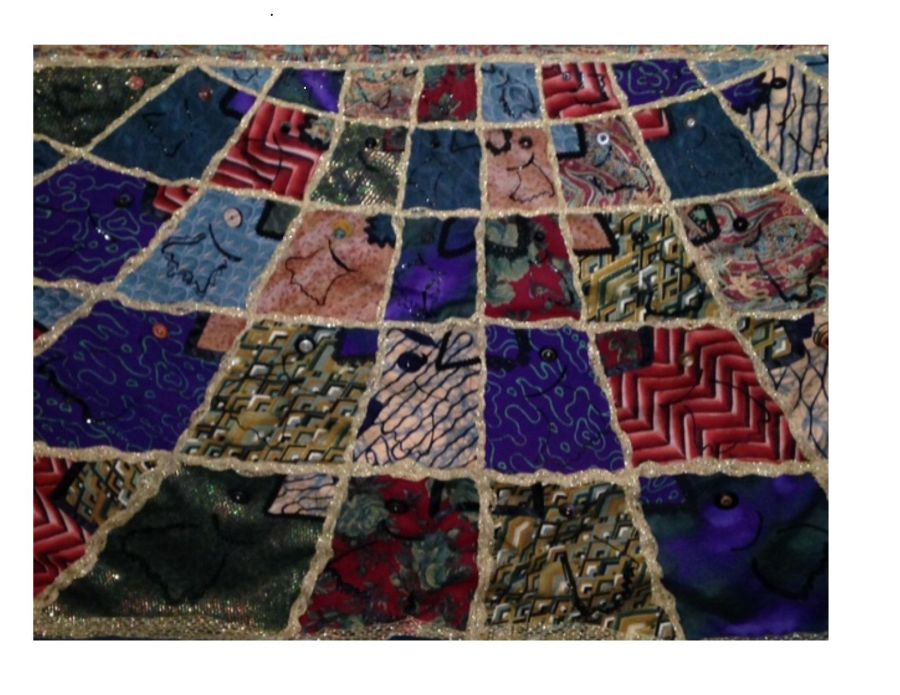
Fishing net parament adorning the communion table of the First Christian Church in Lynchburg, Virginia

As we celebrate 150 years of being church, I think it is good to highlight something that is central to who we are as the First Christian Church in Lynchburg, VA. And that is fishing. You knew that right? Why else would we adorn our communion table with a giant, very colorful, diverse mosaic of a giant fishing net. There’s a great description of our fishing net parament hanging on the wall in the back of the sanctuary that I encourage you to read when you have a chance.

Our fishing net is appropriate as the gospels are full of great fishing stories. Like the story of Jesus is having church on the beach. Luke tells us that the congregation gathered that day is so large, they keep “pressing in on him to hear the word of God,” almost pushing Jesus into the water!

It is then that Jesus sees two boats belonging to some fishermen who are out washing their nets. He climbs into one of the boats belonging to a fella named Simon and asks him to put it out a little way from the shore so he could teach the crowds on the beach from the boat, setting up a little pulpit on the water.

After the Benediction is pronounced and church is over, Jesus says to Simon, “Let’s move the boat to some deeper waters and go fishing.” And this is the moment, for Simon and all of us, that church really begins.

Simon says, “Jesus, we’ve been fishing all night long and haven’t caught a thing. But, if you say so, I’ll cast my net one more time.”

It is then that Luke tells us that they catch so many fish that they had to call in re-enforcements and a second boat. Filled with so many fish, the nets almost break.

Do you remember Simon’s reaction to this glorious catch? “Praise God from whom all blessings flow for this miraculous catch of fish!”

Nope, not even close.

Scared to death, Simon says the almost unthinkable: “Go away from me Lord!”

Then, as it usually is with the stories of Jesus, we learn there is much more going on here than a few folks going fishing. As our scripture lesson in Mark reminds us, this story in Luke is not a story about catching fish at all. It is a story about catching people. It is a story about inclusion. It is a story about bringing new people aboard.

And like Simon, this can scare us sto death.

Growing up in Northeastern North Carolina surrounded by water, I quickly learned that there are basically two types of fishermen.[i] First, there’s the fisherman who really doesn’t care if they catch anything at all. They are perfectly content sitting in their boat with a line in the water. It doesn’t bother them in the least if they do not get a nibble all day long. Enjoying the sunshine and the fresh air, the brim of their hat pulled down over their eyes, they are so comfortable, so at peace, so at home, they might even doze off and take a little nap. They are just happy to be in the boat. They’ve got a bag lunch, some snacks and a few cold beverages, and a bumper sticker on their truck that reads: “A bad day fishing is better than a good day at work.”

And besides, if they did catch anything, which by the way would be by sheer accident or dumb luck since they’re not paying any attention whatsoever to their pole, that would just mean for some work for them to do when they get back to the shore. And the one thing that fishing is not supposed to be is work!

I am afraid I have just painted a portrait of many in the church today. We’re perfectly content just to have one line in the water, not really caring if we ever bring anyone else aboard. Because bringing aboard others always involves work. It involves sacrifice. Because you know about others? They are just so “other.”

So, the purpose of church is reduced to making sure that everyone who is already in the boat is happy, peaceful, and comfortable. If we catch something, that’s well and good. But if we don’t catch anything, well, that is probably for the best.

Then, we have the second kind of fisherman. These are the ones who are really intentional about catching fish. This was my Nana and Granddaddy.

On the water with Nana and Granddaddy, I didn’t know whether to call what we were doing out there in the boat “fishing” or “moving.” Because oftentimes, as soon as I could get some bait on my hooks and drop it in the water, I’d hear Granddaddy say, “Alright, let’s reel ‘em in. We’re going to find another place where the fish are more hungry.” I remember spending as much time watching the bait and tackle on the end of my line fly in the wind as we moved from place to place as I did watching it in the water. But guess what? With Nana and Granddaddy, we moved a lot, but we always caught a lot of fish!

To be the church that God is calling us to be, we must be a people on the move, willing to change, go to other places, and we must be intentional.

We must constantly reel in our lines to go outside of these walls to meet people exactly where they are, not where we might want them to be, but where they are, especially in those deep, dark places where people are hungry for love and starving for grace; where they are famished for liberty, and thirsty justice and equality.

And we must be willing to express our intentionality, publicly, out loud.

Many churches today are happy to say: “All are welcome.” But what does that truly mean? Welcome by whom?  For all can’t be welcome unless someone is doing the welcoming. Right? That’s why we need to be explicit saying, “The First Christian Church of Lynchburg, Virginia welcomes all.”

And who is “all”? Sadly, today saying “all” not saying enough. “All” who want to look like us, believe like us and behave like us?

That’s why we have to say it, and say it explicitly, intentionally, out loud. Especially today, we need to keep saying that this church welcomes people who identify as LGBTQIA+. We need to say out loud that we do not believe being queer is any more sinful than being cisgendered and heterosexual can be. We need to keep saying publicly that we affirm all people are created in the image of God. We are not afraid to say out loud that this church believes black lives matter and black and brown people are always welcome here. To sit in our pews, be on our boards, lead our worship and preach from our pulpits.

We need to keep saying that our church welcomes women and believes women can teach a Bible study class that is of full men. We believe women, as well as people who identify as LGBTQIA+, can be teachers, preachers, pastors and even President of the Denomination. We believe women have power in the church’s boardroom, and that they always have power over their own bodies.

And when you are welcomed here, we need to keep reminding you that you become a part of our body; thus, when you suffer, we all suffer. So, you can count on us to be there for you, to care for you, to pray with you, and to fight for you when the world treats you unjustly.

The problem is that too many churches today are sitting back, half asleep, with one pole in the water. They are not moving, not changing, and not going out. And they are not intentionally saying anything, at least anything out loud. They could care less if anyone new comes to them, but if by sheer accident or dumb luck someone new does happen to come aboard, churches expect them to come aboard in a manner that measures up to their own expectations.

I will never forget that Nana used to go fishing with this special red pocketbook. It was leather or maybe vinyl and must have been lined with plastic. Nana always went fishing with this pocketbook, because when Nana was about the business of catching flounder, Nana did not discriminate.

When it came to flounders, you could say, Nana was Open and Affirming. Nana very graciously welcomed all flounders aboard the boat, even if they did not measure up to the expectations of the North Carolina Wildlife Commission.

I remember measuring a flounder: “Oh no! This flounder is an inch too short, I guess I need to throw him back.”

“Oh, you will do no such thing!” Nana would say, “He’s ‘pocket-book size!’”


Here’s what you don’t know, Nana’s son, my uncle, at the time, was a North Carolina Game Warden. Nana risked getting into trouble not only with the state, but with her own family.

I have heard it said, “If following Jesus does not get you into some trouble, then you’re probably not doing right.”

Pastors are constantly getting into trouble, for it is impossible to please everyone. But what’s crazy to me is that I have gotten into the most trouble when I have preached sermons on loving our neighbors, when I preach against hate and discrimination and for unconditionally loving and fully including people who may not measure up to our cultural, societal, or religious expectations.

I have had family members actually tell me that they are ashamed of me and that I embarrass them by preaching such inclusivity.

Some believe the sole purpose of the church is about making sure that everyone who is already in the boat is contented, comfortable and happy. They are unaware that Jesus calls us all to fish for people, to cast a large net bringing others aboard without discrimination, leading them to make the life-giving, world-changing decision to join a movement following the way of love that Jesus taught his disciples.

And God help us when the church is embarrassed to stand up to our friends and family and shout with the Apostle Paul: “For I am not ashamed of the gospel; it is the power of God for salvation!”  What’s the rest of that verse? “For everyone…Jew and Gentile. (Romans 1:16). Everyone.

I am afraid that many churches today are like fearful ol’ Simon, who upon looking at all those different fish in the boat, responded to Jesus with those unthinkable words, “Lord, go away from me.” They say it today through their exclusive membership policies, through their by-laws, creeds and confessions and in their sermons. And it is the main reason why so many churches today look nothing like Jesus.

Late Disciples of Christ pastor Fred Craddock loved to tell the story of one local church. Although their sign out front read, “A church that serves all people,” when all people would show up to be served, the exclusive spirit of the congregation continually drove the newcomers away.

About ten years went by. When, one day, Craddock was driving down the road where that church was located when he saw that the building that once housed that church had been converted into a restaurant.

Curious, he stopped and went inside. In the place where they used to be pews, there were now tables and chairs. The choir loft and baptistery was now the kitchen. And the area which once contained the pulpit and communion table now had an all-you-can-eat salad bar. And the restaurant was full of patrons—every age, color and creed.

Upon seeing the sad, but very intriguing transformation, Craddock thought to himself, “At last, God finally got that church to serve all people.”

[i] I heard Rev. Jesse Jackson allude to these “2 types of fishermen” at the Oklahoma Regional Men’s Retreat at Camp Christian, Guthrie, Oklahoma in 2016.

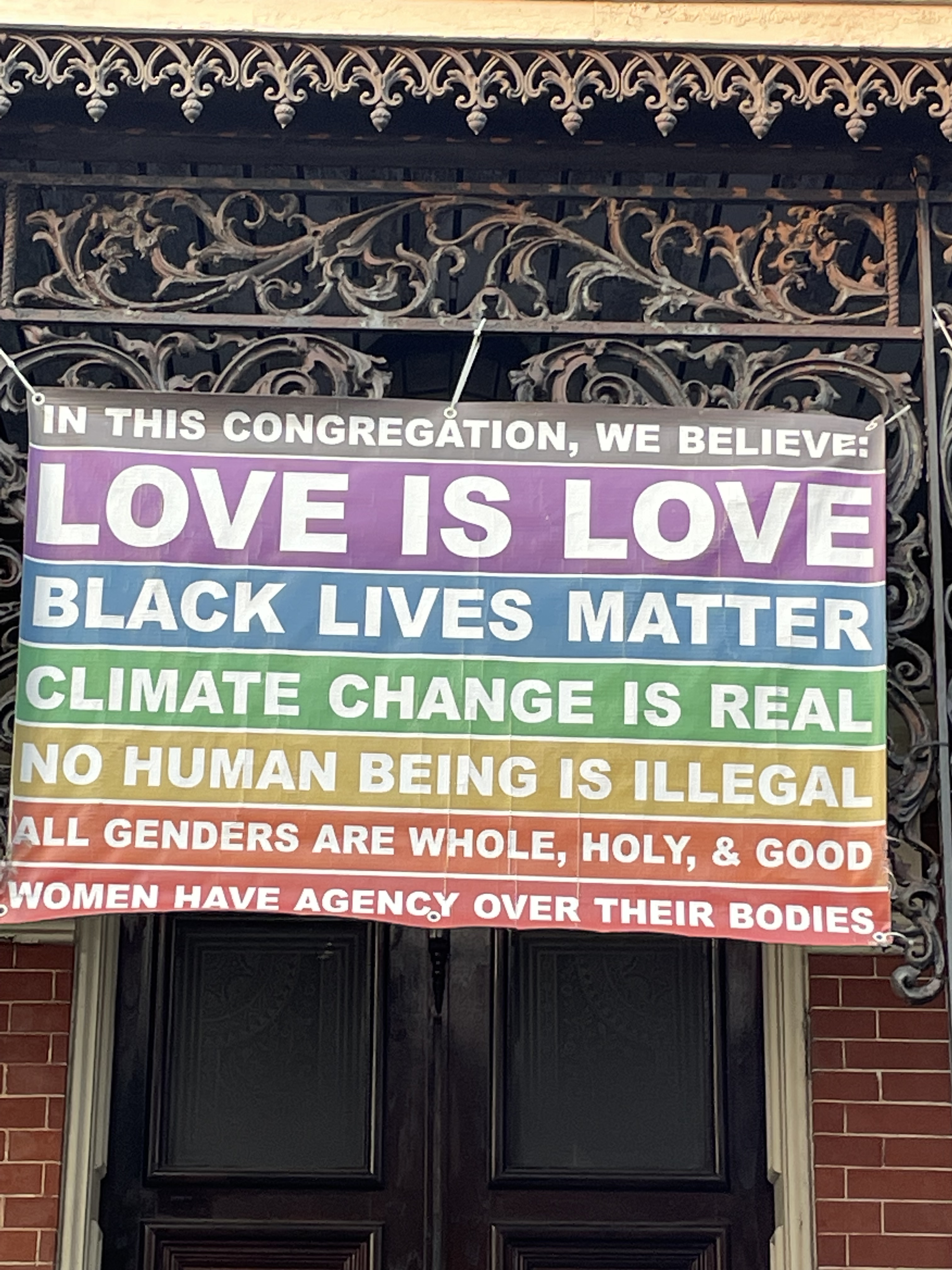
Come and See

Photo taken at the home of the Unitarian Universalist congregation in Lynchburg, Virginia.

What are we doing here this morning? How did we get to this place? Why are we here this morning sitting in a worship service? How does faith happen?

Well, according to John, it all started one day when John the Baptizer saw Jesus walking by and said to two of his disciples: “Look.” “Look, here is the Lamb of God.”

When the disciples heard him say this, they immediately, almost enthusiastically, began to follow Jesus, spending the entire day with him.

The disciple named Andrew went out and found his brother, Simon Peter and said, “We have found the Messiah.” He then brought Simon to Jesus so Simon could see for himself.

This is how church happens. This is how we got here this morning. We are here this morning because one person told another person who told another person who told another person about Jesus.

This is how our faith got started. It is the way our faith happens today. It is the way that faith has always happened. It is the way it is intended to happen. It is to be shared personally, person to person to person.

Our scripture text continues…

The next day, Jesus went out to Galilee and found a man named Philip and said to him, “Follow me.” Then Philip, much like Andrew who went and told Simon about Jesus, went out and found his friend Nathanael and said to him, “We have found him about whom Moses in the law and also the prophets wrote: Jesus, son of Joseph from Nazareth.”

And here’s where the story really gets interesting. Nathanael doesn’t respond with the eagerness and enthusiasm of Andrew or Simon when they first heard about Jesus. In fact, Nathanael responds much like we might expect people to respond to Jesus today. Nathanael seems cynical, skeptical, dismissive, and even rude. We can picture him arrogantly rolling his eyes asking, “Can anything good come from Nazareth?”

We can picture this, because we have seen it. We’ve heard this before, haven’t we?

Especially if we’ve invited anyone to be a part of a church lately, and I am hoping that all of you are inviting people! Because that is how our faith works. It is how church works. It is shared personally, person to person.

Do you remember hearing the cynicism in their voice, asking us: “Can anything good come from the church these days?” “Does anything good ever come from organized religion?”

Nathanael responds the same way people might respond to us when we bring up Jesus or the church these days.

However, notice how Philip responds to the cynicism of Nathanael. Philip does not respond in any of the ways I would respond. He doesn’t snap back. He doesn’t get defensive or walk away disappointed or angry. I am sometimes tempted to start preaching a little sermon, defending God and the way of Jesus, making the case for following Jesus, arguing that the things that he had heard about Jesus, Nazareth, and organized religion, are not all true.

No, Philip doesn’t do any of those things. He lets Nathanael’s criticism roll off his back and simply answers: “Come and see.”

What is interesting is that this is exactly how Jesus answered Andrew and his friend one day when they asked Jesus where he was staying. Jesus said, “Come and see.”

Andrew went and saw, and he saw that Jesus never really stayed anywhere. He saw that foxes have holes and birds have nests but the Son of Man has nowhere to lay his head (Matthew 8:20). He saw that Jesus was continually on the move, on a journey, teaching, leading, touching, healing, forgiving, feeding, giving, welcoming, accepting, restoring.

Jesus simply said, “Come and see,” and when Andrew went and saw, he saw that he had indeed seen the Messiah.

And when Nathanael dismisses Philip, Philip simply responds: “Come and see.”

Professor of preaching Michael Rogness points out that our task is “not to prove the truth of the Christian faith” to a skeptic or a cynic. It is not even to persuade others to become Christian. Our task is simply to say to others: ‘Come and see.’”[i]

And Nathanael came. And Nathanael saw this one who surprisingly knew him by name, this one who saw the good that was in him, this one who loved him and promised to open up heaven for him.

Seminary president David Lose remarks: “Such simple…and inviting words.” “Come and see.” Words, he says sum up “not only the heart of the Gospel of John, but the whole Christian life.” Because the Christian faith, he says, is “all about invitation.”

“It’s not about cramming your faith down someone else’s throat. After all, nowhere in the Bible does it tell us to ask anyone: ‘Have you given your life to Christ?’” Nowhere does the Bible tell us to go up to our neighbors and ask: “Have you accepted Jesus into your heart?” “Have you been saved?” Or worse: “If you died this very day, do you know where you will spend eternity?” Or even much worse: “God loves you and wants a personal relationship with you, but if you reject God, then God will send you straight to hell.”[ii]

No, we’re just asked to say (not to push, guilt or scare) but to say: “Come and see.” “Come and see for yourself what following this way of love that Jesus taught and embodied means in my life.”  “Come and see how the words and actions of Jesus informs my thinking, guides my life, gives my life meaning.” “Come and see for yourself the good things our church is doing to continue the revolution that Jesus started.” “Come and see.”

It is not our job to persuade, convert or to save; only to invite.

And here’s the thing. When we first bring up the subject of church, if they can see that we are truly being sincere, if they can see in our eyes that we are being honest and genuine, if they can see we are sharing from our hearts, we should expect them to be skeptical and cynical. We can fully expect them to dismiss what we are saying, or even make some smart-aleck response like: “I didn’t know anything good could come from church these days!”

And when they do, when they hesitate or smirk, we need to understand that that’s okay. In fact, in this world, it is to be expected. Because this good news that we are sharing—the good news that God, the creator of all that is, not only knows us by name, but loves us, sees the all of the good in us, the good that others are unable to see in us, the good we sometimes have trouble seeing us, and gives God’s self to us, affirming us as their child, and challenging us every day to bring some heaven to this earth—this good news does seem too good to be true.

Thus, we should completely understand if they pause at our invitation, if they look unsure, or even if they walk away. All we can do, all God wants us to do, is just say, “Come and see.”

Come and see a church that never stays put but is always on the move. Come and see a church that does not invite you to come to church but to go and be the church, to be the embodiment of Christ, a movement for wholeness in this fragmented world.

Come and see a church who strives every day to keep the dream of the Rev. Dr. Martin Luther King Jr alive by being a pro-reconciling, anti-racism church.

Come and see a church that believes in religious freedom for all religions, not just Christians. And come and see a church that does not believe religious freedom gives us a right to discriminate or to do harm to another.

Come and see a church that invites and welcomes both Jewish and Muslim leaders in our community to speak at a Thanksgiving Service, a church that wants to do all that it can do to break down the walls that divide us, to build bridges and create friendships will all our neighbors.

Come and see a church where you brain does not have to be checked at the door and believes in the importance of critical thinking. Come and see a church that believes science is real and caring for this planet is a God-given, moral and holy responsibility.

Come and see a church that believes all people are created in the image of God, and all means all. Come and see a church that values the leadership of women, ordains women, and believes women’s rights are human rights.

Come and see a church that is deeply rooted in the American dream, a church that was conceived by immigrants in the early 19th century, a church where the words of Emma Lazarus that are engraved in the foundation of the Statue of Liberty are engraved in our historical and spiritual DNA:

“Give me your tired, your poor,

Your huddled masses yearning to breathe free,

The wretched refuse of your teeming shore.

Send these, the homeless, tempest-tost to me,

I lift my lamp beside the golden door!”

Come and see a church that is not afraid to be labeled “woke” or “liberal” in a conservative town. And when we are, we smile and respond, “Thank you. We strive every day to be as wide awake and liberal as Jesus, Paul and the Hebrew prophets!”

Come and see a church that is committed to the Word of God, and, with the prophet Isaiah, isn’t afraid to speak truth to power:

Ah, you who make iniquitous decrees,

   who write oppressive statutes,

to turn aside the needy from justice

and to rob the poor of my people of their right,

that widows may be your spoil,

   and that you may make the orphans your prey!

Come and see a church that is preparing to celebrate 150 years of serving community by supporting childhood literacy, feeding the hungry, caring for the planet and supporting our threatened democracy by registering people to vote.

Come and see a church who, without condemning or judging, genuinely welcomes all people to join their mission to be the Body of Christ in this world. Come and see a church that believes we are all called to be ministers; we are all disciples called to build up the Body of Christ by inviting others to join us.

Come and see a church that believes that the grace of God extends to all, especially to those who need more grace, and that there is nothing in heaven or on earth, or in all of creation that can ever separate any of us from the love of God through Christ our Jesus Lord.

Come and see a church that seeks to be a place of grace, believing that none of us are better than others, and all of us, each one of us, including the pastor are imperfect and needs grace.

What’s that? You don’t believe what you are hearing?

Of course, you don’t. And we don’t expect you to. We are aware that it sounds too good to be true.

So, why don’t you just come and see!

Holding Christmas Hope

Luke 2:22-40 NRSV

One of the great wonders of church is the surprises. Our worship on Christmas Eve certainly had one, as probably, for the very first time for all who had gathered, as Erin Gresham read from John 1 about the light coming into the world that the darkness could not overcome, a rather exuberant bat invaded the service.

Now, you may not know this, but in seminary, they don’t teach you what to do or say when that happens. So, instead of singing “What Child Is This” with the congregation before Holy Communion, I just stood at the table racking my brain for the right words to say as I watched people in the back of the sanctuary, unsuccessfully and rather comically, trying to shoo the bat out by frantically waving their jackets at the bat to chase it out the door, but I didn’t want to say anything that may illicit some laughter that might interfere with the seriousness of the moment.

So, I just kept leading the service as planned, ducking at least once as the bat swooshed towards the chancel. It was a crazy scene, really. We just lit our candles and sang Silent Night like it had never happened or that it happens all the time. I guess we proved the words Erin read to be true, that our lights were going to shine in the darkness, and nothing, not even a crazy bat, was going be able to stop it!

But that’s the thing with church, you never know when you will be surprised or shocked by what goes on here! You are tired and not feeling your best, but you get up and come to church anyway. You may come more out of duty than desire. You come not really expecting anything surprising from what is certain to be a just another predictable service. You come fully expecting to leave the same way you came, unmoved, untouched, unchanged. But then, out of nowhere something happens that astonishes you: someone unexpectedly hugs you; a song you’ve sung a thousand times before astounds you; a word you’ve heard countless times startles you. God, in spite of everything, in spite of you, and even in spite of the preacher that day, speaks. And everything, including you, your whole world, is amazingly transformed. A simple handshake brings healing. A smile from an unassuming child generates hope. A tiny cracker and a sip of juice become more than sufficient.

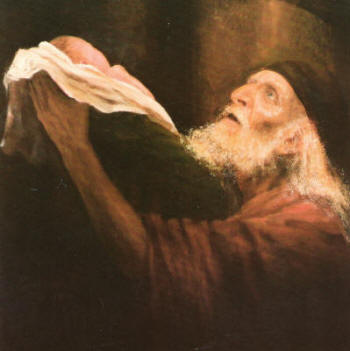
Simeon had arrived to worship in the Temple as he had for many decades. He was as devoted to the Lord as anyone. For years, he had been eagerly coming to the Temple expecting to be surprised by the presence of the Messiah; however, year after year he left each service disappointed.

It was just another ordinary Sabbath. Old Simeon was tired and give-out. Over the years, much of his anticipation had turned into doubt. But he got up and came to Temple anyway, more out of duty than desire, knowing that he would probably once again leave the service unmoved, untouched, and unchanged.

He came in through the front door, nodded politely to the usher who handed him an Order of Service that he had all but memorized, and settled in his usual seat for another predictable service. During the Prelude, he opened the bulletin and noticed that there was going to be another baby dedication service. As was their custom several times during the year, the minister was going to once again ask the congregation to bless a newborn baby. Nothing unusual. Simeon had seen this a hundred times before.

After the Prelude and the Chiming of the Hour, the Call to Worship the Invocation, and a hymn, this strange new couple unexpectedly came down the aisle holding a tiny baby. They were coming for the baby dedication service. And then, out of nowhere, it happened.

Simeon cannot explain how he knew it, but he knew it, nonetheless. This was it! He could not keep his eyes off that baby during the prayers for the child and the parents, for he knew without a doubt that this was the Messiah, the Promised One God sent to save Israel.

In the middle of the dedication service, he grabbed the back of the pew in front of him with both of his hands and slowly pulled himself up to stand on his tired feet. Holding on to the pew in front of him, he shuffled past three people who were sitting beside him and made his way down the aisle to the front where the new parents were standing. Then he had the courage, some would say the audacity, to ask the parents if he could hold the tiny baby. The old man must have looked harmless enough, for Mary and Joseph handed the old gentleman their firstborn son without hesitation.

Again, Simeon cannot explain how he knew it, but he knew that he was holding more than a baby in his arms that morning. Astoundingly, he was holding hope in his arms. Amazingly, he was holding salvation in his arms. Surprisingly, he was holding none other than Christmas in his arms, Simeon had crossed off in his mind the only thing that was ever on his bucket list and started praising God saying:

‘Master, now you are dismissing your servant in peace,
according to your word;
for my eyes have seen your salvation,
which you have prepared in the presence of all peoples,
a light for revelation to the Gentiles
and for glory to your people Israel.’

This is the wonder of this thing called church. When we least expect it, God shows up and surprises us. We perform an ordinary ritual, like a Child Dedication Service, and something extraordinary happens that changes us forever.

Mary and Joseph showed up with their baby asking the likes of old men like Simeon to bless their newborn baby, and the child ends up blessing Simeon.

 We may have thought we knew what we were doing here this morning. We thought our friends Kevin and Elaine Lindmark were coming to merely present their daughter, Leighton Annette and Shanaya and Aili Barricklow-Young were merely presenting their daughter Feyre Elaine.  Wee thought they were coming to ask us, their family of faith, to take them in our church’s arms and bless them—Bless them by promising to teach them the faith, to share our knowledge of the way of love Jesus taught his disciples with them.

But, to our surprise, what if it is the other way around?

What if we are not here this morning to bless Feyre and Leighton, but Feyer and Leighton are actually here to bless us? Now, I know we are not Simeon and they are not the Messiah; however, it was the Messiah who had this to say about children like these: “Let the little ones come to me, for to such as these, belong the Kingdom of God” (Luke 18:16).

I believe this means that these little ones have more to teach us about the ways of God than we could ever possibly teach them. I believe this means that they and the other children whom God has given us are not the future of the church, but they are the church’s present. Surprisingly, they have much to give the church today. Unexpectedly, even as young and as they are, have much to teach the church this very moment.

For example, Feyre and Leighton will never be more vulnerable, more dependent than they are right now. And because of this, they may never have more to teach us. For hey teach us that if the church is going to look like the Kingdom of God, then the church must continually reach out, invite, bring in, accept and adopt, and care for those in our society who are the most vulnerable, the most dependent.

         They teach us that we are to feed those who cannot feed themselves, give drink to those you cannot drink on their own, clothe, shelter, comfort those in need, and love those who are the most frail, fragile and needy.

Feyre and Leighton affirm our support of Our Daily Bread, Miriam’s House, Parkview Mission, The Free Clinic and Interfaith Outreach. Teaching us that we come the closest to living in the Kingdom of God, we come the closest to holding the Messiah in our arms, when we offer grace and hope to the least of these.

However, they also teach us something that may be even more important. The Messiah once said: “Unless one comes to me as a little child, they cannot enter the Kingdom of God.”  Leighton and Feyre may never be more honest, more real, and more genuine than they are today. What you see is what you get. There is no putting on airs with them. They are not proud. There’s not a pretentious bone in their tiny bodies. When they are hungry, they are going to let us know. When they are distressed, saddened or in any discomfort, they are going to tell us. When they need a change, they will cry out to us.

If we could only learn to be as honest as these little ones: honest with each other, and honest with God. Because before we can truly offer grace and hope to others; I believe we must confess our own need for grace and hope. We must confess our own dependency on God and on others. We must confess our own weaknesses, our need of a Savior who knows such vulnerability, to pick us up, to comfort us and to change us in those places where we most need changing.

We thought we were going to come here this morning and hold two little girls in our arms; however, through their honest vulnerability and their utter dependence, through the Christ revealed in them, amazingly, we held hope in our arms, hope for the present and for the future. We held our church’s mission in our arms. We held Christmas in our arms. We held salvation in our arms. And with Simeon, by the grace of God, we will not leave this service unmoved, untouched, unchanged. We will leave this morning praising God saying:

‘Master, now you are dismissing your servants in peace,
according to your word;
for our eyes have seen your salvation,
which you have prepared in the presence of all peoples,
a light for revelation to the Gentiles
and for glory to your people Israel.’ Amen

Christmas Favor

Luke 1:46b-55, 2:14 NRSV

And suddenly there was with the angel a multitude of the heavenly host, praising God and saying, ‘Glory to God in the highest heaven, and on earth peace among those whom he favors!

Among those whom God favors? Let’s be honest for a moment. Are you at least a little bit offended? God doesn’t have favorites, right? God is supposed to be like that parent going back to the shopping mall on Christmas Eve, because they are afraid a few dollars may have been spent more on one child than another! The phrase is so offensive, did you know that some ancient manuscripts omit it all together!

However, even if we omit it, we have the Song of Mary. In the Magnificat, Mary sings: “My soul magnifies the Lord, and my spirit rejoices in God my Savior, for God has looked with favor [there it is again] on the lowliness of God’s servant. God has brought down the powerful from their thrones and lifted up the lowly. God has filled the hungry with good things, and sent the rich away empty” (Luke 1:46-48, 52-53).

And then, we have the shepherds, the first ones on earth to hear the pronouncement of Christmas. Of course, we love to romanticize these shepherds, as we remember our innocent children depicting these Christmas characters wearing bathrobes in adorable Christmas plays. We also think about images of the shepherd king David and the beautiful green pastures, still waters and the protection of the rod and the staff of the twenty-third Psalm. And we may remember Jesus calling himself “the good shepherd.”

However, the reality is that shepherding was a most despised occupation. New Testament Professor Alan Culpepper writes:

In the first century, shepherds were scorned as shiftless, dishonest people who grazed their flocks on others’ lands.

Fred Craddock writes that the shepherds belong to the Christmas story:

Not only because they serve to tie Jesus to the shepherd king, David (2 Sam 14:23, 21) but because they belong on Luke’s guest list for the kingdom of God: the poor, the maimed, the blind, the lame (Luke 14:13, 21).

This is why the angels pronounce the good news of Christmas is great joy for ALL the people. Culpepper writes:

The familiarity of these words should not prevent us from hearing that, first and foremost, the birth of Jesus was a sign of God’s abundant grace.

The birth is a sign that God loves ALL people, even the most despised, the most lowly, those labeled by the religious culture as the most immoral.

And in what form does this sign appear? The savior was coming into the world through a poor peasant woman to be placed in a feeding trough made for animals. And it is this humble scene that sets the stage for his entire life on earth. The savior of the world was born and lived and died on the fringes, on the margins of society—underscoring the truth that the good news has come into the world for ALL—especially to those who are marginalized by politics and religion.

Page Kelly, my Old Testament professor at Southern Seminary, used to love to say that the biblical symbol for God’s justice on this earth was not a woman holding a set of scales wearing a blindfold, but was one of the prophets holding a set of scales with his eyes bugged out and a long bony finger mashing down on the side of the poor—favoring those who have always been despised and marginalized by society. Favoring those in our world who need more justice, more peace and more love.

Think about that for a moment. Today, is there any person or group of people, perhaps someone you know personally, who needs more love today?

It is a most important question, for I believe answering this question, and then doing something about it, is how God wants us to celebrate Christmas. More than lighting candles and singing carols, I believe God needs us, yearns for us, to show some favor, to love some people more than we love others—namely, those among us today who need more love.

The entire Biblical witness affirms that this favor is the will of God.

Moses commanded the Israelites:

If there are any poor…in the land…do not be hard-hearted or tightfisted toward them. Instead, be generous and lend them whatever they need. …Give generously to the poor, not grudgingly, for the Lord your God will bless you in everything you do. There will always be some in the land who are poor. That is why I am commanding you to share freely with the poor and with other Israelites in need (Deut 15:7-11).

Never take advantage of poor and destitute laborers, whether they are fellow Israelites or foreigners living in your towns. …True justice must be given to foreigners living among you… (Deut 24:14-16).

The writers of the Proverbs could not be more emphatic:

…blessed are those who help the poor… Those who oppress the poor insult their Maker, but helping the poor honors him”(Proverbs 14:21, 31).

If you help the poor, you are lending to the Lord— and he will repay you! (Proverbs 19:17).

Those who shut their ears to the cries of the poor will be ignored in their own time of need (Proverbs 21:13).

A person who gets ahead by oppressing the poor or by showering gifts on the rich will end in poverty (Proverbs 22:16).

Whoever gives to the poor will lack nothing, but those who close their eyes to poverty will be cursed (Proverbs 28:27).

So,

Speak out for those who cannot speak, for the rights of all the destitute. Speak out, judge righteously, defend the rights of the poor and needy (Proverbs 31:8-9 NRSV).

The Psalmist writes:

Give justice to the poor and the orphan; uphold the rights of the oppressed and the destitute. Rescue the poor and helpless; (Psalms 82:2).

Isaiah pleads:

Learn to do good. Seek justice. Help the oppressed. Defend the cause of orphans. Fight for the rights of widows. “Come now, let’s settle this,” says the Lord. ‘Though your sins are like scarlet, I will make them as white as snow. Though they are red like crimson, I will make them as white as wool’ (Isaiah 1:17-18).

“In other words,” says the Lord, if you truly want to celebrate the advent of the Messiah, if you want to light a candle on Christmas Eve and experience some of my Christmas favor, sing your carols, but then make a point to love the least among you more. Offer more love to those who need love more!

Free those who are wrongly imprisoned; lighten the burden of those who work for you. Let the oppressed live free and remove the chains of injustice. Share your food with the hungry and give shelter to the homeless. Give clothes to those who need them, and do not hide from relatives who need your help.

Then your salvation will come like the dawn, and your wounds will quickly heal. The Spirit of God will lead you forward, and the glory of the Lord will protect you from behind. Then when you call, the Lord will answer. ‘Yes, I am here,’ he will quickly reply, ‘Remove the heavy yoke of oppression…Feed the hungry and help those in trouble. Then (listen carefully to this!) your light will shine out from the darkness, and the darkness around you will be as bright as noon’(Isaiah 58:6-10).

You know what that sounds like? That sounds like Christmas to me! Sounds like John chapter one:

The light shines in the darkness, and the darkness did not overcome it (John 1:5).

The good news is that when we bear the image of God, when we heed the words of the prophets and follow the way of Jesus, the light of the world, by favoring the least of these among us, when we offer more love to the lowly, the marginalized, the despised, the poor and the weak, when we reach out and offer them our bread, our drink, our clothing, our presence, our touch, our very selves, then we will not be offended by the chorus of the angels:

Glory to God in the highest, and peace on earth, whom God favors.

Christmas: Can You See It?

Isaiah 2:1-5 NRSV

Isaiah 2 begins:

The word that Isaiah, son of Amoz, saw concerning Judah and Jerusalem.

Now, let me ask you, who in the world talks that way?  We would say, “The word that Isaiah heard…” Not “The word that Isaiah saw…”

What does it mean to not just hear a word, but to see a word? What would it mean to say: “That’s why I go to church on Sunday morning, to see a word.”

The word “see” here means much more than merely reading words on a scroll. It implies that the words are literally brought to life.

In chapter 1, Isaiah graphically paints a portrait what he has seen in the world: it is a detailed, dark scene of violence, war, corruption, dishonesty, unfaithfulness, oppression of the weak, and trampling on the poor.

The people worship. But their religion is sick. They pray, and they give. But God is not having it. Their prayers are not heard, and their gifts are not accepted.

Then, chapter 2 opens as though Isaiah is starting all over with a new, fresh canvas – or you could say, God is. Isaiah sees people of every nation going to the Mountain of God, including those who were enemies of Israel and Judah and being completely transformed by God’s love.

Can you see it?

Isaiah can. And the transformation is nothing less than miraculous.

They shall beat their swords into plowshares,

and their spears into pruning hooks;

nation shall not lift up sword against nation,

neither shall they learn war anymore.

The transformation that the love of God creates is a complete reversal of the way things currently are in the world. That is why it is so difficult for us to see.

Living in a world that is in perpetual war, where innocent hostages waving white flags are gunned down, living in a world where children regularly practice hiding in their classrooms from active shooters, it is hard for us to see any possibility of this world being at peace.

But what is important for us to understand is that Isaiah’s image of swords turned to plowshares is not Isaiah being naïve. For Isaiah is no Pollyanna Prophet. Isaiah is a realist. Isaiah had this gift to see the world as it really is, and as it actually will be.

His vision of the world in Chapter 1 is as real as the evening news:

Corrupt deals by those whose heads are sick, whose hearts are small, who have no truth in them from the soles of their feet to the top of the heads. They love a bribe and run after gifts. They do not defend orphans nor listen to widows. They pretend to worship God, but their worship is in vain, and their country is desolate. This is reality.

Then, in chapter 2, Isaiah has another vision which is equally real.

Weapons of war are turned into agricultural tools. Death-dealing images are turned into food-producing, life-giving images. This is not wishful thinking. This is a promise. This is reality. This is truth. The scene in Chapter 2 is as real as the scene Chapter 1. Isaiah saw it. He believed it. The question is, can we see it? Do we believe it?”

I believe President Dwight Eisenhower may have seen it. In one of the most prophetic of all presidential speeches, Eisenhower once said,

Every gun that is made, every warship launched, every rocket fired signifies, in the final sense, a theft from those who hunger and are not fed, those who are cold and are not clothed.

         Like Isaiah, I believe Eisenhower saw the Word of God. The question is can we see it? Do we believe it? Are we praying today for Israel and Russia to see it. For our country to see it?

Wouldn’t it be wonderful if this Word could somehow be made flesh to dwell among us to show us the precise paths we should follow, the narrow but abundant way we could live?

I think it is more than interesting that Isaiah suggests that for people to see the Word, they need to climb the mountain of God to allow God to teach them or show them. For Matthew says Jesus climbed a mountain, and there he taught us to see a world completely re-created by the love of God.

A world where the poor are blessed, mourners are comforted, the meek are rewarded, and those who thirst and hunger for justice are satisfied. A world where those who need mercy, receive it. Those who want peace, find it, and the pure in heart, (what do they do?) They see God.

The question is, can we see it?

Maybe our hearts are not pure enough to see it—too filled with the darkness and despair of the world. I believe this is why we need to continually return to the mountain, to sit at the feet of the Word made flesh, to be taught how to see it, to believe it, and thus how to live it, to be it.

To be light and salt. To love our enemies and to pray for those who do us harm. To forgive seventy times seven, to turn the other cheek, to go the extra mile, to give the very shirt off our backs. To do unto others as we would have them do unto us, to always speak the truth, to never judge or demean another. To avoid greed and materialism and hypocrisy, and more importantly, to be doers of this Word and not hearers only.

With its ornaments and bright lights, December may be the most visual time of the year. Everywhere we look, light pierces the darkness. Yards that would otherwise appear dreary and dead, come to life with evergreens, colorful decorations and bright lights. Like the downtown bluff walk, the whole world is transformed.

This should remind us that one of the most important things we can do during this season we call Advent is to help others visualize a world transformed by Christmas.

How? By going to the mountain to sit at the feet of Jesus so we can walk with others in the Light of the Lord.

And there lies the key to seeing anything – light.

If there is not a considerable amount of light in a room, or even outside, our vision is significantly impaired, and the older we get, the worse it gets. That is why the 21st century technological advance that for which I am most appreciative is the little flashlight on my cell phone.

This is why I love the tradition of the Advent wreath. Christians everywhere prepare for Christmas by lighting candles to celebrate the Light of the World who has come to shine light into our darkness. We believe by going to the mountain to sit at the feet of Jesus, by not only hearing, but seeing, then doing his words, we are allowing this Light to get brighter each week changing the way we see ourselves and this world forever.

Looking at the world in the Light of Christmas means believing God is here with us and has identified with us by becoming flesh to dwell among us. God shares in our joy, but God also shares in our suffering.

Looking at the world in the Light of Christmas means believing that the Word that was made flesh is still very much a part of our lives shining light in the darkness.

Looking at the world in the Light of Christmas also means believing that God is always working to transform the world bringing order out of the chaos, triumph out of defeat, joy out of sorrow, and life out of death. God is always working all things together for the good and uses people like you and me to accomplish this.

What this world needs today is more believers. I am not talking about those who merely believe in God. I am talking about those who believe the gospel truth that God is doing, even today, a new thing in this world. This world needs more believers who believe that the Kingdom of God is really coming, and the will of God is being done on earth as it is in heaven!

Advent is the time to allow the Light of the World to adjust our focus and to sharpen our vision, to remind us, that because the Word was made flesh, we have been given the grace to see the whole creation in a brand new light. Misery becomes opportunity. Strangers become family. Enemies become friends. Everyday becomes gift, a fresh, new canvas to recreate a brand new world!

A world where no child goes to bed cold or hungry, no child knows foster care, and no child ever fears being shot in their classroom—A world where everyone is paid a living wage, healthcare is accessible to all, education is equitable for all, as every life is valued—

A world where people of all creeds and all cultures live peaceably, harmoniously, graciously, side-by-side, shoulder-to-shoulder, hand-in-hand—

A world where the distorted morality is restored. Sick religion is healed, and all that is broken is remade—A world where the lame walk, the deaf hear, the blind see and the outsider is included. It is a world where walls come down, chains are loosened and all are free. Hate, violence, wars, corruption, division and bigotry pass away. All of creation is born again, and liberty and justice fully and finally comes for all.

A world where all will know that into the world’s night, a Light shines in the darkness, and the darkness will never overcome it!

Christmas Shoes

Mark 1:1-8 NRSV

About the gift of Christmas, the gift of God’s enfleshed self to the world, John said, “I am not worthy to stoop down and untie the thong of his sandals.”

It was written in Jewish law that “pupils should do everything that is commanded by their teacher with the exception of unlacing the teacher’s shoes.”  The subservient task of kneeling to the ground and unlacing another’s shoe was something only a slave should perform.[i]

 This means that John not only regarded himself unworthy to be a disciple of Jesus, John believed he was unworthy to even be a slave of Jesus. When he compared himself to the one wearing the shoes of Christmas, John regarded himself as lower than the lowliest lowly.

And who could blame him? John was talking about God, the Holy Creator of all that is, the Divine One, Love Love’s self who has come down to earth wearing shoes. John was talking about the great sovereign of the universe from on high, miraculously and lovingly stooping low enough to the earth to kneel down to the ground, put on, lace up and wear shoes. John was talking about heavenly feet accustomed to walking on streets where angels trod that have put on earthly shoes in order to walk the same roads each one of us walk.

Although it was John’s plan to make our windy and rocky roads straight and smooth for these holy shoes, the purpose of the divine shoes was to walk every crooked path, experience every twist and turn, identify with every bump, every dip, every rut. The Lord of Hosts stooped down, knelt down, and laced up shoes to walk down snaky roads; travel down uncertain roads; journey down long, lonely, and desolate roads.

God knelt down and put shoes on feet that would grow weary and sore from those roads. God laced up shoes that would cause great suffering when Jesus’ feet would swell, blister and bleed.

Those shoes ran down fearful, foreign roads to escape Herod’s sword. Those shoes would journey down dark, dangerous wilderness roads that try the soul. Those shoes would travel down desperate roads to bring good news to the poor. Those shoes would travel down neglected roads to give dignity to those marginalized by a religion that had been hijacked by greed and privilege. Those shoes would walk roads lined with the hypocritical and judgmental to defend and forgive the sinner. Those shoes would move down roads paved with suffering to heal and restore the sick. They would go down tear-soaked roads to comfort mourners and raise the dead. They would march down fearful roads to stand for justice and to bring peace.

And near the end of his road on this earth, those holy shoes, worn, frayed and tattered by life, would lead him to a table with his friends. After supper, he would get up from that table, take off his outer robe, and tie a towel around himself. He would then pour water into a basin. And like his humble beginning in a lowly manger, he would once again stoop down, kneel to the ground, and lovingly, empathetically and subserviently untie the shoes of each one at that table, even the shoes of the one who would betray him and of the one who would deny ever knowing him.

Now, in the historical and cultural context of the day, the disciples’ shoes would be removed long before they reclined at the table. However, figuratively and theologically speaking, Jesus untied their laces and removed their shoes.[ii]

Relief, respite and release overcame them as they realized that none of their unworthiness prevents their Lord from graciously taking their feet into his hands and washing away all the dirt and grime from every road they had ever traveled. None of their filth is too offensive. There are no stains too deep. The fresh water from the basin that restores, refreshes and relaxes their wearied feet is miraculously transformed into living water that saves their wearied souls. And a holy peace beyond all understanding overwhelmed them.

The good news of Christmas is that the Holy One, whose laces John believed he was unworthy to untie, comes to us, stoops down, kneels before us, and unlaces our shoes, freeing us in the places we have been too tightly bound.  He empathetically takes our feet into his hands and washes our dirty, sore and weary feet, and makes us ready for the road again.

That is the good news of Christmas. Now, listen to the good irony of Christmas.

John believed he was unworthy to untie the shoes of Christmas. However, because of the good news of Christmas, John is not only worthy to untie and remove those shoes, John is actually worthy to put on, lace up,  and wear those shoes.

Through the gift of Christmas, through the gift of the God who has walked where we walk, through the gift of the Divine who stoops down, unties and removes our shoes, washing our feet and our souls, we are made worthy to not only untie the shoes of Christmas, but to wear the shoes of Christmas. We are worthy to put on Christmas shoes to go where he went, to do as he did, to include as he included, to forgive as he forgave, to love as he loved, to bend ourselves to the ground to touch the places in people that most need touching.

It is believed that fourteenth century saint Teresa of Avila once said:

“Christ has no body but yours, no hands, no feet on earth but yours.
Yours are the eyes with which he looks with compassion on this world, and yours are the feet with which he walks to do good.”

The Apostle Paul has written: “How beautiful are the feet of those who bring the good news” (Romans 10:15).

Don’t worry. It is perfectly natural to feel unworthy to untie those laces, to wear those shoes, to be the hands, the feet, the body of Christ.  And if you believe you are unworthy you are in very good company.

Abraham and Sarah did not believe they were young enough to be worthy (Genesis 17:17). Jacob was not truthful enough to be worthy (Genesis 27). Moses was not articulate enough (Exodus 4:10). David was not faithful enough. (2 Samuel 11:2-4). Rahab was not pure enough (Joshua 2:1). Jeremiah was not mature enough (Jeremiah 1:6). Mary was not rich or powerful or old enough (Luke 1).

Yet, God makes the unworthy worthy to be God’s enfleshed presence in this world, to be God’s body, hands, eyes, and feet in this world. As the Apostle Paul reminds each of us:

 “Consider your own call, brothers and sisters: not many of you were wise by human standards, not many were powerful, not many were of noble birth. But God chose what is foolish in the world to shame the wise; God chose what is weak in the world to shame the strong” (1 Corinthians 1:26-27).

United Methodist Bishop William Willimon tells a wonderful story about a visit to a fraternity house one night while he was the campus minister at Duke University. The reputations of the fraternity houses at Duke were getting so bad that the University Dean required each fraternity to have a certain number of religious programs each year to give them at least some semblance of respectability.

 One of the fraternities invited Willimon to lead one of the programs. He was tocome to the frat-house and give a lecture on “Morality and Character on Campus.”

On the appointed evening, Willimon went to fraternity and knocked on the door. When the door opened, he was greeted by a young boy who appeared to be nine or ten years old.  He thought, “What in the world is a little boy like this doing in a frat house at this time of night?”

“They are waiting for you in the common room,” the little boy said politely. Willimon followed the boy back to the common room where all the young men were gathered, glumly waiting for the preacher’s presentation.

Willimon says for about an hour he talked about morality, responsibility, character and faith and how the frat houses on campus gave little evidence of any of those things. When he finished his harsh talk he asked if there were any questions. Of course, they were none. So, he thanked them for inviting him and headed out.

 One young man got up and walked him to the door. Before they got to the door, Willimon overhead him say to the little boy, “Hey buddy, you go and get ready for bed. I’ll come up, tuck you in and read you a story in a few minutes.”

When they got outside, the fraternity boy lit a cigarette, took a long drag on it, and thanked the pastor for coming out.

 Willimon turned and asked, “Who is that kid in there, and what is he doing here?”

“Oh, that’s Donny,” said the young man. “Our fraternity is part of the Big Brother program in Durham. We met Donny that way. His mom is addicted to drugs and is having a tough time. Sometimes it gets so bad that she can’t care for him. So, we told Donny to call us if he ever needs us. We go over, pick him up, and he stays with us until it is okay to go back home. We take him to school, buy his clothes, books, and stuff like that. Just trying to give him a little bit peace in his life, if you know what I mean.”

The dumbfounded preacher stood there and said: “That’s amazing. You know, I take back everything I said in there about you guys being immoral and irresponsible.”

“I tell you what’s amazing,” said the college boy as he took another drag on his cigarette, “what’s amazing is that God would pick a guy like me to do something this good for somebody else.”[iii]

 In other words: “What’s amazing is that God, the Holy Creator of all that is, would make an unworthy guy like me worthy to not only untie, but to wear the shoes of Christmas.”

[i] Alan Culpepper, Smyth and Helwys Commentary: Mark, 2007, p. 47.

[ii] From a sermon by J. Will Ormond entitled Advent on a Shoestring preached during Advent in 1987 at the Columbia Theological Seminary.

[iii] From a sermon by William Willimon in Pulpit Resource, January 2006, p. 19.

Room for Christmas

Isaiah 64:1-9 NRSV

It was a dark time in a dark world. The prophet Isaiah prays a desperate prayer asking God to rip open the heavens and come down and heal the nation, to bring peace on earth and joy to the people; a prayer asking God to establish a new order that will override the destructiveness of those in power. It’s a prayer of hope that God will come in the same liberating way as God had come in the past.

However, the mood of the prayer changes. Hopeful expectation turns into dreadful despair as the sins and transgressions of the people are considered.

The term “unclean” means “ritually unacceptable.” It is not believed that Israel is a community where God’s presence is willing to come. Like a “filthy cloth,” the nation is so impure and contaminated that no one would dare touch it.

Like “a faded leaf,” it’s in danger of rotting away. Because the people have called on false gods, there seems to be no room for the God of truth. Because they have turned their backs on social justice, turned their eyes away from the poor, there seems to be no place for the God of mercy. Because the people have chosen a way of violence, there seems to be no way for the God of peace. There seems to be no hope.

But then, the mood changes once more with one of the most hopeful words in the scriptures: “YET!”

YET, you are our Parent. YET, you are our potter. YET, we are all the work of your hand. YET, we are your people.

Isaiah hopefully asserts: YET, you made us, you own us, you are responsible for us, we belong to you. Thus, we trust that you will indeed come again to love us, to save us, just as you have come in the past.

Advent is a time of celebrating this hopeful: “YET!”

It was a dark time in a dark world. The sick and injured were passed by on the other side by prominent men claiming to be religious. The poor were unfairly taxed. Foreigners, scapegoated. Women, objectified. Victims of abuse, stigmatized. Anyone different, marginalized. The entire nation, demoralized.

 YET, a peasant girl named Mary carries hope in her womb and a song in her heart:

 ‘My soul magnifies the Lord,
and my spirit rejoices in God my Savior,
for he has looked with favor on the lowliness of his servant…

…he has scattered the proud…
He has brought down the powerful from their thrones,
and lifted up the lowly;
he has filled the hungry with good things,
and sent the rich away empty.

This is the hope of Advent! The world seems dark, YET, the Light of the World is coming!

Later, the parents-to-be were on the road to pay taxes to a puppet king of an occupied land. The road was long, and being with child made the road especially difficult. And to make things more difficult, when it was time for the baby to be born, they discovered that there was no room in the inn.

There was no room. Sounds like the desperate prayer of Isaiah.

There was no room. There was no place. There was no way. There was no hope.

YET, as God had proved over and over throughout history, from the covenant of Abraham to the great Exodus, there is nothing in all of creation that can separate the world from the love of God. For God, would once again come! Despite every demonic power that tried to thwart God’s coming, God came.

And the good news of this Advent season is that we know that God still comes. And there is nothing in all of creation, nor things above nor below, nor angels nor rulers, nor things present nor things to come, nor life nor death that can stop God from coming.

A church once presented a Christmas play. You know the kind. I used to be in one every year when I was growing up. Three boys playing shepherds are carrying long sticks wearing bath robes with towels wrapped around their heads. And three more boys playing wise men wearing cardboard Burger-King crowns wrapped in Reynolds Wrap are carrying boxes decorated with left-over Christmas garland. They all walk up on the chancel, greet Mary and Joseph, and bow down before the baby Jesus.

Well, during one particular play, after the wise men and shepherds came and bowed before Jesus, a spokesperson for the wise men made the announcement: “We three kings have traveled from the East to bring the baby Jesus gifts of gold, circumstance and mud.” Of course, laughter filled the sanctuary.

But you know what they say: “out of the mouths of babes.”

In the circumstance of being told there is no room for you, there is no place for you, there is no way for you, and there is no hope for you, through Christ, God came to Mary and Joseph and God comes to us and says: “YET!”

The good news of Advent is that God comes to us in all our circumstances and offers us the assurance that there is no circumstance on earth or in heaven that is beyond God’s amazing grace.

And coming as a human being, coming into the world as a fleshly body, a body made up of dust and water, God comes and joins us in our mud.

Through Christ, God came into and still comes into our muck of pain and sickness and offers comfort and healing.

Through Christ, God came into and still comes into our muck of loneliness and fear and shares divine presence and a peace beyond understanding.

The world says there is no room; things are not going to get any better. The world says there is no way; the good old days are long gone. The world says there is no place; evil will get the best of you. The world says there is no hope; peace on earth and good will shall never happen.

YET, a young woman named Mary goes into labor as God says: “I am working all things together for the good!”

YET, a baby is born in the darkness as God says: “The best days of life are always before you.”

YET, a child cries in the night as God says: “Although you cannot go back to the good old days, good new days are coming!

The world says: “There is no room. You will never amount to anything.”

The world says: “There is no way. Sin will always get the best of you.”

The world says: “There is no place for you. Nobody really cares about you.”

The world says: “For you, there is no room, no way, no place, no hope.”

YET, a baby is wrapped in bands of cloth born to underserving, unwed teenagers in an occupied land, as God says: “I love you just as you are, and I come to wrap you in my mercy, clothe you with my grace, nurse you with my love. I know your sins and I forgive you. I will always be with you and never away from you. I will always be for you and never against you. I will always stay by your side fighting for you, even if it means dying for you.”

The world says: “Racism will never end. Bigotry will not cease. Misogyny isn’t going away. There is no way this country will ever come together. There is no room for diversity. There is no place for equality. There is no hope for unity.”

YET, a brown-skinned baby’s birth to a Hebrew woman is announced by angels: “I am bringing you good news of great joy for ALL the people. For you, ALL of you, a baby is born who is Christ the Lord, and through him there is no longer Jew or gentile, slave or free, male or female, for all are one!”

The good news of Advent is while the world often seems dark, YET the light of God will not be diminished.

Biased news channels and social media will continue to divide us, YET the good news that unites us will not be suppressed.

Minorities continue to be pushed to the margins, YET the justice of God will not be defeated.

The sound of gun violence is deafening, YET the Word of God will not be silenced.

The cease-fire has ended, rockets are being fired, YET the Prince of Peace will not be conquered.

The powerful spew misinformation and stoke fear to push their racist agendas, YET truth cannot be hidden.

Hate seems to be flourishing, YET love will not lose.

Sin and selfishness seem to get the best of us, YET grace will not fail.

Despair overwhelms us, YET hope will not die.

The nation feels like a faded leaf that’s about to rot away, YET the kingdom of God will reign forever and ever.

Many churches seem to have lost their way. Blind by power and greed, they embrace a spirit that can only be described as anti-Christ, YET I know of many churches, I know one particularly well, that is committed to following the way of Christ, committed to being the church, to being the enfleshed body of Christ in this world bringing good news the poor, freedom to the oppressed and recovery of sight to the blind.

It’s Advent, and our world grows darker;

YET, it’s Advent, and the Light of the World is coming!

And the darkness will not overcome it.

It’s Advent. God is acting. The Spirit is moving. Christ is coming—Being born, even today, even this very moment, in every one of us. Hallelujah.

Who Is Your King?

christ the king

John 18:33-37 NRSV

Jesus has been arrested for his words and deeds and has already been questioned by Caiaphas, the high priest. Because the sad truth is, that in this world, when you love all people and teach others to love all people, there will always be some people, probably religious, who will want to kill you.

It is now Pilate’s turn to question him.

“Are you the King of the Jews?”

Jesus is the King. But as he told Pilate, Jesus is a different kind of King, for his kingdom “is not from this world.” He adds: “If my kingdom was from this world, my followers would be fighting to keep me from being handed over to the Jews. But as it is, my kingdom is not from here.”

And, if we are honest, this makes those of us living in this world very uncomfortable. But that is Jesus. He comforts the afflicted of this world and afflicts the comfortable of this world. Whether we like to admit it or not, the truth is, we have grown rather fond of the kings and kingdoms of this world.

We prefer the kingdoms in this world that “would be fighting” to keep Jesus “from being handed over to the Jews.”

Nowhere is this more clear than in our response to the threat of terrorism that is in our world today.

We prefer “an eye for an eye and a tooth for a tooth.”

We prefer “It’s not our job to judge the terrorists. It’s our mission to arrange the meeting.”

We prefer “I hear you, and the ones who knocked down these buildings will soon hear from all of us!”

We prefer “the statue of Liberty…shaking her fist.”

The truth is that we prefer answering violence with more violence. We believe combating hate with more hate. We believe fighting for what we believe, even for Jesus.

We believe in coercing our convictions, imposing our opinions, forcing our beliefs, and we don’t care who it offends or even destroys in the process.

We prefer a kingdom where we say it loudly and proudly that “we eat meat; we carry guns; we say Merry Christmas; we speak English, and if you don’t like it, get the heck out.”

We prefer a kingdom where we do unto others as they do unto us.

We prefer a kingdom where we love and help only those who we believe deserve our love and help.

We prefer a kingdom where people know their places and have earned those places.

We prefer a kingdom where people put the needs of their own before the needs of a foreigner.

We prefer a kingdom where we love ourselves, while our neighbors fend for themselves.

Jesus is implying that there are two types of kings. There are the kings of this world, and then there is the king from another world. And Jesus is asking Pilate and Jesus is asking you and me: Who is your king? Who do you say that I am? Am I your King? Is your king from another world or is your king from this world?

One king offers safety;

One king promises persecution, saying if you follow him, people will rise up and utter all kinds of evil against you.

One king offers security;

One king demands risk.

One king endorses greed and prosperity;

One king fosters sacrifice and promotes giving it all away.

One king caters to the powerful, the wealthy and the elite;

One king blesses the weak, the poor and the marginalized.

One king accepts only people of like-mind, like-dress, like-language, and like-faith;

One king accepts all people.

One king is restrictive with forgiveness;

One king is generous with it.

One king controls by fear;

One king reigns with love.

One king leads by threat of punishment;

One king rules with the promise of grace.

One king governs by imposing;

One king leads with service.

One king throws rocks at sinners;

One king defends those caught in the very act of sinning.

One king devours the home of the widow;

One king offers her a new home.

One king turns away the refugee;

One king welcomes the refugee, for he, himself, was a refugee.

One king demeans and mocks women;

One king elevates women as an equals.

One king destroys his enemies with an iron fist;

One king dies for his enemies with outstretched arms.

For one king’s throne is made with silver and gold;

One king’s throne is made with wood and nails.

One king wears a crown of rubies and diamonds;

One king wears a crown of thorns.

So, of course the powers that be, the kings of this world, arrested the king “whose kingdom is not from this world.” Of course they tortured this king, spat on this king, mocked this king and crucified this king, this king from a foreign realm. Of course they tried to bury this king and seal this king’s tomb up with a stone.

But hate could not defeat this king. Bigotry could not stop this king. Religion and nationalism could not overthrow his throne. This king would rise again. But not the way the kings of this world rise. Despite the desires of his followers or the lyrics of their songs, there was no thunder in his footsteps or lightening in his fists. There were no plagues, fire, brimstone, or flood. There was no shock and awe or violence of any kind.

For this king understood what, sadly, few since have understood, and that is:

“The ultimate weakness of violence is that it is a descending spiral, begetting the very thing it seeks to destroy. Instead of diminishing evil, it multiplies it. Through violence you may murder the liar, but you cannot murder the lie, nor establish the truth. Through violence you may murder the hater, but you do not murder hate. In fact, violence merely increases hate. So it goes. Returning violence for violence multiplies violence, adding deeper darkness to a night already devoid of stars. Darkness cannot drive out darkness: only light can do that. Hate cannot drive out hate: only love can do that,” said the Reverend Doctor Martin Luther King Jr.

Consequently, this king arose from the darkness of the grave, powerfully, yet unobtrusively; mightily, yet unassumingly; leaving room to recognize him or not to recognize him, leaving room to believe or to doubt, to reject him or to follow him. This king drove out the darkness, not with more darkness, but with light. This king drove out the hate, not with more hate, but with love.

So, how do we live in these dark days of November 2018?

It all depends on who your king is.

Three years ago this week, Antoine Leiris lost his wife in a terrorist attack in Paris. ISIS claimed responsibility. Days following at the attack, Antoine proclaimed to the world which king he chooses to serve. He shared it in beautiful tribute to his wife on Facebook, promising to not let his 17-month-old son grow up in fear of ISIS.

Friday night you took away the life of an exceptional human being, the love of my life, the mother of my son, but you will not have my hatred…

I do not know who you are, and I do not wish to…

If this God for whom you kill so blindly has made us in His image, every bullet in the body of my wife will have been a wound in His heart…

So I will not give you the privilege of hating you. You certainly sought it, but replying to hatred with anger would be giving in to the same ignorance which made you into what you are. You want me to be frightened, that I should look into the eyes of my fellow citizens with distrust, that I sacrifice my freedom for security. You lost. I will carry on as before.

The good news is that our king is not Donald Trump and our King is not Nancy Pelosi. Our King was never Barak Obama or George W. Bush.

For their kingdoms, like all of the kingdoms of this world, are flawed and dark, and the peace they may offer is temporary. Their reigns are fleeting.

If we choose, our king is and will be the one whom the prophet Daniel speaks:

As I watched,

thrones were set in place,

and an Ancient One took his throne;

his clothing was white as snow,

and the hair of his head like pure wool;

his throne was fiery flames,

and its wheels were burning fire.

A stream of fire issued

and flowed out from his presence.

A thousand thousand served him,

and ten thousand times ten thousand stood attending him.

The court sat in judgement,

and the books were opened. As I watched in the night visions,

I saw one like a human being

coming with the clouds of heaven.

And he came to the Ancient One

and was presented before him.

To him was given dominion

and glory and kingship,

that all peoples, nations, and languages

should serve him.

His dominion is an everlasting dominion

that shall not pass away,

and his kingship is one

that shall never be destroyed.  (Daniel 7:9-10, 13-14)

Grateful to Be Done with Religion

done

Hebrews 10:11-25 NRSV

I am done. I give up. I have nothing left. I just can’t do this anymore. It’s over. No matter how hard I try, nor how much I put into it, I can never get it right.

And I know that I am not the only one. In fact, do you know what the fastest growing “religious” group in America is called?  They are called “the Dones.” At one time, they tried religion. But now they are done.

But here’s the good news—here’s what may be the best reason to be grateful this Thanksgiving: The wonderful truth about the Christian faith is that it is not a religion. No matter what anyone may tell you, the church is not a religious organization.

While I was pastoring a church right out of seminary back in 1993, a deacon in our church asked me where I saw myself in twenty-five years. Although I didn’t mention Arkansas, I told him that I believed that I would still be pastoring a church somewhere.

He laughed out loud.

“What’s so funny?”   I asked.

“I see you more as the type who might be teaching in some college somewhere. I don’t think you are going to be a pastor.”

“Why do you say that?”

He said, “For one thing, pastors are generally religious people. And you, my friend, are not very religious!”

What this deacon failed to realize was that the church is not a religious organization. And the last thing a Christian pastor should be is religious.

Let me share with you what I think is a good definition of religion.  It comes from the late Episcopal Priest Robert Capon: “Religion is the attempt by human beings to establish a right relationship between themselves and something beyond themselves which they think to be of life-giving significance.”

Now, for some people religion has absolutely nothing to do with God.

For example, some say that I run religiously. I have heard my wife tell me that I read Runner’s World magazine like the Bible. I read it religiously to reach beyond myself, to run faster, achieve good health so I can enjoy the good life!

We’ve observed the religious habits of others. “He studies the stock-market religiously.” “She sanctimoniously follows a low-carb diet.” “He works 60 hours a week, religiously.” “He plays golf, religiously.”

We work out, eat right, study, go to work, follow a regimen, all with the same goal: to achieve life! So, it’s possible to be a religious fanatic and have absolutely nothing to do with God.

However, for some, religion is all about God. There are those who feel that we must be religious to get right with God. The main reason they go to church is to work on their relationship with God. They believe if they say the right prayers, believe in the right creed, behave the right way, avoid the right sins, then they can be right with God and God will bless them. If they can conduct their lives in a certain way, they can place themselves in a right relationship with God and achieve abundant and eternal life.

The bad news is that we human beings are always flunking religion.  No matter how hard we work at religion we can never get it right.

We can read all about running and how to run fast, but we will probably get injured.

We can study the Wall-Street Journal religiously and still make a bad investment.

We can religiously follow a diet and still gain weight.

We can place all of our time and energy into our careers, going to work early and leaving work late, and still be unappreciated and miserable.

And when we finally arrive at the place where we think you we have it right with God. When we finally believe we’ve got it right in the religion department, guess what? It only leads to pride and arrogance. A church member once told me, “I am the most humble person in our church!”

Sure you are.

In his wonderful book Unafraid: Moving Beyond a Fear-Based Faith, Benjamin Corey writes about a strange encounter with someone who was religious.

Upon meeting the gentleman, he wondered whether he could ask me a few questions to determine what kind of Christian I was. For some reason, I agreed—and ended up quickly regretting my decision, because the two questions out of his mouth were: “Do you spank your kids? And “Do you think gays are going to hell?”

I was like, “Wait…what kind of survey is this?” I should have known that this True Christian Surveywasn’t going anywhere, but in that moment I was foolish enough to answer his questions.

When I answered “no” on both counts, and answered another question to indicate that I did not believe in the rapture, the gentlemen told me that the reason why I was an adoptive father instead of a biological father was because God was refusing to bless me with children.

The good news of our scripture lesson this morning is that God came into the world through the person of Jesus Christ to put an end to such nonsense, to put an end to religion.

Hebrews notes that the priests stood before God in the temple. Well, of course they stood. There was no time to sit. There is no chair in the holy of holies.

And I know if a priest is going to be setting things right between God and my sin, he’ll never have a chance to sit down! The poor priest will constantly be running back and forth between my sin and God’s salvation.

No matter how great and sincere my sacrifice is when I go to the temple, my shortcoming as a fragmented human being are not going to disappear. The poor priest is never going to get a day off. He’s never going to be able to sit down. That’s why we read: “And every priest stands day after day at his service and offers again the same sacrifices that can never take away sins.”

Now contrast the posture of the priest to Jesus. Notice what Jesus is doing? Jesus is sitting down. “When Christ offered for all time a single sacrifice for sins, he sat down at the right hand of God.”

The veil in the temple, separating us from God was torn in two at his death. And through this great gift of God’s self, God revealed to the world that we should be done with religion.  Jesus is sitting down.

Consequently, there is no point of us getting on some treadmill of right thoughts, right beliefs, right speech, right actions, because that right relationship we so desperately seek has already been made right by God.

We have to only trust that God has indeed done what was needed to be done through Christ.

This is why our church teaches “no creed but Christ.” Being a member of this church is not about believing in this set of principles or that set of ideals, in that biblical interpretation or in this style of worship. It is about trusting and following Jesus.

That is why we call it the gospel. That is why we call it good news. If we called it religion, it would be bad news. Religion would mean that there was still some secret to be unlocked, some ritual to be gotten right, some law to obey, some theology to grasp, or some little sin to be purged.

This Thanksgiving, I thank God that through Jesus Christ this thing called sin between us and God has been made right. Thank God that the church is not a religious organization!  If it hadn’t, as irreligious as I am, there is no doubt in my mind that I would be in some other line of work by now!

The good news is, unlike the priests who are standing, running around, working hard, trying to get it right, Jesus is sitting down. His work is done. Religion is finished. We accept salvation trusting that Jesus has already done the work for us. Our relationship with God has been made right through him.

So, instead of spending holy moments working on our relationship with God, we can spend some sacred time working on our relationships with others, loving others as we love ourselves.

Now, don’t get me wrong. We don’t need religion, but we still need church. However, we don’t need church to get right with God. We need church to discover ways we can get right with our neighbor. Because what this world needs is not more people who say they love God, but more people who love their neighbor with the unconditional, unreserved love of Jesus. We are free. We are free from fear. And we are free to love.

I know that there are some who still believe that what we do here in the church is religious. They have never stepped out to follow Christ, to share the love of Christ with others, because they are waiting until they somehow get it right themselves. They are busy trotting back and forth to the altars of right beliefs, right thinking and right praying.

But this morning I am inviting all to come and realize that God has already made it right through Jesus Christ. I invite all to take a good look at Jesus this morning.

There he is. He’s sitting down.[i]

Thanks be to God.

Invitation to the Table

Each one is now invited to be served the bread and the wine of this table representing the broken body, and outpoured life of God.

There is absolutely nothing you can do to earn a rightful this table. There are no right words, right actions, or right beliefs. The good news is that when we could not make things right with God, God, through the sacrifice of Christ, revealed to the world that things have been made right. May we reflect on the sacrifice of God as we remain seated and sing together.


[i]Inspired from a sermon written by William Willimon.

Unless the Lord Builds It

grandaddy
My grandfather, Eugene Gaston Banks, Sr., served in the US Coast Guard patrolling the North Atlantic during World War II.

Psalm 127 NRSV

Unless the Lord builds the house, those who build it labor in vain.

This is definitely true in marriage.

If a couple does not incorporate some of the basic tenets of the Christian faith into their marriage, their attempts to build a happy home will be in vain. Ephesians 5:20 reminds us that mutual submission in marriage should exist: “Be subject to one another out of reverence for Christ.”

If there is not some mutual sacrifice, self-giving and cooperation in a marriage, then there’s a pretty good chance that the minister who officiated that wedding wasted his or her entire weekend. Randy could have gone to that TCU – Arkansas football game! Howard could have played in that golf tournament!  And we don’t even want to think about what the parents of the couple could have done with all of that money they spent on the wedding!

Furthermore, as a Christian who seeks to be guided and defined by the love of God fully revealed in Christ, here’s the verse from Ephesians that means to most to me: “Husbands, love your wives, just as Christ loved the church and gave himself up for her” (Ephesians 5:25).

If I do not love Lori with a self-giving, self-expending love that is revealed to us in the outstretched arms of Christ on the cross, then all the effort we put into our marriage is in vain. 

Unless the Lord builds the house, those who build it labor in vain.

 This also applies to the church.

Like marriage, I believe the church should be built on the foundation of God’s love that was revealed on the cross.

One day, a very wealthy church member approached the new pastor after he preached a sermon on the inclusive love of Christ. He asked: “Pastor, we’re not going to be the kind of church that welcomes and accepts those people, are we?

By “those” people, I am certain he was referring to anyone who does not look like, live like, love like or think like him.

The new pastor answered, “Of course we are going to be that kind of church. For we believe that the love we are to model to others was fully revealed in the outstretched arms of Jesus on the cross reaching out to all people.

The wealthy man replied: “I suggest that you do everything in your power to prevent that from happening, or I am going to take my family and my money to another church!”

This story, which by the way is a true story, a very personal story, begs the question: “Can a church practice exclusivity and continue to be a church that the Lord is building?”

I believe the answer has to be “no.” For the inclusivity that is revealed in those outstretched arms of our Lord on the cross is foundational to who we are as the church.

A church that does not love and welcome all people in the name of the Christ who died for all is not a church at all, but is only the worst kind of club. And every member of that club is wasting their time. They worship in vain.

Unless the Lord builds the house, those who build it labor in vain. Unless the Lord guards the city, the guard keeps watch in vain.

I believe this most certainly applies to our nation.

If the Lord is not building our nation, if our security and foundation is not in the Lord, then those who labor for this nation and those who guard this nation do so in vain.

Where this becomes the most serious, of course, is when we consider our veterans, especially our veterans who have not only guarded this nation, but gave their lives for this nation.

At one point during the Marine Corps Marathon in Washington DC, we ran along the scenic Potomac River and what’s called “the Blue Mile.” This is a mile stretch of the marathon where fallen service members are commemorated in photographs along the roadway decorated with American flags.

As I ran the Blue Mile, I tried my best to read each name and their ages when they made the ultimate sacrifice. I did not see an age over 39.

As Americans, we owe it to them to do all that we can do to ensure their lives were not given up in vain.

We also owe it to every veteran who survived but nevertheless sacrificed much in service to our country, to do all that we can to ensure that they did not serve in vain.

In the 1930’s Henry Emerson Fosdick, the pastor of Riverside Church of New York, once talked about the seriousness of the Lord building and shaping this world.He prophetically proclaimed:

For myself, I shall try to stand for Jesus Christ as the interpreter of… life. In this world with its cynicism, its disillusionment, often its disheartenment, how men and women are needed to stand for him with the intellectual, personal, and social implications of his gospel. And it is going to be serious business standing for him in this generation.

Fosdick then tells a story:

It is said that a man once came to [the great artist James Abbott] Whistler, and asked his help in hanging a new and beautiful picture. The man complained that he could not make the picture fit the room, and Whistler, looking over the matter, said, ‘Man, you’re beginning at the wrong end. You can’t make that painting fit the room. You will have to make the room fit the painting.’

Fosdick says:

So when we carry into this modern world the picture of [the] life that Jesus Christ brought, we cannot make it fit the room. Put it over against our private morals, our disintegrating family life, our economic system… it will not fit the room. We must change the room to fit the picture. [And] that is serious business.

It is important to mention that since Fosdick inferred that we the need to renovate of our nation to fit the portrait of Jesus, Christian “Reconstructionists” have sought to rebuild or reconstruct America to fit their personal interpretation of biblical morality. You need to know that I am not talking about doing that. I am not advocating transforming our democracy into some sort of theocracy. And I am certainly not advocating dismantling the First Amendment.

I am talking about building upon that foundation that was laid in 1776 with these powerful words found in our Declaration of Independence:

We hold these truths to be self-evident, that all men are created equal, that they are endowed by their Creator with certain unalienable Rights, that among these are Life, Liberty and the pursuit of Happiness.

Although I do not believe our nation is or was ever intended to be a Christian nation, I believe these words found in our Declaration of Independence, like the words inscribed in the Statue of Liberty: “Give me your tired, your poor…your huddled masses yearning to breathe free,” are rooted in and influenced by the love of God revealed in that selfless, inclusive portrait of Jesus hanging on the cross with outstretched arms.

And for me as a Christian, it is this foundation that I believe should be preserved and built upon. This is what it means for the Lord to build the house and guard the city to ensure that the veterans who guarded this nation, did not do so in vain. And more importantly, that those who gave their lives for this nation, did not die in vain.

So, more than anything, what I believe our nation needs today is some Jesus!

I believe that means we must work to ensure that every person, regardless of their race, ethnicity, tax bracket, ability, and religion, is valued equally. That means we must stand against racism, sexism, ableism, anti-Semitism, and Christian White Nationalism. We must speak out against Islamophobia, Xenophobia, trans and homophobia, or else those veterans who served this country did so in vain.

I believe we must work to ensure that every vote counts in our democracy. That means we must fight all tactics of voter suppression, voter intimidation and partisan gerrymandering, or else those veterans who served this country did so vain.

I believe we must work to preserve our fragile freedoms: the freedom of speech, freedom of the press, freedom of religion as well as freedom from religion, or else those veterans who served this country did so in vain.

I believe we must defend the rights of every person to live, to work, to love and to have equal protection under the law. We must work for affordable healthcare, access to quality education and to fair living wages. We must do more that send our thoughts and prayers in response to the mass shooting epidemic in this nation, or else those veterans who served this country did so in vain.

I believe we must be relentless in the difficult work of peacemaking, of reconciliation, of loving our neighbors as we love ourselves. That means we must stand against tribalism and the politics of vulgarity, vitriol, and violence. We must agree that words do matter, and we must be willing speak up against words that stoke the fires of fear and fan the flames of hate, speak against any word that seeks to divide us rather than unify us. We must work with other nations to end perpetual war and the profiteering from war, or else those veterans who served this country did so in vain.

I believe we must care for our environment, to do what we can to reduce the number of wildfires on the West Coast and the number of hurricanes on the East Coast and the number of earthquakes in Oklahoma, or else those veterans who served this country did so in vain.

I believe we must continuously work for, march for, fight for, and vote for the liberty and justice of all, especially for the most vulnerable among us, or else those veterans who served this country did so in vain.

This building-of-a-more-perfect-union was stated most beautifully in a poem written during the First World War by Canadian physician, Lieutenant-Colonel John McCrae. He was inspired to write it on May 3, 1915, after presiding over the funeral of friend and fellow soldier Lieutenant Alexis Helmer, who was killed in action.

In Flanders fields the poppies blow

Between the crosses, row on row,

That mark our place, and in the sky,

The larks, still bravely singing,

Fly, Scarce heard amid the guns below.

We are the dead; short days ago

We lived, felt dawn, saw sunset glow,

Loved and were loved, and now we lie

In Flanders fields.  Take up our quarrel with the foe!

To you from failing hands we throw

The torch; be yours to hold it high!

If ye break faith with us who die

We shall not sleep, though poppies grow

In Flanders fields.

Let us pray together…     

Dear Lord, please keep our veterans in your care and grant them the peace that they sought to safeguard for others. As we continue honor our veterans, we also pray for peace everywhere. O God, teach your children of every race, creed and faith, in every land, the ways of peace, freedom and equality, so that those who have sacrificed so much for peace and freedom will not have sacrificed in vain. It is in the name of Christ Jesus, the prince of peace we pray, Amen.