Back to School Prayer

Inside of a classroom with back to school on the chalkboard

Thank you, O God, for public school teachers and administrators.

Thank you for their selflessness, sacrifice and passion. Although they could have pursued more lucrative careers, their love for all children persuaded them to choose this sacred vocation. Therefore, please show us ways that the church can support them. Help us to join you in enveloping them with your grace and granting them the patience and the determination that is required to prepare all children for a future full of promise and hope.

Thank you, O God for children.

Thank you for the many lessons that they teach us: lessons of fun and play, lessons open-mindedness, a willingness to learn new ideas and to dream new dreams. Please help us to give them what they need to be the best students they can be. If they are hungry, help us to feed them. If they are struggling, help us to encourage them. If they are hurting, help us to comfort them. If they feel unloved, help us to love them, and through our love, may they come to know your love for them.

And forgive us, O Lord.

Forgive us for the church’s complacency as public school education seems to be less a priority in many states. Forgive our apathy as teachers continue to be among the lowest paid professionals in our state’s workforce. Forgive our silence as it becomes more difficult for poor children to get a quality, equitable education.

Forgive us, O God, and then stir us.

Move us. Mobilize us. Revive us again to be the Church, the body of Christ in our world. Help us to boldly be the embodiment of the Christ who welcomed and blessed the children, even while others sought to hinder him. Help us to be a blessing to all children without prejudice and without reservations. Reveal to us tangible ways we can support our public schools again, generously and persistently, until the day comes when all children are seen as you see them: your beloved children, created in your image.

Amen.

Burning Down the House

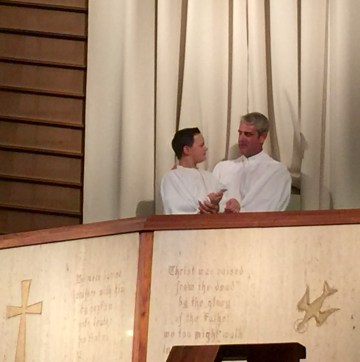
Jackson Weibling Baptism

Luke 12:49-53 NRSV

I’ll never forget what the youth minister said to me right after I bought a brand new car back in 2003. It was a time when I was not a very happy person.

My father-in-law had just died. As a senior minister, I was coming to the harsh realization that it was absolutely impossible to please everyone. The youth minister knew this.

It was during this time I traded in my pick up truck that was just a few years old. The youth minister said, “Jarrett, when most people get a little blue, they might go to the mall a buy a new outfit or get a new pair of shoes, maybe a new piece of furniture, but you go out and buy a brand new car!”

At the time I remembering justifying the purchase by saying that my truck got poor gas mileage, and it just wasn’t very practical driving back and forth to the hospital. I needed something smaller, more economic.

But the reality is that the youth minister had a pretty good point. I, like so many American consumers, thought that I could maybe buy me a little bit of happiness. I could perhaps purchase me a little bit of fulfillment.

We buy new furniture. We hang new clothes in our closet. We park a new car in the garage. And we might even buy a whole new house. But guess what? We are still unhappy. Things at home are still not right. Our spouse is still distant. The relationship with our children is still not what it should be. And our souls are still filled with discontent. On the outside our home looks beautiful and whole, but on the inside our home is broken and is in danger of falling completely a part.

So what do we do? We do what I suppose most good God-fearing Americans do. We go to church. We say: “Maybe that is what is missing in my life. Perhaps the church is the solution to building a happy home, the key to good relationships, the key to my happiness and my fulfillment.”

So we come to this place. We attend Sunday School. We come to worship. We sing and we pray and we listen, and we take communion, and we sing and we pray.

After the first week, nothing really changes in our lives. But we realize that what’s broke didn’t break overnight, so it probably wasn’t going to be fixed over night. So we do it again the next Sunday, and the next and the next. We even start having family devotions, holding hands and saying grace at our meals and praying at bed time. But, still, nothing at home changes.

We’re still struggling. We’re still lost, and the confusion is painful. We are still unhappy. Things are still not right.

Why? Why hasn’t religion worked? Why haven’t things gotten better? We got Jesus. He’s supposed to help our families. He’s supposed to be the glue that keeps us together, right? After all, you know what they say?  The family that prays together stays together, right?  Well, according to our scripture lesson this morning, not necessarily. In fact, according to Luke, Jesus may be more of a home-wrecker, than he is a home-maker.

Jesus said, “I came to bring fire to the earth, and how I wish it were already kindled!  Do you think I have come to bring peace to the earth? No I tell you, but rather division!”  Luke even softens this a bit for us, for in Matthew Jesus sounds downright violent: “I come not to bring peace, but a sword!”

“I will divide father against son and son against father, mother against daughter and daughter against mother, mother-in-law against her daughter-in-law and daughter-in-law against mother-in-law.”

St. Francis of Assisi became a knight in the wars with Perugia and had a promising future ahead of him. His father was proud of his son, but the problem was that Francis kept going to church and praying and asking God what he wanted him to do. Over time, he became convinced that God did not want him to be a French troubadour or a dashing knight, but rather to be a follower of Christ, a genuine disciple. God wanted Francis to serve the poorest of the poor.

Francis heard the scripture say, “Sell all that you have and give it to the poor” and with a startling naïveté he said, “Okay.” And he sold all that he had and gave it to the poor.

But his father took exception, for what the boy gave away really wasn’t his but was given to him by his father, who had no urge to take the Bible literally.  He threw Francis in jail, then took him to court.

It was then Francis said, “No longer is Pietro Bernardone my father, for, from now on, my father is in heaven.”

Sometimes, Jesus sets father against son and son against father.

But that is not the same Jesus that we go to church to get. Is it?

We go to get a different kind of Jesus, a Jesus of our own making.

For many of us, our faith is just one more materialistic thing we own. Many Americans have trivialized Christianity to the point that Jesus has become just another commodity that is supposed to make our lives easier, better, more productive. That’s why we go to church. We go to get this product called “Jesus” to make us feel better. He’s like a new pair of shoes, a new outfit, a new piece of furniture, or a brand new car. He is something that fulfills our desires, our wants, our needs. He is something that helps us to do the things we want to do in life.

But as nine-year old Jackson Weibling told me about his baptism that we are celebrating this day: “Having Jesus in my life means that I can no longer do the things that I want to do, but only the things that God wants me to do.”

Rev. Marianne Williamson once said, “When you ask God into your life, you think God is going to come into your psychic house, look around and see that you just need a new floor or better furniture, and that everything just needs a little cleaning—and so you go along for the first six months thinking how nice life is now that God is there. Then one day you see that there a wrecking ball outside. It turns out that God actually thinks your whole foundation is shot and you’re going to have to start all over from scratch.”

Our problem is that we have so trivialized Jesus, we think of Jesus as someone who comes knocking on our door with a bouquet of fresh flowers to brighten the whole house up when in reality, Jesus comes knocking with a flamethrower to ready to burn the whole house down.

We thought that all we needed was a little bit of family prayer time.  So we prayed for two minutes a day. And it didn’t work. We were still cold.  Why?  Because we can’t pray for two minutes a day, patch that prayer onto an otherwise unchanged life and expect it to be different.

Jesus does not come into our lives so our behavior will just be a little different, but so that everything will be transformed. Jesus is not some sweet commodity we can pick up at church to bring home and meet our needs and fulfill our desires. Jesus comes to change our needs and transform our desires!

And we don’t get Jesus. Jesus is not something that can be got. It is Jesus who gets us.

If Jesus is something or even someone that we get, then the church really does become just another product whose members are merely consumers. Thus, like going to a store, the spa, or the local cineplex, church becomes some place we go to get something. Some go to get fed. Others go to get nurtured and pampered. Some go to get entertained.

However, if it is Jesus who gets us, if Jesus is about us giving ourselves to the God revealed in Christ, then church means a radical, self-denying, sacrificial way of living.

If Jesus is about giving one’s life away, then the church becomes something much more than a self-help center offering self-improvement workshops.

Sunday school and Wednesday Night Fellowships become less of a time to get fed, physically and spiritually, and more of a time to pray for others, celebrate the joys of life with others, and even suffer with others. It becomes a time to build a community of selfless love and forgiveness with others. Bible study becomes less of a time to acquire more biblical knowledge than others and more of a time to consider how the scriptures inform our service to others.

Sunday morning becomes less about what God has to offer us and more about what we have to offer God. When we eat the bread, we do not consume it. When we drink from the cup, we do not merely swallow it. We allow it to consume and swallow us, every part of us. And we commit ourselves to presenting our own bodies as living sacrifices, pouring our very selves out for others in the name of the God who emptied God’s self out for us.

And every day of the week, we become much more than Christians who possess exclusive tickets to heaven in hand. We become the Light, even the fire of the world.

So for all of us who have been settling for an innocuous faith:  look out the window. The torch is lit. The wrecking ball is swinging. So let’s get out of the house!  Let it do its work. Let it bring destruction of all that holds us back form God. Let it all burn down to the ground. Then let our lives be rebuilt on the only foundation that can give us life.

Life Like a Country Song: Remembering Robert Dean Shaw

Bob shaw

Bob Shaw loved music, more specifically country music, more specifically pre-1960 country music, and more specifically, pre-1960 country music that you could dance to, or at least tap your toe to. The kind of songs that were earthy, rural, set in a small town or in a farming community. Songs stirring patriotism and championing hard work. Songs speaking about lasting love and songs speaking about love lost and heart break. Songs speaking about rural life: the land, raising children and bird dogs, hunting and catfishing. Songs of sacrifice and worrying about the kids and the dogs.

Bob loved another Bob with the last name of Wills, known as the King of Texas Swing.

Bob had such a love for Texas Swing that he taught himself to play the guitar, and steered his daughter Ronda away from the flute, an instrument that may never have been played in the Texas Playboy band. Bob even took some guitar lessons in his late in his forties.

I don’t believe Bob’s love for country music should not surprise anyone who reads reads his obituary, as his epitaph reads like lyrics to a country song, you might say, some good ol’ Texas Swing.

Born in Lacey, Oklahoma, a small rural farming community, Bob attended Mound Ridge, a one room school house.

Bob Wills once sang of the rural, slow paced, southern way of life that Bob Shaw was born into:

Yes, this is Southland, where everything’s fine

It’s where they really live and give you a feeling

That you’re welcome any time

You’ll find our men are stronger, women sweeter

And you’ll live much longer, no rush every day.

Bob graduated from high school and was drafted into the United States Army, serving from 1953 to 1955 during the Korean Conflict. He was stationed in what he called “cold and dark Greenland,” building a runway to defend the North Atlantic from a possible Russian advance. Those years of service were difficult for Bob. He lost a dear friend and comrade in an explosion, and Bob himself was injured in an accident with a Jeep. This service and sacrifice, this love for country led him to later become the Commander and District Commander of the American Legion. Bob’s love for country is perhaps what attracted him the patriotic music of Bob Wills’. One song goes:

When the Yanks raised

The Stars and Stripes on Iwo Jima Isle

Ev’ry heart could sing once again

And the sight of Old Glory over Iwo Jima Isle

Swelled the hearts of our fighting men

After serving his country, Bob moved to Kingfisher where he worked for Cimarron Electric, and later he would move to Enid to work with OG&E where he continued to sacrifice for others. Working with electricity is a dangerous venture, but being a lineman, is another kind of danger.

One day, in Pawhuska, Oklahoma, Bob was on the ground while a fellow lineman was high in a bucket truck working on an electric line. Not knowing that the line was live, his co-worker grabbed the line. The electricity immediately grabbed and held on to him, until Bob says he could see smoke appear to come from the top of his head. Without hesitation, and putting himself at risk, Bob climbed the pole and pulled his co-worker off of the line, saving the man’s life.

Bob would find love, have two sons, but then, like a country song, lose love, as his first marriage would not last.

Bob Wills sings of the heartbreak of love lost:

No more to be sweetheart, no more to be friend

My yesterdays haunt me, my weary heart cries

I just can’t go on, dear, with tears in my eyes.

However, Bob Wills also sings of the hope of finding new love:

I’ll have somebody else as soon as you are gone

You’ll never break my heart no more

I used to weep and sigh each time we said goodbye

You broke my heart so often, there’s no more tears to cry.

And in 1969, Bob married Linda Kisling.

Celebrating the joy of lasting love Wills sings:

Stay all night, stay a little longer

Dance all night, dance a little longer

Pull off your coat throw it in the corner

Don’t see why you don’t stay a little longer.

And that is just what Linda did, standing faithfully by his side for 47 years. The two of them had one child together, his only daughter, Ronda.

Bob enjoyed hunting quail on the farm. He and his bird dogs also hunted ducks, turkeys and pheasants. He also enjoyed fishing, especially catfishing. Bob liked to get a way, and enjoy the outdoors. Bob believed in working hard, but he also believed in taking it easy.

Bob Wills sings:

I might have gone fishing. I got to thinking it over.

And the road to the river is a mighty long way,

Now it could be the season, no rhyme or no reason,

Justa taking it easy, it’s my lazy day

Bob Shaw’s obituary closes: Bob is survived by his wife, Linda, a daughter ,Ronda and her husband Terry, two sons, Jerry Walker, Larry Walker and his wife, Candy, three grandchildren, seven great-grandchildren and one sister, June Lindsey. He was preceded in death by a brother.

When I asked Bob’s family how Bob expressed his love and devotion to them, they all agreed: “He worried about us.” Ronda said that he especially worried about her driving, arriving at her destination safely, wherever that may have been. Bob would probably agree that worry is the price that parents pay for the gift of children.

Again, Bob Wills sings:

Woe is me, so is you

What a price to pay

Tell me what I’m gonna do

I can’t go on this way

Every night I walk the floor

Worried over you

All I do is watch the door

Hopin’ you’ll come through

Pacin’ up, pacin’ down

‘Til the break of day

I’m the saddest soul in town

I can’t go on this way

Where are you at tonight?

Now, I do not believe that Bob Shaw’s worry meant that he lacked faith in God. For after his heart surgery, Bob made a grateful promise to God that he’d be more faithful in his church attendance. Keeping his promise, Bob and Linda would arrive around 9 am for the 10:15 service almost every Sunday! They sat together on the same bench for over an hour in the gathering area waiting for the service to begin. It was kind of their spot.

Thus, I don’t believe that Bob’s worry meant his faith was weak. I believe it only meant that he loved you so. Worry was simply the price that he paid for love.

I believe it is good to be reminded that, like worry, grief is also the price we pay for love. Grieving only means that we have loved have loved another the way our creator has intended for us to love another.

Garth Brooks, a post-1960 country music star that Bob probably never listened to, sings a song entitled, “The Dance.”

One line of that song goes: “I could have missed the pain, but I’d a’had to miss the dance.”

The only way to miss pain in life is to miss love in life. But to never love someone the way you loved your husband, your father, your brother, your grandfather and great grandfather is to never really live. As the country song goes, the only way to miss the pain of loss is to miss the whole dance of life.

You loved Bob, and now you are paying the price for that love. Grief is the consequence of love. But you know something? Everyone of us here this day, is going to go on courageously loving one another because the ones we love are worth that price. You have loved.  And now you grieve.

So I say to you this afternoon, grieve. Grieve long and deeply. Do not dare run away from it. Do not treat it as if were a stranger you could send away, or deny that grief, because who does not know any better thinks it means your faith is weak. Grieve what is lost. Grieve honestly, lovingly and patiently. Grieve until your cup is emptied. For this is the only way back to wholeness.

Grieve and even thank God or your grief. Because like Bob’s worry, your grief only means you loved. However, also remember the words of the Apostle Paul in his letter to the Thessalonians that those of us who call ourselves Christians should not grieve as others do who have no hope.  As Christians, our grief is different, because as Christians we possess hope.  We have the hope that as God raised up Jesus from the dead, God has raised Bob.

Perhaps today, Bob Shaw has found another Bob, and maybe even the rest of the Texas Playboy band, and they, even now, are playing the guitar and singing together:

Will you miss me when I’m gone?

Will you ever think of me?

Will the past be just today…

If you cry yourself to sleep

As I did for you for so long

Then perhaps you’ll dream of me

Will you miss me when I’m gone…

…I love you just the same

More than you will ever know

When your hair has turned to white

And you feel so all alone

Maybe then you’ll think of me

Will you miss me when I’m gone?

When God Refuses to Listen

NotListening1

Isaiah 1, 10-20 NRSV

I like to be honest from this pulpit. I like to be real. So let’s be really honest this morning. Have you ever prayed and had the feeling that God’s not listening?

You come to this place of worship and you go through all of the motions. You sing all of the hymns. You actually pray during the moment of silence, instead of spending those moments planning the rest of your day. You listen reverently to the choir’s anthem, and like few people, you even listen intently to every word of the sermon. But as the organist begins playing the prelude, you wonder if it was all just a big waste of time.

I believe this is a reason some people stay home on Sunday mornings. They are not getting through to God and God isn’t getting through to them. And Randy, as the Choir Director, guess what? Sometimes, they say it is your fault. They say that the music just doesn’t inspire them. But most of the time, it is the preacher’s fault. They usually say something like, “I am just not being fed anymore at that church.” Have you heard that before?

Well, Randy, I have some good news for us! Isaiah suggests that their belief that worship is a waste of their time, that God is not listening, is not the choir director’s fault, and it may not be the preacher’s fault either.

Isaiah says that the reason that you may feel like worship is not bringing you close to God, the reason you don’t feel like God is listening, the reason that you feel like God has not heard a word you’ve said is because God has not been listening to a word you’ve said.

Now, I believe that the entire Bible and Jesus himself came and taught us that God operates by something we call grace. Salvation, and prayer for that matter, conversation with God, a personal relationship with God can not be earned, and it is in no way deserved. “We are saved by grace and not works lest anyone should boast.” I know that.  And I believe that with all of my heart.

However, Isaiah says that if we truly want to know that God is listening to us, if we truly want to feel close to God, if we want our worship on Sunday to mean something, there are some things that we must do.

And if we don’t do those things, according to Isaiah, God might respond to our worship this way: “What are your services to me? I have had it up to here, I am sick to my stomach of all your worship! I have no desire for any of it. Stop tramping into my courts. And I have had enough of your preacher with his fancy robe who thinks he is all that with all of his seminary degrees. Your prayers, your hymns, they have become a burden to me. I have stopped listening!”

So, according to Isaiah, what must we do to be heard by God?

Put away the evil of your deeds. Pursue justice and champion the oppressed, give the orphan his rights, plead the widow’s cause.

If we want to be heard by God, if we want worship to be meaningful, Isaiah says that we better doing what we can help the most vulnerable members of our community.

My friend Rev. Dr. William Barber has he wonders why we spend so much time doing the things about which “God says so little” while doing so little of the things about which “God says so much.”

I wonder if Isaiah is suggesting that the church might re-evaluate our committee meetings. Like any congregational-led church, we have a lot of committee meetings here. Isaiah may want us to ask: “What has been the subject of your longest, most arduous church meeting? What was the agenda of that meeting that caused your spouse at home to worry about you, or even question your whereabouts, because they thought you should have been home hours earlier?”

Was it about how our church could could advocate for those in our community who feel oppressed? Was it about meeting the needs of children who do not have the support of family? Was it about defending the rights of widows or the rights of the most vulnerable members of our community? Was the agenda something about which God says so much? Or was the agenda something about which God says so little?

Rev. Michael MacDonald writes that many Christian Americans not only never have any lengthy church meetings about how they can better serve the poor, they just simply have a bad attitude about serving the poor. So bad, that many folks probably wished they had the license to rewrite the many scriptures which speak for the poor.

I would argue that many people actually believe they have such a license. Because as a pastor, it has been my experience that whenever I have spoken on behalf of the poor and the vulnerable, someone almost always accuses me of being a “liberal.” Then, they will something like, “The Bible says that God helps those who help themselves.”

When in fact, the overall message of the Bible says nothing close to that. Aesop’s Fables say that. Benjamin Franklin said that. Thus, I want to respond: “Who’s the liberal here? The one who is conserving the Judeo-Christian teachings of the Scriptures to help the poor, or the one who is re-writing the scriptures with the words of a fable or Deist Ben Franklin?”

For example: This is how McDonald said some Americans would rewrite the story of the Good Samaritan:

The lawyer asked, “And who is my neighbor?”

Jesus replied, “Now by chance a priest was going down the road from Jerusalem to Jericho and saw a man who was hungry and ill clad.  He thought about stopping to help him, but decided that the man had probably been planted there by advocates for the homeless, so he walked by on the other side lest he give encouragement to those who wanted to divide society along class lines in order to gain political power for themselves.

So, likewise a Levite, when he came to the place and saw him, thought about helping him. But the Levite was afraid that he would rob the man of his independence, and he could plainly see that the man had sandal straps by which to pull himself up. So, he too, passes by on the other side.

But a Samaritan came near him and was moved by self-righteous pity. The Samaritan bandaged his wounds pouring oil and wine on the, no doubt as a publicity stunt to make his own self feel good and look good before his peers.

Then the Samaritan put the man on his own animal and brought him to an inn. The next day, he took out two denarii, gave them to the innkeeper and said, “Take care of him; and when I come back, and will repay you whatever more you spend,” thus encouraging the injured man to live like a parasite off other people’s hard-earned wealth.

Which of these three do you think was a neighbor to the man?  The lawyer said, “[Well of course] the two who showed him mercy by walking by on the other side.”

And God says, “You can pray without ceasing but I won’t be listening. I won’t listen to those of you who pervert justice, those of who champion the cause of the rich and powerful, those of you who take advantage of the powerless. God ahead, have yourselves a worship service, have three of them, but I won’t be there.” God says, “I simply don’t listen to the prayers of those who are all about feeding themselves while orphans and widows, the disadvantaged and the vulnerable, go hungry.”

I believe Baptist evangelist Tony Campolo is right when he says that the one thing every Christian should do is not only write a check to help the poor, but help the poor in such a way that we actually build a relationship with them, get to know them on a personal level.

This is what I want to do when we begin feeding the food insecure later this year as the prelude to a new worship service. I don’t want to merely hand them a brown paper bag lunch out the back door, with perhaps a scripture verse stapled to it, or a religious tract thrown inside of it, and then encourage them to go someplace else to eat it, out of sight, out of mind.

I want us to sit down at the table with them, get to know them, listen to them, love them, befriend them, be family to them. Let them know that you are willing to fight for them, defend their rights and plead their case. Be there to help them become the person that God is calling them to be.

Campolo says, in a way that only a good ol’ Baptist could say it, that one important reason that Christians should want to do this is because on the last day, when we are standing before the Great Judge, as God is separating the sheep from the goats and points to us and asks the question, “When have you clothed the naked, fed the hungry, given drink the thirsty, when have you shown generosity to the least of these my brothers and my sisters?”—That is when you are going to want to have the new friend we met around that table standing beside us, and we are going to want to be able to turn to them with confidence, pat them on the back, and say with a smile, “Go ahead, you tell it.”

Do you want to come to this place on Sunday morning and really have an encounter with God? When Terri begins playing the Postlude, do you want to know that you have actually communed with the creator of all that is? Isaiah, and I believe Jesus says, that will depend on how you commune with the most vulnerable members of our community.

Do This and Live

dallas shootings

Luke 10:25-37 NRSV

Sometimes preachers can begin preparing their sermon too early. I began working on this sermon more than a week ago. I chose the theme, the point and the title of the sermon early Tuesday morning.

As you can probably tell by the title of my sermon, “Do This and Live,” the point of my message this morning was going to be that it is high time for Christians to put our faith into action.

In the beginning of Luke 10, we read Jesus saying to seventy of his followers: “the harvest is plentiful but the laborers are few.” Then he commissions them to do some pretty big things: bring peace to the people, cure the sick, work to bring the kingdom of God near.

This was going to be my sermon.

I was going to tell the story of the Good Samaritan, tell how he overcame his fear of the other, how he reached out and reached down to help him in his time of distress, and then I was going to quote Jesus, by saying: “Go and do likewise.” “Do this and live.”

I was going to say that it is time for us act, to go and do likewise.

I was going to say that the Samaritan did not merely wish the man lying in the ditch well. He did not just send his thoughts and his prayers. He didn’t mull over the situation, consider  the risk involved, ask whether or not his insurance would cover it. He just acted.

I was going to encourage you to be the church that Shannon often describes as one that is “on the move.”

I was going to admonish you to move beyond thoughts and prayers, study and contemplation, to be more committed than ever to truly be a movement for wholeness in this fragmented world.

A movement. Not a team of thinkers.

A movement. Not philosophy class.

A movement. Not a club of theorists.

A movement. Not a group of day dreamers.

A movement. Not a church of well-wishers.

A movement, a body of doers, doing all that we can, when we can, with all that we have been given,

working for wholeness in a creation that is broken,

working for justice in systems of inequality,

working for mercy and grace in a society of bigotry and prejudice,

working for peace in a culture of war and violence,

working for truth in a nation of politics,

working for love in a world of hate,

working for hope in a world of despair.

However, after the horrific events continued to unfold this week, I went back to our scripture lesson to read it once more in the light of what has been a horrendous week for our country.

Surely, God has something else to say to us this week.

The first time I read the story, I read it the way many read it. By understanding that God wants us to see ourselves in that Good Samaritan, that God wants us to overcome our fear of the other and act to truly love others as we love ourselves. God wants us to courageously go out, reach out and reach down to help those who have been left behind, put down, beaten up.

But after a week in which we witnessed 250 murders in Baghdad, the murder of two African Americans in Baton Rouge and St. Paul, and the murders of five police officers in Dallas, I began to read the text differently.

Instead of seeing ourselves in that Good Samaritan, perhaps God needs us to acknowledge today that we are more like one who has been robbed, beaten, and left bleeding, half-dead in a ditch on the side of a wilderness road.

That is where I believe we truly are as Americans today. We have been robbed: robbed of pride and dignity, robbed of trust and hope, and robbed of peace and security. We have been beaten: beaten by racism and hate, beaten by terrorism and violence, and beaten by confusion and despair. And we are bleeding. We are bleeding tears, bleeding fear, and bleeding anger.

And honestly, we are currently unable to act sensibly, unable to move courageously, and certainly unable to be any semblance of a movement for wholeness, because we ourselves are not whole. We are broken, barely making it, not knowing whether we might live or die.

And one by one, people are passing us by. Friends are disappointing us, and even people of faith are letting us down. We are being treated as if our lives do not matter.

But here is the good news:

The good news is that someone is coming towards us. Someone is coming very near to us. Although we cannot comprehend it, we sense his presence.

He is but a stranger to us. His ways are not our ways. He comes from a foreign land. He is one who has been despised and rejected by the world, a man of sorrows held in low esteem.

But when this strange one sees us, as he becomes acquainted with our suffering, he is immediately moved with compassion. He is moved thoroughly and deeply.

We have been beaten so badly, he does not recognize if we are black or white, Jew or Muslim, male or female.

Yet, he suffers with us, and he suffers for us. His empathy towards us brings him down to his knees. We can feel his warmth. We perceive his empathy. And then, kneeling beside us, with his own hands, he tends to the places where we have been hurt. He stops the bleeding. He cleanses our lacerations. A costly wine poured out. Carefully, attentively and lovingly, he bandages all of our wounds.

He then puts his arms around us. Although we still cannot make out his face, cannot comprehend his actions, we instinctively know that we can trust him. We can trust him. So we put hands around his neck as he picks us up.

He picks us up and carries us until we reach a safe place, a place where no one judges us, a place where we are welcomed and accepted just as we are.

He stays beside us and continues to care for us. He gives us warm bread and something refreshing to drink. He stays with us through the darkness of the night, holding us, loving us, assuring us that we will not only have life, but we will have life abundantly, assuring us that a new day will dawn and we will be a part of it.

And when that day comes, he sacrificially pays the price for our care, for our healing, for our salvation. And then he places us in the hands of others who will care for us, shepherd us, love us as he loved us.

He then tells us that he must go, but before he departs, he makes a promise. I will come again. I will surely come again, and whatever your debt may be, I will take care of it. I will pay it in full. I will forgive it fully, completely. Grace will be yours not only today, but forever.

And our cups runneth over. We are healed, made whole. We have been saved. For we have never experienced such a love, a love without conditions, a grace without limits, a mercy without reservations.

This afternoon, our church is partnering with Youth and Family Services to host a back to school bash for foster children living here in Garfield County. We will have games, provide haircuts, and give out book bags with school supplies. Most of all, we will give them our love.

We will let them know that today they come to a safe place. A place where no one will judge them, a place where they will be accepted and welcomed.

We will let them know that there is a community here that will hold them, love them unconditionally, share mercy with them unreservedly, and offer grace to them with no strings attached whatsoever.

We are not going to merely offer these foster kids our thoughts and prayers. We are not going to just wish them well. We are going to act.

And we are going to continue these acts of grace with others in our community who find themselves in need. We are truly committed to be a church on the move.

However, before we can do this, before we can be a body of doers, before we can go and hold others in the light of Christ, a light that will certainly drive away the darkness, I believe we first need to be held in that light ourselves.

Before we can envelop others with a love that will drive out the hate, we first need to know that we have been embraced by such a love. Before we can become a movement for wholeness, we first need to be made whole.

And if we do this, accept this love, receive this grace, allow this mercy to take a hold of us, pick us up, heal us, redeem us, and transform us, if we do this, we will live.

And then, we can share this life with others. We can truly be a movement for wholeness in a fragmented world.

Come, Lord Jesus. Come quickly.

Patriotic Dis-ease

wiesel 3

Matthew 22:15-22 NRSV

Most preachers that I know are on vacation this week. One reason, of course, is that it the Fourth of July Weekend, a time when many Americans take a vacation. The other reason is that is the the Fourth of July Weekend, a time when preaching the gospel of Christ can be more than a little tricky. For isn’t this the one topic that we are supposed to try to avoid, religion and politics? I tried to be gone today. Let Shannon worry about preaching. But the beach house that we wanted was already rented this week.

Because what preachers would like to do on this day is to preach a feel-good, God-bless-America-baseball-hot-dogs-mama-and-apple-pie sermon. We want to stand beside the stars and stripes and deliver a sermon that will make us want to go home and set fire to some sparkers and sing I’m Proud to Be An American with Lee Greenwood.

However, despite our efforts, despite our studying and despite our praying, if we are to be true to the gospel of Christ, while at the same time trying to deliver a sermon that is culturally, socially and politically relevant, we know that it is simply impossible to preach such a sermon.

One day, Jesus was facing his critics. They asked him a question in order to entrap him.

“Jesus should we pay taxes to Caesar?”

Jesus says, “My pockets are empty. Who’s got a coin?”

Someone pulls out a drachma, with the image of Tiberius stamped on it.

“Whose picture is on it?” Jesus asked.

“Well, it’s Tiberius Caesar.”

Jesus says, “Well give it to him.  But you be careful.  Don’t give to Caesar that which belongs to God.”  End of lesson.

Here’s the frustrating part for me when I’m studying this: “End of lesson?” Did I miss something? Did Jesus ever really answer the question?  Should we pay taxes or not?

What belongs to Caesar? And what belongs to God? And wait a minute, doesn’t everything belong to God?

Do you feel the frustration?

Here’s the only conclusion that I can draw. And believe you me, it’s the one conclusion that preachers who want to preach a God-bless-the- good-ol’-U-S-of-A sermon do not want to draw this weekend. That is, when it comes to what belongs to Caesar and what belongs to God, when it comes when it comes to faith and politics, perhaps we are supposed to be frustrated. When it comes to matters of church and state, God and country, prophets and politicians, gospel and government, maybe Jesus wants us to be uneasy. When it comes to patriotism, maybe Jesus wants us to be at dis-ease.

As a follower of Christ, have you ever placed your hand on your heart and said, “I pledge allegiance to the flag of the United States of America, and to the Republic for which it stands,” and felt a little uneasy, a little uncomfortable?  During that pledge, have you ever thought, “wait a minute, my heart, my soul, my allegiance belongs to God, not Barak Obama!”

Have ever held out your hands and said the pledge to Oklahoma, and thought, “hold on a second, my fidelity is to Christ, not Mary Fallin!”

My hope is that is why some Christians got so riled up a few years ago when a judge ruled to take “under God” out of the pledge. The government is under God, a step below God. God and only God has our ultimate allegiance.

And maybe this dis-ease, this angst, this tension between heaven and earth, is exactly what Jesus wants to us to experience this weekend.

Let me give you two great examples of great patriots who experienced this patriotic dis-ease.

Thomas Jefferson never did possess the moral courage to liberate slaves, even though he knew that slavery was evil. Yet, before he died, as he considered the institution of slavery, as he thought about the slaves he owned, Jefferson said, “I tremble every time I remember that God is just.”  At least Jefferson had enough moral and ethical insight to be able to tremble.

Abraham Lincoln also trembled when he considered the paradox of war: using evil to end evil and the problem of God in the midst of it.  Speaking of the two sides of the Civil War in his second inaugural address, Lincoln said:

Both read the same Bible, and pray to the same God; and each invokes His aid against the other. It may seem strange that any men should dare to ask a just God’s assistance in wringing their bread from the seat of other men’s faces; but let us judge not that we be not judged. The prayers of both could not be answered; that of neither has been answered fully.

Jefferson and Lincoln both understood something about patriotic dis-ease. Their service to their country was undeniably loyal. However, their loyalty, to their country in the light of God made them incredibly uneasy.

A Jewish Rabbi was speaking one day defending the Jewish position against hunting. “A good Jew never hunts,” said the Rabbi. We are permitted to kill animals, but never for joy, never out of pleasure. We can kill, but we only kill with regret.”

Someone responded to the Rabbi, “Regret?  Isn’t that a bit weak to serve as a basis of morality?”

“Don’t knock regret,” said the Rabbi.  There are some things that are not so much right or wrong as deeply, unavoidably, regrettable.”

So, maybe the message that Christian Americans need to hear, more than anything else, is that when it comes to patriotism, the most Christian response is one of regret or dis-ease.

Perhaps the greatest sin is not to care, to never tremble, to never regret, to be completely at ease, entirely comfortable when we are saluting the flag, singing the national anthem, or watching our fireworks. Perhaps the greatest sin is to be completely comfortable when we pay our taxes with the knowledge of the waste, the immorality, the injustice, and the inequality that is so much a part of our government.

Aushwitz survivor Elie Wiesel, who passed away yesterday, once reminded us, “The opposite of love is not hate. it’s indifference.”

Those of us who are trying to follow Jesus should never be indifferent. We must always be willing to speak out when we think our nation is wrong, and do what we can to rectify those wrongs, because our love for Christ is stronger than our affection for our country.

The prophets who spoke out against the injustices wrought by Israel and the disciples who were imprisoned for disobeying Rome, teach us about this uneasiness. Our allegiance to country never means blindly accepting our faults, never questioning our past, and never second-guessing how current policies will affect our future. Allegiance means faithfully doing our part working to “mend thine every flaw.”

It means being loyal, law-abiding citizens. However, it also means working to change laws that need to be changed. It means honoring our civic duty of voting in elections. However, it also means correcting elected officials who dishonor our nation.

As Christians, the Commander-in-Chief is not our chief commander. The Supreme Court is not our supreme being. Our allegiance is first pledged to something that is bigger than our nation, even larger than our world. We don’t give to the government that which belongs to God.

It is an allegiance that informs our vote, rallies our civic duties, and yet, sometimes calls us to civil disobedience. For the Christian, it is the God revealed through the words and works of Jesus who becomes our civil conscience. We believe the law of God revealed through Christ supersedes every human law.

Immediately following Paul’s words regarding good citizenship and obeying the law in Romans chapter 13, we read that every one of God’s laws is summed up in just one law: “You shall love your neighbor as yourself.” Jesus said it this way: “On this hang all of the laws of the prophets “…that you love your neighbor as yourself.”

And just in case some are still confused to what “love” is, Paul defines love by saying: “Love does no wrong to a neighbor.”

This is the law of God. Jesus said, “There is no law greater.” It is as if Christ is saying, “If you don’t get anything else from Holy Scripture, if you don’t get anything else out of going to church, you need to get this: ‘love your neighbor as yourself.’”

Yet, as evidenced by the amount of division, hatred, racism, and bigotry that is in our nation today, in government policies, even in the American church, this supreme law is widely ignored, disobeyed or rejected all together.

There is much talk today about Christians standing up and speaking out to take our country back, to reverse the moral decay of our society. I believe there is still hope for us to be a great nation; if we would only pledge our allegiance to the supreme law of God, giving to God that which belongs to God.

For when we love our neighbors as ourselves, when in everything we do unto others as we would have them do unto us, it quickly becomes “self-evident that all people are created equal with certain inalienable rights, that among these are life, liberty, and the pursuit of happiness.”

So, when the flag passes us by tomorrow, or when we pay our taxes, or vote, when we are asked to support some government policy, when we are considering the future of our nation, state, and city, our councils and agencies, schools and prisons, military and police, may we never be so comfortable that we  give to the government that which we ought to give to God.

Let us pray together.

When it comes to patriotism, O God, may we always tremble, may we always have some regret, may we always be at dis-ease, lest we give to the state that which we ought to give to you. Amen.

Nourishment in the Wilderness

run and not be weary

1 Kings 19:1-8 NRSV

Luke 8:26-39 NRSV

Poor Elijah didn’t know if he wanted to live or die. Look at verse 3: “Then he was afraid; he got up and fled for his life.” Then look at verse 4: “It is enough; now, O Lord, take away my life…”

One verse he wants to live, for he’s running to save his life. And in the very next verse, he prays to God that he might die.

Can you relate? Have you had moments like that?

The good news comes in verse 5: “Suddenly an angel touched him and said to him, ‘Get up and eat.’ He looked, and there at his head was a cake baked on hot stones, and a jar of water. He ate and drank, and lay down again. The angel of the Lord came a second time, touched him and said: ‘Get up and eat, otherwise the journey will be too much for you.’ He got up, and ate and drank; then he went in the strength of that food forty days and forty nights to Horeb the mount of God.”

The good news is that when the journey is too much for us, when we don’t know whether we want to live or die, God comes to us, and gives us the strength we need to make it through.

On this Father’s Day, I am reminded of the words of Jesus when he said: “Is there anyone among you who, if your child asks for bread, will give a stone? Or if the child asks for a fish, will give a snake? …how much more will your Father in heaven give good things to those who ask him! (Matthew 7:9-11)

It was Isaiah who prophesied: “He gives power to the faint, and strengthens the powerless. Even youths will faint and be weary, and the young will fall exhausted; but those who wait for the Lord shall renew their strength, they shall mount up with wings like eagles, they shall run and not be weary, they shall walk and not faint.” (Isaiah 40:29-31).

The Apostle Paul confidently proclaimed: “I can do all things through him who strengthens me” (Phil 4:13).

The good news is that when we have those moments when we don’t know if we are going to make it or even if we want to make it, God comes to us, nourishing us with the strength we need to do all things.

Now, before we say: “Amen, let’s sing a hymn, have some communion, and go home happy!” I believe we need to hear a little more.

When we read the Bible, study the Bible, interpret the Bible, context is everything. It is a bad practice, and it can be right down dangerous, to lift verses out of their contexts.

And people do it all the time, especially with the verses that I just read. I have seen these verses on coffee mugs or desk calendars, as if they were written as promises to help us have a good day at work.

These verses are all over the walls of the YMCA as if they were written to help us have a good work out. As a runner, I have seen them on written on the shirts of other runners during a marathon. “Run and not grow weary – Isaiah 40:31”; “I can do all things through Christ who strengthens me –  Philippians 4:13”

But when we put these verses in their contexts, we come to understand that when Isaiah was talking about running, he wasn’t talking about running a marathon. When Paul was talking about strength, he wasn’t referring to the bench press. And Elijah was not visited by an angel with hot fresh baked bread and a cold jar of water, because he had just finished a Tai Chi workout.

I believe our lectionary gospel lesson has something very valuable to teach us about our context. It is from Luke, chapter 8 beginning with verse 26.

It is the story about Jesus confronting a man living with demons who was chained and shackled in a cemetery.

Now, we don’t know why they put chains on that man and forced him to live among the dead. But I believe we could take some pretty good guesses. Perhaps he had a different skin color than most people in his town. Maybe he practiced some kind of minority religion. Could it be that he spoke a foreign language? Could it be that he was mentally ill? Might it be that he was gay?

Whatever the reason, it is obvious to me that the chaining of this man, the oppression of this man, the dehumanizing treatment of this man as if he did not even exist among the living, shackling him in a graveyard, is the true demonic evil in this story.

And notice what happens when Jesus liberates this man (verse 37). When they find the man is set free, do they all fall down and worship Jesus? Do they make a commitment to follow Jesus? No, all the people, “all the people in the surrounding country beg Jesus to leave their presence.”

It is very important to remember that when Paul proclaimed the gospel for not only the Jews, but also for the Gentiles; when he baptized a woman named Lydia and others discovered his friend Philip baptized an Ethiopian Eunuch; when Paul, like Jesus, met people where they were, ate what they ate, drank what they drank; when he said things as audacious as in Christ there is neither Jew nor Greek, slave nor free, male or female, but all are one in Christ Jesus, the people did not vote him Citizen of the Year.

Thus, when Paul penned those words: “I can do all things through him who strengthens me,” he wasn’t talking about completing a “couch to 5k program.” He wasn’t talking about having a good day at work or even working out some personal problems. He was talking about keeping the faith in the midst of a persecution that we better believe is coming if we live like Jesus, work like Jesus, and love like Jesus. And he was talking from a prison cell.

For the truth is: whenever we love all people, and teach others to love all people, especially those people who have been degraded, dehumanized, and put away by society, there will always be people in society who will degrade, dehumanize, and try to put us away.

Whenever we oppose bad religion, fight injustice, speak out against hate, and preach the grace of a savior who loved all, died for all, and conquered evil for all, we can expect persecution.

There is a much talk about Christianity being the most persecuted religion in the world today like that is a bad thing. But that type of thinking seems to go against the very words of Jesus who said, “Blessed are you when people revile you and persecute you and utter all kinds of evil against you falsely on my account. (Matthew 5:11).”

I believe the entire biblical witness points out that if we are not being persecuted in this world, then we better question whether or not we fulfilling our mission as people of faith.

The good news is, that the entire biblical witness also promises that when we are persecuted, God shows up. God feeds our bodies, nourishes our souls and gives us the strength we need to see this selfless, sacrificial journey through.

It was in the sermon on the mount that Jesus said that the Father will give his children good things to eat, not so they could live happy and satisfied lives, but after he commanded them: love your enemies, forgive seventy times seven, be light, be kind, don’t judge, turn the other cheek, don’t love money or possessions, go the extra mile and give the shirt off your back. Because Jesus knew that when we do those things, then we better be praying for some strength, because we’re certainly going to need it.

And notice that the angel came to Elijah with a cold jar of water and freshly baked hot bread, not to help him to deal with personal problems, but to climb up on a mountain to continue to stand against bad religion and false prophets.

And Isaiah said that God will renew the strength of God’s people not to deal with the heat and humidity of an Oklahoma summer, but to deal with the heat they will face after they “prepare the way of the Lord in the wilderness, and make straight in the desert a highway for our God;” after they “lift up every valley, and make every mountain and hill low;”

God will renew the strength of God’s people after they break the silence and cry out saying that “the word of our God will stand forever.”

God will renew the strength of God’s people after they get up and climb up to “a high mountain and lift up their voice to be the herald of good tidings to all people.”

Isaiah says that when we stand up, and speak up, it is then that the Lord will come and renew our strength. It is then we shall mount up with wings like eagles. We shall run and not be weary. We shall walk and not faint.

The truth is that when we are truly following Jesus, selflessly, and sacrificially carrying our crosses—when we are truly loving our neighbors as ourselves, all of our neighbors—when we unashamedly proclaim the word of God, the gospel of Christ, challenging injustice and speaking against hate—when we do these things, we can always expect some persecution. It can get so bad that we won’t know whether we want to live or die.

The good news is that it is then that we can always expect God to show up. We can expect a tiny sip of water and a bite of bread, or a little cup of juice, and a small cracker, to give us what we need to make it, to keep the faith, to do all things through Christ who gives us strength.

Response to the Orlando Massacre

more love less hate

How do we begin to respond to this act of hate and terrorism against those attending the Pulse Night Club in Orlando Florida?

First, perhaps we might respond in the same way our God responds. I believe we respond by being prayerfully present, not only suffering with those who are injured and weeping with those who have lost loved ones, but also grieving with the larger LGBTQ and Muslim communities who are hurting today in ways few of us can imagine. We respond by standing in mournful solidarity with all people who are hated for their faith, race, gender, economic status, or sexual orientation.

Secondly, I believe we respond by speaking out against the demonic evil that is intensifying in our world today in the form of racism, sexism, xenophobia, homophobia and all kinds of hateful bigotry.

May we remember the words of Rev. Dr. Martin Luther King Jr. who once said: “In the end, we will remember not the words of our enemies, but the silence of our friends.” These words were spoken during another time in our history when the same demonic evil was rising, and a time, according to Dr. King, when many Christians, including pastors, chose to be “cautious” instead of “courageous” by remaining silently “behind the anesthetizing security of stained glass windows.”

It is way past time for Christians who believe in love, believe that God is love, believe that Christ exemplified and commanded love, especially towards victims of hate and prejudice— it is past time for Christians who believe that we were created for such love to stand up and speak out for this love.

Name injustice and evil when you see it. Speak truth to power when it’s needed. Show great love even when it’s risky.

It is time to boldly and sacrificially bear witness to a grace that is so radical and a love that is so socially unacceptable that, according to Jesus, it will cause people, especially religious people, perhaps people in our own churches and families, perhaps our customers and clients, our friends and neighbors, to revile us, and persecute us and utter all kinds of evil against us falsely on his account.

It is time for Christians to no longer be ashamed of the gospel of the Christ who loves all and died for all and conquered evil for all.

Lastly, I believe we can respond to this tragedy, by doing what we can, where we can, when we can, in this present climate of hate to oppose any legislation or any political candidate that will not promise to defend and fight for the protection, the liberty and the justice for all people.

And all means all.

And may we fight this good fight fervently, yet kindly; fiercely, yet peaceably- with the certain hope knowing that our Bible, our faith, and even history itself, teaches us that evil will not prevail, hate will not have the final word, and the darkness will not overcome; because in the end, it is love that wins.

Love always wins.

Sinners Welcome

sinners only

Luke 7:38-8:3 NRSV

Our gospel lesson is not only being read in churches all over the world today. It is being lived.

Today, sinners—some sick and tired, some broken and afraid, some young and naïve, some middle-aged and stressed, some old and in pain, and some severely wounded by racism, sexism, ageism, by all kinds of bigotry and evil spirits—today, sinners (look at verse 37) are still “learning” that Jesus is at the table, and they are still coming to worship at his feet.

A known sinner comes to Jesus, perhaps because she had learned the stories of Jesus welcoming and including, defending and saving, forgiving and healing other women who had injured by the evil of this world and counting them among his disciples: Mary Magdalene, Joanna, Susanna and many others.

The good news is that Jesus is still at the table today, and Jesus is still working in our world saving and forgiving, welcoming and liberating, and people are still learning about him. They are learning about a grace without limits and a love without conditions, and they are coming. They are coming honestly and openly. They are coming with humility, and they are coming with tears. They are coming saying “yes!” to this Jesus.

They are saying “yes” to this table, to the bread broken and to the cup poured-out. They are saying “yes” to the forgiveness of sin and the deliverance from evil. They are saying “yes” to loving their neighbors as themselves, to treating others how they wish to be treated. They are saying “yes” to fighting the demonic evil that is so much a part of our world today, and they are saying “yes” to welcoming others to the table as they have been welcomed to the table, graciously, lovingly, honestly, openly.

But when the one with religion saw what was going on at the table (see verse 39), “he said to himself,” which probably means he shook his head, or rolled his eyes. When he saw her with all of her sin at the table saying “yes” to Jesus, he said “no!”

The good news is that all over the world today, sinners are coming to the table, and they are coming saying “yes!” to Jesus.

The bad news is that there are people in churches today who are watching this, and they are saying “no!”

Last week, I learned of an Elder who has quit going to his church, because he didn’t like the way some of the new, younger Elders dressed on Sunday morning.

The same week, I learned of a couple leaving a church, because the church had too many of “those people” in it.

This week, I received a Facebook message from a woman who was told by her pastor that she could continue to give her money to the church, attend Sunday School and worship in the church, but she would never be able to serve in any leadership role.

And this week, I met two young women and a young man who told me that they want more than anything else in life to follow Jesus, but when they tried to find a church, it was made very clear to them by the people in the church that they were not welcomed.

Those with sin are saying “yes” to Jesus, and those with religion are shaking their heads, rolling their eyes, and saying “no.”

Jesus responds to the head-shaking and the eye-rolling and he naysayers by telling a story.

“A certain creditor had two debtors; one owed five hundred denarii, and the other fifty.

When they could not pay up, he canceled the debts for both of them. Now which of them will love him more?”

Simon answered, “I suppose the one for whom he canceled the greater debt.” And Jesus said, “You have judged rightly.”

Then turning towards the woman, he said to Simon, “Do you see this woman? I entered your house; you gave me no water for my feet, but she has bathed my feet with her tears and dried them with her hair. You gave me no kiss, but from the time I came in she has not stopped kissing my feet. You did not anoint my head with oil, but she has anointed my feet with ointment.

Therefore, I tell you, her sins, which were many, have been forgiven; hence she has shown great love. But the one to whom little is forgiven, loves little.”

In other words, this religious one who says “no” to the sinner who was saying “yes” to Jesus simply did not see himself as a sinner in need of grace. Jesus is saying that the amount of love people give is directly related to the amount of grace they believe they need.

While I was in college, I had the opportunity to serve with the First Baptist Church of Marshville, North Carolina as their Youth Director.

Almost every Sunday, Sam and Sue Goodwin, whose daughter Sally was in the youth group, would invite Lori and me to their home for Sunday dinner. Sam and Sue cared for Sue’s homebound mother who lived with them.

After we had lunch, Lori and I would always go to her room where she was confined to a bed, and visit with her a little before we left.

Right after I graduated from college in 1988, Lori and I were married. Since Lori had one more year in college, I served with that church one more year before moving to Louisville, Kentucky to attend seminary.

I will never forget our final Sunday dinner at the Goodwin home. As was our custom, after dinner, we went to see Sue’s mother. As we walked in her, she asked if she could speak with me privately.

I said, “Of course.”

She then asked me to shut the door and come over and have a seat in the chair beside her bed.

I looked a Lori, shrugged my shoulders and somewhat nervously did what she asked.

She said, “Jarrett, I want you to do me a favor.”

I said, “Yes, ma’am. What can I do for you?”

She said, “Before you leave to go to seminary to study to be a preacher, I sure wish you’d marry that girl.”

I said, “Don’t you remember? Lori and I got married last year.”

With a great big sigh, she said, “Oh, I am so relieved. I was so afraid you were going to seminary to live in sin!”

Bless her heart, I am certain, that if she really thought about it, she would have known that there was absolutely nothing I could do, no ceremony in which I could participate, no laws I could abide, and no lifestyle to which could adhere that could ever keep me from living in sin. You can ask my wife. Getting married did not stop me from living in sin!

But thank God, that where my sin is great, God’s grace is greater.

And Jesus says that when we realize this truth, that all of us live in sin and fall short of the glory of God, that all stand in desperate need of God’s grace, then we will instinctively love and accept all sinners who are saying “yes” to Jesus instead of shaking our heads, rolling our eyes, and saying “no.”

And when a church realizes that we are all sinners in need of God’s grace, then that church never only loves a little, grudgingly, reservedly, cautiously, and comfortably. But it becomes a church that always loves a lot, generously, unconditionally, recklessly, and even painfully.

At the end of the service a few weeks ago, I said that people often make the mistake of not joining a church because they feel they are too sinful. They need to get right with themselves, get right with their neighbors, and get right with the Lord, deal with some of this sin in their life, before they join the church.

I said then, and I will say now: “That is the worst reason in the world not to join the church!”

For the only requirement to join the church is the acknowledgement you are a sinner and need Jesus. That’s it. You come just as you are confessing your sins and your need of God’s grace through Jesus Christ. There is no other requirement.

I have also said that, sadly, there are people in some churches who fail to meet this requirement. They simply do not regard themselves as sinners. They don’t need grace, because they feel that they have somehow earned God’s love with right beliefs, right thoughts and right lifestyles. And they believe they are a little bit better than those who have not earned it. Thus they are very quick to judge, criticize or demean anyone who might believe, think, or live differently.

When I my hair was darker and my sermons were crasser, I got into a little trouble one day when I preached a sermon entitled: The Church Is Not for Everyone. I got into trouble because that goes against everything I usually preach. However even today, although my hair is grayer, and I try to be more articulate, I still believe there is an element of truth in that statement: The Church Is Not for Everyone.

For how else does one explain the amount of hateful things that are said and done today in the name of God, or in the name of the Church? How else do you explain the little amount of love that is shared by some churches today?

And how else do you explain that there will be preachers standing in pulpits all over this country this very hour blaming the victims of the evil terrorist attack in Orlando, saying the most hateful, evil things in the name of God.

Obviously, there are people in some churches who simply do not belong, because they fail to meet the only requirement for church membership; that is, confessing that they are sinners in need of God’s grace.

In that sermon, I suggested that it might be a good idea to have a special invitation at the end of the service one day. It will be a special invitation, because instead of inviting people to join the church, people would be invited to leave to leave the church. “Go, get out, and don’t come back until you realize you’re a sinner like the rest of us!”

Sounds harsh I know. But if we did this, maybe the church would love a lot more and hate a lot less.

Thank God, that today here at Central Christian Church, to this table, Jesus invites sinners, all sinners, only sinners. And sinners are coming, saying “yes.” And no one here is saying “no.” For today, the gospel is not only being read in this place, it is being lived. Thanks be to God.

Fear and Compassion

Great sermon from my colleague Rev. Speidel. I am grateful for the opportunity to work alongside her at Central Christian Church in Enid.

shannonspeidel's avatarWhere are the Christians?

o-NERVOUSNESS-GPS-GUIDE-facebook

Luke 7:11-17

One of the ways I try to take care of myself physically and emotionally is by practicing yoga. I used to take yoga classes consistently when I was in college, but have picked it up again in the last few months after about 10 years. The encouragement to start again came from a good friend who moved here, to Enid, and is an instructor.

I am not that fabulous. But I try really hard. I have learned not to concern myself with the advanced yogi in the back row who can throw himself into a handstand whenever he is so moved. I’ve learned that there is nothing wrong with taking breaks when needed and sneaking a sip from my water bottle, when my body is saying “that’s about enough of that Shannon, we don’t want to pull EVERY muscle we have”.

In one of our recent classes, our…

View original post 1,345 more words