


Matthew 1:18-25
On the fourth Sunday of Advent, we stand with a man named Joseph, on the threshold of a future he never expected.
Week after week, Advent has been inviting us to look for God to show up where no one is looking: in the wilderness, in the shadows, in the cries of prophets and the songs of unlikely women. And now, as Christmas draws near, our gospel lesson leads us into the quiet and conflicted heart of a man who wanted to do the right thing but wasn’t sure what the right thing was.
We’ve been there before, haven’t we, asking: “Now, what?” “What in the world do we do now?” “How should we respond to the news we’ve just received, this loss, this change, this crisis?” And how do we respond faithfully?
How do we believe with the prophet Zechariah in a future that seems impossible? How do we believe that what is broken doesn’t have to stay that way? How do we move past our grief and our cynicism?
Here’s some good news that we shouldn’t miss: Matthew writes, “This is how the birth of Jesus the Messiah came about.”
How about that? Christmas didn’t come wrapped in certainty, clarity, or confidence, but in confusion, shock, and scandal, in questions that kept Joseph up at night.
Joseph receives the news that Mary is pregnant with a child that is not his. But Joseph is righteous, which means he loves God and neighbor. He believes in the golden rule and wants to do the merciful thing, the kind thing, the just thing. But sometimes, even righteousness can get tangled in fear. Even righteousness can struggle to imagine a horizon beyond the one we can see.
And so, Joseph, like so many of us, makes a plan to manage a difficult situation quietly, discreetly, safely.
This may be where that old saying “If you want to make God laugh, make a plan.”
Joseph had a plan. A good plan. A righteous plan. And then God showed up, and God being God says: “We’re going to need to revise that!”
An angel of the Lord interrupts his plans: “Joseph, son of David, do not be afraid.”
It’s something perhaps we all need to hear:
Do not be afraid of uncertainty.
Do not be afraid of mystery.
Do not be afraid of this news you did not expect.
Do not be afraid to love beyond what the world tells you is reasonable
or socially acceptable.
Do not be afraid to let go of your plans and let God write the rest of your story!
And then comes the promise: “The child conceived in her is from the Holy Spirit… and you shall call his name Jesus, for he will save his people from their sins.”
It’s important to understand that this is not just about personal sin, as we have been led to believe. It’s about God stepping into a world shaped by injustice and rescuing God’s people from everything that keeps them bound. Jesus is born to save people from the moral sickness of systems that deny dignity, distort truth, and crush the vulnerable.
Joseph stands right where many of us stand in this season: between the world as we know it today and the world God is unfolding; between our lived reality and the day when love will finally win; between answering a call and fear of where saying “yes” to that call may take us.
And it is precisely here, in this fragile in-between space, that Advent makes its final turn, not toward certainty or explanation, but toward love. And not toward just any love.
The love that breaks into Joseph’s life is not a sentimental love that asks nothing from him. It’s not a love that Joseph is only meant to feel deep inside.
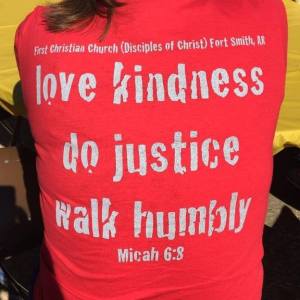
It is a fierce, courageous, and public love that asks something of Joseph: for him to be selfless; for him to sacrifice; for him to give of himself, for him to walk humbly and do justice. It’s the kind of love that refuses to leave any of God’s children cast aside or put away. And it is a love that refuses to allow fear to keep Joseph on the sidelines, insisting instead that he become a participant in God’s unfolding promise.
We know something about that kind of love; because this year, we have lived it. We have seen this love hold us together when the world felt like it was falling apart.
It’s the love that kept us going when mercy was mocked, when compassion was ridiculed, and empathy was dismissed. It’s the love that kept us committed when the holy values of equity, diversity and inclusion were attacked.
It’s the love that kept us showing up when the headlines were heavy, when the rhetoric of the powerful dehumanized the vulnerable, when policies wounded the poor, and when silence would have been much easier than faithfulness.
It’s the love that steadied us as we protested, prayed, voted, organized, fed, welcomed, and spoke out, sometimes with trembling voices, always with stubborn hope, because being silent was not an option, and we knew disengaging was not faithfulness.
It’s the love that has held us.
It’s the love that has carried us.
It’s the love that keeps us from surrendering our conscience,
even when cruelty is normalized, lies are rationalized, faith is compromised, and the truth is redacted.
It’s the love that will not let us look away, back down, or give up.
It’s the love that compelled us to feed the hungry, welcome the stranger, stand with the marginalized, and speak truth even when it came at a cost.
It’s the love that refused to let exhaustion become indifference, or disappointment become despair. It’s the love that sustained Marian Stump in the last year of her life, and so many who faced unexpected hardships, giving this year meaning and purpose with hope.
Time and again, when it would have been easier to retreat, this love called us forward.
And, like Joseph, it asks us not merely to survive the moment, but to participate in what God is still bringing to birth in the world. The same love that has carried us through fear and fatigue continues to call us today: to choose courage even when the path is uncertain. It asks us, like Joseph, to march into God’s unfolding promise, not safely, not quietly, but faithfully, boldly, and without delay.
The story of Joseph, of fear giving way to faithfulness, of uncertainty giving way to courageous action, is the Advent story.
It’s Joseph’s story. And it is our story. It’s a story that teaches us that God’s love does not always look like what we wanted or expected. But it’s always more than we knew to hope for.
Matthew says that all of this happened “to fulfill what the Lord had spoken through the prophet.” A virgin. A child. A name: “Emmanuel, God with us.”
And it’s important to pay attention to where the prophet imagines Emmanuel showing up: not in palaces; not in legislative chambers; not in the places where people wield power as if it belongs to them. Emmanuel is born among the poor, the marginalized, the least of these, in places the world least expects.
And today, if we want to see where God is Emmanuel, where God is still showing up, we must look where the world still refuses to look:
among immigrant families demonized for daring to hope;
among those struggling in poverty in the richest nation in the world;
among workers whose wages don’t cover their rent;
among seniors choosing between food and medicine;
among children whose schools are underfunded;
among those who are dismissed, dehumanized, or told their lives do not matter.
If Christmas teaches us anything, it is that God does not wait for systems to change before God moves. God enters the world right in the middle of the darkness amid the injustice, and says: “Look what I’m about to do!”
“When Joseph awoke from sleep, he did as the angel of the Lord commanded him.”
Joseph steps into God’s calling even though everything around him still looks uncertain. This is the moral courage William Barber calls “standing on higher ground,” on the ground where justice outweighs fear, where mercy outruns judgment, and where love overrides everything!
Joseph chooses love over reputation. Love over comfort. Love over convenience. Love over any path that would have been easier. Love over everything!
And friends, Christmas 2025 asks nothing less of us.
When laws are passed that deepen poverty, we must be Joseph.
When families are separated, migrants are demonized, and immigrants are treated as threats rather than neighbors, we must be Joseph.
When leaders weaponize fear, pitting race against race, faith against faith, neighbor against neighbor, we must be Joseph.
When cruelty masquerades as strength, when lies are repeated until they are accepted as “truth,” when power is prized over people, we must be Joseph.
When the right to vote is narrowed, restricted, or quietly taken away, especially from the poor, the young, the elderly, and communities of color, we must be Joseph.
When creation itself groans under neglect and exploitation, when people cannot afford health insurance, when children are denied safety, dignity, or opportunity, we must be Joseph.
And when our own lives are disrupted, by grief, illness, injustice, or futures we never planned, we must be Joseph.
And the good news—the hopeful, peaceful, joyful, love-filled, good news of Christmas—is that God is still whispering to a fearful people: “Do not be afraid. I am Emmanuel. I am with you.” “Do not be afraid, because Love is about to be born!”
And when Joseph holds that newborn child, he will hold a future no empire can contain, no lie can stop, and no hatred can overcome. And on this Fourth Sunday of Advent, we are reminded: God is still writing the story!
And so, as Christmas approaches:
Let the weary find rest.
Let the silenced find voice.
Let the broken find healing.
Let the fearful find courage.
Let the struggling find companions on the road.
And let love—real, disruptive, justice-making, life-restoring love—be born again in us.
Because Emmanuel is still with us. God is still moving toward us. And Christ is still being born wherever love takes the risk that Joseph took.
May this Advent love, bold, disruptive, and steadfast, fill us with hope.
May it remind us that no matter what the new year brings—uncertainty, struggle, sickness, or sorrow—we are not alone.
May it strengthen us to speak truth, to stand for justice, to welcome the stranger, and to act with courage.
And may it remind us, again and again, that God is still at work. God is still bringing light out of darkness. God is still calling forth life and making all things new.
Amen.


 A Christmas Charge to the Congregation of First Christian Church in Fort Smith, Arkansas


 Just Love