
Pentecost and the Sin of Christian Nationalism

Acts 2:1-21

There are Sundays when the church calendar feels almost divinely timed. And today is one those days.

Here we gather one week after thousands gathered on the National Mall in Washington for a massive Christian nationalist rally, wrapped in flags, political slogans, and declarations about reclaiming America for God, all the while courts across the South continue chipping away at voting rights protections, enabling racial gerrymandering, and turning back hard-won civil rights gains that generations marched, bled, and died to secure. It also so happens to be Memorial Day weekend— a holiday that too often becomes more about glorifying war than grieving its terrible human cost.

And for many of us, especially here in Lynchburg, Virginia, none of this feels abstract, for we know the history all too well.

We know what happens when Christianity becomes entangled with nationalism, militarism, white supremacy, and political power.

We have seen crosses used to bless segregation. We have heard scripture quoted to defend exclusion, to subjugate women, and to oppress queer people— by those who had the audacity to call themselves “a moral majority.”

We have watched churches drape sanctuaries in patriotic symbols while remaining silent about poverty, systemic racism, and state violence. We have seen war baptized as holy, while the Prince of Peace is pushed to the margins.

And now, the courts continue to turn back the clock on civil rights protections while the language of a “Christian America” grows louder.

The good news is: Here comes Pentecost! Arriving right on time, to disrupt it all!

While many Christians proclaim a faith wrapped in control, borders, and cultural supremacy, the Spirit arrives in Acts 2 like uncontrollable wind and untamed fire.

While loud voices today insist God speaks only one language, blesses only one nation, and favors only one color and one kind of believer, Pentecost erupts as a miracle of radical diversity where everybody hears the inclusive good news in their own language.

Outsiders suddenly become insiders. Women prophesy. Young people dream, and ordinary people become preachers.

The Holy Spirit of God does not arrive carrying a flag, but carrying fire, a fire that falls on everybody. And once the wind starts blowing, there’s no power on earth that can contain it or control where it goes.

This whole Pentecost scene is the exact opposite of how you will hear those with power today talk about God. Instead of building walls between people, the Spirit comes and tears them all down. Instead of creating a smaller table, the Spirit sweeps down and makes the table bigger, creating belonging that is bigger than borders, flags, parties, and nations.

And so today, as we gather on this Pentecost Sunday in Lynchburg, Virginia, we are confronted with a question that is as urgent now as it was in the first century: Will Christianity be a movement of uncontrollable, unconstrained, Spirit-filled, inclusive, universal love, or will Christianity be a weapon for cultural and political control?

Will we have the courage to demonstrate that the Spirit of God is indeed still in this world? Not in a political rally, not with flags waving beside crosses—but with wind, wild disruptive wind, the kind of wind you cannot own, predict, domesticate or weaponize.

And then as fire! Not fire descending on one chosen nation. Not fire resting on one kind of faith, affirming one color of skin or one gender or sexual orientation. But fire dancing over every nation, every accent, every gender, every age, every body—

Dark-skinned bodies and light-skinned bodies. Bodies considered clean and bodies considered unclean. Bodies welcomed by religion and bodies pushed outside the gates. Bodies the empire celebrated and bodies the empire overlooked. The Spirit touches the ones with power and the ones those in power try to erase: widows and laborers; immigrants and refugees; people with trembling faith; people with no faith; people carrying shame. The Spirit of God rests every story, every wound, every trauma, everybody.

The Spirit lands in all the places religion has learned to avoid. The Spirit speaks through people empire has learned to silence. The Spirit widens the circle the privileged and the powerful try to close.

And suddenly, through the people, the Spirit begins speaking in languages the empire never taught them. And the miracle is that each heard “in their own native language.”

Rather than forcing the crowd to learn a single, dominant language or forcing them to assimilate erasing their unique backgrounds, Pentecost is the miracle of God honoring the diversity of every culture. Hearing the gospel in their “own native language” is a divine demonstration that every culture, every background, and distinct voice is valued, validated, and worthy to carry God’s message of radical inclusion and revolutionary love.

The Spirit does not come and erase diversity. The Spirit comes and blesses diversity and speaks through it. And that matters deeply today.

It was surreal last Sunday, plugging back into the world from vacation to read about thousands gathering on the National Mall in Washington for a massive Christian nationalist prayer rally. It was described as a recommitment of America as “One Nation Under God.” The event blended patriotic symbolism, political power, and conservative Christianity in ways that set off alarm bells among many faith leaders and advocates for religious and pluralism. There were crosses beside nationalist imagery, political speeches wrapped in revival language, and declarations that America is somehow uniquely chosen by God.

Consequently, on Monday, as if right on cue, two White Christian Nationalists opened fire at an Islamic Center killing two people who sacrificed their lives to save the lives of countless school children.

But the good news is, also right on cue, Pentecost arrives today to dismantle it all.

Christian nationalism wants uniformity. And Pentecost creates plurality.

Christian nationalism says: “One language, one culture, and one kind of Christian.” And Pentecost says: “Every tribe. Every tongue. Every nation.”

Christian nationalism wraps the gospel in the flag. And Pentecost tears down every border.

Christian nationalism confuses political power with divine blessing. Pentecost arrives among the powerless.

And perhaps most importantly: Christian nationalism thrives on certainty and control. But the Holy Spirit is mysterious and uncontrollable.

Richard Rohr often reminds us that God is not a problem to be solved but a mystery to be encountered. The Spirit cannot be confined to any doctrine or creed. The Spirit is breath, movement, surprise, and transformation. Jesus himself says in John’s gospel: “The wind blows where it chooses.”

You cannot legislate wind. You cannot control fire. You cannot trap the Spirit inside a statement of faith or a party platform.

But Christian nationalism tries. Oh, how it tries. Because Christian nationalism is terrified of ambiguity, terrified of questions, terrified of difference, and terrified of change. It has black-and-white answers for every mystery.

Pentecost is gloriously wild and free. So much so, people think the disciples are drunk. Nobody fully understands what’s going on. Maybe that is because real encounters with God often dismantle our certainty before they rebuild our compassion.

Rachel Held Evans once wrote that faith is not about having all the answers but about learning to live inside the questions with God while loving everybody. That is Pentecost.

Pentecost is not certainty descending from heaven. It is courage descending from heaven: courage to love people who are different, even when it is unpopular; courage to cross boundaries, even when it is dangerous; courage to reject white supremacy, even when it benefits you; and the courage to stop pretending God belongs to our tribe.

This is what makes Pentecost such a threat to Christian Nationalism. Because once the Spirit starts moving, the insiders lose control of the gates. Suddenly, Gentiles are welcomed. Women prophesy. Young people speak truth. Old men dream dreams. The poor are lifted. The margins become the center.

As the prophet Joel declares in the passage Peter quotes: “I will pour out my Spirit upon all flesh.”

All flesh. Not just American flesh. Not just Christian flesh. Not just white, straight, cisgendered, conservative flesh. All flesh.

That little word “all” may be the most challenging word in the entire Pentecost story. Because exclusion is always easier than inclusion.

It’s easier to build a movement around fear. It’s easier to define ourselves against our enemies. It’s easier to believe God loves our nation more than others. It’s easier to imagine we alone possess truth.

Church, we must hear this truth today: the opposite of Pentecost is not atheism. The opposite of Pentecost is fearful religion that cannot imagine God speaking through people who are different from us. The opposite of Pentecost is the belief that God endorses our tribe over all others. The opposite of Pentecost is any Christianity more obsessed with control than compassion.

And so, on this Pentecost Sunday, the question for us is: Are we willing to be disrupted and filled by the Holy Spirit?

Because the Spirit is in this world today. And the Spirit is blowing: into sanctuaries and into protests; into immigrants’ prayers and queer children’s tears; into Black churches crying for justice; into young people exhausted by hypocrisy; into weary souls who were told they did not belong.

And the Spirit still burns today. Not to destroy people, but to burn away fear, to burn away supremacy, to burn away the illusion that God can be monopolized by nation, race, ideology, or religion.

And if that fire truly lives in us, then we cannot remain silent while people are pushed to the margins. We cannot worship on Sunday while ignoring voter suppression on Monday.

We cannot sing about justice while children go hungry, while the poor are abandoned, while immigrants are demonized, while truth is traded for power.

Because Pentecost is not just an emotional experience. Pentecost is a public movement. The same Spirit that filled the disciples sent them back into the streets. Back into the world. Back into the struggle for human dignity.

So church, if the Spirit has touched us, then we must become people who resist every form of hatred dressed up as holiness. We must tell the truth when history is being erased. We must protect democracy when voices are being silenced. We must stand with the poor, the excluded, the vulnerable, and the forgotten. We must build communities where every person can breathe, belong, and flourish.

We cannon not be silent, because the fire of Pentecost makes neutrality impossible. The Spirit calls us beyond comfortable religion into courageous love: into a faith that feeds the hungry, welcomes the stranger, confronts racism, rejects nationalism, laments war, seeks peace, tells the truth, and keeps widening the circle of belonging.

Because the world does not need another church obsessed with power. Lord, we know here in Lynchburg, we have too many of those. The world needs a church alive with the Holy Spirit, a church brave enough to love across every border, a church humble enough to listen across every difference, a church courageous enough to believe that another world is still possible.

And maybe that’s the real miracle of Pentecost: That ordinary people like me and you, filled with the breath of God, can still change the world.

Amen.


Pastoral Prayer

Spirit of Wind and Fire,

On this Pentecost Sunday, we gather longing for your presence.

Blow through this sanctuary and through our weary hearts.
Burn away our fear, our prejudice, our need for control.
Teach us again how to become people of compassion, courage, and peace.

Today, we remember the story of your Spirit falling upon all flesh —
upon people of every language and nation —
and we confess how often humanity still chooses division over understanding, violence over reconciliation, domination over love.

As this nation approaches Memorial Day, we pause to remember all those who have died in war.

We remember sons and daughters who never came home.
We remember bodies broken by battle and minds forever scarred by violence.
We remember civilians caught in the crossfire of empire, families displaced by conflict, and children who learned the sound of bombs before they learned the sound of birds singing.

God of mercy, receive the grief of this world.

And while we honor sacrifice, do not let us glorify war.

Do not let flags or patriotic rituals numb us to the human cost of violence.
Do not let nationalism become more sacred to us than the commandment to love our neighbors and our enemies alike.

Instead, make us peacemakers.

Give wisdom to leaders intoxicated by power.
Give courage to prophets who dare speak against violence.
Give comfort to veterans carrying wounds both visible and invisible.
Give strength to all who labor for diplomacy, justice, reconciliation, and nonviolence.

Holy Spirit, disturb every version of religion that blesses hatred, exclusion, supremacy, or cruelty.

When fear tells us to build walls, teach us to build tables.
When certainty tempts us to stop listening, teach us humility.
When bitterness hardens our hearts, breathe through us again.

Pour out your Spirit upon all flesh:
upon the grieving,
the exhausted,
the oppressed,
the marginalized,
the forgotten,
and the hopeful.

Let your fire become light instead of destruction.
Let your wind carry healing instead of meanness.
Let your church become a people known not for power, but for love.

And where this world knows only violence,
teach us the difficult, holy work of peace.

We pray all this in the way of Jesus,
who came not to destroy lives, but to save them. Amen.


Invitation to Communion

You don’t see a flag in this sanctuary because this table does not belong to a nation. It does not belong to any political party, any denomination, or an any ideology. This table belongs to Christ. And at this table, the walls we build around one another begin to fall.

On the day of Pentecost, the Spirit spoke in many languages so that everyone could hear the good news of God’s love. In the same way, this table stretches wider than our divisions, wider than our fears, wider than our certainty.

Here, there is no insider or outsider. No first-class or second-class children of God. Only hungry people longing for grace.

So come: you who are weary, you who are questioning, you who are hopeful, you who are grieving, you who are longing for peace.

Come not because you have all the answers, but because God’s love has already made room for you.

For this is the table where strangers become neighbors, where enemies become beloved, and where the Spirit keeps teaching us how to become one body through love.

Invitation to the Offering

Pentecost reminds us that the Spirit does not move only inside sanctuaries.

The Spirit moves through communities of compassion, justice, hospitality, and courage. The Spirit moves whenever people feed the hungry, welcome the stranger, speak truth to power, and create spaces where every person knows they belong. Our offerings become part of that holy work.

When we give, we participate in building a world shaped less by fear and scarcity and more by generosity and hope. We help keep tables open, ministries alive, and communities connected.

So let us give today not out of obligation, but out of gratitude for the wild and generous Spirit still moving among us.

Commissioning and Benediction

Go now into the world,
not carrying fear, but fire.

Go carrying the breath of the Holy Spirit,
a Spirit too wild to be controlled,
too loving to exclude,
and too powerful to be confined by borders, flags, or walls.

May the wind of God disturb your complacency.
May the fire of God burn away your prejudice.
May the love of God widen your heart.

And may you leave this place speaking peace in every language you know:
through acts of justice,
through courage and compassion,
through mercy and welcome.

For the Spirit has been poured out on all flesh.

So go and live like that is true.

In the name of the Creator,
the Christ,
and the Holy Spirit.

Amen.

A Pentecostal Outpouring

Acts 2 NRSV

I have heard more than one person say: “the Spirit of God is in this place.”

I have also heard people make the counter observation about other churches, saying something like: “I no longer felt the Spirit in that place.” And I am sure that there are some who have made, and who still make, that observation about our church.

So, a good question for us to ask on this Pentecost Sunday is: “How do we know whether or not the Holy Spirit is here?” How do we know if any church ever experiences something like Luke described as a violent wind and tongues of fire? How do we recognize a Pentecostal outpouring of the Holy Spirit?”

As a child, I remember our congregation often opening a worship service by singing:

There’s a sweet, sweet Spirit in this place. And, I know that it’s the Spirit of the Lord; There are sweet expressions on each face, And I know that it’s the presence of the Lord (Doris Akers, 1962).

“Sweet facial expressions?” Is that how we know? I suppose I see a few of those today. But are you happy because the Spirit is here or because you know there’s some good food waiting for you at the end of the service?

I have heard some people talk about an outpouring of the Spirit as they describe a worship service where people are standing singing praise songs to Jesus with their hands raised and tears rolling down their cheeks.

I once served on a town’s recreation committee with the responsibility of organizing the summer church softball league. After leading worship on Sunday, I drove over to a neighboring church to deliver the schedule for the upcoming season. As I pulled into the parking lot, I noticed that cars were pulling out, so I assumed their service had just ended. As I opened and walked through the front door of the sanctuary, I was alarmed to see several people lying motionless in the aisle! The pastor, who was gathering his notes at the pulpit, saw me come in, and without even a hint of concern in his voice, greeted me with a smile saying: “Brother Banks, welcome! Come back with me to my office, and don’t mind those folks lying there in the aisle.”

More than a little distressed, as I walked around the bodies lying in the aisle, I asked: “Are these people ok?”

The pastor said: “Oh, don’t you worry about them. They’ll get up soon enough. We just had a tremendous outpouring of the Holy Spirit today where several people were slain in the Spirit. It happens from time to time.”

I anxiously followed the pastor into his office, where he asked me to sit down across from his desk. As I handed him the softball schedules, I must have had a not-too-sweet expression on my face, because he asked, “Brother Banks, you don’t ever have people fall out during your services, do you?”

I answered: “Oh, it’s happened a time or two, and each time, somebody called 911.”

He smiled and said, “Well, that’s how we know that the Holy Spirit is in this place.”

So, should be concerned that no body passes out in the floor during our worship here? That no one stands and raises their hands as they sing overwhelmed with emotion?

So, what do we mean when we say we feel the spirit in this place?

Some Sundays, I am amazed how the anthem that Jeremy selects or the hymns that Judy plays fit perfectly with the sermon. I sit back here and say to myself: “That’s the Spirit working!”

However, as amazing as that is at times, I am not sure that exactly what is being described by Luke on the Jewish festival called Pentecost.

Luke writes: “When the day of Pentecost had come…all of them were filled with the Holy Spirit and began to speak in other languages, as the Spirit gave them ability.”

I suppose we could ask someone who knows a few languages, like Brian Cox, to come up here and speak to us this morning. But there’s a problem with that. The miracle of Pentecost was not so much in the speaking as it was in the hearing.

Amazed and astonished, they asked, ‘How is it that we hear, each of us, in our own native language?

If Brian comes up here and speaks to us in German, I am pretty sure we are not going to hear him in English.

Perhaps Luke, in describing the outpouring of the Holy Spirit, is trying to paint a portrait to help us see something larger, more wonderful, and more astonishing.

Perhaps Luke is describing what our country needs today, what our world needs today— a divine grace to listen, to hear, to understand, to empathize with others who may be so different from us that they speak a different language. Perhaps Luke is describing an outpouring of the Holy Spirit that produces a divine compassion for more people than the people we see as “our own,” a holy call for people to possess an empathy that transcends countries, ethnicities, sexual orientation, gender, and race. In this great Pentecostal outpouring-of-the-Spirit event, Luke just well may be describing the first Diversity, Equity, and Inclusion Conference!

Luke is describing a Pentecostal outpouring that transforms the hearts and minds of people to have the heart and mind of Jesus who listened to, heard, and learned from a Syrophoenician woman, saw the Samaritan as his neighbor, and accepted Eunuchs, who Matthew records Jesus saying were “born that way” (Matthew 19).

Luke is describing a people who would never say “God bless America” without a sincere desire for God to bless the entire world. He is describing a group of people who would never condemn the genocide of one nation without condemning the genocide of another. He is describing white people who do not hesitate when they see a black man mercilessly executed by police in the street to stand up and say “Black Lives Matter” or to speak out at the school board when the history lessons taught to children in our schools are being whitewashed.

Luke is describing people who do not merely worship Jesus, but they follow Jesus, and teach the way of love that Jesus taught, a generous love that is expressed as goodwill for all people.

Luke is describing hearts that are so generous “they would sell their possessions and goods and distribute the proceeds to all, as any had need.” These are people who never complain about food stamps, free healthcare, and increasing the minimum wage, because they truly believe in supporting the welfare of all people, so no one, regardless of their citizenship is in need.

Luke is describing people who feel a deep sense of connectedness to all people.

The COVID-19 pandemic taught us many things. Like all communicable diseases, that a virus can originate on the other side of the world and quickly spread to every nation on earth taught us how connected we all are to one another.

But it also taught us something about our refusal to acknowledge such connectedness. It taught us something sinister about our selfishness and self-centeredness as some refused to wear a mask in public or get a vaccine to protect their neighbor. Even some churches refused to abide by the stay-at-home orders at the beginning of the pandemic, revealing that we have many churches in America devoid of the Holy Spirit of the One who said the greatest commandment is to love our neighbors as ourselves.

It revealed that what this world needs today is some Pentecost, a serious outpouring of the Holy Spirit!

And by “serious,” I mean the world doesn’t need more people tearfully worshipping Jesus with their hands raised in the air. It needs more people following Jesus by extending their hands to help their neighbors in need.

The world doesn’t need more anthems or postludes that pair well with the sermon. It needs more people who are offering their spiritual gifts to pair with the needs of the world.

The world doesn’t need more people slain in the spirit on Sunday morning. It needs more people to be awakened by the spirit to a live a life of generosity for the goodwill of all people every day of the week.

And the world doesn’t need any more congregations with sweet expressions on each face. It needs more of the fire that was experienced on that day the Holy Spirit showed up enabling people of all nationalities, ethnicities, and races to see, to listen, to hear, and to care for one another.

The world needs more empathy and equity, more justice and generosity, more sharing and more goodwill, and not just for people who speak our language, are born in our country, share our pigmentation, or go to our church, but for all people.

The good news is that I believe this is indeed a spirit-filled church. Now, we are still calling 911 if you fall out in the aisle this morning, but there’s plenty of other evidence that the Spirit of the Lord is in this place.

The building and the blessing of the little food pantries, our donations to the Rivermont food pantry, our volunteers each month who serve at the Park View Mission, our folks who have signed up to deliver Meals on Wheels—these are all evidence of a Pentecostal outpouring of the Holy Spirit, or as my childhood preacher liked to say, “an unction of the Holy Ghost!”

And just this past week, our Outreach Team met with the Interfaith Virginia Center for Public Policy to discuss a partnership that will enable us to not only feed our neighbors in need, but to be advocates for justice, so our neighbors will not be hungry in the first place. This may be the strongest evidence of all that there’s Pentecostal outpouring in this place.

So, as we celebrate 150 years as a church, on this day which has been called “the birthday of the Church” (that’s Church with a big ‘C’), there is indeed a sweet, sweet spirit in this place. There are sweet expressions on some faces, but there are also some holy scowls, some furrowed brows, some eyes filled with divine determination, souls ignited by a fiery Call of Love to make this a more generous, equitable, and just world, not just for some of the people, but for all people. And I know that it’s the Spirit of the Lord. Amen.

Too Smart for Our Own Good

The Shack

John 3:1-17 NRSV

In today’s gospel lesson a very knowledgeable and prominent leader of Israel comes to Jesus seeking to discover who Jesus is and what Jesus is all about. Poised and confident, the educated and sophisticated Nicodemus begins his conversation with Jesus: “Now, we know that you are…”

He begins his conversation from the same place that most of us mature, experienced, long-time students of Sunday School often begin our conversations about God: from the things we know, the things we have figured out… or think we think we have figured out:

“Now we know that you are…”

And it’s from there that the conversation gets all confused, confounded and convoluted. Jesus begins talking to Nicodemus about birth, but poor Nicodemus thinks Jesus is talking about literal, physical birth. Jesus starts talking about the Spirit, but poor Nicodemus thinks Jesus is talking about the wind.

I think it is very interesting that Nicodemus comes to Jesus at night. Because in just a few moments with Jesus, we learn that when it comes to God, when it comes to this mystery that we call faith, Nicodemus is in the dark in more ways than one. Nicodemus comes to Jesus confident and assured, but by the time Jesus gets finished with him, Nicodemus is astounded and dumbfounded, mumbling, “Uh, how can this be?”

Nicodemus has a problem.  And perhaps Nicodemus’ problem is in the very way he came to Jesus in the first place: “Now we know that…”

And maybe that is precisely our problem: “Now we know that…”

Our problem is that we know. And I suppose we can’t help it. After all, we are modern, some say we are even post modern folks who know a lot!

We live in what they call the information age. If there’s something we don’t know, we can just Google it or YouTube it, and in a few simple clicks of a mouse, we know. With WebMD and Wikipedia, there is hardly anything that we cannot understand or easily explain.

Perhaps this is why we try to approach God the way we do. We believe God is to be understood and easily explained.

It is no wonder those on the outside of the church often accuse those of us who are on the inside of the church of being “know-it-alls” when it comes to religion.  They believe that we think we have God all figured out. There are some that think that the reason we are here this morning is because we are God-experts.

And maybe that is why some  they are not here with us this morning.

One day, I was introduced to someone who knew that I was a pastor. I think he wanted to shock me when shook my hand and said, rather proudly, “Well, I’m an agnostic.” Which means that he did not know what he believed about God.

I think I shocked him when I responded, “Well, I have my moments when I am an agnostic too.”

I then said: “If people were honest they would admit: Some people are agnostic all of the time, and all are agnostic some of the time.”

The reality is that what we should be doing here, in this place every Sunday morning, is acknowledging together how little we really know and how much we have to learn, instead of coming here to have everything we think we know about God reaffirmed.

We gather ourselves together to acknowledge the great truth, that when it comes to the mystery that is God, we are all, as God told Mack in the movie The Shack, “idiots.”

“If the shoe fits,” She said.

The truth is that the God we worship is much larger than our imaginations. God is bigger and more alive than we can ever possibly comprehend.

I believe this is one of the reasons some preachers are telling their congregations to avoid the movie The Shack (a movie by the way I highly recommend) And there are many reasons: like maybe Jesus as a Middle Eastern man, if you can imagine that; also, God’s love for humanity compelling Her desire to redeem all people.

But perhaps they are most upset by the way the movie may cause some to question everything they thought they knew about God. Many preachers can not handle God saying to Mack: “I am not who you think I am” and “You misunderstand the mystery.”

But to me, that sounds a little like Jesus’ conversation with Nicodemus (John 3:1-17).

Like Nicodemus, we think we know who God is, how God acts and what God desires. But after we truly encounter the Divine, we might learn that we are, well, idiots.

I heard one preacher you say, “If you want to know something about Jesus, don’t watch The Shack, instead watch the more biblical movie, The Son of God.

But, a few years ago, I remember walking out of the showing of The Son of God when it ended feeling disappointed. For I do not believe there is anyway anyone can capture the essence of who Jesus is and present it in a one-hundred and forty-minute cinematic presentation. I told someone that I have been preaching about God is for over thirty years, and I have not even begun to scratch the surface of who God is!

United Methodist Bishop William Willimon, commenting on how some reduce God to something we can easily understand, said: “You can’t define this God, put this God in your pocket, or on a leash and drag God around with you. Life with this God is an adventure, a journey, a leap into the unknown, an expectation that, among even the most regular attendees among us, there will be surprises, jolts, shocks.”[1]

How often have we gathered around this table confident that we know exactly what is going on?

Catholics, and some Episcopalians are all so mysterious, always insisting on calling it Holy Communion or the Holy Eucharist.

Some of us, though, prefer to simply call it “Supper.” Some believe that something mysterious takes place as they eat this meal. They call it transubstantiation. We only believe it is a dry little cracker and tiny sip of grape juice and an act of remembrance that is confined to our limited and finite minds.

But what if there is more going on here this morning than we can see, touch or taste or even remember?

When we gather around the Lord’s Table, what if there is more going on here than meets the senses? What if there is some mysterious communion or a very holy fellowship happening here?

Sharing what we merely call a “supper,” what if we are surprised to discover that we are somehow invited to join the same fellowship that is mysteriously and inexplicably enjoyed between the Father, Son and Holy Spirit?

In and around this table, what if there is something afoot, something happening— something moving, inviting, healing; something strengthening, loving, forgiving; something saving, calling, challenging, commissioning?

We thought that we have come to remember a life, a death and a resurrection, but I believe we could leave having been caught up in that life and death and transformed by that resurrection.

As Willimon has said, “For, that is our God at our God’s best. That night as Nicodemus talked with Jesus, he began with what he knew. And he ended with questions about what he did not know. He arrived fairly confident that he had a good grasp of, [a good hold on] who Jesus was; [he left surprised,] having been encountered and held by the mysterious, majestic Holy Spirit of God in the flesh.”[2]

This morning, when we awoke, we thought we knew what we were doing. We thought we were going to get up, get dressed and simply go to church, sing a few hymns, have the Lord’s Supper, listen to a choir sing and a sermon preached. Then we would leave, get some lunch and come back home unmoved and unchanged, to watch a little more basketball.

However, when got here, we realized that we did not know it all.

We were shocked when a song spoke to us.

We were surprised when a small wafer and tiny cup filled us.

We were jolted when a word challenged us.

We were startled when someone that we did not even know looked at us and blessed us.

And we were amazed when God, the Creator-of-All-that-Is, somehow, someway that we do not understand, called us by name and told us that She is especially fond of us.

And we were absolutely astounded as Christ himself came and wrapped his arms around us as the Holy Spirit breathed new life into us.

[1]Quote and interpretation of Nicodemus’ first words to Jesus “We know” came from William H. Willimon, We Know (PR 34/2; Inver Grove Heights Minnesota: Logos Productions, Inc., 2006), 49.

[2] Ibid.

The More You Know…

Buechner Blessing and Healing

John 3:1-17 NRSV

Our church has always believed very strongly in education. This one of the reasons that we have a graduate recognition Sunday.

Our church also believes it is very important to always ask questions. Our church has never been the kind of church that expects its members to “check their brain at the door” before entering on Sunday mornings. Like our forefathers Barton Stone and Thomas and Alexander Campbell, we encourage free-thinking and open minds here. We believe that God created our minds to ask questions—even the hard questions of life and faith.

I know of some churches where people are taught never to question anything.  They are expected to go to church with the sole expectation to be indoctrinated with whatever the minister says. Not here.

Believing very strongly in the historic principle of the “Priesthood of All Believers,” our church encourages and even expects free thought and the free expression of ideas. You are your own priest. No one here is expected to agree with everything that is said from this pulpit. You are always free to examine, to mull over, and perhaps, even seek an entirely different word from God.

One of the reasons we encourage such questioning is that we do not believe anyone here, including the one who does the most talking on Sunday mornings, has, or will ever have, all of answers. We come to church recognizing that we will never be able to get our hands on, wrap our arms around, all there is to know about this mystery we call God the Father, God the Son and God the Holy Spirit.

During a Wednesday night supper, an eight year-old little girl came and sat beside me. She said, “Dr. Banks.”

Not many people address me in that manner. I kind of liked it. Made me feel smart, scholarly, intellectual! “Yes, how can I help you?” I responded.

She said, “I’ve got a lot of questions about God.”

I thought to myself, “Well, my dear little one, you’ve certainly come to the right place.”

She then asked, “Where exactly do dogs go when they die?”

I thought for a second or two, and responded the only way I knew how. I just looked at her—in dumbfounded silence

A little impatient, she asked, “Do they go to doggie heaven or to regular heaven with the rest of us?”

It was then I had to admit it, “I really don’t know.”

I could see the disappointment on her face. But she quickly moved on to her next question: “How old are people in heaven?”

Again, dumbfounded silence.

Frustrated she asked, “You know, if you die as a baby will you be a baby when you get to heaven? Or if you die as an old lady, will you be an old lady in heaven?”

Again, I had to say “I really don’t know?”

It was then she said, “You know something? For a doctor, you sure don’t know much.” She didn’t ask me any more questions.

No, the truth is, for someone who not only has a doctorate, but someone who has hardly missed a Sunday in church for the last forty-eight and a half years, I really don’t know that much.” All learned after spending a few moments with an eight-year old.

That is why I love ol’ Nicodemus.  For Nicodemus also discovered that he didn’t know that much either after spending just few moments with Jesus.

The very educated and esteemed Nicodemus, a leader of the Jewish Pharisees, came to Jesus full of questions. “Rabbi,” how can a man be born when he is old?” and “Can you enter the womb a second time and be born?” and “How can this be?”  And through all these questions, Nicodemus is asking another question, “Who are you anyway Jesus?’

When it all comes down to it, isn’t that THE question? Isn’t that the reason we are here every Sunday morning? We come asking, “Who is this Jesus anyway?”

We, like Nicodemus, have heard some rumors about the amazing things Jesus has done. And we have been listening to his teachings and have heard just enough to be confused. And we’ve got questions. Can we really believe everything we have heard about Jesus? How can he be both an earthly human being and God at the same time? How can his spirit be both ascended into heaven yet still here with us?

Notice that although it is Nicodemus who begins the conversation here, by the time our passage ends, it is Jesus who is doing most of the talking. Nicodemus appears to be just sitting there in dumbfounded silence.

For you see, Nicodemus thought he would be able to go to Jesus and grasp Jesus. Nicodemus thought he could go to Jesus and figure Jesus out, get his hands on Jesus, wrap his arms around Jesus—understand, define Jesus.

Nicodemus learned what most of us already know: Sometimes when we come to Jesus with questions, Jesus doesn’t give us easy answers. I’m not sure if Nicodemus got any of his questions answered that night. However, the good news is that Nicodemus got something better. Nicodemus went to Jesus hoping to understand him, put his hands on him, wrap his arms around him, but instead, it was Jesus understood Nicodemus. It was Jesus who put his hands on and lovingly wrapped his arms around him.

So this morning, I want us to take Nicodemus as our model. While you are here this morning in the presence of Christ, I want you to ask Jesus whatever is on your mind. Go ahead and use all of your God-given mental capacities, use every ounce of intellect to try to think about Jesus this morning. Listen to what he has to say. And then, simply enjoy being with him.

Give thanks that we have the sort of God who wants more than anything else to be with us, who descends to us, who speaks to us, who shares truth with us, even if we cannot comprehend the wholeness of that truth.

There are a lot of people who have a great disdain for us church folks. Because they erroneously believe that Christians are those people who have it all figured out. They believe church goers are people who have had all of their questions about Jesus answered. And I am afraid they have good reasons for believing that.

I heard one pastor describe a member of his church who was convinced that he had all the answers. He said: “He is very stubborn and close-minded about everything!”  He said, “If he gets to heaven and discovers that things up there are a little different, he is the type that would get mad and ask for a transfer!”

No, the truth is, as William Willimon has said, “Jesus is that illusive, free, sovereign and living God who makes sense out of us, rather than our making sense out of him.” Every Sunday we risk coming to him, listening to him and following him, even when we do not always grasp what he’s talking about and know precisely where he’s leading us.

Notice that Jesus speaks to Nicodemus about wind and birth. For what in our world is more mysterious than wind and birth? In meeting Jesus, we come face to face with a living God. And we cannot define him. We can’t put our hands on, wrap our arms around him. The good news is that it is he who defines us.  It is he who puts his hands on and wraps his arms around us—And beckons us to follow him even if we do not always understand him.

This is exactly what happened to Nicodemus. We meet Nicodemus again sixteen chapters later in John’s gospel. When Jesus was crucified, when most of his disciples deserted him, Nicodemus was one of the few people who were there to lovingly bury Jesus.

I’m sure Nicodemus still had even more questions on that Good Friday. How could it be that this one sent from God, this Savior of the world, be so horribly crucified?

But there, at the foot of the cross, Nicodemus doesn’t ask questions. He simply does what is right. He simply followed. By being associated with Jesus, a condemned criminal, Nicodemus risks his reputation, and even his life. He proves, in the most loving of ways, that one does not have to have Jesus completely figured out to follow Jesus.

If we take Nicodemus as our model, the question for us then is this, “Will we follow Jesus even if we cannot put our hands on him, even if we don’t always understand him?” The good news is that if we say yes, if we promise to walk with him, Jesus promises that he will walk with us forever. For faith is not in the understanding. Genuine faith is in the following.

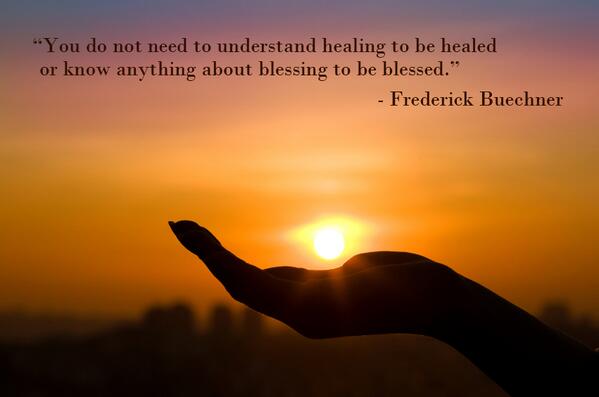
Frederick Buechner has written: “You do not need to understand healing to be healed or know anything about blessing to be blessed.”

I would add that you do not need to understand the miracle of life to breathe. You do not need to understand the marvel of love to be loved and to share love. You do not need to comprehend the gift of grace to receive it and to offer it to others.  And you never need to figure out the holy wonder of the Trinity, the divine relationship of the Father, Son, and Holy Spirit, to be an eternal part of that relationship. You do not need to ever grasp Jesus to follow Jesus and have Jesus grasp you.

Heaven on Earth

DoveMatthew 3:13-17 NRSV

I have a confession to make to you this morning.                                                  

The truth is: I really don’t know what I’m doing half the time I’m standing up here behind this pulpit.  And if I don’t know what I’m doing, I feel certain that some, if not most of you, do not know what I am doing. This preaching thing is probably the hardest things about church. It’s hard on me, and I know it’s hard on you. I don’t know what is more difficult, preaching a sermon or listening to one.

After preaching for over nearly thirty years, I’m really not that certain if I really know how to preach. I’ve tried every technique.  Every once in a while I’ll try to be creative. Try to tell some good stories. Embellish a few if I have to. Robert Fulgum called it “making up necessary facts.” 

But it’s just so hard to talk about, and I know it’s hard to hear about the things of God.  And how do you really talk to people about God’s relationship to this mystery that we call life. How do you talk about Christmas, Epiphany, and the way God reveals God’s self in this world? I am in full agreement with Harry Emerson Fosdick when he said:

“I would rather live in a world where my life is surrounded by mystery than live in a world so small that my mind could comprehend it.”

So if I cannot comprehend any of it, nor even want to comprehend any of it, how can I begin to talk about it?  

And here’s the real difficult part: How do you speak in such a way that people don’t just hear about God, but are brought to God or experience God?  How do you get people to get a sermon?  

After all, you have so many distractions.  There are so many obstacles to successful communication in this place.  First of all there are the people around you. I remember how hard it was when I was growing up trying to get something, anything out of a sermon! There was always somebody was always playing with a candy wrapper, getting up to go the restroom, some coughing, some sneezing, some biting their nails, some whispering, some dozing off, some even snoring. And today you have all of these electronic gadget distractions. There are ipods and ipads and iphones.

And then there are all kinds of entertaining observations. “His hair sure is thinning.  Her hair sure is graying.  What is he wearing?  And my, hasn’t she packed on the pounds!  She must have really enjoyed herself some Christmas!”

Then there’s the temperature.  It is either twenty degrees too cold or twenty degrees too hot. 

Then there are all of those other obstacles that you bring with you—attention deficit disorder, up too late the night before, too many things on your plate, a whole slew of problems and shortcomings, and then there’s that thing called, “sin” that is so much a part of all of us.

Let’s be honest:  It is an absolute miracle that anyone ever gets anything out of any sermon.

But sometimes, people do.  Sometimes, people undeniably hear.  Sometimes people do get it.

William WilIimon, who has written more books about preaching than anyone I know, once said that he suspected that the reason that most of you keep coming back here is “because having had the lightening to strike once, it could well strike again, and you want to be here for it.  Having once shuffled in here—distracted, unfocused, unsure—you have despite everything, irrefutably heard.”  You once came in here and caught a glimpse of something, and that something was undoubtedly from God.

You know what really annoys me about preaching?  It is when I preach a sermon that I had intended to be good sermon, a sermon that could have been a good sermon if I had a little more time, perhaps a been little less distracted and  a little more prayerful. It’s when I preach one of those sermons and you, you have the audacity to look at me on the way out of the church, grip my hand and say, “Thank you for that sermon. God really spoke to me today.”

You walk away to your car leaving me shaking my head thinking, “How did that happen?  How did anyone get anything out of that sermon?  Who pulled back the veil between us and God?  I know it wasn’t me.  It sure wasn’t anything that I said.”

It was just another ordinary day down at the river. John was down there baptizing people. At that time, baptism was a ritual that Jews sometimes went through, a kind of purification rite to prepare for the Advent of the Messiah.

“The Messiah’s coming!” John preached.  And as the people were going through the motions, wading into the water, some of them would ask John, “Are you the Messiah?”

“No,” answered John.  “I could not even tie the shoelaces of the one who is coming after me.  I baptize with water; the one who is more powerful than I, will baptize with fire!”

John keeps baptizing.  Then this one from Nazareth comes—and then, all of a sudden—a miracle happens—a dove swoops, the Spirit descends, a voice echoes, the heavens are ripped open, the veil is torn asunder!

This dove, this Spirit, and this voice is the biblical way of saying that heaven had come down to earth, and God’s Spirit was inexplicably but undeniably present. 

And this voice is of “heaven.”  It is not of the earth.  It is not from John.  John, unworthy to tie the laces of the Messiah, would be the first to admit that.  It has come from some other place. It has come from God.

I don’t know how many heard the voice that day.  I’m just glad that somebody heard it, experienced something like a dove, felt the Spirit and had the foresight to tell us about it.  Because maybe then we, with all of our distractions and obstacles, all of our doubts, all of our shortcomings, and yes, all of our sin, just maybe then, we may be open to such a voice and such a vision.

Professor Steven Vryhof writes about visiting a Lutheran church in a small village on the coast of Sweden where only fourteen congregants had gathered.  The blonde-haired minister was very young and somewhat nervous, right out of seminary.  Vryhoff struggled throughout the service with the Swedish hymns and the Lutheran tendency to stand to pray and sit to sing, the opposite of what he was used to.  He joined the others at the front for communion, taking the bread and the wine and then returning to his seat.

While the minister had his back to congregation, putting away the elements, a parishioner, a middle-aged woman, returned to the front, but this time pushing a very elderly woman, presumably her mother, in a wheelchair. 

He described the mother has having the “classic nursing home look: slumped to the right, thin, scraggly, colorless hair, vacant eyes, and a slack-jaw with her tongue showing just a bit.”  She was there for communion.

There was an awkward minute as they all waited for the minister to turn around and notice the two waiting at the front.  He finally did turn, perceived the situation, and then proceeded to retrieve the elements.  He carefully administered the bite of bread and the sip of wine to the old woman. And then he paused.  

It was then that Vryhof held his breath, because he knew what was going to happen next. The minister looked at the old woman, physically a wreck of a human being, and he said to her the most important words that one human being can say to another human being. The minister looked her straight in the eyes and said to her in Swedish:  “Our Lord Jesus Christ, whose body and blood you have received, preserve your soul unto everlasting life.”

Vryhoff writes:  “I suppose it was a coincidence, but it was a God-given coincidence nonetheless. At that precise moment, the bells of the church started pealing, ringing and resonating and resounding and reverberating through the church and through me, making the hair on the back of my head stand up.  Heaven touched earth and it seemed that Jesus Christ, himself was saying, ‘Yes, I will do that!’

And then the Father and the Spirit joined the Son, and using the same words given to Julian of Norwich [in fourteenth century England], the Triune God proclaimed loudly over the ringing of the bells, “I may make all things well, and I can make all things well, and I shall make all things well; and I will make all things well, and you will see yourself that every kind of thing will be well!”[i]

No, the reality is that I can’t preach God’s Word to you.  Forgive me when I try to explain Jesus or attempt to talk you about faith, God, epiphanies and this mystery life.  I can’t do it. And it’s not because I’m a bad preacher. It’s not because I lack the experience or the training.  It’s because true revelation, authentic recognition—when it’s about God—is always a gift from God.  It’s always a miracle.  It is always “from heaven.” The truth is, I can’t preach.  And the truth is, you can’t hear, except as a miracle, except a gift of God’s amazing grace.

I’m not saying that the baptism of Jesus happened with a literal dove descending and with an audible voice. I’m not saying that visions like this happen every day.  Because I really don’t know. I am saying that if we keep the faith, I believe it can and it will happen to you and to me!

You might be being baptized or receiving communion or listening to a sermon or a choir.  You might be kissing a child on the forehead, holding a puppy or sitting on a front porch with a friend. You might be taking a shower, driving to work or just staring off into space doing absolutely nothing, and then, when you thought you’ve got your world all figured out, the once hushed heavens open up, and something like a bird swoops down.  Heaven comes so close you can feel the breath of God.  A voice speaks. It’s inexplicable but undeniable.  Warmth fills your soul.  And you know beyond any doubt whatsoever that you are God’s beloved child.[ii]  Thanks be to God.  Let us pray together.

Lord Jesus, rip open the heavens and come to us, reach down, reach in, disrupt, touch, embrace, speak to us.  Do not leave us, O Lord, to our own devices.  Abandon us not to our own voices.  Speak to us, miraculously appear to us, and give us the grace to see and listen and the courage to follow.  Amen.


[i]Crash Helmets and Church Bells, Perspectives, August/September 2000, p. 3

[ii] Inspired and adapted from a sermon by William Willimon in Pulpit Resource, Logos Productions, 2009.