Repeat the Sounding Joy

communionThe following was written by Alison Lord Stuart on January 12, 2015 for The Daily Reflector.

A good question to ask ourselves in the cold of January is just what will we take from Christmas into the New Year.  Maybe argyle socks, penny loafers, a cherished memory or an unspeakable loss.  Whatever it is that we fold in for the long journey, we will be different because of it.

Throughout December, I was mesmerized by certain words found in Joy To The World; “repeat the sounding joy.”  I have thought of the beauty wrapped into “sounding joy” and often wondered what it could be.  Then I heard it one morning at First Christian Church in Farmville and almost like an epiphany, I knew.  After the serving of Holy Communion, it was the sound of Communion cups being placed in pew holders. Similar, indeed, to the sound of pew benches being turned back after the serving of the same Sacrament. Both sounds indicating that our singular and corporate seeking of God’s forgiveness is fully present and fully heard.

For Believers, it is a majestic, full bodied, orchestration of sound.  The perfect balance; the fulcrum of falling short and being the beneficiary of unconditional love.  In a long week, month or year, it is a sound to be coveted. It is the sound of hope.

God’s will is that the discordance of our sin doesn’t have to be the end of our song or life story.  Forgiveness, strength and renewal are at God’s Table, there for the asking, freely given and freely received.

The sounding joy given to us by a Risen Savior is grace. It is in the wiping clean of our tarnished slates, in forgiving ourselves and others, and experiencing the dignity of a new beginning.  It is best heard when we rest our weary souls in the hollow of God’s hand, listen and repeat, repeat the sounding joy.

The Realness of Christmas

wounded children

Instead of decorating my tree this year with Christmas music playing in the background, I decorated it while watching the nightly news. As I hung ornaments, I listened to the tragic story of a high school student killed in an automobile accident. As I turned on the lights on the tree, I glanced up to see pictures of mothers with their children escaping from Syria into refugee camps in Lebanon. I saw images of many children: some starving, others injured, some dying, others sick, all very afraid. I thought to myself, “I need to turn this depressing mess off and put on something Christmasy.”

Then it occurred to me. This is probably as close to Christmasy as it gets, for this is Christmas undecorated. This is real Christmas, and it is a shame that we try to cover it up with colorful paper and tie a bow around it. We string it with lights and decorate it. We romanticize and sentimentalize the whole Christmas scene with gleeful music and cheerful food.

Perhaps it is because in our shallow minds, the scene is majestic. It is glorious: angels flying in the night sky singing a heavenly chorus; a brilliant star rising in the east; a baby worshipped by shepherds and kings and even animals. In our nativity scene, there is no crying, no hunger, no disease, no anxiety, no fear, no mourning. Our nativity is a serene, sweet, sanitized scene.

However, this was not the reality of the first Noel. Christmas reality was not beautiful and was far from perfect. And no matter how hard we try, no matter how much energy we expend or how much money we spend; we cannot conceal the real harshness of it, the harsh realness of it. Christmas reality, says the prophet Isaiah is “like, a root out of dry ground.” Jesus was born among animals in a cattle stall and placed in a feeding troth with the stench of wet straw and animal waste in the air.

Yes, Kings, Magi or Wise Men came to worship the baby, but we like to forget that King Herod was using those eastern visitors to locate the baby so he could run a sword through him. And we forget the holocaust in Ramah, the innocent babies slaughtered, the desperate cries of anguish and despair from parents because there children were “no more.” We forget the escape to Egypt like homeless refugees. This is Christmas reality.

This is the reality of it, and this is the good news of it! The good news of Christmas is that there is nothing glamorous, glitzy sentimental, or romantic about it. The good news of Christmas is that God came into our depressing mess. God came into the real world, encountered real evil in the most real of ways, experienced real suffering and pain and died a very real death.

Someone who was suffering with terminal cancer once told me: “Although I cannot explain it, somehow, the sicker I am, the more pain I experience, the more hopeful I become. In the moments of my most immense suffering, God is the most real to me.”

Through the coming of God in Christ into a very real and broken world, we know that God knows something about real human suffering and real human misery. God knows what it feels like to feel forsaken by God. God is therefore able to relate to us in the most intimate of ways in those moments when life is the most real and the most broken.

Thank God something as depressing as the nightly news can actually be Christmasy.

Christmas Begins in the Wilderness

TheGriswoldFamilyChristmasTreeMark 1:6-8 NRSV

When does Christmas begin for you? Was it on Black Friday at the mall, or while watching A Charlie Brown Christmas or National Lampoon’s Christmas Vacation? Was it last Sunday morning as the first candle of Advent was lit in this place? When does it start? When do you begin to realize the good news that is Christmas? Where are you when it happens? On the Town Common during the annual Christmas tree lighting? Walking down Main Street during the Taste of Farmville? Going caroling with the children from church? Maybe it is not until Christmas Eve, as you light your candle and sing, Silent Night. Perhaps it is when you are alone at home, listening to Christmas music and decorating your own tree.

For Mark, the good news of Christmas begins in what most of us would call a strange and unexpected place. Unlike us, the good news of Christmas does not start with some warm sentimental scene. And unlike Matthew and Luke, for Mark, the good news of Christmas does not begin with heavenly visitations, choirs of angels, the worship of shepherds, a star rising in the East, or Magi bearing gifts. For Mark, Christmas does not even begin with a little baby wrapped in swaddling clothes lying in a manger.

For Mark, the good news of Jesus Christ, the Son of God, the good news of Emmanuel, God with us, the good news of Christmas, begins somewhere out in the wilderness. And he is not talking about some snow-covered winter wonderland where the Griswold’s find their family Christmas tree.

For Jewish people aware of their history, Christmas begins in that place that was experienced somewhere between slavery in Egypt and the Promised Land. Somewhere out in that place of testing, trial and temptation, somewhere out in that place of doubt, dread and despair, that place where you do not know if you want to live or die, that place with the Red Sea swelling before you and Pharaoh’s army advancing behind you. That place where Elijah fled to save his life from Jezebel’s army and then prayed for God to take his life away. That place where even Christmas himself would be haunted by wild beasts and tempted by Satan. For Mark, Christmas begins in the most strange and unexpected place, a raw, dangerous place called the wilderness.

The beginning of the good news that is Christmas occurs in that place where God seems to be against you, or appears to be so far away that you doubt God’s very existence—suffering in an intensive care unit at the hospital, laying in utter misery in a nursing home, holding the hand of a parent with Alzheimer’s, picking out a casket for a spouse in a funeral home, at home anxiously trying to pay your monthly bills, in the middle of a fight with a loved one, in Pearl Harbor 73 years ago this hour, in any place where people are overtaken by tension and terror, overwhelmed by despair and disappointment, or overcome by sin and shame.

Last weekend, I was at home trying to get my own Christmas started as I do every weekend after Thanksgiving. However, this year it began a little differently, you might say it began strangely and unexpectedly.

Instead of decorating my tree this year with Christmas music playing in the background, I decorated it while watching the local news. As I hung ornaments, I listened to the tragic story of a high school student killed in an automobile accident outside of Pinetops. As I turned on the lights of the tree, I glanced up to see pictures of mothers with their children escaping from war-torn Syria into refugee camps in Lebanon. I saw images of many children: some starving, others injured, some dying, others sick, all very afraid. I saw gruesome images of parents holding the lifeless body of their child. And I thought to myself, “I need to turn this depressing mess off and put on something a little more Christmasy.”

Then it occurred to me. This may be as close to Christmasy as it gets, for this is Christmas in the wilderness. The Good News according to Mark concurs that this is Christmas, raw Christmas. This is where Christmas truly begins. This is Christmas untamed and undecorated. For Christmas began when God came into a depressing mess.

And no matter how hard we try, no matter how much energy we expend or how much money we spend; we cannot escape the raw truth of it. Christmas begins, says Mark, with a “voice crying out in the wilderness.” And there is no music, no matter how Christmasy, that we can play loud enough to drown out this voice. There are no decorations glitzy enough and no lights bright enough to temper this voice.

This voice can be heard throughout every refugee camp in Lebanon and by every parent mourning the loss of their child. It can be heard in every intensive care unit, in every nursing home and funeral home. This voice can be heard in every wilderness, in every depressing mess on earth.

Through the good news of Christmas, God is crying out: I am for you; not against you. I am with you; not away from you. And I am more real, more alive, and more at work in this world than you can sometimes believe. As the prophet Isaiah said: “I am about to do a new thing; now it springs forth, do you not perceive it? I will make a way in the wilderness and rivers in the desert” (Isa 43:19).

The good news is: Christmas does not begin with us. It does not begin when we get the house all decorated or get all of our shopping done. We do not have to host a Christmas party or even go to one. We don’t even have to go to church, light a candle or sing a carol. Christmas begins with God and with a voice crying out in the wilderness, in those places where we may least expect it, but need it the most.

Some of us know that Luke tells his beloved Christmas story in chapter 2 of his gospel. However, I believe he perhaps tells it more poignantly in chapter 10.

A man was traveling down a wilderness road that was so dangerous that it was sometimes called “the way of blood” or “the bloody pass.” And there out in the wilderness, the man fell into the hands of robbers, who stripped him, beat him, leaving him half dead on the side of the road. As the man lay on the roadside, somewhere between Jerusalem and Jericho, somewhere between life and death, wanting to live, but also maybe wanting to die, he is ignored by two religious leaders who are also traveling down the same road.

God only knows why these men who you would expect to stop and help ignored the man. Perhaps they thought the robbers were still nearby, or maybe they thought the man lying on ground was only pretending, playing some sort of trick, so that when they came near him, he would beat and rob them. For whatever reason, they believed it was much too risky for them to stop.

Then came this one, Luke calls him a Samaritan, which means this was someone who was despised and rejected by the religious establishment, someone who was often misunderstood and rarely respected, someone who knew something about pain and brokenness, betrayal and abandonment, God-forsakenness; someone who had spent many days and nights in the wilderness himself, tempted and tried.

This one who was the least expected to stop and help, saw the man. He saw the man’s wounds, saw the man’s fear, saw the man’s despair and was moved with mercy and compassion. And there in the wilderness he risked his own life, as he sacrificially came to him, selflessly bent himself down to the ground, and joined the man.

The man did not have to do anything to make this one come to him. Out of pure love, unconditional and unreserved, this one just came. He then touched the man where the man most needed touching, pouring oil and wine on the man’s wounds and bandaging them. He then picked the man up and safely carried him out of the wilderness. He stayed with him, at his side through the darkness of the night. When morning came, he paid for the man’s debts, and made the promise: “I will come back. I will return.”

Of course, we call this “The Story of the Good Samaritan.” However, I believe it should be called, “The Story of Christmas.” A story that begins with a voice of mercy and compassion crying out in the wilderness, in those strange, dangerous places where we least expect it, but most need it.

Hospice caregivers will often speak of a dying person “rallying” for a brief time right before death. A person who has been non-responsive will begin to talk. One who has been confused or disoriented will become suddenly coherent. And those who have not had any food for sometimes days may request something to eat or drink. As a pastor, I have seen this “rally” more times than I can possibly count. I am not sure exactly why it happens; I just know that it happens, and it happens often.

My faith tells me that it is Christmas. It is God seeing one lying in the wilderness in their weakest, most broken state, seeing one in their most desperate, most vulnerable need, and it is God being moved with mercy and compassion for that one. It is a voice crying out from the heavens into the wilderness: “I am for you, not against you, I am with you, not away from you. I am Emmanuel. I will risk my own life for you. I will give my all to take care of your wounds and to pick you up, to forgive all of your debts. And when you are ready, I will come back, and I will take you unto myself, so that where I am, you will also be.”

The good news for us this day is that Christmas comes to us all when we confess that we are all half dead, lying on some wilderness road east of Eden, beaten up so badly by this sinful world that no one can tell whether we are Jew or Gentile, male or female, black or white, slave or free.[i] Whenever we confess our brokenness, our sinfulness, and our need for a Savior, a voice from heaven cries out in our wilderness and Christmas comes. Christmas always comes.

When does Christmas begin for you? When does it start? Where are you when you begin to realize the good news that is Christmas? The good news, according to Mark, is that Christmas begins when and where you may least expect it, but need it the most.

[i] This sentence is adapted from words spoken by Frank Tupper in one of my theology classes at Southern Seminary, Louisville, Kentucky, 1989-1992.

From Sorrow to Joy

gone-fishing-600x399Funeral Service for Hubert Chester Outland, Jr.

Aug 23, 1944 – Nov 26, 2014 

Esther 9:20-23 NRSV

John 16:20-24 NRSV

Chester never did care too much for funerals. If he had it his way, we probably would not here this day. Yet, I am sure he knew that, unless he outlived all of us, there would be a service.

“Well, if you’ve got to have a service,” I can almost hear Chester say, with a slight grimace, “at least make it a celebration. Play and sing music that is uplifting. Say things that are hopeful. Be joyful.”

Chester certainly did not want this day to be a day of sadness, of mourning, but a day of gladness, of rejoicing. Instead of a sorrowful, solemn sermon, he would want me to preach a happy, hopeful one, to even tell a joke or two, assuring his friends and family that everything is going to be alright.

“Jarrett,” I can hear him say, “Just tell people: don’t worry. Sing a happy song. If anybody ask where I’m at, just tell them I’ve gone fishing. Just tell them I’ve gone fishing with Daddy and Mama on that beautiful shore in the sweet bye and bye. So, Jarrett, if you have to have a funeral, and as much as I despise a funeral I know you have to, please do me a favor and make it a celebration. And please, do everyone a favor, and try to keep it short.”

“Well, Chester, my good friend, that is much easier said than done.

Because, Chester, you just left us so suddenly. None of us were prepared for it. We are having a hard time accepting it. One minute you’re at the Country Club telling jokes about Obama and the next minute you’re gone. Even now, three days later, it seems more like some strange nightmare from which we cannot wake than it does the reality that we must accept.

And the timing of it, during the start of the holidays, seems to make it even more tragic. As I was sitting with Ben at the hospital, he painfully reminded me that this Thanksgiving was Mernie’s and your 45th wedding anniversary. So Chester, please forgive us if we are somewhat slow and even reluctant to celebrate this day.”

And of course, this day is especially sad because we loved Chester so. And he loved us.

I know I am speaking for more than just me when I say that Chester loved me like I was family. I felt I could go to Chester for any kind of advice, from fishing, golf to finances. It was eight years ago that Chester taught me how to fry my first turkey for Thanksgiving. After I rubbed the bird down and injected it per Chester’s precise instructions, Chester made me come to his house to fry it, so he could supervise and prevent me from blowing myself up.

This is a difficult day, for how many of us here will not miss the way Chester loved us with his wonderful, yet peculiar sense of humor.

One day, he and Ben were fishing for trout off the train trestle in Beaufort. While they were fishing, one of his shoes got caught on the trestle, slipped off and fell in the inlet and was immediately swept away by the current. After a great day of fishing, a man noticed Ben and Chester walking off the trestle, Chester limping a bit, wearing just one shoe. The man asked, “Did you lose your shoe?” Chester said: “No, I found one.”

Yes, today is a sad day as we will miss his quick wit, his funny stories and his dry sarcasm. We will miss all the ways he made us smile, by playing a prank or by cooking us a meal.

This day is especially difficult for his family as Chester loved planning and cooking a meal, especially for a family gathering such as Thanksgiving. All who knew Chester knew that his family meant everything to him: his sister Niki and Eddie; his niece Lou, Tim and great nephew Nick; his daughter Emily, her fiancé Joey, his son Ben and Beth; his adopted grandchildren whom he loved as if they were his own blood, Hunter and Landon, his grandchildren Haley, and Jamison; and his wife of 45 years Mernie.

More than anything, Chester wanted all of you to be happy and fulfilled. For when you hurt, he hurt. When you were not satisfied, he was not satisfied. Although he had spent much putting Ben through school to go into law enforcement, he did not get upset when Ben changed his mind. As tight as Chester was, he never showed any disappointment. On the contrary, Chester encouraged Ben to do what was going to make him happy.

While her friends were critical of Emily’s selfless career choice to be a teacher in North Carolina, saying that she was never going to make any money, Chester encouraged Emily to follow her heart and do what was going to give her the greatest fulfillment. As much as he believed in the importance of making enough money to save some for a rainy day, he never complained that Emily did not have a more lucrative career.

And Mernie, for 45 years, Chester loved you, and although there were times you spent more money than he liked for you to, he would do anything he could do to provide for you, to care for you, to make you comfortable, to make you happy. It grieved him to watch you suffer as you have this past year.

And along with his family, this whole community is saddened this day, as Chester sacrificially protected us and our country when he was younger serving in the National Guard. Chester made this a better place to live as he gave himself in his retirement to the country club, and he as gave himself throughout his life to the service of this church as a faithful usher. He was a friend and encourager to so many, always doing all he could do to make us smile, bring us happiness.

So to transform this sad day into day of gladness, this day of sorrow into a day of rejoicing and celebration, is much easier said than done.

But this is what our faith in God is all about. Throughout history, God has always been in the business of transforming: transforming defeat into victory, despair into hope, and sorrow into joy. The cross of our Lord is just one example of this great truth.

In the wonderful little book of Esther, we are told about the Persian Empire’s plot to destroy the Jewish people. Under Queen Esther’s leadership, the Persians are defeated and Israel was saved. Mordecai, who had adopted Esther, and raised her as if she was his own blood, decreed that the days had been transformed “from sorrow into gladness and from mourning into a holiday; that they should make them days of feasting and gladness…”

Days of sorrow transformed into gladness. Days of mourning transformed into a holiday. Days of grief transformed into days of feasting and gladness. This is exactly what Chester Outland Jr. would want this day and in these days to come.

But, again, that seems easier said than done. It was just all so sudden. We have all lost so much. And right at Thanksgiving.

Again, I can almost hear Chester’s voice: “Well, that’s the whole reason you should be celebrating.”

“Yes, it was sudden,” I can hear Chester say, “But who on earth has ever said: ‘When it is my time to go, I hope it is slow and drawn out.’ Especially after watching my daddy suffer the way he did after his stroke. I have often said, ‘When it is my time, I hope it is sudden and fast.’ And I hope to be doing something that I love. I hope to be out there giving myself to something like the country club. I hope to be doing physically well enough to play golf if it’s not raining. Right before I go, I hope to feel good enough to tell one last joke about Obama.

And yes, you have lost much, for God had certainly blessed by life with much. God has blessed me in my life with good health, the ability to do what I loved, the opportunity to play golf and go fishing. God blessed me with great friends and a wonderful family. Yes, like all families, we have had some tough times, but I was able to see us through them. Ben and Emily have jobs that they love. Emily is happy again as Joey has come into her life. I have been able to be there for my grandkids, all of them. I have been able to show them that I love each one of them the same. And how many people can say that they have been happily married for 45 years to the same person?

And the timing? Although I missed cooking for my family, if I had to go sometime, (and we are going some time) I can think of no better time for me to go than this week of Thanksgiving. For I left this world grateful, grateful for the life that God had given me, grateful for my family, grateful for the life that I was given, grateful that in the end I did not suffer.

So, please be grateful with me, celebrate with me, rejoice with me, give thanks with me and trust God to do what God has done throughout history and take these days of sorrow and transform them into days gladness, take these days of mourning and make them into a holiday, take these days of grief and make them days of feasting and gladness. Prepare feasts for your loved ones, the way that I taught you. Love each other, the way I loved you. The way our Lord taught us to love. Make one another laugh. Make someone happy. And when you do, think of me, and be thankful.”

When Jesus was preparing his friends and family for his death, he spoke these beautiful words which were recorded by John:

Very truly, I tell you, you will weep and mourn…you will have pain, but your pain will turn into joy. When a woman is in labor, she has pain…But when her child is born, she no longer remembers the anguish because of the joy of having brought a human being into the world. So you have pain now; but I will see you again, and your hearts will rejoice, and no one will take your joy from you.

Just as Chester wanted, I believe our days of sadness will be transformed into days of gladness when, instead of being bitter for what we lost, we become grateful for what we had. These days of mourning will once more become holidays. However, that is not saying that we will not continue to have pain. Even when our hearts are bursting with gratitude, even we are the most thankful for what we had in a friend, a brother, a uncle, a father, a grandfather, and a husband, we will continue to have some pain. However, Jesus promises that all of our pain will one day be transformed into joy.

As a mother forgets her pain during labor when she holds her baby, Jesus says that when we see Chester again, when we see our Lord, all of the pain that we have this day and in the days to come will be transformed into joy.

So, for those of us with faith in Christ, this is a day of gladness and rejoicing. This is a day of celebration. This is a day of hope. And if we listen, we can almost hear Chester say:

“I am with Mama, and I am with Daddy. I am with my Lord. Tell people: don’t worry. Everything is going to be alright. Sing a happy song. If people ask where I’m at, just tell them: I’ve gone fishing.”

Voices from the Grave

AllSaintsSundayCandleHebrews 12

Years after her husband died, Betty told me that she still goes to the cemetery, almost daily, to visit his grave. “And Jarrett, I need to ask you something,” she said. “Oftentimes when I go, I stand there and talk to him. Sometimes I even bring a chair to sit in so I can talk to him for hours. I talk about my day, the good parts and the bad parts, and, of course, I talk to him about how much I miss him. Jarrett, here’s my question: “Do you think I am crazy?”

I said, “I guess that all depends. Let me ask you this: Does he ever talk back?”

However, when one considers the response of Jesus in the gospels, perhaps hearing voices from the dead is not so crazy. The Sadducees, who did not believe in eternal life, were trying once again to entrap Jesus by questioning his teaching on resurrection. Jesus responds:

“The fact that the dead are raised Moses himself showed, in the story about the bush, where he speaks of the Lord as the God of Abraham, the God of Isaac, and the God of Jacob. 38Now he is God not of the dead, but of the living; for to him all of them are alive” (Luke 20).

So perhaps Betty would not have been that crazy after all, if she heard her husband’s voice from the grave.

Now, of course, I am not talking about hearing audible voices from the grave. I am talking about the hearing voices from the dead the way the writer of Hebrews describes it when he writes:

“Therefore, since we are surrounded by so great a cloud of witnesses, let us also lay aside every weight and the sin that clings so closely,* and let us run with perseverance the race that is set before us, looking to Jesus the pioneer and perfecter of our faith…”

He is talking about being inspired by, encouraged by those who have lived before us. In the previous chapter, we read a list of those he is talking about: Abraham, Isaac, Jacob and Esau; Moses and each Israelite who escaped slavery in Egypt; Barak, Samson, Jephthah, David, Samuel, all of the prophets and every person had has ever been persecuted or martyred for their faith.

The writer to the Hebrews is saying, when life is hard, when the way is difficult, remember these, remember their voices, remember their actions, and especially remember how they point you to the way of Jesus, and be encouraged, be strengthened, and gain perseverance to continue not only life, but a life of courageous faith and selfless service.

I absolutely love worshipping in this place. Because every person that first worshipped in this sacred place that was built in 1909 ran their race and kept the faith long before us. Every time I gather here, I can hear their voices: voices of those who sang the great hymns of faith in these pews through World War One and the Great Depression. I stand behind and preach from a pulpit and hear the voices of preachers who preached the gospel amid World War Two, the Korean Conflict, Vietnam and the Cold War. I hear voices of those who preached for the rights of African Americans during the Civil Rights movement.

I hear the voices of those who have served the poor in this community and around the world for decades, those who have donated generously, and served sacrificially.

Every time I gather here, I hear the particular voices of those who served faithfully with me through Farmville Benevolent Ministries while I was the pastor of First Baptist Church. I hear the compassion in the voices of AC and Vivian Turnage for the poor of this community. I hear the love in the voice of Gay Johnson who would always have jars of Molasses in the trunk of her car to distribute to those in need.

Listen, can you hear them? Can you hear the voices of the saints echoing through this place this morning? When I listen carefully, I can hear the voice of Marie Allen. I hear great perseverance in the voice of an extraordinary mother who selflessly gave her all in loving her family. I hear the voice of an extraordinary mother who got up each morning, made everyone breakfast, packed lunches, and then went to work herself every day at her full-time job at the drug store or the dry cleaners in town. Then, somehow, some miraculous way, in a world without fast food and microwaves, still managed to prepare a hot supper and have on the family dinner table each night. And whenever little Pete or Donna needed new clothes to wear, with needle and thread and some material, Marie could always create whatever they wanted with her own hands. I hear the voice of a faithful mother who made a point to raise Pete and Donna in this church giving them a foundation for a faithful life that is being lived out today.

Listen, do you hear them? I hear sincere gratitude in the voice of William Meeks. I hear a voice that thanked God, even amid struggle and difficulty, for his opportunity to selflessly and sacrificially serve his country through military service during the Korean War. Although he freely admitted that those years changed him, affected him, not always for the good; in some ways it broke him; he was still very grateful for the opportunity to serve these United States.

William was also very grateful for his opportunity to serve through the First Christian Church of Farmville, especially as an electrician. And the First Christian Church is very grateful that we were able to give him that opportunity! When you worship in a church building that was built in 1909, you appreciate someone with the skills and the generosity of William Meeks. There is no telling how many hours William freely gave to the church doing all kinds of needed repairs. William loved his church. Like his love for his country, there was perhaps something deep within William that yearned to be a part of something that was larger than himself.

William always talked about how good his church was to him, especially when he needed the church the most. I don’t think I ever visited him when he did not express his gratitude to God for Jimmy Lethworth and for the many times that Jimmy picked him up and carried him to the VA Hospital in Durham for his cancer treatments.

Listen, do you hear them? I hear gracious hospitality in the voice of Kenneth Ross. One could say that Kenneth Malcolm Ross lived his entire life preparing a place at the table, preparing a home for others, for Marilyn, Amelia and Ken, and even for all Americans, each one of us, through his service to this country.

I think this explains why life was so difficult for him these last eight years. When Marilyn died in 2006, something inside of Kenneth also died. For Marilyn was such a large part of his purpose for living. And having been diagnosed with lung cancer himself, at the same time Marilyn was diagnosed, undergoing chemotherapy alongside of Marilyn, Kenneth did not only survive with a great loss of sense of purpose, Kenneth survived with the guilt associated with surviving. He also survived with severe physical limitations, COPD and other side effects from his battle with cancer that prevented him from living and breathing, preparing and providing for others as he had his entire life.

However, although he struggled much these last few years, although he was limited physically, it was evident through each of my visits with him that he never lost faith. Kenneth continued to love and care for the First Christian Church where he raised his family, served as a deacon and practiced the greatest commandment of loving God and neighbor as self.  Each visit I had with him, he would always inquire about the state of the church and of the needs of the church.

Listen, do you hear them? I hear great hope in the voice of Marie White. I will never forget the confident faith in her voice that I heard from her the week she passed away. Each time I visited her in the hospital, although she was very sick and felt terrible, it was evident that she was never separated by the love of God. She was sick, but she was not despairing. She was neither eating nor drinking; neither was she giving up hope. Although she was in the valley of the shadow of death, she feared no evil. Although her body was tired and broken and in pain, she was at peace. Although she was near the end of her life, her cup runneth over. It was so evident, that although she was separated from her friends, most of her family, her youth, her health, she was not separated by the love of God through Christ Jesus her Lord. She was a living testimony to the truth that spiritual wholeness is more important that physical well-being, even more important than life on this earth.

Listen, do you hear them? I can. Thanks be to God that we are surrounded by a great cloud of witnesses. So let us set aside every weight and the sin that clings so closely and let us run with perseverance the race that is set before us, [always] looking to Jesus the pioneer and perfector of our faith. Thanks be to God that we clearly hear the voices of the saints that have lived before us.

And no, we are not crazy. We just worship the God of the living; not of the dead, for to God, all of them are alive.

Finish the Fight

finish the fight

I have preached more than my share of funeral or memorial services for people who have died with cancer. Near the end of the many eulogies, including the eulogies for both my maternal grandparents, I have closed by confidently sharing the following words that I have heard other preachers share at funerals. I keep the words saved on my hard drive, so I can easily copy and paste it.

Cancer is so limited.

It cannot cripple love.

It cannot shatter hope.

It cannot corrode faith.

It cannot eat away peace.

It cannot destroy confidence.

It cannot kill friendship.

It cannot shut out memories.

It cannot silence courage.

It cannot invade the soul.

It cannot reduce eternal life.

It cannot quench the Spirit.

It cannot lessen the power of the resurrection. Amen.

You, every person who has supported Relay for Life in this community, some for well over a decade now, you are how I am able to speak those words, even in the face of death, with such confidence.

Former North Carolina State Women’s Basketball Coach, Kay Yow, who passed away in 2009 after a courageous battle with breast cancer once said, “I felt like I had zero control over getting cancer, but I have 100% control of how I will respond to getting cancer.” She then said something that was absolutely inspiring: “When life kicks you, let it kick you forward!”

Just look around you tonight. Everywhere you look you will see people who have been kicked by cancer. You will see people who have lost some of the people in life they have loved the most. You will see people who have lost parents and grandparents, husbands and wives. You will see people who have heard their brothers and sisters who were experiencing unimaginable suffering with cancer say, “I do not wish this on my worst enemy.” You will see people who have lost friends and family members who died way too young. You will see people who have lost their children. And you do not have to look hard to find people who have themselves been personally kicked by cancer. There are people here who are survivors and there are people here who are still fighters. There are people all around us tonight who have been kicked by cancer and kicked hard.

Yet, you will nonetheless see them. They are here tonight. Cancer did not cripple them. Cancer did not shatter their hope or corrode their faith. Cancer did not destroy their confidence, silence their courage or quench their spirits. They are here tonight to continue to do whatever they can do help find a cure for this disease. They have been kicked by cancer, they have been kicked hard, but they have been kicked forward!

Now, as exciting as this night is, as hopeful as this night is, when battling something as enormous as Cancer, I realize that we can easily become discouraged. As I said, some of us have been supporting this Relay in Farmville for over a decade, and today our loved ones are still being diagnosed. Our parents and our children are still dying.

We need to be honest and admit that there are very few things in life more discouraging than trying to put an end to a disease like Cancer. The needs of cancer researchers are so great and our resources are so limited. Sometimes, we can be easily tempted to give up, quit, lay down, throw in the towel.

Jesus knew something of this temptation. Jesus commanded his disciples to do great things, to give sight to the blind, to heal the sick, to bind up the broken hearted, and even to raise the dead. And Jesus knew that whenever one is commanded to do big things, the prospects exist for big discouragement.

So, one day, Jesus told a story of a widow who had some type of opposition in her life, something was discouraging her, tempting her to give in and give up. She had been kicked and kicked hard. She kept going to this judge asking for help. She went time and time again, for maybe a decade or more, and help never came. But she kept persisting, she kept fighting, she kept working to get help, until one day, the judge finally helped the poor widow.

Jesus was saying that God wants us to always be persistent! No matter how hard we are kicked, God wants us to keep at it, never let up, never surrender, never throw in the towel. And no, we may not be able to find a cure for cancer this year, or next year, or even in this decade but I believe God wants to keep trying, to keep forging ahead, keep the faith until that day comes when cancer is defeated forever. We need to keep doing what we can, when we can, however we can.

Despite our good efforts, the little bit of money we raise tonight is not going to fund all of the research that is still needed. But we’re going to keep at it.

Despite our tireless work, we may not find a cure before we lose another loved one, but we’re going to keep trying.

Despite the many hours of our lives we sacrifice each year for Relay for Life, we may succumb ourselves to cancer before a cure is found, but before we do, we are going to keep persisting and never lose heart.

And for those of us who are suffering today with cancer, despite still being kicked by cancer, we are going to let it kick us forward.

We are going to keep buying a ribbon, keep selling baked goods, keep playing Bunco and keep making donations. We are going to keep lighting a luminary and keep walking this track.

And then we are going to keep praying. Keep asking God to take our meager, small efforts and use them. We ask God to do for us that which we cannot fully do for ourselves: Help us finish this fight and defeat this disease forever!

Until that day comes when preachers everywhere can take that poem that has been read at countless funerals and delete it permanently from their hard drives.


When Death Surprises Us

Surprise_Surprise

Memorial Service for Florence Styers, March 17, 2000

Death is always painful.  Losing someone you love is always tragic.  However, the pain and tragedy of loss seem to intensify when it takes us by surprise.  It leaves one in a state of shock, a state of disbelief.  Numb.  There are some times when our hearts break slowly over time, and then there are those harsh times when they break very abruptly.  This is what happened to my heart on Grimmersburg Street on Tuesday evening.

There is nothing good about death. It marks the end of life on this earth. It is our last great enemy. And it separates us from the ones we love. Death is always a tragedy.

We can try to comfort ourselves by saying things like “Our loved one is better off than we.” “She is in a far better place.”  “At least she did not suffer.”

 But at the same time, we cannot help to selfishly ask:

“If she was so healthy, why couldn’t we have her here ten, even twenty more years.”  “What was so bad about the place she was—here with us, in the presence of the ones she loved and with so many who loved her?”

No, the truth is: there is nothing good about any death.

And it seems even harsher when it surprises us. Because the truth is we do not like the surprises of our fallen world.

We do not like the world’s surprises because they do not fit into our plans.  They disrupt our lives. They cause confusion and chaos. And our fallen world is full of them. Tragedy and catastrophe, sickness and disease, wars, storms, floods, and earthquakes stalk our earth continuously ready to jump out and overtake us when we least expect it. And so it often is with death.

However, the good news is, as our fallen world is full of surprises, so is our God. Our God is a God of surprises.  However, God’s surprises are not tainted by sin and evil, but are shaped by love and by grace. In the garden, God surprised Adam and Eve as God took garments of skin, and with God’s own hands crafted together clothes to cover their shame. Although they deserved to die, God clothed them, enveloping them with grace and forgiveness and love.

If one has heard it only once, one cannot forget the story when God told Abraham and Sarah they were going to have a baby in their old age whose descendants would give birth to Israel. Do you remember Sarah’s response? She laughed out loud. Sarah blessed laugh of the surprised.

And in this Lenten season, as Christians, we know how through Jesus, God once again surprised humanity as he became one of us. God surprised us by offering us the very best he had to offer: God’s only Son Jesus Christ. And when this fallen world rejected him, by humiliating him, by stripping him, beating him and crucifying him to a cross, God surprised us yet again by bringing him back to life and offering him to the very ones who denied, betrayed and killed him.  And promising eternal life through resurrection to all who follow the risen Christ.

And the good news is God still surprises us today by transforming our darkness into light, our despair into hope, our sorrow into joy and our deaths into life.

As we were all surprised this past Tuesday, just think of the surprise that Florence Styers’ received!  There is an old hymn which reads:

Just think of what it must be like to step on shore and finding it heaven,

of taking hold of a hand and finding it God’s hand.

Of breathing a new air and finding it celestial air,

of feeling invigorated and finding it immortality,

of passing from storm and tempest into an unbroken calm,

of looking up and finding it home. 

What a great surprise!

And until that day comes when we will meet Florence again, as God will surprise all of us in a twinkling of an eye with the gift of resurrection, we can count on God surprising us in many ways. 

Memories of our loved ones are a gift of grace. I believe God will surprise all of us the rest of our lives with the wonderful memories of Florence Styers . When our days are difficult, and when our days are long, when we have those despairing moments of grief (and because we loved  Florence we will have those moments), I believe it is then when God will surprise us with those precious memories of Florence’s delicate smile, her warm touch, her soft humility, her tender compassion and her faithful service. I believe God will use those memories to surprisingly touch those places within us that most need touching and renew our spirits—giving us the strength to continue our lives until we meet Florence and God one day face to face.

We will never forget the way in which she lived her life.  Someone told her children recently that Florence lived until she died. We will never forget the contributions she made to this community, through her job, through serving Meals on Wheels, and through her church. 

On Monday when she came to the office to write some checks as our church treasurer, as she did faithfully each week, she told me how she would soon be eighty.  I was shocked.  Surprised.  I told her I would not have been surprised if she told me she going to be 67.  She said the secret to staying young was staying busy. And that she did. I cannot tell you how many times people have come into the office this past week asking me questions which my response has been, “I don’t know the answer to that question, that is something Florence always took care of.” 

And you know when I think about her age, I should not have been surprised on Monday when she told me she was going to be eighty. Even God would have needed at least that long to create someone as lovely and as faithful as the Florence Styers I knew and loved. 

Yes, when we are surprised by the harsh surprises of this fallen world, when our hearts break abruptly, we can count on God surprising us with these great memories of Florence, renewing our spirits. 

And I believe God will continue to surprise us through our loved ones, our friends and our family, and our church.  Those days when we most need it, I believe God will send us an unexpected word of encouragement, an unanticipated visit, and an unforeseen embrace. God will startle us as the people of God around us will make us laugh like Sarah and Abraham, the laugh of the surprised.

Yes, when we have those moments when we feel we just can’t go on without Mama, without Nana, without Florence, God will surprise us with her memories, God will surprise us with our loved ones, God will surprise us with God’s Holy Spirit and God’s eternal hope.  God’s hope that as God surprised Florence with eternal life, one day God will surprise all of us who call him Lord with eternal life.

Death is hard.  Losing a loved one is painful. There is nothing good about it. And the pain of loss seems intensified when it catches us by surprise. But thank God, God will catch us all by surprise, with his love and with his grace, now and forevermore.

She’d Had Enough

emma burnette

Luke 2:22-40 NRSV

I just read a story of a beautiful and faithful widow named Anna who lived almost ninety years. Mary and Joseph were presenting the baby Jesus in the temple for circumcision and purification when we are introduced to Anna. She, along with an elderly man named Simeon took part in the blessing of the little baby.

Anna is called a prophet by Luke. She continues the tradition of the great female prophets of the Old Testament—prophets like Miriam, Deborah, Huldah, and the wife of Isaiah. Luke tells us that she never left the temple, but worshipped both day and night. She praised God and spoke about the child to all. Luke paints a beautiful portrait of a devout and faithful woman.

With Simeon, Anna was looking forward to the fulfillment of all prophesy. Anna was looking forward to the salvation of the entire world. In spite of her advanced age, in spite of her physical limitations, Anna never despaired, but always hoped.

I believe it was this hope which caused this devout widow of great age to remain so faithful. It was the hope in the salvation and redemption of the world that kept Anna in the temple worshipping night and day—giving God all she had to give.

We meet Anna and Simeon, near the end of their lives, lives that were lived completely devoted to God and the Temple. We meet them as their joy and their hope is finally being fulfilled in meeting the baby Jesus. I imagine the two of them lovingly and adoringly holding the baby in their arms. 

Holding any baby always floods one’s spirit with hope, but holding this baby, in whom they understood as the fulfillment of the hope of the world, I imagine Anna and Simeon becoming so overwhelmed with hope that they became unable to restrain themselves. Together, nearing the end of their lives, that was enough to cause them to burst into song…

“Lord, now lettest thou thy servant(s) depart in peace, according to thy word: For mine eyes have seen thy salvation.”

Holding the hope and the salvation of the world in their arms, they sang a wonderful hymn consisting of phrases and lines from the Hebrew Scriptures, mostly from Isaiah 49 and 52—a song of God’s great final embrace of all peoples, Jew and Gentile—even while living in the last days of their lives, they sang a song of possibility, a song of a brand new future, a great song of hope.

On this particular day, I believe this story has a rather familiar ring to it.

Like Anna, Emma Burnette, was a devout and faithful woman who was devoted to her church where she spent her entire life worshiping and praying, day and night. She served as an elder and taught Sunday School for 67 years. You could call her a Presbyterian prophet.

Last weekend, nearing the end of her faithful and beautiful life, Emma told her family that she was ready to go home. She told them that she had had enough.  However, Emma was not giving up. Emma was not throwing in the towel. She was not losing the faith. I believe she was faithfully singing the song of Anna:

“Lord, now lettest thou thy servant depart in peace, according to thy word.”

When Emma said that she’d had enough, I believe she was faithfully saying that, in her life, her eyes had seen salvation. She had seen her savior and savior of the world.  It was like she had held Him in her very arms. And that was enough for her. That was enough. That was enough for her to be able to faithfully say to her family, to her minister and to her God, “Lord, now lettest thou servant depart in peace.”

Last weekend, when Emma said that she was finished with doctors and medicines last weekend, she was not in despair. She was not giving up hope. No, Emma was embracing hope, because, like Anna, Emma had held a baby in her arms—and not just any baby—Emma literally held hope. Emma held possibility. Emma held life abundant and eternal. Emma held a new and glorious future. For Emma held Jesus.

When each of us nears the end of our lives, this is what faith in Christ is all about. It is about a widow, advanced in years, holding a baby and faithfully singing a song—a song of strength and a song of grace, a song of possibility and of life—abundant and eternal.  A song about a God who loves us so much that God sought to identify with us by becoming one of us.  A song about a God who has experienced the despair, brokenness and misery of this our fallen and broken world and promises to transform it, recreate it and resurrect it.

This is the good news for us today.  Instead of departing this service today in despair, we can leave singing a song—Emma’s song—a song of eternal hope and amazing grace.  A song that sings our God is Emmanuel, God with us and God for us, and God always working all things together for the good.  A song that sings that even in death, there is hope, there is possibility and there is life forevermore.

And the good news is, that is enough for us all.

Hope in the Winter Storms

two rainbows

Excerpt from “Baptized into a Living Hope” to be posted 2-26-14.

During the second winter storm to cripple the South in less than a month, I was listening to the radio as people were calling in to report ice and snow accumulations, damage and power outages.

One man called into the radio station from Georgia to report that the sun was starting to peak through the clouds. Then he said, “And would you believe that there are two great big rainbows in the sky over the field behind my house!”

The radio jockey acted surprised, “Really?” he said, “Two rainbows? How about that!”

But, from what we know about our God, none of us should have been surprised. Because that is just the way our God always works.

When it comes to giving hope in the midst of the storms of life, God never stops at just one rainbow.

Walter and Frances – A Love Story

Love story

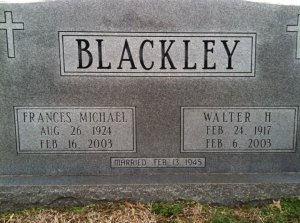
Walter and Frances Blackley were married on the Tuesday before Valentine’s Day, February 13, 1945. They were married for 58 years. In February 2003, they both passed away, ten days apart, around Valentine’s Day. So each time Valentine’s Day rolls around, I remember them and their wonderful love story. The following are the words from their memorial services.

On February 8, 2003 I said…

Luke 2:25-32 NRSV

This scripture text contains one of the most beautiful prayers found in the Bible. In fact, it is more of a hymn than it is a prayer. It is a wonderful hymn of celebration consisting of verses found in the Hebrew Scriptures from the book of Isaiah. It is the last hymn of righteous and devout man named Simeon.

Master, now you are dismissing your servant in peace, according to your word, for my eyes have seen your salvation, which you have prepared in the presence of al peoples, a light for revelation to the Gentiles and for the glory to your people Israel.

This was the last prayer of a righteous and devout man, named Simeon. I want to suggest that this was also the last prayer of a righteous and devout man named Walter Blackley.

Simeon was able to sing this prayer, because Simeon was given the blessed opportunity to hold the Christ Child in his arms. Simeon was given the opportunity to hold the hope for the world in his arms. Simeon was given the blessed opportunity to hold grace in his arms.

More than perhaps anyone that I know, I believe Walter was also a holder of grace.

Allow me to define the concept of grace for you by asking you a few questions:

What do you call a seventy-something-year-old man who was able hit a baseball and ran the bases with his grandson during a little league’s parents’ day?

I believe you call that grace.

What do you call an eighty year old man riding a jet ski with his thirteen-year old granddaughter?

I believe you call that grace.

What do you call someone who valiantly served his country in the Second World War, surviving untold horrors, without loss of limb and life?

You call that grace.

What do you call someone who contracted malaria that sent him home to a military hospital until the end of the war where soon after he married his girl named Frances with whom he shared 58 long years of happiness?

What do you call the gift of a small farm which provided needed therapy which helped a war veteran overcome the dreadful experiences of war?

You call that grace.

What do you all someone who was given the gift of three beautiful daughters and the gift of four beautiful grandchildren? What do you call the miracle of Vida Mclawhorn who has and continues to confound medical science and inspire us all?

You call that grace.

Walter understood that these gifts—this gift of abundant life, this gift of vigorous health, this gift of miraculous strength, and the gifts of love—were all completely unearned and underserved gifts of God’s amazing grace.

This is what I believe made Walter such a wonderful man.  This is what I believe made him so endearing and so loving to so many people.  This is why I believe Walter lived is life and served others in the community with such incredible integrity. This is why he treated everyone the same regardless of their ethnicity and regardless of their religion.  This is what gave this endearing man such a wonderful sense of humor.

Walter understood that it was God’s grace which kept him going so strong so late in his life.  Always in a hurry.  One of Walter’s all time favorite sayings was:  “C’mon Frances, we got it go!”

It was the amazing grace of God which enabled him to mow is own lawn every summer, even this last summer. . .with a push mower.  Walter Blackley was indeed a holder of grace.

Like Simeon, Walter had been given the wonderful opportunity to hold the Christ Child in his arms.  He had been given the opportunity in his eighty-six years to hold the promise of strength and the promise of help in times of trouble which was found through his relationship with Christ.  Walter had been given the opportunity to hold hope and salvation in his arms.

I believe this is what compelled this man to attend Sunday School and worship so faithfully Sunday after Sunday.  Walter came to church, even during the past year when the pain in his neck and shoulder was the greatest, because Walter realized that all that he had, and all that he had received were unearned, undeserved gifts of God’s amazing grace.

I believe the best news for us is that we who loved Walter and were loved by Walter, are also holders of grace. We are holders of grace because we too have been given a wonderful gift.  We too have been given a gift which was completely unearned and undeserved.  For we each of been given the gift of Walter—of  knowing him and loving him and being loved by him.  And when we can consider this, I believe our mourning and grief can be and will be transformed into thanksgiving and joy.

And in what may be more difficult, I believe we should also consider that we are holders of grace because have also been given the peaceful, gracious death of Walter.  I have heard many Christians tell me that they do not fear death.  It is dying that they fear. Christians do not fear going to be with God, it is the pathway to God that we fear—it is the suffering we fear. Yes, the way that Walter died is yet one more reason that I believe the last prayer of Simeon was the last prayer of Walter.

And I believe we also need to consider that we, like Simeon and like Walter, have also been given the gift of the gift of the Christ child.  We too have been given the gift of the promise of strength and help in times of trouble. As God had delivered Walter through so many of life’s storms, we can know that God can and will do the same for us.  God will see us through our grief and our pain, and God will one day see us through our deaths, as God has seen Walter through his. We are indeed holders of hope, holders of salvation, and holders of grace.

And hopefully, we too will one day be able to sing the prayer of Simeon and the prayer of Walter Blackley:

 Master, now you are dismissing your servant in peace according to your word; for my eyes have seen your salvation, which you have prepared in the presence of all peoples, a light for revelation to the Gentiles, and for glory to your people Israel.

_____________________________________

On February 19, 2003 I said…

I need to say it, because during the last three days, we have all have been thinking it. We have said it silently to ourselves and out loud to others.

Frances was always just a few steps behind her husband, Walter.

It was like Walter had called from heaven, “Come on Frances, we got to go!”  Frances was always a few steps behind Walter because Frances loved to tell a story. Walter would say, “Frances, we’ve got to go” or “They’ve got to go. They’ve already heard that story ten times!”

And she would respond, “Well, I’m going to tell it again!”  Then she would say: “That man’s been rushing me since the day we got married!”

Yes, Frances loved to tell a story.  And this woman was the perfect story teller because she knew a little something about everything.  She was one of the most well-read ladies that I know.  She was also one of the most faithful Christians that I know.  Thus, many of her stories, her grandchildren recall, were like Aesop’s Fables. She had a story for everything, and each story taught us a valuable lesson about life. Carol, Janice and Vida, your lives and your children’s lives have been enriched forever because of those stories.  You are who you are—strong, caring, compassionate, loving, Christian—because of the many wonderful stories Frances told.  Her stories taught you to avoid gossip and pettiness.  Her stories taught you not to sweat the small stuff; to respect and to love everyone the same.  Her stories taught you to work hard, to be fair and to keep it simple.

Her stories taught you about love. That love is patient and kind. That love is not envious or boastful or arrogant or rude. That love does not insist on its own way.  It is not irritable or resentful.  It does not rejoice in wrong doing, but rejoices in the truth. It bears all things, hopes all things, and endures all things.

Many of us have said to one another and said to ourselves that Frances died the way Frances lived: Ten steps behind her husband, Walter, telling stories.

Frances spent the last ten days telling and retelling a wonderful love story that mimics a fairy tale.  Eleven days ago, Frances had the rare opportunity to share this love story with her entire family and a host of friends:

A love story of a seventeen-year-old beautiful stenographer from Salisbury named Frances who had eyes for a handsome, confident 25 year old named from Franklinton named Walter— A love story of a courtship that was only six months old when the couple was separated as Walter was called to serve his country during the Second World War— A love story of a long distance  relationship which endured two-and-one-half years as the two sent exchanged love letters between Salisbury and New Guinea— A love story of a young man who came home from the war to meet his girl in Salisbury on a Monday, and to elope the next day on Tuesday, the day before Valentine’s Day.  Frances told us of a love story which encompassed fifty-eight years of marriage— A love story about a couple who were completely devoted to their family, supportive of every  good thing their children did— A love story of a couple who always stayed together, always worked together, always worshipped together and always played together— A love story of a couple who spent many Saturday nights dancing together in their living room to ball room dance tunes emanating from their television tuned to the Lawrence Welk Show.

This past week I believe that Frances also told us another love story.  However, this story was not told with mere words. This story was told more with her life. This story was told more with her tremendous faith in God.  One of the grandchildren showed me Walter and Frances’ big family Bible.  Throughout the book, from Genesis to Revelation, there are dates written on the pages with two initials, “W.” and “F.”  Beginning in Genesis, Walter and Frances read the Bible together and then dated and initialed each passage.  They did this for years until they finished reading the Bible from cover to cover.

Yes, Frances loved to tell a story, but more importantly, Frances loved to tell the story.  With her life and with her faith, and with the word of God engraved on her heart, with tremendous fortitude, Frances shared with us the love story of God. –The love story of a God who has promised to never leave us or forsake us.  –The love story of a God who walks with us in the valley of the shadow of death no matter how many times we are forced to walk there –The love story of a God who promises to be present with us through the storms of life and to see us through them—The love story of a God who always gives us the strength that we need to face any trial and any tribulation—The love story of a God who is always in our world working all things together for the good—The love story of a God who has given us the wonderful gift of God’s self, the gift of the Spirit and the gift of the Church.

One of the first things that Frances said to me after Walter’s death was, “Jarrett, I have said it before, and I will say it again: “If you are going to have to go through trouble in this world, there is no better place to be than the church.”  Frances loved her church.  She knew that it was through her church and through her many relationships in the church that she was going to be alright.  She was so looking forward to attending her circle meeting on the Monday after Walter’s death.

Frances’ tremendous faith was unwavering.  She was so strong, so hopeful.

Over and over and over again, with her life and with her faith, Frances has shared with us the love story of God— The love story of a God who promises each of us who have lost so much recently that we too, are going to be alright— The love story of a God of resurrection and of hope— The love story of a God who is in the business of transforming our sorrow into joy, our despair into hope and death into life— The love story of a God who has brought life, abundant and eternal to Walter and Frances through resurrection and who is working even now to transform our shock and grief and pain into peace.

I believe God has already done that for many of us. When we first heard the tragic news of Frances’ sudden death, we were shaken and dismayed beyond belief. But then the God of resurrection came, and the God of resurrection began to work. And it was not long before the look of bewilderment on our faces was transformed into great big smiles.

“Come on. Frances, we got to go!” he said.

“That man has been rushing me since the day I married him!” she quipped.

“Come on Frances, they have heard that story already ten times!”

“Walter, you are going to have to wait, because I am going to tell it again!”

And that is exactly what she did.

She told us one more time the story— the story of unseen things above— the story of Jesus and his glory, the story of Jesus and his love.  She loved to tell the story, because she knew it to be true.  It satisfied her longings as nothing else can do.

My prayer for the Blackley family and for all of us who grieve is a simple one. Remember the love story of God which was shared over and over again by this beautiful woman.  May the love story of God, which was Frances’ story become our story.  May this story fill us with courage and with strength. And may we spend the rest of our days sharing this story with others, until that day comes when we will see the couple again face to face, as we will one day see God face to face.