 Luke 21:5-19 NRSV
One of the great things about living in southern Louisiana were the countless stories about two infamous Cajuns named Boudreaux and Thibodeaux.
Reverend Boudreaux was the part-time pastor of a small, rural Baptist church and Pastor Thibodeaux was the minister of a Pentecostal church directly across the road. One day, they were both standing out by the road in front of their churches, each pounding a sign into the ground as fast as they could. The sign read:
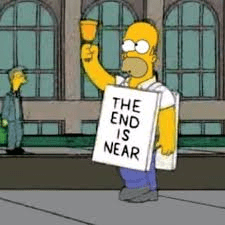
Da End is Near
Turn Yo Sef ‘Roun Now
Afore It Be Too Late!
As soon as the signs got into the ground, a car passed by. Without slowing down, the driver leaned out his window and yelled as loud as he could: “You bunch of religious nuts!”
Then, from the curve in the road you could hear tires screeching and a big splash.
The Reverend Boudreaux yells at Pastor Thibodeaux across the road and asks:
“Do ya tink maybe da sign should jus say ‘Bridge Out’?”
The last couple of Sundays the Christian calendar and the lectionary has led us to ponder the tough subjects of death, the resurrection of the dead and eternal life. And today’s gospel lectionary is on a similar topic: the end of the world.
Now, I have to be honest here, after the last two Sundays, I am really ready to focus on something else! Besides, all this apocalyptic gloom and doom talk is really not for us mainstream, progressive, educated church types here on Main Street.
But this is just how the Church calendar works I guess. We are approaching the end of the calendar as next Sunday concludes the church year with Christ the King Sunday, emphasizing that when it is all said and done, in the end, Jesus Christ is King of Kings and Lord of Lords. So, I guess it makes sense that here, on this next to last Sunday of the church year, even we downtown Main Street church folks are asked to listen to sermon about the final judgment.
And, although we don’t like it, maybe we need to hear it. After all, in the last couple of years, chatter about the end of days seems to have spiked a bit with all of the Mayan doomsday predictions, super storms like last year’s Sandy and last week’s killer typhoon in the Philippians, numerous earthquakes and tsunamis, the global recession, nuclear tensions with North Korea and Iran, the constant threat of terrorism, and with the attention given by cable TV to doomsday preppers.
In September of this year, a poll by the Barna group found 4 in 10 Americans – and 77 percent of evangelical Christians – believe the “world is now living in the biblical end times.”[i]
So, in spite of what you may think about this subject, perhaps we need to hear what Jesus has to say.
About the destruction of it all, in verse 7, we read where they ask Jesus: “When will this be, and what will be the sign that this is about to take place?”
In verse 8 we read Jesus’ answer: “Beware that you are not led astray.”
Then Jesus specifically warns us to stay away from those who claim to be Christian and say, “The time is near.” Jesus says, “Do not go after them.” Do not follow them. Do not listen to them. Don’t pay them any attention!
Well, glory halleluiah! Because after two Sundays preaching on death and the resurrection of the dead, I really don’t want to talk about the end of days! So, Amen Jesus! Preach it! Let’s move on to some more pleasant things! Enough of all this gloom and doom!
Ok, now let’s listen to what Jesus has to say next! Hopefully it is something more uplifting than death!
“But before all this occurs, they will arrest you and persecute you.” “You will be betrayed even by parents and brothers, by relatives and friends; you will be hated by all because of my name; and they will put some of you to death.” “But “this will give you an opportunity to testify.”
Man! And we thought we were off the hook this week!
But if we have been reading and listening to Luke, we should not be that surprised. It is as if Jesus is saying, “Do not worry so much about the tribulations to come with the end of the world, because if you are truly following me, if you are faithfully living as my disciple, if you have fully committed yourself to carrying a cross, if you are really speaking truth to power, if you are serving those I call you to serve, if you are standing up for my justice and my wholeness in this fragmented world, then you have will enough trouble for today!
If you are truly living for me and loving this broken and suffering world as much as I love this world, you will sacrifice much. You may even lose your friends and family! Matthew remembers Jesus saying on another occasion: ‘So do not worry about tomorrow, for tomorrow will bring worries of its own. Today’s trouble is enough for today (Matthew 6:34).
Jesus seems to be saying here: “Don’t focus so much on the end days, don’t’ dwell on the impending doom and demise of it all but instead, focus on the opportunities that you have today in this hurting world ‘to testify,’ to selflessly and sacrificially serve me by serving and suffering for others.”
Jesus is saying: “It is perfectly is to think and dream about going to Heaven one day. It is fine to have the hope that someday, somehow, some way there’s not going to be anything more to fear or dread. It is wonderful to know a time is coming when there is going to be no more crying, no more pain, and no more death. It is great to sing those old hymns of faith, such as “When We All Get to Heaven,” “Shall We Gather at the River,” and “I Can Only Imagine,” but if Heaven is the only place your hearts are, if going to Heaven and avoiding Hell is the only reason you are Christians, then you have missed the whole point of who I am and who you are called to be as my disciples.”
I believe Jesus is saying to us: “So don’t come to church looking to avoid a suffering world! Come to church and bear the sufferings of this world! Don’t come to church looking for some fire insurance. Come to church and let me lead you into the fire!”
This is exactly why I believe so many Christians are tempted “go after” those who love to preach about the end of days, especially those who say that it is coming in our lifetimes. For it is far easier to believe that God has already given up on this world. It is much easier to look at the destruction in the Philippines and believe that it is all a part of God’s plan, a preview of things to come! It is far easier to believe that earthquakes and hurricanes and tornadoes and poverty and wars are all part of God’s apocalyptic will than it is to believe that God calls us to selflessly and sacrificially suffer alongside those who are suffering.
It would be far easier to believe that Christianity is only about getting a ticket to heaven to escape this world than it is to believe that it is about selfless, sacrificial service.
British scholar Lesslie Newbigin comments: “In an age of impending ecological crises,” with the “threat of nuclear war and a biological holocaust” many Christians have retreated into a “privatized eschatology.” That means, that the only hope that they possess, in the words of Newbigin, is “their vision of personal blessedness for the soul after death.”[i]
Christians everywhere, in the words of Newbigin, have “sounded the trumpet of retreat.” They have thrown their hands in the air and have given up on the world. Their faith in Jesus has become solely and merely a private matter. Faith is only something they possess, something they hold on to, that they can someday use as their ticket out here. In the meantime, they withdraw into safe sanctuaries and look forward to that day “the roll is called up yonder.” And they listen to angry sermons by angry preachers condemning the world to Hell in a hand basket.
And giving up on the world is really nothing new. At the turn of the first century, Jews called Gnostics had a similar view of the world. Everything worldly, even the human body itself, was regarded as evil. And maybe, they too, had some pretty good reasons to believe that way, because regardless of what some may believe, the world did not start going bad in our lifetimes. The truth is: it has been bad ever since that serpent showed up in the garden.
At the turn of the first century, Jews were a conquered, depressed people, occupied the Romans. And they were terrorized daily by a ruthless, pro-Roman King named Herod—a king who would murder innocent children to have his way. The Gnostics looked at the world and their situation and came to the conclusion that they were divine souls trapped in evil bodies living in a very dark, God-forsaken, God-despised world.
As I have mentioned, Next Sunday marks the end of the Christian calendar. The next Sunday begins the season of Advent, the very beginning of the church.
It is the season that we remember that it was into a very dark, and seemingly God-forsaken, God-despised world that something mysterious happened that we call Christmas. A light shone in that darkness proving in the most incredible and inexplicable way that this world is anything but God-forsaken or God-despised!
God loves this world so much that God emptied God’s self and poured God’s self into the world. God came and affirmed, even our fleshly existence as God, God’s self, became flesh. And God came into the world not to condemn the world, but to save the world. For so God loved the world that God came into the world and died for the world.
Thus, the message that we all need to hear today and hear often is not that the end is near as God believes the world is worth destroying, but it is that God believes this world is worth saving. God believes the world is still worth fighting for. God still believes that this world is worth dying for.
As the body of Christ in this world, we as the church are not called to retreat or withdraw from the world and its troubles, but are called to love this world, to do battle for this world, to even die for this world. We are called to be a selfless community of faith in this broken world. And, no matter the cost, we are called to share this good news of Christmas all year long!


