Christmas Favor

Luke 1:46b-55, 2:14 NRSV

And suddenly there was with the angel a multitude of the heavenly host, praising God and saying, ‘Glory to God in the highest heaven, and on earth peace among those whom he favors!

Among those whom God favors? Let’s be honest for a moment. Are you at least a little bit offended? God doesn’t have favorites, right? God is supposed to be like that parent going back to the shopping mall on Christmas Eve, because they are afraid a few dollars may have been spent more on one child than another! The phrase is so offensive, did you know that some ancient manuscripts omit it all together!

However, even if we omit it, we have the Song of Mary. In the Magnificat, Mary sings: “My soul magnifies the Lord, and my spirit rejoices in God my Savior, for God has looked with favor [there it is again] on the lowliness of God’s servant. God has brought down the powerful from their thrones and lifted up the lowly. God has filled the hungry with good things, and sent the rich away empty” (Luke 1:46-48, 52-53).

And then, we have the shepherds, the first ones on earth to hear the pronouncement of Christmas. Of course, we love to romanticize these shepherds, as we remember our innocent children depicting these Christmas characters wearing bathrobes in adorable Christmas plays. We also think about images of the shepherd king David and the beautiful green pastures, still waters and the protection of the rod and the staff of the twenty-third Psalm. And we may remember Jesus calling himself “the good shepherd.”

However, the reality is that shepherding was a most despised occupation. New Testament Professor Alan Culpepper writes:

In the first century, shepherds were scorned as shiftless, dishonest people who grazed their flocks on others’ lands.

Fred Craddock writes that the shepherds belong to the Christmas story:

Not only because they serve to tie Jesus to the shepherd king, David (2 Sam 14:23, 21) but because they belong on Luke’s guest list for the kingdom of God: the poor, the maimed, the blind, the lame (Luke 14:13, 21).

This is why the angels pronounce the good news of Christmas is great joy for ALL the people. Culpepper writes:

The familiarity of these words should not prevent us from hearing that, first and foremost, the birth of Jesus was a sign of God’s abundant grace.

The birth is a sign that God loves ALL people, even the most despised, the most lowly, those labeled by the religious culture as the most immoral.

And in what form does this sign appear? The savior was coming into the world through a poor peasant woman to be placed in a feeding trough made for animals. And it is this humble scene that sets the stage for his entire life on earth. The savior of the world was born and lived and died on the fringes, on the margins of society—underscoring the truth that the good news has come into the world for ALL—especially to those who are marginalized by politics and religion.

Page Kelly, my Old Testament professor at Southern Seminary, used to love to say that the biblical symbol for God’s justice on this earth was not a woman holding a set of scales wearing a blindfold, but was one of the prophets holding a set of scales with his eyes bugged out and a long bony finger mashing down on the side of the poor—favoring those who have always been despised and marginalized by society. Favoring those in our world who need more justice, more peace and more love.

Think about that for a moment. Today, is there any person or group of people, perhaps someone you know personally, who needs more love today?

It is a most important question, for I believe answering this question, and then doing something about it, is how God wants us to celebrate Christmas. More than lighting candles and singing carols, I believe God needs us, yearns for us, to show some favor, to love some people more than we love others—namely, those among us today who need more love.

The entire Biblical witness affirms that this favor is the will of God.

Moses commanded the Israelites:

If there are any poor…in the land…do not be hard-hearted or tightfisted toward them. Instead, be generous and lend them whatever they need. …Give generously to the poor, not grudgingly, for the Lord your God will bless you in everything you do. There will always be some in the land who are poor. That is why I am commanding you to share freely with the poor and with other Israelites in need (Deut 15:7-11).

Never take advantage of poor and destitute laborers, whether they are fellow Israelites or foreigners living in your towns. …True justice must be given to foreigners living among you… (Deut 24:14-16).

The writers of the Proverbs could not be more emphatic:

…blessed are those who help the poor… Those who oppress the poor insult their Maker, but helping the poor honors him”(Proverbs 14:21, 31).

If you help the poor, you are lending to the Lord— and he will repay you! (Proverbs 19:17).

Those who shut their ears to the cries of the poor will be ignored in their own time of need (Proverbs 21:13).

A person who gets ahead by oppressing the poor or by showering gifts on the rich will end in poverty (Proverbs 22:16).

Whoever gives to the poor will lack nothing, but those who close their eyes to poverty will be cursed (Proverbs 28:27).

So,

Speak out for those who cannot speak, for the rights of all the destitute. Speak out, judge righteously, defend the rights of the poor and needy (Proverbs 31:8-9 NRSV).

The Psalmist writes:

Give justice to the poor and the orphan; uphold the rights of the oppressed and the destitute. Rescue the poor and helpless; (Psalms 82:2).

Isaiah pleads:

Learn to do good. Seek justice. Help the oppressed. Defend the cause of orphans. Fight for the rights of widows. “Come now, let’s settle this,” says the Lord. ‘Though your sins are like scarlet, I will make them as white as snow. Though they are red like crimson, I will make them as white as wool’ (Isaiah 1:17-18).

“In other words,” says the Lord, if you truly want to celebrate the advent of the Messiah, if you want to light a candle on Christmas Eve and experience some of my Christmas favor, sing your carols, but then make a point to love the least among you more. Offer more love to those who need love more!

Free those who are wrongly imprisoned; lighten the burden of those who work for you. Let the oppressed live free and remove the chains of injustice. Share your food with the hungry and give shelter to the homeless. Give clothes to those who need them, and do not hide from relatives who need your help.

Then your salvation will come like the dawn, and your wounds will quickly heal. The Spirit of God will lead you forward, and the glory of the Lord will protect you from behind. Then when you call, the Lord will answer. ‘Yes, I am here,’ he will quickly reply, ‘Remove the heavy yoke of oppression…Feed the hungry and help those in trouble. Then (listen carefully to this!) your light will shine out from the darkness, and the darkness around you will be as bright as noon’(Isaiah 58:6-10).

You know what that sounds like? That sounds like Christmas to me! Sounds like John chapter one:

The light shines in the darkness, and the darkness did not overcome it (John 1:5).

The good news is that when we bear the image of God, when we heed the words of the prophets and follow the way of Jesus, the light of the world, by favoring the least of these among us, when we offer more love to the lowly, the marginalized, the despised, the poor and the weak, when we reach out and offer them our bread, our drink, our clothing, our presence, our touch, our very selves, then we will not be offended by the chorus of the angels:

Glory to God in the highest, and peace on earth, whom God favors.

Christmas: Can You See It?

Isaiah 2:1-5 NRSV

Isaiah 2 begins:

The word that Isaiah, son of Amoz, saw concerning Judah and Jerusalem.

Now, let me ask you, who in the world talks that way?  We would say, “The word that Isaiah heard…” Not “The word that Isaiah saw…”

What does it mean to not just hear a word, but to see a word? What would it mean to say: “That’s why I go to church on Sunday morning, to see a word.”

The word “see” here means much more than merely reading words on a scroll. It implies that the words are literally brought to life.

In chapter 1, Isaiah graphically paints a portrait what he has seen in the world: it is a detailed, dark scene of violence, war, corruption, dishonesty, unfaithfulness, oppression of the weak, and trampling on the poor.

The people worship. But their religion is sick. They pray, and they give. But God is not having it. Their prayers are not heard, and their gifts are not accepted.

Then, chapter 2 opens as though Isaiah is starting all over with a new, fresh canvas – or you could say, God is. Isaiah sees people of every nation going to the Mountain of God, including those who were enemies of Israel and Judah and being completely transformed by God’s love.

Can you see it?

Isaiah can. And the transformation is nothing less than miraculous.

They shall beat their swords into plowshares,

and their spears into pruning hooks;

nation shall not lift up sword against nation,

neither shall they learn war anymore.

The transformation that the love of God creates is a complete reversal of the way things currently are in the world. That is why it is so difficult for us to see.

Living in a world that is in perpetual war, where innocent hostages waving white flags are gunned down, living in a world where children regularly practice hiding in their classrooms from active shooters, it is hard for us to see any possibility of this world being at peace.

But what is important for us to understand is that Isaiah’s image of swords turned to plowshares is not Isaiah being naïve. For Isaiah is no Pollyanna Prophet. Isaiah is a realist. Isaiah had this gift to see the world as it really is, and as it actually will be.

His vision of the world in Chapter 1 is as real as the evening news:

Corrupt deals by those whose heads are sick, whose hearts are small, who have no truth in them from the soles of their feet to the top of the heads. They love a bribe and run after gifts. They do not defend orphans nor listen to widows. They pretend to worship God, but their worship is in vain, and their country is desolate. This is reality.

Then, in chapter 2, Isaiah has another vision which is equally real.

Weapons of war are turned into agricultural tools. Death-dealing images are turned into food-producing, life-giving images. This is not wishful thinking. This is a promise. This is reality. This is truth. The scene in Chapter 2 is as real as the scene Chapter 1. Isaiah saw it. He believed it. The question is, can we see it? Do we believe it?”

I believe President Dwight Eisenhower may have seen it. In one of the most prophetic of all presidential speeches, Eisenhower once said,

Every gun that is made, every warship launched, every rocket fired signifies, in the final sense, a theft from those who hunger and are not fed, those who are cold and are not clothed.

         Like Isaiah, I believe Eisenhower saw the Word of God. The question is can we see it? Do we believe it? Are we praying today for Israel and Russia to see it. For our country to see it?

Wouldn’t it be wonderful if this Word could somehow be made flesh to dwell among us to show us the precise paths we should follow, the narrow but abundant way we could live?

I think it is more than interesting that Isaiah suggests that for people to see the Word, they need to climb the mountain of God to allow God to teach them or show them. For Matthew says Jesus climbed a mountain, and there he taught us to see a world completely re-created by the love of God.

A world where the poor are blessed, mourners are comforted, the meek are rewarded, and those who thirst and hunger for justice are satisfied. A world where those who need mercy, receive it. Those who want peace, find it, and the pure in heart, (what do they do?) They see God.

The question is, can we see it?

Maybe our hearts are not pure enough to see it—too filled with the darkness and despair of the world. I believe this is why we need to continually return to the mountain, to sit at the feet of the Word made flesh, to be taught how to see it, to believe it, and thus how to live it, to be it.

To be light and salt. To love our enemies and to pray for those who do us harm. To forgive seventy times seven, to turn the other cheek, to go the extra mile, to give the very shirt off our backs. To do unto others as we would have them do unto us, to always speak the truth, to never judge or demean another. To avoid greed and materialism and hypocrisy, and more importantly, to be doers of this Word and not hearers only.

With its ornaments and bright lights, December may be the most visual time of the year. Everywhere we look, light pierces the darkness. Yards that would otherwise appear dreary and dead, come to life with evergreens, colorful decorations and bright lights. Like the downtown bluff walk, the whole world is transformed.

This should remind us that one of the most important things we can do during this season we call Advent is to help others visualize a world transformed by Christmas.

How? By going to the mountain to sit at the feet of Jesus so we can walk with others in the Light of the Lord.

And there lies the key to seeing anything – light.

If there is not a considerable amount of light in a room, or even outside, our vision is significantly impaired, and the older we get, the worse it gets. That is why the 21st century technological advance that for which I am most appreciative is the little flashlight on my cell phone.

This is why I love the tradition of the Advent wreath. Christians everywhere prepare for Christmas by lighting candles to celebrate the Light of the World who has come to shine light into our darkness. We believe by going to the mountain to sit at the feet of Jesus, by not only hearing, but seeing, then doing his words, we are allowing this Light to get brighter each week changing the way we see ourselves and this world forever.

Looking at the world in the Light of Christmas means believing God is here with us and has identified with us by becoming flesh to dwell among us. God shares in our joy, but God also shares in our suffering.

Looking at the world in the Light of Christmas means believing that the Word that was made flesh is still very much a part of our lives shining light in the darkness.

Looking at the world in the Light of Christmas also means believing that God is always working to transform the world bringing order out of the chaos, triumph out of defeat, joy out of sorrow, and life out of death. God is always working all things together for the good and uses people like you and me to accomplish this.

What this world needs today is more believers. I am not talking about those who merely believe in God. I am talking about those who believe the gospel truth that God is doing, even today, a new thing in this world. This world needs more believers who believe that the Kingdom of God is really coming, and the will of God is being done on earth as it is in heaven!

Advent is the time to allow the Light of the World to adjust our focus and to sharpen our vision, to remind us, that because the Word was made flesh, we have been given the grace to see the whole creation in a brand new light. Misery becomes opportunity. Strangers become family. Enemies become friends. Everyday becomes gift, a fresh, new canvas to recreate a brand new world!

A world where no child goes to bed cold or hungry, no child knows foster care, and no child ever fears being shot in their classroom—A world where everyone is paid a living wage, healthcare is accessible to all, education is equitable for all, as every life is valued—

A world where people of all creeds and all cultures live peaceably, harmoniously, graciously, side-by-side, shoulder-to-shoulder, hand-in-hand—

A world where the distorted morality is restored. Sick religion is healed, and all that is broken is remade—A world where the lame walk, the deaf hear, the blind see and the outsider is included. It is a world where walls come down, chains are loosened and all are free. Hate, violence, wars, corruption, division and bigotry pass away. All of creation is born again, and liberty and justice fully and finally comes for all.

A world where all will know that into the world’s night, a Light shines in the darkness, and the darkness will never overcome it!

Christmas Shoes

Mark 1:1-8 NRSV

About the gift of Christmas, the gift of God’s enfleshed self to the world, John said, “I am not worthy to stoop down and untie the thong of his sandals.”

It was written in Jewish law that “pupils should do everything that is commanded by their teacher with the exception of unlacing the teacher’s shoes.”  The subservient task of kneeling to the ground and unlacing another’s shoe was something only a slave should perform.[i]

 This means that John not only regarded himself unworthy to be a disciple of Jesus, John believed he was unworthy to even be a slave of Jesus. When he compared himself to the one wearing the shoes of Christmas, John regarded himself as lower than the lowliest lowly.

And who could blame him? John was talking about God, the Holy Creator of all that is, the Divine One, Love Love’s self who has come down to earth wearing shoes. John was talking about the great sovereign of the universe from on high, miraculously and lovingly stooping low enough to the earth to kneel down to the ground, put on, lace up and wear shoes. John was talking about heavenly feet accustomed to walking on streets where angels trod that have put on earthly shoes in order to walk the same roads each one of us walk.

Although it was John’s plan to make our windy and rocky roads straight and smooth for these holy shoes, the purpose of the divine shoes was to walk every crooked path, experience every twist and turn, identify with every bump, every dip, every rut. The Lord of Hosts stooped down, knelt down, and laced up shoes to walk down snaky roads; travel down uncertain roads; journey down long, lonely, and desolate roads.

God knelt down and put shoes on feet that would grow weary and sore from those roads. God laced up shoes that would cause great suffering when Jesus’ feet would swell, blister and bleed.

Those shoes ran down fearful, foreign roads to escape Herod’s sword. Those shoes would journey down dark, dangerous wilderness roads that try the soul. Those shoes would travel down desperate roads to bring good news to the poor. Those shoes would travel down neglected roads to give dignity to those marginalized by a religion that had been hijacked by greed and privilege. Those shoes would walk roads lined with the hypocritical and judgmental to defend and forgive the sinner. Those shoes would move down roads paved with suffering to heal and restore the sick. They would go down tear-soaked roads to comfort mourners and raise the dead. They would march down fearful roads to stand for justice and to bring peace.

And near the end of his road on this earth, those holy shoes, worn, frayed and tattered by life, would lead him to a table with his friends. After supper, he would get up from that table, take off his outer robe, and tie a towel around himself. He would then pour water into a basin. And like his humble beginning in a lowly manger, he would once again stoop down, kneel to the ground, and lovingly, empathetically and subserviently untie the shoes of each one at that table, even the shoes of the one who would betray him and of the one who would deny ever knowing him.

Now, in the historical and cultural context of the day, the disciples’ shoes would be removed long before they reclined at the table. However, figuratively and theologically speaking, Jesus untied their laces and removed their shoes.[ii]

Relief, respite and release overcame them as they realized that none of their unworthiness prevents their Lord from graciously taking their feet into his hands and washing away all the dirt and grime from every road they had ever traveled. None of their filth is too offensive. There are no stains too deep. The fresh water from the basin that restores, refreshes and relaxes their wearied feet is miraculously transformed into living water that saves their wearied souls. And a holy peace beyond all understanding overwhelmed them.

The good news of Christmas is that the Holy One, whose laces John believed he was unworthy to untie, comes to us, stoops down, kneels before us, and unlaces our shoes, freeing us in the places we have been too tightly bound.  He empathetically takes our feet into his hands and washes our dirty, sore and weary feet, and makes us ready for the road again.

That is the good news of Christmas. Now, listen to the good irony of Christmas.

John believed he was unworthy to untie the shoes of Christmas. However, because of the good news of Christmas, John is not only worthy to untie and remove those shoes, John is actually worthy to put on, lace up,  and wear those shoes.

Through the gift of Christmas, through the gift of the God who has walked where we walk, through the gift of the Divine who stoops down, unties and removes our shoes, washing our feet and our souls, we are made worthy to not only untie the shoes of Christmas, but to wear the shoes of Christmas. We are worthy to put on Christmas shoes to go where he went, to do as he did, to include as he included, to forgive as he forgave, to love as he loved, to bend ourselves to the ground to touch the places in people that most need touching.

It is believed that fourteenth century saint Teresa of Avila once said:

“Christ has no body but yours, no hands, no feet on earth but yours.
Yours are the eyes with which he looks with compassion on this world, and yours are the feet with which he walks to do good.”

The Apostle Paul has written: “How beautiful are the feet of those who bring the good news” (Romans 10:15).

Don’t worry. It is perfectly natural to feel unworthy to untie those laces, to wear those shoes, to be the hands, the feet, the body of Christ.  And if you believe you are unworthy you are in very good company.

Abraham and Sarah did not believe they were young enough to be worthy (Genesis 17:17). Jacob was not truthful enough to be worthy (Genesis 27). Moses was not articulate enough (Exodus 4:10). David was not faithful enough. (2 Samuel 11:2-4). Rahab was not pure enough (Joshua 2:1). Jeremiah was not mature enough (Jeremiah 1:6). Mary was not rich or powerful or old enough (Luke 1).

Yet, God makes the unworthy worthy to be God’s enfleshed presence in this world, to be God’s body, hands, eyes, and feet in this world. As the Apostle Paul reminds each of us:

 “Consider your own call, brothers and sisters: not many of you were wise by human standards, not many were powerful, not many were of noble birth. But God chose what is foolish in the world to shame the wise; God chose what is weak in the world to shame the strong” (1 Corinthians 1:26-27).

United Methodist Bishop William Willimon tells a wonderful story about a visit to a fraternity house one night while he was the campus minister at Duke University. The reputations of the fraternity houses at Duke were getting so bad that the University Dean required each fraternity to have a certain number of religious programs each year to give them at least some semblance of respectability.

 One of the fraternities invited Willimon to lead one of the programs. He was tocome to the frat-house and give a lecture on “Morality and Character on Campus.”

On the appointed evening, Willimon went to fraternity and knocked on the door. When the door opened, he was greeted by a young boy who appeared to be nine or ten years old.  He thought, “What in the world is a little boy like this doing in a frat house at this time of night?”

“They are waiting for you in the common room,” the little boy said politely. Willimon followed the boy back to the common room where all the young men were gathered, glumly waiting for the preacher’s presentation.

Willimon says for about an hour he talked about morality, responsibility, character and faith and how the frat houses on campus gave little evidence of any of those things. When he finished his harsh talk he asked if there were any questions. Of course, they were none. So, he thanked them for inviting him and headed out.

 One young man got up and walked him to the door. Before they got to the door, Willimon overhead him say to the little boy, “Hey buddy, you go and get ready for bed. I’ll come up, tuck you in and read you a story in a few minutes.”

When they got outside, the fraternity boy lit a cigarette, took a long drag on it, and thanked the pastor for coming out.

 Willimon turned and asked, “Who is that kid in there, and what is he doing here?”

“Oh, that’s Donny,” said the young man. “Our fraternity is part of the Big Brother program in Durham. We met Donny that way. His mom is addicted to drugs and is having a tough time. Sometimes it gets so bad that she can’t care for him. So, we told Donny to call us if he ever needs us. We go over, pick him up, and he stays with us until it is okay to go back home. We take him to school, buy his clothes, books, and stuff like that. Just trying to give him a little bit peace in his life, if you know what I mean.”

The dumbfounded preacher stood there and said: “That’s amazing. You know, I take back everything I said in there about you guys being immoral and irresponsible.”

“I tell you what’s amazing,” said the college boy as he took another drag on his cigarette, “what’s amazing is that God would pick a guy like me to do something this good for somebody else.”[iii]

 In other words: “What’s amazing is that God, the Holy Creator of all that is, would make an unworthy guy like me worthy to not only untie, but to wear the shoes of Christmas.”

[i] Alan Culpepper, Smyth and Helwys Commentary: Mark, 2007, p. 47.

[ii] From a sermon by J. Will Ormond entitled Advent on a Shoestring preached during Advent in 1987 at the Columbia Theological Seminary.

[iii] From a sermon by William Willimon in Pulpit Resource, January 2006, p. 19.

Room for Christmas

Isaiah 64:1-9 NRSV

It was a dark time in a dark world. The prophet Isaiah prays a desperate prayer asking God to rip open the heavens and come down and heal the nation, to bring peace on earth and joy to the people; a prayer asking God to establish a new order that will override the destructiveness of those in power. It’s a prayer of hope that God will come in the same liberating way as God had come in the past.

However, the mood of the prayer changes. Hopeful expectation turns into dreadful despair as the sins and transgressions of the people are considered.

The term “unclean” means “ritually unacceptable.” It is not believed that Israel is a community where God’s presence is willing to come. Like a “filthy cloth,” the nation is so impure and contaminated that no one would dare touch it.

Like “a faded leaf,” it’s in danger of rotting away. Because the people have called on false gods, there seems to be no room for the God of truth. Because they have turned their backs on social justice, turned their eyes away from the poor, there seems to be no place for the God of mercy. Because the people have chosen a way of violence, there seems to be no way for the God of peace. There seems to be no hope.

But then, the mood changes once more with one of the most hopeful words in the scriptures: “YET!”

YET, you are our Parent. YET, you are our potter. YET, we are all the work of your hand. YET, we are your people.

Isaiah hopefully asserts: YET, you made us, you own us, you are responsible for us, we belong to you. Thus, we trust that you will indeed come again to love us, to save us, just as you have come in the past.

Advent is a time of celebrating this hopeful: “YET!”

It was a dark time in a dark world. The sick and injured were passed by on the other side by prominent men claiming to be religious. The poor were unfairly taxed. Foreigners, scapegoated. Women, objectified. Victims of abuse, stigmatized. Anyone different, marginalized. The entire nation, demoralized.

 YET, a peasant girl named Mary carries hope in her womb and a song in her heart:

 ‘My soul magnifies the Lord,
and my spirit rejoices in God my Savior,
for he has looked with favor on the lowliness of his servant…

…he has scattered the proud…
He has brought down the powerful from their thrones,
and lifted up the lowly;
he has filled the hungry with good things,
and sent the rich away empty.

This is the hope of Advent! The world seems dark, YET, the Light of the World is coming!

Later, the parents-to-be were on the road to pay taxes to a puppet king of an occupied land. The road was long, and being with child made the road especially difficult. And to make things more difficult, when it was time for the baby to be born, they discovered that there was no room in the inn.

There was no room. Sounds like the desperate prayer of Isaiah.

There was no room. There was no place. There was no way. There was no hope.

YET, as God had proved over and over throughout history, from the covenant of Abraham to the great Exodus, there is nothing in all of creation that can separate the world from the love of God. For God, would once again come! Despite every demonic power that tried to thwart God’s coming, God came.

And the good news of this Advent season is that we know that God still comes. And there is nothing in all of creation, nor things above nor below, nor angels nor rulers, nor things present nor things to come, nor life nor death that can stop God from coming.

A church once presented a Christmas play. You know the kind. I used to be in one every year when I was growing up. Three boys playing shepherds are carrying long sticks wearing bath robes with towels wrapped around their heads. And three more boys playing wise men wearing cardboard Burger-King crowns wrapped in Reynolds Wrap are carrying boxes decorated with left-over Christmas garland. They all walk up on the chancel, greet Mary and Joseph, and bow down before the baby Jesus.

Well, during one particular play, after the wise men and shepherds came and bowed before Jesus, a spokesperson for the wise men made the announcement: “We three kings have traveled from the East to bring the baby Jesus gifts of gold, circumstance and mud.” Of course, laughter filled the sanctuary.

But you know what they say: “out of the mouths of babes.”

In the circumstance of being told there is no room for you, there is no place for you, there is no way for you, and there is no hope for you, through Christ, God came to Mary and Joseph and God comes to us and says: “YET!”

The good news of Advent is that God comes to us in all our circumstances and offers us the assurance that there is no circumstance on earth or in heaven that is beyond God’s amazing grace.

And coming as a human being, coming into the world as a fleshly body, a body made up of dust and water, God comes and joins us in our mud.

Through Christ, God came into and still comes into our muck of pain and sickness and offers comfort and healing.

Through Christ, God came into and still comes into our muck of loneliness and fear and shares divine presence and a peace beyond understanding.

The world says there is no room; things are not going to get any better. The world says there is no way; the good old days are long gone. The world says there is no place; evil will get the best of you. The world says there is no hope; peace on earth and good will shall never happen.

YET, a young woman named Mary goes into labor as God says: “I am working all things together for the good!”

YET, a baby is born in the darkness as God says: “The best days of life are always before you.”

YET, a child cries in the night as God says: “Although you cannot go back to the good old days, good new days are coming!

The world says: “There is no room. You will never amount to anything.”

The world says: “There is no way. Sin will always get the best of you.”

The world says: “There is no place for you. Nobody really cares about you.”

The world says: “For you, there is no room, no way, no place, no hope.”

YET, a baby is wrapped in bands of cloth born to underserving, unwed teenagers in an occupied land, as God says: “I love you just as you are, and I come to wrap you in my mercy, clothe you with my grace, nurse you with my love. I know your sins and I forgive you. I will always be with you and never away from you. I will always be for you and never against you. I will always stay by your side fighting for you, even if it means dying for you.”

The world says: “Racism will never end. Bigotry will not cease. Misogyny isn’t going away. There is no way this country will ever come together. There is no room for diversity. There is no place for equality. There is no hope for unity.”

YET, a brown-skinned baby’s birth to a Hebrew woman is announced by angels: “I am bringing you good news of great joy for ALL the people. For you, ALL of you, a baby is born who is Christ the Lord, and through him there is no longer Jew or gentile, slave or free, male or female, for all are one!”

The good news of Advent is while the world often seems dark, YET the light of God will not be diminished.

Biased news channels and social media will continue to divide us, YET the good news that unites us will not be suppressed.

Minorities continue to be pushed to the margins, YET the justice of God will not be defeated.

The sound of gun violence is deafening, YET the Word of God will not be silenced.

The cease-fire has ended, rockets are being fired, YET the Prince of Peace will not be conquered.

The powerful spew misinformation and stoke fear to push their racist agendas, YET truth cannot be hidden.

Hate seems to be flourishing, YET love will not lose.

Sin and selfishness seem to get the best of us, YET grace will not fail.

Despair overwhelms us, YET hope will not die.

The nation feels like a faded leaf that’s about to rot away, YET the kingdom of God will reign forever and ever.

Many churches seem to have lost their way. Blind by power and greed, they embrace a spirit that can only be described as anti-Christ, YET I know of many churches, I know one particularly well, that is committed to following the way of Christ, committed to being the church, to being the enfleshed body of Christ in this world bringing good news the poor, freedom to the oppressed and recovery of sight to the blind.

It’s Advent, and our world grows darker;

YET, it’s Advent, and the Light of the World is coming!

And the darkness will not overcome it.

It’s Advent. God is acting. The Spirit is moving. Christ is coming—Being born, even today, even this very moment, in every one of us. Hallelujah.

Jesus Is the Answer

Ephesians 1:5-23 NRSV

On this Sunday after Thanksgiving, as a Christian pastor, I am most thankful for Jesus, for I truly believe with all my heart, for me personally, Jesus is the answer.

Now, I know how cliché, cheesy and bumper-stickery that sounds, but I can’t help it. When it comes to questions about theology, about all I got for an answer is Jesus.

And you should know that I dislike few things more than bumper-sticker theology! It tears my nerves up when people try to reduce something as miraculously mysterious as faith in the Holy-Source-of-all-that-is into a few pithy words to slap on the back of a vehicle.

“Jesus is my co-pilot.” If Jesus is merely your co-pilot, I suggest you switch seats. Because I believe it’s Jesus who needs to be your pilot, the one who makes the decisions, charts the course, and steers the ship, leading you on the way of love that has the power heal sick religion, restore a distorted morality and make whole a fragmented planet.

“Honk if you love Jesus.” Please don’t do that. If you truly love Jesus, if you are following the way of love that Jesus embodied and taught his disciples, please, never toot your own horn. If you really love Jesus, feed the hungry, clothe the naked, shelter the homeless, love the outcast, forgive the sinner, care for the dying, and be a friend to the lonely.

“Got Jesus?”  No, I don’t. Because I don’t believe Jesus can be “got.”  I believe the way of love Jesus modeled wants to get us. Jesus wants to get us to deny ourselves, pick up a cross and follow him. We don’t get Jesus to meet our needs. Jesus wants to get us to meet the needs of the world. We don’t get Jesus as some sort of ticket to heaven. Jesus wants to get us to bring heaven to earth.

“Jesus is the reason for the season.” If we call ourselves a Christians, shouldn’t Jesus be the reason for every season, be the Lord over, reign over, every season, every month, and every day. Shouldn’t the way of love of give meaning and direction to our lives all year long?

“Keep Christ in Christmas.” Why don’t we first try to keep Christ in “Christian?” For I believe the reason so many people are turned off by Christians today is because many Christians act nothing like the Christ by whom they identify themselves. And in many cases, behave in a way that is best described as anti-Christ.

“If Jesus had a gun, he’d still be alive today.” No, I am afraid that it is because of Christians like you that the way of Jesus seems dead in this world today.

“Are you following Jesus this closely?”

Hmmm. I actually kind of like that one.

However, I am thankful that faith in God cannot be condensed into a few simple words that will fit on a bumper sticker. Yet, this Sunday after Thanksgiving, I still am most thankful, that for me, that Jesus is the answer.

On this Christ the King Sunday, I am thankful for these beautiful words of Ephesians:

God put this power to work in Christ…far above all rule and authority and power and dominion…And [God] has put all things under his feet and has made him the head over all things for the church, which is his body, the fullness of him who fills all in all. Jesus is above all and is the head over all things.

That is why we celebrate this “Christ the King Sunday” on the last Sunday of the Christian calendar. At the end of the year, we proclaim that our church, our faith, our theology, everything we do, is all about Jesus. In other words, Jesus is the answer.

This is particularly good news for me as I am one who readily confesses that, when it comes to faith and theology, when it comes to this amazing grace that we call life, I have far more questions than I have answers. In fact, over the years I have discovered that the more I know the less I know.

For me, life is as mysterious as it is miraculous. The very existence of God, and the specific revelation of God through Jesus Christ, is even more miraculously mysterious. God, the creator of all that is, is so incredibly large that I will never be able to wrap my mind around God. And I will never understand the height, the depth and the breadth of the love of God.

My mind is not only very small, but I believe it is also very flawed. Whether one blames it on “original sin” or “the Fall of Humankind” or just “being born in an imperfect world,” we can agree that all of creation is seems to be fragmented. Consequently, as a creature on this earth, I will always understand God and God’s will for the world and my life as “seeing through a glass darkly” (1 Corinthians 13). My understanding will always be limited, imperfect and incomplete.

As I was waiting to get my car inspected this past Wednesday, when they found out I was a pastor, someone asked me if I thought we were “living in the last days.”

Honestly, I don’t know much about such things. All I know is that life is precious, fragile and fleeting and, as I said last week, none of us are guaranteed that this is not our last day.

In the days before Halloween, someone asked me about the role of Satan and demons in the world. Again, I don’t know about that. I believe demonic evil is real and personal. I have experienced it in the hate that has been directed at me by people, ironically by those who claim to be Christian, but I don’t really know where it comes from or exactly why it exists in this world.

People have asked me the same questions about angels. Some people believe they have guardian angels that have intervened in their lives, sometimes saving their lives. Again, I don’t know much about that.

People ask me if God created it all, then who created God? Who was Cain’s wife? How did that fish swallow Jonah? How can God be both God and Jesus? If Jesus was God, how does God pray to God? Why do some people seem be blessed and others seem to be cursed? Why are some people healed while others suffer and die? Do people who do not accept Christ as their Lord and Savior go to Hell? What about people who have never heard of Jesus? What about two-thirds of the world’s population who were born and raised in another faith? What really happens to us after we die? Does the soul really leave the body immediately and go to heaven?  What does the Bible mean when it talks about the dead being raised on the last day? Do we have a soul? Are we really any different than animals? Again, I know very little about such things.

And I believe there are many people who agree with me on this. And they say that this is one of the reasons that they find faith in God so difficult. They don’t have all the answers. Consequently, they call themselves agnostic or atheist. And I respect that. In fact, I get along better with agnostics and atheists, than Christians who believe they have all the answers.

However, for me, living in this fragmented world, I cannot imagine life without some type of faith. Without faith, it’s difficult for me to understand how my life would not be devoid of meaning. For there would be nothing to define my life, steer my life, fulfill my life, to give my life hope other than my own selfish desires. So, to give my life meaning, I choose to believe that God, or the Creator of all, or a Higher Power, is not completely mysterious.

After all, I do know some things. I know that I did not do anything to earn the gift of life. I know life is in an inexplicable gift of grace. And I am compelled then to express gratitude for this gift. And the only way I know to do that is through a life of faith in the Giver, the source and power behind it all.

Furthermore, I have specifically chosen a life of Christian faith in this Source or Power. I have chosen to make the God, that is revealed in the words and works of Jesus, my God. I often wonder if I would have chosen this faith if I was born to parents in another part of the world. Nonetheless, I am grateful for the way that this choice informs my beliefs and enriches my life today.

Consequently, my limited understanding of who God is, how God acts and what God desires is derived from the words and actions of Jesus as revealed in scripture. In other words, Jesus is the answer.

As you have heard me say before, I don’t know much. I don’t have all the answers. However, on this “Christ the King Sunday,” on this Sunday after Thanksgiving, I am very grateful that for me personally, Jesus is the answer. The revolutionary way of Jesus recorded in the Holy Scriptures—the radical way Jesus elevated the status of women, lowered himself to wash the feet of others, befriended the lowly, welcomed the stranger, learned from the foreigner, sought justice for the poor and the marginalized, brought wholeness to the disabled, fed the hungry, defended and forgave the sinner, embraced the untouchable, welcomed the children, told extravagant stories of grace and love, healed the sick—the scandalous way his selfless love for others led him to suffer and die on a cross, the way he sacrificially gave his body and inclusively poured his life out for all people, is more than enough to build my life around, to give my life purpose, meaning, direction and hope.

Question: Jarrett, what if we are living in the last days? Answer: I am just going to keep following the way of Jesus, keep doing the things that Jesus did, keep loving the people Jesus loved, keep taking the stands that Jesus took.

Question: Dr. Banks, how real and powerful is the demonic? Answer: Not as real and as powerful as the way of love that Jesus taught and embodied.

Question: Rev. Banks, do you believe angels can save you? Answer: I believe the way of love Jesus emulated saves me, and that is enough for me.

Question: Rev. Dr., why do people suffer? Answer: Jesus suffered, thus when we suffer, I believe that the Divine compassionately, empathetically and intimately understands, and that is all I really need.

Question: Preacher, where are we going when we die? Answer: We need to be more concerned about where we are going while we are living, to the places and to the people Jesus went.

Question: Pastor, what is the meaning of life? Answer: Well, Jesus said that the greatest commandment is to love our neighbors as ourselves. And that is enough for me.

Question: Minister, what will it take to make the church relevant in the 21st century? How can the church be revived to make a positive impact in the community, throughout the region and around the world?  Answer: Jesus. The way of love that Jesus modeled. The acts of welcoming, healing, feeding and liberation that Jesus performed. Jesus is the answer.

I know it sounds like a bumper sticker. But you know something? I really don’t care. Because for me, and perhaps for you. For the sake of the church and this world, I believe Jesus is the answer.

         Jesus is my king, my lord, my savior, my friend, my guide, and my hope in life and in death.

Check Your Oil

Matthew 25:1-13 NRSV

Jesus said the Kingdom of God is like a group of bridesmaids getting ready to meet the bridegroom to enjoy a grand wedding reception. Half the bridesmaids are very wise and fill their lamps with oil. The other half are foolish and forget to fill their lamps. Then, when the groom, “Love himself,” shows up to take them to the party, the ones who ran out of oil are left in the dark, while the ones with oil in their lamps go to the wedding banquet and have the time of their lives.[i] Later, when the bridesmaids who forgot to check their oil somehow find their way in the dark to the dance, they find the door to the banquet hall has been shut, and no one any longer knows who they are.

How many times have you heard “You don’t know what you’ve got until it’s gone?” You don’t know what you’ve got until a relationship ends, a moment is lost, a freedom is taken away, a right is relinquished, a democracy dies, a window is closed, a door is shut.

I once visited a man in the hospital who one day found himself completely paralyzed from the waist down. After he had a successful surgery to remove two cysts on his spine and had regained the use of his body, he said; “One day, you are going about your business taking everything in life for granted; then the next day, everything is gone.” Then he said, “You better believe, I will never take anything for granted anymore!”

A woman who was suffering with cancer and lost her the ability to perform even the most mundane tasks to take care of herself once told me: “It is amazing how much we take for granted every day. Oh, how I would give anything in the world to be able to get up out of this bed, walk into my kitchen and just pour me a bowl of Froot Loops.” She went on, “You know, when I was healthy, when I could get out of bed and walk to the kitchen, when I could feed myself, when I could chew and swallow my food, I don’t believe I once ever thanked God for a bowl of Froot Loops.”

Who in the world even thinks about the awesome gift of being able to do something as mundane and as boring as pouring a bowl of Froot Loops? Someone who can longer pour a bowl of Froot Loops.

Who thinks about the miraculous gift of being able to walk? Someone who has lost the ability to walk does.

Who thinks about the gift of healthy lungs? Someone living with COPD or asthma does.

Who thinks about their kidneys or their liver? Someone on the way to a dialysis treatment. Someone living or dying with cirrhosis.

And who truly thinks about the miracle that is their life, the miracle that is this creation? People diagnosed with a terminal illness do. Those who have had a close encounter with death do or those who have a loved one on the verge of death or those who lost a close friend or family member to death.

In the epistle of James we read: “What is your life? For you are a mist that appears for a little time and then vanishes” (James 4:14, ESV). In other words, life, creation, appears for a little time, then the window closes, the door is shut.

Frederick Buechner has said:  “Intellectually, we all know that we will die, but we do not really know in the sense that the knowledge becomes a part of us. We do not really know it in the sense of living as though it were true. On the contrary, we tend to live as though our lives would go on forever.”  In other words: “We know we are going to die but we don’t live as though we believe it is true. We live as though we are going to live forever.[ii]

In other words, we are really good at taking life for granted. Most of assume that we will be here tomorrow, at Thanksgiving and Christmas, even next year. We live as if we assume that nothing truly ever ends.

About 15 years ago I walked into an AT&T store to talk to someone about getting a new cell phone. As I as waiting in line, I could not help but to hear the conversation that was taking place between the salesperson and another customer. It went something like this:

 “Here’s my phone that no longer works. Will you be able to retrieve my contacts and put them om my new phone?”

The salesperson, who appeared to be a college student, responded: “Sir, that all depends. Did you back up your contacts on the computer with the USB cord that came with your phone?”

“No,” the man answered with a very frustrated tone. “I was not expecting my phone to just one day die.”

The salesperson said: “Oh, that’s too bad. Then I am afraid your contacts are lost.”

The man was flabbergasted. “What do you mean ‘lost’? This was a very expensive phone. It was the best and latest version on the market when I got it. This phone was not supposed to die!”

It was then I noticed the clerk getting a little exasperated, and then, she responded: “Sir, everything dies. People die!”

There’s nothing like being reminded of your mortality by a college student selling cell phones.

It was about this time of the year in 1997 when the doctors told my grandfather, who had been suffering with lung cancer for over a year, that he would likely not be here for Christmas. Looking back, I remember Granddaddy living more during those last few weeks than he did his entire 74 years on this earth. He no longer worried about the insignificant things that occupy the majority of our time. He took nothing and no one for granted. He traveled to Florida to visit his brother whom he had not seen in a decade. He made it a point to spend precious time his family and his friends. He gave more of his money to the church.

Granddaddy was of that generation, or of that mindset, that didn’t do anything that would cause anyone to accuse him of being soft. For example: I don’t remember him ever holding or playing with my little sister. In fact, never remember him ever holding or playing with any of his grandchildren. I never remember getting a toy from him; but I do remember getting a pocket-knife or two and a BB gun.

It is remarkable then when I think about the picture I have of him that was taken right before his last Thanksgiving. He is holding my daughter Sara in his arms, who was about 5 months old. In the picture he is looking at her as if she was his very own. I will never forget taking that picture and watching him adjusting her tiny dress, touch the ruffles on it with his tough, weathered hands as he held her and smiled.

Granddaddy appreciated each new day as he never had before. He cherished each breath. He was grateful for every bite of food and he relished every sip of drink. He treasured watching sunsets, cherished the frost on cold autumn mornings, and revered his friendships. He took absolutely nothing for granted. During those precious weeks, Granddaddy didn’t miss anything.

Jesus said that the foolish bridesmaids forgot to check their oil and missed the whole dance. They never believed that the door to the banquet was one day going to be shut. And he ends the parable with these words: “Keep awake” (Matthew 25).

Keep awake. Check your oil. Keep your lamp burning. Keep watching and keep looking, recognizing that we are never promised tomorrow. Check your oil. Keep your eyes wide open. Take nothing for granted. Treasure your lungs, your kidneys, your liver. Cherish the ability to walk into the kitchen and pour something as mundane and boring as a bowl of Froot Loops. Relish every taste. Revere every sight and every touch. For in life, nothing is ever mundane. It is never boring. It is all miracle. It is all gift. It is all grace. And it all will certainly one day come to an end.

As you may know that I spent the last four years planting a new expression of church in the Greater New Orleans. My salary was funded by the First Christian Church of Mandeville which had made the decision years earlier to close their doors for good. A few of the former members of the church helped me with the new church plant. I would often here them say: “You just don’t ever think that a church will close, that its ministry will come to an end, that the doors would be shut, and shut for good.”

Keep awake. Check your oil. Keep your lamps burning. Keep worshiping the God of love. Keep following the way of Jesus. Be grateful for every opportunity you are given through this church to serve others. Cherish every chance to love your neighbors with this congregation. Relish every ministry team meeting. And revere every board meeting. Although it is a little work, be thankful for every year we’re able to host the Interfaith Thanksgiving Service and have a Christmas Eve Candlelight service. Be grateful for even what appears to be the mundane or the boring aspects of church, because the truth is, nothing in this world is mundane. Nothing is boring. It is all miracle. It is all grace. And one day, the doors will be shut.

Let’s check your oil. And let’s keep your lamps burning and not miss the bridegroom, Love, love’s self. And let’s dare not miss the dance!

[i] Paraphrased from Frederick Buechner: http://frederickbuechner.com/content/weekly-sermon-illustration-once-upon-time-our-time

[ii] This quote and the remarks in the paragraphs above came from and were inspired by: http://jbailey8849.wordpress.com/2010/07/15/taking-life-for-granted/

Great Cloud of Witnesses

Hebrews 12:1-3 NRSV

A couple of weeks ago, Janelle Boss sent me a registration link for next year’s Virginia Ten Miler. Although I have not run regularly in a couple of years, I signed up. And then I looked at a map of the very hilly course with the last mile running uphill from the Farm Basket to EC Glass.

If my knee and my back allow me to do this next year (and after moving into our home this week, I have my doubts), I am going to need the entire congregation to line Langhorn ROAD (or “Langern” as I am learning to say) from the Farm Basket to EC Glass to cheer me on as I run that last arduous mile! And Jeremy, wouldn’t it be fantastic, if during the last 100 meters, the choir could be standing there in your robes singing the Hallelujah Chorus!

And you should know that as a preacher I have some scriptural justification to ask this of you. For in our epistle lesson this morning, the writer to the Hebrews compares life, the struggle to be and to carry on, to a difficult race and encourages the faithful to run this race with perseverance by remembering that we are surrounded by a great cloud of witnesses: people of faith who had previously run and finished this difficult race that we call life. The writer infers that those who have gone on before us can give encouragement, strength, inspiration and hope to those of us who are presently living, and oftentimes struggling, like runners huffing and puffing up Farm Basket Hill wondering whether or not we can finish.

Living in a fragmented world, a world where humanity surprises us with its inhumanity, we quickly learn how important it is to surround ourselves with supportive cheerleaders, persons who are always there for us, pulling for us, rooting for us persistently, loving us unconditionally: like Helen Tatom, that saint who never missed a game, a recital or a performance that her children Matt and Andy were in. Later, she would move to Lynchburg to be close to her grandsons so she would never miss their events until the time came when she was unable to travel. And even then, oftentimes unbeknownst to their parents, she would secretly Venmo her grandchildren money to spend on vacations. And Helen supported her church and the University of Lynchburg with the same unfailing love.

And the writer to the Hebrews says we can keep running, keep persisting, keep fighting, keep persevering, keep moving forward, because Helen’s spirit still supports us today, while encouraging us to be there for one another and to always love one another unconditionally.

However, there are times on this journey when we may be moving forward, taking a step ahead, but we won’t be smiling. The years may pass by, but there may not be joy. It is during those times we can remember Patsy Warren, that saint who had this special ability to always make everyone in the room smile when walked in. A saint who possessed an infectious, contagious, holy joy that could transform anyone’s beleaguered running into carefree dancing!

But in this world, we know that there will always be loud and powerful voices that will want to squelch our dancing, take away our freedoms, strip away our rights and prevent us from being the person we were created to be. That is why we are grateful for saints like Don McVey who started attending our church because we made the commitment to be an Open and Affirming congregation. Because Don understood that no church who claims to follow the way of love that Jesus taught his disciples has any business being Closed and Condemning. Many of us can still see and are still inspired by the joy on Don’s face as he sang praise with the choir to God for God’s love for all people without exceptions.

As I said in a couple of sermons ago, I believe that one of the best ways to finish this race we call life is by possessing a heart full of gratitude. Thankfully, we can be inspired today to be more grateful, more giving, and more generous, by remembering a saint named Jean Wood. Following the words of the Apostle Paul in his letter to the Thessalonians that we studied together last week, Jean generously gave not only of her finances to this church, at one time, donating a window, but Jean selflessly gave of her very self as a School Teacher. And Jean loved to offer her gifts of teaching through the church teaching Vacation Bible School. Jean continues to inspire us today as we prayerfully consider pledging our tithes, offerings and gifts to the church.

One of the things that most excites me about being a part of this congregation are the big, holy dreams of this congregation and the courage to bring those dreams to life. Whether we are talking about using our gifts to be the church outside of these four walls or to promote social and environmental justice, there exists a powerful imagination and a hopeful belief that there is nothing that we cannot accomplish together.

Perhaps it is because we are surrounded by trailblazing saints like The Rev. Marilyn Taylor. For Marilyn will always be remembered for breaking the glass ceilings for women in ministry as she worked quietly yet faithfully to open pulpits in Virginia to accept women clergy, paving the way many women who are still serving throughout our today.

And what is remarkable is that Marilyn may not be remembered for the great things she accomplished during her life as much as she will be remembered by how she accomplished them— with an unassuming spirit and a servant’s heart. Because she never boasted of her work and always pointed out the contributions of others around her, her children were surprised to learn of the big role she played in setting up and leading the first meeting that became the Summit Senior Living Community and in leading its dedication to help residents thrive both physically and spiritually.

And like so many in this congregation, Marilyn possessed this exuberant youthful and playful spirit. She is remembered wearing the best costumes at Halloween for Trunk-or-Treat. She danced with the sacred dance ensemble and never missed a game night. The Rev. Stephanie Mclemore, former Associate Regional Minister at Christian Church in Virginia, once called Marilyn “the most authentic person I know.”

And speaking of authenticity, this congregation is also blessed to be surrounded by saints like Penny Cline, one of the most authentic, kind, gregarious, compassionate, maternal, non-judgmental, forgiving, funny, very social people some of us ever knew.

Penny had this special gift. It was something innate in her personality, in her eyes and in the way she smiled, that made you feel like you were the most special person in the world to her. When I met her for the very first time, although she was tired and weak, her smile had this way of making me feel like I was truly welcomed into her life like family, like she really, truly loved me like I was her own. I must confess that I was a little disappointed when I learned that she, having never met a stranger, treated everyone this way.

And speaking of trailblazers who knew how to dance, we are also blessed to be surrounded by that saint named Dr. Ann Bishop. As a follower of the way of Jesus, the one who set up a free healthcare clinic everywhere he went, Anne believed all people deserved good healthcare, and all means all. Anne simply had no tolerance any type of social injustice, especially an injustice which prevented people from accessing quality, compassionate healthcare. Consequently, Anne, in her quiet but determined, pioneering way, worked with fellow church member, college colleague, and saint Dr. Jack Scudder, and the faith community of Lynchburg, to found and subsequently serve on the board of the Free Clinic of Central Virginia that still operates downtown today. Ann taught us to accomplish big things, like the founding of the school of nursing at the University of Lynchburg. And like others who went before her, she taught us how to accomplish things with grace, humility, laughter and dancing as she also loved expressing her faith as part of our church’s liturgical dance team.

Yes, thanks be to God that we are surrounded by so great a cloud of witnesses that we can not only run into 2024 with holy expectation and bold faith, bit we can dance into the new year with a copious amount of hope!

And there one more saint that is with us today, perhaps the most important one of them all: a miraculous gift of God’s grace named Henry Yates Sadler. Although I read traditional words during his baptism from the Methodist Book of Worship asking God to forgive his sins, we all know that Henry was no sinner. Henry was a most innocent, most pure, most precious gift of God’s grace that we received during this past year—a profoundly sacred gift who taught his parents Emily and Miles how extraordinarily capable they are of love, who awakened a love deep within them that they did not know existed.

And he awakened that same love in us when we learned of his premature birth and the tragic reality that his life on earth would be most fleeting. With a profound sense of empathy that caught us by surprise, we offered our most heartfelt prayers and did what we could do to support the grieving parents, from generous donations to the Mustard Seed offering, to mowing their lawn and picking up their mail. Henry Yates Sadler taught us how to be the church, how to love unconditionally, compassionately and empathetically. Yes, Henry is perhaps the most important saint among us, because without such love, we cannot fully live, and we certainly cannot church.

The writer to the Hebrews says: “Faith is the assurance of things hoped for, the conviction of things not seen.”  By faith, Helen Tatum, faithfully supported this church and community like she supported her children and grandchildren and taught us more than she ever knew.

By faith, Patsy Warren made us smile and filled us with more joy than she ever knew.

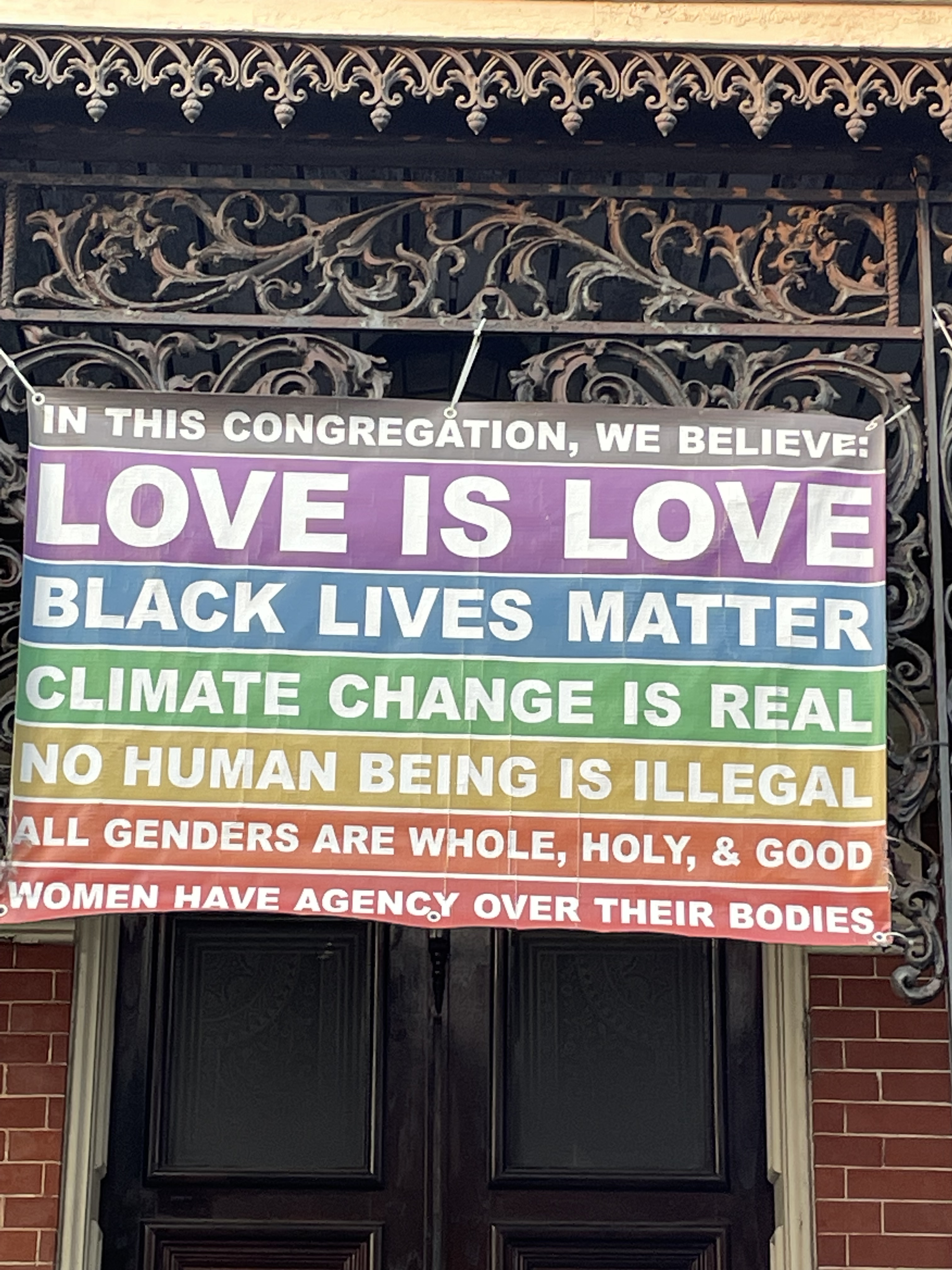
By faith, Don McVey continues to strengthen our mission to be Open and Affirming. Perhaps why our flag that was stolen during the night has already been replaced by Elizabeth, one of our youngest congregants.

By faith, Jean Wood taught us generosity.

By faith, Marilyn Taylor taught us to do big things with humility and authenticity.

By faith, Ann Bishop taught us to do big things and to always dance.

By faith, Penny Cline taught us the miraculous power of hospitality.

And by faith Henry Yates Sadler taught us how to love and how to live.

Therefore, since we are surrounded by so great a cloud of witnesses, let us also lay aside every weight and the sin that clings so closely, and let us run with perseverance the race that is set before us, looking to Jesus the pioneer and perfector of our faith, who for the sake of the joy that was set before him endured the cross, disregarding its shame, and has taken his seat at the right hand of the throne of God.

Trick or Treat or Truth

1 Thessalonians 2:1-8 NRSV

I will never forget the first Halloween I heard about the so-called “Hell Houses” or “Judgment Houses” that churches host during this time of the year. Have you heard of these things? It’s like a Haunted House, but instead of walking through rooms where people jump out and scare you dressed in spooky costumes, you walk through rooms staged to depict scenes of people being tormented for all of eternity for the poor decisions they made while they were living.

The first one I heard about had teenagers in one room who were being punished after they were killed in a car accident after drinking alcohol. Another room featured an atheist or maybe a Taoist or Buddhist. One room featured someone who had completed suicide. Another room had a woman begin tormented for choosing to have an abortion. Another had members of the LGBTQ community. And another room was filled with, I don’t know, I suppose the most popular hell-bound suspects: your fornicators, liberal preachers, democrats.

I first heard of the “Hell House” or “Judgment House” in October of 1999, which just so happened to be a very hellish period in my life. We had just purchased our first home that August. Six weeks later, it was flooded by Hurricane Floyd. Our children, who were 4 and 2 years old at the time and Lori were rescued by a boat, while I stayed behind cramming everything I could into the attic as the house filled up with water. We spent the next 6 months living (“surviving” would be a better word describe it) in a very small, very cramped and very cluttered FEMA camper which was parked our driveway. I had never been more stressed-out in my life.

Of course, upon hearing of a neighboring church hosting a Hell House, I preached a sermon against it. I said something like a colleague, Robert Lowery, recently said, and that is: “If the scariest thing you can come up with to frighten people this Halloween is your own theology, then you might want to rethink your theology.”

And at the conclusion of the sermon, I said something like this: “Now after hearing this sermon, if you still feel inclined to visit a Hell House, please don’t go to that church down the road that is hosting one. Just come on over to my house, and I will gladly let you walk through my Hell camper. And if you really want the fright your life, come next Sunday morning before church, when we are all crammed in there trying to get dressed to make to Sunday School on time!

I believe trying to scare people into joining a church or a religion with bad theology may be part of what Paul meant when he talked about his appeal not “springing from deceit or impure motives or trickery.”

Paul may also be referring to the type of trickery that some churches use to bait and switch and deceive; like churches who say all are welcome, but when some show up, they quickly discover that the grace they first experienced as a treat was only a trick.

Churches say: “come just as you are,” but after you come just as you are, you soon learn you are expected to become just as they are!

Churches host events like the one we are having this afternoon. They entice people in the community with candy, chili and a good time. However, they soon make it clear that if you’re not buying what they’re selling, you’re not truly welcome.

There is a video that went viral a few years ago of a homeless man who walked into to a Chick-fil-a in Tennessee asking if they had any extra food. The manager meets the beggar and says: “I will give you a hot meal, if you will pray with me.” The man agrees. The manager lays his hands on him and prays. And then gives him a sandwich.

Christians loved this video and shared it all over social media. [i]

But it is important to remember that Jesus never said: “Feed the hungry, if they will pray with you,” or “Welcome the stranger, if they will believe like you or learn your language” or “Give drink to the thirsty, if they will dress like you” or “Free the oppressed, if they will make a pledge and contribute to your budget.”

You may be surprised at the number of faith-based social service agencies whose promised assistance comes with some sort of string or trickery attached. “We will give you a hot meal and warm bed, but first, you need to sit and listen to a sermon.” “We will help you if we think that you are helping yourself, and that means believing the way we believe and worshiping the way we worship.”

I knew of one ministry to the homeless that would kick folks out of their program if they failed to turn in four consecutive worship bulletins from an pre-approved “Bible-believing church” they attended on Sunday. One day, I asked the director, “what if they are Muslim, Jewish, or an atheist?” He responded, and I quote: “We only help people who want to better themselves. So, we only help those who want to be Christian.”

The gospel truth is that Jesus said we are to love our neighbors as ourselves—period! No “if’s,” no “buts,” no strings, no tricks, no treats. Just love.  Paul writes we are to love others “as a nurse tenderly cares for her own children.” We are to care for others because they are God’s children who need care, not for any other reason.

In two weeks, we are going to have a Congregational Café to discuss ways we can be the church outside of these four walls, how we can go out into our city and our region to love our neighbors. I believe such discussion is important and necessary, as we must make certain our outreach is not some sneaky, tricky, deceitful church growth tactic. For one of the most disappointing things I’ve heard from church member after we participated in a service or mission project in the community is: “Well, preacher, we didn’t get any new members out of that.” Or “Well preacher, since we have started giving so much in our community, our offerings have not increased.”

This is why you will always hear me insist that we love our neighbors with our ecumenical and interfaith partners. Because, when we love our neighbors, we don’t do it to gain new members or to gain anything for ourselves. Our motive should only be love, just love. It can never be about our church. “Look at us.” “Don’t you want to come join us.” “Don’t you want to give to us.” It always has to be about love, and just love.

Sue Coleman sent me a wonderful quote this week to spark some thoughts for our Congregational Café that underscores this truth. In his book Barking to the Choir: The Power of Radical Kinship, Gregory Boyle asserts:

“There is nothing more essential, vital, and important than love and its carrier – tenderness – practiced in the present moment. By keeping it close, just right now, we are reminded to choose connection over alienation, kinship over self-absorption.”

Boyle sounds a little like the Apostle Paul to me:

“But we were gentle among you, like a nurse tenderly caring for her own children. So deeply do we care for you that we are determined to share with you not only the gospel of God but also our own selves, because you have become very dear to us.”

We love others for the same reason that God loves us, because others are dear to us.

In William Young’s book, The Shack, Papa, conveys the love of God when she says of every human she meets or recollects: “I am very fond of them.” Don’t you love that?

So, this afternoon, when we greet members from our community with chili and candy and a good time, we are not out looking to make some new converts or to get a new pledge to our stewardship campaign. We go out selflessly offering others the gift of our very selves. Why?  Because we are very fond of them, and they are very dear to us. We go out to meet some new friends, friends who may never visit one of our worship services, not even on Christmas Eve or Easter. We go to love the ones we will meet this day honestly, courageously, unconditionally and tenderly. And let’s hope we make a Jewish friend, a Muslim friend, a Buddhist friend, an agnostic or an atheist friend.

So today, although it’s almost Halloween, we are not about “tricks” or “treats.” We are about having the courage to be about “truth.” We are about honesty and integrity and authenticity. We are about sharing the good news of God’s grace and love and sharing ourselves simply because that is what Love calls and compels us to do.

Now, because we are being truthful and because we truly care, let’s always make it clear to those who may be interested in becoming a part of our church, that although they are invited to come “just as they are,” and although they are never expected to become “just as we are,” if they come, we really do hope that they don’t stay “just as they are.”

Let us set the record straight that the reason we are a part of this church, including the pastor, is because we are all hoping to change, to transform into people who love God, love others and love the planet more justly, more honestly and more boldly.

But it’s never our job to judge or change anyone. That’s always God’s job. And we pray God is currently judging and changing all of us. We are praying for a radical repentance that takes away all our prejudices, greed, apathy and selfishness, while filling us with more kindness, more mercy, more grace and more love to share with others.

We pray that if others choose to join our mission, God will bring us together in love, unite us by grace, change us with the truth, and then give us the courage to change the world. Amen.

[i] http://www.fox5atlanta.com/news/most-popular/chick-fil-a-manager-prays-with-homeless-man-gives-him-warm-meal

Living in Amazement


Matthew 22:15-22 NRSV

The religious privileged of Jesus’ day were much like the religious privileged of our day. They believed they had somehow earned their high position at God’s table. They deserved the blessings of God. They were so devout, so pious, so “bible-believing,” they convinced themselves that they had God and the world all figured out and believed they possessed the keys to the Divine. They believed they were God’s gatekeepers and judges.

They looked at the rich, the powerful and the strong with favor. After all, like themselves, they were obviously blessed by God. And they looked down their noses with disdain at the poor, the disenfranchised and the weak. After all, they were obviously cursed by God. A curse they undoubtedly deserved. Probably because of their own sin, or because the sin of their parents. For whatever reason, the least of those in society deserved to be least.

They looked up at those who accepted their biblical worldview with respect. And they looked down upon those who disagreed with their views with contempt.

Because they believed they had somehow earned the right to be the judge, they were more than willing to stone adulterers, crucify heretics, mistreat tax collectors, banish lepers, oppress women, restrain the mentally ill, hinder children, ignore the bullied, even if the poor victim had been robbed, beaten and left for dead on the side of the road.

After all, these who are  least in our society are least for a reason. For whatever reason, it was very evident to them that God had not blessed them. And if God would not bless them, neither would they.

Then from Nazareth, a place from which no one good ever comes, comes this liberal, a radical rabbi named Jesus turning the religious leaders’ worldview upside down by identifying with the least—

         By traveling all over embracing lepers,[i] touching the unclean,[ii] welcoming children,[iii] eating with sinners,[iv] empowering minorities,[v] learning from someone of another faith,[vi] loving the foreigner,[vii] respecting sex workers,[viii] giving dignity to Eunuchs,[ix]defending an adulterer,[x] protecting the rights of women,[xi] bringing peace to the mentally ill,[xii] advocating for the poor,[xiii] feeding the hungry,[xiv] offering drink to the thirsty,[xv]blessing the meek,[xvi] and advocating for prisoners,[xvii] excluding no one, offering his body, his blood, his life to all.

The religious powers-that-be had about all that they could possibly stand.

“He’s destroying the very fabric of society. He’s making a mockery out of our religion. He’s hurting our traditional, conservative family values. He’s what is wrong with our country. And someone needs to put a stop to it.”

So, they plotted and they conspired, and they rallied their people, and sent them to entrap Jesus.

They were sly, and they were sneaky. They said to themselves, “We will soften him up first by showering him with a few compliments. And then we will get him.”

“Teacher, we know that you are sincere, and teach the way of God in accordance with truth, and show deference to no one; for you do not regard people with partiality. You eat with tax collectors, sinners and harlots. You love the good and the bad equally.”

But then, here it comes.

“Tell us, then, what you think. Is it lawful to pay taxes to the emperor, or not?”

But Jesus doesn’t fall for it. Aware of the malice in their hearts, Jesus said:

Why are you putting me to the test, you hypocrites? 19Show me the coin used for the tax.’ And they brought him a denarius. 20Then he said to them, ‘Whose head is this, and whose title?’ 21They answered, ‘The emperor’s.’ Then he said to them, ‘Give therefore to the emperor the things that are the emperor’s, and to God, the things that are God’s.’22When they heard this, they were amazed; and they left him and went away.

The question for us this morning is this: “Why were they so amazed?” What made them walk away astounded?

First, it’s important to understand why Jesus called them “hypocrites” right before he asked them to show him the coin them they used to pay taxes.

The image on the coin was Tiberius Caesar. And the title imprinted on the coin was “son of God,” as the Romans considered Caesar to be divine.

So, the Pharisees would have regarded these Roman coins to be idolatrous. So, simply by producing the coin, they show themselves to be hypocrites, breaking the first of the ten commandments.

Here they were, holier-than-thou judges, judging Jesus, and Jesus drives home the point that he made in his very first sermon: “Why do you seek to judge one with a speck in his eye, when you have a log in your own eye.”

I can imagine the faces of the religious leaders turning red as they realized that this one whom they were sent to entrap has now entrapped them.

But Jesus is not finished with them yet.

With one of the most well-known, yet most misunderstood quotes attributed to him, Jesus responds:

Give to Caesar what belongs to Caesar and give to God what belongs to God.

I like to think that this is the moment when a light bulb came on for these religious leaders. This was the moment when the scales from their eyes fell. You could say “when they became woke”—wide awake to the amazing grace of it all.  For it was like Jesus asking them:

“Give to Zeus what belongs to Zeus and give to God, the creator of all that is, what belongs to God.”

And what would any good Jew say belongs to the Greek god, Zeus?

Nothing, of course. It all belongs to God. All that is, all that they had, all that they were, and all that they would ever have and ever be is but a gift of God’s amazing grace.

Suddenly, it occurred to them: All is gift. Therefore, all is grace. They didn’t do anything to earn the gift of life. Their life was an unearned gift of grace God, the world, and others did not owe them anything. The amazing grace of it all became amazingly clear.

It all belongs to God; thus, God alone is the judge of it all. They were in no position whatsoever to ever judge anyone. They did not own their faith, their synagogue, not even their own lives.

And, if just for a moment, they got it.

“Of course Jesus, that is why you do not show deference to anyone or treat anyone with partiality. We are all the same. We are all gifts of God’s amazing grace, rich and poor, Jew and Palestinian and even Samaritan, all beloved children of God. And recognizing this grace, we now have this holy compulsion to share grace with others, especially with those who need grace the most, especially with those whom society has deemed to be the least, those who have been erroneously taught their entire lives that that God doesn’t just disapprove of them but is actually against them, believes they are abominations.”

Matthew tells us that they walked away from Jesus in amazement. When they awoke to realize that all belongs to God, that all grace, that all is miracle, that all is gift, they left amazed by it, humbled by it, changed by it, and very grateful for it.

I believe there are basically two types of people in this world: the grateful and the ungrateful. I know that it’s not that simple, but I believe there is some truth to it.

I admire anyone who can go on a silent retreat for a few days. You may have heard of the monk who joined a silent monastery. The monks were to be silent 24-7, but at the end of each year the monks were able to go to the abbot and voice just two words. Two words a year. That’s all. At the end of the first year, the monk went to the abbot and said, “Bed hard.” At the end of the second year, the monk went again to the abbot and said, “food bad.” At the end of the third year, the monk said to the abbot, “I quit.”

To which the abbot responded, “I am not surprised. Ever since you’ve been here, all you’ve done is complain.”

Ungrateful people are most often the complainers. Ungrateful people believe that there is always something more owed to them. The world owes them. Others owe them. God owes them. If they have good health and great wealth, a nice home, they somehow earned it. And they have this tendency to judge others who have not achieved what they have achieved, do not believe what they believe, and do not live like they live. Ungrateful people are seldom content. No amount of money, no number of possessions is ever enough. Because of this, they are the least generous people we know.

They are the ones who feel entitled to take and use what is not theirs, whether it be money, land, or even another person. Furthermore, they become bitter when things do not go their way. When bad things happen, they bemoan, “Why me?” because they know they deserve so much better. And because they believe this, they are never surprised or amazed by anything good that comes their way.

On the other hand, grateful people understand that no one, not even God, owes them anything. They understand that they have done absolutely nothing to earn this gift we call life. And they certainly understand that they have not earned the right to marginalize anyone, for all people are God’s children.

Grateful people are content. They are fulfilled. If their cup is half empty, they live like it is running over. When someone asks them: “How are you?” they respond that they are doing better than they deserve. If they only have a few years on this earth, a few friends and a few dollars, that is ok, because that is a few more than they truly earned. Therefore, grateful people the most generous people we know.

Like the ungrateful, they also cry out: “Why me?” But they do so with amazement when the good things come their way. Because they know that none of it is deserved. They walk, live, eat, drink and breathe holy amazement, astounded by the mysterious, amazing grace of it all.

Thus, they have a passion, a sense of call, a divine desire to share grace with others, especially with those in this world who need grace. Because they have received grace freely, they share it freely. Grateful people are the first to forgive the sinner, give drink to the thirsty, share bread with the hungry, care for the sick, visit the lonely, offer friendship to a stranger, stand up for the marginalized and freely give their tithes and offerings to help make this world more just for all people. Grateful people embrace the grace of it all, and in response, grateful people just love. They just love the entire creation, every creature, every life. They live their lives doing justice, loving mercy, and walking humbly.

Matthew says when Jesus pointed out that it all belongs to God, that all is grace, all is gift, they walked away amazed. And this morning, as we begin to think about our financial stewardship as a church, may we do the same.

[i] Luke 17:11-19

[ii] Luke 8:43-48

[iii] Matthew 19:13-15

[iv] Matthew 10:13-17

[v] Luke 10:25-37

[vi] Mark 7:25-30

[vii] Luke 19:34

[viii] Luke 7:36-50

[ix] Matthew 19:12

[x] John 8:1-11

[xi] Matthew 19:3-12,  Luke 10:38-42

[xii] Mark 5:1-17

[xiii] Luke 16:19-31

[xiv] Matthew 14:13-21

[xv] John 4:11

[xvi] Matthew 5:5

[xvii] Matthew 25:36