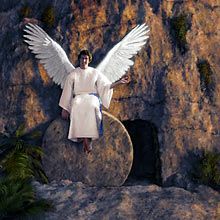
The Seal Broken

stone rolled away

Matthew 27:62-28:10

During our very meaningful Tenebrae service on Friday night, we listened to the voices of Good Friday. “Father, if it is possible, let this cup pass from me; yet not what I want, but what you want.”

“Are you still sleeping and taking your rest? See, the hour is at hand, and the Son of Man is betrayed into the hands of sinners. Get up, let us be going.  See my betrayer is at hand.”

“The one I will kiss is the man; arrest him.”

“Have you come out with swords and clubs to arrest me as though I were a bandit?”

“Then all of the disciples deserted him and fled.”

“He has blasphemed!  Why do we still need witnesses? He deserves death. Then they slapped him and spat in his face.”

“You were also with Jesus, the Galilean.” “I do not know what you are talking about.”

“This man was with Jesus of Nazareth.” “I do not know the man.”

“Certainly you are also one of them, for your accent betrays you.”

“’I do not know the man!’ And the cock crowed.”

“I have sinned by betraying innocent blood.” “Judas then went out and hanged himself.”

“Are you the King of the Jews?”

“Release to us Barabbas.” “Crucify Jesus.” “Let him be crucified.”

“I am innocent of this man’s blood, see to it yourselves.”

“Hail, King of the Jews!”

“You, who would destroy the Temple and build it in three days, save yourself!”  “If you are the Son of God, come down from the cross.” “He saved others, yet cannot save himself.”

“Eli, Eli, lema sa-bach-tha-ni? My God, my God, why have your forsaken me?”

“Command the tomb to be made secure. You have a guard of soldiers; go, make it as secure as you can.” “So they went with the guard and made the tomb secure by sealing the stone.”

These are the voices of Good Friday: voices of betrayal; voices of denial; voices of disappointment; voices of hate; voices of cruelty; voices of finality; voices of no turning back; voices of no moving forward; voices of death. “Make the tomb as secure as you can. Seal the stone.”

And the reality is that you did not have to attend either the service on Thursday or Friday to hear these voices. For we live in a Good Friday World, don’t we?

We’ve heard these voices just this week.

Yesterday from Utah: “A woman heading to her mother’s funeral has died in a car crash.”

From Iraq on Friday: “A suicide attacker detonated an explosive belt in a park outside Baghdad on Friday, killing 41 people and wounding over 50 more.”

From Oklahoma City on Thursday: “The state medical examiner’s office said bones recovered from near Lake Stanley Draper are human.

Oklahoma City police Master Sgt. Gary Knight said police received a call Monday that bones, clothing and personal effects had been discovered near the lake.”

From North Carolina on Wednesday: “In a bill that zoomed through with head-spinning speed, lawmakers blocked cities and counties from protecting people from discrimination.”

From Brussels on Tuesday: “Two suicide bombers blew themselves up in Brussels airport, killing 11 people, and a third man detonated a suicide bomb one hour later in an underground train in central Brussels, killing 20 more.”

From Indiana on Monday: “Indiana Sheriff’s deputy shot dead. Partner seriously injured after serving search warrant.”

And from Enid this week: “I can’t believe she talks about me behind my back.”

“Why does he have to be so hateful?”

“I don’t even know who you are anymore.”

“Why won’t my children come and visit me?”

“My wife is having part of her foot removed next week. We are just waiting for the doctor to call with the exact day and time.”

“Since my back surgery, I am still dealing with a lot of pain.”

“She needs a root canal. He needs braces.”

“I owe thousands in taxes this year. And I don’t know where the money is going to come from. I am already working more hours now than by body and mind can stand.”

“I’m never going to be able to forgive myself. “I have never been so embarrassed in my whole life.” “I simply can’t continue going on like this.”

“My mother really doesn’t like the nursing home. She believes we are all plotting against her. I think my father may have Alzheimer’s.”

“Her baby was born three months premature. My sister has been having chest pains. My brother’s arthritis is about to get the best of him. The doctor said my tumor is malignant and inoperable. I still can’t believe that my wife is gone. I have never felt so alone and so depressed. At times, I just want to go to sleep and never wake up.”

These are the voices of Good Friday, and they echo throughout our world without ceasing, sometimes overwhelming us. Every time we turn around there is something else in our Good Friday world to worry about. There is no escape. It is like being entombed in sepulcher for all of eternity by a large stone that has been sealed shut by soldiers.

So, now let us hear another voice. It is a voice called Easter. It is a voice called resurrection, a voice called hope.

“As the first day of the week was dawning. . .”  (Sounds hopeful already, doesn’t it?) As a new day, a new week was dawning, was beginning anew, fresh, bright, giving a chance to the promise of hope, “Mary Magdalene and the other Mary went to see the tomb. And suddenly there was a great earthquake; for an angel of the Lord, descending from heaven, came and rolled back the stone and sat one it.”

In our Good Friday world, oh how we need to hear this voice of Easter— this voice that says that our God who gave God’s all for us on the cross is so awesome, so good, so great, so much bigger than all of the cruelty and evil of the world, that God does not have to lift one finger, but sends an angel to break the seal that entombs all of us who are shrouded by the evil of our Good Friday world.

The Good Friday world says: “Seal it up.” Then our Easter God, without flinching a muscle, sends one meek angel to break the seal—an angel who then sits upon the stone and says the most hopeful words found in the entire Bible: “Do not be afraid; I know you are looking for Jesus, who was crucified. He is not here; for he has been raised, as he said.”

The world says seal it up. The world says things are not going to get any better. The world says the good old days are long gone. The world says that evil will get the best of us. The world says that God is either a fairy tale, is powerless, or has taken some cosmic vacation. The world says death is final.

Then God without lifting a finger breaks the seal and says: “I am always working all things together for the good. Through the breaking of the seal, God says to us that the best days of our lives are always yet to come. Gods says, although we cannot go back to the good old days, good new days are dawning. God says that nothing in this world is final, not even death. God says I can, and I will transform all of your despair into hope, all of your defeats into victory, all of your pain into joy, and even all of your deaths into life.”

The world says: “seal it up; you will never amount to anything. You’re a loser. You are insignificant. You are worthless. You are not a good person. Nobody really cares about you. You are pitiful. No matter how hard you try, sin always has a way of getting the best of you.  Perhaps you’d be better off dead. Seal it up.”

God breaks the seal and says: “I love you and suffered for you and died for you and raised Jesus to life for you, just as you are. There is nothing you could possible do to earn my love. I will always be with you and never away from you. I will always be for you and never against you. I will always stay by your side fighting for you, doing all that I can to wring whatever good can be wrung out of all of your misery.” God says “I will give you an Easter Faith to live victoriously in your Good Friday world.”

“Through eyes and ears of Easter faith you will see my resurrecting presence all around and hear my voice everywhere. You will be able to see it in flowers and in the trees. You will read it in a card sent to you by a friend. You will experience through the smile of a child.”

You can know it through the devotion of a Sunday School teacher. You can experience it through the woman who serves meals in the soup kitchen the needy. You can experience it with the church group who visits the nursing home; see it in the one who volunteers at the hospital; through the family who gives sacrificially and faithfully to the church, through missionaries who have given their lives to serve in third world countries, through encouraging words, handshakes, hugs, through a meal prepared; a lawn mowed, a house painted, a petition signed.

You can hear it through the confessions of faith from two young men being baptized.

God says you can hear it and see it and sense it and know it through people who by my grace are living an Easter Faith in a Good Friday world. You can see it when and wherever justice finally prevails and love ultimately wins.

During this coming week, you will not have to pay close attention to continue to hear the voices of Good Friday. You will quite possibly hear them even before this Easter Sunday ends. My hope and prayer is that as people living an Easter faith, we will continue to raise our Easter voices: voices of hope; voices of justice; voices of equality; voices of peace and love; voices of life; voices of a new day dawning; voices of a tomb whose seal has been broken on this day and forevermore.


The First Easter Word

peace John 20:1-10, 19-21 NRSV

It is 34 degrees. Feels like 24. And it is snowing! What in the world are you doing here this morning? Why are you here so early? Do you have any idea what time it is? What is it that compelled you to set your alarm clocks before 6am, so you could get up, get dressed and drive to this place this morning?

What are you looking for here this morning? What are you hoping to find? What are you expecting to see? What do you want to hear? What is it that you need, early on this rather cool Easter Sunday morning?

Well, preacher, isn’t it obvious? We have been living in some difficult days, to say the least! We know it has only been a short time, but it seems like forever since we felt like waving palm branches, dancing in the streets, and shouting, “Hosanna, blessed is he who comes in the name of the Lord!”

So much has happened to us since we last felt like dancing, since we felt like celebrating anything.  We’ve endured so much, suffered so much, lost so much.

And as grief, anguish and despair consumes us these days, so does the guilt. We have made so many mistakes in life. We have disappointed so many people. We look in the mirror each morning and a betrayer and a denier looks back at us.

And not only have we disappointed many, so many have also disappointed us. We have deeply hurt by those claiming to be religious. We have been terribly wounded by those claiming to be friends, and we have been painfully rejected by those claiming to be family.

We feel forsaken: forsaken by others and even, at times, forsaken by God. And because of that, we are anxious, agitated and afraid.

So, preacher, you know what we want. You know why we are here. We are here to hear that first Easter Word.

We are here to listen to the Risen Christ as he returns to his disciples from the grave, to the very ones who betrayed, denied and abandoned him, to the very ones who had been devastated by the religious establishment, to the very ones who were so anxious, agitated and afraid that they were cowering together in an upper room behind locked doors.

We are here early this morning to hear Jesus pronounce that first Easter word, that word that we long to hear these days more than any other word: “PEACE!” “Peace be with you!”

That is why we are here! To hear that first Easter word from our Savior and Lord—the same word that was proclaimed at his birth by the angels:  “Glory to the God in the highest and on earth, peace!” –and the last word that came from the cross: “Father, forgive them, for they know not what they do.”

We deniers and betrayers, we who suffer and grieve, we who are so very anxious, set our clocks early this morning so we could hear God say to us once again: “PEACE.”

Peace I leave with you; my peace I give to you. I do not give to you as the world gives. Do not let your hearts be troubled, and do not let them be afraid. My love for you has no end. My love for you never fails. My love does not keep an account of wrongdoing saying I love the sinner but hate the sin. It is without reservations, without conditions. My love offers a grace that is greater than all sin and a peace that surpasses understanding. Peace be with you, for you are my sons. You are my daughters. I have always loved you. I still love you. And I will love you forever. I will forgive you always.

I am making all things new. Fear not, for I am working all things together for the good. I am the resurrection and the life, and because I live you will also live. Peace be with you.

“PEACE.”  This is why you are here. This is why we are all here this morning. We have gotten up early, and we have come to church to hear that first Easter word, a word that we desperately need to hear.

And, just as we need to hear it, so do all of those, who for whatever reason, are not here this morning. It is the word that every human living in this fragmented world needs to hear from the church, and it always needs to be the very first word that they hear from church.

For as soon as Jesus pronounces that word, he says, “As the Father as sent me, so I send you.” We have been commissioned by none other than the risen Christ to share this word with others.

However, sadly, even after nearly 2000 Easters, churches all over this world have ignored this commissioning. And tragically, the very first words that many hear from the church are words that denote the exact opposite of peace.

The first words they hear from many in the church are words of judgment and condemnation. They hear loud, angry, hate-filled rants and protests. They hear words judging them as not only sinners, but as “abominations.” In the name of God, they are condemned by those who justify their hate with the same type of Christ-less scriptural interpretation that was used to support sexism, slavery and racial discrimination.

They may hear reserved words of welcome to come in and sit on a pew, but they clearly get the message right away that they are not to expect to truly become a part of the church. They are not to expect to be able to use their gifts to serve with and alongside those who have been deemed worthy for service.

The sad truth is that there are many people in this world, people in our town who are anxious, agitated and afraid. Just like us, they oftentimes feel God-forsaken. It has been forever since they have felt like dancing in the streets and waving palm branches. They have been deeply hurt by people claiming to be religious, terribly wounded by those claiming to be friends, and painfully rejected by those claiming to be family. Just like us, they look in the mirror and see only guilt and shame.

And just like us, they are yearning for the same word for which we all yearn, that very first word of Easter: PEACE.

They hunger and thirst for the same peace that caused us to set our clocks way too early this morning. And they hunger and thirst for a community of people in our world who have the audacity to truly live as followers of Christ who take the commission of their Risen Christ seriously to share this peace with all people. They are thirsting for a church that seeks to be, not an institution or club of moral and devout people with right religion, right beliefs, right color and right lifestyles, but a church that seeks to be the living embodiment of Christ in this world, serving, loving, accepting and embracing the poor, the lost, the broken, the fearful, the grieving, those riddled with guilt and shame, and those whom society has rejected as outcasts, offering them the unlimited hope, unfettered grace and unreserved love that is in that first beautiful first Easter word, PEACE.

So, let me ask you again. What in the world are you doing here this morning? Why are you here?  I hope you have come to hear the first Easter word. And I hope you have heard it: PEACE. Your sins are forgiven. You are loved. You are accepted. You are enveloped with an amazing grace.

But I also hope you are here to receive this word so you can take it from this place to share it with all people, especially with those in our world who need it the most.

And now, may the PEACE of our risen Lord, Jesus Christ be with us all, now and forevermore.

The King We Need

rolling stones

Luke 19:28-40 NRSV

Our Palm Sunday gospel lesson is a rather strange text. As Jesus instructed them to do so, the disciples borrowed a donkey, brought it to Jesus, threw their cloaks on it and set Jesus on top. “As he rode along, people kept spreading their cloaks on the road. As he was approaching the path down from the Mount of Olives, the whole multitude of the disciples began to praise God joyfully with a loud voice, for all the deeds of power that they had seen, saying, “Blessed is the king who comes in the name of the Lord! Peace in Heaven, and glory in the highest heaven!”

Did you hear something strange there? For when have you ever heard the disciples of Jesus referred to as “the whole multitude of the disciples.” There were only twelve. But Luke describes them as “the whole multitude of the disciples.”

Let’s see, has there been any other time in Luke’s gospel when we have heard such language? Reminds us of another multitude, doesn’t it? The whole “multitude of the heavenly host” at the birth of Jesus, praising God and saying, “Glory to God in the highest heaven, and on earth peace among those whom he favors!” That sounds much like the chant of the disciples this morning, doesn’t it? I believe Luke wants to make the point that this processional of Jesus into Jerussalem is as important as the first processional of Jesus into the world. For Luke, Palm Sunday is as significant as Christmas.


And this is certainly not the only strange thing in this text. But by this point in Luke’s story, should we really be that surprised?  For throughout Luke something is always out of place, out of kilter, out of whack. If we remember the stories Luke has told us thus far, we would remember that the perfect neighbor is a despised Samaritan; the selfish prodigal is welcomed home with an extravagant party; the greedy publican goes home from the Temple justified; a woman who lets down her hair at the dinner table is praised; the first is last and the last is first; to save one’s life, one must lose one’s life; and now the king, and not just any king, the king of kings, the one whose birth was heralded by “a  multitude of heavenly hosts,” a theme now picked up by a multitude of disciples, enters the city riding on a donkey, and not just any donkey, a borrowed donkey.

If Jesus is a King, he is certainly unlike any king the world had ever seen: A king of poor shepherds; A king of simple fishermen; A king of dishonest tax collectors; A king of despised Samaritans; A king of harlots; A king of lepers, demoniacs, cripples, and outcasts. New Testament professor Alan Culpepper writes: “Those who followed this king were a rag tag bunch, pathetically unfit for the grand hopes that danced in their imaginations.”


And the cloaks thrown on the road that day were not expensive garments but tattered shawls and dusty, sweat-stained rags. Jesus was certainly no ordinary king, but a rather strange one.

The King we may want is not the king we get. But the good news is, this is the King we truly need. It is the King this broken world needs. It is the only king that can save this world. It is the only King that can give us life, true life, abundant and eternal.

Reminds me of the words of those great theologians of our time who once sang: “We can’t always get what we want, but we we try sometimes, we might just find, we get what we need.”

Jesus is the King. But as he will tell Pilate later this week, Jesus is a different kind of King, for his kingdom “is not from this world.” He adds: “If my kingdom was from this world, my followers would be fighting to keep me from being handed over to the Jews. But as it is, my kingdom is not from here.”

And, if we are honest, this makes those of us living in this world very uncomfortable. But that is Jesus. He comforts the afflicted of this world and afflicts the comfortable of this world. And whether we like to admit it or not, the truth is, we have grown rather fond of the kings and kingdoms of this world. And we sometimes have difficulty accepting anything different.

We prefer the kingdoms in this world that “would be fighting” to keep Jesus “from being handed over to the Jews.”

We prefer “an eye for an eye and a tooth for a tooth.”

We prefer “It’s not our job to judge the terrorists. It’s our mission to arrange the meeting.”

We prefer “the statue of Liberty…shaking her fist.”

The truth is that we prefer answering violence with more violence. We believe combating hate with more hate. We believe fighting for what we believe, even for Jesus.

We believe in coercing our convictions, imposing our opinions, forcing our beliefs, and we don’t care who it offends or even destroys in the process.

We prefer a kingdom where we say it loudly and proudly that “we eat meat; we carry guns; we say Merry Christmas and Happy Easter; we speak English and if you don’t like it, get the heck out!”

We prefer a kingdom where we do unto others as they do unto us.

We prefer a kingdom where we love only those we believe deserve our love.

We prefer a kingdom where we help only those who are willing to help themselves.

We prefer a kingdom where people put the needs of their own before the needs of a foreigner.

We prefer a kingdom where we care ourselves, while our neighbors fend for themselves.

Jesus implies to Pilate that there are two types of kings. There are the kings of this world, and then there is the king from another world. And then Jesus asks Pilate and Jesus asks you and me: Who is your king? Who do you say that I am? Am I your King? Is your king from another world or is your king from this world?

One king offers protection;

One king promises persecution, saying if you follow him, people will rise up and utter all kinds of evil against you.

One king endorses greed and validates prosperity;

One king fosters sacrifice and promotes giving it all away.

One king caters to the powerful, the wealthy and the elite;

One king blesses the weak, the poor and the marginalized.

One king accepts only people of like-mind, like-dress, like-language, and like-faith;

One king accepts all people.

One king is restrictive with forgiveness;

One king is generous with it.

One king controls by fear;

One king reigns with love.

One king leads by threat of punishment;

One king rules with the promise of grace.

One king governs by imposing;

One king leads with service.

One king throws rocks at sinners;

One king defends those caught in the very act of sinning.

One king devours the home of the widow;

One king offers her a new home.

One king turns away the refugee;

One king welcomes the refugee, for he, himself, was a refugee.

One king destroys his enemies with an iron fist;

One king dies for his enemies with outstretched arms.

For one king’s throne is made with silver and gold;

One king’s throne is made with wood and nails.

One king wears a crown of rubies and diamonds;

One king wears a crown of thorns.


So, of course, the powers that be, the kings of this world, will arrest this king “whose kingdom is not from this world.” Of course, they will torture this king, spit on this king, mock this king, and crucify this king—this king from a foreign realm. Of course, they will try to bury this king and seal this king’s tomb up with a stone.

But hate will not defeat this king. Bigotry will not stop this king. Religion and patriotism will not overthrow this king. This king will rise again. But not in the way the kings of this world rise. Despite the desires of his followers or the lyrics of their songs, there will be no thunder in his footsteps or lightening in his fists. There will be no plagues, fire, brimstone, or flood. There will no shock and awe or violence or riots in the streets of any kind.

For this king understands what, sadly, few since have understood, and that is:

“The ultimate weakness of violence is that it is a descending spiral, begetting the very thing it seeks to destroy. Instead of diminishing evil, it multiplies it. Through violence you may murder the liar, but you cannot murder the lie, nor establish the truth. Through violence you may murder the hater, but you do not murder the hate. In fact, violence merely increases hate. So it goes. Returning violence for violence multiplies violence, adding deeper darkness to a night already devoid of stars. Darkness cannot drive out darkness: only light can do that. Hate cannot drive out hate: only love can do that,” said the Reverend Doctor Martin Luther King Jr.

Consequently, this king will arise from the darkness of the grave, powerfully, yet unobtrusively; mightily, yet unassumingly; leaving room to recognize him or not to recognize him, leaving room to believe or to doubt, to reject him or to follow him. This king will drive out the darkness, not with more darkness, but with light. This king will drive out the hate, not with more hate, but with love.

So, how do we live in these hate-filled days of hostility, violence and riots in the streets?

Well, that all depends on who your king is.

The arrest this week of a terrorist responsible for the attacks in Paris reminded me of Antoine Leiris, who lost his wife in those attacks, who proclaimed to the world which king he chooses to serve. He shared it in beautiful tribute to his wife on Facebook, in the days after the attack, promising to not let his 17-month-old son grow up in fear of ISIS.

“You took away the life of an exceptional human being, the love of my life, the mother of my son, but you will not have my hatred…

I do not know who you are, and I do not wish to…

If this God for whom you kill so blindly has made us in His image, every bullet in the body of my wife will have been a wound in His heart…

So I will not give you the privilege of hating you. You certainly sought it, but replying to hatred with anger would be giving in to the same ignorance which made you into what you are. You want me to be frightened, that I should look into the eyes of my fellow citizens with distrust, that I sacrifice my freedom for security. You lost. I will carry on as before.”

No, it may not be what we want, but if we open our hearts and try, it is truly what we need. It is what our world needs. So let heaven and nature sing! May the whole multitude of God’s people prepare him room shouting with our words and deeds: ‘Blessed is the king who comes in the name of the Lord! Glory in the highest heaven and on earth peace!”

Spring Is in the Air

lilies

“As he was now approaching the path down from the Mount of Olives, the whole multitude of the disciples began to praise God joyfully with a loud voice for all the deeds of power that they had seen, saying,
‘Blessed is the king who comes in the name of the Lord!
Peace in heaven, and glory in the highest heaven!’

Some of the Pharisees in the crowd said to him, ‘Teacher, order your disciples to stop.’ He answered, ‘I tell you, if these were silent, the stones would shout out’”(Luke 19:37-40).

This year, I believe what makes Holy Week special in Oklahoma is the way it corresponds with the unmistakable arrival of spring. The freezing temperatures of this Palm Sunday weekend appear to be the last gasp of winter. It is as if the entire creation is joyfully crying out with a loud voice: “Blessed is the king who comes in the name of the Lord!”

Trees budding; thunder booming; flowers blooming; grass greening; lilies rising; birds singing; sun shining—our world seems to be proclaiming that death has finally been transformed into life! It is Holy Week, and spring and hope and good news is literally in the air.

As disciples of the Lord, our mission is to share this good news with all people. And if we do not do it, Jesus says that the earth itself will shout out! May the arrival of spring remind us each day of this mission.

When we see new leaves in the trees dancing in warm breezes with new life, may we be reminded to hug those experiencing grief and loss.

When we hear the thunder, may we be reminded to comfort those who are afraid.

When we see flowers opening their blossoms toward the sun, may we be reminded to offer a smile and a kind word to those who are discouraged.

When we walk on green grass, may we be reminded to welcome those who feel lost and marginalized.

When we see lilies rise from the earth, may we be reminded to stand tall for justice on the behalf of the victims of narrow-minded bigotry.

When we hear the birds singing harmoniously together, may we be reminded to worship together in community.

And when we feel the warmth of the sun on our faces, may we be reminded to always let the light of love shine brightly for all people.

Left-Handed Power

okalhoma sunset

I recently had a conversation with someone who firmly believed God uses God’s power to cause tragedies in life in order to accomplish some divine purpose. The God who rules with “thunder in his footsteps” and “lightening in his fist” as the song goes, will rain down cancer, heart disease, automobile accidents, hurricanes and earthquake to accomplish the divine purpose.

For me, this represents a gross misunderstanding of the power of God. Although the Bible insists over and over that our ways are not God’s ways, we insist on equating God’s power with our concept of worldly power.

One day, a father was driving down a road with his little boy admiring a beautiful sunset. The father said to son, “And to think, God created all of this just for us to enjoy.”  The little boy responded, “And to think, God did it all with God’s left hand.”

“What do you mean, son? Where did you hear that?”

“Well, God had to use God’s left hand, because my Sunday School teacher told me that in heaven Jesus was sitting on God’s right hand.”

As they say, “out of the mouth of babes.”

The truth is, we have allowed the world to define power for us instead of allowing the Jesus we remember in this season of Lent to define such power.

To the world, power means controlling. Power means dominating.  Power means taking. Power means ruling.  Power means imposing.

However, the power of God as revealed through Jesus Christ is the exact opposite. God has what the late theologian Arthur McGill called a “peculiar” kind of power.  You could call it a “left-handed power.” It is a power of self-expending, self-giving love.

God’s power is not power that takes, but a power that gives.

God’s power is not a power that rules, but a power that serves.

Not a power that imposes, but a power that loves.

Not a power that dominates, but a power that dies.

And as McGill has written, this is the reason that it is “no accident that Jesus undertakes his mission to the poor and to the weak and not to the strong, to the dying and not to those full of life. For with these vessels of need God most decisively vindicates his peculiar kind of power, his power of service whereby the poor are fed, the sinful are forgiven, the weak are strengthened, and the dying are made alive.”

Bear Fruit or Die

rose of sharon

Luke 13:1-9 NRSV

One of the great things about living in southern Louisiana were the countless stories I heard about two infamous Cajuns named Boudreaux and Thibodeaux.

Reverend Boudreaux was the part-time pastor of the Boondock Bible Church and Pastor Thibodeaux was the minister of the Backwoods Gospel Church located directly across the road. One day, they were both standing out by the road in front of their churches, each pounding a sign into the ground as fast as they could. The sign read:

Da End is Near
Turn Yo Sef ‘Roun Now
Afore It Be Too Late!

As soon as the signs got into the ground, a car passed by. Without slowing down, the driver leaned out his window and yelled as loud as he could: “You bunch of religious nuts!”

Then, from the curve in the road they heard tires screeching and a big splash.

The Reverend Boudreaux yells at Pastor Thibodeaux across the road and asks:

“Do ya tink maybe da sign should jus say ‘Bridge Out’?”

Now, because I am a seminary-educated minister that has spent the bulk of my ministry preaching from mainline, downtown pulpits, I have always sought to differentiate myself from the so-called religious nuts. The repent-or-be-sent, turn-or-burn, reach-for-the-sky-or-fry, get-saved-or-get-microwaved style of preaching has never been a part of my repertoire.

Thus, when I preach a passage of scripture like our gospel lesson this morning, I have steered away from any interpretation that sounds like what Jesus is actually saying here is: “The end is near! Ya betta turn yo sef ‘roun now! A fore it be too late!”

For example, I have used this passage as an opportunity to have a deep, theological discussion on the problem of evil. I have said that here, in this passage, we have two basic types of evil in the world. There is natural evil, and there is personal evil.

The tower of Siloam, I have said, represents natural evil. In this fragmented world, sometimes tornadoes and straight-line winds destroy property and take lives.

And the Galileans massacred by Pilate, represent personal evil. In this broken world, sometimes a broken person will grab a gun, fire shots out their car window while driving down the road, then walk into a place where he once worked and begin shooting anyone in sight.

And with Jesus’ very emphatic response, “No, I tell you!” Jesus is saying that God does not will such tragedy because of human sinfulness or any other reason. In this imperfect world, sometimes bad things happen to very good people, and there is no divine explanation or driving purpose for it.

However, maybe, to avoid sounding like a religious nut, I have actually missed the very simple point of this passage which is, “The end is near. Ya betta turn yo sef ‘roun now! A fore it be too late!”

Maybe the point that Jesus is really trying trying to make here is: “Unless you repent, you will perish.”

You have a little more time, but unless you start producing some figs, start bearing some fruit, at least start sprouting a bloom or two, you are going to die.

“But, Dr. Banks, that sounds too much like the hell, fire and brimstone sermons of those backwoods churches in the boondocks, far from the lights of downtown, and you know that we moderate, educated clergy in our mainline, sophisticated pulpits are way too smart for that.”

However, I have a feeling that through this passage Jesus is arguing that we may be too smart for our own good!

People had gathered together, and they started doing what people do best when they gather together, even in the church. They began to gossip, especially about the sinfulness of others, the sinfulness of “those” people. “Those” people who had this tower tragically collapse on top of them.

Sadly, I believe this may be the only reason some people go to church these days: to hear about the sins of all those who are not in church. It makes them feel good, religious, superior, righteous.

And Jesus is emphatic, “No, I tell you!”

It is as if he is saying: “You better stop judging your neighbors and start taking a look at yourselves. Stop worrying about the speck in your neighbor’s eye and worry more about the log in your own eye. Look, bad things happen this world. People die. It’s not a matter of degrees of rightness or wrongness, sin or sainthood. Everyone dies. And one day, you are going to die. So, you better repent. You better change. Ya better turn yo sef roun now. A fore it be too late!”

And to drive the point home, Jesus tells the story about a fruitless fig tree. And the moral of the story is simple. Bear fruit or die.

Reverend Sharron Blezard believes this text is begging the church today to ask: “What are we doing to bear fruit, to bloom where we’ve been planted?”

She says, that far too many congregations are merely existing like a barren fig tree, wasting the soil. There are no signs of any fruits, no promise of any blooms. These churches exist primarily to get together, and sadly to do what people do best: to gossip, to talk about the sinfulness of those outside the church, to lament about the moral decay of society, and to pine for the return of good old days.

And they’ve lost hope. They’ve grown too weary, too worn down, too disheartened to invest the energy, creativity, and passion to share the Good News of Jesus with a broken and hurting world. While many congregations do provide a place to take care of one another, they have no sense of mission to be the Body of Christ that is sent by God into the world bearing fruit.

She says, think of it this way: fruit always “grows outward from the plant into the light. So, too, a healthy church grows outward.”

Several years ago, my mother gave me a Rose of Sharon root. She told me to plant it, and it would grow to be one of the most beautiful plants in my yard, with its flowers blooming all summer long.

Well, although the plant grew, it did not produce a single bloom that summer. I called Mama and said, “I think you must have given me a dud.”

She said, “Oh no. It’s not a dud. It just needs a little TLC. You may need to dig around it, give it a little fertilizer. You may even need to dig it up all together and plant it in better soil. Make sure it is in soil that can soak up water and is growing in a place where it can get good light.

As always, I did what Mama told me to to do. I ended up transplanting it to a spot that had better topsoil. I kept an eye on it, watered it, cared for it, and the next year, just like mama said, it produced the most beautiful blooms all summer long.

From the short time that I have known you, it is obvious that God has given this church many good gifts. The talents and resources that are here are astounding. There is not one dud in this room. And because of that, God expects us to be fruitful with those gifts. God expects our church to bloom.

I believe Jesus is asking us to take a lesson from a barren fig tree. To bloom and bear beautiful fruit will require some work, some sacrifice. We may need to dig around, put out some fertilizer, even transplant a thing or two. It may take some cutting back, pruning, shaping and nurturing.

Yes, it is scary. It is difficult. It is risky. But, Jesus says that it is the only way to life, the only way to bear fruit that nourishes the world.

Eddie Hammett, my friend and church consultant, loves to say that Christians need to stop going to church, and start being the church.

I believe he is talking about the difference between a church that is inward focused, therefore barren, and one that is outward focused, therefore bearing fruit for the world.

Hammett says:

Going to church is routine and easy. Being church in the world is challenging, difficult and calls for prayerful intentionality. Going to church keeps us safe…. Being the church makes us uncomfortable and challenges us to learn to BE salt, light and leaven. Going to church is familiar….Being the people of God as church is unfamiliar to many and overwhelming to most. May we press on in the faith…

And as much as I may want to avoid sounding like a back woods religious nut in the boondocks and speak only articulate, sophisticated words that make us comfortable from this mainline, downtown pulpit, maybe what we really need to hear is that the time is coming, the day is approaching, as it was for that barren fig tree, there’s going to be a reckoning.

What we really need to hear is that we must bear fruit or die. What we really need to hear is: “The end is near, so ya betta turn yo sef ‘roun now! A fore it be too late!”

May we use the gifts God has given us to press on in the faith, step up and out in our discipleship, do the hard work of getting out the fertilizer and the shovel, doing some digging, getting our hands dirty to produce some figs.

May we quit worrying about empty pews and why more people are not in church these days and begin worrying about what we are doing to be good stewards of the the gifts we have been given.

In the words of Blezard: “For there’s a big world out there, a world that is thirsting and hungering for the love of God. May we go out and bloom, bearing fruit in the image of Christ” (paraphrase).

God Fights for Us – Remembering Jane Puckett

3597981

I believe this ground, this sacred place where tears have cried a river, is reminiscent of that place the Israelites found themselves in after they were liberated from Egyptian bondage.

With Pharaoh’s army advancing behind them, it was as if their whole world was suddenly crashing down upon them. Because standing before them stood what they perhaps feared the most, the Red Sea. It stood before them like the casket of a loved one for it most certainly represented the end of the line, the end of dreams, the end of hopes. For the Israelites, encamped by the sea with an army closing in behind them, the sea represented certain death.

Overcome by fear, the Israelites did not know what to do. They could not go back to the good old days, and going forward into the promise of good new days seemed impossible. Paralyzed by grief, unable to take one step forward, they did the only thing they could do. They cried out. They cried out to the Lord. They cried out to Moses. They cried out to anyone who would hear. They cried out in disbelief. They cried out in anger. They cried out in fear. They cried out in grief.

But then, the good news. Moses said to the people: “Do not be afraid, stand firm, and see the deliverance that the Lord will accomplish for you today; for the Egyptians whom you see today, you shall never see again. The Lord will fight for you, and you have only to keep still.” (Exodus 14: 13-14).

And we know the rest of the story: The Red Sea was not the end of the line. It was not the end of their dreams. It was not the end of their hopes.

“Then Moses stretched out his hand over the sea. The Lord drove the sea back by a strong east wind all night, and turned the sea into dry land; and the waters were divided.”

Then the same Israelites who were unable to move forward, unable to see beyond the sea, or the casket in front of them, rose up and walked into the sea of their fear as if it were dry ground. They rose up and moved forward into the future with a renewed confidence and a resurrected strength. And this is how they were able to make it to yet unimaginable promised land.

Gary, Josh, Heidi, Amy and Mike, although you cannot go back to the good old days, this is how you and your family will be able to move forward this day into unimaginable good new days. The good news is that the Lord will fight for you. And the really good news is that you only have to stand firm and keep still.

There is no other way that I can possibly explain the industrious strength and the unfailing patience of Jane Puckett. There is no other explanation for her tenacious work ethic, serving her country working for Vance Air Force Base with aircraft maintenance for 42 years. She only recently retired because her unbeknownst cancer made her work physically impossible.

And how else do you account for her courageous battle she fought once she discovered her stage-four cancer that started in her lungs but had metastasized into her brain? How do you explain someone who was as sick Jane, but never complained?

And if anyone had any reason to complain it was her. To work as hard as she did for 42 long years without the opportunity to enjoy a well-earned retirement would make even the sweetest personality bitter. The truth is: a diagnosis like Jane changes most people.

But not Jane. Jane remained firm. She was still the sweet, fun-loving person that she had always been.

The one who loved to go snow skiing in Colorado and water skiing in Canton Lake.

The one who loved to patiently cross stitch gifts for her family and friends.

The one who loved to make baby blankets that were so beautiful that the mothers who received them would hang them on the wall for all to see instead of wrapping them around their babies.

The one who never said anything negative about anyone else.

The one with terminal cancer who had every right to be jealous of those who arbitrarily live into their seventies, eighties and nineties, but still refused to join in any conversation that demeaned another.

The one refused to be bitter and impatient with anyone, including herself and God.

She was still the same firm and patient one who not only tried to make caramel once, only to have it explode sending its sticky shrapnel flying all over her kitchen, but she was the one who had the audacious forbearance to try it again, albeit with the same result.

Even with a terminal disease, she was still the same person who loved to sit on the back porch with Gary and her beloved pet Weazer enjoying a cold drink on a summer evening, thanking God for the gift of her life.

Now, some may say that her kids should probably take some credit for some of her patience and strength, for they were both known to test it a time or two or thirty. Like the time one winter Josh decided to go skiing in the back yard. However, the flat plains of Oklahoma have never been very conducive to backyard snow skiing. But Josh, being a crafty and smart kid, some would argue “perhaps a little too smart for his own good,” decided he would ski off the roof of the house.

Sitting inside, Amy was watching the snow fall out the window, when here comes Josh flying off the roof like some Nordic Olympic ski jumper. “Mama, Josh just skied off the roof!”

Amy also remembers trying her mama’s patience by doing foolish things like walking through a glass door, without first opening that door, requiring a multitude of stitches.

However, as much as these kids tried her patience and tested her strength, I still believe that her strength, her courage, and her patience, especially in the face of her illness, came from a much higher place. I believe it came from the God who continually whispered words to her throughout her living and perhaps especially in her dying. It was the same words whispered to Moses and to the Israelites when they were tested in the wilderness: “The Lord will fight for you, and all you have to do is be still.”

The good news is that her fight is now over. Jane has crossed the sea. Her enemy, her cancer, has been defeated like Pharaoh’s army. She has been led by a pillar of fire and cloud, led by the very hand of God, into a promised land.

And the good news is that as the Lord fought for her, the Lord will fight for you too, and all you have to do is be still. Be still, and then move forward, holding onto one another, holding onto the memory of Jane’s courage and strength, while holding onto the hand of God.

I want to close by reading some words that I read at my grandmother’s graveside service. She also died in her sixties with lung cancer that also had metastasized. However, because of her courage and strength, because she, like Jane, never complained, never had a bitter bone in her body, never uttered a word of malice against anyone, there was no doubt in my mind that before she died, God was there fighting with her and for her. And I knew that everything was going to be alright.  The following are those words (author unknown):

Although Cancer seems to destroy so much, when God is fighting for us, it is obvious that there are many things that cancer cannot do. Cancer, in fact, is very limited in the presence of God. [Like my grandmother, Jane Puckett was a testimony of this].

Cancer is limited.

Cancer cannot cripple love.

It cannot shatter hope.

It cannot corrode faith.

It cannot eat away peace.

It cannot destroy confidence.

It cannot kill friendship.

It cannot shut out memories.

It cannot silence courage.

It cannot invade the soul.

It cannot reduce eternal life.

It cannot quench the Spirit.

It cannot lessen the power of the resurrection.

Thanks be to God.

This Church Is Going Down

downward

Luke 4:1-13 NRSV

Before coming to be the senior minister of this church, I should probably let you know that I checked your references.

One reference said: “Since losing their beloved pastor John Mclemore, who retired in November and passed away last year on Valentine’s Day, things have been very difficult for the church. John could relate to his congregation like few pastors today can. And they loved him for it. They lost a good man. However, there are still some very good people still that church, and Central has all of the makings to rise back up.”

Another said: “Several people recently joined the church. So, I think Central Christian Church is on an upswing!”

Someone from the Disciples of Christ office in Indianapolis said: “I believe Central Christian Church has to potential to once more be an “up and coming” church in our denomination.

Now, I will be the first to admit that your references sounded pretty good. It sounded positive. Obviously it sounded like the type of church that I would like to be a part of: “A church on its way up”; “on an upswing”; “up and coming.”

Because that is how our society measures success. Success in our world means things are moving ‘upward.”

We are taught at a very early age that “up” is where it is at, and we spend the first twenty years of our lives trying to grow up. Then we go to college in order to move up a little higher. And after graduation we work hard to make sure we are still upward bound: up for a promotion so we can always move up the ladder.

Up, we are told, is where we will find our life, a life that is full, complete, and abundant. Up is where we are able rub elbows with others who also shaped up, grown up and moved up. They are what we call the “in” crowd. They are the “up” and the “in” as opposed to the “down and the out.”

So when I heard others describing this church as one that has the promise to move “up,” of course, I got excited.

And, I suppose, if you look at us on the surface, there are many things about us that are up. Attendance is up. Participation is up. People here seem to be upbeat, uplifted, you seem to have taken an upturn. And that sounds good, doesn’t it?

Being “up” sounds so good, that many churches have actually named their churches “Upward.” If you go on the Google, you will find an Upward Baptist Church, Upward Presbyterian, Upward Methodist, Upward Pentecostal, and yes, even an Upward Christian Church. There is also Christian sports program for young people, with basketball, flag football, soccer and cheerleading, called, you guessed it, “Upward Sports.”

The premise behind almost every Christian best-seller in the bookstore and the message of nearly every popular preacher in America is all about how to shape up and move up, get uplifted and be upbeat.

Thus, it sounds very positive when people say we are a church that is on its way up; that we are up and coming, that we are on an upswing, that we are a church with upward mobility.

However, as the pastor of this church, I would argue that, here at Central Christian Church, it can also be said that the exact opposite is true. It could be said that this church is actually on its way down.

In fact, as one really gets to know this church, gets to know its people, its passions, its love for God and for others, I believe it becomes very obvious that that there is far more here that is going downward than upward.

Now, I realize that sounds rather disconcerting. For nobody wants to go downward. For guess what happens when you go on the Google and look for churches with the name “Downward?” They’re not any. Just like there are no Christian or any sports leagues called “Downward Sports.”

As Henri Nouwen, one of my favorite pastors has said: “Downward mobility [in our society] is not only discouraged, but even considered unwise, unhealthy or downright stupid.”

Yet, that is exactly where I believe we as a church are heading. And guess what? On this First Sunday in Lent, this is actually some very good news.

For on this Sunday, we remember that at the beginning of the ministry of Jesus, at the beginning of his journey to Jerusalem, Jesus resisted the temptation to embrace any type of ministry that was not one with downward mobility.

Notice verse 5: “The devil led him up…”

And again in verse 11: The devil said that the hands of angels would bear Jesus “up.”

Jesus was Savior. But he was a different kind of savior. Jesus was King, but he refused to succumb to the temptation to rule from on high like the Kings of this world. Jesus was a King from another world, sent by a God who chose to reveal divine love through a life of downward mobility.

When God chose to reveal to the world God’s holy power over sin and evil, a power that is even victorious over death itself, God emptied God’s self, poured God’s self out, humbled God’s self and came down, down to meet us where we are, down to earth through a tiny baby, laid down in a manger, to be worshipped by down and out shepherds.

The scriptures do say that Jesus grew upward in stature; however, the gospel writers continually paint a portrait Jesus’ life as one of downward mobility. He is continually bending himself down to the ground, getting his hands dirty to touch the places in people that most need touching.

While his disciples seemed to always focus on privilege and honor and upward mobility, chastising little children who needed to shape up and grow up before they could come to Jesus, Jesus argued that the Kingdom of God actually belonged to such children.

While his disciples argued about who was going to be promoted to be first in the Kingdom, Jesus frustrated them (and if we are honest, frustrated us) by doing things like stooping down down to welcome small children, moving down to sit at the lowest seat at the table, bending down to wash their feet, crouching down to forgive a sinner, reaching down to serve the poor, lowering himself down to accept the outcast, touch the leper, heal the sick, and raise the dead.

And nearing the culmination of this downward life, Jesus, the savior and King of the world, made his triumphant entrance into Jerusalem to liberate God’s people, not on some white war stallion that made its way up the equestrian ladder, but on a borrowed donkey. And he rode into Jerusalem not with an elite army that had advanced up the ranks in some up-and-coming militia, but came in with an army of rag-tag students who had no idea what they were doing or where they were going.

The whole scene, in the words of Henri Nouwen, looks “downright stupid.”

While others exercised worldly power to move up, climb up, and advance, Jesus exercised a strange and peculiar power that always propelled him in the opposite direction. It is not a power that rules. It is a power that serves.

It is not a power that takes. It is a power that gives.

It is not a power that seizes. It is a power that suffers.

It is not a power that transforms stone into bread to feed his body. It is a power that transforms his body into living bread to feed the world.

It is not a power that commands angels to save himself. It is a power that gives himself away.

It is not a power that dominates from some high place in glory. It is a power that dies in a low place called Golgotha.

This is the narrow and seemingly foolish way of downward mobility, the descending way of Jesus toward the poor, the suffering, the marginal, the prisoners, the refugees, the lonely, the hungry, the dying, the tortured, the homeless–toward all who thirst and hunger justice and compassion.

What do they have to offer? Not success, not popularity, not riches, not worldly power, but the way to life, full, complete, abundant and eternal.[i]

And the good news is that as I look around this room, I see people who are committed to traveling this same downward path.

I see people who have chosen to be here this morning, not to move up to be with the “in” crowd. Not to get something here in worship that will make you more successful, more affluent, climb a little higher. You are not even here looking to be uplifted or to be more upbeat or for some kind of upstart to get your life headed on an upswing. I see people here who have chosen to move in the opposite direction.

I see a room full of people who are here not to get something, but to give something, not to be served by programs, but to serve on a mission.

Because you have heard, and you have believed Jesus when he said: “You know that among the gentiles the rulers lord it over them, and great men make their authority felt; among you this is not to happen. No; anyone who wants to become great among you must be your servant, and anyone who wants to be first among you must be your slave, just as the Son of Man came, not to be served, but to serve, and to give his life as a ransom for many (Matthew 20:25-28).

May this always be who we are as a church. Although it may sound good to be a church that is “up and coming,” may we always be a church that is “down and going.”

May we always go down, humbly, sacrificially and selflessly. And then may we go out, bending ourselves down to the ground if we have to, to touch the places in people that most need touching. May we go out and stoop down to welcome all children. May we go out and reach down to serve the poor, lower ourselves down to accept the outcast. May we go out and get down on our knees to pray for and suffer with the sick and the despairing. And as I saw at the Civitan Dance this Friday night, may we always be a church that is ready to get down, drop it down, to get as low as we can go, with any in our community who have special needs.

So, the next time you hear someone say that your church is on the way up, that we are on an upswing, you need to correct them by saying, “No, Central Christian Church is where it is all going down.” And down, not up, is where we have found our life: a life that is complete, full, abundant and eternal.

Measure in Love – Remembering Judith Dell Carter

judy carter

There are many ways that we measure our lives.

Most of us measure our lives by the number of birthdays we’ve celebrated. This weekend, when we learned that Judy had passed away, one of the first things that many of us asked was: “How old was she?” This is not surprising for this is the standard question we ask when someone dies. For time is the standard way that we measure life. It is what we list in the obituary, on funeral bulletins and on headstones.

Judy had seventy-two years on this earth. Many would say that is a full, complete life, three-score and twelve. However, I do not believe that that is the true measure of her life.

Others measure lives by the number of children one has, and by the contributions of those children. This is also something that we sometimes list in the obituary. Judy had two beautiful children who both work tirelessly to make this world a more just and opportunistic place. Jane, who lives in Washington DC, has selflessly devoted her life to justice in the workplace. And Frank or “Skip,” who lives in Fort Worth Texas has sacrificed much to teach math to Middle School students.

However, as proud as Judy was of her two children and their many contributions, I do not believe they are the true measure of her life.

Some measure their lives by the number of grandchildren they have. It would be fair to say that Judy, who has suffered with many health issues since Roland, the love of her life passed away, would probably not have lived as long as she did if it were not for the gift of her precious twins Luke and Reese.

However, although she figuratively and literally lived for those babies, I do not believe they were the true measure of her life.

I believe the real measure, the real yardstick of life, is the amount of love that we share while we are on this earth. Love is the true measure of a person’s life.

In his Pulitzer-Prize-Winning musical, Rent, author Jonathan Larson wrote the following words:

Five-hundred, twenty-five thousand, six hundred minutes

Five-hundred, twenty-five thousand moments so dear,

Five-hundred twenty-five thousand, six hundred minutes

How do you measure—measure a year?

In daylights—in sunsets

In midnights—in cups of coffee

In inches—in miles

In laughter—in strife.

In five-hundred, twenty-five thousand, six hundred minutes

How do you measure a year of life?

How about love?  How about love?

How about love? Measure in love.

Seasons of love.  Seasons of love.

When it is all said and done, none of us can control the quantity of days we will have on this earth. None of us know how many calendars, how many birthdays we will see. And none of us control how many children, grandchildren we might have or what their contributions to society may or may not be. However, the one thing that we can all control is the love that we offer to others. And in the end, this is how others will know what kind of life we lived.

The ancient writer of Ecclesiastes knew something about this. That life is measured not in years but in seasons. And one of those seasons is love.

The Apostle Paul said, “Three things will last forever, faith, hope and love, and the greatest of these is love.”

The Apostle John said: “Love is of God, for God is love.”

And our Savior Jesus Christ proclaimed: “The two greatest commandments are to love God, and to love one another and “this is how people will know that you are my disciples, that you love one another.”

Judy lived seventy-two years on this earth. Some would say that is a full, complete life. But the good news is that this is not the measure of her life. The good news is that Judy loved more and deeper than some people who live 82, 92, or even 102 years on this earth.

I shared with our congregation a couple of weeks ago that one of my favorite camp songs from my youth is entitled: The Main Thing Is to Keep the Main Thing the Main Thing.

One of the things that I love about the Disciples of Christ is they way we remind ourselves of that main thing every Sunday morning. For each week, we come together around a table and practice the hospitality of Christ by welcoming all people to join us. And when we say “all,” “all” means all. I sometimes say, “We exclude only those whom Jesus excluded, and that is no one. We are reminded that we are to welcome and to love others as our Lord welcomes and love us, unconditionally, unreservedly.

This is exactly how Judy lived her life. She practiced a notorious, gracious, vivacious and unconditional hospitality by generously welcoming all people into her home and heart. And all means all. She loved with a love that was without judgment, without restrictions.

And she did not welcome and love others by merely opening her door and being polite. But like our Lord who turned 180 gallons of water into the best tasting wine people had ever tasted and fed thousands with a few loaves and fish, she welcomed people extravagantly. Sometimes she welcomed people with what I have been told was the “best darn chicken-fried steak around.”

It should be noted that the word “darn” is not the actual word I was told to describe this chicken-fried steak. But because I have only been a pastor here for a month, although it is not the most descriptive or the most accurate adjective for her wonderful cooking, this is simply the best I can do from the pulpit at this time!

Jane said that her mother could somehow make a simple “Diet Coke” taste better. It was no doubt to anyone who knew her that her secret recipe in everything that she did was the unconditional love that she had for others.

Thus, Skip and Jane, Cara, Luke and Reese, and all of Judy’s friends, I believe every February for the rest of your lives, before the celebration of patron saint of love, Valentine, you will undoubtedly thank God for the unconditional love of Judith Dell Carter.

Skip and Jane, you are able to thank God not only for the way that she selflessly supported and encouraged you by traveling all over the country to watch you twirl, debate, or play basketball, but for the way that she lovingly supported you through your own illnesses and other difficult times, including the loss of your father.

And Skip and Jane, you will always be able to thank God for the special way that your mother helped you to be the people you are today. For there is no doubt that her extravagant love for others, her selfless work as an elementary school teacher and her work with the PEO has influenced your lives. You make the saying true that the apple truly does not fall far from the tree. And she was so proud of that!

So today, just a few days before Valentine’s Day, we thank God for Judy’s life. But we thank God especially for the love that she shared with this world. For love is the true measure of her life.

And one day, may someone say of us that it is not the number of birthdays that we had, nor the number of children or grandchildren that we produced, but the way we loved, and how we loved, that indicated that we had a very full and complete life.

Oh, they may still talk about our age. People will still ask how old we were. And they may talk about our children and our grandchildren, but that will not be as important to God, or as remembered by anyone, as how much we loved.

And here is the good news. Because we believe that Judy emulated the love of God, our God loves each of us with this same extravagant, tenacious love. A love that is without judgment. A love that is without restrictions. A love that is unconditional. A love that is eternal.

May this wonderful hope, this divine, holy love, give us the strength and the courage, the peace and the comfort, that we need to continue our lives, measure the rest of our lives, living as Judy lived, by loving one another graciously, extravagantly, and unconditionally.

When God Calls

called

Jeremiah 1:4-10 NRSV

Almost every Sunday, I stand from a pulpit and say something about the calling of God. I say things like, “God is calling us to use our gifts.” “God is calling us to this mission or that mission.” “God is calling us to catch fire and light up this city.” God is calling.

Oftentimes, I talk about this “calling” when I pray. “God, you have called us to this place.” “God, you call us to be your servants.” “God, you call us to live a self-denying life of discipleship.”

And on many Sundays we even sing about this calling. “Jesus is tenderly calling.” “I can hear my Savior calling.”

It is the kind of language that I use when my North Carolina beach loving friends ask me: “Why did you move from a place that is a little over an hour’s drive from the ocean to land-locked Oklahoma? Do you have family there? Do you have good friends there? Do you owe someone a favor there? Did you lose some kind of bet?”

“No, I am here because I believe God has called me here.” “God called me to go to seminary.” “God called me to be a pastor.” “God called me to serve with the Central Christian Church in Enid.” God called.

But what are we really saying when we speak of God this way? What is this call of God? Why does God call? How do we recognize God’s call? And more importantly, how do we answer God’s call?

I do not believe there is any better place to examine the nature of God’s “calling” than these first few verses of the book of Jeremiah:

Now the word of the Lord came to me saying, ‘Before I formed you in the womb, I knew you, and before you were born I consecrated you.’

It should be noted that the very first word of this prophetic book that we call Jeremiah belongs to God. The prophet’s words begin, not with the prophet having some word inside of him that needs to be expressed, but rather with God’s word coming to him. This is what Martin Luther referred to as “the external word,” a word that is not self-derived, but a word that comes as an intrusion, oftentimes a surprise, a gift from the outside, a word from a God who says: “I want to transform the world, and guess who I am calling to help me do it!”

Therefore, it is a misnomer when we speak of this book of the Bible as “The Book of Jeremiah,” as if this book were mostly about the words of one man. It is perhaps better entitled, “The Book of God,” for it is God who begins the conversation.

In the beginning, Jeremiah sets the record straight that the words, the mission, and the direction of Jeremiah’s life was God’s idea before it was Jeremiah’s idea. “I knew you before you knew you,” says the Lord.

I believe this is one of the most important theological concepts that the church needs to recover today. Our worship, our mission, our purpose as a church is not about us. This, what we are doing right here and now is not something that we created for ourselves. Central Christian Church was God’s idea before it was our idea.

William Willimon once put it this way: “[Church] is primarily about learning to suppress some of our self-concern and cultivate more God-concern.” Thus, Sunday worship is a blessed opportunity to look beyond ourselves, to get outside ourselves, to hear and to embrace and to follow the external Word.

But notice how Jeremiah responds to this external word. When he hears it, he has a hard time accepting it and even a more difficult time following it. For his very first words in response to the word of God are words of resistance:

Ah, Lord God!  Truly I do not know how to speak, for I am only a boy.

Hmmm. If the external Word of God is anything like the way most preachers these days describe it, why in the world would Jeremiah resist it? For who in their right mind turns down some chicken soup for the soul? Who refuses to take a little pick-me-up-feel-good vitamin to help get you through the week? Who says “no” to words that meet needs and fulfill desires? Who rejects a God who is all about making us happy, healthy, comfortable and prosperous?

And Jeremiah is not alone. He’s not the only one in the Biblical witness who has trouble accepting this divine Word. Remember when God called Sarah? She spat out her coffee and laughed out loud: “Ah Lord God, I am much too old for such a calling!” Remember when God called Moses? “Ah, Lord, God, not me! I am not very good at public speaking.” Remember when God Mary: “Ah, Lord, God, not me! How can this be? I am much too young for such a calling!”

Why the resistance? Why do they all try to argue their way out of it?

Could it be that they all knew just enough about God to know that this word, this external Word, this divine Word was not about them, or even for them, thus it was bound to make their lives more difficult.

But notice that God not phased by Jeremiah’s resistance and continues calling, commanding Jeremiah to “go.” But promises that in spite of the persecution that he will no doubt receive for going out, for standing up and for speaking out, God would be there each time to rescue him.

Now, there is no way that I can go into all of the horrible things that happened to Jeremiah along the way and still keep this sermon under twenty minutes. He was scorned by community leaders. He was beaten and bullied by organized religion. He was physically assaulted by his own family. He was put in prison by the government. And he had his life threatened more than once.

And each time, God did come to his rescue. Well, sort of. For each time Jeremiah got knocked down, God came and picked him up, but only to immediately call out to him once more: “Go!  Get up and go young Jeremiah, for:

Today I appoint you over nations and over kingdoms, to pluck up and to pull down, to destroy and to overthrow, to build and to plant.

No wonder Jeremiah is continually persecuted! Change is never painless. In order for something to be planted, something must be plucked up. The word that brings new life is also the word that destroys and overthrows. As we’ve learned earlier this month, oftentimes the Word of God comes as fire. Henri Nouwen once wrote that our God is one who is continually calling us to go into “unknown, undesirable and painful places.”

After all, this Word, this external Word, this divine call is not about us. This call is not about meeting our needs; for if it has anything at all to do with our needs, this Word is about rearranging our needs. This call is not about fulfilling our desires; for if it has anything at all to do with our desires, it is about transforming those desires. This call is about what God desires and what God needs from ordinary people like you and me to build God’s kingdom on this earth.

Thus, I believe the church must be very careful when we talk about our ministry and mission.

During our wonderful leadership retreat that Rev. Speidel facilitated a week ago, I heard many say that they desired to come up with some ministries that would bring in new people to Central and fill up this sanctuary.

I believe that is a very good desire. It is my desire. However, I wonder if we are ever going to fill this sanctuary again, one of the first things we might need to stop saying is that we desire to fill this sanctuary. After all, this thing called “church” is not about what we desire. It is first and foremost about being called by an external, divine Word.

Let’s have the very best, the most active and the most theologically sound ministry with children and youth in this city. But not because we want to attract and bring in new young families to our church who will come in and help make our church more exciting. Let’s all use our gifts, selflessly and sacrificially, to build a great ministry with our youth and children because we have been called to do so. Because we have heard an external word, saying that “unless one welcomes little children, they do not welcome me.”

Let us love and respect our neighbors who do not belong to a church, meet them where they are, build relationships with them, earn their trust, care for them, be their friends, rejoice with them, even suffer with them, not because they might start coming to church with us, take our place on some committee or begin putting dollars in the offering plate, but because we have been called to love them. We have heard an external Word to “love our neighbors as ourselves.”

Let us give the poor and the hungry a chicken sandwich, treat a stranger like family, give someone who is cold a new coat, offer assistance to those who have been imprisoned, not because they might pray with us, one day believe like us, worship like us, dress like us and act like us, not because they may one day help us or even help themselves, but because we have been called to do this. We have heard an external word to do it unto the least of these our sisters and brothers.

Let us go an visit residents in the nursing homes. Embrace them. Send cards to them. Visit them. Prepare meal for them. Not because cooking or going to the nursing home makes us happy. Not because being nice to someone in the nursing home might one day get us or the church a special gift, but because we have been called to be family to them. We have heard an external word to take care of widows and all who are lonely and destitute.

You want to bring more people into the church? Then maybe we need to stop saying or even thinking that we want to bring more people into the church.

And just go. Go and selflessly and sacrificially use the gifts God has given us to share the love and grace of Christ with others for no other reason except that is what we have been called to do.

Just go and love one another with a love that is so radical and with a grace that is so socially unacceptable that it will cause people to ridicule us asking:

“Why on earth are you treating them that way? Are they friends of yours? Are they family?  Are you returning a favor? Did you lose a bet? Or do you expect them to reciprocate by doing something for you?”

And we respond: “No, we love them like that, because that is simply what we have been called to do. For each Sunday morning our church gives us this blessed opportunity to look beyond ourselves, to get outside ourselves, so we can hear and embrace and follow the divine, external Word.”

Well, I’ve preached long enough this morning. I realize that at this point this sermon seems to be unfinished. It seems to be lacking something. That’s because it is. This is a sermon that doesn’t have a conclusion—yet. That’s because we are going to write the conclusion.  It’s a sermon that each of us who are being called today are going to have to finish ourselves.

I’ve walked you through the story of Jeremiah’s calling, a story that began with God. Our story also begins with God. God is here and God is calling. How will we respond?