A Word from the Lord

cialis

Luke 4:14-29 NRSV

Tom Long tells the story of an incident that occurred in a church one Sunday morning in Charlotte, North Carolina. The minister had just finished reading the scripture lesson and was taking a deep breath before launching into the sermon when suddenly, a man, a complete stranger, stood up in the balcony and startled everyone by proclaiming in a clear, loud voice: “I have a word from the Lord!”

Shoulders tensed and heads swiveled around and upward to see the source of the interruption.

What “word from the Lord” did this man possibly have to bring to the people on that day?

Well, no one will ever know, for the ushers, says Long, “bounded like gazelles” up to that balcony, and before the man could utter another word, they had escorted him down the stairs and out the front door.

Now, with Long, I don’t blame them. I understand. The apostle Paul said we ought to do things with some semblance of order, and his was way out of order. Who knew what this guy had in mind. But it does cause me to wonder a little bit.

Isn’t it strange? Sunday after Sunday countless preachers in innumerable pulpits spread out their sermon notes, clear their throats, and begin their sermon, saying, or at least implying, that they have a word from the Lord. And nobody tenses. No heads swivel in alarm. No ushers leap into action. Instead, people sit back in their pews, crease their bulletins, silently check their watches, and settle back for the sermon. For that is what you’re expecting isn’t it?  A sermon. Right? Not a word from the Lord.[i]

This is exactly how it was on that Sabbath day in Nazareth. Joseph’s son Jesus was home for the weekend and had been asked to read the scripture lesson from the prophets and to preach the sermon. The congregation knew Jesus well. They knew his parents and remembered him as a little boy. They were no doubt proud of the reports that had filtered down from Capernaum and other towns about his preaching and teaching. So, they settled back in their pews to hear what this articulate young man had say. What were they expecting? A sermon. Right? Not a word from the Lord.

Part of the reason I believe we expect a sermon instead of “a word from the Lord” is that as much as we do not like admitting it, we really would prefer not to hear such a word. We prefer a simple sermon. We prefer some nice religious words, some nice sweet thoughts to help get us through the week. What we expect is a little “chicken soup for the soul.”  Some good advice to help make our lives run a little more smoothly, some encouraging words to help get us through the week.

A word from the Lord is completely different. A word from the Lord is disruptive. A word from the Lord is uncomfortable.

A sermon can be can be easily forgotten and even completely ignored. But, a word form the Lord must be heeded. A word from the Lord is sharper than any two-edged sword. For a word from the Lord is news, real news. It is news that turns our whole world upside down. A word from the Lord changes everything and forces us to adjust our lives to that change.

It has been said that most people who pick up the newspaper every morning or watch the evening news are not so much interested in the news as they are in confirming that the world is pretty much the same as it has always been. “Democrats are still not cooperating with Republicans and vice versa.” “It’s going to be windy today, again.” “There was another small earthquake in Fairview.” “The Cleveland Browns and the Detroit Lions are still not going to the Super Bowl.” “Yep, that’s the way the world is, it’s the way it always has been, and it is the way it always will be.”

I am afraid that is why many of us come to church. We do not go to church to hear any news. Instead, we go to church to have the things that we have always believed about God confirmed. We listen to the sermon to have the way we have been practicing our faith all of these years affirmed. We’d really prefer not to hear anything new. We’d rather not hear anything that challenges our beliefs, calls the way we practice our faith into question or creates any urgency to change. We are really not interested in hearing any real news.

For real news is unexpected. Real news is surprising. Real news is disturbing. Real news means the world is not the same as it was yesterday; therefore, I cannot live my life in the same way. A word from the Lord is real news.

It is news that demands change. It is news that demands a complete reordering of priorities. It is news that causes us to see the whole creation in a brand new way. It is news that moves us and mobilizes us to take some kind of action. It is news that often requires sacrifice. It is news that necessitates us doing things that we do not want to do and going to places that we do not want to go.

So, thanks but no thanks. Preacher, I think I’ll be just fine with a simple sermon instead. Either say some words to reaffirm what I already believe or maybe give me a little antidote that might help me live a happier, healthier life. Give me some good ideas that might fix some of the things that are ailing me.

I am afraid we often want a sermon to be like some new prescription drug that has just been FDA approved. Much like the ones whose benefits are being touted these days on nearly every other television commercial.

Do you have frequent heartburn? Are you tired of being tired? Is depression making you depressed?  Do you have trouble going to sleep? Do you have difficulty waking up? Do you want to avoid diet and exercise? Do you want to lose weight and still enjoy the foods you love? Is it painful for you to walk your dog? Is your hair falling out? Do you have a going or a growing problem? Do you need to put some excitement back into your relationships?

And then, in nearly every commercial, after the person begins taking what they asked their doctor to prescribe, there is all of this exuberant celebration: dancing in the streets; jumping up and down; digging for clams; running around in the yard with your dog and your water hose; even sitting outdoors and watching the sunset while holding hands with your significant other in separate bathtubs!

As a pastor, I oftentimes wonder if this is not how we oftentimes promote church. If you channel surf through the religious channels, you will find that there is no shortage of preachers who sound like they are spokespersons for some new drug. “Are feeling depressed?  Are you drowning in a sea of debt? Are you empty inside? Does your marriage need a boost? Then pick up the phone and make your pledge, send in your check, and sit back and wait for God to pour out God’s blessings!”

I am not exactly sure, but I suspect that is what many people were probably expecting when they showed up to hear Jesus’ first sermon back in hometown Nazareth. They came expecting a sermon, a little pat on the back, a little stroke of the ego, a little feel-good-pick-me-up to get them through the week, not a word from the Lord.

So, when Jesus stood up and began to speak, no shoulders got tense. No ushers tried to muscle him out into the street. People smiled and whispered to one another how proud they were of this their product, and how Mary and Joseph must be tickled pink to have such a fine son.

They came expecting a little sermon. But instead of a sermon, they got a word from the Lord. Jesus began to say things like, “For the gate is narrow and the road is difficult that leads to life, and there are few who find it.”

The crowd gets really quiet!  Someone whispers, “I know he didn’t say ‘difficult,’ did he? I thought God was all about making things easy! I thought sermons were about making us happier.”

Jesus continues:

“Love your neighbor, including your enemies. Be a blessing to the poor and to all who hunger and thirst for justice. Stand up for the liberty of those oppressed and bullied by culture. By the way, people will persecute you for that, utter all kinds of evil against you for that, but pray for those who persecute you. Forgive those who have wronged you. Don’t judge. Accept others as I have accepted you. Deny yourself. Pick up your cross and follow me. Die to yourself. Don’t just hear these words, but do these words.”

And then, his words began to sink in. “Today, this scripture is fulfilled in your hearing.”  Today. Not yesterday, not in times gone by, not someday, but today.  Fulfilled.  Not read nicely, heard sweetly, or barely remembered, but fulfilled. In your hearing. Not in somebody else’s. Not just in Abraham’s, Moses’, Elijah’s, and Deborah’s, but in you.

And the Word of the Lord was also not just for them. Jesus said it was for all people. It was also for outsiders, foreigners, those marginalized by society, widows and lepers and others who were not a part of their synagogue, their faith, or even their culture.

And it then became obvious that this was not just another simple sermon. This was a word from the Lord. This was news. Real news. God had come. God is present. Here. Now. Today. God is here, and God’s love is for all people, even for the lepers of Syria in and the widows in Sidon.

The world was now changed, for the Word of God had come, and the Word had come for all people. The Word of God had been made flesh and was now present in all its demanding fullness. And you could fight it, you could try to hurl its presence off a cliff, or you could accept it, you could follow it, but there was no way on earth you could ignore it.

Each Sunday morning, our worship is about the gospel truth, the amazing good news, that God is alive and present to us this day, as alive and present here as Jesus was to those worshippers in Nazareth. Thus some shoulders here this morning should be a more than a little tense, for there is work for us to do!

God is here! God’s kingdom is now! God speaks words of love and of grace, of mission and of purpose, of vocation and of duty, that are fulfilled in our hearing. Words that, if we listen and respond, will send us out from the pews into the public square to transform our world.

[i] https://www.cathedral.org/worship/sermonTexts/tl080601.shtml

 

I Smell Smoke

Fire.jpgLuke 3:15-17 NRSV

Sometimes it astonishes me that I am a pastor today, because as a child, I remember going to church on Sunday mornings and being bored out of my mind. Each Sunday my family in the same pew. We followed the same order of service, sang the same hymns, prayed the same prayers, heard the same ol’ stories, and looked at the back of the same ol’ heads.

I remember doing all kinds of things to pass the time, like counting the number of times the preacher would wipe the sweat from his forehead with his handkerchief. I also remember holding mama’s hand and playing with her jewelry, turning the rings on her fingers, messing with her bracelets. And when she would get tired of all of that, I would just sit there and twiddle my thumbs, while secretly hoping and praying for something, anything, to happen.

Lord, if you really love me, why don’t you send a mouse running down the aisle, or through the choir loft? And Lord, if you really loved me, maybe a cat chasing the mouse! Please, Lord, let something, anything happen!

I’ll never forget that one glorious Sunday my prayers were answered. In the middle of the typical, predictable service, while we were singing the offertory hymn, we began to smell this smell. Then came the whispering. The hymn became more mumbling than singing. I heard Daddy murmur, “I think I smell smoke.” Mama whispered back, “Gene, where there’s smoke, there’s fire.”

Then, in the middle of the half-hearted singing and murmuring, someone in the congregation shouted it: “Fire!”

We then did what most folks do when someone yells “fire” in a crowded building. We got out. Standing outside we discovered that the furnace had overheated.

It was too smoky to go back inside and too cold to stay outside, so after the pastor made the announcement about the furnace, he passed an offering plate (that he just so happened to conveniently grab on his way out door), skipped the sermon, and immediately pronounced the Benediction.

It was one of the best worship services that I’ve ever attended!

As a pastor, there have been many Sundays I’ve thought about that exciting day in church and secretly wished that it could somehow be repeated. In the middle of the service, oftentimes in the middle of my sermon, I have looked at the congregation, some distracted, some nodding off to sleep, some flipping through the hymnal, some playing on their phones, and thought, “What we need here is for somebody, anybody, to stand up in this place and yell “fire!”

Well, this week we’re in luck, because somebody is coming to do just that! In the middle of our order of service comes this shocking introduction by John the Baptist:

 I baptize you with water; but one who is more powerful than I is coming…He will baptize you with the Holy Spirit and fire. His winnowing-fork is in his hand, to clear his threshing-floor and to gather the wheat into his granary; but the chaff he will burn with unquenchable fire.

And nine chapters later, Jesus affirmed these words by proclaiming:

Do you think I have come to bring peace to the earth? No, I tell you…I came to bring fire to the earth, and how I wish it were already kindled!

I believe we really need to hear these words because of how these words cut across the grain of why most of us, especially us grown-ups, come to this predictable place to worship Sunday after Sunday. Children may still pray for something exciting to happen at church, but we adults know better. We know that nothing ever really happens here. Nothing ever changes. If we’ve never done it that way before, then we’re not going to be doing it anytime soon! And you know something? We like it that way.

We come here seeking a place of comfort and rest. Because, after all, it seems as if our lives are always running on fast-forward, always moving, constantly changing. So, each Sunday we gather here, to slow down and sit down, to center ourselves, to get grounded, to touch base with the things that are stable and dependable, even if it is sometimes boring.

In our fast-paced world where we have grown accustomed to burning the candles at both ends to make ends meet, we like to come to this sacred place to cool down, quiet down and settle down. In a world ablaze with constant change and ceaseless activity, we need a place, if just for an hour or so, to just chill out. So here we are. The problem is: Here comes someone who does something as audacious as yelling “fire” in a crowded building!

When we least expect it, and perhaps least desire it, John the Baptist stands up and says, “Someone who is more powerful than me is coming, and he’s bringing the heat!”

Moses was running away from his problems. He was looking for some sanctuary, a place to escape from it all. He was laying back, and he was laying low. Then, out of nowhere comes, you guessed it, fire! A bush burst into flames. Then comes a voice that lights a fire under Moses. “Moses, I have a purpose for you, yes even you Moses, with all of your problems and excuses. I expect you to stand up to the Pharaoh, speak truth to power and liberate the oppressed!”

And John says that Jesus is coming to those of us today who just want to sit back and lay back, “I’m consumed with that “burning-bush” blaze and I intend to light a fire under you for I have a purpose for everyone of you. Like Moses, I also expect you to always stand up, speak up and speak out on the behalf of the oppressed and the marginalized, proclaiming with your words and your deeds liberty and justice for all.”

The children of Israel were set free. But shortly thereafter, they began complaining, “You know Moses, at least as slaves of the Pharaoh, we had three meals a day. At least the status-quo gave us some sense of stability, security and certainty. But out here in the wilderness, we sometimes don’t know whether we are coming or going!”

Do you remember the response of God?

God said, “You poor, poor babies. I’m so sorry. Let me slow things down a bit and let you build a comfy and cozy sanctuary to shelter you from the wilderness. Let me give you some nice padded pew cushions, so you can sit down and take a load off. I’ll send you a preacher to sooth your spirits, a pastor to hold your hands and tell you only the things you want to hear.”

No, God said, “I’ll give you fire, a pillar of fire leading you out into the darkness, driving you towards your purpose, pulling you into my future. I’m giving you fire to lead you out of the sanctuary into the wilderness to be the embodiment of my grace for all people.”

And here comes John, saying to those of us today who just want to unwind and relax, saying to a new pastor whose kids are grown who may be tempted to spend the second half of his ministry playing a little golf while playing a little church: “Jesus is coming, and he is kindling that same Exodus fire. And he’s going to light you up and show you gifts you never knew you possessed, reveal opportunities your never dreamed possible, and take you to places you’ve never been!”

To give hope to an Israel conquered by Babylon, the prophet Daniel described the throne of God. But unlike most thrones, God’s throne is not stationary and immovable. No, the prophet says that God sits on a throne that has wheels. God’s reign is active, turning, moving, going places. And they are not just any wheels. Daniel says that they are wheels of blazing fire.

And here comes John saying to those of us who oftentimes feel conquered and defeated, cowering behind stained glass windows, set in our ways: “Jesus is coming with his kingdom on those same wheels of fire to liberate you, but not without first changing you, challenging you, and moving you to take action.”

The disciples were gathered together going through the motions, following the order of worship. The deacons were making sure everyone had a bulletin, everyone was comfortable and seated, typical boring service; then, at some point, perhaps in the middle of the offertory hymn, somebody stood up and shouted, “fire!”

We call that day the day of Pentecost, the day the Holy Spirit showed up as fire. William Willimon says that on that day, “the church was born in the crucible, in the furnace of God’s fire. [And here comes Jesus, saying to those of us today who have come to this place to check out and chill out], ‘My Spirit is ablaze with that same Pentecostal fire, and I’m looking for a few good men and women, boys and girls, who are combustible!’”[i]

The truth is that when our church becomes nothing but a safe, static sanctuary, a place of secure stability where nothing ever changes, a place where we can cool off, cool down and just for sixty-minutes a week, chill out, we are not fulfilling our purpose as disciples of Christ, and we are not the incendiary force that Jesus ignites us to be. And we are one boring sight, to God as well as to the world.

Yet, when we be become ignited, fired up, and disrupted; when we allow ourselves to be engaged and challenged by the Christ; when we decide to not only worship Jesus but to follow Jesus; when we commit to not just go to church but to be the church; when we move our church out of the sanctuary into the world, each of us using the gifts we have been given by the fiery Holy Spirit to serve others, to truly love all people as we love ourselves; when we lose ourselves and become caught up in the mission and movement of God, discovering God’s purpose for us, I believe we become a purifying blaze, a glorious site to behold, to God, as well as to the world.

When others see that this church looks like the fiery Holy Spirit of Jesus, when they see that we understand…

Church is not about bringing people in to receive a blessing. It is about sending people out to be a blessing.

Church is not about changing people to be who you want them to be. It is about allowing God to change them to be who God wants them to be.

Church is not about feeding our souls. It is about feeding the hungry.

Church is not about finding a home. It is about welcoming the outsider.

Church is not about acquiring spiritual riches. It is about giving to the poor.

Church is not about learning how to be successful and get ahead. It is about sacrificially sharing with people who can barely get by.

Church is not about gaining eternal life for ourselves. It is about dying to ourselves…

When they see us adopting an entire class at Vance Airforce base, meeting and accepting them where they are; when they see us opening our doors to a Hispanic congregation; when they see us visiting the nursing homes and caring for the most vulnerable among us; when they see us throwing a dance party for the disabled; when they see us defending the rights of the marginalized; when they see us feeding and clothing the impoverished; when they see us continually participating in various hands-on mission projects in our city, throughout our region and around the world; when they read on our website, “All Are Welcome,” and they experience our commitment to a gracious inclusion and begin to realize that, that unlike many churches, all really does means all; when they see that we are willing to change and adapt, even reorganize, to meet the needs of a hurting and changing world; when they see that we have different beliefs, follow different politics and even different orders of worship, yet are forged together as one by the love of Christ; when they see the warm glow of Jesus burning in us and through us and from us, I believe that many here in Northwestern Oklahoma will want to catch fire with us and join us in lighting up this city and and our world.

The question today is: Will Central Christian Church accept a baptism of unquenchable fire? I believe I know the answer to this question. Because today, here in this place, the good news is: I smell smoke.  Let us pray.

Lord Jesus, rekindle us, ignite us, set us on fire and enflame us in passionate love for you and for others. Draw us out of the confines of our safe and predictable faith. Prod us, move us, pull us into an adventuresome discipleship. And may we forever burn brightly with your love for us all.  Amen.

[i] This part of the sermon was inspired and adapted from a sermon preached by William Willimon, entitled Fire!

Welcome to Oklahoma

oklahoma home

One week ago, I arrived in Enid, Oklahoma to serve with the Central Christian Church as their new senior minister. I am 1,300 miles from the people who know me best in eastern North Carolina. I have yet to preach my first sermon here, officiate my first wedding, or speak at my first funeral service. I have not led a mission trip, created a new ministry, taught a Bible study, or even offered a blessing for a meal in the fellowship hall. I have only visited two people in the hospital.

However, I have been welcomed here. I have been accepted here. I have been unconditionally loved here. Although I am but a stranger here, people have fed me and have offered me something to drink. I have been embraced as family.

This is church. This is real church, for this is grace. We love others, not because they love us, but because God loves them. We welcome others, not because they have done something to deserve our welcome, but because this is the way God loves and welcomes all of us. In Christ there is no longer Jew or Greek, slave or free, male or female, family or stranger, insider or outsider; for all are one.

As members of the Church, we are united, not by what we have done as Christians for God, but by what God in Christ has done for us. We are not united by our belief in God, our faith in God or even our love for God. After all, our beliefs are shallow, our faith is weak, and our love for God is oftentimes indifferent. We are united by God’s passionate love for us and by God’s unwavering belief and unfailing faith in us to be the hands, the feet and the voice of God in this world.

As the church, let us continue to be a community of grace, by welcoming all people to the Lord’s table as God welcomes us: as an Oklahoma church has welcomed a North Carolina pastor who has done absolutely nothing to earn his place.

Good News of Christmas

no room

Sermon preached at Mt. Moriah Community Church’s Christmas Concert, Farmville, December 23, 2015

Luke 2:1-7 NRSV

No place. No room.

Adam and Eve were in the garden trying to cover up their sins. Ashamed of what they had done, ashamed of who they had become, they saw no way out. So they went into hiding. But what they did not know was that even if they used all of the fig leaves in the garden, there was no place on earth they could hide from God.

As the sun was about to set on them, literally and figuratively, they heard a rustling in the trees, footsteps in the grass, for God showed up! And although they could not go back to the good old days and undo their mistakes, God surprised them by using God’s own hands, making garments of skin and clothing them with grace.

Consumed with hate, Cain kills his brother Abel. He is exiled from the garden into the land of Nod. But just when he thought his new place would be God-forsaken, God forgotten, God-cursed, God showed up and put a mark of protection, a mark of mercy on Cain which would stay on him for the rest of his life.

Abraham and Sarah were enjoying retirement. Their old age, frail bodies and declining health told them that there was no way they could ever be used by God. They were in no place to ever make a difference. But just when they thought they could just sit back, watch the Wheel of Fortune and Jeopardy and just turn in, God showed up with a purpose that was so miraculous, it caused them to laugh out loud!

Moses was a fugitive on the run. Running from his sins. Running from himself. Running from God. Then, just when he thought he was in a place where he had run away from it all, a bush suddenly bursts into flames. God showed up. God showed up saying, “I’m sending you Moses, yes, you Moses, a sinner with a speech impediment and a thousand other excuses, I am anointing you to stand up to the Pharaoh to proclaim good news to the poor, freedom for the prisoners and recovery of sight to the blind, to set the oppressed free.”

Soon after the children Israel were set free from slavery, they they hit a dead end with Moses in the wilderness. Pharaoh’s army was advancing behind them and the Red Sea stood before him. There was no way to escape. No place to go. Then, when they had all but given up, complaining to Moses that they would have been better off dead back in Egypt, at the very moment they lost all faith and all hope, God showed up. God showed up and made a way when there was no way. God showed up and brought hope in the midst of despair, faith in the midst of doubt, victory in the midst of defeat and life in the midst of certain death.

It was a dangerous time in a dangerous world. Mary, who was with child, and her betrothed husband Joseph, were on the road to pay taxes to a puppet king in an occupied territory. The road was long, and being with child made the road especially difficult. And to make things more difficult, when it was time for the baby to be born, they discovered that there was no room in the inn. There was no room.

But this was not the first time God heard these words. There is no room. There is no place. There is no way. There is no hope.

So, as God had proved over and over throughout history that there is nothing in all of creation that can separate the world from God’s love, God, once again, showed up! In spite of every demonic power that tried to thwart God’s coming, God came.

And the good news of Christmas is that God still comes. And there is nothing in all of creation, nor things above nor below, nor angels nor rulers, nor things present nor things to come, nor life nor death that can stop God from coming.

Last Sunday I shared the story about a certain Christmas play that a local church was presenting. You know the kind. I used to be in one every year when I was growing up. Three boys playing shepherds are bare-footed, wearing bath robes with towels wrapped around their heads and carrying long sticks. And three more boys playing wise men wearing cardboard Burger-King crowns wrapped in Reynolds Wrap are carrying boxes decorated with left-over Christmas garland. They all walk up on the chancel, greet Mary and Joseph, and bow down before the baby Jesus.

Well, during one particular play, after the wise men and shepherds came and bowed before Jesus, a spokesperson for the wise men made an announcement: “We three kings have traveled from the East to bring the baby Jesus gifts of gold, circumstance and mud.” Of course, laughter filled the sanctuary.

But you know what they say: “out of the mouth of babes.”

The truth is that when God wanted to reveal God’s love for the world, God came to us through the person of Jesus born in Bethlehem to meet us in all of our circumstances.

Through Christ, God came Adam and Eve and God and comes to meet us hiding in our circumstance of sin and shame and offer us forgiveness.

Through Christ, God came to Cane and God comes to meet us in our circumstance of living in a hate-filled, seemingly God-forsaken and God-cursed world and offers us mercy.

Through Christ, God came to Abraham and Sarah and God comes to us to meet us in the circumstance of our old age, tired bodies and declining health and offers us new life.

Through Christ, God came to Moses and God comes to meet us in the circumstance of our wandering and our running and offers us a divine purpose.

Through Christ, God came to the children of Israel and God comes to us in our circumstances of dead ends and utter despair and offers us a new way and a new hope.

Through Christ, God came to Mary and Joseph and God comes to us in the circumstance of being told there is no room for you, there is no place for you, there is no way for you, and there is no hope for you and says, “Oh, yes there is!”

The good news of Christmas is that God comes to us in all of our circumstances and offers us the assurance that there is no circumstance on earth or in heaven beyond God’s amazing grace.

And coming as a human being, coming into the world as a fleshly body, a body made up of dust and water, God comes and joins us in our mud and all of our muck.

Through Christ, God came into and still comes into our muck of pain and offers comfort.

Through Christ, God came into and still comes into our muck of sickness and brings healing.

Through Christ, God came into and still comes into our muck of loneliness and shares divine presence.

Through Christ, God came into and still comes into our muck of fear and gives peace.

The world says that there is no room, that things are not going to get any better. The world says there is no way, that the good old days are long gone. The world says that there is no place where evil will not get the best of you. The world says there is no hope because in the end, everyone dies.

Then a young woman named Mary goes into labor as God says: “I am always working all things together for the good!” A baby cries in the darkness as God says: “The best days of life are always before you.” The child cries in the night as God says: “Although you cannot go back to the good old days, good new days are always coming, even if you are about to draw your last breath!”

The world says: “There is no room. You will never amount to anything. You are a loser. You are insignificant. You are worthless. You are not a good person.”

The world says: “There is no way. No matter how hard you try, sin always has a way of getting the best of you. You’ve made too many mistakes.”

The world says: “There is no place for you as nobody really cares about you.”

The world says: “There is no hope. You and this world would be better off if you were dead. For you, there is no room, no way, no place, no hope.”

Then a baby is wrapped in bands of cloth born to underserving, unwed teenagers in an occupied land, as God says: “I love you just as you are, and I come to wrap you in my mercy, clothe you with my grace. I know your sins and I forgive you. I will always be with you and never away from you. I will always be for you and never against you. I will always stay by your side fighting for you, even if it means dying for you.”

The world says: “There is no way the churches in this town will ever work together. Racism will never end. Bigotry will never cease. The railroad tracks will always divide. There is no room for compromise. There is no place for reconciliation. There is no hope for unity.”

Then a brown-skinned baby’s birth to a Hebrew woman is announced by angels: “I am bringing you good news of great joy for all the people: white and black, red and brown, Aramaic-speaking and foreign-speaking, gay and straight, rich and poor, documented and undocumented, citizen and refugee. For you, all of you, a baby is born who is Christ the Lord and through him there is no longer Jew or gentile, slave or free, male or female for all are one.”

The good news of Christmas is although the world often seems dark, the light of God will not be diminished.

The good news of Christmas is although racism and bigotry will try to divide us, the good news that unites us will not whitewashed.

Although the sounds of guns and violence are deafening, the Word of God will not be silenced.

Although the rich will always try to rob the poor, the justice of God will not be defeated.

Although the powerful rule with fear, the prince of peace will not be conquered.

Although hate seems to have its way, love will not lose.

Although sin seems to get the best of us, grace will not fail.

Although despair seems to overwhelm, hope will not fade.

Although death seems to be final, the kingdom of God will reign forever and ever.

Hallelujah. Hallelujah. Merry Christmas.

Finding Christmas

Amazing Grace

Here we are. It’s the fourth and final Sunday of Advent. Time is running out. Christmas is only a few days away. Have you been looking for it? Have you been searching for it? Have you been yearning for it?

If so, have you been looking in the right places?

No, not in the shopping mall; not under the tree in the living room; not hanging in a stocking on the fireplace; not in the kitchen or in the dining room; not at the party; and, as fun as it was to try, not even under the mistletoe. Have you been looking for Christmas in the only place that Christmas can be found? Have you been looking for Christmas out in the wilderness, far from the lights of downtown?

Have you heard and accepted the God’s honest truth, even if that truth is difficult to swallow? Have you been able to openly and truthfully say: “The choices I have made on my own have not brought me fulfillment. My freedom, my material wealth, my high tech gadgets, a nice home, a nice car, a seven-day vacation, even a wife, two kids and a dog are not enough. I need something more! The truth is: I am standing the middle of the wilderness, and I am utterly lost!”

Have you heard and accepted the truth that none of us are who we ought to be. I’m not alright. You’re not alright. None of God’s children are alright. Each of us stands in desperate need of a savior. More than anything else, we need a savior to search us and know our hearts, to test us and know our thoughts, to see the wicked ways in us and then lead us into the way everlasting.

Lost in the wilderness of life, have we asked God to take an ax and cut us down, or kindle a fire to purge us, so we can be reborn, so we can start over afresh and anew, so we can be cleansed and changed and completely transformed forever?

I believe this is exactly where we find Mary in this morning’s gospel lesson. In one of most beautiful songs in the entire Bible, Mary’s humility and recognition of need is clearly evident. “My soul magnifies the Lord, and my spirit rejoices in God my Savior, for he has looked with favor on the lowliness of his servant.”

New Testament Scholar Alan Culpepper has noted: Mary’s “confession [of] ‘Savior’ expresses the desperate need of the lowly, the poor, the oppressed, and the hungry.” Those who have it all—freedom, family, a lot of stuff—those who Culpepper says have “power and means, privilege and position, have no need sufficient to lead them to voice such a term that is itself a plea for help.” Savior.

To confess that God is our Savior means that when we discover our lostness in middle of the wilderness, we do not look to some other power for salvation.” When we confess God as savior we are making the announcement that “neither technology nor social progress, neither education nor legislated reforms will deliver us…from [our] meaningless lives.” The only one who can save us is the God revealed through the birth, life, death and resurrection of Jesus.

The first words from the one chosen to be mother of the Messiah’s lips are an acknowledgment that she is but a poor soul lost in the wilderness standing in desperate need of a savior. And the good news is: this is all that Mary does.

Luke does not give us one clue in his narrative or any indication to why she was chosen or what her attributes might be. Luke tells us far more about Zechariah and Elizabeth than he tells us about Mary. All we are told about Mary that warrants this blessing is the acknowledgment that she is a lowly servant in need of a savior. Mary has done nothing more.

Mary continues: “Surely all generations will call me blessed; for the Mighty One has done great things for me, and holy is his name.”

Notice who is doing all of the acting: “He has shown strength with his arm; He has scattered the proud in the thoughts of their hearts; He has brought down the powerful from their thrones; He has lifted up the lowly; He has filled the hungry with good things, and He sent the rich away empty. He has helped his servant Israel, in remembrance of his mercy.”

God is doing it all. God is doing all the acting. The only thing that Mary does is acknowledge her need for a savior. God does the rest.

This is good news of the gospel. In our looking and searching and yearning and seeking, we don’t find Christmas, Christmas finds us. When we go to the wilderness, acknowledge our need for salvation, hear the truth that we need to change, ask God to cut and prune and burn, allow God to have God’s way with us, Christmas comes to us.

This week, I read about a certain Christmas play that a local church was presenting. You know the kind. I used to be in one every year when I was growing up. Three boys playing shepherds are bare-footed, wearing bath robes with towels wrapped around their heads and carrying long sticks. And three more boys playing wise men wearing cardboard Burger-King crowns wrapped in Reynolds Wrap are carrying boxes decorated with left-over Christmas garland. They all walk up on the chancel, greet Mary and Joseph, and bow down before the baby Jesus.

Well, during one particular play, after the wise men and shepherds came and bowed before Jesus, a spokesperson for the wise men made an announcement: “We three kings have traveled from the East to bring the baby Jesus gifts of gold, circumstance and mud.” Of course, laughter filled the sanctuary.

But you know what they say: “out of the mouth of babes.”

The truth is that when God wanted to reveal God’s love for the world, God came to us through the person of Jesus born in Bethlehem to meet us in all of our circumstances.

Through Christ, God came to us and still comes into the wilderness to meet us in the circumstance of our lostness and offers us salvation.

Through Christ, God came to us and still comes to us to meet us in the circumstance of our weakness and offers us strength.

Through Christ, God came to us and still comes to us to meet us in the circumstance of our guilt and offers us forgiveness.

When we acknowledge where we are and who we are and what we need, God comes to us through Christ and finds us in all of our circumstances and offers us the assurance that there is no circumstance on earth or in heaven which is beyond God’s amazing grace.

And coming as a human being, coming into the world as a fleshly body, a body made up of dust and water, God comes and joins us in our mud.

Through Christ, God came into and still comes into our muck of despair and gives us hope.

Through Christ, God came into and still comes into our muck of sickness and brings us healing.

Through Christ, God came into and still comes into our muck of loneliness and shares divine presence.

Through Christ, God came into and still comes into our muck of fear and gives us peace.

Nancy Smith, a member of this church, with no family in this area, has spent most of the last two months alone in the hospital. She suffered a heart attack which has exasperated her COPD. This week, short of breath, she said to me, “Although I get very afraid at times, I know I am going to be alright, because God is with me.”

Nancy was saying: “No matter my circumstance, no matter how muddy my life becomes, everything is going to be alright.” Nancy was saying: “I will be victorious because the creator of all that is, loves me so much that he came into and still comes into my worst circumstances and into my deepest mud and finds me.”

I believe one of the most perverted things about the church today is that it is full of people who believe that they are the ones who have found Christmas. They have everything figured out. They have all of the answers. They no longer see through a glass darkly. Thus, they are the first to judge others, the first to point out the sins of others. They believe they have somehow gotten themselves good enough, wise enough, clean enough, and straight enough to find Christmas. They boast: “I’ve found Jesus!” “I’ve got Jesus! “I’ve accepted Jesus into my heart!”

Which begs the question: “What made them ever think Jesus was the one who was lost, the one who needs to be accepted?”

The good news of Christmas is that it is Jesus who wants to find us, accept us, get a hold of us, and transform us. Jesus does not want us to take him into our hearts. Jesus wants to take us into his heart. Jesus wants us to know his heart, feel his heart, share his heart.

Jesus wants us to feel his heart that beats not for those who casually have him all figured out, but beats for those who stand in awe of his mystery from generation to generation.

Jesus wants us to feel his heart beating not for the proud and their accomplishments who will be scattered, not for the powerful and their influence who will be brought down, and not for the rich and their greed who will be sent away empty.

Jesus wants us to feel a heart beating for the lowly who will be lifted, feel a heart bleeding for the hungry who will be filled with good things, feel a heart pulsating for the afraid who will be given a peace beyond their understanding, feel a heart pounding for the lost who will be found.

Jesus wants us to experience a heart that is filled with a love so unconditional and a grace so free that it changes our hearts and compels us to share that love and grace with all people.

Here we are. It’s the fourth and final Sunday of Advent. Time is running out. The good news is that we can stop looking. We can stop searching. We can stop yearning, and we can stop seeking. All we have to do is stand in our muddy wilderness and acknowledge our need of the Savior, confess that we are the ones who are lost, we are the ones who need to be accepted. And no matter our circumstance, nor the depth of our mud, the hope, the peace, the joy and the love of Christmas will surely find us.

Christmas will find us and change us, so, together, we can change the world.

Looking for Christmas in the Wilderness

Maundy Thursday

Luke 3:7-18 NRSV

United Methodist pastor and  preacher William Willimon once said that he often wonders why people come to church to hear a sermon. He said that he, like most preachers, believe you come here Sunday after Sunday to be comforted. You have had hard, busy weeks. You have been under a lot of stress lately. Your children are not doing as well as you would like. Business is slow. Times are tight. You are having a difficult time taking care of your aging parents. And you have your own health worries. Your marriage is not quite like it used to be. You are still dealing with grief over the loss of a loved one. And you are still struggling with forgiving that friend who let you down and loving a neighbor who betrayed you. So you get in your car every Sunday and drive to this place to sit in a pew to get a little comfort. You come to get stroked and soothed, pampered and pacified.

So I, along with hundreds of other moderate, educated, mainline preachers in pretty, downtown pulpits, seek to give you a dose of what we think you need and want each and every Sunday. We seek give you a little bit of psychology. We metaphorically pat you on the back from our pulpits on Sunday mornings assuring you that everything is going to be alright. We seek to give you a little bit of Jesus-loves-me-and-Jesus-loves-you-so-I’m O.K.-you’re O.K.-all-God’s-children-are-O.K. theology.  Worship, then, is a little feel-good-pick-me-up to help us recover from last week and to help us get through the upcoming week, some chicken soup for the soul.

Then, we encounter a text like this morning’s gospel lesson. And we read the account of a preacher who is a far cry a moderate, educated, mainline preacher in a pretty, downtown pulpit. His name is John the Baptist.  He’s a harsh man with a harsh voice crying out from the boondocks far from the lights of downtown.

No one ever called John the Baptist “moderate.” And no one ever called him “pretty.” And there was certainly nothing comforting about his message of hell, fire, brimstone and impending judgment.

John stood in the mud of the Jordan River and preached: “You bunch of poisonous snakes! There’s a bunch of dead stones in this muddy river. God is able to make a family out of these stones. There’s a heap of dry chaff, mixed all up in with the wheat. You know what God’s going to do? God’s going to start a fire to burn off the chaff.  I wash you with water; and if this water is too cold for you… there is one who’s coming right behind me who is going to scorch you with fire!”

“You better get washed. You better get clean! If you’ve treated someone unfairly, go make it right. If you have prejudice in your heart, get rid of it. This may be your last warning. Today is the day. Now is the hour, for the ax, the judge, and the fire are coming!”

Now I think: “Who in the world would want to travel out in the middle of nowhere to hear a sermon like that? Who wants to look at someone who looks like John and hear him say: “I’m not O.K.! You’re not O.K.! None of God’s children are O.K.!” Who wants to hear him say: “The unquenchable fire is coming, so you better get ready!? You better stop being so arrogant and pompous, so selfish and so greedy. Because guess what? Someone’s coming and hell’s coming with him!”

Who wants to listen to a sermon like that? As it turns out, lots of people. Luke says: “multitudes.” And genteel, educated preachers in pretty downtown pulpits everywhere ask: “why?”

It just so happens that people do not necessarily go to church to listen to a sermon to be comforted. People come to church to hear the truth.

Multitudes went to into the boonies because that redneck preacher who looked like he could handle a snake or two named John the Baptist was telling people the truth.

That is why I believe you come to this place Sunday after Sunday. In a world of so much deceit and falsehood, in a world where people will tell you anything you want to hear to make a dollar, in a world where the rich and powerful control the media, you want to hear someone who unashamedly will speak to you honestly and truthfully. You come here out of a deep yearning to hear a word of truth from God because you know deep in your heart that it is only that truth that will set you free.

That is why more people went out to hear John preach in the desert than have ever come here to hear me preach in my pretty downtown church. Multitudes tramped through the briars and dust and went to hear a fire-breathing preacher who stood, not in a beautifully crafted and decorated pulpit, but in the muddy Jordan River, and spoke of axes, judgment and fire. They went to hear the truth. Even though they knew that sometimes, most of the time, the truth hurts; the truth is not an easy thing to swallow. However, they somehow instinctively knew that it was the truth that was going to set them free.

If John was here today, I believe he would tell moderate, mainline, mainstream preachers safe behind our protective pulpits like me sell you short. And maybe he would be right.

For every now and again, even I, slip up and accidentally step on your toes, a lot harder than I ever intend to, implying: “You’re not right. You need a bath. Some part of you needs to be cut off, removed; something in of you needs to be burned away. The racism and sexism, the homophobia and xenophobia, all of the pride and bigotry and hate inside of you needs to be destroyed so we can fulfill the greatest commandment of God and love all of our neighbors, our white neighbors and our black neighbors, our straight neighbors and our LGBTQ neighbors, our Christian neighbors and our Muslim neighbors, our rich neighbors and our poor neighbors, our English-speaking neighbors and our foreign speaking neighbors.”

And do you know what happens when I do this? You are often lined up at the front door to say, “Thanks preacher, I really needed to hear that!” “You really got on top of my feet today! Thanks for being honest.”

You lined up to thank me because you know that before something can be born anew and fresh within you, something old and rotten has to die. You know that before a church can experience rebirth and new growth, the archaic and the stagnant need to pass away. And you know that before we can truly be the church, we have to get out of the comfort and the security of the sanctuary, and go to the places God is leading us, even the dark, dangerous and dreadful places.

That is why people came to hear John preach. Because if you really listen to him you will hear him make two points in his sermon: “God is coming!” and “You can change!”

From his prolific sermon illustrations, the fire, the ax, and chaff, we know that what John was preaching was the death of something old and the birth of something new. You can get clean. You can be purified. You can be transformed and be washed white as snow!

This is why the multitudes traveled out into the boonies to hear John preach! Because when John preached with brutal honesty, when John told the people what they needed to change, what they needed to prune, cut off and burn up, the wilderness began to look something like the Garden of Eden. The muddy Jordan became the River of Life. Out of the dry dust, a flower began to bloom.

To put me through seminary, Lori worked as a social worker at a transitional apartment building for homeless families on the west side of Louisville Kentucky. Louisville’s west side was the oldest part and the ugliest part of the city. Century old houses which were once the homes of Louisville’s middle to upper class were now run down. Many condemned. Windows boarded up. Others were crack houses. Old, one-time majestic apartment buildings were now considered slums. Litter covered the sidewalks and filled the alleyways. It was the ghetto.

One Saturday I took the youth group from our church to do some cleaning and painting in the apartment building where Lori worked. As soon as we arrived, it began to snow. About six inches fell while we worked inside. When we walked outside to get into the van to drive back to the church, we marveled at the transformation. A gentle white blanket covered the ghetto and completely transformed it into some place wonderful!

Your sins, the psalmist promised, shall be whiter than snow! This was the message of John the Baptist. People flocked to hear John, and I believe come to worship every Sunday so they can hear the truth: that none of us are who we ought to be.

We come here to ask God to hold up a mirror in front of us so we can see clearly all of our shortcomings. We ask him to search us and know our hearts; test us and know our thoughts, see if there is any wicked way in us, and lead us the way everlasting. And chastened, we come to drop to our knees and ask God to take an ax and cut us down, or kindle a fire and purge us, so we can be reborn, so we can be cleansed and changed, so we can then change the world. John the Baptist promises the possibility of such a transformation.

Get ready. God is coming. This was John’s message. Let us hear this message today. Because there is not anyone here who is beyond the reach of a gracious God who comes to us, so that we might come to him.

John the Baptist preached that. And he is still preaching that. You can’t get to Christmas without first meeting him in the wilderness. Multitudes have. By God’s grace, so will we.[i]

[i] Inspired and adapted from a sermon entitled Here Comes the Judge by William Willimon.

We Need a Little Christmas

we-need-a-little-christmas

With the hate that fills our wasteland of a world today, oh how we need a little Christmas, right this very minute.

The gospels tell us that in order to get a little Christmas, we first need to get a little John the Baptist, a voice crying out in the wilderness telling people the God’s honest truth. They tell us that “multitudes” went to hear the truth, even though they knew that sometimes the truth hurts, that sometimes the truth is not an easy thing to swallow. However, they instinctively knew that it was this truth that was going to set them free. If we listen to him, we will hear him make two points in his sermon: “God is coming!” and “You must change!”

John preached something like: “You are not right. Some part of you needs to be cut off, removed; something inside of you needs to be burned away. The racism and sexism, the homophobia and xenophobia, all of the pride, bigotry and hate inside of you needs to be destroyed, so we can fulfill the greatest commandment of God and love all of our neighbors: our white neighbors and our black neighbors; our straight neighbors and our LGBTQ neighbors; our Christian neighbors and our Muslim neighbors; our rich neighbors and our poor neighbors; our English-speaking neighbors and our foreign-speaking neighbors; our abled-bodied neighbors and our disabled neighbors.”

From his prolific sermon illustrations, “the fire, the ax, and chaff,” we know that what John was preaching was the death of something old and the birth of something new. John was preaching that before something can be born anew and fresh within us, something old and rotten has to die; before we can experience rebirth and new growth, the archaic and the stagnant need to pass away.

And when John preached with this brutal honesty, when John told the people what they needed to change, what they needed to cut off and burn up, the wilderness began to look something like the Garden of Eden. The muddy Jordan became the River of Life. Out of the dry dust, a flower began to bloom. The wasteland began to look a little like Christmas.

chrismtas charlie brown

Farewell Farmville

family 1999
Reception at First Baptist Church, August 1999

When we moved to Farmville in 1999, you taught us the meaning hospitality.

When Lori was hospitalized, you taught us the meaning of empathy.

When Hurricane Floyd flooded our home, you taught us the meaning of kindness.

When terrorists attacked on 9-11, you taught us the meaning of community.

When Lori’s father passed away, you taught us the meaning of compassion.

When I continued my education, you taught us the meaning of generosity.

When we announced our move to Louisiana, you taught us the meaning of love.

When we lived a thousand miles away, you taught us the meaning of friendship.

When we moved back to Farmville, you taught us the meaning of home.

When we faced the stress of a recession, you taught us the meaning of peace.

When we changed denominations, you taught us the meaning of grace.

When we studied the words of Jesus together, you taught us the meaning of discipleship.

When our church grew, you taught us the meaning of inclusion.

When we celebrated weddings, baptisms and child dedications, you taught us the meaning of joy.

When we eulogized our loved ones, you taught us the meaning of hope.

When needs arose in the community, the region and the world, you taught us the meaning of missions.

When Carson and Sara graduated from high school, you taught us the meaning of family.

When we announced our move to Oklahoma, you taught us the meaning of gratitude.

And as we celebrate the holidays together for the last time, you continue to teach us the meaning of Emmanuel, God with us.

Thus, when we say farewell to Farmville in 2016, we know we will fare well.

You taught us that.


Lost Without Christmas

nl-Griswold-HouseLuke 3:1-6 NRSV

The pet peeve of nearly every pastor this time of year is driving around town seeing the number of houses which are decked out very ostentatiously with Christmas lights and decorations while knowing that the people living in those houses will not step foot in a worship service during the entire Advent and Christmas season. They have the biggest Christmas tree in their living room, the most lights on the trees in their yard, the prettiest wreaths on their doors, the brightest candles burning in each window, appearing from every indication to be anticipating the coming of Christmas, the coming of the Messiah, Savior and King; yet, for some strange reason, they do not feel the need to gather together on the Lord’s Day to worship and acknowledge their need for Christ. They have no desire to be here this morning to a light another candle in anticipation of advent of Christ.

I wonder what they are celebrating? What has brought their lives so much fulfillment and happiness and peace that they have the energy and desire to go all out decking their homes with lights and evergreens and candles but have no desire to gather for worship? What is so wonderful about their lives which makes them feel as if they simply do not need Christ in their Christmas?

What are they celebrating?  Getting off a few days of work to spend with their lovely families?  Presents? Santa Claus?  Christmas parties and dinners?  Their home?  Are their decorations merely saying, “Look at me!” “Look at my beautiful yard and my beautiful house? Look what I have built!  Look what I have bought!”

During a conversation with a friend of mine from seminary who was serving as a missionary on the outskirts of the Republic of Congo, I said:

Brad, I don’t know how you do it. How you can leave all that our wonderful country affords us to share the gospel of Jesus Christ in a depressed third-world country!

To my surprise, he responded:

To tell you the truth Jarrett, I don’t know how you do it!  How on earth do you share the gospel of Jesus Christ in the affluent United States?  How do you convince people who have everything that they need a savior!  People are so spoiled in the U. S.  They have so much which they believe brings them happiness and fulfillment and peace. They don’t believe they need Christ. People where I minister have nothing. They are starving for the gospel!  They need the gospel!

We do have much, don’t we? The very best technology: computers, smart phones, smart watches, and smart TVs with digital signals carrying more information than our brains can possibly  comprehend beamed from satellites that were employed by space shuttles!

Yes, perhaps all of us living in the affluent West are tempted to look for our peace and fulfillment in the vast accomplishments of humanity. We marvel at science and technology and say, “Look at us, look at what we can do, look how smart we are!”

Because our capitalistic economic system is based on the what humans can accomplish if they are given the freedom to work for themselves, all of us have more clothes than we could ever wear, more food than we could consume, and bigger houses than we really need.

And with our freedom, we have so many choices. We can do so many different things. We can go to so many wonderful places. With our freedom there are no limits to what we can be and we what we can do and where we can go!

We are free to make as much money as we possible can, to marry who we choose, to have as many children as we want, and to live in the neighborhood and home of our choice.

Perhaps that is what so many are celebrating with their lights and evergreens and candles. They are celebrating freedom. They are celebrating the American way of life. They are celebrating their material possessions. They are celebrating technology and the accomplishments of humankind. They are celebrating Santa Claus and his great big bag of goodies made by the hands of mortals. They are celebrating family, the gift of human love and children.

So, maybe my missionary friend is right. In America, we are free to have so much which brings so much happiness and fulfillment and peace that there is really no need for a Savior.

Yet, deep inside, we know, that even within our wealthy country, within our most affluent communities, there is indeed much unhappiness and unfulfillment.

If wealth and freedom and smart human accomplishments are all they’re cracked up to be, why does the United States have highest rate of suicide per capita than any other nation on the planet? If our children have so much more, more opportunity, more toys than the other children of the world why is the suicide rate for children 14 and younger double that of other nations?

I believe that one problem we have with our country is that it takes a great degree of honesty to admit our unhappiness and unfulfillment. After all, with our great freedom of choice, we are free to fashion our lives as we choose. If the lives that we fashion are unfulfilling, guess whose fault it is? We have nobody to blame but ourselves; therefore, we are reluctant to admit to any sense of unfilfillment and unhappiness. Our pride and our ego prevent us from admitting that we ever reflect on our lives and ask ourselves the question: “Is there anything more than this?” We can’t admit that we are in need, that we yearn for something more.

So we cover it up with lights and evergreens and candles. We say to the world: “Look at me, I am happy, I am fulfilled. I don’t need church. I don’t need worship. I don’t need community. My choices and my consumerism are enough. My house, my clothes, my toys, my freedom, my family, my intellectual prowess is all I really need. It is enough.”

And yet, deep inside, we know that it is not enough. Deep inside we all know that there has to be more, but because of our freedom, our pride and arrogance, we are afraid to admit it.

Advent is a season of looking for something. It is a season of hoping and believing that “there has to be more.” It is a season of yearning.  Have you noticed the hymns we sing during Advent? Not the Christmas carols, but the advent hymns like the one we are going to sing in a few moments. The hymns we sing this time of the year are somewhat restrained. They speak of desire, of waiting, of expectation. The Advent prophets speak to a people suffering from homelessness and despair. It is no coincidence that John the Baptist’s voice is that of one “crying out in the wilderness.”

John the Baptist is crying out in the wilderness, because that is where the good news of the gospel is needed. In order to hear the message of Christmas, we must first realize that we are living in a wilderness. We must be able to be honest and say: “The choices I have made on my own have not brought me fulfillment. My freedom, my material wealth, my high tech gadgets, my diplomas, a nice home, a nice car, a vacation in Hawaii, New York, Paris or Southern California, even a wife, two kids and a dog are not enough. I need something more!”

With our freedom, it takes courage and it takes conviction to admit to yearning, to admit to our need to look for something else.

In order to see the fragile light of Christmas, we must first realize that we are in the dark. Even in an information age, we must confess that humankind does not have all of the answers. Advances in technologies, and the freedom to make choices and to make money cannot protect us from our dark world of evil.

As much as we try to decorate it with lights and evergreens and candles: gadgets break; space shuttles crash; family members get sick; relationships fail; loved ones die. Human beings, with all of their potential to accomplish good, are at their core, depraved.

A beautiful December 7th Sunday morning in Hawaii and a crisp September 11th Tuesday morning in New York City can be suddenly transformed into a burning hell without notice. An evening on the town in Paris, even a joyous Christmas party with friends and co-workers can become scenes of unimaginable tragedy.

One of the greatest things about coming to this place during this time of the year is that here, before God, in the midst of a dark world of falsehood and deceit we can be honest. We can come here, if just once a week, and tell the truth.

We can be honest and admit that nothing Santa could ever bring us, nothing made by mortal hands, will bring us fulfillment and peace. Nothing we can accomplish with our freedom and our intelligence can bring us joy.

So, maybe that is the real reason people will not step foot in a church this Advent and Christmas season. Because, what they see here is often really no different than what they see out there. They see, in the church, people who believe they have it all figured out; they have all the answers; they have everything they need for peace and fulfillment; they no longer have to keep yearning for Christmas; they no longer live in the desert. They see people who are unwilling to be honest.

So, here, in this place, let’s get back to what our faith is all about: honesty, authenticity. Let us be honest and admit that we do not have what it takes to experience true peace.

So, hear the good news on this second Sunday of Advent. To those of us who are honest enough to admit that we live in exile, in the wilderness, lost, wandering, hear the good news that God is making a way.

Listen to John the Baptist: “Every valley shall be filled, and every mountain and hill shall be made low, and the crooked shall be made straight, and the rough ways made smooth.”

God is making a way through our desert, a highway straight to us.

Let’s be honest. Let’s realize that we need more, and let’s keep looking, keep yearning, keep working, keep serving, keep loving, and keep inviting others who do not have a church this season to join us, until we shall see the “salvation of God.”

Until we shall see Christmas and truly know peace, now and forevermore.

Have a Selfless Christmas

Bobby running

I have been an avid runner now for ten years. I love the way running makes me feel. I love the way running keeps me relatively thin. I love the way running allows me to enjoy nature. I love the way running gives me opportunities to make new friends.

Do you notice a common theme here? Me, me, me, me.

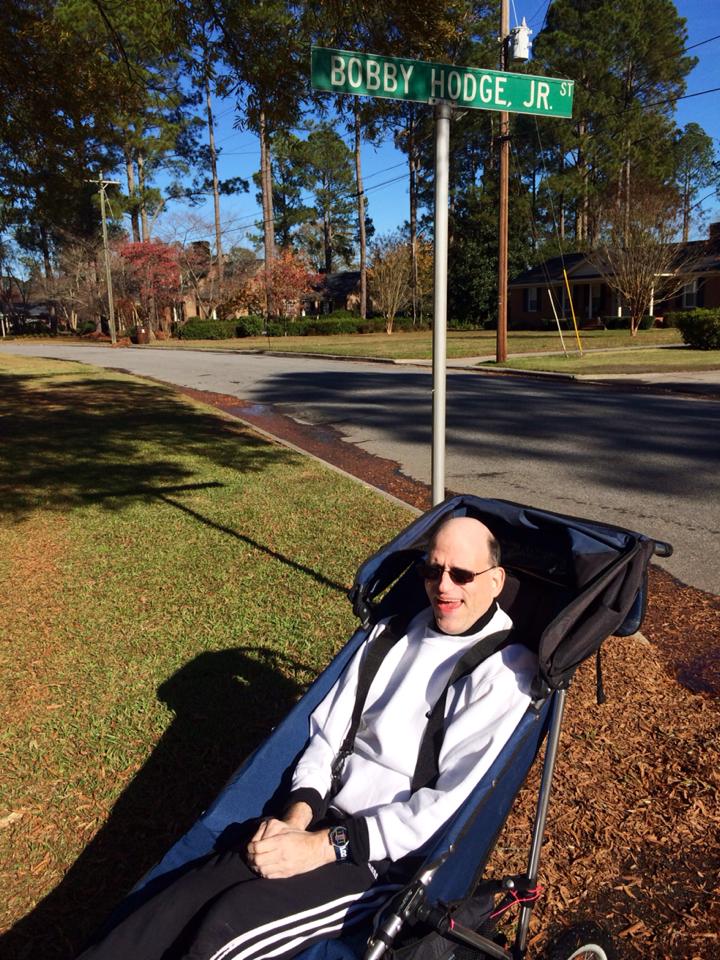
I confess that I run for many selfish reasons. However, thanks to Ainsley’s Angels, an organization created to help those with physical disabilities to enjoy some of the benefits of running, my running has suddenly become more selfless. Last week, Ainsley’s Angels graciously donated a wheelchair to be used to run 5k races with Bobby Hodge, Jr. who suffers with cerebral palsy.

It is as if a little bit of time spent running with Bobby this week has nearly absolved ten years’ worth of selfishness!

The holidays are upon us. If we are honest, we would confess that we love these days for many selfish reasons. We love the way that they make us feel. We love the way they help us enjoy our families and our friends. We love the lights, the parties and the gifts.

However, the truth is that it only takes a little selflessness to absolve a whole month of selfishness. So, during this holiday season, let us spend a little bit of our time doing something for someone else. Serve a hot meal in a soup kitchen. Visit a nursing home or a hospital. Adopt a family in need. Give to a charity. Make worship a priority. Most importantly, put a little faith in a little baby lying in a little manger.

And may our selfish days be transformed into selfless days. May our holidays suddenly become holy days.