Prayer for Emanuel AME Church and the Global Church

names charleston

The following prayer is a response to a joint pastoral letter from the Disciples of Christ in SC and NC written for a prayer vigil held at the Mt Moriah Community Church in Farmville, 9 am, June 20, 2015.

Good and gracious God, Father and Mother of us all,

Hearts shattered, souls lamenting, bodies languishing, and minds enraged,

We gather together with our members of our family of faith here in Farmville to grieve alongside our sisters and brothers in Charleston, praying that they will know a peace that is beyond understanding. May those who have lost loved ones be comforted knowing that you are suffering with them, and so are we.

We gather to support the leaders and the members of the Emanuel AME Church, praying that they will be led by your wisdom, endowed by your love and empowered by your courage to continue to live selflessly boldly proclaiming good news to the poor, freedom to the imprisoned and recovery of sight to the blind, setting free all who are oppressed.

We gather to stand with the leaders of the African Methodist Episcopal Denomination, praying that they will persist and prevail courageously ministering to the social, spiritual and physical development of all people.

We gather in prayer for all African American churches who worship, serve and love their neighbors under the constant threat of persecution by the demonic forces of our time. May they be emboldened by remembering the words of their Lord and Savior and rejoice and be glad, for great is their reward in heaven, for in the same way the prophets were persecuted before them.

We gather to pray for the city of Charleston, the political leaders of our cities, states and country, and for the Body of Christ spread throughout our land. We pray for boldness in naming the sin of racism in our lives, our church and our country. We pray for fortitude in confronting racism, in all of its manifestations. And we pray for courage in confronting hatred and violence in all of its manifestations.

And we also gather this day O God to pray for the Body of Christ here in our own community. Forgive our division. Forgive our segregation. Forgive the barriers we have erected: racial, ethnic, and socio-economic. Forgive the chasm of fear that we have created. Forgive our failure to build bridges between the churches here in our own town. Forgive our failure to come together in the name of Christ, one body following one Lord, to stand for justice and equity for all of our citizens. Forgive us of our failure to truly love our neighbors as we love ourselves.

Forgive us, O God, and envelop us with your grace. Grant us your guidance, will and determination to follow the Christ together in the steps that he is leading us next. It is in the name of Christ Jesus our Lord who unites us all we pray, Amen.

Don’t Feel Sorry for Donna Mosley

donna mosley

In Memory of Donna Marie Mosley

Matthew 5:1-9 NRSV

Perhaps the worst thing we can do on this day is to do what we instinctively believe we should do; do the thing that comes most naturally for us today. One of the worst things we can do is put what we have been doing these last few days, and possibly doing throughout Donna’s life, into some sort of formal expression. I believe that the worst thing we can do today is to feel sorry for Donna.

Born nearly blind and with cerebral palsy, to say that Donna struggled throughout her life would be an understatement. But if you ever asked Donna if she thought people should ever feel sorry for her, she’d shake her head and emphatically say, “Naaw!”

But, against her wishes, that is exactly what we are inclined to do. Oh, poor, poor, poor Donna. Born with disability, she struggled to finish high school and attend Pitt Community College, only to never have a career, an IRA or own a 401-k.

Poor, poor, poor Donna. She never got married. She never knew the joy of parenthood. She was to never be a grandparent.

Poor Donna. She never really lived on her own, never owned her own home, never possessed her own car. She was never self-supporting, self-sufficient.

Pitiful Donna. She suffered with so many chronic health problems; she was never able to be physically active. She never hiked a mountain, swam in a river, cycled in the country or ran a 5k.

Oh, poor, pitiful Donna. She suffered so much loss in her life: the tragic death of a father, the untimely death of a mother, and just recently, the slow and painful death of her beloved brother, Albert.

Poor, poor Donna. She suffered so much these past few years and even more these past few months, and she died, so young, just days shy of just her 54th birthday.

This is our natural inclination: to pity Donna, to sympathize with Donna. Because according to the world’s standards of success, Donna simply did not measure up. But if you ever asked Donna how she was doing, even in her final hours when she was barely able to say a word, Donna would always respond: “Doing good.”

I would visit her during these last few months confined to a bed, her body unable to absorb any nutrients or electrolytes, on oxygen, broke out with a rash from her medication, and immediately after she told me she was “doing good,” she would ask: “How’s the preacher? How’s Carson and Sara? What is Ms. Lori up to?” Just like her beloved brother Albert, I never once heard Donna utter a single complaint, regret, or resentment.

“Donna, should anyone feel sorry for you?”

“Naaw! Don’t feel sorry for me. I have had a great life. Yes, I was born with disabilities, I have had my share of struggles, maybe more than my share, but I was born into a family and into a community that gave me everything I ever needed and wanted.

Yes, I was born with disabilities, but ask anyone who remembers me as a child, walking all over this town, even with cast on my leg! Yes, I was born with poor vision, but if I hadn’t been, the Lion’s Club would have never given me my dog Brandy who traveled to New York City with me.

No, I never had a lucrative career, but I was able to finish school, even go to college and work a little. I was able to fulfill a dream of teaching in a classroom. I was able to work some in the public library and even able to help out Bro in Avon on the fishing pier. And no, I have never had any money. But the good things in life, the truly important things in life, do not come with a price tag.

No, I never got married, never had children, but I have had many priceless relationships. Because of my friends and family, I have never felt unloved or unwanted. Because of these relationships, I have never once doubted that any of my needs would not be met. And, seriously preacher, who can really ask for anything more?

I never owned a car, but I went anywhere I wanted to go. I have never been able to run like you Jarrett, climb a mountain, or swim in the sea, but I bet I have been to more concerts and met more famous people than you. I think it surprised my nieces when some of the members of the Cravin’ Melon group called me by name and spoke to me at that Michael Jordan golf tournament!

I have been so many places, met so many people, some of them quite famous, from NASCAR and golf celebrities to Coach Dean Smith.

And yes, I have experienced loss, even tragic loss. But I have always had a strong faith and certain hope that I would see my loved ones again. My faith and hope was so strong when my daddy died, I was somehow able to console my brothers and sisters. You can ask Puddin’ about that.

I think that is why I always loved the song, ‘Somewhere over the Rainbow’ by the Band of Oz. I have always believed in a land and a life that is better than this one: One where the skies are always Carolina blue and all of your dreams come true.

And, although I may not have been ready to leave all of you so soon, I think this is why when Dan asked me on the phone in the hospital early this week how I was doing, although I could barely breathe and could hardly talk, I said, “Doing good.”

So, please whatever you do, even if you are attending my funeral, please do not feel sorry for me.”

I believe Donna Marie Mosley was a living testimony of Jesus’ first recorded sermon. Whereas some may look at her short life of struggle and draw the conclusion that she should be pitied, because she didn’t appear blessed or favored by God like some, in reality, as Jesus reminded us in the Sermon on the Mount, God looked upon Donna with favor, and truly blessed her in ways that few of us here have been blessed. And I believe this is the real reason that no matter her circumstance, no matter how bad she felt, or how hard it was for her to breathe, she said: “I’m doing good!” Jesus said:

Blessed are the poor in spirit, for theirs is the kingdom of heaven.

Whereas we may look at those with whose spirits are allowed to soar to achieve success as the world defines it as blessed and favored by God, the reality is that God looks with favor and blesses not those who are born with perfect bodies, 20/20 vision, and silver spoons, but those whose spirits have many challenges and obstacles. And notice that Jesus uses the present tense. Not they will be blessed. Not might be blessed. They are, right now, right here, on this earth blessed. And their future is the kingdom of heaven.

Blessed are those who mourn, for they will be comforted.

Whereas we may look at those who have not suffered the tragic or untimely loss of loved ones as blessed and favored by God, the reality is that God favors and blesses the mourners who have experienced great loss, and God promises them comfort. This is the only explanation how Donna was such a comfort to so many of us during our times of grief.

Blessed are the meek, for they will inherit the earth.

The meek and the gentle are favored. Not the strong. Not the ones with the physical strength or the confidence to overcome all sorts of adversity and make it to the top. Blessed are the ones who have never made it to the top, never conquered anything, not even their own fears. Blessed are the ones who are dependent on the love and support of others. For it is the weak, the disabled, says Jesus, not the strong, who survive and inherit the earth.

Blessed are those who hunger and thirst for righteousness for they will be filled.

Not the ones who are righteous, but the ones on whose behalf the prophet Amos preached: “Let justice roll down like waters, and righteousness like an ever-flowing stream” (Amos 5:24). Blessed are the ones who thirst for justice. These are the ones, like the mentally and physically disabled, who have been unjustly judged, mistreated, shunned and even bullied by society. These are the ones society looks upon and says that they haven’t quite measured up. Jesus says that they are blessed. Jesus says that they are the ones who will not only have their thirsts quenched, but they will be filled, their cups overflowing.

Blessed are the merciful, for they will receive mercy.

Blessed, says Jesus, are the ones who are always putting the needs and welfare of others ahead of their own. Blessed are the ones who are suffering, yet when you ask them how they are doing, they immediately ask you how you and your family are doing. Blessed are the ones whose hearts are full of mercy and compassion, for God will give them mercy.

Blessed are the pure in heart, for they will see God.

Blessed are those who have the heart of a child: Those who see only the good in others; those who, even in their sufferings, have no bitterness, no complaints, and no resentments. Blessed are the ones who see not only their misfortunes, but see all of their blessings, for they will see God.

Blessed are the peacemakers, for they will be called children of God.

Not the ones who have necessarily found the world’s peace for themselves, not the self-sufficient, the self-reliant, not the ones who own their own mortgages, have secured their own peace and security through material wealth and assets, but those who seek God’s peace, because they will find a home, a place of security, a place of rest and a place of peace that is beyond all understanding.

No, whatever you do this day, however you mourn, wherever you hurt, whenever your cry, whatever your inclination, please do not feel sorry for Donna. Because she is doing good. She is blessed beyond measure. And because she’s doing good, because she is blessed, although we may not feel like it, so are we.

Flip-Flopping the Message

flip flop

The following is an excerpt from:  Let the Children Come

Although our intentions were to share the love and grace of Christ with others, I believe the church has actually been guilty of doing the exact opposite. Simply put, with our words and our actions, we have oftentimes preached the gospel backwards, and in doing so, we have shared hate and judgment.

To share Christ with others, we often start with what is sometimes called the doctrine of original sin. Now, don’t get me wrong. I believe that all people are born into this world as sinners. I just don’t believe that is where we should begin the conversation or the sermon.

Our sermon usually has three points: 1) All people are sinners; 2) God sent Jesus to die for us; 3) If we believe this, then God will forgive us and love us as God’s children forever.

I think we should preach the same sermon, only flip-flop it and proclaim it the other way around.

I believe we should always begin with God’s love for all people. We should make our number one point that God loves us as God’s children and wants nothing more than to love us forever. The second point should be that God came through Jesus and loved us so radically, showered us with grace so extravagantly, so offensively, that people, most of them religious, nailed him to a tree. And we should make our third and final point that God did this while we were yet sinners.

Do you see the difference? Instead of preaching that all people are born on the outside of the love of God until they do something, say something, or pray something to earn forgiveness, we should preach that all people are actually born inside the love of God without doing, saying or praying a thing to earn it. Our words and actions only help them to believe this and to accept it.

Jesus put it this way: 1) For God so loved the world; 2) God gave God’s only son; 3) So that all whosoever believes may not perish by their sins but have everlasting life (John 3:16).

If we keep teaching this, continue preaching this with our words and deeds, if we keep making the church a place of extravagant grace and radical love, then, before you know it, we will start seeing the entire world differently. We will start seeing people differently. Instead of seeing people first as sinners who deserve hell, fire, and eternal damnation, we will begin to see all people first as God sees them: God’s beloved children.

If They Only Knew

If+They+Only+Knew

Psalm 139 NRSV

Andy Griffith had a home in the same neighborhood where my uncle once lived in Manteo. They met several times and had many long conversations. One day, Andy Griffith said something that surprised my uncle. He said: “I am a very private, extremely introverted person.  Everyone thinks I enjoy being in the spotlight because of my profession, but I don’t. If they only knew.”

One day, Mr. Griffith visited a produce stand in Currituck where my sister, Jenean, was working. As soon as Jenean saw him, she started running towards him, screaming: “Andy Griffith! Andy Griffith!  I just love you!” Jenean said that he acted kind of funny, like he didn’t like the attention. She said, “When he saw me running towards him, he turned around and started heading in the other direction.”  If she only knew.

“If they only knew.”

There are people who always appear confident, like they have it all together. Others look at them and wished they could be as confident. However, while they appear poised and in control, on the inside, they are falling apart, constantly tormented by feelings of insecurity, self-loathing. If they only knew.

There are others who always seem to be happy. They always greet you with a smile and always seem to have an encouraging word for you.  But on the inside they are crying. For reasons unknown, their hearts are breaking.  “If they only knew.  If they only knew how depressed I am. If they only knew how much I really hurt. Oh, if they only knew.”

There are some outside of the church who drive past our church building on the way to the grocery on Sunday mornings. They appear not to be bothered by the large number of cars parked around this building during this hour, while they mutter to themselves, “If they only knew how lonely, how left out I feel. If they only knew how much I wanted to be included, loved and accepted.”

If they only knew. Perhaps we have all said it.

If they only knew how much pain I was in.

If my family only knew how unimportant I feel.

If my parents only knew how hard I am working to please them.

If my friends only knew just how fragmented our marriage really is.

If they only knew how much debt we were in.

If people only knew how bad you treat me.

If my children only knew who much it hurts when I don’t hear from them.

If they only knew how lonely I am since losing my husband.

If she only knew how much I missed her.

If they only knew how much I loved them.

The truth is, we humans long to be known. We desperately want someone to know our feelings, our pain and our joy. We seriously want someone to truly understand us. I think that is one of the reasons that facebook has become so popular in this last decade. For it gives people an opportunity to share their feelings with the world.

However, at the same time, ironically, we are also afraid of people truly knowing us. For we all have thoughts, feelings, desires, secrets and motivations that really do not want anyone to know about. We all have secrets that we want to keep secret. “If they only knew. And I am so glad they don’t!”

However, I believe the only fear that is greater than being fully known, is the fear of someone never really knowing who we are or ever truly understanding us. In spite of all of our mistakes and flaws, I believe most of us want to be known. We want to be understood.  If they only knew.

But the sad reality is that they do not know. And what is more sad, they will probably never really know. Yes, people may say it. And they tend to say it all the time: “Oh, I know exactly what you are going through.” “Yes, believe, me I understand.” “Hey, I get it.” “Been there, done that.” But the truth is that they do not have a clue.

When someone gives me a compliment, I usually say something like, “Well, you don’t know me very well.” Or “Well, there’s a lot of things about me that you don’t know!” And it’s true.

There’s a lot of truth in that old spiritual:  “Nobody knows the trouble I’ve seen.”

If they only knew, but nobody does, and nobody probably ever will. Nobody truly knows all that there is to know about you.

They may know your name, where you live, where you work, something about your family, but nobody knows your greatest disappointment. Nobody knows your deepest hurt. Nobody knows your greatest joy. Nobody knows your deepest fears. Nobody knows the very best thing about you that lifts you up, and nobody knows the very worst thing about you that brings you down. If they only, knew, but, sadly, they don’t.

“Nobody knows the trouble I’ve seen…”  What’s the rest of that song? Nobody knows, but Jesus.

The good news of our faith is that somebody does know. Somebody does know your greatest hurt, your greatest disappointment, your greatest fear, your greatest joy, and the greatest thing about you. The good news is that God knows everything about us.

Wait a minute!

If God knows the best thing about us, God also knows the worst that is within us. If God knows all of our feelings, God knows some of our feelings of unresolved anger and hate. God knows of the intense bitterness which often wells up within us. God knows how selfish we can be.

When someone comes up to the person who knows me better than anyone and says, “Lori, your husband is so wonderful,” guess how she usually responds?

“If you only knew.”

Maybe God knowing it all isn’t such good news after all. But that all depends on your view of God doesn’t it?

If your God is a God of wrath, a power for whom you must work hard to earn it’s favor, then the idea of a God knowing you is very bad news. However, if your God is a friend who loves you, one whose grace abounds and whose mercy has no limits, then you can rest assured that the God who knows your very worst and most scarlet sin is the one who will always love you and forever forgive you. This week, one of our church members said it best when she wrote this on facebook: “So much judgement being tossed around every day. So thankful I serve a merciful, forgiving and AWESOME God. We all would be in trouble without His mercy and grace.”

Our faith is that God loves us so much that God became one of us and died for us. And it was on the cross that God identified God’s self with every human being. The cross is the symbol that our God understands like none other. Our God truly knows us. Through Jesus, God even knows how it feels to be understood by no one, as he cried out, “My God, my God, why have you forsaken me!” God knows the desire that is in every human heart to be known and to be loved.

The good news is that God knows our very worst, and God continues to love us. And the really good news is that God also knows our very best, the best that is within each of us, that no one else knows. Yes, we all have secrets, but not all of our secrets are bad. Some of our secrets are very good. God knows the best, the secret best that is within us all.

Many of you have deep love and affection for others that you just have not been able to communicate because of fear or embarrassment.  Many of you have very generous hearts. You would give so generously to others if you were not limited financially. Many of you would participate in countless mission projects if you were not limited by health or age. There is, in each of us, some secret, some hidden secret, some wonderful secret that has perhaps only partially been exposed to others. If they only knew.

When Robert Lois Stevenson died, one of his friends made the statement: “Robert died with a thousand stories still inside.” We are all a lot like Robert. We will die with a thousand stories still inside of us. We will die with a thousand kind words unspoken, a thousand good deeds undone, a thousand encouraging notes unwritten, a thousand feelings of compassion unacted upon, a thousand good secrets untold. If they only knew.

We will all die with a thousand good stories inside. The good news is that God knows those stories. God knows the very best inside of us that no one else knows, all of the beautiful potential, all of the wonderful promise that is inside of us.

And, more than anything, God wants to work with us to bring some of that potential and promise to life. And I believe that is one of the great purposes of the church: to help bring out the best that is in all of us; to help us build a handicap ramp for the disabled, purchase clothing for a child whose house burned, deliver meals to the elderly, raise money to provide food and shelter for the poor, plant and tend garden for the hungry, make quilts for the sick and grieving, pray for the hurting, welcome and embrace those who have been marginalized, give a voice to the voiceless, fight for justice on the behalf of minorities, plan a Vacation Bible School for children…and who knows what else we and can do? Who knows? God knows. Thanks be to God.[i]

[i] Words inspired and adapted from a sermon written by Charles Poole with the same title while he was a pastor of First Baptist Church, Macon Ga.

A Prayer for Our Graduates

Source of All Life,

We are grateful for the lives of teachers, friends, leaders, and family; for all whose lives have influenced our lives, and helped to make us who we are and who we are still becoming today. May the lives that have and continue to influence these graduates inspire them to lead, to serve and to care for the lives of others, as they care for the entire creation in which the mystery of their lives have happened.

Origin of All Love,

We are grateful for the love and support of those who have cradled our past, envelop us today and promise to surround us tomorrow. May these graduates mirror this love by living lives that always bear love for others.

Supplier of All Faith,

We give you thanks for the trust and confidence that education instills in us to follow our dreams, even if it means sacrifice and taking risks, going to places that we have never been before. May this faith encourage these graduates to dream bold dreams and give them the courage to bring those dreams to life.

Giver of All Hope,

We are thankful that our best days of living, the best days of seeing the meaning of our lives through are always and forever in front of us, even when we fall or falter. May these graduates always know the immense potential, see the boundless possibilities, and recognize the unlimited promises in all of the days that are before them.

Author of All Truth,

We are thankful for what we have already learned, but also for the opportunities that lay before us to continue learning.  May these graduates continue to be seekers of truth and knowledge, and may they always use truth, not for selfish advantage, but to be advocates of truth and justice for all people.

The One Who Grew in Wisdom through Jesus of Nazareth,

Thank you for teaching us how to live and to love. Continue to teach, lead, mold, and make us all into the people you have called us to be.  Amen.

The More You Know…

Buechner Blessing and Healing

John 3:1-17 NRSV

Our church has always believed very strongly in education. This one of the reasons that we have a graduate recognition Sunday.

Our church also believes it is very important to always ask questions. Our church has never been the kind of church that expects its members to “check their brain at the door” before entering on Sunday mornings. Like our forefathers Barton Stone and Thomas and Alexander Campbell, we encourage free-thinking and open minds here. We believe that God created our minds to ask questions—even the hard questions of life and faith.

I know of some churches where people are taught never to question anything.  They are expected to go to church with the sole expectation to be indoctrinated with whatever the minister says. Not here.

Believing very strongly in the historic principle of the “Priesthood of All Believers,” our church encourages and even expects free thought and the free expression of ideas. You are your own priest. No one here is expected to agree with everything that is said from this pulpit. You are always free to examine, to mull over, and perhaps, even seek an entirely different word from God.

One of the reasons we encourage such questioning is that we do not believe anyone here, including the one who does the most talking on Sunday mornings, has, or will ever have, all of answers. We come to church recognizing that we will never be able to get our hands on, wrap our arms around, all there is to know about this mystery we call God the Father, God the Son and God the Holy Spirit.

During a Wednesday night supper, an eight year-old little girl came and sat beside me. She said, “Dr. Banks.”

Not many people address me in that manner. I kind of liked it. Made me feel smart, scholarly, intellectual! “Yes, how can I help you?” I responded.

She said, “I’ve got a lot of questions about God.”

I thought to myself, “Well, my dear little one, you’ve certainly come to the right place.”

She then asked, “Where exactly do dogs go when they die?”

I thought for a second or two, and responded the only way I knew how. I just looked at her—in dumbfounded silence

A little impatient, she asked, “Do they go to doggie heaven or to regular heaven with the rest of us?”

It was then I had to admit it, “I really don’t know.”

I could see the disappointment on her face. But she quickly moved on to her next question: “How old are people in heaven?”

Again, dumbfounded silence.

Frustrated she asked, “You know, if you die as a baby will you be a baby when you get to heaven? Or if you die as an old lady, will you be an old lady in heaven?”

Again, I had to say “I really don’t know?”

It was then she said, “You know something? For a doctor, you sure don’t know much.” She didn’t ask me any more questions.

No, the truth is, for someone who not only has a doctorate, but someone who has hardly missed a Sunday in church for the last forty-eight and a half years, I really don’t know that much.” All learned after spending a few moments with an eight-year old.

That is why I love ol’ Nicodemus.  For Nicodemus also discovered that he didn’t know that much either after spending just few moments with Jesus.

The very educated and esteemed Nicodemus, a leader of the Jewish Pharisees, came to Jesus full of questions. “Rabbi,” how can a man be born when he is old?” and “Can you enter the womb a second time and be born?” and “How can this be?”  And through all these questions, Nicodemus is asking another question, “Who are you anyway Jesus?’

When it all comes down to it, isn’t that THE question? Isn’t that the reason we are here every Sunday morning? We come asking, “Who is this Jesus anyway?”

We, like Nicodemus, have heard some rumors about the amazing things Jesus has done. And we have been listening to his teachings and have heard just enough to be confused. And we’ve got questions. Can we really believe everything we have heard about Jesus? How can he be both an earthly human being and God at the same time? How can his spirit be both ascended into heaven yet still here with us?

Notice that although it is Nicodemus who begins the conversation here, by the time our passage ends, it is Jesus who is doing most of the talking. Nicodemus appears to be just sitting there in dumbfounded silence.

For you see, Nicodemus thought he would be able to go to Jesus and grasp Jesus. Nicodemus thought he could go to Jesus and figure Jesus out, get his hands on Jesus, wrap his arms around Jesus—understand, define Jesus.

Nicodemus learned what most of us already know: Sometimes when we come to Jesus with questions, Jesus doesn’t give us easy answers. I’m not sure if Nicodemus got any of his questions answered that night. However, the good news is that Nicodemus got something better. Nicodemus went to Jesus hoping to understand him, put his hands on him, wrap his arms around him, but instead, it was Jesus understood Nicodemus. It was Jesus who put his hands on and lovingly wrapped his arms around him.

So this morning, I want us to take Nicodemus as our model. While you are here this morning in the presence of Christ, I want you to ask Jesus whatever is on your mind. Go ahead and use all of your God-given mental capacities, use every ounce of intellect to try to think about Jesus this morning. Listen to what he has to say. And then, simply enjoy being with him.

Give thanks that we have the sort of God who wants more than anything else to be with us, who descends to us, who speaks to us, who shares truth with us, even if we cannot comprehend the wholeness of that truth.

There are a lot of people who have a great disdain for us church folks. Because they erroneously believe that Christians are those people who have it all figured out. They believe church goers are people who have had all of their questions about Jesus answered. And I am afraid they have good reasons for believing that.

I heard one pastor describe a member of his church who was convinced that he had all the answers. He said: “He is very stubborn and close-minded about everything!”  He said, “If he gets to heaven and discovers that things up there are a little different, he is the type that would get mad and ask for a transfer!”

No, the truth is, as William Willimon has said, “Jesus is that illusive, free, sovereign and living God who makes sense out of us, rather than our making sense out of him.” Every Sunday we risk coming to him, listening to him and following him, even when we do not always grasp what he’s talking about and know precisely where he’s leading us.

Notice that Jesus speaks to Nicodemus about wind and birth. For what in our world is more mysterious than wind and birth? In meeting Jesus, we come face to face with a living God. And we cannot define him. We can’t put our hands on, wrap our arms around him. The good news is that it is he who defines us.  It is he who puts his hands on and wraps his arms around us—And beckons us to follow him even if we do not always understand him.

This is exactly what happened to Nicodemus. We meet Nicodemus again sixteen chapters later in John’s gospel. When Jesus was crucified, when most of his disciples deserted him, Nicodemus was one of the few people who were there to lovingly bury Jesus.

I’m sure Nicodemus still had even more questions on that Good Friday. How could it be that this one sent from God, this Savior of the world, be so horribly crucified?

But there, at the foot of the cross, Nicodemus doesn’t ask questions. He simply does what is right. He simply followed. By being associated with Jesus, a condemned criminal, Nicodemus risks his reputation, and even his life. He proves, in the most loving of ways, that one does not have to have Jesus completely figured out to follow Jesus.

If we take Nicodemus as our model, the question for us then is this, “Will we follow Jesus even if we cannot put our hands on him, even if we don’t always understand him?” The good news is that if we say yes, if we promise to walk with him, Jesus promises that he will walk with us forever. For faith is not in the understanding. Genuine faith is in the following.

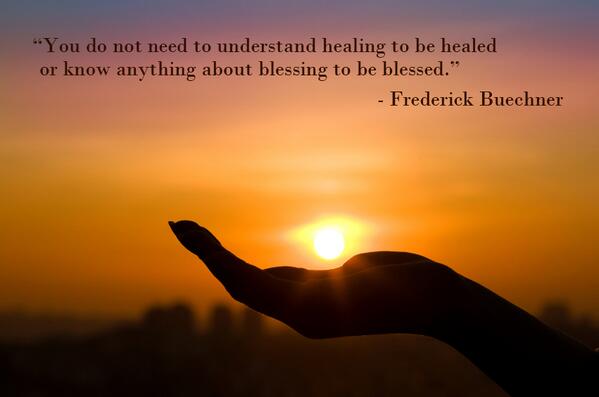
Frederick Buechner has written: “You do not need to understand healing to be healed or know anything about blessing to be blessed.”

I would add that you do not need to understand the miracle of life to breathe. You do not need to understand the marvel of love to be loved and to share love. You do not need to comprehend the gift of grace to receive it and to offer it to others.  And you never need to figure out the holy wonder of the Trinity, the divine relationship of the Father, Son, and Holy Spirit, to be an eternal part of that relationship. You do not need to ever grasp Jesus to follow Jesus and have Jesus grasp you.

God Remembers

Cash
Captain Christopher Cash

If I am to be truly honest with you, I must confess that I have my doubts. It’s just part of my fragmented human nature. This is why I love the Bible so. When I slip into the doldrums of doubt and despair I can pick up the Bible to discover that I am not alone.

Listen to these words of Isaiah to the people of Israel in exile:

“Thus says the Lord…I have answered you…I have helped you…I have kept you…I have given you….”  In other words, “I answered your cries in Egypt, I sent Moses to deliver you, I protected you in the wilderness, and I gave you a promised land.”

“And not only have I acted in the past, I promise to continue acting, reaching out and reaching in… giving you light in your darkness…feeding your hunger, quenching your thirst. I promise to protect, lead and guide you. I will transform mountains into roads, lift up highways and show you the way out of captivity…”

And what did the people say?  “Amen!”  No, not even close.

The people in exile responded to the voice of God the same way I suppose you and I sometimes respond—with a lot of doubt.

In verse 14 we read: “But Zion said, ‘The Lord has forsaken me, the Lord has forgotten me.’”

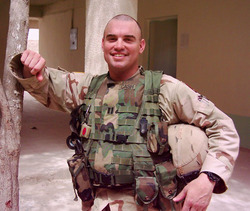
Fifteen years ago I became good friends with Christopher Cash, a member of the National Guard.

On October 1, 2003, his unit was deployed to Iraq. As the only person I personally knew in Iraq, I specifically remember praying for my friend Chris on the Sunday morning before Memorial Day the following year.

About a month later, I picked up the Saturday newspaper and read the headlines on the front page: “Captain Christopher Cash Killed in Iraq.” I tried my best to read the article, but couldn’t. I never made it pass the sub-title: “Cash leaves behind his wife, Dawn, and two children.”

The room started spinning. I felt sick to my stomach. I was lost.  And I had never felt more alone. With Zion I wanted to cry out, “The Lord has forsaken me. The Lord has forgotten me.”

This is why I love the Bible. I love the sheer honesty of it! In spite of everything I knew about God, what God has done, and what God promises to do, like Zion, I doubted.

Now listen to the good news: In verse 15, we read God’s response to our doubts.

“Can a woman forget her nursing child, or show no compassion for the child of her womb?  Even these may forget, yet I will not forget you. See, I have inscribed you on the palms of my hands…”

This weekend we honor those members of our armed forces who have paid the ultimate sacrifice. They have loved others supremely, selflessly. And we remember them.

However, the good news is that our God remembers them.

This is great news, for our remembering is shallow and weak. Our remembering is fraught with doubt, laden with despair. However, God’s remembering is deep and unfailing. God’s memory endures forever. God responds to our doubt with the assurance that our loved ones will never be forgotten by God, because they are literally in the very hands of God.

The Birth of New Life

PentecostSunday_wide_tActs 2:1-21 NRSV

Here are just a few things my mother taught me…

 My Mother taught me about ANTICIPATION…

“You just wait until your father gets home.”

My Mother taught me about RECEIVING….

“When we get home, you’re going to get it!”

My Mother taught me to MEET A CHALLENGE…

“Answer me when I talk to you! And don’t talk back to me!”

My Mother taught me LOGIC…

“If you fall out off that swing and break your neck, you’re not going to the store with me.

My Mother taught me HUMOR…

“When that lawn mower cuts off your toes, don’t come running to me.”

My Mother taught me about GENETICS…

“You’re just like your father.”

My Mother taught me about my ROOTS…

“Shut that door!  Do you think you were raised in a barn!”

And last but certainly not least, my Mother taught me about JUSTICE…

“One day you’ll have kids, and I hope they turn out just like you!

And, of course, all of our mothers taught us something even more important—something about this wonderful gift we call “life.” There is absolutely nothing any of us ever did to earn or deserve this most precious gift. But here we are!—Inexplicable gifts from God, birthed through our mothers.

Pentecost is often referred to as the day the God gave birth to the Church—the day when the outpouring of God’s energy through the Holy Spirit swept down like wind and fire and touched every one who had gathered for the Jewish festival. New Testament professor Beverly Gaventa writes that the essential message of Pentecost is:  “Sudden, unmerited, irresistible new life!”

And this new life came in dramatic, indescribable fashion. Gaventa writes: “It is as if not even the most lavish use of human language is capable of capturing the experiences of the day.” She writes: “All of the stops on the literary organ are employed: a heavenly sound like rushing wind, descending fire, and patterns of transformed speech.” That’s because there are just no words to describe this sudden, unmerited, irresistible gift of new life!

Brooks and Jenny and Chase, Pentecost is like holding precious little Andrew White in your arms: feeling his soft skin pressed up against yours, smelling his sweet head, listening to his precious sounds. There are just no words in any language to describe it.

If only we, living today in the 21st century, could have been there on that day. Think of what First Christian Church could be, rather would be, if we could have been present on the Day of Pentecost. Think of impact we would have in eastern North Carolina and in our world if you and I received this indescribable gift of the outpouring of God’s energy. Think of all we could accomplish together for the honor and glory of God.

But we were not there, were we? Unfortunately, we were born nearly 2000 years too late. The Day of Pentecost was just a one-day, one-time event in human history, and we missed it all! God simply does not work that way in our world anymore!

Well, I don’t believe that, and I have this sense that you don’t either.

Theology Professor, Robert Wall, points out that the Pentecost experience of God’s Spirit occurred not only once, but is repeated several times in Acts. The images and language of Pentecost, Walls says, “are routinely recalled to interpret subsequent outpourings of God’s Spirit as the constant testimony to God’s continuing faithfulness.”

In the eighth chapter of the book of Acts, we read that after Peter and John laid their hands on the people of Samaria, they received the Holy Spirit.” They received sudden, unmerited, irresistible new life.

In the tenth chapter of Acts we read that while Peter was still preaching, “the Holy Spirit came on all who had heard the message. The circumcised believers who had come with Peter were all astonished that the gift of the Holy Spirit had been poured out even on the Gentiles. For they heard them speaking in tongues and praising God.”

Again, in the eleventh chapter Peter says, “As I began to speak the Holy Spirit fell upon them just as it had upon us in the beginning.”

In the nineteenth chapter of Acts, after Paul baptizes twelve people in Ephesus, we read:  “After Paul had laid his hands on them, the Holy Spirit came upon them, and they spoke in tongues and prophesied.”

Throughout Acts we learn that Pentecost, the gift of sudden, unmerited, irresistible new life is not a one-day, one-time event in human history. The gift of Pentecost is an experience which is repeated and repeated often in our world. And it is still being repeated today.

The good news is that we have experienced the possibilities of Pentecost, the promise of the birth of new life, on numerous occasions. We have all experienced those special occasions where we were showered with the inexplicable gift of new life, sudden, unmerited, and irresistible. We have all experienced new beginnings, fresh starts and second chances.

The exhilarating discovery that a new baby is on the way.  The miraculous birth of that baby. The dedication of that baby in a worship service. The excitement of a new job.  The anticipation of a new school. The possibilities of a new marriage.  The promise of new friendships. Yes, we have all experienced the grand possibilities which come with new beginnings, fresh starts and second chances.

And it is not only in the special events of life that we experience these possibilities. I believe when we consider that all of life is a gift of God’s grace, there is no event which is so ordinary that the Spirit of God is not present in it. Frederick Buechner writes that God’s Spirit can be found in the most common of places, “always hiddenly, always leaving room to recognize him or not to recognize him, but all the more fascinatingly because of that, all the more compellingly and hauntingly.” Because all of life is a gift of God’s grace, inexplicable new life can be experienced everywhere!  Buechner writes that it can be found “Taking your children to school, and kissing your wife goodbye. Eating lunch with a friend.  Trying to do a decent day’s work.  Hearing the rain patter against the window.”

Yes, the possibilities of Pentecost are everywhere, but I believe it is most real right here in this place we call church.

On this day as we dedicate Andrew to God, our thoughts are turned towards family—our parents, grandparents, our children and grandchildren. We cannot begin to count the number of times we’ve experienced the gush of new life within the context of family.

However, sometimes I think we need to be reminded that Jesus’ concept of family was often much broader than ours. One day while he was teaching, someone interrupted him and said, “Your mother and brother are waiting for you outside.”  Jesus turned, and pointed to the crowd and said, “Here are my brothers, here are my mothers.  Here is my family.”

Yes, I believe that here, in this place, with our family of faith, the power of Pentecost is most real—as we worship and fellowship together, but also as we serve and reach out together.

I do not believe it is a coincidence that in Acts we read that the gift of the Holy Spirit often came after Peter or Paul laid their hands on others. I believe one of the best ways to usher in the possibilities of Pentecost is by reaching out and personally touching others.

God’s energy is released and sudden, unmerited, irresistible new life comes when graciously serve a meal to someone hungry, when we tenderly caress the forehead of someone in the nursing home, when we gently hold someone’s hand in the hospital, and when we empathetically embrace someone in the funeral home.

Pentecost comes when we, the body of Christ, lay our hands, which, by the way, are the hands of Christ, on all who are in need. Pentecost comes, when we seek out someone who has wronged us offering a handshake of forgiveness or a hug of mercy, offering the grace of friendship. Pentecost comes when we reach out and hold the hand of an outsider.

Pentecost—sudden, unmerited, irresistible new life comes. New beginnings, fresh starts, and second chances can come to us in the ordinariness of life, and most specifically, through the many opportunities we have as the body of Christ to offer personal touches of grace to one another.

And the really good news is that this sudden, unmerited, irresistible new life comes to all of us with faith in Christ when our lives on this earth are complete.

Peter, in his sermon, recalls the words of the prophet Joel. He recalls the signs Joel says are a prelude to disaster—blood, fire, darkness and smoky mist. However, the death and destruction prophesied by Joel is transformed on Peter’s tongue into a declaration of new life.  For Joel, these signs of the outpouring of God’s Spirit are a prelude to disaster. For Peter, with faith in the risen Christ, these signs of God’s energy released are a prelude to the redemption of humankind.

When each of us comes face to face with our own deaths, God, with the power of Pentecost, redeems our deaths and replaces our deaths with sudden, unmerited, irresistible new life.

Pentecost—this is our hope.  And this is our purpose.  May First Christian Church, who may not have been present on that day nearly 2000 years ago, but has, in so many ways, experienced this power of Pentecost nonetheless, work together to share this gift of new life with this community and with our world. May we share it with our words, but also through the laying on of our hands, so that sudden, unmerited, irresistible new life may rain down from heaven like wind and fire and touch everyone!

A Pastoral Prayer for Mother’s Day

mothersdayprayerNote: The words of this pastoral prayer are adapted from a letter written by Amy Young to pastors.

Gracious God, Father and Mother of us all,

During this time, with our hearts and minds turned toward motherhood, we give you thanks for all those in our lives who possess the soul of a mother.

We give you thanks and celebrate with those in our community who have given birth this year, and we give thanks and anticipate with those in our community who are expecting a child.

We give thanks and pray for all mothers who are in the trenches with little ones every day and wear the badge of food stains and wearied bodies. And we pray for and mourn with those who have lost a child, for those who have experienced loss through accidents, sickness, DNCs, miscarriage, failed adoptions Or an unjust system. We pray for mothers who feel like their children are lost to drugs or other addictions.

We pray for and walk beside those who walk the hard path of infertility, fraught with pokes, prods, tears and disappointment. Forgive us when we say foolish things for we certainly do not mean to make this harder than it is.

We give you thanks for those who are foster moms, mentor moms, and spiritual moms – for this world so desperately needs them, perhaps more now than ever.

We give you thanks for and celebrate with mothers who have warm and close relationships with their children. And we pray for and sit with those mothers who have disappointment, heartache and distance with their children.

We pray for and grieve with all children who lost their mothers this year. And we pray for and acknowledge the experience of children everywhere who have experienced abuse at the hands of their mothers.

We pray for those who are single, yet long to be married and mothering their own children. We mourn that life has not turned out the way they have longed for it to be.

We pray for those who step-parent and walk with them on complex paths. And we pray for and grieve with all those who envisioned lavishing love on grandchildren, yet that dream is not to be.

We pray for, grieve with and rejoice alongside all those who will have emptier nests in the upcoming year.

We pray for those who placed children up for adoption. We ask you to bless them for their selflessness and comfort them as they hold that child in their heart.

O God, on this Mother’s Day, we pray that you help us to walk with all mothers, for mothering is not for the faint of heart, and on this day, we have real warriors in our midst.

Being a Friend of Jesus

friends

John 15:9-17 NRSV

Our text this morning contains some of the greatest words Jesus ever said to anyone:  “I do not call you servants any longer. . . I have called you friends.”  The disciples are invited by the risen Christ to know their Lord in a new light; they are invited to see their Jesus as a friend.  The question that I want us to ask this morning is this: “What does being a friend of Jesus truly mean?”

First of all, we learn from this text that being a friend of Jesus means to be chosen. Jesus said to his disciples, “You did not choose me, I chose you.”  This is very different from our definition of friendship, is it not?  For we are accustomed to choosing our friends. For us to be friends with another there’s usually got to be some sense of mutual attraction. My daughter Sara is going to Charlotte this afternoon to meet a girl who may be her college roommate this fall. They met on facebook and have scheduled a meeting today to see if they would both like to choose one another to be friends. However, Jesus had a much different understanding of friendship. It is Jesus who chooses us. We do not choose Jesus.

This understanding of friendship was also completely foreign to Jesus’ disciples. In Jesus’ day, it was customary for Jewish students studying the Torah, the Mosaic Law, to seek out a rabbi whose teaching they wanted to emulate. The choice was theirs. But Jesus reverses the order. The choice is his. Jesus chooses his followers.

That Jesus chooses us to be his friends prevents us from possessing a consumerist attitude toward the practice of this friendship. As disciples, we are not in a position to dictate when and where we will act like friends of Jesus. For example, we cannot choose to be Jesus’ friend on Sunday and treat him as a stranger the other days of the week. We cannot choose to act like he is our friend in front of some people, while acting like we have never heard of him in front of others. Furthermore, we are not in a position to pick and choose to accept and follow some of his teachings, while completely ignoring those teachings that we find offensive.

Secondly, we learn from this text that being a friend of Jesus means to keep his commandment to love others as he loves us.  Again, this too is very different from our understanding of friendship and love.  Most of us would probably tend to agree that the word “command” and the word “love” simply do not fit in the same sentence. We would say that love is not something that can be commanded.  For many of us, genuine love, we would say, must be spontaneous and come from within and not without.  We simply do not associate friendship or love with the word “command.”

The reason that “love” and “command” seem at odds is because we so often misuse and overuse the word “love.”  We have reduced the meaning of the word “love” to a mere feeling.  Jesus is talking about agape hereThis Greek word for love does not represent a “feeling.”  Nor is it a synonym for “like.”  To love is to be for another, to act for another, even at cost to oneself. The supreme act of love is the giving of one’s life for the other.

But for many of us, love is simply a feeling.  Love is an emotion. And we would say that no one can command feeling. We can not even command our own. But Jesus is not talking about feeling here. Jesus is talking about action. Jesus is talking about giving one’s self for another.

This is why the preacher never asks the groom and the bride in the wedding ceremony if they love one another. Think about it. You have never heard a preacher ask, “Do you love each other?” The preacher always asks, “Will you love one another?”  “Do you promise to love each other?”  True love is a verb. True love is action. True love is not a feeling. This misunderstanding of the definition of love is why many marriages end in divorce. A spouse wakes up one day and discovers that they have lost that loving feeling, so they move out.

Being a friend of Jesus means keeping his commandment to love others as he loves us. Unlike a feeling, love can be commanded. This means that we are to be there for others, to act for others, to be there with others, to laugh with others and to cry with others. Being a friend of Jesus means that we are willing to give of ourselves completely for others. Police officers, firefighters and others who put their lives on the line for us every day are our friends. The men and women of our armed forces who we remember in a couple of weeks on Memorial Day were our friends. Being a friend of Jesus means to sacrifice.

And thirdly, being a friend of Jesus means to know what is going on. Followers of Jesus become friends of Jesus when they know what he is doing. Jesus said, “I have called you friends, because I have made known to you everything that I have heard from my Father.” What distinguishes servants from friends is that friends have been let in on the plans.

I once heard story of a family that was getting ready to move to another state. The parents did not want to upset their four year-old son who had made many friends at his preschool and in their neighborhood, so they kept putting off telling him about the move. When the movers came, the little boy was upstairs in taking nap, so the parents instructed them to pack up every room in the house except for their son’s room. They would finally tell him about the move when he awoke.

While the parents were outside taking some things to their car, the poor little thing awoke to find that every room in the house was empty except for his! The parents came back in and found him sitting on the floor in the empty family room crying like a baby. Realizing that it was probably a bad idea to wait until the last minute to let their son in on the plans, they finally told him that they were moving to another state, but assured him that he would quickly make new friends in their new town.

The little boy stopped crying. His face lit up with a big smile. And he said, “What a relief, I thought everyone was moving except for me!”

As friends, we do not like to be left out of the plans do we? As friends, we want to know what is going on. We want to be included in the plans. Jesus lets his disciples in on the plans. They are not kept in the dark about what is happening and what is going to happen.

Being a friend of Jesus means knowing God and God’s plans for us.  Do you remember the words of the prophet Jeremiah? “For surely I know the plans I have for you, says the Lord, plans for your welfare and not for harm, to give you a future with hope. Then when you call upon me, I will hear you. When you search me, you will find me; if you seek me with all your heart, I will let you find me, says the Lord….”

Being a friend of Jesus means finding God. Being a friend of Jesus means knowing that Jesus was God incarnate—God who loved us so much that he came to earth and became one of us—God who became our friend and laid down his life for us on a cross. Being a friend of Jesus means knowing that the same God who resurrected Jesus abides with us today, resurrecting our sorrow into joy, our despair into hope, and our death into life. Being a friend of Jesus means knowing that there is nothing on this earth or in all of creation which will ever separate us from the love of God we know through Jesus Christ our Lord. Being a friend of Jesus means always knowing that God is here with us working all things together for the good.

Students are in their last weeks of the school year. One of the things I loved doing during these weeks was passing my yearbook around and having my friends to sign it. I don’t know if you still do this today or not, but when I was going to school, nearly all of my friends signed my year book, AFA, a friend always.

Being a friend of Jesus means that God has signed our hearts, AFA, a friend always, and forever. It means that he will never forget us, never forsake us, always stay beside us, now and forevermore.