Love One Another

we do love

1 John 4:7-21 NRSV

It the fifth Sunday of Easter, and like the very first disciples, we have gathered together on the first day of the week to be with our family of faith. There are certainly a lot of other places we could be this morning. But here we are. We are here, together as a community of faith because like the very first disciples we have seen the risen Lord.

Somewhere along the way, probably during some of our weakest moments, those moments of pain and despair, those moments of great anxiety and fear, when we needed him the most, the risen Christ inexplicably came into our lives, stood in our presence and filled us with a peace that is simply beyond all human understanding.

So here we are, gathered together on this first day of the week, assembled in this place as believers. We’re here because we believe in Easter. We believe in the wonderful good news that Christ is alive and, even more than that, he is alive for us.

Now the question is: what are we supposed to do with this Easter Faith that we have?  How are we to live as Easter people?

There is no more direct answer to this important question than the one found in the little book we call 1 John.

When I was in seminary, I had to take two semesters of Biblical Greek and at least one semester of Hebrew. In my first year of Greek, the first book of the New Testament that the professor had us to translate was 1 John. Why?  Because in all the New Testament, the Greek in 1 John is the most simple and direct.  There are no complex, convoluted arguments, no long clauses or other linguistic difficulties that make the translation of some of the other New Testament books a nightmare. 1 John is simple and to the point. In fact, I can sum up the entire book in basically three words: “Love One Another.”

Three of the most simplistic, but at the same time, three of the most difficult words ever put together in one command.  Yet, this is how God expects believers in the risen Christ to respond to Easter.

Love one another. It is difficult because the “one another” we are supposed to love is not just our close friends and family, but also those who have misused and mistreated us. We are commanded to love one another, all people, including our enemies.

Every time I read or hear this command, I immediately think of that list that most of us carry, at least in our minds: that list of people who have wronged us.

Of course, none of you here in Farmville are on my list. I think of that long time member of my church in Winston-Salem who wanted me to fail so badly as pastor of the church that he actually wanted the church to fail. Although he gave very generously when the offering plate came around every Sunday, he never gave one dime to our church’s budget. He earmarked all of his money to go to the Baptist Children’s Homes.

I have in me to forgive someone who wanted to hurt me, but to hurt the church?

Then there was that lady in that same church who not only liked to run me into the ground in her conversations with others in the church, but she also seemed to enjoy taking about my family.  She told one group of ladies in the church that my son Carson, who was two years-old at the time, was one of the unhappiest children she had ever seen, implying that somehow Lori and I had made him that way by being bad parents.  “I wonder what really goes on in that home,” she said.  Because, “When I keep the nursery, he never smiles.”

It is one thing to talk about me, and it is another thing all together to talk about my children—a two year old, for goodness sake! I am pretty sure there was a very good reason that Carson never smiled around that woman. Carson wasn’t unhappy. Carson simply had good instincts.

Although we have this clear, direct commandment through the scriptures to “love one another” sometimes I think (or maybe hope) that God must have meant something else. I think: “God must not know some of these ‘one anothers’ that I know!”

I can better conceive of God saying something like: “You know, in this fallen and fragmented world of sinners, let us somehow learn to live with each other.” Now that’s a commandment that makes good sense! “Despite your differences, learn to live with each other.”

I think I would prefer God saying something like: “Respect one another” or “be kind to one another.” “Be courteous.” “Play nice.” Yeah, I like that. Sounds reasonable enough.

What about, “Be tolerant?” I really like that commandment. “I don’t have to like him, but I guess I can somehow tolerate him. I guess I can in someway put up with her.”

How about, “Let bygones be bygones”? That’s another good one. “We’ve got to move on and get over it. Get over them. Forget about them and the things they have done to hurt us. It’s simply not healthy to hold onto resentments or grudges forever.” Although it is sometimes easier said than done, I think I can live with that commandment.

But the scriptures say considerably more than all of the things I may want them to say. “Love one another.” And here in 1 John, it is a direct command. It’s not an option.

Love one another. I met Lori 29 years ago this month, and it was love at first sight. Twenty-nine years. That’s a lot of years. That’s a long time.  And I know, so before she says it aloud from the choir loft, I’ll say it for her—it’s been even longer for Lori.

When you really love another, you have this wonderful capacity to always see the best that is in that another. I know Lori does that with me, or she wouldn’t be with me today. When I do all those things that I do to annoy her, sometimes hurt her, she summons the strength to look past it all. And in so doing, my weaknesses, my quirks, and all of my shortcomings grow small, while my virtues, the few that I have, grow large. That’s love.

Love necessitates that no matter what the other has done to hurt us, we somehow focus on the positives. Love compels us to look for mitigating circumstances, to devise strategies whereby we earnestly attempt to see the other in the very best light.

If another hurts us, or if another is behaving badly, throwing stones at us or the police, love compels us to ask ourselves questions like, “I wonder what was going on in his or her life that made him or her feel the need to act out like this?” or “I have certain ways about me that antagonize others. I wonder how I antagonized him?” or “I have gotten a lot of good breaks in my life. I wonder what bad breaks she got that her to view me in this way?”

But once we give up on love, all moral bets are off. We become free to dehumanize, even demonize our enemies. They are no longer persons, no longer human. They are pigs, aliens, trash, thugs, rag heads and abominations. And are called other names that are too vile to repeat from this pulpit.

There’s an old saying, that in war, we actually kill our enemies twice. First we kill any shred of humanity in them, and then we kill them with bullets. The two go together.

But First John tells us to love one another. This means that when we or society is wronged, all moral bets are never off.  In fact, according to this ethic, it is precisely when we are used spitefully or wrongfully that the true moral test begins. Elsewhere, the scriptures note that if we love only those who show love to us, what is that?

I believe one of the reasons it is so easy for us to write people off, to write love off, is because we have been taught the false gospel of evangelicalism.

The evangelical gospel says: “All people are sinful, and because of that, God has condemned everyone to hell for all of eternity…unless we repent and accept Jesus. Then, and only then, God will love us and let us go to heaven.” It is primarily a gospel of fear; not love. And as John says, fear has nothing to do with love, but has to do with “punishment.”

Consequently, it is easy for us to demonize and dehumanize one another, call another a “thug.” After all, if another is behaving badly, it probably just means they are going to hell anyway!

However the gospel of Jesus Christ is completely different. The gospel of Christ says: “All people are sinful, and because of that, God loves us even more, and God will go to great lengths to reveal that love, even to death on a cross…to get us to see that love, get that love, accept that love, share that love, so that we will not be doomed for all of eternity living apart from that love.” Unlike the evangelical gospel, the gospel of Christ is all about love.

We love one another because the life, death and resurrection of Jesus, the good news of Easter, demands that we love one another.

Because when the risen Christ showed up, when he came to us offering us a peace that is beyond all understanding, we suddenly realized that we were enemies of God. We realized that when this one came and said things as audacious as “love your enemies,” “pray for those who persecute you,” “if another slaps you in the face, turn the other cheek and let them slap you on the other side,” go the extra mile, “give another the shirt off your back,” “forgive another as many seventy times seven times,” “blessed are the poor,” and “blessed are those who hunger and thirst for justice,” “visit the prisoner,” “welcome the outcast,” and “love one another as I have love you,” we betrayed him, and we crucified him. When the risen Christ came to us, we suddenly realized when this one preached love, lived love, shared love and commanded love, unconditional and unmerited, we were so offended by it, we killed him. And yet, God in Christ still came back to us in the resurrection and loved us even more. Even when we did nothing to deserve life, God in Christ, love incarnate, love himself, laid down his life for us to give us life, abundant and eternal.

God not only puts up with us, respects us, and tolerates us, but God comes to us, calls us by name and embraces us. God looks past our flaws, our failures, and believes in the very best that about us and calls that best that is within all of us to come out.

God loves us and therefore commands us to love one another. “If I have loved you, then you should love others.”

Why the Risen Christ Ate a Piece of Fish

fish1

Luke 24:36-53 NRSV

I often wonder what people mean when they say they are “spiritual.”  I hear people say: “I am not religious, but I am a very ‘spiritual’ person.”  “I don’t attend church, but I am quite ‘spiritual.’”

As a Christian, I sometimes find this odd as not even the risen Christ seemed to be all that spiritual. In fact, as our scripture lesson points out, the gospel writes, especially Luke, seem to go almost out of their way to point out the very physical, not spiritual, nature of the risen Lord.

Luke points out that Jesus asked the disciples to touch him and see that he had flesh and bones; not some spirit or ghost.  Jesus showed his disciples his hands and his feet which were scarred from his crucifixion. And then to still prove that he was there in the flesh and not in some spiritual form, he asked the disciples for something to eat. Then they give him a a piece of broiled fish that he eats in their presence.

The question that I want us to ask together this morning is: What is Luke trying to tell us by giving us this unusual and somewhat strange presentation of Jesus to the disciples? Why does the risen Christ eat broiled fish?

I have heard some preachers say that Luke was giving us a clue of what heaven is going to be like and what we will be like when we, like Jesus, are resurrected.

When I was growing up, my home church had a week of revival every August.  We had services Sunday Night through Friday night and we would always conclude the revival with a fish fry on Saturday.  Six long nights: 30 minutes of singing, one hour of preaching, and then thirty more minutes of altar call. I remember that these annual revival services used to scare me to death. The guest preachers would come into town and preach that heaven or hell was right around the corner and we better get ready. Although I’d never feared going to hell, as a nine, ten, eleven year old, going to heaven was not a place I wanted to visit anytime soon.

I used to hate going to revivals. On top of being frightening, it was hot, had to dress up, wear a tie, for six long nights, two hours a night. The only thing that got me through the week, and I suspect a few others, was the big, delicious fish fry that awaited us on Saturday.

Every year, without exception, preachers would come and scare me with their heaven-or-hell-is-right-around-the-corner sermons.  However, I remember that one preacher preached a particular sermon that made me feel a lot better about going to heaven. It was Friday night, and bless his heart, he was trying to connect the revival service with the fish fry that everyone was looking forward to the next day. He said that one of the most appropriate things we can do at the end of these services is to have a fish fry. He said, “After all, most all of Jesus disciples were fishermen. It also seems like Jesus himself liked to fish. And when we all get to heaven at the resurrection, we are all going to sit down with Jesus and eat fish, because after he was resurrected, Jesus ate some fish with his disciples.”

I wanted to shout, “Amen!”  Because that preacher answered one of those tough theological questions that no one could answer for me, a question that was more important than where did God come from and who was Cain’s wife: “Are we going to be able to eat in heaven?”  For all of us who live to eat instead of eat to live, this was good news. The answer is yes. We are going to be able to eat fish. For someone who loves seafood, it took the fear of dying right away.

I love this idea; however, I believe Luke is trying to tell us something more. I believe the fact that Luke tells us that Jesus offered his physical body for examination and eats fish in the disciples’ presence, tell us something very important about who the risen Christ is and who we are called to be as Christians.

First of all, Luke wants us to know that the risen Christ is in fact the same Jesus who died. The Christ the disciples saw was the same Jesus who suffered and died a horrible, degrading death on a cross. We need to get this for the risen Christ’s identification with the suffering Jesus is critical, not just for sound theology, but for defining the nature of the Christian life and who we are to be as Christians.

If the risen Christ the disciples now follow is not the same as the Jesus who suffered and died, then the Christian life takes on forms of spirituality that are without suffering for others, without a cross, without any concern for the suffering of this world. If the risen Christ is not the Jesus who died, then our eyes would be focused only on heavenly matters and not on the problems of this world.

Even Paul, who makes few references to the historical Jesus, insisted in his letters on joining crucifixion with resurrection. Paul always proclaimed “Christ crucified.”  The risen Lord that we worship has nail scars in his hands and on his feet. Thus, Luke points out that Jesus said, “See my hands and my feet.” The empty tomb is directly tied to the cross. The wonderful message of Easter is forever joined to the suffering of Good Friday.  To follow the risen Christ is to follow the one who bore the cross.

Ok, preacher, I get that, but what does that really mean to us and how should that affect the way we should live as Christians?  Here it goes:

I think it is perfectly fine and healthy to think and dream about going to Heaven one day.  It is fine to have the hope that someday, somehow, some way there’s not going to be anything more to fear or dread. It is wonderful to know a time is coming when there is going to be no more crying, no more pain, and no more death. It is great to sing those great hymns of faith, the ones we sang during our six night revival services, such as “When We All Get To Heaven,”  “In the Sweet Bye and Bye we Shall Meet On that Beautiful Shore,” “When the Roll is Called up Yonder,” and “Shall We Gather at the River,” but if Heaven is the only place our hearts are, if going to Heaven is the only reason we are Christians, then we have missed the whole point of who Jesus Christ is and who we are called to be as Christians.

As Christians, our eyes are to always be focused on the suffering of this world. Our Lord is not only the one who is exalted and glorified, but our Lord is the one who was rejected, suffered and died.

When we look at the frail bodies of the hungry, we are looking at the frail body of Jesus.

When we see the parched lips of the thirsty, we see the parched lips of Jesus.

When we walk by the homeless beggar on the street, we walk by Jesus.

When we meet people who are disabled, physically, mentally, and socially, we meet Jesus.

When we encounter minorities who have been oppressed for their religion, for what country they’re from, for their sexuality, or for the color of their skin, we encounter Jesus.

When we visit the sick in hospitals, the forgotten in prisons, the elderly in nursing homes, the widows and widowers who sit all alone day after day, we visit Jesus.

When we reach out with grace and forgive and love even those who have committed unspeakable sins against us, we reach out to Jesus.

When we make the church a place of grace for all people, especially for those who have been marginalized or demonized by society, culture and bad religion, then we make a place of grace for Jesus. When we do it for the least of these our brothers and our sisters, we do it for Jesus.

And there’s more, much more…

Since we know that the risen Christ we serve is a Christ who knows suffering, who knows what it is like to be a human being, and experience the evils of this world, when we find ourselves overwhelmed by the suffering and pain of this world, we can have faith that Christ is there suffering with us and feeling our pain. And giving us hope and understanding and grace as only a loving God who knows suffering can give.

When we are overwhelmed by grief and loneliness, Christ is there.

When we reach the ends of our ropes and feel that we can not take it anymore, Christ is there.

When we hear words from our doctor’s like:  heart disease, cancer, diabetes, pneumonia, Alzheimer’s, inoperable, and terminal, Christ is there.

When human mistakes seek destroy relationships with the ones we love, Christ is there.

When it seems there is nothing holding together our marriages, Christ is there.

And when we are faced with the knowledge of our own imminent deaths, and feel abandoned, even by God, when we want to cry out with a loud voice, “My God, My God why have you forsaken me?” Christ is there.

This is why Luke places so much emphasis on Jesus’ physical nature. This is the reason the risen Christ ate a piece of broiled fish with his disciples. Although it is a good thought, Luke does not write this to tell us that when we all get to heaven we will all get to stuff our faces with seafood. He is telling us a more important message: a message that the disciples got and gave their physical lives proclaiming.

This is why every disciple, except for John, who experienced the risen Christ were killed for preaching “Christ Crucified.”  John died for his preaching all alone on the island of Patmos in prison after writing the book of Revelation.

May each of us, like the disciples, hear Luke’s message this morning. And may each of us, like the disciples, give our physical lives, our bodies, broken, our life, outpoured, proclaiming with our words and by our deeds, “Christ Crucified.”

Our God Rides a Donkey

donkeyjesusJohn 12:12-15 NRSV

A few moments ago we prayed for a variety of people who all have one thing in common.  They are suffering.  Some are suffering with cancer.  Others heart disease.  Some are trying their best to recover from strokes. Others are recovering from injuries from an accident or a fall.  Others are experiencing the grief over losing a loved one to death.

And of course the question that people of faith ask is why?

Why do bad things happen to good people?

As a Christian pastor, I have often said that the question that one should ask is not “why me?”   But “why not me.”  We are human beings, and the reality is, that human beings suffer.  Human beings get cancer, have heart disease and strokes and get into accidents.

“Why me?”  No, the better question is, since I am a human being, “Why not me?’

Hear me clearly say this: When bad things happen, God is not punishing us, God is not trying to get anyone’s attention, wake anyone up, and God is not trying to teach us something.  In this fragmented world, bad things simply happen.

I hate it when people misquote the Bible by saying that “the Good Lord doesn’t put any more on us that we can bear.”  As if the Lord looks at people like Joyce Letchworth and says: She has buried two sons, had heart bypass and a valve replacement surgery, still, I think she could bear breaking a hip.

God does not put anything on us.  We suffer because we are fragile, immortal human beings and that’s it. And God does not “take,” “pluck,” or “call home” anyone from this life.  We die because we are human.

However, I believe the question that most of us really want answered is not so much, “Why me?”, but “Why isn’t God doing something about it?”  Why doesn’t God do something to prevent or relieve the suffering? We understand that God doesn’t cause suffering, but, why on earth, doesn’t God do something about it?  That’s what I don’t understand.

Well, one easy answer is that suffering is for our own good. A long time ago, Irenaeus of Lyons, a second century bishop, wrote on the educational value of suffering.

Why doesn’t God end our suffering?  Well, through our encounters with pain, we grow and develop. The infant who touches a hot stove learns a valuable lesson.  What if human beings never experienced want, deprivation, terrible heat or unbearable cold? Would human culture have developed among other creatures? No, said Irenaeus. Suffering is thus a great teacher, a wonderful prod for advancement in human development.

Even the book of Hebrews says that Jesus learned obedience through his suffering.

Now, I realize that this is somewhat true. The keyword here is “somewhat.” My aching bones tell me that a person in my shape should not try to run a marathon. But what about those whose bones lie in the mass graves in Iraq or Syria? What about the bones of the five year old boy found in a septic tank in Virginia? What lesson is there for that grieving community?

Some pain is helpful, but not all pain. The truth is that there is far too much useless, pointless pain in this broken and fallen world to speak to positively of the educational potential of suffering. What on earth is a child who falls victim to an internet child molester to learn?

Which brings us back to our main question: Why doesn’t God do something about the pain of this world?  Why doesn’t God intervene and do something?

One philosopher once said, “Either God is good, but ineffective and unconcerned, in which case he is not good for us, or, considering the unrelieved, unjustified pain in this world, God is evil.”  There is just too much unrelieved, unaddressed pain in this world to have God any other way.

Another response is that God is very good, but God is simply inactive. This seems to be the conventional modern resolution of the matter. Rabbi Harold Kushner has said that God only had six days to complete the world, and unfortunately, some things were left unfinished. God is not a personal errand boy. Stuff happens. And God? Well, God is simply uninvolved.

This is the modern, deist God of our founding fathers. Deism is the belief that God set up the world then went on a permanent vacation. Deism rescues us from the dilemma of having to make excuses for God’s lack of engagement with us and our suffering. God doesn’t heal, save, rescue or reach in, not because God is unconcerned and unloving, but rather because God is simply uninvolved.

Deism tended to be the faith of most of the modern world because, in order to get the modern world going, the first thing we needed to do was to remove God from the world so that we could be free to run things as we want. Belief in this God who is empathetic but not meddlesome, having gotten God safely filed away as some vague spiritual feeling, we were free to give ourselves more fully to a more effective god—the nation, the economy, or whatever. The bloody 20th century, the perhaps even bloodier beginning of the 21st century, is the result.

But then, despite ourselves—God, all of a sudden, surprises us. God comes. And God acts. A life gets uplifted. Someone comes away healed, whole. A life is changed, a future rearranged.  On her death bed, after suffering more than I have seen anyone suffer, Alawoise Flanagan miraculously smiles, her eyes ablaze with hope. And members of the Flanagan family miraculously experience a peace and strength that surpasses all understanding. Just when we thought God had taken some cosmic vacation, God shows up and we experience life, abundant and eternal.

This is Palm Sunday. It is the Sunday that God showed up on the streets of Jerusalem riding a donkey. It isn’t that God is unconcerned, uninvolved, and uninterested in us, it is that the way God comes to us is not the way we want or expect God to come.

William Willimon writes: We wanted Jesus to come in to town on a warhorse, and Jesus rode in on a donkey. We wanted Jesus to go up to the statehouse and fix the political problem, and Jesus went to the temple to pray. We wanted Jesus to get organized, mobilize his forces, get the revolution going, and set things right, and Jesus gathered with his friends in an upper room, broke bread, and drank wine.  We wanted Jesus to go head-to-head with the powers-that-be, and Jesus just hung there, on Friday, from noon until three, with hardly a word.

It wasn’t that Jesus didn’t do anything; it was that Jesus didn’t do the thing that we wanted. It wasn’t that Jesus did not come and intervene; it was that Jesus came riding a donkey.

God emptied God’s self, poured God’s self out, became one of us, bore our sins and our sufferings, even to death, death on cross. God came to us—not in a way that we wanted—but in a way that is all we truly need for life—abundant and eternal.

When my friend, Tony Cartledge’s, eleven year-old little girl died in his arms after their car was struck by a drunk driver, Tony said that he knew beyond a shadow of a doubt that God was there. No, God didn’t go after the drunk driver with a vengeance and reverse the evil that had happened, but there God was nonetheless: Holding that little girl with him; feeling Tony’s pain; shedding divine tears; promising hope and peace. God was undeniably present. And “miraculously,” said Tony, “that presence was enough.”  “That presence was all that I needed.”

There are people on our prayer list, and others for whom we prayed today who I pray will somehow, some way, be able to say: “It may not have been what I wanted—but God’s humble, loving, suffering, self-giving, life-changing, healing, hopeful presence, is all that I will ever need—for now and forevermore.  Amen.”

Our King Wears a Crown of Thorns

6187141-crown-of-thorns-hung-around-the-easter-crossMany people will not worship in a church this Holy Week because someone in the church, without thinking, offered them an easy answer in the face of evil. “God does not make mistakes,” they said. “God is in control. God knows what God is doing,” they said.

The reason I believe people are tempted to give up on God in the face of evil is because, contrary to what their good-intended church friends say, they are unaware that God does not reign from some heavenly throne in some blissful castle, but from an old rugged cross, on a hill outside of Jerusalem, between sinners like you and me. I believe people become despairing and cynical about God, because they fail to understand that our God does not rule like the rulers of this world.

The rulers of this world rule with violence and coercion and force. Earthly rulers rule with an iron fist: militarily and legislatively and with executive orders. The kings of the world rule with raw power: controlling, dominating, taking, and imposing.

But Christ is a King who rules through suffering, self-giving, self-expending, sacrificial love. Christ the King rules, not from a distance at the capital city, not from the halls of power and prestige, but in little, insignificant, out-of-the-way places like Bethlehem and Nazareth, and Enid and Waukomis..

Christ the King doesn’t rule with an iron fist, but with outstretched arms. Christ the King doesn’t cause human suffering from a far, but is right here beside us sharing in our suffering.

God’s power is not a power that takes, but is a power that gives.

God’s power is not a power that rules, but is a power that serves.

God’s power is not a power that imposes, but is a power that loves.

God’s power is not a power that dominates, but a power that dies.

This, says the late theologian Arthur McGill, is the reason that it is “no accident that Jesus undertakes his mission to the poor and to the weak and not to the strong, to the dying and not to those full of life. For with these vessels of need God most decisively vindicates his peculiar kind of power, [a] power of service whereby the poor are fed, the sinful are forgiven, the weak are strengthened, and the dying are made alive.”

Christ the King did not take our first child. The day our baby died, God cried with us in that hospital room.

God did not cause the tumor. The day the doctor said the word “cancer” was a day of anguish for God as it was for us.

God did not create the layoff.

The day you were told that your job was ending, God stayed up with you and worried with you all night long.

And God did not take your loved one.  When they died, something inside of God died too.

What we all need to learn are very different definitions of “king,” “rule,” “reign” and “power”—very different because they define the ways of the only true and living God rather than defining our false gods and their ways.

So when life gets us down, we need to remember the great truth of Holy Week—Christ is the King. And this King is reigning, suffering, sacrificing and giving all that God has to give from the cross.

God does not make mistakes. God knows what God is doing. God is in control. But God’s throne is not made of silver and gold. God’s throne is made of wood and nails. God wears not a crown of jewels but a crown of thorns.

Phrases Churches Must Stop Saying

Excerpt from Spring Cleaning of Our Mouths for The Farmville Enterprise

wash+mouthBecause words have tremendous power, there are many words that I believe churches need to stop saying.

We’ve never done it that way before and You are in my seat?

When these words are spoken at church, they almost always mean that “new ideas, new ways of thinking, new approaches to ministry, and new people are not welcome here.” These words espouse a “This-is-my-church-my-house philosophy. And any words espousing that this is our house and not God’s house have the power to kill a church.

The Bible clearly says…

Whenever I hear this expression, I get a little nervous. People who use this expression are usually thinking: “There is only one interpretation of the Bible, and it is mine!”

Love the sinner and hate the sin.

These words infer that we can somehow separate the sin from the sinner; however, sin is so much a part of our DNA, so much a part of who we are in this fragmented world, that it simply cannot be avoided. And when we think that we have reached some sort of spiritual pinnacle that we can somehow avoid sin, we contradict who Jesus calls us to be by becoming arrogant, proud, snooty and judgmental. And we drive people away from the church in droves.

If you died today, do you know where you would spend eternity?

When we infer that we should follow Jesus only to selfishly receive some award instead of punishment, then we miss the whole point of who Jesus is and who he calls us to be. Jesus calls us not to save our lives, but to lose our lives. Jesus calls us to live a self-giving, self-expending life rooted in radical selflessness. Jesus never said: “Follow me and go to heaven.” He said: “Follow me and carry a cross.”

And then there are the classics:

God has God’s reasons or God doesn’t make mistakes or God will not put any more on us than we can bear or It’s God’s will and we will just have to accept it.

These words have caused countless people to leave the faith. There is no telling how many people have reached the conclusion: “If God is the one who caused my baby to die, if God is the reason behind my divorce, if God created my loved one to suffer, if God put all of these financial hardships on me, then I would be better off living in Hell for all of eternity than with a God like that.”

I believe too many churches have tried to teach the Christian faith while avoiding the pain and suffering of However, when we move too casually through the season of Lent to get to Easter, when we move too quickly through Holy Week, and sometimes even overlook Good Friday, we miss what may be the most important tenet of the Christian faith: Our God is a God who suffers. God is not seated on a throne far removed from the creation, pressing buttons, pulling levers, causing human misery, but our God is here in the midst of human pain, suffering with us. So, in a way, our God is still on the cross today. Our God is a God who grieves, agonizes, and bleeds. Our God is never working against us, but always working for us, creating and recreating, resurrecting, painfully doing all that God can do to wring whatever good can be wrung out of life’s most difficult moments.

Spring Cleaning Our Mouths

wash+mouthJohn 2:13-22 NRSV

Have you ever wondered what would happen if Jesus showed up one Sunday morning in church? Would he politely take an order of service from a deacon and quietly find a place in the pews? Would he stand for the call to worship, sing from the hymnal and say the Lord’s Prayer? Would he eat the bread and drink from the cup? Would he put money in the plate when it was passed? Would he earnestly and respectively listen to the sermon, without any reply or retort?

Or would he have something to say? Would anything here anger him or incite him to take some sort of action? Would he take a look at how we were doing church and want to do a little spring cleaning? Would he take a whip and drive any of us out? Would he turn over table or two? Would he come up here to the pulpit and take my sermon notes and tear them to shreds?

Because that is kinda what he did when he visited the Temple in Jerusalem before the Passover. You might say that he did a little spring cleaning. Most scholars point out that it wasn’t so much that the people were exchanging money or selling in the Temple that burned Jesus up, but it was the manner in which they were doing it. The common practice was to charge oppressive amounts of interest, taxes and fees to exchange currency. And when selling cattle, sheep and doves for Passover, it was a common practice to take advantage of and rip off the poor. Just like today, those who can afford the least, often have to pay the most.

So what angered Jesus is how the religious establishment was preying on and hurting others. And this this text is asking: “Is there anything that the church does today that hurts other people?” “What is it about church today that needs a good spring cleaning?”

I try to talk to people every week who never attended church, or who no longer attend church. And when I ask them why they are not a part of church, they often tell me that they have been deeply hurt by the church. “How?” I ask. “By words,” they say.

The truth is: words have tremendous power. The Epistle of James says it well:

How great a forest is set ablaze by a small fire! And the tongue is a fire. The tongue is placed among our members as a world of iniquity; it stains the whole body, sets on fire the cycle of nature, and is itself set on fire by hell. For every species of beast and bird, of reptile and sea creature, can be tamed and has been tamed by the human species, but no one can tame the tongue—a restless evil, full of deadly poison. With it we bless the Lord and Father, and with it we curse those who are made in the likeness of God. From the same mouth come blessing and cursing. My brothers and sisters, this ought not to be so (James 3).

Nathan Parrish, a pastor friend of mine in Winston-Salem said that a mother in his church shared with him her outrage one Sunday after church. She said that during the week, her ten year-old boy came home from football practice and told her that the coach had the audacity to say that “he hit like a girl.” My friend Nathan responded: “The message starts early doesn’t it?”

She asked: “What do you mean?”

Nathan said: “Our children learn it while they are young, don’t they? That females are the weaker sex and need to be kept in their place.”

Laura Johnson, the pastor of Broad Street Christian Church in New Bern, has said that as a female pastor people give her qualified compliments all the time: “Laura, that was a great sermon…for a woman.” “Laura, you are a good pastor, for a girl.”

The message starts early, and it is pervasive. And it is prevalent in many churches. Through patriarchal language, the exclusive use of male pronouns to refer to God, men are touted as being somehow closer to God than women. Thus, in many churches, only men can be the leaders, and women are pushed to a more subservient place. The men belong in the church boardroom; whereas the women belong in the church kitchen.

Words indeed have great power and can cause tremendous harm. So, if Jesus was coming to our church do a little spring cleaning, he would perhaps start with our mouths. So what words in our church vocabulary do you think Jesus would want to drive out with a whip? What words or church expressions would be among the first to be cleaned out? What about:

We’ve never done it that way before, or worse, You are in my seat?

When these words are spoken at church, they almost always mean “new ideas, new ways of thinking, new approaches to ministry, and new people are not welcome here.” These words espouse a “This-is-my-church-my-house philosophy. It is what the gospel writer meant when he said: “then the disciples remembered what was written: ‘Zeal for your house will consume me.’” And any words espousing that this is our house and not God’s house have the power to kill a church. There was a great book written nearly thirty years ago that many churches who are closing their doors for good today failed to read. It was called The Seven Last Words of the Church: We’ve Never Done It that Way Before.”

The Bible clearly says…

As I said this past Wednesday night, whenever I hear this expression, I get a little nervous. You may have heard that there are many elected officials and TV evangelists in our country who would like to transform the United States into a Theocracy. That means that they would like to take the laws of God found in the Bible and make them the laws of the land. That is how they want to bring God’s kingdom to earth. While a theocracy may sound good to many Christians at first, it really all depends on who Theo is, doesn’t it? Who gets to pick and interpret the laws that they want others to obey? Whenever people talk about enforcing or legislating biblical morality, they are almost always thinking: “There is only one interpretation of the Bible, and it is mine!” However their interpretation may be the polar opposite of your interpretation that you try to discern through the words and works of Jesus.

ve the sinner and hate the sin.

 A couple of weeks ago I said that these words infer that we can somehow separate the sin from the sinner; however, sin is so much a part of our DNA, so much a part of who we are in this fragmented world, that it simply cannot be avoided. And when we think that we have reached some sort of spiritual pinnacle that we can somehow avoid sin, we contradict who Jesus calls us to be by becoming arrogant, proud, snooty and judgmental. And we drive people away from the church in droves.  We say: “But I don’t do the things that so-in-so does!” That might be good; however, we just need to understand that just because we don’t, we are not any less of a sinner than so-in-so.”

If you died today, do you know where you would spend eternity?

I believe in heaven and hell, but the truth is that when we infer that following Jesus should only be done for purely selfish reasons, to receive some award instead of punishment, then we miss the whole point of who Jesus is and who he calls us to be. Jesus calls us not to save our lives, but to lose our lives. Jesus calls us to live a  self-giving, self-expending life rooted in radical selflessness. Jesus never said, “Follow me and go to heaven.” He said, “follow me and carry a cross.”

And then there are the classics:

God has God’s reasons.

God does not make mistakes.

God will not put any more on us than we can bear.

It’s God’s will and we will just have to accept it.

These words have probably caused more people to leave the church, and leave God, than any others. There is no telling how many people have reached the conclusion: “If God is the one who caused my baby to die, if God is the reason behind my divorce, if God created my loved one to suffer, if God put all of these financial hardships on me, then I would be better off living in Hell for all of eternity than with a God like that.”

I believe many Protestant churches, in an attempt to distance themselves from Catholicism, have tried to teach the faith while avoiding the pain and suffering of Jesus. We look at the crucifix and say, “My Lord is not on the cross! He is living today in heaven! However, when we move too casually through the season of Lent, too quickly through Holy Week, and even skip Good Friday to get to Easter, we miss what may be the most important tenet of the Christian faith: that our God is a God who suffers. God is not seated on a throne far removed from the creation, pressing buttons, pulling levers, causing human misery, but our God is here in the midst of human pain, suffering with us, alongside us. So, in a way, our God is still on the cross today. As long as there is human life, our God is still emptying God’s self, pouring God’s self out. Our God is a God who grieves, agonizes, and bleeds. Our God is never working against us, but always for us, creating and recreating, resurrecting, doing all that God can do to wring whatever good can be wrung out of life’s most difficult moments.

It is almost Passover. And once again, Jesus is visiting the Temple. Jesus is coming, and he’s cleaning house. He is taking a whip and driving out all that we do, and maybe more importantly, all that we say in the name of God that harms others.

Come, Lord Jesus. Come quickly.

Choosing Our Pain

Mark 8:34-38 NRSV

This past week, I invited someone to visit our church. They responded that they had been wounded so badly by people in the church in the past, that they were much better off staying at home on Sunday mornings. Their words and the snow that had just fallen reminded me of an old song by Simon and Garfunkle:

A winter’s day in deep and dark December

I am alone, gazing from my window to the street below

On a freshly fallen, silent shroud of snow,

I am a rock, I am an island.

I’ve built walls, a fortress deep and mighty that none may penetrate.

I have no need of friendship.

Friendship causes pain.

It’s laughing, it’s loving I disdain.

I am a rock, I am an island

Don’t talk to me about love;

Well, I’ve heard that word before.

It is sleeping in my memory.

I won’t disturb this slumber of feelings that have died.

If I had never loved, I never would have cried.

I am a rock, I am an island.

I have my books and poetry to protect me.

I am shielded in my armor, hiding in my room, safe within my womb.

I touch no one, and no one touches me.

I am a rock, I am an island,

And a rock feels no pain, and an island never cries.

How many of us have been tempted by the brokenness of human relationships, hurt so badly by love, that were tempted to withdraw unto ourselves becoming rocks or islands?

We give our love to another—a spouse, a relative, maybe a friend, perhaps even the church. We empty ourselves. We pour out ourselves.  We make ourselves vulnerable as we give ourselves completely to that person, to that family or to that community.  And what do we get in return? We get disappointed. We get betrayed. We get stabbed in the back. We get manipulated. We get used and abused.

Sometimes the pain is so profound and so intense that we are tempted to withdraw. We say: “If loving others is only going to bring heartache and heartbreak, I will never love again! I will never open myself up, empty myself, pour myself out to another!

“If being her friend is going to hurt this much, I’ll go it alone. “If loving him is going to bring this pain, I’ll be a rock.” “If joining a church and getting involved in the life of the church is going to bring this much misery, then on Sunday mornings, I’ll be an island! And I will never feel pain and grief again!  For ‘a rock feels no pain, and an island never cries.’”

Perhaps we’ve all said it, or at least felt it. For who can deny the reality that when we do open ourselves up and love another as God has created us to love, we indeed open ourselves up to the enormous likelihood of grief and pain.

However, the question I would like to pose this morning is this: “Is the likelihood of grief and pain any less enormous when we choose to stay home, go it alone? Is it really true that “rocks do not hurt and islands do not cry?” The truth is that if we love, we cannot avoid grief. But can we truly avoid grief by avoiding love? As human beings, is it possible for us to avoid pain by going it alone, by living life outside of community?”

A Buddhist Monk would argue that the one element in life that is unavoidable in this world is pain. One of the four noble truths of Buddhism is that suffering is a basis for reality. Pain is in inescapable. I believe there is an element of truth here. If we love we will suffer. But if we go it alone we will also suffer. Whatever path we choose, pain is always inevitable.

Jesus himself said, “In the world, we will have tribulation.”

But here’s the good news: We have been given the grace to choose our pain.

We can choose to love as Christ taught us to love, choose to be in community and experience the pain of grief. Or, we can choose to become rocks or islands and experience the pain of loneliness. But what every human being needs to do at some point or another is to choose their pain. We can choose the pain that comes from emptying and pouring out ourselves, denying ourselves, loving and forgiving others, living in community or we can choose the greater pain that comes from being alone.

Let’s consider for a moment the pain of loneliness, the pain of living a total self-centered life.

In the beginning, God called everything in creation good. But when God looked around and saw that Adam was alone, God said, “It is not good that the man should be alone. I will make him a helper as his partner.”  John Milton once wrote: “Loneliness was the first thing the eyes of God called ‘not good.’”[1]

The truth is that we were created for relationships. We were created to be with one another and to love one another. Without other human beings, we cannot be truly human.

Commenting on this passage from Genesis, John Claypool once said, “A man by himself is not a man; that is, he could never have become one, nor having become one, remain one, without…other humans.”[2] And although the path of love will lead to the enormous likelihood of pain, any other path we choose will lead to even greater pain.

The pain of loneliness and isolation is so much greater that C.S. Lewis likened it to Hell itself. He once said that the thought of “being alone forever was more fearful than a thousand burning hells.” And such existence is the logical end of not loving, of leading a totally self-centered life. [3]

T. S. Elliot once wrote these words about self-centeredness and loneliness:

There was a door And I could not open it. I could not touch the handle. Why could I not walk out of my prison? What is Hell? Hell is oneself, Hell is alone, the other figures in it merely projections. There is nothing to escape from And nothing to escape to. One is always alone.[4]

I believe this is partly what Jesus meant when he said: “For those who want to save their life will lose it, and those who lose their life, for my sake, for the sake of the gospel, will save it.”

Loving others as we are created to love others is painful. Being a part of a church can be painful; however, not loving, becoming a rock or an island is “as painful as a thousand burning Hells.”

When I was a pastor in Winston-Salem, our church advertised in our community that we were going to have “a mission blitz.” We were going to take an entire Saturday, split up in teams and to go out into the community to work in people’s yards and homes. We had several people respond to our advertising by contacting the church days before the blitz to request yard work and light housework.

There was an elderly man we will call Mr. Jones who contacted us stating that his gutters needed to be cleaned and his yard needed to be raked. That Saturday afternoon I arrived at his house with three other adults and four teenagers to do the requested work.

Before we could get started, Mr. Jones met us in the front yard. He immediately welcomed us with left over Halloween candy explaining that since the light on his front porch was burned out, not a single trick-or-treater had visited his house this year.

As we sat on his front porch eating fun-size candy bars, Mr. Jones began to share his sad and rather long story with us. He said that since his wife died twenty years ago he had been living all alone in his house. He then shared with us that although he and his wife had desired a family, they were never able to have any children. Having been injured in World War Two, he never had a job, but he somehow managed to make ends meet with his disability checks. When we finally were able to get away from his stories and hospitality, we got the ladders and the rakes out of the truck and went to work on his gutters and yard.

I had not been on my ladder for more than fifteen minutes when Mr. Jones came out of the back door carrying a tray of cups of hot chocolate for all of us. He said, “Y’all better come and get this before it gets cold.”

We stopped our work and visited again with Mr. Jones for another half hour or so. This time he asked us a lot of questions, especially the teenagers. He wanted to know what grade they were in, what their favorite subjects were, what they wanted to do when they grew up, and whether or not they had a girlfriend or boyfriend.

When we finally got away from him again, we began to see something that we had not seen earlier. There was really not that much work to do. He only had one tree in his yard. The gutters had very few leaves in them. They were not impeding the flow of water. And the leaves that were on the ground were being blown by the wind from his yard into a field behind his house.

It then occurred to me, that Mr. Jones did not need any work. Mr. Jones needed us. Mr. Jones needed someone in the world to acknowledge that he was alive. Mr. Jones needed what he was created to need. Mr. Jones needed others to love him. And Mr. Jones needed to love others.

Yes, loving others will inevitably bring us enormous pain. But the pain will not be any less enormous if we become rocks or islands. In fact, the pain of isolation and loneliness may be as enormous as “a thousand burning hells.”

We can choose to love or not to love.  But we cannot choose pain or no pain. Therefore, in this world we must choose our pain. My prayer is that each of us will recommit to choosing the pain that comes with giving, with emptying ourselves, and pouring out ourselves to others.

And may we go out into our community and find the Mr. Jones’ of the world, male and female, young and old, and love them, and allow them to love us.

[1]This quote of John Milton was borrowed from a sermon entitled “When You Are Lonely” by Dr. William Powell Tuck to Hampton Baptist Church in Hampton, Virginia on July 20, 2003

[2]John Claypool, “Choose Your Pain”

 [3]Ibid

 [4]William P. Tuck, “When You Are Lonely”

Peace Be with You: Remembering Albert Mosley

Albert Mosley 1 (3)In the sixteenth chapter, the 33rd verse of John’s gospel, we read words of Jesus that cannot be more true: “In the world you will have tribulation.”

Jesus didn’t say we might or we may have tribulation. Jesus said that we will have “tribulation.” Other translations read: “torment,” “trials,” “trouble,” “sufferings,” “distress” or “persecution.”

In this world, we will suffer. In this world, we will lose people we love, sometimes tragically. In this world, we will be injured, sometimes in terrible accidents. In this world, we will be diagnosed with sickness, sometimes with dreadful diseases. In this world, we will have failed relationships, sometimes divorce. Jesus said that in this world suffering is inevitable.

Albert Mosley could certainly testify to this truth.

Albert had just started high school here in Farmville when his father tragically committed suicide. Later, Albert, himself, would be critically injured on the football field. Years later, there would be the sudden and untimely loss of his mother, a risky back surgery, a grim diagnosis of Addison’s disease, broken relationships, the loss his best friend Ronnie Avery, incessant physical pain, diabetes, debilitating strokes and blindness.

Now, if this was the only testimony that Albert Mosley’s life could give, that in this world, we will have tribulation; then today would certainly be a sad and tragic day for all of us. However, the good news is that this was only a small part of Albert’s testimony.

Jesus said: “In this world, you will have tribulation.” Now, let’s read the entirety of this verse: Jesus said: “I have said these things to you, that in me you may have peace. In the world you will have tribulation. But take heart; I have overcome the world.” (John 16:33).

After Albert lost his father, Albert did not hesitate to courageously become the man of the house, take care of and look after his mother, his six siblings, maybe especially, his little sister, Donna. Albert resonated with the great song by Clarence Carter, “Patches,” intentionally becoming the one that his family could always depend upon.

In spite of the tragic loss of his father and the increased responsibilities for his family, Albert somehow miraculously managed to excel in school. And in spite of some very good reasons to be bitter and angry, Albert possessed such a sweet and loving disposition that the girls in this town affectionately called him “teddy bear.”

However, I am certain that no one called him a teddy bear on the football field. Albert was an exceptional athlete, a strong, ferocious hitter. Perhaps football became the outlet for some of some of his anger that he had to have harbored. He hit someone so hard one night when Farmville was playing at Ayden, that it put Albert in the hospital where he was in a coma for three weeks.

And yet again, although he had even more reasons to become angry or bitter at life, Albert took heart and persevered.

After he recovered, he finished high school and went on to Atlantic Christian College, where he again continued to excel, earning the prestigious Top Hat Award. After college he went on to get a Masters in Education degree at Old Dominion University. Upon graduation, he taught school briefly until he was quickly promoted to principal.

Later, he became Vice President of the Virginia National Bank in Franklin, Virginia and in 1982 was awarded the “Boss of the Year” Award from the Franklin Jaycees. He was also awarded the #1 Jaycee President Award in the state of Virginia.

Then, as Jesus promised all of us, more tribulation would come to Albert, this time in the form of sickness and disease. However, in spite of every tribulation in his life, Albert always miraculously found a way to persevere, to love his life, and to love others. You could see it on the dance floor when you watched him Shag, Twist or do the Gator. In spite of everything, Albert was still the sweet, pleasant, fun-loving teddy bear.

I met Albert twelve or thirteen years ago. He had retired and moved back to Farmville to be with the family he loved. He had experienced many more ups and downs in his life. I watched him grieve deeply when his friend Ronnie passed away, and I witnessed his health continue to decline. The truth is that I have watched him suffer perhaps more than anyone I know. I cannot count the times I have visited him in the hospital and doubted that he would ever make it home.

Yet, I never heard him, not one time, not even in the hospital or in the nursing home, ever complain or grumble. Even when he lost his eye sight, his ability to walk, his ability to swallow just a sip of Diet Pepsi, Albert remained positive. In fact, I never heard him say anything negative, about himself or anyone for that matter. Even in his darkest moments of life, he loved his life, and loved those who were in his life.

Bro was always more concerned about others, than he was himself, especially his siblings. No matter how sick he was, if you asked him, he was always fine. And then he would ask you about others.

Doctor J,” he would say, lying in the hospital, unable to see, blood sugar over 200; “Have you seen Donna? How’s ol’ Carson and Sara doing? How are things going at the church? I got to get myself straight so I can come back there.”

And nearly every time before I left his side, even in ICU after his debilitating stroke in November, he would miraculously say to me, “Peace be with you.” And the miracle was not only that Albert could speak those words of peace, but was how it was obvious to all that in spite of every tribulation, Albert actually possessed this miraculous peace. And he truly wanted to share it with others.

The only way that can possibly explain how Albert endured the tribulations of his life is that the God of Jesus, somehow, some miraculous way came to Albert, obviously since he was a young boy, and filled him with this peace that surpasses all human understanding.

The disciples of Jesus also knew something about the ups and downs of life. Like a star football player, a teddy bear that the girls adored, or the vice president of a bank, the disciples had experienced some very high moments in life. They were with Jesus when he healed the sick, gave sight to the blind and raised the dead. Some of them even went to the mountaintop with Jesus and stood with him in the very presence of God. They rode triumphantly into Jerusalem with Jesus as little children lined the streets waving their palm branches.

And the disciples certainly knew something about tribulation. They were with Jesus when he was arrested in the garden. Some betrayed him. Others denied him. They all deserted him. They had made mistake after mistake, and they knew it. And they watched in horror as the one for whom they left their families and all forms of worldly security be tried, tortured and crucified.

Three days later, John writes that they were cowering in fear in a locked room. Rumors were floating all over town that the body of Jesus had been stolen, and the ones who destroyed Jesus and had taken his body would soon come to destroy and take them.

So, there they were, cowering behind locked doors. They could not have been more afraid. They were not unlike: a small boy who discovers his father’s suicide; a star athlete who is severely injured on a football field; or a well-respected and successful professional whose declining health had stripped nearly everything from him.

Then Jesus comes. We can’t explain how. The doors are locked. The windows are barred. But Jesus somehow, some miraculous way comes; he stands among them, and says: “Peace be with you.”

And this is not some superficial word of peace that denies or overlooks human tribulation and suffering. It is a genuine word of peace that acknowledges the pain of life, recognizes the wounds of today, but also the certain hope of a better tomorrow. Jesus shows them the wounds in his side and in his hands and says again, “Peace be with you. As the Father has sent me, so I send you. When he had said this, he breathed on them and said to them, ‘Receive the Holy Spirit. If you forgive the sins of any, they are forgiven them; if you retain the sins of any, they are retained.’”

The disciples then went out and lived the rest of their lives sharing the grace and peace of Christ with others. And they shared it to the end, even in the face of great persecution, suffering and death.

This is how I will always remember Bro. Like the first disciples, Albert was an imperfect man who suffered much tribulation in this world. However, although I cannot fully explain it, it was obvious to all that knew him that Jesus, somehow, some miraculous way, came to him. Through the love and faithfulness of his wife Ginny, certainly; through the love of his family and friends, definitely; and through divine and mysterious ways that surpasses all human understanding, Jesus came to him and filled him with this genuine peace, and then, sent him out into the world forgiving others, loving others, sharing the peace of Christ with other.

Days before Albert died, Becky said that Albert asked her if Chester could maybe spend the night with him in the nursing home. Becky said, for the first time, I could tell that he was somewhat afraid. And who would not be? In a nursing home, blind, nearly paralyzed, dying: he had more reasons to be afraid than anyone.

However, Becky said that when Albert breathed his last breath on Tuesday, that she had never seen anything so peaceful. I drove her and Chester home from the nursing home that day, and she kept saying, all the way home, “Thank you God, thank you God.”

The good news for all of us is that we have the certain hope that, once more, when Albert experienced his final tribulation on this earth, somehow, some miraculous way, Jesus once again came to Albert, as Jesus had obviously came so many times before, and lovingly tugged Albert’s ear saying: “Peace be with you. Peace I leave with you; my peace I give to you. I do not give to you as the world gives. Do not let your heart be troubled, and do not let it be afraid” (John 14:27). Jesus came to him and filled him once more with a peace that is beyond all understanding, and this time, it is for eternity.

May this wonderful truth give peace to all of us who are still experiencing the tribulations of this world this day, tribulations that will continue in the days ahead. Through the memory of Bro, may we hear the risen Christ speak to us words that cannot be more true: “Peace be with you.”

I Need a New Drug

Cialis

Have you noticed that every other television commercial that comes on the air is an ad touting the benefits of a new prescription drug? There is a new drug available for whatever it is that might ail you!

Do you have frequent heartburn? Are you tired of being tired? Is depression making you depressed?  Do you have trouble going to sleep? Do you have difficulty waking up? Do you want to avoid diet and exercise? Is it painful for you to walk your dog? Is your hair falling out? Do you have a going or a growing problem?  Are you overweight but love to eat?  Do you need to put some excitement back into your relationships? No matter what you’ve got, there is a new pill created just for you.

And then, in nearly every commercial, after the person begins taking what they asked their doctor to prescribe, there is all of this exuberant celebration: dancing in the streets; jumping up and down; digging for clams; running around in the yard with your dog and your water hose; even sitting outdoors and watching the sunset while holding hands with your significant other in separate bathtubs!

As a pastor, I oftentimes wonder if this is not how we oftentimes promote the church.  \If you channel surf through the religious channels, you will find that there is no shortage of preachers who sound like they are spokespeople for some new drug. “Are you down and out?  Are you drowning in a sea of debt? Are you empty inside? Does your marriage need a boost? Then pick up the phone and make your pledge, send in your check, and sit back and wait for God to pour out God’s blessings!  Wait for God to give you a reason to celebrate!”

I am not exactly sure, but I suspect that is what many people were thinking when they were following Jesus throughout Galilee. Listen to how the Sermon on the Mount begins: “And great crowds followed him from Galilee, the Decapolis, Jerusalem, Judea, and from beyond the Jordan.”  Folks had come out from all over to follow Jesus.

And listen to what Jesus says:

Are you 50 years old and wonder where your life is going? Are you down and out and feeling blue?  Do you need help raising your children?  Does your marriage need a boost?

No, instead Jesus says things like, “For the gate is narrow and the road is hard that leads to life, and there are few who find it.”

The crowd gets really quiet!  Someone whispers, “I know he didn’t say ‘hard,’ did he? I thought Jesus was all about making things easy!”

Jesus continues:

“Love everyone, including your enemies. Be a blessing to the poor and to those who hunger and thirst for justice. Pray for those who persecute you. Forgive those who have wronged you. Don’t judge. Accept others as I have accepted you. Deny yourself. Pick up your cross and follow me. Die to yourself. Don’t just hear these words, but do these words.”

I am afraid that churches are so desperate to attract people that they have been willing to trivialize and water down the gospel. I am afraid that the salvation that many churches are preaching is no different than the salvation that is being preached in commercials about a new prescription drug.

May God forgive the church for sometimes implying that Jesus will make life easier, will fix everything that is wrong with us, will put a little lilt in our voices, a little sunshine in our souls, because the chances are very good that the message Jesus preaches will only make your life more difficult.

The Untouchables

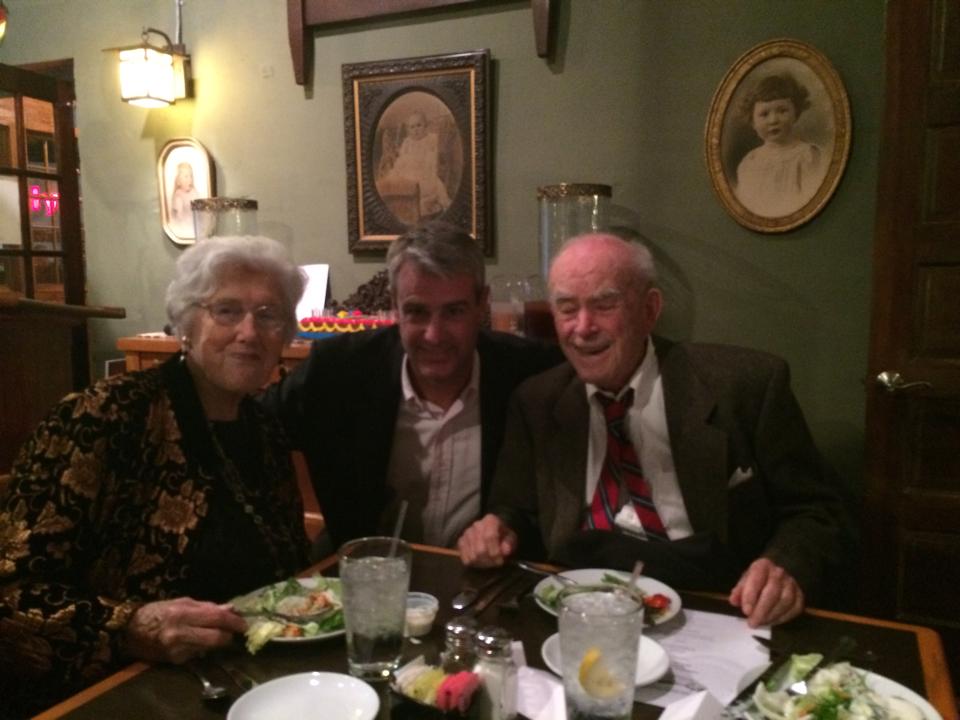
BS and Joan on November 15, 2014
BS, Joan and me on November 15, 2014

Mark 1:40-45 NRSV

As was pointed out a couple of weeks ago, for Mark, Jesus is a teacher. He is a teacher with a new teaching, one with authority. Last week, when Jesus healed Simon’s mother-in-law, we were taught by Jesus that it is not God’s will for anyone to be sick or even have a fever. As Jeremiah prophesied: “For surely I know the plans I have for you, says the Lord, plans for your welfare and not for harm…”

I have said before, albeit somewhat selfishly, that I believe it is God’s will for all men to live to be over 100 years-old and perhaps be married to a much younger woman, which is, of course, perhaps the only way a man can get to a hundred.

However, living in this broken and fallen world, we rarely encounter people who have been so blessed. Because not everything that happens in this world is the will of God, we seldom encounter people with the vitality and longevity of BS and Joan Smith. That is why we are having a party today. This is why we are celebrating today as a community of faith. For their long life together is a special thing. It is a good thing. It is a God-willed thing.

Some of you may say, “Well, I don’t want to live to be 100.” I dare you to say that the last day of our 99th birthday if you look as good as BS Smith! You know who wanted to be a hundred? Well, this past Thursday, it was BS!

This morning, we are still in the first chapter of Mark, and Jesus is still teaching.

“A leper came to him begging him, and kneeling, he said to him…”

Can’t you just picture the desperation? You can almost see it: “begging,” “kneeling.” This picture teaches us that when we are desperate, when we are despairing, when we are anxious, we can always come to Jesus.

“If you choose, you can make me clean.”

Well, of course Jesus chooses. As we have already learned, Jesus never wills for anyone to suffer.

We are then told that Jesus is “moved with pity…” It is important to note that the Greek word here is a visceral, gut-wrenching word. Jesus was moved from deep within his soul. Jesus literally felt this man’s pain. Because he was suffering, Jesus also suffered. Some scholars have said that the word is better translated: “angry.” When Jesus encountered human suffering, it angered him.

Here, Jesus teaches us that God is moved by human misery and suffers with us. As I tried to say yesterday at Alawoise’s memorial service, God never willed for her have Parkinson’s disease. When Alawoise felt the very first symptoms of the disease, God felt it too, from deep within God’s very soul. So, of course, Jesus chooses for him to be made clean, whole and well.

Jesus immediately reaches out his hand and touches him, saying, “I do choose. Be made clean!”

Here is where the story gets interesting. It is interesting, because Jesus reaches out his hand and “touches” this one who was considered by faith and society to be “untouchable.”

Leprosy was the most feared and dreaded disease of Jesus’ day, one that always brought horror and despair. Leprosy is an indefinite and general term used for a whitish rash on the skin. Spots, sores and swelling may also be present. It was an uncomfortable disease; however, what made leprosy so feared was no so much what it did to a person physically, but what it did not a person socially. The disease excluded one from the general population, and thus, from the people of God.

Chapters 13 and 14 of Leviticus discuss the social side effects of this disease at great length. Because a person with leprosy was considered to be “unclean,” a leper had to wear clothes which had been torn so they could be easily recognized and avoided. Lepers also had to cover their mouths and cry “unclean, unclean” in the presence of others so no one would approach them. Eduard Schweizer comments that rabbis considered a leper to be a “living corpse.” They were alive, but not alive. They were here, but not here; in the community, but not a part of the community. They were unalive, unaccepted, and untouchable.

So, when Jesus was deeply moved, or angered at the man’s disease, he was angry not only by the physical pain of it, but by the social pain of it— how this dehumanizing disease took people out of community, how it made them social outcasts, outsiders, untouchables.

However, at least one person did not regard the leper as untouchable. Mark writes that Jesus reaches out his hand and touches him. And “immediately the leprosy left him and he was made clean.”

The passages that we have been studying the past few weeks teach us a lot about healing. We learn that Jesus is against all forms of suffering. Jesus wants to deliver us from afflicting spirits, break our simple fevers and cleanse us of our most dreaded diseases. But, notice in this morning’s lesson that after Jesus touches and heals the leper, he gives the leper some “stern” instructions.

“After sternly warning him he sent him away at once, saying to him, ‘See that you say nothing to anyone; but go, show yourself to the priest, and offer for your cleansing what Moses commanded, as a testimony to them.”

Although Jesus had made the man clean, he wanted him to follow through with the cleansing rituals that would restore him back into community. Yes, God is concerned about our physical well-being, but God is more concerned about our spiritual well-being and our acceptance into community. More than anything else, Jesus wanted this outsider to become an insider. Jesus wanted this untouchable to be touchable.

I think I speak for everyone when I talk about the admiration I have for BS and Joan Smith. Some might say, “Well, of course, you have. You have to admire couple who is 90 and 100 years old. However, it is not so much their physical age or physical vitality that I admire, as much as it is their determination to be in community. Almost every time I visit with them, they ask me about the well-being of others. How is “Jimmy Cowan? Have you heard from Joyce Letchworth? Tell me about Alawoise. How is Harold holding up?”

And on more than one occasion it has been one of them who actually informed me of a concern in the community. I can clearly hear BS asking: “Jarrett, did you hear about so-in-so? And with compassion obviously arching from deep within his soul, he shakes his head, and closes his eyes with almost an agony and anger and says: Shhhhhhhh.”

Both BS and Joan want to meet every new person than joins or even just attends our worship services. And they don’t just want to know their names. They want to know where they live, where they went to school, where they work; who are their parents? Who are their grandparents? They are genuinely interested in truly knowing them, loving them.

And BS constantly asks me about the whereabouts of certain people that he has missed from our gathered community of faith. “Jarrett, have you seen so-in-so? She has not been here in several Sundays. Jarrett, you need to go see her.”

And you should never be fooled by his poor eyesight and selective hearing, for he doesn’t miss a thing, especially when it concerns this, his community of faith.

And have you noticed something else about BS? He not only is concerned about you and others, he not only expresses his compassion and empathy for others, BS likes to reach out his hand and touch you. No matter who you are or where you are from, BS likes to hold your hand. For no one in BS’s book is an outsider. Through his eyes, it is as it is in the eyes of God, no one is untouchable. Everyone’s hand is to be touched, grasped, held. This morning, I am proud to say that BS and Joan are the epitome of who we are as a church.

For all are truly welcome here. This is indeed a safe place. We accept you as Christ accepts you: Just as you are. If you are sick, we pray for your healing. If you are grieving, we pray for your peace. Because we know that when you suffer, God also suffers, and because of that, we suffer.

And know this, here, in this place you will never be alone. Here in this sacred space, there will always be a hand to hold. For here, there are no outsiders. There are no untouchables. There is truly room at the table for all.

Mark continues: “But he went out and began to proclaim it freely, and to spread the word…and people came to [Jesus] from every quarter.”

May we go out this morning from this sacred place and do the same.