Grace of Froot Loops

Froot Loops

Excerpt from Check Your Oil for The Farmville Enterprise.

How many times have you heard “You don’t know what you’ve got until it’s gone”? You don’t know what you’ve got until a relationship ends, a moment is lost, or a freedom is taken away.

A woman suffering with cancer, who lost her ability to perform even the most mundane tasks, once told me: “It is amazing how much we take for granted every day. Oh, how I would give anything in the world to be able to get up out of this bed, walk into my kitchen and just pour me a bowl of Froot Loops.” She went on, “When I was healthy, when I could get out of bed and walk to the kitchen, when I could feed myself, when I could chew and swallow my food, I don’t believe I ever thanked God for something as boring as a bowl of Froot Loops.”

Who in the world even thinks about the awesome gift of being able to do something as mundane and as boring as pouring a bowl of Froot Loops? Someone who can longer pour a bowl of Froot Loops thinks about it.

Who in the world thinks about the miraculous gift of being able to walk? Someone who has lost the ability to walk.

Who in the world thinks about the gift of healthy lungs? Someone living with COPD.

Who in the world thinks about their kidneys or their liver? Someone on the way to a dialysis thinks about their kidneys. Someone living or dying with cirrhosis thinks about their liver.

And who in the world the world truly thinks about the miracle that is their life, the miracle that is this creation? People diagnosed with a terminal illness do. Those who have recently lost a loved one to death do.

In one of his parables, Jesus said that some foolish bridesmaids missed the whole dance, because they forgot to fill their lamps with oil and did not see the bridegroom when he showed up. Jesus ended the parable with the admonishment: “keep awake” (Matthew 25).

Keep awake. Check your oil. Keep your lamp burning. Don’t miss the dance. Keep watching and keep looking, recognizing that we are never promised tomorrow. Take nothing for granted. Don’t wait until it’s gone to know what you’ve got. Treasure your lungs, your kidneys, and your liver. Cherish the ability to walk into the kitchen and pour something as mundane and boring as a bowl of Froot Loops. Relish every taste in creation. Revere every sight and every touch in this world. For in life, nothing is ever mundane. It is never boring. It is all miracle. It is all gift. It is all grace.

A Prayer for Our Veterans

My grandfather, Eugene Gaston Banks, Sr., served in the US Coast Guard patrolling the North Atlantic during World War II.

O good and gracious God, the framers of our Declaration of Independence testified that you have endowed us with inalienable rights to life, liberty, and the pursuit of happiness.  And ever since they penned these words, there have been those who would like to strip these freedoms from us. This week, we remember all those who have defended these freedoms through their service in our armed forces.

Some of them served during World War II or the Korean War. Some served during the Vietnam War, in Grenada, or Panama. Some served during the Persian Gulf War, War in Afghanistan and the Iraq War. Some served during the Cold War, during the Cuban Missile Crises. And some served during a time of unusual peace. Some served on foreign battlefields in harm’s way, whereas some served stateside in relative safety.

Yet, all of them left behind and sacrificed much. They left behind friends, family and dreams. They left behind homes, possessions, even love. And they all sacrificed their health. Many still bear the scars from their service, spiritual, mental and physical. Many lie, even today, in our veterans’ hospitals or struggle for recovery in rehabilitation centers. They suffer from post-traumatic stress and survivor’ guilt; they yearn for peace in their souls. Some find themselves wandering hopeless and homeless in the land they defended.

And many sacrificed their very lives. They gave up their rights to life, liberty and the pursuit of happiness so we could have those rights.

For all of these, our veterans, we ask your blessing.

We also pray your blessing for family members and friends who have made great sacrifices to make their service possible. And we pray for families and friends who grieve the deaths of those who left to serve only to never return.

Jesus said that no one has greater love than to lay down one’s life for one’s friends. So for all our veterans who have been willing to lay down their lives for us, we ask your blessing.

Keep them in your care and grant them the peace that they sought to safeguard for others. As we honor our veterans, we also pray for peace everywhere. Teach your children of every race, creed and faith, in every land, the ways of peace, so that those who have sacrificed so much for peace and freedom will not have sacrificed in vain.

We pray all these things in the name of the Prince of Peace, our Lord and Savior, Jesus Christ.[i]

[i] This prayer was inspired by a litany prepared by Eileen Norrington, ministerial authorization coordinator, Parish Life and Leadership Ministry Team, Local Church Ministries, United Church of Christ, Cleveland, Ohio. Norrington is a veteran of the U.S. Navy Chaplain Corps.

Voices from the Grave

AllSaintsSundayCandleHebrews 12

Years after her husband died, Betty told me that she still goes to the cemetery, almost daily, to visit his grave. “And Jarrett, I need to ask you something,” she said. “Oftentimes when I go, I stand there and talk to him. Sometimes I even bring a chair to sit in so I can talk to him for hours. I talk about my day, the good parts and the bad parts, and, of course, I talk to him about how much I miss him. Jarrett, here’s my question: “Do you think I am crazy?”

I said, “I guess that all depends. Let me ask you this: Does he ever talk back?”

However, when one considers the response of Jesus in the gospels, perhaps hearing voices from the dead is not so crazy. The Sadducees, who did not believe in eternal life, were trying once again to entrap Jesus by questioning his teaching on resurrection. Jesus responds:

“The fact that the dead are raised Moses himself showed, in the story about the bush, where he speaks of the Lord as the God of Abraham, the God of Isaac, and the God of Jacob. 38Now he is God not of the dead, but of the living; for to him all of them are alive” (Luke 20).

So perhaps Betty would not have been that crazy after all, if she heard her husband’s voice from the grave.

Now, of course, I am not talking about hearing audible voices from the grave. I am talking about the hearing voices from the dead the way the writer of Hebrews describes it when he writes:

“Therefore, since we are surrounded by so great a cloud of witnesses, let us also lay aside every weight and the sin that clings so closely,* and let us run with perseverance the race that is set before us, looking to Jesus the pioneer and perfecter of our faith…”

He is talking about being inspired by, encouraged by those who have lived before us. In the previous chapter, we read a list of those he is talking about: Abraham, Isaac, Jacob and Esau; Moses and each Israelite who escaped slavery in Egypt; Barak, Samson, Jephthah, David, Samuel, all of the prophets and every person had has ever been persecuted or martyred for their faith.

The writer to the Hebrews is saying, when life is hard, when the way is difficult, remember these, remember their voices, remember their actions, and especially remember how they point you to the way of Jesus, and be encouraged, be strengthened, and gain perseverance to continue not only life, but a life of courageous faith and selfless service.

I absolutely love worshipping in this place. Because every person that first worshipped in this sacred place that was built in 1909 ran their race and kept the faith long before us. Every time I gather here, I can hear their voices: voices of those who sang the great hymns of faith in these pews through World War One and the Great Depression. I stand behind and preach from a pulpit and hear the voices of preachers who preached the gospel amid World War Two, the Korean Conflict, Vietnam and the Cold War. I hear voices of those who preached for the rights of African Americans during the Civil Rights movement.

I hear the voices of those who have served the poor in this community and around the world for decades, those who have donated generously, and served sacrificially.

Every time I gather here, I hear the particular voices of those who served faithfully with me through Farmville Benevolent Ministries while I was the pastor of First Baptist Church. I hear the compassion in the voices of AC and Vivian Turnage for the poor of this community. I hear the love in the voice of Gay Johnson who would always have jars of Molasses in the trunk of her car to distribute to those in need.

Listen, can you hear them? Can you hear the voices of the saints echoing through this place this morning? When I listen carefully, I can hear the voice of Marie Allen. I hear great perseverance in the voice of an extraordinary mother who selflessly gave her all in loving her family. I hear the voice of an extraordinary mother who got up each morning, made everyone breakfast, packed lunches, and then went to work herself every day at her full-time job at the drug store or the dry cleaners in town. Then, somehow, some miraculous way, in a world without fast food and microwaves, still managed to prepare a hot supper and have on the family dinner table each night. And whenever little Pete or Donna needed new clothes to wear, with needle and thread and some material, Marie could always create whatever they wanted with her own hands. I hear the voice of a faithful mother who made a point to raise Pete and Donna in this church giving them a foundation for a faithful life that is being lived out today.

Listen, do you hear them? I hear sincere gratitude in the voice of William Meeks. I hear a voice that thanked God, even amid struggle and difficulty, for his opportunity to selflessly and sacrificially serve his country through military service during the Korean War. Although he freely admitted that those years changed him, affected him, not always for the good; in some ways it broke him; he was still very grateful for the opportunity to serve these United States.

William was also very grateful for his opportunity to serve through the First Christian Church of Farmville, especially as an electrician. And the First Christian Church is very grateful that we were able to give him that opportunity! When you worship in a church building that was built in 1909, you appreciate someone with the skills and the generosity of William Meeks. There is no telling how many hours William freely gave to the church doing all kinds of needed repairs. William loved his church. Like his love for his country, there was perhaps something deep within William that yearned to be a part of something that was larger than himself.

William always talked about how good his church was to him, especially when he needed the church the most. I don’t think I ever visited him when he did not express his gratitude to God for Jimmy Lethworth and for the many times that Jimmy picked him up and carried him to the VA Hospital in Durham for his cancer treatments.

Listen, do you hear them? I hear gracious hospitality in the voice of Kenneth Ross. One could say that Kenneth Malcolm Ross lived his entire life preparing a place at the table, preparing a home for others, for Marilyn, Amelia and Ken, and even for all Americans, each one of us, through his service to this country.

I think this explains why life was so difficult for him these last eight years. When Marilyn died in 2006, something inside of Kenneth also died. For Marilyn was such a large part of his purpose for living. And having been diagnosed with lung cancer himself, at the same time Marilyn was diagnosed, undergoing chemotherapy alongside of Marilyn, Kenneth did not only survive with a great loss of sense of purpose, Kenneth survived with the guilt associated with surviving. He also survived with severe physical limitations, COPD and other side effects from his battle with cancer that prevented him from living and breathing, preparing and providing for others as he had his entire life.

However, although he struggled much these last few years, although he was limited physically, it was evident through each of my visits with him that he never lost faith. Kenneth continued to love and care for the First Christian Church where he raised his family, served as a deacon and practiced the greatest commandment of loving God and neighbor as self.  Each visit I had with him, he would always inquire about the state of the church and of the needs of the church.

Listen, do you hear them? I hear great hope in the voice of Marie White. I will never forget the confident faith in her voice that I heard from her the week she passed away. Each time I visited her in the hospital, although she was very sick and felt terrible, it was evident that she was never separated by the love of God. She was sick, but she was not despairing. She was neither eating nor drinking; neither was she giving up hope. Although she was in the valley of the shadow of death, she feared no evil. Although her body was tired and broken and in pain, she was at peace. Although she was near the end of her life, her cup runneth over. It was so evident, that although she was separated from her friends, most of her family, her youth, her health, she was not separated by the love of God through Christ Jesus her Lord. She was a living testimony to the truth that spiritual wholeness is more important that physical well-being, even more important than life on this earth.

Listen, do you hear them? I can. Thanks be to God that we are surrounded by a great cloud of witnesses. So let us set aside every weight and the sin that clings so closely and let us run with perseverance the race that is set before us, [always] looking to Jesus the pioneer and perfector of our faith. Thanks be to God that we clearly hear the voices of the saints that have lived before us.

And no, we are not crazy. We just worship the God of the living; not of the dead, for to God, all of them are alive.

Halloween: O Holy Night


peanuts halloween

Halloween is sometimes called an evil or even a demonic holiday. However, I believe when we narrowly define demonic evil as fictional ghosts, goblins, and vampires that come out one night of the year, we may miss the true demonic evil that surrounds us every day—Greed, hate, racism, sexism, ableism and all kinds of bigotry that haunt our world day and night.

Furthermore, when one takes a close look at how our culture observes All Hallows’ Eve, I believe one can reach the conclusion that Halloween may be the most holy night on the calendar. For example:

On what other evening of the year do we turn on our porch lights to welcome, not only friends and family, but all who may pass by?  All are welcomed and greeted with smiles and laughter, and “all” even includes witches, monsters and little devils. It does not matter who they are or from whence they came; all are welcomed equally.

On what other night do we non-discriminately give to others expecting absolutely nothing in return? Others only have to open up their hands, their bags, or their orange pumpkin-shaped containers before us, and we gladly and generously fill them with something good.

On what other evening do we give to others until we can give no more? We keep our porch lights burning until we have given all that we have.

On what other night do we share grace, so freely, unconditionally, and generously? On what other night do we truly give to others as God has given to us?

Halloween is not evil, and it is not demonic, at least not the way that we celebrate it. All Hallows Eve is hallowed. It is holy. It is unreserved grace. It is unconditional love.

And it is a shame that such generosity only happens once a year. If it happened more, perhaps there would be much less true demonic evil haunting our world today.

So, go buy your candy, get a costume, decorate your front porch, and get ready for a holy night!

Stand for the Victims of Bullying

bullyIn the wake of yet another suicide incited by bullying at a local middle school, it is way past time for the church to take a stand. Sadly, for far too long, the church has been silent about bullying; and in some cases, the church has even been the bully. Unfortunately, there are reasons Christian pulpits are sometimes called “bully pulpits,” and some Christians are called, “Bible Thumpers.” They thump their Bibles and use their Bible to thump those who do not embrace their biblical views.

This is rather ironic when one considers that the Jesus of the Bible always stood on the side of the victims of bullying, on the side of those marginalized by society. He identified himself with “the least of these.”

He touched lepers,[i] cleansed the unclean,[ii] welcomed children,[iii] ate with sinners,[iv] praised minorities,[v] learned from one of another faith,[vi] loved the foreigner,[vii] respected a prostitute,[viii] gave dignity to Eunuchs,[ix] defended an adulterer,[x] protected the rights of women,[xi] made whole the mentally ill,[xii] lifted up the poor,[xiii] fed the hungry,[xiv] offered drink to the thirsty,[xv] blessed the meek,[xvi] advocated for prisoners,[xvii] promised paradise to a thief,[xviii] and even forgave this own murderers.[xix]

As we enter the season when some Christians bully non-Christians with their KEEP-CHRIST-IN-CHRISTMAS campaigns, let us begin a new campaign to KEEP CHRIST IN CHRISTIAN. Let’s stand with Jesus by standing up and standing for those marginalized by society.

[i] Luke 17:11-19

[ii] Luke 8:43-48

[iii] Matthew 19:13-15

[iv] Matthew 10:13-17

[v] Luke 10:25-37

[vi] Mark 7:25-30

[vii] Luke 19:34

[viii] Luke 7:36-50

[ix] Matthew 19:12

[x] John 8:1-11

[xi] Matthew 19:3-12,  Luke 10:38-42

[xii] Mark 5:1-17

[xiii] Luke 16:19-31

[xiv] Matthew 14:13-21

[xv] John 4:11

[xvi] Matthew 5:5

[xvii] Matthew 25:36

[xviii] Luke 23:43

[xix] Luke 23:34

All Are Welcome, but…

Homecoming sign

Matthew 22:1-14 NRSV

Jesus said that the Kingdom of God is like a King who hosted wedding banquet for his son. But today, let’s say that the Kingdom of God is like a church hosting their 160th Homecoming Celebration.

The church sent out invitations, publicized it in the newsletter, on their on their sign out front, on their website and all over social media. The invitation was generous: “A bountiful table has been set.” The invitation was inclusive: “All are invited.” And the hospitality promised to be extravagant: A fat cow grilled, a fat pig barbequed, and thirty fat chickens fried golden brown.

Now, most people who rode by the church and read the sign “made light of it” and never gave the invitation much thought at all. They simply continued down the road, some to their farms, others to their places of business, others to CVS or The Little Rocket. Most who came across it in their facebook newsfeeds continued to scroll down to look at funny pictures and videos that had been posted by their friends.

However, some people who read the invitation were rather offended by the inclusive welcome. “What do they mean, ‘all are invited.’? Do they really have the audacity to invite all? If I go, will I have to sit at the same table with the poor, the undeserving, the marginalized, tax collectors and sinners?”

Some became so offended by the invitation that they even had thoughts which proved that the preacher was right when he one day proclaimed: “When you truly love all people and try to convince others to love all people, there will always be some people, probably religious people, who will want to kill you.”

On the day of the feast, many were found to be unworthy as they refused the invitation because the very thought of attending any party with some people was too much to bear.

But many accepted the generous invitation. For they knew that the invitation to the table came not only from the church, but it came from the Lord Himself. So, they came. They came through doors that were opened wide and they came to a table made large by the Lord. They came, and they filled the sanctuary. They came, the good and the bad, saints and sinners. They came from all walks of life, with diverse backgrounds and different beliefs. But they came united by the same extravagant love, the love of their Lord who lived for all and died for all. They disagreed, but they were not divided. They came together in love, through love and by love.

The love which united their hearts was so amazing, so divine, so selfless and so sacrificial that it literally changed them. It changed them inwardly, and it changed them outwardly. Sorrow was turned into joy, stress was replaced by peace, and despair was changed into hope.

It was a radical transformation. Everyone in the sanctuary that morning was covered with grace. They were clothed by grace. It was as if they were all wearing it like a beautiful garment.

Hate was replaced by love. Pride was transformed into humility. Judgment was replaced by acceptance. And complacency was turned into passion. Simply accepting the invitation of the Lord was replaced by a commitment to follow the Lord. Simply admiring the Lord being a shallow observer of the Lord, being a casual fan of the Lord, was transformed into a deep and deliberate discipleship.

Someone sent me the following quote on facebook this week:

Most of us don’t mind Jesus making some minor change in our lives but Jesus wants to turn our lives upside down. Mere fans of Jesus don’t mind him doing a little touch-up work, but Jesus wants complete renovation. Fans of Jesus come to Jesus thinking tune-up, but Jesus is thinking overhaul.

I have heard United Methodist Bishop William Willimon say something like, “Jesus does not want to meet our needs; he wants to rearrange our needs. He does not want to merely fulfill our desires; he wants to transform those desires.”

One of my favorite quotes by Henri Nouwen is that Jesus wants to take us to places we would rather not go: dark, dangerous, dreadful places.

And on that day, that glorious Homecoming morning, the people came and were changed the the grace of it all. They were overhauled. They filled the sanctuary, united by love, ready and willing to follow their Christ wherever he leads.

Then comes the disturbing part of the parable.

But one of the guests at the Homecoming service that day was sitting there in his pew unchanged. He was just sitting there unmoved, unaffected by the extravagant grace of it all, the generous hospitality of it all.

And he was asked, “Friend, how did you come here and not be changed? How did you accept such a generous invitation, receive such an extravagant hospitality, receive such a divine love and an amazing grace, and not be transformed? How can you receive love and not love others? How can you receive grace and not extend grace to others?”

The man was speechless. And the congregation watched in horror as the deacons sprung into action. They went over to the man, picked him up, tied a rope around his feet and hands, and carried him out the front door.

And when the congregation turned back around to face the pulpit, the preacher matter-of-factly said: “Many are invited, but few are chosen.”

That is harsh! It is why I don’t like this parable. But should it surprise us?

A couple of chapters later we read something remarkably similar.

A King will say, “You that are accursed, depart from me into the eternal fire prepared for the devil and his angels; for I was hungry and you gave me no food, I was thirsty and you gave me nothing to drink, I was a stranger and you did not welcome me, naked and you did not give me clothing, sick and in prison and you did not visit me.” Then they also will answer, “Lord, when was it that we saw you hungry or thirsty or a stranger or naked or sick or in prison, and did not take care of you?” Then he will answer them, “Truly I tell you, just as you did not do it to one of the least of these, you did not do it to me.” And these will go away into eternal punishment, but the righteous into eternal life.

Jesus seems to be saying, “All are welcome, but…”

The invitation is inclusive. The hospitality is extravagant. The grace is generous. The love is divine. The doors are wide and the table is large. All are welcome, and “all” means “all”, the good and the bad, the sinner and the saint, all are welcome, but…

All are welcome to this Homecoming Sunday this morning, but there is something more going on here on than a gathering of friends and family, an observance the Lord’s Supper, the singing of hymns, the preaching of a sermon and sharing an extravagant meal on the grounds.

All are welcome, but there is no real acceptance without the acceptance of others.

All are welcome, but there is no real love without loving those who hunger for it.

All are welcome, but there is no grace without extending grace to those who thirst for it.

All are welcome, but there is no forgiveness without forgiving those who have trespassed against us.

All are welcome, but there is no Holy Communion without the offering of our own bodies, the pouring out of our own lives as living sacrifices.

All are welcome to the table, but there is no true sharing, no true fellowship, no true nourishment, without feeding the hungry.

All are welcome to put on the white robes of baptism, but there is no meaning in those garments without clothing the poor.

All are welcome, but there is no life, abundant or eternal, without the dying of self.

All are welcome, but there is no salvation without the cross.

All are welcome, but if there is no discipleship; if there is no desire to follow Jesus; no commitment to stand against the bullies of this world, to share hope with the victims of bullies everywhere; if there is no commitment to stand for the poor, the marginalized, and the outcasts; no desire to eat with tax collectors and sinners; no dedication to love the least of these our brothers and sisters; well then, the deacons might as well pick you up, bind your legs and arms, and carry you out the front door.

That is harsh. It is why I don’t like this parable. It is why I use the entirety of the Bible to interpret this part of the parable.

Now here’s the good news. As far as I know, there is not a deacon in this room who is prepared to pick anyone up and throw them out the door this morning. Each person in this room is different. We come from different backgrounds, different walks of life, and we have different beliefs. We are at different places in our journeys of faith. But we came through these doors this morning united by the same love: the extravagant love of our Lord who lived for all and died for all.

And listen to the good news in the words of the Apostle Paul concerning this love:

Jesus’ love is patient. Jesus’ love is kind; the love of Christ is not envious or boastful or arrogant or rude. The love of our Lord love does not insist on its own way; it is not irritable or resentful. The love of Christ does not rejoice in wrongdoing, but rejoices in the truth. The love of the Lord bears all things, believes all things, hopes all things, endures all things.[i]

So let us join God and keep loving one another with the patient love of our Lord and our Savior. And may this love always be with us as we continually seek to change to be the people and the church God is calling us to be. Amen.

[i] Gale Burritt Hagerty, a thoughtful Christian friend responded  with these words from 1 Cor 13 to the interpretation of Jesus as “belligerent” and “demanding” in the following quote: “Most of us don’t mind Jesus making some minor change in our lives but Jesus wants to turn our lives upside down. Fans don’t mind him doing a little touch-up work, but Jesus wants complete renovation. Fans come to Jesus thinking tune-up, but Jesus is thinking overhaul.”


Saving the Soul of the Church

These days, churches are not only in danger of losing their members, many are in danger of losing their souls.

There are some pastors who look at their pews on Sunday mornings and assume that the reason they are empty is because the vast majority of people today have rejected Jesus, as they believe much of this world is going straight to Hell. However, I believe that many who avoid church these days have actually accepted Jesus. They love Jesus and even want to follow Jesus. The problem is that they simply do not see Jesus in the church, and believe it is the church that is on the way to Hell.

I believe you can go to any main street in the heart of downtown of any city in America and ask people the following question: “What’s the first word that comes to your mind when you hear the word: “Jesus?”

People everywhere will respond: “loving,” “forgiving,” “compassionate,” “hospitable,” “selfless,” “sacrificial,” “humble, “radical.”

Then ask those same people: “What is the first word that comes to your mind when you hear the word: “Christian?”

They will respond: “mean,” “judgmental,” “insensitive,” “unwelcoming,” “selfish,” “self-centered,” “holier-than-thou,” “boring.”—words that describe the very antithesis of who Jesus is and who Jesus calls us to be as his disciples.

And sadly, those of us who are a part of the church know that there are many good reasons for these thoughts.

The church’s mission is to make disciples, to make followers of Jesus. How is that possible when many in the church are not following Jesus?

If the church wants thrive in these days…no, let me rephrase that… if the church wants to survive in these days…no, let me rephrase that once more… if the church these days wants to avoid going to Hell, then the church must answer Jesus’ radical call to be his disciples, to live as he lived, lovingly, graciously, compassionately, hospitably, selflessly, sacrificially, humbly and radically.


Ten Things that Must Change in Church

Follow Jesus. If we make it about anything else, then it is not church.
Welcome all. Jesus never discriminated against anyone, nor should we.

Be real. God created human beings. We should not be afraid to act like one. We must openly confess our shortcomings and never act like we are better than anyone else.

Embrace mystery. No human being can grasp the full meaning of God. If we think we can, then our concept of God is far too small.

Love unconditionally. We are to love others expecting nothing in return without any reservations. Jesus never said to love “some” of our neighbors.

Practice forgiveness. Loving the sinner and hating the sin will not cut it. Love simply keeps no account of wrong-doing.

Be ministers. We don’t pay clergy to be ministers for us. We are all caregivers, grace-givers and hope-givers to one another.

Never judge. Jesus did not misspeak when he said: “Let those without sin cast the first stone.”

Focus outwardly. It is not about getting people to come to our buildings, participate in our programs, believe our creeds and support our institutions. It is about going out and loving others where they are.

Take risks. Jesus’ love for others got him killed. If we make church about sanctuary, comfort, safety and security then we have missed the whole point of who Jesus calls us to be, where Jesus calls us to go, and whom Jesus calls us to love.

Defining Our Church

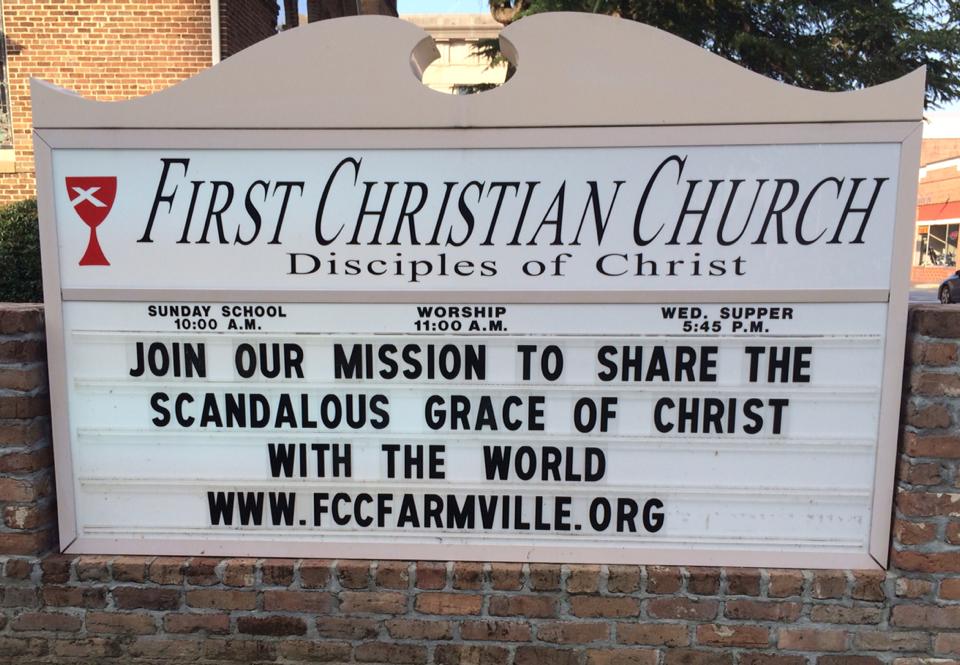
scandalous graceThe following article was written for The Christian Caller, the monthly newsletter of First Christian Church of Farmville

It is fall. That means that we are heading into the months of the year that seems to define who we are as a church.

Homecoming is October 12. On this day, we will open our doors wide and generously welcome our members, former members, and friends of our church with an extravagant meal on the grounds following the worship service.

Halloween at FCC is October 31. On this day, we will welcome the entire community to our church with a hot dog supper, fun Halloween games, and Halloween candy!

Fall Festival is November 8. On this day, we will once again swing wide our doors to welcome all to our annual yard sale, country kitchen, dinner and auction to raise money for various mission projects in our community and around the world.

Breakfast with Santa is December 13. On this day, we will welcome the community to our church with a breakfast and a chance to see Santa before the Farmville Christmas parade.

I believe each of these events defines our church and even differentiates us from other churches and organizations.

Homecoming defines us as a church with an extravagant welcome. When we open our doors, we swing our doors wide to graciously welcome all people. And we are not just going to shake a hand, give a friendly nod or even offer a little hug. We are going to prepare a place at our table and generously serve and feed others as if they are a part of our family.

Halloween at FCC defines us as a church with an unconditional welcome. Our Halloween party is not just for the children of our church and those they might invite. Our party is for all children. That includes: ghosts, goblins, mummies, vampires, witches, monsters, and even little devils.

Fall Festival defines us as a church with a missional welcome. All are not only welcomed to simply come to our church, but all are welcomed to be the church with us. All are welcomed to join us in our mission to minister to others locally, regionally and globally.

Breakfast with Santa defines us as a church with a community welcome. Our church has a passion for and long history of generously serving the town and people of Farmville.

Our church’s activities are not for us, nor are they about us. The focus is never inward, but always outward. Our mission is never self-serving, but always about serving others. It is never about getting, but always about giving. Furthermore, all of our activities are done in the name of the Christ who generously and extravagantly welcomes all people to His table.

Hmmm. Maybe it is not the activities of the coming months that define us after all.

We are defined by the Table that we gather around each Sunday morning and by the Christ who invites us all to that table.

Consecrating Our Lives

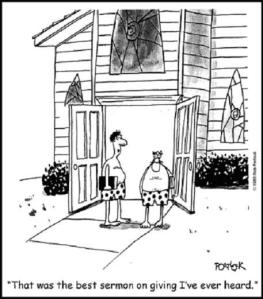
cartoon on giving

Matthew 20:1-16 NRSV

Today is Consecration Sunday. Consecration—It means to bless, to sanctify, or to make holy. This is the Sunday that we consecrate the pledges that we have made to the mission and the ministries of this church for the coming year.

Now, how do you suggest, pray tell, we do that? Exactly, how are we going to make these pledges that are in this box holy? I know how some churches do it. They get themselves a holy man with some holy hands to make the pledges holy. The holy man simply comes, reaches out and everything the holy man touches is consecrated, sanctified, blessed and made holy. The holy man might even have some holy water to help really make some things holy.

Problem is: where are we are going to get a holy man? Does anybody know one? Look around. Does anybody see a holy man in this room? Oh, no. Don’t look at me! Wearing a robe with the pretty stole does not make one a holy man!

And you know better than that as many of you have known me a long time. I have been called a lot of things, but I don’t think anyone has ever called me a holy man. And the only holy water I ever had (if coming from the Jordan River makes it holy), was poured out earlier this month in our baptismal pool.

So, how in the world are we going to consecrate this box, sanctify this box, make this box of pledges holy, without a holy man or a holy woman?

Well, let’s turn to that place that all Christians should turn when they have questions about faith and the church. Let’s turn to the Bible, and more specifically, let’s turn to Jesus.

In this morning’s lectionary lesson, we find Jesus doing something he absolutely loved: telling a story. And not just any story, but a story about who God is, how God acts, and what God desires. And if we want to truly live in the image of God, the story is also about us.

Jesus said, the way God is, acts, and thinks is like a landowner who went out around 6 am to hire some workers for his vineyard. He said, “I will pay you the going rate for 12 hours’ worth of work: 120 bucks.” They agreed and went to work.

At 9 am, he goes out and hires some more workers, and tells them that he will pay them whatever is right. He hired a few more people at noon and told them the same. Then went out and hired some at 3 pm and then even a few more at 5 pm and telling them, “Come and work and I will pay you what is right.”

At 6 pm, when the work day was over and the time had come to settle up with all of the workers, he called up the ones he hired last, who had only worked for only one hour, and shocked everyone by paying them each $120.00.

Well, the ones who had been working for 12 hours started to get a little excited. “Boss man paid them $120 an hour! Let’s see, $120 times 12 hours, uh, that means we are going to get paid $1,440 for our work!”

It is then the boss does something that is even more shocking. He gives those who had worked all day the exact amount he gave those who had worked for just one hour. And you better believe that when they got their check, they got pretty upset: “We have worked out here all day in the scorching heat. And you paid us the same as the ones who worked only an hour in the cool of the day!”

The boss replied: “Did you not agree to work all day for $120? Or are you just envious because I am so generous?”

Of course they were upset because he was generous, too generous. He overdid it with generosity when he paid those last workers, and there was nothing fair about it.  It was shockingly offensive.

This, Jesus says, is who God is, how God works, how God thinks, and what God desires. In other words, this, says Jesus, is holy.

So what is it that makes something holy? According to Jesus, it is an amazing grace, an overdone generosity that is so unfair that it is shockingly offensive.

Now, back to the box. Once again, are we going to make the contents of this box holy? Well, according to Jesus, we do not need a holy man or a holy woman with holy hands or any holy water, which, by the way, is good news, because we certainly don’t have any here.

I believe Jesus would say that these pledges in this box are made holy by the way we give our offerings to fulfill our pledges, and by the way we use these offerings after they are received.

First of all, the ones who made the smallest pledges in this box have as much worth as those who have made the largest pledges in this box. And those who joined this church just a few weeks ago and their pledges, are as important to this church as the ones who joined this church 50 years ago and their pledges. No, it is not fair. It is shockingly offensive. But it is holy.

Secondly, all of these pledges will be made holy if the offerings that are given to fulfill the pledges are given generously and graciously. Jesus says that when the landowner paid an entire day’s wage to those he hired at 5:00, he was essentially paying for nothing. He paid for labor that he did not receive. Therefore, he gave freely, selflessly and sacrificially. He gave generously, expecting nothing in return.

It is interesting to hear some people say that they give to the church expecting to somehow be blessed by God. I cannot tell you how many testimonies I have heard from people on Consecration Sundays about giving a large offering to the church on Sunday, and then on Monday morning, opening their mailbox to find an envelope with an unexpected check inside of it. Or how after they gave to the church their business grew, their sales increased, or a rich uncle died and left them a bunch of money.

The landowner paid some of the workers for 12 hours of labor and only got 1 hour. Therefore for 11 hours, he paid for nothing. He got nothing in return. It is not fair. It is shockingly offensive. But it is holy.

Thirdly, all of these pledges will be made holy, if the offerings which will be given to fulfill the pledges are used to give to others, graciously, selflessly, sacrificially and generously.

We are to give to those who cannot give us anything in return. We are to love those who will never put a dime in our offering plate. We are to use our offerings to reach out to those and care for those who will never do anything whatsoever to benefit our church or our lives. They might live as far away as Nicaragua, West Virginia, and many live right here in Farmville.

I believe this gracious type of generosity that Jesus expects us to have is evident in the way we minister to children and youth: those little ones who have no job, no income, nothing to offer us in return.

Now, I know some churches will say: “if you minister to children and youth by having good and strong programs, then you will get their parents to come and give, maybe even their rich grandparents.” But during the next year, I believe God wants us to minister to our children, finish our basement, purchase children’s choir robes, overdo it with Vacation Bible School, buy some playground equipment, send some kids on a mission trip and send them back to camp, expecting absolutely nothing in return. It is not fair. It is shockingly offensive. But it is holy.

Fourthly, we are also to give generously to those who simply do not deserve our generosity. The landowner gave to workers who did absolutely nothing to earn their pay.

In the weeks leading up to Thanksgiving and Christmas, there is a lot of talk in the media about giving. During this time of the year, many organizations try to raise money to help the less fortunate. In nearly every plea I hear, someone will say something like “Donate this year to a deserving a child.” “Give to the well-deserved needy in our community.” Through this parable, Jesus implies that when we give, we should give maybe especially to those who do not deserve, have done absolutely nothing to earn our generosity. It is not fair. It is shockingly offensive. But it is holy.

This is how we make this box of pledges holy. And we can do it without a holy man or a holy woman with holy hands!

Which brings up an interesting question: If we can make this box holy, if we can consecrate and sanctify our pledges and our offerings, can we then consecrate our lives? Can we make our lives holy? Can we perhaps be holy men and holy women with holy hands?

Through the parable of the workers in the vineyard, I believe Jesus is suggesting that we can.

To make this happen, I believe Jesus wants us to simply get over the envy that we possess by the overdone generosity of God’s grace. And I believe the only way to truly get over it is to understand that we are the recipients of it. We need to understand that there is nothing any of us have done to deserve or earn the gifts of God’s grace. No human being ever did anything to earn the gift of life: the gift of birth; the gift of breath and a beating heart; the gift of feeling the warmth of the sun or a cool autumn breeze or a purple and gold sunset. And no person has or will ever be able to earn, do anything to deserve rebirth, unconditional love, forgiveness, salvation, and life eternal. They are given as free gifts of an amazing grace and an overdone generosity by a loving God. I believe when we understand this truth that all is gift, all is grace, and when we embrace this truth, we will begin to live this truth. We will live it by giving our lives freely, selflessly, sacrificially and generously and thus live in the very image of God. And guess what? Our lives are consecrated and sanctified. They are blessed and made very holy.

Well, how about that! Look around this room. I see a room full of holy men and holy women and holy boys and holy girls with holy hands to go with, what we are going to make together in this next year, a very holy box.